Introduction
The human population in sub-Saharan Africa has grown from 220 million people in 1950 to 800 million people by the turn of the century (EU 2014). The resulting demand for land and natural resources has had a profound impact on the continent’s wildlife, and a significant number of species have experienced range contractions and population declines due to anthropogenic mortality, habitat loss and fragmentation (EU 2014). Because of their wide-ranging nature and food requirements, large carnivores are particularly prone to these anthropogenic pressures (Linnell et al. Reference Linnell, Swenson and Andersen2001, Ripple et al. Reference Ripple, Estes, Beschta, Wilmers, Ritchie, Hebblewhite and Berger2014). Increasing human populations force large carnivores to live near humans, and conflict with humans at the border of wildlife-designated areas represents a main cause of carnivore mortality (Woodroffe & Ginsberg Reference Woodroffe and Ginsberg1998).
Large carnivores are important for the maintenance of biodiversity and ecosystem functioning and often provide substantial economic benefits to their host countries through photographic tourism and trophy hunting (Winterbach et al. Reference Winterbach, Winterbach, Somers and Hayward2013, Ripple et al. Reference Ripple, Estes, Beschta, Wilmers, Ritchie, Hebblewhite and Berger2014). However, large carnivores can also cause considerable socio-economic costs through livestock depredation, which increases the challenge of conserving them (Winterbach et al. Reference Winterbach, Winterbach, Somers and Hayward2013, Ripple et al. Reference Ripple, Estes, Beschta, Wilmers, Ritchie, Hebblewhite and Berger2014). Conservation programmes aim to mitigate human-carnivore conflict by reducing the costs and/or by increasing the benefits of living with carnivores (Winterbach et al. Reference Winterbach, Winterbach, Somers and Hayward2013). Although not always effective (Dickman et al. Reference Dickman, Marchini, Manfredo, Macdonald and Willis2013), such programmes can improve attitudes towards large carnivores (Romañach et al. Reference Romañach, Lindsey and Woodroffe2007, Lindsey et al. Reference Lindsey, Havemann, Lines, Palazy, Price, Retief, Rhebergen and Van der Waal2013).
It has been shown that attitudes are intrinsically linked to behaviour (Dijksterhuis & Bargh Reference Dijksterhuis and Bargh2001) and can predict the likelihood of people killing large carnivores (St John et al. Reference St John, Keane, Edwards-Jones, Jones, Yarnell and Jones2012, Thorn et al. Reference Thorn, Green, Marnewick and Scott2015) and the level of support for carnivore conservation policies (Slagle et al. Reference Slagle, Bruskotter and Wilson2012). Although self-reported attitudes can be biased due to the social acceptability of answers, they are only one of many factors that predict behaviour, and do not necessarily directly translate into action, they are often the only available indication of intended behaviour towards large carnivores (Dickman et al. Reference Dickman, Marchini, Manfredo, Macdonald and Willis2013). As such, attitudinal studies are an important component of carnivore conservation. Retaliatory killing in response to livestock depredation is a main cause of carnivore mortality (Winterbach et al. Reference Winterbach, Winterbach, Somers and Hayward2013, Ripple et al. Reference Ripple, Estes, Beschta, Wilmers, Ritchie, Hebblewhite and Berger2014), therefore, attitudinal studies related to Africa’s large carnivores often focus on subsistence and commercial livestock farmers (e.g., Romañach et al. Reference Romañach, Lindsey and Woodroffe2007, Thorn et al. Reference Thorn, Green, Marnewick and Scott2015, Lindsey et al. Reference Lindsey, Havemann, Lines, Palazy, Price, Retief, Rhebergen and Van der Waal2013). However, the significance of attitudes of other stakeholders should not be overlooked, as they may be involved in human-wildlife conflict management or instrumental to the implementation of carnivore conservation policies. In this study, we conducted a questionnaire-based interview survey to assess attitudes of key governmental and non-governmental wildlife conservation stakeholders in Zimbabwe towards: (1) living with carnivores; (2) five large carnivore species; and (3) the conservation of wildlife.
In Zimbabwe, human-wildlife coexistence is promoted through the Communal Areas Management Programme for Indigenous Resources (CAMPFIRE), which was introduced by the government in 1988 to enable rural communities to benefit from and be involved in the management of their natural resources (Taylor Reference Taylor2009, CAMPFIRE 2013). CAMPFIRE annually generates over US$ 2 million revenue, mostly through the lease of trophy hunting rights to commercial safari operators, which is used to fund community development projects (Taylor Reference Taylor2009, CAMPFIRE 2013). More recently (2002–2011), the government of Zimbabwe signed three treaties to include wildlife protected areas and surrounding land into Transfrontier Conservation Areas (TFCAs); these are areas that are part of one ecological region which crosses the boundaries of two or more countries (Peace Parks Foundation Reference Peace Parks2009). The aim of TFCAs is to facilitate free movement of wildlife by harmonizing policies, provisioning of socio-economic benefits through tourism and the sustainable use of natural resources, plus involvement of stakeholders in the planning, establishment and management of TFCAs (Peace Parks Foundation Reference Peace Parks2009). Here, we evaluate whether being part of these programmes affected stakeholder attitudes towards living with carnivores, large carnivore species and conservation.
Methods
Study area
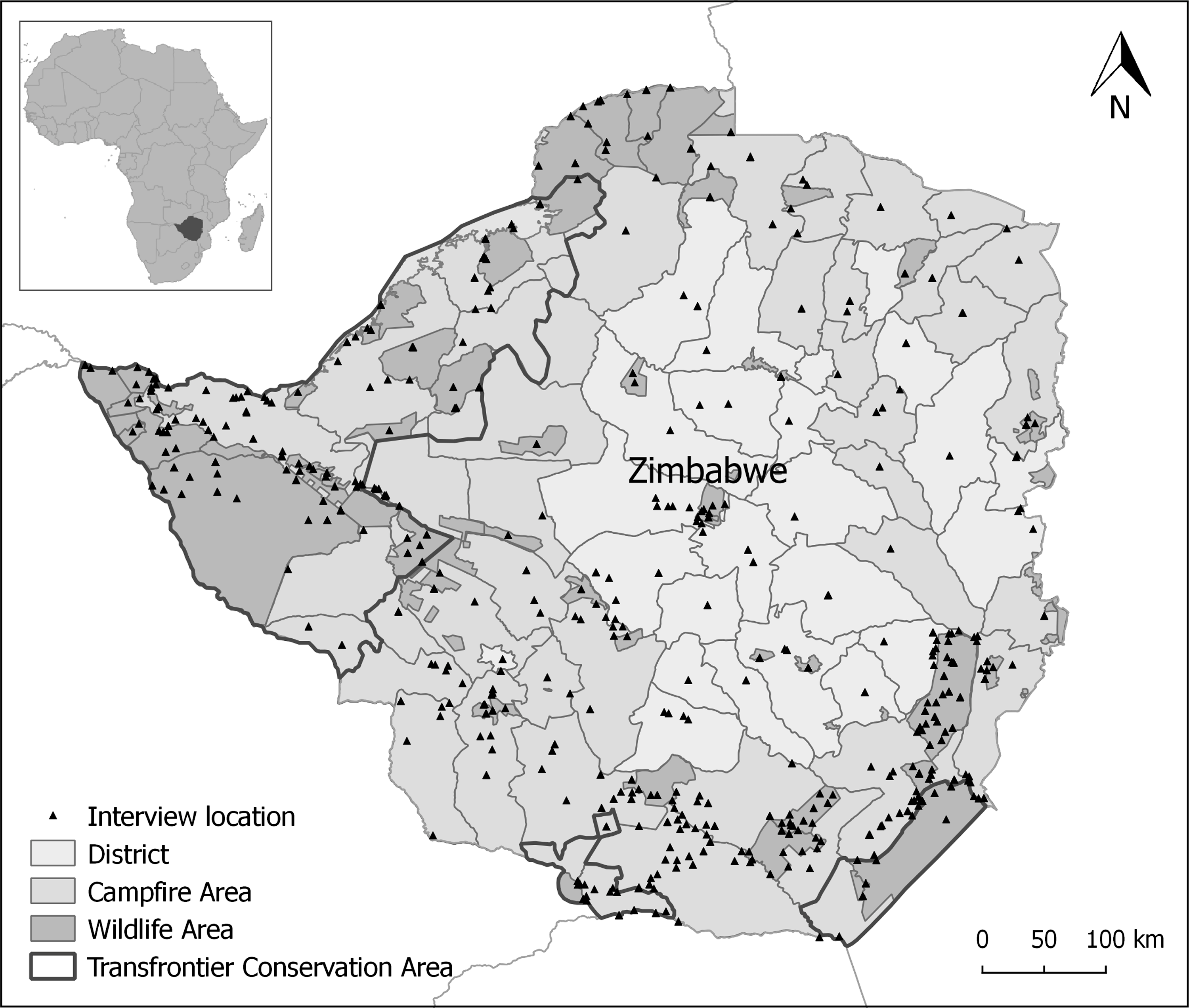
Zimbabwe is divided into 60 districts, 37 of which are considered fully participatory in the CAMPFIRE program (CAMPFIRE 2013) (Fig. 1). Zimbabwe is also party to three TFCAs (Fig. 1): the Great Limpopo, Greater Mapungubwe and Kavango-Zambezi TFCA (EU 2014). Zimbabwe’s African wild dog (Lycaon pictus), cheetah (Acinonyx jubatus) and lion (Panthera leo) populations are largely confined to wildlife-designated areas and conservancies in the northwest and south of the country, while leopard (Panthera pardus) and spotted hyaena (Crocuta crocuta) range much further inland beyond the boundaries of these areas but excluding the central and eastern part of the country (van der Meer Reference Van der Meer, Badza and Ndhlovu2016).
Map of the study area.

Questionnaire-based interviews
Between 2013 and 2015, we visited all districts, except for the cities Bulawayo and Harare. In each district we visited the Rural District Council (RDC) and all Zimbabwe Parks and Wildlife Management Authority (ZPWMA) and Forestry Commission offices and estates, CAMPFIRE offices and programme areas, conservancies, hunting and photographic tourism estates, large commercial farms, plus the communal areas at the periphery of wildlife protected areas (Fig. 1). At each location we interviewed the management staff (i.e., those responsible for administering and directing staff, e.g., area managers, wildlife officers) and a minimum of 50% of the general staff (i.e., those carrying out day to day duties in the field, e.g., rangers, anti-poaching scouts), who had worked in the area for ≥1 year. In the communal areas, we visited villages which were ≥10 km apart and situated within ≤5 km from the periphery of a wildlife protected area (van der Meer Reference Van der Meer2016). In a village we interviewed a minimum of three village heads, who each had c. 46.5 ± 6.2 (mean ± SE) households under his/her guardianship (van der Meer Reference Van der Meer2016). Interviews were based on a structured pilot-tested questionnaire with a mix of open- and closed-ended questions; we showed pictures of carnivores to assess the respondents’ ability to identify the species (van der Meer Reference Van der Meer2016). In this study, we included the questions ‘How do you feel about having predators in your area?’; ‘Do you feel positive/neutral/negative about African wild dog/cheetah/leopard/lion/spotted hyaena?’; and ‘How important do you feel it is to protect wildlife in your area?’, plus the reasons why respondents held these attitudes.
Statistical analyses
We included 941 respondents in our analyses: 28 natural resource officers at RDCs, 490 ZPWMA, 47 CAMPFIRE and 75 Forestry Commission employees, 60 respondents working at management level or as safari guides in the photographic tourism industry, 110 respondents working at management level or as professional hunters in the hunting industry, 41 commercial livestock farmers and 90 subsistence farmers. We categorized answers to the question ‘How do you feel about having predators in your area?’ into positive, neutral or negative answers. Few respondents felt negative about conservation, answers to the question ‘How important do you feel it is to protect wildlife in your area?’ were therefore categorized into positive and neutral/negative answers.
Age and gender were sufficiently represented across the stakeholder groups to allow for an overall analysis. We categorized age into: young adults (<36 years), middle-aged adults (36–55 years) and older adults (>55 years), and used two-sided Fisher’s exact tests to determine whether attitudes towards living with carnivores, large carnivores and conservation differed between gender, age and stakeholder groups.
Seeing a species can influence perceptions (Røskaft et al. Reference Røskaft, Händel, Bjerke and Kaltenborn2007), however, while seeing a species can be positive for one stakeholder (e.g., safari guides), it can be negative for another (e.g., livestock farmers). Also, stakeholders are not equally involved in CAMPFIRE and TFCAs. CAMPFIRE targets subsistence farmers who, via the CAMPFIRE offices and RDCs (which hold the authority to manage and exploit the natural resources on communal land), generate revenue from community-based natural resources through market access via safari operators (Taylor Reference Taylor2009, CAMPFIRE 2013). TFCAs encourage multi-stakeholder involvement but primarily aim to harmonize cross boundary policies and spatial development, and promote tourism for the benefit of rural development (Munthali Reference Munthali2007). In our study, CAMPFIRE employees and respondents in photographic tourism were not represented outside CAMPFIRE areas, while natural resource officers at RDCs and commercial livestock farmers were not represented inside TFCAs. We therefore analysed the potential impact of seeing a species and involvement in CAMPFIRE and TFCAs for each stakeholder group separately, using two-sided Fisher’s exact tests. Within the CAMPFIRE, Forestry Commission and ZPWMA offices we interviewed general and management staff. We also used two-sided Fisher’s exact tests to determine if general and management staff held different attitudes towards living with carnivores, large carnivores and conservation, and to assess if general and management staff differed in gender, age or whether they had seen large carnivores.
For the analyses of attitudes towards the large carnivores, we only included respondents who correctly identified the species. Statistical analyses were performed with SPSS software version 20.0 (SPSS Inc., Chicago, IL, USA), using the EXACT procedure for 2x3 contingency tables, and a Monte Carlo procedure (confidence level 99%, number of samples 10 000) for larger contingency tables. Whenever we found a significant association between the dependent variable and an explanatory variable, we calculated the odds of feeling positive versus neutral/negative and used the odds ratio to quantify the difference between categories. For categorical explanatory variables with >2 categories we calculated the odds ratio against a reference category: young adults for age, subsistence farmers for stakeholders.
The answers to the open questions why respondents held positive, neutral, or negative attitudes towards living with carnivores, large carnivores and conservation were categorized into positive and negative reasons and are presented as the percentage of respondents within each stakeholder group.
Results
General
We interviewed 867 men and 74 women: 416 young, 391 middle-aged and 134 older adults. Many respondents were situated in CAMPFIRE areas (84.5%) or TFCAs (41.4%). Only including those who correctly identified the species (Table S1), respondents felt most positive about cheetah (88.5%), leopard (77.5%) and African wild dog (70.7%), followed by lion (62.9%), and spotted hyaena (50.6%).
Except for spotted hyaena (p = 0.09), general staff at CAMPFIRE, Forestry Commission and ZPWMA offices had more often seen large carnivores than management staff (p ≤ 0.03). Men and women were equally represented at general and management level (p = 0.71), however, there were more young adults (60.9% vs 41.5%) and less middle-aged adults (32.1% vs 51.1%) working at general than at management level (p < 0.01).
Living with carnivores
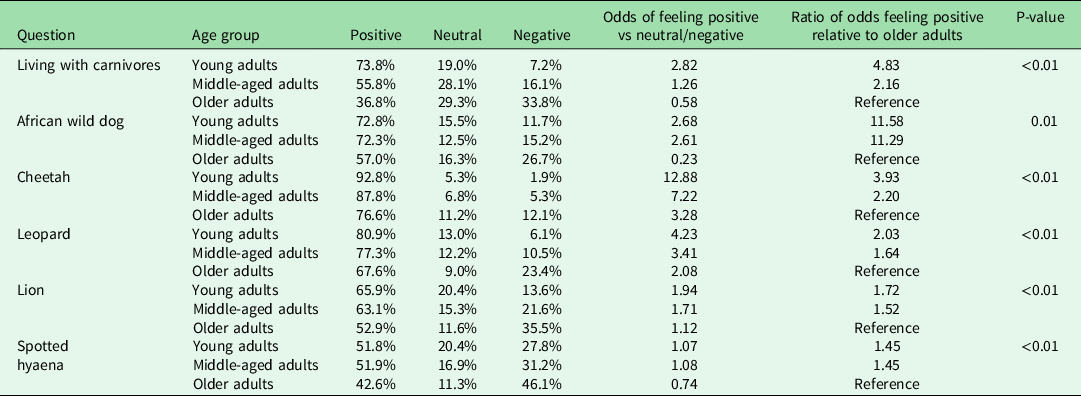
More than half of the respondents felt positive about living with carnivores (61.1%), only 14.7% felt negative. Men felt more positive (men 61.4%, women 58.1%) and less negative (men 13.6%, women 27.0%), and were 1.14 times more likely to like living with carnivores than women (p < 0.01). Age also had an effect, with young adults being most positive about living with carnivores, followed by middle-aged adults (Table 1).
Percentage of respondents within each age category who felt positive, neutral or negative about living with carnivores, African wild dog, cheetah, leopard, lion and spotted hyaena, the odds of respondents within an age category to feel positive about living with carnivores and large carnivore species versus neutral/negative, the ratio of the odds of young and middle-aged adults to feel positive relative to the odds of older adults feeling positive about living with carnivores and the large carnivore species.

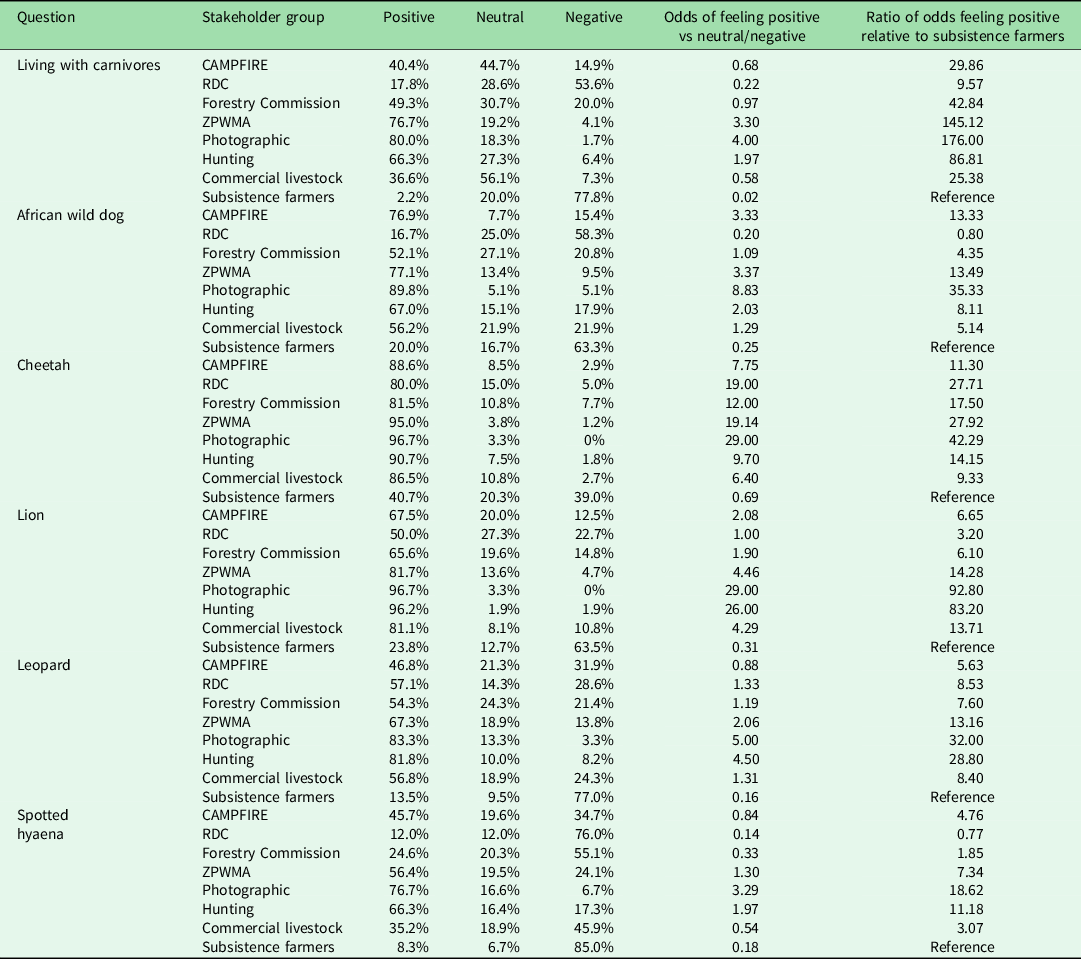
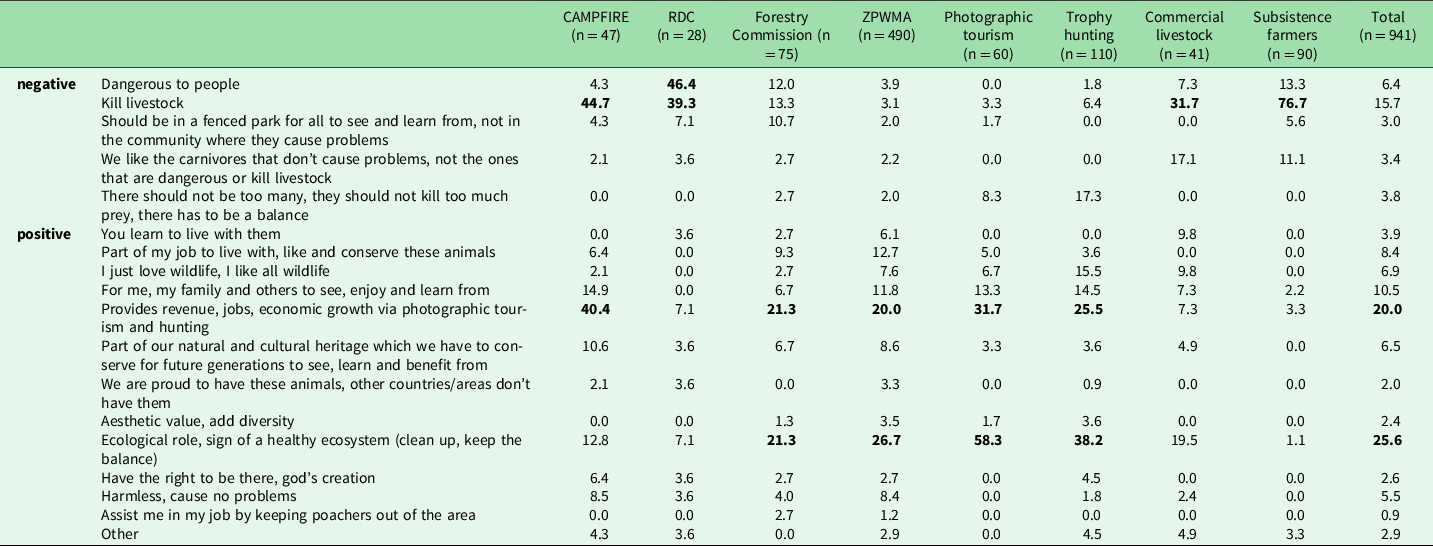
Stakeholders differed significantly in their attitude towards living with carnivores (p < 0.01) (Table 2). Stakeholders in photographic tourism were the most positive, subsistence farmers the most negative (Table 2). The most common reasons to feel negative about living with carnivores were fear of livestock depredation and the perceived danger to humans, while the economic benefits and important ecological role of carnivores were the main reasons to feel positive (Table 3).
Percentage of respondents within each stakeholder group who felt positive, neutral or negative about living with carnivores, African wild dog, cheetah, leopard, lion and spotted hyaena, the odds of respondents within a stakeholder group feeling positive about living with carnivores and the large carnivore species versus neutral/negative, the ratio of the odds of respondents within a stakeholder group feeling positive relative to the odds of subsistence farmers feeling positive about living with carnivores and the large carnivore species.

Reasons given by respondents to feel positive, neutral (often explained with a positive and a negative reason) or negative about living with carnivores, presented as the percentage of respondents within each stakeholder group who gave this reason, reasons given by ≥ 20% of the respondents within a stakeholder group are printed in bold.

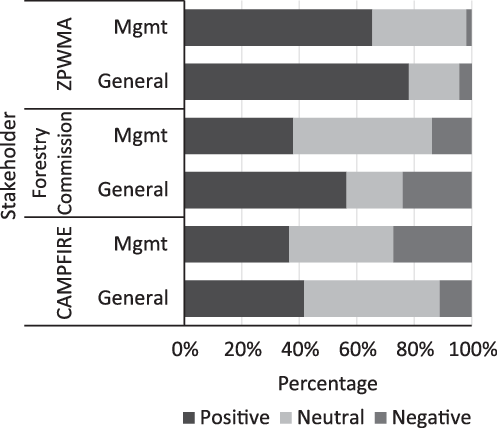
Within CAMPFIRE offices there was no attitude difference between general and management staff (p = 0.51), however, general staff at Forestry Commission (p = 0.04) and ZPWMA (p = 0.03) offices felt less often neutral about living with carnivores than management staff (Fig. 2); general staff was respectively 2.13 times and 1.89 times more likely to feel positive about living with carnivores than management staff.
Percentage of management (mgmt) staff and general staff within the CAMPFIRE, Forestry Commission and ZPWMA offices who felt positive, neutral or negative about living with carnivores.

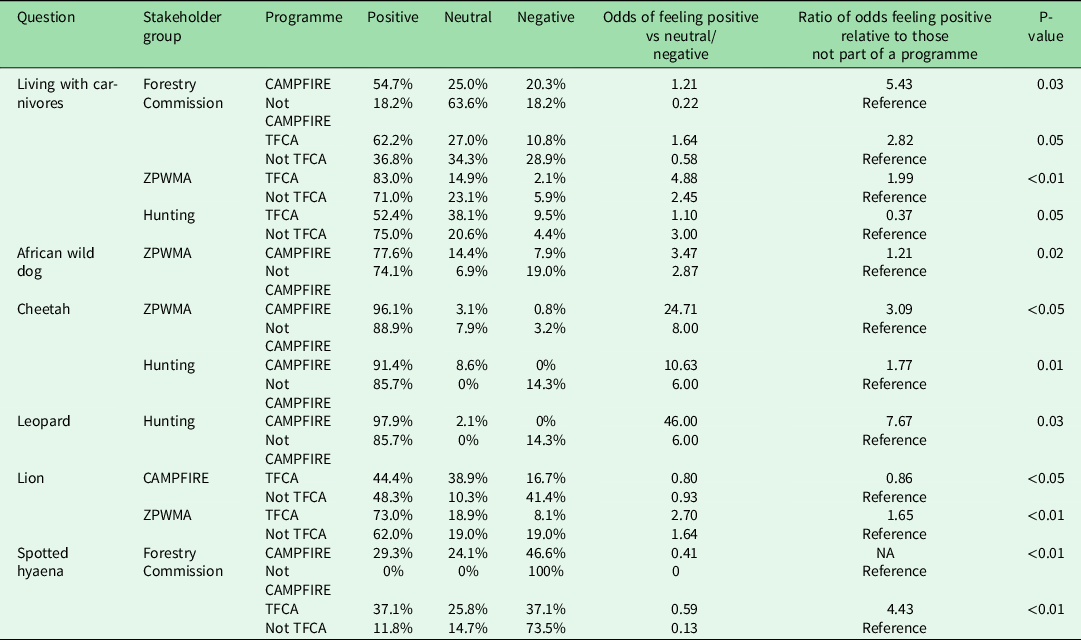
Forestry Commission employees were more positive about living with carnivores when they were part of a CAMPFIRE area (Table 4). ZPWMA employees were more positive about living with carnivores when they were part of a TFCA, a similar non-significant trend was found for Forestry Commission employees in TFCAs (Table 4). Although not significant, respondents in hunting seemed less positive about living with carnivores when hunting in TFCAs (Table 4). Attitude towards living with carnivores of the remaining stakeholders was not affected by being part of a CAMPFIRE area or TFCA (p ≥ 0.07).
Percentage of respondents who felt positive, neutral or negative about living with carnivores, African wild dog, cheetah, leopard, lion and spotted hyaena within the stakeholder groups which were significantly affected by being part of a CAMPFIRE area or TFCA, the odds of respondents within these stakeholder groups to feel positive about living with carnivores and large carnivore species versus neutral or negative, the ratio of the odds of those part of a CAMPFIRE area or TFCA to feel positive relative to the odds of those not part of a CAMPFIRE area or TFCA feeling positive about living with carnivores and the large carnivore species.

Large carnivore species
Men were more positive (89.4%) about cheetah than women (76.7%) (p < 0.01) and 2.57 times more likely to like the species. Attitudes towards the other species were not affected by gender (p ≥ 0.12). Overall, young and middle-aged adults were more positive about large carnivores than older adults (Table 1).
Stakeholders differed significantly in their attitudes towards large carnivores (p < 0.01) (Table 2). Natural resource officers at RDCs were the least positive about African wild dog, while subsistence farmers had the least positive attitudes towards the other species (Table 2). Respondents in photographic tourism held the most positive attitudes towards all large carnivores (Table 2).
Fear of livestock depredation and, in the case of African wild dog fear of losing too much prey, was the most common reason to dislike large carnivores (Tables S2–6). Leopard and lion in particular were often perceived as dangerous to humans (Tables S4–5). A nice appearance was the most common reason to feel positive about large carnivores (Tables S2–6). Most stakeholders mentioned their economic role as a reason to like leopard and lion (Tables S4–5), while spotted hyaena was often appreciated for its ecological role (Table S6).
Seeing the species affected attitudes of respondents in the photographic tourism industry towards African wild dog (< 0.01) and lion (p < 0.01): those who had seen it felt more positive about African wild dog (seen 94.0%, not seen 66.7%) and lion (seen 88.5%, not seen 50.0%) and were 7.83 times and 7.67 times more likely to like it, respectively. ZPWMA employees who had seen lion also felt more positive (seen 72.2%, not seen 58.9%) (p < 0.01) and were 1.82 times more likely to like it. Stakeholders in hunting felt more positive (seen 98.0%, not seen 75.0%) (p = 0.01) and were 16.33 times more likely to like leopard when they had seen it. Although not significant (p = 0.06), commercial livestock farmers who had seen spotted hyaena seemed more positive (seen 56.3%, not seen 19.0%) and 7.08 times more likely to like it. However, in some cases seeing a species had the opposite effect: commercial livestock farmers who had seen African wild dog felt more negative (seen 50.0%, not seen 12.5%) (p = 0.04) and were 1.40 times more likely to dislike it. Attitude towards large carnivores of the remaining stakeholders was not affected by whether they had seen the species (p ≥ 0.09).
There was no difference in attitudes towards African wild dog, cheetah and leopard between general staff and management staff at CAMPFIRE, Forestry Commission and ZPWMA offices (p ≥ 0.15). At Forestry Commission offices, management staff felt more positive about lion (positive 67.9%) than general staff (positive 45.2%) (p = 0.04) and was 2.56 times more likely to like the species. However, Forestry Commission employees at general level were more positive (positive 31.7%) about spotted hyaena than those at management level (positive 14.3%) (p = 0.03) and 2.79 times more likely to like it. Attitudes towards lion and spotted hyaena of CAMPFIRE and ZWPMA general and management staff did not differ (p ≥ 0.18).
Being part of a CAMPFIRE area positively affected attitude of Forestry Commission employees towards spotted hyaena and attitude of ZPWMA employees towards African wild dog and cheetah (Table 4). Respondents hunting in CAMPFIRE areas felt more positive about cheetah and leopard than those hunting in areas not part of CAMPFIRE (Table 4). Being part of a TFCA had a positive impact on attitudes of Forestry Commission towards spotted hyaena, and ZPWMA and CAMPFIRE employees towards lion (Table 4). Attitudes of the remaining stakeholders towards large carnivores were not affected by being part of a CAMPFIRE area or TFCA (p ≥ 0.08).
Conservation of wildlife
Overall, respondents felt positive about the conservation of wildlife in their area (96.7%). Gender did not affect attitude towards conservation (p = 0.09), age did (p < 0.01): young adults were most positive about conservation (99.0%), followed by middle-aged (96.9%) and older adults (88.7%). Compared to older adults, young and middle-aged adults were 13.09 times and 4.01 times more likely, to feel positive about conservation.
Stakeholders differed significantly in their attitude towards the conservation of wildlife in their area (p < 0.01). Apart from subsistence farmers, stakeholders felt very positive about conservation (≥ 96.0%) and were ≥ 8.73 times more likely to feel positive about conservation than subsistence farmers. Although most of the subsistence farmers did feel it is important to conserve wildlife (73.3%), they often mentioned this should be done in fenced parks where wildlife does not cause conflict (50.0%) (Table S7). The most common reasons for stakeholders to feel positive about conservation were the economic role wildlife plays through photographic tourism and hunting and because it is a natural and cultural heritage which should be conserved for future generations (Table S7).
There was no difference in attitude towards conservation between general and management staff at CAMPFIRE, Forestry Commission and ZPWMA offices (p > 0.28).
Being part of a CAMPFIRE area or TFCA did not affect stakeholder attitude towards the conservation of wildlife in their area (p ≥ 0.12).
Discussion
In this study, in which we interviewed all key conservation stakeholders throughout Zimbabwe, we found that stakeholders for whom livelihoods were directly related to the non-consumptive (photographic tourism) and/or consumptive (hunting) use of wildlife, had knowledge about and were exposed to carnivores, held the most positive attitudes towards (living with) large carnivores, while stakeholders whose livelihoods depend on livestock and/or had little knowledge about and less exposure to wildlife were most negative. Positive attitudes towards (living with) large carnivores were largely based on aesthetic and economic value, while negative attitudes were mostly based on fear of livestock loss and perceived danger to human life.
Stakeholders in photographic tourism held the most positive attitudes towards (living with) large carnivores. Those in hunting were very positive about large carnivores, which are frequently trophy hunted (i.e., leopard and lion), but less positive about African wild dog, which is not trophy hunted and perceived as killing too much prey. This stakeholder group also relatively often felt large carnivore populations should be controlled, possibly because they perceive large carnivores as competitors because they predate on prey species that are trophy hunted (Røskaft et al. Reference Røskaft, Händel, Bjerke and Kaltenborn2007). Stakeholders involved in wildlife management (CAMPFIRE, RDCs, Forestry Commission, ZPWMA) showed varying attitudes towards (living with) large carnivores, which are likely related to knowledge level and the ratio of negative (human-wildlife conflict management) versus positive (seeing wildlife in nature) exposure to large carnivores. Of those involved in wildlife management, the authorities directly responsible for Zimbabwe’s wildlife (ZPWMA) held the most positive attitudes and less often perceived large carnivores as dangerous to livestock and human life, while natural resource officers at RDCs held the most negative attitudes. These attitudinal differences between those involved in wildlife management are likely to translate in different considerations when dealing with human-wildlife conflict and may result in pressure on the ZPWMA to use lethal control to eliminate (perceived) problem animals. In accordance with other studies (Romañach et al. Reference Romañach, Lindsey and Woodroffe2007), commercial livestock farmers were more positive towards (living with) large carnivores than subsistence farmers, probably because they experienced less livestock depredation, have the financial resilience to cope with some losses and are in a stronger position to mitigate conflict (van der Meer Reference Van der Meer2016), all of which positively affect attitudes towards large carnivores (Dickman et al. Reference Dickman, Marchini, Manfredo, Macdonald and Willis2013). Subsistence farmers, which are generally poor and reliant on livestock for financial safety and food security (Romañach et al. Reference Romañach, Lindsey and Woodroffe2007, Winterbach et al. Reference Winterbach, Winterbach, Somers and Hayward2013), were the stakeholder group with the most negative attitudes towards (living with) large carnivores.
To promote human-wildlife coexistence and the sustainable use of natural resources on communal land, the government introduced CAMPFIRE (CAMPFIRE 2013). Although in this study, attitudes of some stakeholders towards (living with) large carnivores were more positive in CAMPFIRE areas, the CAMPFIRE programme failed to improve attitudes of their target group; namely subsistence farmers (Fig. S1), nor did it affect attitudes of natural resource officers at RDCs. Since its introduction, CAMPFIRE has faced challenges related to revenue allocation, transparency and active participation of communities in natural resources management, herewith undermining incentives for sustainable management (Logan & Moseley Reference Logan and Moseley2002, Taylor Reference Taylor2009). Although this problem has been addressed by endorsing a system in which communities receive their revenue share directly from the safari operator (CAMPFIRE 2013), it is believed that, in order for CAMPFIRE to be truly effective, the right to manage and exploit their natural resources should be devolved to the communities themselves (Logan & Moseley Reference Logan and Moseley2002, Taylor Reference Taylor2009). In addition, those who bear the largest wildlife costs should receive appropriate benefits to offset those costs (Logan & Moseley Reference Logan and Moseley2002). This is currently not the case because the range and movement of wildlife are not considered in revenue sharing, and communities mostly use CAMPFIRE revenue to fund community development projects (Logan & Moseley Reference Logan and Moseley2002, Taylor Reference Taylor2009). Consequently, damage from wildlife and the lack of direct household benefits have undermined subsistence farmers’ support for the programme (Tshakatumba et al. Reference Tchakatumba, Gandiwa, Mwakiwa, Clegg and Nyasha2019). In addition, CAMPFIRE suffered from the political and economic instability in Zimbabwe, resulting in a collapse of the tourism industry and donor support for the programme (Taylor Reference Taylor2009, Tshakatumba et al. Reference Tchakatumba, Gandiwa, Mwakiwa, Clegg and Nyasha2019).
More recently, the government of Zimbabwe signed TFCA treaties to facilitate the cross-boundary management of natural resources. Apart from harmonizing policies, TFCAs encourage coexistence by promoting tourism development for the benefit of rural development (Munthali Reference Munthali2007). This provides opportunities for the conservation of large carnivores as they can serve as flagship species to promote wildlife-based tourism (van der Meer et al. Reference Van der Meer, Badza and Ndhlovu2016). However, although wildlife-based consumptive and non-consumptive tourism are probably the most profitable form of land use within Zimbabwe’s TFCAs, the CAMPFIRE experience shows that it is also a form of land use that is highly vulnerable to external factors such political instability (Taylor Reference Taylor2009, Tshakatumba et al. Reference Tchakatumba, Gandiwa, Mwakiwa, Clegg and Nyasha2019) and pandemics (Kuo et al. Reference Kuo, Chen, Tseng, Ju and Huang2008). The collapse of the tourism industry and poor community integration in biodiversity conservation have so far resulted in little to no TFCA benefits for rural communities (Katerere et al. Reference Katerere, Hill and Moyo2001, Munthali Reference Munthali2007). In addition, Zimbabwe’s TFCA activities have not been formalized at local level and there is low community awareness of the opportunities TFCAs provide for wildlife-based enterprises and conservation projects (Zanamwe et al. Reference Zanamwe, Gandiwa, Muboko, Kupika and Mukamuri2018). The socio-economic development objective of TFCAs is probably the most challenging to realize, however, TFCAs have hitherto resulted in the mobilization of substantial financial resources and harmonization of policies (Katerere et al. Reference Katerere, Hill and Moyo2001, Munthali Reference Munthali2007). This is probably why, in some cases, being part of a TFCA positively affected attitudes of stakeholders responsible for wildlife management, but failed to influence attitudes of subsistence farmers towards (living with) large carnivores.
In accordance with other studies (Dickman et al. Reference Dickman, Marchini, Manfredo, Macdonald and Willis2013), women were less positive about living with carnivores and more often perceived carnivores as dangerous than men (Table S8), possibly because they perform more duties in which they can encounter wildlife (Dickman et al. Reference Dickman, Marchini, Manfredo, Macdonald and Willis2013). Nevertheless, men and women were equally likely to feel positive about the conservation of wildlife in their area. As reported by others (Dickman et al. Reference Dickman, Marchini, Manfredo, Macdonald and Willis2013), an increase in age resulted in a less positive attitude towards (living with) large carnivores and more fear of livestock depredation (Table S8). An increase in age also resulted in a less positive attitude towards conservation, and older adults often felt wildlife should be conserved in a fenced park where it does not cause conflict (Table S9). The fact that most young adults held positive attitudes towards (living with) large carnivores and conservation provides hope for the future of carnivore conservation. Nurturing such positive attitudes through awareness programmes is key to the conservation of wildlife, as it assists with promoting long-term pro-conservation attitudes and behaviour (Feilen et al. Reference Feilen, Guillen, Vega and Savage2018). However, older adults play important leadership roles in African societies (Ensminger Reference Ensminger1990) and middle-aged adults were more likely to hold management positions at which they take decisions over wildlife, therefore, promoting a positive shift in their attitudes towards (living with) large carnivores and conservation is important for conservation in the short-term. With fear of human-carnivore conflict being a main reason for older adults to be less supportive of conservation, awareness programmes should incorporate a human-wildlife conflict mitigation component.
Increasing knowledge, for example on human-wildlife conflict mitigation and the economic and ecological role of wildlife, can assist in fostering positive attitudes towards wildlife (Glikman et al. Reference Glikman, Vaske, Bath, Giucci and Boitani2012, Dickman et al. Reference Dickman, Marchini, Manfredo, Macdonald and Willis2013, Feilen et al. Reference Feilen, Guillen, Vega and Savage2018). However, feelings and emotions seem to play a stronger role than knowledge in forming lasting positive attitudes towards wildlife (Epstein Reference Epstein1994, Glikman et al. Reference Glikman, Vaske, Bath, Giucci and Boitani2012). Therefore, in addition to transferring knowledge, it is crucial for carnivore conservation to stimulate positive feelings and emotions towards large carnivores (Pooley & O’Connor Reference Pooley and O’Connor2000). Seeing a species in its natural environment can evoke strong positive feelings and emotions and is therefore a powerful tool to promote positive attitudes towards wildlife (Røskaft et al. Reference Røskaft, Händel, Bjerke and Kaltenborn2007, Ballouard et al. Reference Ballouard, Provost, Barré and Bonnet2012). For most stakeholders, seeing a large carnivore indeed had a positive effect on their attitude, and stakeholder groups who regularly get such exposure to wildlife held more positive attitudes than those who do not. Especially with positive attitudes towards the large carnivores often simply being based on the species’ aesthetic appearance, it seems that positive attitudes can be promoted by taking stakeholders out on a guided safari to view wildlife. In a country where wildlife-based tourism is well developed (van der Meer et al. Reference Van der Meer, Badza and Ndhlovu2016), it should be possible to realize such outings, in particular for stakeholders who are usually only exposed to wildlife in a negative context, for example subsistence farmers, or those who do not get exposed to wildlife at all but do have to take decisions about its management, such as natural resource officers at RDCs.
Zimbabwe’s wildlife is under pressure from habitat loss, human-wildlife conflict, poaching and unsustainable legal offtake, which has resulted in range contractions and population declines of the country’s large carnivores (ZPWMA 2018, 2012, Groom et al. Reference Groom, Funston and Mandisodza2014, van der Meer Reference Van der Meer2018). Despite reservations towards (living with) large carnivores, all stakeholders did (strongly) believe it is important to conserve wildlife, however, subsistence farmers often felt wildlife should not be conserved in their communal area where it can cause conflict. Zimbabwe’s land reform programme and expanding human population have resulted in wildlife protected areas being increasingly surrounded by rural communities which rely on subsistence farming (van der Meer Reference Feilen, Guillen, Vega and Savage2018). It is therefore crucial for carnivore conservation to promote coexistence and the sustainable utilization and management of natural resources in those areas and encourage more positive attitudes towards large carnivores. CAMPFIRE was recently (2017–2018) subjected to a comprehensive review and a new policy has been proposed for the devolution of rights and responsibilities over natural resources on communal land to grassroots communities’ institutions (CITES 2019). Once this policy is implemented, CAMPFIRE provides a valuable framework, which, provided that long-term funding is available and communities are assisted in having competitive market access, can be utilized within TFCAs and beyond to engage communities in wildlife-based tourism, but also sustainable harvesting of natural products and the provision of ecosystem services. Although attitudes towards large carnivores are complex and difficult to change (Dickman et al. Reference Dickman, Marchini, Manfredo, Macdonald and Willis2013), awareness programmes can result in positive attitudinal change, in particular when promoting positive feelings and emotions (Røskaft et al. Reference Røskaft, Händel, Bjerke and Kaltenborn2007, Ballouard et al. Reference Ballouard, Provost, Barré and Bonnet2012, Feilen et al. Reference Feilen, Guillen, Vega and Savage2018). Such programmes should not only focus on future wildlife custodians (i.e., children, young adults), but also engage those who live with and are responsible for wildlife management today, so their negative experiences related to human-wildlife conflict are, at least to some extent, offset by positive exposure to large carnivores and other wildlife in its natural environment.
Supplementary material
To view supplementary material for this article, please visit https://doi.org/10.1017/S0376892920000491
Acknowledgements
We thank M. Badza, C. Mapendere, S. Mpansi, H. Ndlovu and A. Goronga for their assistance, and are incredibly grateful to all the people who participated in this survey. We are thankful to the anonymous reviewers for their useful comments on earlier versions of this manuscript.
Financial support
This work was supported by grants from Columbus Zoo and Aquarium, INNO Fund (13-023, 14-025), National Geographic’s Big Cats Initiative (B6-12, B11-14), Panthera, Pittsburgh Zoo and PPG Aquarium, Stichting SPOTS, Stichting Wildlife, The Rufford Foundation (11974-1, 15273-2), Van Tienhoven Foundation and Wilderness Wildlife Trust.
Conflict of interest
None.
Ethical standards
This study complies with applicable ethical standards of the relevant national and institutional committees on human experimentation and with the Helsinki Declaration of 1975, as revised in 2008. Respondents gave verbal free and informed consent to voluntarily participate in this study, which was approved by the Zimbabwe Research Council (permit №: 01392; 02336; 02508) the ZPWMA (permit №: 23(1) (C) (II) 21/2013; 23(1) (C) (II) 08/2014; 23(1) (C) (II) 09/2015) and the Ministry of Local Government, Urban and Rural Development (ADM/23/8).