Introduction
The provision of day care services designed for people with dementia was one of the main priorities in the first governmental Norwegian Dementia Plan 2015, and this commitment has been maintained in the second Dementia Plan, 2020. Local authorities in Norway are offered funding to provide day care services for this group of patients close to their own home.
Day care services for people with dementia aim to offer meaningful activities and a safe environment to improve the quality of life of the users. Additionally, they should act as a respite service for family carers, and it is suggested that such services could delay the need for nursing home placement (Fields et al., Reference Fields, Anderson and Dabelko-Schoeny2014; Tretteteig et al., Reference Tretteteig, Vatne and Rokstad2015).
At present, there is only a limited amount of information concerning the effects of day care center programs designed for people with dementia. In a review from 2011, the Norwegian Knowledge Centre for the Health Service (NOKC) could only find eight published studies of moderate to poor quality (Reinar et al., Reference Reinar, Fure, Kirkehei, Dahm and Landmark2011). The review concluded that special day care for people with dementia might contribute to reductions in the incidence of behavioral problems (Ishizaki et al., Reference Ishizaki2002), the burden on carers (Zarit et al., Reference Zarit, Stephens, Townsend and Greene1998; Mossello et al., Reference Mossello2008), and the use of psychotropic drugs (Mossello et al., Reference Mossello2008). A literature search made by NOKC in 2014 could not identify any relevant new studies on the effects and costs related to special day care centers for people with dementia (Dahm et al., Reference Dahm, Hafstad and Dalsbø2014).
Quality of life (QoL) has increasingly been recognized as an important factor in both the development of the quality of dementia care and as a study outcome in dementia research (Moyle and Bowers, Reference Moyle and Bowers2010). In care practice, measurement of QoL is important, as it helps to determine the effect of a particular treatment or intervention and contributes to an assessment of the influence of dementia on an individual's well-being (Nay and Garratt, Reference Nay and Garratt2009).
The World Health Organization (WHO, 1995) defines quality of life as “an individual's perception of their position in life in the context of the culture and value systems in which they live and in relation to their goals, standards and concerns.” Lawton (Reference Lawton1997) explores four main factors that influence the QoL in people with dementia: (1) psychological well-being as a positive or negative affect, (2) behavioral competence, such as social behavior, physical health, and cognitive and functional abilities, (3) the objective environment, such as the structure of life and routine events, and (4) the QoL as perceived by the patients themselves (Lawton, Reference Lawton1997).
In a review by Banerjee et al. (Reference Banerjee2009), no consistent associations were found between demographic variables and QoL among people with dementia. Additionally, there was no convincing evidence that poorer cognition was associated with lower QoL, based on self-report assessments. Studies using proxy-reported QoL have revealed a modest association between increased cognitive impairment and lower QoL (Banerjee et al., Reference Banerjee2009). Previous studies have reported a significant association between depression and decreased QoL (Banerjee et al., Reference Banerjee2009). Bruvik et al. (Reference Bruvik, Ulstein, Ranhoff and Engedal2012) concluded that depression and impairment in performing the activities of daily living were strongly associated with lower QoL in home-dwelling people with dementia, both in self-reported and proxy-based assessments. Additionally, lower proxy-reported QoL was associated with more severe neuropsychiatric symptoms (NPS) (Bruvik et al., Reference Bruvik, Ulstein, Ranhoff and Engedal2012). An explorative study by Droes et al. (Reference Droes2006) assessing the experiences of people with dementia living in the community and in nursing homes reveals that general well-being, the ability to take part in activities, friendships, and feelings of belonging or attachment are important aspects of their QoL (Droes et al., Reference Droes2006). To our knowledge, no study has been conducted to explore the effect of day care centers designed for people with dementia on their QoL.
The person with dementia's awareness of abilities and deficit has the potential to influence QoL (Woods et al., Reference Woods2014). Awareness can be defined as “a reasonable or realistic perception or appraisal of a given aspect of one's situation, functioning or performance, or of the resulting implications” (Clare et al., Reference Clare, Rowlands, Bruce, Surr and Downs2008).
The main objective of our study was to compare QoL in people with dementia attending a day care center with that of people not attending a day care center.
The secondary objective was to examine which variables would be associated to QoL-AD in people with dementia attending and not attending a day care center.
Methods
The study is based on baseline data from a research project using a quasi-experimental design (Rokstad et al., Reference Rokstad2014). The project includes a group of day care users and their closest family carers, and a comparison group of people with dementia with no access to day care and their caregivers. The day care centers are run by professional health and social care staff. The daily activity program for the day care users includes common meals, psychosocial activities, and getting out for a walk. No specific service is offered to the caregivers. As there is only a short, if any, waiting time to receive day care center service in Norway, it was considered unethical to carry out a randomized controlled trial (RCT) and withhold people from the service. This means that we did not randomize people into the two groups, but rather selected people randomly from a group that had been offered a day care program specially designed for people with dementia (day care group). They were compared with people from municipalities without available day care service, and were thus receiving care as usual (comparison group). All participants received domiciliary care organized by the municipal authorities.
Participants
The inclusion and exclusion criteria were: participants should be 65 years old or older, have a dementia diagnosis according to the ICD-10 criteria, a Mini-Mental State Examination (MMSE) score of ≥15, and the capacity to give informed consent as judged by the professional caregivers. Additionally, they should have a family carer who was willing to participate and who had face-to-face contact with the patients at least once a week.
Participants in the day care group should have attended the center for at least four weeks and have been there no longer than 12 months. Additionally, they should attend the day care center program at least twice a week. Possible participants who had applied for a nursing home placement or were suffering from a serious co-morbid physical disorder with a life expectancy of less than six months were excluded.
Recruitment
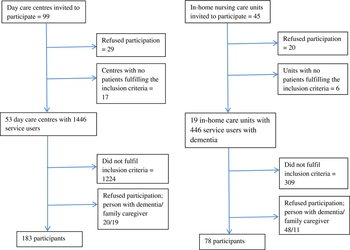
Participants in the day care group were recruited from day care centers designed for people with dementia, and patients in the comparison group were recruited from local authority dementia teams and in-home nursing care service units in municipalities without day care center programs. The participants were recruited from all four national health regions in Norway. A total of 99 day care centers and 45 in-home nursing care units were invited to take part in the study. A total of 183 day care users from 53 day care centers (day care group) and 78 in-home care service users from 19 units (comparison group) were included in the study (see Figure 1). A total of 88 eligible participants declined to participate, based on their own (n = 55) or the family caregivers' (n = 33) decision. The group of eligible participants had a mean age of 83.9 (SD 5.2), which was significantly higher than the participants (p = 0.001). Women constituted 63% of the group that declined participation, so gender was not significantly different from the group of participants.
Recruitment of participants.

Data collection
A group of 13 assessors, consisting of experienced registered nurses, occupational therapists, and a psychologist, collected the data. They attended an information and training day on the use of the assessment scales ahead of data collection.
The demographic data of participants, such as gender, age, marital status, living conditions, and educational level, were registered.
To diagnose dementia, a standardized and structured assessment of symptoms, debut, type, and course was used. Two experienced psychiatrists specialized in the treatment of older people (KE and MLB) independently diagnosed the participants according to the ICD-10 criteria for research using all the available information from the data collection. Discrepancies in diagnoses were settled in a consensus meeting. The severity of dementia was assessed by the Clinical Dementia Rating scale (CDR) (Hughes et al., Reference Hughes, Berg, Danziger, Coben and Martin1982), a six-item assessment scale. Using an algorithm giving precedence to memory, the severity of dementia is staged as (0) none, (0.5) possible, (1) mild, (2) moderate, or (3) severe dementia. The MMSE (Folstein et al., Reference Folstein, Folstein and McHugh1975) was used to evaluate cognitive functioning. The scale consists of 20 items, with a possible sum score between 0 and 30. A higher score indicates better cognitive function.
QoL was evaluated using the Quality of Life-Alzheimer's Disease (QoL-AD) scale (Logsdon et al., Reference Logsdon, Gibbons, McCurry and Teri1999), measuring the domains of physical condition, mood, memory, functional abilities, interpersonal relationships, ability to participate in meaningful activities, financial situation, overall assessment of self as a whole, and the overall QoL. The scale consists of 13 items with a possible sum score between 13 and 52. A higher score indicates better QoL. QoL-AD was used both as a self-reporting tool in interviews with the people with dementia and to collect proxy-based information from the family carers about the QoL of the participant.
Functioning in the activities of daily living (ADL) was assessed by the Physical Self-Maintenance Scale (PSMS), measuring basic activities and the Instrumental ADL scale (IADL) assessing the instrumental activities of daily living (Lawton and Brody, Reference Lawton and Brody1969). The PSMS consists of 6 items with a possible score between 6 and 30, and the IADL scale consists of 8 items with a possible score between 8 and 31. For both scales a higher score indicates poorer functioning and a greater need for assistance. In the analyses, the scorings of the two scales were summed into one ADL score.
The Neuropsychiatric Inventory questionnaire (NPI-Q) (Cummings et al., Reference Cummings1994; Kaufer et al., Reference Kaufer2000) was used to evaluate neuropsychiatric symptoms. The NPI-Q was used in an interview with the carer to assess the presence of NPS. NPI-Q consists of 12 items, but in this study only the 10 first items (thus excluding the vegetative symptoms) were used for the analyses (Kaufer et al., Reference Kaufer2000) with a possible score between 0 and 30. Based on a previous principal component analysis made among home-dwelling people with dementia, the sub-scores NPI-psychosis (delusions + hallucinations), NPI-affective (depression, anxiety, and apathy) and NPI-hyperactivity (agitation, disinhibition, euphoria, irritability, and aberrant motor behavior) were used (Wergeland et al., Reference Wergeland, Selbaek, Bergh, Soederhamn and Kirkevold2015). Depressive symptoms were assessed by the Montgomery Åsberg Depression Rating Scale (MADRS) (Montgomery and Asberg, Reference Montgomery and Asberg1979), which was used in an interview with the participants. MADRS consists of 10 items with a possible score between 0 and 60, with a higher score indicating more severe depressive symptoms.
The Anosognosia Rating Scale (REED) (Reed et al., Reference Reed, Jagust and Coulter1993) was used to rate the patients’ degree of awareness of memory loss. REED consists of a four-point scale (1– full awareness, 2 – shallow awareness, 3 – no awareness, and 4 – denies impairment); the scorings are based on an interview, which is often combined with cognitive testing of the patient.
Statistical analysis
Any missing values in the different instruments were imputed on the item level. The imputation was performed only for cases with at least 50% of items available. The missing values were imputed by random numbers drawn from an empirical distribution generated for each item of interest.
Demographic and clinical characteristics were presented as means and standard deviations (SD), or frequencies and percentages as appropriate. Patients were recruited from 53 day care centers and 19 units, which implied a hierarchical structure in data. A degree of clustering due to center/unit belonging was assessed by an intra-class correlation coefficient. Statistical methods adjusting for intra-class correlations were applied if necessary.
The characteristics of patients in day care and comparison groups were compared by an Independent Samples t-test, or a χ 2-test in the case of no cluster effect. Linear mixed-model or logistic regression models for hierarchical data with random effects for centers/units were estimated in the presence of a cluster effect.
The differences between the day care and comparison groups in self-reported QoL-AD and QoL-AD reported by family caregivers were first assessed using a bivariate linear mixed model, one for each variable, with fixed effects for group belonging and random effects for center/unit. A number of other predictors for QoL-AD were also assessed in similar bivariate models. Next, a multivariate model containing all predictors was estimated. The model also contained interaction terms between group belonging and living alone, REED, MADRS, and ADL respectively, constituting four interaction terms altogether. A significant interaction suggests that the association between QoL-AD and a predictor of interest is of different character among patients in the day care center group and patients in the comparison group. The multivariate model was further reduced by Akaike's Information Criterion (AIC), where a smaller value implies a better model. The results were presented as regression coefficients and standard errors (SE), and p-values. In the presence of interaction, the mean QoL-AD score within relevant sub-groups was derived and tabulated together with the 95% confidence intervals (CI) and p-values, for clarification.
All statistical analyses were performed in SPSS v 22 and SAS v 9.4. Results with p-values below 0.05 were considered statistically significant.
Ethical considerations
The project has been approved by the Regional Committee in Ethics in Medical Research in South-East Norway (2013/1020). After written and oral information, the patients and the family carers were asked to give written informed consent. Only patients with the capacity to give consent were included. The study is registered in Clinical Trials (NCT01943071).
Results
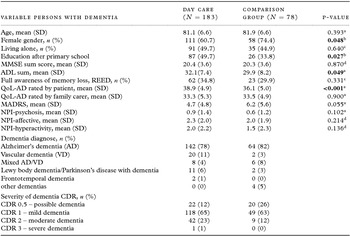
The mean age of the total sample was 81.4 (SD = 6.6), and 169 participants (65%) were females. Differences between the group of participants attending day care and the comparison group are presented in Table 1. There were a significantly higher percentage of females in the comparison group, and a higher percentage of the participants in the day care group had undertaken additional education after primary school. The day care users rated their own QoL according to QoL-AD significantly higher than the comparison group. This difference between groups was not confirmed by the proxy ratings made by family carers using the same scale to evaluate the QoL of the person with dementia. Additionally, the participants in the day care group had higher functional dependency (ADL sum score) than those in the comparison group. The dementia diagnoses and the severity of dementia according to CDR are presented in Table 1.
Analyses comparing the participants attending a day care center with the comparison group

MMSE: Mini-Mental State Examination; ALD sum: sum of the scores of IADL (Instrumental Activities of Daily Living) and PSMS (Physical Self-Maintenance Scale); REED: The Anosognosia Rating Scale; QoL-AD: Quality of Life – Alzheimer's disease; MADRS: Montgomery Asberg Depression Rating Scale; NPI: Neuropsychiatric Inventory questionnaire; CDR: Clinical Dementia Rating scale.
aLinear mixed model.
b χ 2-test with continuity correction.
cLogistic regression model for hierarchical data.
dIndependent samples t-test.
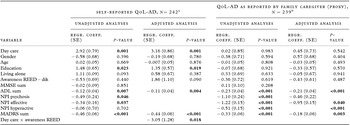
According to the linear mixed model (Table 2), attending day care was significantly associated with higher scores of self-reported QoL both in the unadjusted and adjusted analyses. There was no difference between the group attending day care and the comparison group in proxy-reported QoL. Furthermore, the unadjusted analyses showed that higher functional dependency (ADL), more severe NPS (NPI-psychosis and NPI-affective), and more severe depressive symptoms (MADRS) were significantly associated with lower self-reported QoL, and a higher level of education was significantly associated with higher scores of self-reported QoL. The unadjusted analyses of proxy-reported QoL showed that higher functional dependency (ADL), NPS (NPI-psychosis, NPI-affective, NPI-hyperactive), and depressive symptoms (MADRS) were significantly associated with lower QoL.
Results of linear mixed model for self-reported QoL-AD and QoL-AD reported by family caregiver as the dependent variable

MMSE: Mini-Mental State Examination; ALD sum: sum of the scores of IADL (Instrumental Activities of Daily Living) and PSMS (Physical Self-Maintenance Scale); REED: The Anosognosia Rating Scale; QoL-AD: Quality of Life – Alzheimer's disease; MADRS: Montgomery Asberg Depression Rating Scale; NPI-Q: Neuropsychiatric Inventory questionnaire.
a16 cases had one missing and 2 cases had three missing in adjusting variables, ICC=14.9%.
b16 cases had one missing and 2 cases had three missing in adjusting variables, 3 cases had missing values in outcome variable, ICC =6.8%.
Furthermore, in the adjusted analyses, higher functional dependency (ADL) and depressive symptoms (MADRS) were associated with lower self-reported QoL, and a higher level of education was associated with higher self-reported QoL. Higher functional dependency (ADL), more severe NPS (NPS-psychosis, NPI-affective), and depressive symptoms (MADRS) were associated with lower proxy-reported QoL.
The interaction between day care/comparison group variables and awareness of memory loss was significantly different from zero, implying that among the participants with full awareness of their memory loss, there was no difference between the participants in the day care group compared to the comparison group (Table 3). Among the participants having shallow or no awareness, there was a significant difference between those attending day care and those who did not receive such a service. The day care attendees had a significantly higher mean score of QoL-AD, indicating better QoL.
The results of the interaction between awareness of memory losses measured by REED and attendance to a day care center on self-reported QoL-AD

REED: The Anosognosia Rating Scale; QoL-AD: Quality of Life – Alzheimer's disease.
Discussion
The objective of the study was to compare QoL in people attending day care centers designed for people with dementia to those not attending such a service. As this is, to our knowledge, the first study comparing QoL in people attending such day care facilities with a control group, we are not able to compare our findings with results from previous research. The evidence shows that self-reported QoL is better among people attending day care compared to the comparison group. However, it is the day care center users with shallow or no awareness of their memory loss who report the best QoL, thereby, contributing to the difference between the groups. The relationship between level of awareness and QoL has been explored in previous studies and different results are reported. In a study by Vogel et al. (Reference Vogel, Lykke Mortensen, Hasselbalch, Andersen and Waldemar2006) that included 48 patients described to be in the early stages of Alzheimer's disease, no association between anosognosia and QoL was found. In contrast, the study of Trigg et al. (Reference Trigg, Watts, Jones and Tod2011), including a sample of people with a mild stage of dementia, reveal that lower awareness of memory function was found to have a positive impact on QoL ratings. According to a study by Hurt et al. (Reference Hurt2010), including 256 participants with mild and moderate dementia, health-related QoL was rated higher in those with impaired insight, although only in the group of participants with moderate dementia. Furthermore, anosognosia and cognition were shown to be independent variables in relation to patients’ perceptions of their QoL in the recent three-year longitudinal study of Conde-Sala et al. (Reference Conde-Sala, Turró-Garriga, Garre-Olmo, Vilalt-Franch and Lopez-Pousa2014) including 119 participants. In our study, those participants with shallow or no awareness of memory loss attending day care had significantly higher scores of self-reported QoL, but this relationship between awareness and QoL was not found in the comparison group. These findings indicate that the positive impact of day care on their experienced QoL presupposed that the participants did not have full awareness of their memory loss. Insight or self-awareness could be described as seeing oneself in an almost objective way, based on a subjective feeling. The term "insight" can easily be interpreted as something static and unambiguous, a question of either–or in the way it is used in a dichotomous variable in quantitative analyses. In a longitudinal qualitative interview study exploring the subjective experience of living with dementia, insight was described as a non-dichotomous phenomenon often fluctuating, sometimes fragmented, and often situational (Wogn-Henriksen, Reference Wogn-Henriksen2012). Based on this interpretation of insight we can assume that even though the person with dementia expresses shallow or no awareness of memory loss during the interview, according to REED they can have a valid opinion about their QoL. This assumption is supported by the study of Woods et al. (Reference Woods2014), which concludes that reduced awareness should not disqualify people with dementia from having an entitled opinion about their own situation.
In accordance with this, the other main finding in our study, the difference in self-reported and proxy-reported QoL can be discussed. As in previous studies, people with dementia rate their QoL significantly higher than the family carers (Vogel et al., Reference Vogel, Lykke Mortensen, Hasselbalch, Andersen and Waldemar2006; Bosboom et al., Reference Bosboom, Alfonso, Eaton and Almeida2012; Bruvik et al., Reference Bruvik, Ulstein, Ranhoff and Engedal2012; Zhao et al., Reference Zhao2012; Sousa et al., Reference Sousa2013). The use of self-reporting instruments to explore QoL in people with dementia is increasingly recommended, as the caregivers seem to underestimate the person with dementia's QoL (Zhao et al., Reference Zhao2012).
We found that different factors influenced QoL, depending on whether it was self-reported or proxy-reported. Day care attendance influenced self-reported QoL positively. Although a positive association between day care and QoL as an outcome measure is not reported in previous studies, the positive effects of day care on increased well-being are described in the study of Zank and Schacke (Reference Zank and Schacke2002). In that study a highly significant positive effect on subjective well-being was revealed, and effects on life satisfaction, perceived social support, and depression were demonstrated (Zank and Schacke, Reference Zank and Schacke2002).
The finding of a significantly higher percentage of people having additional education after primary school in the group of day care users is surprising and not easy to interpret. The positive influence of higher education on self-reported QoL found in our study was not reported in the review by Banerjee et al. (Reference Banerjee2009). Functional disability and the prevalence of depressive symptoms had a negative association with both self-reported and proxy-reported QoL, and these findings are in line with previous research (Banerjee et al., Reference Banerjee2009). Proxy-reported QoL is negatively associated with functional disability and NPS, including depression. These results confirm the findings in previous research (Bosboom et al., Reference Bosboom, Alfonso, Eaton and Almeida2012; Bruvik et al., Reference Bruvik, Ulstein, Ranhoff and Engedal2012; Sousa et al., Reference Sousa2013).
To further understand the concept of QoL as it is experienced by people with dementia and how specialized day care can influence this experience, an examination of findings from qualitative research can be useful. In a study by Stewart-Archer et al. (Reference Stewart-Archer, Afghani, Toye and Gomez2016), the participants living with dementia characterized QoL as freedom, independence, having basic needs met, physical health, engagement in meaningful activities, and tranquility. A need for support to self-determination and choice was stated as important. These findings are, to some extent, in line with the four main factors described by Lawton (Reference Lawton1997) that influence the QoL of people with dementia: psychological well-being, behavioral competence, the structure of life and routine events, and the QoL as perceived by the patients themselves (Lawton, Reference Lawton1997).
Strengths and limitations
The study has some limitations. First, we were not able to include the participants randomly. Second, the study included a large sample of 183 day care center users from 53 day care centers, and 78 in-home care service users from 19 units in the comparison group. However, 88 of 349 (25 %) eligible participants rejected participation in the study, based on their own or their family caregiver's decision. These eligible participants were significantly older. As we were not allowed to collect other data than age and gender from the group not willing to participate, we do not know whether they differed from the participants in other characteristics. Third, the findings are based on baseline data collected in a period of 1–12 months after the day care users attended the day care service, and so it is not possible to make conclusions about the longitudinal effects of day care. Finally, the strength of the research is that the assessment tools used in the present study are found by several other studies to be reliable and valid for use in a sample of people with dementia.
Conclusion
The evaluation of QoL as a key outcome is important in the evaluation of therapeutic interventions and service development for people with dementia. Our study reveals significantly higher self-reported QoL among people attending day care that is especially designed for people with dementia, compared to those not attending day care.
Conflict of interest
None.
Description of authors’ roles
A. M. M. Rokstad was involved in designing the study and collecting the data, and also wrote the first draft of the paper. Ø. Kirkevold and G. Selbæk were involved in designing the study and assisted with the writing. K. Engedal was involved in designing the study and diagnosed the participants in collaboration with M. B. Barca. They both assisted with the writing. J. S. Benth performed the statistical analyses and assisted with the writing. All co-authors approved the final manuscript.
Acknowledgments
The project was funded by the Research Council of Norway.