1. Introduction
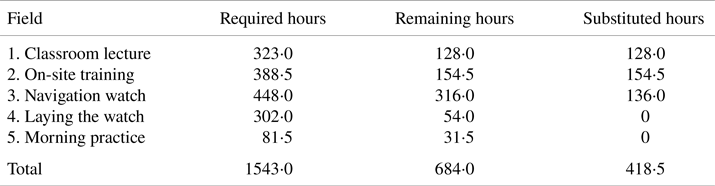
Tokai University prohibited all students from entering the university campuses from 4th April, 2020 as a countermeasure against coronavirus disease (COVID-19). This also applied to 16 Navigation cadets of the 49th Sea training course on the Training ship ‘BOSEI MARU (IMO 9057989)’ moored at Shimizu Port in Japan. They were forced to suspend their training, leave the ship, and start a ‘holiday on board’ in each of their homes on 9th April. The Japanese government expanded the area of the ‘State of emergency for COVID-19’ to the whole of Japan on 16th April. Japan's Ministry of Land, Infrastructure, Transport and Tourism issued the notice about The International Convention on Standards of Training, Certification and Watchkeeping for Seafarers, 1978 (STCW Code) Sea training under COVID-19. Then, Tokai University decided to provide the cadets with an applicable substitute for sea training, and they engaged with it remotely from 11th May to 22nd July (Yoshino et al., Reference Yoshino, Seta, Takashima, Sakakibara and Unno2020). Table 1 shows the curriculum and hours for the sea training. The required hours are the total of the originally ruled hours over 12 months of the onboard training, as required by the STCW Code. The remaining hours were as of 9th April. A total of 418$\cdot$ 5 h were substituted. The substituted hours were composed of 282$\cdot$
 5 h of Classroom lecture and On-site training that were conducted by remote schooling, and 136$\cdot$
 0 h of Navigation watch that were carried out by remote use of the shiphandling simulator from 30th June to 22nd July. The remote use of the simulator was practised with the team of cadets in their homes (Distant cadets) and the cadets in the simulator room (Campus cadets), in which the Distant cadets received shiphandling commands, and the Campus cadets had a Navigating officer on watch (OOW) and a Quartermaster (Q/M) on duty.
Hours of sea training on the BOSEI MARU

Over the past few years, a considerable number of studies have been performed on shiphandling training using shiphandling simulators. Kobayashi (Reference Kobayashi2005) proposed and identified the training to obtain the necessary elements and required techniques for competencies in safe navigation in simulators and methods for their assessment. Lee et al. (Reference Lee, Lee and Oh2006) described the effectiveness of repetitive training using a shiphandling simulator. Robert et al. (Reference Robert, Igor and Dani2012) identified the problems and countermeasures for training with shiphandling simulators. However, these studies were conducted on the assumption that all cadets would conduct their training inside the simulated bridge, and not on the assumption that cadets would be split to be inside and outside the simulated bridge, as presented in this study. In addition, Charlott (Reference Charlott2017) concluded that while the potential of using simulators in training and assessment are clear, little is known about which instructional practices would ensure valid and reliable results of simulator-based education.
In this study, a new training method using a simulator with a team of Distant cadets and Campus cadets, i.e. a method of training by placing cadets inside and outside the bridge of a shiphandling simulator, which has not been done in previous studies, is devised and practised as a new idea and used as a training method. This paper focuses on this Substitute Sea training voyage with the remote use of the shiphandling simulator (Remote voyage) and by analysing the feedback comments received from the cadets, the merits of the new training method will be demonstrated.
2. Substitute sea training voyage with remote use of the shiphandling simulator (Remote voyage)
There are several requirements to obtain certification of officers in charge of a navigational watch on a ship with a gross tonnage of 500 or more (STCW Code A-II/1). Broadly speaking, the first is to complete approved education and training so as to meet the standard of competence. The second is to perform approved sea going service of not less than 12 months. The cadets targeted in this study are those who have completed the first requirement, STCW Code A-II/1 deck officer classroom training, in four years of college, and have undergone 10 months of supervised onboard training in the deck department of a vessel of 500 gross tons or more engaged in international navigation. They have also completed their ECDIS training and are in the final stages of obtaining their STCW Code A-II/1 certificate of competency.
‘Microsoft Teams’ (TEAMS), a Web-meeting software, was used in the implementation of remote lectures and training for the cadets throughout Japan. A total of 288 h (more than the required 282$\cdot$ 5 h) of Classroom lecture and On-site training were completed on 29th June. Upon starting a Remote voyage on 30th June, Tokai University specially permitted six cadets residing in Shimizu-ku, Shizuoka city, where the campus is located, to enter the campus to join the Remote voyage as Campus cadets. Another 10 cadets residing outside of Shimizu-ku participated as Distant cadets. Because exchange between both sides of the cadets was conducted only on the Web, it was predicted that they could face unsettled limitations in sharing information and communication due to the condition of video/audio equipment and its use, and the communication environment. These unsettled limitations caused by the cadets working remotely as a team shall be called ‘Remote hurdles’ in this paper. These Remote hurdles do not use any ‘Immersive technologies’, and are far from the ‘Incorporation of digital technology’ that has been discussed so far (Cwilewicz and Tomczak, Reference Cwilewicz and Tomczak2008; Lundh et al., Reference Lundh, Mallam, Smith, Veitch, Billard, Patterson and MacKinnon2012; Baldauf and Procee, Reference Baldauf and Procee2014; Meadow, Reference Meadow2017; Mallam et al., Reference Mallam, Salman and Sathiya2019). Only video and audio were relayed using personal computers, smartphones and/or web-cameras, and the quality of the information transmission depended on each device, communication environment, and quality and quantity of communication between the cadets.
Simulator technology is in the process of advancing daily and is being used in various fields. Even just in the field of transportation, train and automobile driving, and especially aircraft operation that is said to have a high affinity with shiphandling in navigation, can be said to be pioneers in the introduction of simulator training (Valverde, Reference Valverde1973). According to Swift (Reference Swift1993), bridge resource management (BRM) was introduced by the shipping industry as a maritime version of the training for airline pilots called cockpit resource management (CRM), which was modelled on the training for airline pilots as a measure to prevent the recurrence of serious accidents, and it is evident that measures to prevent accidents caused by human factors using simulators are also ahead of their time. The BRM is a system management method in the bridge that aims to achieve safe and efficient operation without gaps or errors through the effective processing of information and dealing with questions that bridge members can solve together. The BRM is also one of the necessary elements for education on STCW Code A-II/1.
It seems that an evaluation method of the training effect using an objective numerical index has not been implemented for the shiphandling simulator that has been partially introduced for pilot education, but it would be an indispensable training tool in the efficiency discussion regarding future mariner education including sea training (Muirhead, Reference Muirhead2004). Additionally, the development of scenarios for simulator training oriented towards learning goals, and the advanced use of the shiphandling simulator are highly desired (Castells et al., Reference Castells, Ordás, Barahona, Moncunill, Muyskens, Hofman, Cross, Kondratiev, Boran–Keshishyan and Popov2015; Baldauf et al., Reference Baldauf, Dalaklis and Kataria2016; Sharma et al., Reference Sharma, Nazir, Wiig, Sellberg, Imset and Mallam2018).
There is no established method for the effective measurement and/or evaluation of the shiphandling simulator training and various methods/frameworks are being tried (Hontvedt and Arnseth, Reference Hontvedt and Arnseth2013; Nikitakos et al., Reference Nikitakos, Sirris, Dalaklis, Papachristos and Tsoukalas2017; Sanfilippo, Reference Sanfilippo2017; Sellberg and Lundin, Reference Sellberg and Lundin2018). Presently, it relies almost solely on the subjective opinions of the trainer (Ichikawa, Reference Ichikawa2012). Therefore, in this unprecedented training, the new educational possibility of the shiphandling simulator with remote use was studied by analysing the open-ended evaluation comments made by the cadets themselves as trainees.
Roles of the cadets in the Remote voyage

The cadets sailed Seto inland sea, Irago passage and Uraga/Nakanose passages, departing from the port of Shimizu, Shizuoka Prefecture on ‘BOSEI MARU’ after this remote simulator training. However, the evaluation of the synergistic effect of the simulator training and the actual sailing focusing on the remote aspect was impossible because no face-to-face simulator training was conducted for comparison.
2.1 Implementation structure and Remote voyage scenario
Success or failure of remote learning may be influenced by the ability to communicate closely under the difficult situations involved with visibility, handling and understanding, and to figure out how to operate each resource properly by trial and error. The most important point is whether or not the trainee has the desire to acquire knowledge and skills as a mariner. Therefore, in the Remote voyage, the implementation scenario was designed to keep providing a fresh learning experience to all trainees. Not only the Simulator drive team, but the Observation teams and the BRM check team as well, were encouraged to actively participate during the overall review.
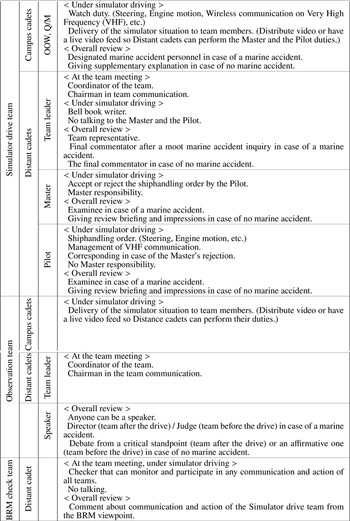
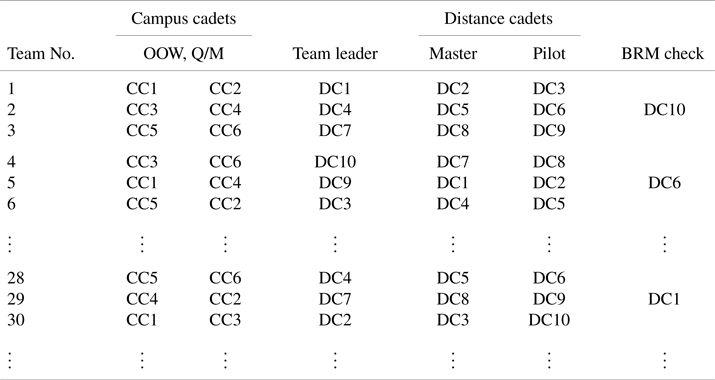
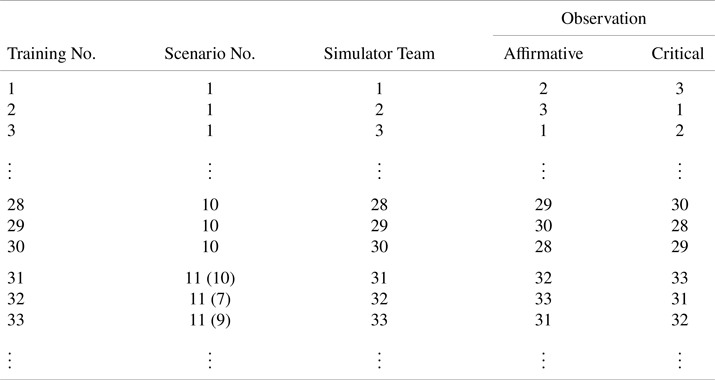
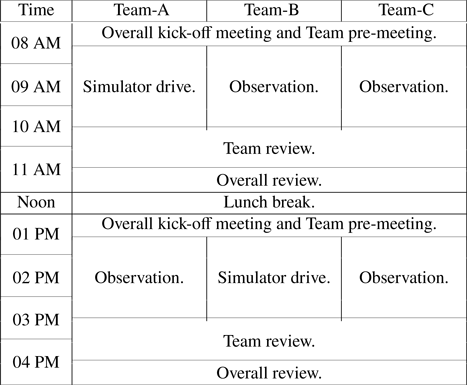
Upon implementation of the Remote voyage, the trainees were divided into four groups, a Simulator drive team, a BRM check team and two Observation teams. Each team consisted of two Campus cadets and three Distant cadets, except the BRM check team which included one Distant cadet. One scenario was implemented by three teams successively as team-A, team-B then team-C in order, and teams were regrouped for each scenario to avoid bias, and the pre-meeting and review were conducted by each team and all trainees per each scenario. During the overall review, the trainees had a moot marine accident inquiry in the case of a marine accident, and debate in the case of no accident, all by themselves. Table 2 shows the roles of the cadets in each team. Tables 3 and 4 show the roles of individual cadets and each team for each scenario. Table 5 shows a daily schedule of Remote voyages. One team drives the simulator, and two teams observe and evaluate. The two Observation teams were given opposite tasks; a team would observe the training from a critical standpoint after completing the simulator drive, and the other would consider an affirmative standpoint.
Role of cadets

Role of the team

TEAMS was used for communication between Campus cadets, Distant cadets and also trainers, and a channel was set up for each team to conduct a team meeting and training. Communication between Distance cadets and Campus cadets was conducted using a common network connection. Distance cadets at home used their PC, but some students were unable to use the PC due to family reasons and used a smartphone or a tablet. Campus cadets in charge of video distribution used fixed smartphones to distribute images of the navigational instruments installed in the simulator and scenes inside the bridge.
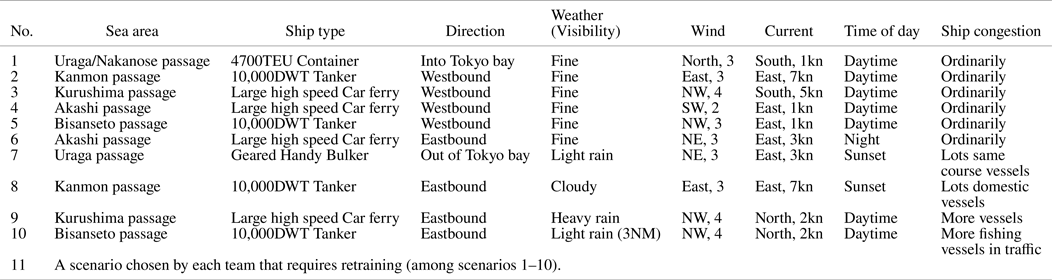
The scenarios shown in Table 6 are designed so that each training can be completed in 90–120 min. Scenarios 1 to 5, the first round of each sea area, have fine visibility, against current and little disturbance traffic, so avoidance action should not be required as long as the route and speed are set correctly. Scenarios 6 to 10, the second round of each sea area, is designed with more difficulty with restricted visibility such as night, twilight or rain, follow current and disturbance traffic, so avoidance action should be required. In addition, because one scenario is used by three teams consecutively, the complexity was added gradually to the scenario each time by rearranging the traffic of other ships. After completing scenarios 1 to 10, those with which each team had the most difficulty were picked as scenario 11.
The daily schedule of the Remote voyage

Scenarios

2.2 Implementation model of the Remote voyage
The flow of the Remote voyage is shown below.
2.2.1 Overall kick-off meeting (10 min).
Reconfirmation of the lined up team members and their roles, the sea area and the ship type that were announced to the cadets the previous day as well as the notification of the start time of the simulator drive.
2.2.2 Team pre-meeting (30 min).
The simulator drive team should confirm its role and passage plan, and set up the communication equipment, camera, etc. Observation teams should confirm their roles and the correspondence for a moot marine accident inquiry and a debate in preparation for an overall meeting.
2.2.3 Simulator drive (Simulator drive team).
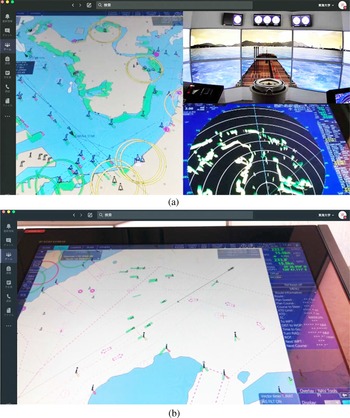
Figure 1 is a screenshot of two images sent by the Campus cadet. The Pilot and the Master receive the shiphandling command as they look at this screen of TEAMS on their own devices in their own homes. Any concerned images in the live video would be pinned and zoomed as they receive the command (Figure 1(b)). They maintain remote communication with Campus cadets with the Pilot role to confirm the indistinct information such as the data of other ships that are displayed on the Radio Detection and Ranging (RADAR) and the Electronic Chart Display and Information System (ECDIS).
Sample of TEAMS screen viewed by Distant cadets. (a) Displaying three split screens. (b) Displaying a pinned screen

2.2.4 Observation (Observation team).
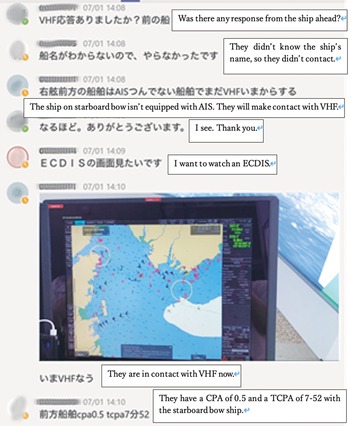
To prepare for the review, the Observation team, just as the Simulator drive team, need to grasp the up-to-date status of the simulator drive. Therefore, Distant cadets receive information from Campus cadets via the chat room of the team channel set up in TEAMS (Figure 2).
Live chat between Distant cadets and Campus cadets on the same team

2.2.5 Team review (30 min).
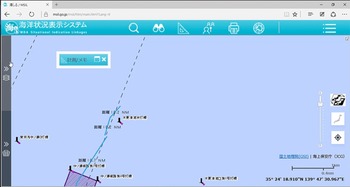
Each team should be briefed via the team channel in TEAMS, and prepare for a moot marine accident inquiry or a debate in the overall review. Track results of their own and other ships are checked against the memos (Figure 2) and images (Figure 3) recorded by each group during the observation in addition to the printout from the simulator.
Record written on MDA Situational Indication Linkages (JCG, 2019)

2.2.6 Entire review (40 min).
In the case of an accident such as a collision and/or a navigation violation etc., the BRM check team comments from the BRM viewpoint about communication and action of the Simulator drive team. Then a moot marine accident inquiry is opened. Its order is as follows.
1. Director interviews examinees about the background and the details of the accident. If needed, designated marine accident personnel are interviewed as well.
2. Director confirms the background recorded in the Bell book with the team leader.
3. Director appoints a Judge to inquire with reasons.
4. The Judge also interviews examinees about the accident background and details. Designated marine accident personnel are examined as well, if needed.
5. The judge states the foundation cause of the accident with reasons.
6. After the conclusion, the leader of the Simulator drive team summarises the inquiry.
In the case of no accident, a debate is opened. Its order is as follows.
1. The Pilot, the Master, OOW, then Q/M, in this order, comments on both the good and bad of each member and the team.
2. The BRM check team comments from the BRM viewpoint about communication and action of the Simulator drive team.
3. The two Observation teams (one with the critical standpoint and the other with the affirmative standpoint) open the debate. The leader of the Observation team with the critical standpoint sequentially states the opinion about the crucial shiphandling. Then the leader of the Observation team with the affirmative standpoint agrees or disagrees with the critical statement, as well as mentions what was good about the whole shiphandling process. Both teams continue to make statements and debate alternately.
4. The leader of the Simulator drive team summarises the debate.
After a moot marine accident inquiry or a debate, the trainers review the shiphandling process throughout the training, and explain and instruct on the key points of shiphandling as well as the decision-making process and the standard as a professional mariner.
3. Analysis of open-ended evaluation comments
3.1 Open-ended evaluation comments from the cadets’ perspective
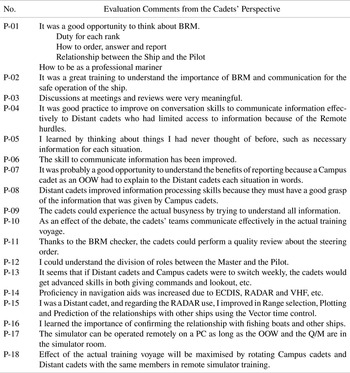
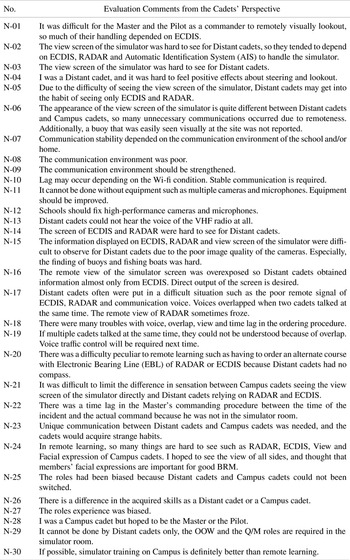
Open-ended evaluation comments for the remote use of the shiphandling simulator were submitted from all of 16 cadets in the mentioned training voyage after the simulator training. Only comments focused on the ‘Remote use of the simulator’ were analysed and arranged in tables (Tables 7 and 8).
Positive comments

Negative comments

3.1.1 Categorisation and analysis of positive comments
Positive comments numbered from P-01 to P-18 were categorised by theme, and analysed.
1. Awareness and Motivation for BRM.
P-01: There is a possibility of a synergistic effect by Remote hurdles and role setting to place the Master and the Pilot.
P-02: This shows that teamwork and high-quality communication are necessary to clear the Remote hurdles. Also, this connects to the evaluation of means to improve the practical skills of BRM.
P-03: There is a possibility of the synergistic effect of receiving and performing a third-party evaluation.
2. Means to improve BRM practical skills.
P-04, P-05, P-07: The Master and the Pilot as Distant cadets have no choice but to actively request high-quality information from Campus cadets, and are not able to accept chaotic communication of information including the transmission of disordered information from Campus cadets. Campus cadets are forced to improve the quality of the information they provide.
P-06, P-07: The cadets must refine both the quantity and quality of information.
P-08, P-09: Distant cadets are forced to continue to screen and evaluate information without delay.
P-10, P-11: Third-party evaluations were fed back to form a virtuous cycle.
P-12: There is an effect of role setting to place the Master and the Pilot.
3. Means to improve shiphandling skills.
P-13, P-14: Since it is an environment where Distant cadets are forced to make ‘Decisions’ and Campus cadets are forced to concentrate on ‘Operations’, each can be deepened. Superiority will be achieved if the cadets are allowed to practice and experience both.
P-15: Distant cadets were in positions to ask Campus cadets to obtain and provide high-quality information, and they were convinced of the importance of proper use of navigation instruments.
P-16: In places where there are restrictions on time situational awareness, the cadets have no choice but to continue their efforts to grasp risk targets without missing an opportunity.
4. Diversification of the simulator training system.
P-17: It was demonstrated that the shiphandling simulator can be used remotely even for educational purposes. It may contribute to the diversification of the Sea training system in the future.
5. Improvement of the training effect by further improvement of remote training use.
P-18: The training effect may be further improved if the same member formation is used for the actual training voyage after experiencing the roles of both Campus cadets and Distant cadets in remote shiphandling simulator training.
3.1.2 Categorisation and analysis of negative comments
Negative comments numbered from N-01 to N-30 were categorised by theme and analysed.
1. Neglect of visual lookout and the dependent trend toward electronic navigational instruments.
N-01, N-02, N-03, N-04, N-05, N-06: Cadets who rely too much on ECDIS, RADAR and AIS will be produced.
2. Instability due to communication equipment and communication environment.
N-07, N-08, N-09, N-10, N-11, N–2, N-13, N-14, N-15, N-16, N-17, N-18, N-19: Sophistication and comfort of communication equipment and communication environment bring about the effect of lowering Remote hurdles, but it contradicts the educational intention to improve the effect by using Remote hurdles.
3. Means to improve shiphandling skills.
N-20, N-21, N-22, N-23, N-24: These are for overcoming Remote hurdles and cannot be expected to occur in the actual onboard job. In other words, they are for remote training and are not necessary for job education. Assuming actual onboard jobs, they may be counterproductive.
4. Restriction by simulator training system.
N-25, N-26, N-27, N-28: They are the cases for setting this time, but they are not applicable if the situation allows Distant cadets and Campus cadets switching.
N-29: They are the cases of the setting this time, but the solution is to design a setting that can be executed only by Distant cadets.
5. Pessimistic about improving the training effect by further improvement of remote training use.
N-30: Up until now, non-remote use has been the best, but any merit must be found out, if there are any, in incorporating remote use.
3.1.3 Summary of evaluation comments from the cadets’ perspective
Positives and negatives are summarised in each theme.
1. Awareness and motivation for BRM.
There are many positive evaluations and no negative evaluations. Amortisation can be an effective method, as the Remote hurdles facilitate the introduction of awareness of the importance of teamwork and communication.
2. Means to improve BRM practical skills.
There are many positive evaluations and no negative evaluations. Amortisation can be an effective method, as teamwork and high-quality communication are indispensable to overcome Remote hurdles.
3. Means to improve shiphandling skills.
Since it is an environment where Distant cadets are forced to make ‘Decisions’ and Campus cadets are forced to concentrate on ‘Operations’, each can be deepened, as the positive evaluation should be noted. However, Distant cadets have many restrictions for overcoming remote hurdles that cannot be expected to occur in the actual onboard job, and it seems unsuitable for improving shiphandling skills. Assuming actual onboard jobs, it may be counterproductive. It cannot be said that it is unsuitable for improving some skills such as steering order, but it cannot be said that remote training has an advantage.
4. Diversification of the simulator training system.
It was demonstrated that the shiphandling simulator can be used remotely even for educational purposes. It may contribute to the diversification of the Sea training system in the future.
5. Improvement of the training effect by further improvement of remote training use.
The training effect may be further improved if the same member formation is used for the actual training voyage after experiencing the roles of both Campus cadets and Distant cadets in the remote shiphandling simulator training.
6. Neglect of visual lookout and the dependent trend towards electronic navigational instruments.
Remote training essentially leads to results that neglect visual lookout. This is the biggest drawback.
7. Instability due to communication equipment and communication environment.
This is closely related to the investment of educational institutions. It is difficult to say how much benefit can be found in capital investment in the remote environment. If the purpose is to improve the quality of teamwork and communication (that is, BRM education), there is no need for excessive sophistication and comfort of the communication equipment and communication environment, and instead, it is difficult to improve for the shiphandlimg skills.
3.1.4 SWOT analysis and comprehensive evaluation
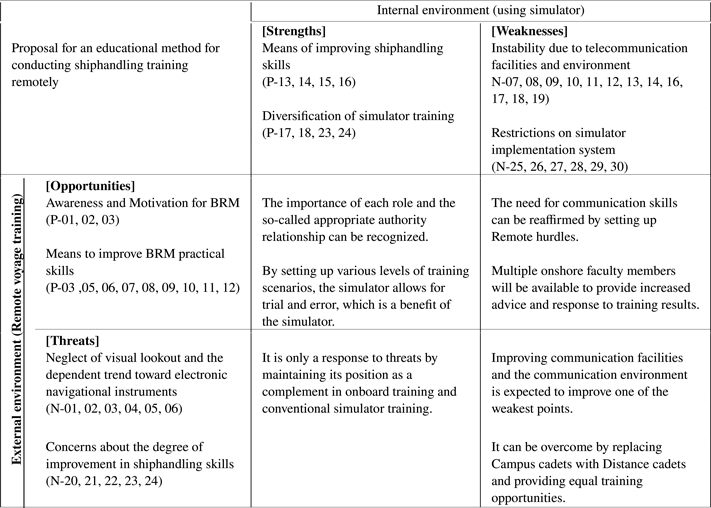
The situation of the business was divided into positive ‘strengths’ and negative ‘weaknesses’ in the internal environment and positive ‘opportunities’ and negative ‘threats’ in the external environment, and the opinions of the trainees were analysed using SWOT analysis, one of the frameworks often used in the examination of business strategies. The results are shown in Table 9. From Sections 3.1.1. and 3.1.2., the negative comments appear to be larger in number, but they have many of the same content. Many complaints were made about the communication environment, but this was expected before the training. This was due to the time constraints of the training period and the lack of time and money to update the communication equipment in the cadets’ possession, as well as the restrictions imposed on their activities. In other words, this problem can be overcome if a sufficient communication environment and facilities can be ensured.
SWOT analysis

In addition, as the cadets’ evaluation shows, it can be said that remote use of the shiphandling simulator in training is an effective BRM education method because it is recognised that it was effective in cultivating the BRM element. However, if the purpose of the simulator training is to improve shiphandling skills, remote training should be avoided.
3.2 Evaluation comments from trainers’ perspective by theme
3.2.1 BRM
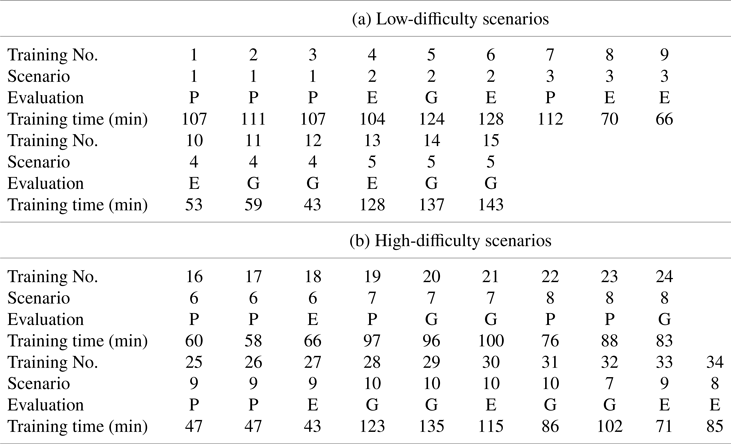
Table 10 shows the trainers’ three grade subjective evaluation (E, excellent; G, good; P, poor) and training times for each training outcome. Observation of the 15 low-difficulty scenarios and 19 high-difficulty scenarios in the order of execution shows an upward trend. Thus, remote training may be a good match for BRM education.
Trainers’ three grade subjective evaluation for each training outcome

3.2.2 Means to improve shiphandling skills
There was no tendency to correct the neglect of visual lookout and the reliance on electronic navigation instruments. It cannot be said that remote training is suitable as a means to improve shiphandling skills.
3.2.3 Communication equipment and communication environment
This remote training was designed with communication instability. Trainers expected that the quality of teamwork and communication between Distant cadets and Campus cadets would improve. In other words, it is the awareness and effect of BRM, and they seem to have achieved their purpose.
3.2.4 Feedback to the implementation team
The observation team discusses the voyage plan at group meetings before the execution of the voyage, assuming that their team will be sailing, and the results are compared with the results of the training of the simulator drive team. Naturally, this is based on the knowledge and skills they have accumulated over the past four years and four months of classroom and practical training.
The moot marine accident inquiry was conceived to be incorporated in terms of teaching knowledge about marine casualty adjudication. However, the cadets’ knowledge of the subject was too limited to be of any use. We decided that there was little need to teach it in this training, so we did not include it in the following year's training for trainees and integrated it as a debate, regardless of whether or not a marine accident had occurred.
3.2.5 Comprehensive evaluation
Remote training may be an effective method for expanding the purpose of the use of the shiphandling simulator not only to improve the shiphandling skills but also to cultivate BRM elements such as teamwork and communication. It was also shown that remote training may be more effective than conventional non-remote training to improve the quality of communication. The evaluation from the trainer's perspective was almost the same as the evaluation from the cadets’ perspective.
4. Considerations for the potential of Remote voyage training
If Maritime Autonomous Surface Ships (MASS) operations are considered, full automation will be difficult as a practical matter. Even if the unmanned operation is achieved, there will still be a phase in which humans on land will operate the vessel based on information from the vessel. According to IMO (2021), the Maritime Safety Committee (MSC) regulatory working group on MASS released its report with recommendations that the best way forward to address MASS in the IMO regulatory framework should, preferably, be through the development of a new MASS Code. In the outcome of the regulatory scoping exercise (RSE) for the use of MASS, conducted by the MSC, remote operators as seafarers are listed as a high-priority issue regarding common potential gaps and/or themes and potential links between instruments, suggesting the following. Remote operators may be designated as seafarers. This is considered a common theme identified as a potential gap in several documents. The qualifications, responsibilities and role of remote operators as seafarers was one of the most complex issues that need to be addressed. As long as remote operators are seafarers, they cannot deviate from the framework of the STCW Code. Given the potential for inconsistency and confusion that could arise if conventional ship rules were to be adapted to MASS, it would be appropriate to adopt the chapters of the STCW Code to MASS, and the MSC working group also suggested that the MASS Code should be developed following a goal-based approach.
In the Remote voyage training conducted this time, commuter students had the advantage of being able to touch the equipment. Simply showing the remote students the equipment would not have had any training effect on them. Therefore, as a reversal of the idea, the remote students were given the roles of master and pilot to give them a sense of responsibility. By having the remote students play the roles of master and pilot, we believe that this training method from the master's point of view will contribute to the training of MASS operators.
5. Conclusions
The implementation of Tokai University introduced in this paper, by applying BRM, has created a training record of using the shiphandling simulator in cooperation with remote and non-remote personnel, and the trainers involved this time have opened new possibilities for mariner education using the shiphandling simulator. In short, remote use of the shiphandling simulator can provide new educational possibilities by clarifying the purpose. Its purpose is to effectively educate the quality improvement of teamwork and communication in the bridge.
Training onboard or in a shiphandling simulator is necessary to acquire shiphandling skills, such as handling various navigational instruments and communicating within a wide range of ship's bridges, including wings. In particular, onboard training is indispensable and the best way to train with a sense of urgency, as any failure can lead to an accident. However, training with a shiphandling simulator is effective because the ship type and surrounding environment can be easily changed according to training objectives, and repeated training is possible through trial and error. However, in general, shiphandling simulators have a narrow bridge, and information that can be obtained on the bridge can be obtained by moving a few steps. Therefore, it is difficult for students, especially those with limited practical experience, to grasp the need for communication among bridge members.
Remote use reduces team performance because of the communication hurdles involved through telecommunications. However, to overcome this, practitioners themselves are awakened to the need to improve BRM and begin actively executing BRM. As they become more sophisticated, team performance recovers. To put it another way, the Remote hurdles built by a not overly sophisticated or comfortable communication environment essentially forced the cadets’ team to establish and maintain good BRM. And as a result, it functions as an extremely effective tool for BRM education.
Moreover, a BRM was introduced as a reference model of CRM, but the ongoing BRM training tends to be a so-called commercial training, which is fixated on the use of the shiphandling simulator to improve and enhance the shiphandling technique (Inoue et al., Reference Inoue, Kuwano and Takahashi2003). The concept of CRM is not to improve the aircraft manoeuvring skills, but to raise individual awareness of safety by emphasising the behaviour between liveware and liveware (L–L) as in the SHELL model (Leonard, Reference Leonard1993). In this paper, it is suggested that remote training, which is a situation where visibility and comprehensibility are difficult, can be expected to educate awareness of the importance of communication. In other words, the remote training can be positioned as the main objective for individual trainees to learn how to act as a whole team because it can be expected to return to the original objective of CRM, which focuses on teamwork between L–L. In this sense, the results suggest that this training method has the potential to go back to its roots in resource management, i.e., enhancing communication, interaction, human factors and management skills among members.
In exchange, some Remote hurdles that will not be encountered in the actual onboard job can be said to act negatively in regards to the effective education of the shiphandling skills. Since it is the modern shiphandling commander who normally is in the bridge and uses their five senses to carry out the duty, it is not justified to judge the shiphandling skills of the cadets based on the result of remote training with most of them closed. However, assuming the birth of new shiphandling technicians such as remote observers or remote-control operators by MASS, Remote hurdles may be an extremely effective tool for training such new shiphandling skills.
In shiphandling simulator training of the 49th cadets in 2020, it was not possible to compare remote and non-remote. Even under such circumstances, the significance of remote training could be found by analysing the evaluation from the cadet's perspective. To further verify this, it is considered that a comparative evaluation of remote and non-remote is necessary. Thirteen navigating cadets of the 50th sea training course in 2021 could complete onboard training under relaxed COVID-19 countermeasures, so the shiphandling simulator training was conducted on just a small scale. The remote situation was set up intentionally on campus, and both remote and non-remote trainings were conducted. Just as with the 49th cadets, the collected cadets’ comments positively evaluated remote training for BRM education, while non-remote training was positively evaluated to improve shiphandling skills. As a side note, because the communication devices and equipment for remote training were prepared and used on campus, comments about inadequate communication, which had been a weak point, were drastically reduced.
We plan to increase the number of training cases in the future, and we believe that similar training can be conducted at other education/training institutions to verify more apt effectiveness, and we also believe that there is a need to consider more functional training methods.
Acknowledgment
We are grateful to all cadets who willingly agreed to the publication of the questionnaire results and to Ms. Okuno Kayo for taking care of the administrative procedures.