INTRODUCTION
Grey nurse sharks (Carcharias taurus) are known to occur on coastal reefs of the continental shelf, from the surf zone to depths of about 230 m (Last & Stevens, Reference Last and Stevens2009; Otway & Ellis, Reference Otway and Ellis2011). They have been reported from inshore regions in temperate to subtropical waters of the Atlantic, Mediterranean and Indo-west Pacific and are generally described as a coastal species (Compagno, Reference Compagno1984; Ahonen et al., Reference Ahonen, Harcourt and Stow2009). Within Australia, two main populations of C. taurus are recognized: one on the eastern coast and one in Western Australia. The eastern Australian population has a range extending from north of Yepoon in southern Queensland (Latitude: 22°S) to the southern border of New South Wales (Latitude: 37.5°S) (Bansemer & Bennett, Reference Bansemer and Bennett2011; Otway & Ellis, Reference Otway and Ellis2011), while the western population is predominantly found in the coastal waters of south-western Australia, although sightings have been reported from as far north as Exmouth (latitude: 21.5°S) (Chidlow et al., Reference Chidlow, Gaughan and McAuley2005). Carcharias taurus has been protected in Australia since 1984, after intense fishing caused severe declines, particularly in the eastern population. They are currently listed by the International Union for the Conservation of Nature as Vulnerable globally and as Critically Endangered in eastern Australia and in the south-west Atlantic (Pollard & Smith, Reference Pollard and Smith2009).
Fishers from the island of Rote in Indonesia's East Nusa Tenggara province have long fished Scott Reef, as well as the reefs of Ashmore Island, Cartier Island and Browse Island in the Timor Sea (Fox & Sen, Reference Fox and Sen2002). Under Australian jurisdiction, an area encompassing these and other reefs known as the Memorandum of Understanding Box (MoU Box) was declared in 1974, allowing traditional fishing with non-motorized vessels by Indonesian fishers in recognition of their traditional fishing grounds (Stacey, Reference Stacey2007). Fishers targeting sharks for local consumption and the export of shark fins often sail to Browse Island in the south-eastern corner of the MoU Box, where they catch various species of sharks (Momigliano et al., Reference Momigliano, Jaiteh, Speed, Stow, Holwell and Maclean2015). Recent fishery surveys (V. Jaiteh, unpublished data) suggested that C. taurus forms part of the fishers’ catch. Although it comes as no surprise to the Indonesian fishers who have fished these waters for centuries, the presence of C. taurus on the remote oceanic reefs of the MoU Box was unexpected, given the available scientific literature on the distribution of this species.
The presence of C. taurus on remote tropical reefs within the MoU Box is described from four specimens collected by Indonesian fishers. These findings highlight the challenges for the management of this species within the MoU Box, where it may be regularly exposed to fishing pressure.
MATERIALS AND METHODS
Tissue samples were collected in the 1974 MoU Box by fishers from the island of Rote, Indonesia (Figure 1) between June and November 2013. All samples were collected from sharks caught on baited demersal longlines during the fishers’ normal fishing activities and immediately stored in a NaCl saturated solution containing 20% dimethyl sulphoxide and 0.25 M ethylenediaminetetraacetic acid; no animals were caught specifically for this study. Fishers also recorded sex, total length and fork length for each specimen. Longline sets that included catches of Carcharias taurus had soak times of 10–12.5 h and were baited with various species of demersal reef fish. Fishers recorded the GPS location and water depth at each location where the sharks were caught.
Map showing locations where Carcharias taurus (N = 4) were caught in the 1974 MoU Box, an area opened for Indonesian traditional fishing within the Australian Exclusive Economic Zone. Red circles indicate locations where one shark was caught, the yellow circle represents two individuals. Bathymetric lines at intervals of 200 m are shown.

DNA was extracted from fin clips of four specimens that were identified by the fishers as C. taurus following a chelex extraction protocol (Walsh et al., Reference Walsh, Metzger and Higuchi1991). A 652 bp fragment of the Cytochrome Oxidase 1 gene was amplified following the protocol outlined by Ward et al. (Reference Ward, Holmes, White and Last2008). The obtained sequences (GenBank accession numbers: KR003980–KR003983) were matched with sequences deposited in the Barcode of Life Data System (BOLD, http://www.boldsystems.org/) database using the BOLD Identification System (IDS). Furthermore, the sequences from these specimens were aligned with sequences from closely related species of the same family (Odontaspididae) obtained from BOLD to construct a Neighbour-Joining phylogeny using the Kimura's two-parameter model (Kimura, Reference Kimura1980) and 1000 bootstrap pseudo-replicates using the software MEGA 5 (Tamura et al., Reference Tamura, Peterson, Peterson, Stecher, Nei and Kumar2011).
RESULTS AND DISCUSSION
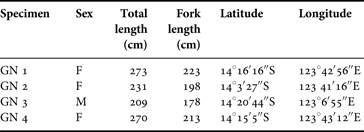
Four individuals of Carcharias taurus (three females and one male) were caught in the approximate vicinity of Browse Island (14°6′30″S 123°32′50″E) in the south-eastern corner of the MoU Box (Table 1 and Figure 1), on demersal longlines set at depths of 50–90 m. Fishers identified the sharks as hiu lapis gigi, which translates to ‘layered tooth shark’, and matched the species to C. taurus when shown an identification guide (Last & Stevens, Reference Last and Stevens2009). Total lengths ranged from 209 cm (the only male specimen) to 273 cm (Table 1), suggesting that all individuals were adults (Bansemer & Bennett, Reference Bansemer and Bennett2011).
Sex, lengths and geographical coordinates for each recorded specimen of Carcharias taurus in the MoU Box, Timor Sea.
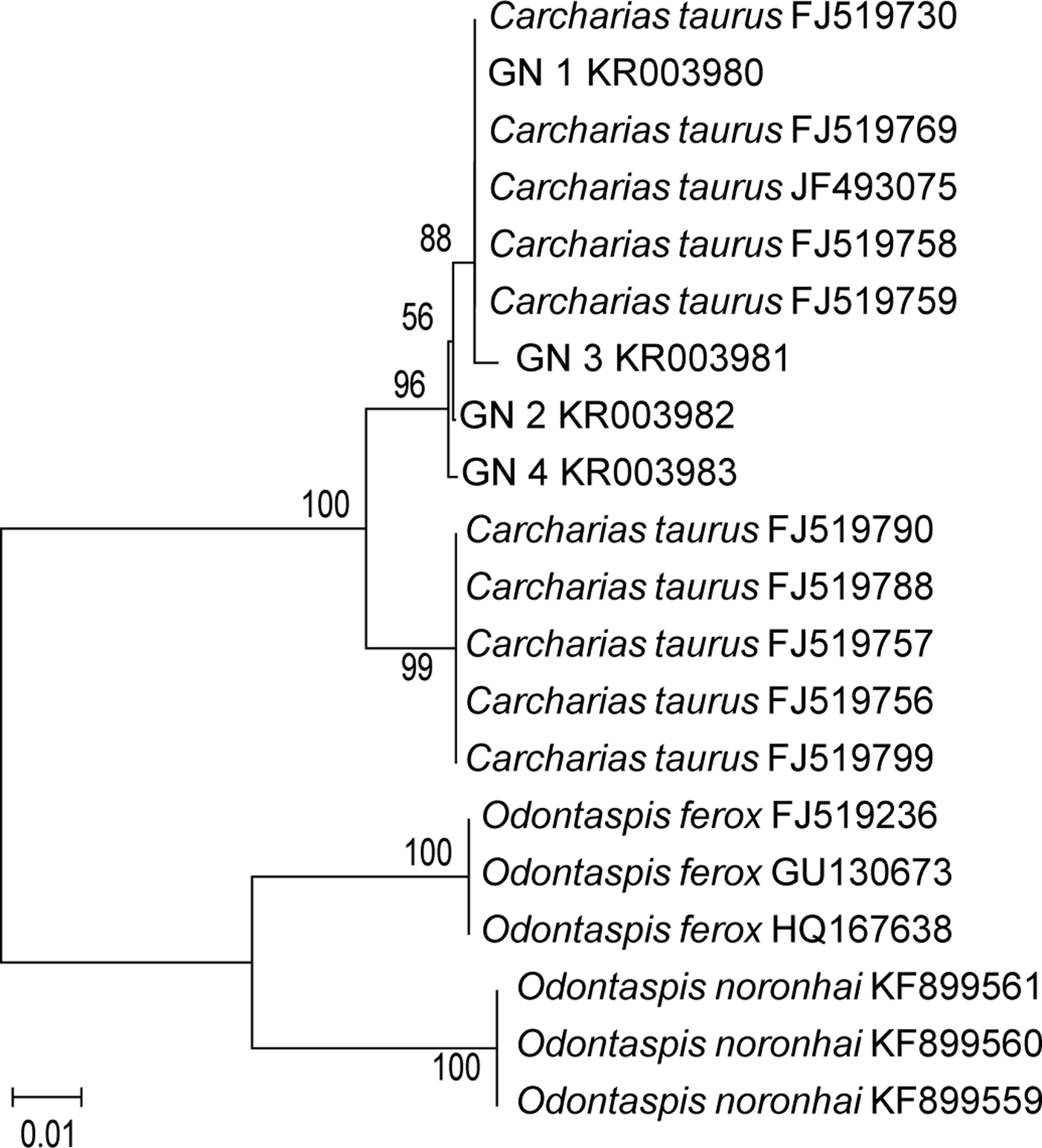
The obtained sequences were unambiguously identified as C. taurus by the BOLD search engine, yielding matches with sequences of C. taurus deposited in BOLD ranging from 99.66 to 100%. The final alignment used for phylogenetic reconstruction included 591 unambiguously aligned positions, including 96 variable sites and 95 parsimony informative sites. Within the phylogenetic reconstruction all individuals were grouped with 100% bootstrap support with other C. taurus sequences (Figure 2).
Neighbour-Joining tree showing the placement of Carcharias taurus samples within a phylogeny of the family Odontaspididae. All sequences obtained in this study are nested within sequences of C. taurus and are grouped with sequences of this species with 100% bootstrap support. Internal branch support values represent 1000 bootstrap pseudo-replicate datasets. The tree was mid-point rooted for purposes of clarity. Scale bar represents number of changes per base pair.
Carcharias taurus is listed as Vulnerable globally, as Near Threatened in Western Australia and as Critically Endangered in eastern Australia (Pollard & Smith, Reference Pollard and Smith2009). The New South Wales government declared C. taurus a protected species in 1984, making it the first shark species in the world to be legally protected. Carcharias taurus is now protected in all Australian states through fishery legislations and in Commonwealth waters via the Environmental Protection and Biodiversity Conservation Act (1999). The MoU Box forms part of Australia's Commonwealth waters and, as such, falls under the jurisdiction of the federal government. Since C. taurus is a protected species in Australian waters, their protection should extend to the remote reefs of the MoU Box. As with the species recently listed in Appendix II of the Convention on International Trade in Endangered Species of Wild Fauna and Flora (the porbeagle, oceanic whitetip and hammerhead sharks and manta rays), ensuring the protection of this species in the MoU Box will present challenges not only due to the remoteness of the reefs, but also because of the agreement with Indonesia that allows traditional fishing by Indonesian fishers.
It is unknown whether C. taurus within the MoU Box are part of the Western Australian population or whether they belong to a separate demographic stock. Previous population genetic studies on C. taurus suggest that there is negligible migration between the populations along the eastern and western coasts of Australia (Stow et al., Reference Stow, Zenger, Briscoe, Gillings, Peddemors, Otway and Harcourt2006; Ahonen et al., Reference Ahonen, Harcourt and Stow2009). However, within eastern Australia, individual C. taurus have been observed undertaking large-scale unidirectional movements of over 1100 km (Bansemer & Bennett, Reference Bansemer and Bennett2011). If the individuals to the far north of Western Australia are part of a separate, geographically isolated demographic unit, there would be reason for concern over their conservation status, given the species’ heavily K-selected life history with only two pups every other year (Bansemer & Bennett, Reference Bansemer and Bennett2009) and regular fishing pressure at Browse Island and surrounding reefs (Momigliano et al., Reference Momigliano, Jaiteh, Speed, Stow, Holwell and Maclean2015). An assessment of the genetic population structure of C. taurus on the western coast of Australia is recommended to provide insight on the appropriate spatial scale of management for this species in Western Australia's Exclusive Economic Zone.
ACKNOWLEDGEMENTS
We gratefully acknowledge the fishers whose time and efforts made this study possible. We thank the Indonesian Biodiversity Research Centre for lab space to analyse tissue samples. Data collection and analysis were conducted under ethics permits 2012/010 and O2484/12, respectively, to V. Jaiteh, Indonesian Research Permits #13/EXT/SIP/FRP/SM/I/2013 to V. Jaiteh and #03B/TKPIPA/FRP/SM/III/2014 to P. Momigliano, issued by RISTEK Indonesia. This study was funded by the Department of Biological Sciences at Macquarie University, the Sea World Research and Rescue Foundation (project SWR/7/2013) and by the Prime Minister's Australia Asia Endeavour Award.