Introduction
The vestibular aqueduct is a canal in the otic capsule of the temporal bone. It contains the endolymphatic sac and duct and is therefore considered a vital element of inner ear pressure and fluid homeostasis.Reference Sugiura, Naganawa, Ishida, Teranish, Nakata and Yoshida 1 – Reference Ciuman 3 The endolymphatic sac and duct together with their physical restriction have been implicated in the pathogenesis of inner ear dysfunction, such as the sensorineural hearing loss and vertigo seen in Ménière's disease.Reference Sugiura, Naganawa, Ishida, Teranish, Nakata and Yoshida 1 – Reference Ciuman 3
The association between hearing loss and an enlarged vestibular aqueduct (with associated enlarged endolymphatic sac and duct) has been named the large vestibular aqueduct syndrome.Reference Valvassori and Clemis 4 – Reference Emmett 6 It is the most common structural cause of sensorineural hearing loss in childhood, and often occurs in association with other inner ear anomalies or systemic syndromes.Reference Sugiura, Naganawa, Ishida, Teranish, Nakata and Yoshida 1 , Reference Valvassori and Clemis 4 , Reference Lin, Lin, Kao and Wu 5 , Reference Swartz, Hansberger and Mukherji 7 Conversely, many studies have reported a smaller vestibular aqueduct width in Ménière's disease patients.Reference Sugiura, Naganawa, Ishida, Teranish, Nakata and Yoshida 1 – Reference Ciuman 3
Studies have investigated the relationship between vestibular aqueduct diameter and various aspects of hearing loss.Reference Madden, Halsted, Benton, Greinwald and Choo 8 , Reference Lai and Shiao 9 The significance of the nature of this relationship lies in its implications for the pathogenesis of hearing loss. There are many theories regarding the pathogenesis of large vestibular aqueduct syndrome, including the hyperosmolar reflux theories and back pressure wave theories.
This review aimed to determine the exact nature of the relationship between vestibular aqueduct diameter and an aspect of hearing loss, pure tone average: the average frequency at 0.5, 1 and 2 kHz. Poiseuille's law states that flow and/or change in pressure is proportional to the fourth power of the radius of a cylindrical pipe. This review sought to investigate whether this law explains the relationship between hearing loss and vertigo symptoms in such conditions as Ménière's disease and large vestibular aqueduct syndrome.
At the outset, it was postulated that, because of Poiseuille's law, the pure tone average would demonstrate a linear relationship with vestibular aqueduct diameter regardless of measurement site (i.e. external aperture or midpoint).
Materials and methods
In order to determine the nature of the relationship between vestibular aqueduct diameter and hearing loss, a literature review was conducted with the objective of performing a meta-analysis.
Data sources and search strategy
A comprehensive search was undertaken of the Allied and Complementary Medicine (‘AMED’), British Nursing Index (‘BNI’), Cumulative Index to Nursing and Allied Health (‘CINAHL’), Embase, Health Business Elite, Health Management Information Consortium (‘HMIC’), Medline, PsycInfo and PubMed databases.
The search strategy, which included key words and associated medical subject and Emtree headings, was: ‘(large* OR wide* OR enlarg*) AND (vestibular aqueduct*) AND (diameter* OR width) AND audiogram’.
There were no limits or filters placed on the searches to minimise bias due to time, language or context. The references of all articles were reviewed, as were personal books and files. Authors were contacted for clarification when required.
Inclusion criteria
The literature search included articles reporting the vestibular aqueduct diameter at either the external aperture or the midpoint, together with either (1) the respective pure tone average (i.e. the average hearing sensitivity at 0.5, 1 and 2 kHz) or (2) the raw data at these frequencies.
Statistical analysis
This was guided by input from a senior medical statistics lecturer at a university teaching hospital (see Acknowledgements).
Data were analysed using the Statistical Package for the Social Sciences version 16.0 software program (SPSS Inc, Chicago, Illinois, USA), including three-dimensional general linear models.
Results
Study selection
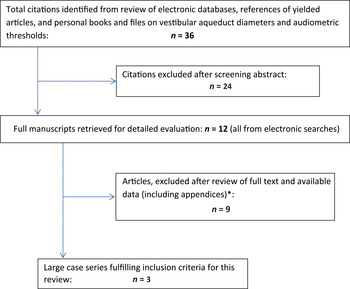
The literature search yielded 36 citations. Twelve of these were considered potentially eligible for inclusion in the review, based on the abstract and/or full text (Figure 1). Further evaluation of the full manuscripts excluded nine studies.Reference Wan, Guo, Xie, Liu, Chen and Gong 10 – Reference Campbell, Adunka, Zhou, Qaqish and Buchman 18
Study selection process. *No width or diameter measurements with respective audiometry data (either as pure tone averages or raw hearing thresholds).

Study characteristics
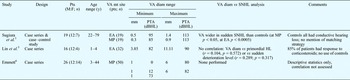
Three articles were included in the review. These were all large case series reporting a total of 61 patients' vestibular aqueduct diameters and pure tone averages (or the respective audiometric thresholds from which this average could be derived) (see Table I).
Included studies assessing vestibular aqueduct diameter and audiometric threshold

Pts = patients; M = male; F = female; y = years; VA = vestibular aqueduct; mt = measurement; diam = diameter; PTA = pure tone average; SNHL = sensorineural hearing loss; EA = external aperture; MP = midpoint; HL = hearing loss
One study evaluated the vestibular aqueduct diameters of patients with unilateral, sudden, sensorineural hearing loss, together with those of 47 control subjects.Reference Sugiura, Naganawa, Ishida, Teranish, Nakata and Yoshida 1
The second study investigated the effect of corticosteroids on the audiograms of patients with large vestibular aqueduct syndrome.Reference Lin, Lin, Kao and Wu 5
The final study was a case series of patients with normal and large vestibular aqueducts, with and without sensorineural hearing loss.Reference Emmett 6
Descriptive statistics
The vestibular aqueduct diameters included in the analysis ranged from 0.3 mm at the midpoint (pure tone average, 85 dBHL) to 11.11 mm at the external aperture (pure tone average, 90 dBHL). Hearing as assessed by pure tone average ranged from 0 dBHL (in two patients with vestibular aqueduct diameters of 1 and 4 mm, variously, at the midpoint) to 116 dBHL (in a patient with a vestibular aqueduct diameter of 7.78 at the external aperture). The mean pure tone average was 78.36 dBHL (standard deviation (SD) 25.46 dBHL) and the mean vestibular aqueduct diameter was 3.71 mm (SD 2.57 mm).
Meta-analysis
Data were analysed to test the effect of interaction between vestibular aqueduct diameter (measured in mm) and pure tone average (measured in dBHL). A linear relationship was found: the pure tone average threshold (beta) increased by 6 dBHL per unit of vestibular aqueduct diameter (95 per cent confidence interval (CI) = 2–10 dBHL; p = 0.003).
Discussion
Principal meta-analysis findings
This review represents the largest correlation of vestibular aqueduct diameter and pure tone average data published to date. Table I summarises the meta-analysis of single institution case series. A linear relationship was observed between vestibular aqueduct diameter and pure tone average, with a projected increase of 6 dBHL per unit of vestibular aqueduct diameter (95 per cent CI = 2–10 dBHL; p = 0.003). The vestibular aqueduct diameter measurements included in the individual series, and in the combined analysis, were taken both at the external aperture and at the midpoint. The derived dose-dependent relationship supports consideration of endolymphatic flow and/or pressure change as aetiological factors in sensorineural hearing loss.
Strengths and limitations
The strength of this meta-analysis lies in its clinically relevant and focused question. Information bias was reduced by utilising comprehensive searches of many data sources. Articles in languages other than English were considered, and complete records were inspected. The meta-analysis was homogeneous in that all data were from large, single-centre case series of patients with sensorineural hearing loss.
This meta-analysis is the largest of its type to date, which increases its power. The inclusion criteria set out at the beginning of the review were strictly adhered to, thereby minimising selection bias. The level of statistical significance of the correlation was high, and although the confidence intervals of the derived beta were wide, they did not reach zero.
This meta-analysis does have some limitations, including possibly the heterogeneity of the series, which ranged from infants to the elderly, with hearing thresholds ranging from normal to profound hearing loss. This could potentially introduce error. However, all patients had sensorineural hearing loss, and the comprehensiveness of this meta-analysis is also a strength. The range of vestibular aqueduct diameters was also very wide. The case series used CT scanning to assess vestibular aqueduct diameters, although magnetic resonance imaging is considered more accurate in assessing endolymphatic sac and duct diameter.
Comparison with other studies
The range of vestibular aqueduct diameters and pure tone averages identified by this review is wider than that of other studies investigating vestibular aqueduct diameter and sensorineural hearing loss. Other studies have attempted to assess the correlation between vestibular aqueduct diameter and aspects of sensorineural hearing loss.Reference Sugiura, Naganawa, Ishida, Teranish, Nakata and Yoshida 1 , Reference Lin, Lin, Kao and Wu 5 , Reference Madden, Halsted, Benton, Greinwald and Choo 8 , Reference Lai and Shiao 9 , Reference Campbell, Adunka, Zhou, Qaqish and Buchman 18 One study found wider vestibular aqueduct diameters in sudden sensorineural hearing loss patients than in controls, while other authors found a correlation between vestibular aqueduct diameter and progressive hearing loss, and also between vestibular aqueduct diameter measured at the external aperture and hearing loss frequency and severity.Reference Sugiura, Naganawa, Ishida, Teranish, Nakata and Yoshida 1 , Reference Madden, Halsted, Benton, Greinwald and Choo 8 , Reference Lai and Shiao 9 , Reference Madden, Halsted, Meinzen-Derr, Bardo, Boston and Arjmand 12 In contrast, smaller studies have failed to detect a correlation between hearing loss and endolymphatic sac or duct size.Reference Gopen, Zhou, Whittemore and Kenna 17
The current meta-analysis is unique in finding a highly statistically significant, linear relationship between pure tone average (in dBHL) and vestibular aqueduct diameter (in mm) measured both at the external aperture and the midpoint. A smaller study found no correlation between vestibular aqueduct midpoint diameters and audiometric parameters.Reference Campbell, Adunka, Zhou, Qaqish and Buchman 18 Correlation at both sites is explained by Poiseuille's law. There is also a strong index of biological plausibility related to observation of flow.
Clinical implications
This review and meta-analysis gives support for sudden sensorineural hearing loss treatment modalities designed to alter the flow or pressure within the membranous labyrinth. These include such treatments as diuretics, corticosteroids and betahistine.
These types of medical treatment have been widely recommended as preferential to decompressive (i.e. pressure-relieving) surgery of the endolymphatic sac in patients with large vestibular aqueduct syndrome and Ménière's disease.
However, this review in itself found no new evidence to support medical treatment over surgical or vice versa.
Conclusion
This review's meta-analysis is the first and largest of its type to date. Similarly to other studies, it found a correlation between vestibular aqueduct diameter and an aspect of hearing loss, namely (in this review) pure tone average. However, the review is unique in finding a linear relationship irrespective of site of vestibular aqueduct measurement. Combined analysis of external aperture and midpoint data resulted in an indeterminate ‘unit’ of vestibular aqueduct diameter which correlated very significantly with the pure tone average. Future research will seek to determine this unit, which could be used to ascertain prognosis.
Acknowledgements
This review acknowledges the contributions of: Mr Liam Flood, Consultant ENT Surgeon, James Cook University Hospital, Middlesbrough; Dr Jan Poloniecki, Senior Lecturer in Medical Statistics, St George's University Hospital, London; and Professor Michael Gleeson, Consultant in Skull Base Surgery, Guy's, King's and St Thomas' University, London, UK.