When Dr. Watson first meets Sherlock Holmes in A Study in Scarlet, the former is an itinerant medical veteran of the Second Afghan War who, sick and rootless, without “kith or kin” in England, is naturally drawn to London, “that great cesspool into which all the loungers and idlers of the empire are irreversibly drained” (6; ch. 1). Lacking emotional ties, physical strength, and purpose of any real kind, Watson seems to demonstrate the “feverish restlessness” and “blunted discouragement” that Max Nordau described as degenerative symptoms of the age. Watson's identification with urban refuse of the empire, together with his metaphor of the metropolitan landscape as cultural sewer, suggests Nordau's degenerative “feeling[s] of immanent perdition and extinction” (2) and emphasizes both the pervasiveness of modern social decay and the destructive potential of insalubrious influences that lurk within the civilized world as much as they do on its remote peripheries.
Although, in his association with Holmes, Watson not only will remove himself from these influences but also actively help to cleanse late Victorian England of its morally most unsavory and dangerous elements, the threat of contagious degeneration is never very far away even in the business of criminal detective work. The dandyish Holmes himself is subject to depression, has a taste for the Romantic composers, and has an addiction to cocaine that compromises a lifestyle otherwise remarkable for its “temperance and cleanliness” (Study 1; ch. 2). In what follows, I will suggest that the stories resist the contamination of degeneracy, less via the sanitizing influence of the ordered, reasoning mind, than through the more obscure workings of genius, something which in turn anticipates the spiritualist focus of Doyle's later work. Understood as a resurgence of peculiar ancestral talents, genius invokes the figure of the savage to suggest, not contemporary moral decline, but rather the recovery of mental riches stored in the subliminal mind and therefore normally unavailable to modern conscious thought. Holmes's genius, I will argue, is atavistic rather than degenerative, intuitive rather than rational, and as worthy an object of psychical investigation as are the strangest phenomena of the séance room.
I. Introduction: Atavism, Degeneration, and Literary Realism
Once Watson meets Holmes and agrees to share accommodation with him, he begins to recover respectability and civility. Suddenly the “lowest portions of the city” (Study 13) have nothing to do with him, and the attention that had been dangerously “objectless” becomes focused on the character and methods of his companion. Watson then becomes healthier in mind as well as body, and he transmutes into the practical-minded Englishman whose personality provides a narrative counterweight to Holmes's own often dreamy eccentricity. Despite his peculiar character, it is no surprise that Holmes has a healing effect on Watson. The detective's extraordinary powers of ratiocination, his skill at interpreting evidence, and his ability to empty his memory of superfluous cultural knowledge so as to retain only a perfectly ordered collection of facts provide an antidotal influence to the aimlessness and excessiveness of Nordau's fin de siècle. For Holmes, burdening the mind with “small matters” like Copernican theory jumbles thought so much as to risk mental torpor (15). Nordau's degenerate, like the formerly dissolute Watson, is the antithesis of Holmes, being unable “to fix his attention long, or indeed at all, on any subject, and [being] equally incapable of correctly grasping, ordering, or elaborating into ideas and judgments the impressions of the external world” (21).
The healing of Watson obviously has its counterpart in the healing of the city as its criminal underworld is exposed and frustrated by the penetrating detective mind.Footnote 1 In narrative form, correspondingly, the stories themselves conduct a kind of self-purging of sinister or barbarous elements. The realism of detective fiction, refusing to shy away from the most brutal elements of modern life and truthfully recording what it sees, encounters and overcomes that fiction's own attraction to the Gothic: to the horrific, the concealed, and the (often) apparently supernatural. The dark alleyways and subterranean passages of criminal London, hidden behind and beneath the houses of the respectable and well-to-do as well as in the poorest and most desperate parts of the city, are exposed to the light of discovery that shines from 221B Baker Street. Yet the Gothic is not fully expelled from the Holmes stories. For one thing, the miraculous findings of deductive reasoning seem sometimes so improbably achieved that the work of ratiocination blurs with mysticism; Holmes may be a logical genius, but he also has a divinatory gift. Moreover, the stories tend to linger distractingly upon Gothic tropes like regression, degeneration, and superstition. The Gothic tale, as Nils Clausson points out, “questions and even subverts the aspirations of criminal science to subject crime and criminality to scientific analysis” (63).
Beyond a “mongrelizing” of genre, however, what this apparent blending of Gothic and realist forms may point to is the difficulty of sustaining Auguste Comte's vision of civilization advancing under the banner of positivist science.Footnote 2 The image of the savage within, identified either in the form of pervasive cultural and physiological degeneracy, as it is by Nordau, or in instances of atavistic throwback such as those we shall see described in Cesare Lombroso's criminal-anthropology, makes Comte's account of the mind's emergence into a post-theological and post-metaphysical state of enlightenment seem overconfident. In late nineteenth-century realism, resurgent savage man is everywhere, notwithstanding all the efforts of scientifically-minded characters and narrators to measure and manage him. This perhaps explains why, for Nordau, literary realism is a contradictory form of expression: on the one hand it seems to embody some of the worst features of cultural decline, and on the other hand it is, methodologically speaking, closely allied with the scientific pursuit of natural truth that offers some hope of reversing social decay. Doyle's “realist” stories intrude the figure of the primitive into the activity of what Victorians perceived as the most evolutionarily advanced nervous and social networks – into mental genius and into civilized modernity. They do so not only by extending scientific investigation into the realm of the supernatural but also by recognizing how mystical states of mind enhance empirical observation and rational deduction.
In thus expanding the territory of literary realism, Doyle's stories engage critically with contemporary evolutionary science and pseudo-science as they distinguish between degeneration and one of its supposed manifestations: atavism. Dégénérescence is, as a partly hereditary and partly environmentally-determined process of decay, what the French psychiatrist B.A. Morel defined as “morbid deviation from an original type” (Chamberlin 265). The condition manifests itself in the abnormal features, or “stigmata,” of inheritable physical, mental, and moral disease that are carried, often invisibly, through succeeding generations. These features are sometimes brought into prominence by particular environmental circumstances, but they often remain concealed for long periods of time, surfacing as a variety of individual ailments that collectively promise to undermine social order and the health of the nation as a whole. Atavism, which was central to the Italian school of positivist criminology, describes the unexpected reappearance in an organism of ancestral characteristics, often very remote ones. Although atavism is appropriated by the language of degeneration, and, in particular, Lombroso's taxonomy of criminal stigmata, it does not in itself carry any implications of pervasive biological and social decline since, on the contrary, it highlights the anomalous status of the throwback. In The Criminal, which he wrote in order to bring England up-to-date with continental developments in criminal anthropology, Havelock Ellis endeavors to undo this distinction, defending the use of the term “atavism” to describe the progressive degeneration within families and the “rising flood of criminality” that occurs as a consequence (371). The argument that “degenerescence and atavism are two absolutely distinct facts” (sic), he objects, is disproved when we consider that reversion to older and lower physical, mental, and (especially for criminals) social states – all of which are increasingly visible conditions in the diseased modern nation – can very probably be said to have a pathological cause and that pathology itself “is the science of anomalies” (252–53). For Doyle, however, a member of the Society for Psychical Research and an increasingly committed spiritualist, the difference is crucial. His stories show how the persistence of a primitive mind and the virtually inexplicable powers it demonstrates, even alongside its capacity for violence, testify to human evolutionary potential as much as to our savage past and that past's lasting expression in a crime-infested present. The instances of atavism in these stories encourage us, not just to read the tendencies of prehistoric man into the social problems of late nineteenth-century England, but also to take the scientific study of human faculties beyond the known material limits to knowledge and experience.
II. The Genius of the Subliminal Mind
Despite the healthier state of mind it encourages in him, Watson's life with Holmes and his involvement in the detective's work is not without its moments of doubt and distress. In the early days, he retains the suspicion of a séance room skeptic, as “there still remained some lurking suspicion in my mind . . . that the whole thing was a prearranged episode, intended to dazzle me” (Study 23; ch. 3). Later in their career together, this uncertainly about Holmes's genuineness develops into ambivalence about the moral safety of crime-solving work itself. In “A Case of Identity,” Watson observes that the stories of criminal violence, often domestic, reported in the papers are “rude, bald, and vulgar,” thus suggesting “realism pushed to its extreme limits.” His fear is that the work of criminal detection is procedurally allied with the lowest form of realist narrative – sensation fiction – whose Gothic thrills, imposed upon familiar domestic settings, satisfy the contemporary appetite for representations of the morally ugliest and most brutal symptoms of modern life. Where he had once doubted the authenticity of Holmes's methods, speculating that such arch positivism could be only rehearsed and pretended observation, he now feels corrupted by his own involvement in a business that is so readily commoditized for a sensation-hungry public. In either case, realism, the narrative method that (like Holmes's strategies of detection) creates a true picture by recording and ordering a multitude of facts, risks degenerating into mere spectacle. Holmes, however, calms Watson by insisting that “there is nothing so unnatural as the commonplace,” thus distinguishing the true job of criminal detection from the sham realism of sensation fiction. Police reports and newspaper stories lay more stress “upon the platitudes of the magistrate than upon the details, which to an observer contain the vital essence of the whole matter” (Holmes 75). In its true incarnation (as detective fiction), then, realism is a bulwark against the degenerate literary forms and appetites that affect the age.
Despite being published four years before the English edition of Degeneration, Doyle's story thus seems to anticipate and answer Nordau's assault on realism as the literary manifestation of pervasive nervous and cultural decay in the late nineteenth-century. Nordau accuses realism of weak mindedness. Its impressionistic sacrificing of the concept to mere sensory stimulation, he accuses, fails to engage the higher centers of the brain in which true knowledge of phenomena is produced through reason and judgment. Moreover, through the vehicle of “milieu,” realist novelists have the arrogance to theorize about and experiment with the impact of environment on character without any of the systematic assembling of facts that has been undertaken in biological science and criminal anthropology. The result, he claims, is not only an erroneous but also a decadent portrait of the social world in which sexual pathologies, brutal behavior towards one's fellow creatures, and hysteric disorders become the norm. “The would-be ‘realist,’” he pronounces, who “sees the sober reality as little as a superstitiously timid savage,” manifests the primitive mental activity and intellectual and moral laziness of a generation that is witnessing the end of civilization (495). For Doyle's detective hero, on the other hand, the careful assembling of facts without selection or discretion, facts that ultimately announce the truth on their own, is precisely the means by which criminal and moral insanity can be exposed and punished.
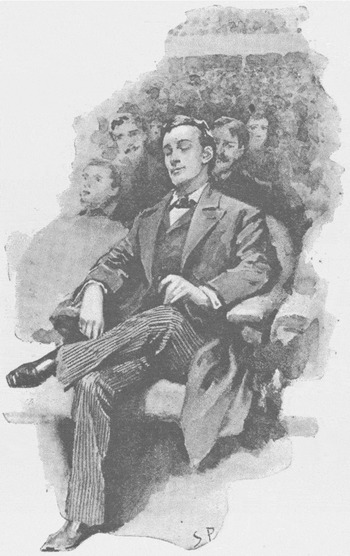
But of course this is not really how Holmes finds his man, nor does it accurately describe his character. Holmes could not be less like his fact-loving literary forefather, Thomas Gradgrind. For one thing, he has a dreamy appreciation of art and music (Figure 10). Music, in particular, he proposes, citing Darwin, calls up not exact knowledge but rather “vague memories in our souls of those misty centuries when the world was in its childhood” (Study 42; ch. 5). Secondly, the bare facts alone do not lead to his divining of the meaning behind the mystery. Indeed, Watson admires the way in which Holmes can unravel a detective puzzle without leaving his room, where other men who have seen every detail surrounding it remain baffled, and Holmes describes the rules of deduction that enable him to do so as “intuitive” (20; ch. 2). Apparently having intuited Watson's earlier skepticism about his methods (along with the probable story behind the murder), he then jokingly compares his mysterious deductive powers to the “conjurer's trick.” Hence while Watson praises Holmes for bestowing the status of “exact science” (36; ch. 4) on criminal detection, the latter betrays how his methods employ something of the psychically supernormal even if, perhaps, like even the most genuine séance room, they inevitably also contain something of the theatrical.
Sidney Paget, “All afternoon he sat in the stalls.” Illustration from “The Red-headed League.” Strand Magazine (July-Dec. 1891): 199.

“A Case of Identity” opens with Holmes's suggesting that the supernormal interpretative powers of the detective, if properly realized, would generate knowledge and appreciation of the marvels of nature in ways that far outstrip any awareness of the world that existing literary conventions are capable of producing. To really grasp criminal goings-on in London, he proposes, he and Watson would need to
fly out of that window hand in hand, hover over this great city, gently remove the roofs, and peep in at the queer things which are going on, the strange coincidences, the plannings, the cross-purposes, the wonderful chains of events, working through generations, and leading to the most outré results, it would make all fiction with its conventionalities and foreseen conclusions most stale and unprofitable. (Holmes 75)
The fantastic ability to see events not only from the bird's eye but from the perspective of an airborne voyeur would, in turn, expose not the moral bleakness of a city awash in criminal activity but the marvelous and the extraordinary realities whose existence it is beyond the capacity of the ordinary senses to grasp. Such marvels belong, he suggests, to evolutionary history, whose manifold events are too tiny and too many for us to perceive. These realities are also psychologically outré: excessive, improbable, beyond the pale of what can be known empirically to the mind. Although detectives usually cannot fly or lift off rooftops, the best of them might, like Holmes himself, be gifted with a form of intuition that analogously enables them to see more than the human faculties normally make possible.
Such supernormal vision belongs to the class of remarkable psychological phenomena (including clairvoyance, spirit materializations, and thought transference) investigated by members of the Society for Psychical Research. The Society was formed in 1882 in order to investigate “amid much delusion and deception, an important body of remarkable phenomena, which are prima facie inexplicable on any generally recognized hypothesis, and which, if incontestably established, would be of the highest possible value.”Footnote 3 Despite the findings of some key members in its early decades that the empirical evidence of human immortality remained inconclusive at best,Footnote 4 the Society endeavored to lift investigations of spiritualism beyond the simple testimony of believers, on the one hand, and the prosecuting actions of the law on the other, so as to make the study of occult phenomena genuinely scientific. This was particularly the case when, after 1866, many disaffected spiritualists abandoned the organization, leaving it largely in the hands of its intellectual founders. Although the attitudes of these and later prominent members ranged from steady skepticism, like that of Henry Sidgwick and Frank Podmore, to profound spiritualist faith, like that of Alfred Russel Wallace, Fredrick Myers, and Doyle himself, the members shared a frustration with the limiting of natural-scientific inquiry to the material world, and they sought to expand its framework to include non-material objects and events (Oppenheim 111–58).
Doyle himself became a member of the society in 1891, although his interest in spiritualism developed a good decade earlier. Despite his reservations about the anti-sensationalism of the Society's investigative work, which, he said, sometimes undermined its effectiveness, and although he later resigned his membership over what he considered to be the organization's betrayal of the spiritualist cause, he maintained even in his later life that the Society did “splendid work” that “helped me to shape my thoughts” (New Revelation 39). Such work provides the intellectual complement to the ideological struggles of spiritualism itself, since the latter, he proposes in The History of Modern Spiritualism, challenges the nearsightedness of conventional nineteenth-century scientific intelligence, both because spiritualism represents “a survival of savagery” and because it demands rethinking of the parameters of scientific investigation (1: 181). Doyle's spiritualist writings postdate nearly all of the Holmes stories; however, his emphases on legitimating the study of supernormal phenomena in mainstream science and on the primitive character of mystical experience suggest the interpretive preoccupations and atavistic mental talents of his detective hero as much as they advocate for spiritualist faith.
In the decade that Holmes became a celebrity, Myers was exploring the notion of a subliminal self whose powers might include thought-transference, precognition, and the ability to communicate with disembodied spirits. Its more mundane task, he suggested, was to preserve all the sensory experiences that an organism expels from primary consciousness in a subliminal memory. When data from the subliminal self leaks into the supraliminal mind or conscious threshold, he proposed, it can introduce either retrocognition, the “knowledge of the past extending back beyond the reach of our ordinary memory,” or precognition, “knowledge of the future, extending onwards beyond the scope of our ordinary inference.” Such knowledge may be manifest in dreams, telepathy, or clairvoyant perception, and it may include information that extends back beyond that recorded by a single life, in which case it is communicated to the subliminal mind either directly by departed spirits or by objects that retain the trace of those departed souls. These objects are thereby rendered, in language that seems to echo Charles Lyell's reading of the fossil, “luminescent with the age-long story of the past” (“Subliminal Self” 338). When we explore the action of the subliminal self, Myers suggests in Human Personality and its Survival after Bodily Death, we discover both the childish weakness and the profound hidden powers of the human organism. The subliminal mind demonstrates both a readiness to “obey the whims of the hypnotist,” or to succumb to its own self-suggestions in the case of hysteria, on the one hand, and a capacity for fantastic cognition, on the other (1: 45). Curiously, then, this dimension of mind is the source of both the most primitive and the most expansive elements of mental life.
Myers's critics included other members of the Society like Podmore, who was incredulous of much of the supernatural phenomena recorded by his colleagues. Yet in 1895, Podmore defended Myers's theory of the subliminal self against Arthur Pierce's claim that this supposed secondary consciousness was merely a symptom of physiological disorders (such as hysteria) wherein memories and sensations may be suppressed from and then restored to consciousness – the phenomenon called “unconscious cerebration.” We infer as much about physical activity in the brain as we do about mental states, Podmore points out, and therefore the observed facts do not compel us to reduce all mental phenomena to cerebral events. “Subliminal consciousness” may be as useful a way of explaining unusual events in the mind as Pierce's account of overtaxed nerve channels is useful for thinking about what happens in the brain. Podmore then inquires whether abnormal mental states might reveal something about the psychological evolution of human beings. In the subliminal consciousness, he suggests
We come across memories of childhood and many old forgotten things; we [also] come across traces of long lost but once serviceable faculties – telepathy, sense of time, of direction, of weight; we acquire partial control over our bodily functions – digestion, circulation, and the like – which civilized man has learned to acquiesce in as beyond his guidance. . . . [The subliminal consciousness] show[s] us what we have once had, and have not yet wholly lost. (332)
This conjecture is not so very different from Doyle's proposal in The History of Spiritualism that those who are capable of spirit communion may be the few members of the “complex races” (1: 38) who grasp the primitive secrets of our species, thereby explaining why they are often to be found in ruder communities like those of the American provinces (1: 42). Wallace, too, observed that the powers of second-sight are more frequent and energetic in remote, mountainous terrain and among uncivilized races (216).
In his posthumously published Human Personality, Myers speculates that the subliminal consciousness might give us the kind of mental access to automatic functions in our bodies that humans achieved more readily at an earlier evolutionary stage. When inspiration bursts into the mind, he proposes, we come “one step nearer to primitive reality than in that specialized consensus of faculties which natural selection has lifted above the threshold for the purposes of working-day existence” (1: 97). In other words, human evolution has suppressed the agency of the primitive mind by limiting the size and number of portals through which it can penetrate the conscious threshold. Subliminal modes of perception direct us to the “unguessed potentialities from the primal germ” (1: 98). These may take the form of profound inspiration or genius, or they may manifest in hysterical disintegrations of personality, where the ordinary flow of thoughts is paralyzed by an idée fixe, a terror that reaches not only back to childhood fears but to “a prehistoric past” and “the vanished perils of primitive man” (1: 41). Natural selection has repressed these primitive emotions and perceptions, he argues, in order that we can keep the ideas we need for ordinary working, waking life easily within reach. Yet we have glimpses of their power in the form of nervous collapse as well as in that of inspired genius.
Myers thus conceives of genius as a form of automatic mental performance as well as a “flash of the supernormal” onto the supraliminal consciousness (1: 107). The man who is guided solely by ratiocination, the complex work of the supraliminal mind alone, is destined to mediocrity. In linking genius so closely with nervous pathologies like hysteria, he seems to echo Nordau's claim in Degeneration that the inspiration of genius belongs to the same category of nervous pathologies as the inspiration of the mystic. For Nordau, such “hallucinations” are the product of a disturbed mind in which the imagination responds to memory-images rather than sense perceptions, thus permitting the association of ideas to predominate over the higher activities of judgment and reasoning which, in a healthy organism, receive and order these sense perceptions. Epilepsy, hysterical delirium, and the degeneration manifest in mystics – so called “realists,” aesthetes, ego-maniacs, and the morally insane – are all heritable, morbid consequences of this nervous and mental disorganization in which a train of associations leads the mind away from the true realities of the external world towards disturbed and “ghostly presentations” (56). Myers also links genius to mysticism, since he attributes both to the psychical work that goes on beneath the conscious threshold. Yet he argues that supernormal perceptions, rather than being symptoms of nervous exhaustion and moral and cultural decline, are the stuff of currently unimaginable truths accessible only to the subliminal mind.
Myers's emphasis on the atavistic event of genius, the moment of inspiration as an explosion of primitive knowledge into the evolved, civilized psyche, in fact brings him closer to Lombroso than to Nordau, for whom genius represents only one of so many morbid erosions of a healthier type. In his review of Degeneration, Lombroso praises Nordau for identifying how genius is a form of degenerative neurosis, yet he cautions him not to dismiss the extraordinary productions of artistic genius as merely symptoms of mental disease. In The Man of Genius Lombroso, like Nordau, links such gifts of the mind to criminal insanity and mysticism, and he suggests that all three tend to run together in families, thus indicating progressive degeneration of the line. Yet he also argues that both genius and insanity are expressed in an atavistic resurgence of the ancestral mind – whether that of the prophets or occultist of ancient times or to the strange precocious brilliance of present day savages. The powerful, divinatory conceptions of modern-day genius, like the impulsive acts of the insane, “suddenly burst forth” as they did out of the pre-modern minds of prophets, saints, and demoniacs (21) – hence the shared isolation and “hypnotic condition” (63) of the genius and the madman, neither of whom can “be restrained within the bounds of common sense” or to respect immediate realities (170). Lombroso's genius, like Myers's, has a power of divination “which precede[s] all common observation” (35). Given that Lombroso does not miss the opportunity to comment on Nordau's own genius and the “gaps and errors” that inevitably accompany it (in this case his overzealous condemnation of so many great artists), it is hard to imagine that he would not look wryly back upon his own account of the revelatory moment in which he became convinced that the anatomy of delinquent criminals, their “stigmata,” expressed traces of our remote ancestry:
This was not merely an idea, but a revelation. At the sight of that skull, I seemed to see all of a sudden, lighted up as a vast plain under a flaming sky, the problem of the nature of the criminal – an atavistic being who reproduces in his person the ferocious instincts of primitive humanity and the inferior animals. Thus were explained anatomically the enormous jaws, high cheek bones, prominent superciliary arches, solitary lines in the palms, extreme size of the orbits, handle-shaped ears found in criminals, savages and apes, insensibility to pain . . . and the irresponsible craving of evil for its own sake, the desire not only to extinguish life in the victim, but to mutilate the corpse, tear its flesh, and drink its blood. (Criminal Man xiv–xv)
Lombroso's discovery is nothing short of a revelation of genius. Given the proximity of intellectual inspiration to criminal insanity and present-day savagery that he identifies in The Man of Genius, this account suggests his not-so-distant relation to the blood-drinking criminal lunatics who revive the violent instincts of primitive mankind.
The risk of embarrassment by this association perhaps explains why Henry Maudsley endeavors to distinguish between the genius, whose organic variation is “evolutional,” and the madman, whose is “pathological and degenerative” (656). Nonetheless, in arguing for atavism as a principle of variation in breeding that contests that of simple heredity, Maudsley too is forced to link manifestations of genius to primitive ancestry. Atavism, he argues, the “latency or dormancy of ancestral qualities that afterwards wake again to open activity,” is the principle at work in the individuation in the species, whereas the law of heredity determines the preservation of that species’ character (651). If one child in a family should manifest symptoms of insanity, and another of genius, this has less to do with their shared “pathology” than with the “deep-lying potentialities of the family stock” (652). There is scant evidence, he corrects Francis Galton, that genius is hereditary; rather, its rarity suggests that it represents an unstable variation which is corrected by the normalizing and stabilizing influence of heredity.
Any late-century account of heredity and atavism is of course indebted to Darwin's use of instances of anomalous primitive physiology in some humans as evidence of our descent from a lower primate. What he describes in The Origin of Species as “well-known principle of reversion to ancestral characteristics” enables us to reconstruct how our early progenitors looked and behaved (44). Ellis identifies Darwin as the father of criminal anthropology, highlighting the latter's observations in The Descent of Man about the phenomenon of the “black sheep” as well as his suggestion that some of mankind's “worst dispositions . . . may perhaps be reversions to a primitive state” (qtd. in Ellis 253). Much more useful to Darwin's account of human social development than the relatively rare incidents of reversion, however, is the living evidence of our past in the form of present-day savage societies. The amazement that he describes in The Voyage of the Beagle at the “wide difference between savage and civilized man” highlights at once the proximity and the enormous distance between them (195). “Savages,” as Canon Schmitt has put it, are “living mnemonic devices” for Darwin, enabling him to recover the early history of mankind and his subsequent development (the myriad of tiny events that Holmes deems essential to any true understanding of life) while marveling at the fantastic power of natural selection to create civilized scientific observers out of primitive, unreflecting animals (61). If atavism seems disturbingly to create a bridge across this enormous evolutionary gulf, such disturbance can be neutralized, for Darwin, by invoking the absolute alterity of existing savage communities.
However, once savage man is interpolated more aggressively into the civilized world (becoming visible either in the form of the pervasive cultural influence of degeneracy or in the aberrant tendencies of the criminally insane and the intellectually outré), this distance cannot be so easily maintained. The reincarnation of primitive man, hitherto encountered primarily in the figure of the colonial savage, occurs in the late nineteenth-century discourse of degeneration as a socially destructive influence within the civilized world, displayed on the bodies of European criminals in the form of stigmata that in turn linked those bodies to those of the non-European savage (Pick 109–52; Horn 43–51). Late nineteenth-century criminal anthropology thus not only directed scientific investigation to mankind's greater history; it also indicated the enduring human potential for violence and madness as well as for exceptional acts of perception.
III. Intuitive Detective Work: The Hound of the Baskervilles
Crime fiction, like the technologies of fingerprinting and anthropometric analysis that were introduced to police work in the late nineteenth-century, perhaps can be seen to endorse Lombroso's insistently positivist approach to the study of human behavior (Thomas 75–90). Holmes, after all, claims that one can know almost anything about a man “by his fingernails, by his coat sleeve, by his boots, by his trouser-knees, by the callosities of his forefinger and thumb, by his expression, [and] by his shirt-cuffs” (Study 28; ch 3). Yet the maturing of the detective novel is contemporary, not only with the development of criminal anthropology but also with theories of the unconscious mind or subliminal awareness. In The Hound of the Baskervilles, Doyle at once references the interpretive techniques of criminal anthropology and pointedly links the activity of the subliminal mind with atavism. While the supposed agency of some otherworldly diabolical force is exposed as fraud, the man who discovers it is mentally and physically associated with the exceptional mental powers of his criminal opponents.
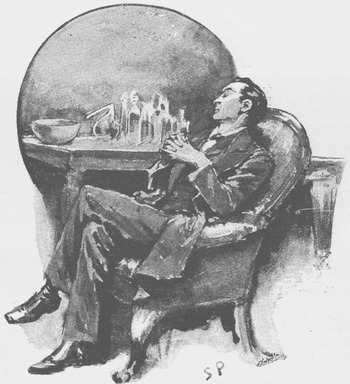
The Holmes of this story – part stand-in omniscient narrator, part scientific experimenter who sets much of the action in motion and then removes himself to watch the results – has “the power of detaching his mind at will” (42; ch. 5), and he removes himself mentally from the world of crime when he is not focused on a case. Here this detachment takes the form of art appreciation rather than an apparently narcotic-induced catalepsy of earlier stories in which he “lie[s] upon the sofa . . . hardly uttering a word or moving a muscle from morning to night” (Study 24; ch. 3). Nonetheless, as the earlier stories already have shown, this apparent split in Holmes between the dreamy bohemian and the “reasoning and observing machine” barely disguises the way in which his subliminal mind also becomes part of the apparatus of detection (“A Scandal in Bohemia,” Holmes 32). One of the qualities that Watson admires about Holmes is that his deductions, while rooted in logical reasoning, are so rapid as to be “swift as intuitions” (“The Speckled Band,” Holmes 153). What turns reason into intuition, Holmes himself has explained to a client in A Study in Scarlet, is “the train of thoughts [that] run so swiftly through my mind that I [arrive] at the conclusion without being conscious of intermediate steps” (20; ch. 2). His description of the work done by subliminal consciousness seems to challenge a distinction that William Benjamin Carpenter makes between, on the one hand, the withdrawal from external reality and the surrender of will to automatic activity and, on the other hand, the volitional “vigorous mind” (640). Holmes's extraordinary reasoning powers are intuitive because they belong to the subliminal mind as much, if not more, than they do to the conscious thoughts (Figure 11).
Sidney Paget, “I found Sherlock Holmes half asleep.” Illustration from “A Case of Identity.” Strand Magazine (July-Dec. 1891): 255.

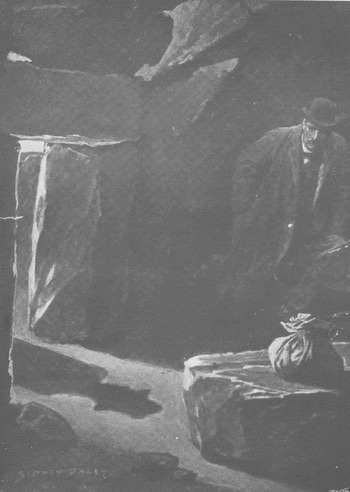
In The Hound of the Baskervilles, such mental magic becomes quite explicitly linked with the theme of reversion. Doyle transports his detective hero from Baker Street to the Devonshire moor where, unbeknownst to Watson, he hides out to observe the goings on of the various suspects in the murder of Sir Charles Baskerville. Here, in the company of at least one criminal savage – the escaped convict – he is also camping amid the ruined monuments of pre-historic human culture (Figure 12). The Neolithic wigwams out of which Watson expects to see crawl a “skin-clad, hairy man” instead house Holmes (77–78; ch. 8). This discovery is especially peculiar because it substitutes the detective for the animal-like criminal who himself seems a throwback to the “old savages” of the Moor: the convict has “an evil yellow face, a terrible animal face, all seamed and scored with vile passions. Foul with mire, with a bristling beard, and hung with matted hair, it might well have belonged to one of those old savages who dwelt in the burrows on the hillsides” (97; ch. 9). Ironically, in the opening chapter of the novel, Dr. Mortimer expresses his astonishment at the shape of Holmes's skull, which is oddly “dolichocephalic” and which exhibits “well-marked, superorbital development” (8; ch. 1). A follower of the French criminologist Alphonse Bertillon, who developed the anthropometric system for criminal identification, Mortimer cannot help linking cranial morphology to individual development and disposition. He is so struck by the Neolithic characteristics of the detective's skull, features that seem remarkable in a man with such mental accomplishments, that he remarks that a cast of it would provide a valuable addition to an anthropological museum.Footnote 5
Sidney Paget, “The Shadow of Sherlock Holmes.” Frontispiece from A. Conan Doyle, The Hound of the Baskervilles (London: George Newnes, 1902): n. p.

Despite this possibility that, in Holmes's skull, science might find evidence for the atavistic physiology of genius as compelling as that for the stigmata of criminal violence, we are initially more inclined to pair the detective with Mortimer so as to, as Holmes himself puts it, join the methods of the “man of science” with those of the “specialist in crime” (7; ch. 1). Together they are capable of deducing the whereabouts of the convict and any link he might have with the Baskerville murder. Indeed, Mortimer's reputation as a medical scientist provides the first clue to the mystery. We have been expecting the convict to emerge from one of these burrows, not only because Watson and Sir Henry have seen his light on the moor but also because we were alerted to the theme of ancestral throwback early in the story. Dr. Mortimer, we are told even before we meet him, is the author of essays on comparative pathology entitled, “Is Disease a Reversion?,” “Do We Progress?,” and “Some Freaks of Atavism” (6; ch. 1). His professional résumé will prove more significant than even Holmes suspects, since the fact eventually emerges that Sir Charles's killer is himself a Baskerville descendent, marvelously identical in all his facial features as well as his brutal character to the seventeenth-century Sir Hugo Baskerville, whose crime against a local beauty and subsequent terrible death is the source of the strange legend of the murderous hound. It turns out, then, that the biological fact of ancestral reversion reveals the truth of the Baskerville curse even while it empties that legend of supernatural content. But strangely (and in plot terms, rather superfluously), Holmes must set up camp in the ancient landscape and live like prehistoric man in order to discover this uncanny truth.
When he exposes the villain, Holmes declares that the study of atavism in old family portraits might convert him to a belief in reincarnation. The improbability that he would turn spiritualist perhaps suggests that his appearance, magician-like, in place of the criminal savage, is merely a conjuring trick on Doyle's part to enhance narrative suspense rather than a genuine effort to link the fantastic mind of the detective with the activity of our Neolithic forebears. In the opening pages of the story, after all, Holmes reveals to the astounded Watson that he observed what the latter was studying, without looking at it and with the help of a “well-polished silver-plated coffee-pot” (3; ch. 1). He also teases Watson by telling him that, while his body has been in an armchair, he has been “in spirit” to Devonshire, when in fact he has merely been reading an ordnance map of the moor (27; ch. 3). Yet these revelations about the material truth behind apparently spiritual phenomena, a prelude to Holmes's exposure of the murderer's “trick” of using phosphorous to create his hell hound, do not entirely represent Holmes's methods any more than the ordnance map captures the spirit of the moor. The “primitive” Holmes seems to be a mysterious creation of the moor itself, which appears “like some fantastic landscape in a dream” (56; ch. 6) and which restores ancient forms to life. It is a place where, Watson observes, one is so mentally transported into the prehistoric age that one would not be surprised to see “a skin-clad, hairy man crawl out from the low door” (77; ch. 8). When Sir Henry first catches sight of the country where his forefathers have “left their mark,” his attention is so powerfully drawn to it that he ceases to look to Watson like a tweed-coated American in “the corner of a prosaic railway carriage” and becomes instead a “true descendent . . . of that long line of high-blooded, fiery, and masterful men” (56; ch. 6). This sudden appearance of the family likeness is of course the prelude to the climatic moment when Stapleton's face will step out of the portrait of Sir Hugh.
Fixed upon the object of enquiry as Sir Henry is fixed in rapt gaze upon this landscape, Holmes also undergoes a physical transformation. When he is working on a case, his “intense mental concentration” has the effect of blotting out the memories that influence ordinary perception (160; ch. 15). This gift of self-hypnosis equips him with the marvelous vision that penetrates the secrets of the criminal mind. In Watson's narrative, however, such vision also lends Holmes a supernatural stature. Before he reveals himself in the Neolithic ruins, Holmes appears to Watson one evening “outlined as black as an ebony statue on [the] shining background” of the moon (98; ch. 9). Too tall to be the convict, he becomes the mysterious figure on the Moor, the rival specter to the hound and the “the unseen watcher, the man of darkness” (105; ch. 10). In his report to the Holmes he believes to be at home in Baker Street, Watson insists it was not a delusion. Yet the explanation that emerges when Holmes reveals himself seems scarcely more credible than the possibility that the moor is inhabited by multiple phantoms and that the danger to its living inhabitants does not come from flesh-and-blood villains alone. Human and mundane as it is revealed to be, the apparently supernatural knowledge and command of the moor, expressed in the stature of the “spirit” Holmes, is neutralized neither by the natural yet extraordinary explanation for his appearance, nor by the teasing exhibitions and debunking of “clairvoyance” with which Holmes taunts Watson earlier in the novel.
IV. Conclusion: Spirit Laughter
With his invention of a new kind of detective – a scientific investigator who also possesses the primitive gifts of supernormal vision – Doyle thus creates characters and scenes that at once suggest something comic or preposterous and yet at the same time genuinely attract us to the heroic and the miraculous. Holmes's prodigious appearance on the moor, strangely contrasting with his jibes about clairvoyance and superstition, embodies something of Doyle's claims for spiritualism in his History that “laughed at, it laughs back; scorned, it gives back scorn for scorn” (1: 181). Holmes's subtle mocking of his own mysterious powers, however, also anticipates a combining of the absurd and the illuminatory that will characterize the rather more eccentric scientific character of Professor Challenger. Challenger is the truly atavistic genius, at once an intellectual marvel who can discover truth in the naturally impossible and a man of violent and intolerant temperament. In “When the World Screamed,” he is a “cave-man in a lounge suit . . . born out of his millennium”; like the moor-residing Holmes of “The Hounds of the Baskervilles,” Challenger rightly belongs “to the early Neolithic” (Challenger 548). In The Lost World, he represents an even more radical form of reversion. Here the principle of atavism drives the entire plot: a team of scientists and adventurers discover a plateau in South America where human beings coexist with all the vertebrate animals that have preceded them in evolutionary history. Challenger's squat, heavy figure, beard, and hairy chest pair him, bizarrely, with the king of a species of blood-thirsty anthropoid apes. Unlike Holmes, however, who seems to be aware of the ironic links Doyle's stories make between savage intuition and scientific discovery, Challenger is the last to admit the comic truth that the king appears to be an “absurd parody” of him (158; ch. 13). Similarly, in “The Land of Mist,” where he reluctantly learns, finally, to admit spiritual phenomena into the arena of scientific facts and possibilities, he remains quite unconscious of the irony of his earlier remark that the séance is best suited to “the stone cabin of a Neolithic savage” (Challenger 501; ch. 16).
If the last laugh on Challenger comes from the spiritualist narrator of “The Land of Mist,” Holmes can be outwitted only by his invented intellectual match, the evil genius Professor Moriarty. Their encounter, in “The Final Problem,” brings Holmes's career to a narrative close not only because he and the Professor plunge over the falls of Reichenbach together but also because the communication between two such men is so purely telepathic that words become unnecessary: Moriarty observes to Holmes that “all I have to say has already crossed your mind,” and the detective replies that then “possibly my answer has crossed yours” (Holmes 218). Doyle brings his detective hero back to life in 1901 in The Hound of the Baskervilles, with the implication that this story takes place chronologically before the tragedy at the falls. Yet however wry and eloquent he returns as the yet-living master crime-solver, he also seems to have come back as a ghost, with the supernatural vision that he had forecast through the image of the flying detective that introduces “A Case of Identity.” Silhouetted on the moor, Holmes has literally transcended ordinary perception and moment-to-moment observation. He has positioned himself, narrator-like, over and above the goings on of, in this case, the remote Devonshire community, so as to witness “the chain of events” as it “work[s] through generations” (Holmes 75). In so doing, he raises the story above the sordid realism of family feuds and sensational scandal that are revealed in its closing pages to the marvels of the subliminal mind. In the attitude of intense concentration, he is transformed in Watson's eyes into the spirit of the moor, breathing the ancient talents of his forebears into the mysteries of the present, even as he decodes these mysteries through the evidence of reversion. Alongside its disturbing, deterministic interpretations of the criminal body, then, Doyle's fiction introduces the visions of atavistic genius to the definite, commonplace truths of literary realism, so giving narrative life to Myers's prophecy in Human Personality of “making for a vaster future, by inheritance from a remoter past” (1: 655).