1. Introduction
Compressible turbulent boundary layers laden with particles are prevalent in a wide range of engineering applications, such as high-speed vehicles travelling through dusty environments (Cheng et al. Reference Cheng, Zeng and Hu2012; Ching et al. Reference Ching, Barnhardt and Ihme2021) and internal flows within solid-fuelled combustion engines (Merker et al. Reference Merker, Schwarz, Stiesch and Otto2005; Zhang et al. Reference Zhang, Li, Ström and Løvås2020; Wang et al. Reference Wang, Wang, Zou, Dong, Zhou, Xie and Shi2023). Compressible fluid flows, characterised by shear, vortical and dilatational motions, transport dispersed-phase particles, leading to their motions and spatial organisation into various patterns. The particles, in turn, exert feedback forces that modulate turbulent motions across all scales (Crowe et al. Reference Crowe, Troutt and Chung1996, Reference Crowe, Schwarzkopf, Sommerfeld and Tsuji2011; Balachandar & Eaton Reference Balachandar and Eaton2010; Brandt & Coletti Reference Brandt and Coletti2022). Provided that the particles are smaller than the Kolmogorov scales of turbulence and the total volume fraction of the particle phase is sufficiently low, they can be treated as mass points and tracked under Lagrangian coordinates, while the continuous fluid phase is simulated under Eulerian coordinates (Soldati & Marchioli Reference Soldati and Marchioli2009; Kuerten Reference Kuerten2016). This approach, known as the Eulerian–Lagrangian point-particle method, has been extensively employed to investigate particle-laden turbulent flows, as comprehensively summarised by related review papers (e.g. Crowe et al. Reference Crowe, Troutt and Chung1996; Balachandar & Eaton Reference Balachandar and Eaton2010; Brandt & Coletti Reference Brandt and Coletti2022).
When the particle mass loadings (defined as the mass ratio of particles to fluid per unit volume) are low, the influences of particle feedback forces can be disregarded, and only the transport of particles by turbulence should be considered (Kuerten Reference Kuerten2016). In such scenarios, the dynamics of the particles is governed by their inertia, characterised by the particle Stokes number
 $St^+$
, where the superscript
 $+$
denotes normalisation under viscous scales in wall-bounded turbulence. The Stokes number
 $St^+$
is defined as the ratio of the particle response time
 $\tau _p$
to the characteristic time scale of the fluid flow
 $\tau _f$
, with the latter constructed by wall shear stress
 $\tau _w$
, dynamic viscosity
 $\mu _w$
and fluid density
 $\rho _w$
(details of these notations are given in § 2). Particles with low
 $St^+$
tend to follow the motions of the fluid, resulting in a uniform distribution within turbulent channels or boundary layers. In contrast, particles with finite
 $St^+$
act as filters, responding most effectively to fluid motions with time scales comparable to their own (Motoori et al. Reference Motoori, Wong and Goto2022). This behaviour leads to a non-uniform particle spatial distribution (Eaton & Fessler Reference Eaton and Fessler1994; Marchioli et al. Reference Marchioli, Soldati, Kuerten, Arcen, Taniere, Goldensoph, Squires, Cargnelutti and Portela2008; Bragg & Collins Reference Bragg and Collins2014; Fong et al. Reference Fong, Amili and Coletti2019), with the tendency to accumulate near the wall and organise in the shape of streamwise-elongated patterns with the scales of such characteristic flow structures as velocity streaks (Rouson & Eaton Reference Rouson and Eaton2001; Marchioli & Soldati Reference Marchioli and Soldati2002; Picciotto et al. Reference Picciotto, Marchioli and Soldati2005; Soldati & Marchioli Reference Soldati and Marchioli2009; Sardina et al. Reference Sardina, Schlatter, Brandt, Picano and Casciola2012), large-scale circulations and very large-scale motions at high Reynolds numbers (Bernardini et al. Reference Bernardini, Pirozzoli and Orlandi2013; Berk & Coletti Reference Berk and Coletti2020; Jie et al. Reference Jie, Cui, Xu and Zhao2022; Motoori et al. Reference Motoori, Wong and Goto2022). In compressible wall-bounded turbulence, similar phenomena are observed. However, due to the non-uniform density distributions, the particles are found to cluster within the low-density regions in the outer region (Xiao et al. Reference Xiao, Jin, Luo, Dai and Fan2020). Additionally, variations in mean density and viscosity, which affect the particle response time, combined with weaker streamwise vortices in compressible turbulent boundary layers and channels, mitigate the degree of near-wall preferential accumulation and small-scale clustering with increasing Mach number (Wang et al. Reference Wang, Zhou and Zheng2024; Yu et al. Reference Yu, Zhao, Yuan and Xu2024b
).
When the particle mass loadings reach a level where the impact of particle feedback forces becomes significant, turbulence will be modulated in terms of augmentation or reduction of the skin friction (Vreman Reference Vreman2007; Zhao et al. Reference Zhao, Andersson and Gillissen2010; Li et al. Reference Li, Wei and Yu2016; Gualtieri et al. Reference Gualtieri, Battista, Salvadore and Casciola2023), the intensification or suppression of the turbulent fluctuations (Dritselis & Vlachos Reference Dritselis and Vlachos2011; Wang & Richter Reference Wang and Richter2019a
; Zhou et al. Reference Zhou, Zhao, Huang and Xu2020) and alterations in the morphology or intensity of the velocity streaks and streamwise vortices (Richter & Sullivan Reference Richter and Sullivan2014; Lee & Lee Reference Lee and Lee2015; Richter Reference Richter2015; Zhou et al. Reference Zhou, Zhao, Huang and Xu2020; Gao et al. Reference Gao, Samtaney and Richter2023). Specific conclusions are dependent on both the particle Stokes number
 $St^+$
and the mass loadings. For a given mass loading, particles with
 $St^+\lt 1$
tend to amplify the turbulent fluctuations, leading to more abundant vortical structures in turbulent channels, whereas particles with
 $St^+\gt 1$
have the opposite effect (Lee & Lee Reference Lee and Lee2015; Mortimer & Fairweather Reference Mortimer and Fairweather2020). On the other hand, at a given particle Stokes number, increasing mass loading gradually diminishes turbulent fluctuations, eventually leading to flow laminarisation beyond a critical threshold (Zhao et al. Reference Zhao, Andersson and Gillissen2013; Muramulla et al. Reference Muramulla, Tyagi, Goswami and Kumaran2020; Zhou et al. Reference Zhou, Zhao, Huang and Xu2020). This critical threshold for laminarisation is also influenced by the particle Stokes number
 $St^+$
, beyond which near-wall turbulent motions are dominated by particle forces rather than turbulence production, particularly in terms of turbulent kinetic energy transport (Vreman Reference Vreman2007; Capecelatro et al. Reference Capecelatro, Desjardins and Fox2018; Muramulla et al. Reference Muramulla, Tyagi, Goswami and Kumaran2020). From the perspective of particle dynamics, the two-way coupling between particles and fluid reduces the degree of near-wall particle accumulation (Vreman Reference Vreman2007; Zhao et al. Reference Zhao, Andersson and Gillissen2013).
If compressibility effects are considered, the two-way coupling between the particles and fluid becomes significantly more complicated. In compressible homogeneous isotropic turbulence, it is found that both vortical and dilatational motions, as well as thermodynamic fluctuations, are suppressed by the presence of particles due to the preferential concentration of inertia particles (Dai et al. Reference Dai, Luo, Jin and Fan2017, Reference Dai, Luo, Fan, Guo and Chen2021). Similarly, in compressible turbulent mixing layers, small particles are found to enhance the spatial growth rate of the mixing layer, while larger particles exhibit the opposite effects (Dai et al. Reference Dai, Jin, Luo and Fan2018, Reference Dai, Jin, Luo, Xiao and Fan2019). In compressible wall-bounded turbulence, however, related studies remain relatively scanty. Chen et al. (Reference Chen, Wang, Luo and Fan2022) conducted direct numerical simulations (DNS) to explore the interactions of boundary-layer turbulence, combustion and particle dynamics. Their findings indicate that reacting flows with heavy particles and high mass loadings lead to reduced turbulent intensities and wall heat flux. Higher mass loadings result in weaker sweep and ejection events, which are associated with near-wall particle accumulation, thereby promoting a more uniform particle distribution. These observations are generally in accordance with those in incompressible turbulence (Brandt & Coletti Reference Brandt and Coletti2022) due to the comparatively low Mach numbers considered and the essentially similar turbulent structures in these flows. The influence of Saffman lift forces was recently explored by Ruan & Xiao (Reference Ruan and Xiao2024) in compressible turbulent channel flows. The turbulent intensities, spectra and near-wall particle accumulations are found to be slightly weakened by the incorporation of the lift force at the given particle populations. However, the effect of the fluid compressibility is not a focus of this study due to the low Mach number (0.2) considered. Yu et al. (2024a) investigated the effects of particle Stokes number and mass loadings on the momentum and kinetic energy transport in compressible turbulent boundary layers at a free-stream Mach number of 2.0. Besides the abatement of skin friction, Reynolds stress and turbulent kinetic energy production, they also observed that the presence of particles reduces near-wall turbulent heat flux, inhibiting the heat transfer from transporting towards and free stream and consequently enhancing the fluid temperature.
The brief literature survey above shows that the two-way coupling effects in particle-laden compressible wall-bounded turbulence have primarily been explored at comparatively low Mach numbers, where genuine compressibility effects are not yet significant (Pirozzoli et al. Reference Pirozzoli, Bernardini and Grasso2010). Consequently, most conclusions are consistent with those of incompressible flows, as turbulent boundary layers under such conditions remain dominated by vortical and shear motions. However, at higher Mach numbers, especially the turbulent boundary layers over cold walls, dilatational motions progressively dominate the turbulent fluctuations in the viscous sublayer and buffer region, particularly for the wall-normal velocity (Yu et al. Reference Yu, Xu and Pirozzoli2019; Yu & Xu Reference Yu and Xu2021). These dilatational motions, manifested as positive–negative alternating patterns and organised as travelling-wave packets, significantly impact wall pressure, wall shear stress and wall heat flux fluctuations (Yu et al. Reference Yu, Xu and Pirozzoli2020, Reference Yu, Liu, Fu, Tang and Yuan2022a , Reference Yu, Liu, Fu, Tang and Yuanb ; Xu et al. Reference Xu, Wang, Wan, Yu, Li and Chen2021; Zhang et al. Reference Zhang, Wan, Liu, Sun and Lu2022, Reference Zhang, Wan, Dong, Liu, Sun and Lu2023). They are dynamically associated with velocity streaks and quasi-streamwise vortices constituting the near-wall regeneration cycle (Yu et al. Reference Yu, Zhou, Dong, Yuan and Xu2024c ). Considering that particles tend to cluster near the wall, where these dilatational travelling-wave packets are prevalent, it is possible that they are closely dynamically coupled, thereby resulting in the variations in wall shear stress and wall heat flux fluctuations, which are of significant engineering relevance. To the best of our knowledge, this aspect has not yet been investigated so far. This serves as the motivation for the present study. To investigate the particle modulations of near-wall vortical and dilatational motions in high-Mach-number turbulent boundary layers, we perform DNS of two-way force coupled particle-laden compressible turbulent boundary layers at a free-stream Mach number of 6.0, considering both adiabatic and cooling wall conditions. The primary focus lies on the examination of the variations in solenoidal and dilatational motions under different particle mass loadings and wall temperatures, as well as the influence of particle forces on these motions.
The remainder of this paper is structured as follows. In § 2, we present the governing equations for fluid flow and particles, along with the numerical methods employed in the simulations. Section 3 provides a brief overview of the basic turbulent statistics, including the mean and fluctuating velocity and temperature, and the modulation of the turbulent dynamics in terms of the skin-friction integral identity. Section 4 discusses the phenomena and flow dynamics that differ from those of incompressible flows. This includes the instantaneous distributions of the fluid velocity and particle feedback forces, modulation of dilatational motions by particles, the work done by particle feedback forces and its correlation with near-wall dilatational motions and the variations of the wall shear stress and heat flux fluctuations. Concluding remarks are given in § 5.
2. Physical model and numerical methods
In this study, we consider the two-way force coupling particle-laden compressible turbulent boundary layers over flat plates at a free-stream Mach number of
 $6$
. The simulations are conducted using the classical Eulerian–Lagrangian point-particle method, treating the compressible fluid flow as a continuous phase under Eulerian coordinates, while tracking the motions of the particles independently as a dispersed phase under Lagrangian coordinates (Kuerten Reference Kuerten2016). The particles are assumed to be adiabatic, allowing us to disregard the interphasial heat transfer.
The compressible fluid flow is governed by the following Navier–Stokes equations for Newtonian perfect gases:
 \begin{align}&\qquad\qquad\qquad \frac {\partial \rho }{\partial t} + \frac {\partial \rho u_j}{\partial x_j} =0, \end{align}
 \begin{align}&\qquad \frac {\partial \rho u_i}{\partial t} + \frac {\partial \rho u_i u_j}{\partial x_j} = - \frac {\partial p}{\partial x_i} + \frac {\partial \tau _{ij}}{\partial x_j} + F_{pi}, \end{align}
 \begin{align}& \frac {\partial \rho E}{\partial t} + \frac {\partial \rho E u_j}{\partial x_j} = - \frac {\partial p u_j}{\partial x_j} + \frac {\partial \tau _{ij} u_i}{\partial x_j} - \frac {\partial q_j}{\partial x_j} + F_{pi} u_i, \end{align}
where
 $u_i$
is the velocity in the
 $x_i$
direction (
 $i=1,\,2,\,3$
, also denoted by
 $x$
,
 $y$
,
 $z$
, representing the streamwise, wall-normal and spanwise directions) and
 $\rho$
,
 $p$
and
 $E$
are density, pressure and total energy of the fluid, related to the temperature
 $T$
by the state equation for perfect gases:
 \begin{equation} E = \frac {1}{2} u_i u_i + C_V T,\quad p=\rho R T, \end{equation}
with
 $C_V$
being the constant-volume specific heat and
 $R$
the gas constant. The viscous stress tensor
 $\tau _{ij}$
is determined by the constitutive equations of the Newtonian fluid, and the molecular heat conduction
 $q_j$
by Fourier’s law:
 \begin{equation} \tau _{ij} = \mu \left ( \frac {\partial u_i}{\partial x_j} + \frac {\partial u_j}{\partial x_i} \right ) - \frac {2}{3} \mu \frac {\partial u_k}{\partial x_k} \delta _{ij},\quad q_j = - \kappa \frac {\partial T}{\partial x_j}, \end{equation}
where
 $\mu$
is the dynamic viscosity, calculated by Sutherland’s law, and
 $\kappa$
is the molecular heat conductivity, related to the dynamic viscosity as
 $\kappa = \mu C_p/Pr$
(
 $C_p$
is constant-pressure specific heat and
 $Pr=0.71$
is the Prandtl number). Force
 $F_{pi}$
is the particle feedback force, the approximation of which will be given subsequently.
The simulations are conducted in computational domains in the shape of rectangular boxes. Turbulent inflow at the inlet is generated using the synthetic digital filtering method (Klein et al. Reference Klein, Sadiki and Janicka2003). At the lower wall, no-slip and no-penetration conditions are given for velocity, and the isothermal condition is given for temperature. The no-reflection condition is imposed at the upper boundary in the
 $y$
direction and outlet boundary in the
 $x$
direction (Pirozzoli & Colonius Reference Pirozzoli and Colonius2013), and periodic conditions are applied in the spanwise direction.
Some other notations are introduced to simplify subsequent discussions. The ensemble average of a generic flow quantity
 $\varphi$
is denoted by
 $\bar \varphi$
and the corresponding fluctuation by
 $\varphi '$
. The density-weighted average is represented by
 $\tilde \varphi$
and its fluctuation by
 $\varphi ''$
. Free-stream flow quantities are identified by the subscript
 $\infty$
. The superscript
 $+$
represents the normalisation by characteristic flow quantities at the wall, namely the wall shear stress
 $\tau _w$
, wall fluid density
 $\rho _w$
and wall viscosity
 $\mu _w$
. The friction velocity
 $u_\tau$
, the viscous length scale
 $\delta _\nu$
and the friction Reynolds number
 $Re_\tau$
are defined accordingly as
 \begin{equation} u_\tau = \sqrt {\frac {\tau _w}{\rho _w}},\quad \delta _\nu = \frac {\mu _w}{\rho _w u_\tau },\quad Re_\tau = \frac {\rho _w u_\tau \delta }{\mu _w}, \end{equation}
where
 $\delta$
represents the nominal boundary-layer thickness at a specific streamwise station.
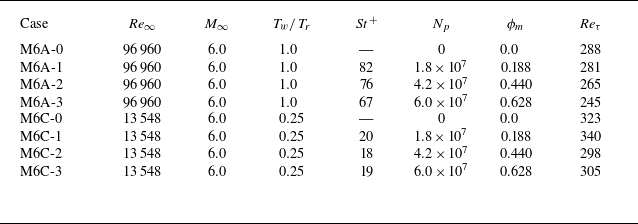
The flow parameters are listed in table 1. The free-stream Mach number
 $M_\infty = U_\infty /a_\infty$
is set as 6.0, where
 $a_\infty = \sqrt {\gamma R T_\infty }$
(
 $\gamma =1.4$
is the specific heat ratio) is the free-stream speed of sound. The free-stream temperature is set as
 $55 \textrm { K}$
. Two groups of cases with different wall temperatures are considered, one with recovery temperature
 $T_w=T_r$
and the other with
 $T_w=0.25 T_r$
, corresponding to scenarios of a quasi-adiabatic wall (with trivial mean heat flux) and a cold wall, denoted as cases M6A and M6C, respectively. The friction Reynolds number at the turbulent inlet,
 $Re_{\tau, in}$
, is set as 200 for all cases, according to which the free-stream Reynolds number
 $Re_\infty = \rho _\infty U_\infty \delta _{in}/\mu _\infty$
is estimated (
 $\delta _{in}$
is the nominal boundary-layer thickness at the turbulent inlet).
Flow parameters. Here,
 $St^+$
is the particle Stokes number,
 $N_p$
is the number of particles and
 $\phi _m$
is the particle mass loading. Parameter
 $Re_\tau$
is the averaged friction Reynolds number within
 $x=(55 {-} 70) \delta _{in}$
.

The governing equations (2.1)–(2.3) are directly solved using a finite difference method with the open-source code developed by Bernardini et al. (Reference Bernardini, Modesti, Salvadore and Pirozzoli2021), which has been validated extensively (Ceci et al. Reference Ceci, Palumbo, Larsson and Pirozzoli2022; Cogo et al. Reference Cogo, Salvadore, Picano and Bernardini2022; Bernardini et al. Reference Bernardini, Della Posta, Salvadore and Martelli2023). The convective terms are approximated using the sixth-order kinetic energy preserving scheme (Kennedy & Gruber Reference Kennedy and Gruber2008; Pirozzoli Reference Pirozzoli2010) in smooth regions, and the fifth-order weighted essentially non-oscillatory scheme (Shu & Osher Reference Shu and Osher1988) in discontinuity regions identified by the refined Ducros shock sensor (Ducros et al. Reference Ducros, Ferrand, Nicoud, Weber, Darracq, Gacherieu and Poinsot1999; Pirozzoli Reference Pirozzoli2011). Viscous terms are expanded into Laplacian form and then approximated using a sixth-order viscous scheme. Time advancement is achieved by the third-order low-storage Runge–Kutta scheme (Spalart et al. Reference Spalart, Moser and Rogers1991).
For all the cases considered, the computational domain sizes in the streamwise, wall-normal and spanwise directions are set as
 $L_x = 80 \delta _{in}$
,
 $L_y = 9 \delta _{in}$
and
 $L_z = 8 \delta _{in}$
, respectively, discretised by grid points of
 $2400 \times 280 \times 280$
. The mesh is uniformly distributed in the streamwise and spanwise directions, resulting in grid intervals of
 $\Delta x^+ \approx 6.68$
and
 $\Delta z^+ \approx 5.71$
under the viscous scales at the turbulent inlet. In the wall-normal direction, grid stretching is implemented using the hyperbolic sine function, with the first off-wall grid point at
 $\Delta y^+_w = 0.5$
and a grid interval of approximately
 $\Delta y^+ \approx 5.37$
at the edge of the boundary layer. These grid settings are deemed adequate for capturing small-scale fluctuations in DNS under the low-dissipative numerical schemes employed in this study (Pirozzoli & Bernardini Reference Pirozzoli and Bernardini2011). An initial assessment of skin-friction coefficients, boundary-layer shape factors, mean velocity and temperature suggests that turbulence reaches quasi-equilibrium states downstream of
 $x=50\delta _{in}$
. Therefore, subsequent discussions primarily focus on the domain within the range
 $x= (55 {-} 70) \delta _{in}$
, where the averaged nominal boundary-layer thickness is denoted by
 $\delta$
.
The trajectories and velocities of the particles are calculated by solving the following equations for each particle individually:
 \begin{equation} \frac {\textrm { d} r_{pi}}{\textrm { d} t} = v_{i},\quad \frac {\textrm { d} v_i}{\textrm { d} t} = \frac {f_D}{\tau _p} (u_i - v_i). \end{equation}
Here,
 $r_{pi}$
and
 $v_i$
represent the particle location and velocity, respectively. The particle relaxation time, denoted as
 $\tau _p$
, is defined as
 $\tau _p =\rho _p d^2_p/(18 \mu )$
, where
 $\rho _p$
stands for the particle density and
 $d_p$
the particle diameter. The modified coefficient
 $f_D$
is estimated by the formula proposed by Loth et al. (Reference Loth, Tyler Daspit, Jeong, Nagata and Nonomura2021), incorporating the high-Reynolds-number and high-Mach-number effects:
 \begin{align}&\qquad\qquad\qquad f_D = (1+0.15 Re^{0.687}_p) H_M, \end{align}
 \begin{align}& H_M = \begin{cases} 0.0239 M^3_p + 0.212 M^2_p - 0.074 M_p + 1,\,\,\, & M_p \leqslant 1 \\ 0.93 + \frac {1}{3.5 + M^5_p}, \,\,\, & M_p \gt 1, \end{cases} \end{align}
with
 $Re_p = \rho \sqrt {(u_i - v_i)^2} d_p / \mu$
and
 $M_p = \sqrt {(u_i - v_i)^2} / \sqrt {\gamma R T}$
representing the particle Reynolds number and particle Mach number, respectively. The ordinary differential equations described in equation (2.7) are solved using a third-order Runge–Kutta scheme. The fluid flow quantities at the particle positions are obtained by trilinear interpolation. Initially, the particles are randomly distributed in the streamwise and spanwise directions within
 $y = \delta _{in}$
. Periodic conditions are applied in the spanwise direction, and elastic collisions are assumed at the wall. As the particles penetrate the flow outlet and upper boundaries, they are reintroduced at random locations within the boundary-layer thickness at the flow inlet.
The particle feedback force is estimated using the particle-in-cell method (Zhao et al. Reference Zhao, Andersson and Gillissen2013; Gao et al. Reference Gao, Samtaney and Richter2023). This method calculates the volume-averaged forces exerted by the particles within a cell:
 \begin{equation} F_{pi} = - \frac {1}{V_{cell}}\sum ^{n_p}_{j=1} m_p \frac {\textrm { d} v_i}{\textrm { d} t}, \end{equation}
where
 $m_p$
represents the mass of a single particle and
 $n_p$
denotes the number of particles within a mesh volume
 $V_{cell}$
. An advanced method that incorporates the particle self-induced velocity has been developed (Gualtieri et al. Reference Gualtieri, Picano, Sardina and Casciola2015). However, as reported by Battista et al. (Reference Battista, Mollicone, Gualtieri, Messina and Casciola2019), the particle self-induced velocity does not contribute significantly to the mean momentum balance when the density of particles is much higher than that of the fluid. Therefore, such an effect is not considered herein. To ensure numerical stability, the particle feedback force is not incorporated until downstream of
 $x=10\delta _{in}$
. The DNS solver for one-way and two-way coupling in particle-laden wall-bounded turbulence has been validated in the prior studies (Yu et al. Reference Yu, Du, Wang, Dong and Yuan2024a
,
Reference Yu, Zhao, Yuan and Xub
) by comparing the fluid and particle statistics in low-Mach-number turbulent channel flows with those in incompressible turbulence (Zhao et al. Reference Zhao, Andersson and Gillissen2013).
In two-way coupling particle-laden turbulent flows, the turbulent motions will be affected by multiple factors, such as the particle density, Stokes numbers under viscous scales and the particle mass loadings. Due to the mean fluid property variation across the boundary layer, it is challenging to keep two of them identical while varying the other in compressible wall-bounded turbulence. Therefore, in the present study, we determine to reconcile this issue by considering only one particle population for all cases. The particle density is set as
 $\rho _p = 1600 \rho _\infty$
. The particle diameter is
 $d_p = 0.002 \delta _{in}$
, which is
 $d^+_p = 0.4$
under viscous scales at the turbulent inlet and approximately 0.3 times the Kolmogorov length scales at the wall, satisfying the requirement of the point-particle simulation approach. The particle Stokes numbers
 $St^+$
(reported in table 1), evaluated based on wall-flow quantities, are different across these cases. Specifically, the
 $St^+$
values in the quasi-adiabatic wall cases (M6A) are approximately three times higher than those in the cold-wall cases (M6C). For the cases with the same wall temperature, such a difference is caused by the variations of the wall shear stress. For the cases with different wall temperatures, it should be attributed to the disparities in the fluid viscosity and density at the wall. The particle mass loading
 $\varphi _m = N_p m_p / (L_x L_z \delta )$
ranges from 0.0 (particle-free flow) to a moderate value of 0.628, remaining below a threshold where the flow can be laminarised (Vreman Reference Vreman2007; Yu et al. Reference Yu, Du, Wang, Dong and Yuan2024a
). The overall volume fraction is estimated to be of
 $O(10^{-4})$
, which is sufficiently low to neglect the inter-particle collisions from the perspective of fluid statistics (Balachandar & Eaton Reference Balachandar and Eaton2010; Kuerten Reference Kuerten2016; Li et al. Reference Li, Wei and Yu2016). Details of the turbulent statistics are discussed in the next section.
3. Basic turbulent statistics
In this section, we consider the basic turbulent statistics and their modulations by particles at different wall temperatures. As is given subsequently, most of the conclusions, especially those regarding the velocity, are similar to those for incompressible turbulence. However, since the density and temperature in compressible flows are not merely passive/active scalars as in incompressible flows, it is necessary to explore whether the compressibility transformations based on the mean density and viscosity can still recover the conclusions to those as for incompressible flows, and the mean temperature and heat flux can be affected by the particle feedback force even when the interphasial heat transfer is not yet incorporated.
3.1. Mean and fluctuating velocity and temperature
We first present the impact of particles on the mean velocity of the fluid. In compressible turbulent boundary layers, it is customary to perform integrations on the wall-normal coordinate and mean velocity to collapse the profiles with the scaling laws of the incompressible turbulence. In the present study, we use the classical van Driest transformation (van Driest Reference Van Driest1951):
 \begin{equation} u^+_{VD} = \frac {1}{u_\tau } \int ^{\tilde u}_0 \sqrt {\frac {\bar \rho }{\bar \rho _w}} \textrm { d} \tilde u, \end{equation}
plotted against
 $y^+$
, and the total-stress-based transformation proposed by Griffin et al. (Reference Griffin, Fu and Moin2021):
 \begin{equation} u^+_{GF} = \frac {1}{u_\tau } \int ^{\tilde u}_0 \frac {S^+_{eq}}{1 + S^+_{eq} - S^+_{TL}} \textrm { d} \tilde u, \end{equation}
plotted against the semi-local viscous scale
 $y^* = y (\bar \rho \tau _w)^{1/2}/\bar \mu$
. Here, the equivalent strain rates
 $S^+_{eq}$
and
 $S^+_{TL}$
are defined as
 \begin{equation} S^+_{eq} = \frac {\bar \mu _w}{\bar \mu } \frac {\partial \bar u^+_1}{\partial y^*},\quad S^+_{TL} = \frac {\bar \mu }{\bar \mu _w} \frac {\partial \bar u^+_1}{\partial y^+}. \end{equation}
The results are reported in figure 1. For the particle-free case M6A-0 over a quasi-adiabatic wall, both of these transformations yield the profiles that obey the linear law in the viscous sublayer and the log law in the log region (if any at the current low Reynolds numbers). The presence of particles (cases M6A-1, M6A-2 and M6A-3) tends to reduce the mean velocities in the viscous sublayer while increasing them from the log region to the free stream under both transformations. In the log region, both the slopes and the intercepts of the log law are altered compared with case M6A-0, the degree of which depends on the particle mass loading. In case M6C-0 over a cold wall, the van Driest transformation of mean velocity is lower than the linear law in the viscous sublayer but higher than the classical log law for incompressible flows within
 $y^+ \approx 30 {-} 100$
, which are amended by the total-stress-based transformation in equation (3.2). In these cold-wall cases, particle feedback forces only weakly influence the transformed mean velocities in the viscous sublayer but elevate them in the log region and above. Under these two integral transformations, the deviations of the mean velocity profiles in the two-way coupling cases from the particle-free cases are almost identical, suggesting that modulation of the mean velocity by the particle feedback force cannot be ameliorated by the incorporation of the variations of the fluid density and viscosity. By comparison, the particle modulation of the mean velocity is weaker in turbulent boundary layers over cold walls than over adiabatic walls, despite the identical particle populations and mass loadings. Such differences can probably be attributed to the different Stokes numbers under viscous scales, the influences of which have been proven to be significant in incompressible turbulent flows (Gualtieri et al. Reference Gualtieri, Battista, Salvadore and Casciola2023).

Wall-normal distributions of the Reynolds stresses (a,b)
 $R^+_{11}$
, (c,d)
 $R^+_{22}$
and (e,f)
 $-R^+_{12}$
for (a,c,e) cases M6A and (b,d,f) cases M6C. Grey arrows indicate increasing particle mass loading.

In figure 2, we present the wall-normal distributions of the Reynolds stresses, defined as
 $R_{ij} = \overline {\rho u''_i u''_j}$
. Considering their better consistency with the scaling laws observed in incompressible turbulence as depicted in figure 1, we display the results of cases M6A against
 $y^+$
and those of cases M6C against
 $y^*$
. The magnitudes of the peaks of
 $R^+_{11}$
are relatively unaffected by particle feedback forces (figure 2
a,b). In cases M6A, the peaks of
 $R^+_{11}$
exhibit a slight shift towards higher off-wall positions with increasing particle mass loading, although the magnitudes display a non-monotonic variation, first decreasing for cases M6A-1 and M6A-2 before increasing for case M6A-3. This non-monotonic behaviour in the streamwise Reynolds stress component with mass loading has also been observed by Zhou et al. (Reference Zhou, Zhao, Huang and Xu2020) in incompressible turbulent channel flows, which was found to be consistent with the variation of the addition of the production term and the work of the particle feedback force in the transport of the Reynolds stress components. The peaks of
 $R^+_{11}$
in cold-wall cases M6C manifest a similar trend of variation with
 $\varphi _m$
, albeit with weaker influences of the particles in comparison. From the perspective of the turbulent structures, we can infer that the intensity of near-wall velocity streaks, as indicated by the
 $R^+_{11}$
component, remains almost unaffected, although their morphology may exhibit significant differences, which is elaborated in subsequent discussions. The wall-normal Reynolds stress
 $R^+_{22}$
and shear stress
 $-R^+_{12}$
(figure 2
c–f) decrease with increasing mass loading, implying reduced cross-stream velocity fluctuations and turbulent momentum transport associated with the cross-stream motions. These observations are qualitatively in agreement with those for incompressible wall-bounded turbulence (Zhao et al. Reference Zhao, Andersson and Gillissen2013; Muramulla et al. Reference Muramulla, Tyagi, Goswami and Kumaran2020; Zhou et al. Reference Zhou, Zhao, Huang and Xu2020).
Wall-normal distributions of (a,b) the mean temperature and (c,d) wall-normal turbulent heat flux for (a,c) cases M6A and (b,d) cases M6C.

The variation in flow dynamics induced by particles influences not only the mean velocity and Reynolds stresses but also the mean temperature and turbulent heat flux, in spite of the absence of direct heat coupling between fluid and particles. As shown in figure 3(a), for the adiabatic wall cases M6A, the mean temperatures below
 $y=0.3\delta$
exhibit significant enhancement in particle-laden flows, displaying a consistent increasing trend with mass loading. The temperature gradients at the wall remain small, indicating that the mean wall heat flux is trivial and that the quasi-adiabatic thermal conditions are maintained. In the cold-wall cases M6C (figure 3
b), the wall heat flux reduces slightly in cases M6C-2 and M6C-3 compared with cases M6C-0 and M6C-1. The highest mean temperatures are slightly reduced by the presence of particles, but the degree of the variation is much smaller compared with cases M6A over adiabatic walls. The variations in mean temperature can be attributed to reduced turbulent heat flux that transports the near-wall high-temperature fluid either to the free stream or to the wall, as shown in figure 3(c,d). Despite these changes in the presently considered cases, we found that the relationship between mean temperature and mean velocity can still be characterised by the generalised Reynolds analogy (Zhang et al. Reference Zhang, Bi, Hussain and She2014), suggesting that the similarity between the mean momentum and total enthalpy transport, which is a crucial assumption in deriving the generalised Reynolds analogy, remains valid. Moreover, the turbulent Prandtl number
 $Pr_T$
that associates the turbulent heat flux and the Reynolds shear stress is close to unity (not shown here for brevity), indicating that the energy-containing temperature fluctuations can still be regarded as being transported by velocity fluctuations. These unchanged features in compressible turbulence laden with particles should probably be attributed to the fact that the interphasial heat transfer effects are neglected and that the flow states remain turbulent (Yu et al. Reference Yu, Du, Wang, Dong and Yuan2024a
).
3.2. Integral identity for skin friction
In this subsection, we explore the variation of the mean momentum balance and its contribution to the skin friction, defined as
 $C_f = 2\tau _w /(\rho _\infty U^2_\infty )$
. Following the skin-friction integral identity proposed by Wenzel et al. (Reference Wenzel, Gibis and Kloker2022), we perform two-fold integration along the wall-normal direction and cast the mean momentum equation as follows:
 \begin{equation} C_f = \frac {2}{\rho _\infty U^2_\infty \delta } \left ( \int ^\delta _0 \bar \tau _{xy} \textrm { d} y - \int ^\delta _0 R^+_{12} \textrm { d} y + \int ^\delta _0 (y - \delta ) I_x \textrm { d} y + \int ^\delta _0 (y - \delta ) F_{p1} \textrm { d} y \right ). \end{equation}
This formula decomposes the skin friction into four components. The terms on the right-hand side represent the contribution to the skin friction of the viscous shear stress (hereinafter referred to as
 $C_V$
), Reynolds shear stress (
 $C_T$
), mean flow convection (
 $C_G$
) and particle force (
 $C_{FP}$
). The
 $I_x$
in the integral of the mean flow convection term is written as
 \begin{equation} I_x = - \frac {\partial \bar \rho \tilde u_1 \tilde u_1}{\partial x} - \frac {\partial \bar \rho \tilde u_1 \tilde u_2}{\partial y} - \frac {\partial \overline {\rho u''_1 u''_1}}{\partial x} - \frac {\partial \bar p}{\partial x} + \frac {\partial \bar \tau _{xx}}{\partial x}. \end{equation}
Pre-multiplied integral of skin-friction decomposition formula (3.4): (a,b) viscous stress term
 $C_V$
, (c,d) Reynolds stress term
 $C_T$
, (e,f) mean flow convection term
 $C_G$
and (g,h) particle force term
 $C_{FP}$
for (a,c,e,g) cases M6A and (b,d,f,h) cases M6C. Grey arrows indicate increasing particle mass loading.

In figure 4 we first present the integral of the four terms on the right-hand side of equation (3.4), pre-multiplied by
 $y^+$
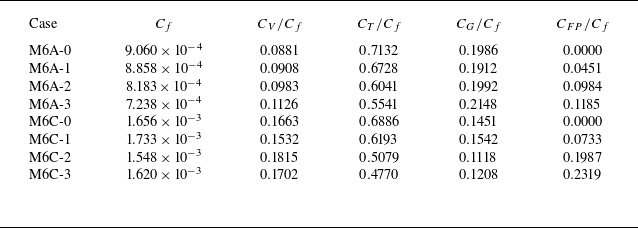
under the logarithmic coordinate. The specific values of the contributions of these terms to the skin friction are listed in table 2. It can be inferred that the presence of particles influences the flow dynamics and the skin friction not only directly by accelerating the near-wall fluid velocity but also indirectly by modulating the mean and fluctuating velocity of the fluid. The viscous term
 $C_V$
constitutes approximately 10 % in the adiabatic wall cases M6A. Their integrals (figure 4
a) reach peaks at
 $y^+ \approx 10$
and show the tendency of abatement below this peak and of increment above it, with the degree of the latter being greater than that of the former, thereby resulting in a slight increment with mass loading. In cold-wall cases M6C, the viscous term
 $C_V$
constitutes a greater portion of approximately 16 %. Their integrals (figure 4
b), however, are slightly affected by the presence of particles, so the differences in the ratio
 $C_V/C_f$
should be ascribed to the variation of
 $C_f$
itself.
The Reynolds shear stress term constitutes the greatest portion of the skin friction, even for the highest-mass-loading cases. Their integrals decrease monotonically as the mass loading gets higher, leading to their monotonic attenuation contribution to the skin friction from approximately 70 % (M6A-0 and M6C-0) to 55 % in adiabatic wall cases (M6A-3) and 48 % in cold-wall cases (M6C-3). The integrals of the mean convection term have complex profiles, showing multiple peaks and valleys, whose magnitudes below
 $y^+=30$
are decreasing and those above
 $y^+=30$
are increasing with the higher-particle-mass-loading cases. The overall integrations are positive, as indicated by the higher magnitude of the positive values. This term constitutes
 $20\,\%$
in the adiabatic wall cases M6A with comparatively small variations in the presence of particles. In cold-wall cases M6C, the mean convection term
 $C_G$
constitutes a lower portion of less than
 $16\,\%$
.
Lastly, the pre-multiplied integral of the particle force term, which is non-zero only in cases laden with particles, is positive near the wall and gradually becomes negative above the buffer region. Such a trend of variation can be ascribed to the fact that high-inertia particles travel faster than the fluid in the near-wall region, while slower than the fluid in the outer region. This can easily be envisaged: the high-inertia particles respond tardily to the variation of the local fluid velocity, so they decelerate gradually when they are faster than the ambient fluid, leading to the positive velocity difference in the average sense. In the outer region, such a scenario is reversed. The change of sign results in its comparatively low contribution to skin friction, even though its magnitude is of the same order as the Reynolds stress term. Quantitatively, the particle feedback force constitutes an increasing portion at higher mass loadings, reaching approximately
 $12\,\%$
in case M6A-3. Nevertheless, this is not sufficient to balance the decrease of the skin friction from the perspective of their absolute values in the adiabatic wall cases. In cold-wall cases, the augmentation of the particle force term is more intense, with approximately 23 % in case M6C-3, resulting in the non-monotonic variation of the skin friction
 $C_f$
as well as the friction Reynolds number
 $Re_\tau$
with increasing particle mass loadings.
To summarise this section, we have shown how the basic turbulent statistics in compressible turbulent boundary layers are affected by the modulation of particles. We found that the mean velocity under the compressibility transformation proposed by Griffin et al. (Reference Griffin, Fu and Moin2021) and the Reynolds stresses manifest similar trends of variations to those of incompressible wall-bounded turbulence. Although the mean temperature and the turbulent heat flux are affected indirectly by the particle feedback force, they still obey the generalised Reynolds analogy in canonical wall-bounded turbulence. We also demonstrated how the presence of particles breaks the balance between the viscous shear stress, Reynolds shear stress and the spatial development of the boundary layer and contributes significantly to the skin friction. In general, compressibility effects seem to be insignificant. However, this is not the case, for the particles also leave strong impacts on the dilatational motions, which reside mostly close to the wall, and modulate the intense wall shear stress and wall heat flux fluctuations. This is the topic of § 4.
Contribution of the right-hand-side terms in (3.4) to the skin friction.

4. Coherent structures and dilatational motions
In this section, we investigate the influences of the particles on the flow characteristics that lack physical counterparts in incompressible flows, namely the dilatational motions. Our discussions start from the observations of the instantaneous flow patterns of fluid and particles, followed by statistics and coherent structures of dilatational motions, and their impacts on the flow quantities that are potentially beneficial to engineering applications.
4.1. Instantaneous flow structures
In this subsection, we present the instantaneous near-wall distributions of fluid velocity, particles and their feedback forces, for the purpose of examining the effects of two-way coupling on flow structures and particle clustering.
Figure 5(a–d) displays streamwise and wall-normal fluid velocity fluctuations at
 $y^+=10$
in cases M6A-0 and M6A-2 over adiabatic walls. In case M6A-0, the flow structures resemble those reported in previous studies (Duan et al. Reference Duan, Beekman and Martin2010, Reference Duan, Beekman and Martin2011), with negative streamwise velocity fluctuations
 $u''_1\lt 0$
forming streamwise-elongated streaks and spanwise paired-up wall-normal velocity fluctuations
 $u''_2$
induced by the near-wall quasi-streamwise vortices. In case M6A-2, the low-speed streaks are weaker and less meandering, while the
 $u''_2$
fluctuations from the quasi-streamwise vortices are less intense, consistent with the lower Reynolds stress at
 $y^+=10$
(recall figure 2). The presence of particles appears to disrupt near-wall turbulent dynamics at a moderate level, rather than completely eradicating the self-regeneration cycle (Jiménez Reference Jiménez2018; Wang & Richter Reference Wang and Richter2019a
). Additionally, both
 $u''_1$
and
 $u''_2$
structures exhibit sporadic spots induced by the particle feedback force
 $F_{p1}$
, as evidenced in figure 5(e). Discontinuous as it is, the
 $F_{p1}$
component generally manifests strong negative values beneath the high-speed regions and positive values beneath the low-speed regions of the fluid flow, indicating the negative work of particle feedback forces exerted on the fluid. In contrast, the wall-normal particle force
 $F_{p2}$
(figure 5
f) is notably smaller than
 $F_{p1}$
, except in the regions aligned with low-speed fluid streaks where particles congregate (figure 5
g). Intriguingly, this component shows streamwise positive–negative alternating structures reminiscent of dilatational motions observed in canonical compressible turbulent boundary layers (Yu et al. Reference Yu, Xu and Pirozzoli2019; Yu & Xu Reference Yu and Xu2021).
Instantaneous distributions of fluid at
 $y^+=10$
and particles within
 $y^+=3 {-} 10$
: (a,c)
 $u''_1$
and (b,d)
 $u''_2$
in cases (a,b) M6A-0 and (c,d) M6A-2, and (e)
 $F_{p1}$
, (f)
 $F_{p2}$
and (g) particle distributions in case M6A-2.

Instantaneous distributions of fluid at
 $y^+=10$
and particles within
 $y^+=3 {-} 10$
: (a,c)
 $u''_1$
and (b,d)
 $u''_2$
in cases (a,b) M6C-0 and (c,d) M6C-2, and (e)
 $F_{p1}$
, (f)
 $F_{p2}$
and (g) particle distributions in case M6C-2.

Companion results for cold-wall cases are displayed in figure 6, showing profound differences in multiple aspects. In case M6C-0 without particles, the coherence of low-speed streaks shown by the streamwise velocity fluctuations
 $u''_1$
(figure 6
a) is stronger compared with turbulence over adiabatic walls (Duan et al. Reference Duan, Beekman and Martin2010; Hadjadj et al. Reference Hadjadj, Ben-Nasr, Shadloo and Chaudhuri2015). The wall-normal velocity
 $u''_2$
(figure 6
b), on the other hand, is dominated by the streamwise positive–negative alternating structures, also referred to as travelling-wave packets (Yu & Xu Reference Yu and Xu2021; Zhang et al. Reference Zhang, Wan, Liu, Sun and Lu2022), corresponding to the dilatational motions near the wall. These are the typical characteristics of cold-wall turbulence, particularly in high-Mach-number flows (Xu et al. Reference Xu, Wang, Wan, Yu, Li and Chen2021; Yu & Xu Reference Yu and Xu2021; Zhang et al. Reference Zhang, Wan, Liu, Sun and Lu2022). In the cases laden with particles, taking case M6C-2 as an example, the low-speed streaks manifested by
 $u''_1$
(figure 6
c) are even less meandering in morphology and weaker in intensity compared with those in case M6C-0. The high-speed regions, which are shorter and more intense in case M6C-0, exhibit longer streaky structures in case M6C-2 as the low-speed regions. The travelling-wave packets that dominate the wall-normal velocity
 $u''_2$
are also weaker in comparison (figure 6
d).
The dominance of the near-wall travelling-wave packets significantly alters the clustering of particles and the distributions of the particle feedback force. As displayed in figure 6(e–g), the tendency of the particles to cluster beneath the low-speed streaks is alleviated compared with the quasi-adiabatic wall cases (recall figure 5
g). If the particle acceleration is further incorporated, we found that the decelerating particles are uniformly distributed in the wall-parallel plane, whereas the accelerating ones appear to organise in patterns similar to travelling-wave packets. The particle feedback forces
 $F_{p1}$
and
 $F_{p2}$
associated with the particle accelerations manifest the features of the travelling-wave packets as well, suggesting that they will probably leave comparative strong impacts on the near-wall dilatational motions with similar morphology. Besides the direct observations given above, it is interesting to notice that although these particle feedback forces exhibit spatial discontinuities, the velocity fluctuations in figure 6(c,d) are devoid of these patterns, probably due to the higher fluid viscosity that rapidly dissipates the high-wavenumber fluctuations.
The resemblance observed in the instantaneous distributions between near-wall dilatational motions and particle feedback forces implies that particles probably influence the near-wall dilatational motions of the fluid flow, reciprocally affecting particle dynamics. Further elaboration on this topic is discussed in the subsequent subsection.
4.2. Particle modulations of dilatational motions
The variation in the strength and morphology of the instantaneous flow structures suggests the potential dynamic modulation of both solenoidal (near-wall velocity streaks and vortices) and dilatational (travelling-wave packets) motions. We perform Helmholtz decomposition (Hirasaki & Hellums Reference Hirasaki and Hellums1970; Pirozzoli et al. Reference Pirozzoli, Bernardini and Grasso2010) to split the velocity fluctuations into a vortical, solenoidal portion and a potential, dilatational portion, in order to evaluate the influences on them separately. By solving the following Poisson equations for the velocity potential function
 $\varphi$
and vorticity vector potential function
 $A_i$
:
 \begin{align}& \frac {\partial ^2 A_{i}}{\partial x_j \partial x_j} = -\omega '_i,\,\, \textrm { at}\,y=0{:}\quad A_1 = A_3 = 0,\quad \frac {\partial A_2}{\partial y}=0, \end{align}
 \begin{align}&\qquad\qquad \frac {\partial ^2 \varphi }{\partial x_j \partial x_j} = \theta ',\,\, \textrm { at}\,y=0{:}\quad\frac {\partial \varphi }{\partial y}=0, \end{align}
with
 $\omega _i$
and
 $\theta$
the vorticity vector and velocity divergence, the solenoidal and dilatational velocity components can be obtained as
 \begin{equation} u^s_i = -\epsilon _{ijk} \frac {\partial A_k}{\partial x_j},\quad u^d_i = \frac {\partial \theta }{\partial x_i}, \end{equation}
hereinafter denoted by the superscripts
 $s$
and
 $d$
, respectively.
Wall-normal distributions of (a,b) dilatational wall-normal Reynolds stress
 $R^{d+}_{22}$
and (c,d) its ratio with the solenoidal component
 $R^{d+}_{22}/R^{s+}_{22}$
. Grey arrows indicate increasing particle mass loading.

In figure 7(a,b), we display the dilatational portion of the wall-normal Reynolds stress
 $R^{d}_{22} = \overline {\rho u''^d_2 u''^d_2}$
, normalised by the mean wall shear stress, which is the most significant amongst all components. For both the adiabatic (M6A) and cold-wall (M6C) cases,
 $R^{d+}_{22}$
consistently decreases with increasing mass loading, with a more pronounced abatement observed in cases M6C. Figure 7(c,d) presents the ratio between
 $R^{d+}_{22}$
and
 $R^{s+}_{22}$
. The highest ratio values are observed within the viscous sublayer. In adiabatic wall cases, this ratio peaks for case M6A-0 at approximately
 $y^* = 4.0$
and decreases with mass loading. The declining solenoidal component coupled with lower ratios in these cases suggests that particle feedback forces suppress dilatational motions, and the degree of such suppression is higher than that of solenoidal velocities. Conversely, in cold-wall cases, the ratios remain at high levels without an obvious decreasing trend, and are notably higher than those in adiabatic wall cases. This is consistent with the previous findings that the dilatational motions are stronger in turbulence over cold walls (Yu & Xu Reference Yu and Xu2021).
Pre-multiplied (a,c) streamwise and (b,d) spanwise spectra of solenoidal velocity (a,b)
 $u''^s_1$
and (c,d)
 $u''^s_2$
. Colours: case M6C-0; lines: case M6C-2.

Pre-multiplied (a,c) streamwise and (b,d) spanwise spectra of dilatational velocity (a,b)
 $u''^d_1$
and (c,d)
 $u''^d_2$
. Colours: case M6C-0; lines: case M6C-2.

For a detailed analysis of the effects of particle feedback force on turbulent fluctuations at different length scales, in figure 8 we present the pre-multiplied streamwise and spanwise spectra of solenoidal streamwise and wall-normal velocities in the cold-wall cases M6C-0 and M6C-2. These spectra are plotted against the coordinates under semi-local scalings which provide improved universal scalings for cold-wall turbulence, as evidenced by the nearly identical wall-normal locations of the Reynolds stress peaks (figure 2). In case M6C-0, the streamwise velocity spectra peaks are located at the streamwise length scale of
 $\lambda ^*_x \approx 1000$
and the spanwise scale of
 $\lambda ^*_z \approx 120$
, with an off-wall location at
 $y^* \approx 12$
, corresponding to the characteristic length scales of velocity streaks. These length scales are similar to those observed in incompressible and compressible turbulence over adiabatic walls (Lagha et al. Reference Lagha, Kim, Eldredge and Zhong2011; Yao & Hussain Reference Yao and Hussain2020), consistent with previous findings when analysed under semi-local viscous scales (Huang et al. Reference Huang, Duan and Choudhari2022). The wall-normal velocity spectra peak around
 $y^* \approx 70$
, with streamwise and spanwise length scales of
 $\lambda ^*_x \approx 200 {-} 300$
and
 $\lambda ^*_z \approx 120$
, respectively, corresponding to the characteristics of vertical motions induced by bursting events or streamwise vortices.
In the particle-laden case M6C-2, the streamwise spectra of
 $u''^s_1$
indicate a weakening of near-wall small-scale motions compared with case M6C-0. Although the peak values remain almost unaffected, their positions shift towards larger scales. Such a variation corresponds to the longer and more coherent velocity streaks manifested in the instantaneous flow fields (recall figure 6). Conversely, the spanwise spectra are intensified near their peaks at
 $\lambda ^*_z \approx 120$
and
 $y^*=12$
, while the spectral intensities at smaller and larger scales are comparatively less affected. Regarding the wall-normal velocity component
 $u''^s_2$
, both the streamwise and spanwise spectra exhibit lower intensities across all scales, with peak locations remaining almost consistent with those in case M6C-0.
Figure 9 displays the spectra of dilatational velocities
 $u''^d_1$
and
 $u''^d_2$
. In general, the dilatational streamwise velocity is significantly weaker than the dilatational wall-normal velocity by approximately one order of magnitude. The streamwise spectra peak around
 $\lambda ^*_x \approx 100$
, while the spanwise spectra peak at
 $\lambda ^*_z \approx 120$
, corresponding to the characteristic length scales of near-wall dilatational motions in the form of travelling-wave packets (Yu et al. Reference Yu, Xu and Pirozzoli2019; Yu & Xu Reference Yu and Xu2021). The addition of particles in case M6C-2 suppresses dilatational motions at all scales across the boundary layer, particularly in the near-wall region, with the peaks of the spectra shifted towards larger scales and higher locations.
The different trend of variation of the solenoidal and dilatational motions also provides interesting insights into the dynamic correlations between them. The near-wall turbulence can be regarded as the self-sustained regeneration cycle between the velocity streaks and streamwise vortices (Jiménez Reference Jiménez2018). The less meandering velocity streaks and the weakened wall-normal Reynolds stress in the particle-laden flows imply that the generation of streamwise vortices is disrupted, and the possibility of the occurrence of the bursting events is lower (Wang & Richter Reference Wang and Richter2019a ). These are closely associated with the variation of the dilatational motions organised as the travelling-wave packets, the generation of which has been demonstrated in our previous study (Yu et al. Reference Yu, Zhou, Dong, Yuan and Xu2024c ). By performing numerical experiments, we found that the dilatational motions are generated in the process of the velocity streak breakdown and the generation of the vortices, especially those associated with the strong bursting events. As a result, it can be inferred that the suppression of the dilatational motions is synchronised with the weaker streamwise vortices and bursting events.
From another perspective, it has also been argued that the travelling-wave packets are evolving acoustic perturbations under the low-speed streaks, similar to Mack mode in transitional flows (Toki et al. Reference Toki, Sousa, Chen, Camillo, Wagner and Scalo2025). Although we have shown that the near-wall dilatational perturbations in the shape of travelling-wave packets cannot amplify in a comparatively quiescent ambient flow, thereby excluding the possibility of their generation via instability or transient growth, it is not sufficient to reach such a conclusion in the fully developed turbulence with strong nonlinearity. The particle-laden flows considered in the present study can probably serve as a valid piece of evidence. As we have demonstrated in the spectra of
 $u''^s_1$
, the strength of velocity streaks remains almost the same as, and even stronger than, that in the particle-free case, but the dilatational motions are nonetheless weakened. The concurrent weakening of the solenoidal wall-normal velocity
 $u''^s_2$
and the dilatational velocity components proves that the generation of the latter should be attributed to the former. Moreover, since the particles also introduce strong and comparatively random perturbations near the wall, it also refutes the idea that these dilatational travelling-wave packets are evolving perturbations lying beneath the velocity streaks. Otherwise, these flow structures would be amplified by the disturbances imposed by the particle feedback forces.
4.3. Near-wall particle feedback force
The fact that dilatational motions are suppressed by the presence of particles at all scales can be partially attributed to the weaker vortices, which is an indirect inference from the dynamics of the coherent structures. A straightforward deduction is that the particles are capable of modulating the dilatational motions as well, as indicated by the particle feedback force distributions shown in § 4.1. In this subsection, we explore the dynamic interactions between particles and fluid by analysing the particle feedback force and its correlation with dilatational motions.
Figure 10 displays the work of the particle feedback force on solenoidal and dilatational velocity fluctuations separately to assess their respective contributions. In general, the work done by particle forces is slightly lower than but of the same order as the production and viscous dissipation in turbulent kinetic energy transport (not shown here for brevity), indicating their significant influence on near-wall turbulence, particularly for solenoidal motions. In both adiabatic and cold-wall cases, the work of the particle force on streamwise solenoidal velocity
 $u''^s_1$
surpasses that on dilatational velocity by at least an order of magnitude. In adiabatic wall cases, the work
 $\overline {F_{p1} u''^s_{1}}^+$
varies from positive near the wall to negative towards the outer region, with the critical point getting higher with mass loading. In low-mass-loading case M6A-1, particles primarily extract turbulent kinetic energy from the fluid flow in the integral sense, but the energy transfer direction is reversed in the moderate-mass-loading cases. This observation is consistent with the findings from instantaneous distributions of velocity streaks and particle feedback force (figures 5 and 6), or equivalently the role played by particles in modulating the near-wall dynamics, which is essentially the same as that in incompressible flows (Zhao et al. Reference Zhao, Andersson and Gillissen2010, Reference Zhao, Andersson and Gillissen2013). For the cold-wall cases M6C, the work
 $\overline {F_{p1} u''^s_{1}}^+$
remains consistently positive and escalates with particle mass loading.
Work of particle force on the solenoidal (black lines) and dilatational (red lines) velocity (a,b)
 $\overline {F_{p1} u''_{1}}^+$
and (c,d)
 $\overline {F_{p2} u''_{2}}^+$
for (a,c) cases M6A and (b,d) cases M6C.

As for the wall-normal component, the work of the particle force on its solenoidal component in adiabatic wall cases M6A is negative and independent of particle mass loadings, suggesting that the particle force suppresses the wall-normal velocity fluctuations. The work on the dilatational component
 $\overline {F_{p2} u''^d_{2}}^+$
remains relatively small. In cold-wall cases M6C, the work on dilatational velocity
 $\overline {F_{p2} u''^d_{2}}^+$
is of the same order as that of the work on the solenoidal velocity
 $\overline {F_{p2} u''^s_{2}}^+$
. Although both terms are overall negative, the work on solenoidal velocity
 $\overline {F_{p2} u''^s_{2}}^+$
is significant within
 $y^+ \approx 30 {-} 200$
, while that on dilatational velocity
 $\overline {F_{p2} u''^d_{2}}^+$
is prominent below
 $y^+ \lesssim 30$
in the buffer and viscous sublayer.
Joint PDF distribution
 $P(\theta ',F_{p2})$
within
 $y^+=1 {-} 15$
in cases (a) M6A-1, (b) M6A-2, (c) M6A-3, (d) M6C-1, (e) M6C-2 and (f) M6C-3. Contour levels: 0.001, 0.005, 0.01, 0.05.

The comparatively high contribution of the particle force work on the dilatational velocity
 $\overline {F_{p2} u''^d_{2}}^+$
indicates the significant role of particles in influencing near-wall dilatational motions. To further elucidate their correlations, in figure 11 we display the joint probability density function (PDF) between velocity divergence fluctuation
 $\theta '$
and wall-normal particle force
 $F_{p2}$
. In the three adiabatic wall cases M6A, the joint PDF distribution shows no preference in any quadrant. Conversely, in the cold-wall cases M6C, the joint PDF predominantly occupies the second and fourth quadrants and the values in the first and third quadrants are almost zero, indicating their negative correlations. With increasing mass loadings, the extension of the joint PDF is smaller in the dimension of
 $\theta '$
, suggesting that the probability of extreme compressive events (
 $\theta '\lt 0$
) or expansive events (
 $\theta '\gt 0$
) is lower. This correlation with
 $\theta '$
can be easily converted to that with the dilatational velocity. Based on the definition of
 $\theta '$
, the Taylor expansion near the wall yields the approximation
 $u''^d_2 \approx \theta ' (y + O(y^2))$
, as long as the other components are relatively small due to the no-slip condition imposed by the wall, i.e.
 $\partial u''^d_1/\partial x =0$
and
 $\partial u''^d_3/\partial z=0$
. Consequently, the particle feedback force
 $F_{p2}$
exhibits a predominantly negative correlation with velocity component
 $u''^d_2$
, consistent with observations from figure 10.
Conditional average of (a,b)
 $F_{p1}$
, (c,d)
 $F_{p2}$
and (e,f)
 $F_{p3}$
under the condition of
 $\theta ' \lt -\theta '_{rms}$
at
 $y^+=15$
in case M6C-2. Colours: conditional averaged particle force; lines: velocity divergence (solid: positive; dashed: negative).

We further calculate the averaged particle force surrounding the intense compressive events where
 $\theta ' \lt -\theta '_{rms}$
at
 $y^+=15$
for case M6C-2, as shown in figure 12. The results for the rest of the cases are similar so they will not be displayed herein. The conditionally averaged streamwise and wall-normal particle forces
 $F_{p1}$
and
 $F_{p2}$
are organised in a pattern similar to that of the velocity divergence, which is consistent with the findings in instantaneous flow fields. The difference between these components lies in their relative spatial positions. Based on the observation that the particle force and dilatational velocity exhibit characteristics of travelling waves, the streamwise particle force
 $F_{p1}$
and the velocity divergence
 $\theta '$
are offset by a phase angle of approximately
 $\pi /2$
. This phase difference results in their trivial correlation and hence the work of the particle force in this direction, even though the conditionally averaged
 $F_{p1}$
surpasses the particle force components in the other two directions. This is reminiscent of the pressure-dilatational term in turbulent kinetic energy transfer as reported by Yu et al. (Reference Yu, Xu and Pirozzoli2020), where the conditional average of pressure and velocity divergence are also offset by a phase angle of
 $\pi /2$
. The wall-normal component
 $F_{p2}$
is phase-shifted by
 $\pi$
relative to
 $\theta '$
, so they are negatively correlated. From the perspective of particle motions, near-wall particles tend to experience vertical acceleration or deceleration as they approach the wall, transported in the streamwise direction by compressive and expansive fluid motions. These effects will probably alter the degree of the near-wall particle accumulation, as inferred by Wang et al. (Reference Wang, Zhou and Zheng2024). Considering that the intensity of the dilatational motions is dependent on the wall temperature, the near-wall particle concentration will probably change under different thermal boundary conditions, which will be considered in our future work. The conditionally averaged spanwise component
 $F_{p3}$
behaves as a saddle point, driving motions opposing the conditional average of the local velocity divergence. All three components of the particle force disrupt the near-wall dilatational motions, in a similar way that they hinder the streamwise vortices (Dritselis & Vlachos Reference Dritselis and Vlachos2008).
4.4. Wall shear stress and heat flux fluctuations
Previous studies (Yu et al. Reference Yu, Liu, Fu, Tang and Yuan2022b ; Zhang et al. Reference Zhang, Wan, Dong, Liu, Sun and Lu2023) have shown that the dilatational motions are closely associated with high wall shear stress and heat flux fluctuations, particularly in high-Mach-number turbulence over cold walls. Considering that the presence of particles strongly modulates the near-wall dilatational motions, it is necessary to investigate how the wall shear stress and heat flux fluctuations are affected.
Instantaneous distributions of (a,b)
 $\tau '^+_x$
and (c,d)
 $q'^+_w$
in cases (a,c) M6C-0 and (b,d) M6C-2.

In figure 13 we display the instantaneous distributions of wall shear stress fluctuations
 $\tau '^+_x$
and wall heat flux fluctuations
 $q'^+_w$
in cases M6C-0 and M6C-2, normalised by the mean wall shear stress
 $\tau _w$
and mean wall heat flux
 $\bar q_w$
, respectively. In case M6C-0, both
 $\tau '_x$
and
 $q'_w$
manifest the streamwise-elongated streaks with, embedded upon them, travelling-wave packets. The positive events are much more intense than the negative ones, corresponding to a positive skewness factor (Yu et al. Reference Yu, Liu, Fu, Tang and Yuan2022b
). In the particulate flows,
 $\tau '_x$
and
 $q'_w$
manifest primarily the streaky structures, while the features of the travelling-wave packets almost disappear. It is noteworthy that there emerge in the positive regions very fine structures, with scales even shorter than the characteristic length scales of the travelling-wave packets. By inspecting their spatial distributions, we found that these seemingly discrete structures mostly span at least ten grid intervals. Numerical experiments have also been performed by using different numerical methods (such as the seventh-order upwind schemes for convective terms) and finer mesh grids. These structures persist in all cases, thereby excluding the possibilities of their being numerical oscillations. While the nature of these structures is still unclear and left for future work, it is evident that they are induced by the particle feedback force, as illustrated in figure 6(e). Despite their intriguing appearance, the low intensities of such structures compared with the travelling-wave packets in the absence of particles suggest that they contribute trivially to the wall shear stress and heat flux fluctuations.
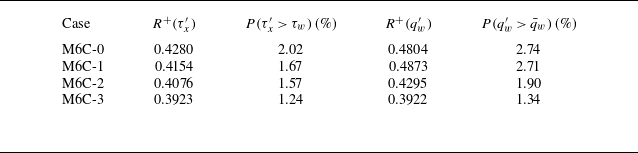
Root mean square and the probability of the extreme events of
 $\tau '_x$
and
 $q'_w$
in cold-wall cases.

Table 3 reports the root-mean-square values of
 $\tau '_x$
and
 $q'_w$
for cold-wall cases, normalised by their respective wall flow quantities and denoted as
 $R^+(\tau '_x)$
and
 $R^+(q'_w)$
. The data reveal a clear trend: as the particle mass loading increases, the root-mean-square values of
 $\tau '_x$
and
 $q'_w$
exhibit a monotonic reduction. Furthermore, the occurrence probability of extreme events – defined as fluctuations exceeding the mean values
 $\tau _w$
and
 $\bar q_w$
– is also significantly reduced. Since the strengths of the velocity streaks remain almost unchanged, as indicated by the streamwise Reynolds stress in § 3.1 and the spanwise spectra in § 4.2, their ‘footprints’, namely the streak portions of the wall shear stress and wall heat flux, are unlikely to be affected. Hence, it can be inferred that the lower values of
 $R^+(\tau '_x)$
and
 $R^+(q'_w)$
should be ascribed to the weaker travelling-wave structures. This observation is particularly noteworthy, as it suggests that injecting multiphase particles into a flow has the potential to mitigate both aerodynamic forces and thermal loads on high-speed vehicles. Such findings underscore the promising role of particle-laden flows in enhancing the performance and durability of high-speed systems under extreme conditions (Yuan et al. Reference Yuan, Li, Jiang and Yu2019; Ding et al. Reference Ding, Zhang, Sun, Yang and Wen2022).
5. Concluding remarks
In this study, we investigate the modulation effects of particles on compressible turbulent boundary layers at a Mach number of
 $6$
over quasi-adiabatic and cold walls by exploiting the DNS databases established using the Eulerian–Lagrangian point-particle method. Four groups of cases with particle mass loadings ranging from 0 to 0.628 are systematically analysed for each wall temperature configuration. The primary focus is on quantifying the variations in turbulent statistics, their contributions to skin friction and the influence of particles on the solenoidal and dilatational motions of the fluid flow. These findings provide critical insights into the interaction between particle dynamics and turbulence in high-speed boundary layers, offering a deeper understanding of how particulate phases influence aerodynamic and thermal properties in such regimes.
The mean and fluctuating velocities in the particle-laden flows exhibit similarities to those reported in incompressible flows under compressibility transformations. The integral transformation proposed by Griffin et al. (Reference Griffin, Fu and Moin2021) effectively improves the alignment of the mean velocity profiles with those of incompressible flows. When scaled using viscous scales, the transformed mean velocities are elevated from the log layer to the free stream, resulting in steeper slopes and higher intercepts within the log layer. The streamwise Reynolds stress remains intense in the buffer layer across all cases, while the wall-normal and shear components of the Reynolds stresses exhibit a monotonic reduction as particle mass loading increases. This attenuation of Reynolds shear stress directly competes with the intensifying particle feedback force. In adiabatic wall cases, the dominance of reduced shear stress leads to the decrease in skin friction, whereas in cold-wall cases, the interaction between these opposing mechanisms results in a non-monotonic skin-friction trend. Additionally, the mean temperature and turbulent heat flux are modulated by the presence of particles as well. However, the generalised Reynolds analogy, which relates the mean temperature to the velocity profile, remains valid, suggesting the robustness of this relation even in particle-laden compressible flows.
Our analysis has also revealed several key distinctions between compressible and incompressible particle-laden flows, particularly the dilatational motions, which lack physical counterparts in the absence of flow compressibility. Near the wall, dilatational motions manifest as travelling-wave structures, which persist even under the influence of particles. These structures are evident not only in the fluctuations of the fluid velocity but also in the particle feedback force, indicating a significant modulation of coherent flow structures. Through Helmholtz decomposition, which separates the velocity field into solenoidal (vortical) and dilatational (compressible) components, we observed that the solenoidal streamwise velocity fluctuations, associated with velocity streaks, remain prominent across varying particle mass loadings. In contrast, the wall-normal velocity fluctuations, both solenoidal and dilatational, decrease almost synchronously.
From the perspective of the self-sustaining cycle of near-wall turbulence, which involves the regeneration of velocity streaks and streamwise vortices, it is inferred that dilatational motions, appearing as travelling-wave packets, are weakened due to the reduced intensity of solenoidal wall-normal velocities. These wall-normal velocities are linked to streamwise vortices and strong bursting events. Notably, the strong perturbations induced by the particle feedback force beneath velocity streaks do not amplify the dilatational motions, refuting the idea that these perturbations resemble unstable acoustic modes observed in transitional flows.
Furthermore, by analysing the work done by the particle feedback force, we identified a strong negative correlation between the particle feedback force and the dilatational velocity components. This suggests that the particle feedback force actively suppresses dilatational motions, resulting in reduced intensities of wall shear stress and wall heat flux fluctuations, as well as their extreme events. These findings highlight the potential of particle-laden flows to mitigate aerodynamic forces and thermal loads, thereby enhancing the performance of high-speed vehicles under extreme conditions.
In the present study, we have focused on a limited subset of phenomena in particle-laden compressible flows, primarily investigating the effects of Mach number and wall temperature. An additional critical factor that significantly influences turbulent dynamics in both one-way and two-way coupled systems is the Reynolds number. Previous studies (Wang & Richter Reference Wang and Richter2019b ; Gao et al. Reference Gao, Samtaney and Richter2023) suggest that higher-Reynolds-number flows are likely to yield more complex and intriguing results, particularly in terms of turbulence modulation and particle–flow interactions. Furthermore, incorporating interphasial heat transfer and inter-particle collisions into the analysis could amplify the distinctions between particle-laden compressible and incompressible wall-bounded turbulence, potentially revealing new physical mechanisms and behaviours. These aspects, which lie beyond the scope of the current work, are left for future investigations.
Declaration of interests
The authors report no conflict of interest.