Older adults with anxiety disorders face an increased risk of disability (Porensky et al., Reference Porensky2009), diminished quality of life (Wetherell et al., Reference Wetherell, Thorp, Patterson, Golshan, Jeste and Gatz2004), and increased risk of dementia (Petkus et al., Reference Petkus, Reynolds, Wetherell, Kremen, Pedersen and Gatz2016). Delivering efficacious treatments to older adults with anxiety disorders may prevent declines in everyday functioning and could help some older adults continue to live independently. Non-pharmacological treatments are of particular interest given that older adults prefer psychotherapy compared with pharmacotherapy for anxiety (Mohlman, Reference Mohlman2012). Further, the proportion of older adults interested in non-pharmacological treatments may grow in light of findings of unfavorable cognitive effects following long-term use of benzodiazepines (de Gage et al., Reference de Gage2014).
The leading non-pharmacological treatment, Cognitive Behavioral Therapy (CBT), has been tested in many studies of late-life anxiety, predominantly focused on generalized anxiety disorder (GAD). CBT is a manualized treatment in which a therapist teaches the patient cognitive (e.g. cognitive reappraisal) and behavioral techniques (e.g. deep breathing, problem solving, relaxation, sleep hygiene). Meta-analysis findings suggest that CBT for GAD is less effective in older adults compared with younger adults (Gould et al., Reference Gould, Coulson and Howard2012), but CBT is superior to no treatment for older adults with GAD (Hall et al., Reference Hall, Kellett, Berrios, Bains and Scott2016). In a meta-analysis of non-pharmacological late-life anxiety treatments, Thorp et al. (Reference Thorp, Ayers, Nuevo, Stoddard, Sorrell and Wetherell2009) found that one behavioral treatment, progressive muscle relaxation (PMR; Bernstein et al., Reference Bernstein, Borkovec and Hazlett-Stevens2000), has larger effect sizes compared with both CBT with relaxation and CBT without relaxation. This finding aligns with recent evidence that single component treatments, such as relaxation or cognitive therapy, are superior to CBT for the treatment of patients with longstanding GAD compared with those with shorter duration GAD (Newman and Fisher, Reference Newman and Fisher2013). Since over half of older adults with GAD began experiencing anxiety in early adulthood (Chou, Reference Chou2009), it follows that these older adults with longstanding GAD may benefit from single component treatments rather than multicomponent treatments such as CBT. In addition to the apparent benefits of single component treatments for longstanding GAD, another potential explanation of the diminished efficacy of CBT for late-life anxiety is that relaxation may not be as efficacious in multicomponent treatments because older adults may need more time for learning consolidation compared with younger adults (Czaja and Sharit, Reference Czaja and Sharit2013). Thus, we conclude that relaxation, a single component treatment, has the potential to be an efficacious treatment for anxiety that may be preferred by older adults. Single component treatments could be included as one of the initial, lower intensity treatments in a stepped care treatment model (Haaga, Reference Haaga2000).
PMR has large effect sizes in older adults (Thorp et al., Reference Thorp, Ayers, Nuevo, Stoddard, Sorrell and Wetherell2009) and is a strong candidate for a guided self-help (GSH) treatment as it is a simple and straightforward technique. GSH interventions consist of traditional self-help interventions in which a patient follows instructions to learn new coping skills combined with coaching or guidance from a trained professional (Haaga, Reference Haaga2000; Cuijpers et al., Reference Cuijpers, Donker, van Straten, Li and Andersson2010). GSH interventions may address older adults’ barriers to accessing mental health treatment such as physical limitations affecting mobility, financial constraints, and lack of transportation (Gum et al., Reference Gum, Iser and Petkus2010). Two studies demonstrate the feasibility and potential benefit of GSH treatments for late-life anxiety, with one testing internet-based CBT for anxiety (Zou et al., Reference Zou2012) and the other testing written CBT modules (i.e. bibliotherapy; Landreville et al., Reference Landreville, Gosselin, Grenier, Hudon and Lorrain2016).
BREATHE program overview
To fill the need for an evidence-based GSH treatment for late-life anxiety, we developed a video-delivered behavioral treatment called Breathing, Relaxation, and Education for Anxiety Treatment in the Home Environment (BREATHE). BREATHE primarily aims to target GAD and anxiety disorder unspecified. However, BREATHE also is hypothesized to reduce anxiety symptoms experienced by older adults with a spectrum of anxiety disorders including panic disorder, agoraphobia, or social anxiety disorder, which will be tested in future studies. BREATHE teaches diaphragmatic breathing and PMR through weekly video lessons viewed in a patient's home, likely increasing access and fidelity to this efficacious treatment. Videos provide visual and audio instructions to help older adults with sensory and/or cognitive impairment learn PMR. Videos can be replayed as often as needed to promote learning consolidation. We hypothesize that in addition to reductions in anxiety (e.g. Scogin et al., Reference Scogin, Rickard, Keith, Wilson and McElreath1992), PMR also has the potential to prevent functional decline by making participation in activities more tolerable. BREATHE program participants are instructed to practice relaxation daily and to use breathing and relaxation skills before or during anxiety-evoking activities to reduce avoidance. Participants receive guidance, trouble-shooting, and encouragement as needed via weekly telephone calls with a coach.
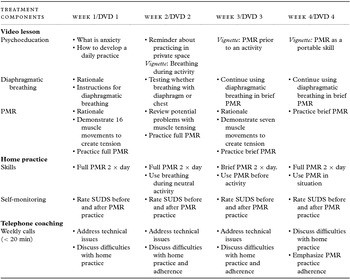
PMR instructions (Bernstein et al., Reference Bernstein, Borkovec and Hazlett-Stevens2000) include modifications for older adults, such as imagined tensing in the case of pain (Scogin et al., Reference Scogin, Rickard, Keith, Wilson and McElreath1992), and shortened tensing duration based on anxiety expert suggestions. Table 1 provides an overview of the 4-week treatment. Week 1 and 2 videos teach the 16-muscle group relaxation (full PMR) and week 3 and 4 videos teach the abbreviated 7-muscle group relaxation (brief PMR). Videos include vignettes of an older adult discussing how they have used the skills to manage anxiety and stress in specific situations. These vignettes follow the premise of Social Learning Theory (Bandura, Reference Bandura1971) that suggests that watching models similar to oneself engage in a behavior can promote behavior change in the observer.
BREATHE program content

Note: SUDS = subjective units of distress scale ratings, PMR = progressive muscle relaxation.
Anxiety is common among Veterans (Gould et al., Reference Gould, Rideaux, Spira and Beaudreau2015), particularly among the aging Vietnam-era cohort, and has the potential to contribute to functional decline and high rates of comorbidity. Yet, despite Department of Veterans Affairs (VA) being at the forefront of disseminating evidence-based psychotherapy (EBPs; Karlin and Cross, Reference Karlin and Cross2014), no specific therapies for anxiety disorders are included in the VA EBP program. In the present study, we describe the development of BREATHE for older Veterans and initial feasibility and acceptability of this treatment. We used mixed methods to examine the clarity of the BREATHE videos based on Veteran feedback. We sought specific feedback about the content from Veterans to determine whether the treatment needed to be tailored for this population.
Methods
Study design
We employed a concurrent mixed methods design (Creswell and Plano Clark, Reference Creswell and Plano Clark2011) to integrate quantitative ratings and qualitative feedback about BREATHE.
Sampling and recruitment
We employed purposeful sampling (Patton, Reference Patton1999) to identify Veterans aged 60 years or older who expressed interest in anxiety treatment. We advertised that we were seeking feedback on an anxiety treatment on flyers posted at two VA medical centers, two community-based outpatient VA clinics, a Vet Center, on Craigslist, and on the VA medical center Facebook page. Exclusion criteria were self-reported diagnosis of dementia or a serious mental illness (i.e. bipolar disorder, psychotic disorder, or schizophrenia); and evidence of possible cognitive impairment based on a Short Blessed Test > 5 (Katzman et al., Reference Katzman, Brown, Fuld, Peck, Schechter and Schimmel1983). We did not exclude individuals with medical comorbidities, substance abuse, or major depressive disorder as these conditions often co-occur with anxiety symptoms and anxiety disorders. Of the 25 Veterans screened by phone, four were ineligible (n = 3 due to serious mental illness diagnosis; n = 1 due to Short Blessed Test > 5) and one did not schedule an interview, leaving 20 Veterans who participated (see Figure available as supplementary material attached to the electronic version of this paper at https://dx.doi.org/10.1017/S1041610217000928). Sample size was based on previous research suggesting data saturation typically occurs within 12 interviews (Guest et al., Reference Guest, Bunce and Johnson2006).
Data collection
Study procedures were approved by the Stanford University Institutional Review Board. Eligible Veterans were invited for in-person interview, during which informed consent and consent for audiotaping was obtained.
The study had three phases. In the first phase, ten participants provided feedback on three instructional videos for Week 1 (psychoeducation, diaphragmatic breathing, and full PMR) during individual interviews. After we analyzed the data and revised the videos based on participants’ feedback, ten different participants viewed revised videos (Week 1 psychoeducation and diaphragmatic breathing) and one new video (Week 3 abbreviated PMR). Eligible Veterans who completed an interview were invited to participate in a focus group in which three vignettes were viewed.
Interview procedures and measures
The study visit consisted of an individual semi-structured interview and questionnaires. Participants received $45 for participation ($25) and travel reimbursement ($20).
Interview
Veterans’ feedback about the videos was collected via quantitative ratings and responses to open-ended questions about the clarity of video content, suggestions, and relevance to older Veterans. An interview guide specifically created for this study is provided in the Supplemental Materials. Quantitative ratings were made using a four-point rating scale ranging from 1 (No, definitely not) to 4 (Yes, definitely). Open-ended questions asked about (1) what the videos were conveying (to assess understandability); (2) clarity of the videos; and (3) suggestions for changes. Interviews ranged in duration from 26 to 96 minutes (M = 44.80, SD = 18.47).
Questionnaires
Following the interview, participants completed three questionnaires. A demographic and health questionnaire assessed participants’ characteristics including age, gender, marital status, race, ethnicity, and perceived health.
The Geriatric Anxiety Scale (GAS; Segal et al., Reference Segal, June, Payne, Coolidge and Yochim2010) assessed anxiety symptom severity with higher scores indicative of more severe anxiety symptoms. The GAS is a 30-item measure of somatic, cognitive, and affective symptoms of anxiety that are rated using a four-point Likert-type scale ranging from 0 (not at all) to 3 (all of the time). The first 25 items are used to compute the total score and the last five items provide information about worry and fear content. Excellent internal consistency was found for GAS total scores in the present study (α = 0.96).
The Patient Health Questionnaire-9 item (PHQ-9; Kroenke et al., Reference Kroenke, Spitzer and Williams2001) assessed depressive symptom severity with higher scores indicative of more severe depressive symptoms. Items are rated on a four-point Likert-type scale ranging from 0 (not at all) to 3 (nearly every day). Excellent internal consistency was found for PHQ-9 total scores in the present study (α = 0.92).
The comorbidity questionnaire (Katz et al., Reference Katz, Chang, Sangha, Fossel and Bates1996) assessed medical comorbidity. The comorbidity questionnaire is a self-report version of the Charlson comorbidity index (Charlson et al., Reference Charlson, Pompei, Ales and MacKenzie1987) on which specific medical conditions predictive of mortality are weighted. Higher scores indicate worse medical comorbidity.
Focus group procedure and measure
We invited participants who completed interviews to partake in a 90-minute focus group and those who participated received an additional $25. The focus group aimed to gather feedback on three vignettes in which older adults describe using the breathing and relaxation skills. A focus group guide (see supplemental material) used open-ended questions to ask participants whether the videos were applicable to participants. We also asked participants for suggestions to improve the videos. A median split of GAS total scores from the interview visit was used to create a high and low anxiety group.
Data analysis plan
Responses to the quantitative evaluation questions and questionnaires were summarized using frequencies, percentages, and descriptive statistics using SPSS (version 21, IBM SPSS Statistics, 2012).
Digitally recorded and transcribed interviews were analyzed using computer-assisted data analysis using Dedoose (version 7.1.3, SocioCultural Research Consultants, 2016). Content and thematic analyses were performed to answer different facets of the research question. Content analysis (e.g. Vaismoradi et al., Reference Vaismoradi, Turunen and Bondas2013) of specific concepts in the data was employed to examine the clarity of each video. We quantified the number of participants who found each video segment to be clear or unclear using codes to first identify the segment participants were discussing and then code weights to indicate whether participants found the videos to be clear or unclear. Clear segments were defined as containing descriptions that the video content or video instructions were straightforward or easy to follow. Unclear segments included comments from participants about missing information, awkward phrasing, ambiguous instructions, or descriptions of illogical procedures or processes that made it difficult to follow instructions. We examined the extent to which the participants felt that these videos fit with their experiences and the overall perceptions of the treatment program using thematic analysis (Malterud, Reference Malterud2001).
Two authors (CEG, AMLZ) independently coded transcripts to refine the code definitions and adjudicate the codebook. After the initial round of coding, they refined the codebook two times until code definitions stabilized. Qualitative and content experts (JB, SBM, SAB) were consulted throughout codebook development and coding process. Cohen's κ measured coder agreement for code application. A priori level for Cohen's κ was > 0.70. The final κ coefficients reported were achieved during the third round of coding with two codebook revisions. The authors refined the definitions for code weights and Spearman's r correlation coefficient measured coder agreement for the application of weights to the codes. The code weight agreement (Spearman's r) was achieved during the second round of coding following one codebook revision.
Video revision process
In addition to the content and thematic analysis, coders reviewed transcripts to identify specific suggestions about the videos; overlapping suggestions were grouped. Coders (CEG, AMLZ) considered the pros and cons of each suggestion and consulted with experts (SAB, ROH, JLW) for guidance about whether or not to modify the videos. Videos were edited after the first ten interviews and again following the remaining ten interviews and two focus groups. The full PMR and abbreviated PMR videos each were shown to participants one time each and edited only once.
Results
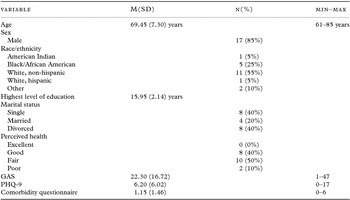
Participants had a mean age of 69.45 (SD = 7.30, range = 61–84) years. Fifty-five percent were White, non-hispanic (n = 11) and the majority (85%) were men (n = 17). Table 2 displays participants’ demographic characteristics. Many participants reported elevated anxiety symptoms, with 11 (55%) obtaining scores above the GAS cut-off (> 16) in community dwelling older adults (Gould et al., Reference Gould, Segal, Yochim, Pachana, Byrne and Beaudreau2014). On average, participants experienced mild depressive symptoms falling below the clinical cut-off (i.e. < 10; Kroenke et al., Reference Kroenke, Spitzer and Williams2001). Using a median split of GAS scores, participants were invited to either the high (n = 11, M = 35.36, SD = 9.94) or low anxiety group (n = 9, M = 6.33, SD = 4.39). Twelve participants (60%) attended the focus groups. Reasons for non-attendance were declined invitation (n = 2) and scheduling conflicts (n = 6). Participants who did not attend did not differ from those who attended the focus groups in terms of age, gender, marital status, years of education, or low versus high anxiety group status.
Characteristics of veteran participants (n = 20)

Note: GAS = Geriatric Anxiety Scale, PHQ-9 = Patient Health Questionnaire-9 item.
Clarity of BREATHE videos
With regards to the content analysis, ten participants (50%) found all of the video segments to be clear and ten (50%) found one or two video segments to be unclear. Final Cohen's κ ranged from 0.71 (diaphragmatic breathing) to 0.85 (psychoeducation) after undergoing the adjudication process (mean κ = 0.80). Final code weight agreement measured with Spearman's r was 1.0 for the code weights (clear vs. unclear).
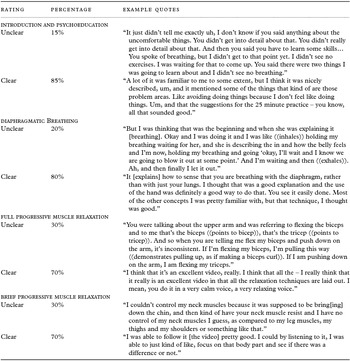
Psychoeducation. The psychoeducation video in the week 1 lesson provides basic information about anxiety and the treatment program rationale. As displayed in Table 3, 85% (n = 17) of participants described this overview to be clear and understandable. In their descriptions, many participants reiterated the video content, described the simplicity of the message, and mentioned what they learned from the video. One participant described this part of the video as “. . . for a lack of a better term, it's ‘Anxiety 101’.” Another participant understood the video and took notes, but “wanted to go and rewind and re-listen to it.” The three individuals who found the video to be unclear were in the second round of interviews. As displayed in Table 3, one participant described that when the instructor mentioned learning new skills, no skills were described and to address this participant's comment, we filmed a brief overview to orient the viewer to the entire BREATHE program. Another participant wanted more examples of symptoms in the video, which were included in the revision. Because one participant attributed his confusion about the psychoeducation video to his own inattention we did not make edits:
Well I was watching step 1 and then suddenly it was step 3. And I don't know what happened to step 2. But in the end that's my ADD [Attention Deficit Disorder]. I was off someplace else.
Clarity of video content

Note: N = 20 for psychoeducation and breathing videos. N = 10 for full progressive muscle relaxation and for brief relaxation videos. Clear segments were defined as containing descriptions that the video content or video instructions were straightforward, easy, or generally easy to follow. Unclear segments were defined as descriptions of missing information, awkward phrasing, ambiguous instructions, or descriptions of illogical procedures or processes that made it difficult to follow instructions.
Despite the feedback received about unclear aspects of the videos, one of the three participants stated that he was “learning new stuff that I had never thought about.”
Diaphragmatic breathing
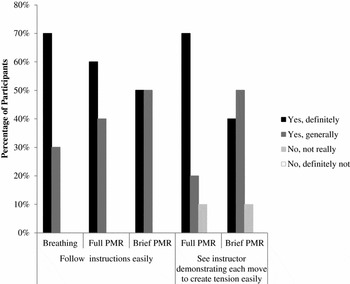
The diaphragmatic breathing, referred to as “deep breathing” in the video, describes how to breathe by engaging the diaphragm and includes breathing practices in which viewers are invited to follow along with the video. Based on quantitative ratings, 100% of participants were able to easily follow the instructions. More participants definitely agreed with the statement about the ease of following instructions as compared with the full and brief PMR instructions (as displayed in Figure 1). The quantitative ratings contrast with qualitative content analysis in which 80% (n = 16) of participants described the breathing video as clear. Three participants in the first round of interviews found the video unclear. The confusion with the breathing video appeared to be due to two factors: (1) difficulty accounting for individual differences in breathing duration using a standard video script; and (2) need for more explicit instruction about watching first and then following along (see Table 3). Both of these recommended changes were incorporated into the video revision. One participant in the second round found the video unclear, which was due to difficulty seeing the instructor's abdomen move during breathing. The final video contains instructions with variations on how to breathe such as using pursed lip breathing, a general guideline rather than a strict amount of time for the inhale and exhale length, and encouragement to viewers to experiment with different techniques to find a comfortable breathing rhythm.
Quantitative ratings.

Some participants mentioned the importance of specific words and terms used in the video. One participant focused on the use of the word “oxygen” during the breathing instructions:
The way you say ‘oxygen’ in this video. That is not true. You are bringing more air into your lungs. . .. and the largest component is, as I recall, nitrogen, and oxygen is the smaller component. So I would change that from oxygen to air.
This suggestion demonstrates the importance of specificity in language to reduce confusion in self-help treatment videos. Other participants mentioned displaying terms such as “diaphragmatic breathing” on the screen or using diagrams to illustrate how breathing works.
Progressive muscle relaxation
The final segment of the week 1 lesson is the full 16-muscle group PMR. The full PMR video describes the rationale for relaxation, demonstrates the muscle tensing procedures, and guides the viewer in practicing the exercise. Quantitative ratings revealed that 90% (n = 9) of participants could see the instructor demonstrating the tension. Qualitative findings identified the difficulty that one viewer had in seeing the instructor tense the foot:
When you [instructor in video] were doing the demo of the foot part, you had your shoe on and it was – I had a little trouble figuring out which way you were pushing your toes. Do you want me to pull my toes up or pushing them down? I couldn't see.
Yet, other participants noted that the older adult model was helpful in demonstrating how to tense the foot “because you could see her really cranking that foot around” and that they “could see the tension created.”
Findings from the content analysis revealed that 70% (n = 7) of participants found the full PMR videos to be clear (see Table 3). Two participants requested more explicit instructions to the viewer to close and/or open his eyes at various points during the videos (e.g. open eyes when initially practicing how to tense the face muscles). Another participant focused on the use of the word biceps as confusing (see Table 3), which came from the manual (Bernstein et al., Reference Bernstein, Borkovec and Hazlett-Stevens2000) but was changed to “upper arm” in the video revision. Participants also emphasized the benefit of providing encouragement to the viewer:
You have already said earlier that it takes a lot of practice. I think some way to reinforce that statement here. . . now you are telling them about these relaxation exercises and because everybody is not going to respond the same way, you tell them that as you learn these techniques and practice them, they will improve your ability to relax. So that they don't say ‘Ah, Crap!’
The brief PMR is introduced and practiced during week 3. The quantitative ratings displayed in Figure 1 show that participants had the most difficulty following along with this skill, yet all participants could follow the instructions. Similar to the findings for the full PMR, one participant commented on a sore muscle, a second had difficulty viewing the tensing procedures, and a third was somewhat unsure of the exact position to sit in when beginning the exercise. Qualitative content analysis revealed that 70% (n = 7) of participants found the video to be clear. One participant described her enjoyment of the videos and explained that the videos enhanced her understanding of the exercises:
Well, [to] be instructed in a pleasant voice to tense the muscle group and then let it go was more—was more valuable to me than learning about the muscle group and relaxing it or saying now relax. I don't know if I missed that 25 years ago, but it was really helpful to me to practice tensing it [muscle] up and letting it go, so you get a good idea where it is happening.
Other participants identified a need for more specific instructions about how hard to tense, closing the eyes, and reminders to release the tension in the initial demonstration of tensing the muscle areas. As displayed in Table 3, one participant commented on challenges encountered when trying to tense the neck muscles. Video edits addressed these comments and also included encouragement and reminders to talk with one's BREATHE coach if needed.
Vignettes
During the focus groups, Veterans viewed three vignettes in which older adults described using the breathing and relaxation skills. Afterwards, we inquired about whether these vignettes were applicable to participants and solicited suggestions for the videos. Participants in both the high and low anxiety groups related to the stressful situations portrayed and appreciated how the older adult dealt with them. In the first vignette that described using deep breathing in a waiting room before a lab draw, participants identified with both the older adult and the situation:
I was real impressed that she caught it early. She knew that she was headed for, um, trouble and caught it early and like [another focus group member] said used the tools that she had. And since we have all been to that lab, I think ((several participants laugh)) it's a good example.
When we inquired about anything to change, participants agreed that the older adult in the video should appear a bit more anxious or describe how she felt in more detail. One participant remarked that the actor's “expression did not exhibit that she was tense or that she was anxious. . . I would expect that she would project a more anxious demeanor.”
In the second vignette, which described practicing relaxation before exercising as recommended by the doctor, participants appreciated the expressiveness of the actor. Participants recommended reordering the events described in the vignette and adding information about negative thoughts that the older adult could have been having: “Where I can go with that is voices in my head telling me I'm a bad person because I haven't been [exercising].”
Both groups universally found the third vignette describing an older adult using the relaxation technique while in a social situation to be relatable:
I think it is very clear the way it is. About a typical situation that we can all relate to, going to meet new people. And taking some food [to a potluck]. I liked the example, and the wording: “palms begin to sweat.”
Participants also appreciated the progression of the videos and thought the third vignette demonstrated that the older adult was experienced with and comfortable using the skills.
Program feedback
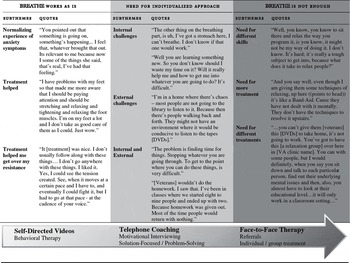
We investigated the extent to which participants felt that these videos fit with their experiences or could see themselves using them. Our thematic analysis used a combined inductive approach and deductive approach that drew from existing research on stepped care and GSH treatments. As displayed on the left of Table 4, one theme that emerged was that some participants felt that the BREATHE program worked well as it is. Subthemes supporting this theme include the importance of normalizing the experience of having anxiety symptoms, the immediate benefits from watching the videos, and help overcoming resistance to treatment. Another theme that emerged was the need for an individualized approach to treating anxiety for some Veterans. Subthemes focused on internal challenges, such as questions about how to tailor the techniques to oneself, motivation to participate, scheduling time to practice, and homework adherence, and external challenges, such as difficulty finding a place to practice due to chaotic home environments. A third theme that emerged was that the BREATHE program alone is not enough. Subthemes underlying this theme were related to a need for different methods of relaxing, the need for more skills in addition to relaxation, and the need for face-to-face treatments. In summary, the three themes that emerged also fit with a stepped care treatment model, which is depicted with the arrow below the table.
Thematic analysis

Discussion
The combined qualitative and quantitative data demonstrate the overall feasibility and acceptability of the BREATHE program, a video-delivered relaxation treatment for late-life anxiety. All participants were able to follow the breathing and relaxation instructions based on quantitative ratings, which suggests that video-delivered teaching of skills is possible. The more fine-grained analysis with the qualitative data highlighted ways to improve the clarity and quality of the videos. Overall, Veterans found the videos to be simple and straightforward, which supports the use of this program as a GSH treatment with only brief interactions with a professional (i.e. BREATHE coach). Participant feedback helped shape the BREATHE program into tailored treatment for older Veterans.
Interestingly, differences emerged between the quantitative and qualitative findings, highlighting the strength of the mixed methods approach. Although all participants were able to generally or definitely follow the video instructions, qualitative findings revealed some simple yet problematic issues with the instructional videos. Identifying these issues during treatment development is essential, particularly when the program consists of either self-help or GSH treatments. The iterative testing process allowed us to identify minor changes to language and more substantial changes to the instructions, such as adding reminders, encouragement, and explicit directives. For example, revisions to the breathing instructions were based on a combination of participant and expert feedback. First, to minimize risk of hyperventilation, we added a recommendation for the viewer to exhale for at least one second longer than the length of their inhale. Then, to account for medical conditions, we introduced two alternative ways of exhaling: using pursed lips or with the tip of the tongue behind the front teeth, which has been found to relieve dyspnea during physical functioning in individuals with Chronic Obstructive Pulmonary Disease (Nield et al., Reference Neild, Soo Hoo, Roper and Santiago2007). In summary, the iterative testing process enabled us to further tailor the videos and identify even minor aspects of the video that are unclear or confusing, which may prevent treatment discontinuation or diminished treatment efficacy.
One intriguing finding from the thematic analysis demonstrated the importance of a personalized and stepped approach to anxiety treatment. Some Veterans were quite pleased with the videos and expressed interest in continuing to use them on their own. Others raised issues regarding difficulties establishing a routine to practice, challenges with practice adherence, and barriers encountered when the program appears to be a “one-size-fits-all.” These issues are not unique to BREATHE, but reflect the larger challenges of evidence-based treatments. Nevertheless, these issues can be addressed by a BREATHE coach, who would check in with the participant weekly and provide encouragement, guidance, and trouble-shooting with the technology or intervention. We identified some evidence-based techniques that a coach could use, including motivational interviewing, problem solving, and solution-focused therapy techniques. Motivational interviewing (Rollnick et al., Reference Rollnick, Miller and Butler2008) may help participants with adherence, whereas problem solving could help participants who struggle in finding a good practice space or in establishing a daily practice routine. Coaches could employ solution-focused techniques to help identify what the participants did well and to encourage them to do more of what was successful (de Shazer and Dolan, Reference de Shazer and Dolan2007). These simple, brief interventions can be delivered by phone and can provide individualized feedback and encouragement, which is central to GSH treatments.
Despite the positive feedback about BREATHE, some Veterans strongly felt that face-to-face therapy or instruction in a classroom setting is needed, and that connection may be critical to the development of therapeutic rapport. However, it is also possible that the use of videos could enhance face-to-face therapy. Some individuals may derive more benefit from face-to-face treatments compared with GSH, although Cuijpers et al. (Reference Cuijpers, Donker, van Straten, Li and Andersson2010) found the two treatment modalities to be essentially equivalent for depression and anxiety disorders in a meta-analysis and review. Taken together, Veterans’ feedback identified how the BREATHE program would fit within a stepped care model of anxiety treatment. Previous research found that stepped care prevented the development of anxiety and depressive disorders compared with usual care (van't Veer-Tazelaar et al., Reference van't Veer-Tazelaar2009). VA mental health care would likely benefit from integration of self-help and GSH treatments in a stepped care model. Existing VA mobile applications (apps) and web-delivered interventions would also fit within this larger approach to mental healthcare. We expect that these findings would generalize to non-Veterans and a pilot randomized controlled trial of BREATHE with community-dwelling older adults is underway (NCT02429778).
The present study has various strengths including use of quantitative and qualitative data to assess the clarity of the videos, an ethnically diverse sample, and extensive feedback during interviews and focus groups. However, several limitations should also be acknowledged. First, our sample was recruited from a metropolitan area, which may limit the generalizability of findings to rural-dwelling Veterans. Second, participants’ mean age was in the late sixties, likely representing mostly Vietnam era Veterans. Thus, the findings may not represent the views of older Veteran cohorts (i.e. Korean War era, World War II era). Third, we did not specifically examine whether participants met criteria for an anxiety disorder or post-traumatic stress disorder (PTSD); however, the elevated mean on the GAS suggests that some participants had substantial anxiety symptoms, which could be a function of underlying subthreshold anxiety or threshold anxiety or PTSD. Fourth, the present findings should be interpreted in light of the research team's personal biases. The BREATHE treatment videos feature the first author providing instructions to the viewer. To mitigate social desirability on the part of the participant, another interviewer conducted six interviews without the first author present with no differences in clarity ratings found. Fifth, although the sample size is sufficient for qualitative analyses, the sample is too small to draw conclusions based on quantitative data. However, we believe our qualitative data to be valuable for guiding future studies investigating this new domain of research on technology-delivered treatments.
Our findings suggest that the BREATHE program is a feasible GSH treatment for late-life anxiety. BREATHE takes a known and efficacious treatment (PMR) and combines it with explicit instructions to engage in activities as a way to decrease avoidance and maintain functioning over time. Strengths of BREATHE include the use of DVDs, which will enable it to be disseminated to older patients who have difficulties attending appointments. Additionally, the use of DVDs allows those without internet access to use the treatment. Thus, BREATHE could provide a low-cost, scalable treatment to many older Veterans with anxiety disorders. Future studies are needed to test the efficacy of BREATHE in reducing anxiety symptoms and in improving functioning of older Veterans with anxiety disorders. Planned future studies will test the BREATHE program delivered via DVD, but these videos also could be disseminated via websites or mobile apps once the efficacy of the BREATHE program has been tested (The videos are in the public domain. For more information, please contact the first author.).
Conflict of interest
None.
Description of authors’ roles
C. E. Gould designed the study, collected and analyzed the data, and wrote the paper. A. M L. Zapata collected and analyzed the data and revised the paper. J. Bruce and S. Bereknyei Merrell helped design the study and formulate the research questions, contributed to data analysis, and revised the paper. J. Loebach Wetherell, R. O'Hara, E. Kuhn, M. K. Goldstein, and S. A. Beaudreau contributed to the design of the study, provided feedback on analysis, and revised the paper.
Acknowledgments
This work was supported by the Department of Veterans Affairs Rehabilitation Research and Development (RR&D IK2 RX001478; PI Gould) and by Ellen Schapiro and Gerald Axelbaum through a 2014 NARSAD Young Investigator Grant from the Brain and Behavior Research Foundation (PI Gould). The authors have no conflicts of interest to disclose related to the manuscript. Views expressed in this article are those of the authors and not necessarily those of the Department of Veterans Affairs or the Federal Government.
Supplementary material
To view supplementary material for this article, please visit https://doi.org/10.1017/S1041610217000928