Second language (L2) grammar acquisition has received researchers’ attention for several decades, yet surprisingly little is known about incidental acquisition of grammar during reading. It has been claimed that incidental acquisition (i.e., acquisition that is a by-product of another activity like reading or listening) in both first language (L1) and L2 contributes substantially to vocabulary growth (Grabe, Reference Grabe2009). However, most studies in this area have been concerned either with the breadth of lexical knowledge or other quantitative aspects of incidental vocabulary acquisition (e.g., which proportion of new words may be acquired incidentally). Considerably less research has been devoted to qualitative aspects of incidental vocabulary acquisition (Webb, Reference Webb2008).
Despite the general consensus that “knowing a word involves more than being able to recall the meaning (or L1 translation) of a presented word form” (Nation, Reference Nation1994, p. 121), little research has gone beyond the acquisition of the meaning of new words so far. Earlier approaches captured only different levels of meaning acquisition (Beck, McKeown, & McCaslin, Reference Beck, McKeown and McCaslin1980; Dale, Reference Dale1965; Kameenui, Dixon, & Carnine, Reference Kameenui, Dixon, Carnine, McKeown and Curtis1987). Read (Reference Read1989) may well have been the first researcher to attempt to set up an interview protocol for the purpose of assessing depth of vocabulary knowledge of adult L2 learners that also covered grammatical aspects of the new words. Paribakht and Wesche (Reference Paribakht and Wesche1993; see also Paribakht & Wesche, Reference Paribakht, Wesche, Coady and Huckin1997; Wesche & Paribakht, Reference Wesche and Paribakht1994, Reference Wesche and Paribakht1996) developed the Vocabulary Knowledge Scale (VKS), now a well-established and frequently used instrument in the area of incidental vocabulary acquisition. It consists of five levels that “range from complete unfamiliarity, through recognition of the word and some idea of its meaning, to the ability to use the word with grammatical and semantic accuracy in a sentence” (Paribakht & Wesche, Reference Paribakht, Wesche, Coady and Huckin1997, p. 179). Like similar measures in this area, the VKS is based on learners’ self-evaluation of their vocabulary knowledge.
Though little attention has been paid to the incidental acquisition of grammatical properties in natural languages, in the related area of artificial language acquisition, grammar is one of the central issues. A number of studies have explored the acquisition of more or less complex grammatical rules from pure exposure to an artificial language (Saffran, Reference Saffran2001). The focus of these studies typically has been on implicit learning and the ability of the human brain to abstract statistical regularities from the input. In some versions of such experiments, novel morphemes with novel functions were integrated in an existing language known to the participants to avoid the reduction of the acquisition to form-form mappings (Leung & Williams, Reference Leung and Williams2012). In general, however, the generalizability of the results in this area of acquisition of natural languages is viewed controversially (for an overview, see Folia, Uddén, De Vries, Forkstam, & Petersson, Reference Folia, Uddén, De Vries, Forkstam and Petersson2010). Footnote 1
To our knowledge, no study has explicitly been directed at incidental grammar acquisition during text reading in natural languages. One reason for the lack of research in this area so far may be the fact that the attention of researchers has primarily been directed at the acquisition of new rules. This requires learners of a natural language to not be very advanced so that there may be rules that they have not yet encountered or not yet mastered. This is at odds with acquisition during reading because beginning learners that fulfil such requirements typically do not engage in independent reading.
Advanced L2 learners who often engage in reading and thus comprise the population that may profit most from incidental acquisition through reading typically do not encounter completely unfamiliar grammatical structures. They do, however, encounter new words, which they then need to integrate into their L2 grammatical landscape. This means, for example, that they need to identify the grammatical categories of the new word and assign to them the correct values, which they need to infer from the input.
The present study addresses this particular process by examining the initial stages of L1 and L2 incidental acquisition of two grammatical features, subcategorization and (ir)regularity of novel verbs, during reading in German. In contrast to previous related studies that relied on various pen-and-paper tasks to test the incidentally acquired knowledge (e.g., the VKS, multiple choice tests requiring identification of the target word’s meaning, or tasks that require generating a definition), we employ an experimental paradigm based on reaction time (self-paced reading) measurements that permits insights into the very first stages of acquisition and also reveals gains of knowledge that may not be conscious to the learners. Specifically, we explore (a) whether two or three initial contextualized exposures to an unknown verb are sufficient to infer its subcategorization or (ir)regularity status, (b) whether the linguistic differences between the two grammatical features are reflected in the potential different trajectories of their initial acquisition, and (c) whether the difference in the language proficiency between the L1 and L2 learners is mirrored in their acquisition processes. In addition, we manipulate the syntactic complexity of the contexts in which the new words appear to test (d) whether this variable contributes to or hinders the inference of grammatical features.
In the study, we use the term acquisition as opposed to learning to stress the unintentional nature of the process and to comply with the previous literature on incidental vocabulary acquisition during reading. Unintentional or incidental in this context does not imply free of any conscious processes and shall not be equated with implicit (cf. Ellis, Reference Ellis and Ellis1994, or Rieder, Reference Rieder2003).
We view both acquisition and learning as cumulative processes that pass through several stages. The present research focuses on the very initial stage of the acquisition process and does not intend to imply that the acquisition of initial knowledge about, for example, the regularity status of a new verb equals the complete acquisition of the verb’s conjugation. Rather, our intention is to explore how particular context properties affect the acquisition of two grammatical features at initial exposure. Clearly, more research that includes posttests and creates conditions to assess the progress in the cumulative knowledge gain would be necessary to make claims about the acquisition as a completed state.
BACKGROUND
Subcategorization and (Ir)regularity
Subcategorization and conjugation type are two grammatical properties of verbs with different characteristics. Whereas conjugation type (i.e., the adherence of a verb to a regular or irregular conjugational pattern) is a morphological property that cannot be derived from the verb’s meaning, subcategorization is primarily a syntactic property, and meaning is considered the determining factor in its acquisition in most accounts (e.g., Gropen, Pinker, Hollander, Goldberg, & Wilson, Reference Gropen, Pinker, Hollander, Goldberg and Wilson1989; Pinker, Reference Pinker1989).
Subcategorization refers to structural aspects of verbs that allow them to participate in certain syntactic frames that represent specifications of the number and types of their arguments. The study of subcategorization is related to the notion of transitivity because, traditionally, the most basic distinction among verb classes rests on the delineation of transitive and intransitive predicates (Zyzik, Reference Zyzik2006).
The acquisition of subcategorization has been the topic of research in both L1 and L2 (e.g., Berman, Reference Berman1993, Reference Berman and Levy1994; Bowerman, Reference Bowerman1990; Cabrera & Zubizarreta, Reference Cabrera, Zubizarreta and Eddington2005; Juffs, Reference Juffs1996; Montrul, Reference Montrul2000; Pinker, Reference Pinker1989). Researchers typically focus on how learners discover the number of participants that obligatorily or optionally participate in a particular event, which thematic roles they bear, and how the roles are mapped to syntactic positions. The L2 studies often examine transitivity alternations for which structural encoding differs in participants’ L1 and L2 and explore learners’ knowledge of these alternation patterns from the perspective of language transfer (Cabrera & Zubizarreta, Reference Cabrera, Zubizarreta and Eddington2005; Montrul, Reference Montrul1997, Reference Montrul2000; Toth, Reference Toth2000; Zyzik, Reference Zyzik2006). In addition to L1 and L2 acquisition studies on subcategorization, there are a number of studies that explore this topic from a computational perspective (Messiant, Reference Messiant2008; Schütze, Reference Schütze, Ram and Eiselt1994).
Most of the studies on subcategorization stress the role that semantics plays in the acquisition of subcategorization but do not propose that one type of verb (transitive or intransitive) may be considered the default representation (see Wunderlich, Reference Wunderlich2006). However, if they do make such assumptions, then transitive verbs are considered the default class. Footnote 2 The claim then is that syntax always provides a complement position for verbs, but the verb’s selectional properties determine whether it is filled by an explicit argument (Cummins & Roberge, Reference Cummins and Roberge2005; Fournier, Roberge, & Troberg, Reference Fournier, Roberge and Troberg2003). Montrul (Reference Montrul2000) makes the following claim:
Transitivity errors with unaccusative, unergative, and nonalternating verbs across studies can be explained if it is assumed that L2 learners, like L1 learners, resort to a default transitive template when they do not know the specific semantic constraints on certain lexical items. (p. 264)
The situation is different in the case of verb conjugation in languages that differentiate between regular and irregular conjugation types. Different theoretical frameworks converge on the assumption that regular and irregular verbs are stored and processed differently and assume that the regular conjugation is the default type. So-called dual-mechanism models implement this idea in the form of two principally different systems: The default system splits regular forms into their stem morphemes and affixes, and the memory-based system stores and retrieves all exceptions to the default as whole forms. A prominent model that has adopted this view is the dual-route model (e.g., Clahsen, Reference Clahsen1999; Clahsen, Rothweiler, Woest, & Marcus, Reference Clahsen, Rothweiler, Woest and Marcus1992; Pinker, Reference Pinker1991, Reference Pinker1997), according to which regular forms are generated by combining verb stems with corresponding suffixes in a rule-governed process (i.e., the rule-based route), whereas irregular forms need to be retrieved as ready-made entries from the lexicon (i.e., the lexical route).
Ullman and colleagues (Ullman, Reference Ullman2001a, Reference Ullman2001b; Ullman & Pierpont, Reference Ullman and Pierpont2005; Ullman et al., Reference Ullman, Corkin, Coppola, Hickok, Growdon, Koroshetz and Pinker1997) also postulate two mechanisms for parsing and/or producing regular and irregular morphology that are implemented in distinct neural systems: Whereas the default system corresponds to a procedural-memory system in left-frontal structures, the lexical storage of irregular word forms is part of a declarative-memory system in left temporal or temporoparietal structures. Different neural systems underlying regular and irregular inflection are also assumed by Marslen-Wilson and Tyler (Reference Marslen-Wilson and Tyler1998, Reference Marslen-Wilson and Tyler2007).
Although the preceding approaches favor dichotomous distinction between the two verb types, others question such absolute dissociation. For example, in fully decompositional models of inflection that conceptually rely on morphological theories such as distributed morphology (Halle & Marantz, Reference Halle, Marantz, Hale and Keyser1993, Reference Halle and Marantz1994), all verbs are processed within a single system (see, e.g., Embick & Marantz, Reference Embick and Marantz2005; Stockall & Marantz, Reference Stockall and Marantz2006). Such models assume that both regular and irregular verb forms are decomposed into stems and affixes followed by root-based lexical access. Also, schema-based accounts like that of Bybee (Reference Bybee1995) and connectionist models (McClelland & Rumelhart, Reference McClelland and Rumelhart1981; Plaut & Gonnerman, Reference Plaut and Gonnerman2000; Rumelhart & McClelland, Reference Rumelhart and McClelland1982; Seidenberg & Gonnerman, Reference Seidenberg and Gonnerman2000) assume that the different patterns for processing regular and irregular morphology are not related to the involvement of different memory systems but rather emerge on the basis of the type frequency (i.e., the number of items stored in the mental lexicon that represent that structure) of different patterns, which determines the productivity of a particular pattern. Finally, Smolka, Khader, Wiese, Zwisterlood, and Rösler (Reference Smolka, Khader, Wiese, Zwitserlood and Rösler2013) argue for a single processing system and provide evidence that linguistic categories of verb inflection are processed continuously.
Difficulties with the acquisition and production of inflectional morphology of verbs, especially when stem alternations are involved (Leow, Reference Leow2000), as it is the case with irregular verbs, have been observed for adult learners regardless of their proficiency level (e.g., for German: Clahsen, Reference Clahsen1999; Neubauer & Clahsen, Reference Neubauer and Clahsen2009). Different accounts propose different explanations for these difficulties. Larsen-Freeman (Reference Larsen-Freeman2010) assumes that “it is processing difficulty that makes the acquisition of inflectional morphology so elusive” (p. 221; see also Prévost & White, Reference Prévost and White2000). DeKeyser (Reference DeKeyser2005) argues that at least in the context of uninstructed L2 processing, “it is the transparency of form-meaning relationships to a learner who is processing a language for meaning that determines the difficulty of acquisition” (p. 3). The stem vowel change in German irregular verbs is both opaque (i.e., may be explained diachronically but not synchronically) and has low salience (Peters, Hulstijn, Sercu, & Lutjeharms, Reference Peters, Hulstijn, Sercu and Lutjeharms2009) because the change appears in the middle of a word. Footnote 3 Irrespective of the, so far, unclear status of the acquisition difficulties of stem alternations, all studies concerned with the acquisition of regular and irregular verbs generally report an overgeneralization of the regular inflection that exceeds the much rarer overgeneralization of any irregular patterns. Most authors view this as evidence that regular inflection is the result of a rule-based procedure, whereas irregular forms are stored in the lexicon.
Syntactic Complexity
An additional variable that we explored in this study was the syntactic complexity of the context in which the new word appears. In previous studies (Bordag, Kirschenbaum, Opitz, & Tschirner, Reference Bordag, Kirschenbaum, Opitz, Tschirner, Torrens and Escobar2014, Reference Bordag, Kirschenbaum, Tschirner and Opitz2015), it was shown that syntactically complex contexts contribute to meaning acquisition in L2 but not in L1. With respect to the difference between L1 and L2, we assume that the syntactic manipulations (i.e., longer sentences; a greater amount of subordinate clauses; more passive, participle, and infinitive constructions) created challenging comprehension conditions with processing consequences for L2 learners but not for L1 natives. We also assume that the usage of complex structures leads to a disruption of the text model of the L2 readers and, thus, triggers a shift of their attention from the text level to the word level (Rieder, Reference Rieder2002), which favors the acquisition of the meaning of the new words. By contrast, the native speakers in our study (mostly students of philological subjects) were very proficient readers who had also mastered less frequent and complex syntactic structures. Consequently, no shift of attention from the text to the word level was needed because—similar to syntactically simple texts—the global goal of text comprehension could be achieved without paying focal attention to the text’s basic components even for complex texts.
The positive effect of a challenging context on incidental acquisition is also supported by findings from studies on the impact of different types of text modification on L2 comprehension (for reviews see Chung, Reference Chung1995; Parker & Chaudron, Reference Parker and Chaudron1987) and especially of text genre. The more challenging genre (expository) was found to contribute more to incidental vocabulary acquisition than the narrative genre, which is perceived as easier with respect to text comprehension (but see Nagy, Anderson, & Herman, Reference Nagy, Anderson and Herman1987, for contradictory evidence). Shokouhi and Maniati (Reference Shokouhi and Maniati2009) argue that:
in texts which display an easy-to-construct state of affairs due to their very genre, readers are less likely to attempt discovering the meaning of every single unknown word because they rely on inferencing higher level text organization such as propositions rather than individual words. (p. 18)
Readers of narratives thus emphasize attaining the global thematic information, whereas readers of expository texts compensate “for the lack of a unified global structure of their texts by trying to get the meaning of the individual unknown words in order to construct a coherent representation of the texts” (Shokouhi & Maniati, Reference Shokouhi and Maniati2009, p. 18). Similarly, we may assume that if readers experience difficulties with text comprehension due to problems with decoding complex syntactic structures, they shift their attention to more basic components such as the meaning of new (or less well-known) words.
Positive contributions of complex tasks on language acquisition have also been acknowledged by several pedagogically oriented approaches, in particular by Robinson’s cognition hypothesis (e.g., Robinson, Reference Robinson and Robinson2001, Reference Robinson2007). According to this hypothesis, tasks that increase cognitive demands (represented in our study by complex syntax) increase attention to input, thus supporting learning and improving memorization of forms made salient in input. Robinson’s hypothesis takes up Givón’s argument (Reference Givón and Slobin1985, Reference Givón1995) that demanding tasks and contexts elicit a syntactic mode of production characterized by greater use of morphology and more complex syntactic structures. This may support the assumption that processing of grammatical features is also greater in complex comprehension tasks, at least for populations that perceive the task as cognitively more demanding (e.g., L2 learners).
In the present paper, we explore whether the acquisition of (ir)regularity and subcategorization is also affected by the syntactic complexity of the context, at least in the L2. In a broader context, we want to know whether syntactic complexity contributes to incidental acquisition in general or only with respect to particular word properties. From previous studies, we know that syntactic complexity positively affects meaning acquisition (Bordag et al., Reference Bordag, Kirschenbaum, Tschirner and Opitz2015), but does it also contribute to the acquisition of word properties at the same level (i.e., grammar)? It could be conceivable that syntactic complexity might, for example, hinder the acquisition of the syntactic properties of novel words because the processing of syntactically complex contexts uses up all resources available for this type of processing so that no resources are left for the acquisition of new syntactic (and perhaps other grammatical) properties. In addition, similar to our previous studies (Bordag et al., Reference Bordag, Kirschenbaum, Opitz, Tschirner, Torrens and Escobar2014, Reference Bordag, Kirschenbaum, Tschirner and Opitz2015), we examine the differences in incidental vocabulary acquisition between L1 and L2 speakers.
Rationale Behind the Present Study
The general idea of all the experiments reported in this paper is the following: If a novel verb manifests the assignment of a specific value within a particular grammatical category (e.g., intransitivity or regular conjugation) during the learning phase and if this information is inferred successfully and in some way initially represented, then a subsequent violation of the inferred category value should negatively affect participants’ processing. Such a violation may be achieved in a subsequent testing phase by presenting the novel verb as manifesting a value that is different from the one associated with the verb in the learning phase (i.e., the verb is presented, e.g., as transitive or irregular). The discrepancy between the inferred and, thus, initially stored value and the tested value should lead to processing difficulties reflected in longer reading times compared to a situation in which the inferred and the tested value are the same. We implemented this idea by using an adjusted self-paced reading method with moving window that has been used for similar research purposes previously (e.g., Bordag et al., Reference Bordag, Kirschenbaum, Tschirner and Opitz2015) for an investigation of meaning inference). To address the question of the influence of syntactic complexity on the inference and initial storage of the grammatical information, participants read the texts in the learning phase in a simple and complex version. The details of the approach are described in the next section.
Experiments 1a and 1b: Incidental Acquisition of Subcategorization of Novel Verbs
In these experiments, we explored the initial stages of incidental acquisition of subcategorization frames of novel verbs by native speakers of German (Experiment 1a) and advanced German learners (Experiment 1b) while reading syntactically simple and complex texts.
Methods
Participants
The participants in Experiment 1a were 80 German native speakers, mostly students of the University of Leipzig. The average age of the participants was 22.7 years. The L2 participants in Experiment 1b were 72 advanced German learners, mostly exchange students at the University of Leipzig. Their native languages were of Slavic or Romance origin, and their L2 German proficiency corresponded to the levels B2 and C1 of the Common European Framework of Reference for Languages (CEFR; levels from least to most proficient: A1, A2, B1, B2, C1, C2). Footnote 4 Four individual participants constituted one superparticipant (see the “Procedure” section for the explanation of this term) with one and the same L1. Thus, there were six Romance superparticipants each with one L1 (Italian, French, Portuguese, and Spanish) and 12 Slavic superparticipants each with one L1 (Czech, Polish, Russian, Bulgarian, and Ukrainian). The average age of the participants was 25.6 years, their first contact with the German language was, on average, at the age of 13.5 (minimum = 11, maximum = 21), and they had been learning German for an average of 8.5 years (minimum = 5.5, maximum = 14; most participants had learned German for 7–11 years). The data about the participants and their language background were collected with a language questionnaire that each participant filled out at the end of the experimental session.
Participants were informed in advance that they would participate in a study on reading comprehension. However, they were not told about its main purpose—namely, vocabulary and grammar acquisition—until they completed the experiment, as this information would direct their attention to the new words, and the learning then would not be incidental. A few participants of the study, most of them L1 speakers of German, when asked about their observations after completing the experiment, reported encountering one or a few words that they did not think existed or that they considered strange, usually because they knew there was another word that matched the given context (our low-frequency verb). Most participants reported that they did not know some of the words, but none of them disclosed the systematic experimental manipulation.
The task took about 30 min for the L1 and about 40 min for the L2 participants. All participants were paid for their participation.
Materials
Pseudowords
Twenty-eight low-frequency German verbs were selected (20 experimental, eight fillers). All of them were intransitive. Almost all transitive German verbs can also readily be used intransitively, which makes it impossible to construct a violation of subcategorization for those verbs that would show up as clearly ungrammatical. In contrast, the transitive usage of intransitive verbs is much rarer and possible only for a limited number of intransitive verbs, often with specific objects and with modified meaning (e.g., den letzten Schlaf schlafen “to sleep one’s last sleep”). Therefore, we decided to rely on intransitive verbs as critical items throughout this experiment. They were used as the starting point for constructing violations of the subcategorization frames by presenting them as transitive forms in the incompatible condition.
All verbs formed the past participle form with the auxiliary verb haben “have” (not sein “be”). Each verb was matched with a phonologically unrelated disyllabic pseudoverb (see Appendix A). All pseudoverbs were morphologically simple (no affixes) and regular. They were partly generated with the Wuggy pseudoword generator (Keuleers & Brysbaert, Reference Keuleers and Brysbaert2010).
Texts
Twenty short (approximately 100 words each) texts were constructed that enabled the derivation of meaning and the subcategorization information of each low-frequency verb, which was replaced with one of the pseudowords functioning as a placeholder. Each pseudoverb appeared in the text three times: once in the infinitive (diechen) and twice in the participle form (perfect tense [Perfekt] as gediecht). Each verb was presented at least once with a nonpronominalized subject. In addition, there were eight filler texts that consisted only of words that were assumed to be known by German learners at the B2 level (the main criterion was their frequency). The texts were written with the help of dictionary definitions of the low-frequency verbs and their statistical co-occurrences using the Das Digitale Wörterbuch der deutschen Sprache (DWDS) corpus of the German language Footnote 5 and the Wortschatz Projekt. Footnote 6
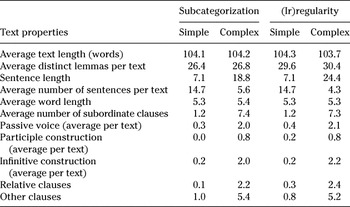
Two versions of each text were created: a syntactically simple and a syntactically complex one. On the basis of the discussions of complexity in previous studies (especially Arya, Hiebert, & Pearson, Reference Arya, Hiebert and Pearson2011, and Leikin & Assayag-Bouskila, Reference Leikin and Assayag-Bouskila2004), we extracted and manipulated the following syntactic or structural properties that have been shown to affect text complexity and consequently its comprehensibility due to their demands on cognitive capacity (Britton, Glynn, Meyer, & Penland, Reference Britton, Glynn, Meyer and Penland1982, p. 59): sentence length as the number of clauses per sentence (sentences in syntactically complex texts were longer), number of subordinate clauses (more in complex texts), number of reduced clauses embedded in one syntactic structure (i.e., more participle attributes, deverbal nominalizations, infinitive constructions in complex texts), and voice of verbs (more passives in the complex texts). For a more detailed description of these syntactic manipulations see Bordag et al. (Reference Bordag, Kirschenbaum, Tschirner and Opitz2015). Table 1 summarizes the basic properties of the manipulated texts, example texts may be found in Appendix B.
Properties of manipulated texts for Experiments 1 and 2

However, it should be stressed that the manipulation of syntactic complexity in the present study intended to yield texts that would still be considered as both nativelike and relatively unmarked. Thus, we did not try to exhaust extreme positions on the complexity scale for both versions of a particular text at the expense of readability and relative unmarkedness. Instead, the texts were designed to exhibit a noticeable as well as quantifiable difference in syntactic complexity between both versions that would reflect the syntactic differences between original texts and adapted graded readers (Crossley, Louwerse, McCarthy, & McNamara, Reference Crossley, Louwerse, McCarthy and McNamara2007; Simensen, Reference Simensen1987).
Self-Paced Sentences
In the self-paced reading part of the experiment, one critical sentence was created for each pseudoverb in which the pseudoverb appeared in a semantically plausible context in perfect tense (i.e., in the same form as it appeared twice in the text). Syntactically plausible and implausible sentence pairs were created for each critical sentence. In the plausible version, the pseudoverb was used with a correct subcategorization frame (i.e., intransitive as in the text) and, in the implausible version, with an incorrect subcategorization frame (i.e. transitive), thus yielding an ungrammatical violation. Footnote 7 In the implausible version, the object was the pronoun es “it” and always preceded the participle form.
Examples of a plausible and an implausible sentence for the pseudoverb dresen replacing the German intransitive verb zappeln “to thrash about” are presented in (1):
-
(1) a. Plausible (intransitive)
-
Der Fisch hat sehr gedrest, als ich ihn aus dem See zog.
-
“The fish was thrashing about a lot as I pulled it out of the lake.”
-
-
b. Implausible (transitive)
-
Der Fisch hat es sehr gedrest, als ich ihn aus dem See zog.
-
“The fish was thrashing about it a lot as I pulled it out of the lake.”
-
The pseudoword never appeared at the end of the sentence; at least four words always followed. In all critical sentences, an adverb immediately preceded the pseudoverb, intervening between the pronominal object (es “it”) and the pseudoverb in the implausible condition. All critical sentences started with the same structure (noun phrase – auxiliary – [object] – adverbial –participle, . . .). The subject in each critical sentence was always a masculine noun in nominative case, so that there was no ambiguity regarding its status as the subject versus the object of the sentence. Footnote 8 The contents of the sentences were related to the topics of the short texts.
For each text, two additional filler sentences were constructed that were also related in topic but consisted only of known words. Up to three self-paced reading sentences were also created for the filler texts. For each subject, four filler texts were followed by self-paced reading sentences that included a violation of the subcategorization frame of an existing verb that also occurred in the filler text. The other four filler texts were followed only by correct sentences. Some of the (grammatical) filler sentences contained the pronominal object es “it” in a similar position as in the critical implausible sentences, so that it could not be perceived as a signal of implausibility by the participants.
Statements
Twenty statements referring to the contents of the texts were created that could be answered with a yes or no response. This task was applied to ensure that participants read the texts carefully and to disguise the actual goal of the study. All participants included in the analysis answered at least 18 of the 20 questions correctly.
Procedure
Participants were tested individually or in pairs in a laboratory in the presence of an experimenter. They were given written instructions for the task that also explained that the texts they would read may contain low-frequency words that they may not know because these words come from specific dialects or special registers. Nevertheless, participants were instructed to try to understand the texts and read them at their usual speed (i.e., not too slowly). Stimuli were presented electronically on a 17-in monitor using the E-Prime software (Version 2.0).
The experimental session started with two practice trials followed by the experimental and filler trials. Each one began with a presentation of the text. Participants read the text silently and pressed the space bar when they were finished. Reading duration was measured. After pressing the space bar, a plausible, implausible, or filler sentence appeared, with each letter masked with an X, so that each word of the sentence consisted of a sequence of Xs whose number corresponded to the number of letters in the word. Each time the participant pressed the space bar, one word was disclosed, while the previous one turned into Xs again. This way, participants were able to read the whole sentence, word by word (self-paced reading with a moving window). The reaction time of each space bar press was measured. Though we obtained reading times for each word of the self-paced reading sentences, regions of interest were the position of the novel verb (n) and the first and second word following the novel word (n + 1 and n + 2, respectively). Reading times for these positions were subsequently analyzed. The number of self-paced reading sentences following each text varied between one and three sentences. One of the sentences was always the critical plausible or implausible sentence. After presenting the self-paced reading sentence(s), the statements referring to the text appeared on the screen, and the participant had to decide whether the statement was true or false by pressing one of the corresponding buttons. Each participant read each text only once, either in the syntactically simple or complex version, followed either by the semantically plausible or implausible sentence. That is, each participant read five syntactically simple texts followed by a plausible sentence, five syntactically simple texts followed by an implausible sentence, five syntactically complex texts followed by a plausible sentence, and five syntactically complex texts followed by an implausible sentence. Thus, there were four experimental lists, and all participants were assigned to only one of them. Therefore, four participants always created a superparticipant Footnote 9 with a complete design (i.e., when each text was administered in both the simple and complex condition, and a text in each condition was followed by both an implausible and a plausible sentence). The order of the texts and sentences in each condition rotated and were presented in a pseudorandomized fashion, so that it was not possible to predict which condition would follow. For each experimental list there were two randomizations. The four participants that created the superparticipant were matched with respect to their mother tongue and language proficiency.
Results
One text (with the pseudoverb hunken replacing keimen “to germinate”) was excluded from the analyses because an error was discovered in the critical self-paced reading sentence following it. Thus, there were 19 items (texts and novel verbs) included in the analyses.
Experiment 1a: L1 Participants
Texts
The t tests revealed that participants tended to read the syntactically complex texts more slowly than the simple texts (32.6 s vs. 32.1 s), though the effect was only marginally significant, t1(1, 19) = 4.03, p = .065; t2(1, 18) = 2.45, p = .054.
Self-Paced Sentences
Before statistical analyses were carried out, the reaction time data were checked for outliers. Single data points were excluded from further analyses if they deviated more than two standard deviations from the particular participant’s mean. According to this procedure, 225 data points (4.9%) were removed from a dataset of 4,560 points. The statistical analyses were run for the reading times (not residual times). For more information about self-paced reading experiments and their analysis see Jegerski (Reference Jegerski, Jegerski and VanPatten2014).
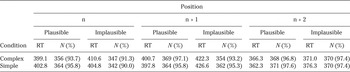
ANOVAs with the factors position, plausibility, and complexity revealed main effects for position, F1(1, 19) = 7.47, p = .002, ηp Footnote 2 = .28; F2(2, 36) = 48.02, p < .001, ηp Footnote 2 = .73, and plausibility, F1(1, 19) = 15.41, p = .001, ηp Footnote 2 = .45; F2(1, 18) = 3.85, p = .067, ηp Footnote 2 = .17. Participants were 14 ms slower in the implausible (402 ms) than in the plausible condition (388 ms), and there were also more outliers in the implausible (135) than in the plausible condition (88). There were no significant interactions.
The subsequent ANOVAs for the individual positions revealed a significant plausibility effect on the regions n + 1, F1(1, 19) = 12.02, p = .003; F2(1, 18) = 7.59, p = .013, and n + 2, F1(1, 19) = 7.41, p = .014; F2(1, 18) = 5.57, p = .030, and no effect on n, F1(1, 19) = .78, p = .389; F2(1, 18) = .22, p = .648. In region n + 1, participants were 25.2 ms slower in the implausible than in the plausible condition; in region n + 2, the difference was 9.3 ms. No effect of complexity was observed.
The plausibility effect (i.e., slower reaction times in the implausible than in the plausible condition) indicates that participants inferred the (intransitive) subcategorization frame of the novel verbs and perceived their transitive usage as a violation, leading to longer reading times (see Table 2).
Mean reading times (RTs, in ms), number of valid data points (N), and their respective percentage for experimental conditions in each position for self-paced reading task in Experiment 1a (L1 participants)

Experiment 1b: L2 Participants
Texts
Statistical tests (t tests) showed that participants read the syntactically complex texts more slowly than the simple ones (49.5 s vs 47.0 s), t1(1, 17) = 4.03, p < .001; t2(1, 18) = 2.45, p = .025.
Self-Paced Sentences
Following the same procedure as described for Experiment 1a, 195 (4.75%) out of 4,104 data points were identified as outliers and removed from further analyses. ANOVAs with the factors position, plausibility, and complexity revealed a main effect for position, F1(1, 17) = 9.97, p < .001, ηp Footnote 2 = .28; F2(2, 36) = 48.03, p < .001, ηp Footnote 2 = .52. Plausibility was marginally significant in F1: F1(1, 17) = 3.24, p = .093, ηp Footnote 2 = .14 (participants tended to be 9.3 ms slower in the implausible than in the plausible condition), and, similarly, the interaction between position and complexity was also significant only in F1: F1(2, 34) = 3.3, p = .038, ηp Footnote 2 = .17. Footnote 10 Participants were 13.6 ms slower in the implausible condition when the texts were complex and only 5.0 ms slower when the texts were simple.
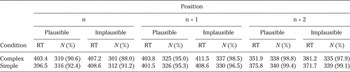
The subsequent ANOVAs for the individual positions revealed no significant effects for the regions n or n + 1. However, for region n + 2 the interaction of plausibility and complexity was marginally significant, F1(1, 17) = 3.05, p = .082, ηp Footnote 2 = .19; F2(1, 18) = 3.93, p = .063, ηp Footnote 2 = .21. Participants were 29.3 ms slower in the implausible condition when the texts were complex, indicating a larger effect in the complex condition. Subsequent t tests revealed that the plausibility effect was significant only for the complex condition, t1(1, 17) = 2.79, p = .012 (two-tailed); t2(1, 18) = 1.82, p = .043 (one-tailed).
The results show a weak late plausibility effect that appears only in the complex condition. This finding indicates that the ability of the L2 learners to infer or initially represent the subcategorization frame of novel verbs from just three occurrences is limited compared to the L1 participants and that the initial acquisition was more successful if the novel verb appeared in syntactically complex texts (see Table 3).
Mean reading times (RTs, in ms), number of valid data points (N), and their respective percentage for experimental conditions in each position for self-paced reading task in Experiment 1b (L2 participants)

Discussion
The results of Experiments 1a and 1b show that both L1 and L2 participants are able to infer incidentally and (at least) initially store information about the subcategorization frame of novel verbs after just three occurrences in the text. The plausibility effect was stronger and appeared earlier for the L1 participants (already at the n + 1 region) than for the L2 participants (only at the region n + 2). The L2 participants were sensitive to the violation of a novel verb’s subcategorization frame only if the verb appeared in syntactically complex texts. This finding is in line with our previous studies showing that syntactic complexity contributes to meaning acquisition in L2. The results of the two experiments will be discussed in detail in the “General Discussion” section.
Experiments 2a and 2b: Incidental Acquisition of Conjugation Type of Novel Verbs
In these experiments, we explored the inference and initial acquisition of conjugation type of novel verbs (i.e., whether a verb is conjugated regularly or irregularly) during a reading of syntactically simple and complex texts by native speakers of German (Experiment 2a) and advanced German learners (Experiment 2b).
Methods
Participants
Two groups of participants, native speakers (n = 76) and advanced learners (n = 68), were recruited according to the same criteria as in Experiments 1a and 1b. The average age of the L1 participants was 21.9 years, and, for the L2 participants, the average age was 24.6 years. The L2 participants’ first contact with German was, on average, at 14.1 years of age (minimum = 7, maximum = 24), and they had been learning the language for an average of 8.8 years (minimum = 4.6, maximum = 15.1; most participants had learned German for 7–12 years). In the L2 group, 10 superparticipants had Slavic native languages and seven had Romance native languages.
Materials
Pseudowords
Twenty low-frequency German verbs were selected, all of them transitive. All verbs formed the past participle form with the auxiliary verb haben “to have” (not sein “to be”). Each verb was matched with a phonologically unrelated disyllabic pseudoverb (see Appendix B). All pseudoverbs were morphologically simple (no affixes). They were partly generated with the Wuggy pseudoword generator (Keuleers & Brysbaert, Reference Keuleers and Brysbaert2010). The phonological form of the infinitive of the pseudoverbs was neutral with respect to its regularity status.
Regular conjugation was assigned to half of the pseudoverbs (i.e., no stem changes in perfect tense or past tense; participle formed by regular affixation of ge- and -t) and irregular conjugation to the rest. The generated irregular forms were in accordance with existing ablaut patterns of irregular German conjugation (i.e., no affixation of -t in simple past forms, instead stem changes according to existing ablaut patterns; forms of perfect tense [Perfekt] or participle marked by irregular affixation, i.e., ge- and -en). Examples of pseudoverbs are provided in (2) and (3):
-
(2) Regular pseudoverb, replacing necken “to tease”:
diechen (infinitive) - diechte (past) - gediecht (participle)
-
(3) Irregular pseudoverb, replacing naschen “eat /indulge in sweets”:
paufen (infinitive) - pief (past) - gepaufen (participle)
Texts
Twenty short texts were constructed (for example texts, see Appendix A) according to the same criteria as in Experiments 1a and 1b (see Table 1 for details on text properties). Each pseudoverb appeared in the text three times, once in the infinitive and twice in the simple past. Thus, by virtue of the past tense forms, each pseudoverb was unambiguously identifiable as regular or irregular.
Self-Paced Sentences
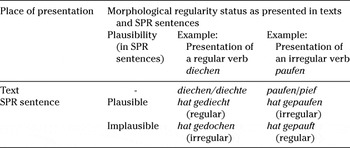
In the self-paced reading part of the experiment, one critical sentence was created for each pseudoverb in which the pseudoverb appeared in a semantically plausible context in its perfect form (hat gediecht, hat gepaufen). Two versions of each sentence were created, one being morphologically plausible and the other morphologically implausible (see Table 4). The morphologically plausible sentence contained the pseudoverb in a form that corresponded to its conjugation type (regular vs. irregular) as presented in the previously read text. In the implausible condition, the form in the critical self-paced reading sentence did not match the conjugation type of the pseudoverb in the corresponding text. In other words, a sentence was considered morphologically plausible if the morphological markings of the pseudoverb in the text (indicated by its past tense form) and in the self-paced reading sentences (indicated by its participle form) were either both regular or both irregular. For each text, two filler sentences were constructed that were also topically related but consisted only of known words.
Examples of presented morphological word forms of the pseudoverbs in the self-paced reading (SPR) task

Procedure
The procedure was the same as in Experiments 1a and 1b.
Results
Experiment 2a: L1 Participants
Texts
The participants were significantly slower when reading the syntactically complex texts (M = 33.4 s) compared to the syntactically simple ones (M = 32.4 s), t1(1, 18) = 4.87, p < .001; t2(1, 19) = 3.03, p = .006.
Self-Paced Sentences
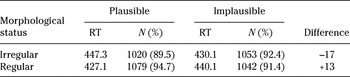
Three-hundred sixty data points (7.9%) were removed from a dataset of 4,560 points according to the same procedure used in the previous experiments. The results are summarized in Tables 5 and 6.
Mean reading times (RTs, in ms), number of analyzed data points (N), their respective percentage for experimental conditions regularity and plausibility, and the difference between the implausible and plausible conditions for Experiment 2a

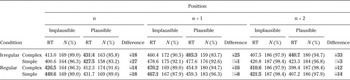
Mean reading times (RTs, in ms), number of valid data points (N), their respective percentage for experimental conditions in each position, and the difference between plausible and implausible conditions for the cases of same regularity and complexity values for Experiment 2a

Note. The gray markings highlight the longer reading times for regular versus irregular forms in the complex versus simple texts and the corresponding difference between the plausible and implausible conditions.
Statistical tests (ANOVAs) were performed on the remaining reaction time data and included the following factors: regularity, complexity, plausibility, and position. The results revealed a significant effect for position, F1(2, 36) = 39.23, p < .001, ηp Footnote 2 = .69; F2(2, 18) = 30.43, p < .001, ηp Footnote 2 = .77, and a significant Plausibility × Regularity interaction, F1(1, 18) = 16.73, p < .001, ηp Footnote 2 = .48; F2 (1, 9) = 27.09, p < .001, ηp Footnote 2 = .75. Whereas regular verbs were slower in the implausible condition than in the plausible condition, irregular verbs were faster in the implausible condition than in the plausible condition (see Table 5). The pattern of the results gives no indication that participants acquired the regularity status of the novel verbs in the texts because they were not slower in the implausible condition in general.
Instead, participants were slower only if a novel regular verb was presented as irregular in the self-paced sentence (implausible condition) or, in contrast, when a novel irregular verb was presented as irregular in the self-paced sentence (plausible condition). In other words, participants responded with slower reading times and demonstrated higher outlier rates whenever the presented novel verb form in the self-paced sentence was an irregular one—irrespective of the regularity status of the verb in the previous texts (see Table 6). This finding will be discussed in detail in the “Discussion” section.
Experiment 2b: L2 Participants
Texts
The participants read the syntactically complex texts significantly slower (M = 47.45 s) than the syntactically simple ones (M = 45.51 s), t1(1, 16) = 3.73, p = .002, t2(1, 19) = 2.38, p = .027.
Self-Paced Sentences
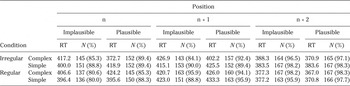
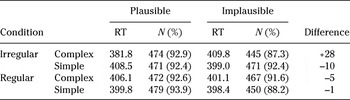
Three hundred and eighty-two (9.4%) outliers were removed from a dataset of 4,080 points. The results are summarized in Tables 7 and 8.
Mean reading times (RTs, in ms), number of valid data points (N), and their respective percentage for experimental conditions regularity, complexity, and plausibility in each position for Experiment 2b

Mean reading times (RTs, in ms), number of analyzed data points (N), and their respective percentage for experimental conditions regularity, complexity, and plausibility (conflated over the three positions) for Experiment 2b

A series of 2 × 2 × 2 × 3 ANOVAs were performed on the remaining reaction time data and included the following factors: regularity, complexity, plausibility, and position (see Table 7). The results revealed a significant effect for position, F1(2, 32) = 8.78, p < .001, ηp Footnote 2 = .35, F2(2, 18) = 10.01, p < .001, ηp Footnote 2 = .55. Moreover, a three-way Plausibility × Regularity × Complexity interaction was observed that was significant in F1 but not F2, F1(1, 16) = 4.36, p =.048, ηp Footnote 2 = .23; F2(1, 9) = 1.73, p = .222, ηp Footnote 2 = .16.
The subsequent t tests revealed that the difference between the plausible and implausible conditions was significant only for the irregular novel verbs that appeared in the complex texts (28 ms), t1(1, 16) = 3.11, p = .007 (two-tailed), t2(1, 9) = 2.01, p = .045 (one-tailed). The numerical differences between the plausible and implausible conditions for the irregular verbs in the complex condition at the individual positions showed that the effect was strongest at position n (45 ms) and gradually disappeared (24 ms at position n + 1, 17 ms at position n + 2, and 3 ms at position n + 3, which was not included in the analyses; see Table 8).
These results indicate that the L2 participants were able to derive the regularity status of the novel verb forms only under specific conditions. Furthermore, they show that, in general, just two occurrences of a novel verb form carrying a conjugation type cue are not sufficient for the acquisition of the regularity status to take place, unless other factors positively contribute to it as well. The details of this finding will be addressed in the “General Discussion” section.
Discussion
Contrary to the experiments on subcategorization, the data from the experiments exploring the incidental acquisition of (ir)regularity or conjugation type show fundamentally different patterns of results for L1 and L2 participants.
The data from the L2 participants principally comply with those from the previous experiments in that they show that grammatical features of novel verbs can be acquired incidentally after just two or three occurrences. Footnote 11 They also concur with the results of the L2 participants in Experiment 1b in that they show that syntactic complexity contributes to incidental acquisition of grammatical features in L2. However, they differ in the fact that the initial acquisition of the conjugation type was observed only for a subgroup of the novel verbs—namely, the irregular ones.
We can assume that incidental acquisition of the (ir)regularity status or conjugation type of irregular verbs in the complex condition was facilitated due to a combination of two factors. First, text complexity contributed to the acquisition of this morphological feature as was observed with meaning derivation and acquisition in an earlier study (Bordag et al., Reference Bordag, Kirschenbaum, Tschirner and Opitz2015) and with subcategorization in Experiment 1b in this study, that is, participants focused more on the individual word forms to decode complex syntactic structure.
Second, the markedness of irregular forms in the text may have also contributed to incidental acquisition of the (ir)regularity status or conjugation type of irregular verbs. Atypical word forms may be more salient and, thus, more easily noticed during reading than regular forms (see also Storkel, Armbruster, & Hogan, Reference Storkel, Armbruster and Hogan2006, p. 1188). We stipulate that it is not only (a)typicality of spelling patterns that affects incidental acquisition, but also grammatical—in our case, morphological—(a)typicality or markedness. We assume that participants scrutinized the irregular forms in the complex texts more closely than the forms that were regular and/or appeared in the syntactically simple texts. The incidental acquisition of their features thus profited from the attention directed at them due to the context (complex) and word-form (irregular) properties.
The pattern of results of the L1 participants differs from all other experiments in that, in the present experiment, no evidence was found indicating that participants inferred and at least initially retained any grammatical information about the regularity status of the novel verbs from the input. Instead, they perceived all irregular forms as implausible, no matter how the novel verb was conjugated in the previous text. This and the previous findings of Experiments 1a and 1b are addressed in detail in the “General Discussion” section.
GENERAL DISCUSSION AND CONCLUSION
In our previous study on meaning acquisition (Bordag et al., Reference Bordag, Kirschenbaum, Tschirner and Opitz2015), we have shown that syntactic complexity contributes to meaning inference and retention in L2. We argued that syntactic complexity functions as a trigger to shift a learner’s attention from the text level to the word level. The individual meaning of each word in a syntactically demanding context becomes vital for the construction of the mental model of text meaning. When the global goal of text comprehension cannot be easily achieved, the attention shifts from this goal to its elementary components. Word forms and the meanings mapped to them are scrutinized more closely to assure their validity and appropriateness for the given context. Sentences are read more slowly or reread, which enables more attention and resources to be allocated to the individual words that they contain.
The results of the present study show that syntactic complexity contributes to the inference and initial acquisition not only of meaning but also of morphological and syntactic features. This finding is in line with the cognitive hypothesis (Robinson, Reference Robinson and Robinson2001; Robinson & Gilabert, Reference Robinson and Gilabert2007) and with an earlier hypothesis of Hulstijn (Reference Hulstijn, Dechert and Raupach1989), who stipulated that acquisition (in this case of grammatical properties) may be more successful if comprehension does not proceed smoothly:
Why would learners bother to pay attention to formal properties (function words, syntax) of such a sentence, if they can get away with a semantic strategy? Perhaps input sentences need not be too comprehensible! Perhaps they must instead offer the learner a small problem to solve, just to make sure that the formal L2 properties will receive the attention minimally required for their implicit acquisition to take place. (p. 49)
The interpretation of the results that finds syntactic complexity to be a trigger of a learner’s shift of attention to the word level and, consequently, that does not ascribe the acquisition advantage to the syntactic complexity per se is also supported by the noticing hypothesis (e.g., Schmidt, Reference Schmidt1990). Its strong interpretation views noticing as a “necessary and sufficient condition for the conversion of input to intake” (Schmidt, Reference Schmidt1990, p. 129). We assume that syntactic complexity leads to “conscious registration of attended specific instances of language” (Schmidt, Reference Schmidt2012, p. 32), which corresponds to Schmidt’s definition of noticing.
We further assume that noticing can also be triggered by irregular or otherwise phonologically or morphologically conspicuous word forms. For advanced learners who are familiar with the German verb system, morphological irregularity can trigger noticing, because advanced learners know that acquisition of irregular verbs requires additional effort including memorization. Being, thus, sensitized to irregular verbs as a learning problem (e.g., Ellis, Reference Ellis, Fotos and Nassaji2007), such learners attend to them more closely when encountering them during reading (see also the projection model of Zobl, Reference Zobl1983, Reference Zobl, Gass and Madden1985).
The results of Experiment 2b indicate that learners inferred and at least temporarily retained the irregularity status of the (ir)regular verbs after just two exposures to the (ir)regularity status cue. However, they do not reveal whether participants also acquired the verbs’ irregular conjugation. In other words, we know that participants assigned these verbs to a correct category (i.e., irregular verb), but we cannot say whether they were also able to acquire the irregular patterns of the novel verbs. Along these lines, both the claims that irregular forms are salient and are not salient can be valid. They are salient in the sense that they are morphologically conspicuous to learners on advanced levels and, thus, attract their attention (cf. Godfroid & Uggen, Reference Godfroid and Uggen2013, for beginning learners). However, they are possibly not salient with respect to the particular phonological changes that occur on their stems (Peters et al., Reference Peters, Hulstijn, Sercu and Lutjeharms2009) because “evidence shows clearly that although onsets are unquestionably the most salient word parts, endings are more salient than middles” (Hawkins & Cutler, Reference Hawkins, Cutler and Hawkins1988, p. 300). Footnote 12
The results of Experiment 2a with German native speakers demonstrate how acquisition can be determined by previously acquired knowledge and by linguistic characteristics of a given grammatical phenomenon. Contrary to (ir)regularity, the two subcategorization classes explored in this experiment—intransitive and monotransitive verbs—do not essentially differ in their expected processing. Most theories do not assume that one is a default case and the other represents exceptions. Indeed, in Experiments 1a and 1b, we saw that both L1 and L2 participants readily inferred the intransitive feature of the novel verbs and perceived the transitive usage as a violation. Obviously, the assumption of some authors (e.g., Cummins & Roberge, Reference Cummins and Roberge2005; Fournier et al., Reference Fournier, Roberge and Troberg2003) that transitive verbs represent the default case is not reflected in the acquisition behavior of either L1 or L2 speakers as revealed in the present experiments. Footnote 13
On the contrary, dual-mechanism models for verb processing assume that regular and irregular verbs are processed differently and that the rule-based processing route for regular verbs represents the default one. Production errors in L1 and L2 acquisition such as overgeneralization of regular inflection indicate that, for the background mechanism (regardless of which nature it is), the regular inflection represents the default, generalized case. In Experiments 2a and 2b, we observed that, whereas the L2 learners can infer the (ir)regularity status of novel irregular verbs and perceive their regularization as violation, native German speakers perceive any novel irregular form as a violation and seem to classify all new verbs as regular irrespective of the evidence that they receive through input. We interpret this finding in terms of a learning by unlearning effect. The L1 participants learned that regular conjugation is productive and that the set of irregular verbs is a rather small, closed group of verbs and that they can be certain to know all its members. Having learned this, they stopped acquiring information about conjugation type from texts and instead assumed, per default, that all new verbs were regular. If an unknown irregular form appears, they consider it implausible. Seemingly paradoxical is the fact that the reduced amount of knowledge and experience the L2 learners have keeps them more open to turning input into intake and to learning new forms. By contrast, the response to the input by the L1 native speakers is determined primarily by their previously acquired, more profound knowledge that had shaped the grammatical landscape of their mind into more distinctive and clear-cut forms.
The present study further showed that, whereas the violation of a morphological feature (i.e., that [ir]regularity affects reading times already at position “n” or on the novel word), the violation of a syntactic feature (i.e., subcategorization) affects the reading times only at the spillover region(s). This observation is in line with Reichle, Warren, and McConnell’s (Reference Reichle, Warren and McConnell2009) model of eye-movement control called E-Z Reader 10. According to the model, processing difficulty can occur either at the lexical or postlexical processing stage. The lexical processing stage comprises a word-familiarity check and lexical access, whereas the higher order postlexical processing involves the integration of the currently fixated word n “into the higher-level representations that readers construct online” (Reichle et al., Reference Reichle, Warren and McConnell2009, p. 5). We can stipulate that the first stage also includes a word-form familiarity or plausibility check, which is directed at aspects of grammatical (primarily morphological) form. These are bound to the individual lexical item whose inappropriateness is revealed immediately and not later during reading due to an integration failure. Such an aspect would be, for example, verb conjugation with respect to its (ir)regularity status. In such a case, the processing difficulty arising from the mismatch between newly acquired conjugation and the conjugation of the presented form would occur temporarily close to the mismatch—in our case, directly at the position n (the wrongly conjugated novel verb). By contrast, the higher order postlexical processing difficulties would be due to syntactic violations that arise from failed integration into the syntactic context rather than from inappropriate morphological formation. This is in line with the time course of the response to subcategorization violation, which we observed later (at the spillover regions) than the response to the morphological violation.
In addition to enhancing our understanding of initial stages of incidental vocabulary acquisition, the present study also provides important data for language instruction. Nevertheless, all implications for instruction should be considered with caution because no long-term retention measures were used. Our data indicate that syntactically complex contexts can trigger learners’ attention, which results in better inference and (at least) initial retention of both meaning (Bordag et al., Reference Bordag, Kirschenbaum, Tschirner and Opitz2015) and grammatical properties of new words that appear in such contexts. This finding challenges the traditional approaches to text adaptations: Typically, reading material for learners (e.g., graded readers) has been adapted to a more syntactically simple structure to provide easier opportunities for the learner to pick up new vocabulary (Crossley et al., Reference Crossley, Louwerse, McCarthy and McNamara2007; Simensen, Reference Simensen1987). Our results indicate that a more subtle approach is necessary and that advanced learners can profit from (local) syntactic complexity in their vocabulary and grammar acquisition. Footnote 14
Future research in this area would profit from, for example, eye-tracking studies that could illuminate in more detail how participants read syntactically simple and complex texts, how they react to encountering novel words in these contexts, and whether and how they cope with later encounters with forms (or word combinations) that deviate from what could have been expected on the basis of the previous input. Furthermore, whereas the present research focused on the initial acquisition stages, studies that include more learning phases and a longer term retention posttest could track the gradual accumulation of knowledge and its stability and thus offer a more comprehensive account about the acquisition process. We hope that our study will inspire more research in these suggested directions.
APPENDIX A
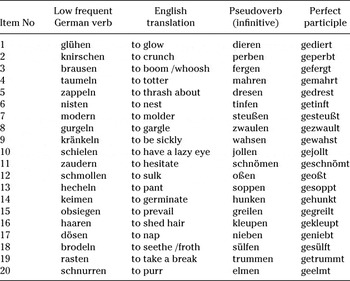
List of pseudoverbs used in Experiment 1a) and b) with the low frequent existing German verbs for which they served as placeholders

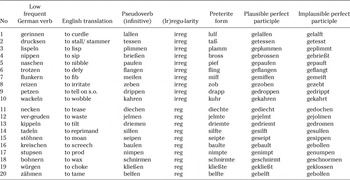
List of pseudoverbs used in Experiment 2a) and b) with the low frequent existing German verbs for which they served as placeholders

Appendix B
SAMPLE TEXTS FOR EXPERIMENTS 1 A) AND B) FOR PSEUDOVERB “JOLLEN” (I.E. HAVING A LAZY EYE)
-
1) syntactically simple version
Julius und Moritz liefen durch den Park. Sie trafen eine Frau. Die suchte ihren Hund. Sie halfen ihr ihn zu finden. Julius sagt, er habe sich in sie verliebt. Moritz sagt, auch er habe sich in sie verliebt. “Aber sie hat mich mehr angesehen!” “Nein, sie hat mich mehr angesehen!” streiten Julius und Moritz. “Vielleicht hat sie ja gejollt und jedes ihrer Augen hat einen anderen von euch angesehen?” fragt Julius’ Freund Kilian. “Die Frau hat nicht gejollt!” sind sich Moritz und Julius einig. “Sie war doch so hübsch!” Auch hübsche Frauen können jollen, meint Kilian. “Vielleicht hat sie eine Schwester? Fragt doch mal nach!”, schlägt er vor und lacht.
Julius and Moritz were walking through the park. They met a woman. She was looking for her dog. They helped her to find it. Julius says, he has fallen in love with her. Moritz says, he has fallen in love with her too. “But she looked at me more!” “No, she looked at me more!” argue Julius and Moritz. “Maybe she jollen[past perfect] and each of her eyes was looking at one of you?” asks Julius’ friend Kilian. “The woman didn’t jollen[past perfect]!” agree both Moritz and Julius. “She was so beautiful!” Also beautiful women can jollen[infinitive], says Kilian. “Maybe she has a sister? Go and ask her!”, he suggests and laughs.
-
2) syntactically complex version
Julius und Moritz liefen durch den Park, wo sie eine Frau trafen, die ihren Hund suchte, welchen sie zu finden halfen. Julius sagt, er habe sich in sie verliebt, worauf Moritz sagt, auch er habe sich in sie verliebt. Moritz und Julius streiten darüber, wen sie mehr angesehen hat. “Vielleicht hat sie ja gejollt und jedes ihrer Augen hat einen anderen von euch angesehen?” fragt Julius’ Freund Kilian. Dass die Frau nicht gejollt hat, darüber sind sich Moritz und Julius einig, denn sie wäre ja doch so hübsch gewesen. Auch hübsche Frauen können jollen, meint Kilian, der dann lachend vorschlägt, sie zu fragen, ob sie nicht eine Schwester hätte.
Julius and Moritz were walking through the park, where they met a woman who was looking for her dog which they helped to find. Julius says, he has fallen in love with her, to which Moritz says, he too has fallen in love with her. Julius and Moritz argue who she looked at more. “Maybe she jollen[past perfect] and each of her eyes was looking at one of you?” asks Julius’ friend Kilian. That the woman didn’t jollen[past perfect] is agreed on by both Moritz and Julius because she was so beautiful. Beautiful women can also jollen[infinitive], says Kilian, who then suggests laughingly to ask her if she has a sister.
SAMPLE TEXTS FOR EXPERIMENTS 2 A) AND B) FOR REGULAR CONJUGATION TYPE PSEUDOVERB “BELFEN” (I.E. TO TAME)
-
1) syntactically simple version
Gestern brachte mir meine Freundin eine kleine Katze. Die Katze zitterte. Meine Freundin hatte sie auf der Straße gefunden. Die Katze war noch ziemlich wild, denn niemand belfte sie bisher. Sie versteckte sich sofort unter dem Sofa. Sie kam den ganzen Abend nicht hervor. Wie sollte ich dieses Kätzchen nur belfen? Ich versuchte, ihr Vertrauen mit Futter zu gewinnen. Ich stellte ihr das Futter vor das Sofa. Danach wartete ich fast zwei Stunden. Dann schlich sie sich endlich an das Futter heran. Langsam ging ich dann mit einer Schale Milch in der Hand auf sie zu. Ich versuchte sie zu berühren. Aber sie verschwand sofort wieder unter dem Sofa. Wenige Minuten später kam sie jedoch wieder heraus und trank die Milch. Vorsichtig streichelte ich sie. Jetzt versteckte sie sich nicht wieder. So belfte ich nun endlich die kleine Katze.
Yesterday my friend brought me a little cat. The cat was shivering. My friend had found it on the street. The cat was still quite wild because no one had belfen[preterite, regular] it before. It quickly hid under my sofa. It did not come out the whole evening. How should I belfen[infinitive] this kitty? I tried to earn its trust through food. I put the food in front of the sofa. Afterwards I was waiting for nearly two hours. Then it finally crept towards the food. I then advanced with a bowl of milk in my hand to it slowly. I tried to touch it. But it disappeared under the sofa again immediately. However, a few minutes later it came back out and drank the milk. Gently, I petted it. Now it did not hide anymore. That’s how I finally belfen[preterite, regular] the little cat.
-
2) syntactically complex version
Gestern wurde mir von meiner Freundin eine kleine zitternde Katze gebracht, die auf der Straße gefunden wurde und die noch ziemlich wild war, denn niemand belfte sie bisher. Sie versteckte sich sofort unter dem Sofa, von wo sie den ganzen Abend nicht wieder hervorkam. Wie ist dieses Kätzchen nur zu belfen? Ich versuchte, ihr Vertrauen mit Futter zu gewinnen und stellte ihr dafür etwas Futter vor das Sofa, woraufhin ich fast zwei Stunden wartete, bis die Katze an das Futter heran geschlichen kam. Mit einer Schale Milch in der Hand, langsam auf sie zugehend, versuchte ich sie zu berühren, aber sie verschwand sofort wieder unter dem Sofa, von wo sie jedoch wenige Minuten später wieder hervorkam, um die Milch zu trinken. Ich streichelte vorsichtig die kleine Katze, die sich nicht mehr versteckte und die ich so nun endlich belfte.
Yesterday a little shivering cat, which had been found on the street and which was still quite wild because no one had belfen[preterite, regular] it before, was brought to me by my friend. It quickly hid under my sofa, from where it did not come out the whole evening. How was I to belfen[infinitive] this kitty? I tried to earn its trust through food and therefore put some food in front of the sofa, whereupon I was waiting for nearly two hours until it finally crept towards the food. With a bowl of milk in my hand, slowly advancing, I tried to touch it but it disappeared under the sofa again, from where it came back out to drink the milk a few minutes later. Gently, I petted the little cat, which did not hide anymore and which I had thus finally belfen[preterite, regular].
SAMPLE TEXTS FOR EXPERIMENTS 2 A) AND B) FOR IRREGULAR CONJUGATION TYPE PSEUDOVERB “BRIEßEN” (I.E. TO SIP)
-
1) syntactically simple version
Der Winter ist schon zu Ende. Die Restaurants, Bars und Cafés stellen Tische und Stühle auf ihre Terrassen. Die Leute sitzen draußen. Sie genießen es, in ihrer Mittagspause oder an ihrem Feierabend ihre Getränken langsam zu brießen. Anfangs sind die Temperaturen noch niedrig. Trotzdem sind kalte Getränke genauso beliebt wie heiße Getränke. Am vergangenen Wochenende machte ich einen Spaziergang durch die Innenstadt. Ich beobachtete kleine Kinder. Sie tranken genüsslich ihre Limonade. Männer leerten ihre Biergläser in großen Schlucken. Frauen brossen vorsichtig ihre bunten Cocktails. Eine Gruppe Straßenmusiker lenkte einige Eltern ab. Sie bemerkten nicht, dass auch die Kinder heimlich die Cocktails ihrer Mütter brossen.
Winter is already over. The restaurants, bars and cafes put the tables and chairs on their terraces. The people are sitting outside. They enjoy slowly brießen[infinitive] their drinks during their lunch break or after work. At first, temperatures are still low. Nevertheless cold drinks are liked just as much as hot drinks. Last weekend I went for a walk through the town center. I was watching small kids. They drank their lemonades with relish. Men emptied their beer glasses in great gulps. Women carefully brießen[preterite, irregular] their colorful cocktails. A group of street musicians distracted the parents. They did not notice that the kids also secretly brießen [preterite, irregular] their mothers’ cocktails.
-
2) syntactically complex version
Sobald der Winter zu Ende ist und die Restaurants, Bars und Cafés Tische und Stühle auf ihre Terrassen stellen, sitzen die Leute draußen und genießen es, in ihrer Mittagspause oder an ihrem Feierabend ihre Getränke langsam zu brießen. Trotz den anfänglich noch niedrigen Temperaturen sind kalte Getränke dabei ebenso beliebt wie heiße. Während eines Spaziergangs durch die Innenstadt konnte ich am vergangenen Wochenende genüsslich ihre Limonade trinkende Kinder beobachten, sowie Männer, die in großen Schlucken ihre Biergläser leerten, und Frauen, die vorsichtig ihre bunten Cocktails brossen. Abgelenkt von einer Gruppe Straßenmusiker bemerkten einige Eltern nicht, wie die Kinder heimlich die Cocktails ihrer Mütter brossen.
As soon as winter is over and the restaurants, bars and cafes put the tables and chairs on their terraces, people are sitting outside and enjoy slowly brießen[infinitive] their drinks during their lunch break or after work. Although the temperatures are still low at first, cold drinks are liked just as much as hot ones. During a walk through the town center last weekend I could see how small kids drank their lemonades with relish as well as how men emptied their beer glasses in great gulps and women carefully brießen[preterite, irregular] their colorful cocktails. Distracted by a group of street musicians, the parents did not notice that the kids also secretly brießen[preterite, irregular] their mothers’ cocktails.