Introduction
The problem of childhood obesity is a very significant public health issue, especially, as excess body weight present in early age can persist into adulthood (Park et al., Reference Park, Falconer, Viner and Kinra2012; Saldanha-Gomes et al., Reference Saldanha-Gomes, Marbac, Sedki, Cornet, Plancoulaine and Charles2020). Thus, studies investigating the factors influencing the metabolic health of children, especially young ones, are crucial.
There have been some studies exploring the role of various parameters other than diet and physical activity (Chaput et al., Reference Chaput, Saunders and Carson2017; Biddle et al., Reference Biddle, Pearson and Salmon2018; World Health Organization [WHO], 2019; Saldanha-Gomes et al., Reference Saldanha-Gomes, Marbac, Sedki, Cornet, Plancoulaine and Charles2020). For example, it has been suggested that relatively shorter sleep time may be associated with an increased risk of excess body mass (WHO, 2019). The mechanism of this relationship is still largely unknown, though it has been proposed that it may be mediated by the unhealthy eating habits facilitated by a lack of, or poor quality, sleep (Lundahl & Nelson, Reference Lundahl and Nelson2015; Mullins et al., Reference Mullins, Miller, Cherian, Lumeng, Wright, Kurth and Lebourgeois2017; Miller et al., Reference Miller, Miller, LeBourgeois, Sturza, Rosenblum and Lumeng2019). An association has also been shown between time spent in front of a screen/TV and excess body mass in youth. Increased screen time, especially happening at the expense of movement-based activities, has been shown to amplify the risk of overweight/obesity in childhood, as well as later in life (Chaput et al., Reference Chaput, Saunders and Carson2017; Carson et al., Reference Carson, Chaput, Janssen and Tremblay2017; Miller et al., Reference Miller, Miller, LeBourgeois, Sturza, Rosenblum and Lumeng2019).
Moreover, familial factors, such as the presence of obesity within the immediate family, have been consistently associated with increased risk of excess body weight in youth (Juonala et al., Reference Juonala, Juhola, Magnussen, Würtz, Viikari and Thomson2011, Reference Juonala, Harcourt, Saner, Sethi, Saffery and Magnussen2019; Robinson et al., Reference Robinson, Crozier, Harvey, Barton, Law and Godfrey2015). Additionally, socioeconomic characteristics of the family, such as parents’ education, occupation or income, have been suggested to influence the metabolic health of the children, even independent of parental BMI levels (Juonala et al., Reference Juonala, Juhola, Magnussen, Würtz, Viikari and Thomson2011, Reference Juonala, Harcourt, Saner, Sethi, Saffery and Magnussen2019). The relationship between the social and economic status of the family and childhood obesity has also been highlighted in a recent review of relevant policy plans from the World Health Organization, the European Union, Canada, England and New Zealand (Vazquez & Cubbin, Reference Vazquez and Cubbin2020).
It should also be stressed that studies analysing the factors associated with the risk of overweight/obesity usually tend to include individuals more than 9 years old and evidence in children younger than 6 is scarce (Leech et al., Reference Leech, McNaughton and Timperio2015; Santaliestra-Pasias et al., Reference Santaliestra-Pasías, Mouratidou, Reisch, Pigeot, Ahrens and Mårild2015; Miguel-Berges et al., Reference Miguel-Berges, Zachari, Santaliestra-Pasias, Mouratidou, Androutsos and Iotova2017; Saldanha-Gomes et al., Reference Saldanha-Gomes, Marbac, Sedki, Cornet, Plancoulaine and Charles2020). Additionally, there have been no such studies carried out in Polish preschool children, especially in the Lesser Poland region. There is some evidence from older age groups, where the risk of overweight/obesity has been shown to be associated with characteristics such as number of siblings or financial status of the family (Mazur et al., Reference Mazur, Klimek, Telega, Hejda, Wdowiak and Małecka-Tendera2008; Szajewska & Ruszczyński, Reference Szajewska and Ruszczyński2010). Thus, exploring these issues in young children poses an important research problem.
Kraków is the second largest city in Poland. The social and economic structure of its population has not changed appreciably for many years and is representative of the urban population of Poland as a whole. Consequently, any associations between social and economic indicators and anthropometric measures in Kraków are likely to be reflected elsewhere in Poland (Kowal et al., 2012, Reference Kowal, Kryst, Sobiecki and Woronkowicz2013, Reference Kowal, Woronkowicz, Kryst, Sobiecki and Pilecki2016; Kryst & Bilińska, Reference Kryst and Bilińska2017; Żegleń et al., Reference Żegleń, Kryst, Kowal, Sobiecki and Woronkowicz2021).
The aim of this study was to examine the differences between selected lifestyle and socioeconomic parameters among preschool children (3–7 years of age) of differing adiposity status.
Methods
The study was conducted from February to June 2018 in 20 randomly selected kindergartens in Kraków located in four traditional residential districts of the city: Śródmieście, Podgórze, Krowodrza and Nowa Huta. The districts represent a wide range of socioeconomic status of the city’s population, i.e. they are inhabited by families with varying social and economic situations.
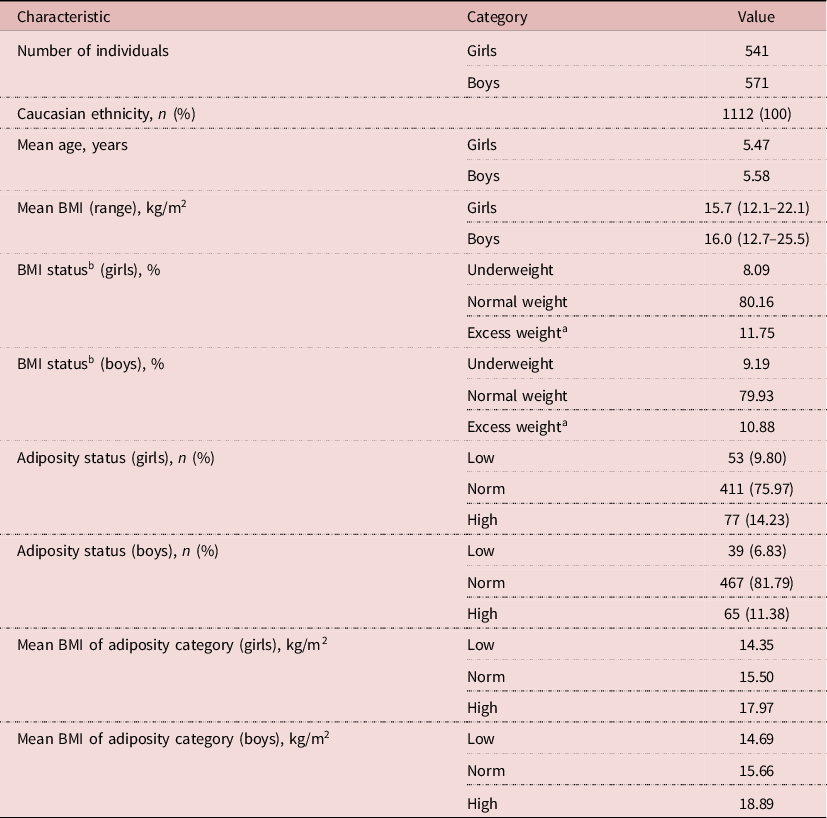
The study group included generally healthy children with a normal range of nutritional status (i.e. their BMI was not right- or left-skewed compared with the general population). Characteristics of the sample are provided in Table 1. The calendar age of the subjects was calculated as a difference between the date of the examination and the birth date, expressed as a decimal fraction, and was the basis for classifying children into five age groups (for example: 4-year-olds: 3.50–4.49).
Characteristics of study children aged 3–7, N=1112

a Due to low prevalence of obesity in the examined population the provided percentage includes children with overweight and obesity.
b BMI categories were determined on the basis of Cole’s cut-off points.
Skinfold thickness was measured using a Holtain calliper (GPM, Switzerland) with a constant spring pressure of 10 g/mm2 (accuracy 0.5 mm). The triceps skinfold was measured with the arm muscles relaxed, in the middle part of the posterior surface of the upper arm, over the triceps muscle. The biceps skinfold was measured at the same mark as the triceps skinfold, rotated around along the biceps branchi (the arm resting relaxed and supine). The subscapular skinfold was measured below the inferior angle of the scapula, at 45° to the vertical, along the natural crease lines of the skin. The suprailiac skinfold was measured above the iliac crest, posterior to the mid-axillary line and parallel to the cleavage lines of the skin. The abdominal skinfold was measured 5 cm adjacent and 1 cm below the umbilicus. Lastly, the calf skinfold was measured on the side of the calf, at the point of the maximum girth, with the lower limb relaxed (Tanner, Reference Tanner1962).
Then, the sum of all six skinfolds was calculated. The children were subsequently characterized by low (≤–1 SD [standard deviation]), normal (–1 to 1 SD) or high body fat (≥1 SD). The number of individuals in each adiposity group is shown in Table 1.
Body height was assessed using an anthropometer (GPM, Switzerland; accuracy 1 mm) and weight was obtained using an electronic scale (Tanita, Japan; accuracy 0.1 kg). Body Mass Index (BMI) was calculated according to the formula: body weight [kg]/body height [m]2.
Socioeconomic and lifestyle characteristics were obtained using a questionnaire filled out by the children’s parents or legal guardians. They included: number of siblings, self-assessment of financial status of the family (assessed by the parents on a scale of 1–10, where 1 was the worst and 10 the best score), parents’ education level (categorized as having, or not having, a higher education, understood as fully completing a degree) and job status (manual/ intellectual) as well as daily screen time and duration of sleep.
Statistical differences of socioeconomic and lifestyle parameters between the adiposity categories were calculated using one-way ANOVA or χ 2, depending on the analysed variable.
Results
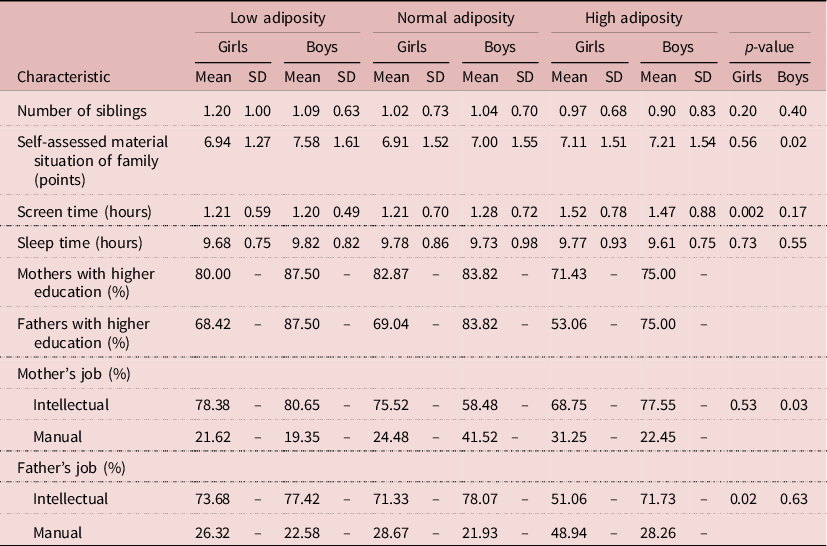
Preschool children in the high adiposity category turned out to have, on average, fewer siblings than children in other fat ratio categories. However, the noted differences were not significant (Table 2). The parents of girls categorized as having high body fat assessed the economic situation of the family better than those whose daughters had low or average adiposity. The direction of the observed discrepancies was the opposite among the boys, where the families of the children in the low body fat group had the best economic status (as self-assessed by the parents) among the analysed categories. The differences were only significant among the boys (Table 2).
Means and standard deviations (SD) of analysed characteristics in each adiposity category, with statistical significance of the differences between the means

Differences, although not statistically significant, were also noted in the level of education of the parents. Mothers and fathers of children classified as having high adiposity less often had higher education in comparison to those whose children were characterized by low or average adiposity (Table 2).
There were also differences according to the job status of the parents. In both sexes, the children categorized as having high adiposity more often had mothers and fathers working in jobs requiring manual, rather than intellectual, labour. Those differences were statistically significant in the case of mothers’ education for boys and fathers’ education for girls (Table 2).
Additionally, children in the high adiposity category had the longest screen time, but the differences were only statistically significant in the case of girls. Moreover, boys in the high adiposity category on average slept for the shortest time, while in girls with the shortest sleep-time category were noted in the low body fat group. However, none of these observed differences was statistically significant (Table 2).
Discussion
In the currently studied sample of preschool children, it was observed that those in the high adiposity category had, on average, fewer siblings than children in the other fat ratio categories. This is in line with findings of previous research carried out among 9- to 10-year-olds from Japan (Ochiai et al., Reference Ochiai, Shirasawa, Ohtsu, Nishimura, Morimoto and Obuchi2012). This study also noted that boys and girls with a larger number of siblings had a lower risk of being overweight Moreover, analogous results have also been obtained in a study conducted among Polish schoolchildren, where a small number of siblings was reported as one of the risk factors associated with obesity, as well as in a recent meta-analysis (Mazur et al., Reference Mazur, Klimek, Telega, Hejda, Wdowiak and Małecka-Tendera2008; Meller et al., Reference Meller, Loret de Mola, Assunção, Schäfer, Dahly and Barros2018). It has also been suggested in some studies that only-children are particularly at risk when considering the problem of excess body weight (Chen & Escarce, Reference Chen and Escarce2014; Wang et al., Reference Wang, Sekine, Chen, Kanayama, Yamagami and Kagamimori2007). It has been hypothesized that this may be caused by the fact that interaction with other children (i.e. siblings) increases the active time of boys and girls from relatively large families (Deforche et al., Reference Deforche, Bourdeaudhuij, Tanghe, Hills and Bode2004; Chen & Escarce, Reference Chen and Escarce2014). Another proposed explanation is the smaller amount of resources, such as food, available per person/child compared with smaller families (Serra-Majem et al., Reference Serra-Majem, Ribas, Pérez-Rodrigo, García-Closas, Peña-Quintana and Aranceta2002; Ochiai et al., Reference Ochiai, Shirasawa, Ohtsu, Nishimura, Morimoto and Obuchi2012).
The study found that family economic status differed between children in each adiposity category. However, the direction of the differences differed by sex. Also, an association between the financial status of parents and children’s body composition and/or body weight has been noted in previous research carried out in different populations (Deshmukh-Taskar et al., Reference Deshmukh-Taskar, Radcliffe, Liu and Nicklas2010; Maddah & Nikooyeh, Reference Maddah and Nikooyeh2010; Szajewska & Ruszczyński, Reference Szajewska and Ruszczyński2010; Nasreddine et al., Reference Nasreddine, Naja, Akl, Chamieh, Karam, Sibai and Hwalla2014). Research carried out among Canadian youths noted that children from low-income environments had an increased likelihood of being overweight or obese compared with those living in high-income families (Veugelers & Fitzgerald, Reference Veugelers and Fitzgerald2005; Janssen et al., Reference Janssen, Boyce, Simpson and Pickett2006; Merchant et al., Reference Merchant, Dehghan, Behnke-Cook and Anand2007).
In the present study, the children of parents with higher levels of education, as well as those with intellectual as opposed to manual jobs, had relatively lower adiposity. Interestingly, opposite results were noted in children from Belarus, where the 6.5-year-old children of parents with non-manual jobs, and/or were more educated were characterized by relatively higher waist circumference as well as percentage of body fat (Patel et al., Reference Patel, Lawlor, Kramer, Smith, Bogdanovich, Matush and Martin2011). On the other hand, the present findings are in line with those obtained in the Norwegian population, where the adiposity of the examined children increased from high to low maternal education level (Biehl et al., Reference Biehl, Hovengen, Grøholt, Hjelmesæth, Strand and Meyer2013). Additionally, these results are in line with other primary as well as secondary studies (Shrewsbury & Wardle, Reference Shrewsbury and Wardle2008; Bjelland et al., Reference Bjelland, Lien, Bergh, Grydeland, Anderssen and Klepp2010; Júlíusson et al., Reference Júlíusson, Eide, Roelants, Waaler, Hauspie and Bjerknes2010; Moraeus et al., Reference Moraeus, Lissner, Yngve, Poortvliet, Al-Ansari and Sjöberg2012).
This study’s findings suggest that relatively higher education of parents may also be associated with better knowledge regarding health-promoting behaviour, including lifestyle and dietary choices. Additionally, better education may be associated with a higher paying job and thus a better economic situation. This, in turn, can enable the family to have better quality food choices as well as more opportunities for active leisure time (i.e. playing sports).
In the currently analysed population, children in the high adiposity category turned out to have the longest screen time. This is in line with the findings of a recent systematic review, which noted that excessive sedentary time spent in front of screen devices has a significant, unfavourable effect on metabolic outcomes including BMI, waist circumference and adiposity (Tripathi & Mishra, Reference Tripathi and Mishra2020). Similar findings were also obtained in previous primary research (Falbe et al., Reference Falbe, Rosner, Willett, Sonneville, Hu and Field2013; Nightingale et al., Reference Nightingale, Rudnicka, Donin, Sattar, Cook, Whincup and Owen2017). An association between screen time and adiposity in children has been linked to certain types of advertisement in the media, particularly those promoting energy-dense food and fast foods. These have been suggested to influence the dietary choices of the youth leading, in conjunction with increased sedentary time, to excess weight and fat tissue gain (Arora et al., Reference Arora, Hosseini-Araghi, Bishop, Yao, Thomas and Taheri2013; Falbe et al., Reference Falbe, Rosner, Willett, Sonneville, Hu and Field2013; Ghavamzadeh et al., Reference Ghavamzadeh, Khalkhali and Alizadeh2013; Arcan et al., Reference Arcan, Hannan, Fulkerson, Himes, Rock, Smyth and Story2014). Additionally, this may be facilitated by excess calorie intake caused by unconscious eating and increased craving for unhealthy foods while distracted by screen-related activities. This, combined with low energy expenditure, increases the risk of overweight and obesity as well as excess adiposity (Ghavamzadeh et al., Reference Ghavamzadeh, Khalkhali and Alizadeh2013; Borgogna et al., Reference Borgogna, Lockhart, Grenard, Barrett, Shiffman and Reynolds2015; Coombs & Stamatakis, Reference Coombs and Stamatakis2015; Tripathi & Mishra, Reference Tripathi and Mishra2020).
In this study’s analysed population, there were insignificant differences regarding the sleep time among the different adiposity categories and these differences also varied between the sexes. Similar findings have been obtained in research based on the International Study of Childhood Obesity, Lifestyle and the Environment, which found that sleep duration generally did not differ between children of varying adiposity and lifestyle choices, including junk food consumption, level of physical activity and sedentary behaviour (Dumuid et al., Reference Dumuid, Olds, Lewis, Martin-Fernández, Barreira and Broyles2018). The authors suggested that this may be associated with parental control, which facilitates relative stability of sleep time. This could have been the case in the present study, of preschool children aged 3–7.
In conclusion, this study observed that preschool children in different adiposity categories varied in terms of some socioeconomic as well as lifestyle characteristics. Knowledge regarding the influence that these factors can have on the metabolic health of children is essential for children’s present and future well-being. Moreover, it can help health care professionals and the parents decide what interventions and/or preventive measures should be undertaken to ensure the best possible outcomes, as the development of successful obesity prevention strategies should rely on evidence-based information. Nonetheless, future research examining the issue of factors influencing the metabolic health of children, as well as these outcomes later in life, is crucial. Well-planned studies, including a large number of individuals, as well as longitudinal research, will be particularly beneficial in this regard.
Funding
This study was sponsored by the University of Physical Education in Kraków (Grant Number: 137/BS/INB/2017).
Conflicts of Interest
The authors have no conflicts of interest to declare.
Ethical Approval
The study was conducted with the consent of the Bioethics Committee of the Regional Medical Association in Kraków (No. 2/KBL/OIL/2018) and with the written consent of the children’s parents or legal guardians, as well as verbal assent from the children themselves. The authors assert that all procedures contributing to this work comply with the ethical standards of the relevant national and institutional committees on human experimentation and with the Helsinki Declaration of 1975, as revised in 2008.