

Introduction
An article by Cihan Tuğal explores the prevalence of petty entrepreneurialism among “sub-proletarians” (i.e., workers with irregular wages and precarious employment) in Sultanbeyli, one of the poorest working-class districts in İstanbul. In the article, Tuğal asks whether there are “traces of small producer ideology even among the proletariat.” Based on his interactions with a few workers in the formal sector, he suggests that they seem less influenced by the small-producer ideology, before concluding with an invitation for further research in order to determine “whether aspirations to small business persist among the proletariat despite changing conditions.”Footnote 1
This article answers Tuğal’s invitation by examining working-classFootnote 2 entrepreneurialism in Turkey from a comparative perspective. I aim to contribute to the understudied, scattered, and mostly non-comparative literature on the subject in question, which is often overlooked or underestimated by the critical research on labor and the working class. The article is based on research that I conducted in İkitelli, a working-class neighborhood in northwestern İstanbul. My ethnographic interest in İkitelli dates back to 2007, when I investigated a local labor struggle as part of the mobilizations on which I was focusing for another research project.Footnote 3 During the research process, I became acquainted and developed friendships with many factory workers living in this neighborhood. After working on labor movements during the early years of my graduate studies, I felt the necessity to look beyond just the tip of the iceberg and delve more into everyday life. It was thus my intention to dig deeper in order to uncover the rather hidden dilemmas that labor movements are forced to confront. Originally, working-class entrepreneurialism was not at all an item on my agenda, until, during my fieldwork, I came across its prevalence.
I subsequently moved into the neighborhood, lived in two different apartments, and conducted ethnographic fieldwork for nearly two years between 2010 and 2011.Footnote 4 I have since continued this fieldwork, though less intensively, by maintaining my relationships with a core group of İkitelli residents. Since I had already had friends in the neighborhood thanks to my previous research, I was able to build close relationships with my new neighbors, and so initially entering the field was not very difficult. This study, in addition to years of participant observation, includes 81 interviews.
İkitelli originally hosted only a small population, until the mid-1990s, when it began to boom. The reason for the influx of new residents was the opening of the İkitelli Organized Industrial Zone (İkitelli Organize Sanayi Bölgesi, İOSB) on the northern side of the neighborhood. Like many other working-class districts in İstanbul, there are three major communities in İkitelli: Sunni Turks, Alevis, and Kurds. Following a preliminary inquiry into the field, I followed in the steps of certain well-known studies on the working classes and decided to focus on one particular ethnocultural community.Footnote 5 Had I not made this decision, my research would have likely ended up as a comparison of the subjectivities of different ethnocultural groups.Footnote 6 Although such a comparison would certainly be interesting, it would compel me to make generalizations about each community and focus on the differences between the communities. Therefore, I chose to study the Sunni Turks instead of the other two communities.Footnote 7 Lamont points out that the white working class is “the backbone of American society” in the sense that they “exercise an especially strong influence on social and political change” in the country.Footnote 8 It is reasonable to assume that a parallel argument holds true for the Sunni Turkish working class of Turkey.
For similar reasons in this article, I confined my focus to one gender. In Turkey, women’s participation in the labor force and their rates of entrepreneurship are among the lowest in the world.Footnote 9 Moreover, only a quarter of the people whom I was able to reach during my research were women. Therefore, I decided to focus on male workers’ entrepreneurialism. The male workers of İkitelli, and especially the Sunni Turks, are primarily employed in regular jobs in the formal sector.Footnote 10
In the section that follows, I will review the theoretical and empirical findings about working-class entrepreneurialism in the literature and clarify my contribution thereto. The second section will explore a particular colloquial phrase (el işi) that reveals how workers and their families perceive wage work in contrast to entrepreneurship. The final section will examine the entrepreneurialism of male workers in the field and present five cases of workers who attempted to become full-time entrepreneurs.
Working-class petty entrepreneurialism
There are competing discourses over the precise definition of entrepreneurship.Footnote 11 In this article, I use the term “entrepreneur” to denote an individual who engages in an economic activity by taking responsibility for the whole process and by assuming risks in the hope of making profit.Footnote 12 In this, I follow the broader definition of the term as articulated by sociologists, who conceive of entrepreneurship as a practice of creating new organizations, and more specifically, business organizations.Footnote 13 Following the critical and/or empirically oriented studies of entrepreneurship, this definition of entrepreneurship does not entail any “innovative” or “heroic” qualities.Footnote 14 I employ the term “entrepreneurialism” to capture not only the actual practice, but also aspirations towards entrepreneurship.
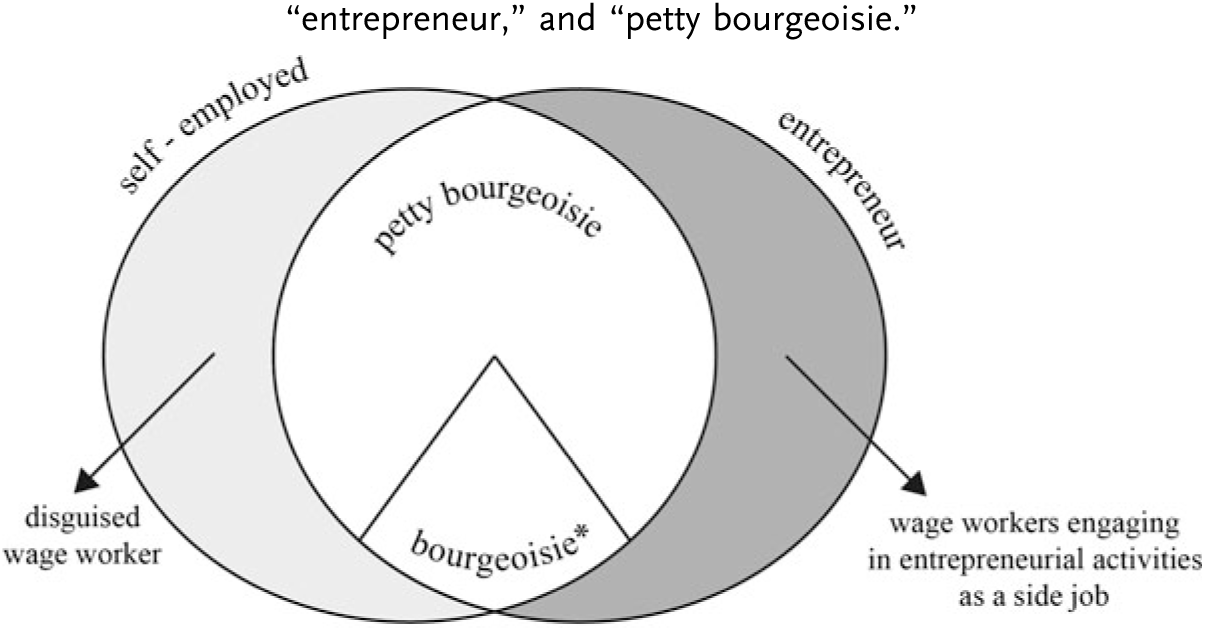
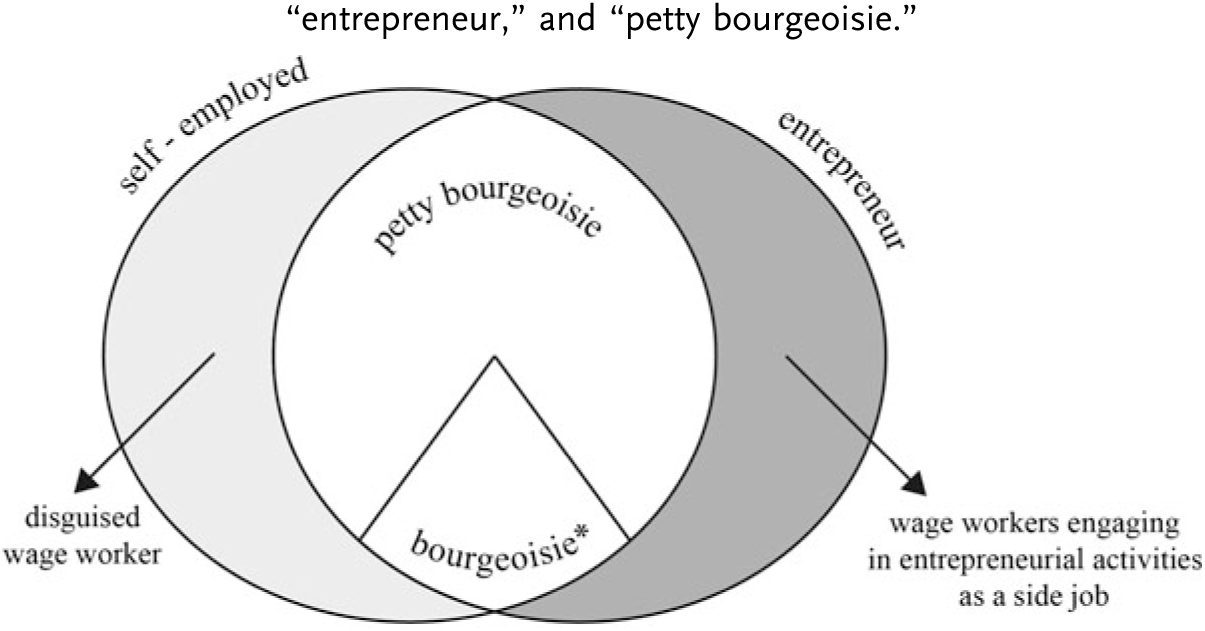
Two other concepts, self-employment and petty bourgeoisie, have also been widely used in the literature on the examination of entrepreneurship at a small scale. At the empirical level, self-employment is “the closest approximation” to the manifestation of full-time entrepreneurship.Footnote 15 However, the two terms “self-employed” and “entrepreneur” do not completely overlap, as there are two exceptional groups outside the overlap. The first of these are those seemingly self-employed people who are actually disguised wage workers. Although self-employed, they are fully dependent on one client “who controls the process and outcomes of work and absorbs the risks involved.”Footnote 16 The second exceptional group comprises wage workers who engage in entrepreneurial activities as a side job in order to supplement their wage income.Footnote 17 “Petty bourgeoisie” is the third term with a similar meaning to (full-time) entrepreneurship and self-employment on a small scale.Footnote 18 The petty bourgeoisie is primarily defined as those of the self-employed who run a business but do not hire any full-time workers.Footnote 19 Figure 1 below summarizes the nuances and overlaps between the definitions of these three concepts.
Nuances and overlaps between the concepts “self-employed,” “entrepreneur,” and “petty bourgeoisie.”
For the working class, entrepreneurialism is mostly related with “a mid-life search for independence, for freedom from the increasingly severe restraints of factory and other work discipline”Footnote 20 ; accordingly, the self-employed express higher levels of satisfaction with their work as compared to wage workers.Footnote 21 Push factors related to the low quality of available wage work or unemployment may, in many cases, be more prominent in the choice to undertake self-employment.Footnote 22 Indeed, the high rates of entrepreneurship in developing countries are largely explained by the presence of fewer opportunities for finding decent wage work.Footnote 23
The transition from wage work to self-employment does not necessarily lead to upward mobility, since some forms of self-employment may actually bring about worse conditions.Footnote 24 Even those who manage to gain a degree of independence and generate better income are probably exploiting themselves and/or are being exploited by the larger firms for which they produce.Footnote 25 The low cost of starting up a business in a certain sector at a certain place and time ensures the popularity of entrepreneurship in that niche, but it also creates fierce competition as well as low and fluctuating profit rates.Footnote 26 It is thus no wonder that bankruptcy rates are high among small enterprises.Footnote 27
Aspiration or actuality?
It is telling that in his otherwise seminal book, Dignity at Work, Randy Hodson mentions working-class entrepreneurialism in only a single sentence, wherein he refers to a book published in 1955.Footnote 28 This attests to the arguments claiming that self-employment remains understudied by sociologists, “especially when compared with its counterpart in the labor market, wage-work.”Footnote 29
Self-employment rates have indeed declined historically, as foreseen by the classical Marxist argument concerning the “liquidation and elimination” of the petty bourgeoisie.Footnote 30 This decline is due largely but not exclusively to a universal decline in the agricultural sector.Footnote 31 Erik Olin Wright claims that “the classical Marxist argument” about the petty bourgeoisie needs a “significant modification,” because, given the theoretical claims, the petty bourgeoisie “should have virtually disappeared by now” in Western countries.Footnote 32
Michael Mann claims that the decline of the urban petty bourgeoisie in Western countries during the nineteenth and twentieth centuries was “largely confined to manufacturing and to relative proportions, not absolute numbers.”Footnote 33 John Benson discovers that small-scale entrepreneurial activity “remained a widespread and vital component of working class life throughout the nineteenth and early twentieth centuries” in Great Britain.Footnote 34 However, in terms of labor history, working-class entrepreneurialism remained always “on the margins: at best unimportant, at worst unknown.”Footnote 35 While affirming the general historical decline, Frank Bechhofer and Brian Elliott underscore “the remarkable resilience” of the petty bourgeoisie,Footnote 36 which keeps finding “new niches” in the economic structure in the face of major economic, political, and technological changes.Footnote 37 They emphasize that the petty bourgeoisie survives “by a continuous process of replacement” in which “a large number of aspiring petite bourgeois” join and later fall from the ranks with a high turnover.Footnote 38
Wright argues that, although self-employment constitutes a central part of American life, sociologists have paid little attention to it as an object of systematic empirical study.Footnote 39 He states that the number of self-employed in the United States of America decreased up through the 1970s, after which it slightly increased up through the 1990s. He suggests that expansion within the manufacturing sector was a major force in the general expansion of self-employment, and he correlates this phenomenon with post-Fordism and the growth of subcontracting.Footnote 40 More importantly, Wright identifies the significance of past self-employment experiences among workers. While the ratio of self-employed was at around 12 percent during the 1980s, he points out that “at least a quarter of the labor force and a third of the male labor force either is or has been self-employed.”Footnote 41 Similarly, in the 2000s, although the ratio of self-employed decreased to 11 percent, Howard Aldrich and Martin Ruef found that “by their early fifties, more than 40 percent of American men will have experienced a spell of self-employment.”Footnote 42 Wright, following up on his argument about self-employment, observes that “the patterns of class-boundary permeability” have been “largely neglected within the Marxist tradition of class analysis.”Footnote 43 According to his findings, the “durability” of capitalism in developed countries is also a result of “the extent to which individual lives and interactions cross the salient divisions within the class structure.”Footnote 44
In an early work where he analyzes a Korean city, Hagen Koo suggests that for both blue-collar and white-collar workers it is “relatively easy to become owners of small businesses.”Footnote 45 Similarly, in his book on a working-class neighborhood in İstanbul, published in the same year as Koo’s article, Kemal Karpat discovers a significant level of self-employment and remarks that owning a small enterprise “appears to be the average squatter’s immediate economic ideal.” Karpat reaches the conclusion that this neighborhood “seems to breed […] enterprising individuals.”Footnote 46 Examining entrepreneurial aspirations among Muslim workers in Nigeria at the end of the 1970s, Paul Lubeck remarks that a large majority of the workers whom he surveyed voiced their aspiration to become a trader, with one-third of these workers believing that they had a good chance of realizing this aspiration.Footnote 47 Three decades later, Richard Sennett claimed that skilled manual workers in the Global South “are often quite entrepreneurial” in that they aspire and attempt to start a small business of their own.Footnote 48
Vittorio Capecchi reveals the high rates of transition to industrial small entrepreneurship in a region of Italy among working-class men in the 1980s.Footnote 49 Lauren A. Benton discovers that most of the small enterprises in the Madrid electronics industry were initially started by skilled workers, whom she calls “worker-entrepreneurs.”Footnote 50 Enzo Mingione puts forward a much broader argument: for her, four southern European countries—viz. Italy, Spain, Portugal, and Greece—are all variants of a particular model of capitalist development characterized by relatively dynamic family enterprises and self-employment. She notes a persistent inclination toward small entrepreneurship among the urban working class of these countries.Footnote 51 Diane Davis remarks that entrepreneurialism is very common among workers in Taiwan, where the discourse and practice of small entrepreneurship are “central” in both the countryside and the city.Footnote 52
Two surveys conducted in different districts of İstanbul in the 1990s found similar results. Korkut Boratav reveals that a large majority of those entrepreneurs who employed three or more workers were blue-collar or unskilled service workers in their first jobs in İstanbul.Footnote 53 Sema Erder considers this sort of transition from wage work and irregular employment to the establishment of one’s own business to be the most significant trend of social mobility.Footnote 54 She goes on to claim that municipal politics and the high level of informality in the urban economy favor petty entrepreneurship.Footnote 55
More recently, a number of ethnographic studies conducted among workers have uncovered working-class entrepreneurialism as well. Ruth Milkman observes that following the buyout and closure of an auto factory in the US, a significant number of its former workers became self-employed, and their businesses have demonstrated “fairly high” survival rates.Footnote 56 In an Indian city he studied, Sharad Chari determines entrepreneurial aspirations among male workers to be highly prevalent.Footnote 57 He shows that “there was no way out of the fact that most” business owners, “especially the most successful ones, are of working-class origin.”Footnote 58 Ching Kwan Lee observes that, among Chinese rural-to-urban migrants, “entrepreneurial aspirations abound,” as “[a]lmost without exception” they express a desire to open a small business back in the countryside in the future.Footnote 59 In terms of actual entrepreneurship, however, she notes that very few Chinese workers are actually able to realize their dreams.Footnote 60 As already mentioned, Tuğal focuses on the entrepreneurial aspirations of workers in a district of İstanbul, Turkey. The actual entrepreneurial activities of the workers that he observed were side jobs, such as petty trade engaged in by wage workers. He notes that some of the workers “actually had attempted small trade, but failed,” and that “many of the small shopkeepers of the district had spent their youth” as wage workers.Footnote 61
In fieldwork conducted among Zambian workers, Lee observes the increasing pervasiveness of entrepreneurial aspirations, as well as how some workers engage in part-time entrepreneurial activities as subcontractors or petty traders.Footnote 62 She concludes that “the ideology of entrepreneurship was gaining ground in many African countries, enticing workers, no matter how poor and indebted, to see their future in the illusive light of the self-made businessman.”Footnote 63
As this review has shown, aspirations of entrepreneurship are very popular among the working class globally. More importantly, the review also reveals that a minority of workers actually do become full-time entrepreneurs across diverse occasions, locations, and time periods. One might, as most critical scholars do, prefer to emphasize the fact that the ratio of urban self-employment has decreased historically.Footnote 64 Turkey is no exception to this: there, the non-agricultural self-employment rate among men declined from 28 to 19 percent between 1988 and 2018.Footnote 65 One might also prefer to focus on the facts that few workers realize their dream of opening a small business, and even fewer manage to maintain their businesses for long periods of time. Still, such preferences would not alter certain facts. For one, a significant proportion of the non-agricultural labor force is still self-employed in many countries, including Organisation for Economic Co-operation and Development (OECD) countries.Footnote 66 Moreover, many others who are not self-employed for the time being have nevertheless experienced self-employment in the past. Many more are also involved in petty trade as a side job and/or considering the possibility of becoming self-employed in the near future. Finally, even more people aspire to become self-employed in a more abstract sense. Since critical labor scholars often tend to underestimate or deflect entrepreneurialism among the working class, the research on entrepreneurialism has been left to pro-business studies, which have largely been indifferent to the categories of class and labor.Footnote 67
Most of the findings reviewed above are based on surveys. Very little research has been based on fieldwork and ethnography, and their findings on actualized working-class entrepreneurship have come from the part-time entrepreneurial activities of wage workers and drawn on interviews with small business owners who only inform the researchers retrospectively about their working-class backgrounds. None of these studies, though, offer direct observations of workers’ transition to self-employment. In this article, my first and foremost contribution to the literature will be an ethnographic account of the actual transition process from wage work to self-employment, and, in some cases, the subsequent return to wage work. As is also the case with many of the studies reviewed above, during my fieldwork I came across many small entrepreneurs who used to be wage workers. But, more crucially, thanks to the length of my ethnographic research, I had a chance to get to know several workers attempting to become full-time entrepreneurs, with some of whom I became very close. In the article, I will narrate and interpret the stories of five of these workers.
Exceptional or common?
Given the literature’s general tendency to underestimate and the ensuing absence of comparison and theorizing, most researchers who have observed entrepreneurial aspirations and activities among the working class either claim or imply that entrepreneurialism is an exceptional situation pertaining to a specific section of the working class, or else they regard it as a phenomenon peculiar to the specific location or time period that they are investigating.
Poulantzas defended the classical Marxist argument about the petty bourgeoisie. However, faced with the reality of France in the 1960s, he also had to note that France, “for certain historic reasons, still contains an appreciable number of small-scale enterprises.”Footnote 68 Regarding Muslim workers in Nigeria, Lubeck concludes that, given “the Muslim preference for commerce, it is logical that workers’ resistance to proletarianization should take the form of an idealized aspiration to enter the commercial sector as a petty commodity producer.”Footnote 69 Milkman remarks that the extent of self-employment among the auto factory workers whom she observed was “extraordinary.”Footnote 70 Furthermore, in a footnote, she draws attention to the American exceptionalism argument of the nineteenth century, which holds that, in the US, workers have greater opportunities to transform into independent producers.Footnote 71 Davis claims that the primacy of the entrepreneurial spirit in Taiwan is due to characteristics that are “in many ways unique to Taiwan.”Footnote 72 In the conclusion of the edited book in which the aforementioned articles by Capecchi and Benton were published, Portes, Castells, and Benton argue that “entrepreneurial environments” filled with the “business successes of former workers” are “exceptional.”Footnote 73 In a similar vein, Chari is amazed by his observations and does not hide it: “There was no way out of the fact that most” of the business owners he observed, “especially the most successful ones, [were] of working-class origin.”Footnote 74 Tuğal relates the prevalence of petty entrepreneurialism among the workers he observed to their “sub-proletarian” conditions, and claims that this prevalence is “due to specificities of the Turkish class structure and the Ottoman past.”Footnote 75 Lee, while observing working-class entrepreneurialism in both China and Zambia, does not refer to any other cases or theoretical debates on the issue, instead leaving her observations purely descriptive and claiming that in Zambia and many other African countries, working-class entrepreneurialism is a new phenomenon related to neoliberalism.Footnote 76
There is no question that there are significant variations among working-class entrepreneurial aspirations and activities, whether among different nations,Footnote 77 different sections,Footnote 78 different cities of the same nation,Footnote 79 different sectors,Footnote 80 or different time periods.Footnote 81 However, as my literature review tentatively suggests, entrepreneurialism among working-class men might not be an exceptional phenomenon peculiar to specific time periods, locations, or sections of the working class. Although the findings of the scholarship examined above are mostly localized, non-comparative, and non-theorized, overall they imply that among working-class men under capitalism, it is not entrepreneurialism that is more exceptional, but rather its absence, especially in peripheral countries. This contextualization will be my second contribution to the literature.
The perception of wage work: “El işi”
This section will explore male workers’ and their families’ perceptions of wage work as contrasted with self-employment. To set the scene, it begins with a short description of the neighborhood in question, İkitelli. The vast majority of the working population in İkitelli are manual workers, and many of them are employed in the nearby organized industrial zone. The largest sectoral concentration is in the textile and garment sectors. Within the neighborhood, there are many small and mid-sized garment workshops. Workshop owners report that there are around 150 workshops all together, but they add that many more existed prior to the economic crisis of 2009. The manufacturing workers other than those in the textile and garment sectors are employed in the metal, electronics, food, and furniture industries, and as regards the last of these, there are around 50 furniture workshops in İkitelli. Many janitors and security guards also work in the industrial zone or in other firms, mostly as subcontracted workers. Construction is another important source of employment. Although white-collar professionals and civil servants are present, they constitute a very small minority.
The neighborhood is home to a small number of employers, such as the owners of small garment workshops, furniture workshops, and fewer mid-sized garment workshops. Since almost 100,000 people live in the neighborhood and are relatively isolated from their surroundings, the everyday consumption of products and services takes place within the neighborhood. This demand has resulted in the opening by local entrepreneurs of numerous grocery stores, supermarkets, coffeehouses, real estate agents, construction craftsmens’ stores, hairdressers, bakeries, and the like. Most of these entrepreneurs employ only a family member or less than five people. I also met or heard of a few people who had a small store in the neighborhood but lived somewhere else. Likewise, a few employers run businesses elsewhere, but have certain reasons, typically related to family, for continuing to live in the neighborhood.
One particular popular saying can serve as a good point of entry for discussion of how workers and their families in İkitelli conceive of entrepreneurship as contrasted with wage work. “El işi” is a colloquial phrase widely used to mean “wage work,” and it roughly translates to “stranger’s business”—thus implying working in a business owned and/or run by a stranger. As a colloquial word not used by educated urbanites, el has a clearly negative and unpleasant connotation, implying that the “stranger” in question is unreliable.
Cengiz was a skilled senior factory worker who often expressed how much he enjoyed his job, and working in general. He was planning to continue working in his factory even after retirement age, but a short time before he was to qualify for retirement, he began making plans to become a self-employed driver. When I asked him about this change in plans, he answered, “I’ve had enough of el işi.” On another occasion, I had asked Adem, a janitor working in the organized industrial zone, what exactly he does on a given workday. He provided a common response: “I do whatever they tell me. What else I can do? It’s el işi.” Explaining his hard work in the factory where he had worked for ten years, another skilled factory worker, Nafız, stated, “I didn’t consider the job to be el işi, someone else’s business. I embraced it as my own.” One retired worker, Hüseyin, often complained that his son, who was running his own auto mechanic workshop, was not making enough money and was constantly demanding loans from his father to make ends meet. Hüseyin was angry about this, and explained his son’s attitude by stating, “He doesn’t want to do el işi, to be under someone’s command.”Footnote 82
During a chat in their home with Adil, his wife Yeter, and Yeter’s sister Güler, Yeter complained to her sister about her job, which involved three days a week of cleaning the building where her husband works as a superintendent. Yeter explained, “The job exhausts me. It isn’t like cleaning your own home.” To this Güler responded, “It’s el işi; it’s always different, harder.” A few minutes later, I asked Güler whether her daughter, a university graduate about to get married, was working, and she explained: “Of course she’s working. What else can one do, if you’re like us? You work in el işi. We don’t have our own business, our own establishment (kurulu düzen).” Yeter then took up the thread: “That’s the way it is. Even if you get a university education, you have to work for a stranger (el). Nothing changes.”
At another home, I was chatting with Hanife, her husband Mustafa, and her brother Adem in their living room. Hanife mentioned her older brother who had, after a short stint in İstanbul, decided not to settle in the city but to continue living in their home village. When I asked why those who stay in the village do so, Hanife explained as follows:
The key issue is el işi. Those who don’t come to city don’t want to work in el işi. They want to keep doing their own business; they want to work one day and rest the next. But these [pointing to her husband and brother] came to the city and have been working in el işi for 20 years. It’s not easy, not at all, but they keep working. The others, they don’t want anyone telling them what to do. My brother wasted himself by staying in the village.
Are there any similar colloquial names for “wage labor” in different parts of the world that can be compared with the term el işi? For this, I will give three examples from three continents of the Global South. Although he does not focus on the terminology, Taussig examines the attitudes of neophyte proletarians in Columbia and Bolivia toward wage labor in the 1970s. They saw something devilish in wage work “in a historical context in which one mode of production and life [was] being supplanted by another” and “the devil dramatically represents this process of alienation.”Footnote 83 “Dagong” is a Chinese term used for “working for the bosses” or “selling labor to the bosses,” as observed by Lee in the 2000s. Dagong does not include the notion of working for a stranger, but it literally means “to toil,” with the vague implication of manual work.Footnote 84 In Nigeria, as Lubeck notes, the local term for wage work detected in the 1970s was much more loaded: “Because wage labor was inserted by conquering Christian aliens, it came to be labeled as aikin bature (work for Europeans) by the Muslims of northern Nigeria.” Among Muslim nationalists who were “independent producers,” a tendency to resist aikin bature developed: wage labor in a capitalist enterprise was seen as “alien and, if not inherently un-Islamic, certainly as a set of alien social relations introduced by European colonialism.”Footnote 85
El işi is a less dramatic term as compared to the South American (“devilish”) and Nigerian (“aikin bature”) cases, while it is much more loaded than the Chinese term (“dagong”). Nonetheless, there is a certain similarity with the Nigerian case in terms of the role of Islam and the related glorification of the independent producer identity, although the experience of colonization seems to have severed the meaning of wage work in Nigeria.
The middle-aged residents of İkitelli were mostly born in villages. As inherited from the Ottoman Empire, agricultural production in the villages of Turkey still chiefly revolves around small farmers,Footnote 86 which means that the workers of İkitelli originally came from independent farming families. Many have a brother or cousin still living and working in the village. With this background, and operating in an urban economy that enables many workers to undertake self-employment, wage work does not seem to be taken for granted. Turkey is by no means the only country with such an agricultural structure. In other countries where small peasant ownership has always been dominant in agriculture, researchers detect a direct link between small family farming and rural-to-urban migrants’ petty entrepreneurship in urban space.Footnote 87
Thus, “el işi” entails a kind of popular resentment toward and non-identification with wage labor in a social milieu where self-employment seems achievable. Indeed, workers in İkitelli usually have at least one relative or acquaintance who has done precisely this. Just as was found by Wright in the case of the US, in İkitelli many male, middle-aged workers have petty entrepreneurship experience in their work history. Many report some relative or else someone from their village who moved upward, while others have plans to become petty entrepreneurs themselves. While “el işi” implies a resentment toward wage labor, capitalism conditions this resentment, thus igniting the desire for entrepreneurialism.
Cases of entrepreneurialism among male workers
There is a widespread belief that almost all the employers living in İkitelli arrived at their position through upward mobility, having originally been a worker. Except for a few people who actually started their urban careers in petty entrepreneurialism, this seems to be true.Footnote 88 I spent some time with thirteen entrepreneurs in the neighborhood who were already self-employed when I met them. Nine of them had begun their working lives as unskilled workers. Some of these entrepreneurs’ businesses looked to be stagnating, offering their owners little more than working-class standards, but some of them were slowly moving upwards from the lowest ranks of the bourgeoisie, though they were consistently complaining about the high risk of bankruptcy. Although the experiences of the latter do offer revealing details, here I choose to focus on a few of the petty entrepreneurship attempts of the male workers I witnessed.Footnote 89
From a minority of male workers, mostly older, one may hear some version of the following statement: “I’m a worker, I can’t grasp those things,”Footnote 90 where “those things” stands for full-time entrepreneurship. However, apart from this minority, entrepreneurialism in fact abounds among male workers both young and old. The remainder of this article will narrate the stories of five such men. After briefly explaining four of them, I will relate the fifth at length in order to better capture the relevant motivations, emotions, embedded meanings, and twists and turns of everyday life in detail.
Salih is an electrician who exhibits hard work and entrepreneurialism to an extreme level. A graduate of a vocational high school, he has been working as an electrician at İstanbul Atatürk Airport since 2009. One of Salih’s favorite topics of discussion is how a hard-working and skilled electrician he is. Proud of his skills, he has even himself made some small yet practical inventions. He is also proud of having worked since he was a child, saying: “I’ve always worked since I was eight. I shined shoes at that time. You know, everybody says they’ve been working since they were kids. But my story is different. I really did use to work then. I used to make real money.” Besides being a wage worker, as a second job he also works as a self-employed electrician, and is an eager participant in the real estate market. His main goal is to free himself of wage labor and become a full-time entrepreneurial electrician. Indeed, he has founded a firm with a partner, another electrician from the neighborhood, in order to be able to get bigger jobs in the construction sector. When last we spoke, he was waiting for his side job to grow more so that he could quit his job at the airport.
Selami is one of the three initiators of a victorious unionization struggle that I examined elsewhere.Footnote 91 A veteran knitting worker, he was organized by a socialist worker into taking part in the struggle. With his social skills, his naturalness, and the passion he found in the idea of finally getting rid of unbearable working conditions and intimidation at the workplace, Selami has turned into an organizing machine. In the beginning phase of the struggle, he was the one who personally convinced most people to join the union. Later, he would frame his transformation into an activist as “getting rid of the vegetating” that he sees himself as engaging in before. During the four years of struggle, they first managed to get the workday decreased from 12 to 8 hours, after which they managed to win raises, and finally, in 2013, they succeeded in unionizing. In 2014, quite unexpectedly, Selami became a petty entrepreneur as a second job. He initially began to sell thread to Syrian workshop owners whose social networks in the industry were very limited as compared to veteran workers like Selami.Footnote 92 Then, in collaboration with a partner, in 2015 he developed this enterprise into a small workshop producing hangers. At first, Selami continued to work in the knitting factory, but at the beginning of 2016 he quit to become a full-time entrepreneur. In 2016, his workshop was employing two workers in addition to himself and his partner. As I later learned, Selami’s younger brother has also been an entrepreneur, operating a garment shop in Russia.
Sinan is a skilled glass worker who learned his trade through apprenticeship and is proud of his craft. When I met with him, he was unionized and earning much more than the average wage among workers in İkitelli. He was clearly admired by his neighbors for his relatively well-paid job, but then in 2011 his German employer decided to close the plant where he was employed. Within two months, he found another job in his trade, though this one was less well paid in addition to being non-unionized. At the beginning of 2012, Sinan was fired along with his coworkers as a result of a costly production error. At this point, he decided to take a risk: with the encouragement of his brother-in-law, who had been a driver, Sinan decided to become a self-employed driver and bought a minibus to this end. His main stated motivation was “being his own boss.” He obtained credit from the bank to buy the minibus and began working with the firm where his brother-in-law was working. At first, he was pleased with the new job. After a while, though, he began to complain about the long hours and the lack of annual leave. He was not making enough money to both make a living and pay back his credit, and as a result his wife also had to begin working, taking up a job as a laborer in a print shop due to this family financial crisis. After two and a half years as a driver, Sinan gave up. He managed to quickly find a job in a glass factory with relatively good conditions, and he reported that, after two stressful years, he finally has obtained “peace of mind”—the worker’s blessing, as many entrepreneurs (and workers who aspire but hesitate to become entrepreneurs) will claim.
Cengiz has already been mentioned above, in the section about the term and concept of “el işi.” He was a senior factory worker who had “had enough of el işi” and was planning to become a self-employed driver, like Sinan, when he reached retirement age. Cengiz had originally migrated to İkitelli from his village in 1990, and ever since he had worked as a powder painter in a factory producing ovens and electrical heaters. A pious man, he performs the Islamic prayer ritual of salah (Turkish, namaz) five times a day. Eventually, Cengiz reconsidered his plans about becoming a driver and instead took advantage of close relations within the pious community to take over the teahouse at the neighborhood mosque, a moderate but stable business. His severance payment helped him to take over the business. When last we spoke, his enterprise was in its second year and he was very content with his business, which he had expanded by also retailing some cheap farm products that he orders from his hometown.
I met Mustafa in 2006, when he was one of the leaders of a unionization campaign at a chewing gum factory in İkitelli. His story deserves closer scrutiny. During the unionization campaign, he grew alienated from the union owing to several misdeeds on the part of the union chief.Footnote 93 In the summer of 2008, he quit his job and went to his hometown to harvest the hazelnuts on his modest plot, just as he does every year. Mustafa is married to Sema, and the couple have two children. Throughout his career, Mustafa had worked at a variety of different formal jobs, mostly in factories. After quitting the chewing gum factory, though, he wanted to try entrepreneurship in the real estate business. He had previously done some different experiments in small-scale trade, such as three plots of land that he bought and sold with different partners, including his brother-in-law. Mustafa always claims that their family savings are based chiefly on these transactions, rather than on their wages. Thanks to these savings, the family owned the apartment that they lived in when I first met him. Mustafa explained his experience with the land market thusly: “You should engage in trade, that’s how one can make money. Land makes money. I didn’t earn all of this money from my worker’s wages, I bought and sold land.”
Mustafa’s brother-in-law, Sema’s younger brother, is an important figure for their family because of what he represents. He first came to İstanbul in 1998, when he stayed in the couple’s house for a year. He started off as a garment worker, but soon became an entrepreneur, with his decisive achievement being a small workshop he operated which produced candies. From there, he moved on to the booming construction sector, becoming one of the largest local contractors in Kıraç, a neighborhood 20 km west of İkitelli. Mustafa does not hide his jealousy of his brother-in-law, who “didn’t even have underwear on his butt when he came to İstanbul, but later became a big boss.”Footnote 94
In the fall of 2008, Mustafa made a bold move: he sold the family’s apartment in İkitelli and bought a plot in Çerkezköy, a town in the neighboring province of Tekirdağ, which is a developing industrial basin with opportunities in the real estate market.Footnote 95 Later, he borrowed money from a construction contractor and built a two-story apartment building on his plot. He sold this building in 2010, and gave up on the idea to move to Çerkezköy due to Sema’s unwillingness. Since 2007, Sema had been back working full time as a janitor at a hospital, but later she found a better job as a cleaner at a nearby furniture store, where she is still working.Footnote 96 Later, in 2010, the couple bought another apartment in İkitelli and moved in there.
Despite these changes, Mustafa did not give up on his dream. Convincing an acquaintance, Bayram, to become his partner, they opened up a real estate agency in İkitelli. Mustafa’s dream was finally realized, but it was hardly the panacea that was expected. He was indeed finally employed by no one but himself and could benefit from his alleged entrepreneurial skills; however, it soon became clear that, in the wake of an economic crisis, the real estate market in İkitelli did not offer many opportunities. In the later part of their partnership, Mustafa claimed that Bayram was not suitable for the job: “He looks down on people; a tradesman can’t act like that. You have to charm people; you have to be honey-tongued.” During the year of their partnership, they had managed to sell ten apartments in addition to renting a few more. Conflicts between the two partners arose, and they broke up after a year together. Mustafa found another partner, but the same fate awaited them. Some last-ditch efforts proved futile, and in the end Mustafa returned to wage labor at the end of a nearly two-year period of self-employment. After experiences at several unpleasant workplaces, he most recently began working as a janitor in the office of a nearby construction project.
As already mentioned, Mustafa and Sema had bought an apartment in İkitelli in 2010, but before the family moved in, Mustafa renovated the interior. I later realized that this was in fact an investment: in mid-2013, he sold the apartment at a much better price thanks to the renovations he had carried out. With this profit and some mortgage (the equivalent of one of the couple’s wages paid to the bank for the next six years), they bought a duplex apartment on the top floors of a newly built, high-quality building. This move was unexpected for me, as my impression had been that the family was still having a hard time recovering from the setbacks of Mustafa’s years of self-employment. But in fact, they now began to live in a luxurious apartment, the best I have seen in İkitelli among those owned by workers. Moreover, being located right next to the middle-class high-rise construction where Mustafa had begun working, this home was actually an investment in that regard as well.
After they bought the house, Sema seemed relieved and forgave Mustafa, though not completely. Whenever she finds the opportunity, she still teases him for being lazy and too carefree: “Our son inherited his laziness from his father!” To this, Mustafa retorts: “Yeah, right! For sure!” But later he somehow admits, “I may work less, but I work efficiently. For example, in this workplace, they’re very content with my work.” Some of his self-confidence seems to have been restored, as he responded to my appreciation of his new apartment by saying: “We real estate agents are like that. If we have money, we buy and sell and make some real profit. You should engage in trade, that’s how one can make money.”
None of these men became self-employed because they were unable to find wage work: in fact all of them, with the exception of Mustafa, are skilled workers who have no real trouble finding relatively stable jobs according with working-class standards. Salih, Cengiz, and Selami were all working at relatively decent jobs when they decided to try their luck with entrepreneurship, and Selami was even working at a unionized workplace. What is more, the cases of Selami and Mustafa demonstrate how the entrepreneurial side activities of workers can evolve into self-employment, and Salih’s case is likely to unfold in a similar way. Overall, then, the entrepreneurialism found among the formal workers of İkitelli seems to be close to the levels of the informal workers of Sultanbeyli as described by Tuğal.
Inspired by Wright’s argument about the prevalence and significance of past self-employment experience, it seems that a terminated self-employment experience does not necessarily entail total failure. While Sinan’s case was a failure both objectively and subjectively, Mustafa’s case suggests that a small business experience might bring about moderate financial progress in a family history, despite the fact that at some point this experience proved unsustainable and was terminated. Furthermore, the way Mustafa sees himself as a real estate agent even two years after terminating his business signifies another aspect of the impact of past self-employment; namely, it can indeed dilute class identity, as Wright noted would be expected.Footnote 97
Conclusion
In this article, I have examined working-class entrepreneurialism from a comparative perspective, based on my research in a neighborhood of İstanbul. The article focuses on the perceptions, aspirations, and entrepreneurial attempts of workers employed in regular and formal jobs. My aim has been to contribute to the understudied, scattered, and mostly non-comparative literature on working-class entrepreneurialism, which has been largely overlooked by critical labor studies. In this conclusion section, I will summarize my findings in terms of three main points.
The first point concerns how members of the working class in Turkey perceive and interpret wage work and self-employment. I discovered that a particular colloquial phrase, “el işi” or “a stranger’s business,” is widely used in İkitelli to refer to wage work. The phrase perfectly manifests popular resentment toward and non-identification with wage labor in a social milieu where self-employment seems accessible. Inevitably, this resentment is conditioned by capitalism, which ignites the desire for entrepreneurialism.
The second point is a broader contribution to the literature on working-class entrepreneurialism. Most studies of entrepreneurship that are based on fieldwork reveal the popularity of aspirations for entrepreneurship and the working-class roots of many of the self-employed. As I have shown in my literature review, however, none of these studies offer direct observations of workers’ transition into self-employment. My contribution to this literature is thus an ethnographical account of the actual transition process from wage work to self-employment, which in some cases also involves a return to wage work. During my extended ethnography, I had the opportunity to closely observe several workers’ attempts to become full-time entrepreneurs, and in this article I have examined the stories of five such workers.
Finally, through a review of a scattered set of research, I have revealed that most of the studies on working-class entrepreneurialism are disconnected due to the literature’s general tendency to underestimate, and the ensuing absence of comparison and theorizing. In this context, I have demonstrated that most researchers observing entrepreneurial aspirations and activities among male workers either claim or imply that entrepreneurialism is an exceptional situation pertaining to a specific section of the working class, or else they regard it as a phenomenon peculiar to the specific location or time period that they are investigating. However, a significant amount of evidence suggests that entrepreneurialism among working-class men might not in fact be an exceptional phenomenon peculiar to specific time periods, locations, or sections. Although the findings of the literature are mostly localized, non-comparative, and non-theorized, they imply that entrepreneurialism among working-class men is actually quite common, especially in peripheral countries.