Introduction
A Dr. Paterson of Calcutta, having examined the skulls of a number of Hindus concluded that the skull of an average Hindu man aged thirty years was comparable to the skull of a fifteen year old European boy. Therefore, if one believes that the volume of the skull is an indicator of the intelligence of the individual, it not impossible to understand why a mere 30,000 Europeans have successfully conquered this huge nation of 40 million Hindus.Footnote 1
The problem was [that] colonialism was founded on a basic contradiction: on the one side was a rhetoric proclaiming that the colonized possessed the capacity to become civilized, while on the other was a political and economic agenda that depended on exclusiveness and the myth of racial purity.Footnote 2
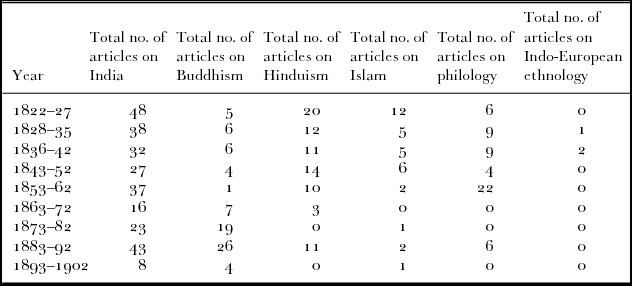
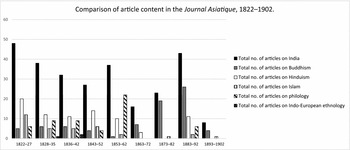
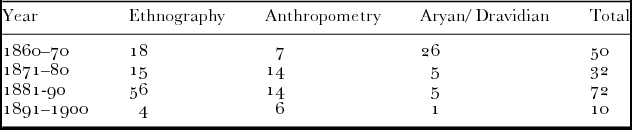
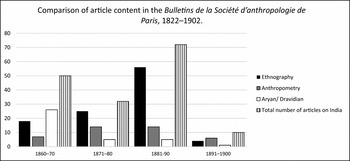
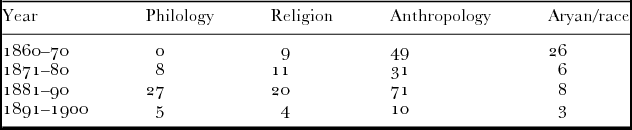
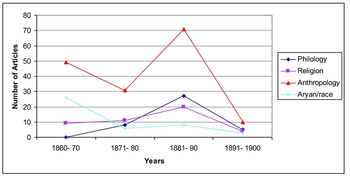
By the middle of the nineteenth century the rapidly growing enterprise of imperialism had established its position in the intellectual lives of European nations. European colonialists now justified their dominance and continued exploitation of colonies in terms of their natural ‘superiority’ and their duty as members of advanced civilizations to civilize other, lesser cultures. The merging of this need to justify imperialism with the emerging discipline of anthropology inevitably led to the use of ‘scientific data’ in the form of anthropometric measurements to prove conclusively that the colonies were peopled by ‘inferior’ races who needed the ‘benevolent’ rule of their colonial masters. This article follows the development of India as a specific racial entity in French academic works from the middle of the nineteenth century, as reflected in the work of Paul Topinard, Louis Rousselet, Arthur Gobineau, and Gustave le Bon.Footnote 3 In fact, the decline in the number of articles on Indian history and philology that appeared in French academic journals in the mid-nineteenth century was matched by an increase in the number of anthropological articles on India. Table 1 and Figure 1 show a comparison of the content of articles that appeared in the Journal Asiatique from 1822–1902; Table 2 and Figure 2 show a comparison of the content of articles that appeared in the Bulletins de la Société d'anthropologie de Paris from 1822–1902, and Table 3 and Figure 3 compare the content of articles that appeared in the Journal Asiatique, Revue d'Ethnographie, Revue d'Anthropologie, and Bulletins de la Société d'anthropologie de Paris from 1860–1900.
Comparison of article content in the Journal Asiatique, 1822–1902.
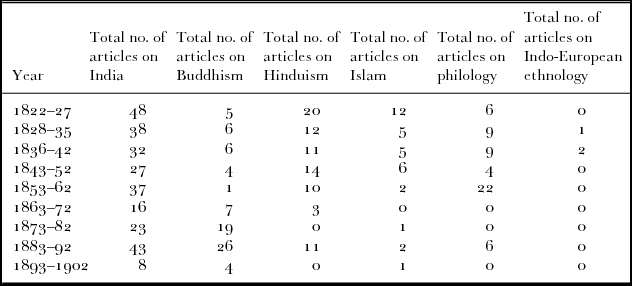
Comparison of article content in the Journal Asiatique, 1822–1902.

Comparison of article content in the Bulletins de la Société d'anthropologie de Paris, 1822–1902.
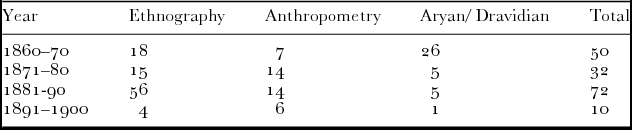
Note: The following volumes are missing: Vol. 9, series 2 (1874), Vol. 1, series 4 (1890), Vol. 6, series 4 (1895), Vol. 9, series 5 (1898).
Comparison of article content from the Bulletins de la Société d'anthropologie de Paris, 1822–1902.

Comparison of article content, based on a study of the Journal Asiatique, Revue d'Ethnographie, Revue d'Anthropologie, and Bulletins de la Société d'anthropologie de Paris, 1860–1900.
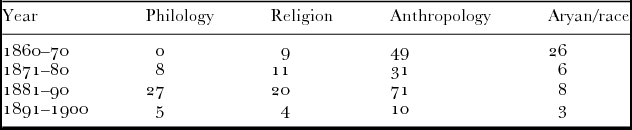
Comparison of article content, based on a study of the Journal Asiatique, Revue d'Ethnographie, Revue d'Anthropologie, and Bulletins de la Société d'anthropologie de Paris, 1860–1900.

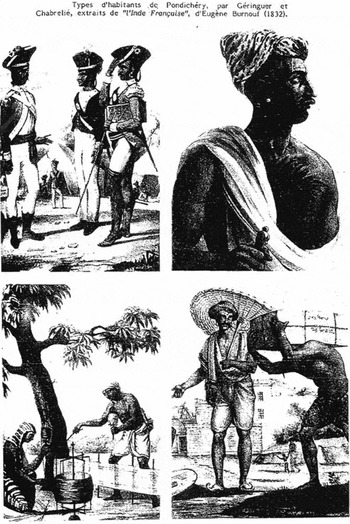
The types of inhabitants of Pondichéry in 1832. Source: Narayani Gupta, ‘The Citizens of French India: The Issue of Cultural Identity in Pondicherry in the XIX Century’, in Les relations historiques et culturelles entre la France et l'Inde XVII–XX siècles, Actes de la Conférence international France-Inde de juillet, 1986, Saint-Dénis, A.H.I.O.I, 1987, 2 volumes.

The primacy of this study lies in the often overlooked fact that French academics in the mid-nineteenth century led the field in defining and using ‘race’ as a category of historical argument: colonial nations like Algeria were occupied by ‘inferior’ races; French colonial rule helped to uplift them. It is no coincidence that the term ‘mission civilisatrice’, used to denote the French colonial mission, predates Kipling's ‘white man's burden’.Footnote 4 In fact, Topinard provided the method for Herbert Risley's ambitious 1901 Census in India, while earlier censuses using categories of caste to define ethnic groups were influenced by French studies. While the British came to different conclusions for the purposes of their own colonial survival, the French insisted, both as a challenge to British rule in India as well as to claim academic impartiality, that India was originally an Aryan nation and thus possessed the potential to return to her once-great past.
The first section of this article provides the context for nineteenth-century anthropological writings about India. A new trend, differing from the previously popular ethnographies of William Jones and the Asiatick Society, was that the emerging anthropologists were by-and-large based in Paris. So the adoption of the idea of India as a microcosm of races in the world began in France, first as an academic enterprise and then as a useful addition to France's colonial rivalry with Britain. The second section looks at the opinions of Topinard and Rousselet, regarding the position of India in a hierarchy of men, followed by sections on Gobineau, and Le Bon. Thus the study of anthropology is contextualized within the example of India. The different trajectories that French and British anthropological theory on India took, driven by colonial rivalry, is also highlighted in the final section.
The study of man
The scientific study of other people in the early part of the nineteenth century was undertaken by men who called themselves ethnologists. The work consisted mostly of writing about the ‘natural histories’ of man, which became the examination of non-European peoples.Footnote 5 Various models of human development emerged out of these ethnological accounts, some privileging the notion of development through association with ‘superior’ cultures and others arguing that levels of development were determined by heredity.Footnote 6 The most common division between ethnologists was between the monogenists, who believed that all humans had a common ancestry and therefore could achieve the same level of civilization,Footnote 7 and the polygenists, who insisted that different human races developed independently, based on intrinsic genetic factors.Footnote 8 According to the polygenists, the level of development of a culture, defined in terms of literary, social, and cultural accomplishment, reflected the capacity of each race.
Accounts of India during this time were primarily ethnological. In fact, many of the members of the Société Ethnologique, which was established in 1831 and devoted to the subjective study of races and peoples, were Indologists like Garcin de Tassy and Burnouf.Footnote 9 Reflecting the general intellectual trend to become more scientific, French ethnology gave way to ethnography by the middle of the century, whereby authors interspersed narratives of festivals and cultural observations with sweeping statements about ‘levels of civilization’. The works examined in this article— Louis Rousselet's L'Inde des Rajahs and Gustave le Bon's Les Civilisations de l'Inde—belong in this category. In the case of India, these ethnographic accounts placed the various races on a hierarchical ladder which was based on parallel anthropological studiesFootnote 10 and focused on categorizing human races on a civilizational and developmental hierarchy based on race.Footnote 11
By the mid-century, the polygenist theory was driving anthropological studies. The notion that race (defined in physiological rather than linguistic or cultural terms) was a determining factor in the capacity of people to progress was established.Footnote 12 Studies on race provided validation to the colonial civilizing mission since the white race was now considered indubitably ‘superior’ to other races. As Martin Staum points out, the collection and classification of species and objects in the nineteenth century was not an inherent impulse of the mind, but often directed toward a specific purpose.Footnote 13 For example, the Société Géographique de Paris, founded in 1821, was primarily interested in seeking knowledge during its early years. In 1860, the society had 300 members; by 1881 the number had swelled to 2,000, and the proliferation of a number of provincial geographical societies by 1881 added 9,500 new members. This period of interest in overseas territories also coincided with a growing nationalism in Europe, particularly in France. By 1871 the geographical society's aim had shifted to promote the civilizing mission, an agenda that was emphasized in reports by the secretaries of other geographical societies during the 1870s.Footnote 14 Maxwell also points to the fact that between the 1867 Paris Exposition Universelle and the next exhibition in 1889, the attention of the Parisian academy had shifted towards anthropology. Correspondingly, the focus of the exhibitions was on ‘live’ displays of people and cultures, rather than on displays of the Orient.Footnote 15
India first caught the attention of French anthropologists because of its diverse racial composition. Nearly every ‘pure’ and mixed race was represented in the larger sub-continent. Therefore comparisons between races and studies on the relative intelligence, ability, and civilization of races were made easy in India since so many races existed side by side. Unlike other comparisons of races where climate, language, and even history were variables and therefore could be cited as the cause of difference, racial hierarchy could clearly be proved by studying India, since Aryans, Mongoloids, Dravidians, and Negrito races had developed their different cultures and civilizations within the same climatic and historical conditions. By studying India, anthropologists tried to prove that the crucial element in determining the physical and intellectual ability of people was not their history or climate, but their racial make-up.
Before long, the practice of making qualitative statements about ‘superior’ and ‘inferior’ races had crept into anthropology. The rise of anthropology coincided with the mid-century imperialistic expansion which sought to legitimize colonization by constructing it as the effort of ‘superior’ people to ‘civilize’ inferiors. Racial hierarchies now validated colonial beliefs that Europeans—particularly the Caucasian race which had descended from the Indo-European or Aryan race—was ‘superior’ to the Asian, African, Aboriginal, and Native American races that they had conquered. This was the era of ‘scientific racism’. The fact is that these uses for race were a nineteenth-century development and one that dovetailed neatly with the era of imperialism. The studies on race and the subsequent creation of hierarchies were artificial constructs, meant to support a specific agenda.Footnote 16 The sheer extent of academic imagination in these hierarchies is easily demonstrated in the case of India. Although India was frequently cited in studies on race in the nineteenth century, the categories and their characteristics continually shifted to correspond to the prevailing colonial agenda.
Early French Indologists and travellers remarked that the sheer diversity of India made it nearly impossible to demarcate its inhabitants into clear and distinct categories, whether of race or other descriptors. They preferred to focus on linguistic and historical similarities which were clearer than physiological traits in a country that for centuries was marked by racial intermixing. For example, in an article published in the Nouveau Journal Asiatique in 1828 (before the obsession with racial hierarchies took centre stage), Burnouf examined the context of the usage of the words Drâvida and Tamil:Footnote 17 ‘[Of] thirty words taken among the principal geographical names of the country that the Hindus call Drâvida desha, seventeen were found to belong to the dialect tamoul (Tamil), and nine to Sanskrit; four only are of a doubtful origin.’Footnote 18 In total, of 30 references to the word Drâvida—from ancient texts like Ptolemy's Geography to modern texts like Buchanan's account of India,Footnote 19 and the accounts of missionaries in the Lettres Édifiantes, including both indigenous texts and European accounts—Burnouf concluded that 17 of the 30 references were to a linguistic region—Drâvida, or that of the Tamil-speaking people. Nine references defined Drâvida as Sanskrit-speaking people who were Aryan Brahmins who had migrated to the southern peninsula and spoke Sanskrit as opposed to the locals who were lower caste and spoke Tamil.Footnote 20 The Brahmins were Aryan invaders from the North and therefore brought their own language—Sanskrit—with them.Footnote 21 This usage of Drâvida did not refer to race since the southern Brahmins were also presumably Aryans, but rather identified the southern Brahmins as a sub-branch of the Indo-Aryans, who were called Drâvida due to their geographical location. The indigenous people, who were dark skinned and spoke a different language—Tamil—were conquered by the Aryans and incorporated into the Aryan social hierarchy as Sudras and were called ‘Tamiler’: ‘It is that the caste of Shoûdras, or the last of all in the brahmanic hierarchy, constitutes the primitive population of the southernmost end of the peninsula; it is that it is them who, strictly speaking, are called Tamiler, in opposition to the Drâvida Brahmans.’Footnote 22 As we have seen, the last four of the references Burnouf examined were of doubtful origin.
In other references to the word Drâvida, Burnouf noted the various geographical meanings the term had come to represent, including the peninsula of India south of the Vindhya Mountains and the Coromandel coast—references which had become popular by the time of the Muslim invasion and early European penetration.Footnote 23 Burnouf also noted the changing boundaries of the areas comprising the Drâvida region, including Canara, Karnataka, Malabar, and the Coromandel coast, and the shifting definitions of these areas as topographic sub-divisions as well as linguistic and political boundaries over the course of several centuries.Footnote 24 The important thing to note was that nowhere did ‘Drâvida’ or even ‘Tamil’ equate to a racial definition. Burnouf's lithographs of ‘Indian types’ similarly stressed the differences in clothing styles far more than physical differences.
Topinard, Rousseulet, and the anthropometric method
Despite the lack of evidence for constructing racial categories in India, by 1859 French anthropologists had shifted to studying races on comparative-anatomical lines and Burnouf's philological approach was left behind as relic of an older, less accurate method of studying races. Here again, French academics took the lead, with British and German scholars learning from Parisian erudites. Paul Broca, who founded the Société d'Anthropologie de Paris in 1859, was the proponent of a new method of studying man called ‘scientific anthropology’. Broca was one of the pioneers of the new method of anthropometric measurement as a means to document the differences between races. Broca outlined his method and theory in several articles published in the Bulletin de la Société de l'Anthropologie.Footnote 25 While Broca was clear that the results of his method could not be used to argue for a racial hierarchy, his students—notably Paul Topinard and Gustave le Bon—were convinced that the results of the new anthropometry could explain why Europe was superior to the rest of the world.Footnote 26 The result of this new method was that anthropologists now began looking for ‘specimens’ that would measure up to their preconceived categories of race rather than taking a random sample of the population and allowing the data to dictate the result. Topinard, for example, argued that the development of various parts of the brain was determined by race, and that an examination of cranial development and cultural ‘progress’ could define the intellectual and mental capabilities of each race.Footnote 27 He conducted a survey of the cranial measurements of different races and concluded the African Negroes had a brain capacity of 1,400 cubic centimetres, the Negroes of Oceania a brain capacity of 1,450, the ‘yellow’ races a brain capacity of 1,500, and the whites a brain capacity of 1,550 cubic centimetres,Footnote 28 thus suggesting the existence of a racial hierarchy in intellect and development.Footnote 29 He further elaborated on this racial hierarchy by defining civilizational development in terms of religious development (from fetishism to animism to polytheism and then to monotheism), social organization (savage hordes to tribes to clans and then classes), and achievements (such as architectural ruins or monuments). Within these parameters of development, black people were at the lowest level. According to Topinard, ‘the characteristic of all the black races is the inaptitude to rise by their own efforts’.Footnote 30 Next in the racial hierarchy were the ‘yellow’ races which were capable of achievement of varying levels. These races had it within them to attain average civilizational development, like the Dravidians of India, or even relatively high development, like the Aztecs and Peruvians of South America and the Chinese. According to Topinard, ‘The characteristic of the yellow races is a certain quickness in apprehending the means of satisfying the immediate needs of life and of rendering existence agreeable, but they have little initiative, do not know how to raise themselves to higher planes and seem prone to immobilization.’Footnote 31 The white races were the highest in terms of civilizational development and included the culture of the Vedic Aryans of India. He summed up the white races thus: ‘The characteristics of the white races are a remarkable aptitude for developing by their own independent efforts or for assimilating the empirical results of others, their ever-increasing need of comfort, their vigorous and comprehensive cerebral activity and their spirit of initiative. . .’.Footnote 32 Topinard further observed that all races might progress if they were favoured by circumstances of location (topographical and climactic serendipity, the presence of abundant food as well the freedom from invasion and the presence of peaceful and advanced neighbours to emulate), brilliant leaders who spurred progress and met needs, all of which provided the stimulus for material and intellectual development. Nevertheless, all races did not possess the same aptitude or initiative to progress and Topinard noted that leaders were lacking among the black races, were scarce among the ‘yellow’ races, but common in the white races.Footnote 33
Topinard's application of racial principles to define progress was clear in the Indian context in his work, L'Anthropologie. In this work, he defined the Hindu type as best represented by the Rajputs and, most of all, by the Brahmins of Mathura, Thaneswar, and Banaras. According to him, ‘The Hindu type is not any more represented in the Indies (than) by Radjpouts and especially by the most venerated Brahmans of Mattra, Bénarès and Tanessar in Hindoustan.’Footnote 34 In his work on science and faith,Footnote 35 he described the Aryans in India as dividing society into four classes according to the Code of Manu. These were the Brahmins or priests, the kshatriyas or warriors, the vaiçyas or husbandmen, merchants and artisans, and the shudras or servants. The aim of this classification was to prevent a mingling of the conquering Aryans with the Dravidians and, consequently, the absorption of the former into the lower ranks of Vedic society. The first caste was composed of pure Aryans, the second of the Aryans and Dravidians who had intermarried, and the other two of Dravidians. The black aborigines, which were mentioned in the Vedic texts, were excluded from the four-fold classification and consequently bore the name of ‘pariahs’, a term invented subsequently.Footnote 36 Afterwards the castes continued to be modified and numerous intermediary castes were created within each caste.Footnote 37 Topinard quoted the Census of 1881 which put the total number of castes in India at 2,500.Footnote 38
According to Topinard, castes in themselves were not an evil. But in the case of closed castes, as were found in India and Egypt, where the caste or corporation became the social unit/entity and the individual entity was submerged within the corporate identity, there could be no sense of liberty. Consequently such people became submissive and social development suffered. The antagonism between class and individual was central to the continued development of a society.Footnote 39 It was this aspect of development—or the lack of development—that played a role in the decline of Indian civilization.
The change between the race-neutral study of Burnouf and the racial context of Topinard is clearly demonstrated in the latter's reliance on Rousselet. Louis Rousselet had travelled in India from 1863 to 1868 and written extensively of his travels and experiences. His essays were published in Revue d'Anthropologie and in La Tour du Monde. Rousselet collected all his essays and published them in one volume.Footnote 40 He was highly regarded in anthropological circlesFootnote 41 and many leading anthropologists, including Topinard, used his data on India in their works.
Rousselet's writing focused primarily on the racial composition of the various tribes and peoples of India, much in the same style as other ethnographic writings of the time. He described the different tribes that he came across in terms of height, cranial measurements, and mental and cultural achievements. In his detailed descriptions of the different tribes and castes of India, Rousselet categorized them racially as Aryan, Turanian, and Dravidian, as well as combinations of these. Yet his writings contained none of the critical descriptors of ‘inferior’ and ‘superior’, nor of the ‘inability’ of certain races to progress beyond a racially determined level that Topinard and other anthropologists clearly referred to. Although he used the accepted anthropological language of the time to describe his findings, he eschewed ranking the various peoples of India. Even though other anthropologists were experimenting with various methods of depicting the differences in racial characteristics, Rousselet's lithographs show a clear and consistent use of the same type of features for all the different people he encounters in the Indian subcontinent. The images he provides in his articles and his book are more ample and attractive than the text, which often becomes a compilation of his travels. The title of his articles and his book, which prominently feature the ‘races’ of India, along with the images he provides, thus form a powerful image of India. The difference between the work of Rousselet on races of India and that of other anthropologists like Topinard is in the latter's creation of racial hierarchies.
Rousselet's work was used by many subsequent authorities on anthropology, including Topinard, although the former's neutral statements about race were used to define a racial hierarchy by the latter. Topinard cited Rousselet as an important source for his information about India and the racial composition of India in his work L'Anthropologie. Yet, while Rousselet's articles on the Central Indian tribes were full of ethnographic descriptions, Topinard appropriated these descriptions to ascribe a racial hierarchy of India, citing the tribes of Rousselet's descriptions as examples of the lower races in India. Based on his understanding of Rousselet, Topinard divided the population of South India into black, Mongol, and Aryan.Footnote 42 According to Topinard, the black peoples in India were the tribal groups such as the ‘Bhils, Mahars, Gonds, and Khonds who possessed a primitive character, black color, and short stature’.Footnote 43 Contrasted to this was Rousselet's original description: ‘[The] Bhils are in general of a medium height; though missing the elegant shapes of the Aryan Hindu, they are much more robust; their force and their agility are sometimes surprising.’Footnote 44 The Mongol race, which belonged primarily to Central Asia, was also found in the northeast [Assam, for example] and northwest of India, as well as intermarried with the indigenous Dravidian population of the Tamils and Jats.Footnote 45 The Aryans, the third, and most recent, race in India was also the most important, because of their numbers as well as their ‘quality’.Footnote 46 Topinard described the Aryans as follows: ‘The Brahmans of the banks of Ganga, says Mr. Rousselet, have the high, developed front [forehead], the oval face, the perfectly horizontal eyes, the nose projecting, hooked and slightly thick at the end, but framed by delicate nostrils. They are white, but are more or less bronzed by the sun of these climates. Their black hair appears abundant.’Footnote 47 Elsewhere in his work, Topinard notes the presence of blue-eyed, ‘white’ people in India, as described by Rousselet, Prichard, Davy, and Frasier. ‘One finds [them] in India, notably among the Kattees, who sometimes have “clear hair [blonde?] and blue eyes” [Prichard and L. Rousselet] . . . The Bisahuris of Rampoor, not far from the sources of the Ganges, often have “very fair skin, though burned by the sun, blue eyes, curly hair and beards of clear or red color” [Frasier].’Footnote 48
In addition, Topinard divided the Negroids in India into the ‘true Negroid which could be traced back to mentions in the Mahabharata as inhabiting the South and were represented by the Andaman tribes’,Footnote 49 and the Australian type represented by the Bhils, Gonds, Khonds, Mahars, Varalis, Mundas, Yanadis, and the Maravars of the Coromandel coast, Todas of Nilgiri, Kurumbas, Irulas and other tribes of the Ghats and Deccan.Footnote 50 Topinard even noted the existence of the bust of a black man of the ‘Tasmanian type’ who was born in Pondicherry and examined in 1875 at the Anthropological laboratory and who was included in Paul Broca's collection.Footnote 51 The hierarchical racial development, which was absent in Rousselet, was clear in Topinard's work. Although Rousselet preferred to describe the customs of many tribes as ‘primitive’, he used ‘inferior’ very sparingly; in contrast, Topinard's description of various human races was almost exclusively in terms of ‘superior’ and ‘inferior’. Broca and Topinard were only beginning to apply theories of race to the relative development of people. Most of their work was suggestive at best, especially in the context of India. Moreover, they were unclear about how to define race in India. A select group of intellectuals transformed race into a pernicious weapon in support of colonialism. The most famous of these was Arthur de Gobineau.
Gobineau and race
Among the most visible works on racial theory in the nineteenth century was the Comte de Gobineau's Essai sur l'inégalité des races humaines. Gobineau's ideas influenced the German school of anthropology more than it did the French school,Footnote 52 but his ideas were certainly a window into the literary and scholastic treatment of France's various colonies. Gobineau argued that political systems, governments, and regimes did not determine the quality of a civilization and nor did conquest (since this was a superficial imposition, which did not change any racial characteristics) nor the accident of geography. Defining ‘civilization’ as ‘a state of relative stability, where the mass of men try to satisfy their wants by peaceful means, and are refined in their conduct and intelligence’,Footnote 53 he reached the conclusion that all civilizations were not equal. This was the central quest of his work—to discover why, given the existence of these conditions in different civilizations, there was still a wide range in the quality of civilizations.
He concluded that as the only variable was race, each race had a fundamental intellectual and moral capacity that determined civilizational development and which only miscegenation could alter. This capacity was different and therefore measurable on a scale of ‘superior’ to ‘inferior’ for all human races. This scale, based on cranial measurement, and the moral and material achievement of races in their purest form, proceeded with the whites, declining to the ‘yellow’ race, with black people at the bottom. Translated to the Indian context, Gobineau described Hindus as having reached great heights of intellectual and metaphysical achievement, but fundamentally lacking in material desire and therefore material accomplishment.Footnote 54 Moreover, this achievement had been accomplished in the early stage of the development of Hindu civilization, when the Aryan race was at its purest. Gobineau argued that a civilization was strongest when the blood or race of its founders was purest, and that degeneration occurred with inter-racial unions and the weakening of inherent racial qualities. According to him:
The world of art and great literature that comes from the mixture of blood, the improvement and ennoblement of inferior races—all these are wonders . . . Unfortunately, the great have been lowered by the same process; and this is an evil which nothing can balance or repair . . . the Brahmans of primitive India . . . give us a higher and more brilliant idea of humanity, and were more active, intelligent and trusty. . . than the peoples, hybrid a hundred times over, of the present day.Footnote 55
To Gobineau the mixing of races was the cause of the downfall of Indian civilization. He maintained that when the conquering Aryans decided to mix with the indigenous black peoples, many of their characteristics of the latter, including their lack of judgement and reason, clouded the naturally intelligent Aryan mentality.Footnote 56 In the present day, and despite its noble origins, Brahminism was in complete decline, was riddled with absurd superstitions, theological complications, and lacked great men to guide it. This was solely a result of the influx of black and yellow blood into the original Aryan blood, to such an extent that it was impossible to tell a high caste Brahmin from a lower caste person any more. In all cases of culture and life, this perversion and degeneration of the white race in India meant that India was incapable of withstanding the ‘superior’ white races of Europe.Footnote 57 In fact, the races that continued to hold off English power in India and all other foreign invasions were the races that were still more or less Aryan, like the Rajputs, Sindhis, Rohillas, and other people of the northwest borders of India.Footnote 58 The Aryan family was the most noble, intelligent, and energetic of all races. In India, the Aryans had a highly developed sense of morality, philosophy, grand institutions of family and politics, and a total superiority of personality over the black tribes that inhabited the area. The caste system was a reflection of Aryan ‘superiority’. He pointed out that the Indian notion of beauty was described in terms of the typical Aryan physiognomy—fair skin, oval face, and muscular and graceful appearance. The descriptions of great heroes and gods in Indian literature always conformed to this ideal of beauty.Footnote 59 The Indian term for caste, ‘varna’, also meant colour. Although he noted that, ethnographically speaking, the system of dividing society according to race was a fiction, since all castes had been penetrated by the local black races, he maintained that for Indians the importance of caste lay in the importance of maintaining race purity.Footnote 60 All over the world, however, the dilution of Aryan blood caused the degeneration of the race. Due to this complete ethnic disorder, which had occurred with particular violence in India, Gobineau predicted that the civilization of India could never regain its former majesty and glorious culture.Footnote 61
Gobineau was the most vociferous of race thinkers. His theory of scientific racism had various agendas and India's place in these was incidental at best. For instance, according to Halbfass, Gobineau used India to argue against the liberal democratic ideals of the French Revolution, and which Marx was promoting in his theory that racial ability was fixed and that the white race was pre-eminent.Footnote 62 But his theories were echoed in the growing anthropological interest in India and were reflected in the number of articles and items of interest about India which were published in the prominent anthropological journals available in Paris by the late nineteenth century, including the Revue d'Anthropologie, which was published by Paul Broca, and the Revue d'Ethnographie.Footnote 63 The more prominent works included some articles by travellers, and articles by Broca and other anthropologists on topics directly pertinent to India, or on topics related to race where India was a crucial part of the popular theory of Aryan migration from the Caucasus. According to Leon Poliakov, ‘. . . however they were transmitted, Gobineau merely systematized in a very personal way ideas which were already deeply rooted in his time’.Footnote 64
Le Bon and India
The piecemeal anthropological statements on India and the tentative ethnographic work of Rousselet were surpassed in the late nineteenth century by a magnum opus on India. In 1886, Firmin Didot published an all-encompassing ethnographic work on India by Gustave le Bon, comprising over 700 pages of text and hundreds of photographs, lithographs, and etchings, entitled Les Civilisations de l'Inde. A student of Paul Broca, Le Bon was a controversial anthropologist who continued to have an acrimonious relationship with his fellow anthropologists and even with his one-time teacher throughout his lifetime. Many of his differences with other anthropologists, notably Broca, sprang from the fact the Broca believed in strict scientific anthropology, as verifiable by data and anthropometric measurements, while Le Bon believed that ethnological study in terms of culture, language, and religion was as useful to anthropology as anthropometry.
In the context of India, however, Le Bon's conclusions were not markedly different from the views of other anthropologists. Often quoted in contemporary works of the period, Le Bon seems to have been forgotten by modern scholars of India who find it difficult to trace references to him. That said, one must closely analyse his work on India because it mirrored the traditional French view of India that had been produced over the course of the nineteenth century. Le Bon provided, in some ways, a grand summary of the French image of India at the end of the nineteenth century. His work drew on most of the known and available literature on India at the end of the nineteenth century, including translations of Indian texts as well as works by other ethnologists, geographers, historians, and Indologists. His work demonstrated the enduring image of India, which was painstakingly created by the primarily Parisian academic elite during the course of the nineteenth century and the recovery of ‘India’ as a great example of civilization.
On the other hand, Le Bon was also influenced by prevailing theories of colonial administration and, in fact, was a notable participant in many debates on the nature of colonial assimilation.Footnote 65 His work on India reflected the debate in France on colonial policy between the proponents and opponents of assimilation and the emerging idea of association in colonial rule. A firm believer in anthropology and the capabilities of people based on their racial heritage, Le Bon was an influential and outspoken opponent of the notion that ‘inferior’ races could ‘uplift’ themselves through association with ‘superior’ races.Footnote 66
For Le Bon, the capability of each race was already decided and available for academic examination through the civilization it had produced. Race determined intelligence and this intelligence gave rise to the cornerstones of civilization.
While in the previous century India had always been thought of as a land with a homogenous culture, inhabited by one race that possessed a single culture, art, and religion, studies in the nineteenth century had proven that this was not the case. India was really a diverse milieu of peoples, languages, religions, and cultures—in fact, a whole world in miniature.Footnote 67 However, the theme of a single homogenous race representing ‘India’ was inextricably woven into Le Bon's work.
Le Bon divided the main Indian racial types into four—Negroid, the ‘yellow’ races, Turanian, and Aryan. The caste system, which to Le Bon was a reflection of this four-fold racial mix, consisted of the more or less pure Aryan type, the Brahmins, the Rajput type or the Aryan-Turanian mix, which included the Kshatriya, the Turanian or the Vaiçya, and the Shudra who represented the amalgamation of the Turanian and local aboriginal races.Footnote 68
Narrating an anthropological history of Indian race, Le Bon began with the assumption that the earliest inhabitants of India were black people of the Negrito type, who inhabited the centre, and the black people of the Australian type, who lived in the south and west. The former lived as ‘savages’ in the mountains of central India, in the region known as Gondwana, and the latter lived in the south, in the mountains of the Nilgiris.
The mountains bounding India in the north, northwest, and northeast, and the seas, which protected India from invasion from the south, southwest, and southeast, meant that India remained fairly undisturbed in terms of racial mixing for a long time. However, there were two sets of peoples who managed to penetrate the Indian sub-continent. The first were the Turanians who originated in Turkestan and represented the ‘yellow’ race. They entered from the Brahmaputra valley and fanned out into two branches. The first settled in the Ganga valley and the second continued south to Bengal. The result of the intermarriage of the Turanians and Negritos of India resulted in the proto-Dravidian race which, in turn, evolved into the Dravidians or Tamils of South India. The dominant Turanian influence in terms of physical features was clear in the inhabitants of Assam, Tibet, Nepal, and Bhutan. The natives of Bengal and Orissa also displayed marked racial features of the ‘yellow’ races.
The second racial invasion was that of the Aryans who entered India through the northwest and settled primarily in the north of India. Their mixing with the Turanians accounted for the emergence of the Kshatriya caste, while the pure Turanian element became the Vaiçya caste, according to Le Bon. The southern part of India remained more or less proto-Dravidian or Kolarian, after the Kolar region.
In his description of the people inhabiting various geographical regions of India, he painstakingly listed the various tribes (Chibalis, Paharis, Gaddis, Kulus, Gujars) and populations of the western Himalayas (Ladakh, Balti, Dardistan, Kashmir), Nepal (Gurkhas and Newars), Bhutan, and Sikkim. Then he moved to Assam, inhabited by the Abors, Michmis, Singpos, Nagas, Garos, and Khasias. Most of these people were described as being predominantly part of the ‘yellow’ race. Southwards to the Ganga Valley, he listed the result of the racial mix of Aryans, Turanians, and proto-Dravidians as the populations of Awadh, Bengal, and Bihar, including the tribes of the Malers and Santals. Punjab was described as the land of the Pathans who approached the closest ‘pure Aryan’ racial type, then the Jats, Dogras, Sikhs, and the Rajputs who came from the mix of Aryans and Turanians. Sindh and Rajputana included the tribes of the Bhils and Minas who represented the Negrito element. The populations of Gujarat and Kathiawar were too mixed to allow for racial categorization. The races of central India included the Marathas of Maharashtra, who represented the Turanian element, the Kolarian people of the Konkan, the Nairs on the Malabar coast, and the Negrito tribes of the Todas, Irulkas, Kotas, Kurumbas, and Vadagas of the Nilgiri hills, the Gondwana tribes of the Gonds, Bhils, and the Chota-Nagpur/Orissa area of the Kols and Khonds. The primitive tribes of the south included the Kaders in the Annamalai hills, Shanars of Travancore and Cape Cormorin, the Kanikhars, Nayadis of Calicut and Pulicat, and the Kolars of Madurai and Coimbatore.
Each of these peoples was described in terms of their racial mix and their customs, culture, and religion. Thus, while Le Bon stated at the outset that there were no pure races left in India in anthropological terms, he described the ‘races of India’ ethnologically as possessing all the characteristics of anthropological races, because his discussion of the culture of each ‘race’ was intended to describe their mental and intellectual capacity, as well as their physical attributes. The descriptions were further cemented by numerous illustrations of each ‘racial type’. Le Bon concluded that India was composed of four main racial groups—Kolarian, Dravidian, Turano-Aryan, and Tibetan. These were secondary races but they possessed distinct physical and mental characteristics.Footnote 69 Le Bon blurred the line between ‘race’ and ‘peoples’ by attributing both with hereditary physical and mental characteristics. This confusion was more pronounced in his work Lois Psychologiques where he used the terms ‘race’ and ‘people’ interchangeably. As Nye points out, the use of race now could be used to provide:
. . . a total explanation of the history of man and of the modern world itself. By providing a ‘scientific’ explanation of race which was based on psychological and character traits, but which had the concrete durability and hereditary transmissibility of physical characteristics, Le Bon could avoid the worst pitfalls of the ‘caliper’ race thinker whose data was so often conflicting. His more flexible definition, though it clearly took its initial inspiration from the body-mind analogy, could be used to explain psychological differences arising between social classes, linguistic groups and broad culture types and still retain the word ‘race’ which the nineteenth century understood so well and which clearly favoured the power of ‘blood’ over education. The integrity and uniqueness of race, class, language and culture, which were themselves so much the psychological extension of a people's hereditary apparatus, were dominant themes in a Europe experiencing the pangs of a growing nationalism and class consciousness: the invention of a flexible definition of ‘race psychology’ was Gustave Le Bon's own small contribution to these movements.Footnote 70
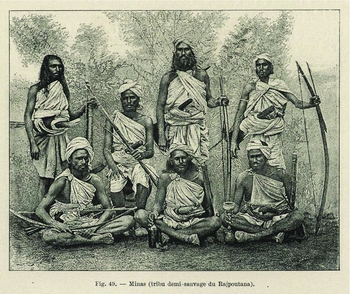
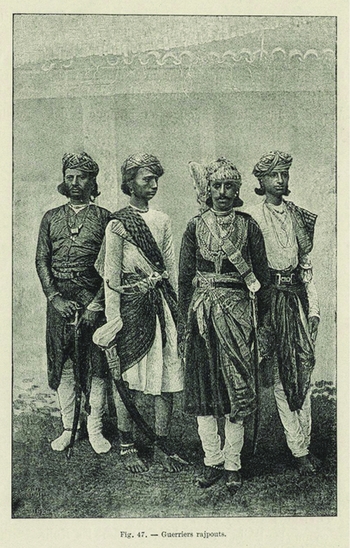
After his discussion of the physical characteristics of Hindus, Le Bon moved on to evaluate the mental features of these diverse peoples. The mentality of Hindus was no less diverse than their physical traits. So while the Rajputs were fair, tall, and well built, tribal populations were represented as semi-savages: dark, short, half-naked, and unkempt (see Figures 6, 7, and 8 below).
Similarly, he described extremes of bravery, like that of the Rajputs, and contrasted this with the cowardice of the Bengalis, as well as the honesty of the mountain people of Rajmahal and the lying treachery of others.Footnote 71 He put forward the idea that there was a certain ‘Hindu’ mentality which had formed over the centuries and that, generally speaking, allowed for a characterization of the mentality of Hindus as a determinate racial entity.Footnote 72 The three major factors which accounted for the mentality of Hindus were the caste system, the political regime of caste, and the village (being the primary political entities), and the paramount importance and all-encompassing nature of the Hindu religion. These in sum accounted for the nature and mentality of Hindus. The caste system prevented Hindus from developing any other identity outside of their caste and meant that the loyalties of region and nation were ignored in the all-encompassing identity of caste. Moreover, the nature of the caste system as a corporate entity, with its age-old privileges and unchanging nature, took away all sense of initiative and energy from the individual, who knew that his innovations in work or talents outside of his hereditary occupation would go unnoticed.Footnote 73
This lack of ambition on the part of Hindus arose both from the knowledge that their advancement was dictated more as a result of their position within their caste rather than their achievements, as well as the fact of the self-sufficient nature of the village, which limited economic growth. The overarching nature of the Hindu religion, which dictated obedience to higher castes without the possibility of individual growth as well as its prohibitive injunctions regarding economic or social radicalism, meant that Hindus gradually became submissive and timid. As a result, Le Bon summed up the mentality of Hindus as follows:
As a general rule, the Hindu is weak, timid, crafty, insinuating, and dissimulating to the highest degree. His manners are flattering and importunate; he is entirely deprived of ideas of patriotism. Centuries of tyranny [have] habituated him to the idea that he must have a Master, and provided that this Master respects the laws of his caste and his religious beliefs, the Hindu is resigned in advance to undergo all his will, and finds happiness if one leaves him about the handful of rice which he needs to live. The Hindus form a soft, patient population, absolutely resigned to their fate. Their defects [all the] more striking, for a European . . . are indolence, the absence of precaution and the still larger absence of energy.Footnote 74
Le Bon's choice of words is itself interesting in its contradictory approach. Describing Hindus initially as ‘weak’ and ‘timid’, he later uses the adjectives ‘gentle’ and ‘patient’. This contradictory description may be found in many works of the time, both French and British.Footnote 75 As a result of these characteristics, Le Bon concluded that while the average Hindu was not ‘inferior’ intellectually to the average European, he was still condemned to be a servant and never a master.
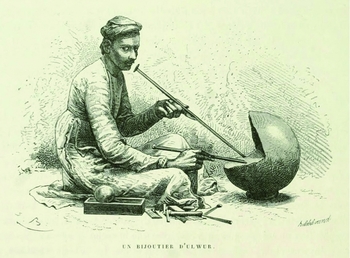
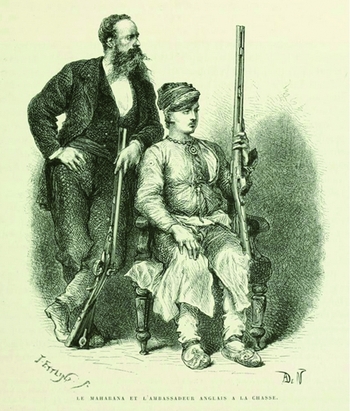
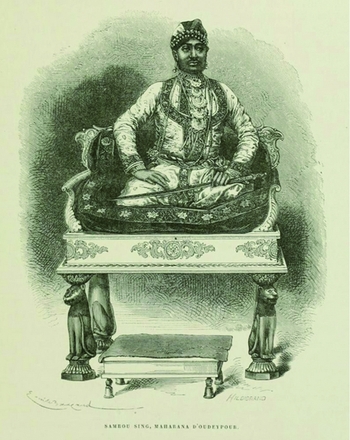
Gustave Le Bon's magnum opus about India contained many inaccuracies, inconsistencies, and stereotypes. Yet no one seems to have analysed his work far enough to point out these problems. Instead Le Bon was used as a reliable reference about Indian life, customs, and peoples, not only by European travellers to India, but also by respected and noted scholars writing about India. A clear indication of the direction in which race studies in France had progressed from the time of Rousselet to Le Bon can be seen by comparing Rousselet's lithographs with the photographs of ‘racial types’ which Le Bon brought back with him from his voyage in India (see Figures 5, 6, 7, and 8). Rousselet's images used standard features for a gamut of occupations (which would have meant different castes as well)—a dancing girl would have belonged to a lower caste, a jeweller to the trading caste, and a ruler to the warrior caste.
A bayadère. Image by Louis Rousselet.

A jeweller. Image by Louis Rousselet.

The maharana of Udaipur with the English Resident. Note the remarkable similarity in their features as well as their weaponry. The fact that the former is seated indicates his centrality and dominance in the image. Image by Louis Rousselet.

Samboe Sing (sic), the maharana of Udaipur. Image by Louis Rousselet.

Even the lithograph of the English Resident with the maharana of Udaipur shows both with similar builds, features, and physiology. In fact, the seated position of the maharana indicates his superior social standing. The only variation in Rousselet's lithographs is in the skin colour of his subjects. While Le Bon used this feature as an indicator of caste, Rousselet does not, as both the bayadère (lower caste) and maharana are darker skinned (see Figures 5 and 8).
Based on a desire to capture his ‘subjects’ at their most exotic, Le Bon's images built a racial hierarchy for India which was far more succinct than, and just as forceful as, his hundreds of pages of description. He used physiology, colour, and material apparatus to distinguish the ‘inferior’ races of India. In his depiction of the savages and semi-savages of central India for instance, he presents a classic European conception of a savage as semi-clothed, with long unkempt hair, and possessing primitive weapons like the bow and arrow.
In addition, a closer look at the image of the Minas (see Figure 9) reveals the presence of a bottle (presumably alcohol) as well as a pipe (presumably an opium pipe) emphasizing the inferior morals of the ‘inferior’ race. Le Bon definitely ‘staged’ his subject to support his writing.Footnote 76 In the photos that he collected, Le Bon emphasized the difference between the dark-skinned tribes who belonged to ‘inferior’ races from the fair-skinned Rajputs and Brahmins of North India by contrasting the latters’ fair skin colour, facial structure, and clothing with that of the tribes (compare Figures 9 and 10 with Figure 11).
Featuring in Le Bon's work Les civilizations de l'Inde, the caption to the image reads: ‘Minas: a half-savage tribe in Rajputana’.

Featuring in Le Bon's work Les civilizations de l'Inde, the caption to the image reads: ‘Savages of Chota Nagpur’.

Rajput warriors. Note the more sophisticated weapons (swords) that they carry as opposed to the primitive weapons of the dark-skinned and Negroid-featured Minas and Chota Nagpur tribes in Figure 10 as well as the latter's half-clothed, semi-civilized aspect as opposed to the fairer Rajputs with their more chiselled features.

Note the dark skin of the southern, ‘Dravidian’ Brahmin as opposed to the fair, northern ‘Aryan’ Bahmins. Also note the excessive exoticism in the first image, displaying the numerous ritualistic marks and the semi-nakedness of the Mysore Brahmins, as opposed to the more ‘civilized’ looking, fully clothed Udaipur Brahmins.

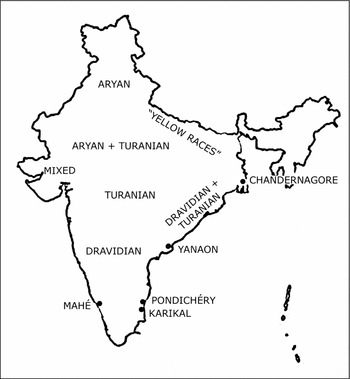
The racial map of India.

Le Bon also highlighted the differences between the Brahmins of southern India with their exaggerated ritual marks, semi-nakedness, and dark skins, and the fair, well-built Aryan Brahmins of the north.
As Anne Maxwell points out, by the 1880s anthropologists could use photographs to make anatomical comparisons they needed to racially classify and rank human subjects on an evolutionary scale. While ostensibly scientific, the photographs that anthropologists developed around this time also served a political purpose by confirming that some peoples were less ‘evolved‘ than others and would therefore benefit from imperial control.Footnote 77
Le Bon's images merely reinforced his writings. Based on his study of India he made assertions about the nature of caste and religion which echoed the statements of British administrators in India. Since Le Bon greatly admired the British and their empire, this is not surprising. Yet his pronouncements about race in India were unmatched in British scholarship. His position on India was widely read in France and therefore influenced India's image in late nineteenth-century France to a considerable extent. While fallacies about the caste system, like its immutability, its presence as the sole identity of Indians, and its tyrannical position had already been repeated in endless French operas of the day,Footnote 78 Le Bon's text now added a racial dimension to the French lens on India.
In particular, Le Bon added to the mid-century understanding of Aryanism by looking closely at the elements of ‘Aryan’ culture in India. Despite his considerable criticism of contemporary Indian culture and society, he held that the only worthwhile institutions which still existed in modern India were part of its Aryan heritage. For instance, he noted that the one institution in India which came close to assuring the average person rights in the midst of the tyranny of religion and despots was the Panchayat, an institution which Le Bon claimed had Aryan origins.Footnote 79 The Panchayat system was an elected assembly of peers who tried all disputes and cases involving petty theft and crime in the village. This was the first court of appeal and most disputes and cases were usually resolved at this level. The Panchayat system was mostly prevalent in the north of India.
Another institution of Aryan origin, which, according to Le Bon, began as an admirable system of division of labour as well as a means by which the racial components of Vedic society could be identified, was the caste system. He maintained that if one was to compare the Aryans with any other race of antiquity, they would come out the superior, in terms of mentality, intellect, and physicality.Footnote 80 A few years after he had published his work on India, Le Bon's theories of race crystallized into a hierarchy of intelligence in anthropological races, proceeding downwards from the white races to the ‘yellow’ and the black races. According to this, the main feature of the white race was its ‘superior’ intelligence and thereby its capacity to grow through education, invention, and culture. While all races might wish to raise themselves through external achievement, their psychological capacity would limit their level of attainment. Thus a black or ‘yellow’ race would never be as great as a white race: ‘They are capable of the rudiments of civilization, but solely the rudiments.’Footnote 81 Moreover, while the ‘inferior’ races were possessed of a uniformity of intelligence, variation of intelligence between individuals of the white race was the norm. It was this variation of intelligence which gave rise to different civilizations.Footnote 82
An interesting feature of French race theory as it applied to India was the inability of scholars to come to any sort of consensus about which Indian races were ‘Aryan’. Variously defined as the Rajputs or the northwestern tribes, Pathans, or even the Banaras Brahmins, French scholars described these races as possessing nobler mental and physical traits than their Dravidian or Turanian brethren. While the British concluded that the great Aryan potential of India had long been diluted by ‘inferior’ racial blood, the French thought otherwise.Footnote 83 As the studies examined in this article demonstrate, the French anthropologists, while lamenting the dilution of Aryan blood among the peoples of India, nevertheless defined certain tribes and races in terms such as ‘more or less pure Aryan’ (Gobineau) and ‘pure brahminical Aryans along the Ganges’ (Topinard). Yet there was no agreement as to what constituted the ‘pure Aryan’. While Topinard described the Brahmins in Banaras as Aryan, Gobineau lamented that the dilution of Aryan blood made it impossible to distinguish physically between someone who was a Brahmin and someone from a lower caste. Rousselet described the Rajputs as Aryan, while Le Bon described them as having a large element of the Turanian in them. Anthropologically there was a huge gap between French scholars as to what degree of racial elements could pass for a ‘pure race’. Yet the description of Aryan India was an inevitable part of all their works. Even with the disagreement as to which races and tribes were Aryan, there was still an agreement that certain races of India continued to be Aryan. Le Bon accepted that modern races were the product of racial intermarriage and therefore called them ‘historical races’ rather than ‘anthropological races’.Footnote 84 Yet, he too described certain races of India as Aryan, thus blurring the line between his categories of ‘historical’ and ‘anthropological’ races.Footnote 85
The important thing was that the races that were described as being ‘Aryan’ were usually credited with the ability to withstand British rule. The British, on the other hand, described those who had remained loyal to them during the Mutiny of 1857 as the ‘martial races of India’.Footnote 86
For French scholars, the common ground between India and France lay in their shared Aryan ancestry, which Norman Britain could not share. The diffusion theory of civilization, which was extremely popular at the time, held that civilization was spread through the world by the migrating Aryans, and described the migration of various streams of Aryans from the Caucasus region to different parts of the world. The branch of Aryans who arrived in India was obviously linked to other branches that had migrated to Europe and elsewhere. This explained the high cultural achievements of the Vedic civilization of India and the linguistic affinities between Sanskrit and other Indo-Germanic languages.Footnote 87 Since the Aryans were the forefathers of modern Indians, they came from the same racial stock as the Europeans. The superior civilization of the Aryans in India was already proven in terms of the institutions they had created such as the caste system, as well as the advanced religion and philosophy that they had produced in the form of Brahminism. At its core, therefore, India was Aryan. India had degenerated over centuries due to the invasions of foreigners, particularly of the Muslims. But its Aryan ancestry meant that India had the capability to throw off the decline of centuries and assume its place among the advanced countries of the world once more.
By the mid-nineteenth century, race was an important category in India. Specifically, India was home to the Aryan race which explained the heights of civilization attained by the ancients who had been glorified in the work of Voltaire. The presence of the ‘inferior’ Dravidian race and centuries of intermarriage provided a cautionary tale of the dangers of race mixing. The history of India, from her glory days of Aryan civilization and the resulting downfall of a ‘superior’ race as a result of diluting their pure blood, to India's position as an ‘inferior’ society colonized by Britain, was a perfect example of the theory of racial hierarchy. Anthropologically speaking, India could provide an all-encompassing example of racial theory. Poliakov's seminal work on Aryanism in Europe also points to the importance of India in the creation of the myth of Aryan supremacy. According to Poliakov, the importance of India as the home of the Aryans only declined with the emergence of Germanic Aryanism.Footnote 88
British and Aryan India
The father of the theory that Sanskrit was the original language of the Indo-Aryans was William Jones. That said, the British did not set much store by the Aryan blood of contemporary India. To them, Aryans had indeed accomplished great intellectual and philosophical achievements in the ancient period, but the dilution of their race over centuries of intermarriage with ‘inferior’ races had left them corrupt and incapable of ruling themselves. Unlike the French and German school of Indologists who posited a possible return to greatness if India embraced her Aryan past once again, the British theory—justified in large part by the need to rule India—held that the once-great capability of the Indo-Aryans was non-existent in the present time, simply because there were no extant pure Aryans left in India.
As Joan Leopold points out, British explanations of India's ‘inferiority’ were based on Lamarckian notions of the environment, which in India was considered physically enervating and morally sapping; the admixture of Dravidian blood and institutions, history, and the influx of Mongoloids, Muslims, and Dravidians into pure Aryan blood; and on the notion that in India, the Aryans exhibited an arrested growth.Footnote 89 The combination of these factors was applied to justify British rule, which it was posited would provide Indians with the necessary institutions and civilization they needed to develop. On the other hand, India's essentially Aryan roots also meant that a combination of Orientalist and Anglicist methods could be used in Indian government and reform.
Thus the modified theory that Indo-Aryans were the originators of the Indo-Europeans argued that the historical ‘inferiority’ of India validated British colonial rule. In fact, Le Bon certainly held this view. For some, the racial equality and thereby a greater respect for, and fairer treatment of, Indians was key to preventing any repeats of the 1857 Mutiny.Footnote 90 Similarly, Henry Maine's studies of Aryan institutions and their remnants in India were meant to combat British prejudice against India by pointing to common roots.Footnote 91 Yet the official position was to ignore this ostensible claim by Indians to equality. As Thomas Trautmann has demonstrated in his work on Aryans and British India, the Aryan race theory was mostly propagated by romantic Indologists like Williams Jones in the eighteenth century.Footnote 92 In the nineteenth century, these voices in Britain were rare. Instead, officials focused on retrieving evidence of the dominance of ‘inferior’ races, like the Dravidians, in present-day India.Footnote 93 The use of Aryan race theory was limited to civilians, especially missionaries, who hoped to show that Christianity was the natural Aryan corollary to the degraded religion of idolatry in India.
The need for an overview of Indians was certainly felt in order to strengthen British rule, and particularly to avoid a repeat of the 1857 Rebellion. So the government instituted a census, which collected information relating to race. The census commissioner Herbert Risley was profoundly influenced by Topinard's anthropometric method and instructed his juniors to collect data about the nasal and cranial indices of different groups in India. The result of this process was the institutionalization of the caste system.
Conclusion
Through the efforts of Topinard, Gobineau, and Le Bon, India became an intrinsic part of nineteenth-century anthropology. As Poliakov points out, even the father of French anthropology Paul Broca, who followed the tradition of physical anthropology begun by the work of Cabanis, ‘thought of the Aryan theory as very probable, even regarding the use of the term “Aryan races” as perfectly scientific. . .’.Footnote 94 By the time Le Bon's most popular works on crowd psychology had been published,Footnote 95 the theory of scientific racism was widely accepted, even among academics. Poliakov notes that ‘the popular works of Gustave le Bon on collective psychology and the racial soul show how rapidly these theories of racialism could spread and be used in the practice of racism.’Footnote 96
The primary lesson that was learned from India was the ‘danger’ of racial mixing. As these scholars pointed out, the regions in India which had adhered closely to their ‘Aryan’ roots and institutions had maintained a higher level of culture and achievement, despite the overall degeneration of Indian civilization. No one seems to have pointed out the inconsistencies in their definition of ‘Aryan’ and the extent of the achievements of the Aryan race. By the mid-century, colonialism had allied itself with race to argue that Europeans were eminently qualified to ‘civilize’ Asia and Africa by virtue of their ‘Aryan heritage’. While Germany was the leader in Aryan studies, French scholars were not far behind in using polemic to disguise the gaps and inconsistencies in their studies. In fact, Poliakov's work on the Aryan myth is notable for the number of French scholars who contributed to the growth of the theory of a pre-eminent Aryan race.Footnote 97 In the process, the systematic studies of Burnouf, who warned against loosely comparing Western culture with Eastern religion or philosophy, were ignored.
The academic and popular journals of the day reflected the hold that anthropology, and, by extension, race theory had over both institutional and popular culture. There was a decline in the number of articles on India in traditional Indological publications like the Journal Asiatique and the Journal des Savants which was compensated for by an increase in articles on Indo-China and Africa.Footnote 98 In the decade 1860–70 the popularity of articles on Indian race and anthropology increased, with the Bulletins de la Société d'anthropologie de Paris registering a total of 50 such articles (see Table 2).
Thus the notion of ‘superior’ Aryan races arising from India became a truism, which would later be taken up by German academics with devastating consequences in the twentieth century. The casting of India as a land which sustained an ‘Aryan’ invasion in the ancient period would also lead to serious consequences for race and caste politics in India in the centuries during colonial rule and after. Exposing the artificial process by which such colonial knowledge was created should aid in revisiting the influence that colonial pasts have on the current Indian psyche.