Introduction
Leisure activities and cognitive impairment
The “use it or lose it” hypothesis suggests that an active and engaged lifestyle confers protective effects on cognitive function for older adults (Hertzog, Reference Hertzog, Bosworth and Hertzog2009). Accumulating studies have found an inverse relationship between levels of engagement in leisure activities and the risk of dementia or cognitive decline (for reviews, see Fratiglioni et al., Reference Fratiglioni, Paillard-Borg and Winblad2004; Hertzog et al., Reference Hertzog, Kramer, Wilson and Lindenberger2008; Bennett et al., Reference Bennett, Arnold, Valenzuela, Brayne and Schneider2014). However, on the beneficial effects of different types of activities, studies reached no consensus. Some observational studies found the protective effects on cognition in both cognitive and physical activities (Scarmeas et al., Reference Scarmeas, Levy, Tang, Manly and Stern2001; Wang et al., Reference Wang, Karp, Winblad and Fratiglioni2002; Niti et al., Reference Niti, Yap, Kua, Tan and Ng2008), while others failed to find the effects in physical activities (Wilson et al., Reference Wilson2002; Verghese et al., Reference Verghese2003; Wang et al., Reference Wang2006) or cognitive activities (Eriksson Sörman et al., Reference Eriksson Sörman, Sundstrom, Ronnlund, Adolfsson and Nilsson2013). Although observational studies received critiques on methodological issues (the self-report measurement of activities; Salthouse, Reference Salthouse2006), interventional studies provided further evidence for beneficial effects of activities. Both standardized cognitive training and cognitively stimulating activities in everyday context can improve cognitive function in older adults (Carlson et al., Reference Carlson2008; Lampit et al., Reference Lampit, Hallock and Valenzuela2014; Park et al., Reference Park2014). Controlled trials have shown that aerobic exercise can induce improvement in cognition for elderly (for meta-analyses, see Colcombe and Kramer, Reference Colcombe and Kramer2003; Smith et al., Reference Smith2010), but other studies suggested that the existing evidence was still inconclusive (Jedrziewski et al., Reference Jedrziewski, Lee and Trojanowski2007; Snowden et al., Reference Snowden2011; Kelly et al., Reference Kelly, Loughrey, Lawlor, Robertson, Walsh and Brennan2014).
The underlying mechanism of the protective effects of leisure activities on cognitive function is not yet clear. The cognitive reserve hypothesis suggests that an engaged lifestyle may enable related neural networks more efficient or plastic, thus result in postponement dementia onset or less cognitive deterioration (Stern, Reference Stern2012). Cognitive engagement has been related with lower brain beta-amyloid burden (Landau et al., Reference Landau2012), less hippocampal atrophy (Valenzuela et al., Reference Valenzuela, Sachdev, Wen, Chen and Brodaty2008), greater brain weight, and less cerebrovascular disease (Valenzuela et al., Reference Valenzuela2012). Physical activity can facilitate cognition by enhancing hippocampal neurogenesis, synaptic plasticity, neurotrophin levels and cardiovascular fitness (Voss et al., 2013). Physical activity also associates with a greater volume in hippocampus, prefrontal cortex and basal ganglia, greater white matter integrity, and increased brain functional connectivity (Voss et al., 2013; Erickson et al., 2015).
Most previous studies on the relationship between physical activities and cognition have focused on physical exercise, such as brisk walking and cycling. However, leisure-time non-exercise physical activities, such as housework and shopping, also contribute to total daily energy expenditure (Levine, Reference Levine2007). Non-exercise physical activities play an important role in overall physical activity in elderly, especially for those without a habit of exercise. A study reported an association between frequent non-exercise physical activity and a lower risk of mortality in Chinese female (Matthews et al., Reference Matthews2007). Another study linked daily non-exercise physical activity to cognitive function (Buchman et al., Reference Buchman, Boyle, Yu, Shah, Wilson and Bennett2012). The question whether non-exercise physical activity benefits cognitive function in older adults remained largely unknown.
Education and cognitive function
Formal education early in life is another important marker of cognitive reserve (Stern, Reference Stern2012). Low education has been related to a higher risk of dementia (Katzman, Reference Katzman1993; Caamaño-Isorna et al., Reference Caamaño-Isorna, Corral, Montes-Martínez and Takkouche2006), possibly due to greater vulnerability to brain pathology in aging (EClipSE Collaborative Members et al., 2010). Compared to no education, even a few years of education is related to lower risk of cognitive impairment (Farfel et al., Reference Farfel2013). Although the association of education with dementia risk has been well-established, whether education attenuates cognitive decline is still an ongoing debate. Earlier finding reported an association between more education and reduced cognitive decline (Evans et al., Reference Evans1993; Lee et al., Reference Lee, Kawachi, Berkman and Grodstein2003), whereas more recent studies have shown that education was associated with the level of cognitive function but not the rate of cognitive decline (Wilson et al., Reference Wilson, Hebert, Scherr, Barnes, Mendes de Leon and Evans2009; Zahodne et al., Reference Zahodne2011). These findings suggest that the association of more education with improved cognitive performance may account for the association between education and the risk of dementia. On the association of education with cognitive test performance, recent studies have shown that this association is mainly driven by domain-specific cognitive skills, but not more elementary abilities such as processing speed (Ritchie et al., Reference Ritchie, Bates, Der, Starr and Deary2013; Ritchie et al., Reference Ritchie, Bates and Deary2015).
There is limited research on whether early life educational achievement modifies the protective effect of leisure activities on late-life cognitive function. One hypothesis could be that the beneficial effect of leisure activities on cognitive function is greater in more educated people, because longer formal education in early life might help establish better skills and regulatory capacities (Stine-Morrow and Chui, Reference Stine-Morrow and Chui2012), and thus stimulate engagement in an active lifestyle throughout adulthood. It is also possible that active individuals with lower education might gain greater cognitive capacity from activities, because low and lack of education leaves larger space for cognitive reserve accumulation (Bielak, Reference Bielak2010).
Research aims and hypothesis
In the current study, we aimed to explore the relationship between leisure activities and the risk of cognitive impairment in a large-scale population-based sample of Chinese elderly people. Based on the previous studies, we hypothesized that leisure activities, both cognitive and non-exercise physical activity, may benefit late-life cognitive function among Chinese elderly people, and that the possible beneficial effect may vary by educational level. We predicted that a high level of participation in cognitive and non-exercise physical activities was associated with a decreased risk of cognitive impairment. Potential interactions between leisure activities and education were also expected: The magnitudes of beneficial effects of leisure activities on cognitive function would differ in elderly people with and without education.
Methods
Study sample
The Chinese Longitudinal Healthy Longevity Survey (CLHLS) was initiated in 1998 and follow-up surveys were conducted in 2000, 2002, 2005, and 2008/2009. The details of the study design and data collection of CLHLS have been fully described previously (Zeng et al., Reference Zeng, Vaupel, Xiao, Zhang and Liu2001). Participants were distributed in 631 randomly selected counties or cities from 22 provinces in China, which covered about 85% of the Chinese population living area. At baseline (1998), the CLHLS survey only included people aged 80 years or older. Name lists of centenarians in the randomly selected counties or cities were provided by local civil administration department. All voluntary centenarians were interviewed. For each centenarian, one octogenarian (aged 80–90 years) and one non-agenarian (aged 90–99 years) living nearby (same village, street, or town), with pre-assigned age and gender, were matched and interviewed. Since 2002, the sample of CLHLS was expanded to cover elderly aged 65 to 79 years. The procedure of sampling younger older adults was the same as the sampling procedure for octogenarians and non-agenarians. In this study, we used three waves of CLHLS data collected in 2002, 2005, and 2008/2009.
Figure S1 (see Figure S1, available as supplementary material attached to the electronic version of this paper at http://dx.doi.org/10.1017/S1041610216001769) shows the flowchart of the study sample from baseline (2002) to follow-up (2008/09). A total number of 16,064 older adults were enrolled in 2002. In 2005, 8,175 older adults (50.7%) were re-interviewed, 5,874 (36.6%) died before the re-interview, and 2015 (12.5%) were lost to follow-up. In the 2008/2009 survey, 4,190 participants (51.3%) were re-interviewed, 2,513 (30.7%) died before the interview, and 1,472 (18.0%) were lost to follow-up. The main reasons for attrition included changed addresses of previous interviewed participants and unwillingness to participate due to transportation difficulties and unfavorable weather. The unit non-response rate among sample elderly ranged from 4% to 6% in the 2002 and 2005 waves (Gu, Reference Gu2007).
Each participant underwent an interview and health examination at home performed by an enumerator and a nurse or a senior medical student. Information was collected on demographics, socioeconomic status, and cognitive and physical functions. Out of 8,175 participants with at least one follow-up, we further excluded 804 participants with cognitive impairment in 2002, 31 with missing cognitive data in 2002, and 708 with missing follow-up cognitive test due to visual or hearing impairments, serious illnesses, paralysis, and unwillingness to participate. We also excluded 38 persons whose validated age was younger than 65 years. Finally, we eliminated eight persons who reported being aged 106 years or older, due to lack of sufficient information to validate their age (Zeng et al., Reference Zeng, Vaupel, Xiao, Zhang and Liu2001). Thus, a total number of 6,586 participants were included in the current analysis.
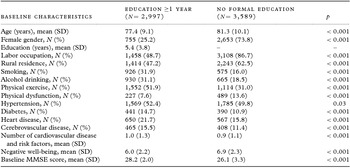
Out of the 6,345 participants, 1,448 (22.0%) were identified to have developed cognitive impairment at follow-up. The mean follow-up time was 4.63 years (SD = 1.61). Table 1 presents demographic variables of participants by educational level. Compared to participants with no formal education, educated participants were younger, less likely to be female and rural residents, and more likely to smoke, drink, and participate in regular exercise. Educated participants also had better physical functioning and baseline MMSE scores, reported more cardiovascular diseases and risk factors and less negative well-being.
Baseline characteristics of participants by educational level

Notes: Data were missing in nine for occupation, ten for ADL, three for smoking, and five for alcohol drinking, five for physical exercise, nine for cardiovascular diseases and risk factors, and 85 for negative well-being. SD: standard deviation; ADL: activities of daily living; MMSE: Mini-Mental State Examination. Physical dysfunction was defined as dependence on one or more activities (Katz index of ADL <6).
The CLHLS was approved by the Research Ethics Committees of Duke University and Peking University. Written informed consents were obtained from all participants.
Cognitive impairment
Global cognitive functioning was measured by using a modified Chinese version of the Mini-Mental State Examination (MMSE, score range 0–30) (Folstein et al., Reference Folstein, Folstein and McHugh1975). Most items were translated literally from the original version without modification, while some items were adapted to meet Chinese cultural context according to pilot survey interviews (Zeng and Vaupel, 2002). The CLHLS study was initially designed to include only oldest old participants (aged over 80 years old). Because the majority of Chinese oldest old had no education, several items of MMSE were simplified to make them easily understandable and practically answerable for oldest old. The serial 7 subtraction was simplified to serial 3 subtraction, and reading and writing a sentence was replaced by verbally reporting as many names of food as possible.
Education is strongly correlated with MMSE scores (Bravo and Hebert, Reference Bravo and Hébert1997). Previous studies in China have developed the education-based MMSE cut-off points to screen cognitive impairment among older population with low education (Cui et al., Reference Cui2011). In the current study, a considerable proportion (54.2%) of the study sample had no formal schooling. Therefore, we used education-based MMSE cut-off points widely accepted and used in China (Zhang et al., Reference Zhang1990) to define cognitive impairment, that is, <18 for participants with no formal education, <21 for elderly with 1–6 years of education, and <25 for elderly with more than six years of education.
We also defined cognitive decline as an outcome measure in two ways: (1) the index of “greater cognitive decline,” defined as the rate of cognitive decline was larger than 10%, i.e. ((baseline MMSE – follow-up MMSE)/baseline MMSE) >0.1 (Qiu et al., Reference Qiu, Winblad and Fratiglioni2006); (2) the absolute change on MMSE score over time, i.e. (baseline MMSE – follow-up MMSE).
Assessments of leisure activities
At baseline, data was collected from participants on the frequency (“almost every day,” “not daily, but once a week,” “not weekly, but at least once a month,” “not monthly, but sometimes,” or “never”) of their participation in nine leisure activities common in Chinese urban and rural elderly people. According to the predominant element of each activity (Karp et al., Reference Karp, Paillard-Borg, Wan, Silverstein, Winblad and Fratiglioni2006), these activities were categorized into cognitive activities and non-exercise physical activities except for one activity (watching television and listening to radio), for watching television was considered as a passive activity. Cognitive activities refers to activities which require a cognitive component in participation, including reading books or newspapers, playing cards or mahjong, organized social activities, and religious activities. Non-exercise physical activities refer to physical routines not aiming at developing and maintaining fitness, including housework, gardening, keeping domestic animals or pets, and personal outdoor activity. The frequency of participation in each activity was coded on a three-point Likert scale: three points for daily, two for weekly, one for monthly, and 0 for occasional or never participation (Niti et al., Reference Niti, Yap, Kua, Tan and Ng2008). Score on each activity ranged from 0 to 3. Composite scores were calculated separately for cognitive activities (ranging from 0 to 12), non-exercise physical activities (ranging from 0 to 12) and all type activities (the sum of all nine activities, ranging from 0 to 27).
Covariates
At baseline, potential confounders were measured, including age, gender, education (in years), principal occupation before retirement (labour vs. intellectual), residence (urban vs. rural), smoking (current vs. never or former smoking), alcohol drinking (frequent drinking vs. no frequent drinking), regular physical exercise (yes vs. no), the number of cardiovascular diseases and risk factors, negative well-being, and physical functioning.
Physical exercise participation was measured by one question “do you regularly participate in physical exercise (yes or no)?” Education was defined as years of formal schooling. Residence (urban vs. rural areas) can be an important indicator of socioeconomic status in China because people living in rural areas are disadvantaged in income, healthcare, and other welfare. Cardiovascular diseases and risk factors included hypertension (self-report history of hypertension or measured systolic blood pressure ≥140 mm Hg or diastolic blood pressure ≥90 mm Hg), diabetes, heart diseases, and cerebrovascular diseases. An index of negative well-being was used to control for the potential influence of depressive symptoms (Smith et al., Reference Smith, Gerstorf, Li, Zeng, Poston, Vlosky and Gu2008). Negative well-being was measured by three items about neuroticism (I often feel fearful or anxious), loneliness (I often feel lonely or isolated), and perceived loss of self-worth (The older I get, the more useless I feel). Participants answered on a five-point scale, with one point for “describes me very well” and five for “does not describe me at all.” Responses were reverse coded. The sum of the three items was treated as the indicator of negative well-being, with higher scores indicating worse psychological well-being (Cronbach's α = 0.64). We used an index of negative well-being as a measure of depressive symptoms. Physical function was assessed using the Katz Index of Activities of Daily Living (ADL) scale (Katz, Reference Katz1983; Cronbach's α = 0.87), and physical dysfunction was defined as inability to perform one or more activities (ADL score <6).
Statistical analysis
We used t-test, the Mann–Whitney U test or the Pearson χ 2 test to compare baseline characteristics by status of cognitive impairment and cognitive decline at follow-up.
Cox proportional hazards models were constructed to estimate the hazard ratio (HR) and 95% confidence interval (CI) of cognitive impairment associated with leisure activities. The time to an event was defined as the date from baseline survey to the time of a diagnosis of cognitive impairment or the time of the final survey for participants without cognitive impairment. The composite scores of leisure activities were categorized into tertiles (low/medium/high). All type of activities, cognitive activity, and non-exercise physical activity were examined separately. Results from two models were reported: model 1 was adjusted for age, gender, education, residence, and occupation; in model 2, additional adjustment was made for current smoking, drinking, physical function, the number of cardiovascular diseases and risk factors, regular fitness activities, negative well-being, baseline MMSE scores, and participation in other activities. When subtype activities were examined, variables of both cognitive and non-exercise physical activities as well as watching television and listening to radio were included in the models simultaneously to examine their independent associations with cognitive impairment. Similar Cox hazard analysis was performed to examine HR of cognitive impairment associated with each single activity. For single activity analysis, all nine activities entered the regression model together as nine different variables. Cox regression analysis was also performed to examine the association between leisure activities and “greater cognitive decline.” To validate the relationship between activity engagement and cognitive decline, linear regression model was further used to examine the association between leisure activities and the absolute change in MMSE score over the follow-up periods. In linear regression models, education and activity engagement were treated as continuous variables, and the covariates were the same as those used in Cox hazard models.
To examine whether the association between leisure activities and cognitive impairment was modified by educational level, the two-way interactions between leisure activities and educational level (educated vs. uneducated) on cognitive impairment were also tested. When a statistical interaction was detected, further analysis stratifying by educational level was conducted to explore the direction of the interaction. IBM SPSS Statistics 18 for Windows (IBM SPSS Corp.) was used for all statistical analyses.
Results
Leisure activities and cognitive impairment
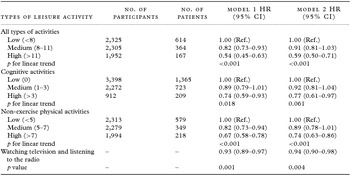
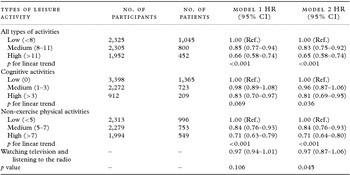
Controlling for potential confounders, higher frequency of participating in leisure activities was significantly associated with a decreasing HR of cognitive impairment (p < 0.001); compared to low level activity, a high level of participation in all types of leisure activities was associated with a 41% decrease in the risk of cognitive impairment (Table 2). When cognitive activities and non-exercise physical activities were examined separately, but simultaneously entered into the model, a high level of non-exercise physical activities were significantly associated with reduced HRs of cognitive impairment (HR, 0.74; 95% CI 0.63–0.86, p < 0.001), while the significant linear association between levels of cognitive activities and HR of cognitive impairment in Model 1 (p for trend = 0.018) became statistically marginal when multiple additional confounders were controlled for in Model 2 (p for trend = 0.061) (Table 2). Watching television and listening to radio was significantly related to lower risk of cognitive impairment (p = 0.004). In addition, the effect of physical exercise was not significant (p > 0.05).
Association of leisure activities with cognitive impairment

Notes: Data were missing in four participants for cognitive activity scores and sum scores. Model 1 was adjusted for age, gender, education (years), residence, occupation, and participation in other activities; in Model 2, additional adjustment was made for current smoking, drinking, physical function, the number of cardiovascular diseases and risk factors, regular physical exercise, negative well-being, and baseline MMSE scores. All types of activities refer to the combination of watching TV and listening to the radio, cognitive and non-exercise physical activities. MMSE: Mini-Mental State Examination; HR: hazard ratio; CI: confidence interval.
Leisure-time individual activities and cognitive impairment
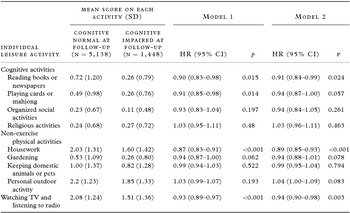
Table 3 presented mean scores on nine leisure-time different activities and their associations with cognitive impairment. Of these activities, reading books and newspapers, housework, and watching television and listening to radio, were significantly associated with a decreased risk of cognitive impairment.
Mean scores on individual activities and association of individual activities with cognitive impairment

Notes: Data were missing in two participants for playing cards or mah-jong and two for religious activities. Model 1 was adjusted for age, gender, education (years), residence, occupation, and participation in other activities; in Model 2, additional adjustment was made for current smoking, drinking, physical function, the number of cardiovascular diseases and risk factors, regular physical exercise, negative well-being, and baseline MMSE scores. MMSE: Mini-Mental State Examination; HR: hazard ratio; CI: confidence interval; SD: standard deviation.
Educational level, leisure activities, and cognitive impairment
More years of education were associated with a lower HR of cognitive impairment (HR, 0.96; 95% CI 0.93–0.98; p < 0.001). There were statistical interactions of educational level with all types of leisure activity (for the interaction term of high leisure activity × educational level, p < 0.001), with cognitive activities (for the interaction term of high cognitive activity × educational level, p = 0.008), and with non-exercise physical activities (for the interaction term of high cognitive activity × educational level, p = 0.001) on the risk of cognitive impairment. There were also statistical interactions of educational level with watching television and listening to radio (p = 0.008) and physical exercise (p = 0.009) on cognitive impairment.
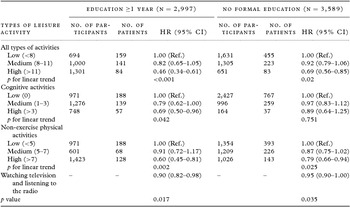
Analysis stratifying by educational levels suggested that the beneficial effect of a high level of leisure activities on cognitive function was more profound in educated participants (HR, 0.46; 95% CI, 0.34–0.61) than in those without formal schooling (HR, 0.69; 95% CI, 0.56–0.85) (Table 4). The reduced risk of cognitive impairment associated with a high level of cognitive activities was statistically evident in educated participants (p = 0.042) but not in uneducated persons. The associations between non-exercise physical activities and reduced risk of cognitive impairment were significant in both educated (HR, 0.60; 95% CI 0.45–0.81; p = 0.002) and uneducated elderly (HR, 0.79; 95% CI 0.66–0.94; p = 0.025). Physical exercise was not associated with the risk of cognitive impairment in either educated or uneducated participants.
Association of leisure activity with cognitive impairment by educational level

Notes: Missing values: Four for cognitive activity scores and sum scores. All models were adjusted for age, gender, education, residence, occupation, smoking, drinking, physical functioning, the number of cardiovascular diseases and risk factors, regular physical exercise, negative well-being, baseline MMSE scores and participation in other activities. All types of activities refer to the combination of watching TV and listening to the radio, cognitive, and non-exercise physical activities. MMSE: Mini-Mental State Examination; HR: hazard ratio; CI: confidence interval.
Leisure activities and cognitive decline
During the mean 4.63 years of follow-up, 2,298 (34.9%) participants experienced a greater cognitive decline (decline > 10%). Higher frequency of participating in leisure activities was significantly associated with lower HR of a greater cognitive decline (p <0.001); compared to low level activity, a high level of participation in all types of leisure activities was associated with a 35% decrease in the risk of a greater cognitive decline (Table 5). High level of participation in both cognitive and physical activities was associated with reduced risk of a greater cognitive decline (Table 5).
Association of leisure activities with cognitive decline

Notes: Data were missing in four participants for cognitive activity scores and sum scores. Model 1 was adjusted for age, gender, education (years), residence, occupation, and participation in other activities; in Model 2, additional adjustment was made for current smoking, drinking, physical function, the number of cardiovascular diseases and risk factors, regular physical exercise, negative well-being, and baseline MMSE scores. All types of activities refer to the combination of watching TV and listening to the radio, cognitive, and non-exercise physical activities. MMSE: Mini-Mental State Examination; HR: hazard ratio; CI: confidence interval.
There were statistical interactions of educational level with all types of leisure activity (for the interaction term of high leisure activity × educational level, p = 0.009), with cognitive activities (for the interaction term of high cognitive activity × educational level, p = 0.015), and with non-exercise physical activities (for the interaction term of high cognitive activity × educational level, p = 0.004) on greater cognitive decline. Educational level also significantly interacted with physical exercise (p = 0.039) and watching television and listening to radio (p = 0.044).
The linear regression analysis suggested that participation in all types of leisure activities was negatively related to the absolute change on MMSE score (β = −0.11, p < 0.001). Cognitive decline was also negatively associated with cognitive activities (β = −0.06, p < 0.001), non-exercise physical activities (β = −0.05, p < 0.001), and watching television and listening to radio (β = −0.06, p < 0.001), but not exercise (p = 0.23). The interaction of all types activities with education was significant (β = −0.05, p = 0.001). Education also showed significant interaction with non-exercise physical activities (β = −0.05, p = 0.001), physical exercise (β = −0.05, p = 0.001) and watching television and listening to radio (β = −0.05, p = 0.001), but not with cognitive activities (p = 0.12).
Discussion
Main findings
In this large-scale population-based study of Chinese older adults, we found that older people with a high level of engagement in leisure activities had a 41% decreased risk of subsequent development of cognitive impairment compared with those with low level engagement. The effect is independent of major potential confounders, including demographic features, residence, regular physical exercise, vascular risk factors, physical functioning, and baseline MMSE. Similarly, more frequent engagements in leisure activities were associated with a reduced risk of cognitive decline. These results are in line with the view that leisure activities can be a proxy of cognitive reserve. Furthermore, our study extends previous research by showing that the association of more participation in cognitive activities with decreased risk of cognitive impairment is evident merely among educated elderly.
Effects of leisure activities and non-exercise physical activity
We found associations of all types of leisure activities and non-exercise physical activities with reduced risk of cognitive impairment, but the association between cognitive impairment and cognitive activities was largely dependent on potential confounders. Compared to single type of activities (i.e. non-exercise physical activities), higher engagement in all types of activities were associated with larger decline in HR of cognitive impairment. In line with the result, studies have reported that greatest cognitive benefits were observed in older adults who participate in a broader spectrum of activities comprising multiple components (Karp et al., Reference Karp, Paillard-Borg, Wan, Silverstein, Winblad and Fratiglioni2006; Paillard-Borg et al., Reference Paillard-Borg, Fratiglioni, Xu, Winblad and Wang2012). We found no association of physical exercise with the risk of cognitive impairment, which is consistent with some prior studies (Wilson et al., Reference Wilson2002; Verghese et al., Reference Verghese2003; Wang et al., Reference Wang2006; Niti et al., Reference Niti, Yap, Kua, Tan and Ng2008). However, participation in physical exercise was measured in this study by merely a single question. Because both frequency and intensity of physical activities are important for cognitive function (Groot et al., Reference Groot2016), the lack of an effect for physical exercise might be due to partly imprecise measurement.
Effects of non-exercise physical activity
We found that a high level of non-exercise physical activity was related with lower risk of cognitive impairment and the effects were independent of cognitive activity and regular physical exercise. Very few studies have discriminated non-exercise and exercise physical activities in studying the association between leisure-time physical activities and cognitive performance. In Rush Memory and Aging Project, total daily exercise and non-exercise physical activity measured with actigraphy were associated with global cognitive function after adjusting for self-report physical, cognitive and social activities, suggesting that not only exercise but also non-exercise physical activity were related to cognition (Buchman et al., Reference Buchman, Boyle, Yu, Shah, Wilson and Bennett2012). These findings have significant implications. First, older adults with no regular exercise, especially those with limited exercise capacity, may nevertheless benefit from non-exercise physical activity such as housework. Thus, physical activities, including both exercise and non-exercise activities, might be considered as intervention approaches for improving cognitive functioning in older adults. Second, our results imply that it is important to measure both exercise and non-exercise physical activities in the research of leisure activities and cognitive function among older people.
Interactions between education and leisure activities
The association between levels of leisure activities and the risk of cognitive impairment varied by education. Specifically, the cognitive benefits of leisure activities were larger for educated than uneducated elderly people, and only educated elderly benefited from cognitive activities. Consistent with our finding, cognitive training studies have showed that individuals with higher cognitive abilities often benefit most from training. For instance, a recent study found that, cognitively healthy older adults gained more from a combined cognitive and physical training than cognitively impaired participants (Bamidis et al., Reference Bamidis2015). Memory strategy training studies have reported that younger adults improved more than older adults after training (Baltes and Kliegl, Reference Baltes and Kliegl1992; Nyberg et al., Reference Nyberg2003). The result of interaction is also in line with a recent neuropathological study that showed the relationship between cerebral microvascular disease (e.g. lacunar infarcts) and cognitive ability was modified by educational achievement, that is, the likelihood of cognitive impairment associated with lacunar infarcts was lower among individuals with high education compared to those with low education (Farfel et al., Reference Farfel2013).
An active lifestyle may benefit cognition through different ways, including indirect pathways that enhance the ability for using neural networks more efficiently and compensating brain pathology (Stern, Reference Stern2012), and direct pathways in reducing beta-amyloid deposition (Landau et al., Reference Landau2012).The explanation for the difference by educational background might be that the actual mental complexity involved in activities may vary in educated and uneducated older adults. First, skills developed from early-life educational experience may enable people throughout adulthood to participate in activities in a more productive and active way, like applying strategies to achieve specific purposes. For example, individuals with high levels of education are more likely to use strategies when performing a verbal fluency task (Troyer, Reference Troyer2000). Second, motivational states during activities, which may contribute to gains from activities, might also be different in educated and uneducated elderly. Environmental success hypothesis assumes that, individuals with high fluid intelligence are more able to successfully manage new situations, resulting in more enjoyment which ensure them to seek more new situation (Ziegler et al., Reference Ziegler, Cengia, Mussel and Gerstorf2015). A previous study on flow state reported that older adults with higher fluid ability enjoy cognitively demanding activities more, while those with lower levels experienced less pleasure in these activities (Payne et al., Reference Payne, Jackson, Noh and Stine-Morrow2011). Educated older adults might be more absorbed and interested in cognitive activities than uneducated ones, thus gaining more cognitive profits.
Possible cognitive benefits of watching television
Watching television and listening to radio were found to be associated with a lower risk of cognitive impairment, which was inconsistent with previous studies where watching television was associated with increased risk of dementia and cognitive impairment (Lindstrom et al., Reference Lindstrom2005; Wang et al., Reference Wang2006). We speculated that the inconsistency might relate to difference of sample characteristics. The study sample of our study had very low level of education (education ≤ 6 years, 87%), compared to the sample (education ≤ 6 years, 29%) in the study of Wang et al. (Reference Wang2006). Watching television and listening radio might serve, to some extent, as a source of cognitive stimulation for elderly with very low education, because their participation in other cognitive activities (e.g. reading books) might be restricted by the lack of reading and writing ability. Television and radio might be an important source of latest news and information for uneducated elderly. In accordance with our results, a study which used the first two waves of the CLHLS data also reported positive effect of watching television and listening to radio on cognitive impairment in oldest old (Zhang, Reference Zhang2006).
Limitations
The major strength of this study refers to the large-scale national sample of Chinese elderly people from the general population. However, several limitations of the present study deserve mentioning. First, cognitive function was solely assessed with the MMSE, without clinical evaluation or other cognitive tests. The MMSE is a brief measure of global cognitive function, which might not be sensitive enough to screen early stage of cognitive impairment or detect changes in cognitive function. Second, the measure of physical exercise participation was rough and imprecise. The measure did not include information about frequency, duration, intensity, types, or energy expenditure of physical exercise, possibly causing null finding of exercise in this study. To assess physical activity for population-based studies, self-reported questionnaires which provide proxies of energy expenditure may be recommended, such as the Yale Physical Activity Survey or the Community Healthy Activities Model Program for Seniors Questionnaire (Harada et al., 2001). Third, the measure of nine individual leisure activities only provided information on frequency but not intensity or longitudinal information (e.g. when participants start and quit an activity). Lifelong activities and activities started more recently may have different effects on cognitive function. Some studies reported long-term effects of midlife leisure activities on late life cognitive function (Karp et al., Reference Karp, Andel, Parker, Wang, Winblad and Fratiglioni2009; Chang et al., Reference Chang2010). Besides, change of participation in an activity may also be a possible predictor of cognitive impairment or cognitive change in older adults. Fourth, the categorization of leisure activities is relatively broadly defined in the current study. For example, although organized social activity and religious activity included both cognitive and social components, both were categorized as cognitive activities. The compound characteristic of these activities might confound the effects of particular types of activities. In the study of Karp et al. (Reference Karp, Paillard-Borg, Wan, Silverstein, Winblad and Fratiglioni2006), researchers did not group activities but scored each activity on cognitive, physical, and social components, and the scoring was validated by an independent group of older adults. This approach could build a multidimensional profile for each activity. Finally, the mean follow-up time of the study was relatively short (about five years). Stronger relationships between activity engagement and cognitive impairment or cognitive decline might be observed for longer follow-up time. In addition, owing to the long-term preclinical phase of cognitive impairment and the relatively short period of follow-up, we cannot for sure conclude the temporal relationship between leisure activities and risk of subsequent cognitive impairment because decreased frequency of participation in leisure activities might be an early marker of cognitive impairment (Eriksson Sörman et al., Reference Eriksson Sörman, Sundstrom, Ronnlund, Adolfsson and Nilsson2013).
Conclusion
Our study suggested that late-life leisure activity protected against cognitive impairment, with the beneficial effects being greater for educated elderly compared to illiterate elderly people. Increased non-exercise physical activity was associated with a lower risk of cognitive impairment, indicating that non-exercise physical activity may serve as a potential intervention method for improving cognitive function in elderly. More studies are needed to clarify the various effects of different activities and the interaction between leisure activity and education on cognitive function in old age.
Conflict of interest
None.
Description of authors’ roles
X. Zhu and J. Li developed research question and designed the study. X. Zhu analyzed the data and wrote the draft. Y. Zeng is the principle investigator of the CLHLS project. J. Li, C. Qiu, and Y. Zeng made critical revision of the paper.
Acknowledgments
This work was supported by the National Natural Science Foundation of China (31671157, 31470998, 31271108, 31070916, 71233001, 71490732, and 71110107025), the US National Institutes of Health (5R01-AG023627), the CAS Key Laboratory of Mental Health, Institute of Psychology, Chinese Academy of Sciences (KLMH2014ZK02), the Pioneer Initiative of the Chinese Academy of Sciences, Feature Institutes Program (TSS-2015-06), and the CAS/SAFEA International Partnership Program for Creative Research Team (Y2CX131003).
Supplementary Material
To view supplementary material for this article, please visit http://dx.doi.org/10.1017/S1041610216001769.