When a state wants to cooperate with other states, it faces a choice among a variety of international organizations through which it can do so. In deciding to join an international organization, an important variable is the number of member countries. For example, everything else equal, a higher number of member states exacerbates the collective-action problem among states.Footnote 1 In the field of development assistance, a higher number of donors implies that burden-sharing benefits for each donor are larger but the costs for each donor in terms of its loss of control are also higher.
While this mechanism may plausibly govern the institutional choices by individual donor countries, it is extremely hard to test. We are able to do so by exploiting a relatively new development in the multilateral development system. Over the past decade, donor governments have increasingly channeled their foreign aid through “trust funds” earmarked for particular activities. These trust funds are ad hoc international institutions that support specific development issues and rely on the implementing capacities of the international development organization that hosts them. A prominent example is the Afghanistan Reconstruction Trust Fund. It is hosted by the World Bank, but the World Bank must keep the trust fund contributions apart from its own assets and cannot use them for other purposes related to its mandate. The World Bank is the most important trustee organization, followed by the United Nations.Footnote 2 Since the turn of the millennium, trust funds at international development organizations have grown massively. With a volume of 19 billion USD in 2012, they represent about 20 percent of bilateral aid and almost 60 percent of multilateral aid.Footnote 3 At the World Bank, annual trust fund contributions quadrupled in less than a decade from their levels in the late 1990s.Footnote 4 Currently, the World Bank receives annual contributions of about USD 4 billion that support its own programs. It further holds about USD 10 billion in trust for which it provides only fiduciary services.Footnote 5 The sheer number of different funds is even more striking: the World Bank Group manages over 1,000 funds. They differ in their size in terms of the number of donors, ranging from single-donor trust funds to multi-donor trust funds that in some cases make up almost the entire membership of the host organization. These funds therefore cover a whole range of new institutional options for donor activities, ranging from perfect substitutes for traditional bilateral aid to perfect substitutes for multilateral aid, in terms of the number of donors.
We study the determinants of individual donor choices among different-sized trust funds. Using a simple theoretical model, we posit that a given donor faces a trade-off between the greater burden-sharing benefits of funds with more donors and the greater ability to assert its own preferences in funds with fewer donors. The number of donors within a fund represents a key variable in our model: synergies from cooperation with other donors increase when there are more of them, but any given donor must compromise more on the fund's specific objectives, for example, with respect to regions, countries, sectors, or themes. Other things equal, in an issue area with low alignment of interests, cooperation with many other donors will be less attractive than a fund with fewer donors. Conversely, a fund with many other donors will be more attractive when “burden sharing” is an important motive, for example, in high-risk areas such as assistance to fragile or postconflict countries.
Using a data set of trust fund participation decisions of donor countries at the World Bank from 2002 to 2013, we conduct multivariate analysis to test some observable implications of our theory. Using Wald tests in seemingly unrelated regression estimations to compare the effect of fund and donor characteristics on the participation decisions in single-donor, multi-donor, and large multi-donor trust funds, we find consistent support for our main hypotheses. Ex ante sector alignment among all donors, as well as indicators for global activities and fragile-states assistance, increase a donor's willingness to opt for (large) multi-donor trust funds. In contrast, a donor prefers single-donor trust funds when and where its national interests tend to predominate. This evidence also puts into perspective the common wisdom that trust funds first and foremost are a means to enhance donor coordination and to reduce donor fragmentation.Footnote 6 In contrast, our paper suggests that donors can reap the benefits of aid harmonization through trust funds only when their preferences are relatively aligned.
Our argument is not entirely novel but combines key elements of existing approaches to international cooperation. Some aid-allocation studies argue that the choice between bilateral aid and multilateral aid hinges on how a given donor trades off potential burden-sharing benefits versus its desire for control.Footnote 7 Our paper goes beyond the discrete choice between these two channels of aid allocation and studies the entire range of intermediate choices available to a donor through participation in trust funds. Another novel aspect of our study is its analysis of the implications for burden-sharing benefits and loss of control as the number of donor partners in an international organization increases. In addition, recent research has examined allocations of individual donors among existing international development organizations based on the similarities in the allocations of these organizations with the bilateral portfolios of the donors and the organizations' efficiency differences.Footnote 8 We extend this approach by considering the number of donors in any given organization. We also do not consider a given set of organizations but allow for the possibility that a donor creates an ad hoc international institution (specifically, in the form of a trust fund) on its own or in partnership with other donors. This is a new feature of the flexible instrument of trust funds that has not been considered in the previous literature.
Our theory has implications for institutional design beyond trust funds. On the one hand, we expect a similar trade-off to govern the choice of a given country to join a specific set of international organizations. On the other hand, we emphasize the novelty of trust funds as a design solution for global issues that warrant flexible forms of cooperation among states. In contrast to full-fledged international development organizations, trust funds are ad hoc institutions that are easy to establish but that are also readily terminated when deemed appropriate by the donors. While international development organizations are typically seen as the most efficient solution to resolve burgeoning development challenges, our evidence suggests that alternative institutional solutions that convene a coalition of states may be more efficient, depending on the preference constellation of all states. In some cases, trust funds may even be the only feasible solution to address new development challenges, notably when there is stalemate in the formal governing bodies of the established international organizations. Accordingly, donors emphasize that they use trust funds to “fill gaps in the multilateral system,” for example, assisting fragile states, supplying global public goods, and tackling humanitarian emergencies.Footnote 9
Historical Development of Trust Funds
Trust funds represent the main instrument for bilateral donors to channel multi-bi aid to international development organizations. Multi-bi aid refers to earmarked contributions by donor countries to international development organizations to support specific development purposes, notably specific themes, sectors, or countries.Footnote 10 From a recipient-country perspective, trust funds provide grant resources and thus are most comparable to the established grant-making facilities of multilateral agencies.Footnote 11 In most agencies, trust funds can be established between the donor(s) and the agency without approval of the formal governing bodies.Footnote 12 Fund administration is governed by an agreement between the bilateral donor(s) and the agency, which provides trustee services and administers the related programs.Footnote 13 The agreement covers not only the substantive program priorities supported by the fund but also determines the conditions of program delivery. Despite much flexibility in such an agreement, international procurement rules also apply to the programs supported through trust funds. In particular, this usually prevents donors from directly tying their contributions to domestic purchases.Footnote 14
The Rise of Trust Funds at the World Bank
The World Bank—technically, the International Bank for Reconstruction and Development (IBRD)—has long-standing experience with trust funds. Its first was established in 1960, when several donors jointly created a trust fund to co-finance the Indus Basin Project in Pakistan. Also in the 1960s, the World Bank agreed to execute technical assistance projects of the United Nations Development Program (UNDP). Until the late 1990s, trust funds grew only very slowly and mostly were a vehicle for the Bank to participate in partnership programs, for example, the Consultative Group on International Agricultural Research (CGIAR) in the 1970s. In the mid-1980s, donors also started to use consultant trust funds to support the analytical work of the Bank and to provide technical assistance to recipient countries. An important fund established in 1987 was the Policy and Human Resource Development program (PHRD), which financed project-preparation activities.Footnote 15
In the early 1990s, the first sizable trust fund appeared that was a collective makeshift for donors confronted with policy stalemate in the formal governing body. When the United States withheld its International Development Association (IDA) contribution to pressure for reforms at the World Bank, other donors created an interim trust fund to cover the costs of some World Bank programs.Footnote 16
In the late 1990s, trust funds were discovered by donors frustrated with their own limited possibilities to influence World Bank policies, and by the Bank's sluggishness in addressing emergent issues they deemed important. For example, Japan sought to establish an ideological counterpart to the United States by establishing its own trust fund with the World Bank.Footnote 17 Some middle powers such as the Nordic donors were “much more financially forthcoming relative to their economic wealth than the United States” and bypassed the formal budgetary process, providing supplementary trust fund resources in exchange for policy influence.Footnote 18 Examples of such influence-seeking trust funds include the Japanese Social Development Fund (JSDF), which complemented Bank-financed operations by small-scale activities with local nongovernmental actors;Footnote 19 the Bank-Netherlands Partnership Program (BNPP), which supported pilot studies to help the Bank identify “where most development impacts could be expected”;Footnote 20 the Governance Partnership Facility (GPF), funded by the United Kingdom, the Netherlands, and Norway (Australia joined later);Footnote 21 and trust funds to alleviate postconflict reconstruction needs, for example, in Bosnia and Herzegovina.Footnote 22
In some cases, the Bank has encouraged donors to channel their development assistance through trust funds. A well-documented case of “mission creep” initiated from inside the Bank is climate change. Expecting a honey pot, the Bank expanded into carbon finance, despite reservations in the board of executive directors and by the United States. In 1996, it launched a pilot fund, backed by Bank president James Wolfensohn, and institutionalized its new role by establishing the Carbon Finance Group in the department for sustainable development in 2003. Subsequently, trust funds related to climate change have proliferated.Footnote 23
While formally rejected by many member states, the climate activities of the World Bank were supported by some Organisation for Economic Cooperation and Development (OECD)/Development Assistance Committee (DAC) donors.Footnote 24 Similarly, OECD/DAC donors pushing a “good governance” agenda over the opposition of many recipient countries also turned to trust funds. The governance agenda clashed not only with the principle of enhancing recipient-country ownership, but also to some extent with the Bank's Articles of Agreement, which prohibit it from interfering in countries' political affairs.Footnote 25 By operating via trust funds, OECD/DAC donors could avoid lengthy discussions and costly concessions in the board of governors to build consensus on the necessary legal adaptations to make the Bank work on political governance issues.
In the 2000s, the World Bank further expanded its role in trust funds. In tandem with its explosion in IBRD/IDA trust funds, the Bank also positioned itself as a trustworthy partner for “multi-actor funds”Footnote 26 —legally independent multilateral institutions that mobilize donor resources and pass them on to multilateral agencies for implementation.Footnote 27 In these partnerships, supported by “financial intermediary funds” (FIFs), the Bank provides only limited fiduciary services. In essence, while donors did not perceive the World Bank and many other United Nations entities as “fit for purpose” to address global challenges,Footnote 28 for example HIV/AIDS,Footnote 29 they charged the Bank with the financial accounting for multi-actor funds. This helped the Bank become involved in global issues and hence build up the relevant expertise to position itself against competition.Footnote 30 There are only twenty FIF programs, but these programs are sizable and account for almost two-thirds of total trust fund portfolio assets.Footnote 31
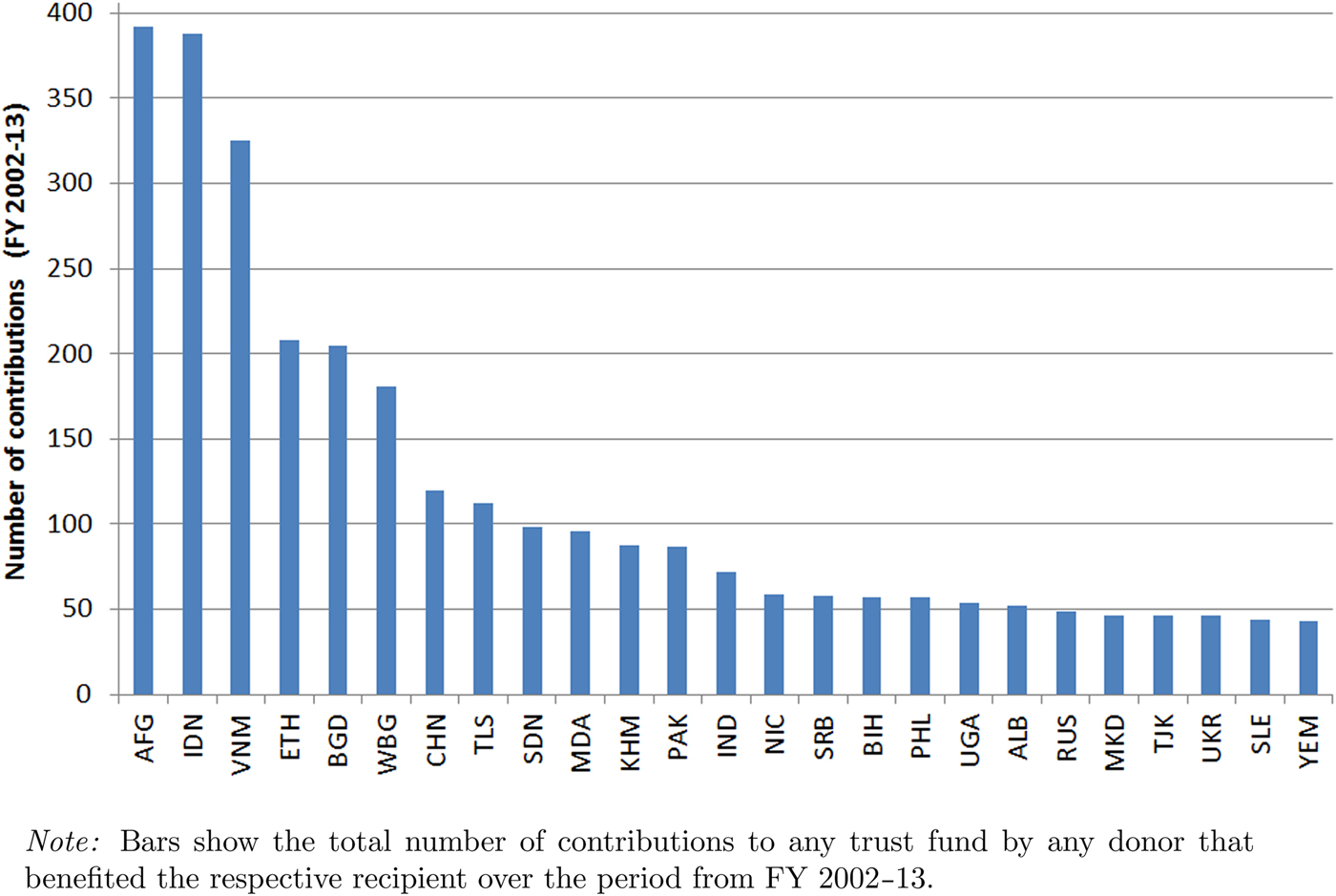
The historical evolution of trust funds at the World Bank is reflected in its current portfolio. Mirroring the crucial role of trust funds in assisting postconflict states, it is no surprise that Afghanistan, West Bank and Gaza, Timor-Leste, and Sudan are among the top ten recipients in terms of the overall number of trust fund contributions between 2002 and 2013 (Figure 1). Postconflict needs may also play a role in Serbia, Bosnia, and Sierra Leone, which follow suit in the top twenty-five list.Footnote 32
Top twenty-five recipient countries of country-specific trust funds

Most trust funds are not designed to support specific countries. An analysis of the historical record of trust fund contributions from 2002 to 2013—the longest time span for which systematic information on trust fund contributions is available—shows that less than 30 percent of all trust funds were earmarked for a specific country at the time of agreement. Conversely, almost 60 percent of the funds are of global scope, while the remainder supports (inter-) regional activities. However, almost all trust funds support dedicated themes or sectors,Footnote 33 reflecting the fact that many trust funds were initiated by individual donors pushing for their most salient sectoral or thematic interests.
OECD/DAC donors provide the bulk of contributions, and account for 90 percent of all participation decisions. About 300 other donors, including multilateral donors, donor countries, and private foundations, share the remainder.Footnote 34
Donor Participation Decisions
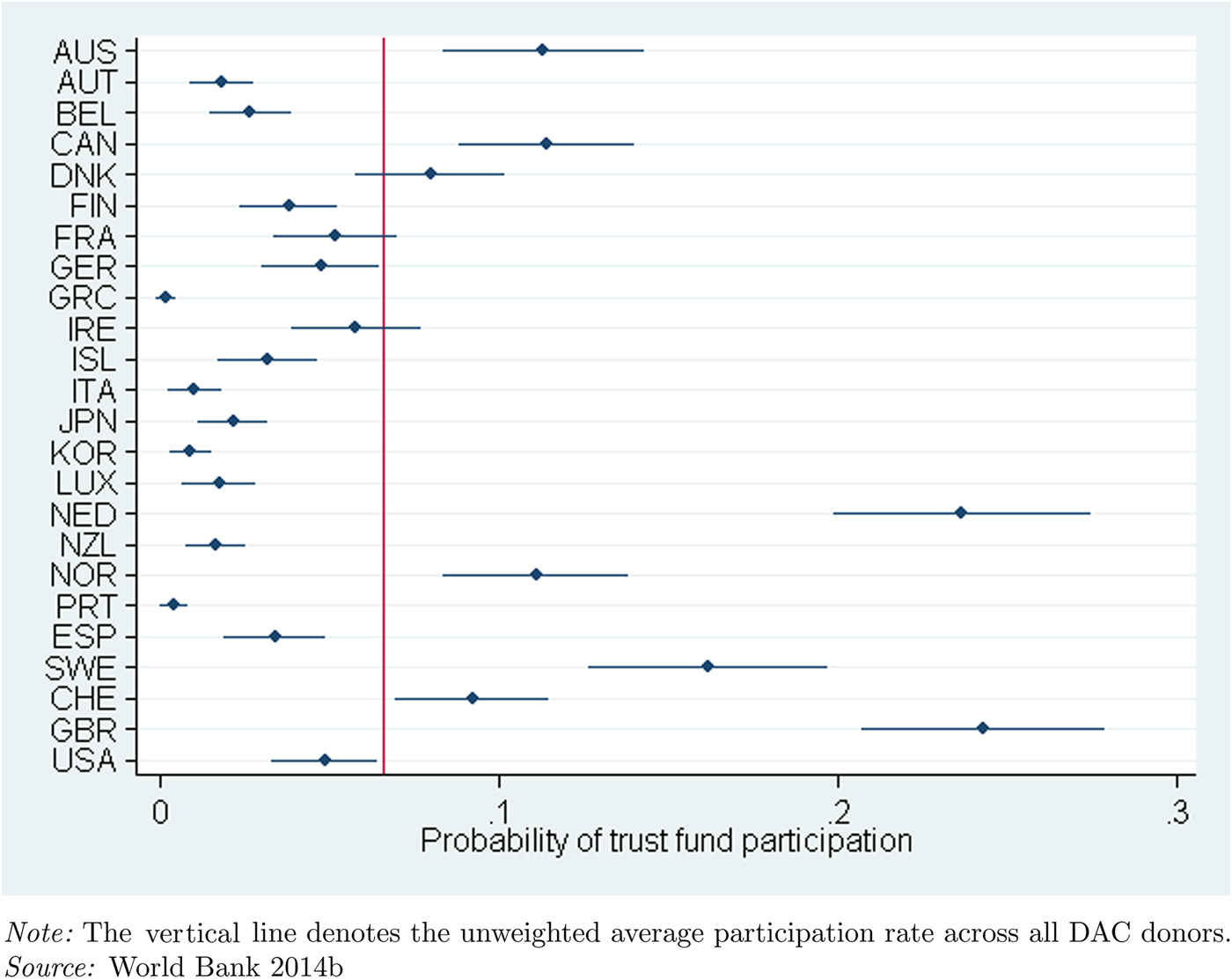
Some descriptive statistics help us understand donor participation decisions in World Bank trust funds based on contributions data in the trust fund databases.Footnote 35 We consider the average participation in any type of trust fund for each donor. Figure 2 shows that the Netherlands and the United Kingdom are by far the most active users of trust funds at the World Bank. Australia, Canada, Denmark, Norway, Sweden, and Switzerland are the other donors with a significantly higher-than-average propensity to use trust funds. Finland, France, Germany, Ireland, and the United States are just below, but very close to the DAC average. The group of countries with a propensity significantly below the DAC average includes the southern European member states (Greece, Italy, Portugal, and Spain), other small donors (Austria, Belgium, Iceland, New Zealand), and the two Asian donors (Japan and South Korea).
Propensity to participate in any fund across DAC donors

In terms of the total number of trust funds a donor contributed to between 2002 and 2013, the United Kingdom (450 contributions), the Netherlands (400 contributions), and Sweden (280 contributions) are the top three donors. In cumulative terms, the largest contributions between 2002 and 2013 were made by the United Kingdom (USD 15 billion), the United States (USD 14 billion), and Japan (USD 8 billion). The United Kingdom has also undergone the most dynamic evolution, growing from a mid-sized to the largest trust fund donor in less than a decade.
The distribution of the number of donors that join together in a trust fund tends to follow a power law: almost half of trust funds are supported by a single donor, while trust funds with two, three, or four donors each occur at a frequency of about 8 percent, and trust funds with more than four donors at a frequency of below 5 percent. These frequencies further decline for increasing fund sizes. However, there also are some funds in which all DAC donors are members. The empirical distribution of fund sizes suggests a simple categorization of trust funds that forms the backbone of our subsequent analysis. In particular, we distinguish among single-donor trust funds (SDTFs), small multi-donor trust funds (MDTFs) (up to four donors), and large MDTFs (five donors or more). The cut-off between small and large MDTFs is somewhat arbitrary, but corresponds to the discussion in the literature, as exemplified by donor groups such as the “Nordic donors.”
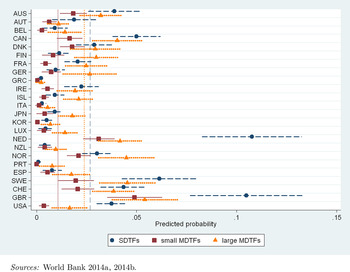
Figure 3 differentiates between donors' propensity to join these three types of funds. Donors with above-average propensity to create SDTFs include the Netherlands, the United Kingdom, Sweden, Canada, Switzerland, Australia, and the United States. For small MDTFs, several donors are significantly above the average, including the United Kingdom, the Netherlands, Norway, Switzerland, Sweden, Denmark, and Australia. Particularly noteworthy is the low participation of the United States in these types of funds, even more so given its above-average use of SDTFs. For large MDTFs, the picture looks similar, with the United Kingdom, the Netherlands, Norway, Sweden, Switzerland, and Canada being significantly above the average donor in their participation rates.
Participation in different types of funds across DAC-24.

In general, the donor countries with more SDTFs also participate more frequently in MDTFs. Similarly, most donors with little or no participation in SDTFs are even further below average in their propensity to join MDTFs. Essentially, this implies that they hardly engage in trust funds at all. By contrast, some countries participate in nearly all multi-donor initiatives, which cannot easily be seen from the plotted probability in Figure 3. For example, the United Kingdom participates in almost half of all small MDTFs. There is no strong correlation between choice of trust fund type and overall donor size. Relatively large donors such as the United Kingdom, the Netherlands, and the United States have the capacity to “go it alone,” but smaller donors such as Austria, Ireland, and Switzerland also have a tendency to use SDTFs—perhaps hinting at isolated policy preferences.
The different participation patterns across DAC donors as well as the use of different funds warrant an explanation. We leverage related literature for developing our theoretical argument to account for these empirical patterns.
Related Literature
Few academic studies explicitly address multi-bi aid. Only recently have scholars begun to analyze it more systematically, and some of the work we cite is not yet published. Erin Graham traces the growing bilateralization of the United Nations development system. Her article raises concerns that multi-bi funding undermines universal multilateralism.Footnote 36 In another article, Graham illustrates that variation in donor preferences over both the size and the substance of agency activity can explain macrohistorical shifts in funding rules from core funding to (unearmarked) voluntary funding and earmarked funding at international organizations since the Second World War.Footnote 37 Devi Sridhar and Ngaire Woods examine the specific case of the Global Fund to Fight Aids, Tuberculosis, and Malaria and suggest that donors channel resources through the Global Fund to influence the activities of the World Health Organization, a practice they call “Trojan multilateralism.”Footnote 38
A broader analysis of multi-bi aid across all institutions has become possible only recently with a new multi-bi aid data set.Footnote 39 The new data allow researchers to track the evolution of multi-bi aid after the Cold War and inform the debate on its underlying motives and related implications for aid effectiveness.Footnote 40 In fact, multi-bi financing may have tangible implications for international development organizations in terms of distorting program priorities, rivalry with core resources, and funding sustainability.Footnote 41 From a theoretical perspective, the combination of donor preferences, discretion granted to the multilateral organization, and voting rules influence allocation decisions among bilateral aid, unearmarked voluntary contributions, and earmarked funding.Footnote 42 Other work shows that earmarked funding relates to the interplay between capacity constraints and domestic politics in the donor, as evident in the European Union institutions.Footnote 43 These studies illustrate that trust funds are used for various purposes and that their effectiveness hinges upon their funding purposes and underlying motivations. However, none of these studies explicitly address the variety of choices within multi-bi aid, and the key question of how donors decide among these alternatives.
Based primarily on donors' own arguments regarding this new phenomenon, some of the literature is also based on faulty assumptions that can lead to erroneous conclusions.Footnote 44 In particular, the neglect of SDTFs tends to perpetuate the conventional wisdom that donors use trust funds primarily as a means to enhance aid coordination. In fact, many studies argue that multi-bi aid allows bilateral donors to pool their resources and thereby achieve key principles of the Paris Declaration,Footnote 45 including recipient-country ownership, aid harmonization, and mutual accountability,Footnote 46 although success is sometimes difficult to achieve.Footnote 47
In contrast, other studies emphasize that multi-bi aid gives an individual donor nearly as much control as bilateral aid, but without requiring the donor to sustain a full-fledged aid bureaucracy, while still benefiting from the expertise and professionalism of multilaterals.Footnote 48 This view suggests that multi-bi aid is popular with donors because it combines the “best of two worlds.” But this perspective overlooks the variety of choices within multi-bi aid. Our argument is that there is a trade-off in using multi-bi aid, but the flexibility of trust funds allows the donors to select the optimal combination between the two extremes, on a case-by-case basis for specific topics and under the varying political and economic conditions in the donor country itself.
To analyze the choice among different types of trust funds, we draw on three related, more general strands of the literature on international organization and adapt their insights to our research questions. The first strand concerns the rational design of international institutions that can be used to explain the associated institutional choices from a donor perspective. In general, the rational design literature relates specific institutional design choices of interstate cooperation to the potential conflicts over the distribution of the gains from cooperation, the existence of an enforcement problem, the number of relevant actors in the field, and issue characteristics such as the distribution of state preferences, uncertainty, transaction costs, and group characteristics.Footnote 49 The rational design literature is relevant for our purpose because it can explain the establishment of trust funds. While we analyze donor participation decisions rather than decisions about the establishment of new funds, in the case of trust funds these decisions are generally identical. Trust funds hosted at international development organizations are temporary mechanisms, often created in an ad hoc manner and with a donor base that usually changes little, if at all, over the lifetime of the fund. These characteristics distinguish trust funds from more sustainable institutional choices—such as legally independent multilateral organizations—although a small percentage of trust funds evolve into independent multilaterals. For donor countries that are averse to “zombie organizations,”Footnote 50 trust funds are a useful institutional mechanism because they do not face problems in attracting qualified staff, while being relatively easy to dismantle once they have served their purpose.Footnote 51
The second strand of literature examines how donors allocate their aid budgets. This vast literature dates to the 1970s and establishes the general motivations for donors' provision of foreign aid.Footnote 52 A major theme of this literature distinguishes donor interest and recipient need as primary motives. Similar motives should apply to donors' choice of trust funds. In particular, the specific strand of the aid allocation literature that compares allocations of bilateral donors to those of multilateral donors should provide analogues for our study. Just as multilaterals' allocations appear to be oriented more than bilaterals' towards recipient needs,Footnote 53 we should expect larger MDTFs to reflect development objectives more than small MDTFs or SDTFs that can be used as alternatives to bilateral aid in pursuing geopolitical or commercial interests.
The third strand of literature deals with regime choices between bilateralism and multilateralism.Footnote 54 We focus on the set of studies that more narrowly analyze the choice between alternative existing aid channels.Footnote 55 Two studies by Helen Milner and Dustin Tingley, and Christina Schneider and Jennifer Tobin, are most related to our work.
In the Milner-Tingley study, donors choose between bilateral aid and multilateral aid and thereby trade off the burden-sharing benefits against the loss of control from delegating to multilaterals. If donors find their preferences to be aligned with the priorities of multilateral agencies, the greater benefits of burden sharing through multilateral aid can make it the preferred choice. Conversely, if preferences are poorly aligned, donors are more likely to prefer bilateral aid than to give up control to a multilateral. In contrast to their model, a donor in our model considers preference alignment with other donors on an issue that may be the subject of a trust fund, rather than alignment of its preferences with those of a multilateral agency. In the new and flexible world of trust funds, alignment with existing agencies becomes less relevant as a new institution can be quickly established, responding to the preferences of its contributors.
Schneider and Tobin study donors' contributions to different multilateral agencies. When choosing among multilateral institutions, donors trade off policy compatibility against risk aversion. Benefits from delegation increase when aid is channeled through multilaterals with policies that best match the bilateral's own preferences, but only up to the point where further concentration of funding to those organizations incurs excessive risk, such that the donor prefers to diversify its contributions among more multilaterals. Excessive risk in this context refers to the possibility of sudden changes in a multilateral's policies, or in its efficiency. This theoretical approach has the advantage of providing an argument for why the typical donor spreads its funding over numerous multilateral agencies.
In our study, we ensure the existence of intermediate choices (regarding the number of participating donors in a trust fund) by assuming that as the number of donors to a fund increases, other things equal, preference homogeneity among them declines, while the burden-sharing benefits increase. Hence, the donor's utility from participating in a trust fund on a given issue can increase with the number of other donors up to a point but then decrease. The optimal number of partners in the fund will often be greater than zero but less than the number of donors contributing to a multilateral such as IDA. In contrast, the donor's decision in Milner and Tingley is dichotomous: it will choose either bilateral or multilateral aid.
Theory and Hypotheses
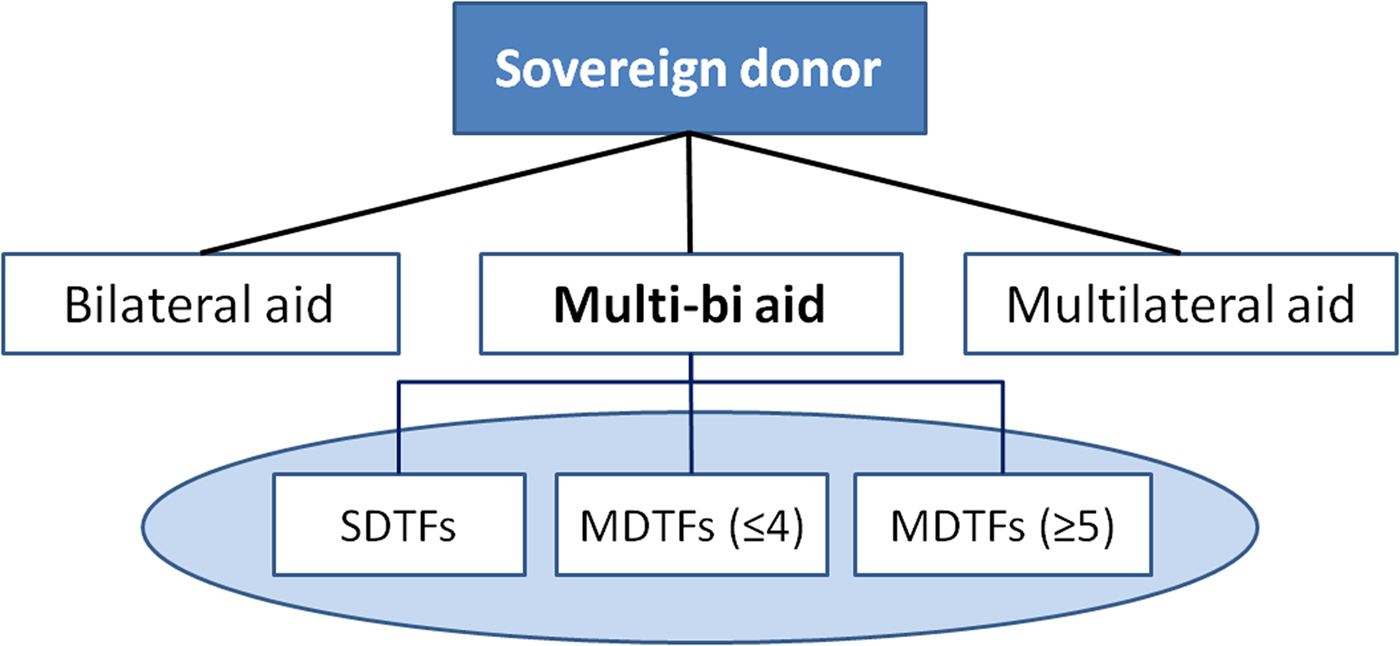
We posit that each sovereign donor first makes a decision about (core) multilateral aid (often fixed through long-term international commitments) and about (pure) bilateral aid, that is, aid implemented directly by bilateral agencies or their partners such as local nongovernmental organizations. Once this decision is made, the remaining aid budget is allocated to multi-bi aid. As the ellipsis in Figure 4 indicates, this allocation process is our focus. The question whether and under which conditions multi-bi aid is preferred to bi- or multilateral aid in the first place is equally interesting, but its analysis requires a different data structure, based on disbursements by sovereign donors rather than on fund membership. Even when focusing on the options within multi-bi aid alone, we can basically cover the full range of options. This is because at the extremes, multi-bi aid offers (almost) perfect substitutes to traditional bilateral and traditional multilateral aid respectively. Therefore, we do not lose much by excluding these traditional aid flows from our analysis. Concentrating on the choice between different types of multi-bi aid, we develop our argument here but refer readers to the supplementary appendix for a formal presentation.
Individual donor decision among general aid types

Multi-bi aid can be allocated to trust funds of different sizes, varying from SDTFs to large MDTFs. For illustrative purposes, we consider the choice between three types, namely SDTFs, small MDTFs (with two to four donors), and large MDTFs (with five or more donors).
When choosing which trust funds to participate in, a donor considers the utility that it could gain from participating in each possible fund. Assuming that each donor faces a budget constraint that allows for participation in only a limited number of funds, the donor chooses to engage in those funds that provide the highest utility. The role of the budget constraint is to ensure that not every donor is a member of every fund, provided that the utility from joining any fund is generally positive.
To unpack the utility function, we posit that any individual donor cares about both efficiency of resource use and the maintenance of control in its delivery of foreign aid. In this regard, the overall number of participating donors plays a critical role. By cooperating with other donors, a donor can achieve efficiency gains, for instance, as a result of synergies, economies of scale, risk-sharing opportunities, or the prospect of contributing to important results with limited resources. These burden-sharing benefits to a donor from participating in a fund increase with the number of other donors to the fund. However, any given donor will also have to compromise more on the priority objectives of the fund as the number of other donors increases. Large divergences in preferences among donors reduce the utility of individual participation by lowering the degree of control for each donor. With greater preference heterogeneity, transaction costs associated with finding a consensus will increase, and the congruence between that consensus and each donor's own objectives will be reduced.
Our argument that a donor considers the potential for burden sharing with other donors and the extent of preference homogeneity is supported by our interviews.Footnote 56 For example, an executive director from a small donor country said “Multi-donor trust funds are a vehicle to help in areas where we would have no pathway to do anything and where we can expect more impact from our tiny contribution.”Footnote 57 Another executive director, from a large donor country, said that global funds would be a useful mechanism to “catalyze aid from other donors.”Footnote 58 Donors also emphasized that sometimes there might be only a limited subset of donors with similar preferences, leading to small-N funds rather than large-N funds. For example, one executive director from a Nordic donor country explained that “we give core funds wherever possible, but we also go into basket funding with other progressive, like-minded donors,”Footnote 59 while yet another donor representative observed that “there is always a tension between efficiency … and bilateral interests.”Footnote 60
Both preference homogeneity and burden-sharing benefits depend on the number of other donors participating in a fund. Because preference homogeneity decreases while burden-sharing benefits increase with the number of other donors, the utility of participation first increases and later decreases in the number of other donors. The optimal number of partners in a fund can be between zero and the universe of all donors.
We are not able to directly measure preference homogeneity and burden-sharing benefits in a systematic way for a large sample of trust fund decisions. Our empirical tests instead rely on issue-area and donor-country characteristics that plausibly reflect variation in preference homogeneity and/or burden-sharing benefits. We generate testable implications about how these characteristics should influence donors' choices among SDTFs, small MDTFs, and large MDTFs, based on arguments about how these characteristics affect the considerations for preference homogeneity and burden-sharing benefits.
We formulate six testable hypotheses regarding a donor's choice of trust fund size types (SDTFs, small MDTFs, and large MDTFs). Note that the sectoral and donor-specific characteristics on which these arguments focus are certainly not the only ones that could influence the balance between preference homogeneity and burden sharing. Our choice of appropriate variables is restricted by the availability of adequate indicators at the trust-fund level. However, we believe that our set of variables is comprehensive enough to demonstrate the mechanisms at work if donors in fact trade off between preference homogeneity and burden sharing as we posited. The specific variables that we consider relate to donors' general sectoral preferences, the state of their economies, recipients' income levels, and the thematic orientation of the trust fund towards fragile states, global public goods, or generally, topics that have made it onto the agenda of restrictive clubs of industrialized countries (that is, G8).
Ex ante Sector Variation of Donor Interests
The degree to which an additional donor in the trust fund affects preference homogeneity depends on how much ex ante preferences are aligned. We particularly consider preferences in development sectors because almost all trust funds are earmarked for activities with a particular sectoral focus, but only a minority of trust funds are earmarked for activities in specific countries. In contrast to the (unmeasurable) concept of preference heterogeneity used throughout our model, we refer to “ex ante variation of sector focus” to denote our indicator of heterogeneity in donors' preferences over sectors, measured independently of their actual participation in the various trust funds.
In some sectors, ex ante variation in donors' focus on the sector is higher than in others. Where donors agree more about the importance of a sector, it is arguably more likely they can readily agree on activities and objectives for a trust fund devoted to that sector. In that case, adding more donors to the fund should not substantially decrease preference homogeneity. Hence, a donor can benefit from burden sharing without incurring strong losses from a dilution of focus within the fund, or risking a shift in the fund's objectives away from its preferences. Conversely, if donors' views on the sector's importance are more varied, the less willing donors should be to invest in large trust funds.
H1
In an issue area with high ex ante variation of sector focus among the donors, a given donor prefers to participate in small trust funds as opposed to large trust funds.
A standard way of measuring ex ante preference variation between donors is by looking at differences in the shares of aid allocated to individual sectors (i.e., issue areas) in each donor's bilateral aid portfolio. If all donors provide a similar share of bilateral aid to a sector, we consider that interests in this area are relatively aligned. In contrast, a strong variation in bilateral aid shares for a given sector indicates ex ante variation of sector focus and should aggravate the problem of preference heterogeneity when adding more donors to a trust fund.
Accordingly, we measure ex ante variation of sector focus by calculating the coefficient of variation in the sectoral shares of bilateral aid, for the sector(s) relevant to the respective trust funds, by all donors covered in the OECD/DAC's Creditor Reporting System (CRS).Footnote 61 Admittedly, this measure is not perfect because, for example, donors may have different ex ante preferences over subsectors (such as primary versus secondary education) within a sector, or about specific goals (such as enrollment versus quality of schooling). Disagreement over sectoral priorities, however, is likely to be correlated with the level of disagreement on some subsidiary issues, for example, the same donors with above-average preferences for education aid will tend to have above-average preferences for aid for primary education. This method is consistent with other studies that use bilateral aid to measure and compare individual donor preferences.Footnote 62
Note that donor preferences over sectoral allocations may differ even if their aid is motivated purely by development objectives. For ideological or other reasons, some donors, for example, may emphasize government provision of education and health services as the crucial path to development, while others may emphasize private sector development. However, donors may have differing sectoral preferences for geopolitical or commercial reasons as well. Either explanation is consistent with Hypothesis 1.
Joint Priorities in Global Governance
When donors have a joint interest in acting upon a common development challenge, adding more donors can increase the burden-sharing benefits, with little or no negative impact on preference homogeneity. For instance, when a topic is discussed at the level of the G8 and commitments are made, one can infer that the issue requires some common action and that there is some commonality of interests among most of the G8 member states.Footnote 63
The Global Agriculture and Food Security Program (GAFSP) is a frequently mentioned example of a World Bank trust fund emanating from a G8 summit.Footnote 64 At the L'Aquila summit in 2009, G8 leaders expressed their concern about hunger and poverty caused by soaring food prices, lack of investment, and the global financial crisis. Recognizing the “urgent need for decisive action,” they promised to “partner with vulnerable countries and regions to help them develop and implement their own food security strategies, and together substantially increase sustained commitments of financial and technical assistance to invest in those strategies.”Footnote 65 A number of international organizations including the World Bank attended the summit and endorsed the G8's statement. Leaders pledged a total of USD 22 billion for food security over three years. USD 800 million were ultimately committed to GAFSP, which was established one year after the L'Aquila summit.Footnote 66
This example demonstrates that issues adopted at G8 summits typically imply a strong consensus among the G8 leaders. This alignment of preferences may catalyze joint funding for initiatives addressing common-priority development problems.Footnote 67
H2
If a given development issue has benefited from donor pledges at the previous G8 summit, a given donor is more likely to support this issue through a multi-donor fund rather than a single-donor trust fund.
Number of G8 summit pledges measures trust funds' relevance to the G8 by donors' rhetorical commitments at preceding summits. Specifically, for each trust fund, we count the number of its sectors for which pledges were made at the G8 summit in the year prior to trust fund activation.
Financing of Global Public Goods
The salience of donor cooperation is even more evident when it comes to addressing global challenges such as climate change or the spread of communicable diseases. Activities in these areas benefit all donors, so preferences will be relatively homogeneous. Moreover, a large common effort is likely to be required to produce satisfactory results, so burden-sharing benefits will be relatively high. Hence, in the area of global public goods, cooperation among many donors appears as the most effective form of intervention.
H3
If a donor wishes to contribute to the supply of global public goods, it is more likely to operate through large MDTFs instead of using small MDTFs or SDTFs.
We use the binary indicator variable global activities that is based on the World Bank's own classification of trust fund activities.Footnote 68 An activity is global if its benefits do not accrue to any single recipient country. The IEG confirms that global activities are usually related to the provision of global public goods.Footnote 69 Hence, our understanding is that trust funds for global activities primarily support the provision of global public goods.
Assistance to Fragile States
Risk sharing is one aspect of burden-sharing benefits that is particularly relevant in certain contexts, such as assistance to fragile and postconflict states.Footnote 70 When the activities of a fund are perceived as high risk, cooperation among multiple donors allows the risks to be shared. In some high-profile cases such as Afghanistan, there are risks that large-scale peace-keeping and state-building programs may fail, and the reputational costs to a single donor responsible for such a program in the event of failure could be prohibitive.Footnote 71 In the event of a successful program, all involved donors could share in the credit. Even in cases where a donor can be relatively confident about the success of a program overall, some specific projects may fail. When many donors contribute, the project portfolio can be larger and more diversified, hence reducing the risk that publicity surrounding one failed project will outweigh a larger storyline of success. Moreover, it is politically useful for a donor to share the responsibility with other donors if individual projects turn out to be problematic. Risk sharing is particularly relevant in the context of fragile states. Assistance to fragile and postconflict states is also likely to be an area where donors have strong common interests because instability, conflict, and insecurity are problems that tend to spill across borders. For larger fragile or postconflict states (such as Afghanistan) the spillover effects of conflict could be global, but even for smaller ones with regional effects (e.g., the Solomon Islands) there are likely to be multiple donors with similar interest in cooperating through a trust fund. Our next hypothesis thus is:
H4
In assisting fragile states, a donor is more likely to participate in multi-donor trust funds than in single-donor trust funds.
The binary variable fragile states assistance indicates whether a trust fund supports fragile states, drawn directly from the World Bank trust fund database.Footnote 72
Assistance to Middle-income Countries
Assistance to middle-income countries (MICs) was frequently mentioned in our interviews as a key motive in trust funds. Grants and concessionary loans from IDA, the IMF, and regional development banks are not available to MICs, so they may face a higher risk of running into a financing gap for their development needs. As one executive director stressed, “trust funds are really important in MICs … there is consensus on that.”Footnote 73 However, donors may agree on the specific MICs to which they want to extend their assistance. Aid to MICs is a case where donor-specific interests are likely to predominate over recipient need in the choice of recipient countries. The promotion of donors' commercial and geopolitical interests has been emphasized in the aid-allocation literature as an important motive for providing development assistance.Footnote 74 In MICs, donors may compete for trade access or other commercial and geopolitical objectives. Even where they do not compete, some donors will have a stronger interest than others because of geographic proximity or cultural, linguistic, and/or historical ties. Where such interests are at stake, donors' preferences will tend to differ more than when their aid is responding to recipient need. In some cases—Jordan is arguably an example—the geopolitical interests of most donors may coincide in aiding an MIC. In general, however, donors will have fewer common interests when using trust funds to aid an MIC than when using them for other purposes, such as aiding fragile states or financing the provision of global public goods.
H5
A donor prefers to channel its support for middle-income countries through small trust funds as opposed to large trust funds.
Donors have full discretion in limiting a trust fund's disbursements to countries that are not eligible for IDA allocations. We construct the dummy variable middle-income country assistance to capture such a restriction, based on IBRD/IDA eligibility status as available from the trust fund database.Footnote 75
Economic Hardship in the Donor Country
An economic downturn in the donor country can lead to increased emphasis on the use of aid for donor interests and specifically for commercial benefits, rather than for development objectives broadly shared within the donor community. Particularly when unemployment is relatively high in the donor country, combating poverty at home will become more of a priority relative to combating poverty overseas. Parliamentarians, voters, and interest groups in the donor country may favor earmarking aid more narrowly so that it can potentially be delivered in ways that support job creation or other commercial benefits to the donor country. In this context, a donor's preferences for earmarked aid are less likely to be aligned with those of other donors, and may even conflict with them.Footnote 76 This argument leads to our last hypothesis:
H6
If a given donor country faces increased unemployment, it will participate more in small trust funds relative to large trust funds.
Unemployment rates (in percent) for all bilateral donors are taken from the World Development Indicators (WDI).Footnote 77
Empirical Analysis
Estimation Strategy
Our theoretical focus is on the determinants of donor choices to join different types of trust funds. Empirically, however, we would ideally want to estimate a fuller model in which the donor country first allocates its aid budget between trust funds, other bilateral aid, and core contributions to multilateral agencies, and then chooses which trust funds to participate in (see Figure 4). The key advantage of such an approach would be to account for potential unobserved confounders that introduce correlated decisions.Footnote 78
Unfortunately, this approach is infeasible because of the lack of common data structures in both stages. The first stage uses total amounts allocated to each general aid type, whereas the second stage considers participation decisions of the donors in various institutional arrangements that jointly define multi-bi aid. Because we are interested precisely in the determinants of donor participation in the various trust funds, we would also unduly sacrifice meaningful information if we aggregated all donor participation decisions within a particular trust fund type.
Our empirical analysis therefore remains focused on the second stage. This approach yields consistent estimates when all confounders are observable and controlled for in the empirical analysis. This is possible because the propensity of a donor to engage in trust funds largely depends on its available aid budget. Even when there are unobservable factors we fail to control for, they do not affect the consistency of the differences in estimated coefficients across equations, so long as they affect only the baseline probability that a donor joins a trust fund. In other words, to produce inconsistent estimates a potential confounder must affect the relative attractiveness of different fund types.
When unobservables introduce correlation between the first stage and the second stage in the latter way, our approach may yield biased estimates. This is particularly likely in two cases. First, a potential trust fund of a particular type might not be observed because the donor chose to allocate aid to one of the two traditional aid types. Second, a donor may perceive a fund to be less attractive because some specific other donor is a member, which more generally reflects cross-sectional dependence.
Based on qualitative evidence, we argue that the first bias is negligible. Staff interviews suggest that confounders in this case are likely time invariant, for example, because a certain type of donor prefers SDTFs for some unmeasurable reason.Footnote 79 Such a bias is eliminated when using fixed effects.
To mitigate the second bias, we present estimates based on two trust fund “choice sets” that reflect different assumptions on the counterfactual. In line with the model, all possible trust funds should be considered. However, information is available for only trust funds that actually exist. To generate the full data set, we proceed with two alternative assumptions leading to two choice sets. In choice set A, we assume that within each group of trust funds (SDTFs, small MDTFs, and large MDTFs), any fund that is used by at least one of the donors could have been chosen by any other donor also. As an example, when Switzerland agrees with the World Bank on a SDTF in any specific area, we assume that any other donor could have made the same kind of arrangement. Similarly, if there is an MDTF in a given area, we assume that those donors who do not participate in this fund would in principle also have had the option to do so. In choice set B, we allow for any observed fund to be counterfactually conceived as any of the other trust fund types. For all funds that exist in the form of one particular fund type (as included in choice set A), the two other fund types would also have been possible (choice set B). This implies, for example, that a specific SDTF that the Netherlands used to channel money through the World Bank could have been set up alternatively as a small MDTF or even a large MDTF. This greatly increases the number of observations in the data set by adding further zeros for nonmembership (since many of the potential funds never came into existence in reality), and hence makes it unlikely that we miss out a potential fund whose existence is related to some unobservable factor. It is not clear a priori which choice set is more plausible in practice.
We acknowledge that our inferences are based on observational data, and caution should be exercised in interpreting our findings as causal. However, we apply conventional remedies such as fixed effects to mitigate potential omitted-variable bias.
Data
To test our hypotheses, we use a data set of all World Bank Group trust funds that received at least one contribution within fiscal years 2002–2013.Footnote 80 The donors considered are the twenty-four DAC member countries for which information on trust fund membership and a range of key predictors are available.
The dependent variable is a binary indicator reflecting the participation of each individual donor i in fund f.Footnote 81 Trust funds were created in different years, and the corresponding year effects can be controlled for, but we do not have time-series cross-sectional panel data, since each fund is observed only once for each donor.
We run the estimations separately for SDTFs, small MDTFs, and large MDTFs, using robust linear probability models with standard errors clustered at the level of donor countries. Given that each donor country faces a budget constraint that implies that its participation in a number of funds may preclude participation in another fund, we consider that the decisions are not made independently of each other. Possible correlations of errors across equations are taken into account using seemingly unrelated estimation with unbalanced equations, a method that uses a common variance-covariance matrix for the different regressions.Footnote 82 The observation numbers across equations are unbalanced because the World Bank managed far more SDTFs than MDTFs between 2002 and 2013. Robust estimation can flexibly handle this lack of balance. To test our hypotheses, we conduct Wald tests to compare coefficients across equations.
In the supplemental appendix, we also show a replication of the same regressions for different definitions of small versus large MDTFs. Because the cut-off point is somewhat arbitrary, we should be able to confirm that a small change will not substantially affect our results. In addition to the cut-off between four and five donors used so far, we present estimations for cut-offs between six and seven, and between ten and eleven donors. Given that few funds include many more than ten members, the latter is already a relatively big step that tends to blur the distinction between the two categories. The outcomes are generally in line with these expectations.
For each block of three regressions corresponding to the three categories of funds, we use exactly the same specification. The first block includes only six variables corresponding to our six hypotheses, without fixed effects or other controls. The second block includes fixed effects for donor countries and for trust fund starting years.Footnote 83 The third block adds more controls, including variables related to bi- and multilateral aid as alternative funding options to multi-bi aid as a whole. Moreover, they include a variety of indicators capturing the (development-related and general) know-how and capacity of the donor country. Such capacity should generally reduce the need to use the multilateral channel, given the conventional wisdom that expertise and knowledge are key reasons for delegation to multilaterals.Footnote 84 Finally, we include a binary indicator variable for particularly contentious issues, as identified from a small expert survey carried out within the World Bank.Footnote 85 Creating a trust fund pertaining to one of these issues allows donors to circumvent lengthy or divisive debates within a multilateral's decision-making body, where not only the big traditional donors but also MICs have an influential voice. All variables and their sources are described in more detail in Tables 6 and 7 in the online appendix.
Findings
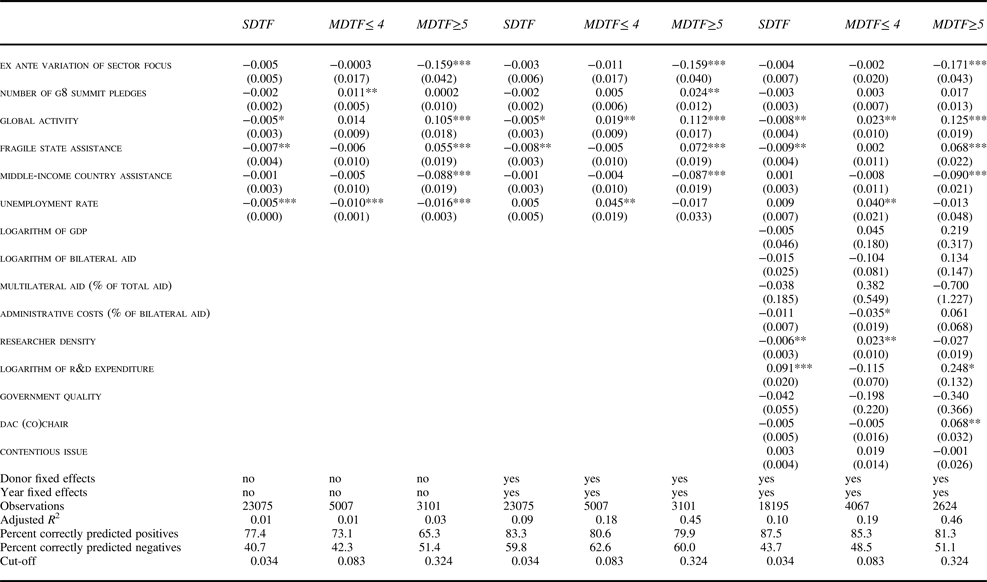
Tables 1 and 2 show the results for choice sets A and B respectively. As expected, the larger the variation in ex ante bilateral sectoral aid preferences, the lower is the propensity of any donor to contribute to large MDTFs. This result is robust across specifications. In Table 1, an increase in the coefficient of variation by one standard deviation leads to a 13 percent decrease in the probability that any given donor joins such a large fund, whether or not fixed effects or control variables are included. This is a substantively meaningful effect.Footnote 86 Wald tests (Table 3) confirm that differences in the effects of ex ante variation of sector focus on the likelihood of joining large-N funds versus small-N funds (small MDTFs or SDTFs) are statistically significant.
Main regressions using Choice set A
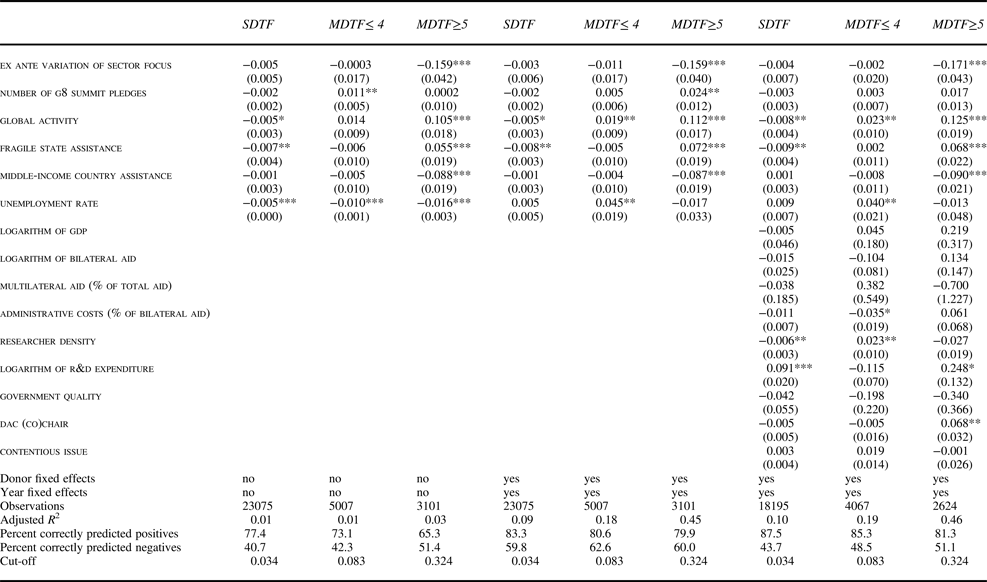
Notes: Robust standard errors clustered on donors in parentheses. Significance levels: ∗p < .10; ∗∗p < .05; ∗∗∗p < .01. Cut-offs represent the unconditional means of the dependent variable for each fund type.
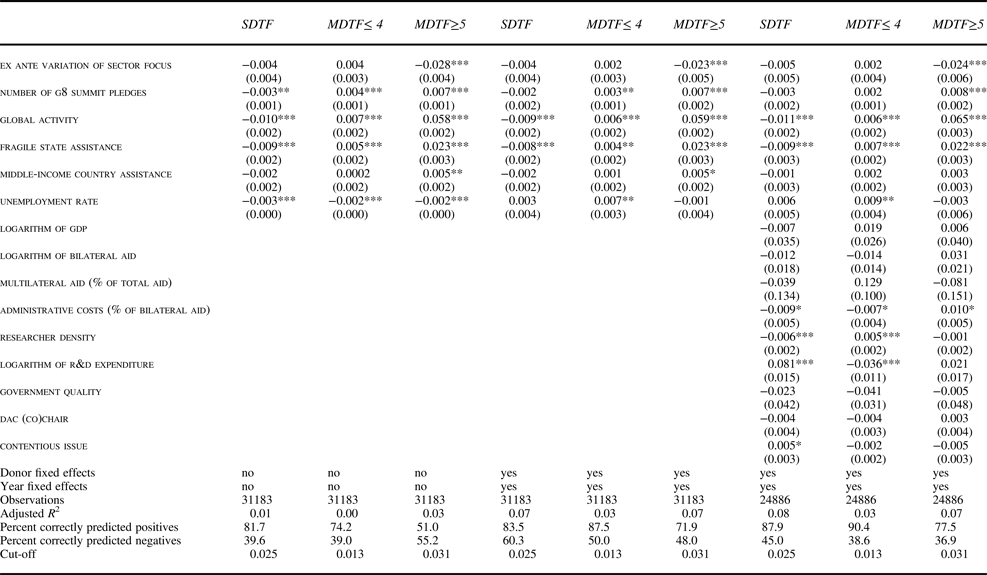
Main regressions using Choice set B
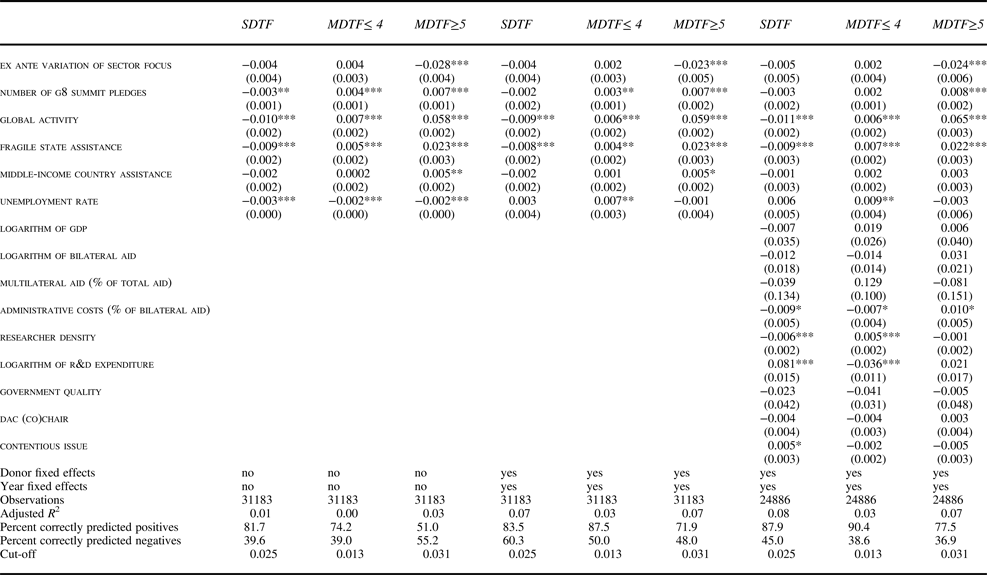
Notes: Robust standard errors clustered on donors in parentheses. Significance levels: ∗p < .10; ∗∗p < .05; ∗∗∗p < .01. Cut-offs represent the unconditional means of the dependent variable for each fund type.
Wald tests corresponding to Table 1

Notes: For each variable shown in the first column, cell entries show the difference in coefficients across equations indicated by the column headers (β (1) − β (2) for any coefficient β), along with the significance of a one-sided t-test (expected direction of effect shown to the right of each variable).
Coefficients on ex ante variation of sector focus are similarly signed and statistically significant in Table 2. Coefficient magnitudes appear to be much smaller, however, as a result of the much larger number of “0” observations in choice set B. For large MDTFs, the data set size increases tenfold, with the addition of numerous observations for potential funds that did not come into existence. This addition reduces the baseline probability for being a member of any of these multiple potential funds to about one-tenth of its initial value. A similar reduction in coefficient magnitudes is a normal consequence of this reduction in the mean of the dependent variable, and thus consistent with the results of Table 1. In fact, a one standard-deviation increase in ex ante variation of sector focus reduces the participation probability in large-N MDTFs by 25 percent in relation to the baseline probability.Footnote 87 As Table 4 shows, Wald tests again confirm the distinctiveness of large-N funds compared to small-N funds.
Wald tests corresponding to Table 2

Notes: For each variable shown in the first column, cell entries show the difference in coefficients across equations indicated by the column headers (β (1) − β (2) for any coefficient β), along with the significance of a one-sided t-test (expected direction of effect shown to the right of each variable).
Prior pledges at the G8 should reflect a common interest of at least some donors in certain sectors. As expected, this variable is associated with increased participation in (small or large) MDTFs as opposed to SDTFs; for SDTFs, the coefficient is always negative but in most cases insignificant. Results for the G8 variable are statistically significant more often for choice set B than for A. This pattern can also be seen from the corresponding Wald tests (Table 4), which indicate positive and significant effects of G8 pledges at each step, moving from SDTFs to small MDTFs to large MDTFs. One representative from a large donor explained that “for political reasons, it is difficult to decline participation in high-level multi-donor funds,” citing the Global Agriculture and Food Security Program (GAFSP) and the Middle East and North Africa Trust Fund as two examples.Footnote 88
An even more robust relationship is observed between global activities and trust fund participation. In line with our hypotheses, no matter the specification and the choice set considered, trust funds supporting global activities tend to include multiple donors. The probability of participating in a large MDTF increases by more than 32 percent in choice set A (and doubles relative to the baseline probability in choice set B) if it funds global activities. This effect is significantly larger than the corresponding effect on small MDTFs funds (between 4 and 6 percent in choice set A; between 20 and 24 percent in choice set B), which is in turn significantly higher than for SDTFs (negative coefficients, not significantly different from 0). All differences across trust fund types are strongly significant, as shown by Wald tests in Tables 3 and 4.
In our interviews, donor officials explicitly mentioned climate change as a global challenge that would require their cooperation, preferably through MDTFs.Footnote 89 One staff member speculated that trust funds enabled donors to show progress in climate change.Footnote 90
Results are also strong for trust funds with a focus on fragile states, which tend to take the form of large MDTFs, consistent with the view that risk sharing is an important consideration for these funds. For funds supporting fragile states, the relative increase in the propensity to become a member is between 17 and 22 percent in choice set A if it is a large MDTF, and about 80 percent in choice set B. According to the Wald tests, differences across all fund types are significant in choice set B (Table 4). The significant difference in coefficients between small and large MDTFs is consistent with the possibility that a subset of donors may have a disproportionate interest in certain fragile states, where potential spillover effects are perceived to be regional rather than global. However, the Wald test cannot establish a significant difference between SDTFs and small MDTFs in choice set A (Table 3).
A large number of donors interviewed at the World Bank (including Australia, Belgium, the European Commission, Germany, the Netherlands, the Nordics, and the United Kingdom) said that they wished to see the World Bank doing more on fragile states. World Bank staff also pointed to studies that pioneer MDTFs as a useful instrument for postconflict situations.Footnote 91
The hypothesis that aid for middle-income countries tends to be motivated by donor-specific interests—and should hence lead to the use of SDTFs rather than MDTFs—is only partially supported. Results in Table 1 are mostly supportive, but not those in Table 2 based on the larger choice set B. For this MIC-assistance indicator, the outcome thus hinges on the beliefs about the more appropriate option space for bilateral donors. If we believe that choice set A is more appropriate (because, for instance, the multilateral agency might not be willing to host trust funds of all types in all areas), then the results indicate that a large MDTF has a (27 percent) lower probability of receiving contributions from any donor if it targets MICs.Footnote 92 In general, a focus on MICs tends to reduce the likelihood a fund receives contributions, but this effect is significantly increased for large MDTFs. Wald tests for choice set A show significant differences across all fund type comparisons except between SDTFs and small MDTFs (Table 3). For choice set B, we cannot confirm our hypothesis because all cross-equation coefficient differences are insignificant (Table 4).
Coefficient estimates for unemployment are the only ones within each choice set that are highly sensitive to the inclusion of fixed effects and other controls. In the very simple models without fixed effects or controls, these coefficients capture, to a large extent, pure cross-sectional variation. Our hypothesis, however, is not related to the base level of unemployment (associated with structural problems of the economy that cannot be addressed through aid), but to temporary downturns of the economy that may lead donor-country governments to use their foreign policies to signal their concern for increasing employment. This reasoning is supported by regressions that control for donor fixed effects. When the cross-sectional variation is controlled for by the fixed effects (with or without additional controls), the coefficients turn positive and partly significant in both choice sets for the smaller two fund types. While this pattern of coefficients is consistent with our hypothesis, Wald tests show that the differences between them are not always significant (Tables 3 and 4).
Qualitative evidence from staff interviews is consistent with these findings on economic downturns. One staff member explained that “the financial crisis changed things. There is more attention from bilateral constituencies … and more pressure to account for aid money.”Footnote 93 World Bank staff generally felt that donor countries increased their tendency to earmark funds after the economic crisis.Footnote 94
Overall, these tests mostly support our hypotheses. Results for ex ante variation of sector focus and the indicator variables for global activities and fragile states are particularly robust. We also have a tentative explanation for why some relationships do not turn out as strongly as expected. In reality, the type of fund a donor chooses does not always allow us to infer the donor's actual motivation. On the one hand, donors are sometimes bound by legal rules to channel their support to an SDTF even in a multi-donor partnership. On the other hand, while individual donors cannot legally earmark specific activities in MDTFs, they sometimes use “notional earmarking” to indicate priority areas that the agency seeks to accommodate whenever possible. Our data cannot tell whether any of these situations are present, but our qualitative evidence suggests that they are rare. In statistical terms, these cases imply measurement error in the respective fund category and attenuation bias on the related coefficients, with differences across fund types tending to appear less significant. As both of these sources of measurement error work against finding support for our hypotheses, our coefficients can be seen as lower bounds on the true effect size.
Results for the control variables provide some support for the plausibility of the overall specification. Donor wealth as measured by the log of GDP tends to be associated with reduced participation in SDTFs but increased participation in both small and large MDTFs. The coefficient on the log of bilateral aid tends to be negative for the first two types of funds, but positive for large MDTFs, suggesting that smaller trust funds may be closer substitutes for bilateral aid. The share of multilateral aid in total aid is mostly insignificant.
The coefficient estimate for the share of administrative costs (as a percentage of bilateral aid) is negative and sometimes significant for small funds, in contrast to large MDTFs where it is positive. A higher administrative cost share may imply greater capacity (in terms of staff and expertise) for the donor, reducing the need to delegate administrative tasks such as concrete project identification and monitoring to the multilateral agency. However, donors with greater capacity may be more willing and able to exercise influence over multilateral agencies through trust funds. Neither of these potential effects, one positive and the other negative, appears to predominate in our tests.Footnote 95
We also control for a specific measure of donor expertise or intellectual leadership, namely service by the donor as a chair or co-chair of DAC working parties related to the topic of the fund. As expected, such a role within the DAC is positively related to participation in large MDTFs, although the coefficient is significant only in choice set A. Two broader proxies for capacity do not show any clear relationship with trust fund participation. The number of researchers per 100 workers, and the log of total expenditures on research and development, have opposing effects when included together, and neither is significant when only one of them is included (latter result not shown in tables). A subjective measure of the government bureaucracy's quality in the donor country (from the International Country Risk Guide) is also insignificant. These are admittedly rough proxies: they do not specifically measure research on development and aid, or bureaucratic quality for the government's aid agencies.
Our final control variable that identifies particularly contentious issues within the World Bank does not show the expected positive effect on multi-bi aid in general. The coefficient for the contentious issues indicator is generally insignificant for MDTFs, and positive (and marginally significant) in the SDTF regressions in choice set B. These findings suggest that these topics may be contentious not only among World Bank members as a whole, but also among donors. The contentious issue variable may then be acting as, in effect, a second indicator of ex ante heterogeneity of donor interests, supplementing the main indicator that is based on bilateral sector allocations.
Our main findings from regressions with fewer control variables are robust to including this larger set of controls. They are also unaffected by using different estimation techniques. In another robustness check, we performed conditional logit estimations to account for the binary nature of the dependent variable. In these tests, the direction and significance of all effects of interest were virtually unaffected.Footnote 96
Overall, these results are consistent with our general argument that a given donor faces a trade-off between burden sharing and preference homogeneity when choosing the institutional channel for addressing development challenges, that is, smaller versus larger trust funds. This trade-off is affected by a range of variables that capture specific characteristics of issue areas and the donor country itself. We obtain strongest support for our argument from variables relating to ex ante variation of sector focus as well as to global activities and fragile states.
Conclusion
Over the past two decades, donor countries have dramatically expanded their reliance on trust funds in their delivery of official development assistance. Trust funds are flexible instruments that cover a wide range of possible institutional setups—from single-donor trust funds that are close substitutes to bilateral aid to large multi-donor trust funds that, in a few instances, have evolved into separate multilateral agencies. This instrument considerably increases the options from which bilateral donors can choose for channeling their aid.
Based on a seemingly unrelated regression analysis of the World Bank's trust fund database over the last decade, we find that the donor's willingness to opt for (large) multi-donor trust funds is positively associated with ex ante sector alignment among all donors as well as indicators for global activities and fragile states assistance (for which the gains from burden sharing are more likely to outweigh the potential loss in control). Donors prefer single-donor trust funds when and where national (e.g., commercial or geopolitical) interests tend to predominate (e.g., aid to middle-income countries, and when unemployment rates are increasing). While they could use bilateral aid for the same purpose, channeling funds through multilateral agencies lets them benefit from the agency's expertise and reduce administrative cost, particularly in areas where their own capacity is limited. While our rough proxies for donor capacity generally were not significant in our tests, capacity (along with other donor-specific effects) differences are controlled for by the donor fixed effects included in some of our specifications.
We believe that our analysis of donor choices among different trust funds is theoretically relevant. Trust funds are a new form of international institution that is more flexible than full-fledged international organizations but not informal. Trust funds reflect a trend toward global governance in various sets of state coalitions—a trend that also is pervasive in other areas such as international trade.Footnote 97 Trust funds have lower sunk costs than international organizations because they are easy to create and easy to end when they have served their purpose or when underlying preferences change, which reduces the likelihood of “zombie organizations.”Footnote 98 Also, trust funds provide more choice in terms of combining the traditional benefits of bilateral and multilateral aid. Hence, the proliferation of trust funds may be an efficient mechanism for varying coalitions of donors to cooperate when their interests converge on particular development issues at a particular moment in time. Nonetheless, trust funds still involve transaction costs, and there is potential for further reforms to reduce fragmentation, that is, through consolidating smaller funds with similar objectives. For these reforms to be successful, however, it is important that the determinants underlying the choice of the various trust funds are better understood.
Our data and methodology are not designed to test hypotheses about why donors' use of trust funds has increased so much in recent years. However, our arguments and evidence can suggest some answers. First, our interviews of donor officials and staff indicate that budget constraints following the financial crisis have played a role. By funneling their bilateral aid through the World Bank, they can “get more money out the door with fewer staff.” Second, climate change and other cross-border challenges have increased interest among donors in working through MDTFs. As noted in some of our interviews, the country-based aid model of IDA is far from ideal for providing aid in global public goods. Moreover, preferences among the World Bank's board members are not fully aligned in supporting some public goods, such as climate change. Third, as more countries graduate from IDA, there are more MICs that certain donors will want to continue aiding, with trust funds as one mechanism that continues to employ the Bank's country expertise. Finally, as the relative influence (both formal and informal) of traditional donor countries in the World Bank gradually declines, trust funds become a more important means of bypassing the Bank's governance systems, including the need to obtain consensus on aid priorities.Footnote 99
Our main theoretical insight applies to international development organizations more generally. In deciding to join an international organization, a key variable for any donor to consider is the number of other donors: the more donors there are for any given distribution of policy preferences, the greater are the burden-sharing benefits, but the greater are the costs in terms of the loss of control (with respect to activities and duration). A single-donor trust fund is at one extreme, while a large multi-donor trust fund with essentially all possible donors is at the other extreme. In analogy to trust funds, this trade-off should apply in the creation of any international development organization. But there is a rather limited number of international development organizations.Footnote 100 Some of them were created a long time ago, and most donors are members of most of them. Therefore, it would be difficult to construct a data set of international development organizations with much variation in their size to test our hypotheses. The rise of trust funds presents an ideal opportunity to test institutional design conjectures.Footnote 101
Supplementary Material
Supplementary material for this article is available at <https://doi.org/10.1017/S0020818317000340>.