INTRODUCTION
Nitrogen (N) use efficiency by ruminants is an environmental and economic issue for animal husbandry. Although increasing dietary crude protein (CP) levels have a positive effect on animal performance, ruminal microbial growth and microbial protein synthesis (Broderick Reference Broderick2003; Bach et al. Reference Bach, Calsamiglia and Stern2004; Reynal & Broderick Reference Reynal and Broderick2005), only 0·30 of dietary CP supply can be used by cattle, with the remainder being excreted through urine and faeces (Broderick Reference Broderick2003). Thus, the optimization of dietary CP content by decreasing the CP supply of the diets and other nutrition management strategies are worth studying (Oh et al. Reference Oh, Kim, Kim, Choi, Kang, Nam, Kim, Song, Kim and Park2008; da Silva et al. Reference da Silva, Pereira, da Silva, Valadares Filho and Ribeiro2016). Previous studies reported that folic acid (FA) could be synthesized by ruminal micro-organisms (Bechdel et al. Reference Bechdel, Honeywell, Dutcher and Knutsen1928; Lardinois et al. Reference Lardinois, Mills, Elvehjem and Hart1944). However, ruminal-synthesized FA is about 16·5–21·0 mg/day (Santschi et al. Reference Santschi, Berthiaume, Matte, Mustafa and Girard2005), less than the estimated requirement of FA for a dairy cow (35 mg/day; NRC 2001). It can be assumed that ruminal-synthesized FA is insufficient to meet the requirements of highly productive and rapidly growing ruminants with the improvement of animal breeding and management (Li et al. Reference Li, Liu, Wang, Yang, Guo, Huo, Pei, Zhang, Zhang, Wang, Liu and Huang2016). Furthermore, >0·95 of FA supplemented in dairy cow diets is degraded by ruminal micro-organisms (Santschi et al. Reference Santschi, Berthiaume, Matte, Mustafa and Girard2005). Thus, rumen-protected folic acid (RPFA) is necessary for high-producing ruminants. Folic acid is required by ruminal micro-organisms (Girard et al. Reference Girard, Chiquette and Matte1994; Wejdemar Reference Wejdemar1996), and FA supplementation has been shown to increase cellulolytic bacterial population (Wejdemar Reference Wejdemar1996), cellulose digestion (Hall et al. Reference Hall, Cheng and Burrows1953; Ragaller et al. Reference Ragaller, Lebzien, Bigalke, Südekum, Hüther and Flachowsky2010), ruminal fermentation (Hayes et al. Reference Hayes, Mitchell, Little and Bradley1966) and ammonia (NH3)-N utilization (Wejdemar Reference Wejdemar1996). However, other studies found that ruminal fermentation (Chiquette et al. Reference Chiquette, Girard and Matte1993; Girard et al. Reference Girard, Benchaar, Chiquette and Desrochers2009) and NH3-N utilization (Girard et al. Reference Girard, Chiquette and Matte1994; Ragaller et al. Reference Ragaller, Lebzien, Bigalke, Südekum, Hüther and Flachowsky2010) were not affected by supplementary FA. Moreover, there is little evidence available in the literature referring to the interaction between dietary CP levels and RPFA supplementation. Considering the inconsistent results and the role of FA involved in the metabolism of protein by transferring one carbon unit, it was hypothesized that an interaction between dietary CP levels and RPFA supplementation could exist. The current study was undertaken to assess the effects of dietary CP levels and RPFA supplementation on ruminal fermentation, microbial enzyme activity and bacterial populations in growing cross-bred beef steers.
MATERIALS AND METHODS
Animals, experimental design and diets
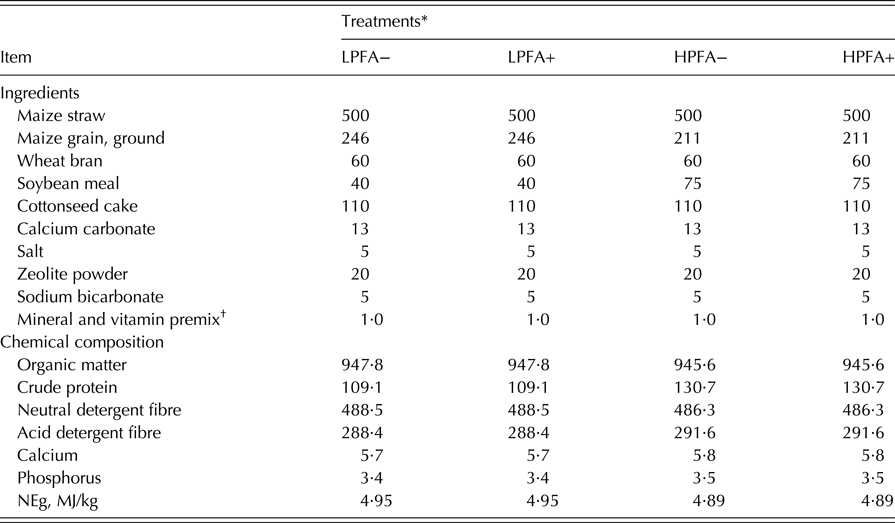
The trial was authorized by the Committee of Animal Care and Research, Institute of Shanxi Agriculture University. Eight ruminally cannulated first-generation cross-bred (Blonde d'Aquitaine × Simmental) beef steers, averaging 10 months of age and 267 ± 1·4 kg body weight (BW), were allocated to a replicated 4 × 4 Latin square design with a 2 × 2 factorial arrangement. One factor was the low-protein (LP) (109·1 g CP/kg) or high-protein (HP) (130·7 g CP/kg) diets; another was with or without RPFA supplementation (0 mg (FA−) or 75 mg/kg dietary dry matter (DM) (FA+)). The amount of RPFA fed was estimated by animal weight according to Wang et al. (Reference Wang, Liu, Guo, Huo, Ma, Zhang, Pei, Zhang and Wang2016). Supplementary RPFA containing 100 g FA/kg was hand-mixed into the first third of the morning ration to ensure its complete consumption. The supplement was produced according to the method of Wang et al. (Reference Wang, Liu, Guo, Huo, Ma, Zhang, Pei, Zhang and Wang2016) and manufactured by Shanxi Jushuoyuan Biological Technology Co., Ltd., Taiyuan, China. The ruminal degradability of RPFA was 0·304, as determined using the nylon bag technique (Wang et al. Reference Wang, Liu, Guo, Huo, Ma, Zhang, Pei, Zhang and Wang2016). Steers were fed a total mixed ration (TMR) twice daily at 07 : 00 and 19 : 00 h and clean water was provided throughout the experimental period. The dietary concentrate to maize silage ratio was 50 : 50 based on a DM basis (Table 1). Maize silage had been harvested at full ripening stage after removing the ear and was ground to pass through a 6·35-cm sieve. The entire experimental period was divided into four sub-periods. Each sub-period comprised 25 days with 15 days of adaptation followed by 10 days of data collection. Between sub-periods, a washout period was provided for 10 days during which the LP diet was fed. Animals were housed in single pens (3·5 × 3 m2) during the adaptation phase and in metabolic cages during data collection. On day 13 of each sub-period, animals were confined to 0·95 of their voluntary intake, measured during the first 12 days, to guarantee no residues at the collection periods. All animals were weighed at the beginning and end of each sub-period.
Ingredients and chemical composition of experimental diets (dry matter basis)

* LPFA−, low dietary protein supply without rumen-protected folic acid (RPFA); LPFA+, low dietary protein supply with 75 mg RPFA per kg dietary dry matter (DM); HPFA−, high dietary protein supply without RPFA; HPFA+, high dietary protein supply with 75 mg RPFA per kg dietary DM; NEg, net energy for gain.
† Contents/kg premix: 100 mg cobalt, 8500 mg copper, 50 000 mg iron, 30 000 mg manganese, 30 000 mg zinc, 300 mg iodine, 300 mg selenium, 75 00 000 international units (IU) vitamin A, 12 00 000 IU vitamin D and 40 000 IU vitamin E.
Data collection and sampling procedures
Samples of TMR and refusals were collected separately, once daily, for DM determination and then composited by steer for later chemical analysis. Feed offered and refusals were dried in an electrothermal blowing dry box at 55 °C for 48 h, and ground with a mill to pass through a 1-mm sieve (110, Qingdao Ruixintai Instrument Co., Ltd., Qingdao, China) for chemical analysis. Ruminal fermentation parameters were determined from day 24 to 25 of each sub-period. Ruminal fluid was sampled (approximately 200 ml) from several sites (reticulum, dorsal and ventral sac) at 07 : 00, 10 : 00, 13 : 00 and 16 : 00 h. The rumen fluid was analysed for each collection time. Ruminal pH was immediately determined by a pH meter (PHS-2C, Shanghai Leijun Experimental Instrument Co., Ltd., Shanghai, China). The ruminal fluid samples were filtered and separated into four portions. The first portion (5 ml) was combined with 1 ml of 250 g/l (w/v) metaphosphoric acid for preservation and used to measure volatile fatty acid (VFA). The second portion (5 ml) was combined with 1 ml of 20 g/l (w/v) sulphuric acid (H2SO4) for preservation and used to measure NH3. These two portions were kept frozen at −20 °C prior to analysis. The third portion (50 ml) of filtrate was kept in a centrifuge tube and frozen at –80 °C for DNA extraction. The fourth portion (50 ml) of filtrate was used to determine microbial enzyme activity.
During each sub-period, the entire volume of urine excreted by each steer was gathered daily into plastic containers using urine collection aprons (Wang et al. Reference Wang, Liu, Huo, Yang, Dong, Huang and Guo2009). Urine samples accounting for 0·01 of the total urine output were collected and placed in a glass reagent bottle with sufficient 10% H2SO4 to maintain pH <3·0. At the end of each sub-period, urine samples were pooled by animal, and then separated into two sub-samples. The sub-samples were kept frozen at −20 °C until further analysis.
Ruminal degradation
Degradabilities of maize silage and concentrate were determined using the nylon bag technique from day 16 to 18 during each sub-period, according to the method of Wang et al. (Reference Wang, Liu, Huo, Yang, Dong, Huang and Guo2009). The air-dried maize silage and concentrate mix were milled to 2·5 mm (110, Qingdao Ruixintai Instrument Co., Ltd., Qingdao, China). About 3 g of maize silage and 4 g of concentrate mix were weighed and placed into 8 × 12 cm2 nylon bags with a pore size of 36 ± 1·5 µm: an empty bag was used as a blank control. The duplicated bags per steer, except 0 h bags, were put into the rumen at 2 h after morning feeding and suspended in each steer's rumen for 4, 8, 12, 24, 36, 48 and 72 h. Upon removal, each nylon bag was thoroughly rinsed in cold water, dried for 12 h at 65 °C and then for 24 h at 100 °C. All nylon bags were then weighed and measurements were used to estimate DM degradability.
Ruminal degradability was estimated by the following model (McDonald Reference McDonald1981):
 $$y = a + b{\rm} (1 - {\rm e}^{ - c(t - L)} )\,\,{\rm for}\,\,t \gt L$$
Ruminal effective degradability (ED) was estimated by the following formula:
 $${\rm ED} = a + [bc/(c + k)]$$
where a represents soluble fraction, b represents slowly degradable fraction, c represents the fractional degradation rate constant at which b is degraded, L represents lag time (h), t represents time of incubation (h) and k represents the particulate passage rate, which was 0·025/h for maize silage and 0·058/h for concentrate mix (Liu et al. Reference Liu, Wang, Huang, Dong, Yang and Wang2008).
Chemical analyses
The DM content of laboratory samples was determined by desiccating at 135 °C for 3 h (AOAC 1997; method 930·15). Ash content was measured by combustion at 550 °C for 5 h, then organic matter content was calculated as the difference between DM and ash contents. Content of N was measured by the Kjeldahl method (AOAC 1997; method 976·05). Contents of neutral detergent fibre (NDF) and acid detergent fibre (ADF) were measured according to the methods described by Van Soest et al. (Reference Van Soest, Robertson and Lewis1991) with heat-stable α amylase and sodium sulphite used in the NDF procedure, and expressed inclusive of residual ash. Concentration of ruminal VFA was determined by gas chromatography (GC122; Shanghai Jingke Instrument Co., Ltd., Shanghai, China) according to the method of Liu et al. (Reference Liu, Wang, Pei, Li, Wang, Zhang, Zhang, He, Wang, Yang, Bai, Shi and Liu2014). Ammonia-N content of ruminal samples was measured by the method of AOAC (1997). Concentrations of allantoin and uric acid were measured by ultra-violet (UV)-2100 spectrophotometer (UV-2100, Shanghai Younike Instrument Co., Ltd., Shanghai, China) according to the method of IAEA (1997). The samples of ruminal fluid for determination of ruminal enzyme activity were taken immediately to the laboratory after collection in an ice bath. The samples were sonicated at 4 °C in an ice water bath at a 30-s pulse rate for 10 min, then centrifuged at 27 000 g at 4 °C for 20 min. Then the supernatant was used for the estimation of enzyme activity (carboxymethyl-cellulase, cellobiase, xylanase, pectinase, α-amylase and protease), as described by Agarwal et al. (Reference Agarwal, Kamra, Chaudhary, Agarwal, Sahoo and Pathak2002).
Extraction of DNA and quantitative real-time polymerase chain reaction
According to the method of Pei et al. (Reference Pei, Liu, Dong, Li, Jiang and Gao2013), microbial DNA was extracted from 1·0 ml ruminal fluid with repeated bead beating plus column. The extracted DNA was kept frozen at −20 °C for polymerase chain reaction (PCR). Populations of Ruminococcus albus, Ruminococcus flavefaciens, Fibrobacter succinogenes, Butyrivibrio fibrisolvens, Prevotella ruminicola and Ruminobacter amylophilus were assessed with real-time PCR as a proportion of total bacterial 16S rDNA according to the following formula (Pei et al. Reference Pei, Liu, Dong, Li, Jiang and Gao2013):
 $$\eqalign{ &{\rm Relative \; quantification} \cr &\quad = 2^{-{\rm (Cycle \; threshold [C_t] target - C_t \; total \; bacteria)}}} $$
where C t was threshold cycle. The real-time PCR primer sets were selected from previous studies for R. albus (Koike & Kobayashi Reference Koike and Kobayashi2001), R. flavefaciens and F. succinogenes (Denman & McSweeney Reference Denman and McSweeney2006), B. fibrisolvens (Forster et al. Reference Forster, Teather, Gong and Deng1996), and P. ruminicola and R. amylophilus (Jami & Mizrahi Reference Jami and Mizrahi2012). All real-time PCR reactions were carried out in triplicate and run on a StepOne Plus™ real-time quantitative PCR system (Applied Biosystems, Life Technologies, Waltham, Massachusetts, USA). The reaction mixture (20 µl) consisted of 10 µl SYBR Premix Taq™ (TaKaRa Biotechnology Co., Ltd., Dalian, China), 0·8 µl 0·2 µmol/l PCR Forward Primer, 0·8 µl 0·2 µmol/l PCR Reverse Primer, 0·4 µl ROX Reference Dye (50×), 6·0 µl distilled water and 2 µl of the template DNA. The quantity of DNA in every sample was measured in triplicate by using the ND-1000 UV spectrophotometer (NanoDrop Technologies, Rockland, DE, USA), and the means were estimated. The PCR was implemented according to the following conditions: one cycle of 95 °C for 30 s for initial denaturation, and 40 cycles of 95 °C for 3 s and 60 °C for 30 s for primer annealing and product elongation (Denman & McSweeney Reference Denman and McSweeney2006; Pei et al. Reference Pei, Liu, Dong, Li, Jiang and Gao2013).
Statistical analyses
Data were analysed as a duplicated Latin square by the mixed model procedure of SAS (Proc Mixed; SAS 2002), accounting for influences of square, period within square, steer within square and treatment. Crude protein and RPFA supplementation were considered as fixed effects, while square, period within square and steer within square were considered as random effects. These data of ruminal pH, VFA, NH3-N, enzyme and bacteria were summarized by sampling time and then analysed using the same mixed model but with time included as a repeated measure using compound symmetry. The P values in Tables 2–6 are for the main effect of CP supplied (LP v. HP), the main effect of RPFA (RPFA− v. RPFA+) and their interaction. Effects of the factors were declared significant at P < 0·05, and trends are discussed at 0·05 < P < 0·10.
RESULTS
Ruminal fermentation parameters
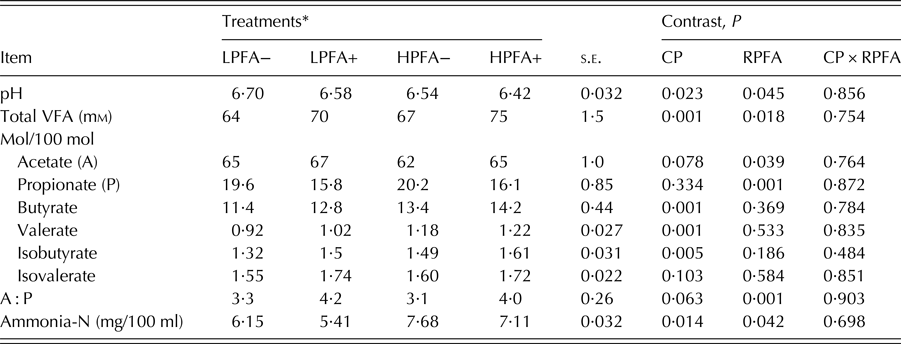
Ruminal pH, VFA and NH3-N content were not affected by the RPFA × CP interaction (Table 2). The diets containing RPFA had lower ruminal pH, molar proportion of propionate and NH3-N content, higher total VFA concentration and molar proportion of acetate than diets without RPFA supplementation (P < 0·05). The HP diets showed lower values for ruminal pH in comparison to the LP diets. Ruminal total VFA concentration and NH3-N content were higher for the diets containing 109·1 g CP/kg DM than diets containing 130·7 g CP/kg DM (P < 0·05). There was no effect of dietary CP levels on molar proportion of propionate, whereas molar proportion of acetate tended to decrease with increasing dietary CP levels (P = 0·078). Consequently, the acetate to propionate ratio increased with RPFA supplementation (P = 0·001), but tended to decrease with increasing dietary CP levels (P = 0·063). Molar proportions of butyrate, valerate and isobutyrate were unaffected by RPFA supplementation, but increased with increasing dietary CP levels (P < 0·05). Molar proportion of isovalerate was unchanged among treatments.
Effects of different dietary protein and rumen-protected folic acid supplementation on rumen fermentation parameters in growing cross-bred beef steers
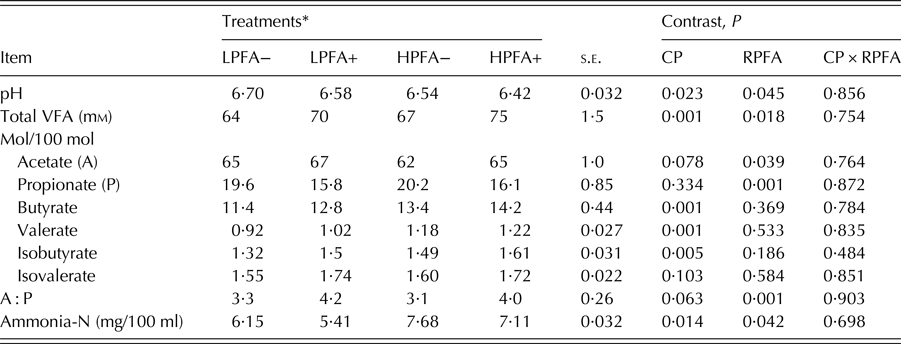
* LPFA−, low dietary protein supply without rumen-protected folic acid (RPFA); LPFA+, low dietary protein supply with 75 mg RPFA per kg dietary dry matter (DM); HPFA−, high dietary protein supply without RPFA; HPFA+, high dietary protein supply with 75 mg RPFA per kg dietary DM.
Ruminal degradation
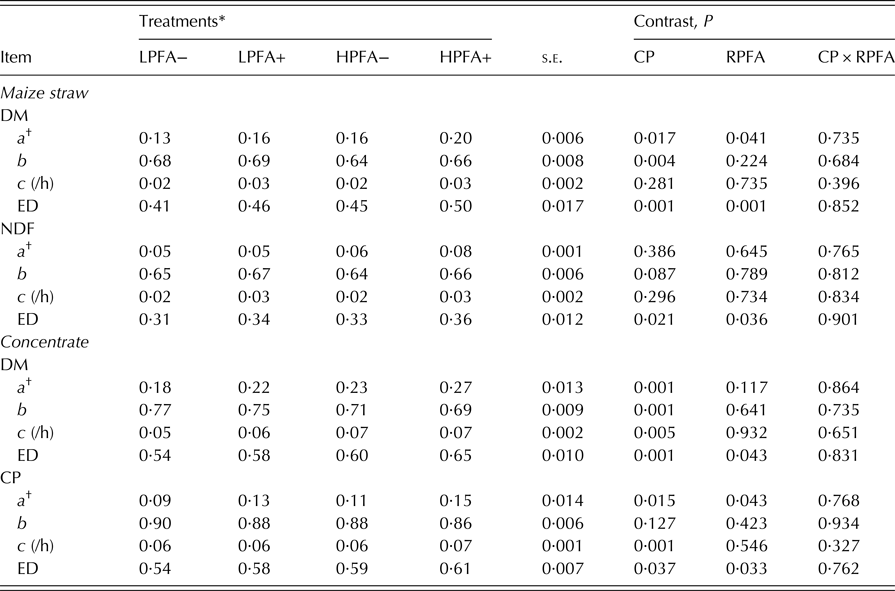
There was no effect of the RPFA × CP interaction on in situ ruminal digestion kinetics and ED of maize straw and concentrate (Table 3). For maize straw, the potentially degradable fraction of DM was not affected by RPFA supplementation, but decreased with increasing dietary CP levels (P = 0·004). The degradation rate of DM was unchanged among treatments. The soluble fraction and ED of DM increased with increasing dietary CP levels or RPFA supplementation (P < 0·05). There was no significant difference in the soluble fraction and degradation rate of NDF among treatments. The potentially degradable fraction of NDF was unchanged with RPFA supplementation, but tended to be lower for the HP diets than the LP diets (P = 0·087). The ED of NDF increased with RPFA supplementation and increasing dietary CP levels (P < 0·05). For concentrate, the soluble fraction and degradation rate of DM were not affected by RPFA supplementation, but increased with increasing dietary CP levels (P < 0·05). The potentially degradable fraction of DM was unaffected by RPFA supplementation, but decreased with increasing dietary CP levels (P = 0·001). The ED of DM increased with RPFA supplementation (P = 0·043) and increasing dietary CP levels (P = 0·001). The potentially degradable fraction of CP was not affected by treatment. The degradation rate of CP was not affected by RPFA supplementation, but increased with increasing dietary CP level (P = 0·001). The soluble fraction and ED of CP increased with RPFA supplementation (P < 0·05) or increasing dietary CP levels (P < 0·05).
In situ ruminal digestion kinetics and effective degradability of maize straw and concentrate
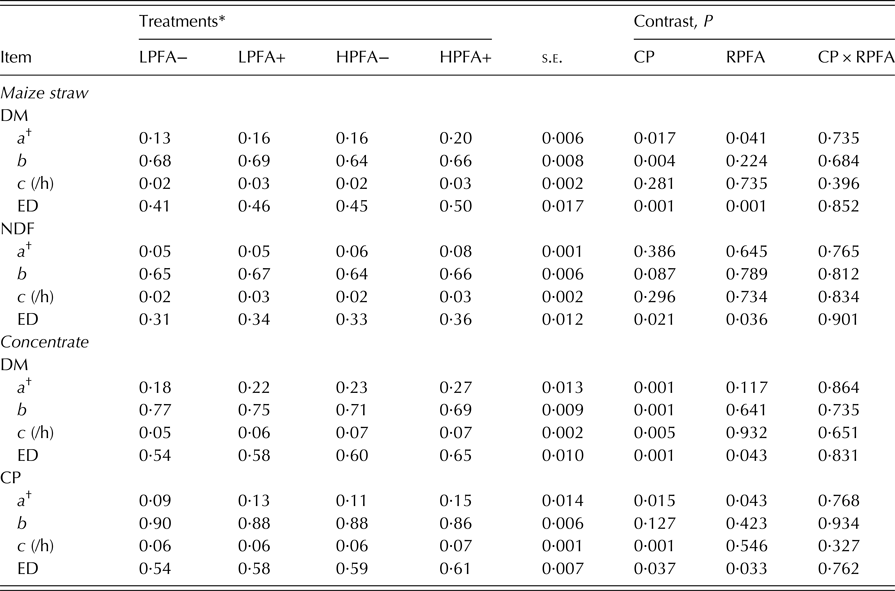
ED, effective degradability; CP, crude protein; DM, dry matter; NDF, neutral detergent fibre.
* LPFA−, low dietary protein supply without rumen-protected folic acid (RPFA); LPFA+, low dietary protein supply with 75 mg RPFA per kg dietary dry matter (DM); HPFA−, high dietary protein supply without RPFA; HPFA+, high dietary protein supply with 75 mg RPFA per kg dietary DM.
† Parameters were calculated from the fitted equation y = a + b(1 − e−c(t−L)) for t > L, where y = percentage of DM disappearance from the nylon bag at time t, a = soluble fraction, b = slowly degradable fraction, c = fraction rate constant at which b is degraded, L = lag time (h), and t = time of incubation (h). Effective degradability was calculated using equation a + bc/(c + k), where k = 0·025 or 0·058/h for maize silage or concentrate, respectively.
Microbial enzyme activities, bacterial populations and urinary purine derivatives
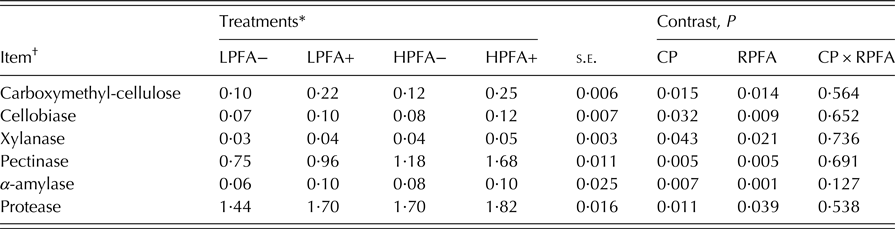
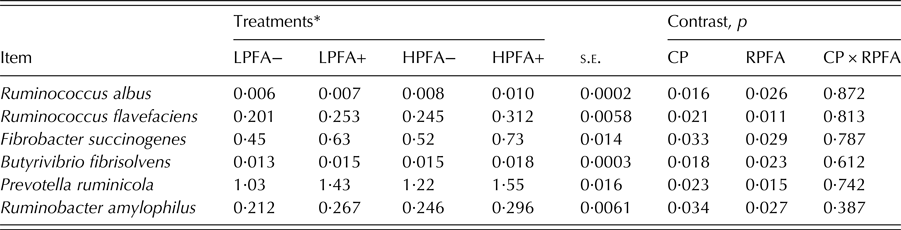
There were no RPFA × CP interactions for microbial enzyme activity, ruminal bacterial populations and urinary purine derivatives (PD) excretion (Tables 4–6). Microbial enzyme (carboxymethyl-cellulase, cellobiase, xylanase, pectinase, α-amylase and protease) activity, bacterial populations (R. albus, R. flavefaciens, B. fibrisolvens, P. ruminicola, F. succinogenes and R. amylophilus) and urinary PD excretion increased with increasing dietary CP levels or RPFA supplementation (P < 0·05). Uric acid was unchanged among treatments.
DISCUSSION
Ruminal fermentation
The increased ruminal total VFA concentration was consistent with the improved degradability, and was due to the increased bacterial population and microbial enzyme activity with increasing dietary CP levels or RPFA supplementation (Broderick Reference Broderick2003; Wang et al. Reference Wang, Liu, Guo, Huo, Ma, Zhang, Pei, Zhang and Wang2016). The decreased ruminal pH was attributed to the increased ruminal total VFA concentration (Froetschel et al. Reference Froetschel, Amos, Evans, Croom and Hagler1989; Kolver & de Veth Reference Kolver and de Veth2002), and was also observed with increasing RPFA supplementation in steers (Wang et al. Reference Wang, Liu, Guo, Huo, Ma, Zhang, Pei, Zhang and Wang2016) or with increasing dietary CP from 150 to 180 g/kg DM in cows (Weigel et al. Reference Weigel, Elliott and Clark1997). The increase in acetate to propionate ratio with RPFA supplementation was attributed to the increased molar proportion of acetate and the reduced molar proportion of propionate, and could be supported by the improved in situ ruminal NDF degradability with RPFA supplementation in the current experiment and other studies (Hayes et al. Reference Hayes, Mitchell, Little and Bradley1966; Wang et al. Reference Wang, Liu, Guo, Huo, Ma, Zhang, Pei, Zhang and Wang2016). It is suggested that ruminal fermentation pattern was altered from propionate to more acetate production with RPFA supplementation. The tendency towards decreased ratio of acetate to propionate with increasing dietary CP levels was attributed to the tendency towards decreased acetate molar proportion and the unchanged propionate proportion. However, other studies found that ruminal total VFA concentration and molar proportions of acetate and propionate were not affected by dietary CP levels (Oh et al. Reference Oh, Kim, Kim, Choi, Kang, Nam, Kim, Song, Kim and Park2008; da Silva et al. Reference da Silva, Pereira, da Silva, Valadares Filho and Ribeiro2016). The inconsistent effects of dietary CP levels on ruminal fermentation were attributed to the differences in forage grass quality and dietary NDF content. The NDF content in da Silva et al. (Reference da Silva, Pereira, da Silva, Valadares Filho and Ribeiro2016) was about 332 g/kg dietary DM, and lower than that in the current study. Ruminal NH3-N is derived mainly from ruminal degradable protein and used for microbial protein synthesis (Reynolds & Kristensen Reference Reynolds and Kristensen2008). In the current study, the reduced NH3-N content indicated that microbial protein synthesis was improved by RPFA supplementation and was consistent with Wang et al. (Reference Wang, Liu, Guo, Huo, Ma, Zhang, Pei, Zhang and Wang2016), who reported that urinary total PD excretion increased linearly with increasing RPFA supplementation. Additionally, the increased NH3-N content with increasing dietary CP levels was consistent with other studies (Weigel et al. Reference Weigel, Elliott and Clark1997; da Silva et al. Reference da Silva, Pereira, da Silva, Valadares Filho and Ribeiro2016), and was mainly attributed to the increased ruminal CP degradability (Reynal & Broderick Reference Reynal and Broderick2005).
Ruminal degradability
The improvement in degradability was attributed to increased microbial enzyme activity (Liu et al. Reference Liu, Wang, Pei, Li, Wang, Zhang, Zhang, He, Wang, Yang, Bai, Shi and Liu2014; Wang et al. Reference Wang, Liu, Guo, Huo, Ma, Zhang, Pei, Zhang and Wang2016), and further confirmed that ruminal fermentation was improved with increasing dietary CP levels or RPFA supplementation. Wang et al. (Reference Wang, Liu, Guo, Huo, Ma, Zhang, Pei, Zhang and Wang2016) found similar results with RPFA supplementation in steers. Other studies also reported that fibre degradability was increased by 42% with FA supplementation in vitro (Hall et al. Reference Hall, Cheng and Burrows1953), and in situ ruminal ADF degradability was improved by supplementary FA (Ragaller et al. Reference Ragaller, Lebzien, Bigalke, Südekum, Hüther and Flachowsky2010). Similarly, improved digestibilities of NDF, ADF and CP with increasing dietary CP levels were observed in cows (Weigel et al. Reference Weigel, Elliott and Clark1997; Broderick Reference Broderick2003). However, da Silva et al. (Reference da Silva, Pereira, da Silva, Valadares Filho and Ribeiro2016) found that degradabilities of NDF, ADF and CP were unaffected by dietary CP levels in bulls. The inconsistent results were associated with the physiological status of animals and dietary composition (Oldham Reference Oldham1984).
Microbial enzyme activity, bacterial populations and urinary purine derivatives
The improved microbial enzyme activity was due to the increased bacterial populations (Liu et al. Reference Liu, Wang, Pei, Li, Wang, Zhang, Zhang, He, Wang, Yang, Bai, Shi and Liu2014). Similarly, Wang et al. (Reference Wang, Liu, Guo, Huo, Ma, Zhang, Pei, Zhang and Wang2016) reported that activities of cellobiase, xylanase, pectinase and α-amylase quadratically increased with increasing RPFA supplementation, while activities of carboxymethyl-cellulase, pectinase and protease were not affected. The increase in bacterial population indicated that ruminal microbial growth was promoted with increasing dietary CP levels or RPFA supplementation. Similarly, some studies found that FA supplementation promoted the growth of R. albus and R. flavefaciens (Bryant & Robinson Reference Bryant and Robinson1961; Slyter & Weaver Reference Slyter and Weaver1977; Wejdemar Reference Wejdemar1996). Wang et al. (Reference Wang, Liu, Guo, Huo, Ma, Zhang, Pei, Zhang and Wang2016) also found that populations of B. fibrisolvens, R. albus, R. flavefaciens and F. succinogenes quadratically increased with increasing PRFA supplementation in steers. The increased bacterial population with increasing dietary CP levels was attributed to the increased ruminal amino acids, peptides, branched chain VFA and NH3-N with increasing dietary CP levels (Reynal & Broderick Reference Reynal and Broderick2005; Oh et al. Reference Oh, Kim, Kim, Choi, Kang, Nam, Kim, Song, Kim and Park2008; Vinh et al. Reference Vinh, Wanapat, Khejornsart and Kongmun2011; Liu et al. Reference Liu, Wang, Pei, Li, Wang, Zhang, Zhang, He, Wang, Yang, Bai, Shi and Liu2014). However, Yang et al. (Reference Yang, Si, Diao, Jin, Zeng and Tu2016) reported that populations of R. albus, R. flavefaciens and F. succinogenes were not affected by increasing dietary CP level from 111·7 to 143·6 g/kg DM in lambs. The inconsistent results could be due to the difference in animal and dietary composition (Oh et al. Reference Oh, Kim, Kim, Choi, Kang, Nam, Kim, Song, Kim and Park2008; Yang et al. Reference Yang, Si, Diao, Jin, Zeng and Tu2016). Ruminal microbial protein synthesis is positively related to urinary PD excretion (Verbic et al. Reference Verbic, Chen, MacLeod and Ørkov1990; Thanh & Ørskov Reference Thanh and Ørskov2006). The increased urinary total PD excretion indicated that microbial protein synthesis and ruminal NH3-N utilization were improved with increasing dietary CP levels or RPFA supplementation. Similar results were also observed in other studies with increasing dietary CP levels (Broderick Reference Broderick2003; Reynal & Broderick Reference Reynal and Broderick2005) and with RPFA supplementation (Wang et al. Reference Wang, Liu, Guo, Huo, Ma, Zhang, Pei, Zhang and Wang2016).
Some studies have demonstrated that 110 g CP/kg DM was enough to meet the requirement of growing steers (NRC 1996; da Silva et al. Reference da Silva, Pereira, da Silva, Valadares Filho and Ribeiro2016) and similar average daily gain values have been observed with levels of 110, 130 and 150 g CP/kg dietary DM (Obeid et al. Reference Obeid, Pereira, Pereira, Valadares Filho, Carvalho and Martins2006; da Silva et al. Reference da Silva, Pereira, da Silva, Valadares Filho and Ribeiro2016). In the current study, although CP content in the HP diet was only 20% higher than in the LP diet, positive effects of the HP diet on ruminal fermentation, degradability, microbial growth and enzyme activity were observed. This might be attributed to the inferior roughage in the current study compared with other studies (Obeid et al. Reference Obeid, Pereira, Pereira, Valadares Filho, Carvalho and Martins2006; da Silva et al. Reference da Silva, Pereira, da Silva, Valadares Filho and Ribeiro2016). The supplemental FA dose was 2 mg/kg BW in Girard et al. (Reference Girard, Chiquette and Matte1994), 3 or 6 mg/kg BW in Girard et al. (Reference Girard, Benchaar, Chiquette and Desrochers2009), and approximately 1·65 mg/kg BW in Ragaller et al. (Reference Ragaller, Lebzien, Bigalke, Südekum, Hüther and Flachowsky2010), while it was only 0·2 mg/kg BW in the current study. The lower relative magnitude of FA provided by RPFA supplementation in comparison to other studies was possibly inadequate to cause the interaction between RPFA and dietary CP levels.
CONCLUSION
Increasing dietary CP levels or RPFA supplementation in beef diet promoted microbial growth, increased microbial enzyme activity, improved in situ ruminal ED and increased ruminal total VFA concentration. Rumen fermentation pattern was switched into more acetate production by RPFA supplementation, and more propionate production with increasing dietary CP levels. No CP × RPFA interaction was observed in the current study. Further study is warranted to focus on the interaction between dietary CP levels and higher dose of RPFA supplementation.
Effects of different dietary protein and rumen-protected folic acid supplementation on rumen microbial enzyme activity in growing cross-bred beef steers
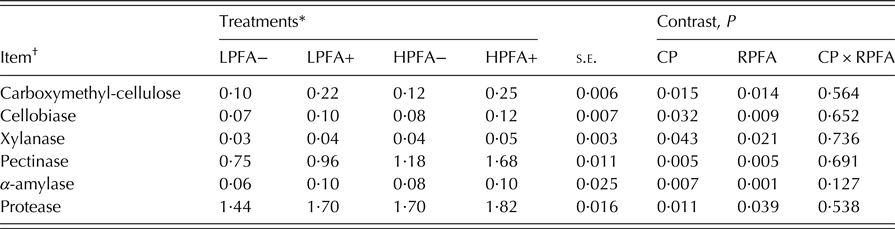
* LPFA−, low dietary protein supply without rumen-protected folic acid (RPFA); LPFA+, low dietary protein supply with 75 mg RPFA per kg dietary dry matter (DM); HPFA−, high dietary protein supply without RPFA; HPFA+, high dietary protein supply with 75 mg RPFA per kg dietary DM.
† Units of enzyme activity are: carboxymethyl-cellulase (μmol glucose/min/ml), cellobiase (μmol glucose/min/ml), xylanase (μmol xylose/min/ml), pectinase (μmol D-galactouronic acid/min/ml), α-amylase (μmol glucose/min/ml) and protease (μg hydrolysed protein/min/ml).
Effects of different dietary protein and rumen-protected folic acid supplementation on ruminal bacterial populations (proportion of total bacterial 16S rDNA) in growing cross-bred beef steers
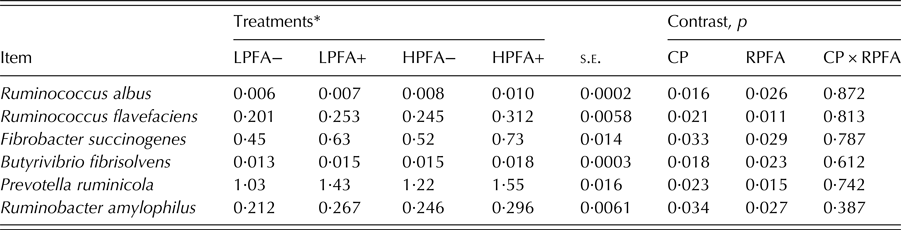
* LPFA−, low dietary protein supply without rumen-protected folic acid (RPFA); LPFA+, low dietary protein supply with 75 mg RPFA per kg dietary dry matter (DM); HPFA−, high dietary protein supply without RPFA; HPFA+, high dietary protein supply with 75 mg RPFA per kg dietary DM.
Effects of different dietary protein and rumen-protected folic acid supplementation on urinary excretion of purine derivatives in growing cross-bred beef steers

* LPFA−, low dietary protein supply without rumen-protected folic acid (RPFA); LPFA+, low dietary protein supply with 75 mg RPFA per kg dietary dry matter (DM); HPFA−, high dietary protein supply without RPFA; HPFA+, high dietary protein supply with 75 mg RPFA per kg dietary DM.
This work was supported by a grant from Natural Science Funding projects of Shanxi Province (201601D011068), Graduate Student Education Innovation project of Shanxi Province (2016SY023). The authors thank the staff of Shanxi Agriculture University beef unit for care of the animals.