Introduction
Dolichousnea longissima (Ach.) Articus is considered the world’s longest lichen (Rolstad & Rolstad Reference Rolstad and Rolstad2008; Eriksson et al. Reference Eriksson, Gauslaa, Palmqvist, Ekstrom and Esseen2018). It is often referred to as an ‘iconic’ or ‘charismatic’ species which can serve as a flagship for conservation (Jovan Reference Jovan2008; Eriksson et al. Reference Eriksson, Gauslaa, Palmqvist, Ekstrom and Esseen2018). Whereas D. longissima once had an extensive circumboreal distribution (Smith et al. Reference Smith, Johnston and Lücking2016), it is now threatened in many regions due to air pollution, habitat destruction and forestry practices (Esseen et al. Reference Esseen, Ericson, Lindstrom and Zackrisson1981). Incipient climatic change is likely to further threaten vulnerable lichen populations (Pirintsos et al. Reference Pirintsos, Paoli, Loppi and Kotzabasis2011; Nascimbene et al. Reference Nascimbene, Casazza, Benesperi, Catalano, Cataldo, Grillo, Isocrono, Matteucci, Ongaro and Potenza2016; Smith et al. Reference Smith, Nelson, Jovan, Hanson and McCune2018). Loss or biomass-reduction of D. longissima could have negative consequences for endangered lichenivorous monkeys (Grueter et al. Reference Grueter, Li, Ren, Wei, Xiang and van Schaik2009, Reference Grueter, Li, Ren, Z-F and Li2012; Zhao et al. Reference Zhao, Ren, Li, Garber, Zhu, Xiang, Grueter, Liu and Li2019) and the wider ecosystem (Knops et al. Reference Knops, Nash and Schlesinger1996; Porada et al. Reference Porada, Weber, Elbert, Poschl and Kleidon2013; Pypker et al. Reference Pypker, Unsworth, Van Stan and Bond2017). It is of both theoretical interest and importance to conservation (Martínez et al. Reference Martínez, Flores, Otálora, Belinchón, Prieto, Aragón and Escudero2012) to determine whether D. longissima growth and reproduction could be affected by climatic change.
There have been extensive studies of D. longissima, primarily under its previous taxonomic name of Usnea longissima Ach. Most research mentioned below has focused on its North American and remnant Scandinavian populations. Widespread D. longissima populations in China (e.g. He & Zhang Reference He and Zhang2012; Wang & Qian Reference Wang and Qian2012) have been treated as mis-identifications by some researchers (Smith et al. Reference Smith, Johnston and Lücking2016), despite publication of supporting genetic data (He & Zhang Reference He and Zhang2012). Although European populations of D. longissima have apparently passed through paleoenvironmental-induced genetic bottlenecks, with low genetic variation (Rolstad et al. Reference Rolstad, Ekman, Andersen and Rolstad2013), there are no historical reasons to suspect comparable bottlenecks in China, which might harbour genetically diverse lichen populations. In the context of climate change, our study addresses the important characteristics of thallus length and growth, and related properties of reproductive mode, which are introduced below through a brief review of the evidence available for D. longissima.
The size of organisms impacts growth, survival and reproduction (Sugiyama & Bazzaz Reference Sugiyama and Bazzaz1998). However, studies of size-dependence in lichen growth and allometry have mostly focused on foliose lichens (Gauslaa et al. Reference Gauslaa, Palmqvist, Solhaug, Hilmo, Holien, Nybakken and Ohlson2009). For species of pendant fruticose lichens with apical growth (e.g. for Bryoria fuscescens (Gyeln.) Brodo & D. Hawksw. (Greenhalgh & Whitfield Reference Greenhalgh and Whitfield2007)), it appears likely that relative growth rates would decrease as thallus length increased, since the apex would become a progressively lesser proportion of the total thallus. Alternatively, diffuse growth (e.g. in Ramalina menziesii Taylor (Sanders & Ascaso Reference Sanders and Ascaso1995) and D. longissima (Rolstad & Rolstad Reference Rolstad and Rolstad2008)) could allow expansion in a geometric manner (exponential growth), allowing growth rates to increase with size, thereby supporting more rapid growth rates than for species growing at the apex alone (Voisey Reference Voisey2010).
Although diffuse growth occurs in D. longissima (Rolstad & Rolstad Reference Rolstad and Rolstad2008; Sanders & de los Ríos Reference Sanders and de los Ríos2012), whether its growth rates increase with length remains uncertain. Three studies have addressed this question, based on transplantation of thalli of differing lengths. McCune et al. (Reference McCune, Derr, Muir, Shirazi, Sillett and Daly2007) found no relationship between percentage biomass growth and initial thallus mass. Jansson et al. (Reference Jansson, Palmqvist and Esseen2009) found that absolute length gain was three times higher in long than short thalli, with relative weight gain twice as high in long than short thalli. Gauslaa et al. (Reference Gauslaa, Palmqvist, Solhaug, Hilmo, Holien, Nybakken and Ohlson2009) found that initial thallus size was negatively associated with area gain, but did not directly report length. They suggested that newly dispersed thallus fragments require rapid area growth in order to attach to the canopy, but thereafter reallocation of growth towards mass gain is more advantageous.
Maximum reported lengths of the main axis of D. longissima range from 10 m (Rolstad & Rolstad Reference Rolstad and Rolstad2008) to only 81 cm (Gauslaa Reference Gauslaa1997). Such strong regional variation in maximum D. longissima thallus lengths might arise from differing fragmentation rates along weak areas of the thallus (Gauslaa Reference Gauslaa1997) rather than from differing growth rates. Fragmented thallus pieces can disperse, although often only by 2–3 m (Esseen et al. Reference Esseen, Ericson, Lindstrom and Zackrisson1981), either landing in the canopy or as litter on the forest floor. Longer thalli seem more likely to land in canopies (Gauslaa Reference Gauslaa1997), where they are ‘draped over branches or other thalli’ (Gauslaa Reference Gauslaa1997). Holdfasts, indicating an origin from soredia rather than fragmentation, are rare, in only 1.5% of thalli (Gauslaa Reference Gauslaa1997). Snow can exacerbate thallus fragmentation (Arseneau et al. Reference Arseneau, Ouellet and Sirois1998). Future changes to frequency, duration or dampness of snow cover might alter fragmentation rates.
The evolution and maintenance of asexual versus sexual life history strategies has been a focus of extensive debate in evolutionary biology (Judson & Normark Reference Judson and Normark1996; Grishkan et al. Reference Grishkan, Korol, Nevo and Wasser2003; Schwander & Crespi Reference Schwander and Crespi2009). Most eukaryotic organisms maintain sexual reproductive strategies despite high costs (Judson & Normark Reference Judson and Normark1996; Hadany & Otto Reference Hadany and Otto2007). Theories have primarily focused on the advantages of generating genetic variation or removing deleterious mutations (Schwander & Crespi Reference Schwander and Crespi2009). Genetic variation is proposed to be advantageous under stressful conditions or fluctuating environments (Schwander & Crespi Reference Schwander and Crespi2009), such as those produced by climatic change. Under the ‘abandon ship’ hypothesis, asexual reproduction is favourable when individuals are well adapted to their environment, but maladapted individuals should switch to sexual reproduction, because recombinant genomes could produce fitter offspring (Agrawal et al. Reference Agrawal, Hadany and Otto2005; Hadany & Otto Reference Hadany and Otto2007). This hypothesis has been supported by laboratory and field experiments exposing facultatively asexual fungi to climatic stress (Grishkan et al. Reference Grishkan, Korol, Nevo and Wasser2003; Seudre et al. Reference Seudre, Namias, Gardella, Da Silva, Gouyon and López-Villavicencio2018).
For lichens, there are costs and benefits to sexual reproduction, beyond those typically considered in such evolutionary theories (Lawrey Reference Lawrey1980; Hestmark Reference Hestmark1992; Singh et al. Reference Singh, Dal Grande, Cornejo, Schmitt and Scheidegger2012). Reproductive strategies differ in the extent to which mycobionts can co-disperse with photobionts. For sexual propagules containing only the mycobiont, the lichen association must be re-established with a new photobiont (Sanders & Lücking Reference Sanders and Lücking2002), risking mortality if propagules disperse to locations where a compatible photobiont is absent.
Some lichens are limited to either asexual or sexual reproduction, but not both, whereas others have mixed strategies, apparently favoured by fluctuating climatic conditions of temperate zones (Lawrey Reference Lawrey1980). Mixed strategies include asexual reproduction in young, small thalli, switching to sexual reproduction as thalli increase in size (Hestmark Reference Hestmark1992; Martínez et al. Reference Martínez, Flores, Otálora, Belinchón, Prieto, Aragón and Escudero2012). Reproductive strategies could switch in frequently disturbed microhabitats or under severe environmental stress (Grishkan et al. Reference Grishkan, Korol, Nevo and Wasser2003; Hadany & Otto Reference Hadany and Otto2007; Eaton & Ellis Reference Eaton and Ellis2014). It would be advantageous for stressed lichens to begin sexual reproduction at a younger, smaller, thallus size and increase reproductive allocation (Merinero et al. Reference Merinero, Méndez, Aragón and Martínez2017) to compensate for reduced life expectancy (Stearns & Koella Reference Stearns and Koella1986). Conversely, if reproductive capacity is diminished by drought stress (Tolpysheva & Timofeeva Reference Tolpysheva and Timofeeva2008; Martínez et al. Reference Martínez, Flores, Otálora, Belinchón, Prieto, Aragón and Escudero2012) or other unfavourable conditions (Bowler & Rundel Reference Bowler and Rundel1975; Tolpysheva & Timofeeva Reference Tolpysheva and Timofeeva2008; Molina et al. Reference Molina, Divakar, Zhang, González and Struwe2013), such lichens could be especially vulnerable to climatic change (Martínez et al. Reference Martínez, Flores, Otálora, Belinchón, Prieto, Aragón and Escudero2012).
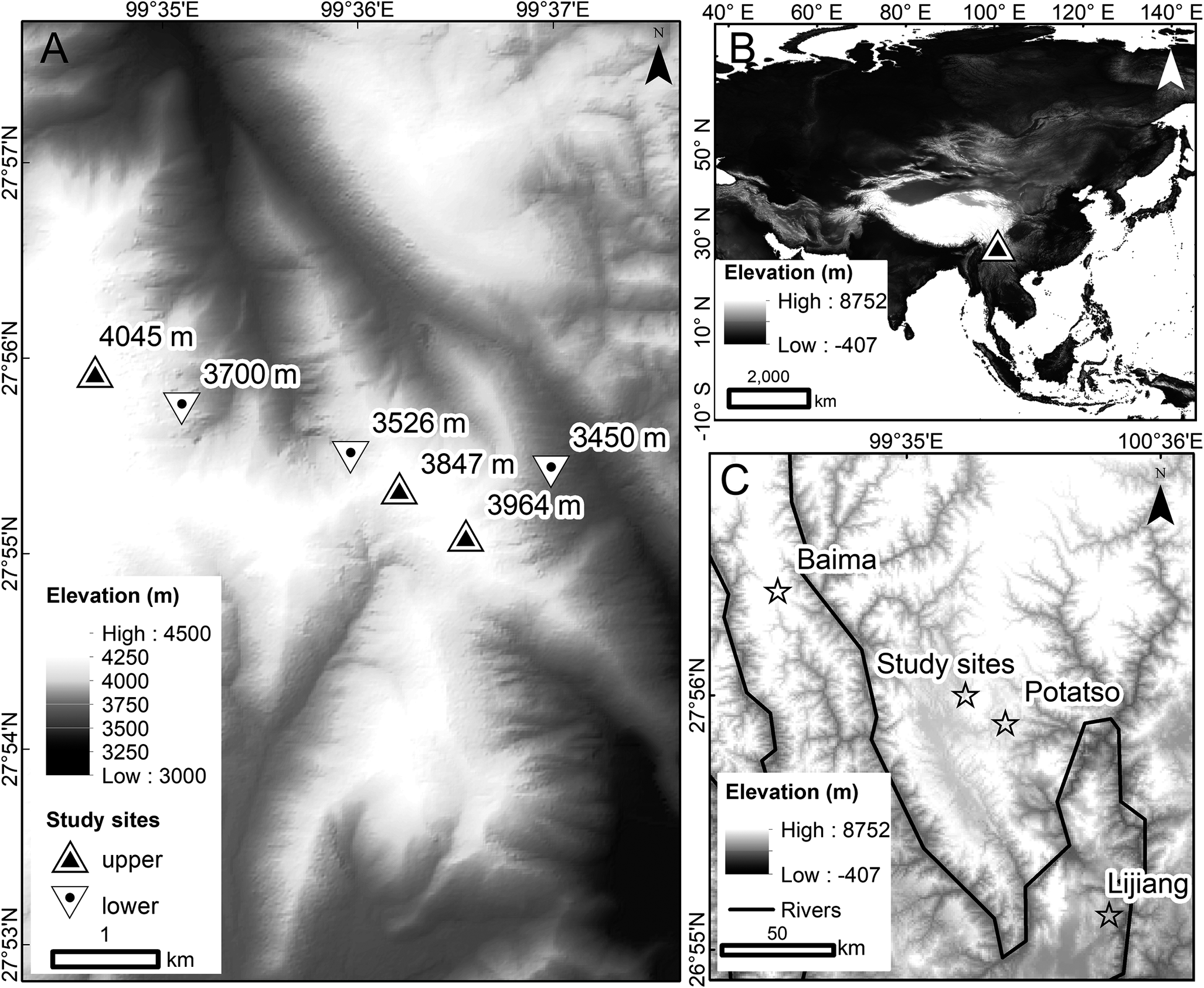
Dolichousnea longissima is usually asexual, with thallus fragmentation causing short-distance dispersal (Gauslaa Reference Gauslaa1997), and vegetative propagules (soredia) enabling longer-distance dispersal (Gauslaa Reference Gauslaa1997). Early records of fertile, apothecia-producing D. longissima from Europe included reports from Lake Longemer, France (Harmand Reference Harmand1905). Keon (Reference Keon2002) listed historical records and herbarium specimens of fertile D. longissima, with three herbarium specimens from China possessing apothecia. One locality was recorded merely as ‘Western China’, but two were from north-western Yunnan Province, including Likiang (26 May 1886, J. M. Delavay 2340 (PC)), a trading post along the historic Tea-Horse route. That route passed through the current Lijiang Prefecture, which is adjacent to Diqing Prefecture in north-western Yunnan, China (Fig. 1). During fieldwork in a mountain range in Diqing (Worthy et al. Reference Worthy, Schaefer, Goldberg, Wanasinghe, Li, Thiyagaraja, Xu, Wang and Wang2025), we serendipitously observed apothecia on some D. longissima thalli. That site provided a suitable location for the present study.
Study sites of Dolichousnea longissima along a mountain elevational gradient (A) and their location in the trans-Himalayas (B). Location of our study sites relative to Baima Snow Mountain National Nature Reserve, Potatso National Park and where the historic Tea-Horse route passed north of Lijiang (C), a likely location of earlier ‘Likiang’ herbarium records.

Keon (Reference Keon2002) published records of apotheciate D. longissima from the Oregon Coast Range of North America. In the transplantation experiment of Keon & Muir (Reference Keon and Muir2002), D. longissima thalli transplanted to locations across western Oregon did not produce apothecia. Keon (Reference Keon2002) noted a personal communication from R. Rosentreter, in which some apparently asexual D. longissima thalli from Oregon’s Cascadia State Park had produced apothecia after being relocated to an arid, partially wooded garden in Boise, Idaho. Later, Rolstad et al. (Reference Rolstad, Ekman, Andersen and Rolstad2013) found apotheciate populations in three areas of the western coast of North America. Their comparison of ITS and IGS haplotype groups from North American apotheciate thalli with Scandinavian non-apotheciate thalli (Rolstad et al. Reference Rolstad, Ekman, Andersen and Rolstad2013) suggests some link between apothecia production and genetic differentiation.
Incipient climatic change (IPCC 2023) is of great concern for lichens, for which raised temperatures can have many negative impacts, ranging from death of the photobiont (Williams et al. Reference Williams, Colesie, Ullmann, Westberg, Wedin and Budel2017; Colesie et al. Reference Colesie, Büdel, Hurry and Green2018) and thallus deterioration (Song et al. Reference Song, W-Y and Nadkarni2012), to decreased thallus growth rates (Fortuna & Tretiach Reference Fortuna and Tretiach2018; Smith et al. Reference Smith, Nelson, Jovan, Hanson and McCune2018) and lowered reproduction and establishment (Kärnefelt Reference Kärnefelt1988; Tolpysheva & Timofeeva Reference Tolpysheva and Timofeeva2008). There could be further impacts from fewer frost days and altered number of freeze-thaw cycles (Worthy et al. Reference Worthy, Goldberg, Thiyagaraja, Wang and Wang2024a). Climate change impacts are likely to vary with the baseline temperatures and degree of warming. In Sweden, warming is detrimental to Usnea spp. in warmer sites, but beneficial to those in colder sites (Esseen et al. Reference Esseen, Ekstrom, Westerlund, Palmqvist, Jonsson, Grafstrom and Stahl2016). Temperature rises are expected to be accelerated at high latitudes and at high elevations (Ohmura Reference Ohmura2012; Chan et al. Reference Chan, Lenoir, Mai, Kuo, Chen and Shen2024), such as the sites in this study, where mean annual temperatures are predicted to increase by up to 2.5 °C by 2080 (Liu et al. Reference Liu, Chen, Li and Li2017).
Atmospheric water conditions are especially important for lichens due to their poikilohydric nature. Lichen growth and survival are impacted by precipitation (Marini et al. Reference Marini, Nascimbene and Nimis2011), fog (Stanton & Horn Reference Stanton and Horn2013), dew (del Prado & Sancho Reference del Prado and Sancho2007), vapour pressure deficit (Pypker et al. Reference Pypker, Unsworth, Van Stan and Bond2017), and relative humidity (Gauslaa Reference Gauslaa2014). In western North America, higher proportions of D. longissima water sources gained through dewfall and fog interception correspond to higher growth rates (Strother et al. Reference Strother, Coxson and Goward2022). Across our study region, fog is probably of less importance, with only up to five annual fog days (Hao et al. Reference Hao, Chen, Han, Shan and Meng2017), but humid air, dew, rain and snow would contribute to hydration. Regional climatic changes since 1961 have included reduced annual mean surface humidity (Niu et al. Reference Niu, Wang, Fang, Li and Yao2020) and increased vapour pressure deficit (VPD) (Sun et al. Reference Sun, Chen, Wang, Li, Mu, Yan, Xu, Huang, Wang and Zhang2016; Qin et al. Reference Qin, Tan, Shen, Schaefer, Chen, Zhou, Xu, Zhun, Cheng and Wu2024). The projected continuation of these trends (Sun et al. Reference Sun, Chen, Wang, Li, Mu, Yan, Xu, Huang, Wang and Zhang2016; Niu et al. Reference Niu, Wang, Fang, Li and Yao2020; Qin et al. Reference Qin, Tan, Shen, Schaefer, Chen, Zhou, Xu, Zhun, Cheng and Wu2024) seems likely to threaten D. longissima.
Although lichens with green algae as photobionts are able to conduct photosynthesis without requiring liquid water (Lange et al. Reference Lange, Kilian and Ziegler1986; Green et al. Reference Green, Budel, Heber, Meyers, Zellner and Lange1993; Worthy et al. Reference Worthy, Schaefer, Wanasinghe, Xu, Wang and Wang2024b), there is substantial inter-specific variation in these abilities (Lange et al. Reference Lange, Kilian and Ziegler1986). Dolichousnea longissima depends heavily on external water storage, favoured by longer fibrils. Thalli dry out quickly, but can rapidly saturate tissues from water vapour uptake (Eriksson et al. Reference Eriksson, Gauslaa, Palmqvist, Ekstrom and Esseen2018). However, there are extended time lags between rehydration and photosynthetic recovery (Liden et al. Reference Liden, Cabrajic, Ottosson-Lofvenius, Palmqvist and Lundmark2010), which can be exacerbated by photoinhibition from light exposure (Färber et al. Reference Färber, Solhaug, Esseen, Bilger and Gauslaa2014). These factors, coupled with distribution patterns, indicate that D. longissima needs microhabitats with extended periods of both humid air and sustained, but not excessive, light exposure (Esseen et al. Reference Esseen, Ericson, Lindstrom and Zackrisson1981; Liden et al. Reference Liden, Cabrajic, Ottosson-Lofvenius, Palmqvist and Lundmark2010). However, putative preferences for moderate light could be due to correlated variables related to desiccation along canopy height gradients.
In this study we took a ‘space for time’ approach (Gaio-Oliveira et al. Reference Gaio-Oliveira, Dahlman, Máguas and Palmqvist2004), in which D. longissima thalli were transplanted from higher to lower elevations in order to generate an in situ simulation of prospective climatic change. Since the temperature in mountain ranges is usually closely related to elevation, and mountains tend to intercept precipitation, downwards transplantation was expected to generate increased temperatures and VPD, with reduced relative humidity (RH). We used this field experiment to test the following non-mutually exclusive hypotheses:
-
1. Dolichousnea longissima shows positive length-dependent growth.
-
2. Length-dependent growth patterns will be altered by climatic change.
-
3. Switches from asexual to sexual reproduction are induced by climatic stressors.
-
4. Greater stress will drive higher reproductive allocation, and reproduction beginning at a smaller thallus size.
-
5. Raised temperatures, reduced relative humidity and increased vapour pressure deficit will reduce mycobiont growth and photobiont survival.
We also considered the possibility that there were genetically distinct populations of Dolichousnea in north-western Yunnan, China. In which case, we proposed that apothecia production would be clustered among some branches of a phylogenetic tree and might be linked to other distinct morphological differences. We therefore tested the alternative hypothesis that:
-
6. Apotheciate Dolichousnea specimens from these study sites belong to a genetically and morphologically distinct population.
Methods
Study area
We conducted this study in mature forests, in the mountains of Shangri-La County of Diqing Prefecture, Yunnan Province, China (Fig. 1). Survival, growth rates and biomass production of Dolichousnea longissima are of special importance for conservation in this region because of its local culinary and medicinal uses and its role as the major food source for the endangered Yunnan snub-nosed monkey Rhinopithecus bieti (Grueter et al. Reference Grueter, Li, Ren, Wei, Xiang and van Schaik2009, Reference Grueter, Li, Ren, Z-F and Li2012). The nearest groups of R. bieti to our study sites are in Baima Snow Mountain National Nature Reserve (Zhao et al. Reference Zhao, Ren, Li, Garber, Zhu, Xiang, Grueter, Liu and Li2019), as indicated in Fig. 1. With an estimated population size of < 3000 individuals, R. bieti is already threatened by habitat loss and human disturbance (Zhao et al. Reference Zhao, Ren, Li, Garber, Zhu, Xiang, Grueter, Liu and Li2019; Xia et al. Reference Xia, Zhang, Zhuang, Ren, Zhou, Shen, Krzton, Luan and Li2020). If climatic change causes reduced lichen abundance, there could be a further range contraction of R. bieti (Zhao et al. Reference Zhao, Ren, Li, Garber, Zhu, Xiang, Grueter, Liu and Li2019).
These mountains are in the southern range of the trans-Himalayas, a region that is predicted to experience accelerated warming, reduced relative humidity and increased vapour pressure deficit. One site with abundant D. longissima cover, at 3847 m elevation, was chosen as the location for a pilot experiment in 2019. The interesting results of this pilot experiment led us to conduct a full transplantation experiment in 2020, using three transects with paired upper and lower sites (Fig. 1; Supplementary Material Table S1 & Fig. S1, available online). The upper sites of transects T1 and T2 were near the top of a mountain ridge, whereas the upper site of transect T3 was near the treeline of a higher ridge. The lower sites of T2 and T3 were immediately above a zone of bamboo. The lower site of T1 was on a slope immediately above a transition to shrubland, with only scarce and short thalli of D. longissima present in mixed forest with a semi-open canopy structure (Supplementary Material Fig. S1). All sites supported a mixture of coniferous and deciduous trees (Supplementary Material Table S2, available online). The shift to shrubland below the lower site of T1 was probably shaped by previous deforestation.
Based on initial observations of the current distribution of D. longissima along these transects, these sites were expected to represent climates possibly colder than optimal (upper T3), favourable current climatic conditions (upper T1 and T2), detrimental future warmer climates (lower T2 and T3) and warming so severe as to be likely to cause thallus mortality (lower T1). Comparison of D. longissima between upper and lower sites was intended as a model system to simulate impacts of future climatic change.
Microclimate records
Based on published climate models (WorldClim v. 2.1: historical climate data for 1970–2000, at 1 km2 spatial resolution, www.worldclim.org), mean air temperatures at these sites would be c. 10 °C in July and −3 °C in December (Supplementary Material Fig. S2, available online); precipitation would be c. 132 mm in July and 8 mm in December (Supplementary Material Fig. S3, available online); solar radiation would be c. 14 300 kJ m−2 day−1 in July and 11 300 kJ m−2 day−1 in December (Supplementary Material Fig. S4, available online). However, in high-elevation regions, lacking ground-truthing from meteorological records, estimated values would be too imprecise (Fick & Hijmans Reference Fick and Hijmans2017) for meaningful comparisons between our study sites. We therefore recorded microclimate conditions at each of our sites, for three variables impacted by climatic change that we hypothesized would strongly influence Dolichousnea longissima. The data loggers UniT UT330 (Youlide, China) and Hygrochron iButton DS1923 (OnSolution Pty Ltd, Australia) were used to record temperature, relative humidity and dewpoint, at 30-min intervals. Data loggers were intercalibrated at standard temperatures. UniT loggers have internal sensors within a logger unit, whereas Hygrochron loggers have relatively exposed sensors within a coin-sized shell. Data were already being recorded from these sites as part of a separate experiment conducted between 2018 and 2020 (Worthy et al., unpublished data). Further data were recorded from 2020 to 2023 for the purpose of the present study, using UniT loggers (UT330). These data sets have some gaps due to incidents of logger failure at extreme freezing temperatures, and repeated travel restrictions limiting the frequency with which batteries could be replaced. Therefore, the main data analysis is based on mean hourly, daily and monthly data. Loggers were each attached to a tree, adjacent to a transplanted specimen. Thus, microclimate records should have closely corresponded to the conditions to which the lichens were exposed (Lakatos et al. Reference Lakatos, Obregon, Büdel and Bendix2012; Proctor Reference Proctor2012), although the thermal heat capacity of the tree trunk may mean temperatures logged were slightly higher than those experienced by pendulous thalli. The canopy of the tree to which loggers were attached would have acted as a solar shield, limiting measurement errors caused by direct solar radiation.
Pilot experiment
In July 2019, Dolichousnea longissima thalli were collected from a forested site at 3847 m elevation, which was later selected as the upper site of T1. These thalli were cut at both ends into sections of either 20, 40 or 80 cm, such that none had apical meristems. None of the thallus strands had any side branches or apothecia. These were draped through plastic loops, to form pendants of either 10, 20 or 40 cm, with four separate thallus strands per pendant. One pendant of each length was attached with a nylon line to the branches of each of ten different recipient host trees at the upper site of T1 (trees, n = 10; pendants, n = 30; thallus strands n = 120).
After 90 days, these pendants were harvested and brought back to the laboratories of the Kunming Institute of Botany. Length was measured after being air-dried (for 7 days, LA), then soaked in water, shaken and blotted (wet, LW), and then oven-dried (LO) at 64 °C for 24 h. Finally, oven-dried mass (M O) was determined. Drying-induced shrinkage (E) of each thallus strand was calculated as the difference in length (cm) between being air- versus oven-dried (EAO = (L − LO)/LO) or between being wet versus oven-dried (EWO = (LW − LO)/LO).
Oven drying had two major disadvantages. Firstly, it became more difficult to completely straighten thallus strands in order to measure length. Secondly, it killed the lichen, thus excluding the option of later studying the photobiont layer or extracting genetic material. There was such a close correspondence (R 2 = 0.99) between the length of thalli after being air-dried or oven-dried (Supplementary Material Fig. S5A, available online), that we considered it unnecessary to oven-dry thalli thereafter. Oven-dried thallus mass was significantly related to length of oven-dried, air-dried and wet thalli (Supplementary Material Fig. S5B–D), but there was too much variation in the relationship to justify using initial pendant length to calculate initial sample mass. Thalli were much longer when wet. The shrinkage of wet thalli after oven-drying was EWO = 0.262 ± 0.008 cm cm−1 (mean ± S.E.), while the shrinkage of dry thalli after oven-drying was only EAO = 0.013 ± 0.009 cm cm−1 (mean ± S.E.). In both cases, the shortest thalli had the greatest shrinkage, with the least shrinkage for the longest thalli (Supplementary Material Fig. S6C & D, available online).
Thereafter, we measured air-dried length L 1 during set-up of the main experiment, with air-drying followed by further drying with CaCl2 after the final harvest prior to measuring L 2 and mass M 2.
Where D t is the number of days between setting up the experiment (t 1) and its final harvest (t 2), then Relative Thallus Length Growth Rate (mm cm−1 day−1) was:
 $$ \mathrm{RTLGR}=\log \left(\frac{L_2}{L_1}\right)\times \left(\frac{100}{D_{\mathrm{t}}}\right) $$
Thallus Mass Length ratio (g cm−1) at final harvest was:
 $$ \mathrm{TML}={M}_2/{L}_2 $$
Transplantation experiment
Between 3–5 July 2020, Dolichousnea longissima thalli were collected from each of the three upper study sites for use in a transplantation experiment. Collection began at the centre of the site, moving outwards until sufficient suitable thalli had been obtained. The main criterion was that thalli should be of sufficient length to be disentangled from other thalli and extraneous material (Supplementary Material Fig. S7, available online). They were primarily gathered from areas of the lower and middle tree canopy, in which D. longissima was especially abundant (Supplementary Material Figs S7 & S8, available online). These thalli were cut at both ends into thallus strands of 10, 20, 40 or 80 cm lengths, without apical meristems. We avoided taking multiple samples from the same thallus and ensured that none of these strands had any side branches or apothecia. To avoid excessive fragmentation rates, we excluded thallus strands that had sections of dark or discoloured tissue (Strother et al. Reference Strother, Coxson and Goward2022). Thallus strands were draped through plastic loops, to form pendants of 5, 10, 20 or 40 cm, with four thallus strands per pendant (Fig. 2A & B, Supplementary Material Fig. S8). Matching sets of pendants were constructed at each of the three upper study sites and transplanted to recipient host trees at either that same site (upper site), or to lower down the slope of the same mountain ridge (lower site).
Ten different recipient host trees were selected for each site, choosing multiple tree species at each site, and where possible choosing trees that hosted some D. longissima naturally distributed within their canopy. Four pendants were transplanted to each recipient host tree, one of each pendant length (trees, n = 60; pendants, n = 240; thallus strands, n = 960). A ladder was used to access the lower-middle canopy and tie pendants with a nylon line to branches at 2–4 m above the ground, to avoid disturbance by people or herbivores. Thus, all pendants were in semi-shaded and comparatively sheltered conditions. Elsewhere, D. longissima is most abundant in the lower half of the canopy, possibly because if it fragments from above it can still land on lower branches (Storaunet et al. Reference Storaunet, Rolstad and Rolstad2008).
We aimed to minimize contact of thallus strands at the top of the pendant with the tree bark, in order to reduce potential occurrences of bark acids causing thallus fragmentation (snapping) or decay. To control for such issues in the analysis, we recorded recipient host tree species and bark pH. In 2020, thin bark samples were sliced from each recipient host tree, oven-dried, then put through a grinder. An amount of 0.5 g of each bark powder was soaked in 5 ml of deionized water for 4 h, with occasional shaking. Each solution was filtered to remove bark particles, then pH was determined (Kricke Reference Kricke, Nimis, Scheidegger and Wolseley2002).
Sites were monitored 98 days later, in October 2020. Records were made of pendant presence versus absence, and length and health of thalli. The pendants were kept attached to their recipient host tree and remained in the field until 2023. This initial data showed distinct inter-site differences in length-dependent growth, motivating our decision to maintain the experiment for a further three years. Measurements of thallus length for whole pendants in the field was inevitably far less precise than laboratory measurements of dried, individual thallus strands, with the additional problem that precipitation and humidity will affect length at the time of measurement. Therefore, field measurements were not included in the final data analyses.
In August 2023, all pendants were removed from their recipient host trees. Where available, additional fresh control thalli were collected from the same tree. All pendants and control thalli were air-dried and brought back to the KUN-L herbarium, where they were further dried, then kept in the dark in a humidity-controlled room. Between August and November 2023, the following procedures were completed for all material. Thallus strands were carefully separated from each pendant. Where sufficient control material was available, it was divided into four thallus sections. All thalli were then placed over CaCl2 in sealed containers to ensure complete desiccation. Whilst still in the humidity-controlled room, thalli were removed from the container and measured.
The thallus of D. longissima forms a cylindrical structure in which an outer cortex covers a photobiont layer, encircling a central medullary cord, thereby enabling light to be utilized from all aspects (Gauslaa et al. Reference Gauslaa, Palmqvist, Solhaug, Hilmo, Holien, Nybakken and Ohlson2009). The thalli are characterized by a main stem (central axis) with side fibrils and sometimes side branches. Nybakken & Gauslaa (Reference Nybakken and Gauslaa2007) proposed that the main stem provides structural support, with photobionts primarily present and photosynthesizing in the fibrils. Thus, consideration of health and growth might be improved by multiple measures of the main stem and side branches, with separate measures of fibril status. Photobiont presence was also directly recorded, because previous lichen transplantation experiments have found an outwardly healthy-looking external mycobiont, despite the photobiont layer having died (Williams et al. Reference Williams, Colesie, Ullmann, Westberg, Wedin and Budel2017).
Thallus length and mass were measured both for the main stem and separately for the side branches (Supplementary Material Fig. S9, available online). Lateral branches from the main axis were considered ‘side branches’ if they had fibrils extending from them. If thallus strands from pendants were shorter than their original length, this was treated as thalli having fragmented.
Fibril length was measured with digital callipers, 1–10 cm from the thallus tip at 1 cm intervals (Supplementary Material Fig. S9). Only one such set of ten measurements was recorded for the main axis of each thallus strand. If the main axis of a thallus strand was < 10 cm, data for intervals beyond the end of the strand was recorded as ‘NA’.
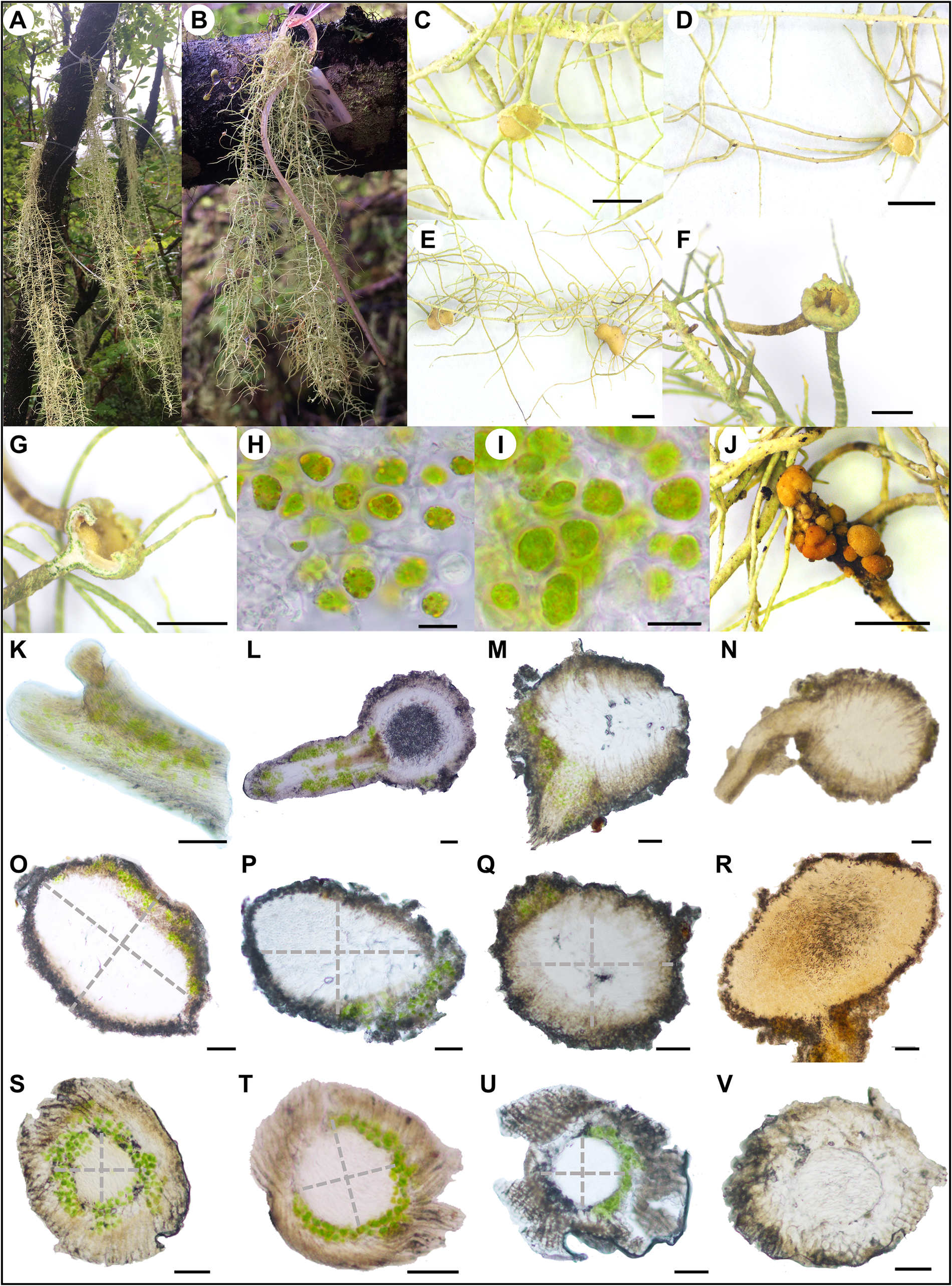
Thalli were moved to a room with ambient air humidity. They were viewed under an Olympus SZ61 dissecting microscope for the following measurements. Thallus width was measured 1–10 cm from the thallus tip at 1 cm intervals (Supplementary Material Fig. S9). The cortex of main axes was present at some points along the thallus strands, with only a thin loose layer of medullary hyphae along other sections. All width measurements are the sum of outer cortex (or layer of medullary hyphae), photobiont layer and central medullary cord width. The number of apothecia was counted (see Fig. 2B–G), and width was recorded for the first four apothecia from the thallus tip. Lichenicolous fungi (e.g. Fig. 2J) were recorded if present; these may represent new species, and identification is beyond the scope of this study. Images were captured using a Nikon DS-Fi2 digital camera mounted on a Nikon SMZ-745T microscope (Fig. 2C–J).
Dolichousnea longissima. A, pendants attached to branches of a recipient host tree. B, pendant with apothecia. C–F, apothecia. G, cross-section of apothecia. H & I, green algal cells. J, lichenicolous fungus. K–V, thallus sections. K, longitudinal section of fibril. L–N, cross-sections of main stem, with longitudinal section of fibril. O–R, cross-sections of main stem. S–V, cross-sections of fibrils. Dotted lines in O–Q and S–U indicate quartiles within which algal presence was scored, demonstrating scores of four (S), three (T), two (O & U), one (P & Q) and zero (R & V). Scales: C–G, I & J = 1 mm; H = 10 μm; K–V = 50 μm.

Cross-sections of both the main stem and fibrils were taken at 1 cm, 3 cm and 6 cm away from a single tip of each thallus strand (Supplementary Material Fig. S9). These were mounted in water and viewed under a Nikon Eclipse E200 light microscope. Algal layers were present in main stems, side branches and fibrils. The abundance of green algae within the thallus was scored from 1 to 4, according to whether they were present or absent within each of the four quadrants (Fig. 2O–V). Scores were summed such that values for algal presence in either the main stem G m or fibrils G f could range from 0–12, with total algal presence in both main stem and fibrils (G T = G m + G f) ranging from 0–24. The proportion of algae in fibrils versus the main stem G r was calculated as:
 $$ {G}_r={G}_f/{G}_m $$
High values for G r would indicate that algae had died within the main stem, but survived or re-established in the new growth of the fibrils (e.g. Fig. 2L). In cases such as Fig. 2M, where algae were present only in the vicinity of the join of the main stem with a fibril, these were still scored as being present in that quadrant of the main stem. Images of thallus sections in Fig. 2K–V were later taken with a Nikon Eclipse Ci-S microscope mounted on a Nikon DS-Fi2 digital camera.
Three additional parameters were calculated related to reproduction: the threshold thallus length required for apothecia production (adapted from Gregersen et al. (Reference Gregersen, Hegseth, Hestmark, Kongsbak and Moe2006)), and reproductive allocation according to either thallus length or mass (adapted from Merinero et al. (Reference Merinero, Méndez, Aragón and Martínez2017)). Where A is number of apothecia, c is the allometric coefficient and s is the allometric slope according to either thallus length s L or mass s M:
 $$ \mathrm{log}(A)=\log (c)+{s}_L\;\log (L) $$
 $$ \mathrm{log}(A)=\log (c)+{s}_M\;\log (M) $$
If s L < 1 or s M < 1, it indicates that there would be higher reproductive allocation in shorter or lighter thalli, respectively. If s L > 1 or s M > 1, there would be higher reproductive allocation in longer or heavier thalli.
Phylogeny
For phylogenetic analyses, a subset of 203 thalli were selected from this experiment (only healthy thalli and not exceeding one thallus strand per pendant or control), along with an additional comparison group of ten Dolichousnea longissima thalli from the KUN-L herbarium previously collected from across the Qinghai-Tibetan Plateau. A small sample of c. 1 cm was taken from close to the thallus tip, then ground prior to extraction of genomic DNA using DNAsecure Plant Kits (TIANGEN), according to the manufacturer’s instructions. ITS1F and ITS4 (White et al. Reference White, Bruns, Lee, Taylor, Innis, Gelfand, Sninsky and White1990; Gardes & Bruns Reference Gardes and Bruns1993) were used as primers. PCR amplification reactions were performed in a 30 μl volume, containing 1 μl of genomic DNA, 2 μl of a 5 pmol μl−1 solution for each primer, 15 μl of 2 × Taq PCR Master Mix and 10 μl of ddH2O. The PCR process was as follows: initial denaturation at 95 °C for 5 min, followed by 35 cycles of denaturation at 95 °C for 30 s, annealing at 60 °C for 30 s, and elongation at 72 °C for 30 s, with a final extension at 72 °C for 5 min. A volume of 2 μl of the PCR product was tested by agarose gel electrophoresis (1%). PCR product sequencing was carried out with the same amplification primers, using Sanger technology, by Huayu Gene Biotechnology Co., Ltd (Wuhan, China).
Forty-five sequences from samples of Usnea and Dolichousnea were downloaded from GenBank, ten sequences were obtained from our herbarium materials and 198 new D. longissima sequences were obtained from materials collected in this study. All sequences were edited manually using Geneious v. 8.0.2. The nrITS matrix was aligned using MAFFT v. 7 with the option of E-INS-I (Katoh et al. Reference Katoh, Kuma, Toh and Miyata2005). Ambiguous regions were excluded using Gblocks (Talavera & Castresana Reference Talavera and Castresana2007) with the default settings. Phylogenetic relationships were inferred based on Bayesian inference (BI) and maximum likelihood (ML). ML analyses were performed using RAxML v. 8.2.12 (Stamatakis Reference Stamatakis2006) with 2000 rapid bootstrap replicates. Bootstrap support values (BS) were estimated from the 70% majority-rule tree from all saved trees. BI analyses were performed with MrBayes v. 3.2.7 (Ronquist et al. Reference Ronquist, Teslenko, van der Mark, Ayres, Darling, Höhna, Larget, Liu, Suchard and Huelsenbeck2012), running for 2 million generations. The trees were sampled every 100 generations, with the first 25% of trees discarded as burn-in. Bayesian posterior probabilities (PP) were obtained from the 95% majority-rule consensus tree of all saved trees. FigTree v.1.4.0 (Rambaut Reference Rambaut2012) was used to view and edit the phylogenetic tree. All new ITS sequences from this study are deposited in GenBank.
Data analysis
All maps were produced using ArcMap 10.8.2, with schematic diagrams produced in Microsoft PowerPoint 2016. All graphs were plotted in R; data analysis was conducted using R v. 4.1.1, within RStudio v. 1.4.1717 (R Core Team 2021). Data from the pilot experiment in 2019 were analyzed using ANOVA (with function ‘aov’) and linear regression ‘lm’. For the main transplantation, field data after three months’ growth were analyzed using linear regression ‘lm’, with initial thallus length log transformed. All other analyses relate to the final data from 2023.
Generalized linear mixed models (‘glmer’ in ‘lme4’) were used for presence/absence and probability data, fit by maximum likelihood (Laplace Approximation), following a binomial distribution with a logit link. Since pendants on the same tree and thallus strands in the same pendant are not fully independent, recipient host tree and pendant identity were included as nested random effects. Linear regression ‘lm’ was used to analyze microclimate impact on the threshold thallus length for apothecia production, and the allometric slope. All other analyses used linear mixed models (‘lmer’ in ‘lme4’) with recipient host tree and pendant identity as nested random effects. Model residuals were acceptably close to a normal distribution, since mixed models are robust to deviations from distributional assumptions (Schielzeth et al. Reference Schielzeth, Dingemanse, Nakagawa, Westneat, Allegue, Teplitsky, Réale, Dochtermann, Garamszegi and Araya-Ajoy2020).
Microclimate predictors were first identified using stepwise regression, then utilized in the full model analyses described above. The leaps package was used with repeated k-fold cross-validation, trained using the ‘leapSeq’ method, selecting the number of variables with the lowest RMSE, then the best set of predictor variables for that model size. The full model was selected using a substitution approach. Non-significant interactions were removed unless this increased the AIC values for the model. Model residual plots were examined; in three cases where these indicated possible non-linear effects, non-linear regression was also conducted, but there was no case in which this improved model fit so only linear models have been reported. Partial residual plots were produced using ‘effect_plot’, ‘crPlots’ and ‘interact_plot’.
A Principal Components Analysis (PCA) was used to establish whether apothecia production was linked to other co-variates and whether there were clusters amongst the above measured variables which might indicate that samples belonged to morphologically and genetically divergent populations. Two extreme outliers of high apothecia production were removed from the PCA data set in order to improve visualization. These outliers were not removed from any other analyses.
Results
Microclimate records
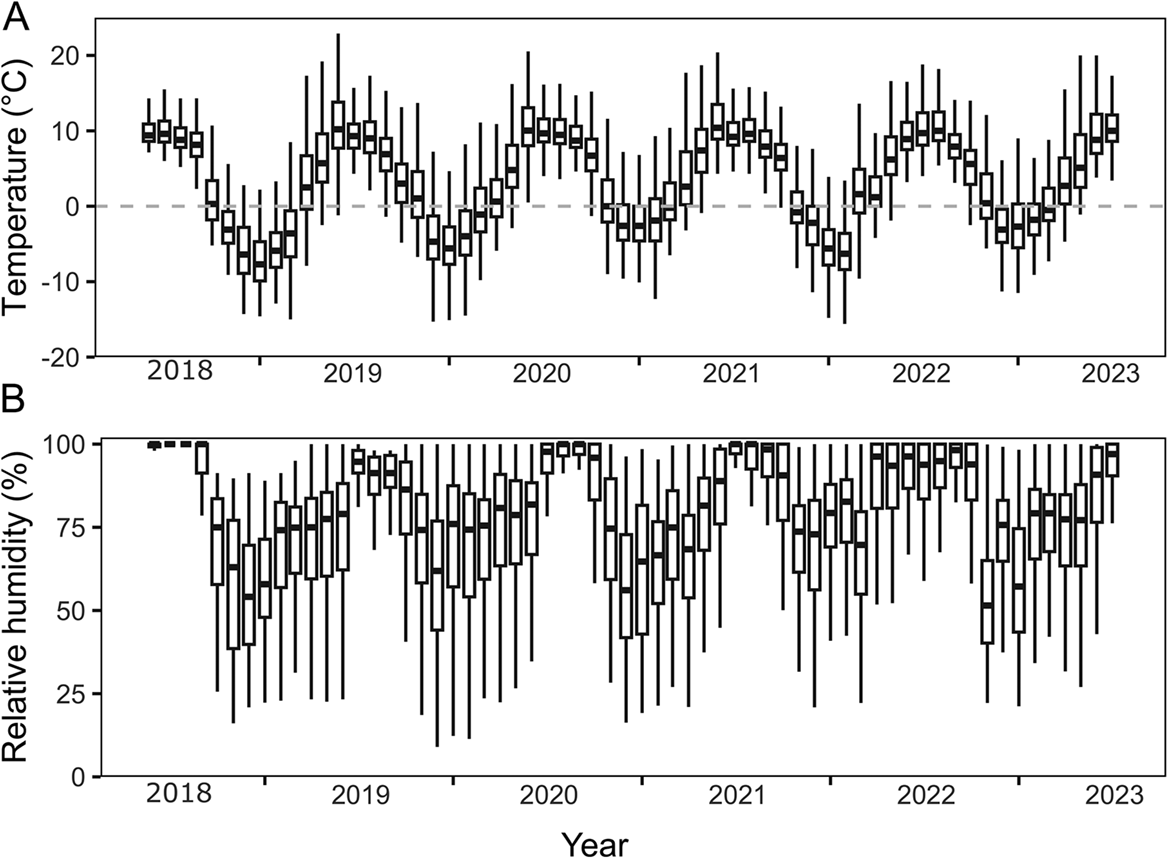
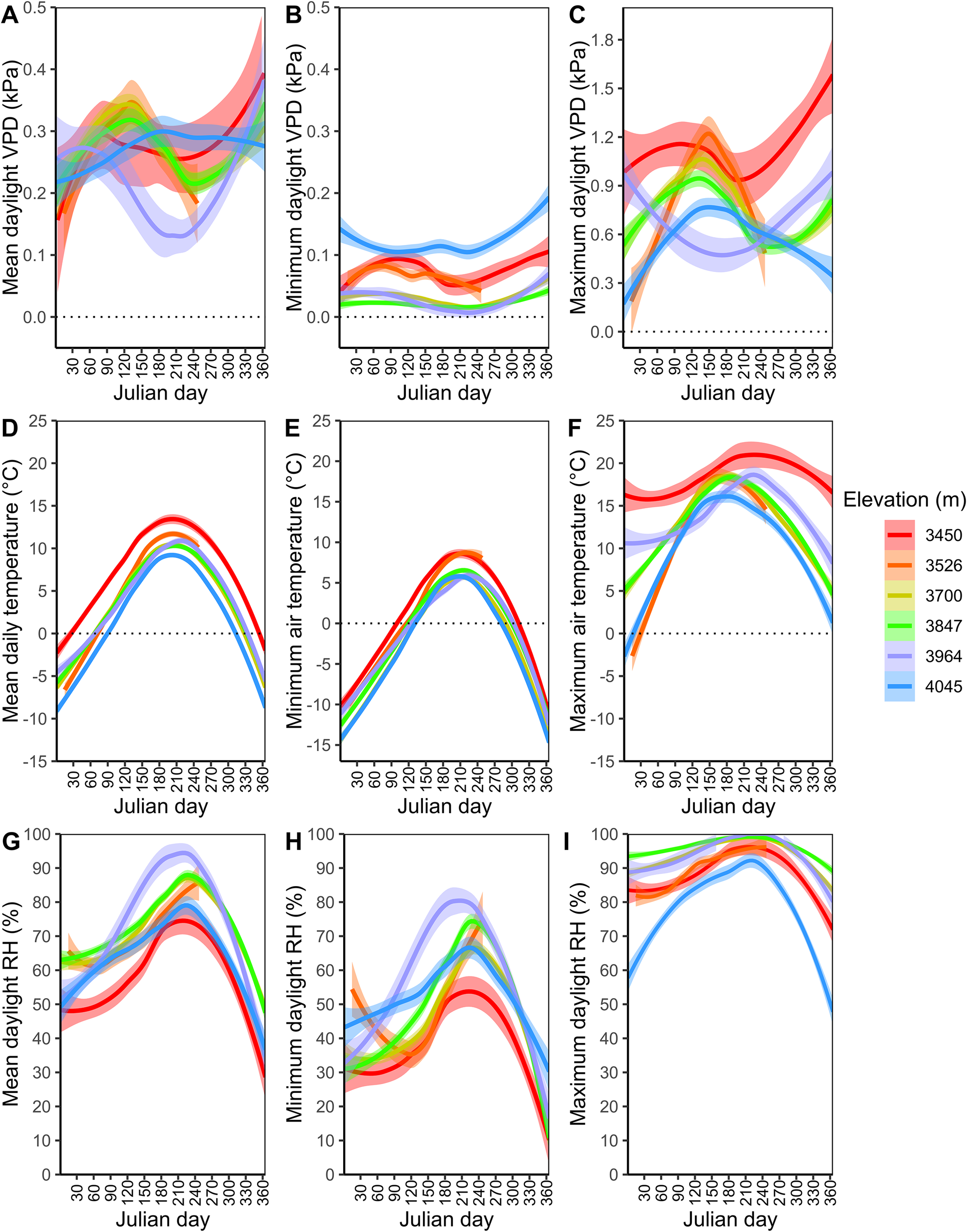
Microclimate records showed similar seasonal patterns from 2018 to 2023 (Fig. 3). The rainy season generally falls between June and September, thus both temperature and relative humidity (RH) were higher in summer and lower in winter (Figs 3 & 4). During daylight, minimum vapour pressure deficit (VPD) was fairly stable throughout the year (Fig. 4B). The greatest VPD was in winter at the lowest elevation site (Fig. 4A & C). The coldest temperatures were recorded at the highest elevation site, with the warmest temperatures at the lowest site (Fig. 4D–F). The lowest elevation site had the lowest RH. Overall, the most humid sites were at 3964 m and 3847 m elevation, corresponding to the upper sites of transects T1 and T2 (Fig. 4G–I).
Boxplots showing variation in monthly (A) temperature (°C), and (B) relative humidity (%) between 2018 and 2023 across all Dolichousnea longissima study sites in the mountains of Shangri-La County of Diqing Prefecture, Yunnan Province, China.

Microclimate conditions at study sites of Dolichousnea longissima along an elevational gradient in the mountains of Shangri-La County of Diqing Prefecture, Yunnan Province, China. A–C, vapour pressure deficit (VPD, kPa). D–F, temperature (°C). G–I, relative humidity (RH %).

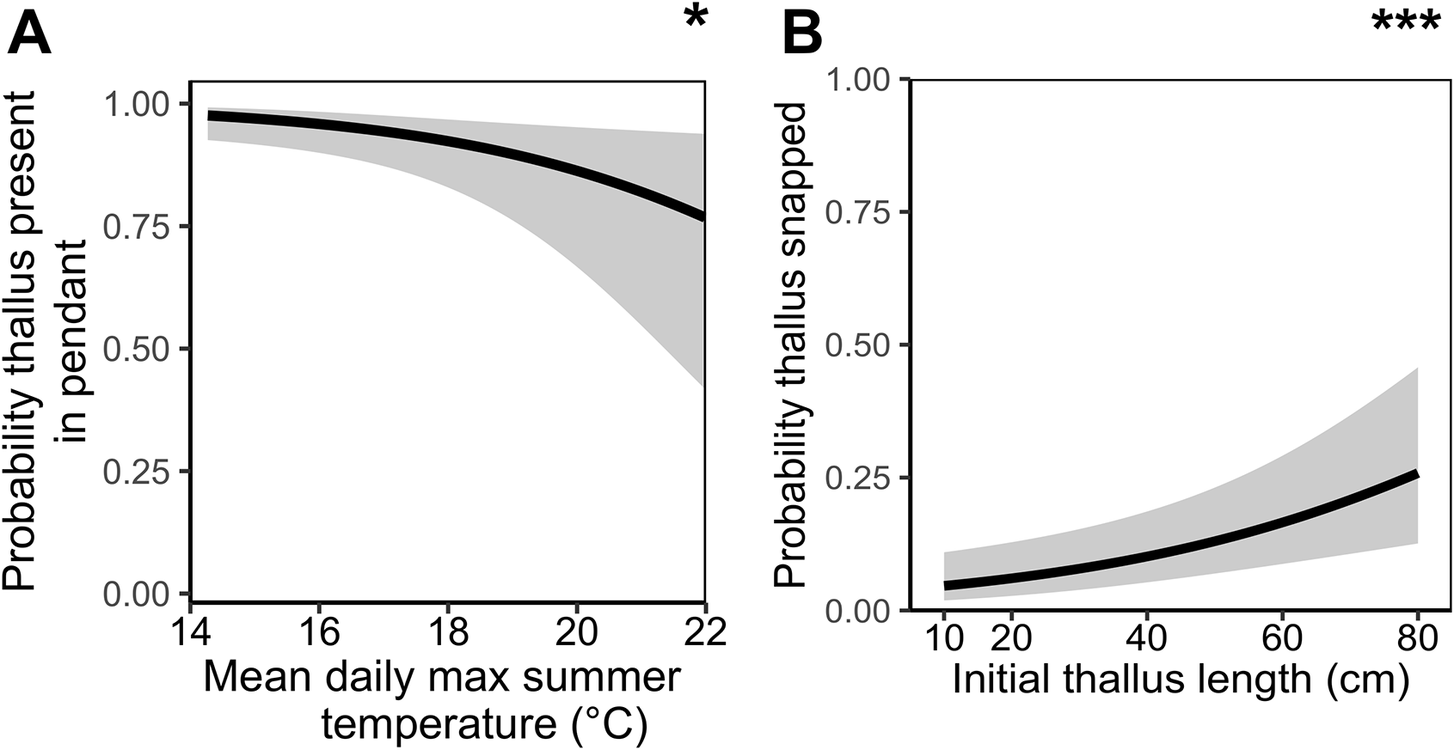
Partial residual plots for impact of mean daily maximum summer temperature (°C) on the probability of transplanted thalli of Dolichousnea longissima still being present within pendants (A), and of initial thallus length (cm) on the probability that the thallus had snapped (B). Confidence intervals (95%) for the regression lines reflect only the variance of the fixed effects, not random effects. Significant trends are indicated by: * P < 0.05, ** P < 0.001.

Pilot experiment
In the pilot experiment, no thalli produced apothecia. Relative thallus length growth rate (RTLGR) was significantly faster for thallus strands of 20 cm initial length, becoming progressively slower for the 40 cm then 80 cm thallus strands (Supplementary Material Fig. S6A, available online). Thallus mass length ratio (TML) was higher for the longest thallus strands, but this was not statistically significant (Supplementary Material Fig. S6B).
Transplantation experiment
When the transplanted pendants were monitored after three months’ growth, all pendants were still present and all thalli appeared healthy. Most thalli had grown and few had fragmented. Microclimate conditions changed between days during the monitoring trip, altering thallus hydration and thereby complicating the interpretation of between-site length differences. However, within each site, comparisons between pendants of differing lengths would be unbiased. Thalli showed significant negative length-dependent growth at all sites: shorter thalli grew more rapidly than longer thalli (Supplementary Material Table S3 & Fig. S10, available online), but with inter-site differences. At the highest, coldest site, longer thalli would grow nearly as fast as shorter thalli. However, in the lowest, warmest site, shorter thalli grew far more rapidly, with markedly slower growth rates for longer thalli (Supplementary Material Fig. S10).
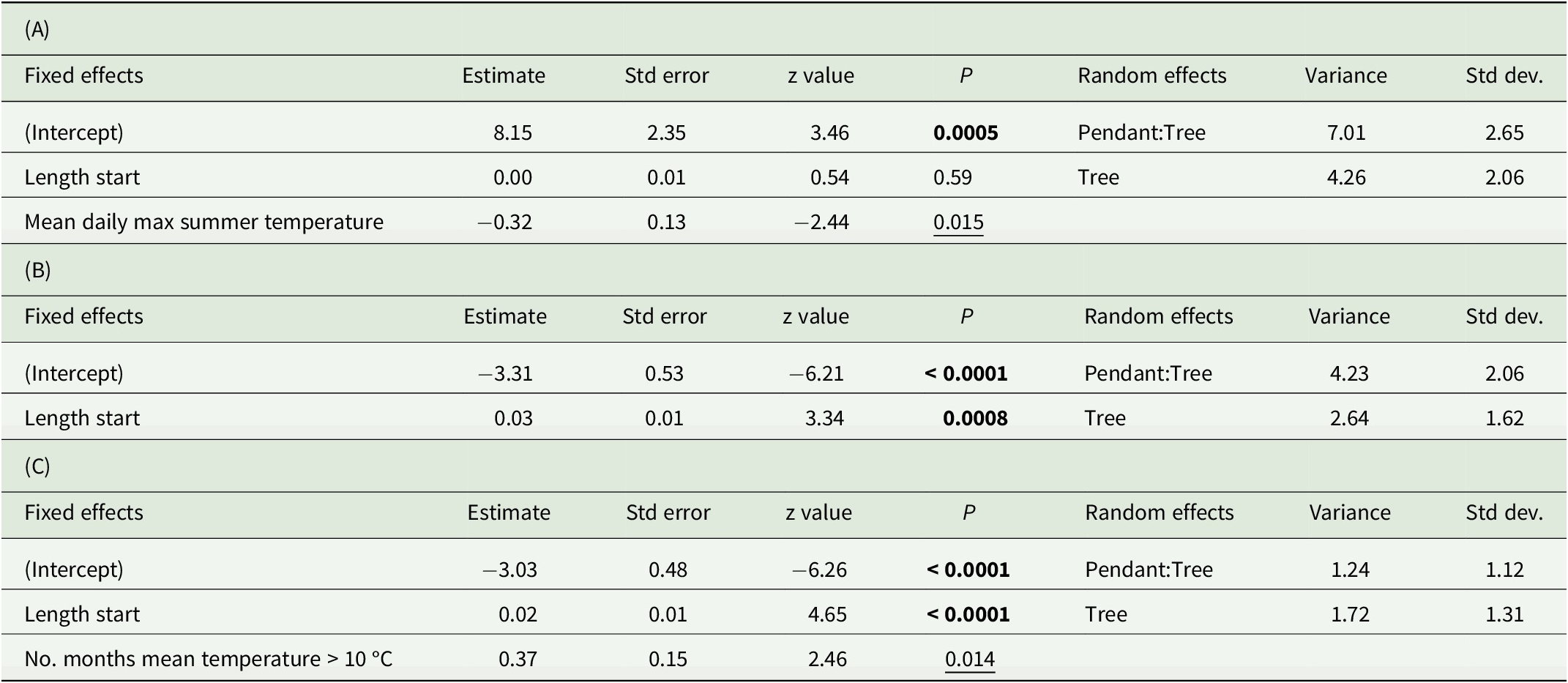
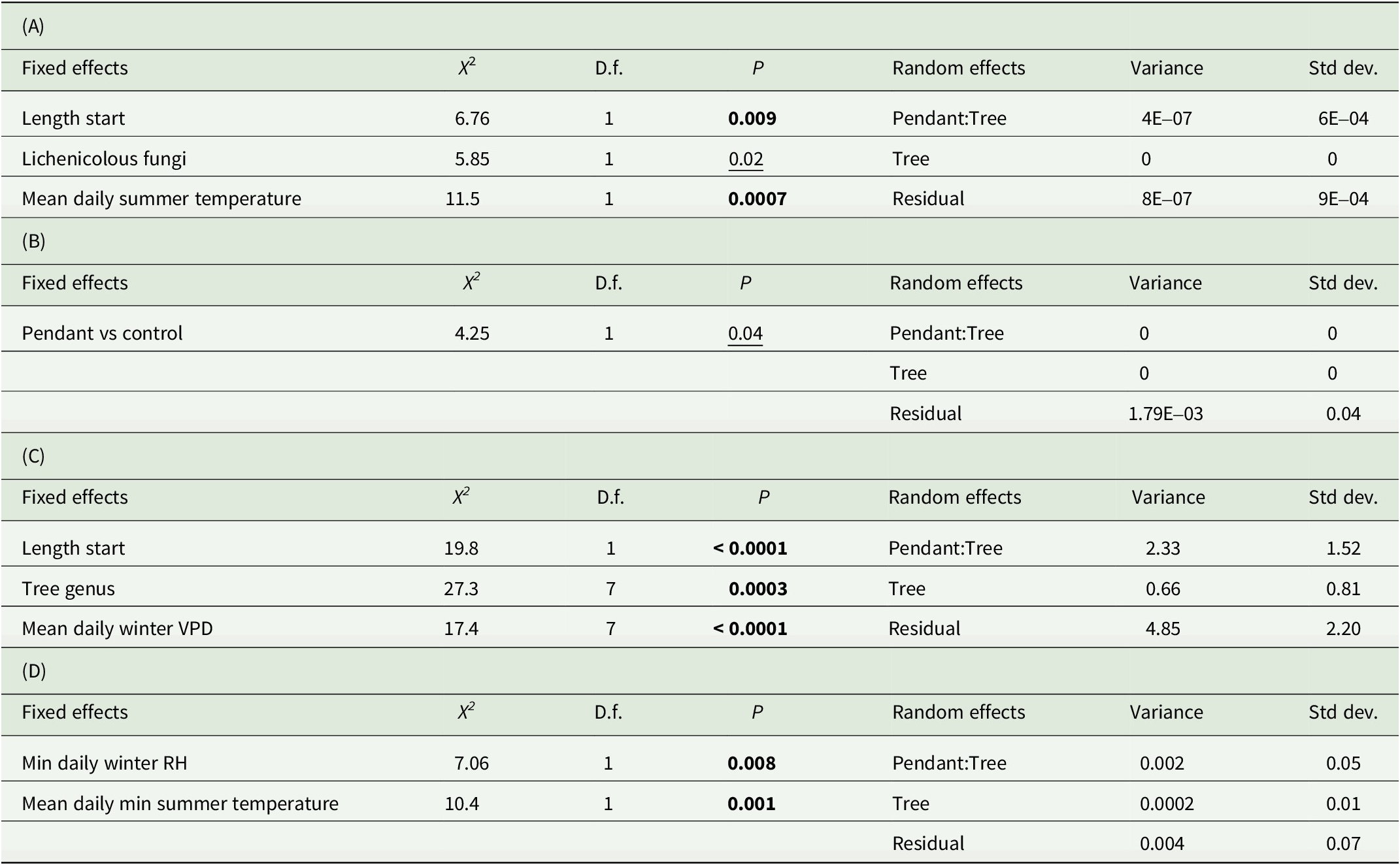
At the end of the experiment in 2023, 14 pendants were not found. Of the remaining 226 pendants, 15 had no thallus strands still suspended within the pendant, and only 105 still contained all four thallus strands. In one instance an entire tree had fallen, causing the loss of all thalli (n = 12) from three pendants. Otherwise, the probability that each thallus strand was still present within its pendant declined with higher maximum summer temperatures, indicating that the highest temperatures (22 °C) may have increased rates of thallus fragmentation and decay (Table 1A, Fig. 5A), leading to mortality of the thalli which fell to the forest floor. Of the 715 thallus strands still present, 164 had partially fragmented (22.9%) and 551 were longer than at the time of the initial transplantation. Final length of the main stem ranged from 1.7 cm to 321 cm, with a median of 34.1 cm and mean of 49.6 cm. Total length of both main stem and side branches ranged from 1.7 cm to 764 cm, with a median of 42.5 cm and mean of 70.7 cm. Histograms for thallus length are provided in Supplementary Material Fig. S11 (available online). Although these show highly skewed data, calculated values (e.g. RTLGR) tended to normalize the data, so that residuals of the final linear models followed a normal distribution.
Generalized linear mixed model for the probability that (A) for Dolichousnea longissima pendants which were present, the thallus was missing. For thalli which were present in pendants, whether (B) the thallus had snapped and (C) they had produced apothecia.

Note. Generalized linear mixed model fit by maximum likelihood (Laplace Approximation), following a binomial distribution with a logit link. Values for P < 0.05 are underlined, P < 0.01 are in bold font.
The probability that thalli had fragmented increased with initial thallus length (Table 1B, Fig. 5B), indicating that causes were likely to be mechanical (e.g. snow, wind, heavy rainfall). Therefore, fragmented thalli were excluded from analyses related to length (leaving n = 551) rather than treated as negative growth rates (see footnotes to Tables 1–6).
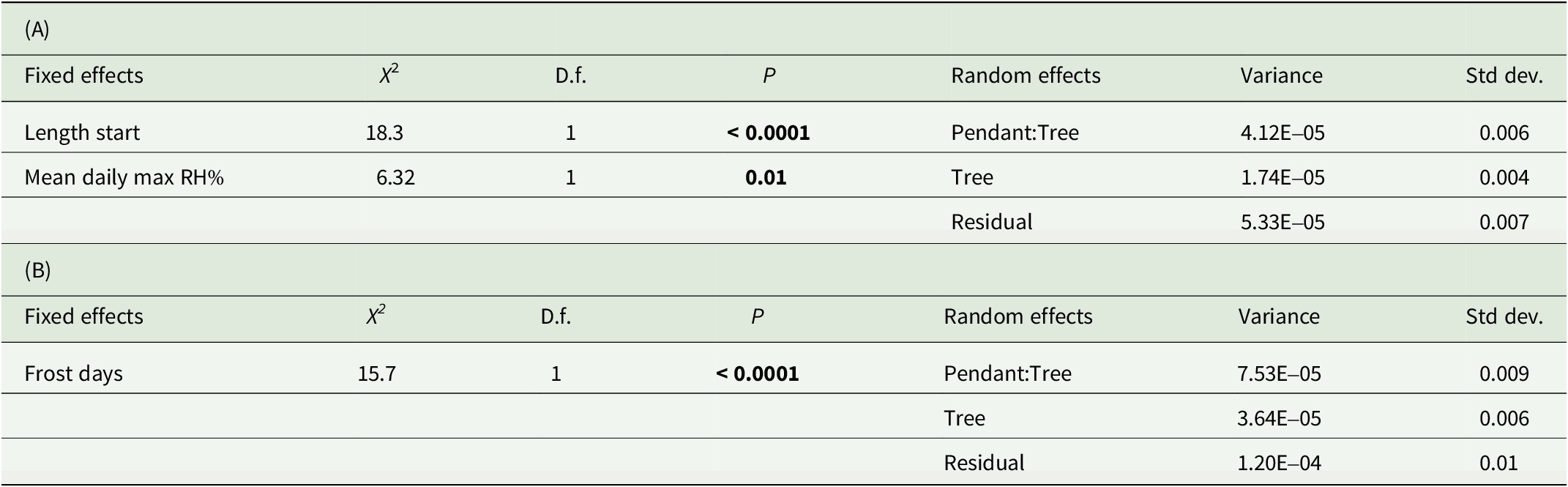
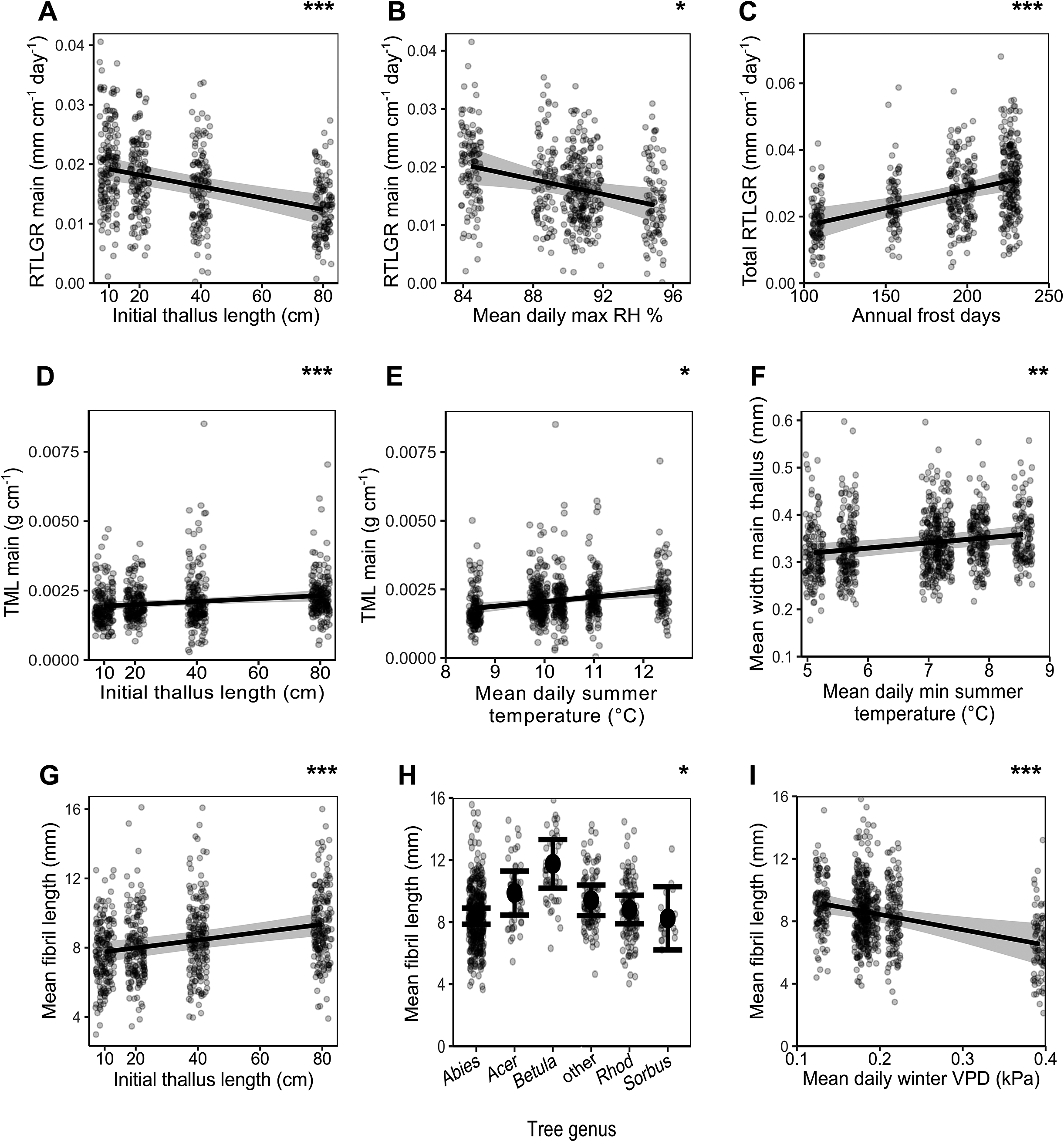
Relative thallus length growth rate (RTLGR) of the main stem was fastest for the shortest thalli, progressively declining with length, with the slowest growth rates for the longest thalli (Table 2A, Fig. 8A). RTLGR was also affected by microclimate; unexpectedly, the fastest growth of the main stem was at sites with the lowest relative humidity (RH; Table 2A, Fig. 6B). RTLGR of the main stem was 0.018 ± 0.0004 (mean ± S.E.), ranging from 0–0.057 mm cm−1 day−1. Total RTLGR was 0.028 ± 0.0006 (mean ± S.E.), ranging from 0.0004–0.087 mm cm−1 day−1. Total RTLGR was fastest at sites with the greatest number of annual frost days (Table 2B, Fig. 6C). Other variables related to mycobiont growth were also related to initial thallus length, but variables related to the photobiont were unaffected (Tables 3– 5, Figs 6 & 7). Both thallus mass length ratio (TML) and fibril length were greater for longer thalli (Table 3, Fig. 6D & G).
Linear mixed model of relative thallus length growth rate (RTLGR; mm cm−1 day−1) for the main stem of Dolichousnea longissima (A) and the total for main stem and side branches (B). RH = relative humidity.
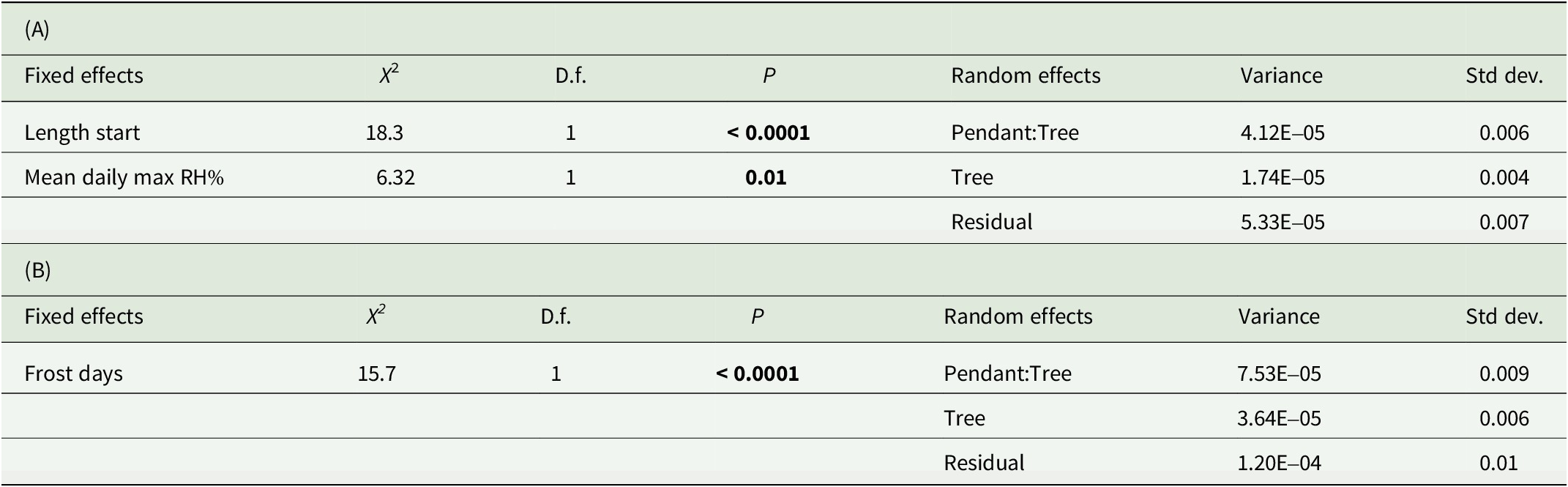
Note. Data set includes only transplanted thalli that were present in pendants and had not snapped. Values for P < 0.01 are in bold font.
Partial residual plots for impact of initial thallus length, microclimate and host tree on relative thallus length growth rate (RTLGR), thallus mass length ratio (TML), thallus width and fibril length. Values relate to either the main stem of Dolichousnea longissima or total value from both main stem and side branches. VPD = vapour pressure deficit; RH = relative humidity. Confidence intervals (95%) for the regression lines reflect only the variance of the fixed effects, not random effects. Significant trends are indicated by: * P < 0.05, ** P < 0.01, *** P < 0.001.

Linear mixed model of thallus mass length ratio (TML; g cm−1) for the main stem of Dolichousnea longissima (A) or all side branches (B), with length (mm) of fibrils (C) and width of main stem (mm) (D). RH = relative humidity; VPD = vapour pressure deficit.
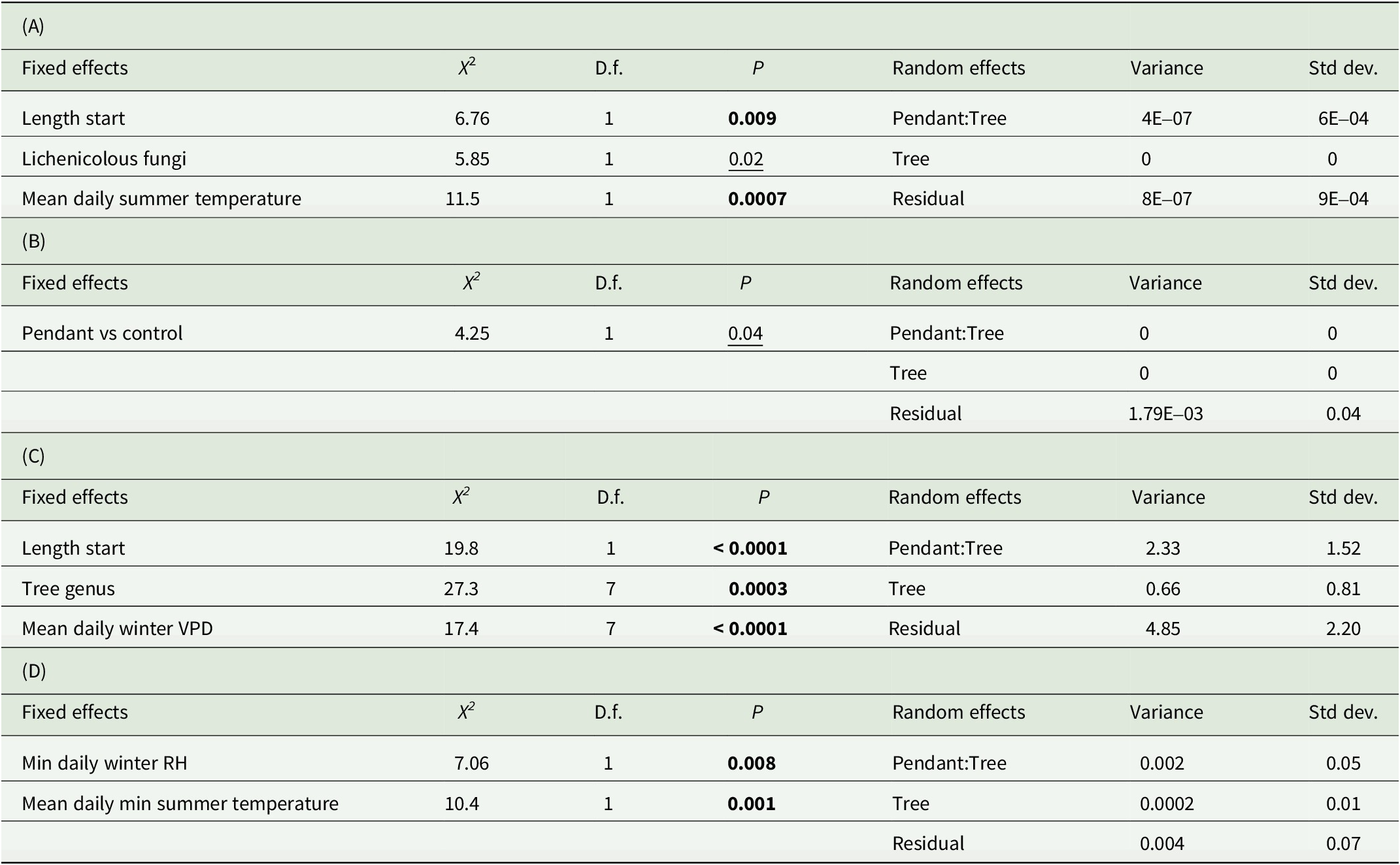
Note. Data set includes all thalli present in transplanted pendants and control specimens. Values for P < 0.05 are underlined, P < 0.01 are in bold font.
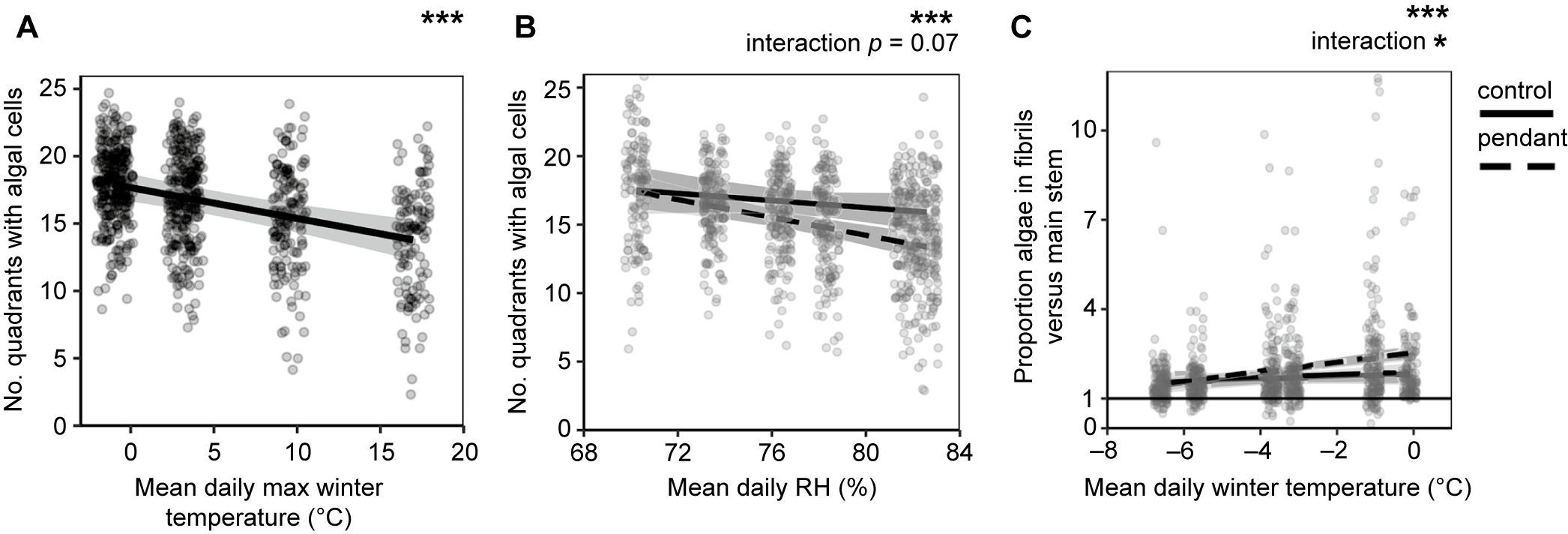
Partial residual plots for impact of microclimate on the number of quadrants in Dolichousnea longissima thallus cross-sections which contained live green algal cells, and the proportion of the quadrants containing live green algal cells which were in fibrils versus main stem of the thallus. Values are contrasted for the transplanted pendants versus control thalli freshly collected from the same tree. RH = relative humidity. Confidence intervals (95%) for the regression lines reflect only the variance of the fixed effects, not random effects. Significant trends are indicated by: * P < 0.05, *** P < 0.001.

Higher summer temperatures were related to higher TML and wider main thallus stem (Table 3, Fig. 6E & F). Higher winter RH was also related to wider main thallus stem (Table 3; Supplementary Material Fig. S12, available online). Higher winter vapour pressure deficit (VPD) was related to shorter fibrils (Fig. 6I). Higher TML was also linked to the presence of lichenicolous fungi and thalli being from pendants rather than fresh controls (Table 3, Supplementary Material Fig. S12). The main impact of recipient host tree genus was on fibril length (Fig. 6H). Bark pH differed between recipient host tree species but had no significant impact on any dependent variable (Tables 3– 6; Supplementary Material Table S2, available online).
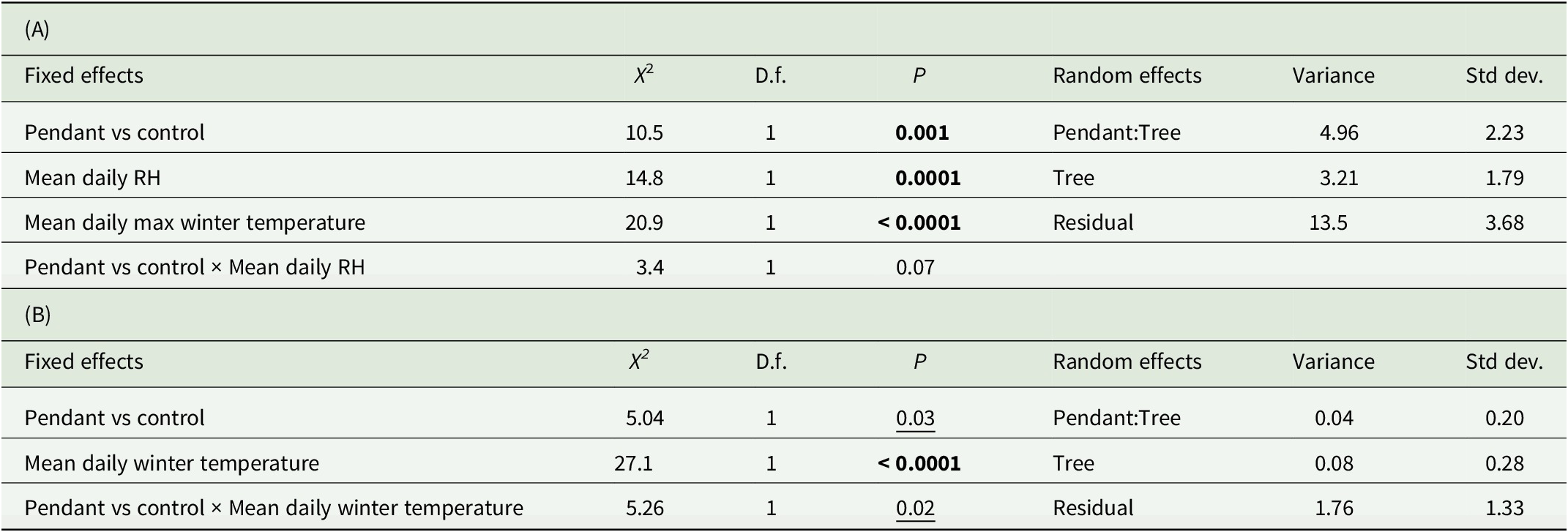
The photobiont was also affected by microclimate conditions (Table 4, Fig. 7). Algae were most abundant within thalli at sites with continuously sub-zero winter temperatures, progressively declining with warmer winters (Fig. 7A). For transplanted thalli, algae were also less abundant at higher RH (Fig. 7B). Algae were generally more abundant in the fibrils than the main stem, with this tendency increasing for thalli transplanted to milder winter temperatures (Fig. 7C).
Linear mixed model of total number of quadrants with live green algal cells (A), and the proportion of the quadrants containing live green algal cells in fibrils versus main stem of the thallus (B) of Dolichousnea longissima. RH = relative humidity.
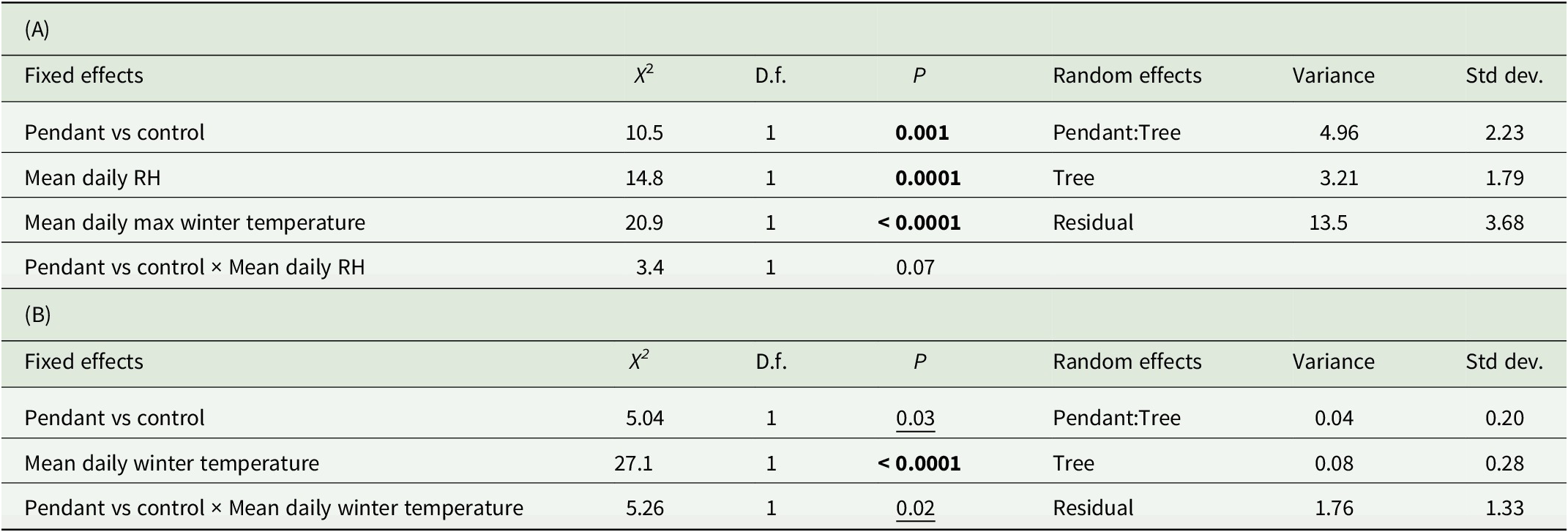
Note. Data set includes all thalli present in transplanted pendants and control specimens. Values for P < 0.05 are underlined, P < 0.01 are in bold font.
Apothecia were observed growing along or at the terminus of fibrils. Smaller apothecia were typically cup-shaped, sometimes becoming flatter with increasing size (Fig. 2C–G). Larger apothecia frequently had fibrils extending from the thalline exciple. Discs were tan-coloured, with the exception of one thallus with overmature apothecia where the discs were black. Cross-sections of apothecia showed a double photobiont layer: one layer directly beneath the cortex and a second layer beneath the internal surface of the disc (Fig. 2G).
In total, 217 thallus strands in pendants (30.3%) produced new apothecia during the study period, with apothecia also present on 42 fresh control thalli (17.5%) collected at the end of the experiment. Among thallus strands from pendants, the number of apothecia ranged from 1 to 141, with a median of 3 and mean of 9.19. Apothecia size ranged from 0.2 mm to 3.1 mm, with a median of 0.8 mm and mean of 0.94 mm. The smallest apothecia were only clearly visible under a microscope. Histograms for apothecia number and size are provided in Supplementary Material Fig. S13 (available online). For apothecia/thallus mass, there were maximum values of 800 apothecia g−1 and 1300 apothecia g−1. To avoid these two extreme outliers skewing the whole analysis, they were removed from the data set used for Principal Components Analysis (PCA).
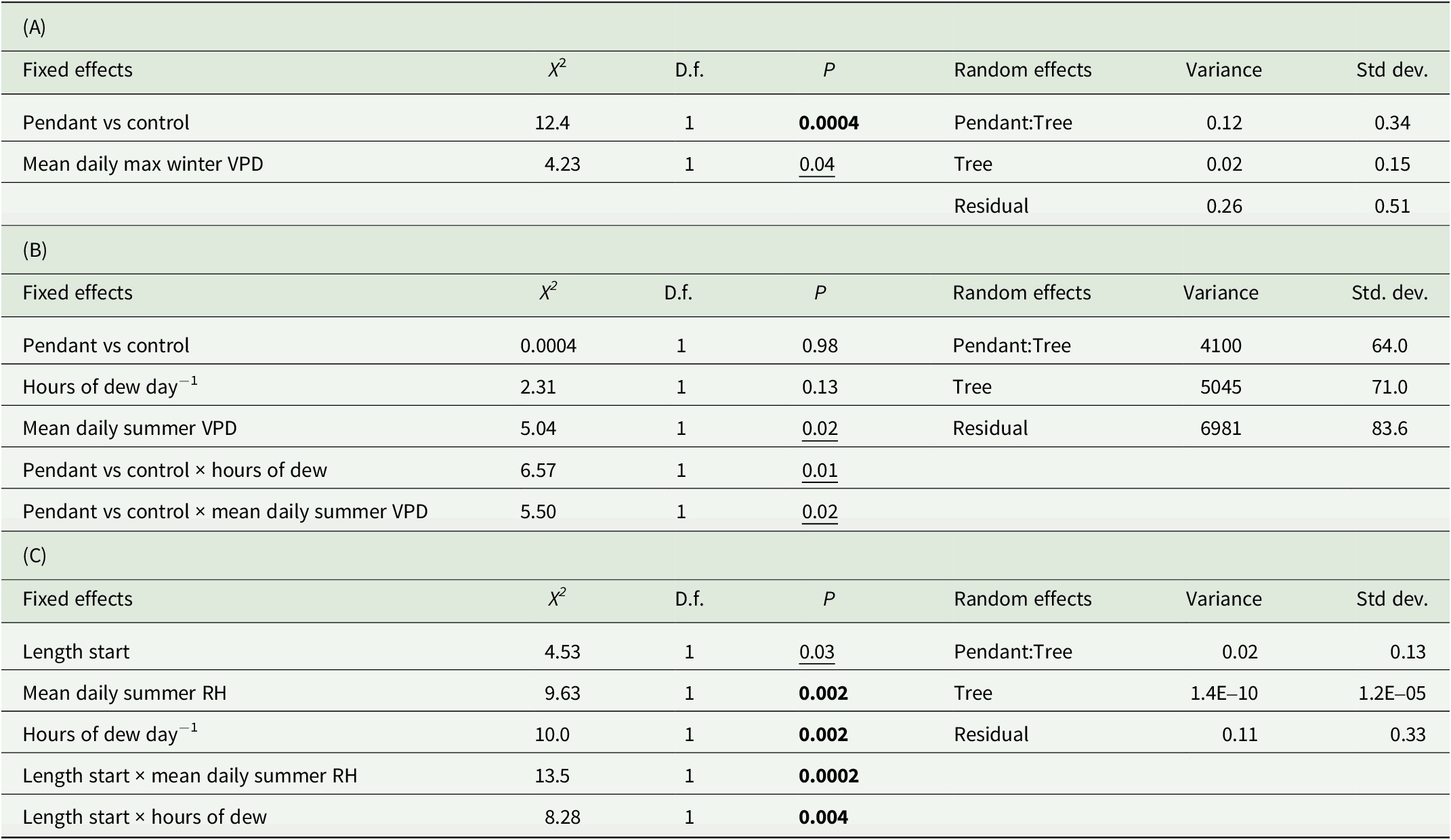
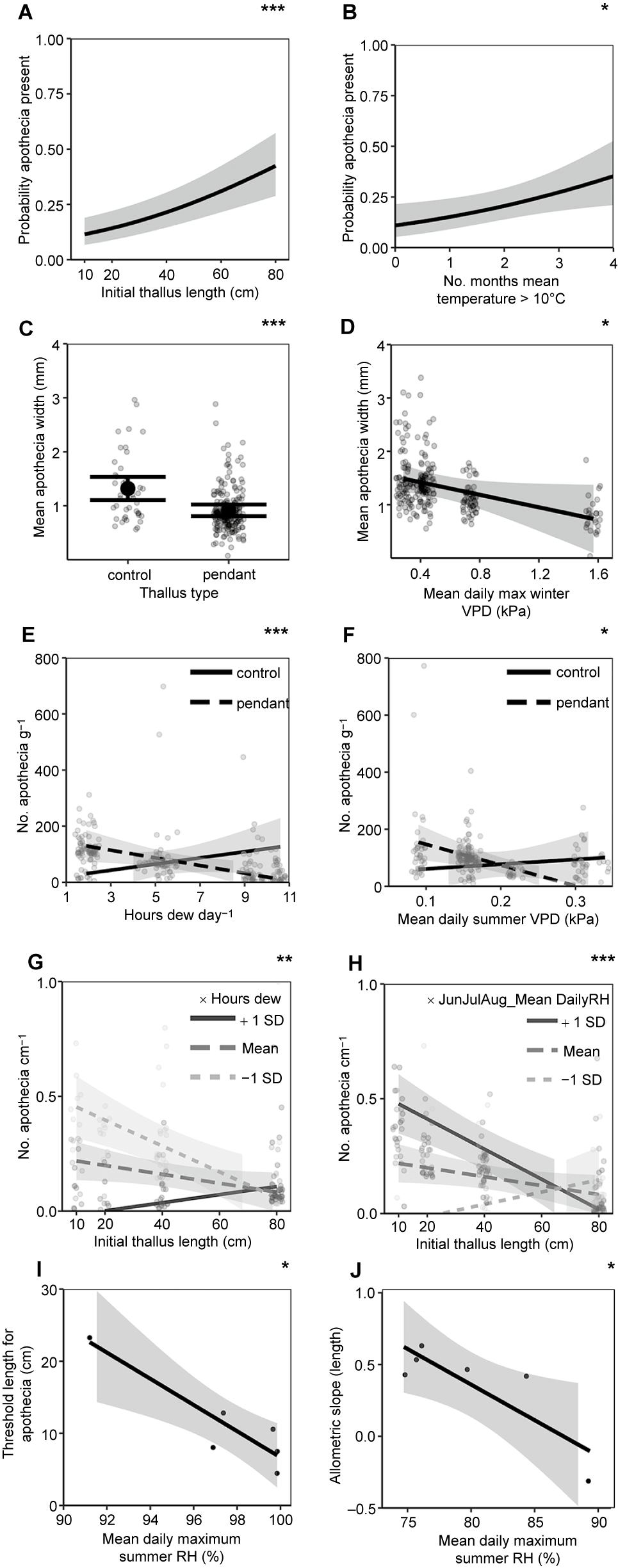
Presence, width and abundance of apothecia were affected by both initial thallus length and microclimate (Tables 1 & 5, Fig. 8). Probability of apothecia presence increased with initial thallus length (Table 1C, Fig. 8A) and sustained warmer temperatures (Table 1C, Fig. 8B). Thalli transplanted in pendants had produced new apothecia that were smaller than those found on any control thalli (Table 5A, Fig. 8C). Apothecia were also smaller at sites with high winter VPD (Table 5A, Fig. 8D). There were complex interactions between moisture conditions, transplantation and initial thallus length on abundance of apothecia relative to thallus length and mass (Table 5B & C, Fig. 8E–H).
Linear mixed model of mean apothecia width (mm) (A), number of apothecia g−1 thallus dry mass (B) and number of apothecia cm−1 thallus length (C) of Dolichousnea longissima. RH = relative humidity; VPD = vapour pressure deficit.

Note. Data set includes thalli present in transplanted pendants and control specimens, but excludes thalli in which apothecia were absent. Values for P < 0.05 are underlined, P < 0.01 are in bold font.
Partial residual plots for relationship between initial thallus length (A) and temperature (B) on the probability of apothecia of Dolichousnea longissima being present. Impact of initial thallus length, microclimate and whether thalli were transplanted or controls on mean apothecia width (C & D), number of apothecia relative to thallus mass (E & F), number of apothecia relative to thallus length (G & H), threshold thallus length for apothecia production (I) and allometric slope (J). RH = relative humidity; VPD = vapour pressure deficit. Confidence intervals (95%) for the regression lines reflect only the variance of the fixed effects, not random effects. Significant trends are indicated by: * P < 0.05, ** P < 0.01, *** P < 0.001.

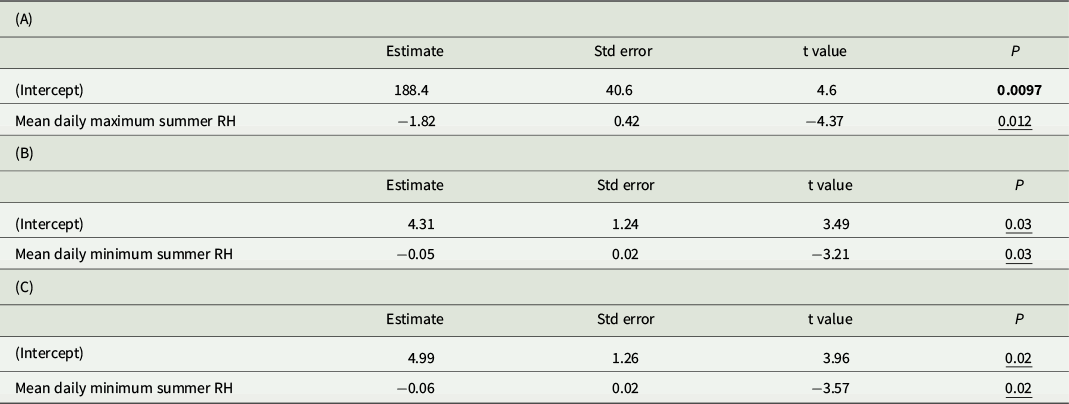
The threshold length for apothecia production was longest (25 cm) at the site with the lowest maximum summer RH (upper site of T3), with a progressively declining threshold with rising RH (Table 6A, Fig. 8I). The shortest thallus with apothecia was 4.4 cm, which was found at the lower site of T2, followed by a 7.6 cm thallus at the upper site of T1 and one of 8.3 cm at the lower site of T2. As the shortest initial thallus length was 10 cm, these correspond to thalli that had produced apothecia despite thallus fragmentation. The allometric slope s was always < 1, meaning that there was higher reproductive allocation in shorter and lighter thalli. The value for s was negatively related to minimum summer RH, regardless of whether it was calculated according to thallus mass or length (Table 6, Fig. 8J). With 74.7% to 84.1% summer RH, sL ranged from 0.39–0.61, and s M ranged from 0.49–0.93. At the highest summer RH (89%), the allometric slope was negative (sL = −0.31, s M = −0.18), indicating that total apothecia production declined for longer and heavier thalli.
Linear model of the threshold thallus length of Dolichousnea longissima for apothecia production (A), and the allometric slope s between apothecia production and thallus length (B) and mass (C).

Note. Data set includes only transplanted thalli that were present in pendants. Values for P < 0.05 are underlined, P < 0.01 are in bold font.
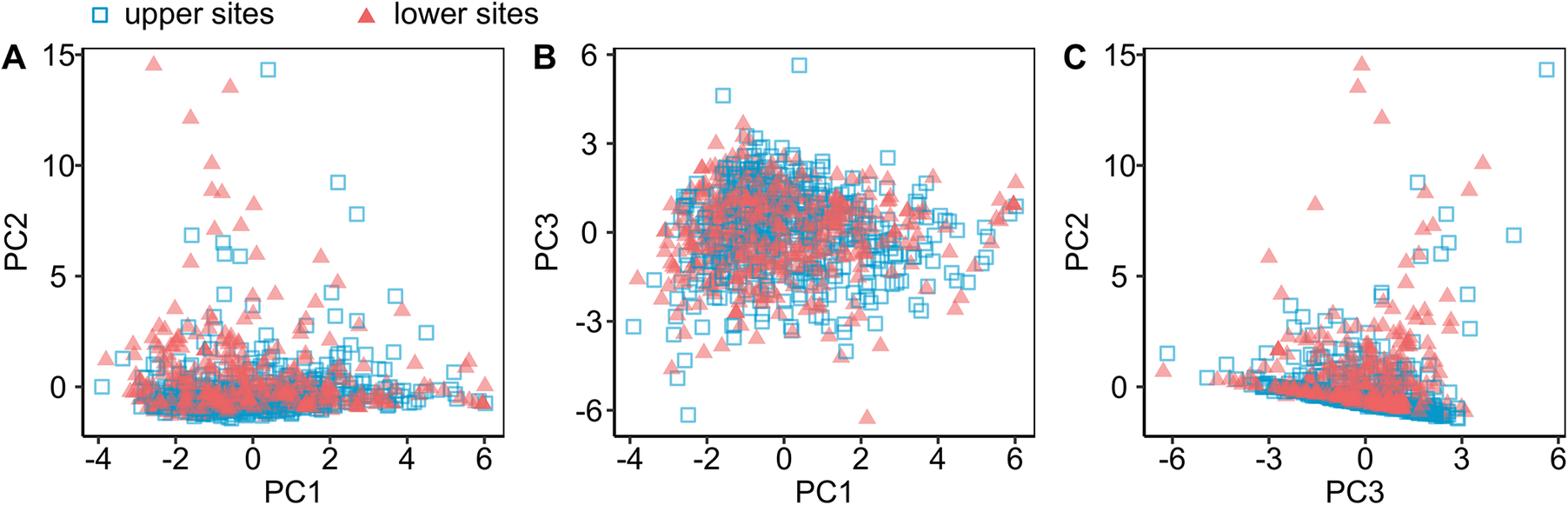
The first three axes of the principal components analyses, PC1, PC2 and PC3, can be summarized as algal abundance (PC1), apothecia size and abundance (PC2), and main stem width, TML and fibril length (PC3) (see axis description in Supplementary Material Table S4, available online), accounting for 18.7%, 15.9% and 12.2% of the variance, respectively. The weightings for these first three axes are provided in Supplementary Material Table S5 (available online). Biplots did not reveal any major discontinuities along the axes (Fig. 9, Supplementary Material Figs S14– S16, available online); there was no evidence for separated clusters of trait associations which might have indicated morphologically distinctive subgroups. For every axis, values recorded at the lower sites fell within the range of those at the upper sites. Notably, positive versus negative values for PC2 (apothecia) did not correspond to bimodal distributions on any other axis. In the upper sites, the highest apothecia production occurred in thalli with abundant algae, high TML and long fibrils, whereas at lower sites, apothecia production occurred even for thalli with low algal abundance, low TML and short fibrils (Fig. 9).
Biplots between the three main axes extracted from the Principal Components Analysis, comparing associations for upper and lower study sites of Dolichousnea longissima in the mountains of Shangri-La County of Diqing Prefecture, Yunnan Province, China. Variables are PC1 (algal abundance), PC2 (apothecia size and abundance) and PC3 (main stem width, thallus mass length ratio and fibril length). In colour online.

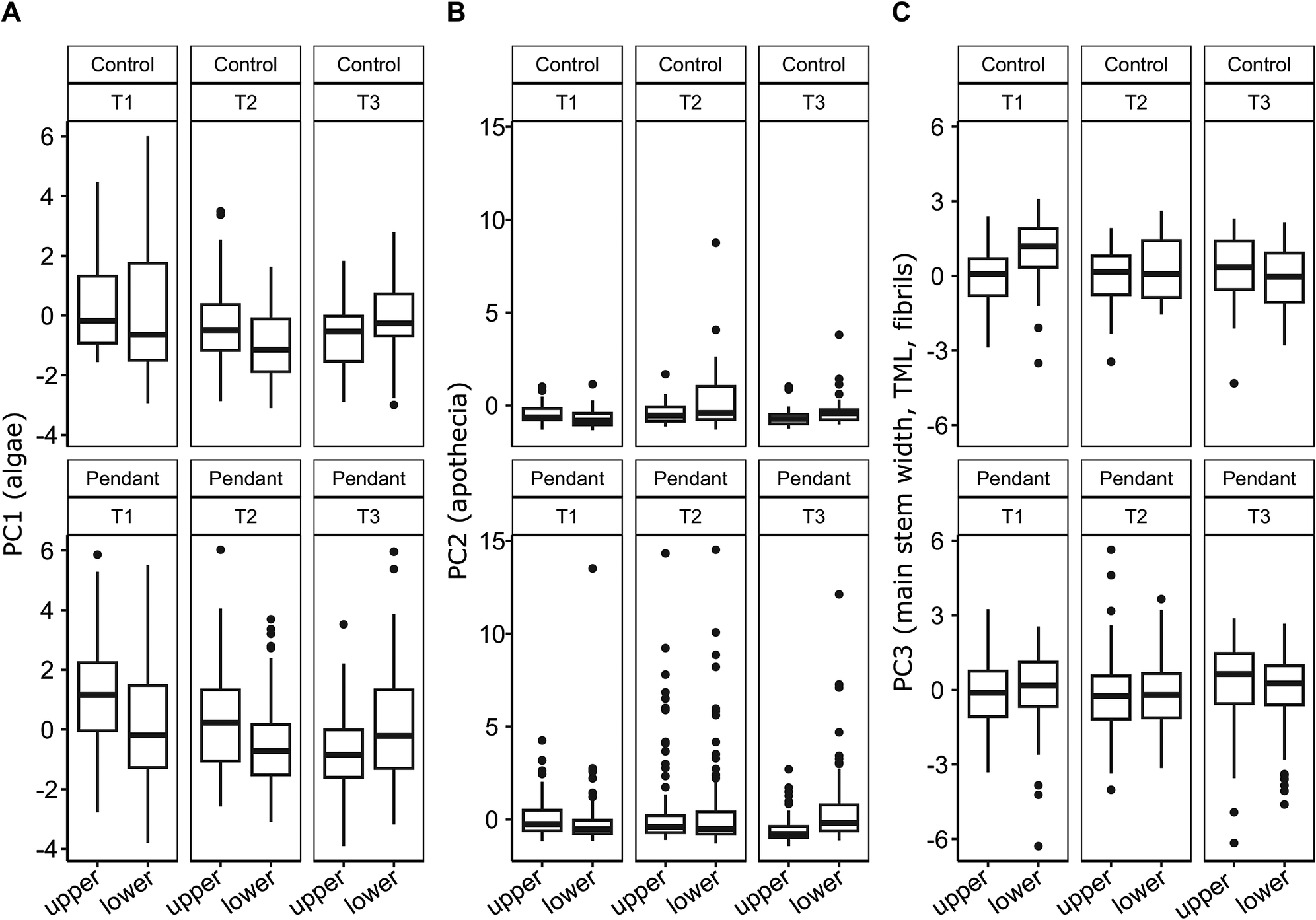
Overall, transplantation had caused changes to morphology and reproduction of thalli, but the exact impact differed between transects (Fig. 10). Algal abundance of thalli (PC1) at lower sites was more similar to that of control thalli at the same site than for thalli at the upper site from which they had been originally transplanted (Fig. 10A). Both warming and transplantation itself could have contributed to inducing apothecia production (Fig. 10B). Although the general trends of associations along the three axes were comparable for both control thalli and those that had been transplanted in pendants, the highest values for PC2 and PC3 were both from pendants (Supplementary Material Fig. S14). Biplots showed apparent differences between transects and sites (Supplementary Material Figs S15 & S16). Transplantation down transect T3 was associated with thicker main stem width, higher thallus mass length ratio and longer fibrils (Fig. 10C), indicating the measured parameters are inducible traits.
Comparison between the first three Principal Components among transects (T1, T2, T3), upper and lower study sites of Dolichousnea longissima in the mountains of Shangri-La County of Diqing Prefecture, Yunnan Province, China. Variables are PC1 (algal abundance), PC2 (apothecia size and abundance), and PC3 (main stem width, thallus mass length ratio and fibril length).

Phylogeny
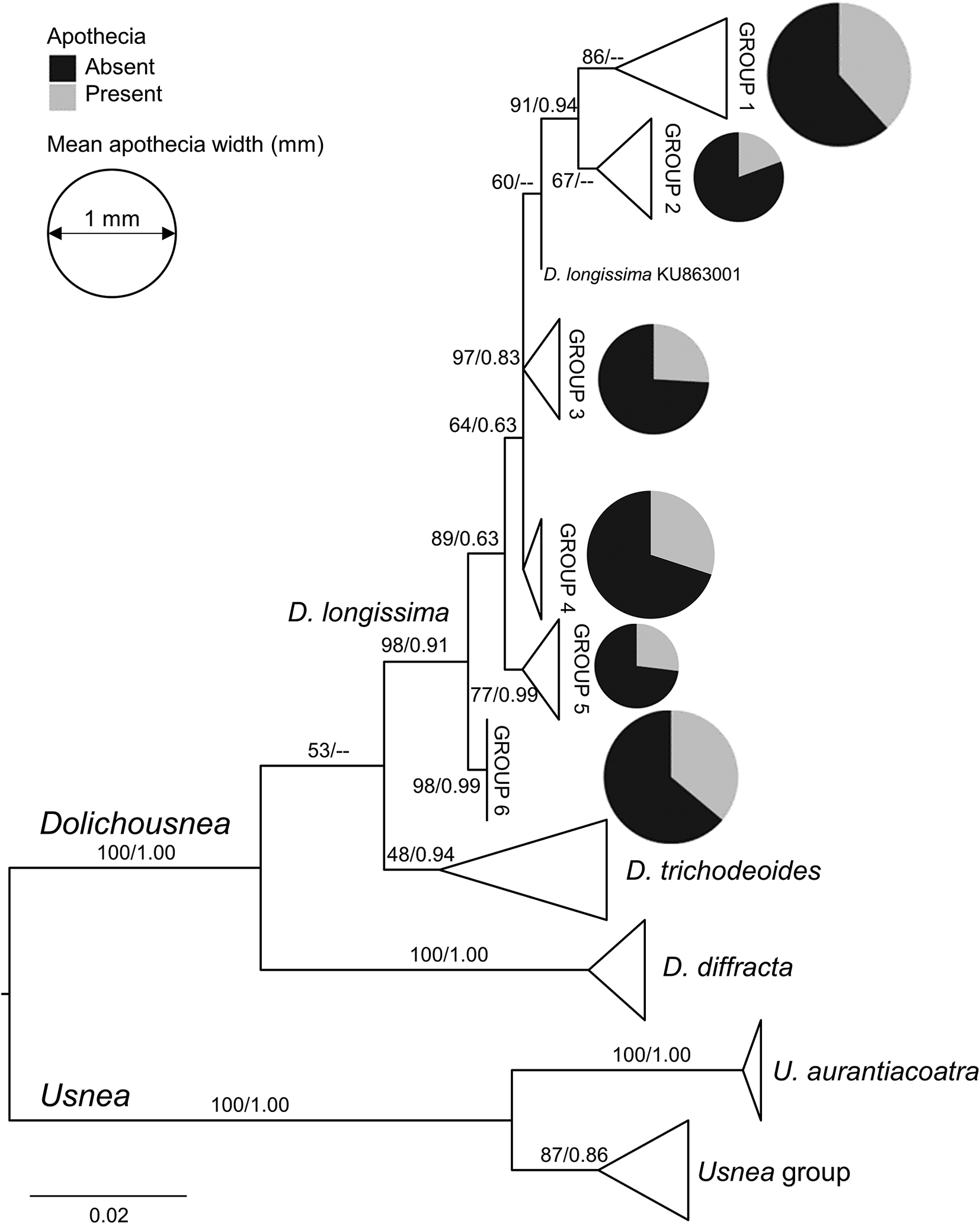
The phylogenetic analyses showed that Dolichousnea formed a monophyletic group which was clearly separated from Usnea (Fig. 11; Supplementary Material Fig. S17, available online). Within Dolichousnea there were three monophyletic groups, representing three species: D. longissima, D. trichodeoides (Vain. ex Motyka) Articus and D. diffracta (Vain.) Articus. There was genetic variation in the ITS region in our study population. We divided the D. longissima sequences into six groups for illustrative purposes (Fig. 11, Supplementary Material Fig. S17). Of these, only group 6 forms a highly supported clade. However, we did not observe any distinctive morphological features for the specimens in this group that would justify describing group 6 as a new species of Dolichousnea. All specimens in groups 3, 5 and 6 had been collected from our study sites, whereas groups 1, 2 and 4 also included sequences from D. longissima collected elsewhere in China, Japan, Canada or the USA (Supplementary Material Tables S6 & S7, available online).
Maximum likelihood phylogenetic tree for Dolichousnea and Usnea spp. based on the ITS region. Branches are collapsed at the nodes to aid visualization of the relationship between genetic differentiation and apothecia production. Maximum likelihood bootstrap support values and Bayesian posterior probabilities are displayed above the branches (BS/PP). Pie charts are shown to the right of each D. longissima group, displaying the proportion of specimens which had apothecia present versus absent, with the diameter of the pie chart representing the mean width of apothecia (mm). The full phylogenetic tree is provided in Supplementary Material Fig. S17 (available online). Specimen information and GenBank accession numbers are provided in Supplementary Material Tables S6 & S7 (available online).

Within the D. longissima clade, no morphological traits measured in this study were linked to particular branches on the phylogenetic tree. At least some thalli within each group had produced apothecia. There was no indication that differences in apothecia production are related to genetic differences within the ITS region (Fig. 11, Supplementary Material Fig. S17). Each group also included thalli with a wide range of stem widths, fibril lengths, mass allocation to side branches and TML (Supplementary Material Fig. S17). Apothecia size differed between groups, with the largest apothecia in group 1 and the smallest apothecia in group 5 (Fig. 11). However, as apothecia size tends to increase during the course of development, we do not propose that this comprises a taxonomically distinctive trait.
Discussion
Apotheciate Dolichousnea specimens did not belong to a single genetically and morphologically distinct population
Our phylogenetic tree is in accordance with that of Articus (Reference Articus2004), in which Dolichousnea was first raised to genus rank. In both trees, D. longissima is placed closest to D. trichodeoides, followed by D. diffracta. Based on phylogenetic analyses of ITS sequences, all the Dolichousnea specimens in this study form a monophyletic clade which can be treated as D. longissima. There is strong support for a separate ‘group 6’, but we did not observe any morphological traits that would justify describing these specimens as a new species of Dolichousnea. The displayed division of other branches into groups 1 to 5 are shown primarily for illustrative purposes, although it is possible that some of these branches might be more highly supported if other gene regions were sequenced (e.g. IGS and RPB1 (Lücking et al. Reference Lücking, Nadel, Araujo and Gerlach2020)).
The widespread distribution of three of the ITS variants from our study sites is striking, stretching across two continents and two islands. Apparently, minor genetic diversification occurred prior to intercontinental dispersal. For other lichen genera, the Himalayan and Hengduan Mountain regions have been a hotspot for diversification (Yang et al. Reference Yang, Wang, Miao and Scheidegger2022). The geo-referenced sequence data from this study confirm that D. longissima is present far beyond the niches predicted by Smith et al. (Reference Smith, Johnston and Lücking2016), thereby improving knowledge of its ecology and distribution beyond the circumpolar range.
No discontinuities were revealed in the PCA analyses linking apothecia to any distinct thallus morphology types. Neither whether thalli produced apothecia, nor the measured morphological traits were linked to between-specimen differences in the ITS gene region. This does not exclude the possibility of underlying genetic differences controlling facultative apothecia production, since such genes may not be linked to neutral markers such as ITS (Rolstad et al. Reference Rolstad, Ekman, Andersen and Rolstad2013). It is possible that further sequencing and genetic analyses might reveal between-specimen differences in other gene regions. However, given that environmental factors contributed to apothecia production, it seems more likely that differences would be present in gene expression (Rodenburg et al. Reference Rodenburg, Terhem, Veloso, Stassen and van Kan2018).
Dolichousnea longissima showed negative length-dependent growth
Shorter thalli grew faster than longer thalli, with the fastest growth rates recorded for 10 cm thalli after three months growth. Thallus growth rates consistently declined with increasing thallus length and age, supporting the findings of Gauslaa et al. (Reference Gauslaa, Palmqvist, Solhaug, Hilmo, Holien, Nybakken and Ohlson2009). Relative thallus length growth rates (RTLGR) of the main stem decreased with increased initial thallus length. Thallus mass length ratio (TML) and fibril length both increased with initial thallus length, indicating reallocation of resources from length-growth to main stem mass and fibrils. Thick, strong central cords are probably essential for longer thalli to mitigate escalating rates of fragmentation. Longer fibrils and increased TML will both increase the water-holding capacity of thalli and decrease the speed of desiccation, thereby prolonging the duration of photosynthesis (Larsson et al. Reference Larsson, Solhaug and Gauslaa2012; Gauslaa et al. Reference Gauslaa, Solhaug and Longinotti2017; Ure & Stanton Reference Ure and Stanton2019).
The growth rates recorded in this study, of 0.028 ± 0.0006 mm cm−1 day−1 (mean ± S.E.), with a maximum of 0.087 mm cm−1 day−1, are within the range found in previous studies of D. longissima (Keon & Muir Reference Keon and Muir2002; Jansson et al. Reference Jansson, Palmqvist and Esseen2009; Marks et al. Reference Marks, Pett-Ridge, Perakis, Allen and McCune2015; Strother et al. Reference Strother, Coxson and Goward2022). Our thalli reached greater lengths than those reported in these previous studies, due to the inclusion of longer initial pendants, added years of growth and lower fragmentation rates. We had reduced fragmentation by using four thallus strands per pendant for mutual support, attaching pendants in the canopy to reduce wind exposure, and suspending pendants to minimize contact with bark. The latter precaution probably also accounts for the lack of host-tree genus or bark pH impacts (Gauslaa et al. Reference Gauslaa, Ohlson and Rolstad1998).
We did not include the variables of tree age, branching, canopy structure or consequent light interception, which could have complex associations with abundance, fragmentation and growth of D. longissima (Rolstad & Rolstad Reference Rolstad and Rolstad1999; Josefsson et al. Reference Josefsson, Hellberg and Ostlund2005). Such factors might jointly explain the ‘tree’ level variation in the random effects.
Climatic impacts on length-dependent growth patterns decreased over time
After three months’ growth, growth rates at the highest-elevation site were comparable for all thallus lengths, but elsewhere there was negative length-dependent growth, with the strongest trend at the lowest-elevation, warmest site. This raised the concern that with warming climatic conditions, Dolichousnea longissima growth, and therefore biomass production, might decline. By the final harvest, negative length-dependent growth was recorded at all study sites, with no significant interactions between initial thallus length and climatic variables. Thus, over extended growth periods, the negative length-dependent growth findings of Gauslaa et al. (Reference Gauslaa, Palmqvist, Solhaug, Hilmo, Holien, Nybakken and Ohlson2009) were supported, even with different parameters measured and the inclusion of greater thallus lengths, differing habitat and climatic variables.
Switches from asexual to sexual reproduction were associated with transplantation to lower elevations
Hotter summer temperatures were associated with increased probability of thallus loss. These warmer conditions would also be drier, potentially subjecting thalli to more severe and prolonged periods of desiccation. For the surviving thalli, these altered microclimate conditions were associated with a switch from asexual to sexual reproduction. The probability of initiating apothecia production increased with the number of months in which mean temperature exceeded 10 °C. These results are highly suggestive of stress-induced switching of reproductive strategies. Switches from asexual to sexual reproduction have previously been reported following transplantation of fungi down an elevational gradient of increasing temperature, aridity and salinity (Grishkan et al. Reference Grishkan, Korol, Nevo and Wasser2003).
Notably, cross-sections showed an algal layer throughout the apothecia. Photosynthesis within Dolichousnea longissima apothecia could be a crucial factor in reducing the energy costs associated with switching from asexual to sexual reproduction. Otherwise, if asexual structures (e.g. isidia in Lasallia spp.) can support their own development via photosynthesis, whereas apothecia cannot, switching reproductive strategies would be more costly (Hestmark Reference Hestmark1992).
Our results suggest a smaller size threshold for apothecia production than anticipated. Although no thalli produced apothecia after three months of growth, some thallus strands with an initial length of only 10 cm produced apothecia within a three-year timescale. Rolstad et al. (Reference Rolstad, Ekman, Andersen and Rolstad2013) had reported a 70 cm threshold for apothecia production and estimated that 15–20 years of growth may have been required for initiation of apothecia development. However, their estimates were based on intact thalli that had established from basal holdfasts. As our thallus strands were subsections cut from larger thalli, we cannot determine the threshold age for reproduction.
Climatic factors altered reproductive allocation and the threshold size for reproduction
The probability of apothecia production increased with length but the allometric slope was < 1, indicating higher reproductive allocation in shorter thalli. The number of apothecia relative to thallus mass and length was impacted by atmospheric moisture conditions, but significant interactions with thallus length and type make these findings difficult to interpret. It appears that for transplanted thalli, the presumably stressful condition of increased VPD resulted in reduced apothecia size and production. This is in accordance with previous records of drought stress diminishing the reproductive capacity of lichens (Tolpysheva & Timofeeva Reference Tolpysheva and Timofeeva2008; Martínez et al. Reference Martínez, Flores, Otálora, Belinchón, Prieto, Aragón and Escudero2012).
Higher summer RH was associated with apothecia production beginning at a smaller thallus size, with progressively stronger trends for greater reproductive allocation in smaller thalli. Unexpectedly, higher RH was associated with lower algal abundance and slower RTLGR. We speculate that wetter thalli were longer, incurring increased fragmentation rates, but followed by growth. High RH is a usually a favourable condition for Dolichousnea longissima (Esseen et al. Reference Esseen, Ericson, Lindstrom and Zackrisson1981; Storaunet et al. Reference Storaunet, Rolstad and Rolstad2008; Liden et al. Reference Liden, Cabrajic, Ottosson-Lofvenius, Palmqvist and Lundmark2010), which was especially abundant in the tree canopies of the two sites with the highest RH.
Raised temperatures and increased vapour pressure deficit reduced photobiont and mycobiont survival and growth
Increased maximum winter temperatures were associated with negative impacts on the photobiont, with reduced total abundance of green algal cells. Algal death possibly occurred after transplantation to warmer, drier sites (Williams et al. Reference Williams, Colesie, Ullmann, Westberg, Wedin and Budel2017), with later recovery and recolonization, leading to a higher proportion of algal cells in fibrils versus main stems. Genetic analyses would be required to determine if these patterns correspond to photobiont death (Williams et al. Reference Williams, Colesie, Ullmann, Westberg, Wedin and Budel2017; Colesie et al. Reference Colesie, Büdel, Hurry and Green2018), acclimation (Colesie et al. Reference Colesie, Büdel, Hurry and Green2018), or switching (Medeiros et al. Reference Medeiros, Mazur, Miadlikowska, Flakus, Rodriguez-Flakus, Pardo-De la Hoz, Cieślak, Śliwa and Lutzoni2021).
Higher temperatures were associated with the loss of entire thalli. The surviving thalli had reduced RTLGR, and increased TML and thallus width. Increased winter VPD was associated with shorter fibrils. If climate change alters the presence of lichenicolous fungi (Větrovský et al. Reference Větrovský, Kohout, Kopecký, Machac, Man, Bahnmann, Brabcová, Choi, Meszárošová and Human2019), there could be further indirect effects on Dolichousnea longissima.
Implications for conservation
If climate change causes increased thallus loss and reduced growth in Dolichousnea longissima, this could lead to local extinction of populations at the lower edge of its elevational range. Reduced productivity and range of D. longissima could also seriously reduce the food supply and alter suitable home ranges for Rhinopithecus bieti (Grueter et al. Reference Grueter, Li, Ren, Z-F and Li2012; Xia et al. Reference Xia, Zhang, Zhuang, Ren, Zhou, Shen, Krzton, Luan and Li2020). Habitat conservation efforts should especially concentrate on preservation of the highest-elevation ranges (Quan et al. Reference Quan, Ren, Behm, Wang, Huang, Long and Zhu2011), and on creating ecological corridors (Xia et al. Reference Xia, Zhang, Zhuang, Ren, Zhou, Shen, Krzton, Luan and Li2020) connecting current R. bieti groups to the most productive D. longissima habitats.
Apothecia production by the D. longissima thalli in our study sites could generate genetic diversity which could produce mycobiont genotypes better adapted to changing conditions. This special apotheciate population must be made a priority for conservation since they could be more likely to persist and evolve (Zoller et al. Reference Zoller, Lutzoni and Scheidegger1999). Currently, anti-logging measures are not being successfully enforced at the vicinity of our study sites, putting this D. longissima population at risk of extirpation. Serious consideration should be given to transplanting many apotheciate D. longissima thalli to the protected area of the Potatso National Park (Fig. 1). Transplantations could also be made directly to the Baima Snow Mountain National Nature Reserve (Fig. 1), but this would carry the risk of immediate consumption by R. bieti so would be inadvisable as the sole means of conserving the apotheciate D. longissima population. If D. longissima were heterothallic, and the presence of gametes from parent mycobionts with different mating types were to increase the likelihood of sexual reproduction (Singh et al. Reference Singh, Dal Grande, Cornejo, Schmitt and Scheidegger2012), then such transplantation might also stimulate apothecia production in D. longissima at the destination site.
Conclusions
There appear to be diminishing returns for Dolichousnea longissima thalli to grow ever-longer, since they suffer both increasing rates of fragmentation and negative length-dependent growth. However, longer thalli may have more resources available to devote to increasing strength, fibril production and total reproductive effort. Although fragmentation probably has a high mortality cost, it is also a form of asexual reproduction, which offers the opportunity for short-distance co-dispersal of mycobionts and photobionts. Apothecia production should enable long-distance dispersal of sexual propagules and increased genetic variability. Stressful conditions were associated with switches from asexual to sexual reproduction. However, for thalli that have begun sexual reproduction, unfavourable climatic conditions could reduce total investment in apothecia.
Overall, it appears that in the short-term, raised temperatures with associated increased vapour pressure deficit would increase D. longissima photobiont mortality and reduce thallus length, and therefore also probably biomass. This is highly concerning for the future of D. longissima in its current range, and would also potentially reduce the food supply for Rhinopithecus bieti. However, there seems some prospect of future photobiont acclimation to change. Furthermore, switches to sexual reproduction should generate genetic variability, increasing the long-term likelihood of some mycobiont genotypes arising that are better adapted to the altered climatic conditions.
Supplementary Material
The Supplementary Material for this article can be found at http://doi.org/10.1017/S0024282925000064.
Acknowledgements
We are grateful for field assistance from Qu Pin, Lishen Qian and Wei Zheng. We thank Douglas A. Schaefer for the repair and calibration of data loggers. This research was funded by the Yunnan Provincial Science and Technology Department Intelligent Yunnan Young Scientist (202303AM140006 to FRW); the Chinese Academy of Sciences President’s International Fellowship Initiative (2020FYC0003 to FRW); the Yunnan Provincial Human Resources and Social Security Bureau Post-Doctoral Grant to FRW; Yunnan Fundamental Research Projects (202401AT070196 to XYW); Yunnan Young & Elite Talents Project (to XYW); the Second Tibetan Plateau Scientific Expedition and Research Program (STEP) (2019QZKK0503 to LSW); the Youth Innovation Promotion Association CAS (2020388 to XYW).
Author Contributions
The research was planned by FRW, with support from XYW and LSW. Funding was acquired by FRW, XYW and LSW. Fieldwork was conducted by FRW and ACY. Laboratory work and statistical analyses were conducted by FRW. Phylogenetic analyses were conducted by XYW. Figures were produced by FRW. The manuscript was written by FRW with XYW. All authors approved the final version of the manuscript.
Author ORCIDs
Fiona Ruth Worthy, 0000-0003-0042-3110; An Cheng Yin, 0009-0000-7837-7797; Li Song Wang, 0000-0003-3721-5956; Xin Yu Wang, 0000-0003-2166-6111.
Competing Interests
The authors declare none.
Data Accessibility
All sequences from this study have been deposited in GenBank, with matching georeferenced records to be uploaded to GBIF. Accession numbers and specimen details are provided in Supplementary Material Tables S6 and S7 (available online). Lichen and microclimate data have been deposited in the Mendeley data repository (DOI: 10.17632/52pw63pxsc.1).