Introduction
Mungbean [Vigna radiata (L.) Wilczek] is one of the important grain legume crops extensively grown in Southeast Asia. However, its production is severely constrained by mungbean yellow mosaic virus (MYMV) disease (Kang et al., Reference Kang, Yeam and Jahn2005; Nagaraj et al., Reference Nagaraj, Basavaraj, Padmaja, Nagaraju and Ramesh2019) which is transmitted by whitefly, Bemisia tabaci Genn. Hemiptera: Aleyrodidae (Butler, Reference Butler1977). Disease symptoms vary from a few small yellow specks or spots on a few leaves to yellowing or chlorosis of all leaves of the whole plant followed by necrosis. In highly susceptible plants, symptoms include shortening of internodes, severe stunting of plants with no yield or few flowers and deformed pods producing small, immature and shrivelled seeds. The present investigation was carried out to unravel the number and mode of action of genes controlling resistance to MYMV disease under natural infection as a prelude to develop resistant cultivars.
Experimental
The basic material consisted of four MYMV-resistant cultivated genotypes namely AVMU 1698, AVMU 1699, AVMU 16100 and AVMU 16101, and MYMV-susceptible genotype, ‘Harsha’ (Nagaraj et al., Reference Nagaraj, Basavaraj, Padmaja, Nagaraju and Ramesh2019). Using the four MYMV-resistant genotypes as male parents and Harsha as the female parent, four crosses namely (1) Harsha × AVMU 1698, (2) Harsha × AVMU 1699, (3) Harsha × AVMU 16100 and (4) Harsha × AVMU 16101 were synthesized during the 2018 rainy season at the experimental plots of the Department of Genetics and Plant breeding (GPB), University of Agricultural Sciences, (UAS), Bengaluru, India. The F1s of the four crosses were selfed to obtain F2 seeds. The F1s of four crosses, their five parents and F2s constituted the experimental material.
Nine or ten F1 seeds of four crosses, and 118 F2 seeds of Harsha × AVMU 1698, 115 seeds of Harsha × AVMU 1699, 110 seeds of Harsha × AVMU 16100 and 111 seeds of Harsha × AVMU 16101 were planted in separate contiguous blocks during summer 2019 at the experimental plot where MYMV was maintained on a susceptible genotype. In each block after every five rows of test genotypes, seeds of a susceptible parent, ‘Harsha’ which also served as the susceptible check was planted in single rows. The parents, F1s and F2s were exposed to natural infection by MYMV.
The population of whiteflies were monitored from 15 days after planting (DAP) at frequent intervals, to ensure the presence of sufficient flies (online Supplementary Figure S1). To confirm the incidence of MYMV disease, ‘Harsha’ was examined for symptoms typical to the disease from 20 DAP. The MYMV disease incidence on randomly selected five leaves of each parent, F1 and F2 plants of four crosses was inspected at 30, 45 and 55 DAP. The incidence was quantified on a scale of 1–6 (online Supplementary Table S1). The scores were converted into per cent disease index (PDI) using the following formula (Wheeler, Reference Wheeler1969).
The parents, F1 and F2 plants of four crosses whose PD
 $${\rm PDI\;}\lpar {\rm \%} \rpar = {{{\rm Sum\;}\;{\rm of}\;{\rm scores}\;{\rm across}\;{\rm five}\;{\rm leaves}} \over {{\rm Maximum\;}\;{\rm disease}\;{\rm scale\;} \times {\rm No}.\ {\rm of}\;{\rm leaves\;\lpar 5\rpar \;on}\;{\rm which}\;{\rm scores}\;{\rm were}\;{\rm recorded}}} \times 100$$
I estimates were ⩽25% were classified as resistant and those with >25% were classified as susceptible(online Supplementary Table S2). The numbers of F2 plants with resistance and susceptible responses varied gradually from 30 DAP and stabilized at 55 DAP.
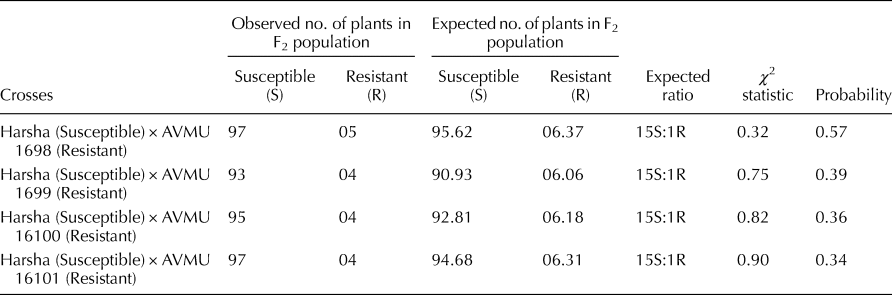
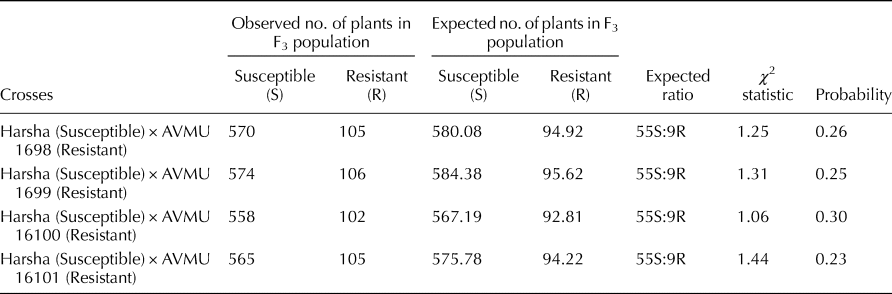
The goodness of fit of observed segregation of F2 plants into resistant and susceptible responses at 55 DAP with expected ratios of 15:1 (Gajaraj et al., Reference Gajaraj, Shubhadra and Sheoran2013; Alam and Somta, Reference Alam and Somta2014) was examined using χ 2 statistic. Non-significance of cross-wise χ 2 was considered as evidence for digenic control of resistance to MYMV disease and that resistance is governed by two recessive alleles. To confirm the inheritance of resistance to MYMV disease, 80–85 F3 families derived from four crosses each consisting of 10–15 plants were grown in contiguous blocks during the 2019 late summer season. Responses of each of the plants of each F3 family to MYMV disease incidence were scored using a scale of 1–6 at 55 DAP and scores were converted into estimates of PDI. The F3 plants were classified as resistant and susceptible using the same criteria that were used to classify the F2 plants. The goodness of fit of observed segregation of F3 plants with the expected ratio of 55susceptible:9 resistant was examined using χ 2 statistic.
Discussion
The appearance of symptoms typical to MYMV disease on the susceptible parent within 25 DAP ensured adequate populations of MYMV and whitefly and prevalence of optimal weather conditions for disease development. The susceptible parent ‘Harsha’ and F1 plants of all four crosses showed a susceptible (S) reaction, with scores ranging from 4 to 6 with mean scores ranging from 4.83 to 5.16 at 55 DAP when the disease development stabilized. These results provide evidence for recessivity of resistance to MYMV disease.
Based on the PDI classification criteria (online Supplementary Table S2), F2 plants derived from four crosses were grouped as susceptible and resistant to MYMV disease at 55 DAP. The χ 2 test suggests that observed segregation of F2 plants was a good fit to the expected segregation (Gajaraj et al., Reference Gajaraj, Shubhadra and Sheoran2013; Alam and Somta, Reference Alam and Somta2014) of 15 susceptible:1 resistant at 55 DAP (Table 1). These results suggest that resistance to MYMV disease is controlled by two recessive alleles displaying duplicate recessive epistasis, which was confirmed in the F3 population which segregated in the expected ratio of 55 susceptible:9 resistant (Table 2).
Test for the goodness of fit of observed segregation of F2 populations derived from four crosses with that expected for responses to MYMV infection at 55 days after planting (DAP)

Test for the goodness of fit of observed segregation of F3 populations derived from four crosses with that expected for responses to MYMV infection at 55 DAP

Digenic recessive inheritance of resistance to MYMV disease has also been reported by several other researchers (Gajaraj et al., Reference Gajaraj, Shubhadra and Sheoran2013; Alam and Somta, Reference Alam and Somta2014). However, the monogenic inheritance of MYMV disease resistance has also been reported (Khan et al., Reference Khan, Ahmad, Khattak and Ahmad2007; Rashmi et al., Reference Rashmi, Roopa, Ashokm and Suresh2013; Cayalvizhi et al., Reference Cayalvizhi, Nagarajan, Raveendran, Rabindran, Jagadeesh, Kannanbapu and Senthil2015).
Because resistance to MYMV disease is controlled by two recessive genes, the probability of recovering MYMV disease-resistant plants in the F2 population is as low as 6.25%. Therefore, a sufficiently large F2 population needs to be raised to increase the chance of identifying and selecting MYMV disease-resistant plants. However, as MYMV disease-resistant plants breed true from the F2 population and subsequent selfing generations, resistance could be fixed in the F2 generation.
Supplementary material
The supplementary material for this article can be found at https://doi.org/10.1017/S147926212000012X.
Acknowledgements
The senior author acknowledges the receipt of Post-Matric ePASS fellowship from the Department of Backward Classes Welfare, Government of Karnataka, India for pursuing MSc (Agriculture) thesis research during 2017–2018 and 2018–2019.