Introduction
In the United States, over 40 million women have been diagnosed with hypertension, and the prevalence of hypertension in women has been rising in the last three decades (Mozaffarian et al. Reference Mozaffarian, Benjamin, Go, Arnett, Blaha, Cushman, de Ferranti, Després, Fullerton, Howard, Huffman, Judd, Kissela, Lackland, Lichtman, Lisabeth, Liu, Mackey, Matchar, McGuire, Mohler, Moy, Muntner, Mussolino, Nasir, Neumar, Nichol, Palaniappan, Pandey, Reeves, Rodriguez, Sorlie, Stein, Towfighi, Turan, Virani, Willey, Woo, Yeh and Turner2015). Hypertension is a major modifiable risk factor for cardiovascular disease (CVD), the leading cause of death in women (Mozaffarian et al. Reference Mozaffarian, Benjamin, Go, Arnett, Blaha, Cushman, de Ferranti, Després, Fullerton, Howard, Huffman, Judd, Kissela, Lackland, Lichtman, Lisabeth, Liu, Mackey, Matchar, McGuire, Mohler, Moy, Muntner, Mussolino, Nasir, Neumar, Nichol, Palaniappan, Pandey, Reeves, Rodriguez, Sorlie, Stein, Towfighi, Turan, Virani, Willey, Woo, Yeh and Turner2015). Recently, we demonstrated that elevated post-traumatic stress disorder (PTSD) symptoms were associated with increased CVD risk in younger and middle-aged women (Sumner et al. Reference Sumner, Kubzansky, Elkind, Roberts, Agnew-Blais, Chen, Cerdá, Rexrode, Rich-Edwards, Spiegelman, Suglia, Rimm and Koenen2015). Better understanding of who is at risk for hypertension could inform CVD prevention efforts.
Exposure to trauma, including childhood abuse (Riley et al. Reference Riley, Wright, Jun, Hibert and Rich-Edwards2010) and combat (Granado et al. Reference Granado, Smith, Swanson, Harris, Shahar, Smith, Boyko, Wells and Ryan2009), has been associated with increased hypertension risk. PTSD, the sentinel trauma-related disorder, has been tied to hypertension across numerous, and largely cross-sectional, studies (e.g. Davidson et al. Reference Davidson, Hughes, Blazer and George1991; Lauterbach et al. Reference Lauterbach, Vora and Rakow2005; Kang et al. Reference Kang, Bullman and Taylor2006; Sareen et al. Reference Sareen, Cox, Stein, Afifi, Fleet and Asmundson2007; O'Toole & Catts, Reference O'Toole and Catts2008; Cohen et al. Reference Cohen, Marmar, Ren, Bertenthal and Seal2009; Glaesmer et al. Reference Glaesmer, Brähler, Gündel and Riedel-Heller2011; Pietrzak et al. Reference Pietrzak, Goldstein, Southwick and Grant2011; Abouzeid et al. Reference Abouzeid, Kelsall, Forbes, Sim and Creamer2012; Paulus et al. Reference Paulus, Argo and Egge2013; Stein et al. Reference Stein, Aguilar-Gaxiola, Alonso, Bruffaerts, de Jonge, Liu, Miguel Caldas-de-Almeida, O'Neill, Viana, Al-Hamzawi, Angermeyer, Benjet, de Graaf, Ferry, Kovess-Masfety, Levinson, de Girolamo, Florescu, Hu, Kawakami, Maria Haro, Piazza, Posada-Villa, Wojtyniak, Xavier, Lim, Kessler and Scott2014). Additionally, rates of metabolic syndrome – a constellation of cardiometabolic risk factors that includes hypertension – have been elevated in those with (v. without) PTSD (e.g. Bartoli et al. Reference Bartoli, Carrà, Crocamo, Carretta and Clerici2013). However, although PTSD is twice as common in women as in men (Kessler et al. Reference Kessler, Sonnega, Bromet, Hughes and Nelson1995), studies examining PTSD and hypertension in younger and middle-aged civilian women exposed to a range of traumas are generally lacking. Much research has been in predominantly male veteran samples (e.g. Schnurr et al. Reference Schnurr, Spiro and Paris2000; Kang et al. Reference Kang, Bullman and Taylor2006; O'Toole & Catts, Reference O'Toole and Catts2008; Abouzeid et al. Reference Abouzeid, Kelsall, Forbes, Sim and Creamer2012; Paulus et al. Reference Paulus, Argo and Egge2013, see Cohen et al. Reference Cohen, Marmar, Ren, Bertenthal and Seal2009, for an exception). Several studies have also suggested that PTSD is linked to increased hypertension risk in civilians (e.g. Davidson et al. Reference Davidson, Hughes, Blazer and George1991; Lauterbach et al. Reference Lauterbach, Vora and Rakow2005; Sareen et al. Reference Sareen, Cox, Stein, Afifi, Fleet and Asmundson2007; Glaesmer et al. Reference Glaesmer, Brähler, Gündel and Riedel-Heller2011; Pietrzak et al. Reference Pietrzak, Goldstein, Southwick and Grant2011; Stein et al. Reference Stein, Aguilar-Gaxiola, Alonso, Bruffaerts, de Jonge, Liu, Miguel Caldas-de-Almeida, O'Neill, Viana, Al-Hamzawi, Angermeyer, Benjet, de Graaf, Ferry, Kovess-Masfety, Levinson, de Girolamo, Florescu, Hu, Kawakami, Maria Haro, Piazza, Posada-Villa, Wojtyniak, Xavier, Lim, Kessler and Scott2014). However, relatively few of these civilian investigations have evaluated if the link between PTSD and hypertension is similarly evident in men v. women; it is not yet clear whether associations hold in civilian women. One exception is the cross-sectional study by Pietrzak et al. (Reference Pietrzak, Goldstein, Southwick and Grant2011), which found that odds of hypertension were higher for men, but not women, with PTSD in the National Epidemiologic Survey on Alcohol and Related Conditions sample. Stein et al. (Reference Stein, Aguilar-Gaxiola, Alonso, Bruffaerts, de Jonge, Liu, Miguel Caldas-de-Almeida, O'Neill, Viana, Al-Hamzawi, Angermeyer, Benjet, de Graaf, Ferry, Kovess-Masfety, Levinson, de Girolamo, Florescu, Hu, Kawakami, Maria Haro, Piazza, Posada-Villa, Wojtyniak, Xavier, Lim, Kessler and Scott2014) also tested whether the PTSD-hypertension association was moderated by sex using the cross-sectional World Mental Health Surveys, although they did not present sex-stratified results given the non-significant PTSD by sex interaction. Further studies are needed to understand if PTSD symptoms are associated with hypertension risk in women from the general population.
Furthermore, the effects of trauma with and without PTSD have rarely been considered in a single study. In a general population sample of German elderly individuals, trauma exposure without PTSD and current PTSD were cross-sectionally associated with increased hypertension risk compared to no trauma, although the magnitude of elevation in risk was greater for those with (v. without) PTSD (Glaesmer et al. Reference Glaesmer, Brähler, Gündel and Riedel-Heller2011). O'Toole & Catts (Reference O'Toole and Catts2008) also considered trauma and PTSD separately in their cross-sectional study of male veterans; only PTSD – not trauma alone – was associated with hypertension. Additional research examining effects of trauma and PTSD separately is needed, particularly in younger and middle-aged civilians.
Although research suggests a relationship between PTSD and hypertension, the American Heart Association (2014) maintains that ‘stress is not a confirmed risk factor for high blood pressure (BP).’ Virtually all PTSD-hypertension research has been cross-sectional (excepting Schnurr et al. Reference Schnurr, Spiro and Paris2000); longitudinal research is needed to demonstrate more convincingly that PTSD increases risk of, rather than is a consequence of, hypertension. Additionally, knowledge of mediating factors is limited. Mediating behavioral risk factors are likely given a sizable proportion of incident hypertension can be reduced by addressing health behaviors, such as diet and exercise (Forman et al. Reference Forman, Stampfer and Curhan2009), and PTSD has been associated with obesity and unhealthy behaviors (e.g. Zen et al. Reference Zen, Whooley, Zhao and Cohen2012; Kubzansky et al. Reference Kubzansky, Bordelois, Jun, Roberts, Cerda, Bluestone and Koenen2014). Furthermore, antidepressants – frequently prescribed for PTSD (Friedman & Davidson, Reference Friedman, Davidson, Friedman, Keane and Resick2007) – have been linked to hypertension (Licht et al. Reference Licht, de Geus, Seldenrijk, van Hout, Zitman, van Dyck and Penninx2009). Although several studies have adjusted for specific health behaviors (e.g. Schnurr et al. Reference Schnurr, Spiro and Paris2000), whether a range of health behaviors and antidepressant use can explain an observed PTSD-hypertension relationship is not known.
We addressed limitations in prior literature by examining associations between trauma exposure, PTSD symptoms, and risk of incident hypertension over 22 years in the Nurses’ Health Study II (NHS II), an ongoing longitudinal cohort study of younger and middle-aged women begun in 1989. A previous study in this cohort found that childhood abuse was associated with increased hypertension risk (Riley et al. Reference Riley, Wright, Jun, Hibert and Rich-Edwards2010). Although PTSD could partly mediate the childhood abuse-hypertension relationship, Riley et al. (Reference Riley, Wright, Jun, Hibert and Rich-Edwards2010) did not consider the psychological sequelae of early abuse. Here, we build on these findings by examining PTSD symptoms in response to a variety of traumas and incident hypertension. Additionally, we considered the effects of trauma and PTSD symptoms separately. We hypothesized that, compared to no trauma, higher PTSD symptoms would be related to increased risk of developing hypertension, after accounting for a range of potential confounders (determined from previous studies; e.g. Chasan-Taber et al. Reference Chasan-Taber, Willett, Manson, Spiegelman, Hunter, Curhan, Colditz and Stampfer1996; Gangwisch et al. Reference Gangwisch, Feskanich, Malaspina, Shen and Forman2013). Unlike most research on PTSD and hypertension, we also considered a range of potential mediators. We predicted that health behaviors and antidepressant use would explain some of this association.
Method
Sample
The NHS II includes 116 430 female nurses in the United States, aged 25–42 years at enrollment in 1989. Women complete questionnaires biennially; follow-up is ongoing. Supplemental questionnaires with special interests are periodically administered. In 2001, a supplemental questionnaire on violence exposure was mailed to 91 297 women and returned by 68 376 women. In 2008, when participants were aged 44–62 years, 60 804 women who completed the 2001 Violence questionnaire and 2007 biennial questionnaire were mailed a supplemental questionnaire assessing trauma and PTSD (Morgan et al. Reference Morgan, Hazlett, Wang, Richardson, Schnurr and Southwick2001). After repeated mailings, 54 224 women returned the supplemental questionnaire (89% response rate). This study was approved by the Partners Healthcare Human Research Committee. Return of the questionnaire constituted implied consent. All procedures contributing to this work comply with the ethical standards of the relevant national and institutional committees on human experimentation and with the Helsinki Declaration of 1975, as revised in 2008.
Trauma and PTSD symptom assessment
PTSD symptom severity and age of onset were derived from information on trauma and PTSD symptoms. Trauma exposure was measured with a 16-item modified version of the Brief Trauma Questionnaire (Schnurr et al. Reference Schnurr, Vieilhauer, Weathers and Findler1999; Morgan et al. Reference Morgan, Hazlett, Wang, Richardson, Schnurr and Southwick2001), a reliable and valid measure of trauma exposure that parallels interview measures (Schnurr et al. Reference Schnurr, Vieilhauer, Weathers and Findler1999). Lifetime exposure to 15 traumatic events (e.g. natural disaster exposure, physical assault), in addition to ‘a seriously traumatic event not already covered,’ was assessed. Respondents reported whether events occurred, which event occurred first, and which was their worst experience, along with their ages at the first and worst events. The Short Screening Scale for DSM-IV PTSD (Breslau et al. Reference Breslau, Peterson, Kessler and Schultz1999) was used to assess whether women ever experienced seven PTSD symptoms in response to their worst trauma. Reliability of self-reported age-of-onset of trauma and PTSD has been excellent in this sample (ICC = 0.95).
A time-varying variable characterizing women according to their trauma/PTSD symptom status was derived, with PTSD symptom onset dated according to the year women reported their worst trauma. For each study year, participants were classified into five groups based on their dates of trauma exposure and PTSD symptom severity: (1) no trauma exposure, (2) trauma-exposed with no PTSD symptoms, (3) trauma-exposed with 1–3 symptoms, (4) trauma-exposed with 4–5 symptoms, and (5) trauma-exposed with 6–7 symptoms. Before their first trauma (if reported), women were categorized as having no trauma exposure. After their first trauma, women were classified as being trauma-exposed with no symptoms. Following their worst trauma, women were classified as being trauma-exposed with the number of PTSD symptoms reported subsequent to the worst event. If women reported only one event, the years of the first and worst traumas were identical. In other words, if no trauma was ever reported, women were classified as having no trauma at all follow-up waves. Prior to reporting trauma, women were classified as having no trauma at all waves until trauma or trauma and PTSD symptoms were reported. Once trauma/PTSD symptom onset was reported, the severity of trauma/PTSD symptoms at onset was carried through all subsequent waves.
Trauma/PTSD symptom categorizations were selected based on previous research with the Short Screening Scale for DSM-IV PTSD recommending scores of ⩾4 (Breslau et al. Reference Breslau, Peterson, Kessler and Schultz1999) and ⩾6 (Kimerling et al. Reference Kimerling, Ouimette, Prins, Nisco, Lawler, Cronkite and Moos2006) as clinical cutoffs for PTSD. Following this rubric resulted in one group of women with trauma and subclinical PTSD symptoms and two groups of women with trauma and PTSD symptom counts above the recommended clinical cutoff on this screening questionnaire, with the latter two grouped according to increasing symptom severity. With this nuanced classification rubric, we could examine hypertension onset in women with no trauma, trauma and no symptoms, and trauma and varying symptom severity.
Hypertension assessment
Women reported lifetime physician-diagnosed hypertension at baseline in 1989. At each subsequent biennial questionnaire, participants indicated whether they had physician-diagnosed hypertension in the past 2 years. Self-reported hypertension has been validated in this cohort. In randomly chosen NHS II participants self-reporting hypertension, 94% had confirmed hypertension (Forman et al. Reference Forman, Curhan and Taylor2008). Moreover, BP was measured in an age-stratified sample of 194 NHS II participants to examine unreported hypertension. Of the 161 women not reporting hypertension, only 11 (7%) had a BP > 140/90 mmHg. None had a BP > 160/95 mmHg (Chasan-Taber et al. Reference Chasan-Taber, Willett, Manson, Spiegelman, Hunter, Curhan, Colditz and Stampfer1996). For this study, women who reported ever having hypertension at the baseline assessment were excluded. We considered incident hypertension reported on the 1991–2011 questionnaires.
Covariates
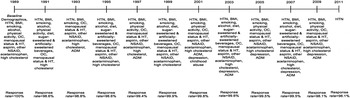
Potential confounders included age at baseline, race/ethnicity (African American, Latina, Asian, Caucasian, other), maximum parental education at the participant's birth (high school or less, some college, ⩾4 years of college), maternal and paternal history of hypertension, and age 5 somatotype (to estimate childhood adiposity). Time-varying indicators for hypertension-relevant medical risk factors and medications were included as biomedical covariates; all were assessed biennially unless otherwise indicated (see Fig. 1 for study timeline). These included: oral contraceptive use (never used, current user, former user; Chasan-Taber et al. Reference Chasan-Taber, Willett, Manson, Spiegelman, Hunter, Curhan, Colditz and Stampfer1996); menopausal status and hormone therapy (HT) use (pre-menopausal, post-menopausal/never HT, post-menopausal/past HT, post-menopausal/current HT, post-menopausal/missing HT, unknown menopausal status; Gangwisch et al. Reference Gangwisch, Feskanich, Malaspina, Shen and Forman2013); current aspirin use, acetaminophen use, and other non-steroidal anti-inflammatory drug (NSAID) use (these were assessed with each biennial questionnaire except in 1991; Gangwisch et al. Reference Gangwisch, Feskanich, Malaspina, Shen and Forman2013); physician-diagnosed hypercholesterolemia.
Timeline of variables collected at biennial assessments. HTN, Hypertension; BMI, body mass index; OC, oral contraceptive use; HT, hormone therapy use; NSAID, non-steroidal anti-inflammatory drug; ADM, antidepressant medication. Response rates for the analytic sample are listed for each time point. Trauma/PTSD symptom status was assigned for each year of the study and updated based on reported age of worst trauma (assessed with a supplemental questionnaire in 2008).

Health behaviors were examined as potential mediators of the PTSD symptom-hypertension relationship. These were time-varying covariates, assessed at baseline via self-report and updated biennially, unless otherwise noted (see Fig. 1). Adult body mass index (BMI) in kg/m2 was computed from self-reported height and weight (validated in NHS research; Rimm et al. Reference Rimm, Stampfer, Colditz, Chute, Litin and Willett1990), and categorized as <18.5, 18.5–<21, 21–<23, 23–<25, 25–<27, 27–<30, and ⩾30 (Munger et al. Reference Munger, Chitnis and Ascherio2009). Participants were classified as non-smokers, former smokers, or current smokers of 1–14, 15–24, or ⩾25 cigarettes/day. Alcohol consumption (0, 1–<5, 5–<10, 10–<20, ⩾20 g/day) was assessed in 1989, 1991, 1995, 1999, 2003, and 2007. Physical activity (<3, 3–<9, 9–<18, 18–<27, ⩾27 metabolic equivalent hours/week) was measured in 1989, 1991, 1997, 2001, 2005, and 2009. Diet quality based on the Alternative Healthy Eating Index (Chiuve et al. Reference Chiuve, Fung, Rimm, Hu, McCullough, Wang, Stampfer and Willett2012) was assessed every 4 years beginning in 1991. Diet quality was divided into quintiles; the highest quintile represented the healthiest diet. Sugar-sweetened and artificially-sweetened beverage consumption were each categorized as <1 drink/month, 1–4 drinks/month, 2–6 drinks/week, and ≥1 drink/day (Cohen et al. Reference Cohen, Curhan and Forman2012). Lifetime antidepressant use was assessed in 1993, and regular past 2-year antidepressant use was assessed in 1997, 2001, 2003, 2005, 2007, and 2009. Women endorsing lifetime use in 1993 were coded as using antidepressants from 1989–1993; use was updated as available.
Sensitivity analyses
Childhood abuse has been associated with hypertension in the NHS II (Riley et al. Reference Riley, Wright, Jun, Hibert and Rich-Edwards2010), and meta-analytic evidence has linked depression (often co-morbid with PTSD) with incident hypertension (Meng et al. Reference Meng, Chen, Yang, Zheng and Hui2012). We examined potential confounding by childhood abuse and lifetime depression. Sexual abuse before age 18 was measured in 2001 with four questions regarding unwanted sexual touching or forced/coerced sexual contact by an adult or older child (Moore et al. Reference Moore, Gallup and Schussel1995), and categorized as no sexual abuse, sexual touch only, or forced sex (Sumner et al. Reference Sumner, Kubzansky, Elkind, Roberts, Agnew-Blais, Chen, Cerdá, Rexrode, Rich-Edwards, Spiegelman, Suglia, Rimm and Koenen2015). Childhood physical abuse was assessed in 2001 with the revised Conflict Tactics Scale (Straus & Gelles, Reference Straus and Gelles1990), and classified as none, mild, moderate, or severe (Sumner et al. Reference Sumner, Kubzansky, Elkind, Roberts, Agnew-Blais, Chen, Cerdá, Rexrode, Rich-Edwards, Spiegelman, Suglia, Rimm and Koenen2015). Lifetime depression (experiencing depressive symptoms for ⩾2 weeks) was assessed in 2001, and women reported experiencing depressive symptoms for ⩾2 weeks or receiving a depression diagnosis in 2003, 2005, 2007, and 2009. Lifetime depression was assigned if women reported ever having depressive symptoms for ⩾2 weeks or receiving a depression diagnosis.
Exclusions
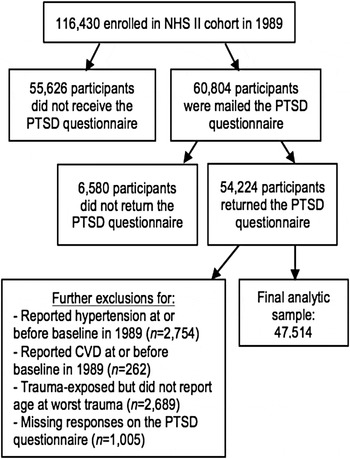
Fig. 2 shows exclusions for deriving the analytic sample (N = 47 514). Compared to those in the analytic sample, women who returned the trauma/PTSD questionnaire but were excluded from analyses were slightly older at baseline (35.6 v. 34.7 years), had higher rates of maternal (37.6% v. 29.8%) and paternal (36.7% v. 30.1%) hypertension and childhood adiposity (highest somatotype: 8.9% v. 6.6%), and had parents with lower educational attainment (maximum parental education of high school or less: 50.3% v. 47.1%). Cumulative incidence of hypertension (1989–2011) was similar for those included (33.5%) v. excluded (34.0%).
Exclusions for deriving the analytic sample.

Statistical analyses
We examined whether trauma and PTSD symptoms were associated with incident hypertension with Cox proportional hazards models to calculate hazard ratios (HRs) and 95% confidence intervals (CIs). Trauma/PTSD symptom status was considered a time-varying variable, and trauma/PTSD symptom status for each year of follow-up was determined based on the year women reported experiencing their worst trauma. SAS proc phreg was used for analyses (SAS Institute, USA). The Andersen–Gill data structure was utilized because it can accommodate updating time-varying exposures and covariates, left-censored data, and potentially discontinuous intervals of risk (Therneau, Reference Therneau1997). With the Andersen–Gill data structure, a new data record was created for every questionnaire cycle when a participant was at risk, with covariates set to their values at the time the questionnaire was returned. This method accounts for the nested structure of our data; it allows explicitly for correlated data, multiple time scales, and, if needed, multiple events per subject (Therneau, Reference Therneau1997). Participants contributed person-time (in months) from baseline in 1989 until hypertension onset, death, end of follow-up in 2011, or their last questionnaire (if they did not return the 2011 questionnaire). Individuals who developed CVD (myocardial infarction or stroke) during the study (n = 242) were censored at CVD onset.
We tested a series of models that first adjusted for demographic confounders, further adjusted for hypertension-relevant biomedical covariates, and further adjusted for potential mediators. Model 1 adjusted for demographics, family history, and childhood adiposity. Model 2 further adjusted for hypertension-relevant medical risk factors and medications. Model 3 additionally adjusted for health behaviors. Model 4 further adjusted for antidepressant use. Missing data in covariates were handled by treating missing as a separate category. Variables added in models 2–4 (i.e. hypertension-relevant medical risk factors, medications, health behaviors) were time-varying and updated every 2, 4, or 6 years as available. For each period of prediction, variables added in models 2–4 were lagged by one period, and trauma/PTSD symptom status was lagged to represent the year prior to the period for models 2–4 covariates. For example, for hypertension status on the 1993 questionnaire, covariates added in models 2–4 (including proposed mediators) were derived from the 1991 questionnaire, and trauma/PTSD symptoms reflected status in 1990. The outcome for the final period of prediction was hypertension status on the 2011 questionnaire, with trauma/PTSD symptoms characterized/updated only through 2008 (when the trauma/PTSD questionnaire was administered). To assess which trauma/PTSD symptom groups differed significantly from one another, we varied the reference group in further analyses using the same modeling strategy described above.
Health behaviors (e.g. smoking, diet), BMI, and antidepressant use were examined as potential mediators. We first considered their separate associations with trauma/PTSD symptoms using generalized estimating equations (trauma/PTSD symptoms and potential mediators were time-varying variables that were updated over the course of the study period). We also considered separate associations of potential mediators with hypertension risk using Cox proportional hazards models. We then tested for mediation by adding each variable individually to model 2. Attenuation ⩾10% in trauma/PTSD symptom parameter estimates after including the hypothesized mediator was used as a cutoff considered sufficient to be consistent with mediation (Gangwisch et al. Reference Gangwisch, Feskanich, Malaspina, Shen and Forman2013). We examined the percent of the PTSD symptom-hypertension relationship accounted for by potential mediators using the SAS Mediate macro (2009), which calculates point estimates and 95% CIs of the percent of exposure explained by each intermediate variable.
We conducted three sensitivity analyses. We tested for potential confounding by childhood abuse and depression by re-estimating model 1 adjusting for each relevant indicator. Additionally, because many hypertension events occurred before assessing trauma/PTSD symptoms in 2008, we considered the possible impact of recall bias by analyzing prospectively detected new-onset hypertension events reported on the 2009 and 2011 questionnaires (N = 35 187; 3554 hypertension events).
Results
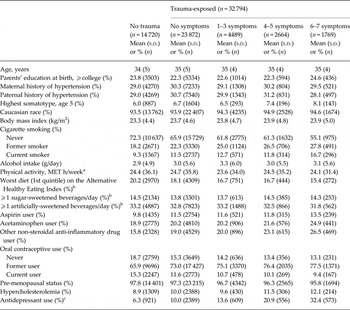
Table 1 presents participant characteristics by trauma and PTSD symptom status at baseline. Many women (69%) reported trauma by 1989. Of trauma-exposed participants at baseline, 73% reported no PTSD symptoms, 14% reported 1–3 symptoms, 8% reported 4–5 symptoms, and 5% reported 6–7 symptoms. Over the study, 5144 additional women reported trauma exposure.
Baseline participant characteristics as a function of trauma exposure and PTSD symptoms at the NHS II 1989 assessment (N = 47 514)

a MET h/week = metabolic equivalent hours/week.
b First assessed in 1991.
c First assessed in 1993.
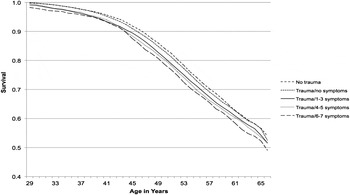
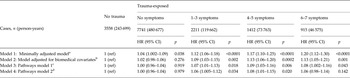
Over the 22-year study period, 15 837 women developed hypertension. Time-updated PTSD symptoms were modestly associated with increased risk of incident hypertension in a dose-response fashion. Women with 6–7 PTSD symptoms had a 20% higher rate of developing hypertension compared to women without trauma, after adjusting for demographics, family history, and childhood adiposity (Table 2, model 1; see Fig. 3 for survival curves). Analyses considering different reference groups indicated that the HRs for the no trauma and trauma/no symptoms groups were lower than those for all PTSD symptom groups; however, the PTSD symptom groups did not differ significantly from each other (Supplementary Table S1). Findings remained significant, although attenuated, after adjusting for time-varying hypertension-relevant medical risk factors and medications (Table 2, model 2; Supplementary Table S2 includes HRs for hypertension risk associated with model 2 covariates). Despite additional attenuation after adjusting for time-updated health behaviors, PTSD symptoms remained associated with significantly elevated hypertension risk (Table 2, model 3). Covarying time-varying antidepressant use attenuated associations further, particularly for women with 6–7 symptoms (Table 2, model 4).
Survival by trauma/PTSD symptom status, 1989–2011. Model adjusted for age at baseline, race/ethnicity, parental education, maternal and paternal history of hypertension, and somatotype at age 5.

Adjusted hazard ratios (95% confidence intervals) for the association of trauma exposure and PTSD symptoms with risk of incident hypertension, 1989–2011

HR, Hazard ratio; CI, confidence interval.
a Adjusted for age at baseline, race/ethnicity, parental education, maternal and paternal history of hypertension, and age 5 somatotype.
b Additionally adjusted for use of oral contraceptives, acetaminophen, aspirin, and other non-steroidal anti-inflammatory drugs, menopausal status and hormone therapy use, and hypercholesterolemia.
c Additionally adjusted for body mass index, physical activity, diet quality, sugar-sweetened beverage consumption, artificially-sweetened beverage consumption, cigarette smoking, and alcohol consumption.
d Additionally adjusted for antidepressant use.
As all potential mediators were significantly associated with trauma/PTSD symptoms and hypertension risk (online Supplementary Table S3), all were included as described above in pathway models. However, as only two potential mediators – BMI and antidepressant use – resulted in ⩾10% attenuation in trauma/PTSD symptom parameter estimates in relation to hypertension risk, we present only findings for these variables. Results of generalized estimating equations indicated higher PTSD symptoms were associated with higher BMI and greater likelihood of antidepressant use (Supplementary Table S3). BMI and antidepressant use were significantly associated with hypertension risk, after adjusting for demographics, family history, and childhood adiposity. Increasing BMI was monotonically related to elevated hypertension risk, with the largest increases in risk observed for BMI of ⩾27 (Supplementary Table S3). Antidepressant use (v. non-use) was also associated with increased risk of hypertension (Supplementary Table S3). In models adjusting for all other covariates, BMI accounted for an estimated 30% (95% CI 12–57) and antidepressant use accounted for an estimated 21% (95% CI 9–43) of the PTSD symptom-hypertension association.
After including childhood abuse in model 1, PTSD symptoms remained associated with elevated hypertension risk (trauma/no symptoms: HR 1.02, 95% CI 0.98–1.06; trauma/1–3 symptoms: HR 1.09, 95% CI 1.03–1.15; trauma/4–5 symptoms: HR 1.12, 95% CI 1.05–1.19; trauma/6–7 symptoms: HR 1.13, 95% CI, 1.05–1.22). When including lifetime depression with model 1 covariates, PTSD symptoms remained significantly associated with hypertension risk, although HRs were attenuated (trauma/no symptoms: HR 1.03, 95% CI 0.99–1.07; trauma/1–3 symptoms: HR 1.08, 95% CI 1.02–1.14; trauma/4–5 symptoms: HR 1.10, 95% CI 1.03–1.17; trauma/6–7 symptoms: HR 1.11, 95% CI 1.03–1.20).
In the analysis predicting 3554 prospectively detected hypertension events after 2008 (adjusted for model 1 covariates), higher PTSD symptoms were associated with increased hypertension risk (trauma/no symptoms: HR 0.98, 95% CI 0.90–1.07; trauma/1–3 symptoms: HR 1.05, 95% CI 0.94–1.17; trauma/4–5 symptoms: HR 1.11, 95% CI 0.98–1.26; trauma/6–7 symptoms: HR 1.10, 95% CI 0.95–1.28). Findings did not reach statistical significance, likely due to limiting to cases that onset when women were older.
Discussion
We present the first study of PTSD symptoms and incident hypertension in women that utilizes a longitudinal population-based cohort and examines potential mediators. PTSD symptoms were modestly associated with increased risk of developing hypertension over 22 years. Effect sizes were largest for the highest PTSD symptom levels, although CIs for the different PTSD symptom groups were overlapping. BMI and antidepressant use emerged as mediators, accounting for an estimated 30% and 21% of the PTSD symptom-hypertension relationship. Elevated PTSD symptoms have been associated with myocardial infarction and stroke incidence in women (Sumner et al. Reference Sumner, Kubzansky, Elkind, Roberts, Agnew-Blais, Chen, Cerdá, Rexrode, Rich-Edwards, Spiegelman, Suglia, Rimm and Koenen2015); increasing hypertension risk may be one mechanism by which PTSD contributes to these diseases.
Cross-sectional studies have documented associations between PTSD and hypertension but they have not been able to address whether PTSD precedes hypertension (e.g. Pietrzak et al. Reference Pietrzak, Goldstein, Southwick and Grant2011; Abouzeid et al. Reference Abouzeid, Kelsall, Forbes, Sim and Creamer2012). Our investigation expands this literature by examining PTSD symptoms in relation to hypertension onset – assessed longitudinally – over 22 years. PTSD symptoms were significantly associated with developing hypertension, even when adjusting for factors related to PTSD that have been linked to hypertension, including childhood abuse and lifetime depression (Riley et al. Reference Riley, Wright, Jun, Hibert and Rich-Edwards2010; Meng et al. Reference Meng, Chen, Yang, Zheng and Hui2012). Our findings are consistent with research suggesting that the PTSD-hypertension relationship does not solely reflect risk associated with co-morbid depression (Kibler et al. Reference Kibler, Joshi and Ma2009). Furthermore, our study extends previous research by (1) examining the association between PTSD symptoms and incident hypertension in younger and middle-aged civilian women, (2) considering effects of trauma and PTSD symptoms separately, (3) utilizing a longitudinal design, and (4) considering a range of potential mediators.
PTSD symptoms remained associated with hypertension risk when predicting prospectively detected new-onset hypertension, although findings were not statistically significant. This analysis predicted cases that onset when women were older (44–66 years), which may explain the lack of statistical significance. Hypertension becomes more common as women age (Mozaffarian et al. Reference Mozaffarian, Benjamin, Go, Arnett, Blaha, Cushman, de Ferranti, Després, Fullerton, Howard, Huffman, Judd, Kissela, Lackland, Lichtman, Lisabeth, Liu, Mackey, Matchar, McGuire, Mohler, Moy, Muntner, Mussolino, Nasir, Neumar, Nichol, Palaniappan, Pandey, Reeves, Rodriguez, Sorlie, Stein, Towfighi, Turan, Virani, Willey, Woo, Yeh and Turner2015). With increasing age, more hypertension risk factors are at play, making it harder to disentangle differential risk and detect relative effects. We believe it is suggestive that we detected any elevated risk in this subsample, particularly because we had a shorter timeframe in which to examine the PTSD symptom-hypertension relationship.
We identified two behavior-related risk factors as potential mediators of the PTSD symptom-hypertension association: BMI and antidepressant use. Even modest weight gain has been associated with increased hypertension risk in women (Huang et al. Reference Huang, Willett, Manson, Rosner, Stampfer, Speizer and Colditz1998), and women with PTSD symptoms are at risk of becoming overweight and obese (Kubzansky et al. Reference Kubzansky, Bordelois, Jun, Roberts, Cerda, Bluestone and Koenen2014). Weight loss reduces hypertension risk (Huang et al. Reference Huang, Willett, Manson, Rosner, Stampfer, Speizer and Colditz1998); thus it may be important to consider benefits of weight loss among women with PTSD who are overweight or obese. Additionally, our finding that antidepressant use accounted for a portion of the PTSD symptom-hypertension relationship is consistent with research suggesting antidepressant use may partly explain the link between PTSD symptoms and chronic disease (e.g. Type 2 diabetes; Roberts et al. Reference Roberts, Agnew-Blais, Spiegelman, Kubzansky, Mason, Galea, Hu, Rich-Edwards and Koenen2015). Antidepressant use may indicate greater PTSD severity rather than be a mediator. In our sample, higher PTSD symptoms were associated with greater likelihood of antidepressant use. Additionally, antidepressants have been found to influence BP, in part, by affecting vagal control (Licht et al. Reference Licht, de Geus, Seldenrijk, van Hout, Zitman, van Dyck and Penninx2009).
Additional behavioral and biological mediating risk factors not captured by the health behaviors examined likely also underlie the PTSD symptom-hypertension relationship and merit investigation. For example, sleep disturbances are associated with hypertension in women (Cappuccio et al. Reference Cappuccio, Stranges, Kandala, Miller, Taggart, Kumari, Ferrie, Shipley, Brunner and Marmot2007), and are commonly reported by individuals with PTSD (Maher et al. Reference Maher, Rego and Asnis2006). PTSD is also characterized by dysregulation of the autonomic nervous system, hypothalamic-pituitary-adrenal axis, and inflammatory response (Zoladz & Diamond, Reference Zoladz and Diamond2013), which could increase hypertension risk. For example, sympathetic nervous system hyperactivity (e.g. as indicated by elevated norepinephrine levels; Zoladz & Diamond, Reference Zoladz and Diamond2013) has been observed in PTSD. Sympathetic overdrive has been implicated in elevated BP onset and the progression and increased severity of hypertension over time (Mancia & Grassi, Reference Mancia and Grassi2014).
Methodological limitations of this study include the retrospective assessment of trauma and lifetime PTSD symptoms via screener and the derivation of date of symptom onset based on the date of the worst trauma (to which symptoms were anchored). Nevertheless, we were able to use this information as a time-varying variable in our models, with trauma/PTSD symptom status updated only through 2008. Dating of trauma has been reliable in this sample, but precision of reports may be somewhat lower than contemporaneous report. To avoid concerns about potential reverse causality, we lagged the trauma/PTSD symptom exposure so measures of potential mediators occurred one period after exposure date and hypertension status was evaluated two periods after exposure date. This approach could lead to underestimated results if disease-related effects of trauma/PTSD symptoms appear a few years after trauma/PTSD onset. Furthermore, our study does not address how remission of PTSD symptoms might impact risk of hypertension. If hypertension risk declines once PTSD symptoms remit, our findings may underestimate the strength of the PTSD symptom-hypertension association. Further research is needed to explore this topic. Another limitation is the self-reported hypertension outcome, although it has been validated in this cohort (Chasan-Taber et al. Reference Chasan-Taber, Willett, Manson, Spiegelman, Hunter, Curhan, Colditz and Stampfer1996; Forman et al. Reference Forman, Curhan and Taylor2008). Survivor bias is potentially a concern because women needed to remain in the study until 2008 to provide trauma/PTSD data. However, study retention is high (>90% biennial questionnaire response rate), and only 1.6% of the cohort (n = 1826) was deceased by trauma/PTSD symptom assessment. Generalizability of findings may be limited as the NHS II cohort is predominantly white and highly educated. However, findings are consistent with cross-sectional studies in more diverse samples (Davidson et al. Reference Davidson, Hughes, Blazer and George1991; Pietrzak et al. Reference Pietrzak, Goldstein, Southwick and Grant2011). Despite these limitations, this study is characterized by several unique strengths. It is the largest study of PTSD symptoms and hypertension in women to date and uses longitudinal data, thereby reducing concerns about reverse causality. We are the first study to our knowledge to evaluate the PTSD symptom-hypertension relationship in civilian women exposed to various traumas after accounting for a substantial set of potential confounders. Further, we tested a broad range of previously hypothesized mediators.
Conclusions
Approximately 1 in 10 women develop PTSD in their lifetime. Our study suggests that PTSD symptoms not only affect women's mental health but also their cardiovascular health. These findings, along with results linking PTSD symptoms to myocardial infarction and stroke (Sumner et al. Reference Sumner, Kubzansky, Elkind, Roberts, Agnew-Blais, Chen, Cerdá, Rexrode, Rich-Edwards, Spiegelman, Suglia, Rimm and Koenen2015), indicate that women with PTSD symptoms may be particularly susceptible to cardiovascular dysfunction, and this may suggest the value of targeted surveillance of individuals with PTSD to improve early detection of cardiovascular risk. A key goal of future research is to determine whether successful PTSD treatment reduces hypertension. Ultimately, it is clear that the impact of PTSD does not end with the mind but extends to the heart.
Supplementary material
For supplementary material accompanying this paper visit http://dx.doi.org/10.1017/S0033291716001914.
Acknowledgements
We acknowledge the Channing Division of Network Medicine, Department of Medicine, Brigham and Women's Hospital, and Harvard Medical School for managing the NHS II. This study was supported by the National Institutes of Health grants R01MH078928, R01MH101269, K01HL130650, T32MH017119, and UM1CA176726; and the Yerby Postdoctoral Fellowship.
Declaration of Interest
None