Lactation represents the final step to complete the reproductive cycle and it is fundamental for neonatal survival. This phase is characterized by an intense secretory activity from the mammary glands to produce milk. In ruminants, photoperiod can modulate the milk yield during lactation (Bocquier et al., Reference Bocquier, Thériez, Kann and Delouis1986). Thus, goats exposed to artificial long days consisting of 16 h light/day when kidding during late autumn, yielded about 20% more milk than goats under natural short days (Flores et al., Reference Flores, Flores, Elizundia, Mejia, Delgadillo and Hernandez2011).
In rams, studies investigating a photo-inducible phase exposed males to a pulse of extra-light (of 1 h) given at 10, 13, 16 or 19 h after a fixed dawn and demonstrated that 16 h after the dawn is when animals interpreted the pulse as a long day (Ravault and Ortavant, Reference Ravault and Ortavant1977). In addition, a study in dairy goats showed that exposure to 2 h of extra-light given from 16 to 18 h after dawn during 2 months (starting in January) followed by melatonin treatment caused ovulation in 75% of females after being in contact with males for 2.5 months, compared with no ovulations whatsoever in non-treated does (Chemineau et al., Reference Chemineau, Normant, Ravault and Thimonier1986). These previous studies show that 1 or 2 h of extra-light given at 16 h after dawn in winter is interpreted as a long day in both males and females.
Considering this, the objective of this study was to determine if 1 h of extra-light given at 16 h after dawn would stimulate milk yield in subtropical goats initiating their lactation during natural short days, in the same way as should occur when they are exposed to artificial long days of 16 h light.
Materials and methods
The study was carried out from the end of December to March in the Laguna region situated in the northern part of Mexico. During the study, the mean time at sunrise was 07.23 h and the mean time at sunset was 18.37 h with a mean duration of the day of 11 h 14 min.
Animals, management and general conditions
Twenty multiparous creole goats (in their third lactation), with a mean date of parturition of December 25th, were used. Animals were fed alfalfa hay (1.0 kg/animal: 1.95 Mcal of ME/kg of DM; 17.0% CP); corn silage (2.0 kg/animal: 2.27 Mcal ME/kg of DM; 9.4% CP) and commercial concentrate (0.2 kg/animal: 1.7 Mcal of ME/kg of DM; 18% CP). The average prolificacy was 1.3. All females nursed their kids up to day 30 of lactation and thereafter the goats were hand milked once a day until the end of the study. Body condition score (BCS) was assessed by palpating the spinous and lateral processes and the musculature of the lumbar region of the spine, and a score from 1 (very lean) to 4 (fat) in increments of 0.5 was assigned (Santucci and Maestrini, Reference Santucci and Maestrini1985).
Experimental design
A schematic representation of the experimental design is shown in Fig. 1. One group of lactating goats was maintained throughout the study under natural short photoperiod (natural day; ND (n = 7)). This group of lactating females received a mean 11 h 14 min of natural light during the study. Another group of females was submitted to an artificial long-day photoperiod starting at 5 d postpartum (long days; LD, n = 7). In this group, the pen (10 × 10 m) was equipped with daylight type lamps that emitted a minimum luminous intensity of 400 lx at the eye level of the goats. A third group of females received 1 h of extra-light 16 h after the fixed dawn (pulse of light; PL, n = 6). In this group, artificial dawn was fixed at 06 : 00 h and the lamps were off when natural light was sufficient. During the night, the lamps were on from 22 : 00 to 23 : 00 h to provide the light pulse. All groups were balanced for milk yield (1.1 ± 0.1; 1.1 ± 0.2 and 1.2 ± 0.2, for ND, LD PL groups respectively) and BCS (1.6 ± 0.1; 1.7 ± 0.1 and 1.8 ± 0.1, respectively) at the beginning of the study (at 5 d postpartum).
Schematic representation of the different photoperiodic treatments used in the present study. Goats had given birth December 25th ± 2.0 d, during the natural short days. A first group of goats perceived the natural photoperiod throughout the study (ND). Another group was submitted to an artificial long-day photoperiod (LD); lights were on from 06 : 00 to 09 : 00 h and from 17 : 00 to 22 : 00 h. A third group of goats was subjected to an artificial fixed down set at 06 : 00 h and lights were on until 08 : 00 h. Then, a 1-h pulse of light was given from 22 : 00 to 23 : 00 h (PL). Black areas represent the dark phase, while withe areas represent the artificial or natural luminous phase. The bulb picture represents lamps, while the sun represents the natural light.

Measurements
Milk yield and composition
During the suckling phase, the milk yield was assessed at 17 and 24 d postpartum using the weigh-suckle-weigh method. In the milking phase (from d 31 to 75 of lactation), the milk yield was assessed by one hand milking a day associated with OT application. The contents in percentage of fat, protein and lactose in milk samples were determined with a milk analyzer (Milkoscan 6000; Foss Electric, Hillerød, Denmark). Using the individual data of milk yield and the percentage of each milk content, the mean quantity of each component obtained/day was calculated.
Body condition score (BCS) of the females
The BCS of the females was determined once a week from d 10 postpartum. A trained person determined this measurement. The same person performed this measurement in the present study and he has done this measurement for more than 5 years.
Statistical analysis
Data from milk yield as well as fat, protein and lactose contents were analyzed using the MIXED MODELS procedure in SYSTAT 13. The model included the fixed effects of photoperiod treatments (3 levels: ND, LD and PL, the error term being goats within treatment), week of lactation (the residual error being the error term), their interaction, and the random effects of goats and residual. The individual goat was the experimental unit. All dependent variables were included as repeated measures. The post-hoc Bonferroni test was used to compare differences between means. Data from BCS was compared between the three groups with non-parametric U Mann–Whitney test. The statistical significance was set at P < 0.05 level.
Results and discussion
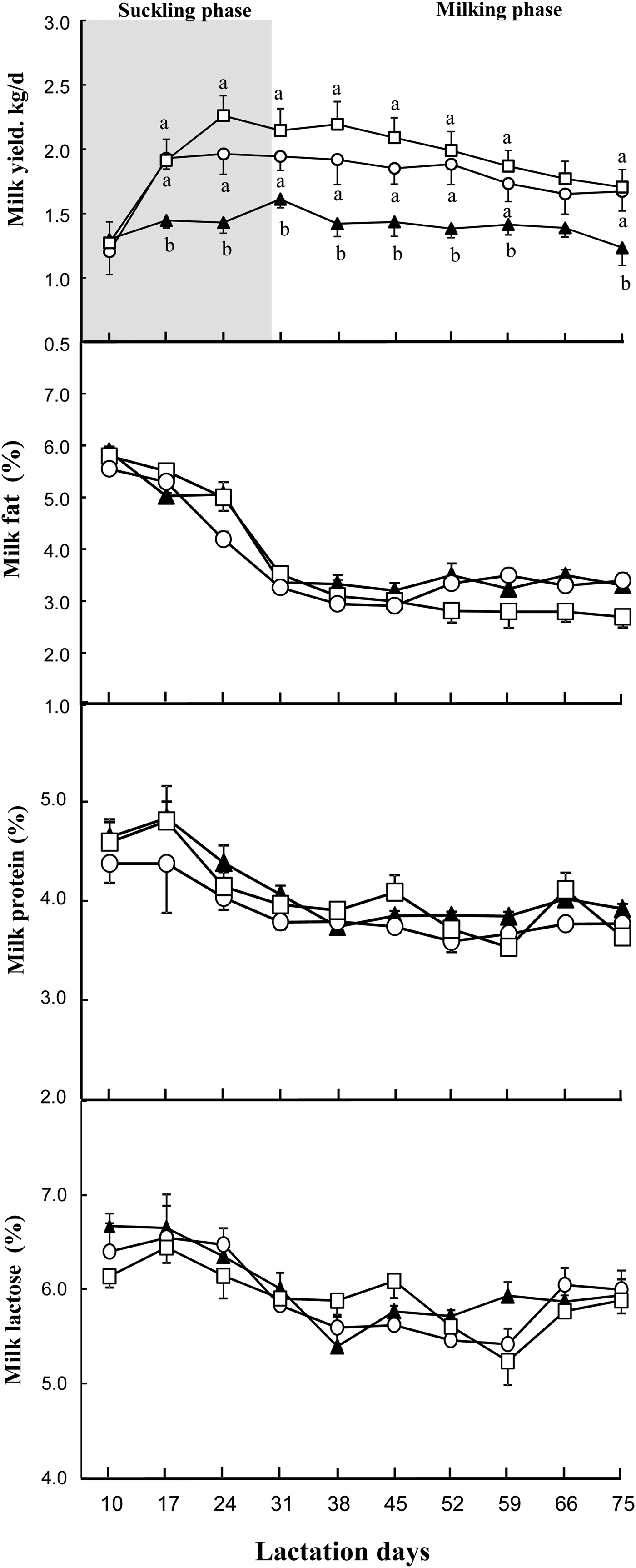
To our knowledge, these are the first results to document a milk yield response to a 1-h pulse of light in goats. Beginning at 17 d postpartum and across the rest of the study, goats from LD and PL yielded more milk than goats from ND, resulting in an interaction treatment × time (P ≤ 0.01). In addition, milk yield did not differ between goats from LD and PL (P > 0.05, Fig. 2). The present results are in accordance with other works in which the exposure to artificial long days increased the milk yield. In fact, subtropical goats that kidded during late autumn or winter yielded about 25% more milk when they were exposed to artificial long days (Flores et al., Reference Flores, Flores, Elizundia, Mejia, Delgadillo and Hernandez2011). In the literature, the galactopoietic response to artificial long days was observed whether goats were milked once or twice a day (Flores et al., Reference Flores, Flores, Elizundia, Mejia, Delgadillo and Hernandez2011). Globally, milk yield in the LD and PL groups was about 30% higher than in the ND group throughout the lactation period. The present results agree with studies in rams in which the application of the same photoperiodic scheme (PL) showed increased PRL levels, indicative of the perception of long days (Ravault and Ortavant, Reference Ravault and Ortavant1977).
Mean variation (±sem) of milk yield and their percentages of fat, protein and lactose during suckling (gray area) and milking (white area) phase in goats that had given birth December 25th ± 2.0 d. A first group of goats perceived the natural photoperiod throughout the study (ND, ▲). Another group was submitted to an artificial long-day photoperiod (LD, ○). A third group of goats was subjected to an artificial fixed down and a 1-h pulse of light during the dark phase (PL, □). Different letters between groups denotes differences (P ≤ 0.01).

Although the endocrine response to the photoperiodic treatment was not measured in our study, it is very likely that, as in rams, goats from LD and PL groups had higher PRL levels as was previously demonstrated (Hart, Reference Hart1975). The importance of PRL for lactation was tested in dairy goats, when a single injection of cabergoline (a dopaminergic inhibitor of PRL secretion), caused a 28% decrease in milk yield (Lacasse et al., Reference Lacasse, Ollier, Lollivier and Boutinaud2016). Another well-documented explanation for the galactopoietic effect of long days is the increased levels of IGF-1. Lactating goats submitted to an artificial long-day photoperiod had increased IGF-1 levels, which were associated with high milk yield in this species (Flores et al., Reference Flores, Delgadillo, Flores, Pastor, Duarte, Vielma and Hernández2015).
In the goat, exposure to artificial long days during lactation increased feed intake as well as milk yield (Garcia-Hernandez et al., Reference Garcia-Hernandez, Newton, Horner and Nuti2007). However, in our study no additional food was provided to LD and PL groups. It is possible that the pulse of light or artificial long day-length exposure could have stimulated milk yield due to increased feed conversion efficiency. For example, Bocquier et al. (Reference Bocquier, Thériez, Kann and Delouis1986) reported that under long day-length lactating ewes produced more milk than ewes under short days when the same food intake was provided. These authors concluded that photoperiod acts to partition more nutrients toward the mammary gland than to body reserves. However, we did not observe any variation in BCS as a consequence of light exposure throughout the study (P > 0.05). In addition, BCS analysis also did not reveal any effect of group (P > 0.05) and the interaction time × group was not significant (P > 0.05: online Supplementary Fig. S1).
Mean percentages of fat, protein and lactose contents in milk samples varied throughout the study (P < 0.0001; Fig. 2). Nevertheless, these percentages in milk did not differ between the 3 groups at any stage of lactation, since analyses did not reveal an effect of the group (P > 0.05), nor an interaction group × time of lactation (P > 0.05). Taking into account the milk yield and their corresponding milk contents, the mean grams of milk fat/day, milk protein/day and lactose/day were higher during some stages of lactation in goats from PL than in the others two groups within the first 45 d of lactation (online Supplementary Fig. S2).
Overall, this influence of the exposure to a pulse of light on the total milk yield and their components can be considered as an effective tool in goats kidding under natural short days to increase the incomes of goat producers. In the present, the production costs of light treatments was not evaluated, although it should be assumed that, in the case of the pulse of light, significant savings should be obtained.
In conclusion, in dual-purpose lactating goats that started their lactation during natural short days, daily exposure to a 1-h pulse of light is sufficient to stimulate milk yield compared to females maintained under natural photoperiod. In addition, the milk yield levels are similar to those of goats that were submitted to artificial long days (16 h of light).
Supplementary material
The supplementary material for this article can be found at https://doi.org/10.1017/S0022029919000517
Acknowledgements
The authors want to thank to Professor Jesús Abasta for facilitating the animals used in the present study. E.S. Mendieta was supported by a grant from CONACyT during his doctoral studies. This research was conducted as part of the CABRAA International Associated Laboratory between Mexico (UAAAN-CIRCA) and France (INRA-PRC).
Conflict of interest
None of the authors has any conflict of interest to declare.