Introduction
Differentiating among species of Trichinella has been a permanent objective since 1972, when four sibling species were proposed for Trichinella spiralis, T. nativa, T. nelsoni and T. pseudospiralis, based mainly upon differences in host infectivity, geographic location, distinguishable morphological characters and cross-breeding experiments (Britov & Boev, Reference Britov and Boev1972; Garkavi, Reference Garkavi1972). At the present time, eight species and four genotypes of Trichinella have been identified worldwide (Murrell et al., Reference Murrell, Lichtenfels, Zarlenga and Pozio2000; Pozio & Zarlenga, Reference Pozio and Zarlenga2005; Krivokapich et al., Reference Krivokapich, Prous, Gatti, Confalonieri, Molina, Matarasso and Guarnera2008). According to the International Trichinella Reference Center, which has typed more than 1800 isolates of human and animal origin from throughout the world, four species are present in Europe: T. spiralis, predominating in domestic and sylvatic swine, synanthropic animals and a broad range of sylvatic carnivores (Dick & Pozio, Reference Dick, Pozio, Samuel, Pybus and Kocan2001; Pozio, Reference Pozio2001); T. nativa, affecting mostly the sylvatic carnivores living in the frigid zones of Europe (Pozio & Zarlenga, Reference Pozio and Zarlenga2005); T. britovi, identified mostly in the sylvatic carnivores of the temperate areas of Europe; and T. pseudospiralis, in domestic hosts and sylvatic mammals as well as birds, and present in Bulgaria, Croatia, Denmark, Finland, France, Georgia, Germany, Hungary, Italy, Lithuania, The Netherlands, Slovakia, Sweden and Russia (Pozio & Zarlenga, Reference Pozio and Zarlenga2005; Nockler et al., Reference Nockler, Reckinger and Pozio2006; Beck et al., Reference Beck, Beck, Lučinger, Florijančić, Bošković and Marinculić2008; Széll et al., Reference Széll, Marucci, Bajmóczy, Cséplo, Pozio and Sréter2008; ITRC database: http://www.iss.it/site/Trichinella/scripts/Dedb.asp?lang = 2).
Various biochemical methods, reviewed by Zarlenga & La Rosa (Reference Zarlenga and La Rosa2000), have been employed for species differentiation, including the analysis of the host antibody responses to different species of Trichinella, isoenzyme analysis, restriction enzyme analysis (RFLP) and the use of DNA probes. Tremendous advances in genotyping Trichinella spp. isolates have been made using PCR technology to amplify random polymorphic DNA (RAPD) (Bandi et al., Reference Bandi, La Rosa, Bardin, Damiani, de Carneri and Pozio1993; Dupouy-Camet et al., Reference Dupouy-Camet, Robert, Guillou, Vallet, Perret and Soulé1994; Tighe et al., Reference Tighe, Goyal, Wilson, Wakelin and Pritchard1994), or to amplify specific nuclear DNA sequences such as the expansion segment 5 (ESV) of rRNA (Arriaga et al., Reference Arriaga, Yepes-Mulia, Viveros, Zarlenga, Lichtenfels, Benitez and Ortega-Pierres1995; Zarlenga et al., Reference Zarlenga, Aschenbrenner and Lichtenfels1996; Gasser et al., Reference Gasser, Zhu, Monti, Dou, Cai and Pozio1998; Appleyard et al., Reference Appleyard, Zarlenga, Pozio and Gajadhar1999), the ESV and internal transcribed spacer (ITS) (Zarlenga et al., Reference Zarlenga, Chute, Martin and Kapel1999), the ESV, D4 and D5 (Gasser et al., Reference Gasser, Hu, El-Osta, Zarlenga and Pozio2005), 5S rRNA (Rombout et al., Reference Rombout, Bosch and Van Der Giessen2001; De Bruyne et al., Reference De Bruyne, Yera, Le Guerhier, Boireau and Dupouy-Camet2005; van der Giessen et al., Reference van der Giessen, Fonville, Briels and Pozio2005), the Ts43 glycoprotein gene (Wu et al., Reference Wu, Nagano and Takahashi1998, Reference Wu, Nagano, Pozio and Takahashi1999) and the Ts 53 kDa E/S antigen gene (Soulé et al., Reference Soulé, Guillou, Dupouy-Camet, Vallet and Pozio1993). Few sequences of mitochondrial DNA (mtDNA) have been used to differentiate among species of Trichinella and these include cytochrome oxidase subunit I (cox I) (Nagano et al., Reference Nagano, Wu, Matsuo, Pozio and Takahashi1999) and large-subunit ribosomal RNA (rrnL) (Borsuk et al., Reference Borsuk, Moskwa, Pastusiak and Cabaj2003). Mitochondrial DNA is maternally inherited and evolves independently from, and generally more rapidly than, the nuclear genome (Brown, Reference Brown and MacIntyre1985; Anderson et al., Reference Anderson, Komuniecki, Komuniecki and Jaenike1995, Reference Anderson, Blouin and Beech1998), presenting higher substitution rates than the nuclear sequences (Blouin, Reference Blouin2002). It therefore provides a useful tool for analysis of genetic variation within and among parasite populations (Zhang et al., Reference Zhang, Chai, Jiao, Osman and McManus1998; La Rosa et al., Reference La Rosa, Marucci, Zarlenga and Pozio2001) and for the systematics, ecology and epidemiology of nematodes (Hu et al., Reference Hu, Chilton and Gasser2004). Moreover, mtDNA has a major advantage over nuclear DNA in that for each copy of nuclear DNA, there are thousands of copies of mtDNA in each cell, suggesting the possibility that mtDNA analysis may be sensitive, and thus more successful, on highly degraded specimens such as those commonly recovered from field conditions. Hence, the aim of this work was to establish a genotyping system to differentiate the four Trichinella species described in Europe, using two RNA genes of the mitochondrial genome as molecular markers, and to evaluate its sensitivity and specificity when compared to other PCR methods.
Materials and methods
Parasite strains and DNA isolation
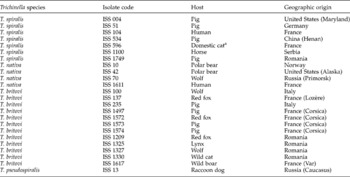
All Trichinella species used in this study are described in detail (code, original hosts, country of origin) in table 1. They were maintained by serial passages in OF1 female mice under specific quality control. Muscle larvae (ML) were recovered from muscle tissue of infected mice by a standard pepsin–HCl digestion method (Gamble et al., Reference Gamble, Bessonov, Cuperlovic, Gajadhar, van Knapen, Noeckler, Schenone and Zhu2000). Genomic DNA was obtained from a pool of approximately 1000 ML of Trichinella species using the Genomic DNA from Tissue kit (Macherey–Nagel, Bethlehem, Philadelphia, USA), according to the manufacturer's instructions for mouse- or rat-tail protocols. DNA concentrations were determined spectrophotometrically. Crude DNA from a single larva was also prepared according to the protocol of Pozio & La Rosa (Reference Pozio and La Rosa2003) with a slight modification: a single larva was washed five times in phosphate-buffered saline (PBS) and then placed in 5 μl of PBS in a 0.5 ml tube; 2 μl of 1 mm Tris–HCl, pH 7.6, was added, overlaid with a drop of mineral oil and heated to 90°C for 10 min and then cooled on ice; 3 μl of proteinase K solution (final concentration of 100 μg/ml) was added and samples were incubated at 48°C overnight. Samples were heated to 90°C for 15 min and cooled on ice. Samples were stored at − 20°C prior to PCR test.
Species, origin and localization of the Trichinella genotypes tested by mitochondrial multiplex PCR. The Trichinella pseudospiralis isolate used in this study is from the Palaearctic region (ISS 13).

a Muscular biopsy of a domestic cat contaminated by ingestion of Trichinella-positive horsemeat.
Serial dilutions of genomic DNA for all four Trichinella species were made in MilliQ water, having final dilutions of 100 ng/μl, 10 ng/μl, 1 ng/μl, 100 pg/μl and 10 pg/μl.
Cloning, sequencing and sequence analysis of mitochondrial small and large subunit ribosomal RNA genes
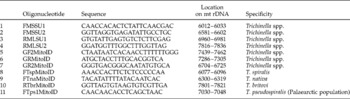
Primers 1–4 (FMSSU1, FMSSU2, RMLSU1, RMLSU2) (table 2), deduced from the published sequence of the mitochondrial genome of T. spiralis (Lavrov & Brown, Reference Lavrov and Brown2001; accession number: NC_002681), were used to amplify the small and large subunit ribosomal RNA genes (mt-rrnS and mt-rrnL, respectively) of T. nativa (ISS 042), T. britovi (ISS 100) and T. pseudospiralis (ISS 13). PCR was performed in a 50 μl reaction volume containing 10 mm Tris–HCl (pH 8.5), 50 mm KCl, 1.5 mm MgCl2, 200 μm dNTPs, 1.25 units Taq DNA polymerase (Promega, Madison, Wisconsin, USA), 0.5 μm of each primer and 50 ng of template DNA. All reactions were performed in a Bio-Rad iCycler (Bio-Rad, Hercules, California, USA) under the following PCR conditions: one cycle at 94°C for 5 min, 35 cycles at 94°C for 1 min, 55°C for 1 min, 72°C for 1.5 min and one extension cycle at 72°C for 10 min. The amplicons were electrophoresed on a 1% agarose gel (Sigma-Aldrich, St. Louis, Missouri, USA) and visualized under an ultraviolet transilluminator after staining with ethidium bromide. Two microlitres of fresh PCR product were cloned into the plasmid pCR 2.1 using the TOPO T/A cloning kit (Invitrogen, Carlsbad, California, USA) according to the manufacturer's instructions. Three recombinant plasmids for each mitochondrial gene of each Trichinella species were sequenced by a capillary sequencer (Applied Biosystems, Foster City, California, USA) in both directions. The resulting sequences were aligned and analysed by means of MultAlin (Corpet, Reference Corpet1988), a multiple sequence alignment program.
Species-specific and cross-specific primers used for the amplification of the mitochondrial small subunit (SSU) and large sububit (LSU) rDNA of T. nativa (ISS 042), T. britovi (ISS 100), and T. pseudospiralis (ISS 13) (primers 1–4) and for the mitochondrial multiplex PCR (primers 5–11).

Mitochondrial multiplex PCR
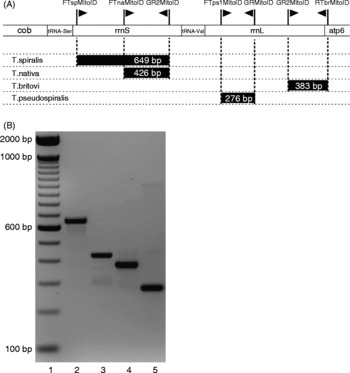
The mitochondrial multiplex reaction consisted of the concomitant use of seven primers (primers no. 5–11; table 2), designated to amplify a single, species-specific DNA fragment (649 bp, 426 bp, 383 bp and 276 bp, respectively) for each of the four Trichinella species (fig. 1A). Five microlitres of crude DNA from a single larva of 24 isolates and 1 μl of genomic DNA from the serial dilutions (100 ng/μl, 10 ng/μl, 1 ng/μl, 100 pg/μl and 10 pg/μl), of each Trichinella species were amplified in a 50 μl PCR reaction volume, including 10 mm Tris–HCl (pH 8.5), 50 mm KCl, 1.5 mm MgCl2, 200 μm dNTPs, 1.25 units Taq DNA polymerase (Promega) and 0.5 μm of each primer. The mitochondrial multiplex PCR was also performed on a mixture of crude DNA of the four Trichinella species present in Europe. Reactions were run in a Bio-Rad iCycler under the following conditions: one cycle at 94°C for 5 min, 35 cycles of 94°C for 1 min, 55°C for 1 min, 72°C for 30 s and one extension cycle at 72°C for 10 min. Reaction products (7 μl) were separated on a 2% agarose gel (Sigma–Aldrich) and detected by ethidium bromide staining. Photographs were taken with a Bio-Rad Doc Gel XR digital imager.
(A) Schematic representation of the expected amplified mitochondrial multiplex PCR products for the four Trichinella species. (B) Electrophoresis of the mitochondrial multiplex PCR products. Lanes: 1, 100 bp ladder (Invitrogen); 2, T. spiralis (ISS 004); 3, T. nativa (ISS 042); 4, T. britovi (ISS 100); 5, T. pseudospiralis (ISS 13).

ESV/ITS1 multiplex PCR
A multiplex PCR using the ESV/ITS1 primers was performed on 1 μl of genomic DNA from the serial dilutions (100 ng/μl, 10 ng/μl, 1 ng/μl, 100 pg/μl and 10 pg/μl), of each Trichinella species, according to Guidelines for the identification of Trichinella muscle stage larvae at the species level by multiplex PCR (Community Reference Laboratory for Parasites, 2007).
Results
Mitochondrial rRNA genes of T. nativa, T. britovi and T. pseudospiralis
The PCR amplification, using the pair of primers FMSSU1/RMLSU1 and FMSSU2/RMLSU2, generated products of expected sizes (972 bp and 1256 bp, respectively) for T. nativa (ISS 042), T. britovi (ISS 100) and T. pseudospiralis (ISS 13) (data not shown). Following cloning and sequencing, the mitochondrial small subunit (SSU) and large subunit (LSU) nucleotide sequences of T. spiralis (Lavrov & Brown, Reference Lavrov and Brown2001), T. nativa, T. britovi and T. pseudospiralis were aligned and analysed by means of MultAlin (Corpet, Reference Corpet1988). The levels of pairwise nucleotide sequence differences are shown in table 3. Altogether, 326 bp of the total 1709 bp were found to be variable among the four species. The T. spiralis nucleic sequences present 94%, 93.4% and 85.5% identity with those of T. britovi, T. nativa and T pseudospiralis, respectively. When compared to the T. nativa sequences, homologues from T. britovi and T. pseudospiralis are 96% and 85.1% identical, respectively. Additionally, 85% identity exists between the T. britovi sequences and the T. pseudospiralis nucleic sequences of mitochondrial rDNA genes. DNA sequences were deposited into GenBank™ under accession numbers DQ159093 (T. nativa), DQ159092 (T. britovi) and DQ159091 (T. pseudospiralis).
Levels of identity (%) and pairwise sequence differences (bp) among mitochondrial small and large subunit rDNA genes of the four Trichinella genotypes.

Mitochondrial multiplex polymerase chain reaction (mitochondrial multiplex)
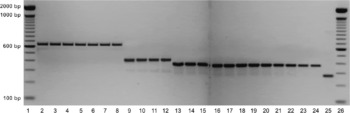
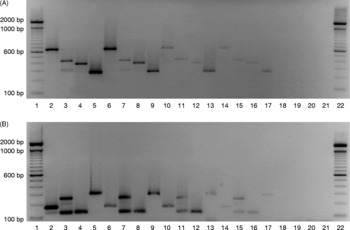
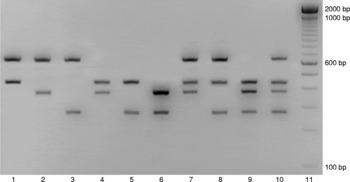
When mitochondrial multiplex PCR was performed on the crude DNA from a single larva of the four species of Trichinella (T. spiralis, T. nativa, T. britovi and T. pseudospiralis), a unique profile with species-specific bands of 649 bp, 426 bp, 383 bp and 276 bp, respectively, was obtained (fig. 1B). The specific profile was reproducible for 24 isolates of the four Trichinella species present in Europe (fig. 2). Positive amplification of the four Trichinella species was obtained with as little as 100 pg of genomic DNA (fig. 3A). The species-specific pattern was also observed on a mixture of crude DNA of the four Trichinella species (fig. 4).
Electrophoresis of the mitochondrial multiplex PCR products of the 24 Trichinella isolates. Lanes: 1 and 26, 100 bp ladder (Invitrogen); 2–8, T. spiralis isolates (ISS 004, 51, 104, 534, 596, 889, 1100); 9–12, T. nativa isolates (ISS 10, 42, 70, 1611); 13–24, T. britovi (ISS 100, 137, 235, 1497, 1572, 1573, 1574, 1209, 1325, 1327, 1330, 1617); 25, T. pseudospiralis (ISS 13) Palaearctic population.

Electrophoresis of the multiplex PCR products of four Trichinella species and dilutions. Lanes: 1 and 22, 100 bp ladder (Invitrogen); 2, 6, 10, 14, 18, T. spiralis (ISS 004); 3, 7, 11, 15, 19, T. nativa (ISS 042); 4, 8, 12, 16, 20, T. britovi (ISS 100); 5, 9, 13, 17, 21, T. pseudospiralis (ISS 13) Palaearctic population. Serial dilutions were as follows: lanes 2–5, 100 ng/μl; 6–9, 10 ng/μl; 10–13, 1 ng/μl; 14–17, 100 pg/μl; 18–21, 10 pg/μl. (A) Mitochondrial multiplex PCR products; (B) ESV/ITS1 multiplex PCR products.

Electrophoresis of the mitochondrial multiplex PCR products of mixed crude DNA of four Trichinella species. Lanes: 1, T. spiralis/T. nativa; 2, T. spiralis/T. britovi; 3, T. spiralis/T. pseudospiralis; 4, T. nativa/T. britovi; 5, T. nativa/T. pseudospiralis; 6, T. britovi/T. pseudospiralis; 7, T. spiralis/T. nativa/T. britovi; 8, T. spiralis/T. nativa/T. pseudospiralis; 9, T. nativa/T. britovi/T. pseudospiralis; 10, T. spiralis/T. nativa/T. britovi/T. pseudospiralis; 11, 100 bp ladder (Invitrogen).

Discussion
The study of mt genomes has been important for various fundamental areas, including mt biochemistry, physiology and molecular biology (Hu et al., Reference Hu, Chilton and Gasser2004). To date, more than 1475 mt genomes have been sequenced for a range of metazoan organisms, including 27 species of parasitic nematodes (Organelle Genome Resources of the National Center for Biotechnology Information: http://www.ncbi.nlm.nih.gov/genomes/ORGANELLES/mztax_short.html).
The analyses of the substitution patterns for mt genes (cox1 and nad4) of nematodes have indicated that they yield useful markers for identifying, differentiating and determining relationships of closely related species (Hu & Gasser, Reference Hu and Gasser2006). A recent study of Trichinella species used the variation in the mitochondrial rrnL gene along with two other nuclear genes to develop the first robust and comprehensive analysis of their phylogeny (Zarlenga et al., Reference Zarlenga, Rosenthal, La Rosa, Pozio and Hoberg2006).
The multiplex PCR developed herein exploits the sequence variability within the mitochondrial small and large subunit rRNA genes (rrnS, rrnL) to differentiate T. spiralis (649 bp), T. nativa (426 bp), T. britovi (383 bp) and T. pseudospiralis (276 bp). The unique single-band profile of the mitochondrial multiplex polymerase chain reaction amplification was conserved among the 24 isolates of the four Trichinella species tested (fig. 2). The isolates analysed were sufficiently diverse in geographical origin to support the claim that the banding patterns presented here can be used as reference profiles for each species. When the mitochondrial multiplex PCR was performed on a serial dilution (100 ng/μl, 10 ng/μl, 1 ng/μl, 100 pg/μl and 10 pg/μl), positive amplification for the four Trichinella species was obtained with as little as 100 pg of genomic DNA (fig. 3A). When compared to the ‘gold-standard’ assay employed by the International Trichinella Reference Center and Community Reference Laboratory for Parasites (CRLP, Rome) (2007), the mitochondrial multiplex PCR presented comparable sensitivity (fig. 3). However, the comparative abundance of mitochondrial DNA made no evident improvement in the diagnostic sensitivity among these tested specimens. Perhaps modifications to this approach may yet offer a basis to increase the performance of this, or similar assays, when the recovered larvae have undergone degradation.
Our assay was evidently unaffected by any acceleration in the accumulation of mutations in mitochondrial genes (as compared to their nuclear counterparts), allowing consistent amplification of all isolates. This is consistent with recent evidence that the T. spiralis of Europe, and indeed of Europe's former colonial dependents, underwent a recent spread of genetically homogeneous individuals (Rosenthal et al., Reference Rosenthal, La Rosa, Zarlenga, Dunams, Chunyu, Mingyuan and Pozio2008). Further testing will be required to understand whether intraspecific variation in the mitochondrial RNA of other species of Trichinella can be diagnosed with this assay, or can compromise its application. Nonetheless, these data sustain the belief that European species can be readily and accurately identified using such methods.
Previous PCR-based methods using mitochondrial genes are either more laborious, like PCR-RFLP (Nagano et al., Reference Nagano, Wu, Matsuo, Pozio and Takahashi1999), or can only differentiate T. spiralis and T. britovi (Borsuk et al., Reference Borsuk, Moskwa, Pastusiak and Cabaj2003). Nevertheless, mixed species infection has been observed in wild boars infected by T. spiralis and T. britovi (Pozio et al., Reference Pozio, Serrano, La Rosa, Reina, Perez-Martin and Navarrete1997) and T. spiralis and T. pseudospiralis (Nockler et al., Reference Nockler, Reckinger and Pozio2006), and in foxes, cats and racoon dogs infected by T. spiralis and T. nativa, T. spiralis and T. britovi, or T. britovi and T. nativa (Kapel et al., Reference Kapel, Oivanen, La Rosa, Mikkonen and Pozio2001). When mitochondrial multiplex PCR was applied to samples containing a mixture of genomic DNA of T. spiralis, T. nativa, T. britovi or T. pseudospiralis species, the specific amplified profile could lead to their precise identification (fig. 4). On the contrary, the ‘gold standard’ technique (CRLP, Rome) and the other PCR-based methods need several PCR runs performed on single larvae taken from the same sample to identify species mixtures.
If by means of the mitochondrial multiplex PCR method, a positive discrimination can be made between the four Trichinella species identified in Europe, using the banding patterns presented here as reference profiles, no band would be obtained with other genotypes (e.g. T. nelsoni or T. murrelli) not normally present in Europe but which could be introduced through meat or animal importation, as the primers were designed to be species specific.
In conclusion, mitochondrial multiplex PCR has proven to be an easily implemented technique for distinguishing between the four Trichinella species identified in Europe. One major advantage is its flexibility for pools of larvae, to identify mixed species infection or a single larva, when studying the genetic structure of different Trichinella spp. isolates or populations. Prior to routine application in the field, a validation of the specific PCR profiles is being carried out by extensive analysis of more Eurasian isolates, as well as a variety of larvae recovered in the field. Moreover, the use of the cross-specific primers, designed from a conserved region of the mitochondrial DNA, may be extended to other nematodes, representing a molecular marker at the species level.
Acknowledgements
The authors are grateful to Dr Benjamin Rosenthal (USDA) for the comments and suggestions he had made on an earlier draft. This work was supported by grants of the EU TRICHIPORSE contracts (QLRT-2000-01156, QLK1-CT-2002-02826), MetVetNet (Trichinet/Trichimed and Med Vet Net), NEMAGECO-ICONES (2006), UEFISCSU (RP-Programmes 11/01.10.2007) and ANCS (Capacities-Module III-China, 2009-2010).