Introduction
Host specificity, in which symbionts utilize specific hosts, is a key factor driving their speciation and phylogenetic diversification (Millanes et al., Reference Millanes, Truong, Westberg, Diederich and Wedin2014; Norton and Carpenter, Reference Norton and Carpenter1998). Ecological specialization through host specificity restricts gene flow between symbiotic populations and drives speciation and phylogenetic diversification (Kagawa et al., Reference Kagawa, Hirota, Saito, Uchida, Watanabe, Miyazoe, Yamaguchi, Matsuno, Araki, Wakasugi, Suzuki, Kobayashi, Miyazaki, Suyama, Hanyuda and Chiba2023; Thines, Reference Thines2019). Symbionts are usually characterized by dual niches: traits on the host and the external environment (Mestre et al., Reference Mestre, Poulin and Hortal2020). Host specificity can be influenced by spatio-temporal scales, environmental heterogeneity, and the availability of potential hosts in the field (Devictor et al., Reference Devictor, Clavel, Julliard, Lavergne, Mouillot, Thuiller, Venail, Villéger and Mouquet2010; Wells and Clark, Reference Wells and Clark2019). Therefore, to accurately assess whether symbionts exhibit host specificity, it is essential to consider these factors in the evaluation. Investigating potential hosts that coexist in the same space and examining which hosts are utilized by symbionts is an effective approach for assessing host specificity, as it reduces environmental heterogeneity (Sakata et al., Reference Sakata, Tatani, Chiba and Kagawa2024). However, potential hosts may occupy different microhabitats depending on the species, making it difficult to determine whether their distributions are entirely overlapping. In contrast, laboratory host selection experiments allow for the control of environmental heterogeneity and the presence of potential hosts. Therefore, by eliminating external environmental factors, the laboratory experiments provide a valuable approach for assessing whether symbionts actively select their hosts within their interactions (Poulin and Keeney, Reference Poulin and Keeney2008).
Stylochoplana parasitica (Kato, Reference Kato1935) (Figure 1a) is an acotylean flatworm belonging to Polycladida and is found in the mantle groove of the intertidal chiton Liolophura japonica (Kato, Reference Kato1935). A phylogenetic study suggested that S. parasitica forms a monophyletic group with Stylochoplana pusilla, which symbiotically associates with intertidal gastropods in the same region, indicating that speciation occurred through host shift (Kagawa et al., Reference Kagawa, Itoh, Nakajima and Fukumori2025). Previous field surveys suggested that S. parasitica is specifically associated with L. japonica and not with any other intertidal chiton or gastropods (Morita, Reference Morita2018). The original species description of S. parasitica also noted that this flatworm does not attach to Acanthochitona or Onithochiton chitons, which co-occur with L. japonica (Kato, Reference Kato1935). Furthermore, the species description reported that L. japonica was selected when different chiton species and flatworms were placed in the same container. However, no methodology or quantitative data on host selection experiments were provided, only descriptive observations. Can the host specificity of S. parasitica be reproduced even under laboratory conditions? Verification of this hypothesis will support the evidence that this species is adapted to its host and provide insight into the evolution of host specificity and the process of speciation.
I found that Stylochoplana parasitica was present at high densities in the mantle groove of Liolophura japonica on the tidal flats of Ena Bay, Miura City, Kanagawa Prefecture, Japan. To date, S. parasitica has only been reported in the intertidal zones of Shimoda City, Shizuoka Prefecture, and Tateyama City, Chiba Prefecture, Japan (Kato, Reference Kato1935; Morita, Reference Morita2018; Oya et al., Reference Oya, Yoshida and Kiyomoto2023). The study site is located between these areas, within the known distribution range of S. parasitica. In addition to L. japonica, Acanthochitona defilippii was also present at this site (Figure 1b), and both species occupied the same bedrock and boulders (Figure 1c). Thus, areas where multiple potential hosts occur sympatrically are suitable for investigating host specificity in the field. Therefore, to address the above issues, I first collected L. japonica and A. defilippii and compared the prevalence rates of flatworms between chiton species to examine host specificity under natural condition. Furthermore, I experimentally examined which host the flatworms attached to and verified whether the host specificity observed in the field was also reproduced under controlled laboratory conditions.
(a) Stylochoplana parasitica, a parasitic flatworm, removed from Liolophura japonica. (b) The chitons L. Japonica and Acanthochitona defilippii were used in this study. The left and right images show the dorsal and ventral sides, respectively. (c) L. Japonica and A. Defilippii are attached to the same boulder. This photograph was taken at the study site.

Materials and methods
In October 2024, I randomly collected individuals of both chiton species L. japonica and A. defilippii, within their sympatric range on the tidal flats of Ena Bay, Miura City, Kanagawa Prefecture, Japan (10 m radius around lat 35.143125, long 139.664404). Collected samples were placed in plastic bags for each host individual at the site and transported to the laboratory. The flatworms attached to the mantle grooves of the chitons were then removed in the laboratory using a paintbrush, and the number of individuals was counted. Flatworm prevalence was calculated (Number of hosts with flatworms attached/Number of hosts surveyed) and compared between hosts for differences. The difference in host utilization was statistically analysed using Fisher’s exact test in R ver. 4.2.2 (R Core Team 2013).
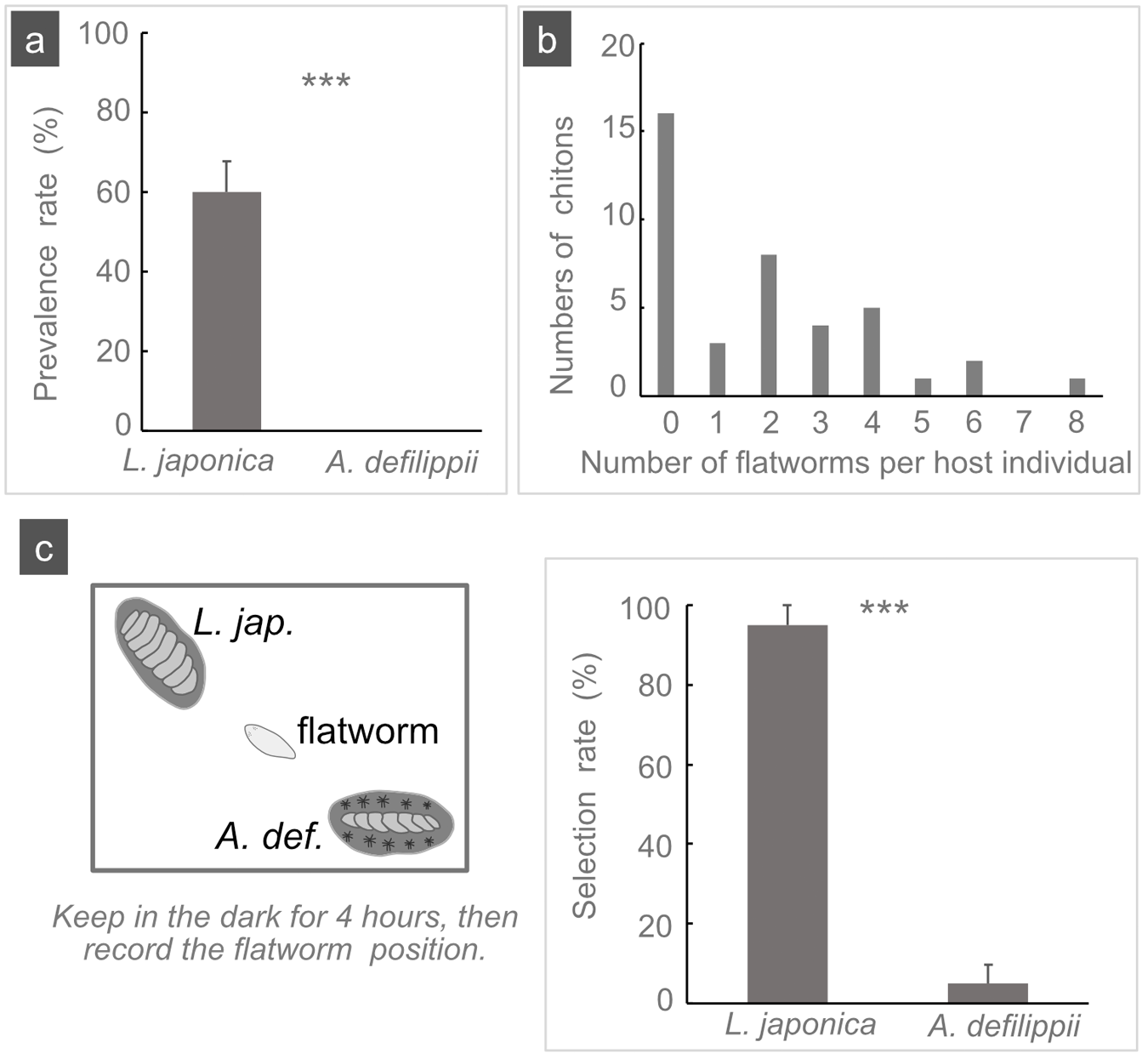
To examine whether host specificity was also observed under laboratory conditions, Liolophura japonica (with flatworms removed) and Acanthochitona defilippii were each placed on the bottom of a plastic container (193 × 139 × 64 mm, Nakaya Kagaku Sangyo Co., Ltd., Japan) filled with 400 mL of filtered seawater (Figure 2a). After confirming that the chitons had attached to the bottom, a single flatworm was introduced at the wall furthest from the two chiton species and left to settle for four hours. Because the behaviour of symbiotic flatworms may change depending on the light, the experiments were conducted under uniform dark conditions (Faubel et al., Reference Faubel, Sluys and Reid2007; Kato, Reference Kato1933; Oya et al., Reference Oya, Nakajima and Kajihara2022). Subsequently, the attachment of the flatworm to the mantle groove of either chiton species was recorded. A total of 44 flatworms were tested in this experiment. The difference in preference rate was statistically analysed using a binomial test in R ver. 4.2.2 (R Core Team 2013).
(a) This boxplot indicates the prevalence of flatworms in the field. *** denotes p < 0.001 (Fisher’s exact test). Error bars represent standard deviations. (b) The histogram shows the number of flatworms attached to each chiton. (c) The method and results of the host selection experiment. The graph shows the percentage of hosts selected at the end of the experiment. *** denotes p < 0.001 (binomial test). Error bars represent standard deviations.

Results
A total of 95 chitons (40 L. japonica, 55 A. defilippii) were collected in the field survey. All collected flatworms were S. parasitica. S. parasitica was found on 60% of L. japonica but was absent from A. defilippii (p < 0.001, Figure 2a). Multiple flatworms were often observed on a single host, with a maximum of eight individuals per host (Figure 2b). In the laboratory experiment, of the 44 flatworms tested, 22 remained unattached, while 20 attached to a chiton. Among these 20 flatworms, 19 attached to L. japonica, whereas only one attached to A. defilippii (p < 0.001, Figure 2a).
Discussion
Previous field surveys suggested that S. parasitica exhibits host specificity (Kato, Reference Kato1935; Morita, Reference Morita2018). In this study, I newly demonstrated that S. parasitica utilizes specific hosts even under laboratory conditions, successfully replicating the host specificity observed in the field. The host chiton frequently moves across the complex rocky shore at night and during high tide. To date, it remains unclear how often S. parasitica leaves its host in the field. However, the ability to return to the original host species after detachment implies that S. parasitica has specialized for a symbiotic lifestyle.
Many polyclad flatworms are typically free-living (Littlewood et al., Reference Littlewood, Rohde, Bray and Herniou1999). In contrast, some polyclad flatworms, including S. parasitica, have adapted to associate with specific hosts (K. Faubel et al., Reference Faubel, Sluys and Reid2007; Kato, Reference Kato1933; Oya et al., Reference Oya, Nakajima and Kajihara2022). In a previous study on Stylochoplana pusilla and Paraprostatum echinolittorina, acotylean flatworms and inhabitants of the mantle of intertidal gastropods, field surveys and laboratory experiments showed that host specificity, using certain gastropods as hosts. (Fujiwara et al., Reference Fujiwara, Iwata, Urabe and Takeda2016, Reference Fujiwara, Urabe and Takeda2014; Lee et al., Reference Lee, Davidson and Torchin2021; Sakata et al., Reference Sakata, Tatani, Chiba and Kagawa2024). These previous observations are consistent with the results of this study. Also, a phylogenetic study suggested that S. parasitica forms a sister group with S. pusilla, indicating that speciation occurred through host shift (Kagawa et al., Reference Kagawa, Itoh, Nakajima and Fukumori2025). Differences in host recognition by symbionts may have promoted enhanced reproductive isolation of symbionts.
So far, it remains unclear how flatworms recognize their hosts or how hosts recognize flatworms. A study examining the response to host mucus in S. pusilla suggested that host mucus may not be involved in host acquisition, as S. pusilla did not exhibit an active response to host mucus (Sakata et al., Reference Sakata, Tatani, Chiba and Kagawa2024). On the other hand, non-host gastropods exhibit rejection behaviours in response to the intrusion of S. pusilla and P. echinolittorinae into their shells, suggesting that such behaviour may contribute to the establishment of host specificity (Lee et al., Reference Lee, Davidson and Torchin2021; Sakata et al., Reference Sakata, Tatani, Chiba and Kagawa2024). However, this study did not examine whether S. parasitica responds to L. japonica mucus or whether A. defilippii exhibits rejection behaviours towards S. parasitica. In addition, the available living space within the host after attachment may also play an important role in host specificity. A previous study on S. pusilla has suggested that the size of the mantle cavity space of host gastropods is a key factor influencing host specificity (Fujiwara et al., Reference Fujiwara, Urabe and Takeda2014). L. japonica and A. defilippii are among the larger chiton species inhabiting the Japanese intertidal zone, and their body sizes overlap (mean body length: L. japonica about 70 mm; A. defilippii about 60 mm) (Okutani, Reference Okutani2000). However, detailed morphological traits such as the size of the mantle groove space were not compared between species in the present study. Future studies should investigate these factors to elucidate the mechanisms underlying host specificity.
Anyway, the fact that the host specificity observed in the field was also reproduced under controlled laboratory conditions. Many phylogenetic studies in marine organisms suggest that symbionts have diversified in association with their hosts. However, the diversification process remains unknown for most marine symbiotic systems. Rigorous investigation of host specificity will be an important step in investigating whether the adaptation of symbionts contributes to the diversification processes. Combining field surveys with laboratory experiments that eliminate biases caused by environmental heterogeneity is useful for quantifying the degree of host specialization. This approach may provide important insights into how host acquisition and ecological specialization occurred.
Acknowledgements
I extend my special thanks to Chiaki Yamamoto for her support in field surveys. I also appreciate Kazuo Inaba and Kogiku Shiba at the Shimoda Marine Research Center for providing access to research facilities. This study was supported by JSPS KAKENHI (22J00433). I thank the editors and anonymous reviewers for their helpful comments and for ensuring a smooth review and publication process.
CRediT authorship contribution statement
Osamu Kagawa: Conceptualization, formal analysis, funding acquisition, investigation, methodology, resources, supervision, validation, visualization, writing – original draft, writing – review and editing.
Funding
This study was supported by JSPS KAKENHI (JP22J00433).
Competing interests
The author declares none.
Ethical standards
Not applicable.
Data availability
Data will be made available on request.