1 Introduction
We study homotopy ribbon concordance of knots, extending the work [Reference Friedl and PowellFP20] by the first and fifth authors on the classical Alexander polynomial to the Blanchfield form and to Levine–Tristram signatures. Then, we present an application of twisted Alexander polynomials to homotopy ribbon concordance. As described in [Reference Friedl and PowellFP20], the classical Alexander polynomial is useful to show that there exists an infinite family of concordant knots that are not homotopy ribbon concordant to each other. In this paper, we show that there exists such an infinite family of knots even with isomorphic Seifert forms, and so also isomorphic Blanchfield forms, using twisted Alexander polynomials.
Let J and K be oriented knots in
 $S^3$
, and let
 $\pi _J$
and
 $\pi _K$
be the knot groups of J and K, respectively. A locally flat oriented annulus C properly embedded in
 $S^3 \times [0, 1]$
, is called a homotopy ribbon concordance from J to K if the following conditions are satisfied, where we write
 $\pi _C = \pi _1 (S^3 \times [0, 1] \setminus C)$
:
-
(1)
 $\partial C = -J \times \{ 0 \} \cup K \times \{ 1 \}$
;
-
(2) the induced homomorphism
$\iota _J \colon \pi _J \to \pi _C$
is surjective; and -
(3) the induced homomorphism
$\iota _K \colon \pi _K \to \pi _C$
is injective.



If there exists a homotopy ribbon concordance from J to K, then we say that J is homotopy ribbon concordant to K, and write
 $J \geq _{\operatorname {top}} K$
. In particular, in this case J and K are topologically concordant. A knot K is called a homotopy ribbon knot if K is homotopy ribbon concordant to the unknot. As we discuss in more detail around Question 1.4, the relation
 $\geq _{\operatorname {top}}$
is conjectured to be a partial order on the set of isotopy classes of knots.
The notion of a homotopy ribbon concordance is a topological analogue of the notion of a (smooth) ribbon concordance, defined by Gordon [Reference GordonGo81] as a smooth, oriented annulus C properly embedded in
 $S^3\times [0,1]$
satisfying condition (1), such that after a small isotopy, the canonical projection of C to
 $[0,1]$
is a Morse function without local minima. A ribbon concordance from J to K satisfies conditions (1)–(3), and thus is a homotopy ribbon concordance from J to K [Reference GordonGo81, Lemma 3.1]. A knot K is a ribbon knot if and only if there is a ribbon concordance from K to the unknot. For further classical work on ribbon concordances, we refer the reader to [Reference GilmerGi84, Reference MiyazakiMiy90, Reference MiyazakiMiy98, Reference SilverSi92]. Recently, a number of articles [Reference Juhász, Miller and ZemkeJMZ20, Reference Levine and ZemkeLZ19, Reference Miller and ZemkeMZ19, Reference SarkarSa19, Reference ZemkeZ19] have related the Heegaard Floer and the Khovanov homology theories to ribbon concordances of knots, providing evidence for Gordon’s conjecture that ribbon concordance is a partial order. Those relationships rely on smooth techniques and do not generalize to homotopy ribbon concordances of knots.
On the other hand, we prove that the following statement, proven first by Gilmer [Reference GilmerGi84] for ribbon concordances using smooth methods, does in fact hold for homotopy ribbon concordances. We denote the complement of an open tubular neighborhood of K in
 $S^3$
by
 $X_K$
. Let us write
 $H_1(X_K;\mathbb {Z}[t^{\pm 1}])$
for the Alexander module of K, and
 $\operatorname {\mathrm {Bl}}_K$
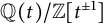
for the Blanchfield pairing of K, which is a sesquilinear Hermitian pairing on
 $H_1(X_K;\mathbb {Z}[t^{\pm 1}])$
with values in
 $\mathbb {Q}(t)/\mathbb {Z}[t^{\pm 1}]$
. For a submodule
 $G \subset H_1(X_K;\mathbb {Z}[t^{\pm 1}])$
, let
 $G^{\bot } := \{a\in H_1(X_K;\mathbb {Z}[t^{\pm 1}])\mid \operatorname {\mathrm {Bl}}_K(a,b)=0 \text { for all } b\in G\}$
.
Theorem 1.1 If
 $J \geq _{\operatorname {top}} K$
, then there exists a submodule
 $G\subset H_1(X_J; \mathbb {Z}[t^{\pm 1}])$
such that
 $G\subset G^{\bot }$
and the pairing on
 $G^{\bot } / G$
induced by
 $\operatorname {\mathrm {Bl}}_J$
is isometric to
 $\operatorname {\mathrm {Bl}}_K$
.
This theorem extends the result [Reference Friedl and PowellFP20, Theorem 1.1] that for
 $J\geq _{\operatorname {top}} K$
, the Alexander polynomial of K divides that of J, i.e.,
 $\Delta _K ~|~ \Delta _J$
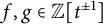
. This should be contrasted with the Fox-Milnor condition [Reference Fox and MilnorFM66] that for concordant knots K and J, up to units we have
 $\Delta _K \cdot f \cdot \overline {f} = \Delta _J \cdot g \cdot \overline {g}$
for some
 $f,g \in \mathbb {Z}[t^{\pm 1}]$
with
 $|f(1)|=1=|g(1)|$
. See Remark 3.2 for further discussion contrasting Theorem 1.1 with the analogous statements for concordance.
Gilmer showed that any ribbon concordance obstruction that is determined by the isometry class of the Blanchfield pairing (which contains the same information as the S-equivalence class of the Seifert form [Reference TrotterT73]) is subsumed by the obstruction given in Theorem 1.1. However, that obstruction is not easily testable. So, we derive homotopy ribbon obstructions coming from the homology of the double branched cover, and from Levine–Tristram signatures, in Propositions 3.3 and 3.4, respectively. As far as we know, those obstructions are new even in the smooth category, i.e., as ribbon concordance obstructions.
Then, we move on to an application of twisted invariants. The following theorem shows the subtlety of the homotopy ribbon concordance relation, even for smoothly concordant knots with isomorphic Seifert forms.
Theorem 1.2 Let K be an oriented knot in
 $S^3$
with nontrivial Alexander polynomial
 $\Delta _K$
, and let V be a Seifert form of K. Then there exists an infinite family
 $\{ K_i \}_{i=1}^\infty $
of oriented knots in
 $S^3$
satisfying the following.
-
(i) For every i,
$K_i$
has a Seifert form isomorphic to V. -
(ii) For every i,
$K_i$
is ribbon concordant to K. -
(iii) For every
$i \neq j$
,
$K_i$
is not homotopy ribbon concordant to
$K_j$
.


Of course, the second item implies that
 $K_i$
is concordant to
 $K_j$
for every
 $i,j$
. The third item implies [Reference GordonGo81, Lemma 3.1] that
 $K_i$
is not ribbon concordant to
 $K_j$
. We believe that the weaker version of Theorem 1.2, stated entirely in the smooth category by deleting “homotopy” from (iii), is also new. Moreover, it seems to be hard to prove this statement using Heegaard Floer or Khovanov homology. The theorems from the articles [Reference Juhász, Miller and ZemkeJMZ20, Reference Levine and ZemkeLZ19, Reference Miller and ZemkeMZ19, Reference SarkarSa19, Reference ZemkeZ19] cited above show that a ribbon concordance from J to K induces a bigraded injection
 $\mathcal {H}(K) \hookrightarrow \mathcal {H}(J)$
, for
 $\mathcal {H}$
a suitable knot homology theory. This is extremely powerful for obstructing ribbon concordances for particular pairs of knots. However, general satellite formulae for these invariants are either very complicated, or in the case of Khovanov homology still under development. Thus, with currently known computational methods, it seems hopeless to prove a result as general as Theorem 1.2 by constructing the family
 $K_i$
as satellites, and then applying these injectivity results.
We prove Theorem 1.2 by applying twisted Alexander polynomials [Reference LinLin01, Reference WadaW94]. In fact, we establish an obstruction to homotopy ribbon concordance in terms of these invariants. Suppose that
 $J \geq _{\operatorname {top}} K$
with a homotopy ribbon concordance C. Let
 $\alpha \colon \pi _C \to \operatorname {\mathrm {GL}}(n, R)$
be an n-dimensional representation over a Noetherian UFD R. We write
 $\Delta _J^{\alpha \circ \iota _J}(t)$
and
 $\Delta _K^{\alpha \circ \iota _K}(t)$
for the twisted Alexander polynomials of J and K associated to the induced representations
 $\alpha \circ \iota _J$
and
 $\alpha \circ \iota _K$
, respectively. The invariants are elements in
 $R[t^{\pm 1}]$
, and well-defined up to multiplication by a unit in
 $R[t^{\pm 1}]$
. We write
 $f ~|~ g$
for
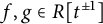 $f, g \in R[t^{\pm 1}]$
if
 $g = f h$
for some
 $h \in R[t^{\pm 1}]$
. In particular,
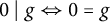 $0 ~|~ g \Leftrightarrow 0 = g$
.
The following theorem generalizes the result [Reference Friedl and PowellFP20, Theorem 1.1] on the classical Alexander polynomial to the case of twisted Alexander polynomials.
Theorem 1.3 For a homotopy ribbon concordance C from J to K and a representation
 $\alpha \colon \pi _C \to \operatorname {\mathrm {GL}}(n, R)$
, the following holds:
 $$ \begin{align*} \Delta_K^{\alpha \circ \iota_K} ~|~ \Delta_J^{\alpha \circ \iota_J}. \end{align*} $$
Again, we can contrast this with the Kirk–Livingston condition [Reference Kirk and LivingstonKL99] on twisted Alexander polynomials of concordant knots, which is a direct analogue of the Fox-Milnor condition mentioned above.
Let us briefly sketch the proof of Theorem 1.2 assuming Theorem 1.3. The infinite family
 $\{K_i\}_{i=1}^{\infty }$
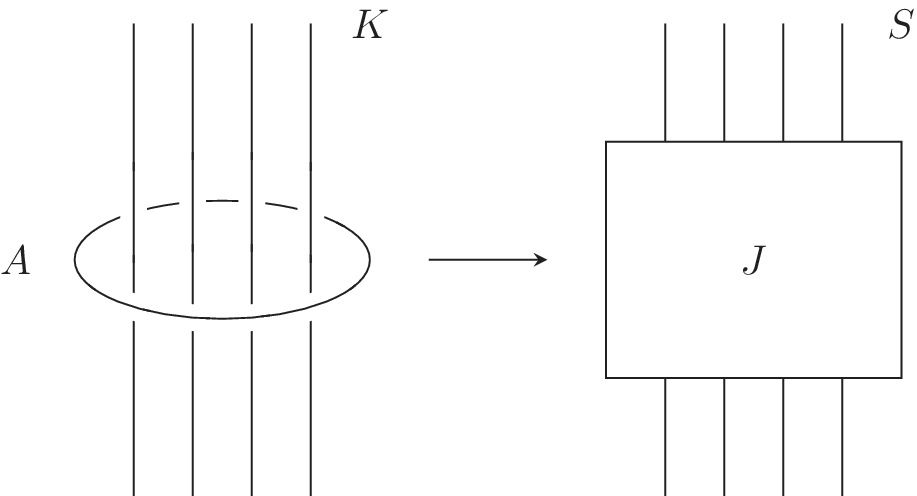
of knots in the statement of the theorem is produced by a satellite construction. Let K be an oriented knot with nontrivial Alexander polynomial and let V be a Seifert form associated to a Seifert surface F for K. We pick a simple closed curve A in
 $S^3$
, unknotted in
 $S^3$
and disjoint from F, and think of K as a knot in the solid torus exterior of A. Then, fixing a prime p, we consider the satellite knots
 $K_q$
of
 $T(p, q) \sharp - T(p, q)$
with pattern K for primes
 $q \neq p$
, where
 $T(p, q)$
is the
 $(p, q)$
-torus knot. By the construction we can check that the family of knots
 $\{ K_q \}_{q \neq p}$
, with q prime, satisfies conditions (i) and (ii) of Theorem 1.2. Also, for appropriate A and p, we can see condition (iii) as follows. Suppose that
 $K_q \geq _{\operatorname {top}} K_{q'}$
for
 $q, q' \neq p$
with a homotopy ribbon concordance C. The nontriviality of the Alexander polynomial of K enables us to find a metabelian representation
 $\alpha \colon \pi _C \to \operatorname {\mathrm {GL}}(n, \mathbb {Z})$
factoring through a p-group such that if
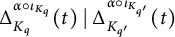 $\Delta _{K_q}^{\alpha \circ \iota _{K_q}}(t) ~|~ \Delta _{K_{q'}}^{\alpha \circ \iota _{K_{q'}}}(t)$
, then
 $q = q'$
. The condition that the representation
 $\alpha $
factors through a p-group is important in showing that both of these twisted polynomials are nonzero. Thus, (iii) follows from Theorem 1.3.
Let us conclude the introduction with some open questions highlighting the differences between ribbon concordance and homotopy ribbon concordance. The set of ribbon concordances is closed under composition. We do not know whether this holds for homotopy ribbon concordances, too.
Question 1.4 Is the homotopy ribbon concordance relation transitive, i.e., does
 $I \geq _{\operatorname {top}} J$
and
 $J \geq _{\operatorname {top}} K$
for oriented knots I, J, K imply
 $I \geq _{\operatorname {top}} K$
?
The transitivity of the surjectivity condition (2) is easily verified, but the same cannot be said for the injectivity condition (3). An affirmative answer would be a very interesting first step towards showing that
 $\geq _{\operatorname {top}}$
is a partial order. One also needs antisymmetry, that
 $K \geq _{\operatorname {top}} J$
and
 $J \geq _{\operatorname {top}} K$
implies J and K are isotopic.
Let us emphasize that Theorems 1.1 and 1.3 actually hold without condition (3). So, one might be tempted to simply strike condition (3) from the definition of homotopy ribbon concordances; Theorems 1.1 and 1.3 would still hold. However, there is some indication that this would be a less natural definition than the one we have given. Let
 $K_1$
,
 $K_2$
be two knots with trivial Alexander polynomial. For such knots, there exist discs embedded properly and locally flat in
 $D^4$
with
 $\partial D_i = K_i$
and
 $\pi _1(D^4\setminus D_i) \cong \mathbb {Z}$
[Reference Freedman and QuinnFQ90, Theorem 11.7B]. Tubing together
 $D_1$
and
 $D_2$
yields a topological concordance from
 $K_1$
to
 $K_2$
satisfying conditions (1) and (2), but (if
 $K_2$
is nontrivial) not (3). So then without (3),
 $\geq _{\operatorname {top}}$
has no hope of being a partial order.
This observation also implies that, to answer the following question positively, one must indeed make use of condition (3).
Question 1.5 Does
 $J \geq _{\operatorname {top}} K$
imply
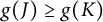 $g(J) \geq g(K)$
?
The analogous statement for ribbon concordance was established by Zemke using knot Floer homology [Reference ZemkeZ19].
One may easily show using embedded Morse theory (see e.g., [Reference Borodzik and PowellBP16]) that for smoothly concordant knots
 $K, J$
, there exists a third knot L that is ribbon concordant to both K and J. Whether the analogous statement holds for homotopy ribbon concordance is less clear.
Question 1.6 Given two topologically concordant knots
 $K, J$
, does there exist a third knot L such that
 $L \geq _{\operatorname {top}} K$
and
 $L \geq _{\operatorname {top}} J$
?
Note that the homotopy slice-ribbon conjecture (which states that all topologically slice knots are homotopy ribbon knots) would imply an affirmative answer to Question 1.6, since one could pick L as
 $K \# -J \# J$
.
This paper is organized as follows. Section 2 provides a brief review of twisted Alexander polynomials of knots. Section 3 contains the proof of Theorem 1.1 and Propositions 3.3 and 3.4. In Section 4, we generalize the results in [Reference Friedl and PowellFP20] to the case of twisted Alexander modules, and prove Theorem 1.3. In Section 5, we describe a satellite construction producing such an infinite family of knots as in Theorem 1.2, and a satellite formula of twisted Alexander polynomials. In Section 6, we introduce certain nonzero twisted Alexander polynomials associated to metabelian representations, which are useful for applications of Theorem 1.3. Section 7 fleshes out the details of the proof of Theorem 1.2 that was sketched above. Appendix A discusses the base ring change properties of Blanchfield pairings that are needed in Section 3.
2 Twisted Alexander polynomials
We begin with the definition of twisted Alexander polynomials of knots [Reference LinLin01, Reference WadaW94]. We also refer the reader to the survey papers [Reference Dubois, Friedl and LückDFL15, Reference Friedl and VidussiFV11] for more details on the invariants. In this section, let R be a Noetherian UFD with (possibly trivial) involution
 $\overline {\,\cdot \,} \colon R \to R$
, and
 $Q(R)$
is its quotient field.
2.1 Twisted homology and cohomology groups
Let X be a path connected space having universal cover
 $\widetilde {X}$
and let Y be a subspace of X. Let
 $\widetilde {Y}$
be the pullback of Y by the covering map
 $\widetilde {X} \to X$
. Note that
 $\pi _1(X)$
acts on
 $\widetilde {X}$
on the left via deck transformations. The singular chain complex
 $C_*(\widetilde {X}, \widetilde {Y})$
of
 $(\widetilde {X}, \widetilde {Y})$
is a left
 $\mathbb {Z} \pi _1(X)$
-module. We write
 $\overline {C}_*(\widetilde {X}, \widetilde {Y})$
when we think of
 $C_*(\widetilde {X}, \widetilde {Y})$
as a right
 $\mathbb {Z} \pi _1(X)$
-module, using the involution of
 $\mathbb {Z} \pi _1(X)$
reversing elements of
 $\pi _1(X)$
.
Let
 $\alpha \colon \pi _1 (X) \to \operatorname {\mathrm {GL}}_n(R)$
be a representation. For each non-negative integer i we define the ith twisted homology group
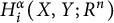 $H_i^\alpha (X, Y; R^n)$
and the ith twisted cohomology group
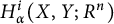 $H_\alpha ^i(X, Y; R^n)$
of
 $(X, Y)$
associated to
 $\alpha $
as:
 $$ \begin{align*} H_i^{\alpha}(X, Y; R^n) &= H_i(\overline{C}_*(\widetilde{X}, \widetilde{Y}) \otimes_{\mathbb{Z} \pi_1(X)} R^n), \\ H_{\alpha}^i(X, Y; R^n) &= H^i(\operatorname{Hom}_{\mathbb{Z} \pi_1(X)}(C_*(\widetilde{X}, \widetilde{Y}), R^n)). \end{align*} $$
When Y is empty, we write
 $H_i^{\alpha }(X; R^n)$
and
 $H_{\alpha }^i(X; R^n)$
, respectively.
If
 $(X, Y)$
is a CW-pair, then the cellular twisted homology and cohomology groups are similarly defined for the cellular chain complex of
 $(\widetilde {X}, \widetilde {Y})$
, and isomorphic to the singular twisted homology and cohomology groups, respectively.
The
 $0$
th twisted homology and cohomology groups are computed as follows (see for instance [Reference Hilton and StammbachHS71, Proposition 3.1]):
 $$ \begin{align*} H_0^{\alpha}(X; R^n) &= R^n / \{ \alpha(\gamma) v - v \mid \gamma \in \pi_1(X), v \in R^n \}, \\ H_{\alpha}^0(X; R^n) &= \{ v \in R^n \mid \alpha(\gamma) v = v ~\text{ for all } \gamma \in \pi_1(X) \}. \end{align*} $$
2.2 Twisted Alexander polynomials of knots
Let K be an oriented knot in
 $S^3$
. Recall that we denote the complement of an open tubular neighborhood of K in
 $S^3$
by
 $X_K$
, and set
 $\pi _K = \pi _1(X_K)$
. Let
 $\phi _K \colon \pi _K \to \mathbb {Z}$
be the abelianization map sending a meridional element to
 $1$
.
Let
 $\alpha \colon \pi _K \to \operatorname {\mathrm {GL}}(n, R)$
be a representation. We write
 $\alpha \otimes \phi _K \colon \pi _K \to \operatorname {\mathrm {GL}}(n, R[t^{\pm 1}])$
for the tensor representation given by
 $$ \begin{align*} \alpha \otimes \phi_K(\gamma) = \alpha(\gamma) t^{\phi_K(\gamma)} \end{align*} $$
for
 $\gamma \in \pi _K$
. We call
 $H_1^{\alpha \otimes \phi _K}(X_K; R[t^{\pm 1}]^n)$
the twisted Alexander module of K associated to
 $\alpha $
, which is a finitely generated
 $R[t^{\pm 1}]$
-module. We define the twisted Alexander polynomial
 $\Delta _K^\alpha (t) \in R[t^{\pm 1}]$
of K associated to
 $\alpha $
to be its order. Namely, for an exact sequence
 $$ \begin{align*} R[t^{\pm 1}]^l \xrightarrow{r} R[t^{\pm 1}]^m \to H_1^{\alpha \otimes \phi_K}(X_K; R[t^{\pm 1}]^n) \to 0 \end{align*} $$
with
 $l \geq m$
,
 $\Delta _K^\alpha (t)$
is the greatest common divisor of the m-minors of a representation matrix of r, and is well-defined up to multiplication by a unit in
 $R[t^{\pm 1}]$
. In the following we write
 $f \doteq g$
for
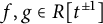 $f, g \in R[t^{\pm 1}]$
if
 $f = u g$
for some unit
 $u \in R[t^{\pm 1}]$
.
Remark 2.1
-
(1) The twisted Alexander polynomial of K associated to the trivial representation
$\pi _K \to \operatorname {\mathrm {GL}}(1, \mathbb {Z})$
coincides with the classical Alexander polynomial
$\Delta _K(t)$
of K. -
(2) The twisted Alexander polynomial
$\Delta _K^\alpha (t)$
is invariant under conjugation of representations
$\alpha $
.



3 The Blanchfield pairing
3.1 Proof of the Blanchfield homotopy ribbon obstruction
Recall that for a knot K,
 $X_K$
denotes the complement of an open tubular neighborhood of K in
 $S^3$
, and the Alexander module of K is
 $H_1(X_K; \mathbb {Z}[t^{\pm 1}])$
, where t acts as a generator of the deck transformation group of the infinite cyclic covering of
 $X_K$
. The Blanchfield pairing
 $\operatorname {\mathrm {Bl}}_K$
of K is a nonsingular sesquilinear Hermitian form
 $$ \begin{align*} \operatorname{\mathrm{Bl}}_K \colon H_1(X_K; \mathbb{Z}[t^{\pm 1}]) \times H_1(X_K; \mathbb{Z}[t^{\pm 1}]) \to \mathbb{Q}(t)/\mathbb{Z}[t^{\pm 1}], \end{align*} $$
which may be defined by setting its adjoint
 $x\mapsto \operatorname {\mathrm {Bl}}_K(-,x)$
to be the composition
 $$ \begin{align} H_1(X_K; \mathbb{Z}[t^{\pm 1}]) &\xrightarrow{\;\;\;\phantom{PD{^{-1}}}\;\;\;} H_1(X_K, \partial X_K; \mathbb{Z}[t^{\pm 1}]) \xrightarrow{\;\;\;{\scriptstyle{PD}{^{-1}}}\;\;\;} H^2(X_K; \mathbb{Z}[t^{\pm 1}]) \nonumber\\ &\xrightarrow{\;\;\;\phantom{D}{{\scriptstyle\beta_K^{-1}}}\;\;\;} H^1( X_K; \mathbb{Q}(t)/\mathbb{Z}[t^{\pm 1}])\\ &\xrightarrow{\;\;\;\phantom{PD}{{\kappa}}\;\;\;} \operatorname{\overline{Hom}}_{\mathbb{Z}[t^{\pm 1}]}( H_1(X_K; \mathbb{Z}[t^{\pm 1}]), \mathbb{Q}(t)/\mathbb{Z}[t^{\pm 1}] ), \nonumber\end{align} $$
where the first map is the natural one, PD denotes the Poincaré duality map,
 $\beta _K$
denotes the Bockstein connecting homomorphism in cohomology induced by the short exact sequence
 $0 \to \mathbb {Z}[t^{\pm 1}] \to \mathbb {Q}(t) \to \mathbb {Q}(t)/\mathbb {Z}[t^{\pm 1}] \to 0$
, and
 $\kappa $
is the so-called Kronecker evaluation (see e.g., [Reference Friedl and PowellFP17] for details regarding this definition). The involution
 $\overline {\,\cdot \,}$
on
 $\mathbb {Z}[t^{\pm 1}]$
is given by
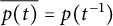 $\overline {p(t)} = p(t^{-1})$
, and for a
 $\mathbb {Z}[t^{\pm 1}]$
-module M,
 $\overline {M}$
denotes the module given by the same abelian group as M, and
 $p(t)$
acting as
 $\overline {p(t)}$
. We write
 $\overline {\operatorname {Hom}(\,\cdot \,,\,\cdot \,)}$
as
 $\operatorname {\overline {Hom}}(\,\cdot \,,\,\cdot \,)$
. A submodule
 $P \subset H_1(X_K; \mathbb {Z}[t^{\pm 1}])$
satisfying
 $P = P^{\perp }$
with respect to
 $\operatorname {\mathrm {Bl}}_K$
is called a metabolizer.
Let us now recall Theorem 1.1 from the introduction, and prove it.
Theorem 1.1 If
 $J \geq _{\operatorname {top}} K$
, then there exists a submodule
 $G\subset H_1(X_J; \mathbb {Z}[t^{\pm 1}])$
such that
 $G\subset G^{\bot }$
and the pairing on
 $G^{\bot } / G$
induced by
 $\operatorname {\mathrm {Bl}}_J$
is isometric to
 $\operatorname {\mathrm {Bl}}_K$
.
Proof Let C be a homotopy ribbon concordance from J to K and let
 $X_C$
be its exterior, i.e., the complement of an open tubular neighborhood of C in
 $S^3\times [0,1]$
. See [Reference Friedl, Nagel, Orson and PowellFNOP19] for a thorough treatment of tubular neighborhoods of submanifolds of a topological
 $4$
-manifold. The boundary
 $\partial X_C$
is homeomorphic to the gluing of
 $X_{-J}$
and
 $X_K$
along their boundary tori, gluing meridian to meridian and longitude to longitude.
The composition
 $j\colon X_{J} \to X_C$
of orientation reversal and inclusion induces a surjection
 $j_*\colon H_1(X_J;\mathbb {Z}[t^{\pm 1}]) \to H_1(X_C;\mathbb {Z}[t^{\pm 1}])$
, while the inclusion
 $k\colon X_K \to X_C$
induces an injection
 $k_*\colon H_1(X_K;\mathbb {Z}[t^{\pm 1}]) \to H_1(X_C;\mathbb {Z}[t^{\pm 1}])$
. This was shown in [Reference Friedl and PowellFP20]; the proof (also for twisted homology) can be found in Section 4.
The surjectivity of
 $j_*$
implies that the kernel of the homomorphism induced by the inclusion
 $\partial X_C\to X_C$
is a metabolizer of
 $-\operatorname {\mathrm {Bl}}_J \oplus \operatorname {\mathrm {Bl}}_K$
(see [Reference Friedl, Leidy, Nagel and PowellFLNP17] for additivity of the Blanchfield form and [Reference FriedlF04, Proposition 8.2] for the proof that the kernel is a metabolizer). The remainder of the proof is an algebraic argument that we outsource to the following lemma, applied with
 $e = j_*$
,
 $m = k_*$
,
 $\lambda _E = \operatorname {\mathrm {Bl}}_J$
,
 $\lambda _M = \operatorname {\mathrm {Bl}}_K$
, and
 $R = \mathbb {Z}[t^{\pm 1}]$
. Such a submodule
 $G \subset H_1(X_J; \mathbb {Z}[t^{\pm 1}])$
as in the theorem can be chosen to be
 $\operatorname {Ker} (j_*)$
.▪
For a commutative ring R, we write
 $Q(R)$
for the total quotient ring of R, i.e., the localization of R with respect to the multiplicative set of elements of R that are not zero divisors. An element a of an R-module is called torsion if it is annihilated by some
 $r\in R$
that is not a zero divisor, and an R-module is called torsion if all its elements are torsion. For a finitely generated torsion R-torsion module M with a nonsingular sesquilinear form
 $\lambda \colon M \times M \to Q(R) / R$
, a submodule
 $P \subset M$
satisfying
 $P = P^\perp $
with respect to
 $\lambda $
is called a metabolizer.
Lemma 3.1 Let R be a commutative ring with an involution. Let
 $M, E$
be finitely generated R-torsion modules with sesquilinear, Hermitian and nonsingular pairings
 $\lambda _M \colon M\times M\to Q(R)/R$
and
 $\lambda _E \colon E\times E\to Q(R)/R$
. Let N be an R-module with an epimorphism
 $e\colon E\to N$
and a monomorphism
 $m\colon M\to N$
, such that the kernel of
 $(e + m)\colon E\oplus M \to N$
is a metabolizer for
 $-\lambda _E \oplus \lambda _M$
. Let G be the kernel of e. Then the pairing induced by
 $\lambda _E$
on
 $G^{\bot } / G$
is isometric to
 $\lambda _M$
.
Proof Let
 $S = e^{-1}(\operatorname {\mathrm {Im}}(m)) \subset E$
and define
 $g\colon S\to M$
as
 $m^{-1}\circ e$
. Let us check that g respects the pairings. Let
 $a_1, a_2 \in S$
be given. Then for
 $i\in \{1,2\}$
, we have
 $e(a_i) = m(g(a_i))$
, so
 $a_i - g(a_i) \in \operatorname {Ker}(e + m)$
. Since
 $\operatorname {Ker}(e + m)$
is a metabolizer for
 $-\lambda _E \oplus \lambda _M$
, we have
 $$ \begin{align*} -\lambda_E(a_1, a_2) + \lambda_M(-g(a_1), -g(a_2)) = 0 ~\Rightarrow~ \lambda_E(a_1, a_2) = \lambda_M(g(a_1), g(a_2)) \end{align*} $$
as claimed. Next, g is clearly surjective and has kernel
 $G = \operatorname {Ker} e$
, so it induces an isometry
 $S/G \to M$
. Let us now prove that
 $S = G^{\bot }$
.
To show
 $S\subset G^{\bot }$
, let
 $a\in S$
. If
 $b\in G$
, then
 $$ \begin{align*} \lambda_E(a,b) = - (-\lambda_E(a,b) + \lambda_M(-g(a),0)), \end{align*} $$
which equals zero since
 $a - g(a)$
and b are both contained in the metabolizer
 $\operatorname {Ker}(e + m)$
.
To show
 $G^{\bot } \subset S$
, let
 $c\in G^{\bot }$
be given. Consider the homomorphism
 $S/G \to Q(R)/R$
given by
 $[a] \mapsto \lambda _E(a,c)$
. The pairing induced on
 $S/G$
by
 $\lambda _E$
is nonsingular since it is isometric to
 $\lambda _M$
. So its adjoint map is an isomorphism, whence there exists
 $[c'] \in S/G$
such that for all
 $[a] \in S/G$
, we have
 $\lambda _E(a,c) = \lambda _E(a,c')$
. Thus for all
 $a\in S$
, we have
 $\lambda _E(a, c-c') = 0$
. If
 $a\in E$
and
 $b\in M$
with
 $e(a) + m(b) = 0$
are given, then
 $a\in S$
, and so
 $-\lambda _E(a, c-c') + \lambda _M(b,0) = 0$
. Thus
 $c-c' \in \operatorname {Ker}(e + m)^{\bot } = \operatorname {Ker}(e + m)$
, and thus
 $c - c' \in \operatorname {Ker}(e + m) \cap E = G \subset S$
. Since
 $c'$
is also in S, it follows that
 $c\in S$
.▪
3.2 Homotopy ribbon obstructions from the double branched covering and signatures
Let us write
 $[K]$
for the S-equivalence class of a knot K, i.e.,
 $[K] = [K']$
if and only if
 $\operatorname {\mathrm {Bl}}_K$
and
 $\operatorname {\mathrm {Bl}}_{K'}$
are isometric. Write
 $$ \begin{align*} [J] \geq_S [K] \end{align*} $$
if the conclusion of the previous theorem holds, i.e., if there exists a submodule
 $G \subset H_1(X_J;\mathbb {Z}[t^{\pm 1}])$
such that
 $G\subset G^{\bot }$
and the pairing on
 $G^{\bot } / G$
induced by
 $\operatorname {\mathrm {Bl}}_J$
is isometric to
 $\operatorname {\mathrm {Bl}}_K$
. This relation was introduced by Gilmer [Reference GilmerGi84], who showed that if J is ribbon concordant to K, then
 $[J]\geq _S [K]$
. Theorem 1.1 strengthens this statement, and may now be formulated as
 $$ \begin{align*} J\geq_{\operatorname{top}} K \Rightarrow [J]\geq_S[K]. \end{align*} $$
Gilmer provides an equivalent characterization of the relation
 $\geq _S$
in terms of Seifert matrices, which constitutes his main technical tool. Among other results, he shows that the relation
 $\geq _S$
is a partial order. In this text, we will rely on the definition of
 $\geq _S$
via the Blanchfield pairing, instead of Seifert matrices.
Remark 3.2 If J and K are topologically concordant knots, then
 $[J]$
and
 $[K]$
are algebraically concordant, i.e.,
 $-\operatorname {\mathrm {Bl}}_J \oplus \operatorname {\mathrm {Bl}}_K$
admits a metabolizer. Let us point out that
 $[J] \geq _S [K]$
implies that
 $[J]$
and
 $[K]$
are algebraically concordant (and thus, as one might expect, our Blanchfield obstruction for homotopy ribbon concordance is indeed stronger than the usual Blanchfield obstruction for topological concordance). Indeed, let
 $G \subset H_1(X_J;\mathbb {Z}[t^{\pm 1}])$
be chosen as above, such that the pairing induced on
 $G^{\bot }/G$
by
 $\operatorname {\mathrm {Bl}}_J$
is isometric to
 $\operatorname {\mathrm {Bl}}_K$
. Let
 $g\colon G^{\bot } \to H_1(X_K; \mathbb {Z}[t^{\pm 1}])$
be the composition of the projection to
 $G^{\bot }/G$
and the isometry to
 $\operatorname {\mathrm {Bl}}_K$
. Then, one may check that a metabolizer of
 $-\operatorname {\mathrm {Bl}}_J \oplus \operatorname {\mathrm {Bl}}_K$
is given by
 $\{ (x, g(x)) \mid x \in G^{\bot } \} \subset H_1(X_J; \mathbb {Z}[t^{\pm 1}]) \oplus H_1(X_K; \mathbb {Z}[t^{\pm 1}])$
.
There seems to be no known algorithm to decide whether
 $[J]\geq _S[K]$
holds for given knots J and K. On the level of modules (forgetting about the Blanchfield pairing), the relation
 $[J]\geq _S[K]$
implies that the Alexander module of K is a quotient of a submodule of the Alexander module of J. But even this condition seems difficult to check for general given knots J and K.
Switching to PID coefficients at least gives testable obstructions beyond divisibility of the Alexander polynomials. In particular, in this way one obtains homotopy ribbon obstructions from the homology of the double branched covering, and from Levine–Tristram signatures. Let us state these obstructions now. Denote the double branched cover of
 $S^3$
along K by
 $\Sigma _{K,2}$
.
Proposition 3.3 If J, K are knots with
 $[J] \geq _S [K]$
, then
 $H_1(\Sigma _{K,2}; \mathbb {Z})$
is isomorphic to a subgroup of
 $H_1(\Sigma _{J,2}; \mathbb {Z})$
. In fact, there exist abelian groups
 $W, G$
and two short exact sequences
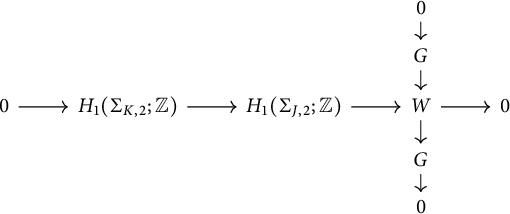
The proof will be given in Section 3.3. Recall that for a knot K, the order of
 $H_1(\Sigma _{K,2};\mathbb {Z})$
is
 $\det K$
. So the existence of the abelian groups W and G satisfying (3.2) implies that
 $\det K$
divides
 $\det J$
, and that the quotient
 $\det J / \det K$
is a square. In fact, that much would already follow from
 $\Delta _K$
dividing
 $\Delta _J$
and the Fox–Milnor condition. However, (3.2) has stronger implications. For example, if
 $[J] \geq _S [K]$
and p is an odd prime not dividing
 $\det J / \det K$
, then the p-primary parts of
 $H_1(X_J;\mathbb {Z})$
and
 $H_1(X_K;\mathbb {Z})$
are isomorphic. To give another example, if for some odd prime p, the p-primary parts of
 $H_1(X_J; \mathbb {Z})$
and
 $H_1(X_K; \mathbb {Z})$
are
 $\mathbb {Z}/p \oplus \mathbb {Z}/p^5$
and
 $\mathbb {Z}/p^2$
, respectively, then
 $[J] \ngeq _S [K]$
follows (because the cokernel W of any injection
 $\mathbb {Z}/p^2 \to \mathbb {Z}/p \oplus \mathbb {Z}/p^5$
is isomorphic to
 $\mathbb {Z}/p \oplus \mathbb {Z}/p^3$
, and this group W does not admit a group G fitting into (3.2)). In contrast, if J and K are merely assumed to be topologically concordant, then the only statement that needs to follow about the groups
 $H_1(\Sigma _{J,2};\mathbb {Z})$
and
 $H_1(\Sigma _{K,2};\mathbb {Z})$
is that their direct sum has square order, i.e., that
 $\det J\cdot \det K$
is a square.
Let us denote the Levine–Tristram signature and nullity, of a knot K at
 $e^{\pi i x} \in S^1$
for
 $x\in \mathbb {R}$
, by
 $\sigma _x(K)$
and
 $\eta _x(K)$
, respectively. We write
 $\deg _x(K)$
for the multiplicity of the root
 $e^{\pi ix}$
of
 $\Delta _K$
, which equals
 $0$
if
 $e^{\pi ix}$
is not a root of
 $\Delta _K$
. In this notation, the classical knot signature corresponds to
 $\sigma _1$
. Note that
 $\deg _x(K) \geq \eta _x(K)$
holds for all knots K and all
 $x\in \mathbb {R}$
.
Proposition 3.4 If J, K are knots with
 $[J] \geq _S [K]$
, then for all
 $x\in \mathbb {R}$
,
 $$ \begin{align*} \deg_x(J) - \deg_x(K) ~\geq~ \eta_x(J) - \eta_x(K) ~\geq~ |\sigma_x(J) - \sigma_x(K)|. \end{align*} $$
The proof will be given in Section 3.4. Note that in the particular case, where
 $e^{\pi i x}$
is not a root of the quotient
 $\Delta _J / \Delta _K$
, one obtains that
 $\sigma _x(J) = \sigma _x(K)$
. In contrast, if J and K are merely assumed to be topologically concordant, only the following inequalities (which are weaker than the inequalities given by Proposition 3.4) need to hold for all
 $x\in \mathbb {R}$
:
 $$ \begin{align*} \deg_x(J) + \deg_x(K) ~\geq~ \eta_x(J) + \eta_x(K) ~\geq~ |\sigma_x(J) - \sigma_x(K)|. \end{align*} $$
The proofs of Propositions 3.3 and 3.4 follow a similar path for the start of their proofs. The homology of the double branched covering and the Levine–Tristram signatures are determined by the Blanchfield pairings
 $\operatorname {\mathrm {Bl}}^R$
with certain PIDs R as coefficient module. As discussed in Appendix A,
 $\operatorname {\mathrm {Bl}}$
determines
 $\operatorname {\mathrm {Bl}}^R$
, and
 $[J] \geq _S [K]$
implies the condition for
 $\operatorname {\mathrm {Bl}}^R$
analogous to Theorem 1.1, which in turn (using that R is a PID) implies (3.2) in Proposition 3.3 and the inequalities in Proposition 3.4. Before delving into those proofs in full detail in Sections 3.3 and 3.4, let us give two example applications.
Example 3.5 Let
 $J'$
and
 $K'$
be the knots
 $8_{18}$
and
 $8_{20}$
from the knot table [Reference Livingston and MooreLM20]. Let
 $J = J'\# -J'$
and
 $K = K'\# -K'$
. Clearly, J and K are ribbon knots. We claim Proposition 3.3 implies that J is not homotopy ribbon concordant to K, whereas no previously available obstructions could even show that J is not ribbon concordant to K.
Indeed, one computes
 $H_1(\Sigma _{J,2}; \mathbb {Z}) \cong H_1(\Sigma _{J',2}; \mathbb {Z})^{\oplus 2} \cong (\mathbb {Z}/3)^{\oplus 4} \oplus (\mathbb {Z}/5)^{\oplus 2}$
and
 $H_1(\Sigma _{K',2};\mathbb {Z}) \cong H_1(\Sigma _{K,2};\mathbb {Z})^{\oplus 2} \cong (\mathbb {Z}/9)^{\oplus 2}$
. Since
 $p = 3$
does not divide
 $\det J / \det K = 25$
, and the p-primary parts of the groups
 $H_1(\Sigma _{J,2}; \mathbb {Z})$
and
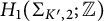 $H_1(\Sigma _{K',2};\mathbb {Z})$
are not isomorphic, Proposition 3.3 indeed implies that
 $J \ngeq _{\operatorname {top}} K$
.
Let us now check previously known ribbon concordance obstructions. The Alexander polynomial
 $\Delta _{J'} = (t^2 - t + 1)^2(t^2 - 3t + 1)$
is divisible by the Alexander polynomial
 $\Delta _{K'} = (t^2 - t + 1)^2$
, and so
 $\Delta _J = \Delta _{J'}^2$
is divisible by
 $\Delta _K = \Delta _{K'}^2$
. Thus, the known Alexander polynomial homotopy ribbon obstruction [Reference Friedl and PowellFP20] is not applicable for J and K. Moreover, one may check by computer calculation that there exist bigraded injections
 $\mathcal {H}(K) \hookrightarrow \mathcal {H}(J)$
for
 $\mathcal {H}$
either Khovanov homology, or knot Floer homology. So the ribbon concordance obstructions of Khovanov homology [Reference Levine and ZemkeLZ19] and knot Floer homology [Reference ZemkeZ19] are not applicable for J and K, either. In fact, one may avoid computer calculation and read the Khovanov homologies of J and K from their Jones polynomials and knot signatures, and the knot Floer homologies of J and K from their Alexander polynomials and knot signatures, since both J and K are quasi-alternating [Reference Manolescu and OzsváthMO08].
Example 3.6 Let K be the knot
 $12n_{582}$
from the knot table [Reference Livingston and MooreLM20]. This knot is a ribbon knot with Alexander polynomial
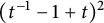 $(t^{-1}-1+t)^2$
and nonconstant signature profile:
 $\deg _{1/3}(K) = 2, \eta _{1/3}(K) = 1, \sigma _{1/3}(K) = 1$
. As an example application of the Blanchfield obstructions, let us prove that if J is a prime knot with crossing number 12 or less such that
 $J\geq _{\operatorname {top}} K$
, then
 $J \in \{K, K'\}$
, where
 $K'$
is the knot
 $10_{99}$
in the knot table.
First off, J needs to be topologically slice. This leaves (up to symmetry, i.e., counting mirror images and reverses only once) 159 knots from the table. Among those, there are 134 knots with
 $\deg _{1/3} = 0$
(i.e.,
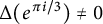 $\Delta (e^{\pi i/3}) \neq 0$
) and 10 knots with
 ${\deg _{1/3} = 2}$
,
 ${\eta _{1/3} = 2}$
,
 ${\sigma _{1/3} = 0}$
. These are ruled out by the first inequality in Proposition 3.4, whereas
 $-K$
is ruled out by the second inequality, since
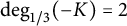 ${\deg _{1/3}(-K) = 2}$
,
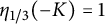 ${\eta _{1/3}(-K) = 1}$
,
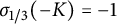 ${\sigma _{1/3}(-K) = -1}$
. There remain 15 knots. Among them, 13 have double branched covering with first homology group isomorphic to
 $\mathbb {Z}/9, \mathbb {Z}/81$
or
 $\mathbb {Z}/9\oplus \mathbb {Z}/25$
. So they are ruled out by Proposition 3.3, since the first homology group of the double branched covering of K is
 $\mathbb {Z}/3\oplus \mathbb {Z}/3$
, which does not inject into a cyclic group (note that here we are not using the vertical exact sequence in (3.2)).
The two remaining knots are K itself and
 $K'$
(the latter being amphicheiral). We have
 $H_1(K'; \mathbb {Z}) \cong \mathbb {Z}/9 \oplus \mathbb {Z}/9$
and
 $\deg _{1/3}(K') = 4, \eta _{1/3}(K') = 2, \sigma _{1/3}(K') = 0$
, so Propositions 3.3 and 3.4 do not obstruct
 $K' \geq _{\operatorname {top}} K$
. One may check that
 $K'$
is not ribbon concordant to K, e.g., using Khovanov homology [Reference Levine and ZemkeLZ19]. However, we do not know the answer to the following.
Question 3.7 Does
 $[10_{99}] \geq _S [12n_{582}]$
hold? If so, is
 $10_{99}$
homotopy ribbon concordant to
 $12n_{582}$
?
Remark 3.8 In light of the obstructions for homotopy ribbon concordances coming from the Blanchfield pairing (Theorem 1.1) and from twisted Alexander polynomials (Theorem 1.3), one might hope for an obstruction coming from twisted Blanchfield pairings. We have not pursued this any further in order to avoid overly complicating this text, and because it was not necessary to obtain the application in Theorem 1.2.
Remark 3.9 The obstruction given in Proposition 3.4 could be strengthened a bit by considering the full isometry type of the Blanchfield pairing over
 $\mathbb {R}$
, which is not completely captured by nullities, signatures and the Alexander polynomial. Likewise, taking the linking pairing of the double branched cover into account, and not just its homology, would strengthen Proposition 3.3.
3.3 The Blanchfield pairing with PID coefficients
This subsection is devoted to the proof of Proposition 3.3. Let us jump directly into it, and prove the crucial Lemma 3.10 afterwards.
Proof of Proposition 3.3 First, we appeal to two technical results dealing with change of base ring for the Blanchfield form, whose proofs we have relegated to Appendix A. The
 $\mathbb {Z}[t^{\pm 1}]$
-algebra
 $R:= \mathbb {Z}[t^{\pm 1}]/(t + 1)$
has only
 $(t+1)$
-torsion, and is thus admissible in the terminology of Appendix A. So, by Proposition A.1, for all knots L, there is a Blanchfield pairing
 $\operatorname {\mathrm {Bl}}^R_L$
defined on
 $H_1(X_L; R)$
, which is determined by
 $\operatorname {\mathrm {Bl}}_L$
. Moreover, by Proposition A.2,
 $[J] \geq _S [K]$
implies that there exists an R-submodule
 $G \subset H_1(X_J; R)$
such that
 $G\subset G^\bot $
, and
 $G^{\bot } / G$
is isomorphic to
 $H_1(X_K;R)$
.
Note that
 $R \to \mathbb {Z}, t \mapsto -1$
is an isomorphism of
 $\mathbb {Z}[t^{\pm 1}]$
-algebras (with trivial involution), where t acts on
 $\mathbb {Z}$
by
 $-1$
. In particular, as a ring
 $\mathbb {Z}[t^{\pm 1}]/(t + 1)$
is a PID. By Lemma 3.10 (iii) below, there are two short exact sequences

Note that for all knots L,
 $H_1(\Sigma _{2,L}; \mathbb {Z})$
and
 $H_1(X_L; R)$
are isomorphic abelian groups. Indeed, since
 $H_1(X_L;R) \cong H_1(X_L;\mathbb {Z}[t^{\pm 1}]) \otimes _{\mathbb {Z}[t^{\pm 1}]} R \cong H_1(X_L;\mathbb {Z}[t^{\pm 1}])/(t+1)$
by a straightforward application of the universal coefficient theorem (noting
 $\displaystyle {\operatorname {\mathrm {Tor}}_1^{\mathbb {Z}[t^{\pm 1}]}(\mathbb {Z},R) =0}$
), both modules are presented by the matrix
 $(tV-V^T)|_{t=-1} = -V-V^T$
, where V is a Seifert matrix for L. Thus, we have indeed constructed the two short exact sequences (3.2).▪
As a side remark, note that under the identification of
 $H_1(X_L; R)$
with
 $H_1(\Sigma _{2,L}; \mathbb {Z})$
, we have
 $\operatorname {\mathrm {Bl}}^R_L = 2\cdot \text {lk}_L$
, where
 $\text {lk}_L$
denotes the usual linking pairing on
 $H_1(\Sigma _{2,L}; \mathbb {Z})$
.
Also, note that one could prove the conclusion of Proposition 3.3 under the stronger hypothesis that
 $J \geq _{\operatorname {top}} K$
instead of
 $[J] \geq _S [K]$
, namely by using that Theorem 1.1 holds not just for
 $\mathbb {Z}[t^{\pm 1}]$
, but for all
 $\mathbb {Z}[t^{\pm 1}]$
-algebras R without
 $t-1$
and
 $\Xi $
-torsion (cf. Appendix A), with the analogous proof. This proof would not require the relationship between
 $\operatorname {\mathrm {Bl}}$
and
 $\operatorname {\mathrm {Bl}}^R$
, but would result in a weaker version of Proposition 3.3.
Now, let us come to Lemma 3.10. Let us consider modules and pairings over a general PID R (PIDs are understood to be commutative in this text). The order
 $\operatorname {\mathrm {ord}} M$
of a finitely generated torsion module M over R is defined as follows: pick a decomposition of M as sum of cyclic modules
 $R/(a_1) \oplus \cdots \oplus R/(a_n)$
. Then
 $\operatorname {\mathrm {ord}} M := a_1 \cdot \cdots \cdot a_n \in R$
. The order is well-defined up to multiplication with units in R; we use the symbol
 $\doteq $
to denote that two elements of R are equal up to multiplication with a unit. Note that if R has an involution
 $\overline {\,\cdot \,}$
, then
 $\operatorname {\mathrm {ord}} \overline {M} = \overline {\operatorname {\mathrm {ord}} M}$
. This definition of order agrees with the more general definition in Section 2.2 of orders of modules over rings that need not be PIDs.
Lemma 3.10 Let R be a PID with an involution
 $\overline {\,\cdot \,}$
.
-
(i) Every finitely generated R-torsion module M is (noncanonically) isomorphic to
$\operatorname {Hom}(M, Q(R)/R)$
.

Let A be a finitely generated R-torsion module and let
 $\lambda \colon A\times A\to Q(R)/R$
be a sesquilinear Hermitian nonsingular pairing.
-
(ii) For M a submodule of A, we have
$\operatorname {\mathrm {ord}} M \cdot \operatorname {\mathrm {ord}} M^{\bot } \doteq \operatorname {\mathrm {ord}} A$
and
$M = M^{\bot \bot }$
. -
(iii) For a submodule
$G \subset A$
such that
$G\subset G^{\bot }$
, there is an R-module W fitting into the following two (non-natural) short exact sequences as follows.



Proof (i) Cyclic torsion modules are (noncanonically) isomorphic to
 $R / (a)$
for some
 $a\in R\setminus \{0\}$
, and an isomorphism
 $R/(a) \to \operatorname {Hom}(R/(a), Q(R)/R)$
is given by
 $1\mapsto (1\mapsto 1/a)$
. This suffices, since M decomposes as a sum of cyclic torsion modules, and
 $\operatorname {Hom}(N\oplus N', Q(R)/R) \cong \operatorname {Hom}(N, Q(R)/R)\oplus \operatorname {Hom}(N', Q(R)/R)$
.
(ii) There is a short exact sequence

where the second map is the inclusion, and the third map is the composition of the adjoint map
 $A\to \operatorname {\overline {Hom}}(A,Q(R)/R)$
of
 $\lambda $
(which is an isomorphism) and the map
 $\operatorname {\overline {Hom}}(A,Q(R)/R) \to \operatorname {\overline {Hom}}(M,Q(R)/R)$
, which is surjective since
 $Q(R)/R$
is an injective R-module, and so the contravariant functor
 $\operatorname {\overline {Hom}}(-,Q(R)/R)$
is exact. The orders of modules in a short exact sequence are multiplicative, so
 $\operatorname {\mathrm {ord}} M^{\bot } \cdot \operatorname {\mathrm {ord}} \operatorname {\overline {Hom}}(M,Q(R)/R) \doteq \operatorname {\mathrm {ord}} A$
, which implies
 $\operatorname {\mathrm {ord}} M^{\bot } \cdot \operatorname {\mathrm {ord}} \overline {M} \doteq \operatorname {\mathrm {ord}} A$
using (i). In the same way, we obtain
 $\operatorname {\mathrm {ord}} M^{\bot \bot } \cdot \operatorname {\mathrm {ord}} \overline {M^{\bot }} \doteq \operatorname {\mathrm {ord}} A$
. Thus we get
 $\operatorname {\mathrm {ord}} M \doteq \operatorname {\mathrm {ord}} M^{\bot \bot }$
. The inclusion
 $M\subset M^{\bot \bot }$
follows directly from the definition of
 $^\bot $
, and since M and
 $M^{\bot \bot }$
have the same order, they are equal.
(iii) Let us write
 $\iota $
for inclusions of submodules of A into A, and
 $\psi \colon A\to \operatorname {\overline {Hom}}(A,Q(R)/R)$
for the adjoint of
 $\lambda $
. Let
 $\beta $
be the composition of the maps

The kernel of
 $\beta $
is
 $G^{\bot \bot } = G$
. So
 $\beta $
induces an injection
 $$ \begin{align*} \tilde\beta\colon {G^{\bot} / G} \to \operatorname{\overline{Hom}}(G^{\bot},Q(R)/R). \end{align*} $$
Fix an isomorphism
 $\alpha \colon {\operatorname {\overline {Hom}}(G^{\bot },Q(R)/R)}\to \overline {G^{\bot }}$
. We get the following commutative diagram, in which the two rows and the first column are exact; this induces the dashed maps, such that the second column is also exact.

The second row and second column of this diagram form the desired diagram, using that
 $\overline {A}\cong A$
and setting
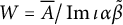 $W = \overline {A}/\operatorname {\mathrm {Im}} \iota \alpha \tilde \beta $
. It just remains to check that
 $\overline {A/G^{\bot }}\cong G$
and
 $\overline {G^{\bot }} / \operatorname {\mathrm {Im}} \alpha \tilde \beta \cong \overline {G}$
.
An isomorphism
 $\overline {A/G^{\bot }} \cong \operatorname {Hom}(G,Q(R)/R)$
is given by considering the short exact sequence (3.3), and
 $\operatorname {Hom}(G,Q(R)/R)$
is isomorphic to
 ${G}$
by (i).
In the following commutative diagram, the rows are exact (the surjectivity of the second map in the top row follows from the injectivity of the module
 $Q(R)/R$
as in the proof of (ii) above), and the first two vertical maps are isomorphisms.

This induces the desired isomorphism
 $G \cong \operatorname {\overline {Hom}}(G,Q(R)/R) \to \overline {G^{\bot }} / \operatorname {\mathrm {Im}} \alpha \tilde \beta $
, drawn dashed.▪
As an illustration of how the previous lemma can be used, we give a new proof of the following corollary, by applying the lemma to
 $R = \mathbb {Q}[t^{\pm 1}]$
. The corollary was originally shown by Gilmer using Seifert matrices.
Corollary 3.11 [Reference GilmerGi84]
If J and K are knots with
 $[J] \geq _S [K]$
and
 $\Delta _J \doteq \Delta _K$
, then
 $\operatorname {\mathrm {Bl}}_J$
and
 $\operatorname {\mathrm {Bl}}_K$
are isometric.
Proof By definition of
 $\geq _S$
, there exists a submodule
 $G\subset H_1(X_J; \mathbb {Z}[t^{\pm 1}])$
such that
 $G\subset G^{\bot }$
and the pairing induced by
 $\operatorname {\mathrm {Bl}}_J$
on
 $G^{\bot } / G$
is isometric to
 $\operatorname {\mathrm {Bl}}_K$
. Let
 $\widetilde G = G \otimes \mathbb {Q}$
. By Proposition A.2,
 $\widetilde G^{\bot } / \widetilde G$
is isomorphic to
 $H_1(X_K; \mathbb {Q}[t^{\pm 1}])$
, so
 $$ \begin{align*} \operatorname{\mathrm{ord}} \widetilde G \cdot \Delta_K \doteq \operatorname{\mathrm{ord}}\widetilde G^{\bot}. \end{align*} $$
Moreover, by Lemma 3.10 (ii), we have
 $$ \begin{align*} \operatorname{\mathrm{ord}} \widetilde G \cdot \operatorname{\mathrm{ord}} \widetilde G^{\bot} \doteq \Delta_J. \end{align*} $$
Since
 $\Delta _K \doteq \Delta _J$
by assumption, those two equations imply that
 $\operatorname {\mathrm {ord}} \widetilde G \doteq 1$
, which means that
 $\widetilde G$
is trivial. This is equivalent to G being
 $\mathbb {Z}$
-torsion. However,
 $H_1(X_J; \mathbb {Z}[t^{\pm 1}])$
is
 $\mathbb {Z}$
-torsion free (see Lemma A.7), and thus its submodule G is as well. Hence G is trivial, and the pairing induced by
 $\operatorname {\mathrm {Bl}}_J$
on
 $G^{\bot } / G \cong H_1(X_J; \mathbb {Z}[t^{\pm 1}])$
, to which
 $\operatorname {\mathrm {Bl}}_K$
is isometric, is just
 $\operatorname {\mathrm {Bl}}_J$
itself.▪
3.4 Dévissage of linking pairings over a PID
This subsection is devoted to the proof of Proposition 3.4. As will be explained in detail later,
 $\deg _x, \sigma _x$
and
 $\eta _x$
can be read from the Blanchfield pairing
 $\operatorname {\mathrm {Bl}}^{\mathbb {R}[t^{\pm 1}]}$
with
 $\mathbb {R}[t^{\pm 1}]$
coefficients, which is in turn determined by
 $\operatorname {\mathrm {Bl}}$
, as discussed in Appendix A. Since
 $\mathbb {R}[t^{\pm 1}]$
is a PID, the results of Lemma 3.10 apply. But this is not enough; to prove Proposition 3.4, we need a clearer understanding of linking pairings over
 $\mathbb {R}[t^{\pm 1}]$
. Localizing this ring will simplify things. Let us work in a more general setting. Let R be a discrete valuation ring, or DVR for short (i.e., a commutative PID with a unique nonzero maximal ideal), equipped with an involution
 $\overline {\,\cdot \,}$
, satisfying the two following conditions:
 $$ \begin{align} &\text{There is a generator } \tau\in R \text{ of the unique maximal ideal of } R \text{ with } \tau=\overline{\tau}. \end{align} $$
 $$ \begin{align} &\qquad\qquad\text{There is a unit } s\in R \text{ such that } s + \overline{s} = 1. \end{align} $$
Here is the key example of such a ring.
Lemma 3.12 Let
 $\zeta \in \mathbb {R}[t^{\pm 1}]$
be an irreducible polynomial with
 $\zeta = \overline {\zeta }$
. The localization
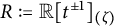 $R:= \mathbb {R}[t^{\pm 1}]_{(\zeta )}$
of
 $\mathbb {R}[t^{\pm 1}]$
at the ideal
 $(\zeta )$
is a DVR satisfying (
3.4
) and (
3.5
) with
 $\tau = \zeta $
and
 $s=1/2$
.
Proof Since
 $\zeta $
is irreducible, the ideal
 $(\zeta )$
is prime. Now, R is the localization of a PID at a prime ideal, and as such R is a DVR.▪
Let us give some motivation for the conditions (3.4) and (3.5). Symmetric bilinear forms are usually dramatically simplified by imposing the condition that the ground field has
 $\text {char} \neq 2$
(or that 2 be invertible in the ground ring). Condition (3.5) is simply the analogue condition for Hermitian sesquilinear forms. It is needed below in the proof of Lemma 3.13(iv), and later on to simplify Hermitian pairings over the field
 $R / (\tau )$
. Bourbaki consider a similar condition in their discussion of Hermitian forms [Reference BourbakiBo59], calling it Condition (T). Regarding (3.4), note that
 $(\tau ) = \overline {(\tau )}$
follows from
 $\overline {\,\cdot \,}$
being an automorphism. However, condition (3.4) is a slightly stronger condition, which is e.g., not satisfied by the DVR
 $\mathbb {R}[t^{\pm 1}]_{(t-1)}$
. The condition is only needed in the proof of Lemma 3.13(iv).
Note that up to multiplication with units,
 $\tau $
is the unique irreducible element of R. It follows that every nonzero element in R can be written as
 $r\tau ^\ell $
for some
 $\ell \in \mathbb {N}$
and
 $r \in R$
a unit. For any R-torsion module A, let
 $\nu \colon A\to \mathbb {N}$
be the function sending
 $a\in A$
to the minimal
 $k \geq 0$
such that
 $\tau ^k a = 0$
. Note that
 $\nu a = 0 \Leftrightarrow a = 0$
. The following lemma lays some technical groundwork for pairings over such rings R, and shows in particular that they are diagonalizable. By abuse of notation, we denote the functions
 $\nu \colon A\to \mathbb {N}$
and
 $\nu \colon Q(R)/R\to \mathbb {N}$
defined above both by the same symbol
 $\nu $
.
Lemma 3.13 Let R be a DVR with involution satisfying (
3.4
) and (
3.5
). Let A be a finitely generated R-torsion module and let
 $\lambda \colon A\times A \to Q(R) / R$
be a sesquilinear Hermitian nonsingular pairing.
-
(i) If
$B\subset A$
is a submodule such that
$B\cap B^{\bot } = 0$
, then
$(A, \lambda )$
is isometric to the orthogonal sum of B and
$B^{\bot }$
. -
(ii) If
$a \in A$
and
$\nu a = \nu \lambda (a,a)$
, then
$(A,\lambda )$
is isometric to the orthogonal sum of
$\langle a\rangle $
and
$\langle a\rangle ^{\bot }$
. -
(iii) For all
$a\in A$
, there exists
$b\in A$
such that
$\nu \lambda (a,b) = \nu a$
. -
(iv) There exists
$a\in A$
with maximal
$\nu a$
such that
$\nu \lambda (a,a) = \nu a$
. -
(v)
$(A,\lambda )$
is isometric to an orthogonal sum
$\langle e_1\rangle \oplus \cdots \oplus \langle e_n\rangle $
of cyclic modules. For any such
$e_1, \ldots , e_n$
, we have
$\nu \lambda (e_i,e_i) = \nu e_i$
for all
$i\in \{1,\ldots ,n\}$
. -
(vi) Let
$a\in A$
with
$\nu a = 1$
, and let
$\tilde a\in A$
be an element with maximal
$\nu \tilde a$
such that
$a = \tau ^{-1+\nu \tilde a}\tilde a$
. Then there exists
$b \in A$
such that
$\nu b = \nu \tilde a = \nu \lambda (\tilde a,b) = \nu \lambda (b,b)$
. -
(vii) Let
$a\in A$
and assume that
$\nu \lambda (a,b) < \nu a$
for all
$b \in A$
with
$\nu b = \nu a$
. Then there exists
$c\in A$
with
$\nu c> \nu a$
such that
$\nu (a + \tau c) < \nu a$
.






















Proof (i) The sum of the inclusion maps gives a map
 $B \oplus B^{\bot } \to A$
that clearly preserves pairings. It just remains to see that this map is bijective. Injectivity follows from
 $B \cap B^{\bot } = \{0\}$
. Surjectivity follows since
 $\operatorname {\mathrm {ord}} B \oplus B^{\bot } \doteq \operatorname {\mathrm {ord}} A$
by Lemma 3.10 (ii), using that R is a PID.
(ii) By (i), we just have to check that
 $\langle a\rangle \cap \langle a\rangle ^{\bot } = \{0\}$
. Take an element
 $ra \in \langle a\rangle $
with
 $r\in R$
. If
 $ra\in \langle a\rangle ^{\bot }$
, then
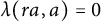 $\lambda (ra, a) = 0$
, and so
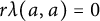 $r\lambda (a,a) = 0$
. Hence
 $r \in (\tau ^{\nu \lambda (a,a)}) = (\tau ^{\nu a})$
, and thus
 $ra = 0$
.
(iii) If
 $a = 0$
, take
 $b = 0$
. If
 $a \neq 0$
, let
 $\tilde a = \tau ^{-1 + \nu a} a$
. Since
 $\lambda $
is nonsingular, there exists
 $b\in A$
such that
 $\lambda (\tilde a, b) \neq 0$
. It follows that
 $\nu \lambda (\tilde a, b) = 1$
and
 $\nu \lambda (a,b) = \nu a$
as desired.
(iv) Pick any
 $b\in A$
of maximal
 $\nu b = k$
. If
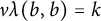 $\nu \lambda (b,b) = k$
, just take
 $a = b$
. Else, by (iii), we may pick
 $c\in A$
such that
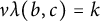 $\nu \lambda (b,c) = k$
, i.e.,
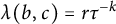 $\lambda (b,c) = r\tau ^{-k}$
for
 $r\in R$
a unit. Note this implies
 $\nu c = k$
. Again, if
 $\nu \lambda (c,c) = k$
, just set
 $a = c$
. Else we have
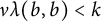 $\nu \lambda (b,b) < k$
and
 $\nu \lambda (c,c) < k$
. Pick
 $s\in R$
such that
 $s + \overline {s} = 1$
and set
 $a = b + s\overline {r}^{-1}c$
. This element a satisfies
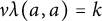 $\nu \lambda (a,a) = k$
, as one computes:
 $$ \begin{align*} \begin{split} \tau^{k-1}\lambda(b + s\overline{r}^{-1}c,b + s\overline{r}^{-1}c) &= \tau^{k-1}(\lambda(b, s\overline{r}^{-1}c) + \lambda(s\overline{r}^{-1}c, b)) \\ &= \tau^{k-1}(\overline{s}\tau^{-k} + s\overline{\tau}^{-k}) = \tau^{-1}. \end{split} \end{align*} $$
(v) Note that
 $\operatorname {\mathrm {ord}} A \doteq \tau ^j$
for some
 $j\geq 0$
. The proof goes by induction over j. For
 $j = 0$
, A is trivial and the statement holds. If A is nontrivial, by (iv), there exist a nontrivial
 $a\in A$
with maximal
 $\nu a$
and
 $\nu \lambda (a,a) = \nu a$
. By (ii), A is isometric to
 $\langle a\rangle \oplus \langle a\rangle ^{\bot }$
, and by induction
 $\langle a\rangle ^{\bot }$
is isometric to an orthogonal sum of cyclic modules.
For the second statement, note that
 $\tau ^{\nu e_i}\lambda (e_i, e_i) = 0$
, so
 $\nu \lambda (e_i, e_i) \leq \nu e_i$
. Moreover,
 $\lambda $
is nonsingular, so there exists some
 $a\in A$
such that
 $\lambda (\tau ^{\nu e_i - 1} e_i, a) \neq 0$
. Because of the orthogonality of the sum, we have
 $a = a_i e_i + b$
with
 $a_i\in R\setminus \{0\}$
and
 $b\in \langle e_1, \ldots , e_{i-1}, e_{i+1}, \ldots , e_n\rangle $
. Then
 $\lambda (\tau ^{\nu e_i - 1} e_i, a) = a_i \tau ^{\nu e_i - 1} \lambda (e_i, e_i) \neq 0$
, and so
 $\nu \lambda (e_i, e_i) \geq \nu e_i$
.
(vi) Using (v), we may identify
 $(A, \lambda )$
with the orthogonal sum over cyclic modules with generators
 $e_1, \ldots , e_n$
, so we write elements of A as vectors with respect to that generator set. In this notation, the ith coordinate of a is
 $r_i \tau ^{-1+\nu e_i}$
for
 $r_i \in R$
a unit or 0. Since
 $\nu a=1$
,
 $a \neq 0$
, and by maximality of
 $\nu \tilde {a}$
, there exists i such that
 $r_i \neq 0$
and
 $\nu e_i = \nu \tilde a$
. This implies that the ith coordinate of
 $\tilde a$
is
 $r_i$
. Set b to be
 $e_i$
. Then
 $\nu b = \nu \tilde a$
and by the second part of (v),
 $\nu \lambda (e_i,e_i) = \nu e_i$
, so
 $\lambda (\tilde a,b) = \lambda (r_i e_i, e_i)$
, where
 $\nu \lambda (r_i e_i, e_i) = \nu e_i$
. Likewise
 $\nu \lambda (b,b) = \nu \lambda (e_i, e_i) = \nu e_i$
.
(vii) Choose
 $e_1, \ldots , e_n$
as in (vi). Let the ith coordinate of a be
 $r_i \tau ^{k_i}$
with
 $r_i\in R$
a unit or
 $0$
, and
 $k_i \geq 0$
. Reorder the
 $e_i$
such that there exists
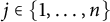 $j\in \{1, \ldots , n\}$
with
 $\nu (r_i \tau ^{k_i} e_i) = \nu (a)$
for
 $i \leq j$
and
 $\nu (r_i \tau ^{k_i} e_i) < \nu (a)$
for
 $i> j$
. If
 $k_i = 0$
for some
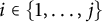 $i\in \{1,\ldots , j\}$
, then
 $\nu (a) = \nu (e_i) = \nu \lambda (e_i, a)$
, contradicting the assumption that no such
 $b = e_i$
exists. So
 $k_i \geq 1$
for all
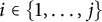 $i\in \{1,\ldots , j\}$
. Set
 $$ \begin{align*} c = -\sum_{i=1}^j r_i \tau^{k_i - 1} e_i. \end{align*} $$
Then, clearly,
 $\nu c = 1 + \nu a$
and
 $\nu (a + \tau c) < \nu a$
.▪
Let A be a finitely generated R-torsion module and let
 $\lambda \colon A\times A \to Q(R) / R$
be a sesquilinear Hermitian nonsingular pairing. By a technique known as dévissage (see e.g., [Reference RanickiRa98, Chapter 38]), the isometry type of
 $\lambda $
can be understood by considering the isometry type of sesquilinear Hermitian nonsingular pairings over the field
 $\mathbb {F}:= R/(\tau )$
. Let us make this precise now.
Let
 $A_k = \{a\in A\mid \tau ^k a = 0\}$
for
 $k\geq 0$
and
 $A_k = \{0\}$
for
 $k < 0$
. Let
 $$ \begin{align*} \Phi_k(A) = A_k/(A_{k - 1} + \tau A_{k+1}). \end{align*} $$
Note that
 $\lambda $
induces a sesquilinear Hermitian form
 $\Phi _k(\lambda )\colon \Phi _k(A) \times \Phi _k(A) \to (\tau ^{-k} R) / (\tau ^{-k+1} R)$
, and
 $(\tau ^{-k} R) / (\tau ^{-k+1} R)$
is canonically identified with the field
 $\mathbb {F} = R/(\tau )$
by multiplication with
 $\tau ^k$
. Nonsingularity of the form
 $\Phi _k(\lambda )$
follows from Lemma 3.13 (vii).
Write
 $\mathfrak {T}(R)$
for the set of isometry classes of sesquilinear Hermitian nonsingular pairings
 $A\times A \to Q(R)/R$
on finitely generated R-torsion modules A, and
 $\mathfrak {M}(\mathbb {F})$
for the set of isometry classes of sesquilinear Hermitian nonsingular pairings
 $V\times V\to \mathbb {F}$
on finite dimensional vector fields V over the field
 $R/(\tau )$
. The orthogonal sum of pairings, which we denote by
 $\oplus $
, makes both
 $\mathfrak {T}(R)$
and
 $\mathfrak {M}(\mathbb {F})$
into commutative monoids. We may now see the
 $\Phi _i$
for
 $i\geq 1$
as a family of monoid homomorphisms
 $\mathfrak {T}(R) \to \mathfrak {M}(\mathbb {F})$
(abusing notation, let
 $\Phi _k(\lambda )$
denote both the concrete form induced by
 $\lambda $
, as well as the isometry type of that form).
The monoid
 $\mathfrak {M}(\mathbb {F})$
enjoys some special properties, due to condition (3.5) [Reference BourbakiBo59, Section 4]. Firstly,
 $\mathfrak {M}(\mathbb {F})$
is cancellative, i.e.,
 $[\lambda ] + [\mu _1] = [\lambda ] + [\mu _2] \Rightarrow [\mu _1] = [\mu _2]$
for all
 $[\lambda ],[\mu _1],[\mu _2] \in \mathfrak {M}(\mathbb {F})$
(this is the sesquilinear version of Witt’s cancellation theorem). Secondly, metabolic forms (defined as forms
 $V\times V\to \mathbb {F}$
admitting a metabolizer, i.e., a subspace
 $P\subset V$
with
 $P^{\bot } = P$
) are fully characterized by their dimension, and so every metabolic form is a multiple of the isometry class
 $H\in \mathfrak {M}(\mathbb {F})$
of the hyperbolic plane, which is the pairing on
 $\mathbb {F}^2$
sending
 $(e_1, e_1)$
,
 $(e_2,e_2)$
to
 $0$
and
 $(e_1, e_2)$
,
 $(e_2, e_1)$
to
 $1$
.
The following lemma forms the core of the proof of Proposition 3.4.
Lemma 3.14 Let R be a DVR with involution satisfying (
3.4
) and (
3.5
), and let A be a finitely generated R-torsion module with a sesquilinear Hermitian nonsingular pairing
 $\lambda $
. Let
 $G\subset A$
be a submodule such that
 $G\subset G^{\bot }$
, and let
 $\lambda '$
be the pairing induced on
 $G^{\bot }/G$
by
 $\lambda $
. Then there are
 $T_1, T_2, \ldots \in \mathfrak {M}(\mathbb {F})$
and
 $h_1, h_2, \ldots \in \mathbb {N}$
such that
 $T_1$
is trivial and for all
 $n\geq 1$
, we have
 $h_{n} \geq h_{n+2}$
and
 $$ \begin{align*} T_n \oplus h_n \cdot H \oplus \bigoplus_{i=0}^{\infty} \Phi_{n+2i}(\lambda') = h_{n+1}\cdot H \oplus \bigoplus_{i=0}^{\infty} \Phi_{n+2i}(\lambda). \end{align*} $$
Proof Throughout this proof, let us write
 $\lambda \geq _{\mathfrak M} \lambda '$
if
 $T_n$
and
 $h_n$
as above exist. It is straightforward to check that the relation
 $\geq _{\mathfrak M}$
on
 $\mathfrak {M}(\mathbb {F})$
is transitive.
Now,
 $\lambda \geq _{\mathfrak M} \lambda '$
holds for trivial G. The main part of the proof is to show the statement for
 $\operatorname {\mathrm {ord}} G \doteq \tau $
. Having established that, let
 $\operatorname {\mathrm {ord}} G \doteq \tau ^j$
with
 $j\geq 2$
, and proceed by induction over j as follows. Pick
 $g\in G$
with
 $\nu g = 1$
. Let
 $\mu $
be the pairing induced on
 $\langle g\rangle ^{\bot } / \langle g\rangle $
by
 $\lambda $
. Note that the pairing induced on
 $(G / \langle g\rangle )^{\bot } / (G / \langle g\rangle )$
by
 $\mu $
is isometric to
 $\lambda '$
. Since
 $\operatorname {\mathrm {ord}}\langle g\rangle = \tau $
and
 $\operatorname {\mathrm {ord}} G / \langle g\rangle = \tau ^{j-1}$
, we may apply the induction hypothesis twice, and get
 $\lambda \geq _{\mathfrak M} \mu \geq _{\mathfrak M} \lambda '$
.
So let us now deal with the case that
 $\operatorname {\mathrm {ord}} G \doteq \tau $
, i.e.,
 $G = \langle g\rangle $
with
 $g\in \Phi _1(A)\setminus \{0\}$
. Let
 $\tilde g \in A$
have maximal
 $\nu \tilde g =: k$
such that
 $g = \tau ^{k-1}\tilde g$
. We will distinguish two cases, depending on whether
 $$ \begin{align} \nu \lambda(\tilde g, \tilde g) = k \end{align} $$
holds. If it does, set
 $B = \langle \tilde g\rangle $
. Otherwise, we have
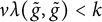 $\nu \lambda (\tilde g, \tilde g) < k$
and pick
 $b\in A$
as in Lemma 3.13(vi), i.e.,
 $$ \begin{align} \nu b = \nu \lambda(\tilde g, b) = \nu \lambda(b,b) = k \end{align} $$
and set
 $B = \langle \tilde g, b\rangle \subseteq A$
. Let us check that
 $B \cap B^{\bot } = \{0\}$
. In case (3.6) holds, this is true by Lemma 3.13 (i). If (3.6) does not hold, let
 $a \in B \cap B^{\bot }$
be given. Since
 $a\in B$
, we have
 $a = r \tau ^{\ell } \tilde g + s \tau ^m b$
for some units
 $r,s \in R$
and
 $\ell , m\geq 0$
. We want to show
 $a = 0$
. For that, it is sufficient that
 $\ell \geq k$
and
 $m\geq k$
, since both
 $\tilde g$
and b are annihilated by
 $\tau ^k$
. We have
 $\lambda (a, b) = 0$
, since
 $a \in B^{\bot }$
and
 $b \in B$
, and thus
 $$ \begin{align*} r \tau^{\ell} \lambda(\tilde g, b) + s \tau^m \lambda(b, b) = 0. \end{align*} $$
If both summands are zero, then
 $\ell \geq k$
and
 $m \geq k$
using (3.7), and so we are done. Otherwise, the two summands must have the same
 $\nu $
, and so
 $k - \ell = k - m$
, implying that
 $\ell = m$
. Now
 $\lambda (a, \tilde g) = 0$
implies that
 $$ \begin{align*} r \tau^{\ell} \lambda(\tilde g, \tilde g) + s \tau^m \lambda(b, \tilde g) = 0. \end{align*} $$
If the second summand is zero, then
 $\ell \geq k$
, and we are done. Otherwise, the two summands must have the same
 $\nu $
, i.e.,
 $\nu \lambda (\tilde g, \tilde g) - \ell = k - \ell $
, implying
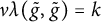 $\nu \lambda (\tilde g, \tilde g) = k$
contradicting the assumption that (3.6) does not hold. We have thus shown
 $B \cap B^{\bot } = \{0\}$
.
By Lemma 3.13 (i), it follows that A is isometric to
 $B \oplus B^{\bot }$
. Since
 $\langle g\rangle \subset B$
, we have
 $B^{\bot } \subset \langle g\rangle ^{\bot }$
. Thus,
 $\langle g\rangle ^{\bot } / \langle g\rangle $
is isometric to
 $C \oplus B^{\bot }$
where
 $C = (B \cap \langle g\rangle ^{\bot }) / \langle g\rangle $
with the pairing induced by
 $\lambda $
. Hence it suffices to show
 $\lambda |_{B\times B} \geq _{\mathfrak {M}} \lambda |_{C\times C}$
.
If (3.6) holds, then B is cyclically generated by
 $\tilde g$
with
 $\nu \tilde g = k$
, where
 $k\geq 2$
follows. So,
 $\Phi _n(B)$
is trivial for
 $n \neq k$
, and
 $\Phi _k(\lambda _{B\times B})$
is isometric to the pairing on
 $\mathbb {F}$
sending
 $(e_1,e_1)\mapsto \tau ^k\lambda (\tilde g, \tilde g) \in R / (\tau ) = \mathbb {F}$
. Observe that C is also cyclic, generated by
 $a = [\tau \tilde g]$
, with
 $\nu a = k - 2$
and
 $\lambda (a,a) = \tau ^2 \lambda (\tilde g, \tilde g)$
. So
 $\Phi _n(C)$
is trivial for all
 $n\geq k-2$
; and
 $\Phi _{k-2}(\lambda _{C\times C}) = \Phi _k(\lambda _{B\times B})$
if
 $k> 2$
(if
 $k = 2$
, then C is trivial). To demonstrate
 $\lambda |_{B\times B} \geq _{\mathfrak {M}} \lambda |_{C\times C}$
, one may take
 $h_n = 0$
for all n,
 $T_n = 0$
for all
 $n\neq k$
, and
 $T_k = \Phi _k(\lambda _{B\times B})$
.
If (3.6) does not hold, recall that
 $B = \langle \tilde g, b\rangle $
. So
 $\Phi _n(B)$
is trivial for
 $n\neq k$
and
 $\Phi _k(B)$
is two-dimensional, with basis
 $[\tilde g], [b]$
. The pairing
 $\Phi _k(\lambda _{B\times B})$
is metabolic, since
 $([\tilde g], [\tilde g])$
is sent to
 $0$
. So
 $\Phi _k(\lambda _{B\times B}) = H$
. One calculates that
 $\langle g\rangle ^{\bot } \cap B = \langle \tilde g, \tau b\rangle $
, so
 $\Phi _n(C)$
is trivial for
 $n \geq k - 1$
; and
 $\Phi _{k-1}(\lambda _{C\times C}) = H$
if
 $k> 1$
(if
 $k = 1$
, then C is trivial). To demonstrate
 $\lambda |_{B\times B} \geq _{\mathfrak {M}} \lambda |_{C\times C}$
, one may take
 $T_n = 0$
for all n,
 $h_n = 1$
if
 $n \leq k$
and
 $n \equiv k \pmod {2}$
, and
 $h_n = 0$
otherwise.▪
We are now ready to prove Proposition 3.4.
Proof of Proposition 3.4 If
 $e^{\pi i x}$
is not the root of the Alexander polynomial of any knot, then
 $\sigma _x$
is a topological concordance invariant. For such x, the stated inequalities thus simply read
 $0\geq 0\geq 0$
. So from now on, we may assume that
 $e^{\pi ix}$
is the root of some Alexander polynomial. In fact, it will be sufficient to assume
 $e^{\pi i x}\notin \mathbb {R}$
(equivalently, that
 $x\notin \mathbb {Z}$
). Let
 $\zeta (t) = t^{-1} - 2\cos x + t$
. The localization
 $\mathbb {R}[t^{\pm 1}]_{(\zeta )}$
of
 $\mathbb {R}[t^{\pm 1}]$
at
 $(\zeta )$
is a DVR satisfying conditions (3.4) and (3.5) by Lemma 3.12.
Note that
 $\mathbb {R}[t^{\pm 1}] / (\zeta )$
is isomorphic to
 $\mathbb {C}$
via the isomorphism sending t to
 $e^{\pi ix}$
. So
 $\mathfrak {M}(\mathbb {R}[t^{\pm 1}]/(\zeta ))$
is isomorphic to the monoid
 $\mathbb {N}^2$
via the signature. Indeed, send
 $[\mu ]\in \mathfrak {M}(\mathbb {R}[t^{\pm 1}]/(\zeta ))$
to
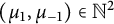 $(\mu _1, \mu _{-1}) \in \mathbb {N}^2$
, where
 $\mu _1$
and
 $\mu _{-1}$
are the dimensions of maximal subspaces on which
 $\mu $
is positive definite and negative definite, respectively. Let us write
 $\sigma (\mu ) = \mu _1 - \mu _{-1}$
.
For a knot L, let us abbreviate
 $\Psi _i(L) := \Phi _i(\operatorname {\mathrm {Bl}}^{\mathbb {R}[t^{\pm 1}]_{(\zeta )}}_L)$
. Denote the difference between the signature and the averaged signature at
 $e^{\pi ix}$
by
 $d_x(L)$
:
 $$ \begin{align*} d_x(L) = \sigma_x(L) - \tfrac12\lim_{\varepsilon\to 0} \sigma_{x+\varepsilon}(L) + \sigma_{x-\varepsilon}(L). \end{align*} $$
Note that
 $d_x(J) - d_x(K) = \sigma _x(J) - \sigma _x(K)$
, since
 $\sigma _{x\pm \varepsilon }(J) = \sigma _{x\pm \varepsilon }(K)$
for almost all
 $\varepsilon $
. One may read
 $\deg _x(L), \eta _x(L)$
, and
 $d_x(L)$
from
 $\Psi _i(L)$
(see [Reference LevineLev89], where the first and second equations are implicit, and the third equation is given in Theorem 2.3):
 $$ \begin{align*} \deg_x(L) = \sum_{i=1}^\infty i\cdot \dim \Psi_i(L),\quad \eta_x(L) = \sum_{i=1}^\infty \dim \Psi_i(L),\quad d_x(L) = -\sum_{i=1}^\infty \sigma(\Psi_{2i}(L)). \end{align*} $$
For the two knots
 $J, K$
with
 $[J]\geq _S [K]$
, Proposition A.1 yields a submodule
 $\tilde G \subset H_1(X_J; \mathbb {R}[t^{\pm 1}]_{(\zeta )})$
such that the pairing induced on
 $\tilde G^{\bot } / \tilde G$
by
 $\operatorname {\mathrm {Bl}}^{\mathbb {R}[t^{\pm 1}]_{(\zeta )}}_J$
is isometric to
 $\operatorname {\mathrm {Bl}}^{\mathbb {R}[t^{\pm 1}]_{(\zeta )}}_K$
. By Lemma 3.14, this implies that for all
 $n\geq 1$
, there are
 $T_n\in \mathfrak {M}(\mathbb {F})$
and
 $h_n\in \mathbb {N}$
such that
 $T_1$
is trivial and
 $h_{n} \geq h_{n+2}$
, and
 $$ \begin{align*} T_n \oplus h_n \cdot H \oplus \bigoplus_{i=0}^{\infty} \Psi_{n+2i}(K) = h_{n+1}\cdot H \oplus \bigoplus_{i=0}^{\infty} \Psi_{n+2i}(J). \end{align*} $$
For
 $n = 2$
, this implies
 $$ \begin{align} \sigma(T_2) + \sum_{i=1}^{\infty} \sigma(\Psi_{2i}(K)) = \sum_{i=1}^{\infty} \sigma(\Psi_{2i}(J)). \end{align} $$
It also implies
 $$ \begin{align} T_n \oplus T_{n+1} \oplus (h_n - h_{n+2})\cdot H \oplus \bigoplus_{i=0}^{\infty} \Psi_{n+i}(K) = \bigoplus_{i=0}^{\infty} \Psi_{n + i}(J) \end{align} $$
for all
 $n\geq 1$
. It follows that
 $$ \begin{align*} \begin{split} &|\sigma_x(J) - \sigma_x(K)| = |d_x(J) - d_x(K)| = \Bigl|\sum_{i=1}^{\infty} \sigma(\Psi_{2i}(J)) - \sigma(\Psi_{2i}(K))\Bigr| \stackrel{(3.8)}{=} |\sigma(T_2)| \\ &\leq\kern-1pt \dim(T_2)\kern-1pt \leq\kern-1pt \dim(T_2\kern-1pt +\kern-1pt (h_1\kern-1pt -\kern-1pt h_3)\kern-1pt\cdot\kern-1pt H)\kern-1pt \stackrel{(3.9)}{=}\kern-1pt \sum_{i=1}^{\infty} \dim \Psi_i(J) - \dim \Psi_i(K) = \eta_x(J) - \eta_x(K), \end{split} \end{align*} $$
proving the second desired inequality. To prove the first inequality:
 $$ \begin{align*} \bigoplus_{n=2}^{\infty}\bigg(T_n \oplus T_{n+1} \oplus (h_n - h_{n+2})\cdot H \oplus \bigoplus_{i=0}^{\infty} \Psi_{n+i}(K)\bigg) & \stackrel{(3.9)}{=} \bigoplus_{n=2}^{\infty}\bigoplus_{i=0}^{\infty} \Psi_{n + i}(J) \\ \Rightarrow\quad (h_2 + h_3)\cdot H \oplus T_2 \oplus \bigoplus_{i=3}^{\infty}2T_i \oplus \bigoplus_{i=1}^{\infty} (i - 1)\Psi_{i}(K) & = \bigoplus_{i=1}^{\infty} (i - 1)\Psi_{i}(J) \\ \Rightarrow\quad \sum_{i=1}^{\infty} (i - 1)\dim \Psi_{i}(K) & \leq \sum_{i=1}^{\infty} (i - 1)\dim\Psi_{i}(J) \\[1.5ex] \Rightarrow\quad \eta_x(J) - \eta_x(K) & \leq \deg_x(J) - \deg_x(K). \end{align*} $$
▪
4 Injections and surjections of twisted Alexander modules
We provide an obstruction for the homotopy ribbon concordance in terms of twisted Alexander modules, which generalizes the results in [Reference Friedl and PowellFP20] on the classical Alexander module.
Let J and K be oriented knots in
 $S^3$
with
 $J \geq _{\operatorname {top}} K$
, and let C be a homotopy ribbon concordance from J to K. As in the proof of Theorem 1.1, we denote the complement of an open tubular neighborhood of C in
 $S^3 \times [0, 1]$
by
 $X_C$
, and set
 $\pi _C = \pi _1(X_C)$
. We think of
 $X_J$
and
 $X_K$
naturally as subspaces of
 $\partial X_C$
. We write
 $\iota _J \colon \pi _J \to \pi _C$
and
 $\iota _K \colon \pi _K \to \pi _C$
for the induced epimorphism and the induced monomorphism, respectively. Let
 $\phi _C \colon \pi _C \to \mathbb {Z}$
be the abelianization map satisfying
 $\phi _J = \phi _C \circ \iota _J$
and
 $\phi _K = \phi _C \circ \iota _K$
.
From here on out, let R be a Noetherian UFD with (possibly trivial) involution
 $\overline {\,\cdot \,} \colon R \to R$
, and
 $Q(R)$
is its quotient field.
4.1 Surjections of twisted Alexander modules
First we prove the following proposition, which generalizes [Reference Friedl and PowellFP20, Proposition 3.1].
Proposition 4.1 Let C be a homotopy ribbon concordance from J to K and
 $\alpha \colon \pi _C \to \operatorname {\mathrm {GL}}(n, R)$
a representation. Then the induced homomorphism
 $$ \begin{align*} H_1^{\alpha \circ \iota_J \otimes \phi_J}(X_J; R[t^{\pm 1}]^n) \to H_1^{\alpha \otimes \phi_C}(X_C; R[t^{\pm 1}]^n) \end{align*} $$
is surjective.
The proof of Proposition 4.1 is parallel to the second proof of [Reference Friedl and PowellFP20, Proposition 3.1]. We need the following lemmas.
Lemma 4.2 For a homotopy ribbon concordance C from J to K, the following hold:
 $$ \begin{align*} H_0(X_C, X_J; \mathbb{Z} \pi_C) = H_1(X_C, X_J; \mathbb{Z} \pi_C) = 0. \end{align*} $$
Proof We consider the homology long exact sequence for
 $(X_C, X_J)$
:
 $$ \begin{align*} \begin{split} H_1(X_C; \mathbb{Z} \pi_C) & \to H_1(X_C, X_J; \mathbb{Z} \pi_C) \to \\ H_0(X_J; \mathbb{Z} \pi_C) \to H_0(X_C; \mathbb{Z} \pi_C) &\to H_0(X_C, X_J; \mathbb{Z} \pi_C) \to 0. \end{split} \end{align*} $$
Since
 $\iota _J$
is surjective, the induced homomorphism
 $H_0(X_J; \mathbb {Z} \pi _C) \to H_0(X_C; \mathbb {Z} \pi _C)$
is an isomorphism. Also, we have
 $H_1(X_C; \mathbb {Z} \pi _C) = H_1(\widetilde {X}_C; \mathbb {Z}) = 0$
, which proves the lemma.▪
Lemma 4.3 For a homotopy ribbon concordance C from J to K and a representation
 $\alpha \colon \pi _C \to \operatorname {\mathrm {GL}}(n, R)$
, the following holds:
 $$ \begin{align*} H_1^{\alpha \otimes (\pm \phi_C)}(X_C, X_J; R[t^{\pm 1}]^n) = 0. \end{align*} $$
Proof We consider the universal coefficient spectral sequence for homology groups [Reference RotmanRo09, Theorem 10.90]:
 $$ \begin{align*} E_{p, q}^2 = \operatorname{\mathrm{Tor}}_p^{\mathbb{Z} \pi_C}(H_q(X_C, X_J; \mathbb{Z} \pi_C), R[t^{\pm 1}]^n) \Rightarrow H_{p+q}^{\alpha \otimes (\pm \phi_C)}(X_C, X_J; R[t^{\pm 1}]^n), \end{align*} $$
where the
 $\operatorname {\mathrm {Tor}}$
group on the left hand side uses
 $\alpha \otimes (\pm \phi _C)$
. It follows from Lemma 4.2 that
 $$ \begin{align*} \operatorname{\mathrm{Tor}}_1^{\mathbb{Z} \pi_C}(H_0(X_C, X_J; \mathbb{Z} \pi_C), R[t^{\pm 1}]^n) = H_1(X_C, X_J; \mathbb{Z} \pi_C) \otimes_{\mathbb{Z} \pi_C} R[t^{\pm 1}]^n = 0. \end{align*} $$
Thus, all the terms on the line
 $p+q=1$
of
 $E^2$
page of the spectral sequence vanish, and the desired equation holds.▪
The case of
 $-\phi _C$
in Lemma 4.3 will be considered in the proof of Lemma 4.7.
Proof of Proposition 4.1 Consider the long exact sequence of pairs, and apply Lemma 4.3.▪
4.2 Injections of twisted Alexander modules
Next, we prove the following proposition, which generalizes [Reference Friedl and PowellFP20, Proposition 3.4].
Proposition 4.4 Let C be a homotopy ribbon concordance from J to K and let
 $\alpha \colon \pi _C \to \operatorname {\mathrm {GL}}(n, R)$
be a representation. If
 $\Delta _J^{\alpha \circ \iota _J} \neq 0$
, then the induced homomorphism
 $$ \begin{align*} H_1^{\alpha \circ \iota_K \otimes \phi_K}(X_K; R[t^{\pm 1}]^n) \to H_1^{\alpha \otimes \phi_C}(X_C; R[t^{\pm 1}]^n) \end{align*} $$
is injective.
We collect ingredients of the proof as the following three lemmas. The proof of the first one is straightforward.
Lemma 4.5 For a homotopy ribbon concordance C from J to K and a representation
 $\alpha \colon \pi _C \to \operatorname {\mathrm {GL}}(n, R)$
, the following hold:
 $$ \begin{align*} H_0^{\alpha \otimes (\pm \phi_C)}(X_C, X_J; R[t^{\pm 1}]^n) = H_0^{\alpha \otimes (\pm \phi_J)}(X_C, X_K; R[t^{\pm 1}]^n) = 0. \end{align*} $$
For a representation
 $\alpha \colon \pi _C \to \operatorname {\mathrm {GL}}(n, R)$
, we write
 $\alpha ^\dagger \colon \pi _C \to \operatorname {\mathrm {GL}}(n, R)$
for its dual given by
 $$ \begin{align*} \alpha(\gamma) = \overline{\alpha(\gamma^{-1})}^T \end{align*} $$
for
 $\gamma \in \pi _C$
, where
 $\overline {\alpha (\gamma ^{-1})}$
is the matrix obtained by replacing each entry a in the matrix
 $\alpha (\gamma ^{-1})$
by
 $\bar {a}$
. Note that
 $(\alpha ^\dagger )^\dagger = \alpha $
.
Lemma 4.6
-
(i) There exists a convergent spectral sequence
$$ \begin{align*} \begin{split} E_2^{p, q} &= \operatorname{\mathrm{Ext}}_q^{R[t^{\pm 1}]}(H_p^{\alpha \otimes \phi_C}(X_C, X_K; R[t^{\pm 1}]^n), R[t^{\pm 1}]) \\ &\Rightarrow H_{4-p-q}^{\alpha^\dagger \otimes (-\phi_C)}(X_C, X_J; R[t^{\pm 1}]^n). \end{split} \end{align*} $$
-
(ii) There exists a convergent spectral sequence
$$ \begin{align*} \begin{split} E_2^{p, q} &= \operatorname{\mathrm{Ext}}_q^{R[t^{\pm 1}]}(H_p^{\alpha^\dagger \otimes (-\phi_C)}(X_C, X_J; R[t^{\pm 1}]^n), R[t^{\pm 1}]) \\ &\Rightarrow H_{4-p-q}^{\alpha \otimes \phi_C}(X_C, X_K; R[t^{\pm 1}]^n). \end{split} \end{align*} $$


Proof Since the proof of (i) is similar to that of (ii), we only prove (ii). By Poincaré–Lefschetz duality we have an isomorphism
 $$ \begin{align*} H_{4-i}^{\alpha \otimes \phi_C}(X_C, X_K; R[t^{\pm 1}]^n) \cong H_{\alpha \otimes \phi_C}^i(X_C, X_J; R[t^{\pm 1}]^n) \end{align*} $$
(See for instance [Reference Friedl, Nagel, Orson and PowellFNOP19, Theorem A.15] for the case of twisted coefficients.) Also, we have an isomorphism
 $$ \begin{align*} \operatorname{Hom}_{\mathbb{Z} \pi_C}(C_*(\widetilde{X}_C, \widetilde{X}_J), R[t^{\pm 1}]^n) \cong \operatorname{Hom}_{R[t^{\pm 1}]}(C_*(\widetilde{X}_C, \widetilde{X}_J) \otimes_{\mathbb{Z} \pi_C} R[t^{\pm 1}]^n, R[t^{\pm 1}]), \end{align*} $$
where the tensor product on the right hand side uses
 $\alpha ^\dagger \otimes (-\phi _C)$
, given by
 $$ \begin{align*} f \mapsto ( (c \otimes v) \mapsto f(c)^T \bar{v}) \end{align*} $$
for
 $f \in \operatorname {Hom}_{\mathbb {Z} \pi _C}(C_*(\widetilde {X}_C, \widetilde {X}_J), R[t^{\pm 1}]^n)$
,
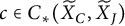 $c \in C_*(\widetilde {X}_C, \widetilde {X}_J)$
and
 $v \in R[t^{\pm 1}]^n$
. Now the lemma follows from the universal coefficient spectral sequence for cohomology groups [Reference LevineLev77, Theorem 2.3].▪
Lemma 4.7 Let C be a homotopy ribbon concordance from J to K and let
 $\alpha \colon \pi _C \to \operatorname {\mathrm {GL}}(n, R)$
be a representation. If
 $\Delta _J^{\alpha \circ \iota _J} \neq 0$
, then the following hold:
-
(i)
$H_1^{\alpha \otimes \phi _C}(X_C, X_K; R[t^{\pm 1}]^n)$
is a torsion module. -
(ii)
$H_2^{\alpha ^\dagger \otimes (-\phi _C)}(X_C, X_J; R[t^{\pm 1}]^n)$
is a torsion module. -
(iii)
$H_3^{\alpha ^\dagger \otimes (-\phi _C)}(X_C, X_J; R[t^{\pm 1}]^n) = 0$
.



Proof We first prove (i). We consider the homology long exact sequence for
 $(X_C, X_K)$
:
 $$ \begin{align*} H_1^{\alpha \otimes \phi_C}(X_C; R[t^{\pm 1}]^n) \to H_1^{\alpha \otimes \phi_C}(X_C, X_K; R[t^{\pm 1}]^n) \to H_0^{\alpha \circ \iota_K \otimes \phi_K}(X_K; R[t^{\pm 1}]^n). \end{align*} $$
It is easy to check that
 $H_0^{\alpha \circ \iota _K \otimes \phi _K}(X_K; R[t^{\pm 1}]^n)$
is a torsion module. Since
 $\Delta _J^{\alpha \circ \iota _J} \neq 0$
, the module
 $H_1^{\alpha \circ \iota _J \otimes \phi _J}(X_J; R[t^{\pm 1}]^n)$
is torsion, and it follows from Proposition 4.1 that
 $H_1^{\alpha \otimes \phi _C}(X_C; R[t^{\pm 1}]^n)$
is also a torsion module. Therefore (i) follows.
Next, we prove (iii). It follows from Lemma 4.5 and (i) that
 $$ \begin{align*} \operatorname{\mathrm{Ext}}_1^{R[t^{\pm 1}]}(H_0^{\alpha \otimes \phi_C}(X_C, X_K; R[t^{\pm 1}]^n), R[t^{\pm 1}]) &= 0, \\ \operatorname{Hom}_{R[t^{\pm 1}]}(H_1^{\alpha \otimes \phi_C}(X_C, X_K; R[t^{\pm 1}]^n), R[t^{\pm 1}]) &=0. \end{align*} $$
Thus all the terms on the line
 $p+q=1$
of
 $E^2$
page of the spectral sequence of Lemma 4.6 (i) vanish. Therefore, (iii) follows.
Finally, we prove (ii). Let
 $(X, Y)$
be a finite CW-pair homotopy equivalent to
 $(X_C, X_J)$
, and we identify
 $\pi _1(X)$
with
 $\pi _C$
. By (iii) and Lemmas 4.3 and 4.5, we have
 $$ \begin{align*} &\operatorname{\mathrm{rank}}_{R[t^{\pm 1}]} H_2^{\alpha^{\dagger} \otimes (-\phi_C)}(X_C, X_J; R[t^{\pm 1}]^n)\\ &\quad = \sum_{i=0}^3 (-1)^i \operatorname{\mathrm{rank}}_{R[t^{\pm 1}]} H_i^{\alpha^{\dagger} \otimes (-\phi_C)}(X_C, X_J; R[t^{\pm 1}]^n) \\ &\quad = \sum_{i=0}^3 (-1)^i \operatorname{\mathrm{rank}}_{R[t^{\pm 1}]} H_i^{\alpha^{\dagger} \otimes (-\phi_C)}(X, Y; R[t^{\pm 1}]^n) \\ &\quad = \sum_{i=0}^3 (-1)^i \operatorname{\mathrm{rank}}_{R[t^{\pm 1}]} \overline{C}_i(\widetilde{X}, \widetilde{Y}) \otimes_{\mathbb{Z} \pi_C} R[t^{\pm 1}]^n \\ &\quad = n \sum_{i=0}^3 (-1)^i \operatorname{\mathrm{rank}}_{\mathbb{Z}} C_i(X, Y) \\ &\quad = n \chi(X, Y) = n \chi(X_C, X_J) = n ( \chi(X_C) - \chi(X_J)) = 0, \end{align*} $$
where we consider the cellular chain complexes
 $C_*(X, Y)$
and
 $C_*(\widetilde {X}, \widetilde {Y})$
. Therefore, (ii) follows, which completes the proof.▪
We are now in a position to prove Proposition 4.4.
Proof of Proposition 4.4 It follows from Lemmas 4.3, 4.5 and 4.7(ii) that
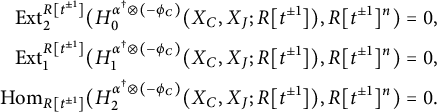 $$ \begin{align*} \operatorname{\mathrm{Ext}}_2^{R[t^{\pm 1}]}(H_0^{\alpha^\dagger \otimes (-\phi_C)}(X_C, X_J; R[t^{\pm 1}]), R[t^{\pm 1}]^n) &=0, \\ \operatorname{\mathrm{Ext}}_1^{R[t^{\pm 1}]}(H_1^{\alpha^\dagger \otimes (-\phi_C)}(X_C, X_J; R[t^{\pm 1}]), R[t^{\pm 1}]^n) &=0, \\ \operatorname{Hom}_{R[t^{\pm 1}]}(H_2^{\alpha^\dagger \otimes (-\phi_C)}(X_C, X_J; R[t^{\pm 1}]), R[t^{\pm 1}]^n) &=0. \end{align*} $$
Thus, all the terms on the line
 $p+q=2$
of
 $E^2$
page of the spectral sequence of Lemma 4.6(ii) vanish. Therefore,
 $H_2^{\alpha \otimes \phi _C}(X_C, X_K; R[t^{\pm 1}]^n) = 0$
, and the proposition follows.▪

4.3 Divisibility of twisted Alexander polynomials
Now Theorem 1.3 is a corollary of Propositions 4.1 and 4.4. For the readers’ convenience we recall the statement.
Theorem 1.3 For a homotopy ribbon concordance C from J to K and a representation
 $\alpha \colon \pi _C \to \operatorname {\mathrm {GL}}(n, R)$
, the following holds:
 $$ \begin{align*} \Delta_K^{\alpha \circ \iota_K} ~|~ \Delta_J^{\alpha \circ \iota_J}. \end{align*} $$
Proof We may suppose that
 $\Delta _J^{\alpha \circ \iota _J} \neq 0$
, since
 $g~|~0$
for every
 $g \in R[t^{\pm 1}]$
, so if
 $\Delta _J^{\alpha \circ \iota _J} = 0$
then the theorem trivially holds. Let
 $\Delta _C^{\alpha }(t)$
be the order of
 $H_1^{\alpha \otimes \phi _C}(X_C; R[t^{\pm 1}]^n)$
. Since orders are multiplicative for a short exact sequence of finitely generated
 $R[t^{\pm 1}]$
-modules, it follows from Propositions 4.1 and 4.4 that
 $$ \begin{align*} \Delta_C^{\alpha} ~|~ \Delta_J^{\alpha \circ \iota_J} ~\text{and}~ \Delta_K^{\alpha \circ \iota_K} ~|~ \Delta_C^{\alpha}, \end{align*} $$
which proves the theorem.▪
Remark 4.9 In order to use the results of this section as a homotopy ribbon concordance obstruction, one needs to find a representation
 $\alpha \colon \pi _1(X_C) \to \operatorname {\mathrm {GL}}(n, R)$
for a putative concordance C, by defining representations
 $\pi _1(X_K) \to \operatorname {\mathrm {GL}}(n,R)$
and
 $\pi _1(X_J) \to \operatorname {\mathrm {GL}}(n,R)$
that extend over any homotopy concordance exterior. Of course, we can use representations that extend over any topological concordance exterior: while abelian representations recover the classical obstructions [Reference Friedl and PowellFP20], we will illustrate the use of metabelian representations in Section 7, making use of the assumption that the Alexander modules of K and J coincide.
5 A satellite construction
We describe a satellite construction of knots, which produce an example of an infinite family of knots as in Theorem 1.2.
5.1 Satellite knots
Let J and K be oriented knots in
 $S^3$
, and let A be a simple closed curve in
 $X_K$
unknotted in
 $S^3$
. We think of K also as a simple closed curve in
 $X_A$
. Let
 $\phi \colon \partial X_A \to \partial X_J$
be a diffeomorphism sending a longitude of A to a meridian of J, and a meridian of A to a longitude of J. We identify
 $X_A \cup _\phi X_J$
with
 $S^3$
, and denote the image of K by
 $S = S(K, J, A)$
. The knot S inherits an orientation from K. We call S the satellite knot with companion J, orbit K and axis A. In other words, S is the satellite knot of J with pattern K in the solid torus
 $X_A$
. If A bounds a disc in
 $S^3$
pierced by w strands of K, then S is isotopic to the knot obtained by replacing the w trivial strands by w untwisted parallels of a knotted arc whose oriented knot type is J as in Figure 1.
The satellite knot
 $S(K, J, A)$
in the case
 $w=4$
.
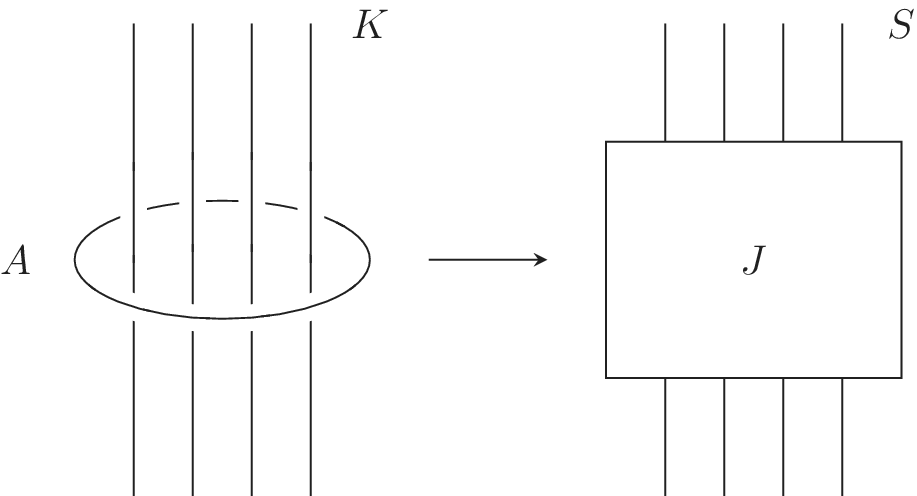
Let
 $\nu _A$
be an open tubular neighborhood of A in
 $X_K$
. The abelianization map
 $\pi _J \to \mathbb {Z}$
gives rise to a degree one map
 $X_J \to \overline {\nu _A}$
that is a diffeomorphism on the boundary. It defines a map
 $$ \begin{align*} X_S = ( X_K \setminus \nu_A) \cup_\phi X_J \to ( X_K \setminus \nu_A) \cup_\phi \overline{\nu_A} = X_K. \end{align*} $$
Let
 $\rho _S \colon \pi _S \to \pi _K$
be the induced epimorphism. Note that A determines an element
 $[A] \in \pi _K$
up to conjugation.
For a non-negative integer m, we write
 $\pi _K^{(m)}$
for the mth derived subgroup of
 $\pi _K$
, defined inductively by
 $$ \begin{align*} \pi_K^{(0)} = \pi_K ~\text{and}~ \pi_K^{(m+1)} = [\pi_K^{(m)}, \pi_K^{(m)}]. \end{align*} $$
The following lemma was proved in [Reference CochranCoc04, Theorem 8.1].
Lemma 5.1 Let
 $S = S(K, J, A)$
be the satellite knot with companion J, orbit K and axis A. If
 $[A] \in \pi _K^{(m)}$
, then
 $\rho _S$
induces an isomorphism
 $$ \begin{align*} \pi_S / \pi_S^{(m+1)} \to \pi_K / \pi_K^{(m+1)}. \end{align*} $$
The following lemmas are immediate consequences of the construction. We record them for use in the proof of Theorem 1.2.
Lemma 5.2 Let V be a Seifert form of K associated to a Seifert surface F, and let
 $S = S(K, J, A)$
be the satellite knot with companion J, orbit K and axis A. If A is disjoint from F, then S has a Seifert form isomorphic to V.
Proof Since A is disjoint from F, we have the image
 $F'$
of F by the inclusion map
 $X_A \to X_S$
. We see at once that
 $F'$
is a Seifert surface of S, and its Seifert form is isomorphic to V, which proves the lemma.▪
Lemma 5.3 Let
 $S = S(K, J, A)$
be the satellite knot with companion J, orbit K and axis A.
-
(i) If J is a ribbon knot, then S is ribbon concordant to K.
-
(ii) If J is a homotopy ribbon knot, then S is homotopy ribbon concordant to K.
Proof First, we prove (i). A ribbon concordance from J to the unknot can be encoded as a sequence of n saddle moves from J to the unlink with
 $n+1$
components. If A bounds a disc in
 $S^3$
intersecting K in w points, then one may find a sequence of
 $wn$
saddle moves from S to the disjoint union of K with a
 $wn$
-component unlink. To find them, for each saddle move on J, perform w parallel copies of it on S as in Figure 2. This converts S to a disjoint union of K and a
 $wn$
-component unlink. Cap off the unlink with
 $wn$
discs to complete the construction of a ribbon concordance from S to K. This completes the proof of (i).
Parallel copies of a saddle move in the case
 $w=4$
.
Now we prove (ii). Since J is a homotopy ribbon knot, J is homotopy ribbon concordant to the unknot U, via a homotopy ribbon concordance C. So the exterior
 $X_C$
has boundary
 $X_J \cup S^1 \times S^1 \times I \cup -X_U$
. Recall that
 $X_{S(K,J,A)} = X_{K \cup A} \cup _{\partial \overline {\nu A}} X_J$
and that, trivially,
 $X_K = X_{K \cup A} \cup _{\partial \overline {\nu A}} X_U$
. Glue to form:
 $$ \begin{align*} Y:= X_{K \cup A} \times I \cup_{\partial \overline{\nu A} \times I} X_C \end{align*} $$
along the
 $S^1 \times S^1 \times I$
part of the boundary of
 $X_C$
. Note that
 $\partial Y = X_S \cup -X_K$
and Y is a
 $\mathbb {Z}$
–homology cobordism with
 $\pi _1(Y)$
normally generated by a meridian of K or of S. Therefore,
 $Y \cup S^1 \times D^2 \times I$
is an 4-dimensional h-cobordism from
 $S^3$
to itself. The five-dimensional h-cobordism theorem [Reference Freedman and QuinnFQ90, Theorem 7.1A] may be applied to deduce that
 $Y \cup S^1 \times D^2 \times I \cong S^3 \times I$
, and therefore Y is a concordance exterior. The image of
 $S^1 \times {0} \times I$
under this homeomorphism gives rise to a concordance from
 $S(K,J,A)$
to K. The fact that
 $X_C$
is a homotopy ribbon concordance exterior easily implies that Y is too. This completes the proof of (ii) and of the lemma.▪
5.2 A formula for twisted Alexander polynomials
The following proposition is proved by reinterpreting twisted Alexander polynomials as Reidemeister torsion (see [Reference Kirk and LivingstonKL99, Reference KitanoKi96]) and using a surgery formula for Reidemeister torsion. For a proof of a more general statement we refer the reader to [Reference Cha and FriedlCF10, Lemma 7.1].
Proposition 5.4 Let
 $S = S(K, J, A)$
be the satellite knot with companion J, orbit K and axis A, and let
 $\alpha \colon \pi _K \to GL(n, \mathbb {Z})$
be a representation. Suppose that A is null-homologous in
 $X_K$
. Then the following holds:
 $$ \begin{align} \Delta_S^{\alpha \circ \rho_S}(t) \doteq \Delta_K^\alpha(t) \prod_{i=1}^n \Delta_J(z_i), \end{align} $$
where
 $z_1, \ldots , z_n$
are the eigenvalues of
 $\alpha ([A])$
.
Recall that the resultant of two polynomials
 $$ \begin{align*} f(t) = c \prod_{i=1}^m ( t - \alpha_i),~ g(t) = d \prod_{j=1}^n (t - \beta_j) \end{align*} $$
in
 $\mathbb {C}[t]$
, where
 $c, d, \alpha _1, \ldots , \alpha _m, \beta _1, \ldots , \beta _n \in \mathbb {C}$
, is given by
 $$ \begin{align*} \operatorname{\mathrm{Res}}(f, g) = c^n d^m \prod_{1 \leq i \leq m,~ 1 \leq j \leq n} ( \alpha_i - \beta_j). \end{align*} $$
Remark 5.5 In Proposition 5.4, taking a representative
 $\Delta _J \in \mathbb {Z}[t]$
, we can rewrite (5.1) as
 $$ \begin{align*} \Delta_S^{\alpha \circ \rho_S}(t) \doteq \frac{1}{c^n} \operatorname{\mathrm{Res}}(\Delta_J, f_{\alpha([A])}) \Delta_K^\alpha(t), \end{align*} $$
where c is the leading coefficient of
 $\Delta _J(t)$
and
 $f_{\alpha ([A])}(t)$
is the characteristic polynomial of
 $\alpha ([A])$
.
6 Metabelian Alexander polynomials
We introduce twisted Alexander polynomials associated to certain metabelian representations, which are useful for applications of Theorem 1.3. An important property of these invariants is that they are always nonzero. (See [Reference Herald, Kirk and LivingstonHKL10] for a similar construction of twisted Alexander polynomials.)
6.1 Metabelian representations
Let K be an oriented knot in
 $S^3$
and let r be a positive integer. Let
 $X_{K, r}$
and
 $X_{K, \infty }$
be the r-fold cyclic cover and the infinite cyclic cover of
 $X_K$
, respectively, and let
 $\Sigma _{K, r}$
be the r-fold cyclic branched cover of
 $S^3$
along K. We set
 $H_K = H_1(X_{K, \infty }; \mathbb {Z})$
. The abelianization map
 $\phi _K \colon \pi _K \to \mathbb {Z}$
defines an action of
 $\mathbb {Z}$
on
 $X_{K, \infty }$
, and we write t for the automorphism on
 $H_K$
corresponding to
 $1 \in \mathbb {Z}$
. Then
 $H_K$
has the structure of a
 $\mathbb {Z}[t^{\pm 1}]$
-module.
Let p be a prime, and let
 $\mathbb {F}_p$
be the field of order p. We identify
 $$ \begin{align*} \pi_K / \pi_K^{(2)} = \pi_K^{(1)} / \pi_K^{(2)} \rtimes \pi_K / \pi_K^{(1)} = H_K \rtimes \mathbb{Z}. \end{align*} $$
We set
 $\Gamma _K^{r, p}$
to be the quotient group
 $$ \begin{align*} \Gamma_K^{r, p} := ( H_K \otimes_{\mathbb{Z}[t^{\pm 1}]} \mathbb{F}_p[t^{\pm 1}] / (t^r-1)) \rtimes \mathbb{Z} / r \mathbb{Z}, \end{align*} $$
and we write
 $$ \begin{align*} \overline{\alpha}_K^{r, p} \colon \pi_K / \pi_K^{(2)} \to \operatorname{\mathrm{GL}}(|\Gamma_K^{r, p}|, \mathbb{Z}) \end{align*} $$
for the composition of the quotient map and the regular representation
 $\Gamma _K^{r, p} \to \operatorname {\mathrm {GL}}(|\Gamma _K^{r, p}|, \mathbb {Z})$
, fixing a basis of the free abelian group
 $\mathbb {Z} \Gamma _K^{r, p}$
. We define a representation
 $$\begin{align*}\alpha_K^{r, p} \colon \pi_K \to \operatorname{\mathrm{GL}}(|\Gamma_K^{r, p}|, \mathbb{Z})\end{align*}$$
to be the composition of the quotient map
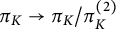 $\pi _K \to \pi _K / \pi _K^{(2)}$
and
 $\overline {\alpha }_K^{r, p}$
, and set
 $$ \begin{align*} \Delta_K^{r, p}(t) = \Delta_K^{\alpha_K^{r, p}}(t) \in \mathbb{Z}[t^{\pm 1}]. \end{align*} $$
Since it is invariant under conjugation of
 $\alpha _K^{r, p}$
as in Remark 2.1 (2), it does not depend on the choice of a basis of
 $\mathbb {Z} \Gamma _K^{r, p}$
.
It is straightforward to see that the composition
 $X_{K, \infty } \to \Sigma _{K, r}$
of the projection
 $X_{K, \infty } \to X_{K, r}$
and the inclusion map
 $X_{K, r} \to \Sigma _{K, r}$
induces an isomorphism
 $$ \begin{align*} H_K \otimes_{\mathbb{Z}[t^{\pm 1}]} \mathbb{F}_p[t^{\pm 1}] / (t^r-1) \cong H_1(\Sigma_{K, r}; \mathbb{F}_p). \end{align*} $$
Since
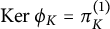 $\operatorname {Ker} \phi _K = \pi _K^{(1)}$
and
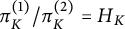 $\pi _K^{(1)} / \pi _K^{(2)} = H_K$
, we see that
 $\alpha _K^{r, p} |_{\operatorname {Ker} \phi _K}$
factors through this p-group.
The following theorem is proved in [Reference LivingstonLiv02, Theorem 1.2]. This shows that if
 $\Delta _K \neq 1$
, then there exist some r and p such that
 $\alpha _K^{r, p} |_{\operatorname {Ker} \phi _K}$
is nontrivial.
Theorem 6.1 The
 $three$
-manifold
 $\Sigma _{K, r}$
is a homology
 $3$
-sphere for every r if and only if
 $\Delta _K(t) = 1$
.
Remark 6.2 Livingston [Reference LivingstonLiv02, Theorem 1.2] also showed that
 $\Sigma _{K, r}$
is a homology
 $3$
-sphere for every prime power r if and only if every nontrivial irreducible factor of
 $\Delta _K(t)$
is a cyclotomic polynomial
 $\Phi _n(t)$
for some n divisible by three distinct primes.
The following lemma will be useful in Section 7.
Lemma 6.3 Let J and K be oriented knots in
 $S^3$
with an isomorphism
 $\psi \colon \pi _J / \pi _J^{(2)} \to \pi _K / \pi _K^{(2)}$
. Then for any positive integer r and any prime number p,
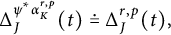 $$ \begin{align*} \Delta_J^{\psi^* \alpha_K^{r, p}}(t) \doteq \Delta_J^{r, p}(t), \end{align*} $$
where
 $\psi ^* \alpha _K^{r, p}$
is the composition
 $$ \begin{align*} \psi^* \alpha_K^{r, p} \colon \pi_J \to \pi_J / \pi_J^{(2)} \xrightarrow{\psi} \pi_K / \pi_K^{(2)} \xrightarrow{\overline{\alpha}_K^{r, p}} \operatorname{\mathrm{GL}}(|\Gamma_K^{r, p}|, \mathbb{Z}). \end{align*} $$
Proof The groups
 $\Gamma _J^{r, p}$
and
 $\Gamma _K^{r, p}$
are quotients of
 $\pi _J / \pi _J^{(2)}$
and
 $\pi _K / \pi _K^{(2)}$
, respectively, and
 $\psi $
induces an isomorphism
 $\Gamma _J^{r, p} \to \Gamma _K^{r, p}$
. Since the actions of
 $\pi _J / \pi _J^{(2)}$
on
 $\Gamma _J^{r, p}$
and
 $\pi _K / \pi _K^{(2)}$
on
 $\Gamma _K^{r, p}$
are compatible with
 $\psi $
and the induced isomorphism,
 $\overline {\alpha }_K^{r, p} \circ \psi $
and
 $\overline {\alpha }_J^{r, p}$
are conjugate, and so are
 $\psi ^* \alpha _K^{r, p}$
and
 $\alpha _J^{r, p}$
. Therefore, the lemma follows from Remark 2.1 (2).▪
6.2 Nonvanishing of metabelian Alexander polynomials
The following theorem is significant in applying Theorem 1.3.
Theorem 6.4 For any positive integer r and any prime number p,
 $\Delta _K^{r, p} \neq 0$
.
For the proof, we need the following theorem by the first and fifth authors [Reference Friedl and PowellFP12, Theorem 3.1].
Theorem 6.5 Let
 $\pi $
be a group, p a prime and
 $f \colon M \to N$
a morphism of projective right
 $\mathbb {Z} \pi $
-modules such that the homomorphism
 $$ \begin{align*} M \otimes_{\mathbb{Z} \pi} \mathbb{F}_p \to N \otimes_{\mathbb{Z} \pi} \mathbb{F}_p \end{align*} $$
induced by f is injective. Let
 $\phi \colon \pi \to H$
be an epimorphism onto a torsion-free abelian group and let
 $\alpha \colon \pi \to \operatorname {\mathrm {GL}}(n, Q)$
be a representation over a field Q of characteristic
 $0$
. If
 $\alpha |_{\operatorname {Ker} \phi }$
factors through a p-group, then the homomorphism
 $$ \begin{align*} M \otimes_{\mathbb{Z} \pi} Q(H)^n \to N \otimes_{\mathbb{Z} \pi} Q(H)^n \end{align*} $$
induced by f is also injective, where
 $Q(H)$
is the quotient field of the group ring of H over Q.
Remark 6.6 The original result [Reference Friedl and PowellFP12, Theorem 3.1] concerns projective left
 $\mathbb {Z} \pi $
-modules. But we can think of them also as right
 $\mathbb {Z} \pi $
-modules, using the involution of
 $\mathbb {Z} \pi $
reversing elements of
 $\pi $
, and the results of tensor products from the left are naturally identified with those from the right. Thus, we adapt the statement to the case of projective right
 $\mathbb {Z} \pi $
-modules.
Proof of Theorem 6.4 The proof is similar to that of [Reference Friedl and PowellFP12, Proposition 4.1].
Let
 $\mu $
be a meridian in
 $X_K$
. Since the induced homomorphism
 $H_*(\mu ; \mathbb {F}_p) \to H_*(X_K; \mathbb {F}_p)$
is an isomorphism, we have
 $H_*(X_K, \mu ; \mathbb {F}_p) = 0$
. We first prove that
 $H_*^{\alpha _K^{r, p} \otimes \phi _K}(X_K, \mu ; \mathbb {Q}(t)^n) = 0$
, following a standard argument of chain homotopy lifting (see for instance [Reference Cochran, Orr and TeichnerCOT03, Proposition 2.10]).
We pick a CW complex structure of
 $X_K$
containing
 $\mu $
as a subcomplex, and set
 $C_*$
and
 $\widetilde {C}_*$
to be the cellular chain complexes
 $C_*(X_K, \mu ) \otimes _{\mathbb {Z}} \mathbb {F}_p$
and
 $C_*(\widetilde {X}_K, \widetilde {\mu })$
, respectively, where
 $\widetilde {\mu }$
is the pullback of
 $\mu $
in the universal cover
 $\widetilde {X}_K$
of
 $X_K$
. Let
 $h_i \colon C_i \to C_{i+1}$
be a chain contraction for
 $C_*$
, so that
 $\partial h_i + h_{i-1} \partial $
is the identity map on
 $C_i$
. Since the natural map
 $\widetilde {C}_* \to C_*$
is surjective and all modules in
 $C_*$
and
 $\widetilde {C}_*$
are free, there exists a lift
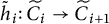 $\tilde {h}_i \colon \widetilde {C}_i \to \widetilde {C}_{i+1}$
of
 $h_i$
for each i. We write
 $f_i \colon \widetilde {C}_i \to \widetilde {C}_i$
for the chain map
 $\partial \tilde {h}_i + \tilde {h}_{i-1} \partial $
.
Since the chain map
 $C_i \to C_i$
induced by
 $f_i$
is the identity map and
 $\alpha _K^{r, p}|_{\operatorname {Ker} \phi _K}$
factors through the p-group
 $$ \begin{align*} H_K \otimes_{\mathbb{Z}[t^{\pm 1}]} \mathbb{F}_p[t^{\pm 1}] / (t^r-1), \end{align*} $$
it follows from Theorem 6.5 that the chain map
 $$ \begin{align*} \widetilde{C}_i \otimes_{\mathbb{Z} \pi_K} \mathbb{Q}(t)^n \to \widetilde{C}_i \otimes_{\mathbb{Z} \pi_K} \mathbb{Q}(t)^n \end{align*} $$
induced by
 $f_i$
is injective, and is therefore an isomorphism. Thus,
 $\tilde {h}_i$
induces a chain homotopy between the zero map and the chain isomorphism. Therefore,
 $H_*^{\alpha _K^{r, p} \otimes \phi _K}(X_K, \mu ; \mathbb {Q}(t)^n) = 0$
.
By a direct computation we have
 $H_*^{(\alpha _K^{r, p} \otimes \phi _K) \circ \iota }(\mu ; \mathbb {Q}(t)^n) = 0$
, where
 $\iota \colon \pi _1(\mu ) \to \pi _K$
is the induced homomorphism. Now it follows from the homology long exact sequence for
 $(X_K, \mu )$
that
 $H_*^{\alpha _{r, p} \otimes \phi _K}(X_K; \mathbb {Q}(t)^n) = 0$
. Hence
 $H_1^{\alpha _{r, p} \otimes \phi _K}(X_K; \mathbb {Z}[t^{\pm 1}]^n)$
is a torsion module, which completes the proof.▪
7 Proof of Theorem 1.2
Now, we prove Theorem 1.2. For the readers’ convenience we recall the statement.
Theorem 1.2 Let K be an oriented knot in
 $S^3$
with nontrivial Alexander polynomial
 $\Delta _K$
, and let V be a Seifert form of K. Then there exists an infinite family
 $\{ K_i \}_{i=1}^\infty $
of oriented knots in
 $S^3$
satisfying the following.
-
(i) For every i,
$K_i$
has a Seifert form isomorphic to V. -
(ii) For every i,
$K_i$
is ribbon concordant to K. -
(iii) For every
$i \neq j$
,
$K_i$
is not homotopy ribbon concordant to
$K_j$
.


Proof Let K be an oriented knot in
 $S^3$
with
 $\Delta _K(t) \neq 1$
, and let V be the Seifert form associated with a Seifert surface F. Since
 $\Delta _K(t) \neq 1$
, it follows from Theorem 6.1 that there exists a positive integer r such that
 $\Sigma _{K, r}$
is not a homology three-sphere. Let p be a prime factor of
 $| H_1(\Sigma _{K, r}; \mathbb {Z}) |$
. Since the homomorphisms
 $$ \begin{align*} H_1(X_K \setminus F; \mathbb{Z}[t^{\pm 1}]) & \to H_1^{\phi_K}(X_K; \mathbb{Z}[t^{\pm 1}]) = H_K,\\ H_K \otimes_{\mathbb{Z}[t^{\pm 1}]} \mathbb{F}_p[t^{\pm 1}] / (t^r-1)& \to H_1(\Sigma_{K, r}; \mathbb{F}_p) \end{align*} $$
are surjective, there exists a simple closed curve in
 $X_K \setminus F$
with nontrivial image in
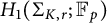 $H_1(\Sigma _{K, r}; \mathbb {F}_p)$
. Let A be such a simple closed curve in
 $X_K \setminus F$
that is unknotted in
 $S^3$
. Note that A determines an element
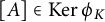 $[A] \in \operatorname {Ker} \phi _K$
with nontrivial
 $\alpha _K^{r, p}([A])$
up to conjugation.
Use the satellite construction in Section 5.1 to define a family of oriented knots
 $K_q$
in
 $S^3$
for primes
 $q \neq p$
by
 $$ \begin{align*} K_q = S = S(K, T(p, q) \sharp - T(p, q), A), \end{align*} $$
where
 $T(p, q)$
is the
 $(p, q)$
-torus knot. In the following we show that the family
 $\{ K_q \}_{q \neq p}$
of knots satisfies the conditions (i)–(iii) as in the statement.
Since A is disjoint from F, it follows from Lemma 5.2 that for every q,
 $K_q$
has a Seifert form isomorphic to V. Also, since
 $T(p, q) \sharp - T(p, q)$
is a ribbon knot, it follows from Lemma 5.3 that for every q,
 $K_q$
is ribbon concordant to K. It remains to prove that for all primes
 $q, q' \neq p$
, if
 $K_q \geq _{\operatorname {top}} K_{q'}$
then
 $q = q'$
.
First, we compute
 $\Delta _{K_q}^{r, p}(t)$
for a prime
 $q \neq p$
. Since A is null-homologous, it follows from Lemma 5.1 that
 $\rho _S \colon \pi _{K_q} \to \pi _K$
induces an isomorphism
 $\overline {\rho }_S \colon \pi _{K_q} / \pi _{K_q}^{(2)} \to \pi _K / \pi _K^{(2)}$
. By Lemma 6.3, we have
 $$ \begin{align} \Delta_{K_q}^{r, p} \doteq \Delta_{K_q}^{\overline{\rho}_S^* \alpha_K^{r, p}} \doteq \Delta_{K_q}^{\alpha_K^{r, p} \circ \rho_S}. \end{align} $$
It follows from Proposition 5.4 and Remark 5.5 that
 $$ \begin{align} \Delta_{K_q}^{\alpha_K^{r, p} \circ \rho_S} \doteq \operatorname{\mathrm{Res}}(\Delta_{T(p, q) \sharp - T(p, q)}, f_{\alpha_K^{r, p}([A])}) \Delta_K^{r, p}. \end{align} $$
Here, we have
 $$ \begin{align} \Delta_{T(p, q) \sharp - T(p, q)}(t) \doteq \Delta_{T(p, q)}(t) \Delta_{-T(p, q)}(t) \doteq \Delta_{T(p, q)}(t)^2, \end{align} $$
 $$ \begin{align} \Delta_{T(p, q)}(t) \doteq \Phi_{pq}(t) = \frac{(t^{pq}-1)(t-1)}{(t^p-1)(t^q-1)}, \end{align} $$
where
 $\Phi _n(t)$
denotes the nth cyclotomic polynomial, defined as
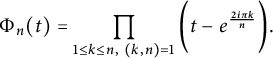 $$ \begin{align*} \Phi_n(t) = \prod_{1 \leq k \leq n,~ (k, n) = 1} \bigg( t - e^{\frac{ 2 i \pi k}{n}} \bigg). \end{align*} $$
Using (7.1)–(7.4), conclude that
 $$ \begin{align} \Delta_{K_q}^{r, p} \doteq \operatorname{\mathrm{Res}}(\Phi_{pq}^2, f_{\alpha_K^{r, p}([A])}) \Delta_K^{r, p} \doteq \operatorname{\mathrm{Res}}(f_{\alpha_K^{r, p}([A])}, \Phi_{pq})^2 \Delta_K^{r, p}. \end{align} $$
Now we show that
 $\operatorname {\mathrm {Res}}(\Phi _{pq}^2, f_{\alpha _K^{r, p}([A])})^2 = q^{m_q}$
for a positive integer
 $m_q>0$
. Note that
 $\alpha _K^{r, p}([A])$
is a nontrivial permutation matrix, and since
 $\alpha _K^{r, p}|_{\operatorname {Ker} \phi _K}$
factors through the p–group
 $$ \begin{align*} H_K \otimes_{\mathbb{Z}[t^{\pm 1}]} \mathbb{F}_p[t^{\pm 1}] / (t^r-1), \end{align*} $$
the order of
 $\alpha _K^{r, p}([A])$
is a nontrivial p–power. Hence
 $f_{\alpha _K^{r, p}([A])}$
is a product of
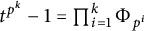 $t^{p^k} - 1 = \prod _{i=1}^k \Phi _{p^i}$
for some positive integers k. Thus,
 $\operatorname {\mathrm {Res}}(f_{\alpha _K^{r, p}([A])}, \Phi _{pq})$
is a nontrivial q–power, since
 $\operatorname {\mathrm {Res}}(\Phi _{p}, \Phi _{pq})=q$
and
 $\operatorname {\mathrm {Res}}(\Phi _{p^i}, \Phi _{pq})=1$
for
 $i> 1$
, which follows from the following theorem: for positive integers m and n with
 $m < n$
,
 $$ \begin{align*} \operatorname{\mathrm{Res}} (\Phi_m, \Phi_n) = \begin{cases} q^{\phi(m)} &\text{if } m ~|~ n \text{ and } \frac{n}{m} \text{ is a power of a prime } q, \\ 1 &\text{otherwise}, \end{cases} \end{align*} $$
where
 $\phi (n)$
is Euler’s totient function [Reference ApostolA70, Reference DiederichsenD40, Reference LehmerLeh30], which is equal to
 $\deg \Phi _n$
. We conclude that (7.5) implies that there exists a positive integer
 $m_q$
such that
 $$ \begin{align} \Delta_{K_q}^{r, p}(t) \doteq q^{m_q} \Delta_K^{r, p}(t). \end{align} $$
Now for arbitrary primes
 $q, q' \neq p$
suppose that
 $K_q \geq _{\operatorname {top}} K_{q'}$
with a homotopy ribbon concordance C. Since the Seifert forms of
 $K_q$
and
 $K_{q'}$
are isometric, the Alexander polynomials
 $\Delta _{K_q}$
and
 $\Delta _{K_{q'}}$
are equal. By Corollary 3.11, the Blanchfield pairings are isometric. This implies that the submodule G in the statement of Theorem 1.1 is trivial. But G is the kernel of the inclusion induced map
 $j_* \colon H_1(X_{K_q};\mathbb {Z}[t^{\pm 1}]) \to H_1(X_C;\mathbb {Z}[t^{\pm 1}])$
, so
 $j_*$
is injective. Then Proposition 4.1, applied with the abelianization representation
 $\alpha \colon \pi _C \to \operatorname {\mathrm {GL}}(1,\mathbb {Z}) =\mathbb {Z}$
(or [Reference Friedl and PowellFP20, Proposition 3.1]), implies that
 $j_*$
is surjective. On the other hand, the proof of Theorem 1.1 implies that the inclusion induced monomorphism
 $H_1(X_{K_{q'}};\mathbb {Z}[t^{\pm 1}]) \to H_1(X_C;\mathbb {Z}[t^{\pm 1}])$
identifies
 $H_1(X_{K_{q'}};\mathbb {Z}[t^{\pm 1}])$
with
 $$ \begin{align*} j_*(G^{\perp}/G) = j_*(H_1(X_{K_q};\mathbb{Z}[t^{\pm 1}])) = H_1(X_{C};\mathbb{Z}[t^{\pm 1}]). \end{align*} $$
Therefore, the inclusion induced maps
 $$ \begin{align} H_1(X_{K_q};\mathbb{Z}[t^{\pm 1}]) \xrightarrow{\cong} H_1(X_{C};\mathbb{Z}[t^{\pm 1}]) \xleftarrow{\cong} H_1(X_{K_{q'}};\mathbb{Z}[t^{\pm 1}]). \end{align} $$
are isomorphisms. Now, for
 $T \in \{K_q,K_{q'},C\}$
, we have a short exact sequence
 $$ \begin{align*} 1 \to H_1(X_T;\mathbb{Z}[t^{\pm 1}]) \cong \pi_T^{(1)}/\pi_T^{(2)} \to \pi_T/\pi_T^{(2)} \to \mathbb{Z} \to 0 \end{align*} $$
that splits, so
 $\pi _T/\pi _T^{(2)} \cong H_1(X_T;\mathbb {Z}[t^{\pm 1}]) \rtimes \mathbb {Z}$
.
It follows that
 $\iota _{K_q} \colon \pi _{K_q} \to \pi _C$
and
 $\iota _{K_{q'}} \colon \pi _{K_{q'}} \to \pi _C$
induce isomorphisms
 $\overline {\iota }_{K_q} \colon \pi _{K_q} / \pi _{K_q}^{(2)} \to \pi _C / \pi _C^{(2)}$
and
 $\overline {\iota }_{K_{q'}} \colon \pi _{K_{q'}} / \pi _{K_{q'}}^{(2)} \to \pi _C / \pi _C^{(2)}$
, respectively. We write
 $$ \begin{align*} \alpha_C^{r, p} \colon \pi_C \to \operatorname{\mathrm{GL}}(|\Gamma_{K_q}^{r, p}|, \mathbb{Z}) \end{align*} $$
for the pullback of
 $\overline {\alpha }_{K_q}^{r, p} \circ \overline {\iota }_{K_q}^{-1}$
to
 $\pi _C$
.
Note that
 $\alpha _C^{r, p}$
determines a representation
 $\alpha _C^{r, p} \circ \iota _{K_{q'}} \colon \pi _{K_{q'}} \to \operatorname {\mathrm {GL}}(|\Gamma _{K_q}^{r, p}|, \mathbb {Z})$
by composition with the inclusion map. The identification of Alexander modules in (7.7) induces an isomorphism
 $\Gamma _{K_q}^{r, p} \xrightarrow {\cong } \Gamma _{K_{q'}}^{r, p}$
, under which we may compare
 $\alpha _C^{r, p} \circ \iota _{K_{q'}}$
and
 $\alpha _{K_{q'}}^{r, p}$
. These representations of
 $\pi _{K_{q'}}$
may well differ, but the induced twisted Alexander polynomials agree up to units:
 $$ \begin{align} \Delta_{K_{q'}}^{\alpha_C^{r, p} \circ \iota_{K_{q'}}} \doteq \Delta_{K_{q'}}^{(\overline{\iota}_{K_q}^{-1} \circ \overline{\iota}_{K_{q'}})^* \alpha_{K_q}^{r, p}} \doteq \Delta_{K_{q'}}^{r, p}. \end{align} $$
The first equation follows from the equality
 $\alpha _C^{r, p} \circ \iota _{K_{q'}} = (\overline {\iota }_{K_q}^{-1} \circ \overline {\iota }_{K_{q'}})^* \alpha _{K_q}^{r, p}$
and the second one does from Lemma 6.3.
Now, we have all the tools we require to complete the proof that
 $K_q \geq _{\operatorname {top}} K_{q'}$
implies
 $q = q'$
. It follows from Theorem 1.3 that
 $$ \begin{align} \Delta_{K_{q'}}^{\alpha_C^{r, p} \circ \iota_{K_{q'}}} ~|~ \Delta_{K_q}^{\alpha_C^{r, p} \circ \iota_{K_q}} \doteq \Delta_{K_q}^{r, p}. \end{align} $$
Combining (7.8) and (7.9), we obtain
 $$ \begin{align*} \Delta_{K_{q'}}^{r, p} ~|~ \Delta_{K_q}^{r, p}. \end{align*} $$
It then follows from (7.6) that
 $$ \begin{align*} q^{'m_{q'}} \Delta_K^{r, p} ~|~ q^{m_q} \Delta_K^{r, p}. \end{align*} $$
Since
 $m_q, m_{q'}> 0$
, and since
 $\Delta _K^{r, p}(t) \neq 0$
by Theorem 6.4, we have
 $q = q'$
.
Therefore, the family
 $\{ K_q \}_{q \neq p}$
of knots satisfies all the conditions (i)–(iii), and the proof of Theorem 1.2 is complete.▪
A Base changes for Blanchfield pairings
The goal of this appendix is to prove Propositions A.1 and A.2, which give a sufficient condition on a
 $\mathbb {Z}[t^{\pm 1}]$
-algebra R for a Blanchfield pairing
 $\operatorname {\mathrm {Bl}}^R$
to be definable in the same way as
 $\operatorname {\mathrm {Bl}}$
is defined over
 $\mathbb {Z}[t^{\pm 1}]$
, such that the analogue of Theorem 1.1 holds for
 $\operatorname {\mathrm {Bl}}^R$
. Of course, a twisted Blanchfield pairing may be defined in a much more general situation than the one considered in this appendix (see e.g., [Reference PowellP16]). The focus here is to choose R such that
 $\operatorname {\mathrm {Bl}}^R_K$
is determined by
 $\operatorname {\mathrm {Bl}}_K$
, and
 $[J] \geq _S [K]$
implies the conclusion of Theorem 1.1 for
 $\operatorname {\mathrm {Bl}}^R_J$
and
 $\operatorname {\mathrm {Bl}}^R_K$
.
Propositions A.1 and A.2 are used at two places in this paper. To prove Proposition 3.3, which is about the homology of double branched covers of knots, we set
 $R = \mathbb {Z}[t^{\pm 1}] / (t + 1)$
. To prove Proposition 3.4, which is about knot signatures, we set R to be the localization of
 $\mathbb {R}[t^{\pm 1}]$
at
 $(\zeta )$
, for
 $\zeta (t) = t^{-1} - 2\cos x + t$
a polynomial with nonreal roots on the unit circle.
Let us first establish some notation and definitions. Let
 $\Xi \subset \mathbb {Z}[t^{\pm 1}]$
be the multiplicative set
 $\{p(t)\in \mathbb {Z}[t^{\pm 1}]\mid |p(1)| = 1\}$
. Let us call an element a of a
 $\mathbb {Z}[t^{\pm 1}]$
-module
 $\Xi $
-torsion if
 $q\cdot a = 0$
for some
 $q\in \Xi $
, and let us call a
 $\mathbb {Z}[t^{\pm 1}]$
-module
 $\Xi $
-torsion if all of its elements are
 $\Xi $
-torsion. Let us call a
 $\mathbb {Z}[t^{\pm 1}]$
-module
 $M \ \Xi $
-divisible if for all
 $a\in M$
and
 $q\in \Xi $
, there exists
 $b\in M$
with
 $q\cdot b = a$
. Examples of
 $\Xi $
-divisible modules are given by
 $\Xi ^{-1} \mathbb {Z}[t^{\pm 1}]$
and
 $\Xi ^{-1} \mathbb {Z}[t^{\pm 1}] / \mathbb {Z}[t^{\pm 1}]$
.
An admissible
 $\mathbb {Z}[t^{\pm 1}]$
-algebra is defined to be a commutative unital
 $\mathbb {Z}[t^{\pm 1}]$
-algebra R with an involution, which we also denote by
 $\overline {\,\cdot \,}$
, satisfying
 $\overline {p}\cdot \overline {r} = \overline {p\cdot r}$
for all
 $p\in \mathbb {Z}[t^{\pm 1}], r\in R$
, such that R has no
 $(t-1)$
-torsion and no
 $\Xi $
-torsion. Clearly,
 $\mathbb {Z}[t^{\pm 1}]$
is an admissible
 $\mathbb {Z}[t^{\pm 1}]$
-algebra itself. Further examples of such algebras are given by
 $\mathbb {Z}[t^{\pm 1}] / (q)$
for any polynomial
 $q \in \mathbb {Z}[t^{\pm 1}]$
that satisfies
 $\overline {(q)} = (q) \subset \mathbb {Z}[t^{\pm 1}]$
and
 $q(1) \neq 0$
, and has no factor
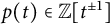 $p(t)\in \mathbb {Z}[t^{\pm 1}]$
with
 $|p(1)| = 1$
. For instance, one may take q as an n-th cyclotomic polynomial
 $\Phi _n$
for
 $n\geq 2$
. Yet further examples of admissible
 $\mathbb {Z}[t^{\pm 1}]$
-algebras are given by localizations of
 $\mathbb {Z}[t^{\pm 1}]$
with respect to multiplicative sets
 $\Theta \subset \mathbb {Z}[t^{\pm 1}]$
with
 $0\notin \Theta $
and
 $\overline {\Theta } = \Theta $
.
For a
 $\mathbb {Z}[t^{\pm 1}]$
-module M, we write
 $\Xi ^{-1}M = M \otimes \Xi ^{-1}\mathbb {Z}[t^{\pm 1}]$
for the localization of M with respect to
 $\Xi $
(in this appendix, all tensor products are understood to be over
 $\mathbb {Z}[t^{\pm 1}]$
). Since
 $\mathbb {Z}[t^{\pm 1}]$
itself and R are
 $\Xi $
-torsion free, we have natural inclusions of modules (by sending
 $1$
to
 $1$
)
 $$ \begin{align*} \mathbb{Z}[t^{\pm 1}] \subset \Xi^{-1}\mathbb{Z}[t^{\pm 1}] \subset \mathbb{Q}(t), \qquad R \subset \Xi^{-1}R \subset Q(R), \end{align*} $$
where we recall that
 $Q(R)$
is the localization of R with respect to the multiplicative set of elements of R that are not zero divisors. The homomorphisms
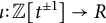 $\iota \colon \mathbb {Z}[t^{\pm 1}] \to R$
and
 $\Xi ^{-1}\mathbb {Z}[t^{\pm 1}] \to \Xi ^{-1}R$
(both given by sending
 $1$
to
 $1$
) induce a homomorphism
 $\iota '\colon \Xi ^{-1}\mathbb {Z}[t^{\pm 1}]/\mathbb {Z}[t^{\pm 1}] \to \Xi ^{-1}R/R$
.
Proposition A.1 Let R be an admissible
 $\mathbb {Z}[t^{\pm 1}]$
-algebra and K a knot. The four maps

defined analogously to ( 3.1 ) are isomorphisms, and their composition is the adjoint of a sesquilinear, Hermitian, and nonsingular pairing
 $$ \begin{align*} \operatorname{\mathrm{Bl}}^R_K\colon H_1(X_K; R) \times H_1(X_K; R) \to Q(R)/R. \end{align*} $$
That pairing is determined by
 $\operatorname {\mathrm {Bl}}_K$
, satisfying
 $$ \begin{align*} \operatorname{\mathrm{Bl}}^R_K(a\otimes r, b\otimes s) = r\cdot\overline{s}\cdot\iota'(\operatorname{\mathrm{Bl}}_K(a,b)) \end{align*} $$
for all
 $a, b\in H_1(X_K; \mathbb {Z}[t^{\pm 1}])$
and
 $r,s\in R$
(here, we use that
 $\operatorname {\mathrm {Bl}}_K(a,b) \in \Xi ^{-1}\mathbb {Z}[t^{\pm 1}] \subset \mathbb {Q}(t)$
).
Proposition A.2 Let J and K be knots, and let
 $G\subset H_1(X_J;\mathbb {Z}[t^{\pm 1}])$
be a submodule such that the pairing on
 $G^{\bot } / G$
induced by
 $\operatorname {\mathrm {Bl}}_J$
is isometric to
 $\operatorname {\mathrm {Bl}}_K$
.
-
(i) The pairing on
$(G^{\bot }\otimes R) / (G \otimes R)$
induced by
$\operatorname {\mathrm {Bl}}^R_J$
is isometric to
$\operatorname {\mathrm {Bl}}^R_K$
. -
(ii)
$G^{\bot } \otimes R = (G\otimes R)^{\bot _R}$
.




Note that in particular, if
 $\operatorname {\mathrm {Bl}}_K$
is metabolic, then so is
 $\operatorname {\mathrm {Bl}}^R_K$
. Proposition A.1 might not come as a surprise to the experts, but we thought it beneficial to include a detailed proof. This proof is spread over two lemmas. The first lemma contains the proofs that the four maps in Proposition A.1 are isomorphisms, and shows that
 $\operatorname {\mathrm {Bl}}^R$
may be defined equivalently with target modules either
 $\Xi ^{-1}R/R$
or
 $Q(R)/R$
.
Lemma A.3 Let R be an admissible
 $\mathbb {Z}[t^{\pm 1}]$
-algebra and let K be a knot.
-
(i) The natural maps
$H_1(X_K; \mathbb {Z}[t^{\pm 1}])\otimes R \to H_1(X_K; R)$
and
$H_1(X_K, \partial X_K; \mathbb {Z}[t^{\pm 1}])\otimes R \to H_1(X_K, \partial X_K; R)$
are isomorphisms. -
(ii)
$H_1(X_K; R)$
and
$H_1(X_K, \partial X_K; R)$
are
$\Xi $
-torsion modules (in particular, R-torsion modules), and multiplication by
$(1-t)$
acts invertibly on them. -
(iii) The inclusion induced homomorphism
$H_1(X_K; R) \to H_1(X_K, \partial X_K; R)$
is an isomorphism. -
(iv) For
$\Omega = Q(R)$
or
$\Omega = \Xi ^{-1}R$
, there exists a unique isomorphism such that
$$ \begin{align*} \delta\colon H^2(X_K; R)\to \operatorname{\overline{Hom}}_R(H_1(X_K; R), \Omega/R), \end{align*} $$
$\delta \circ \beta = \kappa $
, where
$\beta \colon H^1(X_K; \Omega /R) \to H^2(X_K; R)$
is the Bockstein connecting homomorphism, and
$\kappa \colon H^1(X_K; \Omega /R) \to \operatorname {\overline {Hom}}_R(H_1(X_K; R), \Omega /R)$
is the Kronecker evaluation.
-
(v) For
$\Omega = Q(R)$
,
$H^1(X_K;\Omega )$
is trivial, and
$\delta = \kappa \circ \beta ^{-1}$
. -
(vi) The following diagram commutes.
Here, the second vertical map is induced by the inclusion
$\Xi ^{-1}R/R \to Q(R)/R$
.

















Proof (i) The universal coefficient spectral sequence for homology groups [Reference RotmanRo09, Theorem 10.90] yields a short exact sequence

Since
 $H_0(X_K; \mathbb {Z}[t^{\pm 1}]) \cong \mathbb {Z}[t^{\pm 1}] / (t-1)$
, the
 $\operatorname {\mathrm {Tor}}$
-term above is isomorphic to the
 $(t-1)$
-torsion submodule of R, which is trivial by assumption. So the map
 $H_1(X_K; \mathbb {Z}[t^{\pm 1}])\otimes R \to H_1(X_K; R)$
is an isomorphism. For homology rel.
 $\partial X_K$
, a similar but simpler argument can be made, since
 $H_0(X_K, \partial X_K; \mathbb {Z}[t^{\pm 1}])$
is trivial.
(ii) Consider
 $\Delta _K\in \Xi $
. Note that
 $\Delta _K$
annihilates
 $H_1(X_K; \mathbb {Z}[t^{\pm 1}])$
, and so
 $\Delta _K\cdot 1_R\in R$
annihilates
 $H_1(X_K; R)$
by (i). The same argument works for homology rel.
 $\partial X_K$
.
The polynomial
 $\Delta _K\in \Xi $
decomposes as
 $\Delta _K = (1-t)q(t) \pm 1$
for some
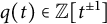 $q(t)\in \mathbb {Z}[t^{\pm 1}]$
. Since
 $\Delta _K$
annihilates the modules in question, multiplication by
 $1-t$
is an isomorphism, with inverse given by multiplication by
 $\mp q(t)$
.
(iii) One computes
 $H_0(\partial X_K; R) \cong H_1(\partial X_K; R) \cong R/(t-1)R$
. It follows that the inclusion induced map
 $H_1(\partial X_K; R) \to H_1(X_K; R)$
and the connecting homomorphism
 $H_1(X_K, \partial X_K; R) \to H_0(\partial X; R)$
both vanish, since multiplication by
 $(1-t)$
is an isomorphism of
 $H_1(X_K, \partial X_K; R)$
and of
 $H_1(X_K; R)$
by (i) and (ii).
(iv) Part of the Bockstein long exact sequence coming from
 $0 \to R\to \Omega \to \Omega /R\to 0$
is

We have that
 $$ \begin{align*} H^2(X_K; \Omega) \cong H_1(X_K, \partial X_K; \Omega) \cong H_1(X_K, \partial X_K; R) \otimes \Omega \end{align*} $$
by Poincaré duality and flatness of
 $\Omega $
. The latter module is trivial, since
 $H_1(X_K, \partial X_K; R)$
is
 $\Xi $
-torsion by (ii). It follows that
 $\beta $
is surjective.
The Kronecker evaluation
 $\kappa $
is part of the short exact sequence

Since
 $\beta $
and
 $\kappa $
are both surjective, to show existence and uniqueness of
 $\delta $
it suffices to show that
 $\operatorname {Ker} \beta = \operatorname {Ker} \kappa $
. For this, consider the following commutative diagram.
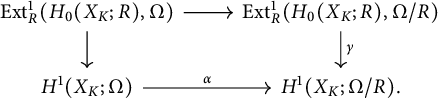
Note that
 $\operatorname {\overline {Hom}}(H_1(X_K; R), \Omega )$
vanishes, since
 $H_1(X_K; R)$
is
 $\Xi $
-torsion by (ii). So the left map in the diagram is an isomorphism. Moreover,
 $\operatorname {\mathrm {Ext}}^2_R(H_0(X_K; R), R)$
is trivial, since
 $H_0(X_K; R) = R/(1-t)R$
. So the top map in the diagram is surjective. It follows that
 $$ \begin{align*} \operatorname{Ker} \kappa = \gamma(\operatorname{\mathrm{Ext}}^1_R(H_0(X_K; R), \Omega/R)) = \alpha(H^1(X_K; \Omega)) = \operatorname{Ker} \beta. \end{align*} $$
(v) As shown in (iv),
 $H^1(X_K; Q(R)) \cong \operatorname {\mathrm {Ext}}^1_R(H_0(X_K; R), Q(R))$
. Since
 $H_0(X_K; R) \cong R / (1-t)R$
, the
 $\operatorname {\mathrm {Ext}}$
-term is isomorphic to
 $Q(R) / ((1-t)Q(R))$
, which is trivial since
 $(1-t)$
is invertible in
 $Q(R)$
. So
 $\beta $
is an isomorphism, and
 $\delta = \kappa \circ \beta ^{-1}$
.
(vi) This follows from naturality.▪
The next lemma analyses the relationship between
 $\operatorname {\mathrm {Bl}}$
and
 $\operatorname {\mathrm {Bl}}^R$
.
Lemma A.4 The following diagram of
 $\mathbb {Z}[t^{\pm 1}]$
-modules commutes.
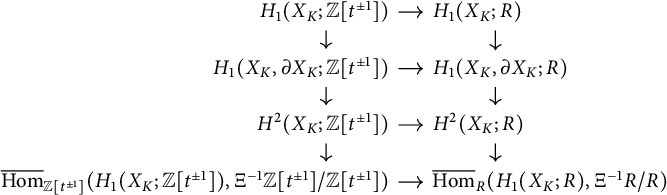
Here, the vertical maps are the isomorphisms given by inclusion, inverse of Poincaré duality and
 $\delta $
, respectively. The first three horizontal maps are induced by
 $\iota $
, and the fourth horizontal map is defined as composition of

Proof Commutativity of the diagram follows from the naturality of the maps (for the naturality of Poincaré duality, see e.g., [Reference Friedl, Nagel, Orson and PowellFNOP19, Section A.3]).▪
Proof of Proposition A.1 The first map is an isomorphism, as shown in Lemma A.3(iii). For the second map, see [Reference Friedl, Nagel, Orson and PowellFNOP19, Section A.3]. The third and fourth map are discussed in Lemma A.3(iv) and (v). That these maps are isomorphisms implies the nonsingularity of
 $\operatorname {\mathrm {Bl}}^R_K$
, whereas the sesquilinearity of
 $\operatorname {\mathrm {Bl}}^R_K$
is automatic. The formula relating
 $\operatorname {\mathrm {Bl}}_K$
and
 $\operatorname {\mathrm {Bl}}^R_K$
follows from Lemma A.3(vi) and Lemma A.4. This formula also implies that
 $\operatorname {\mathrm {Bl}}^R_K$
is Hermitian, since
 $\operatorname {\mathrm {Bl}}_K$
is.▪
For the proof of Proposition A.2, we need several lemmas. Much of the required homological algebra machinery was developed by Levine. In particular, we will need the following statement.
Lemma A.5 ([Reference LevineLev77, Proposition (3.5)])
If M is a finitely generated
 $\mathbb {Z}$
-torsion free
 $\mathbb {Z}[t^{\pm 1}]$
-module on which multiplication with
 $1-t$
is an automorphism, then M is of homological dimension
 $1$
, i.e., there is a short exact sequence

for some
 $n,m \in \mathbb {N}$
.
Lemma A.6 For every
 $\mathbb {Z}[t^{\pm 1}]$
-module M,
 $\operatorname {Hom}_{\mathbb {Z}[t^{\pm 1}]}(M, \Xi ^{-1}\mathbb {Z}[t^{\pm 1}]/\mathbb {Z}[t^{\pm 1}])$
is
 $\mathbb {Z}$
-torsion free.
Proof Let a homomorphism
 $\alpha \colon M \to \Xi ^{-1}\mathbb {Z}[t^{\pm 1}]/\mathbb {Z}[t^{\pm 1}]$
be given such that
 $m\alpha = 0$
for some nonzero
 $m\in \mathbb {Z}$
. Let
 $a\in M$
be given. Write
 $\alpha (a) = n(t) / d(t) \in \Xi ^{-1}\mathbb {Z}[t^{\pm 1}]/\mathbb {Z}[t^{\pm 1}]$
, where
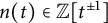 $n(t)\in \mathbb {Z}[t^{\pm 1}]$
and
 $d(t)\in \Xi $
have no nonunital common divisors. Then
 $m\alpha (a) = mn(t)/d(t) = 0 \in \Xi ^{-1}\mathbb {Z}[t^{\pm 1}]/\mathbb {Z}[t^{\pm 1}]$
, which implies that
 $d(t)$
divides
 $mn(t)$
in
 $\mathbb {Z}[t^{\pm 1}]$
. Because
 $\mathbb {Z}[t^{\pm 1}]$
is a UFD and
 $n(t)$
and
 $d(t)$
have no common divisor, it follows that
 $d(t)$
is an integer dividing m. But the only integers in
 $\Xi $
are
 $\pm 1$
. It follows that
 $\alpha (a) = 0$
. So we have established
 $\alpha = 0$
.▪
Lemma A.7 The module
 $H_1(X_K;\mathbb {Z}[t^{\pm 1}])$
is
 $\mathbb {Z}$
-torsion free for all knots K.
Proof The adjoint of the Blanchfield pairing is an isomorphism between the modules
 $H_1(X_K;\mathbb {Z}[t^{\pm 1}])$
and
 $\operatorname {\overline {Hom}}_{\mathbb {Z}[t^{\pm 1}]} (H_1(X_K; \mathbb {Z}[t^{\pm 1}]), \mathbb {Q}(t) / \mathbb {Z}[t^{\pm 1}])$
. The latter module is isomorphic to the module
 $\operatorname {\overline {Hom}}_{\mathbb {Z}[t^{\pm 1}]} (H_1(X_K; \mathbb {Z}[t^{\pm 1}]), \Xi ^{-1} \mathbb {Z}[t^{\pm 1}] / \mathbb {Z}[t^{\pm 1}])$
by Lemma A.3. That last module, in turn, is
 $\mathbb {Z}$
-torsion free by Lemma A.6.▪
Lemma A.8 Let M be a finitely generated
 $\mathbb {Z}[t^{\pm 1}]$
-module without
 $\mathbb {Z}$
-torsion that is annihilated by some
 $q(t)\in \Xi $
, and let R be a
 $\Xi $
-torsion free
 $\mathbb {Z}[t^{\pm 1}]$
-algebra R (possibly
 $\mathbb {Z}[t^{\pm 1}]$
itself).
-
(i) The R-module
$M\otimes R$
has homological dimension 1. -
(ii) For a
$\Xi $
-torsion free R-module N, the module
$\operatorname {\mathrm {Tor}}^R_1(M\otimes R,N)$
is trivial. -
(iii) For a
$\Xi $
-divisible R-module N, the module
$\operatorname {\mathrm {Ext}}_R^1(M\otimes R,N)$
is trivial.





Proof Let us first prove (i)–(iii) in the special case that
 $R = \mathbb {Z}[t^{\pm 1}]$
.
(i) for
 $R = \mathbb {Z}[t^{\pm 1}]$
. Similarly as in Lemma A.3(iii), one shows that multiplication by
 $1-t$
is an isomorphism of M. So M is of homological dimension 1 by Lemma A.5.
(ii) for
 $R = \mathbb {Z}[t^{\pm 1}]$
. Consider the short exact sequence

which induces the exact sequence

By (i), the first Tor term in the above sequence is trivial. Hence multiplication by
 $q(t)$
is injective on
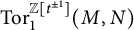 $\operatorname {\mathrm {Tor}}^{\mathbb {Z}[t^{\pm 1}]}_1(M, N)$
. But it is also trivial, since
 $q(t)$
annihilates M. This implies that
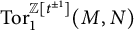 $\operatorname {\mathrm {Tor}}^{\mathbb {Z}[t^{\pm 1}]}_1(M, N)$
is trivial.
(iii) for
 $R = \mathbb {Z}[t^{\pm 1}]$
. The proof is dual to that of (ii), starting with the short exact sequence

(i) for general R. We have already shown that M is of homological dimension
 $1$
over
 $\mathbb {Z}[t^{\pm 1}]$
. Tensoring the short exact sequence as in Lemma A.5 with R gives a short exact sequence

showing that
 $M\otimes R$
is of homological dimension
 $1$
over R, since
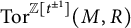 $\operatorname {\mathrm {Tor}}^{\mathbb {Z}[t^{\pm 1}]}(M, R)$
is trivial by (ii).
Now, the proofs of (ii) and (iii) for general R are analogous to the proofs in the special case
 $R = \mathbb {Z}[t^{\pm 1}]$
.▪
Proof of Proposition A.2 (i) Consider the following short exact sequence of
 $\mathbb {Z}[t^{\pm 1}]$
-modules:

The module
 $H_1(X_K; \mathbb {Z}[t^{\pm 1}])$
satisfies the hypotheses of Lemma A.8(ii), since it is
 $\mathbb {Z}$
-torsion free by Lemma A.7, and is annihilated by
 $\Delta _K\in \mathbb {Z}[t^{\pm 1}]$
. Thus tensoring with R, and using Lemma A.3 (i), yields a short exact sequence of R-modules:

Here,
 $G\otimes R$
and
 $G^{\bot }\otimes R$
carry pairings that are restrictions of
 $\operatorname {\mathrm {Bl}}^R_J$
, while
 $H_1(X_K; R)$
carries the pairing
 $\operatorname {\mathrm {Bl}}^R_K$
. By Proposition A.1, the homomorphisms in the sequence respect those pairings. This implies that the
 $\operatorname {\mathrm {Bl}}^R_K$
is isometric to the pairing induced by
 $\operatorname {\mathrm {Bl}}^R_J$
on
 $(G^{\bot }\otimes R) / (G\otimes R)$
.
(ii) There is a short exact sequence of
 $\mathbb {Z}[t^{\pm 1}]$
-modules

where the second map is the inclusion, and the third map is the composition of the adjoint of
 $\operatorname {\mathrm {Bl}}_J$
and the map induced by the inclusion
 $G\to H_1(X_J;\mathbb {Z}[t^{\pm 1}])$
. To see exactness, observe that
 $G^{\bot }$
is by definition the kernel of the third map, and the third map is surjective since
 $$ \begin{align*} \operatorname{\mathrm{Ext}}^1_{\mathbb{Z}[t^{\pm 1}]}(H_1(X_J;\mathbb{Z}[t^{\pm 1}])/G, \Xi^{-1} \mathbb{Z}[t^{\pm 1}] / \mathbb{Z}[t^{\pm 1}]) \end{align*} $$
is trivial by Lemma A.8(iii). The
 $\operatorname {\overline {Hom}}$
-module in (A.1) is
 $\mathbb {Z}$
-torsion free by Lemma A.6, and it is annihilated by
 $\Delta _J$
. So the module satisfies the hypothesis of Lemma A.8(ii). Hence, tensoring with R preserves exactness of (A.1). Consider now the following diagram of R-modules, in which the top row is (A.1) tensored by R.

The bottom row is the analog of (A.1) over the base ring R, and its exactness is shown in the same way as for (A.1). The first vertical map is just the inclusion, and the second map is the identity. The third map is induced by
 $\iota '\colon \Xi ^{-1}\mathbb {Z}[t^{\pm 1}]/\mathbb {Z}[t^{\pm 1}]\to \Xi ^{-1}R/R$
, using the Tensor-Hom-adjunction isomorphism
 $$ \begin{align*} \operatorname{Hom}_R(G\otimes R, \Xi^{-1} R / R) &\cong \operatorname{Hom}_{\mathbb{Z}[t^{\pm 1}]}(G, \Xi^{-1} R / R) \\ f &\mapsto \big(g \mapsto f(g \otimes 1)\big). \end{align*} $$
Commutativity of the first square of the diagram is clear, and commutativity of the second square follows from Lemma A.4. It follows that the first vertical map is injective, and the third vertical map is surjective. Our goal is to show that the first map is bijective; for that, by an easy diagram chase as in the proof of the Five Lemma, it suffices to show that the third map is injective.
By Lemma A.5, G admits a resolution

for some
 $n,m\in \mathbb {N}$
. Since
 $\operatorname {\mathrm {Ext}}^1_{\mathbb {Z}[t^{\pm 1}]}(G, \Xi ^{-1} \mathbb {Z}[t^{\pm 1}] / \mathbb {Z}[t^{\pm 1}]) = 0$
by Lemma A.8(iii), we obtain another short exact sequence by applying
 $\operatorname {Hom}_{\mathbb {Z}[t^{\pm 1}]}(-,\Xi ^{-1}\mathbb {Z}[t^{\pm 1}] / \mathbb {Z}[t^{\pm 1}])$
:

where we abbreviate
 $B_i = \operatorname {Hom}_{\mathbb {Z}[t^{\pm 1}]}(\mathbb {Z}[t^{\pm 1}]^{\oplus i},\Xi ^{-1}\mathbb {Z}[t^{\pm 1}] / \mathbb {Z}[t^{\pm 1}])$
. Let us show that
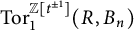 $\operatorname {\mathrm {Tor}}_1^{\mathbb {Z}[t^{\pm 1}]}(R, B_n)$
is trivial. Tensoring the short exact sequence

with R yields the exact sequence

In that sequence, the first module is trivial since localizations are flat, and the last map is injective, since R is
 $\Xi $
-torsion free. It follows that the second module is trivial. Since
 $B_i \cong (\Xi ^{-1}\mathbb {Z}[t^{\pm 1}] / \mathbb {Z}[t^{\pm 1}])^{\oplus i}$
, we have that
 $\operatorname {\mathrm {Tor}}_1^{\mathbb {Z}[t^{\pm 1}]}(R, B_n) \cong \operatorname {\mathrm {Tor}}_1^{\mathbb {Z}[t^{\pm 1}]}(R, \Xi ^{-1}\mathbb {Z}[t^{\pm 1}] / \mathbb {Z}[t^{\pm 1}])^{\oplus i}$
is trivial, as desired.
Hence, tensoring the short exact sequence (A.2) with R preserves exactness. Part of that sequence forms the first row in the following diagram of R-modules:

Note the second row, obtained from the resolution by applying
 $\operatorname {Hom}_{\mathbb {Z}[t^{\pm 1}]}(-,\Xi ^{-1}R / R)$
, is also exact, the diagram commutes, and the second vertical map is an isomorphism. This implies that the first vertical map is injective, concluding the proof.▪
Acknowledgment
The authors thank Maciej Borodzik for inspiring ideas regarding applications of the Blanchfield obstruction, and the anonymous referee for fruitful suggestions. Some of the work on this article was undertaken at the MPIM Bonn during the workshop on four-manifolds in September 2019, and some motivation came from the workshop on low-dimensional topology in Regensburg one month later. S.F. was supported by the SFB 1085 “higher invariants”, funded by the DFG. T.K. was supported by JSPS KAKENHI Grant Numbers JP18K13404, JP18KK0380. L.L. was supported by the Emmy Noether Program of the DFG. M.N. gratefully acknowledges support by the SNSF Grant 181199.