Business partnerships were the main organizational form during the nineteenth century in both common-law and civil-law countries, often outnumbering corporations by a very wide margin.Footnote 1 We contribute to the literature on partnerships by constructing a unique partner-level data set on late-nineteenth-century Brazilian businesses to study the determinants of partners’ contractual terms and highlight the roles of risk, incentives, and bargaining power in shaping these terms.
A key distinction in the study of partnerships is between partnerships where all partners are liable for firm debts and partnerships where at least one partner's liability is limited to his investment (and who does not typically play an active role in running the firm). The latter option was mostly available in civil-law countries and recent studies have used the existence of the flexibility offered by the limited liability option to cast doubt on the argument that the common-law system is inherently superior to the civil-law system.Footnote 2 Moreover, limited and unlimited partnerships have both coexisted in civil-law countries, suggesting that each of these organizational forms has its own advantages.Footnote 3
Empirically studying the logic and the potential advantages and disadvantages of limited vs. unlimited partnerships is challenging because partner-level data on contractual terms are scarce. We address this challenge by constructing and analyzing a novel individual-level data set based on manuscript partnership contracts from Brazil in the late nineteenth century. We characterize contractual terms such as draws for private expenses, profit shares, and capital contributions for both types of partners, and test how these terms changed when the broad-ranging reforms of 1890 opened up other investment opportunities.
Conceptually, it is useful to consider the framework of Naomi Lamoreaux and Jean-Laurent Rosenthal who, based on the French case, outline the key advantages and disadvantages of limited partnerships vis-à-vis unlimited partnerships in civil-law countries. They argue that limited partnerships were more effective in preventing untimely dissolution because the partner with limited liability (henceforth limited partner) could not intervene in managing the firm and could not withdraw his participation before the specified expiration of the term without significant costs. However, because the limited partner could not intervene in the management of the firm and had lower ability to monitor, he was more at risk from exploitation and shirking on the part of his partners with unlimited liability (henceforth unlimited partners). We empirically examine these arguments and some of their implications, and use this trade-off between partnership types to frame our analysis.
Our data collection was made possible because the complete registers of partnerships in Rio de Janeiro are available in Brazil's National Archive. Hundreds of partnerships were registered every year in the ledgers of the Junta Comercial of Rio de Janeiro.Footnote 4 The data suggest that these contracts brought together thousands of partners and millions of dollars in capital. For 1870, 1888 (just before the reform), and 1891 (just after the reform), we collected full information on all partnership contracts registered in the books, including partner-level information on draws (most commonly denoted as a monthly draw on individual annual profit shares), profit shares, capital contributions, and the partners’ liability statuses. We also matched partners with a comprehensive set of property records for Rio de Janeiro for 1888, which provides us with an additional measure of partners’ wealth.
Our empirical results highlight and quantify the idea that insurance, shirking, untimely dissolution, and bargaining power played important roles in determining contractual terms. First, we compare limited and unlimited partners in limited firms to shed light on the importance of risk bearing in determining contracts. We find that limited partners received less favorable terms than their unlimited partners, which we interpret as the “price” they paid for limiting their downside risk and their involvement in management. At the same time, just like unlimited partners, limited partners received periodic draws for private expenses despite not taking an active role in managing the firm. We interpret these draws paid out to limited partners as a means of insurance from the firm, which is a benefit typically unavailable to financiers in joint stock companies.
Second, we compare unlimited partners in limited vs. unlimited partnerships to examine the roles of shirking and monitoring in determining contracts. Specifically, we find that unlimited partners received more high-powered incentives when they contracted with limited as opposed to other unlimited partners. This finding supports the premise in Lamoreaux and Rosenthal that shirking was a bigger concern in limited partnerships, where the limited partner was disadvantaged in monitoring the unlimited partner, who managed the firm.Footnote 5 Furthermore, we find evidence consistent with the idea that improved monitoring reduces the need for incentive contracts. In particular, we find that unlimited partners in limited firms with more than one unlimited partner received lower-powered incentive contracts than those in limited firms with only one unlimited partner. We interpret this as evidence that the improved mutual monitoring generated by multiple unlimited partners reduced the need to write higher-powered incentive contracts.
Next, we find that, as in the case of France, untimely dissolution was a primary concern of entrepreneurs. As a whole, over 80 percent of contracts explicitly specified a length of time during which the partnership could not be dissolved without considerable transaction costs. However, unlike the French case, we do not find a significant difference in this concern between limited and unlimited partnerships. Moreover, limited partnerships do not appear more likely than unlimited partnerships to dissolve prematurely.
Finally, we examine the role of bargaining power in determining contracts. Specifically, we exploit a set of broad-ranging reforms in 1890 that affected the relative bargaining power of unlimited partners. A difference-in-differences approach shows that the terms of unlimited partners in limited partnerships improved after the reforms of 1890, especially relative to partners in unlimited partnerships. This analysis is consistent with an increase in the bargaining power of entrepreneurs (unlimited partners) relative to financiers (limited partners). We illustrate that the improved terms for unlimited partners in limited partnerships were indeed due to the reform and not just a continuation of a prior trend by performing a placebo test that falsely assumes the reform occurred between 1870 and 1888. The placebo test finds no relative improvement in the terms for unlimited partners. Overall, our article demonstrates that businessmen designed flexible contracts to deal with the various incentive problems they faced, and adjusted these contracts in response to changes in their environment.
ECONOMIC AND INSTITUTIONAL BACKGROUND
Brazil between 1822 and 1889 was the only long-lasting monarchy in the Western Hemisphere. A coup d'etat led by the army and backed by elements of the elite and urban middle class brought about a declaration of a republic on November 15, 1889.Footnote 6 This new republican regime ushered in substantial reforms of the laws governing joint stock companies, as well as the whole financial system, in 1890/91. The Commercial Code of 1850, meant to help spur the modernization of the economy, provided the template for the formation and regulation of partnerships and other business organizations.Footnote 7 Joint stock companies were also considered, but these firms required a charter. Chartering, however, depended on imperial government authority, and very few joint stock companies were formed before the 1880s. It was only in 1882 that the chartering law was revised and joint stock companies were allowed in most sectors of the economy without governmental permission. This law (Brazil Lei n. 3150), however, still maintained a number of restrictions; specifically managers did not enjoy complete limited liability.Footnote 8 The declaration of a republic in 1889 allowed further institutional innovation which, together with a credit expansion (that nearly doubled the money supply in 1890 alone), financed a great number of new joint stock companies.Footnote 9 Indeed, Stephen H. Haber argues that it was this last set of institutional innovations that mattered the most in the context of the cotton industry.Footnote 10
Precise measurement of the weight of partnerships in the local economy is probably impossible, but it is likely that they accounted for the greater part of Rio de Janeiro's manufacturing and warehousing and a substantial part of retail trade circa 1870.Footnote 11 Our calculations suggest that the capitalization of all partnerships in Rio do Janeiro was just over half the value of the joint stock companies on the Rio exchange. Specifically, by 1886 the market value of the companies listed on the Rio de Janeiro stock exchange amounted to 213,000 contos, or $80,940,000 current U.S. dollars.Footnote 12 We compare this figure with the combined capitalization of business partnerships located and registered in Rio de Janeiro in 1888. We consider the total number of partnerships extant in 1888 according to the city directory, approximately 2,100, and estimate a total value for all these partnerships by applying to all partnerships the mean value of partnerships newly registered that same year. This calculation implies capitalization of all partnerships in Rio de Janeiro in the realm of 112,000 contos—just over half the value of the joint stock companies.Footnote 13 These rough calculations suggest that partnerships were a substantial component of the Rio economy.
By 1896 the capitalization of joint stock companies jumped to 575,000 contos.Footnote 14 The number of companies listed and traded on the Rio de Janeiro stock exchange rose from an average of 12 in the decade of the 1860s to an average of 54 by the last years of the 1880s, rising again to over 100 companies in the late 1890s.Footnote 15 Most of these companies were banks, insurance companies, and railroads, rather than the smaller business firms associated with partnerships in our database.Footnote 16 It is not necessarily the case that companies that would have been partnerships necessarily switched to the joint stock form; rather, in the 1888 sample and thereafter, investors increasingly had the choice of putting some of their resources into joint stock companies.
We collected lists of shareholders in joint stock companies in Rio de Janeiro and found some evidence of partners who also invested in public companies. As a test of the cross investment in partnerships and joint stock companies, over 1,700 shareholders in our sample of 50 joint stock companies circa 1891 were compared with the names of the partners in our database.Footnote 17 There were 51 matches out of the over 2,100 individual partner listings in our data set, showing that some individuals invested in both partnerships and joint stock companies. These cross investors tended to be wealthier than the average partner, and were no more or less likely than the average partner to be limited partners. The mean capital contribution of the partner who also owned stock in the sample was 5,537 1870 pounds, indicating that cross investors tended to be significantly wealthier than the mean partner whose average capital contribution was 2,477 pounds. Approximately a third of the partners who were found to own stock in the sample were limited partners, which is in rough proportion to the number of limited partners in our overall sample. Furthermore, there were no significant minimum share price or share holding requirements that limited partners from withdrawing from partnerships and investing in portfolios of joint stock companies. Most shares were denominated $200 mil-réis, and some investors held as little as five shares.Footnote 18
An analysis of estate inventories recorded in the city of Rio de Janeiro indicates that, in the period in question, the average proportion of decedents’ wealth in stocks and bonds rose from 11.2 percent circa 1870 to 32 percent circa 1888, at the same time that business assets declined slightly from 14.4 percent to 11 percent of wealth. Capital that might have flowed into partnerships increasingly ended up in stocks and bonds as Brazil's institutions improved and capital markets expanded.Footnote 19
DATA
Formal business partnerships were required to register with the Junta Commercial in Rio de Janeiro.Footnote 20 Registration served two purposes. First, it allowed the state to regulate and tax businesses in accordance with the Commercial Code of 1850. Second, and more importantly for our purposes, it allowed individuals to pool their resources in larger enterprises under the discipline of the rules of the Junta. Registration as a formal partnership carried consequences for relations among partners as well as for relations between the partnerships and outside creditors. Recent work by Aldo Musacchio documents several instances where the Commercial Code was enforced vigorously when partners committed fraud or otherwise attempted to avoid their obligations.Footnote 21
Over the period in question, there were three main types of business partnership in Rio de Janeiro (and Brazil more broadly): 1) sociedades em nome coletivo (common, unlimited liability); 2) sociedades em comandita (limited liability); and 3) sociedades de capital e indústria (capital and industry, with or without limited liability). This article focuses on the first two types because they comprised the vast majority of all partnerships and are also more analytically tractable. For the sake of readability and consistency, we will refer to these forms as “unlimited” and “limited” partnerships. Unlimited partnerships predominated, although this form declined relative to limited partnerships over the period covered by our data. In unlimited partnerships, each member took on unlimited liability. The limited liability form of partnership was formed when one or more partners, protected by limited liability, provided capital to the enterprise, which was then managed by one or more active partners with unlimited liability.Footnote 22
The data used in this article is housed in the National Archive of Brazil in Rio de Janeiro. The archive itself consists of the registry books maintained by the Junta Commercial, containing the detailed contracts regarding new, renewed or modified, or dissolved firms for all registered partnerships in the city of Rio de Janeiro. Our data collection proceeded as follows: for 1870 we collected full information on all partnership contracts registered in the books pertaining to that year (books 638–640). Some firms registered in the books for 1870 were actually initiated in 1869; we collected these as well. We also noted the incidence of partnership contracts outside the city, but did not collect full information on these cases. Finally, we noted basic information about each case of dissolution throughout the year. For 1888 our procedure was the same. We collected all of the information on contracts regarding firms within the city of Rio de Janeiro (in books 204–217) and the supplemental partial information regarding firms outside of the city and dissolutions. As with the 1870 data, the initiation date of firms in the 1888 books included some firms founded in 1887. Finally, we collected data on firms in 1891 from books 244, 245, 248, 252, and 254. These data cover all firms with initiation dates ranging from December 1890 through September 1891. As with the other years, we also collected abbreviated information from these books regarding firms outside the city and dissolutions. We chose to collect data on partnership contracts in 1888 and 1891 because they are right before and right after the 1890 reforms. The short span was chosen so that we could test the effect of the 1890 reforms rather than the effect of other events that happened later. The data from 1870, when compared with 1888, allow us to test for preexisting trends before the reforms.
Analysis of the specific clauses underpinning partnership contracts reveals sophisticated and sometimes complex arrangements. The first clauses are generic, stipulating the names of the partners, the form the contract would take, the type of enterprise, the address, and the duration of the enterprise.Footnote 23 There are scores of different kinds of enterprises listed in the contracts, ranging from bakeries and tailoring shops up to major import-export houses. Our regressions include three industry dummy variables for partnerships engaging in commissions and/or consignments (comissões e consignações Footnote 24), dry goods, and cloth. These were among the largest, most complex, and most highly capitalized firms in the database. Because many firms were listed as engaging in multiple activities, or were listed with vague designations, we were not able to conduct detailed analysis of firm types below the most general level.Footnote 25
Next are clauses indicating the capitalization of the partnership, the amount each partner brought to the table, and the nature of each partner's contribution to the firm. Among artisan and retail establishments, the capital often included equipment and stock provided by one or more partners. For this reason, it is important to acknowledge that noncash contributions could be over or undervalued in the contracts. Systematic undervaluation will only affect our difference-in-differences estimates if the 1890 reform changed this undervaluation systematically differently for unlimited and limited partners. After specifying the distribution of capital, contracts usually stipulated the rules for the use of the firm name in business and private dealings. Many contracts forbade the use of the firm name in private matters or in business affairs outside of the narrowly defined purposes of the firm. In some contracts, only one partner was given the right to use the firm name in the course of business, such as for signing contracts for goods or services.Footnote 26
All contracts included a clause indicating which partner or partners would be in charge of maintaining the firm's account ledger. The ledger was to be updated regularly, to include all relevant data and correspondence, and to be used at the end of each year to audit the balance of the firm, including information on all assets and liabilities.Footnote 27 And, as if this were not enough to dissuade cheating, merchants were required by the Commercial Code to maintain a detailed daily log of their transactions.Footnote 28 Failure to produce these books in the case of a legal proceeding against the merchant could result in a stint in prison.Footnote 29 In general, the larger the number of partners in the firm, the more detailed were the restrictions on the activities of various partners.Footnote 30
Most contracts stated that a given partner had the right to withdraw a certain amount from the partnership per month (or year) for private expenses. In some cases, the contracts indicated that these draws were against his current account and/or his share of annual profits. In over 90 percent of the contracts, the exact language used to characterize the draw was “poderá retirar para suas despesas particulares,” which translates literally as “may withdraw for his private expenses.” As a whole, the vast majority (94 percent) of partners in our sample were entitled to such draws (the figure was 97 percent for unlimited partners and 89 percent for limited partners). The average annual draw figure was about 209 pounds sterling (1870 pounds).Footnote 31
Over 70 percent of contracts used identical vocabulary to describe the draws of unlimited and limited partners and stipulated the same periods of payment. A typical example states: “Each partner may withdraw for his private expenses up to 60 mil-réis per month, with the clear understanding that the limited partner may not interfere in the management of the partnership; the withdrawals of each will be debited from the profit account of each partner.”Footnote 32 We take this as evidence that, just like the unlimited partner, the limited partner had the expectation of receiving a regular periodic draw from the firm. Second, we show that the typical period was a month. That is, the contracts typically stipulated a monthly draw for both limited and unlimited partners, suggesting that these were amounts that the partners expected to be able to withdraw regularly. Finally, our results hold even when we restrict estimation to the sample for which only monthly draws were stipulated (results not presented). We note these draws are often stipulated as “up to” amounts, most likely to allow flexibility in an uncertain environment.
Among smaller contracts, the draw tended to be high relative to capitalization, suggesting that these firms probably provided their partners with their primary source of income. Larger partnerships, to be sure, had higher draws in nominal terms, but quite a bit lower relative to capitalization. It seems likely that these partners expected to derive some of their income from the division of profits, which was accounted for separately in the contracts, rather than from a regular draw. Earnings in a form of profit shares were nearly universal in our sample with 99 percent of the partners receiving a positive profit share.
The contracts also specified the precise capital contribution made by each partner. As with profit sharing, capital contributions were nearly universal in our sample across all years, with more than 95 percent of the partners contributing some capital to the enterprise. In fact, 95 percent of unlimited partners made some capital contribution to the firm, although, as we shall see, their average contribution was lower than that of limited partners.
Finally, all contracts contained clauses dealing with the event of the death of a partner or the dissolution of the partnership for other reasons prior to the end of the contracted period. In most cases, these clauses stipulated that the procedures of the Junta Commercial and the Commercial Code would be followed. The clauses reduced the degree of uncertainty associated with problems of untimely dissolution. The default position was one in which a complete inventory of the firm's assets was undertaken within 15 days of the dissolution and, after paying creditors in the order determined by the code, the remaining assets were divided among the partners according to the proportion of their capital contribution (see Codigo Commercial 1850, arts 344–353). Most contracts included a provision that disputes be settled by arbitration, sometimes citing the relevant paragraphs in the Commercial Code in this connection. Some contracts included more creative clauses regarding the potential dissolution of the partnership. These clauses included monetary penalties for early withdrawal and, in one instance, a precocious non-compete provision in which the defecting partner was barred from opening a competing shop in the same neighborhood.Footnote 33 It is important to note that, in the absence of judicial intervention, untimely dissolution was only permitted in cases where all partners agreed to it or when the firm was constituted without a set time limit (Codigo Commercial 1850, art. 335, sec. 3).
The contracts also indicated how profits and other responsibilities were to be divided. There was wide variation in profit sharing across firms in all years. In a general sense, profit shares were strongly correlated with capital contributions; however, considerable variation remained even after accounting for capital shares. These draw setting and profit-sharing clauses, along with stipulations regarding the right to sign papers in the company name, served to reduce uncertainty and inhibit misconduct.
Most partnerships stipulated a specific period of association, although a substantial number of partnerships, increasing in proportion over the period studied, were registered without time limits. Every three to five years, most partnerships needed to be renewed or unwound. There were several reasons for firms to adopt fixed time horizons. The most important was that these time-delimited firms were not construed legally as “at will” partnerships and were thus less susceptible to untimely dissolution. Partnerships with open time horizons could be dissolved at the whim of any individual partner, whereas without judicial intervention time-delimited partnerships could only be dissolved in the event that all partners agreed to dissolution.Footnote 34
We collected information on 263 partnerships in 1870, 215 partnerships in 1888, and 188 partnerships in 1891.Footnote 35 Most partnerships were unlimited liability, but the proportion of limited liability firms increased from 17 percent in 1870 to a third in 1888 and 1891. Most partnerships had two or three partners and partnership size increased between 1888 and 1891. The average total capital of partnerships in our data is 6,421 measured in 1870 pounds sterling. The total capital increased substantially between 1888 and 1891, with the average amounting to £9,429 by 1891. The capital contributions of each partner to the partnership were quite even, with a Herfindahl index of about 0.5 in all years. About a third of all partnerships in 1870 were based on equal sharing of profits, but this fraction increased to 52 percent in 1888, and fell slightly to 46 percent in 1891. Almost all partnerships in 1870 stipulated a time-delimitation clause of the type described above, but by 1888, 24 percent of partnerships did not have this clause. About 16 percent of partnerships were family firms and this number did not vary much over the period under study. About two-thirds of all partners in 1870 and 1888 were Portuguese, but this number dropped to 44 percent in 1891. The relatively high fraction of Portuguese partners is reflective of the strong hold that the Portuguese merchant community continued to exercise over the economy of Rio de Janeiro, a reflection of Brazil's colonial past. The Portuguese merchant community was fairly large (it formed the majority of merchant businessmen through the 1870s) and was a cohesive group. Relevantly, there was a historical divide between this community and the Brazilian-born merchant community. We thus include in the partner-level regressions below a variable indicating whether the partner is Brazilian rather than Portuguese to examine whether these tensions caused the contract terms of Portuguese partners to be different.
We observe 178 limited firms (27 percent of the sample) and 488 unlimited firms. Limited firms had, on average, a larger number of partners, greater capital contributions, and less concentration of the capital contribution shares amongst the partners. Additionally, while limited firms were more likely than unlimited firms to be family firms and to have a smaller fraction of Portuguese partners, they were less likely than unlimited firms to be based on equal sharing. Lastly, limited firms were more likely to be commission firms than unlimited firms, while unlimited firms were more likely to operate in the dry goods industry.
We collected information on 548 partners in 1870, 488 partners in 1888 and 443 partners in 1891 for a total of 1,479 partner-level observations.Footnote 36 Based on a name-matching algorithm, we found that fewer than 5 percent of our partners participated in multiple partnerships that were formed or adjusted in a given year.Footnote 37 The fraction of limited partners increased over time in our sample, with only 6 percent of partners having limited liability in 1870, but 15 percent and 17 percent of partners having limited liability in 1888 and 1891 respectively. The fraction of partners making positive capital contributions remained uniformly high throughout the period (in each of the three years, between 96 percent and 98 percent of all partners made positive capital contributions), as did the fraction of partners receiving a profit share, with 99 percent of all partners receiving a share (averaged over 1888 and 1891). Unfortunately, we do not have data on profit shares and wealth for 1870. Finally, for the purposes of the analysis, we also define profit shares relative to a reference point of equal sharing. We define the “normalized profit share” variable to equal

where Si is the share of profits received by partner i and N is the number of partners in the firm. It measures the deviation from equal sharing and is equal to zero when profits are divided equally. It is positive when the partner gets more than an equal share and it is negative when the partner gets less than an equal share. We similarly define normalized capital share to create a measure of the share of a partner's capital contribution that is not mechanically related to firm size.
EMPIRICAL STRATEGY AND RESULTS
We next explore the roles of insurance, risk bearing, moral hazard (shirking), and bargaining power in business partnership contracts. Contract theory in general and partnership theories in particular yield several predictions that we can confront with our data. First, if insurance is valuable for business partners, we expect contracts to include periodic (e.g., monthly) pay that is not profit-based. Moreover, if facing limited downside risk and avoiding the effort involved in managing the firm are valuable, we expect the limited partner to get worse contractual terms than the unlimited partner. Second, because the limited partner could not intervene in the management of the firm and had lower ability to monitor, he was more at risk from exploitation and shirking on the part of his unlimited partners. We thus expect him to motivate his unlimited partners by giving them high-powered incentives.Footnote 38 Therefore, more high-powered incentives are expected in limited partnerships than in unlimited partnerships. Third, because the limited partner could not intervene in managing the firm and could potentially incur significant costs if he withdrew his participation before the specified expiration of the term, we might expect limited partnerships to be less likely to use clauses to prevent untimely dissolutions than unlimited partnerships.Footnote 39 Finally, we use the reforms in 1890, which facilitated both the creation of joint stock companies (which is expected to disproportionately benefit limited partners) and bank lending (which is expected to disproportionately benefit unlimited partners), to examine how the change in the relative bargaining powers of partners affected their relative contractual terms.
RISK AND INSURANCE: DID PARTNERS WITH UNLIMITED LIABILITY RECEIVE BETTER TERMS?
We ask whether limited partners received worse terms (lower profits, lower draws, or higher capital contributions) than unlimited partners, as we predict, given their lower level of risk bearing and their lower involvement in running the firm.
Specifically, we compare the (normalized) share of profits, the draws, and the (normalized) share of capital contributions of the limited and unlimited partners in limited partnerships. We run partner-level OLS regressions where the alternative dependent variables are the partner's normalized profit share, the log of his draw, and his normalized capital share, and the main explanatory variable is whether the partner had limited liability.
The regressions pool observations from the years 1888 and 1891. In all regressions, we include a set of control variables that comprise a set of firm-level variables such as total firm capital, the number of partners, whether the firm existed in any prior form, a set of industry dummies including in particular one for whether a firm was a commission firm (defined roughly as a firm listed to be primarily working on commission and consignment), and whether the contract included a time-delimitation clause. We also control for a set of partner-level variables including nationality and whether the partner was one of two or more family members in the firm. Because profit shares, draws, and capital contributions are jointly determined, we also include profit shares, capital, and draws received as explanatory variables when they are not being used as dependent variables. We do not attempt to account for the simultaneity and so these regressions are best interpreted as best linear predictions. For symmetry, when the dependent variable is measured in 1870 pounds (draw), we control for the (log) capital contribution in 1870 pounds, but when the dependent variable is a share (profit share), we control for the capital share. For robustness, we also examined one specification where we predict draw and control for the capital share (but we do not report these results since they are very similar to the ones using log contributions). Finally, to account for unobserved differences between partnerships, we ran specifications with partnership-level fixed effects (available from the authors upon request), but since the results were very similar to those obtained from standard OLS regressions, we only present the results from the OLS regressions. We also ran specifications that included wealth, as proxied by a partner's rental holdings culled from the Rio property records as a control; the results were very similar to those presented here, therefore we omit them.Footnote 40 In all the regressions, we compute heteroscedasticity-robust standard errors and allow for intra-firm correlation in the error terms.
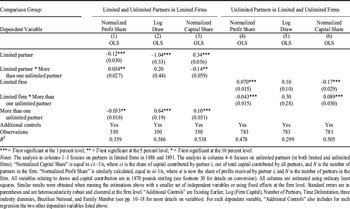
Columns 1–3 of Table 1 show that in limited partnerships, limited partners had significantly worse terms than their unlimited counterparts. Limited partners’ profit shares were 12 percentage points lower than those of unlimited partners. Since the average profit share was about 39 percent, this represents about a 30 percent lower profit share for limited partners. Draws for limited partners were 64 percent ((exp(–1.04)–1)*100) lower and capital contributions were 34 percentage points higher. Given an average capital contribution of about 34 percent, the coefficient implies that limited partners were contributing nearly twice the share of capital of their unlimited counterparts (even after controlling for firm size). Limited partners were thus the primary investors in the partnership. In return for limited liability and not taking part in any active management, the limited partner contributed a higher share of the capital and received a lower profit share and a lower draw. That is, the lower profit share, the lower draw and the higher capital contribution can be viewed as the “price” for limiting risk and not managing or working in the firm.
COMPARING CONTRACT TERMS ACROSS PARTNER TYPE AND PARTNERSHIP TYPE

*** = T-test significant at the 1 percent level;
** = T-test significant at the 5 percent level;
* = T-test significant at the 10 percent level.
Notes:
The analysis in columns 1–3 focuses on partners in limited firms in 1888 and 1891. The analysis in columns 4–6 focuses on unlimited partners (in both limited and unlimited firms). “Normalized Capital Share” is equal to ci–1/n, where ci is the share of capital contributed by partner i, out of total capital contributed by all partners, and N is the number of partners in the firm. “Normalized Profit Share” is similarly calculated, equal to si–1/n, where si is now the share of profits received by partner i, and N is the number of partners in the firm. All variables relating to draws and capital contribution are in 1870 pounds sterling (see footnote 30 for details on conversion). All columns are estimated using ordinary least squares. Similar results were obtained when running the estimations above with a smaller set of independent variables or using fixed effects at the firm level. Standard errors are in parentheses and are heteroscedasticity robust and clustered at the firm level. “Additional Controls” are Existing Earlier, Log (Firm Capital), Number of Partners, Time Delimitation, three industry dummies, Brazilian National, and Family Member (see pp. 10–18 for more details on variables). For each dependent variable, “Additional Controls” also includes for each regression the two other dependent variables listed above.
An interesting finding is that even the limited partner got some of his return in the form of a “draw” despite not taking an active role in managing the firm. The draw clauses can be viewed as clauses that determine dividend policy in order to protect the limited partners from the lock-in of their capital. This finding may imply that the limited liability partners received some insurance from the firm (an insurance they could not get in joint stock companies) to protect their investments against very low profits or lazy or incompetent unlimited partners.Footnote 41
SHIRKING AND INCENTIVES: DID UNLIMITED PARTNERS GET BETTER TERMS WHEN IN LIMITED PARTNERSHIPS?
We expect monitoring to have been easier in unlimited partnerships, where all partners were actively involved in running the firm. In contrast, the lack of active participation by limited partners made monitoring more difficult for them. We thus expect the potential shirking problem to be greater in limited partnerships. One way limited partnerships could mitigate the shirking problem was to offer higher-powered incentives (higher profit shares) to unlimited partners.
Empirically, we run partner-level OLS regressions where the dependent variables are the unlimited partner's (normalized) profit share, his log of draw, and his (normalized) share of the capital contribution. The main explanatory variable of interest is a dummy for whether the unlimited partner was in a limited partnership (as opposed to an unlimited partnership). Columns 4–6 in Table 1 suggest that, compared with unlimited partners in unlimited partnerships, unlimited partners in limited partnerships received higher-powered incentives. They contributed lower shares of the overall firm capital by 17 percentage points or about 42 percent lower capital contributions given the average contribution level of 40 percent. Further, they received a 7 percentage point higher profit share (or about a 17 percent higher profit share given the average profit share was about 40 percent among unlimited partners). These findings lend support to the idea that shirking and the imperfect ability to monitor were of concern to partners. These findings, however, are also consistent with two other hypotheses. First, they are consistent with positive selection of unlimited partners to limited firms. That is, unlimited partners in limited firms may have been “better” than those in unlimited firms as reflected by their higher shares of profits, higher draws (statistically insignificant), and lower shares of capital contributions.Footnote 42 Second, it could be that unlimited partners were required to work harder in limited firms, so that the better terms they received were merely compensation for their greater efforts.
It is reasonable that the extent of the shirking problem varied with the number of unlimited partners in the firm. In a limited firm with more than one unlimited partner, there exists both the possibility of collusion (the unlimited partners could collude and shirk together), which would exacerbate the shirking problem, and of monitoring (the unlimited partners could monitor each other and had incentives to do so), which would attenuate the shirking problem. We thus expect unlimited partners in such firms to receive higher-powered incentives if collusion was more important, and lower-powered incentives if monitoring was more important.
The results in columns 1–3 of Table 2 show that the limited partner received unambiguously and significantly better terms (about 15 percent higher profit shares and 41 percent lower capital contributions based on average calculations) when in a partnership with more than one unlimited partner, and that the unlimited partners in such firms received unambiguously worse terms and lower-powered incentives. These results suggest that the shirking problem was attenuated in firms with more than one unlimited partner, perhaps because monitoring was more effective in such firms.Footnote 43 The results in columns 4–6 further corroborate this finding. In particular, they show that an unlimited partner in a limited firm with more than one unlimited partner received a lower profit share (column 4) and contributed a greater capital share (column 6) than his counterpart in a two-partner limited firm. Note that since the former was always in a three (or more) person firm, his profit share is likely to be mechanically lower than that of the unlimited partner, who was usually in a two-person firm (although note that there are ten partnerships with one unlimited partner and multiple limited partners). However, the capital share results are unambiguous: despite being in larger firms, partners in limited firms with multiple unlimited partners contributed greater capital shares than partners in two-person limited firms. Since the draws remain the same (column 5), the most convincing conclusion is that the unlimited partners in limited firms with multiple unlimited partners received lower-powered incentive contracts than their counterparts in two-person limited firms. We note that the largest number of unlimited partners in any limited firm in our data is 3 (while the largest limited firm as a whole comprises 12 partners). Larger limited liability firms therefore consisted primarily of limited partners. This is consistent with the hypothesis that beyond a certain firm size, the monitoring advantages obtained by contracting with more partners with unlimited liability were outweighed by the attendant collusion problems.
TIME DELIMITATION CLAUSES AND FIRM TYPE OVER TIME, 1870–1891

*** = T-test significant at the 1 percent level.
Notes:
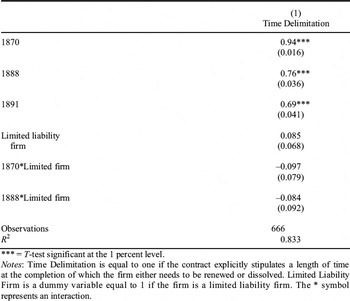
Time Delimitation is equal to one if the contract explicitly stipulates a length of time at the completion of which the firm either needs to be renewed or dissolved. Limited Liability Firm is a dummy variable equal to 1 if the firm is a limited liability firm. The * symbol represents an interaction.
UNTIMELY DISSOLUTION: WERE LIMITED PARTNERSHIPS MORE LIKELY TO INCLUDE A TIME-DELIMITATION CLAUSE?
The literature on partnerships has argued untimely dissolution is a key concern among partnerships and that it is one of the defining disadvantages of unlimited partnerships. We next examine whether partnerships in general attempted to prevent untimely dissolutions by including time-delimitation clauses, and (more directly than before) whether such clauses were more common in unlimited partnerships. We find that a large fraction of partnerships (about 82 percent) specified a time-delimitation clause (as described above), suggesting that partners were concerned by the possibility of untimely dissolution. Looking at Table 2, where the dependent variable is whether the partnership included a time-delimitation clause, we see that while such clauses were nearly universal in 1870, their use declined to about 70 percent of partnerships by 1891.
Interestingly, unlike the predictions in Lamoreaux and Rosenthal, there does not seem to be a differential rate of adoption of these clauses by limited vs. unlimited partnerships, suggesting that, at least from the language of the contracts, this was of equal concern to partners in limited and unlimited partnerships.Footnote 44 One possible reason for the contrast with Lamoreaux and Rosenthal could be the different dissolution terms for limited partnerships between the Brazilian and French cases.Footnote 45 In France, it appears that a limited partnership implied a specified expiration term for the partnership. Further, upon an analysis of 82 dissolutions registered in 1888 and 1891, we find that the rate of (likely) untimely dissolution did not vary by partnership type.Footnote 46 Therefore, while it seems clear that untimely dissolution was an important concern for partnerships, we do not have evidence that suggests that this concern was different for limited partnerships. In addition, the decline in the presence of this clause is also potentially interesting, but there seem to be no good predictors of this decline, precluding any analysis of why this should be the case.
BARGAINING POWER: THE EFFECT OF THE 1890 FINANCIAL REFORMS ON LIMITED AND UNLIMITED PARTNERS
Finally, we examine how contract terms change when the relative bargaining powers of the partners change. Specifically, a set of broad-ranging reforms in 1890 both increased investment opportunities (more joint stock companies were created) and facilitated borrowing opportunities.Footnote 47 We expect the increased investment opportunities to disproportionately benefit limited partners, who now had an additional investment option. We expect the better borrowing opportunities to disproportionately benefit unlimited partners, who now could finance their entrepreneurial activities more easily without relying on limited partners. Thus, when designing partnership contracts, the rise of joint stock companies is expected to increase the bargaining power of limited partners, and easier borrowing opportunities are expected to increase the bargaining power of unlimited partners. It thus remains an empirical question whether these reforms improved the bargaining power (i.e., relative contractual terms) of unlimited partners.
Before we describe our empirical strategy, a few things are worth noting. First, additional reforms were put in place over the course of 1891. These reforms further protected investors in joint stock companies, increasing the attractiveness of this option. However, for our purposes, the most important shift came with the promulgation of Laws 164 and 165 of January 17, 1890.Footnote 48 These laws, which passed in conjunction, liberalized banking and made joint stock companies easier to form and invest in. This is the “shock” to the system that our analysis aims to exploit. Subsequent reform laws in 1891 added to this process, but did not, we argue, fundamentally shift the parameters with respect to choices made in contracting partnerships. It is true that the collapse of the speculative bubble known as the Encilhamento provided a shock in the opposite direction, as many shareholders stood to lose everything in a wave of bankruptcies and fraudulent companies, but this collapse did not occur until late in 1891. Second, partnerships by and large remained in the same industries before and after the reforms. These industries were typically small and medium scale enterprises, as distinct from joint stock companies, which were typically much larger and in sectors such as railroads, banking, and utilities. Third, limited liability already existed in the 1850 Commercial Code and was further extended, with certain restrictions, in the 1882 reform of joint stock company law. Therefore, the importance of the 1890 reforms was not in the realm of liability, but rather in the expansion of borrowing opportunities and joint stock companies. Finally, similar broad-ranging reforms took place in other countries such as France and the United States, so a promising direction for further research could be to test whether these reforms had similar effects in other countries.
We next test whether the effect of the 1890 reforms differed for unlimited partners who worked in limited firms relative to the two other types of partners. We use a standard difference-in-differences approach to examine the role of bargaining power in contract choice. We run the following regression on partners in limited firms to test: (1) whether the contractual terms for limited partners vs. unlimited partners improved after the reforms; and (2) whether the terms of unlimited partners in limited vs. unlimited partnerships improved after the reforms.

where Y is the outcome of interest (normalized profit shares, normalized capital contributions, or log draws), Post is a dummy variable for the year 1891, LimitedPartner is a dummy variable for whether a partner has limited liability, and PostLimitedPartner is the interaction between these two variables. The coefficient of interest is β3, which tests whether limited partners post reform improved their contract terms relative to the unlimited partners in limited partnerships. We run a similar regression for our second test, but using the sample of unlimited partners, and replacing LimitedPartner with a dummy variable for the partner being in a limited firm.
It is important to point out that such a strategy cannot control for differential time trends in the types of partner or firm. As a potential check, we explore whether any differential time trends existed before the reforms by looking at data from 1870 and repeat the above regressions for pre-reform data only. Specifically we use data from 1870 and 1888, “pretending” that the reforms occurred sometime in between those years. We expect β3 to be zero in these regressions, unless the terms for the three types of partners were on different time trends.
Finally, we note that since we are obtaining identification off time trends and the financial reforms were part of a larger set of major changes in the economic regime, our results capture the net effects of these different policy changes and we cannot determine the relative contributions of different policies to the changes in contract terms. However, absent any data on the channels through which these reforms affected policy, the reduced form results presented here are a useful first approximation of the effects of the reforms on partnership contracts.
WITHIN LIMITED PARTNERSHIPS: COMPARING LIMITED PARTNERS VS. UNLIMITED PARTNERS
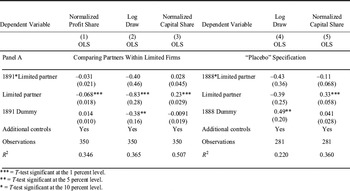
We test whether the difference in contractual terms (profit shares, draws, and capital contributions) of limited vs. unlimited partners in limited firms changed after the 1890 reforms. The top left quadrant of Table 3 presents results from these regressions using data from the years just before (1888) and just after (1891) the reforms. None of the coefficients are statistically significant at conventional levels although the point-estimates suggest that limited partners’ terms deteriorated post-reform. The point-estimate implies that profit shares declined by about 10 percent (–0.03 percentage points on an average profit share of 30 percent), stipulated draws decreased by about 32 percent ((exp(–0.40)–1)*100), and capital contributions increased by about 10 percent (0.028 percentage points on an average capital contribution of about 30 percent).
THE EFFECTS OF THE REFORMS: DIFFERENCE-IN-DIFFERENCE RESULTS

*** = T-test significant at the 1 percent level.
** = T-test significant at the 5 percent level.
* = T-test significant at the 10 percent level.
Notes:
The analysis in Panel A focuses on partners in limited firms and the analysis in Panel B focuses on unlimited partners. The analysis in columns 1–3 focuses on partners in 1888 and 1891 and the analysis in columns 4–5 focuses on partners in 1870 and 1888. See p. 27 for a discussion of the “placebo” specifications. “Normalized Capital Share” is equal to, ci–1/n, where ci is the share of capital contributed by partner i, out of total capital contributed by all partners, and N is the number of partners in the firm. “Normalized Profit Share” is similarly calculated, equal to si–1/n, where si is now the share of profits received by partner i, and N is the number of partners in the firm. All variables relating to draws and capital contribution are in 1870 pounds sterling (see footnote 30 for details on conversion). All columns are estimated using ordinary least squares. Similar results were obtained when estimating using median regression or fixed effects at the firm level. “Additional Controls” are Existing Earlier, Log (Firm Capital), Number of Partners, Time Delimitation, three industry dummies, Brazilian National, and Family Member (see pp. 10–18 for more details on these variables). For each dependent variable, “Additional Controls” also includes the two other dependent variables listed above. For the regression with “Log Draw” as the dependent variable, we also ran the same regression as columns 2 and 5, only with “Log(Capital Contribution)” instead of “Normalized Capital Share” as one of the control variables, in order to compare the effect of the level of capital contribution on the draw level. Results were similar to those reported in columns 2 and 5. Standard errors are in parentheses. Standard errors are heteroscedasticity robust and clustered at the firm level.
The top right quadrant of Table 3 presents results of these regressions for pre-reform data (1870 and 1888) to test for differences in preexisting trends. These tables suggest that there were no differences in pre-reform trends in capital contributions, and the negative point- estimate is encouraging since it suggests the higher capital contributions post-reform were likely an effect of the reform rather than of preexisting differences in trends. However, while there were also no statistically significant differences in pre-reform trends for draws, the negative point-estimate could suggest that the decline in post-reform draws was a continuation of a previous trend. Note that we cannot run the placebo for profit shares because we do not have data on this variable in 1870.
COMPARING UNLIMITED PARTNERS IN LIMITED VS. UNLIMITED PARTNERSHIPS
We test how the difference in contractual terms of unlimited partners in limited vs. unlimited partnerships changed after the 1890 reforms. The bottom left quadrant of Table 3 presents results from these regressions using data from the years just before (1888) and just after (1891) the reforms. The table suggests that the difference in terms between unlimited partners in limited vs. unlimited firms increased somewhat post-reform, with the former receiving even better terms post-reform than the latter. Specifically, the profit shares of unlimited partners in limited firms vs. unlimited firms increased post-reform (by about 2 percentage points or about 5 percent based on average profit shares of 34 percent in 1888) and their capital contributions decreased (by about 3.4 percentage points or about 10 percent based on average capital contributions of 34 percent in 1888). These results are consistent with an increase in the relative bargaining power of unlimited partners in limited firms, probably a result of the reduced need to rely on limited partners for resources. Alternatively, the selection of unlimited partners could have changed after the reform.Footnote 49 Finally, unlimited partners may have been expected to do more work or to take more risks in limited partnerships post-reform, so that their better terms simply reflect compensation for these additional activities.
The bottom right quadrant of Table 3 presents results of placebo regressions that use pre-reform data (1870 and 1888) to test for differences in preexisting trends. This table suggests that the results we found above do not just reflect different time trends, because there were no significant changes in the relative capital contributions of unlimited partners in limited firms compared with unlimited partners in unlimited firms between 1870 and 1888.
CONCLUSIONS
Our findings for Brazil highlight the importance of considerations of risk and incentives in determining contracts. Draws and capital contributions were near universal for all partners, irrespective of liability status. More than three quarters of all limited liability partners received fixed periodical payments from their partnerships, a form of draw. Because limited liability partners were legally prohibited from participating in running the firm, we interpret this draw as an income-smoothing device for the limited liability partner. Capital contributions by both limited and unlimited partners could serve as a lock-in device that made leaving the partnership costly, a complementary mechanism to time- delimitation clauses to prevent untimely dissolutions.Footnote 50
Furthermore, limited partners obtained lower profit shares and lower draws than did unlimited partners; at the same time, limited partners contributed more capital to their firms. These worse terms can be interpreted as the “price” an investor paid in return for limiting both his downside risk and his involvement in managing the firm. Unlimited partners received higher profit shares when they contracted with limited partners. This attests to the potential importance of higher-powered incentives in limited partnerships, where the ability to monitor is limited and thus shirking is more likely.
We hypothesize that in firms where shirking problems (by the unlimited partner) were attenuated, one would observe lower-powered contracts. In Brazil, sole unlimited partners in limited partnerships received higher-powered contracts than their counterparts in limited firms with more than one unlimited partner. The presence of two partners with unlimited liability in a firm appears to have increased monitoring in ways that reduced the limited partner's fears about shirking on the part of one of the unlimited partners.
A major institutional reform in 1890 increased the number of joint stock companies and increased borrowing opportunities and altered the contract terms received by limited and unlimited partners. After the reform, unlimited partners received better terms than limited partners, suggesting an increase in their relative bargaining power because they had to rely less on limited partners for resources. Unlimited partners in limited firms improved their terms relative to those in unlimited firms, which is again indicative of the relative increase in their bargaining power in limited firms.