

Introduction
Global attention has continued to be drawn to the daunting challenges confronting policing as part of the United Nations 2030 Agenda for Sustainable Development, adopted in September 2015. Goal 16 of the Sustainable Development Goals (SDGs) is focused on promoting peace, security, human rights, stability and effective governance based on the rule of law. In the SDG Agenda, it is pretty clear that police services are required to provide human rights-oriented policing, a style of policing that focuses on protecting the vulnerable (Aborisade Reference Aborisade2023; Aborisade and Adedayo Reference Aborisade and Adedayo2018; Zvekić, Sellar, and Lovrich Reference Zvekić, Sellar and Lovrich2019). That is, policing should be committed to and practised within the provisions of the rule of law and entrusted to a transparent, effective and accountable public institution.
Without an iota of doubt, the recent and unprecedented global health crisis of COVID-19, which called for massive intervention of police institutions across the world, tested the preparedness of the police in facilitating the achievement of Goal 16 of the SDG. Even before the emergence of the COVID-19 pandemic, one of the most significant challenges confronting modern policing was the lack of legitimacy (Aborisade and Adeleke Reference Aborisade and Adelere Adeleke2024; Sheldon Reference Sheldon2021; Stott West, and Harrison Reference Stott, West and Harrison2020). Therefore, policing the pandemic occasioned by COVID-19 presented two tales of eventualities for police legitimacy and Goal 16 of the SDG Agenda. First, response to the pandemic by the police may result in further militarization and draw deeper divides between police and communities. Second, police deploy a compassionate response that builds on procedural just operations, which will then result in rebuilding police legitimacy and better post-pandemic relationships with communities. In this article, the approach deployed by the Nigeria Police Force (NPF) is explored with a specific focus on the implications of pandemic policing on police–community relations.
The first case of COVID-19 to be reported in Nigeria was that of an Italian citizen who was working in Nigeria and had returned to Lagos from Milan, Italy, on February 25, 2020 (Nigeria Centre for Disease Control and Prevention 2020). A little after the first case, the Nigerian President declared COVID-19 a dangerous infectious disease and legalized lockdown activities in Lagos, Ogun states and the Federal Capital Territory (FCT), Abuja (Nigeria Centre for Disease Control and Prevention 2020). Then, the President signed the Coronavirus Health Protection Regulations (2020) into law. The Regulations restricted all movements in Lagos, Ogun and the FCT for 14 days, effective from 23.00 hours on Monday, 30 March 2020. After that, the police and other security agencies were deployed to ensure compliance with the Regulations. However, the Regulation did not contain punitive measures for those deemed to have contravened the directives until a revision of the Regulation (Coronavirus (COVID-19) Health Protection Regulations 2021) was released. In the revised edition, any person deemed to have violated the Regulation without reasonable excuse is punishable, on conviction, by a fine or a term of six months imprisonment or both.
This article deployed a systematic and iterative approach to review the literature on Nigerian police enforcement of COVID-19 protocols. Leaning on legitimacy and procedural justice theories (PJTs), the article highlights pre-COVID legitimacy issues of the Nigerian police and how this may have impacted public trust and cooperation during the lockdown period. Second, the evident and remote causes of the critical challenges confronting the Nigerian police in successfully supervising the COVID-19 lockdown and other protocols are discussed. Finally, drawing from the principles of procedural justice, the lessons learned from the experiences of policing the pandemic and its implications on Nigeria’s quest to achieve Goal 16 of the SDG Agenda 2030 are presented.
Theoretical Background
In intervening to enforce COVID-19 mandates, police have to respond to and assist in a public health crisis, an unusual operation for many police organizations worldwide (Agarwal et al. Reference Agarwal, Jeremy Farrar, Hatchett and Sands2022; Stogner, Miller, and McLean Reference Stogner, Lee Miller and McLean2020). By implication, governments will be relying on the police to perform their statutory functions of ensuring community safety and protecting the community from not just the usual threats to public or individual safety, like kidnapping, sexual violence and domestic abuse, but also from COVID-19. For police departments that have not assumed a similar role or function in the recent past, the initial daunting decision that will be made will be about the approach to adopt in conducting this assignment (Nix, Ivanov, and Pickett Reference Nix, Ivanov and Pickett2021; Sheldon Reference Sheldon2021). Consequently, legitimacy theorists have drawn attention to the importance of how the police use their new powers during the pandemic (Jones Reference Jones2020; Peacock Reference Peacock2021; St. Louis and Greene Reference St. Louis and Greene2020).
Legitimacy is commonly understood as a justified use of power or authority. Specifically, Jackson et al. (Reference Jackson, Mike Hough, Hohl and Kuha2012) described legitimacy as the act of bestowing an authority with the right to exist, to exercise power, and to fulfil its agreed functions. It is also described as the extent to which members of the public view the police as a higher-power authority figure and is often measured concerning the willingness of the public to obey and cooperate with the police (Bolger and Walters Reference Bolger and Walters2019; Bottoms and Tankebe Reference Bottoms and Tankebe2012; Bradford et al. Reference Bradford, Huq, Jackson and Roberts2014; Sunshine and Tyler Reference Sunshine and Tyler2003; Tankebe Reference Tankebe2013).
Legitimacy theorists have identified police performance and procedurally just policing as sources of police legitimacy (Bolger and Walters Reference Bolger and Walters2019; Homolova Reference Homolova2018). According to Eck and Rosenbaum (Reference Eck and Rosenbaum1994), the three essential criteria of police performance are effectiveness, efficiency and equity (or fairness). In a broad sense, police performance probably has its instrumental and normative dimensions that are empirically distinct; they are relatively assessed separately. In a study conducted in England and Wales, Huq, Jackson, and Trinkner (Reference Huq, Jackson and Trinkner2016) identified three independent components of policing as crucial for police legitimacy: procedural fairness, effectiveness and bounded authority (the limiting or non-abuse of police powers). However, they found distributive fairness, electronic surveillance (intrusive investigative techniques) and lawfulness not to have significant influence in predicting police legitimacy.
Procedurally fair policing is adjudged to include maintaining neutrality (objective decision-making and treating citizens equally) and giving voice (offering citizens the opportunity to tell their sides of the story and contribute to decision-making on policing) (Homolova Reference Homolova2018). Also, it includes being respectful (treating citizens with respect and dignity) and being accountable (justifying decisions made to citizens in a bid to carry them along) (Pósch, Jackson, and Bradford Reference Pósch, Jackson and Bradford2021). Findings from criminological studies have indicated that the empirical legitimacy of the police and that of other institutions can be enhanced through public perceptions of procedurally fair policing, which stands separately from the impact of the public perception of police effectiveness (Tyler and Fagan Reference Tyler and Fagan2008). People may trust the police more if they manifest values such as fairness, which may influence people’s law-related behaviour in the long run.
There are police studies that have been conducted through the lens of legitimacy and that have substantiated the position of the theory. For example, in their comparative analysis of data collected from Sierra Leone and South Africa, Boateng, Pryce, and Abess (Reference Boateng, Pryce and Abess2022) examined the relationship between police legitimacy and public cooperation. They reported a positive relationship between police legitimacy and procedural justice, which resultantly predicted the willingness of the public to cooperate with the police. Similarly, Koper et al. (Reference Koper, Taylor, Liu and Wu2022) utilized a sample of 1,000 community members across two mid-sized US cities to examine community members’ perceptions of police activities in hot spots. In both cities, community members showed higher confidence and more positive attitudes towards police regarding trust. In his contribution to legitimacy, Tom Tyler (Reference Tyler2006a:375) described it as:
… a psychological property of an authority, institution, or social arrangement that leads those connected to it to believe it is appropriate, proper, and just. Because of legitimacy, people feel that they ought to defer to decisions and rules, following them voluntarily out of obligation rather than out of fear of punishment or anticipation of reward.
In furtherance of his position on legitimacy, Tyler (Reference Tyler2006b) then propounds the PJT from his seminal work based on a social psychological analysis of “why people obey the law”. In his theory, he mainly proposed that people’s adherence to the directives of powerful authorities is based on two distinct modes: instrumental and normative compliance. Instrumental compliance revolves around fear of the capacity of the authority to punish those who go against directives. Normative compliance, conversely, has to do with conforming to directives based on people’s favourable judgment and perception of the directives of authorities as morally appropriate and enforced in fair manners.
There are also police studies that have deplored PJT to support their empirical analysis. For example, Bradford et al. (Reference Bradford, Hohl, Jackson and MacQueen2015) examined why people comply with traffic laws and regulations. They found evidence that both normative and instrumental factors are responsible for variance in motorists’ self-reported propensity to violate traffic laws. Similarly, Lee, Callahan, and Kwak (Reference Lee, Callahan and Hoon Kwak2024) used a South Korean college sample to examine the predictability of the perception of police legitimacy based on procedural justice and police effectiveness. This determines how a sense of obligation to obey the police is achieved. Their results showed support for both instrumental and normative models of legitimacy. However, it should be noted that there are studies whose findings have not wholly supported the influence of PJT in predicting compliance with the law.
Methods
We undertook a scoping review – a systematic and iterative approach to identifying and synthesizing an emerging and existing body of literature on a given topic. Indeed, adopting a scoping review method may be premised on several reasons. The key reasons are to map out the extent, range and nature of the literature and determine the gaps in the literature on a given topic (Adetola, Aborisade, and Fasanmi Reference Adetola, Aborisade and Fasanmi2017; Mak and Thomas Reference Mak and Thomas2022). In this study, we used Peters et al.’s (Reference Peters, Marnie, Tricco, Danielle Pollock, Lyndsay Alexander, Godfrey and Khalil2020) guidance to ensure the robustness and integrity of all aspects of the review on pandemic policing in Nigeria, which include the formulation of questions, articulation of inclusion and exclusion criteria, and development of a replicable search strategy with a decision flowchart and data extraction.
Eligibility Criteria
We included empirical studies that explored and examined activities, events and outcomes of police interventions in the COVID-19 crisis by enforcing protocols and other measures in Nigeria. In particular, those that focused on police–community relations during the lockdown and post-lockdown periods were included. For inclusion, studies had to be: (i) based on empirical data (qualitative, quantitative or mixed-methods); (ii) published in a peer-reviewed journal; (iii) written in English; (iv) focused on Nigerian experience of policing COVID-19 pandemic; and (v) published from March 2020 to June 2024. Theoretical or scholarly papers, commentaries, editorials and articles published in any language other than English or focused on countries outside Nigeria were excluded from the review.
Data Sources
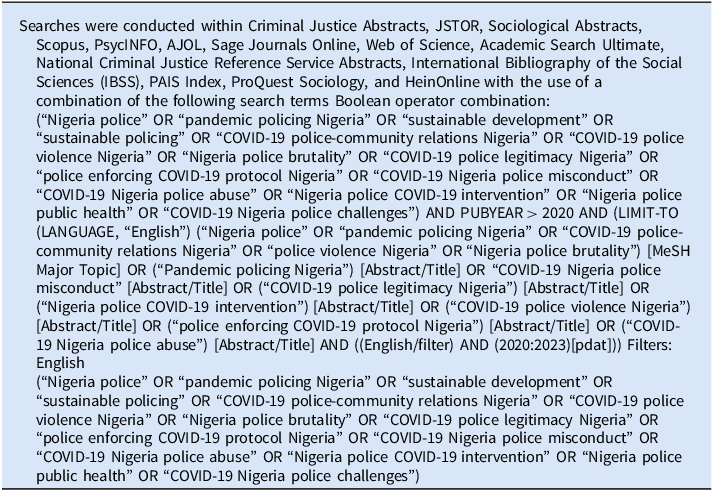
We conducted a comprehensive literature search that utilized Criminal Justice Abstracts, JSTOR, Sociological Abstracts, Scopus, PsycINFO, AJOL, Sage Journals Online, Web of Science, Academic Search Ultimate, PAIS Index, ProQuest Sociology and HeinOnline. We selected these databases to ensure that all evidence from the fields of policing, criminal justice, law and social sciences on Nigerian police intervention during the COVID-19 health crisis was included. The keywords used in the search included pandemic policing in Nigeria, Nigeria police and COVID-19, Nigeria police–community relations, human rights and pandemic policing, Nigeria police, COVID-19 lockdown, COVID-19 protocol, COVID-19 measures, COVID-19 enforcement, COVID-19 abuses, pandemic policing, and police misconduct. The use of Boolean operators together with broader terms helped to achieve a comprehensive exploration of the search engines. We also used Google and Google Scholar to search for studies that were not published in index journals. Also, we checked through the reference list of each article to identify studies that may not be included in the databases that were searched. Table 1 lists all search terms for key concepts and Boolean operator combinations. We were consistent in the use of search terms and keywords for all the databases.
Database search terms and keywords

Study Selection
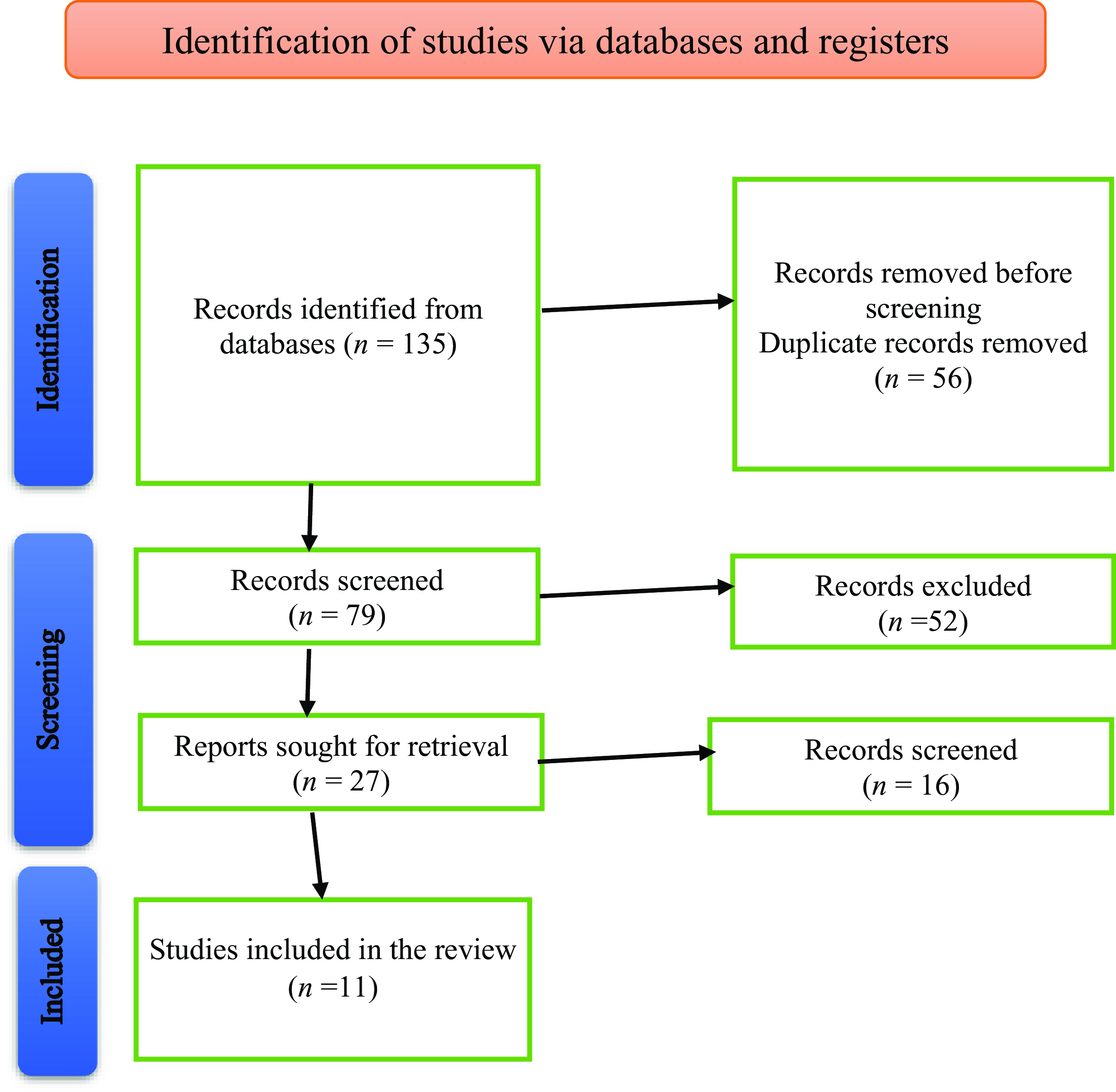
The searches returned 135 potentially relevant studies, screened by title and abstract to determine the level they aligned with the inclusion criteria (see Figure 1). The first screening of the articles led to the removal of 56 studies that failed to comply with the eligibility criteria. The two authors then independently reviewed the abstracts and titles of the 79 studies that remained, leading to the removal of another 52 studies that, based on further scrutiny, did not comply with the inclusion criteria. The 27 remaining and considered eligible studies were then retrieved and independently subjected to full-text review by the two authors. This was to determine the studies’ relevance to this review’s aim. After the full-text review, including an interrogation of the reference list of each article and a further process of hand searching with the use of Google and Google Scholar, the authors found 11 papers eligible to be included in the study.
PRISMA flowchart showing the inclusion of studies of Nigerian police intervention in the COVID-19 health crisis.

Data Extraction and Analysis
A Microsoft Excel spreadsheet was used to construct a data extraction template, which was then used to record relevant information such as research design, purpose, sampling method, sample characteristics, data collection methods, data analysis methods, study findings, limitations, and comments of selected studies. Statistical pooling of review results was impossible due to the heterogeneity and the limited number of selected studies. Consequently, we developed appropriate figures, tables and narrative themes to summarize the findings. The analysis followed the thematic analysis techniques that Braun and Clarke (Reference Braun and Clarke2006) described for coding publications. Coding the publications involved reading and rereading selected studies and categorizing the text into emergent categories. At first, the two authors read the publications and noted their initial thoughts on the themes identified in the publications. After this round of analysis, the two authors met to collectively discuss and code themes as nodes within NVivo14, a tool used for data management. The two authors separately reread each publication and coded them according to the already-established themes to guide the selection process.
Findings
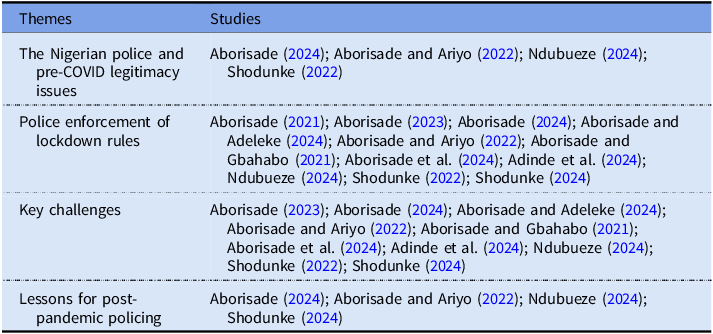
In total, 11 studies were included in the review (summarized in Table 2). The included studies were published between 2021 and 2024 and focused on policing COVID-19 in Nigeria. Both qualitative (Aborisade Reference Aborisade2021, Reference Aborisade2023, Reference Aborisade2024; Aborisade, Adegoke, and Adeleke Reference Aborisade and Adelere Adeleke2024; Aborisade and Adeleke Reference Aborisade and Adelere Adeleke2024; Aborisade and Ariyo Reference Aborisade and Ariyo2022; Aborisade and Gbahabo Reference Aborisade and Gbahabo2021; Ndubueze Reference Ndubueze2024; Shodunke Reference Shodunke2022, Reference Shodunke2024) and quantitative (Adinde et al. Reference Adinde, Emmanuel Nlemchukwu, Egwu and Igwe2024) approaches were used by the selected studies.
Themes identified in the study

The thematic analysis uncovered four main themes, illuminating key areas, including the Nigerian police and pre-COVID legitimacy issues, police enforcement of lockdown rules, key challenges and lessons for post-pandemic policing (see Table 2). The limited number of empirical studies found and reviewed in this study demonstrate a significant gap or limitation in the literature assessing police intervention in the health crisis in Nigeria.
The Nigerian Police and Pre-COVID Legitimacy Issues
Four studies discussed pre-COVID legitimacy issues of the Nigerian police as it bothered their relationship with the public (Aborisade Reference Aborisade2024; Aborisade and Ariyo Reference Aborisade and Ariyo2022; Ndubueze Reference Ndubueze2024; Shodunke Reference Shodunke2022). Aborisade (Reference Aborisade2024) traced the history of militarized policing adopted by Nigeria’s police, claiming it might be responsible for the force-led approach used to enforce laws in the country. The NPF is considered a control-dominated policing system that is characterized by a centralized police structure (Aborisade and Ariyo Reference Aborisade and Ariyo2022). Also, it has crime control as the main aim of policing activities and derives its legitimacy mainly from the state. Therefore, its motivation for compliance relies heavily on instrumental incentives in which sanctions or threats are prevalent. In its crime-control function, the Nigerian police have been reported to primarily rely on confession from suspects to solve crime cases, thereby making use of torture as a principal means of investigating (Aborisade and Ariyo Reference Aborisade and Ariyo2022; Ndubueze Reference Ndubueze2024; Shodunke Reference Shodunke2022).
The incessant reports of police brutality and extrajudicial killings appear to have reached a “tipping point” when a video recording of a man being brutalized and killed by officers of the now-disbanded Special Anti-Robbery Squad (SARS) went viral (Aborisade and Ariyo Reference Aborisade and Ariyo2022). This culminated in a nationwide protest against police brutality in October 2020 that defied movement restrictions occasioned by the COVID-19 pandemic and further demonstrated deep distrust between the community and the police. The aforementioned problematic relationship between the public and police appeared to impact legitimacy negatively and was poised to make police intervention in the COVID-19 health crisis a herculean task.
Police Enforcement of Lockdown Rules
The entire 11 studies reviewed, reported and assessed the strategies and operations deployed by the police to enforce COVID-19 protocols in Nigeria (Aborisade and Adeleke Reference Aborisade and Adelere Adeleke2024; Aborisade and Gbahabo Reference Aborisade and Gbahabo2021; Aborisade et al. Reference Aborisade, Adegoke and Adelere Adeleke2024; Ndubueze Reference Ndubueze2024; Shodunke Reference Shodunke2022), Officers were advised to make arrests the last resort, and if detention is considered necessary, detainees should be held safely while physical distancing should be enforced (Aborisade and Adeleke Reference Aborisade and Adelere Adeleke2024; Aborisade et al. Reference Aborisade, Adegoke and Adelere Adeleke2024). Detention facilities must be regularly and thoroughly cleaned, and operating personnel must wear personal protective equipment when interacting with the detainees.
Aside from the enforcement operations of the Nigerian police coming under the scrutiny of news media and civil rights organizations, empirical studies documented police misconduct during the lockdown (Adinde et al. Reference Adinde, Emmanuel Nlemchukwu, Egwu and Igwe2024; Ndubueze Reference Ndubueze2024; Shodunke Reference Shodunke2022, Reference Shodunke2024). For example, Shodunke (Reference Shodunke2022) reported the patterns of police extortion that characterized the lockdown period and how it compromised the government’s efforts to restrict movement to contain the spread of the virus. They reported how police officers took bribes in exchange for allowing inter-state travellers to subvert the lockdown rules. In respect of gender-based violence and abuse of human rights perpetrated by lockdown enforcement officers, Aborisade (Reference Aborisade2024) reported the accounts of women who considered the police sexually violated them during the lockdown. In another qualitative study, frontline health workers, in responding to the COVID-19 pandemic, reported different forms of police aggression and extortive behaviour at checkpoints (Aborisade and Gbahabo Reference Aborisade and Gbahabo2021). These alleged aggressions and extortions eventually made the Nigerian medical union embark on a nationwide industrial action to protest about police maltreatment.
Key Challenges
In all, 10 studies provided assessments of Nigerian police intervention in the COVID-19 crisis and reported a high level of public violations of lockdown rules and disobedience to other protocols (Aborisade Reference Aborisade2023, Reference Aborisade2024; Aborisade and Adeleke Reference Aborisade and Adelere Adeleke2024; Aborisade and Ariyo Reference Aborisade and Ariyo2022; Aborisade and Gbahabo Reference Aborisade and Gbahabo2021; Aborisade et al. Reference Aborisade, Adegoke and Adelere Adeleke2024; Adinde et al. Reference Adinde, Emmanuel Nlemchukwu, Egwu and Igwe2024; Ndubueze Reference Ndubueze2024; Shodunke Reference Shodunke2022, Reference Shodunke2024). From the 10 studies, the following challenges that negated police intervention efforts at restricting movement and ensuring public compliance with COVID-19 protocols were identified, and the key challenges were discussed.
Unfavourable Socio-economic Conditions
One of the main factors identified as responsible for the poor adherence to COVID-19 protocols in the country is the prevailing economic downturn and the shortness of notice given before the lockdown/curfew enforcement (Aborisade and Adeleke Reference Aborisade and Adelere Adeleke2024; Aborisade and Gbahabo Reference Aborisade and Gbahabo2021; Aborisade et al. Reference Aborisade, Adegoke and Adelere Adeleke2024; Ndubueze Reference Ndubueze2024; Shodunke Reference Shodunke2022, Reference Shodunke2024). The Nigerian government gave a 24-hour notice for a complete lockdown in selected states, the FCT, and a national curfew. At the time the lockdown was announced, the country was grappling with an economic recession, a high poverty rate, a high unemployment rate, a high debt profile, fragile health systems and a decline in the gross domestic product (GDP) (Aborisade et al. Reference Aborisade, Adegoke and Adelere Adeleke2024; Ndubueze Reference Ndubueze2024). The harsh socio-economic conditions that the lockdown inflicted on many households in the country were identified as a significant factor that increased the level of household conflicts and other forms of domestic violence in the country (Shodunke Reference Shodunke2022, Reference Shodunke2024).
Government’s Legitimacy Issues
Aside from the legitimacy problems of the Nigerian police in handling its law enforcement responsibilities, studies on the government’s legitimacy, especially concerning the handling of the COVID-19 pandemic, have indicated low trust on the part of the public (Aborisade and Adeleke Reference Aborisade and Adelere Adeleke2024; Aborisade and Gbahabo Reference Aborisade and Gbahabo2021; Aborisade et al. Reference Aborisade, Adegoke and Adelere Adeleke2024). Ndubueze’s (Reference Ndubueze2024) empirical studies have reported public expression of disbelief in the Nigerian government’s official reports regarding the epidemiology, prevalence and government’s ability to manage the COVID-19 virus in Nigeria. This may have stemmed from legitimacy issues bordering on low public trust in governance in the country before the pandemic.
Nigeria’s Low Capacity to Tackle the Public Health Crisis
Aborisade and Gbahabo (Reference Aborisade and Gbahabo2021) and Shodunke (Reference Shodunke2024) identified the low capacity of Nigeria’s public health system to contain and manage cases of COVID-19 as one of the significant challenges that confronted police intervention in the crisis. There were reports of people testing positive for the virus and yet not being referred to the isolation or treatment centres because of the capacity challenges in the approved centres. Ndubueze (Reference Ndubueze2024) reported that the capacity problem was identified as a source of stress by police officers mandated to enforce the COVID-19 protocols and assist the health workers in their duties.
Inadequate Police Training on Health Crisis Intervention
Prior to the pandemic, the Nigerian police had not been operationally involved in the enforcement of health-related emergencies, especially one that involved restrictions. Therefore, the level of preparedness for policing lockdown and other COVID-19 protocols was inadequate. In a qualitative study on police preparedness for COVID-19 intervention, senior officers of the Nigerian police admitted limited knowledge and inadequate training related to collaborating with health officials in responding to health emergencies (Aborisade and Ariyo Reference Aborisade and Ariyo2022). The limited training was also adjudged to have manifested in the repressive style adopted by police officers in dealing with the public during the lockdown, as the COVID-19 laws were reported to be enforced in a crime-fighting manner (Aborisade and Gbahabo Reference Aborisade and Gbahabo2021; Shodunke Reference Shodunke2022, Reference Shodunke2024).
Poor Police–Public Relationships
Upon the announcement of lockdown rules, there were immediate fears that the police might carry out new powers of restricting people’s movement and other COVID-19 rules in a way that would further widen the gap between the public and the police. In an apparent affirmation of this concern, gross human rights abuses were reported to have plagued the enforcement of lockdown rules by officers of the Nigerian police (Aborisade and Ariyo Reference Aborisade and Ariyo2022; Shodunke Reference Shodunke2022, Reference Shodunke2024). A section of the Nigerian public was also reported to have attacked police officers enforcing COVID-19 rules within their neighbourhood to restrict their movement (Aborisade and Adeleke Reference Aborisade and Adelere Adeleke2024; Aborisade and Gbahabo Reference Aborisade and Gbahabo2021). According to Aborisade and Adeleke (Reference Aborisade and Adelere Adeleke2024), youths in the Eleko community in Ibeju-Lekki local government of Lagos State protested against and attacked police officers enforcing COVID-19 rules, accusing the police of bias in performing their duties.
Failure to Engage the Community
In enforcing COVID-19 protocols, the Nigerian police failed to significantly deploy community participation (Aborisade and Adeleke Reference Aborisade and Adelere Adeleke2024). This may be a consequence of the control-dominated and centralized system of policing that is embedded in the structure of the Nigerian police. Also, before the pandemic, the community policing system or any form of community participation in policing was yet to be clearly defined or officially incorporated into the mainstream of policing (Aborisade and Ariyo Reference Aborisade and Ariyo2022). Therefore, police enforcement of lockdown rules was characterized mainly by force and orders to compel people to obey with little or no input from the community.
Militarization Approach Adopted
The Nigerian police were widely reported to have approached the policing of the pandemic and enforcement of lockdown measures with repressive force and a crime-controlling posture (Aborisade and Adeleke Reference Aborisade and Adelere Adeleke2024; Aborisade and Gbahabo Reference Aborisade and Gbahabo2021; Shodunke Reference Shodunke2022, Reference Shodunke2024). People who flouted the lockdown and curfew rules were reportedly treated like criminals by being shot at, brutalized and subjected to other forms of violence (Aborisade et al. Reference Aborisade, Adegoke and Adelere Adeleke2024). Police officers were caught on viral video physically assaulting citizens, engaging in arbitrary arrests and detention of those considered to have flouted the lockdown laws.
Inadequate Personnel and Logistics
Before the COVID-19 pandemic, insufficient staff strength had been identified as a significant factor responsible for ineffective policing in many aspects of national lives (Ndubueze Reference Ndubueze2024; Shodunke Reference Shodunke2022). With the emergence of the COVID-19 pandemic, the inadequate police personnel were stretched further to ensure community safety and perform other primary duties alongside enforcing COVID-19 (Ndubueze Reference Ndubueze2024). Although there is a dearth of Nigerian-based studies identifying stress as a possible cause for police brutality in enforcing COVID-19 mandates, Ndubueze (Reference Ndubueze2024) hypothesized that COVID-19 was a significant stressor for officers.
Inadequate Deployment of Modern Information and Communication Technology
Prior to the emergence of the COVID-19 pandemic, there had been reports of limited deployment of modern information and communication technology (ICT) by the Nigerian police in performing its crime prevention, detection and crime-fighting functions (Aborisade and Adeleke Reference Aborisade and Adelere Adeleke2024; Aborisade and Gbahabo Reference Aborisade and Gbahabo2021; Shodunke Reference Shodunke2022). For example, studies have reported the frequent use of confession-based approaches to solving crimes rather than forensic technologies to unravel crime mysteries (Aborisade and Adeleke Reference Aborisade and Adelere Adeleke2024; Aborisade and Gbahabo Reference Aborisade and Gbahabo2021). This has led to a series of human rights violations in the process of investigating crimes, which often involve subjecting suspects to torture, threats of torture and other inhuman treatment in a bid to elicit confessions from them.
Inconsistencies in the Communication Flow
COVID-19 was primarily reported to have exposed police communication weakness and Nigeria’s lack of a comprehensive government communication policy (Aborisade and Ariyo Reference Aborisade and Ariyo2022). Nigeria’s response to the COVID-19 pandemic was remarkably threatened by gross confusion in communication and directives given by various outlets and channels of authority. In particular, there were conflicting communication flows between the government and police authorities concerning the lockdown rules (Aborisade and Adeleke Reference Aborisade and Adelere Adeleke2024; Shodunke Reference Shodunke2022). While the federal government, through the Presidential Task Force on COVID-19, exempted essential workers, including doctors and other health workers, from movement restriction, the Commissioner of Police in Lagos state reportedly gave a counter-directive to the police that doctors and other health workers are to produce authorization certificates (Aborisade and Gbahabo Reference Aborisade and Gbahabo2021). This misunderstanding created confusion and medical officers being harassed by police officers, which eventually led the medical union in the country to embark on a nationwide industrial action in protest of police aggression (Aborisade and Gbahabo Reference Aborisade and Gbahabo2021).
Lessons for Post-Pandemic Policing
Five studies identified the lessons learned from COVID-19 and offered ways to address the challenges of policing in Nigeria beyond the COVID period (Aborisade Reference Aborisade2024; Aborisade and Ariyo Reference Aborisade and Ariyo2022; Ndubueze Reference Ndubueze2024; Shodunke Reference Shodunke2024). Aborisade (Reference Aborisade2024) noted that the apparent failure of the militarized and force-led style in policing the pandemic in Nigeria should indicate that a review of the police approach to engaging the public should be imminent.
To effectively deploy procedurally just policing in Nigeria, officers must undergo specific training to change their policing orientation, especially regarding engaging the public. In this regard, and based on the principles of procedural justice, officers should be trained to allow community members to be heard before police decisions or actions. Training should also focus on officers’ education to play down factors such as gender, social class, physical appearance, monetary incentives or other individual characteristics when discharging their responsibilities. Police education should also emphasize respecting human rights and dignity in interactions with the public and crime suspects. In addition, officers should be educated about the importance of public trust in their conduct. Corrupt practices that currently pervade the Force should be confronted, and police authorities should purge themselves of compromised officers. Police professionalism should be evident to the public so that community members will believe they do not have to pay a bribe before receiving positive police attention.
Aborisade (Reference Aborisade2024) affirmed that lessons from the pandemic policing ought to have effectively communicated to the NPF the need to revisit its authoritarian and heavily securitized policing model, which only served to anger the public and generate multiple sites of disorder. This policing model, as adopted by the NPF, appears to contrast with the community policing model, which focuses more on social welfare and cooperative relationships with the authorities.
The Nigerian government should increase police funding by a reasonable margin, leading to the massive recruitment of more officers nationwide (Ndubueze Reference Ndubueze2024). This will ensure the achievement of adequate manpower capable of combatting security challenges in the country. By so doing, deploying police officers to intervene in future health crises will be more effective, with less burden and stress that may make an impact on officers’ mental and physical health. The recruitment should also be done meritoriously without political interference to get quality and dedicated individuals who are genuinely qualified and interested in police work (Aborisade and Ariyo Reference Aborisade and Ariyo2022). In addition, policies that will facilitate the annual recruitment of officers to fill the current shortage of police personnel in the country should be established. This will facilitate a replacement system for officers retiring or exiting service for different reasons.
Discussion
This article deployed a systematic and iterative approach to review the literature on Nigerian police enforcement of COVID-19 protocols. Drawing from the findings of 11 systematically selected articles (Aborisade Reference Aborisade2021, Reference Aborisade2023, Reference Aborisade2024; Aborisade and Adeleke Reference Aborisade and Adelere Adeleke2024; Aborisade and Ariyo Reference Aborisade and Ariyo2022; Aborisade and Gbahabo Reference Aborisade and Gbahabo2021; Aborisade et al. Reference Aborisade, Adegoke and Adelere Adeleke2024; Adinde et al. Reference Adinde, Emmanuel Nlemchukwu, Egwu and Igwe2024; Ndubueze Reference Ndubueze2024; Shodunke Reference Shodunke2022, Reference Shodunke2024), this study highlights pre-COVID legitimacy issues of the Nigerian police and how this may have had an impact on public trust and cooperation during the lockdown period. Also, the evident and remote causes of the critical challenges confronting the Nigerian police in successfully supervising the COVID-19 lockdown and other protocols are discussed. Finally, drawing from the principles of procedural justice, the lessons learned from the experiences of policing the pandemic and its implications on Nigeria’s quest to achieve Goal 16 of the SDG Agenda 2030 are presented.
Selected studies described the NPF’s pre-COVID law enforcement approaches, which were characterized by a force-led and control-dominated policing system that had adversely had an impact on its legitimacy and relations with the public over time (Aborisade Reference Aborisade2024; Aborisade and Ariyo Reference Aborisade and Ariyo2022; Ndubueze Reference Ndubueze2024; Shodunke Reference Shodunke2022). They affirmed that these pre-COVID police–public relations acted as a background factor that negatively affected public support for police intervention in the health crisis.
In identifying the problems bedevilling the nation’s police, a non-governmental organization, the Network of Police Reform in Nigeria – NOPRIN (2010) described the Nigerian police as over-centralized, under-resourced, ill-equipped and suffering from political interference. According to NOPRIN (2010), the recruitment process of the NPF was described as often compromised, while the personnel are inadequately trained with poor pay, making them prone to corruption and violence. Meanwhile, the accountability deficit of the Nigerian police system has been a subject of concern from multiple sources over the years (Aborisade and Fayemi Reference Aborisade and Fayemi2015; Adisa, Alabi, and Adejoh Reference Adisa, Alabi and Adejoh2018; Agbiboa Reference Agbiboa2015; Human Rights Watch 2010), despite the existence of the Nigeria Police Service Commission which is constitutionally mandated to supervise the country’s police. Consequently, civil organizations have reported that incidents of public abuse by police officers go without being reported and, when reported, are hardly addressed by police authorities (Amnesty International 2014; Asimi Reference Asimi2020; Human Rights Watch 2010).
Aside from reports of civil organizations, empirical studies have reported the pervasive use of torture by officers of the Nigerian police on crime suspects despite the enactment of the Anti-Torture Act 2017 (Aborisade and Oni Reference Aborisade and Fortune Oni2020a). In their sample of 1,000 inmates of Lagos prisons, Aborisade and Obileye (Reference Aborisade and Obileye2017) reported police use of various tortuous measures to elicit confessions from crime suspects during interrogations. Similarly, using a mixed-methods approach involving 186 inmates of Lagos female prison, Aborisade and Oni (Reference Aborisade and Fortune Oni2020a) reported low compliance with anti-torture law, with female suspects subjected to various physical, sexual and emotional forms of torture during police interrogations.
In the second theme of the findings, selected studies reported low compliance with the lockdown rules and other COVID-19 protocols as supervised by the police (Aborisade and Adeleke Reference Aborisade and Adelere Adeleke2024; Aborisade and Gbahabo Reference Aborisade and Gbahabo2021; Aborisade et al. Reference Aborisade, Adegoke and Adelere Adeleke2024; Ndubueze Reference Ndubueze2024; Shodunke Reference Shodunke2022). This happened despite the proactive release of guidelines and a code of conduct for Nigerian police officers in lockdown and other COVID-19 rules enforcement. Meanwhile, gross violations of human rights were reported across the nation, with fatal casualties recorded in some instances (National Human Rights Commission 2020). Prior to scholarly work on police enforcement of lockdown rules, there had been news media reports of human rights abuse and protests against the police. For instance, a few days into the lockdown, the video of two police officers flogging a woman with long sticks went viral (Kabir Reference Kabir2020). She was reported to have left her home with the intention of buying drugs for a sick relative when accosted by the police and subjected to beating for apparently flouting the lockdown order. Also, there were media reports of pervasive police corruption at various checkpoints during the lockdown (Olokor Reference Olokor2021). Bribes were reportedly paid to police officers at the checkpoints by those who flouted the stay-at-home rules to get past the police barricades.
Regarding the challenges that police were confronted with in their efforts to intervene in the COVID-19 health crisis, selected studies offered a variety of causes and underlining factors to explain the impediments (Aborisade Reference Aborisade2023, Reference Aborisade2024; Aborisade and Adeleke Reference Aborisade and Adelere Adeleke2024; Aborisade and Ariyo Reference Aborisade and Ariyo2022; Aborisade and Gbahabo Reference Aborisade and Gbahabo2021; Aborisade et al. Reference Aborisade, Adegoke and Adelere Adeleke2024; Adinde et al. Reference Adinde, Emmanuel Nlemchukwu, Egwu and Igwe2024; Ndubueze Reference Ndubueze2024; Shodunke Reference Shodunke2022, Reference Shodunke2024). This includes unfavourable socio-economic conditions, which intergovernmental agencies have also identified as capable of compounding the gruesome effects of the pandemic on the socio-economically disadvantaged people that constitute a majority of the population in Nigeria (Human Rights Watch 2020; Oduwole and Aborisade Reference Oduwole and Aborisade2023; UN News 2020). Also, the legitimacy challenges faced by the government were identified as significant factors. Expressly, the pandemic was adjudged to have unveiled the lacunae in public policy and administration, formulating and implementing issues of imminent public interest (Ayoola Reference Ayoola2022). For example, the apparent insincerity of the Nigerian government, both at the state and federal levels, appeared to have manifested in the (mis)handling of the distribution of palliatives for the vulnerable population in coping with the COVID-19 movement restrictions (Agbedo et al. Reference Agbedo, Daniel Anazia, Ijeoma Thomas-Odia, Adeowo and Ezeilo2020; Eranga Reference Eranga2020).
The studies also identified Nigeria’s low capacity to tackle the public health crisis, an enduring problem before the COVID-19 pandemic. In a 2017 World Health Organization Joint External Evaluation (JEE) of International Health Regulation core capacities (an independent, collaborative multi-sectoral effort that aims to assess countries’ capacity to prevent, detect and respond to public health risks), Nigeria was reported to have scored poorly on prevention and response (Dixit, Ogundeji, and Onwujekwe Reference Dixit, Kofoworola Ogundeji and Onwujekwe2020). The country’s average score in the “prevent” category was 1.9 across the 15 JEE indicators, which suggests a limited capacity to prevent chemical, biological and radiation health risks. Also, the country’s poor performance in the “response” category, scoring an average of 1.5 across 20 indicators, implies that the country is limited in responding to a sudden health risk. The poor scoring suggested that the country was unprepared to respond to the COVID-19 pandemic. There had also been reports of gross inequality, inequity and disparities in accessing essential primary healthcare and skilled healthcare providers in Nigeria, even before the emergence of COVID-19 (Adeyanju, Tubeuf, and Ensor Reference Adeyanju, Tubeuf and Ensor2017).
Other identified challenges include inadequate police training on health crisis intervention and poor police–public relations, which have often been reported to be problematic (Aborisade and Fayemi Reference Aborisade and Fayemi2015; Aborisade and Obileye Reference Aborisade and Obileye2017; Adisa et al. Reference Adisa, Alabi and Adejoh2018; Akinlabi Reference Akinlabi2017; Amnesty International 2014; Human Rights Watch 2010). Also, police failure to engage the community in making decisions and in the process of enforcing the COVID-19 protocols was mentioned. Scholars and epidemiologists have emphasized the importance of community participation in tackling the health crisis occasioned by the COVID-19 virus (Jones Reference Jones2020; Stott et al. Reference Stott, West and Harrison2020). Community participation was essential in ensuring compliance with lockdown measures, guidelines for easing restrictions, and community support through volunteering (Cheng Reference Cheng2020; Reicher and Stott Reference Reicher and Stott2020). The militarization approach used by the NPF was also mentioned.
The inadequacy of police personnel and logistics needed for the assignment was also pointed out in the studies, which aligned with existing literature and reports. There is an avalanche of reports that have highlighted the inadequacies of police personnel in terms of quality and quantity in the country (Aborisade and Oni Reference Aborisade and Fortune Oni2020b; Falaye, Adama, and Agemerien Reference Falaye, Adama and Agemerien2013; Okakwu Reference Okakwu2016). This is despite occasional restructuring, reformation and reorganization of the NPF from 1930 to date. With a projected population of about 300 million in Nigeria, the staff strength of the NPF is yet to be up to 370,000 (Shu’aibu Reference Shu’aibu2022). This is grossly inadequate, considering the 2016 United Nations recommendation of one police officer per 450 citizens. To achieve the United Nations projection, Nigeria must build its police staff strength to 2.5 million. Aside from inadequate staff strength in terms of numbers, the recruitment and selection process of officers into the force have been criticized for not being thorough, objective and devoid of nepotism and other forms of corruption (Falaye et al. Reference Falaye, Adama and Agemerien2013).
The studies discussed the challenges of inconsistencies in communication flow and inadequate deployment of modern information and communication technology for health crisis intervention. Indeed, police chiefs in the country have continually acknowledged the need for the NPF to align with twenty-first-century policing by deploying digital forensic investigation and analysis. In particular, the former Inspector General of Police, Solomon Arase, posited that modern policing is driven by applying technology, forensic science, intelligence and citizens’ consent (Okakwu Reference Okakwu2016). Despite this admission, the Nigerian police are still deficient in the use of modern technologies in fighting crimes, which largely accounts for the thriving of crimes like kidnapping, banditry and armed robbery that could be effectively combatted with the use of modern technologies.
Finally, the selected studies discussed the lessons learned in the intervention of the police and the challenges that emanated from their efforts during the pandemic (Aborisade Reference Aborisade2024; Aborisade and Ariyo Reference Aborisade and Ariyo2022; Ndubueze Reference Ndubueze2024; Shodunke Reference Shodunke2024). The COVID-19 pandemic has been noted as a potential “tipping point” for policing worldwide (Jones Reference Jones2020; Stott et al. Reference Stott, West and Harrison2020). As visible in the case of Nigeria, countries that deployed highly “securitized” approaches, which is the expression and use of state power to check the spread of the virus, may experience erosion of trust in policing and government as a consequence. In the previous section, the key challenges that made pandemic policing in Nigeria highly problematic to the police and the public have been identified and discussed. In this section, lessons from pandemic policing that need to be addressed and subsequently guide post-pandemic policing will be discussed. As broadly indicated for twenty-first-century policing, the state and the police are meant to protect collective security, that is, against both the epidemic and the consequences of the disruption that result from it. Therefore, the COVID-19 pandemic should be seen in Nigeria and in other countries with policing challenges as an opportunity to nurture and reconstruct the fundamental principles of legitimate and procedurally just policing.
Crime is intrinsically connected to a changing technological world. Therefore, the NPF must evolve with time and position itself to confront crimes in the twenty-first century with modern technologies. This should involve incorporating forensic science into its investigation methods and purging itself of the use of torture and other inhuman practices to force out confessions. This will also ensure that the prevailing public safety challenges that have made Nigeria attain an unenviable position as one of the most unsafe countries in the world are addressed. To achieve this, the government needs to improve police funding and deploy effective policies on using technology by the Nigerian police. Also, specialized officers training in forensic science and other technological methodologies should be prioritized. Although the use of torture has been criminalized in Nigeria, the enforcement of the Anti-Torture Act needs to be monitored and erring officers punished. In contrast, the use of intelligence-based investigation should be positively reinforced.
Implications for Policing for SDGs
As affirmed earlier, Goal 16 of the SDGs refers to promoting peace, security, human rights, stability and effective governance based on the rule of law. Therefore, Nigeria’s police are saddled with the responsibility of facilitating the achievement of the goal to support Nigeria’s drive towards sustainable development. To align with the drive of the SDGs, the NPF needs to consider the lessons learned from its intervention in the COVID-19 health crisis and reform its approaches to law enforcement. If procedurally just approaches are deployed, policing future public health crises and other regular police duties will be characterized by less public anger, non-compliance and distrust in police directives. Police leadership in Nigeria must ensure that just practices are established between the police and the public as a matter of procedure. Indeed, policing Nigeria in the twenty-first century requires the police to be perceived by the public as legitimate power holders. This will involve embracing the principles of procedural justice that have long been established as the most reliable predictor of citizens’ trust in the police. It will also include a consideration to replace the present control-dominated policing system, which often relies on repressive, force-led styles, with consent-based policing models.
From the selected studies reviewed, it is evident that the responses of the police to the pandemic resulted in further militarization and drew deeper divides between police and communities. According to Mawby (Reference Mawby and Newburn2012), the community policing model is meant to be achieved through localized structure and legitimacy granted by local communities. The community policing model would have engendered a higher level of community participation in COVID-19 protocols through volunteering to disseminate relevant information and encouraging compliance with police directives among community members. The 2030 SDG Agenda clearly states the imperativeness of service and human rights-oriented policing, which can be firmly achieved through the models of consent-based and community policing.
Conclusion
The twenty-first century has presented several conditions and challenges that draw global attention to the need for police departments to reconsider policing in many aspects. The relevance of police and policing as integral parts of the SDG document has been brought to bear in this article using the empirical evidence from selected studies on policing COVID-19 in Nigeria. Without a doubt, the mandate of policing the pandemic awakened the realization in the Nigerian police about the importance of legitimate and consent-based policing. The key challenges that confronted effective pandemic policing in Nigeria have highlighted the need for attention to be paid to major areas of concern in policing Nigeria for the achievement of sustainable development. The need for these key challenges and the manifestation of the deficiencies of the Nigerian police to be addressed so they do not evolve into post-pandemic policing and hinder the achievement of Goal 16 of the SDGs has been stressed. Nigerian police leaders must articulate to their police officers that they see these uncertain times as an opportunity to repair the dented image of the Force and rebuild lost police legitimacy. In essence, COVID-19 presents an opportunity for the leadership of the Nigerian police to assist in building momentum for a systemic and stylistic change of policing from force-based to consent-based. If achieved, consent-based policing should be sustained for both pandemic and post-COVID policing, leading Nigeria to achieve the targeted Sustainable Development Goals.
Competing interests
The authors declare that they have no known competing financial interests or personal relationships that could have appeared to influence the work reported in this paper.
Richard Abayomi Aborisade is a Professor of Sociology in the Department of Sociology, Faculty of Social Sciences, Olabisi Onabanjo University, Ago-Iwoye, Ogun State, Nigeria. He received his doctorate from the University of Ibadan, Nigeria. He also holds an MBA in Information Technology from Coventry University, UK. He has published in both local and international journals in the areas of security management, criminal justice, criminology, victimology and penology. His recent work includes The Essentials of Sociology (co-edited) and Crime and Delinquency: A Sociological Introduction, both published by Ibadan University Press.
John Ajibola Ogunyemi recently completed his Master’s degree in the Department of Sociology, Faculty of Social Sciences, University of Ibadan. He has commenced his PhD in Criminology in the Department of Sociology at Olabisi Onabanjo University, Ago-Iwoye, Ogun State, Nigeria. His doctoral research focuses on state policing in Nigeria.