


1 Introduction
Chinese is regarded as a classifier language, that is, a language in which modification of count nouns with numerals always requires a classifier. Apart from appearing between a numeral and a countable noun, Chinese classifiers can also appear after determiners like mei ‘each’ and ji ‘several’. Classifiers are basically considered to be individuators and constitute a special grammatical category, possibly projecting a Classifier Phrase (ClP) (see Cheng & Sybesma Reference Cheng and Sybesma1999, Reference Cheng and Sybesma2005; Li Reference Li2011; Rothstein Reference Rothesin2017), which is the structure adopted in this paper.
As a special grammatical category, classifiers (CLs) can be reduplicated in three forms: (i) ‘CL + CL’, like ge + ge; (ii) ‘one + CL + CL’, like yi + ge + ge; and (iii) ‘one + CL + one + CL’, like yi + ge + yi + ge. When reduplicated, classifiers are considered to convey various meanings in the nominal domain, which have not been systematically studied until X. Yang (Reference Yang2002), K. Yang (Reference Yang2004, Reference Yang, Xu and Jingqi2015), Cheng (Reference Cheng2009), Steindl (Reference Steindl2010), N. Zhang (Reference Zhang2013), Zhang & Tang (Reference Zhang and Tang2013, Reference Zhang and Tang2018). These authors considered reduplicative classifiers as conveying two readings: (i) a distributive reading on a par with Mandarin mei ‘every’ and English every/each, with the presence of dou ‘all’; and (ii) a plural reading of ‘many’ without the presence of dou (see Cheng Reference Cheng2009; Steindl Reference Steindl2010; N. Zhang Reference Zhang2013; Zhang & Tang Reference Zhang and Tang2013, Reference Zhang and Tang2018). The two readings are taken to be complementary to each other. Moreover, comparing Cantonese with Mandarin, while various types of classifiers can be reduplicated in Cantonese, including generic classifiers, sortal classifiers, measure classifiers, collective classifiers (see Cheung Reference Cheung1972/2007, Matthews & Yip Reference Matthews and Yip1994/2011), classifier reduplication is less flexible in Mandarin. Despite the productivity of reduplication in Cantonese, previous studies are mainly on Mandarin, with limited attention paid to Cantonese (see Cheng Reference Cheng2009).
In light of the above, this paper aims to study Cantonese reduplicative classifiers, focusing on its basic form ‘CL + CL’. The paper serves to fill in the gap by providing a clearer semantics for classifier reduplication, through answering the following four questions:

The analysis I propose draws heavily on ideas introduced by Hoeksema (Reference Hoeksema and ter Meulen1983), Westerståhl (Reference Westerståhl1984), Partee (Reference Partee2004), and others on quantifying determiners like many and few, and ideas introduced in the cover theory proposed by Schwarzschild (Reference Schwarzschild1996), Brisson (Reference Brisson1998, Reference Brisson2003), and others for plurals. I will argue that reduplicative classifier ‘CL + CL’ is a quantifying determiner. When conveying the ‘many’ reading, ‘CL + CL’ is ambiguous between a modifier type and a quantifier type, with the former giving a weak cardinal reading and the latter a strong proportional reading. On the other hand, when ‘CL + CL’ occurs with a distributive operator (D-operator) like dou1 ‘all’, it forms a licensing relation with dou1. As distributive quantification is performed by dou1, prenominal ‘CL + CL’ serves as a modifier-type quantifying determiner, and its presence is to regulate the quantification domain of dou1. A maximizing effect would be imposed by the ‘CL + CL’ on the nominal it modified.
If the above semantics of reduplicative classifier holds, it would lead to the prediction that reduplicative classifier cannot be considered equivalent to Cantonese mui5 ‘every’ or English every/each, and it cannot be a plural classifier/marker either. As the readings conveyed by ‘CL + CL’ differ in whether or not dou1 is present, the following two notations will be used throughout the paper:

The proposed analysis of reduplicative classifiers lends support to the claim that classifier – single classifier or reduplicative – may be a strategy for determiner building in Chinese. Chinese may not be a covert strategy language in terms of domain restriction, which at the very least, is true in the case of classifier reduplication.
The paper is organized as follows: Section 2 will review previous studies of reduplicative classifiers. In Section 3, I will examine the semantics of reduplicative classifier without dou1, with relevant interpretations ambiguous between strong ‘many’ and weak ‘many’. In Section 4, I will propose the semantics of [CL + CLdou1] and demonstrate how it serves as a domain regulator. In Section 5, I will compare [CL + CLdou1] with a plural classifier/marker and Cantonese mui5 ‘every’, and argue that [CL + CLdou1] can neither be the former nor an equivalent of the latter. Section 6 presents the conclusions drawn from the semantics of [CL + CL] and [CL + CLdou1] and discusses the theoretical implications of the proposed analysis.
2 Previous studies of reduplicative classifiers
In this section, I will briefly review previous studies that examined reduplicative classifiers. As noted, previous studies are mainly on Mandarin, so examples cited here will be mainly from Mandarin.
2.1 Reduplicative classifiers conveying distributivity
Let us start with the distributive reading. Previous analyses, such as those by Cheng (Reference Cheng2009), N. Zhang (Reference Zhang2013) and Zhang & Tang (Reference Zhang and Tang2013, Reference Zhang and Tang2018), state that reduplicative classifiers give rise to a reading on a par with English every/each or Chinese mei ‘every’. The Mandarin sentences in (1) are cited from Cheng (Reference Cheng2009) and Zhang & Tang (Reference Zhang and Tang2013, Reference Zhang and Tang2018), and the Cantonese sentences (2a) and (2b) are the author’s examples.Footnote [2]
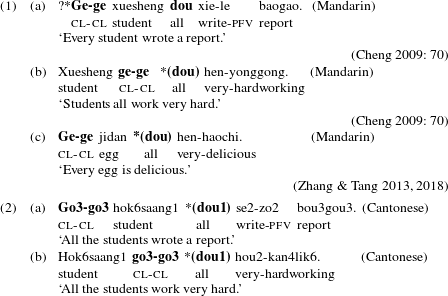
The examples in (2) suggest that Cantonese allows reduplicative classifiers in both prenominal and postnominal positions. However, the same story remains debatable in Mandarin. Cheng (Reference Cheng2009) pointed out that Mandarin classifiers cannot be reduplicated, as in (1a), and if reduplicated, as in (1b), [CL + CL] may in fact be adverbial reduplicative classifiers, instead of nominal classifiers. Contrarily, studies like Zhang & Tang (Reference Zhang and Tang2013, Reference Zhang and Tang2018) (see (1c)) and N. Zhang (Reference Zhang2013) do accept reduplicative classifiers in the prenominal position. Despite the inconsistencies and the judgements discussed in different papers, (1a) and (2a) are accepted by most native speakers. While the acceptability of prenominal classifier reduplication in Cantonese is unquestionable, for the Mandarin cases, I would follow N. Zhang and Zhang & Tang, who claim that Mandarin [CL + CL] can occur in a prenominal position, a judgment accepted by most native speakers. The grammaticality of sentences like (1a) and (2a) would therefore have no effect on the current paper. Additionally, the occurrence of dou/dou1 is obligatory in (1) and (2), with the reduplicative classifiers giving a distributive meaning to the co-occurring NP, as claimed previously.
Focusing on quantificational expressions of the ‘every’ type, Cheng (Reference Cheng2009) further mentioned that the use of classifier reduplication is one way of expressing ‘every’ in Mandarin.

As (3a) is cited from Cheng (Reference Cheng2009), classifier reduplication in the postnominal position is adopted. Both [CL + CL
 $_{dou}$
] and mei ‘every’ give a distributive reading equivalent to English every in the presence of dou ‘all’, leading to the claim that [CL + CL
 $_{dou}$
] is analogous to mei. To account for the co-occurrence of mei ‘every’ with dou ‘all’, following Giannakidou & Cheng (Reference Giannakidou and Cheng2006) (see also Xiang Reference Xiang2008), Cheng (Reference Cheng2009) assumes that dou is an iota/maximality operator. Mei ‘every’ provides universal force by introducing sets of individuals, while dou ‘all’, as a maximality operator, operates on these sets and closes the domain. Therefore, if [CL + CL
 $_{dou}$
] were considered to be analogous to mei ‘every’, it would follow that maximality would be given by dou, with distributive force coming from [CL + CL
 $_{dou}$
].
2.2 Reduplicative classifiers giving the ‘many’ reading
Besides the distributive reading, it has been noted that reduplicative classifiers can convey a plural reading of ‘many’. The examples in (4) are from Steindl (Reference Steindl2010: 71).

Duo-duo-yun ‘CL-CL-clouds’ in (4a) and di-di-yan-lei ‘CL-CL-tears’ in (4b) are considered to convey a plural reading of ‘many’, hence ‘many clouds’ and ‘many tears’. Such a plural reading is usually found when [CL + CL] occurs in the object position and dou ‘all’ is absent. Therefore, the contrast between (1) and (4) suggests that reduplicative classifiers give different readings to the sentence, depending on whether it occurs in the subject or the object position. However, the picture of prenominal reduplicative classifiers is not that simple. As will be revealed in Section 3.4, the so-called subject–object asymmetry does not exist.
2.3 Reduplicative classifiers as plural markers
N. Zhang (Reference Zhang2013) differed from others in considering reduplicative classifiers to be defective plural markers (or unit-plurality markers, to use N. Zhang’s term). Song (Reference Song1978) stated that reduplicative classifiers give the meaning of English many. Following Song, N. Zhang further argued that the reduplicative classifierFootnote [3] zhi-zhi ‘CL-CL’ in (5) is a plural marker, as the nominal modified by it can never have a singular reading and only gains a plural meaning from the reduplicative classifier. The examples in (5) are from N. Zhang (Reference Zhang2013: 120).

N. Zhang observed that zhi-zhi ‘CL-CL’ in (5a) occurs with dou ‘all’ and that the occurrence of dou would suppress the presence of yi ‘one’, while the opposite is true in (5b). The distribution of Mandarin dou and yi is accounted for by assuming reduplicative classifiers to be defective plural markers, in the sense that their occurrence needs a formal licenser, either a distributive quantifier or an existential quantifier. According to N. Zhang, yi, which occurs to the left of the reduplicative classifiers, is not a numeral, but an existential quantifier. When yi is the licenser, the reduplicative classifiers are compatible with either a distributive reading or a collective reading, as seen in (5b), with the ‘many’ reading coming from the plurality of the reduplicative classifiers. Although Steindl (Reference Steindl2010) also notes that [CL + CL] can give a reading of ‘many’, occurrence of yi is not necessary in her analysis. On the other hand, when the distributive quantifier dou is the licenser, only a distributive reading is found, which is the reading given in (5a).
At this point, the two central claims for the meaning of reduplicative classifiers have been summarized. We will now move on to examine the semantics of Cantonese [CL + CL].
3 [CL + CL]: Reduplicative classifiers without dou1
Mandarin and Cantonese show obvious differences in their classifiers. Cantonese classifiers can combine with NP to give [CL + NP] phrases, hence ClP, which are found in both subject and object positions, with definite and/or indefinite interpretations. Contrarily, [CL + NP] phrases in Mandarin are restricted to object positions (see Wang Reference Wang2013), which is considered to have the numeral ‘one’ omitted, with only indefinite interpretation, e.g. shuo ju-hua ‘say CL-sentence’, xie feng-xin ‘write CL-letter’ (see Zhu Reference Zhu1982). As [[CL + CL] + NP] represents reduplication of single classifiers, before accounting for the semantics of [[CL + CL] + NP], we need to briefly mention the semantics of [CL + NP].
3.1 Cantonese [CL + NP]
It is widely acknowledged that Cantonese [CL + NP] phrases are related to individuation and definiteness of the relevant N or NP. Krifka (Reference Krifka, Carlson and Pelletier1995) argues that classifier languages morphologically separate the semantic measure function (i.e. the classifier) from the numerals, whereas non-classifier languages have a measure function incorporated into the numerals. In line with this, Cheng & Sybesma (Reference Cheng and Sybesma1999) takes classifiers to have the function of individuation. Cheng further proposed that ‘aside from the CL(assifier) projection, there is also an IND(ividuation) projection. Cantonese classifiers start out as individuators and move to CL’ (Cheng Reference Cheng2009: 73–74). If this is true, when we reduplicate the classifier in Cantonese, what is reduplicated is the individuator and reduplication would therefore yield (sets of) individuals, which is where plurality of [CL + CL] comes from and also the stand taken in this paper. Unlike Cantonese, Mandarin classifiers are not individuators, and the individuator function in Mandarin can be performed by -zi in N-zi ‘N-suffix’, as in yi-zi ‘chair, as pointed out in Borer (Reference Borer2005), Sybesma (Reference Sybesma2007) and Cheng (Reference Cheng2009).
For definiteness, Cantonese [CL + NP] phrases are generally considered to mark specific or definite NPs, as stated in Sybesma (Reference Sybesma2007) who notes that [CL + NP] phrases in Cantonese can denote definiteness. In fact, the existential meaning expressed by the singular [CL + NP] is usually interpreted as definite when occurring in the subject position, and either as definite or as indefinite when occurring in the object position. The examples in (6) are from Cheng & Sybesma (Reference Cheng and Sybesma1999: 511).

The sentences in (6) reveal that classifiers in Cantonese are like determiners and can yield definite or indefinite interpretation. While zek3-gau2 ‘CL-dog’ which occurs in the subject position gives a definite interpretation, [CL + NP] in the object position can give either definite or indefinite interpretation, as seen by the indefinite bun2-syu1 ‘CL-book’ in (6b) and definite zek3-gau2 ‘CL-dog’ in (6c). If this is true, can we infer that definiteness directly comes from [CL + CL] in [[CL + CL] + NP], with [CL + CL] taken as a determiner? How can we account for the ‘many’ readings given by [[CL + CL] + NP] in the object position, which may not suggest definiteness? Under what conditions, would [[CL + CL] + NP] give a definite reading?
3.2 Reduplicative classifiers without dou1: A quantifying determiner of modifier type and quantifier type
As mentioned, without dou1, [CL + CL] gives the ‘many’ reading as claimed in Steindl (Reference Steindl2010) and N. Zhang (Reference Zhang2013). It is well acknowledged that cardinals and ‘many’ can be adjectives, though appearing in what looks like determiner position. This has been stated as early as Hoeksema (Reference Hoeksema and ter Meulen1983), which mentioned that English many, as adjectives, are interpreted as cardinal predicates of groups numerals. Along the same line, Westerståhl (Reference Westerståhl1984) pointed out that in the relation between D(eterminer) and NP, D can be syntactically ambiguous between a quantifier type and a modifier type.
The fact that many has both adjective-like and determiner-like properties has led to significant controversies regarding its interpretation (see Bennett Reference Bennett1974, Löbner Reference Löbner, Groenendijk, de Jongh and Stokhof1987). With ideas developed from Milsark (Reference Milsark1977), Carlson (Reference Carlson1980), Kamp (Reference Kamp, Groenendijk, Janssen and Stokhof1981), Heim (Reference Heim1982) and Link (Reference Link, Bäuerle, Schwarze and von Stechow1983), Partee (Reference Partee2004) argued that many is ambiguous between cardinal and proportional readings, and below is the basic idea adopted in this paper.

If one maps the above with Westerståhl (Reference Westerståhl1984), the quantifier type of D would make it only a determiner, whilst the modifier type of D would make it as either an adjective or a determiner. According to Partee (Reference Partee2004), the two readings of many are represented as follows:

On the cardinal reading in (7a), many as a vague cardinal quantifier would have a meaning of at least n, like that of the cardinal numbers, and the value of n must be one that counts as large in the given context. On the proportional reading in (7b), many would give a meaning of at least k, with k either as a fraction between 0 and 1 or as a percentage, and the value of at least k must be one that counts as a relatively large proportion.
Sections 3.3 and 3.4 will show how the morpho-syntactic ambiguity of [CL + CL] accounts for the different readings found in [CL + CL]. The discussion will fall into the two following two parts:

3.3 Morpho-syntactic ambiguities of [CL + CL]: A determiner or an adjective
Consider (4a) and (4b) again,Footnote [4] cited from Steindl (Reference Steindl2010: 71):

Since Steindl’s examples are in Mandarin, the discussion here will be primarily of Mandarin. The cardinal readings given in (4a) and (4b), are provided by the author of this paper. As mentioned in Section 2 above, Steindl (Reference Steindl2010) regards the [[CL + CL] + NP] construction in (4a) and (4b) as giving a plural reading of ‘many’. When [[CL + CL] + NP] occurs in the object position, (4a) and (4b) show that only cardinal reading to its modified nominal can be found. In the case of (4a), the truth condition would be that the cardinality of the set of clouds that are floating in the sky is of a relatively large value n. The value of n in (4a) is something that is considered large in the given context. That being the case, the ‘many’ reading given is on a par with that of a vague and indefinite cardinal quantifier, with the vagueness arising from the unspecified values assigned to n and the relatively vague value assigned to the cardinality of the set of clouds that are floating in the sky. Contrarily, if the proportional reading were conveyed in (4a), it would need the totality of clouds be measured according to areas in the sky, in order to give more specific values of |A| and |A
 $\cap$
B|. The value in terms of areas that the clouds occupy has to reach at least k in order to make the sentence true. However, such a proportional value of at least k is vague and not possible to get, according to the judgment of native speakers.
Similarly, the reading of (4b) would be that the cardinality of the set of tears that are running down her face is of a relatively large value n, which represents the cardinal reading of indefinite ‘many’. To get the proportional reading, it would require the totality of areas which the tears have covered, that is |A
 $\cap$
B|, be measured according to areas of the face, that is |A|. Even one assumes the scenario that the speaker is looking at the face of a particular individual, the value would need to reach at least k proportionally in order to have the proportional reading, which again is not possible for (4b).
Generalizing from (4a) and (4b), while English many shows ambiguity between the cardinal reading and the proportional reading, such an ambiguity is not clear with Mandarin [[CL + CL] + NP] in the object position. Under such a case, [CL + CL] would be an adjective modifying the NP, giving the weak cardinal reading of indefinite ‘many’.
Now, consider the Cantonese examples (9) and (10), with [[CL + CL] + NP] appearing in the object position.

Cardinal reading (non-quantificational modifier type): ‘The speaker walked past many street corners (, but still cannot find the post box).’
Without knowing exactly where the post-box is, the speaker walked around different street corners and tried to find one. Eventually, s/he failed to find it and uttered (9). Like the case of Mandarin, when the [[CL + CL] + NP] occurs in the object position, it tends to be interpreted as indefinite. This can be understood as the speaker was not pointed to particular areas or streets, making the locations of the post boxes become indefinite to him/her. (9) would be true if the cardinality of the street corners passed by the speaker is at least n, giving the modifier-type reading of ‘many’ as defined in (7a). [CL + CL] serves as an adjective under such a case, conveying the weak and indefinite cardinal reading as the default reading.
Consider (10) next.

This example includes a sentence with go3-go3-gaai1hau2 ‘CL-CL-street.corner’ topicalized. As mentioned in Sui & Hu (Reference Sui and Jianhua2017), [CL + CL + N] in Mandarin is projected into DP and licensed by the [+topic] feature. As go3-go3-gaai1hau2 is topicalized, along the line of Sui & Hu’s [+topic] feature analysis, it is proposed that the nominal structure is moved to occupy the specifier position of Top(ic)P, which allows it to be licensed by the [+topic] feature through Specifier–Head agreement. The TopP under such a case is in line with Sui & Hu’s DP, with both as a phrasal structure licensed by [+topic] feature. The internal structure of the nominals would take the assumption of Cheng & Sybesma (Reference Cheng and Sybesma1999, Reference Cheng and Sybesma2005), Li (Reference Li2011) and Rothstein (Reference Rothesin2017), which considers [CL + CL] occupying the CL(assifier) Head position, hence ClP structure. Licensed by the [+topic] feature, the [[CL + CL] + NP] will have a definite interpretation. Unlike (9), this would be interpreted under the scenario that the speaker was pointed to particular areas or streets, making the locations of the post boxes become known and definite to him/her. S/he then walked past many street corners, with the existence of a relatively large number n emphasized. Regardless of whether it is determiner-like, as in (10), or adjective-like, as in (9), as what is conveyed is the cardinal reading, be it definite or indefinite, [CL + CL] under such a case is non-quantificational.
However, with [[CL + CL] + NP] topicalized, (10) is possible to receive the proportional reading. To clearly present the proportional reading, we can treat the prenominal [CL + CL] in the same manner as an operator in the tripartite structure proposed by Kamp (Reference Kamp, Groenendijk, Janssen and Stokhof1981) and Heim (Reference Heim1982) for quantificational (proportional) reading, namely [OP] [RESTRICTOR] [MATRIX]. Assume that the addressee instructed the speaker to walk around a particular area of the street, which includes 10 street corners, and the speaker uttered the sentence in (10) above. Such a reading would require a certain proportion of the set of street corners, namely a set of 10, satisfying the restrictor [Street-corner(x)] also satisfy the matrix [Pass(x)], giving a strong partitive reading of “many of the street corners out of the 10 in the area that were passed by the speaker”. This will be a case where the speaker was given some street corners as stated in the restrictor [Street-corner(x)], and with those street-corners given, the speaker still cannot find the post box. The partitive property is also the distinguishable feature between the cardinal reading and the proportional reading, namely that no partitive reading will be given under the cardinal reading, which is non-quantificational. Under the tripartite structure, [CL + CL] can only be an operator, giving (10) the reading of [OP
 $_{\text{CL+CL}}$
] [Street-corner(x)] [Pass(x)]. As will be further argued in Section 3.4, the quantificational [CL + CL] under such a reading is a determiner, if Q position is uniformally called D position, and will be in line with what has been stated in Partee (Reference Partee2004).
Now, the question is what will happen if [[CL + CL] +NP] occurs in the subject position? Consider (11).

For (11), [CL + CL] dung6-dung6 ‘CL-CL’ is used to modify the NP daai6haa6 ‘blocks’, giving the plural reading of ‘many’, with dung6-dung6-daai6haa6 ‘CL-CL-block’ occupying the subject position. The cardinal ‘many’ reading conveyed by [[CL + CL] + NP] tends to have a definite interpretation, with the existence of a relatively large number n emphasized.Footnote [5] With Cantonese taken to be topic-prominent, the definite reading can be attributed to the movement of the subject [[CL + CL] + NP] to the [Spec,TopP] position, licensed by the [+topic] feature through Spec–Head agreement. This is similar to the case of (10) where the [[CL + CL] + NP] is preposed from the object position.
Like (10), proportional reading is possible for dung6-dung6-daai6haa6 ‘CL-CL-block’ under the following scenario. Assume that the speaker and the addressee know that in this area, there are 46 blocks of buildings, and the speaker uttered (11). The quantified NP with the prenominal [CL + CL] is paraphrasable by the partitive ‘many blocks out of a total of 46’, as seen in the translation. The proportional reading conveyed in (11) will then give a tripartite structure of ‘[OP
 $_{\text{CL+CL}}$
] [building(x)] [we-can-see (x)]’ and would require a certain proportion of the set of buildings satisfying the restrictor [building(x)] also satisfy the matrix [we-can-see (x)]. This would give a strong partitive reading to the common noun daai6haa6 ‘blocks’, with the totality of the NP obtained from the context.
In sum, although the values of n and k as defined in (7) are context-dependent. However, the truth or falsity of individual readings are determined truth-conditionally, hence operating at the semantic level. The ambiguity of the ‘many’ readings given by prenominal [CL + CL] has to do with it being a quantifying determiner. When [CL + CL] gives the modifier-type cardinal reading, it behaves like English numerals, hence as an adjective or a determiner. As an adjective, [[CL + CL] + NP] gives an indefinite reading and as a determiner, licensed by a [+topic] feature, a definite reading. Quantifier-type proportional readings will be possible if the [[CL + CL] + NP] is licensed by the [+topic] feature, [CL + CL] would then be a determiner and a tripartite structure of [OP
 $_{\text{CL+CL}}$
] [restrictor] [matrix] is triggered.
3.4 Deriving different readings of [[CL + CL] + NP]
Riding along the different readings discussed in Section 3.3, this section derives the structural representations of [[CL + CL] + NP]. We will start with the quantifier-type reading of [CL + CL], followed by its modifier-type readings. When it is of a quantifier type, [[CL + CL] + NP] gives a quantifier phrase (QP), with its syntax shown in (12).

With tripartite structure of ‘[OP
 $_{\text{CL+CL}}$
] [restrictor] [matrix]’ triggered, [CL + CL] would take the quantifier type, namely <<e, t>, <<e, t>, t>>, which combines with an NP of type <e, t>, giving a quantifier of type <<e, t>, t>. Syntactically, for reduplication, Travis (Reference Travis, Kim and Strauss2001, Reference Travis2003) pointed out that phonological reduplication is achieved by the checking of a quantity feature on a reduplicative head through head movement. Without going into complicated syntactic structure, at this point, I will simply assume [CL + CL] as a single unit, with Cl(assifier)P projected. The syntax of (12) represents a simple version, which is derived based on two theoretical assumptions: (a) previous studies calling the Q position uniformly D position (see Matthewson Reference Matthewson2001, Gillon Reference Gillon2008), with QP taken as DP; and (b) following Travis, when [CL + CL] is of a quantifier type, the quantity feature on the [CL + CL] head is checked through head movement. With these two assumptions put in place, with [CL + CL] bearing the quantity feature, the [Q] feature is checked through movement from [CL + CL] Head to the Q Head position of QP. Moreover, recall that proportional reading is possible only when [CL + CL] is licensed by [+topic] feature. If the Q position is called uniformly as a D position, the licensing of [CL + CL] by the [+topic] feature to give the proportional reading naturally follows. First, QP is projected due to the semantics of [CL + CL] as a quantifying determiner of the quantifier-type, which carries the [+Q] feature. Second, the [+topic] feature is to ensure that there exists a definite set satisfying the restrictor part of the tripartite structure.
Contrarily, in the case of [CL + CL] serving as a quantifying determiner of modifier type, [CL + CL] gives a reading like numerals. It is a NP-modifier, and to be more specific, a type-preserving modifier of type <<e, t>, <e, t>> which combines with a nominal argument of type <e, t>. Cardinal readings would be given under such a case. To account for the definite reading of [[CL + CL] + NP] in the topic position and the indefinite reading in the object position, the following structures are assumed:

According to an earlier proposal in Matthewson (Reference Matthewson2001), a DP is of type e. The structures in (13a) and (13b) are consistent with Etxeberria & Giannakidou’s (Reference Etxeberria, Giannakidou, Recanati, Stojanovic and Villanueva2010, Reference Etxeberria, Giannakidou, Schürcks, Giannakidou and Etxeberria2014) proposal of the definite determiner argued to be a type-preserving modifier and DP of type <e, t>. The diagram in (13a) represents a structure which the object ClP is topicalized, and (13b) a structure in which the subject ClP is moved to [Spec,Top(ic)P]. Regardless of whether it is (13a) or (13b), the ClP would give a definite reading through Spec–Head agreement with the [+topic] feature of the Top(ic) Head. Unlike (12), which involves a quantity feature, as the feature is a [+topic], the readings given in (13a) and (13b) are still cardinal readings. This is the case of a definite cardinal reading given by [CL + CL +NP] in (10) and (11) above.
On the other hand, (14) demonstrates the case where [[CL + CL] + NP] stays in-situ, with no topicalization, as in (9).

As no [+topic] feature is involved, [[CL + CL] +NP] would give an indefinite cardinal reading. The syntax is shown in (14), with [CL + CL] as an adjective on a par with English cardinal many. Regardless of whether it is (13) or (14), [CL + CL] functions as a type-preserving modifier of type <<e, t>, <e, t>>, which combines with a nominal argument of type <e, t>, giving ‘[CL + CL] + NP’ a type of <e, t>. The only difference is whether it is licensed by the [+topic] feature, giving definite or indefinite reading.
Generalizing, without dou1, [[CL + CL] + NP] has its syntax ambiguous among (12), (13) and (14), with its quantifier-type and modifier-like readings derived accordingly. Table 1 summarizes the different readings.
A summary of different readings of [[CL + CL] + NP].

Table 1 shows the distribution of the ‘many’ readings given by [CL + CL]. The ambiguity of the ‘many’ readings of [CL + CL] can be attributed to the nature of quantifying determiner, which leads to the readings described in (8a) and (8b), which I will not repeat here (see Section 3.2). When [[CL + CL] + NP] is licensed by [+topic] feature in the topic position, it would demonstrate an ambiguity between the definite weak cardinal reading as described in (8a) and the proportional reading as described in (8b). On the other hand, the ‘many’ reading which has the [[CL + CL] + NP] in the object position, would convey an adjective-like reading. [[CL + CL] + NP] would be indefinite under such a case, due to the failure to be licensed by [+topic] feature. This gives an indefinite weak cardinal reading as described in (8a), accounting for the observation made in Steindl and others.
Before we end this section, a few points need to be briefly mentioned. First, along the line of Travis (Reference Travis, Kim and Strauss2001, Reference Travis2003), Yip (Reference Yip2015) assumes that classifier reduplication in Cantonese is a kind of phonological reduplication, and classifiers under such a case undergo movement from CL to D, hence resulting in a definite DP (see also Simpson Reference Simpson2005). Yip’s analysis of classifier reduplication is close to the analysis proposed in this paper. However, it should be noted that Yip’s analysis did not recognize the ‘many’ reading of [CL + CL] and focuses on [CL + CL] with the distributive quantifier dou1. Therefore, if we merely follow the assumption of definiteness of [CL + CL] coming from the CL-to-D movement, without recognizing the role of [+topic] feature, the indefinite ‘many’ reading of object [[CL + CL] + NP] would be coerced.
Second, rethink the seeming subject–object asymmetry stated in previous analyses like K. Yang (Reference Yang2004, Reference Yang, Xu and Jingqi2015), N. Zhang (Reference Zhang2013), namely that [[CL + CL] + NP] occurring in the object position would give the ‘many’ reading, whilst that occurring in the subject position would give the distributive reading. At this point, it is clear that the subject–object asymmetry does not exist. Cardinal ‘many’ reading is in fact possible in both subject and object positions, differing only in being definite or indefinite.
Third, at the beginning of Section 3, it is mentioned that Mandarin [CL + NP] is restricted to its occurrence in the object position, with indefinite reading only. If Mandarin has no definite [CL + NP], a related question is whether Mandarin has definite [[CL + CL] + NP]. Our stand is that nominal classifier [CL + CL] in Mandarin is acceptable, and if [[CL + CL] + NP] is licensed by a [+topic] feature, what we have shown in Cantonese would also apply in Mandarin. The underlying (parametric) difference between Mandarin and Cantonese is the productivity of reduplicative classifiers. This is a complicated question which the current analysis would fail to give a satisfactory answer.
4 [CL + CLdou1]: A quantifying determiner of modifier type
As mentioned in Section 1, when reduplicative classifier occurs with dou1 ‘all’, dou1 holds a licensing relation with [CL + CLdou1], with maximality guaranteed on the modified NP. I will argue that under such a case, while dou1 serves as a distributive quantifier, [CL + CLdou1], as a quantifying determiner, demonstrates its adjective-like characteristics, which serves as a modifier to regulate the quantification domain of dou1. However, before going into the semantics of [CL + CLdou1], I would need to examine the distributive interpretation of dou1, which is an issue of controversy.
Distributivity is widely described as the meaning associated with dou ‘all’ in Mandarin, with limited studies on Cantonese dou1 ‘all’, which is assumed to be equivalent to Mandarin dou. Therefore, this section will focus on Mandarin dou.
Consider the contrast between the following two sentences:

While (15a) asserts that the entire group of people denoted by the subject NP collectively bought a car, the addition of dou ‘all’ in (15b) suggests that each of them bought a car of his own. In other words, dou ‘all’ provides a distributive reading. The meaning given by dou ‘all’ in (15b) has led previous studies, such as Lee (Reference Lee1986) and F-h. Liu (Reference Liu1990), to analyze dou as a distributive quantifier. Lin (Reference Lin1998) further argued that dou ‘all’ is the overt realization of the generalized distributive operator, which was proposed along the lines of Schwarzschild (Reference Schwarzschild1996). It is only if dou is taken as a generalized distributive operator (Part) that (16) can be accurately interpreted.

What dou ‘all’ does in (16) is to distribute pairs of people within the set. (16) yields the correct interpretation only if it is read under the formal definition of covers and plurality covers stated by Schwarzschild (Reference Schwarzschild1996: 69) as follows:

Drawing on (17), Lin (Reference Lin1998) argued that as a generalized distributive operator, dou ‘all’ quantifies over a set whose members are pairs to the plurality cover, accounting for the intermediate reading or the reading of subpluralities of (16).
Contrary to the quantificational analysis of dou ‘all’, recent studies such as Xiang (Reference Xiang2008), Cheng (Reference Cheng2009), Liao (Reference Liao2011) and M. Liu (Reference Liu2017) indicate that the basic semantics of dou ‘all’ is neither quantificational nor distributive. Among these studies, Cheng, in her very first paper (with Giannakidou, see Giannakidou & Cheng Reference Giannakidou and Cheng2006), and later in Cheng (Reference Cheng2009) analyzed dou ‘all’ as an external determiner that provides contextual domain restriction. This analysis explains the maximality reading of the mei … dou ‘every … all’ construction and by extension dou ‘all’ serving as a maximality operator (see also Xiang Reference Xiang2008). M. Liu (Reference Liu2017), a very recent study, adopts a unified analysis for dou ‘all’. M. Liu (Reference Liu2017) proposes that dou ‘all’ is a focus particle, which has the semantics of English even, with distributive and collective readings arising from varieties of alternatives operating according to Rooth’s (Reference Rooth1985) alternative semantics. With such an assumption in place, M. Liu generalizes that distributive dou ‘all’ is a trivialized ‘even’ dou (or ‘even’-less dou to use his term), which occurs only if dou (with stress on dou) is associated with a sum-based alternative set and distributive readings are analyzed by a covert distributive operator dist on VP. As dou ‘all’ is ‘even’ dou, the ‘even’ presupposition of dou in a distributive context cannot possibly be met, unless the referent of dou’s associate is the maximal among its alternatives. This makes ‘even’-less dou require maximality of dou’s associate, referred to as  in M. Liu. Put it in another way, M. Liu’s analysis of distributive dou ‘all’ is in line with or at least supports the maximality operator proposed in Xiang (Reference Xiang2008) and Cheng (Reference Cheng2009).
These accounts have provided comprehensive and sophisticated analyses to unify different readings of dou, which shed lights on its semantics. However, to account for the semantics of reduplicative classifiers, I will take an analysis of dou1 which can better account for the ‘many’ reading and the distributive reading of reduplicative classifiers mentioned in Section 2. To start off, assuming dou1 as a maximality operator or a focus particle would in one way or another be forced to claim that the [CL + CL] giving rise to the ‘many’ reading and the [CL + CLdou1] giving rise to the so-called distributive reading are different. That is to say, with dou1 assumed to be a determiner giving definiteness to its associate or as a maximality operator imposing maximality on its associate, [CL + CL] would at most be reduced to an operator imposing exhaustivity within the maximal set given by dou1 on the NP. This cannot be the same as the [CL + CL] giving the ‘many’ reading to its modified NP. It would therefore be difficult to connect [CL + CL] with [CL + CLdou1] and the two readings given by them, which is theoretically not attractive for any analyses of reduplicative classifiers.
On the other hand, along the line of Lee (Reference Lee1986), Liu (Reference Liu1990), Lin (Reference Lin1998) and others, if one assumes that distributivity comes from dou ‘all’ or Cantonese dou1, it would be possible to come up with an analysis of reduplicative classifier which is able to connect the two readings of reduplicative classifier. If dou1 is the distributive quantifier, [CL + CLdou1] cannot be a quantifier, and will be taken to be a modifier. This fits in what is assumed under the current analysis, namely that reduplicative classifier is a quantifying determiner, which is possible to demonstrate modifier-like characteristics. Therefore, the two readings of the reduplicative classifier can be connected by appealing to its dual role as a quantifier and as a modifier, which at the very least, has already been demonstrated in the ambiguity between cardinal ‘many’ and proportional ‘many’ in Section 3. The proposed account of [CL + CLdou1] would then represent another realization of reduplicative classifier as a quantifying determiner of modifier type.
Additionally, to further support that distributivity comes from dou1 all’, consider one basic fact of reduplicative classifier given in (4) and (5) in Section 2 above. Steindl (Reference Steindl2010) used (4a) and (4b) to argue for a plural reading of ‘many’ for reduplicative classifier and N. Zhang used (5b) to argue for a similar reading (see Section 2). Without the distributive quantifier dou ‘all’, (4a) and (4b) do not convey any distributive reading. Similarly, putting aside the issue whether [CL + CL] is a plural classifier or not, which I will come back to in Section 5, N. Zhang also pointed out that distributive reading of [CL + CL] can only be conveyed through the licensing of dou (see (5a)). Without dou1, the prenominal reduplicative classifier only gives a plural reading in (5b). This supports that distributivity cannot be coming from the prenominal reduplicative classifier, but from dou1, unless one still insists that [CL + CL] and [CL + CLdou1] are different types of classifier reduplication. Finally, as shown in Section 3, plurality in fact come from the reduplicative classifier and definiteness from [CL + CL] licensed by [+topic] feature, making [[CL + CLdou1] + NP] in fact not relying on dou1 for definiteness and plurality.
In sum, since the current analysis focuses on reduplicative classifier, if the traditional view of dou1 as a distributive quantifier would have the advantage of connecting the two readings of reduplicative classifier, and with additional facts supported, I would go along the traditional view of dou1 as a distributive quantifier.
4.1 Domain restriction and cover theory
Section 3 has accounted for [CL + CL] without the presence of dou1 ‘all’. With the assumption of dou1 as a distributive quantifier put into place, we can then examine the semantics of [CL + CLdou1], which will be shown to be in line with what has been argued in Section 3.
To begin with, regardless of whether the distributive quantifier dou1 exists or not, reduplicative classifiers remain as quantifying determiners. The semantics of reduplicative classifiers with dou1 ‘all’ will be elaborated in Section 4.3. The basic idea is that [CL + CLdou1], as a quantifying determiner, demonstrates non-quantificational characteristics and serves as a type-preserving modifier. It acts on its co-occurring NP, which allows dou1, as a distributive quantifier, to distribute over the nominal set denoted by the NP. Additionally, distributive quantification by dou1 with and without [CL + CLdou1] shows a difference in that the presence of [CL + CLdou1] will give a maximizing reading to the associated NP under dou1’s distributive quantification. Based on theoretical assumptions regarding domain restriction and cover theory, I will argue that the role of [CL + CLdou1] is to help partition or structure the contextually restricted domain of dou1’s distributive quantification, to ensure that it is over a good-fitting cover. This would result in a maximizing effect on the co-occurring NP, which is otherwise absent. All these would only be possible if one assumes that [CL + CLdou1] assigns a value to a domain selection variable Cov relating to the restricted set, such that the distribution of dou1 ‘all’ will not be down to the atoms, but to sub-pluralities of the plural NP via covers. It is also due to such a role of [CL + CLdou1] that accounts for its obligatory licensing by a D-operator dou1.
As mentioned, the proposed analysis draws heavily on ideas introduced under the cover theory, so I will briefly review some of the important theoretical assumptions associated with domain restriction and cover theory. To start off, generalized quantifiers often presuppose the existence of a syntactic and semantic constituent comprising the quantificational element and a restrictive argument, with determiner quantifiers such as English every, some, most, denoting second-order relations between two sets. The first argument is the set denoted by the common noun phrase, and this set restricts the quantifier, or supplies the domain of quantification, hence restricted quantification. In an early treatment of plural quantifier phrases in a Montague grammar framework, Bennett (Reference Bennett1974) proposed treating many and few as context-dependent cardinal quantifiers only, with a possibly different context allowed for different interpretations of cardinality. Von Fintel (Reference von Fintel1994) proposed that the domain of quantification is pragmatically constrained and that ‘contextual restriction is captured by interpreting the determiner relative to a contextually supplied set which is intersected with the common noun argument’ (von Fintel Reference von Fintel1994: 30). Von Fintel called this set the resource domain; and Westerståhl (Reference Westerståhl1984) referred to it as the context set.
A quantificational element is indexed with a new index C, the resource domain variable, which is supposed to evoke context and generally is the most salient resource domain. Later studies such as Stanley & Szabó (Reference Stanley and Szabó2000), Matthewson (Reference Matthewson2001), Martí (Reference Martí2002), Stanley (Reference Stanley, Preyer and Peter2002), Etxeberria (Reference Etxeberria2004, Reference Etxeberria2009), Giannakidou (Reference Giannakidou and Young2004), Gillon (Reference Gillon2008), Etxeberria & Giannakidou (Reference Etxeberria, Giannakidou, Recanati, Stojanovic and Villanueva2010, Reference Etxeberria, Giannakidou, Schürcks, Giannakidou and Etxeberria2014) and many others follow a similar line in considering the domain of quantification to be restricted linguistically or by pragmatic information through contextual variables. However, it is generally acknowledged that domain restriction does not work on the internal structure of the set that restricts the set denoted by the NP, and that all it does is provide a set that is contextually restricted so that the quantifier quantifies over a contextually restricted set of whatever the NP denotes.
The idea of distributivity is later extended to distributing down to sub-pluralities, as illustrated in sentences like (18).

Fiengo & Lasnik (Reference Fiengo and Lasnik1973) stated that (18) might be considered true even if the reciprocity brought by each other holds within subpluralities of the plurality denoted by the men, giving the intermediate reading of distributivity. The concept of subpluralities then led to the interpretive principle of partition within the pluralities, which is a kind of cover. Following Higginbotham (Reference Higginbotham1981), Schwarzschild (Reference Schwarzschild1996) proposes that the D-operator (which he calls part, for partition) is always accompanied by a context-dependent domain selection variable, which he calls Cov, because the value assigned to the variable takes the form of a cover of the universe of discourse. The formal definitions for covers and plurality covers by Schwarzschild have been given, and I will not repeat here (see (17) in Section 4).
Brisson (Reference Brisson1998, Reference Brisson2003) also drew on Schwarzschild’s cover concept, proposing to distinguish good-fitting covers from ill-fitting ones, based on her analysis of English all and plural noun phrases. Brisson observed that speakers may allow exceptions to (19a), but they will not do so for (19b). Both examples are cited from Brisson (Reference Brisson2003: 130).

A maximizing effect is given by all to the girls in (19b), which is absent in (19a).
To account for the maximizing effect, Brisson defines a good fit relation between a cover and a definite DP denotation (i.e. a set): ‘the cover is a good fit if every element of the set is in a cell of the cover that is a subset of that set’ (Brisson Reference Brisson2003: 141). This is formally defined as follows:

The function of all is to ensure that the value assigned to Cov is a good fit with respect to the subject DP, hence eliminating ill-fitting covers and making sure that a good-fitting cover is given to the sentence. This accounts for the maximizing effect observed in (19b) with all but not in (19a).
4.2 Maximizing effect and prenominal [CL + CLdou1]
With the help of cover theory and good-fitting cover, I will now propose an analysis to account for the occurrence of prenominal reduplicative classifiers with the distributive quantifier dou1 ‘all’.
To start off, consider (21) below. The prenominal [CL + CLdou1] zou2-zou2 ‘CL-CL’ in (21) relies on the presence of dou1 ‘all’, or the sentence will be unacceptable.

What I want to show here is that (21) requires all the groups to have collaborated on a picture. (21b) allows for cases in which there are students who were not in any groups and therefore did not participate in the collaboration. (21) suggests that although the NP hok6saang1 ‘students’ denotes a plural set of students, with the presence of zou2-zou2 ‘CL-CL’, hok6saang1 is divided in different cells, i.e. they are considered as groups, not individuals. Therefore, dou1 ‘all’ in (21) does not distribute over individual students within the plural set, but only over groups of students. This is only possible if it is assumed that the domain of dou1-quantification has been restricted by the prenominal reduplicative classifier zou2-zou2 ‘CL-CL’, which assigns the plurality cover of the distributive quantifier dou1 to a set whose members are groups. Therefore, the restriction on the NP hok6saang1 ‘students’ by zou2-zou2 ‘CL-CL’ allows for exceptions for students, but not for groups, as shown by the acceptability of (21b), but not (21a).
To account for this, we need to spell out clearly what a ‘maximizing effect’ is. It can be understood clearly through the contrast illustrated in (22), between [[CL + CLdou1]
+ NP] and [CL
 $_{\text{PL}}$
+ NP] (i.e. NP with the plural classifier CL
 $_{\text{PL}}$
).

The NP hok6saang1 ‘students’ is modified by the prenominal reduplicative classifiers go3-go3 ‘CL-CL’ in (22a) and by the plural classifier di1 in (22b), with both distributively quantified by dou1 ‘all’. However, di1-hok6saang1 ‘CL
 $_{\text{PL}}$
-student’ in (22b) allows for or at least is more natural regarding exceptions among the students, and the same reading is found when di1-hok6saang1 is replaced by the bare plural hok6saang1 ‘students’. In contrary, a maximizing effect is found in go3-go3-hok6saang1 ‘CL-CL-student’ in (22a), meaning that speakers would not allow any students to fail to satisfy the condition stated by the predicate in the first clause. (22a) and (22b) only differ in the use of the prenominal reduplicative classifier and the plural classifier. (22) clearly shows that the maximizing effect over the subject NP of (22a) can only be contributed by the prenominal reduplicative classifier, not by dou1 ‘all’, which is present in both sentences. If dou1 is assumed to be a maximality operator, (22a) and (22b) should result in the same reading in terms of the maximizing effect stated, contrary to what we see. Therefore, there are grounds to claim that the distributive interpretation of the subject NP comes from dou1 ‘all’, making dou1 ‘all’ quantificational. And it is only when the subject NP is modified by the prenominal [CL + CLdou1] that no exceptions are allowed, making prenominal [CL + CLdou1] more likely to be the item contributing the maximizing effect.
Moreover, for dou1 to perform distributive quantification, its associated NP must denote a closed set, hence the need for the associated NPs to be definite plurals. A related issue here is that if dou1 is a distributive quantifier, definiteness cannot be coming from dou1. Along the lines of Section 3, while it is clear that [CL + CLdou1], as a quantifying determiner, gives plurality to the common noun, the definiteness effect of [[CL + CLdou1] + NP] can be satisfied by having it licensed by [+topic] feature. (23) illustrates that distributive quantification of dou1 can reach up to topic position.

This example shows that when the object saang1gwo2 ‘fruits’ is preposed to the topic position, dou 1 can quantify over it to give a universal reading. If this is true, there are grounds to conclude the following: licensed by the [+topic] feature, [CL + CLdou1] gives the modified NP a definite reading, making [[CL + CLdou1] +NP] on a par with English definite plurals.
4.3 [CL + CLdou1] as a domain regulator
On the basis of Section 4.2, the following three semantic properties of [[CL + CLdou1] + NP] can be identified:

The first two properties naturally follow if one assumes that prenominal [CL + CLdou1] is a quantifying determiner. First, for (i), the property of [[CL + CLdou1] + NP] denoting definiteness and plurality in fact comes from reduplicative classifiers as a quantifying determiner, which has been pointed out in Section 4.2. Second, without dou1, as argued in Section 3, as a quantifying determiner, [CL + CL] modifies the nominal, giving [[CL + CL] + NP] the ‘many’ NP reading. Therefore, distributivity must be coming from dou1 not the reduplicative classifiers, hence Property (ii).
Property (iii) leads us to argue that [CL + CLdou1] is a quantifying determiner that operates on a definite plural to ensure a maximizing effect on distributive quantification by dou1. The maximizing effect on the NP is achieved through assuming the presence of cells or covers within the contextually restricted quantification domain (see Section 4.1 above) and its licensing by a D-operator dou1, so as to guarantee a maximal collection of the plural set. I will hypothesize that this can be done through ensuring that the value assigned to Cov is a good fit. As given in (13a, b) and (14), when [CL + CL] serves modifier-type quantifying determiner, it is ambiguous between a determiner (see (13a, b)) and an adjective (see (14)). Owing to the Leftness Condition of dou1 (see Lee Reference Lee1986, Liu Reference Liu1990), quantification by dou1 is generally to the left NP. Therefore, when licensed by dou1, the syntax given earlier in (13b) applies, and is adapted as (13b
 $^{\prime }$
) to include dou1 ‘all’, assumed to be an adverb.

When dou1 is present, as a distributive quantifier, it requires its associated NP be D-linked to a finite set for distributive quantification. The syntax in (13b
 $^{\prime }$
) suggests that licensed by [+topic] feature, [[CL + CLdou1] + NP] is definite, giving the domain for dou1 to perform distributive quantification. The [CL + CLdou1] is taken to be a type-preserving modifier, modifying the NP of type <e, t>, resulting in the ClP of type <e, t>.
To account for the maximizing effect on the NP, I will adopt Brisson’s (Reference Brisson2003) definition of a good-fitting cover, as already given in (20) above. Brisson’s definition of a good-fitting cover works further on the cover assignment to ensure that the value assigned to Cov includes a maximal number of individuals. Those covers that fail to include a maximal number are considered ill-fitting covers and will be eliminated and not be assigned to Cov. As [CL + CLdou1] functions as a modifier type of quantifying determiner through modification on the NP, [CL+CLdou1] ensures a good-fitting cover to the NP.
Assuming (13b
 $^{\prime }$
) and (20), the distributive quantification of dou1 under Cov is as in (24).

The denotation of NP
 $_{\text{plural }}$
is a set of singularities based on the universe of discourse with a set of possible covers Cov as defined by Schwarzschild (Reference Schwarzschild1996). [CL + CLdou1] serves to ensure that the value assigned to Cov is a good fit with respect to the definite plural, through structuring the contextually restricted quantification domain denoted by the plural set X. The structuring is to ensure that every member y of X belongs to some set Z in the plurality cover Cov of X. Therefore, [CL + CLdou1] can be considered to be a domain
regulator
Footnote
[6]
that acts further on the contextually restricted domain by eliminating ill-fitting covers or making good-fitting covers more salient, to create a maximizing effect on Cov.
To make the role of [CL + CLdou1] explicit, contrast (24) with (25).

(25) is a preliminary translation of dou1 ‘all’ taken as a distributive quantifier.Footnote
[7]
Without the presence of [CL+ CLdou1], the plural set X denoted by the NP
 $_{\text{plural}}$
is operated by the resource domain variable C (to use von Fintel’s term), which would restrict the set such that it denotes a specific and contextually relevant set of individuals. The main difference between (25) and (24) is that without the domain selection variable Cov, dou1 distributes over to members of the set of singularities denoted by NP
 $_{\text{plural}}$
, which may simply be an unstructured set in the contextually restricted quantification domain. In that case, dou1 ‘all’ may not always trigger a maximizing effect, with the possibility of non-maximality conveyed via pragmatic weakening and exception is allowed, as shown in the contrast between (22a) and (22b) above.
To illustrate how this works, consider (26).

In (26a), assume that John is the father, the four sons are Peter, Sam, Richard and Tom, and the universe of discourse is U in (27b). Dou1 ‘all’ will distribute the property of ‘looking-like John’ over the definite plural zai2 ‘sons’. (26b) is translated as in (27a), with the possible covers I, M, N, R given in (27b), and (27b) is interpreted as in (27c). (Example (27d) will be discussed below.)

Without the prenominal [CL + CLdou1], the contextual variable in (25) can be considered as the resource domain variable C (to use von Fintel’s term). This would restrict the set such that the plural set X denoted by the NP
 $_{\text{plural}}$
denotes a specific and contextually relevant set of individuals, including the four sons, e.g. {a, b, c, d, p, s, r, t}. If the analysis so far is correct, without the prenominal [CL + CLdou1], (26a) is interpreted as in (27d), seen above.
(27d) has the resource domain variable C operating on a set like {a, b, c, d, p, s, r, t} to reduce the plural set X denoted by the NP
 $_{\text{plural}}$
into a more specific, contextually relevant set {p, s, r, t}, with an unstructured set of singularities of the four sons. I, M, N and R involve cover assignment and would not be for (26a), which would need the domain selection variable Cov, not C. Without Cov to structure the set, non-maximality or exception is allowed in the distributivity of dou1 to the unstructured set of contextually relevant entities, as evidenced by the naturalness of (26a), with the final phrase ‘except for the youngest one, who looks like the mother instead’ suggesting exception. Dou1 would simply distribute over the unstructured set, with the possibility of exceptions or non-maximality conveyed via pragmatic weakening.
In (26b), by contrast, with the inclusion of the prenominal reduplicative classifier go3-go3, the domain selection variable Cov is introduced. [CL + CLdou1] now operates on the plural set X denoted by the NP
 $_{\text{plural}}$
to ensure that the value assigned to Cov is a good fit with respect to the subject NP. The value-assignment of Cov is determined by the context and the semantics of the predicate, with Cov being the context-dependent variable that is associated with the distributive quantifier dou1, and the role of the contextual domain variable C minimized here (see Brisson Reference Brisson1998).
With the predicate being ‘looking like the father’, to ensure a good-fitting cover that allows a distributive reading, the value given to Cov will be I {{p}, {s}, {r}, {t}, {a, b}}, and x must be a member of the covers assigned to the variable Cov (x
 $\in$
[|Cov|]) and a subset of [|the sons|] (x
 $\subseteq$
[|the.sons
 $^{\prime }$
|]), as given in (27c). Dou1 ‘all’ then distributes the property denoted by the predicate ‘looking like the father’ over the plurality cover which consists of four singleton sets, guaranteeing a maximal collection, as evidenced by the oddness of (26b) with the final clause suggesting exception. Along the line of Brisson (Reference Brisson1998), since {a, b} is not a subset of the set [|the.sons
 $^{\prime }$
|], there is no question of whether it will make (26b) true or not, so it can be eliminated. As {p}, {s}, {r}, {t} fall into four singleton cells, the union of the four sets of cells is equivalent to the set of sons, and Cov I constitutes a good-fitting cover.
In the case of (27b), M, N and R would not be good-fitting covers, for different reasons. For M, r (Richard) is in the same cell with a and b, who are not sons of the father (John), and the set {r, a, b} is not a subset of [|the.sons
 $^{\prime }$
|], the set {p, s, r, t}. As there is no cell containing Richard that satisfies the restriction of the quantifier stated in (27c), (27b) may be true whether Richard looks like his father or not, which does not meet the maximality requirement of the quantified NP. For N, because the cover is a single-cell plurality cover {{p, s, r, t}}, it can only be a good-fitting cover if it gives a collective reading to (26b). This is eliminated by the semantics of the predicate ‘look-like-the father’, which needs a distributive reading. For R, the problem is similar to the problem with M: r (Richard) and t (Thomas) are in another set, {r, t, a}, which is not a subset of the set of [|the.sons|]. There is no cell containing r and t that satisfies the requirement of [CL + CLdou1].
Now, contrast (26) with (28), which involves a slightly different predicate. In (28), again assume that John is the father, the four sons are Peter, Sam, Richard and Tom, and the universe of discourse is U in (29b). Dou1 ‘all’ will distribute the property of ‘looking-like’ over a plurality cover of {x, y}. (28) is translated as in (29a), with the possible covers I, M, N, R given in (29b), and (28) is interpreted as in (29c).

Unlike (26), (28) has the predicate being ‘look like (each other)’, with (28) translated as (29a) and interpreted as (29c). Although ‘look like’ has a distributive reading, dou1 ‘all’ cannot distribute over the atomic individuals of the plural set {{p}, {s}, {r}, {t}}, as in (26). With (28) interpreted to contain a covert daai6-gaa1 ‘each-other’, the predicate requires that distributivity goes down to the level of subpluralities, with distributivity over a pair of individuals. Consider the possible covers I, M, N, R given in (29b). The cover I therefore cannot be assigned to Cov in (29c).
For the cover N, assume that m is Mary and j is Janet, the two daughters of the father. (28) only concerns the four sons. Within the set of the four sons, it does not include the two daughters. If r (Richard) and s (Sam) form a cell with the daughters m and j, {r, m} and {s, j} cannot be subsets of the set {p, s, r, t}. Since {r, m} and {s, j} fail to satisfy the quantifier restriction stated in (29c), to ensure a maximal collection of individual pairs, the cover N would not be assigned to be the value of Cov in (29c).
R cannot serve as a cover for Cov, either. With (28) interpreted to contain a covert daai6-gaa1 ‘each-other’, to ensure that every set is a subset of the plurality cover Cov, subsets in which x and y have the same value cannot be considered to be proper subsets <x, y> generated from the set {p, s, r, t}. Therefore, R cannot be assigned to Cov. The distributive quantifier dou1 ‘all’ then distributes the property ‘looking like’ denoted by the predicate over to the six-cell plurality cover of {x, y} with x
 $\neq$
y, i.e. M. The interpretation given in (29c) will ensure a maximal collection of individual pairs, deriving the maximizing reading of all four sons looking like each other, as evidenced by the oddness of adding the clause which suggests exception.
We can see that the presence of [CL + CLdou1] rules out the possibility of pragmatic weakening by assigning a value to the context-dependent domain selection variable Cov, which ensures a good-fitting cover. Without [CL + CLdou1], quantification by dou1 ‘all’ alone, as in (26a), would allow the possibility of pragmatic weakening. The reason is that as the function of C is merely to reduce the plural set X denoted by the NP
 $_{\text{plural}}$
into a more specific, contextually relevant set, as represented in (27d), without structuring that set into different cells for maximality via covers assigned by Cov. Moreover, in line with Brisson, among good-fitting covers, a distinction should be made between those that give a distributive reading and those that give a collective reading, which is determined by the predicate, as mentioned in (26b) and (28).
Generalizing from what we have so far, there are grounds to analyze the prenominal reduplicative classifier as a quantifying determiner. Without dou1 ‘all’, [CL + CL] is a weak quantifier on a par with English many and is presuppositional only in proportional reading, which is given by the tripartite structure triggered. When dou1 is present, dou1, as a distributive quantifier, requires its associated NP be D-linked to the closed set for dou1 to perform distributive quantification. [CL + CLdou1] would serve as a modifier-type determiner that helps regulate the quantification domain of dou1 ‘all’. It performs a type-preserving function by taking its co-occurring nominal argument of the predicate type <e, t> and returning it a predicative argument of type <e, t>, which allows dou1, as a distributive quantifier, to operate on it. The maximizing effect in fact comes from the reduplicative classifier [CL + CLdou1], which helps to regulate the context-dependent quantification domain of dou1 via covers. The presence of the prenominal reduplicative classifier ensures the plurality cover denoted by the nominal argument is a good-fitting one.
5 [CL + CLdou1] vs. plural classifier and [mui5 … dou1]
As mentioned in Section 2, [CL + CLdou1] has been argued to be a plural marker, as in N. Zhang (Reference Zhang2013), or to give rise to a reading on a par with English every/each or Chinese mei ‘every’, as in, for example, Cheng (Reference Cheng2009), Zhang & Tang (Reference Zhang and Tang2013, Reference Zhang and Tang2018). Before concluding the paper, I will argue that [CL + CLdou1] cannot be a plural classifier, and cannot be entirely analogous to Cantonese [mui5 … dou1] ‘[every … all]’, either.
5.1 [CL + CLdou1] cannot be a plural classifier or marker
Despite the fact that plurality does come from the reduplicative classifier, I will argue that prenominal [CL + CLdou1] cannot be the plural classifier in the way as claimed in N. Zhang, as it is by nature a quantifying determiner. Relying on dou1 to be a distributive quantifier, [CL + CLdou1] serves to regulate the restricted quantification domain, with a maximizing effect found on the modified NP. Such an effect is not found in plural classifiers or markers, of which their presence does not rely on any quantifiers.
To further show the difference between [CL + CLdou1] and a genuine plural classifier, I appeal to the Cantonese prefix di1-, which is widely taken to serve the same function as the Mandarin plural suffix -men. Both are attached to the noun to mark plurality, hence plural markers.
Consider (30).

The example in (30a) shows the co-occurrence of di1- and the reduplicative classifier go3-go3 ‘CL-CL’ with dou1 ‘all’. If one assumes that [CL + CLdou1] is a pure plural classifier or a plural marker, without differentiating the two, we have a problem because the co-occurrence of di1- and go3-go3 ‘CL-CL’ in (30a) would mean that we have two plural markers operating on the same NP, hok6saang1 ‘students’. However, their co-occurrence can be adequately accounted for if we assume that di1- is the plural marker, and go3-go3 ‘CL-CL’, as a domain regulator, regulates the domain of [di1-hok6saang1]. [CL + CLdou1] takes scope over [di1-NP] to give ClP, and the ClP would then move to the [Spec,TopP] to allow it to be licensed by the [+topic] feature of Top(ic) Head. Dou1 would then perform distributive quantification over the ClP in the topic position.
Although plurality and definiteness can be regarded to be coming from [CL + CLdou1], (30a) and (30b) clearly show that [CL + CLdou1] cannot be a simple plural classifier. While a maximizing reading is found in (30a), it is absent in (30b), with the only difference lying on the presence of [CL + CLdou1] in the former but not in the latter. In N. Zhang’s analysis, reduplicative classifiers are considered to be reduplicative unit words, expressing unit-plurality. However, the analysis of reduplicative classifiers as counting units cannot explain the maximizing effect found in (30a), as plural markers only express plurality and do not impose maximality on the nominal they modify. The only counter-argument would be that the maximizing reading in fact comes from dou1 ‘all’, but this would again lead us back to two basic questions. First, if dou1 ‘all’ already gives a maximal reading to the sentence, what is the role of [CL + CLdou1]? Second, if both Cantonese di1- and [CL + CLdou1] are plural markers or classifiers, why is it that [CL + CLdou1] is licensed by dou1 for maximality, but non-maximality is found in Cantonese di1- with dou1?
In sum, although definiteness and plurality may be coming from the reduplicative classifier, [CL + CLdou1] cannot be taken as a pure plural classifier or marker, without recognizing its role as a domain regulator (see Section 4.3). It is [CL + CLdou1] as a domain regulator that makes its basic semantics different from that of plural classifiers or plural markers.
5.2 [CL + CLdou1] vs. [mui5 … dou1]
Cheng (Reference Cheng2009) stated that ‘[classifier] reduplication yields an interpretation comparable to mei and the presence of dou is obligatory’ (Cheng Reference Cheng2009: 69). In this section, I will show that [CL + CLdou1] cannot be semantically equivalent to [mui5 … dou1] ‘[every … all]’. As previous analyses generally are on Mandarin mei ‘every’, with Cantonese mui5 ‘every’ assumed to be equivalent, I will start with a brief review of some previous analyses of Mandarin mei.
5.2.1 Previous studies of Mandarin mei ‘every’
To account for the co-occurrence of mei ‘every’ with dou ‘all’, Cheng (Reference Cheng2009) assumes that mei provides a universal force introducing sets of individuals for the maximality operator dou ‘all’ to operate on. Similar analyses which assume the quantificational force comes from mei ‘every’ not dou ‘all’ in the [mei … dou] construction are also found in Huang (Reference Huang1996) and R. Yang (Reference Yang2001). Huang stated that ‘mei is a Skolemized universal quantifier and it requires a lexically overt variable within its scope to license this Skolemized quantification. Dou is a sum operator over events’ (Huang Reference Huang1996: 39).Footnote [8] R. Yang proposed that mei ‘every’ is a universal quantifier, which is said ‘to denote the functional from a property P to a generalized quantifier introducing the maximal sum individual X such that its atomic part each has the property P and the sum X is contained in the set of Q-denoting individuals’ (R. Yang Reference Yang2001: 93).Footnote [9] Analyses like those of Huang, R. Yang and Cheng basically consider that in the [mei … dou] construction, the universal quantificational force comes from mei ‘every’, not dou ‘all’.
Lin (Reference Lin1998) proposed a slightly different analysis of mei ‘every’. Lin assumes that mei ‘every’ denotes a function which takes a predicate of type <e, t> as its argument and returns the maximal collection of the individuals denoted by the predicate. That is, instead of assuming mei ‘every’ to be of type <<e, t>, <<e, t>, t>>, the semantic type of mei ‘every’ is assumed to be <<e, t>, e>.Footnote [10] Under such an assumption, the universal interpretation of mei ‘every’ will be coming from its role as a functor generating a union set of the individuals. However, Luo (Reference Luo2011) pointed out that ‘in Lin’s analysis, mei “every” is in fact taken to be a determiner, not a quantifier, as mei “every” is analyzed as an operator of type <<e, t>, e>, rather than the quantifier type of <<e, t>, <<e, t>, t>>. If one adopts Lin’s semantics, [mei-CL-NP] would denote a plural individual forming the distributable domain for dou and is distributively quantified by dou’ (Luo Reference Luo2011: 118). Lin’s analysis may to a certain extent avoid the problem of assuming both mei ‘every’ and dou ‘all’ are distributive or universal quantifiers, but at the same time, as stated by Luo, empirical problems arise if mei ‘every’ is assumed to be not inherently distributive. As Huang (Reference Huang1996) notes, mei ‘every’ can occur alone without dou ‘all’, when the object is an indefinite NP. In such a case, Lin’s claim that mei ‘every’ lacks distributive force encounters problems.
The fact that mei ‘every’ can occur alone without dou ‘all’ when the object is an indefinite NP makes it impossible to deny the quantifier role of mei ‘every’. Therefore, to compare mui5 ‘every’ with [CL + CLdou1], I will adopt the assumption that mui5 ‘every’ is a quantifier that is the source of the distributive force in the [mui5 … dou1] construction.Footnote [11] With such an assumption in place, let us move on to compare [mui5 … dou1] construction with [[CL + CL] … dou1].
5.2.2 Non-maximality and [mui5 … dou1]
If the claim that prenominal [CL + CLdou1] serves to regulate domain restriction via covers stands, one would predict that it cannot be the same as mui5 ‘every’. This is in contrary to the analogy between reduplicative classifiers and mei drawn previously, as the former, serves as a modifier under such a case, while the latter is a distributive quantifier. This is what I will argue in this section.
Previous analyses have generally assumed D(eterminer)-quantifier mei ‘every’ to be on a par with English every. The sentences below reveal that neither mei nor prenominal reduplicative classifiers are analogous to English every in their occurrence with collective predicates.

The ungrammaticality of (31a) shows that English every cannot combine with collective predicates, which is not the case for mei ‘every’ or prenominal [CL + CLdou1]. (31c) reveals that a similar sentence sounds odd with a prenominal reduplicative classifier. While maximizing is found in the [CL + CLdou1] construction, it is not possible in the [mei … dou] construction, which shows the major difference between mei ‘every’ and [CL + CLdou1]. From here, I will assume Cantonese mui5 ‘every’ to be similar to Mandarin mei ‘every’. Therefore, sentences in (31) show that while no maximizing effect is found on the common noun in the [mei … dou] construction, a maximal reading is found on the definite plural modified by the [CL + CLdou1] in (31c). Such a claim is further supported by (31d), in which the absence of the prenominal reduplicative classifier means that the second clause, which suggests exceptions, is acceptable. This reveals that while distributive quantification is performed by dou1 ‘all’, a maximizing effect is triggered by the presence of [CL + CLdou1], but not by mei/mui5 (see (31b)), or dou1 alone (see (31d)).
Furthermore, as mentioned, Huang (Reference Huang1996) observed that when the object is an indefinite, mei ‘every’ can occur alone without dou. Relevant examples are as follows:

When the object is definite, the co-occurrence of dou ‘all’ with mei ‘every’ is obligatory, as shown in (32). However, with the indefinite object yi-fen-jingfei-shenqing ‘one-CL-grant-application’, mei ‘every’ in (33a) can occur without dou ‘all’ and convey the same quantificational meaning as (33b), where dou is present. Cheng’s (Reference Cheng2009) analysis of [mei ... dou] presents an insightful means of solving the puzzle of the obligatory co-occurrence of the two. However, if mei is what gives a universal force to sets of individuals, it becomes difficult to explain the indefinite–definite asymmetry mentioned in Huang (Reference Huang1996).
While (33a) supports the quantificational nature of mei ‘every’, one would predict that when [CL + CLdou1] is used to modify the subject NP, it would still rely on the licensing of dou1 ‘all’ for the maximizing effect, regardless of whether the object is definite or indefinite. This prediction is borne out in (34a, b), from Mandarin and Cantonese, respectively.

Both (34a) and (34b) show the obligatory occurrence of dou ‘all’ and dou1 ‘all’ when prenominal reduplicative classifiers occur to modify the NP for the maximizing effect. This further supports my analysis of [CL + CLdou1] and the idea that the prenominal reduplicative classifier cannot be treated on a par with mui5 ‘every’ in such a case. Moreover, one point to note is that under the current analysis, the set resulting from the contextual domain restriction by mui5 ‘every’ and dou1 ‘all’ alone is an unstructured set of contextually relevant things. A maximizing effect is not necessary in cases like (32) and (33), as maximality resulting from Cov relies on [CL + CLdou1], which is absent in dou/dou1 ‘all’ alone and [mei/mui5 … dou/dou1] here.
To sum up, the proposed analysis of [CL + CLdou1] lead to a prediction that without involving Cov, pragmatic weakening of the contextually restricted domain by the resource domain variable C allows a non-maximality reading of relevant quantifiers, which is the case predicted in quantification by mui5 ‘every’ with dou1 ‘all’. Brisson pointed out that the contextual variable C works differently in determiner quantification and distributive quantification. With mui5 ‘every’ taken to be a determiner quantifier, the function of C here is to reduce the set that the CN denotes to a more specific, contextually relevant set, without further partitioning the set into different cells. Such partitioning would require Cov. The set resulting from the contextual domain restriction is an unstructured set of contextually relevant things, which explains why a maximizing effect is not necessary in distributive quantification by [mui5 … dou1]. A maximality reading may still be found when no pragmatic weakening occurs. Cov, not C, is involved in the distributive quantification by dou1 ‘all’ in [CL + CLdou1], and distributive quantification requires the value assigned to Cov to give a good-fitting cover with a maximizing effect on the nominal modified by [CL + CLdou1].
Finally, one underlying difference between mui5 and [CL + CL
 $_{dou1}$
] is that while mui5 is a determiner-quantifier, [CL + CLdou1] in the current analysis is a type-preserving modifier, which is originated from the ambiguity of quantifying determiner as a modifier type and a quantifier type. The two overlap in the sense that both involve quantifying meaning, but differ in their underlying semantic type under such a case: mui5 being of the quantifier type of <<e, t>, <<e, t>, t>> and prenominal [CL + CLdou1] is a quantifying determiner of the modifier type, viz’ a type of <<e, t>, <e, t>>. This makes the two in fact not comparable to each other. Even if quantifier raising is possible with mui5 as a quantifier, leading to relevant scope interpretation, this would not be possible for [CL + CLdou1] as a modifier, with [CL + CLdou1] restricted to operating on the NP it modifies.
6 Conclusions and theoretical implications
In this paper, I have argued that prenominal reduplicative classifier is a quantifying determiner, with their semantics governed as follows:

Table 1 in Section 3.4 above summarizes different readings of [CL + CL]. With [CL + CLdou1] included, Table 1 is now revised as Table 2.
A summary of different readings of [[CL + CL] + NP] and [[CL + CLdou1] + NP].

The two statements in (35) have at least three implications. First, domain restriction has always been considered to be done in pragmatics only, although recent studies by Von Fintel (Reference von Fintel1994, Reference von Fintel1998), Stanley & Szabó (Reference Stanley and Szabó2000) and Stanley (Reference Stanley2000, Reference Stanley, Preyer and Peter2002) have taken an opposing view and suggested that domain restriction is done in grammar. The current paper has taken the view that the domain of strong quantifiers like dou1 ‘all’ is contextually restricted, and contextual restriction is part of syntax/semantics. Moreover, focusing on other languages, Giannakidou (Reference Giannakidou and Young2004) has briefly mentioned that a language that does not employ overt definite or indefinite articles (like Chinese) is likely to be a covert strategy language, with domain restriction done covertly. In my analysis, [CL + CLdou1] is licensed by a distributive quantifier for maximizing effect. The semantics of [CL + CLdou1] states that the prenominal reduplicative classifier under such a case serves to overtly restrict the distributive quantification of dou1. The proposed analysis implies that domain restriction in Chinese is overtly realized in grammatical form by means of the reduplicative classifier (when combined with a D-operator), which is at least true in the case of Cantonese.
The above supports that Chinese may be an overt strategy language. It is in fact possible for domain restriction to be done through linguistic means, and Cheng (Reference Cheng2009) has already argued that domain restriction is fulfilled in the overt syntax in Chinese. Von Fintel (Reference von Fintel1994, Reference von Fintel1998), Stanley (Reference Stanley2000, Reference Stanley, Preyer and Peter2002), Stanley & Szabó (Reference Stanley and Szabó2000), Martí (Reference Martí2002, Reference Martí2009), Etxeberria (Reference Etxeberria2004, Reference Etxeberria2009), Giannakidou (Reference Giannakidou and Young2004) and others basically hold that domain restriction cannot be done solely in pragmatics. Following their line of analysis, if one assumes a syntactic and semantic analysis for domain restriction, the current analysis reveals that both grammar and pragmatics are needed to account for domain restriction in Chinese.
Second, the heterogeneity of the meanings of reduplicative classifiers calls for a finer classification within the family of expressions that are claimed to be universal quantifiers. Previous analyses of Chinese quantification have identified a family of universal quantifiers (e.g. souyou ‘all’, mei ‘every’, dou ‘all’, quan ‘all’). The case of reduplicative classifiers, claimed to be distributive quantifiers, clearly shows that if Partee’s classification is followed, quantifying determiners do demonstrate modifier characteristics. Licensed by dou1, prenominal reduplicative classifiers can serve as a modifier affecting the quantification of the D-operator by restricting or regulating its domain. That is to say, although Chinese, a classifier language, is assumed to have its classifier occupying the determiner position (see Cheng & Sybesma Reference Cheng and Sybesma1999, Simpson Reference Simpson2005), prenominal reduplicative classifiers do demonstrate determiner-like and adjectival-like characteristics. Without dou1, a prenominal reduplicative classifier behaves like English many, as described in (35a). This can be understood as follows: (i) there is a cardinal prenominal [CL + CL], which can be taken as an adjective or a modifier type, giving a cardinal reading, and (ii) there is a proportional prenominal [CL + CL], which is more like a determiner or a quantifier type, giving the proportional reading. Licensed by a distributive quantifier dou1 ‘all’, the prenominal reduplicative classifier performs the role described in (35b). Under such a case, [CL + CLdou1] serves as a modifier, with the distributive force coming from the D-operator. If the dual role of quantifying elements as modifiers and quantifiers is recognized, then within the family of universal quantifiers identified in Chinese, some seeming quantifiers may be modifiers, playing a much richer role than previously expected. The co-occurrence of these quantifiers is indeed not uncommon (e.g. [quan ‘all’ + dou ‘all’] and [mei ‘every’ + dou ‘all’] (Mandarin Chinese); and prenominal [CL + CLdou1], [mui5 ‘every’ + dou1 ‘all’] (Cantonese)), which calls for a need of a finer classification of quantifying elements in Chinese.
Third, Chinese, a classifier language, is assumed to have its classifier occupying the determiner position (see Cheng & Sybesma Reference Cheng and Sybesma1999, Simpson Reference Simpson2005). The current study of reduplicative classifiers as quantifying determiners has made clear that classifiers, be it single classifiers or reduplicative classifiers, may be a strategy for determiner building. This would further consolidate the theoretical claim that Chinese may have determiners, which at the very least, can be further concluded from the current study.
Finally, many types of reduplication have been described and discussed in the literature (see Inkelas Reference Inkelas, Lieber and Štekauer2014, Downing & Inkelas Reference Downing and Inkelas2015, Inkelas & Downing Reference Inkelas and Downing2015, Melloni & Basciano Reference Melloni, Basciano, Bonami, Boyé, Dal, Giraudo and Namer2018). Verbal and adjectival reduplications in Mandarin have been briefly covered in these studies, with the former showing a diminishing function and the latter an increasing function (see Melloni & Basciano Reference Melloni, Basciano, Bonami, Boyé, Dal, Giraudo and Namer2018). Classifier reduplication represents reduplication of monosyllabic units in the form of AA, and reduplicative classifiers are said to have a distributive or plural meaning (see Inkelas Reference Inkelas, Lieber and Štekauer2014, Downing & Inkelas Reference Downing and Inkelas2015, Inkelas & Downing Reference Inkelas and Downing2015, Melloni & Basciano Reference Melloni, Basciano, Bonami, Boyé, Dal, Giraudo and Namer2018). In Mandarin and Cantonese, reduplication of classifiers demonstrates less structural effect, with ClP assumed for both reduplicative classifiers and single classifier (see Cheng & Sybesma Reference Cheng and Sybesma1999, Simpson Reference Simpson2005). However, while adjectival reduplication which is more related to lexical factors and verbal reduplication be a syntactic phenomenon involving units in the vP domain (see Basciano & Melloni Reference Basciano and Melloni2017), the current study shows that reduplicative classifier shows significant interpretive effects on the modified nominals. The outputs of the reduplicative process affect the semantic domains of quantification and domain restriction, leading to the plural reading or the maximal reading of the nominals. Further work will be needed to examine in detail how to situate the effect of reduplicating a classifier among different types of reduplication in Chinese, without limiting to Mandarin and Cantonese, and to extend it to natural language at large.



