INTRODUCTION
Rice is the main staple food for nearly half of the world's population and is predominantly cultivated in lowlands, where it is one of the most important crops. In Brazil, the largest rice producer outside Asia, 80% of the rice is produced in lowlands in the southern states of the country. In these fields, irrigated rice is cultivated in 1.2 million ha by approximately 17,000 farms, which attained an average grain yield of 7.6 Mg ha−1 in the 2015/16 cropping season (IBGE, 2016). Cropping systems from the southern Brazilian lowlands have historically relied on a combination of irrigated rice, cultivated in summer, and beef-cattle, which can occupy the field at any time the field is left fallow (Rocha, Reference Rocha and Unipampa2011). In the last decades, important technological changes occurred in the southern Brazilian lowlands, as the increase in area of minimum tillage over conventional tillage, the introduction of herbicide-tolerant rice cultivars, and the increase of soybean area, rotated with irrigated rice. Minimum-tillage and herbicide-tolerant rice are currently present in 70% of the lowland paddies, and approximately one-third of irrigated rice is rotated with soybean, where these crops usually compose a two-year rotation scheme (IRGA, 2017).
Despite the technical benefits provided by these aforementioned advances, the sustainability of southern Brazilian paddies is still fragile, and faced with major challenges. Lowering the energy use in rice production, which requires 1.5 times more energy than upland wheat and 2.25 times more energy than soybean (Ferreira et al., Reference Ferreira, Neumann and Hoffmann2014), is one of these tasks. Next to irrigation and fertilizers, the relatively high energy demand is connected to the requirement for soil preparation, which originates from rice harvesting taking place under wet soil conditions. Soil preparation following a rice season is required to make a proper seedbed for the next crop seeding. These operations, which are required in conventional as well as in minimum-tillage fields, are commonly based on plough, harrow and levelling, and are energy-demanding, intensively soil-disturbing and time-consuming (SOSBAI, Reference Sosbai2014).
The typical plough-harrow-levelling method seldom delivers the seedbed in the proper time for winter crops, as these operations require dry soil, and in subtropical South America the period between autumn and winter is commonly rainy (Britto et al., Reference Britto, Barletta and Mendonça2006). This hurdle affects cattle gains, since the growing of winter pastures is delayed, and reduces the chances of establishing a winter cover crop meant for soil amelioration. In this way, typical conservation agriculture (CA)-associated techniques, such as the quick establishment of a living mulch layer by cover crops or pastures and the absence of soil disturbance, are hardly successful in the lowlands. In some years, soil preparation is delayed to such an extent that farmers cannot even seed the next summer crop at the proper time, despite the long interval since the previous rice harvest. Clearly, a more robust soil preparation method, less reliant on weather conditions, would favour the lowland's cropping systems.
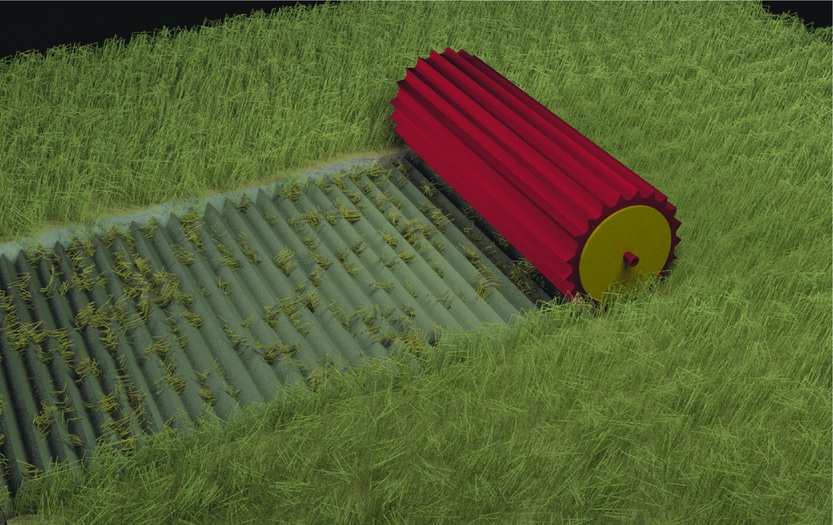
Roller-based equipment, like knife-rollers (Figure 1), crimper rollers and rotovators, has been used for soil preparation in several regions across the world. A number of distinct functions and attributes have been reported for rollers, like seedbed preparation; increased seed–soil contact; breaking of soil clods; soil levelling in rice paddies; control of insect–pests, weeds and cover crops and stubble management, to accelerate decomposition and facilitate the seeding of the next crop. The potential benefits from using roller-based tillage after irrigated rice advance beyond its inherent logistic advantages. A knife-roller operation commonly requires less fuel and draught power if compared to rotovators or plough-and-harrow operations (Pimentel, Reference Pimentel and Fluck1992). Knife-rollers can incorporate rice stubbles near to the soil surface, which, compared to deep incorporation, reduces the amount of methane from residue decomposition (Alberto et al., Reference Alberto2015). The shallow soil preparation inherent to rollers also protects the soil hardpan from disruption, thereby preventing water losses through percolation in the rice paddies (Janssen and Lennartz, Reference Janssen and Lennartz2007). Finally, as the method requires standing water in the field, it is possible to apply a knife-roller passage shortly after rice harvest. Standing water is required, since it allows the soil to be shaped by the weight of the equipment and to reduce the adherence of the soil to the machinery. The advantage of early soil preparation, which is not possible with the conventional method simply because the soil is still too wet for this practice, is the creation of a good opportunity for the establishment of winter pastures or cover crops (Silva et al., Reference Silva, Theisen, Andres, Silva and Idehara2012). This in turn supports crop diversification and a higher production of biomass in the cropping system. A passage of a knife-roller levels the soil and will not completely eliminate compaction resulting from harvesting operations and the tractor pulling the roller. However, this is not a major problem, as the knife-roller method minimizes the frequency of soil disturbance and the instalment of cover crops, particularly grasses, helps to improve the soil structure in the long run.
Representation of a knife roller operating in a post-harvest, watered rice field. Additional parts of equipment are not included in the image. Roller promotes shallow rice straw incorporation, levels the soil and creates uniform depressions in the soil. Drawing made by the author using the software Blender 3D v2.78.

Roller-based methods on their own are seldom described as the single tool used for soil preparation in rice paddies. In the current research, we evaluated the performance of a knife-roller preparing the soil after the harvest of irrigated rice. The roller-based technique was compared to the plough-and-harrow method, in a cropping system in which irrigated rice is rotated with soybean. Besides evaluating time- and energy- requirement, the quality of the seedbed was evaluated based on soybean seedling establishment, uniformity and productivity. Our hypothesis is that if the roller produces similar agronomic results as the plough-based tillage, the efficiency of the overall cropping system is increased, since the knife-roller demands less energy to prepare the soil than the traditional method. The novelty of this research is that the knife-roller was used as the only form of soil preparation in a typical flat lowland field after irrigated rice.
MATERIALS AND METHODS
Initial field preparation
This study was conducted during the cropping seasons 2011, 2012 and 2013 in the Lowlands Experimental Station (LES) of Embrapa, Pelotas, south Brazil (31.8134 S; 52.4736 W). The terrain is flat (0% slope), at 13 m above sea level, and the soil is classified as Solodic haplic eutrophic Planosol (Streck et al., Reference Streck2008), with a hard pan 40–50 cm below soil surface. Soil bulk density was 1.33 kg dm−3, with 15.9 g dm−3 organic matter, 266 g dm−3 clay, 493 g dm−3 silt and 552 g dm−3 sand. The climate is characterized as humid temperate (Cfa, according to Köppen's classification), with an average temperature of 17.8 °C and yearly precipitation of 1370 mm.
A uniform paddy field of 2.7 ha was cultivated with irrigated rice in mid-November 2010, dry-seeded with a no-tillage seeder, in rows 17.5 cm apart. A short-cycle, long-grain variety was used (BRS Querência, with 110 days to maturation). Management for pest control and plant nutrition followed the regional recommendations for irrigated rice (SOSBAI, Reference Sosbai2014). Irrigation started three weeks after rice emergence and 8 cm water layer was maintained until physiological maturity. Rice was harvested with a commercial combine harvester equipped with rubber tyres, approximately 120 days after emergence. At harvest, the water still formed a narrow layer of 0.5–2 cm on the soil surface. The harvest operations resulted in extensive soil disturbance, with machinery tracks measuring an average depth of 30 cm. Following this initial rice cultivation, the field was divided in two parts: one received the experiment and was cultivated with soybean in the next summer, starting a yearly soybean–rice rotation. The other half was for the second year cultivated with rice, and the rotation with soybean started only in the next season. In this way, the experimental field always had a plot available to receive the treatments after rice harvest.
Description of treatments
Two treatments for soil tillage after rice harvest were compared, consisting of the traditional plough and harrow system, and the alternative knife-roller tillage system. Each treatment was applied in three plots of 6 m × 30 m, with breaks of 5 m in between to facilitate machinery operations. Residues remaining on the soil surface were 6.3, 5.9 and 6.7 Mg dry matter ha−1 for the cropping seasons 2011, 2012 and 2013, respectively. Tillage with the knife-roller was always performed in the first week after rice harvest. As the plough and harrow requires dry soil this operation was conducted later, up to 45 days after rice harvest. The essential characteristics of both soil preparation systems are as follows:
Plough and Harrow: the primary tillage after rice harvest used a common five-piece mouldboard plough, inverting the soil and incorporating the rice straw at an average depth of 0.4 m. The secondary tillage was performed between one to two weeks after the mouldboard plough, using a heavy 26″-disk harrow (diameter 66 cm) with 26 disks operating at a depth of 0.3 m, followed by a double-pass of a light 20ʺ-disk harrow (diameter 51 cm) with 28 disks operating at a depth of 0.1 m. In the third cropping season, a large 28″-disk plough (diameter 71 cm) with 3 disks operating at 0.3 m depth substituted the mouldboard plough and only one pass of the light harrow was applied.
Knife–roller system: the knife-roller consisted of a hollow steel drum of 3.6 m length, a diameter of 1.0 m equipped with 15 sharp blades of 0.13 m high. The steel drum was partially filled with water and the operational weight was 2860 kg. A tractor pulled the roller, which, through its weight, levelled the soil and partially incorporated rice straw up to 0.13 m deep. Since free water on the soil surface is required for this equipment – to improve soil levelling, avoid the adherence of soil to the roller and reduce the depth of tractor tracks – the levees in the perimeter of the plots were re-constructed after rice harvest, using a levee-plow. At the moment of rolling, a water layer of 2 cm remained in the field. Two passes with the knife-roller were applied in each plot to create a uniform soil levelling. Figure 1 illustrates the soil adjustment created by the knife-roller.
After finishing a tillage treatment, a series of drainage channels were created with a narrow rotary trencher. The channels were spaced at 20 m, were 0.15 m wide and around 0.30 m deep. The soil was maintained dry during the cold season (April–October). In the succeeding summer, a medium-cycle soybean (cv. BRS 246-RR) was seeded and the drainage channels were re-made. Commercial S2-class soybean seeds with a germination rate of 80% were used. For all cropping seasons, the soybean was seeded in the second week of November with a no-tillage seeder in rows 44 cm apart, at a seeding rate of 70 kg ha−1 (2011) and 60 kg ha−1 (2012 and 2013). All soybean management followed the official regional recommendations.
Energy cost, energy balance and greenhouse gas (GHG) emissions
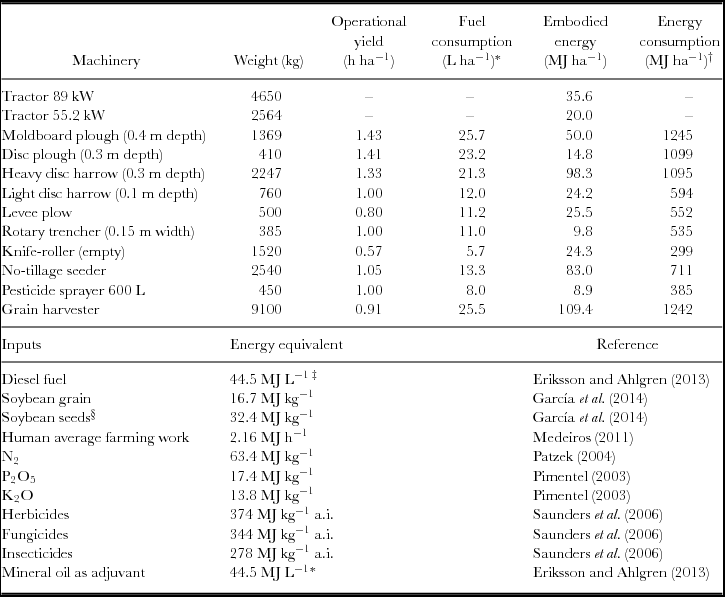
The description of the machinery, their weight, operational yield, average fuel consumption, embodied energy and total energy consumption is presented in Table 1. Operational yield (h ha−1) and fuel consumption (L diesel oil ha−1) were both recorded during the execution of the experiment. Embodied energy represents the energy consumed to build the machinery, distributed over the machines’ normal life span. Embodied energy of machinery and the depreciation over time was calculated using procedures described by Pimentel (Reference Pimentel and Fluck1992). In the table, embodied energy is expressed on a per unit area basis (MJ ha−1), based on the empirically determined operational yield for the machinery. Next to the regular energy consumed for field operation in Table 1, an extra energy of 216 MJ and an extra greenhouse gas (GHG) emission of 13.1 kg CO2-e were attributed to the knife-roller treatment and included in the further analysis. These values are equivalent to a 5-day extension of the irrigation period in order to guarantee a proper amount of standing water on the soil surface. For this addition, the energy consumed by the electro-mechanical irrigation system was calculated from the regional values reported by IRGA (2014).
List and characteristics of machinery and inputs used in the field operations.

*Diesel oil.
†Included energetic content of fuel consumed in each operation and energy embodied in the equipment. Extra 4.5% added in account of lubricants and greases. Energy related to human labour is not included.
‡Value from Lower Heat Value (LHV) of fuels, plus extra 24% added for distribution costs (averaged from Eriksson and Ahlgren (Reference Eriksson and Ahlgren2013)).
§The energy content of certified soybean seeds used was assumed as 2 times the energy contained in the whole grains.
The energy equivalent from the inputs and from soybean grains, as well as the reference from which this information was retrieved, are described in Table 1. To estimate the total energy costs and GHG emissions, the amount and type of nutrients and pesticides used in soybean were recorded for each cropping season. GHG emissions were reported in CO2-e units. Values used were 3.368 kg CO2-e L−1 for diesel (2.966 kg CO2-e from combustion (IPCC, 2006) + 0.320 kg CO2-e from production (Carvalho, Reference Carvalho2012) + 0.082 kg CO2-e from transports (Eriksson and Ahlgren, Reference Eriksson and Ahlgren2013), 5.15 kg CO2-e kg−1 for urea, 2.03 kg CO2-e kg−1 for di-ammonium-phosphate, 0.27 kg CO2-e kg−1 for super triple phosphate, 0.25 kg CO2-e kg−1 for chloride of potassium (Fertilizers Europe, 2014). For pesticides, an emission of 0.069 kg CO2-e per MJ required to process 1 kg a.i. was assumed, using values of 374, 344 and 278 MJ kg−1 a.i. for herbicides, fungicides and insecticides, respectively (Saunders et al., Reference Saunders, Barber, Taylor and University2006). The GHG emissions related to soybean seeding material (seed production, processing, packaging and transport) were estimated according to Heichel (Reference Heichel and Pimentel1980), and assumed as 0.98 kg CO2-e (kg seed)−1.
Data collection
Soybean was sampled to evaluate plant density (at V4 and R8 growth stages) and grain yield (at R8). Each sample consisted of two rows of soybean, located side-by-side with a length of 5 m. Four (2011 and 2012 cropping seasons) and five (2013 cropping season) two-row samples were taken in each plot. At V4, the soybean plants were counted in the field. At R8, the plants were pulled out, counted and then threshed in an electrical threshing machine to evaluate grain yield. Grain moisture was evaluated in an automatic analyser and the yield was standardized to 13% moisture.
The variables used to compare both soil preparation methods were: (i) soybean plant density (plants ha−1) at V4 and R8; (ii) soybean grain yield (kg ha−1); (iii) total energy consumption (MJ ha−1) from soil preparation to soybean harvest; (iv) energy used for soil preparation (MJ ha−1); (v) GHG emitted (kg CO2-e ha−1) from soil preparation to soybean harvest; (vi) GHG emitted by the machinery in soil preparation (kg CO2-e ha−1); (vii) energy balance (GJ ha−1); (viii) Energy Return on Energy Invested (MJin MJout−1), representing how efficiently the energy from the inputs was converted into soybean grain energy; (ix) yield-scaled energy demand (MJin Mg soybean−1), representing the energetic cost to produce 1000 kg of soybean; (x) time required for soil preparation (h ha−1); (xi) amount of soybean produced per kg CO2-e emitted.
Statistical analysis
The experiment was carried out as a randomized complete block design, with three replications per treatment in each cropping season. Data were tested for normality assumption using the Shapiro–Wilk test provided by the Proc Univariate in SAS software version 9.4 (SAS Institute, 2016). No data transformation was needed. Analysis of variance was applied to data and tillage treatments compared by F test. Variability of soybean density and grain yield was evaluated by the Levene´s test, with an additional aid of the graphical diagnostics provided by the option ‘plot=diagnostics’ in the GLM procedure in SAS software. Data is presented as means and their respective standard errors (SEM).
RESULTS AND DISCUSSION
Technical results on soybean
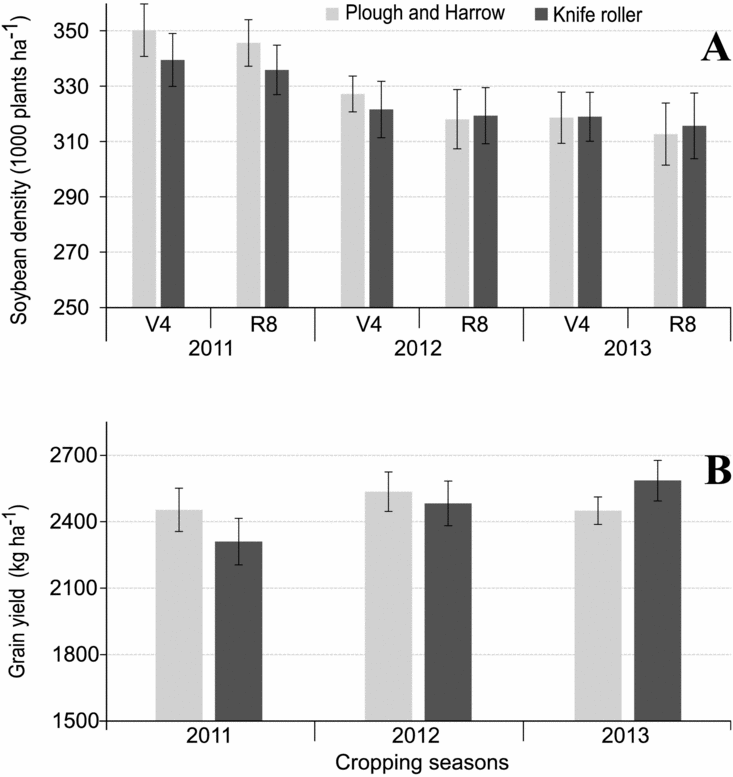
Rice–soybean rotation is used in several lowland cropping systems in the world. Constraints associated to residue management and seedbed formation are a well-known difficulty of these hydromorphic soils (Garrity et al., Reference Garrity and Gines1990). Soybean requires an efficient soil drainage system and an adequate seedbed formation for attaining high rates of seed germination, adequate seedling survival, a uniform plant stand and high growth rates during the early stages of development (Wuebker et al., Reference Wuebker, Mullen and Koehler2001). The current experiment showed that both methods of soil preparation were effective in preparing an appropriate seedbed for soybean seeding and germination. In none of the three cropping seasons, we found significant differences in soybean population (P > 0.43) between Plough and Harrow and the alternative Knife–Roller system, either at the initial stage (V4) or at soybean maturity (R8) (Figure 2a). On average, final soybean density was according to the recommended population for the crop in south Brazil (240,000–360,000 plants ha−1). In the first cropping season, the population was approximately 30,000 plants ha−1 higher than in the last two seasons (Figure 2a), following the difference in seeding rates between 2011 (70 kg ha−1) and 2012 and 2013 (60 kg ha−1).
Influence of two soil preparation methods (plough-and-harrow, grey columns; knife–roller, dark columns) on soybean plant density (a) at two growing stages (V4 and R8) and grain yield (b), in three cropping seasons. Bars represent the standard error of means. Within a cropping season, the differences between soil preparation methods were not significant for any of the measured characteristics (P > 0.05).

For both treatments, soybean density at R8 was, on average, 1.5 ± 0.3% lower than the density observed at V4 (Figure 2a). This result is not a surprise, since a minor adjustment due to self-thinning is normally observed as the crop develops towards maturity. In the experiment, some plants also got lost because of temporary flooding, which occurred in parts of the field after the rains. These flooded spots, which are common for lowland paddies, were observed in both soil preparation methods and coincided with small depressions dispersed over the terrain surface, with an individual area no larger than 0.3 m2.
Similar to soybean density, the methods used to prepare the soil after irrigated rice did also not influence soybean grain yield. In the first cropping season, an apparent gain in favour of Plough and Harrow was perceived, whereas in the last season, a difference in favour of the alternative Knife–Roller system was observed (Figure 2b). These differences, however, were not significant (P > 0.05). Additional to the comparison between yield averages, we examined the data on plant density and grain yield from the variability perspective, since establishing a uniform plant population is one of the key factors for enabling a high yield potential for soybean (Tourino et al., Reference Tourino, De Rezende and Salvador2002). Variability of plant density and grain yield was similar for both treatments (P > 0.05; according to Levene's test). This result reinforces the evidence that the roller-based method, from an agronomic perspective, has a potential to produce similar results as the traditional plough-and-harrow system on seedbed preparation following irrigated rice.
Energy consumption and greenhouse gas emissions
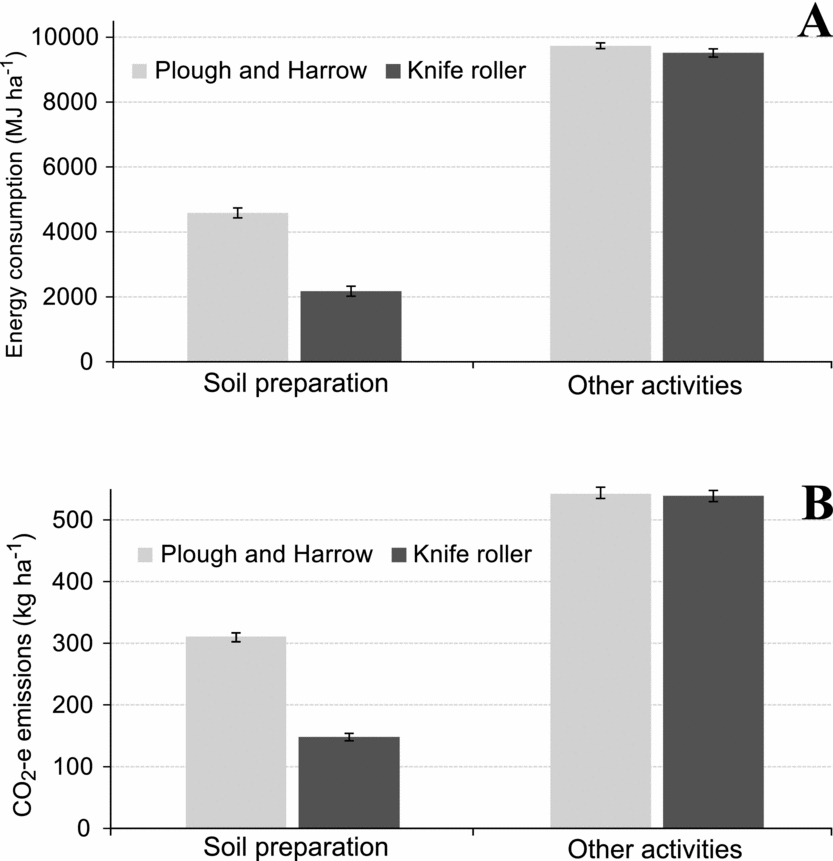
The energy consumed to cultivate soybean ranged from 11.7 (knife-roller) to 14.3 (plough and harrow) GJ ha−1 per cropping season (data from Figure 3a). These values are higher than the energetic cost reported by Ferreira et al. (Reference Ferreira, Neumann and Hoffmann2014) in Brazil [around 7.5 GJ ha−1], but lower than the costs described by Hamzei and Seyyedi (Reference Hamzei and Seyyedi2016) in Iran [27.8 to 31.8 GJ ha−1]. Regardless of such differences, our data visibly revealed the distinction between both soil preparation methods from the energy perspective. Energy costs were reduced with 18% when the soil was prepared with the knife–roller. This difference could be largely attributed to soil preparation, which made up 32% and 19% of all energy required, for the Plough and Harrow and the Knife–Roller methods, respectively. The conventional system, based on plough and harrow, required two times more energy to prepare the soil than the alternative method based on the knife–roller (Figure 3a).
Energy consumed (a) and greenhouse gas emitted (b) related to soil preparation and other activities in soybean production using either plough-and-harrow (grey columns) or knife-roller (dark columns) as soil preparation method. Data averaged over three cropping seasons. Bars represent the standard error of mean.

GHG emission (Figure 3b) followed a similar trend as observed for energy consumption. Cropping soybean under the traditional plough and harrow method emitted 140 kg CO2-e ha−1 more than under the alternative knife–roller based method. A high correlation between energy consumption and GHG emissions is expected, since most of the energy used in soybean production originates from fossil fuels, which are an important source of GHG emissions. Similar to what was mentioned above, these differences between both tillage methods largely originated from the distinct amounts of fuel used for soil preparation. While the quantity of diesel fuel used in the alternative system in soil preparation was about 45 L ha−1 (from a total of 132.9 L ha−1) per cropping season, the conventional system consumed on average 94 L ha−1 (of 182.6 L ha−1).
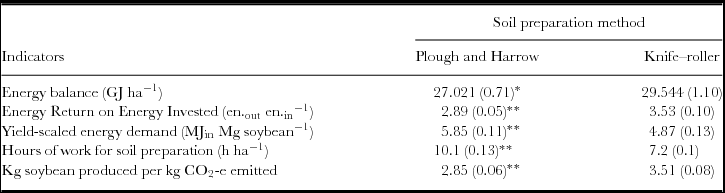
Different from the agronomic characteristics (plant density and grain yield), the indicators related to energy, labour time and GHG emissions pointed at important differences between the soil preparation systems (Table 2). The energy balance, which indicates the energy represented in soybean grains after discounting for all energy used in production, was 9% larger in the Knife–Roller method. Energy Return on Energy Invested, which represents the net energy produced by each unit of energy put in the system, improved with 22% when the alternative method was used. In the same way, the yield-scaled energy demand, which represents how much energy was required to produce 1 Mg of soybean, was more favourable with the Knife–Roller method. Energy savings of 20% per Mg of soybean produced were obtained by using the alternative method of soil preparation.
Indicators related to energy, labour time and greenhouse gas emissions in soybean cultivated in lowland fields, which were submitted to two distinct forms of soil preparation following irrigated rice in the previous cropping season.

The differences between tillage systems are significant at levels of P < 0.05 (*) and P < 0.001 (**). Values between parentheses are the standard error of mean.
Since the soybean grain yield was similar between the two soil preparation methods, but the energy consumed and the GHG emissions were distinct, the results found for the integrated indicators combining these aspects were not a surprise. For instance, the indicators Energy Return on Energy Invested, Yield-scaled energy demand, and soybean produced per kg CO2-e emitted, all revealed the superiority of the alternative method. These indicators consistently showed an average advantage of around 22% of the new system over the conventional plough-and-harrow method. Such differences are highly relevant. Agricultural improvements on energy use and GHG emissions, as reported here, are required to meet international targets regarding agriculture and global warming (Blandford and Josling, Reference Blandford and Josling2009), and also provide incentives for local farmers towards a more sustainable agriculture, congruent with the ‘Low-Carbon-Agriculture’ program in Brazil (Brasil, 2012).
Using the knife–roller system instead of the traditional method for soil preparation saved 29% in labour time. The relatively high speed that can be used with the alternative method and the reduced number of passes (just two, whilst the conventional system requires three to four passes) are responsible for this difference. The last indicator, which related GHG emissions to soybean production, was also in favour of the alternative, roller-based soil preparation. In this case, the knife–roller system produced 0.66 kg more soybean per unit of CO2-e emitted than the traditional method of soil preparation, which corresponds to a 23% increase.
Evidence for further benefits from the roller-based system
Frequency and intensity of soil preparation are the most important factors influencing soil quality in lowlands, and these factors affect especially soil bulk density (Lima et al., Reference Lima, Hoogmoed, Pauletto and Pinto2009). The roller-based method, in this perspective, is a step towards the improvement of soil quality, since the system disturbs the soil less frequently if compared to the conventional method. We speculate that the roller system can provide additional benefits in another way: as the field is prepared earlier than with the conventional method, the establishment of pastures is anticipated and the system produces a larger amount of biomass during winter time. In this situation, livestock will have access to more food, in a period which is normally restrictive for cattle in the lowlands of south Brazil, due the shortage of pastures (De Moraes et al., Reference De Moraes, Carvalho, Anghinoni, Lustosa, Costa and Kunrath2014). Additionally, the deposition of manure and the biomass remaining from pastures can increase soil quality in these integrated crop-livestock systems (Assmann et al., Reference Assmann2015).
Economic indicators were not the main focus of the present work; however, some considerations are relevant in this context. Our records pointed out that the roller-based method reduced the total amount of fuel used to produce soybean by almost 50 L ha−1. Such savings represent an economic gain of 27% on fuels, which were derived through a reduced number of soil operations, combined with the less energy demanding nature of these operations. In parallel, consistent reductions in the expenses related to labour are inferred from the roller-based method, since the system reduced the time required for soil preparation with almost three hours per hectare, if compared to the conventional method. A lower number of hours on labour can also reduce the economic depreciation of machinery, since all fieldwork is conducted using machines. In this specific case, benefits in the order of 28% are expected for machinery depreciation. These aspects are important and reflect some additional advantages evidenced by the roller system. In the long run, these benefits can represent stable savings to the benefit of farm profitability.
Final remarks
In the southern Brazilian lowlands, large programs to increase rice yield were successfully implemented in the last years. Increasing the grain yield per unit of land was, and still is, a priority for most farmers, suppliers and scientists. In most fields, however, such increases are largely based on a higher energy use (e.g. more fertilizers, more pesticides and intensive soil preparation). In our view, and in line with Bennetzen et al. (Reference Bennetzen, Smith and Porter2016), a sustainable, modern cropping system should neither be myopic regarding energy-efficiency issues, nor depend on solutions, which are far too complex for the farmers to accomplish. The current research demonstrates that increasing the efficiency of lowland cropping systems can be obtained through relatively simple measures, as the knife–roller based method. From a practical point of view, that is what matters: a fast and easy way to prepare the soil was identified, and the method is suitable for one of the most important rotation schemes used in lowlands at a regional level. The use of this technique can obviously present different results under other conditions, but we are convinced that the roller-based method, by its inherent simplicity and easiness, can be tested and successfully used in other lowland farming systems.
CONCLUSIONS
In this research, the performance of a heavy knife-roller to prepare the soil in a typical hydromorphic lowland soil was evaluated. The equipment was operated in a watered field soon after mechanical rice harvest, and the method was compared to a conventional plough-and-harrow soil preparation system. Both methods for soil preparation adequately level the soil and prepare an acceptable seedbed for soybean cultivation in the next summer season. Population uniformity and plant density at V4 and R8 soybean growth stages, as well as soybean grain yield, were similar between both methods. The roller-based method, however, requires less energy, allows for a smaller time gap between rice harvest and soil preparation and is faster than the conventional system. Indicators integrating energy, grain production and GHG emissions confirm that the alternative technique, besides its inherent logistic advantages, offers a smart and sustainable option for soil preparation in lowland cropping systems.
Acknowledgements
The authors express their gratitude to the staff from the Embrapa Clima Temperado and to the Eng. Agronomists Marcus Fipke and Joice Fernanda Lübke Bonow for their field assistance. This work was funded by the Brazilian Agricultural Research Corporation (Embrapa). The authors declare there is no conflict of interests regarding this research.