Introduction
The circumpolar north is being transformed at an increasing pace, caused by, among other things, climate change and its consequent effects (IPCC Reference Solomon, Qin, Manning, Chen, Marquis, Averyt, Tignor and Miller2007, Reference Field, Barros, Dokken, Mach, Mastrandrea, Bilir, Chatterjee, Ebi, Estrada, Genova, Girma, Kissel, Levy, MacCracken, Mastrandrea and White2014; Overland and others Reference Overland, Wang, Walsh and Stroeve2014). In parallel with receding ice-caps, the global economic landscape has been extending towards the north (Harsem and others Reference Harsem, Heen, Rodrigues and Vassdal2015). As the Arctic Ocean is a semi-enclosed sea, and not a landmass, access to the Arctic and its business outlook depend on maritime activity (Williams and others Reference Williams, O’Sullivan and Wilkinson2011). Accordingly, Arctic shipping has gained a new momentum from a global perspective through the unfolding of shorter maritime connections with a close proximity to areas with high natural resource potential (Coen Reference Coen2012; Wilson Center 2013; Bondareff Reference Bondareff2014). In this process, establishing efficient Arctic maritime networks has become pivotal. Out of these connections, a route trailing the coast of the Russian Arctic, the northern sea route (NSR), is considered the most prominent (Stephenson and others Reference Stephenson, Smith, Brigham and Agnew2013). The NSR comprises a central part of the northeast passage (NEP), a link between the Atlantic and the Pacific oceans.
The Arctic maritime economics has been a recurrent topic in polar research for over 50 years (for example, Armstrong Reference Armstrong1952; Sherman Reference Sherman1969; VanderZwaag and Lamson Reference VanderZwaag and Lamson1990; Pullen and Swithinbank Reference Pullen and Swithinbank1991; Granberg Reference Granberg1992; Wergeland Reference Wergeland1992). Since the 2000s much literature devoted to analysing the feasibility of Arctic shipping, in particular the NSR shipping, has emerged (for example, Ragner Reference Ragner2000a; Verny and Grigentin Reference Verny and Grigentin2009; Liu and Kronbak Reference Liu and Kronbak2010; Schøyen and Bråthen Reference Schøyen and Bråthen2011). These studies have revealed that economic viability is constrained by a number of Arctic-specific operational and economic factors. These relate to prerequisites for predictability and schedule reliability, which are vulnerable to prevailing physical and environmental conditions (Moe and Jensen Reference Moe and Jensen2010). Especially for the NSR, one of the underlying economic factors is the pricing of ice-breaking services levied for escorted ships (henceforth referred to as ice-breaking tariff policy). High ice-breaking fees have been identified as one of the primary obstacles for viable NSR operations (Granberg Reference Granberg1998; Liu and Kronbak Reference Liu and Kronbak2010; Moe and Jensen Reference Moe and Jensen2010).
Tariffs can be considered as a policy instrument intended to regulate market access. Therefore careful consideration needs to be paid both to the basic properties of the NSR shipping market and to the ice-breaking tariff policy development. In 2009, a comprehensive study relating to Arctic shipping, the Arctic marine shipping assessment (AMSA 2009) concluded that the NSR ice-breaking tariff policy has many challenges in order to sustain the growth of traffic. The fee levels were considered too high as they were based on the actual cargo volumes, not supportive of the application of sophisticated ship technology, and their transparency was deemed insufficient. Since then, the ice-breaking tariff policy has been further developed as a number of changes were introduced, but still the information on it is scattered, and this results in ambiguousness in determining the route's overall viability. Unlike previous accounts that conceived opportunities and challenges of the NSR in a broad manner, this study aims at reviewing one component of the NSR policy environment, namely the ice-breaking tariff. The timeframe is set from 1991, when the NSR was officially opened for non-Russian vessels, until 2014, when the latest changes to the NSR ice-breaking policy were introduced. The hypothesis may be put forward that NSR ice-breaking tariff policy plays an important role in the development of the NSR as it largely influences the operational aspects of navigation, yet, in order to determine the overall competitiveness of the NSR, and consequently the future traffic volumes, contextual political and strategic considerations should be taken into account.
In order to address this hypothesis, the paper turns to the concept of institutions. Institutions are understood here as latent structures that function as bearers of social constraints and incentives, and stand behind the observed processes and events as ‘rules of the game’ (North Reference North1990). The institutional approach to study of complex social processes emphasises multiple external factors that affect actors (including political, economic, technological, legal and environmental). At the same time, in course of policy formation, actors can (re)shape their institutional environment. Thus, social structure appears as both the medium and the outcome of the regular interactions in which actors engage (Giddens Reference Giddens1984; Aalto and others Reference Aalto, Dusseault, Kivinen, Kennedy and Aalto2012). The analysis offered in this paper takes account of the existing structural conditions (physical/environmental, financial and legal) in order to reveal how the volatile Arctic policy environment affects the attractiveness of the NSR. The paper examines strategies employed in ice-breaking tariff policy as means to secure the core economic and political interests vulnerable to structural uncertainties. Qualitative and longitudinal quantitative data related to NSR traffic, ice-breaking tariffs and ice conditions constitute the empirical material used in this investigation, as well as the broader context of the Arctic policy environment.
There are long-standing traditions of using the NSR in Russia, as it was an integral part of former Soviet maritime networks (Goncharov Reference Goncharov2011). Its modern period was initiated in the 1930s, mainly to facilitate the extraction of natural resources and to supply Arctic settlements (Selin and Istomin Reference Selin and Istomin2003). During the Soviet era, technological breakthroughs in ship-building and the expansion of Soviet production facilities in the high north enabled steady growth of NSR transport and by the end of the 1970s, year-round navigation commenced in the Western part of the NSR. Traffic volumes reached peak levels in the mid-1980s. After the collapse of the Soviet Union, the utilisation of the NSR was rather limited as a result of the profound change in the Russian political and economic systems and the subsequent loss of governmental financial support (Selin and Istomin Reference Selin and Istomin2003: 21). In 2009 the revival of the NSR to its former state has become a priority laid down explicitly in the Russian Arctic strategy 2020. New NSR legislation was implemented in 2012 and subsequently significant resources have been allocated from the federal budget to refurbish the deteriorated infrastructure, including the construction of nuclear powered icebreakers to renew the aging tonnage (Pavlenko and others Reference Pavlenko, Glukhareva, Kutsenko, Chung, Hong, Langen and Prinsenberg2011; Mikhaylichenko Reference Mikhaylichenko, Young, Kim and Kim2012). Yet, the development of transport infrastructure alone cannot foster international interest in use of the NSR as a new transcontinental connection. The prospects of international cooperation in the Arctic shipping are vulnerable to instabilities outside the region, such as the 2014 Ukrainian crisis, that raised questions about the scale of Russia's ambitions in its border regions and sustainability of fostering the Arctic cooperation (Olesen Reference Olesen2014; Klimenko Reference Klimenko2014).
Over the last five years, the Russian Federation (RF) has become openly engaged in Arctic issues, driven by its political and economic endeavours. Its interest in the NSR was meant to improve Russian access to the abundant Arctic natural riches and facilitate their extraction and subsequent transportation. At the same time, if revitalisation of the NSR can extend it from being a part of the Russian maritime system into a part of the global maritime networks, the NSR can also have an impact upon global seaborne trade patterns (Ragner Reference Ragner and Hallberg2008; Moe and Jensen Reference Moe and Jensen2010). Yet, whether or not the NSR will also become a viable transit route in global context depends on an intertwined complex of developments. The primary drivers of NSR shipping are linked with the dynamics of climate change and global market conditions. Further, NSR governance pursued by the RF and technological development can be considered as paramount. Since under the prevailing climatic conditions unassisted passage of vessels remains subject to operational, safety and environmental uncertainties, operations in the Arctic largely rely on ice-breaking services. That is why clarifications on the tariff policy's history and prospects are relevant and a timely subject of research.
The paper proceeds as follows. Section 2 presents background information regarding the NSR by reviewing its geography and cargo flows, including the development of navigational conditions and administration. Section 3 discusses in detail the provision of ice-breaking services. Section 4 specifically turns to ice-breaking tariff policy and places it in context within both economic and political developments. Section 5 presents the findings and section 6 concludes the paper.
NSR shipping in the context of Arctic changes
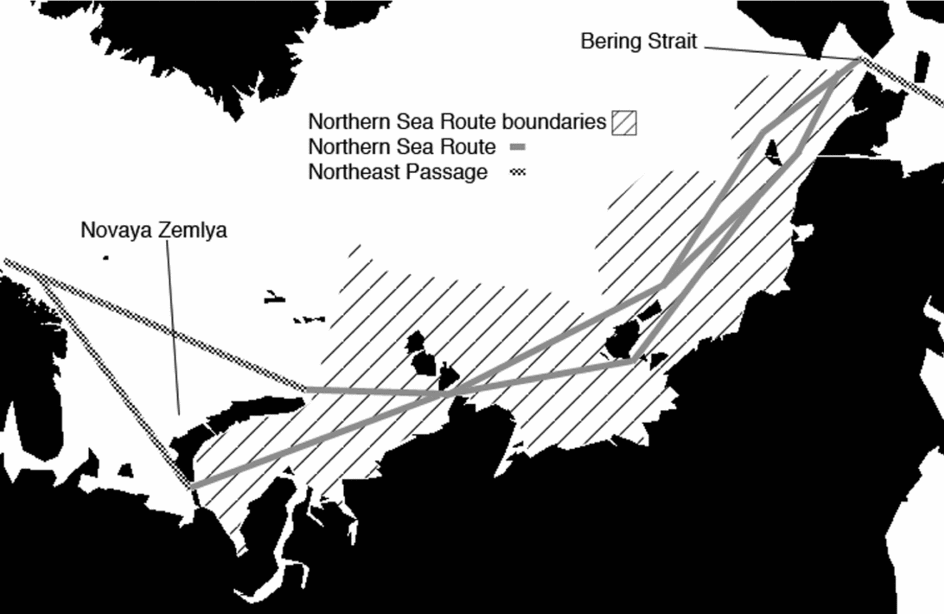
The NSR (in Russian: Severnyj morskoj put’) is a network of shipping routes located on the coast of the Russian Arctic within the Russian exclusive economic zone (EEZ) as defined in Russian Federal Law (last amended 2012). The NSR is not a single waterway (Fig. 1); it consists of several routing alternatives between Novaya Zemlya and the Bering Strait depending on seasonal, regional and annual variations of ice-conditions and consequent routing decisions (Ragner Reference Ragner2000a).
The northern sea route (NSR) (Source: authors).

The legal status of the NSR is defined in the Russian federal legislation based on the principles of the UN Convention on the Law of the Sea 1982 entailed in Art. 234. This article authorises the coastal states to adopt and enforce non-discriminatory laws and regulations for the prevention and monitoring of marine pollution from vessels in ice-covered areas. The status of the NSR has been internationally disputed and no agreement has been yet reached. Russian claims of sovereignty over the NSR conflict with the official position of USA and the European Union, which state that it passes through international straits, but thus far Russia's de facto control over the NSR has not been actively challenged (Blunden Reference Blunden2012). Despite the legal controversies over the status of the passage, Russian authorities are actively engaged in the administration and management of the NSR.
Under the current system, the NSR administration (NSRA) grants navigational permits to the NSR water area; 16 Russian port authorities maintain their own infrastructure and provide safety of navigation at the Arctic sea ports; the Federal State Unitary Enterprise (FSUE) Rosatomflot provides nuclear ice-breaking services as well as ice-pilotage together with Ice Pilots Ltd and FSUE Rosmorport, the Joint Stock Company (JSC), the Far Eastern Shipping Company, and the JSC Murmansk Shipping Company. Thus, the overall NSR governance system can be described as multi-leveled (involving federal, regional and municipal/local authorities), as well as polycentric (involving government authorities, ice-breaking and ice-pilotage services providers, shipping companies, ports and navigational service providers) (Sintsov Reference Sintsov2004).
The role of global climate change as a primary contributor to the increased utilisation of the NSR has been widely discussed. Recent climate studies project unprecedented levels of warming in polar areas and consequent decrease in Arctic sea ice extent (ACIA 2005; IPCC Reference Solomon, Qin, Manning, Chen, Marquis, Averyt, Tignor and Miller2007, Reference Field, Barros, Dokken, Mach, Mastrandrea, Bilir, Chatterjee, Ebi, Estrada, Genova, Girma, Kissel, Levy, MacCracken, Mastrandrea and White2014; Stephenson and others Reference Stephenson, Smith, Brigham and Agnew2013). This, in turn, could facilitate an enlargement of Arctic maritime activity by improving accessibility, providing easier ice-conditions and subsequently lengthening the annual navigational season. Currently, the NSR navigational conditions are a subject to distinct annual, seasonal and regional variation. For instance, 2012 was a record low year with 3.41 million km2 of ice at the end of the annual melting season in September. The respective number for 2014 was 5.02 million km2 (Vizcarra Reference Vizcarra2014). The sheer ice-extent is not a conclusive indicator of the viability of maritime activities since it does not indicate the thickness of ice. In particular, thick multi-year ice poses serious obstacles for shipping operations.
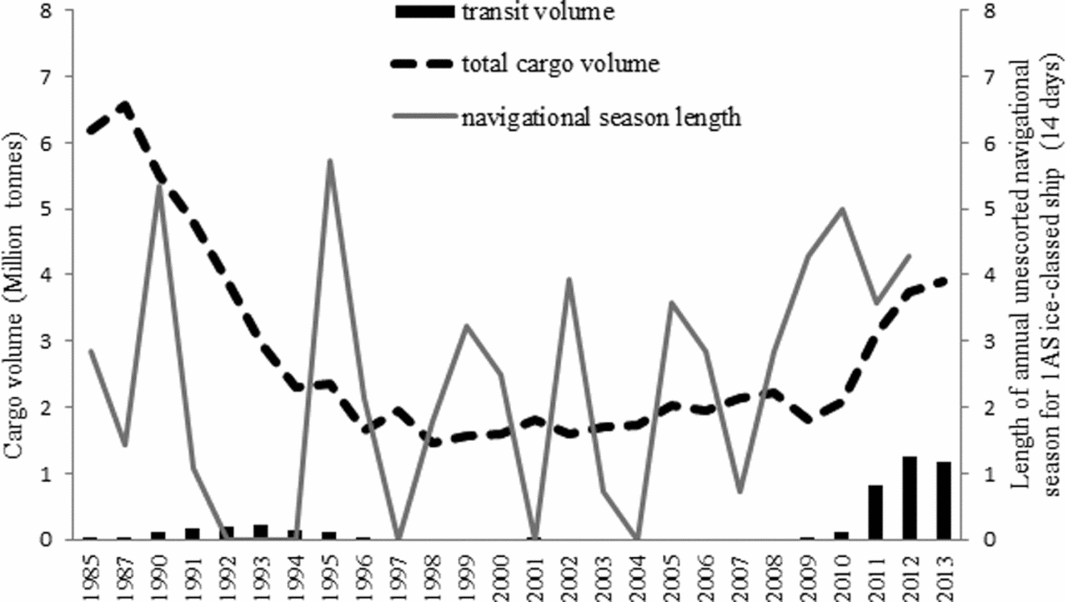
A viable measure for displaying the actual ice conditions is the length of annual navigational season. Fig. 2 illustrates the dynamics of the length of annual unassisted navigation for 1A Super (1AS) ice-classed ships and cargo flows between 1985 and 2013. Ice data is obtained from the Arctic and Antarctic Research Institute (AARI), the state scientific centre of the RF. Currently, the annual navigational season in the NSR, with ice-breaker and ice-piloted convoys, lasts typically from late June to late November. For example, in 2013 the navigational season was 146 days (NSRIO 2014). Albeit that climate change is transforming the Arctic, there is considerable uncertainty regarding the pace and magnitude of thawing. Ice shrinkage has been most substantial at the end of the melting season in autumn, suggesting that an ice-free Arctic Ocean during the summer period could be reality in the foreseeable future. Yet, ice is not expected to disappear completely: none of the climate models predict a year-round ice-free Arctic Sea by the end of century. Given the seasonal nature of shipping operations, ice-breaking support is likely to remain a necessary component, even in the event of further ice retreat, since the amount of ice hummocks (pressure ridges) and drifting icebergs hazardous for ships is likely to increase (AARI 2014).
Dynamics of the NSR seasonal length of unassisted passage of 1AS ice-classed vessels (right axis; unit = 14 days) and cargo volumes (left axis; transit and total cargo volumes in million tonnes). (Source: own compilation upon data acquired from CNIIMF (The Central Research and Design Institute of the Maritime Fleet), St. Petersburg, Russia) and AARI).
The dynamics of NSR navigation can be further illustrated with the historical data on shipping volumes 1985–2013, also presented in Fig. 2. It shows that cargo volumes peaked in 1987 when a total of 6.6 million tonnes were carried. After the dissolution of the Soviet Union the volumes plummeted and only recently they have gradually started to recover. There are four types of maritime activities on the NSR: (1) destinational traffic, the largest part of NSR traffic that serves a purpose of delivering cargo to the peripheral northern regions, (2) intra-Arctic cabotage, voyages conducted within the destinations along the NSR, (3) import/export transport voyages to/from the ports along the NSR to/from the ports outside the NSR, (4) transit.
There is no conclusive definition of ‘transit traffic’ in the extant literature. Strictly speaking, an ‘NSR transit’ voyage shall fulfill two criteria. First, a vessel traverses the whole NSR (from Novaya Zemlya to Bering Strait or vice versa, see Fig. 1). Second, no port calls are made while transiting within the boundaries of the NSR. Thus, a voyage between Murmansk and Vladivostok fulfils the criteria of the definition whereas a voyage from Yokohama to Hamburg with a call at Pevek does not. However, broader utilisation of the NSR as a shortcut between Europe and Asia extends the notion of ‘NSR transit’ to transcontinental traffic between Atlantic and Pacific oceans. More pragmatic definitions consider also transcontinental voyages that included calls at the NSR ports as ‘transit traffic’.
During the 1990s, total cargo volume decreased by almost 80%, in particular due to the shrinkage of destinational transport, especially in the eastern part of the NSR. Furthermore intra-Arctic cabotage and import/export activity also decreased. Import/export and transit activities were subjected to market fluctuations to a greater extent than destinational traffic and intra-Arctic cabotage. It is broadly acknowledged that the main reason for decreased traffic volumes during the 1990s was a decrease in extractive and production activities in the Arctic caused by the economic crisis (Granberg Reference Granberg1998; Selin and Istomin Reference Selin and Istomin2003; Buyanov Reference Buyanov2004). During the last decade, however, shipping volumes started to recover, which can be explained by the revival of Russian economy in the 2000s and the state support for NSR activities as a part of the wider Russian Arctic development policy, which was prompted by the need for the Russian oil and gas industry to move to exploit Arctic deposits. To date, besides shipping companies, large Russian extractive industry companies, such as Norilsk Nickel, also have a fleet of highly ice-classed vessels operating independently in the western part of the NSR operation on year-round basis.
From 1989–1996, only a limited number of commercial transits through the NSR took place by Russian ice-classed cargo vessels of the multi-purpose type Norilsk (SA-15, with ice class Arc 7, equivalent to Polar Class 4) and bulk-carriers of Dimitry Donskoy (ice class Arc 5, equivalent to Polar Class 6) classes (Isakov and others Reference Isakov, Yakovlev, Nikulin, Serebryansky and Patrakova1999). These voyages included shipments from Murmansk and Latvia to Japan, China and Thailand (Ragner Reference Ragner2000b). Sailings commenced in 1989 due to favourable currency rates inducing Russian ship owners to earn highly-valued US dollars (Yakovlev and others Reference Yakovlev, Semanov, Ivanov, Ushakov, Zubarev, Gavrilo, Khlebovitch, Moe, Thomassen and Brude1999). The transit traffic consisted of dry bulk cargoes (Granberg Reference Granberg1998) and reached its contemporary peak in 1993 when 208,600 tonnes of cargo were shipped by SA-15 multi-purpose cargo ships in their 30 voyages (Østreng Reference Østreng, Heininen, Exner–Pirot and Plouffe2012). Though volumes declined by 1996, followed by an almost complete interruption of transit activity, the transit activity gave a first glimpse of NSR's potential to serve as an international shipping route (Ragner Reference Ragner2000b).
In 1991, the NSR was officially opened for non-Soviet/Russian flagged vessels. Soon thereafter, in autumn 1991, a French Arctic supply vessel L’Astrolabe carried out a voyage from Murmansk to Provideniya (Ushakov Reference Ushakov and Ragner2000). In 1997, a 16,000 DWT Finnish oil tanker M/T Uikku passed through the NSR. In July-August 2001 Kapitan Nazarar’ev transported 17,000 tonnes of minerals from the Philippines to Rotterdam. The relatively small amount of transported cargo may be seen as an indication that the voyages had a trial-based approach to the commercial and operational aspects of maritime activities.
In 2009, boosted by the gradual retreat of sea ice, trials by non-Russian companies interested in the NSR revived. For instance, two project-cargo carriers operated by German-based Beluga Shipping traversed the NSR from South Korea to Germany with a call in Novyy Port. By 2013, 1.35 million tonnes were carried along the NSR, serving ports in Canada, China, Finland, Japan, the Netherlands, Poland, Russia, South Korea, Taiwan and other countries, consisting mostly of bulk cargoes (NSRIO 2014). The factual prevalence of bulk cargo is consistent with the literature arguing that under the current conditions the NSR is most suitable for bulk transport (Schøyen and Bråthen Reference Schøyen and Bråthen2011; Lasserre Reference Lasserre2014). However, there is no agreement concerning the status of these voyages (Sander and others Reference Sander, Gille, Stepien, Koivurova, Thomas, Gascardand and Justus2014). While official statistics accounted for 71 transit sailings in 2013, a closer investigation reveals that only 41 voyages qualify as ‘transit traffic’ according to the strict definition (see earlier in the section).
In 2009, the Russian government established an ambitious goal to create and develop the management of the NSR and associated infrastructure to enable ‘pan-European transit’ (Russian Arctic Strategy 2020 2009) and in 2011 President Putin emphasised that increasing international transit on the NSR is one of the top priorities for Russia's Arctic policy (Putin Reference Putin2011). This political pursuit opened a window of opportunity for international use of the NSR resulting in a number of trial-based transit sailings. The growth of total cargo volume and in particular of initial steps of international transit traffic (Fig. 2) have created a glimpse of optimism regarding the prospects of NSR revival in Russia and consequently raised modest interest outside Russia for harnessing the NSR as a transcontinental shipping route. Yet, there has been no systematic investment into the future of the NSR neither from Russia nor from large shipping companies, as everybody adopted a ‘wait-and-see’ strategy (Lasserre and Pelletier Reference Lasserre and Pelletier2011; Huang and others Reference Huang, Lasserre and Alexeeva2014). The waiting has not been long. The change of the political situation in 2014 after the Ukrainian crisis and the sanctions between the west and Russia, accompanied by the low level of commodity prices of hydrocarbons, have reduced interest in the NSR transits as a whole. The number of voyages supported by Russia's Atomflot ice-breaker fleet has fallen from 71 in 2013 to 31 voyages during 2014 navigation (among those only six vessels sailed under a non-Russian flag) (NSRIO 2014). The more dramatic drop is shown in cargo volumes as only 274,000 tonnes were carried in contrast to over a million tonnes in 2013. It seems that the political uncertainties hindered interest towards NSR use outside Russia.
The role of ice-breaking in the NSR
The development of ice-breaking technology has been vital to NSR development (Ruksha and others Reference Ruksha, Smirnov, Kashka and Babich2011; Verevkin Reference Verevkin2012). In particular, the introduction of nuclear icebreakers, initiated in 1957 by the deployment of N/S Lenin, has significantly altered the exploitation of the NSR. By the 1970s, technical progress in ice-breaking and ship-building allowed for the extension of the navigational season to 6 months. In the late 1980s, when the NSR navigation had reached its peak years, the total fleet operating in the NSR and on the big rivers of Siberia consisted of 38 icebreakers, out of which six were nuclear-powered (Østreng Reference Østreng1991; Doyban and others Reference Doyban, Batskih and Luzin1995; Selin and Istomin Reference Selin and Istomin2003). There was also a large fleet of nearly 700 ice-classed merchant ships operating in the NSR on a year-round basis (Østreng Reference Østreng1991). The active Russian NSR fleet includes six nuclear icebreakers and the atomic containership Sevmorput as well as a number of diesel-powered icebreakers. Nuclear icebreakers operate in line escort missions along the NSR while diesel icebreakers are mostly used in port operations. As most of the active fleet will be decommissioned by 2025, the construction of the next-generation of nuclear powered icebreakers is required. According to the latest estimates, replacement tonnage is to be deployed between 2017 and 2021 (Eilertsen Reference Eilertsen2014), yet, financial uncertainties due to Russian economic instability may result in delays.
According to the new NSR rules of navigation, introduced in 2012, the use of ice-breaker services is no longer mandatory, given that permission for navigation has been acquired from the NSR administration. However, de facto practice more often than not urges ship owners to use ice-breaker assistance for, among other things, safety and marine insurance reasons (Sarrabezoles and others Reference Sarrabezolesa, Lasserre and Hagouagn’rin2014). Service is performed by nuclear icebreakers under the Russian flag and fees are subject to services rendered in accordance with a tariff. In addition to the actual support of the icebreaker in ice-convoys, the service typically also includes ice reconnaissance.
Over the last 25 years, the ice-breaking services have been constantly experiencing financial flux. During the Soviet period, the economy of the NSR maritime infrastructure was artificially sustained by tariff policy adjustments, direct subventions, and other forms of state support including capital/infrastructural investment (Selin and Istomin Reference Selin and Istomin2003: 25). After the dissolution of the Soviet Union, the ice-breaking fleet has continued to be financed from the state budget, but the subsidies have been insufficient. For example, in 1993 state subsidies covered only 12.7% of the total expenses of icebreakers (Granberg Reference Granberg1998: 193). Given the lack of state capacity to maintain the ice-breaking fleet, a decree was issued in 2002 that prescribed ceasing the state subsidy of ice-breaking fleet from the federal budget starting in 2003. Since then, the running costs of the ice-breaker fleet are to be covered from funds received from ice-breaking fees defined through the tariff policy, fees levied in accordance with the governmental policy for using the ice-breaking services.
Ice-breaking fees are rather uncommon in global shipping, because their application is limited to ice-covered waters (for instance, the Baltic Sea). To put the NSR ice-breaking fees into perspective, the academic literature usually compares them to the tolls collected from ships transiting through the Suez and Panama canals (Schøyen and Bråthen Reference Schøyen and Bråthen2011; Liu and Kronbak Reference Liu and Kronbak2010). Much like income generation for the maintenance of canals’ infrastructure, the NSR needs to be able to secure sufficient traffic income for the financing of the ice-breaking fleet. Thus, conditions attractive for shipping companies and cargo-owners should be created in a way that Arctic shipping should offer clear savings in comparison to conventional routes. In the context of the NSR, these are most likely incurred in operational costs through shorter sailing distances and in particular in bunker costs. Yet, in the event that ice-breaking fees outweigh the potential savings, the overall attractiveness of the route is lost. At the same time it has been stated that the costly ice-breaker fleet maintenance is only viable in cases where there is a sufficient amount of tariff-based income or state subsidy (Ragner Reference Ragner2000a).
The legal rationale behind charging the ice-breaking fees on vessels passing the NSR is that ice-breaking services constitute a natural monopoly (Federal Law N147 ‘On natural monopolies’ from 17 August 1995). In practice, notwithstanding its monopolistic features, the NSR is not a pure natural monopoly since it is one routing alternative in the highly dynamic global shipping market. The ice-breaking assistance in the NSR has been politically rather than economically defined as a ‘natural monopoly’, as in the case of ice-breaking monopolistic service provision, which cannot be justified by the nature of the business. State primacy in this domain has a strategic image character, allowing the Russian state to claim its right upon regulation and control of third party access to the transport infrastructure.
NSR ice-breaking tariff policy 1991–2014
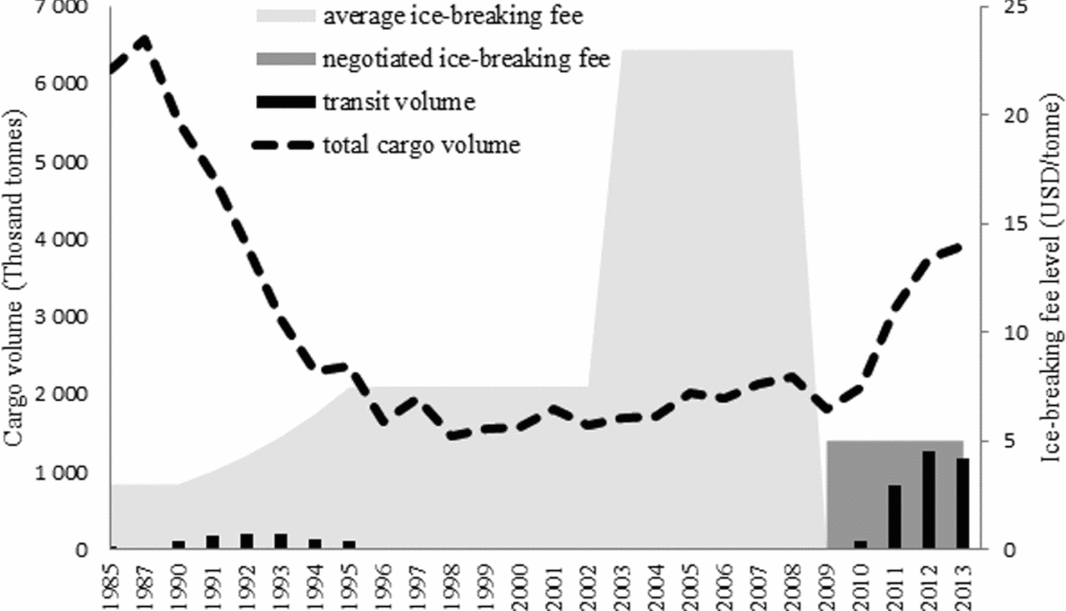
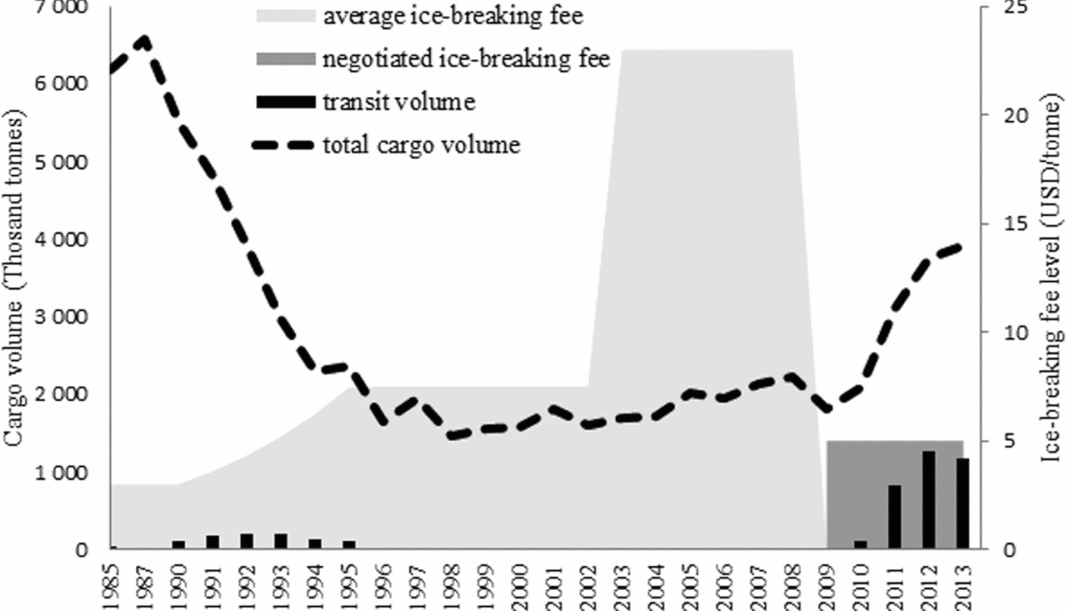
NSR ice-breaking tariff development 1991–2014 is depicted in Fig. 3 in the context of the total and transit traffic volumes. During 1991–2014, the approach to pricing of the NSR ice-breaking tariff has had three fundamentally different periods (1991–2002, 2003–2013, 2014–now). These periods are discussed in chronological order below. The tariffs on ice-breaking services 1991–2014 are presented in Annex 1 where respective tariff tables are compiled on the basis of Russian legislation.
Dynamics between cargo volumes and ice-breaking fees in the NSR 1985–2013. (Source: own compilation upon data acquired from CNIIMF and Eger and others Reference Eger, Mejlænder–Larsen, Wergeland, Østreng, Eger, Fløistad, Jørgensen–Dahl, Lothe, Mejlænder–Larsen and Wergeland2013).
Ice-breaking fees 1991–2002
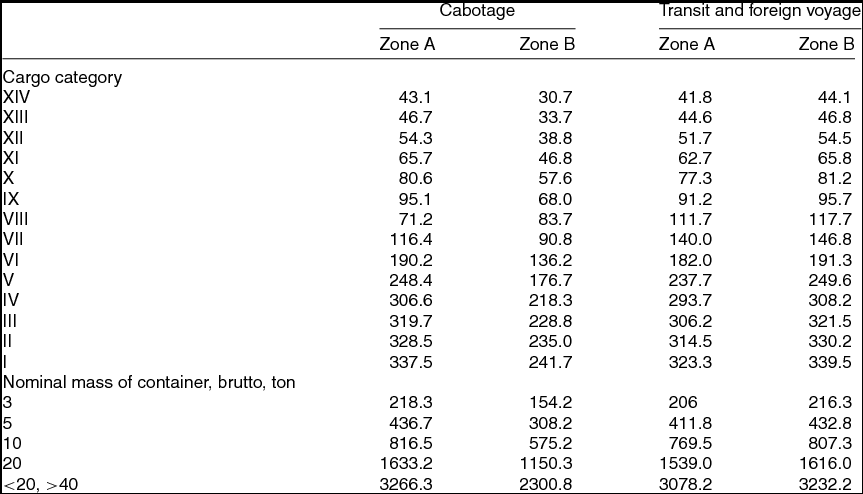
The first ice-breaking tariff system found its legal basis in the Price-Current II-01 in 1989 (Goskomtsen USSR 1989). This document foresaw the collection of a tonnage levy and includes not only ice-breaking maintenance costs, but also hydrographic, hydro-meteorological services and aerial ice surveillance. The main characteristic feature of this tariff was that ice-breaking fees were levied upon 14 cargo nomenclature categories and separately for containers subject to actual cargo tonnes. In order to calculate the fees, the NSR was divided into two zones – zone A (to the west from 90° E) and zone B (to the east from 90° E). Additionally, there were segregated fees for internal (cabotage) and international (transit) transportation. The latter tariff was significantly higher.
The arrangements set by the 1989 tariff policy were functional in a planned economy as tariffs could have been altered in accordance with changes in ice-breaking fleet or increase in cost of navigational services (Doyban and others Reference Doyban, Batskih and Luzin1995: 74). Once the economy started to convert to market principles and cargo volumes dropped, tariffs aimed at the compensation of total cost increased enormously, making cargo-owners incapable of paying the dues. In the early 1990s, the entire Russian Arctic maritime system, consisting of the transport fleet of ice-classed cargo ships, the ice-breaking fleet and Arctic ports, was encountering drastic economic challenges. According to Granberg (Reference Granberg1998), this was primarily caused by the Russian economic crisis and the subsequent decline in state subsidies. The change of tariffs was meant to approximate discrepancies in profitability of domestic and overseas shipping. For instance, the 1993 devaluation in Russia made the tariff 1,376 times more expensive in USD terms compared to 1990. The consequences were also visible, yet not as severe, for the hard currency: valued in USD the average ice-breaking fee increased from approximately 3 USD per tonne to USD 7.5 per tonne in the mid-1990s (Eger and others Reference Eger, Mejlænder–Larsen, Wergeland, Østreng, Eger, Fløistad, Jørgensen–Dahl, Lothe, Mejlænder–Larsen and Wergeland2013). The constant need for tariff adjustments resulted in indexations conducted almost every year during the period 1990–2002 and the tariff fee grew continuously. As a result of the economic turmoil, the ice-breaking fleet was incapable of covering its expenses with its revenues (Granberg Reference Granberg1998: 193).
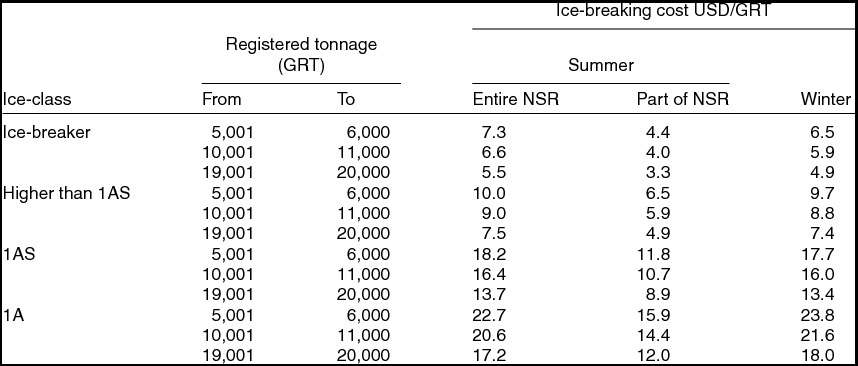
During 1995–2002 fees for ice-breaking services entailed in tariff legislation were applied only to destinational traffic whereas fees for vessels transiting in international voyages were a subject to agreement between the operator of the icebreaker fleet and the non-Russian charterer or the ship owner (Buyanov Reference Buyanov2004). As a result, peculiar negotiated arrangements emerged during this period. Unlike the still-in-force 1989 Price-Current II-01, these ice-breaking fees depended on the ice-class of the vessel, season, nationality of charterer and plied parts of the route (Yakolev and others Reference Yakovlev, Semanov, Ivanov, Ushakov, Zubarev, Gavrilo, Khlebovitch, Moe, Thomassen and Brude1999). Another peculiarity is that summer rates were higher than winter rates. Tariffs for vessels larger than 20,000 DWT were not reported (supposing they were not needed due to a lack of precedent).
Ice-breaking fees 2003–2013
On 31 October 2002 the Russian government adopted Decree N 1528-p. It prescribed, among other things, stopping the state subsidy of the ice-breaking fleet from the federal budget from 2003 and financing the running costs of the icebreaker fleet with funds received from the payments to the service icebreaker fleet in form of tariffs. Together with this decision, the tariff calculation basis was fundamentally changed. The new calculus was based on a paying potential by determining the fees on the actual tonnage on type of cargo carried. This resulted in a considerable increase in the ice-breaking fee and the average fee reached USD 23 per tonne (Eger and others Reference Eger, Mejlænder–Larsen, Wergeland, Østreng, Eger, Fløistad, Jørgensen–Dahl, Lothe, Mejlænder–Larsen and Wergeland2013: Ministry of Economic Development and Trade 2003).
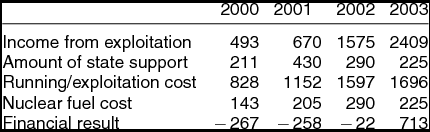
Altogether, in comparison to the 1989 tariff system, the new arrangements unified tariffs for all types of shipping by abolishing differentiation between cabotage and transit/foreign voyages while still relying on fees based on cargo nomenclature categories. To assist the uninterrupted delivery of basic goods to the peripheral Arctic regions, special discounts were introduced for destinational traffic financed from the federal budget (Buyanov Reference Buyanov2004). The new tariff policy introduced in 2002 seems to have had an immediate effect as in 2003 the ice-breaking fleet for the first time since 1992 reached a break-even point (Table 1).
Financial performance of OAO MMP icebreakers in 2000–2003 (mln RUB)
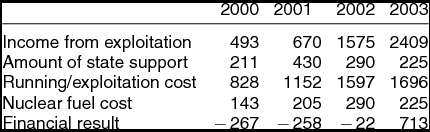
Source: adapted from Buyanov, Reference Buyanov2004 (Note: the exchange rate varied from 27 to 30 RUB for 1 USD during the reported period)
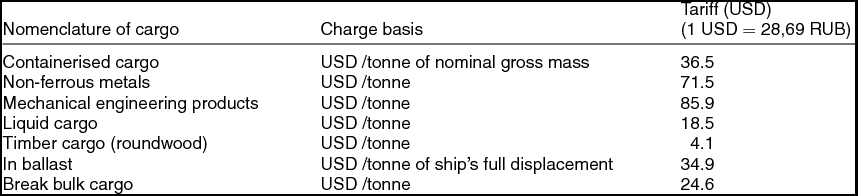
In 2005, the tariff system established in 2003 was substituted by a new tariff table. The new tariff relied on the same principles as the previous one but contained higher fee levels (Federal Tariff Service 2005). For example, this meant extremely high costs for containers as the fee to transport one TEU amounted to over USD 760 because a TEU was considered equivalent to 24 tonnes of cargo (Liu and Kronbak Reference Liu and Kronbak2010).
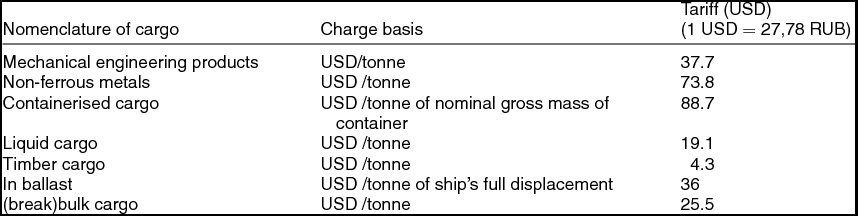
In 2011, further changes were introduced into the ice-breaking tariff system by the adoption of the decree of the Federal Tariff Service of Russia No 122-t/1 of 07.06.2011. This led to a yet another subsequent increase in tariff. The 2011 tariff was arranged in a fashion similar to the 2003 and 2005 tariffs by differentiating according to the type of cargo. A novelty in the system was a clause that stated that tariffs are ceiling tariffs indicating the maximum levels and can be applied at lower levels upon negotiation (Federal Tariff Service 2011).
In 2012, new NSR navigational rules abolished the requirement of compulsory year-round ice-breaking fees by stating that fees can only be collected from actually rendered services (NSRA 2014). As a consequence of the new application method, Atomflot reported approximately RUB 400 million (roughly USD 13.5 million) as deficits (NSRIO 2014). Balancing the profitability of ship owners with the cost coverage of ice-breaking providers was not yet achieved.
2014 ice-breaking tariff
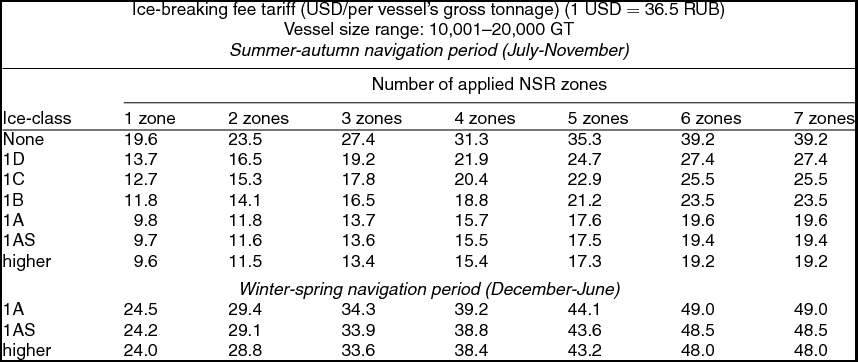
In April 2014, new navigational rules for the NSR were adapted, based on the Federal Tariff Service of Russia decree No 45-t/1 of 4 March 2014. Simultaneously, a new tariff was introduced. The new system has several principal innovations addressing the issues raised by the AMSA study in 2009. Firstly, tariffs are published and applied on the basis of actually rendered services. Secondly, the calculation basis of the tariff has several determinants, such as gross tonnage of vessel, ice class of ship distance of the escorting, and the period of navigation. The ice-class of a vessel is one of 10 categories, distances are measured based on a zonal approach (the whole NSR is subdivided into seven zones) and seasonality is approached by defining the winter-spring sailing season (November to June) and the autumn-summer (July to October). The winter-spring rates are about triple compared to the autumn-summer season (Federal Tariff Service 2014).
The 2014 tariff allowed a more targeted approach to account for differences between the segments of shipping and types of voyages. The tariff is built upon the size of ship and thus supports economies of scale to some extent. The system has a slight resemblance to the Finnish fairway tariff system since the tariffs are levied based on the ice class of the escorted ships, resulting in the highest ice class ships being subjected to the lowest fees and vice versa. However, as the size of the ship does not reflect the actual cargo types and volumes, the new tariff is not beneficial in the case of a ship that is not fully laden or is transiting on ballast.
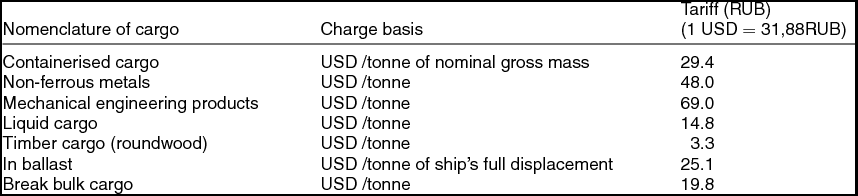
The negotiated NSR tariff practice
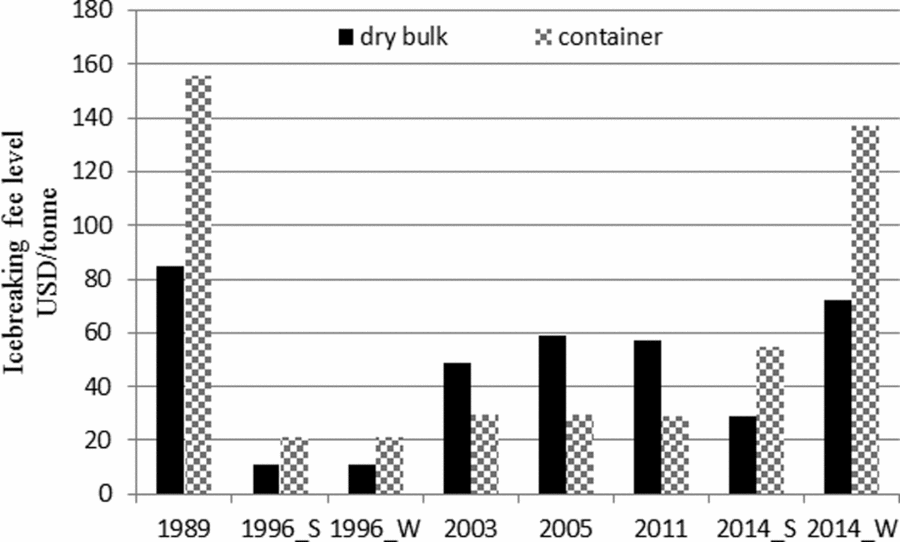
In general, a brief glimpse at the tariffs presented in the previous sub-sections draws attention to the high level of the introduced fees. In order to display how the tariffs evolved over the last 25 years, Fig. 4 depicts historical development of the NSR ice-breaking fees. Calculations present an overview of ice-breaking fees for a SA-15 multipurpose cargo ship carrying both containers and dry bulk between 1989 and 2014. Over the observation period, the fees for containers (assumed 10 tonnes nominal weight) were high compared to those for dry bulk (non-ferrous metals). Presumably, this is due to sporadic nature of container movements and overall poor viability of the NSR in container shipping. The change of the tariff calculation basis from vessel size to actual cargo volume in 2003 may explain the observed relatively low tariff levels per tonne between 2003 and 2011. This change lowered the tariffs for container cargo per tonne, but it did not explicitly address the issue of container nominal weight (actual or fixed weight). For example, in late 2000s a TEU was considered as 24 tonnes of cargo (Liu and Kronbak Reference Liu and Kronbak2010).
Development of the NSR ice-breaking tariff policy 1989–2014 for a SA-15 multipurpose cargo ship. SA–15 ship details: ice-class: ARC 7 (equivalent to polar class 4), DWT: 14.700, Length: 177.2 m, Beam: 24.55 m, Draught: 9 m, gross tonnage: 16.500, net tonnage: 11.000, container capacity: 576 TEU. S and W refer to summer and winter navigation. (Source: own compilation based on official tariff rates, see Annex I).
The high official ice-breaking tariffs may have reduced the attractiveness of the NSR for international transit traffic during 1989–2014. Cargo volumes in 1985–1995 indicate that tariffs between USD 5–7.5 per tonne could render the ice-breaking service profitable when annual cargo volumes per icebreaker constitute one million tonnes or more (Doyban and others Reference Doyban, Batskih and Luzin1995: 75; Yakovlev and others Reference Yakovlev, Semanov, Ivanov, Ushakov, Zubarev, Gavrilo, Khlebovitch, Moe, Thomassen and Brude1999; Peresypkin and Yakovlev Reference Peresypkin and Yakovlev2008). On the other hand, with six Atomflot icebreakers in operation, a total of six million tonnes of cargo would be required annually. So far, this number has been reached only in the late 1980s.
A tariff rate designed solely on the basis of historical cargo volumes may still be not sufficiently appealing to attract transcontinental traffic given the incurring incremental costs due to Arctic conditions (for example the need for ice-classed tonnage). These historical volumes mostly consisted of destinational and Russian domestic intra-Arctic traffic, which has remained largely separated from the global shipping market and consequently has a more inelastic demand. For transcontinental traffic, such as liner shipping, the demand is more price elastic due to the existence of alternative routing options. Thus, in order to lure additional volumes, the fees may need to be further adjusted to a more competitive level, systematically or on a case-by-case basis.
In fact, the NSR ice-breaking tariff policy has been marked by a certain degree of flexibility similar to the competitive pricing policy applied by the Suez Canal Authority. Discounts for operators intending to use the NSR on a regular basis can be a result of the tariff bargaining process. The current system of ceiling tariffs permits Atomflot to apply rates lower than the official tariff level. In practice, however, the literature suggests that the official fee levels were subject to negotiation throughout the whole period. Between 1995 and 2002 legal arrangements foresaw a fixed ice-breaking fee only for cabotage whereas for import/export voyages and transit a practice of negotiated tariff with service provider was in place (Buyanov Reference Buyanov2004). In 2009, the German-based Beluga Shipping's project cargo carriers paid only around USD 2.5 per DWT for high-valued project cargoes (Østreng and others Reference Østreng, Eger, Fløistad, Jørgensen–Dahl, Lothe, Mejlænder–Larsen and Wergeland2013). Based on correspondence with Atomflot in 2013, the applicable fees for bulk and liquid cargo shipments were on a level of USD 5 per tonne of cargo and in ballast USD 2.5 per tonne of a ship's full displacement. As for container shipping, the only indicated fee levels were for a 4,000 TEU vessel, amounting to around USD 375,000 per transit based upon the TEU capacity of the vessel. It results in a fee of USD 93.75 per TEU, which corresponds to a roughly 25% higher rate than to Suez Canal tolls. Thereby tariff negotiations added flexibility to reactions to market fluctuations and to attracting additional (mostly transit) traffic by adopting a similar competitive pricing policy as exercised by the Suez Canal.
The practice of negotiated tariffs can be seen as one of the multiple cases of a phenomenon referred to as ‘post-Soviet “informality”‘ (Gel’man Reference Gel’man2012: 296), meaning that de facto rules are applied based on informal practices, rather than a set of institutional norms. Tariff adjustments aside of the overarching regulation demonstrate a way to make ice-breaking self-financing by finding a tariff that would be attractive for ship and cargo owners both in Russia and abroad without any legal governance structures, but based rather on ad hoc policy experimentation. On the one hand, informality is a way to deal with uncertainty as it allows governing authority much flexibility in maintaining spontaneity, on the other hand, informality itself creates ambiguity for those who are subjected to informal rules-in-use.
Main findings
This study has provided a review of the NSR ice-breaking tariff policy over the period of 23 years between 1991 and 2014. The following propositions can be put forward.
Due to high costs and unpredictability of Arctic shipping, a development in which the whole Arctic fleet would become equipped with a high ice-class enabling independent operations is highly improbable. Thus, navigational assistance and route maintenance provided by ice-breaking services will remain necessary for safe navigation. Given that navigation in the ice-covered Arctic requires special skills and equipment, as well as favourable natural conditions, both technological and natural factors have an impact on the optimal ice-breaking tariff policy design.
The development of sustainable and competitive Arctic shipping requires defining 1) the type of property for icebreakers (public/private); 2) the character of ice-breaking assistance (mandatory, voluntary, based on 3rd party expertise); 3) the flagging policy (can any icebreaker offer its services or only specially defined flags?); and 4) the financing of the ice-breaking services (from state budget/tariff income). The history of the NSR ice-breaking tariff policy reveals numerous experiments with the arrangements for ice-breaking service provision: the character of services has been changed from mandatory to optional (but applied de facto); the icebreakers used to be exclusively public in private management, and now both, yet the NSR rules of navigation maintain that icebreaker assistance is rendered by the icebreakers authorised to navigate under the state flag of the RF.
During the observed period, the NSR has mainly been affected by the changes in the policy environment. After the collapse of the Soviet Union, systemic changes within the Russian economy and privatisation of activities formerly financed from the state budget played a major role in the decrease of the NSR activity. The launch of the Russian Arctic strategy 2020 in 2009 led to revival of NSR shipping. Throughout the observed period international transit traffic had rather trial-based than systematic character. Whereas the relaxation of the tariff policy in late 2000s has promptly awakened more interest in trial voyages, the escalation of political conflicts between Russia, the EU and the US in 2014 had an immediate negative effect on the attractiveness of NSR shipping.
In the coming 5–10 years, the NSR is most suitable for bulk shipping as transport of natural resources (minerals, oil, and gas) depending on commodity price levels. For the time being, it is reasonable to suggest that Russia will remain the prime beneficiary of the NSR exploitation and the related economic effects (local mineral extraction and trade, regional development impacts). The use of the NSR as a complement or substitute to conventional container shipping routes is subject to major uncertainties. Among other factors, demand for diversification of maritime networks by extending them to the Arctic seas can only increase as a derivate of global shipping demand growth.
The NSR ice-breaking fees have fluctuated considerably and an inverse relation between the tariff fees and traffic volumes is observed. Higher tariffs corresponded to decreasing traffic volumes, which in turn created pressure to further increase the tariffs. Thus, the relation between ice-breaking tariffs and traffic volumes remains a type of ‘chicken-and-egg’ problem. For this reason, the ice-breaking tariffs need to be studied more closely to be included in economic feasibility studies.
In the past, development of the NSR tariff ice-breaking policy has been closely connected to Russian Arctic policy in broader terms. The interplay of the NSR ice-breaking tariff policy with the NSR maritime activity is ambiguous and cannot be studied only in the light of economic and financial viability. Tariffs can be seen as a (geo)strategic instrument that includes security issues and image concerns.
Discussion and conclusions
Over the past decade, an increase in Arctic shipping along the NSR was envisaged both in industry and in academia (Arbo and others Reference Arbo, Iversen, Knol, Ringholm and Sander2013; International Chamber of Shipping 2014). In the first place, this development was expected to be a derivative of accelerated energy and mineral resource extraction in the Arctic from which the Russian energy industry would be a main beneficiary. Towards the beginning of 2015, the increasing volatility in the world oil and gas markets, together with US, EU and Canadian sanctions against Russia over the conflict in Ukraine and growing political and economic instability within Russia, the expectations regarding the NSR shipping have been tempered. Whereas the past increase of maritime activity along the NSR is mostly connected to the dynamics of climate change, the question of how fast and how extensively the NSR shipping will grow depends mostly on future developments in global economic and political arenas.
Regardless of the political developments, the future prospect of the NSR becoming a viable seasonal alternative to the conventional routes also depends on its economic feasibility for different shipping sectors. If the NSR is to be used for international transit traffic to an extent similar (or exceeding) its use for destinational shipping and export of Arctic resources, the way to align the function of the NSR as a part of Russian maritime system and the NSR as a part of global shipping network has to be found. The challenge of this alignment has its roots in a number of legal, economic, security and (geo)strategic controversies directly or indirectly affecting the cost of the NSR shipping. In this context, along with safety and predictability concerns, the ice-breaking fee levels would, to some degree, have a role in defining the total cost of using the NSR.
The ice-breaking services remain a key source of the safe and efficient development of Arctic transportation. As the NSR is located in Arctic conditions, provision of commercial operations in the NSR requires special and/or additional services, including a well-maintained waterway, reliable navigational charts based on up-to-date hydrographic data, real-time information concerning the ice conditions (including ice charts, satellite images of ice-covered waters, real-time description of ice conditions, forecasts for weather and sea ice distribution), search and rescue facilities (including shore side infrastructure) and ice-breaking and ice-pilotage services capable of assisting crews in harsh Arctic conditions. The availability of polar icebreakers and marine salvage support can significantly reduce the risk to the vessel and enable safer navigation both for ships and their crews, and to the fragile Arctic nature.
The uncertainty about the future prospects regarding the diversified maritime activity in the NSR (raised by, among others, Lasserre Reference Lasserre2014 and Kiiski Reference Kiiski, Gammelgaard, Prockl, Kinra, Aastrup, Andreasen, Schramm, Hsuan, Malouf and Wieland2014a, Reference Kiiski, Martínez de Osés and Castells i Sanabra2014b) poses questions regarding the capability of maintaining an ice-breaking fleet solely on tariff-generated income. It has been calculated, that the NSR requires approximately 40–50 million tonnes of cargo annually to be commercially attractive in global context (AMSA 2009; Skaridov Reference Skaridov2014). Such a course of development will have an impact upon the ice-breaking service provisions, and, in the first place, upon the tariff policy.
Over the past two decades, the ambiguity and poor transparency of the NSR tariff system complicated calculations concerning economically-feasible NSR ice-breaking fee levels. From the shipping operators’ point of view, use of the NSR is economically viable in cases when the total cost of transportation via alternative routes exceeds the costs of using the NSR. From the public authorities’ perspective, the maintenance of the route pays off in the event that the shipping traffic is large enough to provide full cost recovery of the provisions rendered, including icebreaker assistance as one of the most significant cost components. Thus, the profitability of the NSR shipping for private operators and feasibility of the route maintenance for public authorities are dependent on each other. Yet, uncertainty about the feasible tariff levels, on the one hand, and about the future increase in maritime activity, on the other, resulted in strategic interdependence, but under incomplete information and a lack of trust, making predictions for future development of the NSR transport system ambiguous at best.
Whereas tariffs constitute the central instrument for ice-breaking services’ financing, as long as ice-breaking services remain necessary, tariffs will almost fully define the budget for ice-breaking services’ provision, their scope and quality. At the same time, for non-Russian ship owners considering operations in the ice-covered waters, ice-breaking fees are only one of the components of a complex mixture of factors determining the overall viability of the NSR. The forthcoming IMO Polar Code will probably have an effect on the development of the NSR and may prove beneficial by adding some legal certainty to operational guidelines. Thus, in order to provide a balanced picture of NSR future prospects, research needs to account for the complex, critical drivers that are likely to place the operational, financing and economic aspects of decision-making within the scope of ‘national interest’ politics, thus originating outside of a shipping market.
The recent technical developments in ice-breaking and ice-going ship technology have shifted the concept of Arctic shipping from being a technical challenge into a business decision. In other words, there exists technology to operate in ice-covered waters, but now the central question is how to do it in an economically-feasible manner and create net gains for all parties involved. To date, the official tariff remains relatively high to make the NSR into an attractive option for those ship owners who can choose alternative routes. At the same time, the optimal tariff should be capable of providing sufficient compensation for the cost of ice-breaking services, which can partially explain the reluctance from the side of the public authorities to lowering the tariff levels. The lack of competition in ice-breaking services provision also undermines the establishment of a stable and competitive tariff regime. Finally, the outcomes of 2014 summer navigation have indicated a decrease in a number of voyages despite the improvement in the tariff system, thereby pointing out the influence of the political component in adding uncertainties regarding the decision to operate along the NSR. As a result, the lack of demand for NSR together with structural uncertainties undermine the capacity of tariff policy to increase the overall attractiveness of NSR and consequent growth of traffic, especially in global context.
Acknowledgments
This research was financially supported by the Jenny and Antti Wihuri Foundation and the Finnish Centre of Excellence in Russian Studies ‘Choices of Russian modernisation’. The authors would like to thank Professors Veli-Pekka Tynkkynen, Lauri Ojala, and Pami Aalto and the anonymous reviewers for their constructive criticism and helpful comments.
Annex I. Tariffs for ice-breaking services 1991–2014
1989 NSR Ice-breaking tariff (USD for 1 tonne), 1 USD = 0.6 RUB
1996 NSR ice-breaking tariffs
2003 NSR ice-breaking tariffs
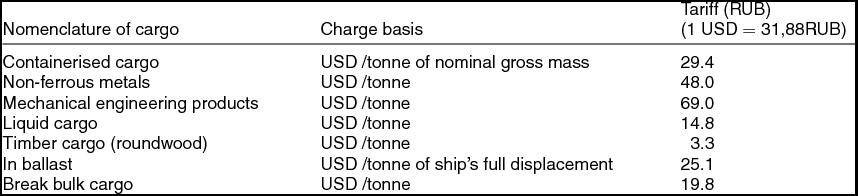
2005 NSR ice-breaking tariffs
2011 NSR ceiling ice-breaking tariffs
2014 NSR ceiling ice-breaking tariffs