Introduction
The recovery approach provides a key organising principle underlying mental health policy throughout the English speaking world with endorsement by agencies such as the World Health Organisation (Amaddeo et al. Reference Amaddeo, Becker, Fioritti, Burti and Tansella2007). In Ireland personal recovery is one of the quality markers identified by users of mental health services (Mental Health Commission, 2005a) and has become central to national policy objectives in respect of social inclusion and mental health (Department of Health & Children, 2006). As in other jurisdictions (e.g. Mental Health Commission New Zealand, 1997; in the United States, New Freedom Commission on Mental Health, 2003), Irish National Mental Health Policy clearly acknowledges the central role of service users in decision making at an individual level in terms of the services available to them, through to the strategic development of local services and national policy. The recovery approach has been a central theme in mental health service planning since the publication of A Vision for Change which states: ‘A recovery orientation should inform every aspect of service delivery and service users should be partners in their own care’ (Department of Health and Children, 2006: 9).
The term ‘recovery’ as used in the mental health context has multiple meanings, arising from different theoretical perspectives. A critical distinction is made between clinical and personal recovery where clinical recovery refers to a reduction or elimination of clinical symptoms and is defined and measured by health professionals using criteria developed by researchers and clinicians. In contrast to the traditional approach to treating mental illness (focused on reducing or eliminating clinical symptoms), recovery-focused mental health services require a different focus on enabling people to realise their own potential to manage their condition so that they can live a life that they value even in the presence of clinical symptoms. In this respect, the concept of recovery may be more consistent with a formulation of mental well-being rather than mental disorder, for example ‘mental health is a state of wellbeing in which an individual can realise his or her own potential, cope with the normal stresses of life, work productively and make a contribution to the community’ [World Health Organisation (WHO), 2007]. The recovery approach focuses on what a person can achieve while living with a mental illness: ‘a deeply personal, unique process of changing one’s attitudes, values, feelings, goals, skills and/or roles. It is a way of living a satisfying, hopeful, and contributing life even with limitations caused by the illness. Recovery involves the development of new meaning and purpose in one’s life as one grows beyond the catastrophic effects of mental illness. Recovery from mental illness involves much more than recovery from the illness itself’ (Anthony, Reference Anthony1993).
Personal recovery is proposed as a realistic possibility for people diagnosed with a mental illness based in part on research and practice guidelines within the Irish context (e.g. guidance documents from the Mental Health Commission), evidence of the experience of recovery within cohorts of people in Ireland (e.g. Kartalova- O’ Doherty & Tedstone Doherty, Reference Kartalova-O’Doherty and Tedstone Doherty2010), indicators of what a recovery service could look like (Mental Health Commission, 2008) and attempts to develop recovery-orientated service improvement change models (Mac Gabhann et al. Reference Mac Gabhann, McGowan, Walsh and O’Reilly2010). There is an emerging consensus that recovery is not a linear process but a personal journey that involves a change in attitudes, beliefs and skills in order to live a hopeful and meaningful life. Among the conceptual frameworks proposed for understanding and operationalising recovery are the presence of the triad of ‘hope’, ‘control’ and ‘opportunity’ identified for the service user (Repper & Perkins, Reference Repper and Perkins2003), and the concept of ‘reconnecting with life’ (Kartalova-O’Doherty & Tedstone Doherty, Reference Kartalova-O’Doherty and Tedstone Doherty2010). An alternative conceptual framework based on a systematic review and narrative synthesis of the literature and international guidelines comprises five recovery processes: connectedness; hope and optimism about the future; identity; meaning in life; and empowerment (Leamy et al. Reference Leamy, Bird, Le Boutillier, Williams and Slade2011).
Irrespective of which particular framework is chosen, it is apparent that fundamental changes are required in how services operate in order to accommodate the recovery approach. To this end guidelines for recovery focused practice and service development frameworks to support the recovery approach have been available for more than a decade in order to support mental health policies in Ireland. For example, ‘enhanced self-management for mental health service users and the development of services which facilitate the individual’s personal journey towards recovery’ (Mental Health Commission, 2005b: 41) and ‘significant changes in our conception of mental distress, service users’ involvement and models of care’ (Mental Health Commission, 2008: 17). The Quality Framework specifies standards for person-centred care, service user inclusion and implementation of the recovery approach and acknowledges the need to develop new ways of working at the clinical operational level and at other organisational levels of mental health service (Mental Health Commission, 2007).
However, despite the publication of policy papers, the availability of guidance documents and a substantial research literature there is a lack of evidence of significant development of professional practices or of whole system change in mental health services to provide recovery-orientated supports.
Method
The aim of this study was to explore the implications for mental health services and professional practice arising from a structured investigation of what personal recovery means for people using specialist mental health services and the extent to which services support their individual recovery.
Participants
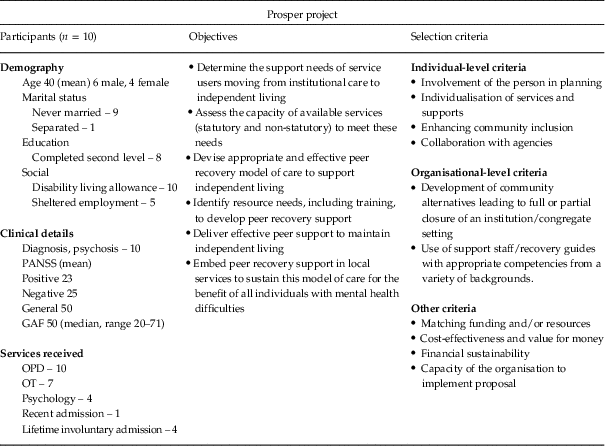
The participants were ten service users who were taking part in a service improvement initiative involving transition from congregated settings in hospital ward or supervised hostel accommodation (the PROSPER project, detailed in Table 1). The project involved the provision of additional peer support workers over a 12-month period in conjunction with specialist mental health care from a Rehabilitation and Recovery Multidisciplinary Team to facilitate the movement from institutional care and to maintain these individuals in their own tenancies. Participants’ views about their recovery and their experience of support for recovery were examined in the context of existing service provision including conventional mental health professional staff and before commencement of the service improvement initiative or support from peer support workers.
Participants’ details

The PROSPER Project was conducted by a consortium including the Health Service Executive (Mayo Mental Health Services), the Mayo Mental Health Association and the Irish Advocacy Network with funding support from the Genio Trust in 2011/ 2012.
Consent
Informed consent was obtained from each participant after verbal and written information about the study was provided. All research interviews were conducted in private. Ethical approval was obtained for the study of the PROSPER project from the Ethics Committee, Mayo Mental Health Services.
Procedure
Service user participants were asked to complete assessment measures at the commencement of their participation in the Prosper project. Information regarding personal recovery beliefs and supports in respect of a mental health professional member of the multidisciplinary team was collected by a member of the research team and co-author (M.N.) using the INSPIRE (Bird et al. Reference Bird, Leamy, Le Boutillier, Williams and Slade2011). Clinical assessments were completed by a member of the research team and first author (S.S) using the Positive and Negative Syndrome Scale (Kay et al. Reference Kay, Fiszbein and Opler1987) and Global Assessment of Functioning Scale (American Psychiatric Association, 2000).
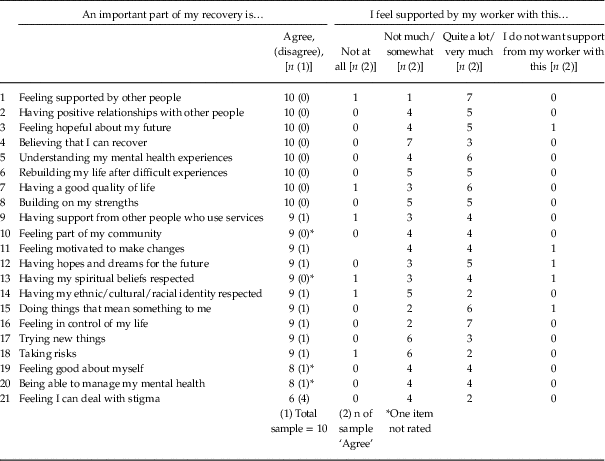
INSPIRE is a service user-rated measure of recovery support from a mental health worker. It is designed for wide use, with any type of worker or mental health service user and assesses the service user experience of being supported with their recovery. There are two sub-scales, the 21-item support sub-scale and eight-item relationship sub-scale. The Support sub-scale is individualised to reflect the idiosyncratic differences in people’s journeys of recovery and a utility rating is incorporated to keep the values of the respondents central. In the Support sub-scale service users identify whether an item is important to their recovery. If it is important, they rate the support they receive from a worker. The Support section contains twenty one propositions of potential relevance to an individual’s recovery each with the prefix ‘An important part of my recovery is’ inviting a ‘Yes’ or ‘No’ response and a linked evaluation defined as ‘I feel supported by my worker with this’ for each proposition on a scale of five choices: ‘Not at all’, ‘Not much’, Somewhat’, ‘Quite a Lot’, ‘Very Much’ or the qualifying choice ‘I do not want support from my worker with this’. Table 1 lists the INSPIRE Support section items. The eight-item Relationships sub-scale asks about the relationship between the service user and the mental health worker using a five-point Likert scale. The score for each subscale is a per cent (i.e. ranging 0=low support to 100=high support) quantifying the perceived recovery support received. Further information can be found at researchintorecovery.com/inspire.
Results
Participants
All participants had a diagnosis of psychosis and were prescribed antipsychotic medication including depot antipsychotic (three); seven participants were on oral antipsychotic medication of whom two were prescribed Clozapine. Global Assessment of Functioning Scale showed moderately severe impairments in social and occupational functioning. Structured clinical assessment showed moderately severe ratings on positive, negative and general psychopathology symptoms. Demographic and clinical details are summarised in Table 1.
Meaning of recovery
Most respondents (eight or more) endorsed the majority of scale items which define characteristics of recovery (20 items of total 21). A belief that recovery was possible and feeling hopeful about the future were endorsed by all participants. Similarly, personal understanding of their mental health experiences, together with the rebuilding of their lives after difficult experiences, having a good quality of life and building on their personal strengths were identified by all respondents as being significant in their recovery journey as were feeling supported by, and having positive relationships with other people. The support of fellow service users, feeling part of their community, feeling motivated to make changes and having hopes and dreams for the future were important to the majority of participants as were a feeling of self control of their lives, engaging in meaningful activities, trying out new things and taking risks. Equally important was having one’s spiritual beliefs and ethnic, cultural and racial identity respected. Table 2 summarises the responses obtained using the INSPIRE Support sub-scale.
Inspire support sub-scale
Support for recovery
The Support sub-scale provided a measure of the recovery support from a mental health worker. All respondents indicated that support by other people was an important part of their recovery and a majority indicated high levels of support received from staff in this regard. The majority of respondents also reported a high level of support in relation to feeling in control of their lives. Understanding mental health experiences and quality of life were endorsed as important by all participants with most reporting good support from staff in these areas. Although all participants endorsed the belief that recovery was possible as important for their recovery, most reported low levels of support from staff in respect of this item. Of note, respondents felt adequately supported only for a minority (8 of 21 items) of those areas identified as important for their individual recovery (items 1, 2, 3, 5, 7, 12, 15, 16 – see Table 2) and felt unsupported in other areas (items 4, 14, 17, 18). The majority of areas (nine items) which were identified as important for recovery attracted ambivalent responses in respect of perceived support (items 6, 8, 9, 10, 11, 13, 19, 20, 21). Table 2 summarises the INSPIRE, Support sub-scale results. The mean score of the Support sub-scale was 65 (minimum=41, maximum=93, standard deviation=16.5).
Relationships
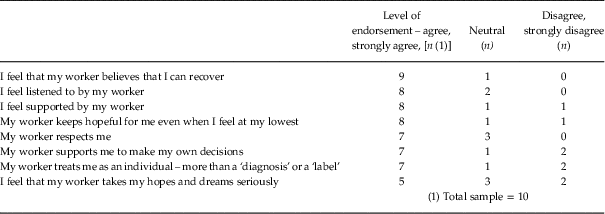
The Relationship sub-scale of the INSPIRE evaluated the relationship between service users and their mental health professional worker. The majority of respondents indicated that the staff member believed that recovery was possible, that their worker listened, was supportive and remained hopeful. Most participants felt respected by the worker, supported in making their own decisions and treated as an individual rather than a diagnosis. Half of the participants reported that their worker took their hopes and dreams seriously. Of note, the majority of participants rated their worker as supportive in respect of most relationship items of the scale. Table 2 summarises the INSPIRE, Relationship sub-scale results. The mean score of the 10 participants Relationships sub-scale was 73 (minimum=50, maximum=94, standard deviation=20.2).
There were some conspicuous deficits in the participants’ experience of recovery oriented practice in staff, albeit in the context of predominantly positive service user experiences. For example, half of all respondents indicated that their workers ‘did not take my hopes and dreams seriously’, an aspect of recovery which was regarded by 90% of participants as important in their recovery. A minority of respondents indicated that they did not feel supported in making their own decisions (30%). The same proportion did not feel that they were treated ‘as an individual- more than a diagnosis or a label’. Table 3 summarises the INSPIRE, Relationship sub-scale results.
Inspire relationships sub-scale
Discussion
The key findings from this study include a coherent description of recovery based on the participants’ responses to a novel recovery evaluation tool with a notable level of consistency in responses defining the meaning of recovery. In addition, all participants indicated a role for their support worker in most areas which were identified as important for their recovery. However, whilst the service users’ perception of the importance of therapeutic relationships was comparatively high (relationship sub-scale), the actual support for recovery was perceived to be lower (Support sub-scale).
As a whole, the responses to the INSPIRE were consistent with previous descriptions of recovery outlined in the literature and regulatory publications in this country (e.g. Mental Health Commission, 2005b, 2008) suggesting that this instrument represents a valid means for the investigation of this aspect of mental health service delivery. The study findings highlight both the centrality of the interpersonal relationship as a key element of therapeutic working and the ‘person to person’ aspect of care that is most valued by service users. The current participants’ responses in relation to hopefulness, both within themselves and as experienced in the supporting relationship are consistent with the contention that a ‘hope inspiring relationship’ is of central importance to recovery oriented treatment and support whereby engagement is defined by ‘a common humanity between the professional carer, service user and family member’ (Mental Health Commission, 2008: 38). These findings reflect the existing research that has explored what service users find helpful in their relationships with staff. Key themes from the literature on what service users find helpful about the therapeutic relationship they have with staff are: being listened to, feeling understood and feeling staff have time for you (Shattell et al. Reference Shattell, Starr and Thomas2007; Denhov & Topor, Reference Denhov and Topor2011). Literature that asked service users what they want from staff to support their relationship also identify similar key themes of being treated with respect, being listened to and staff providing hope (Borg & Kristiansen, Reference Borg and Kristiansen2004; Happell, Reference Happell2008; Russinova et al. Reference Russinova, Rogers, Ellison and Lyass2011).
Implications for services/practice
The findings from this study have a number of implications for service development and mental health practice. Notwithstanding the positive assessments by respondents of some of the aspects of the support they received from mental health staff, a number of the findings on both the support and relationship sub-scales of the recovery measure are noteworthy. For example, the discrepancy between the service users’ expectations of the therapeutic relationship and the perceived level of support for their recovery highlights the importance of the manner in which support and mental health care are delivered. For example, it may be particularly relevant that on the item ‘Believing that I can recover’ which was endorsed by all respondents as important for their recovery, the majority indicated that they felt inadequately supported. The majority of respondents also reported no or limited support from their worker in relation to ‘Taking risks’ while most also reported limited support from their worker in relation to ‘Trying new things’. The results may indicate aspects of recovery that staff feel less comfortable discussing. Risk is one area where there is conflict between the rhetoric of recovery and staff concerns about dealing with risk which often involve risk avoidance (Slade, Reference Slade2009: 176).
The study findings indicate that the development of more recovery focused services will not only require new resources in the form of personnel trained in particular skills, it also requires a fundamental change in the mind set of mental health staff. The findings from this sample of service users highlight particular needs in relation to training and professional development including education about the evidence for positive personal recovery outcomes in enduring mental disorder (e.g. Warner, Reference Warner2009), approaches to positive risk enablement (Morgan, Reference Morgan2007) and delivering individualised care (McConkey et al. Reference McConkey, Bunting, Ferry, Iriarte and Stevens2013) as well as the skills needed to support service users with enduring mental disorder in terms of rebuilding their lives, autonomous decision making and maintaining hope.
Studies of the implementation of recovery oriented supports in the Irish context (e.g. McFarlane et al. Reference McFarlane, Street, Crown and Jeffers2009) and other countries (e.g. Whitley et al. Reference Whitley, Gingerich, Lutz and Mueser2009) demonstrate the need to involve whole teams and managers in order to achieve practice change in front line staff. Furthermore, evidence suggests that involvement of service users and carers in education of mental health practitioners may impact on service provision by increasing partnership and advocacy skills, challenging professional orthodoxies and power and enabling practitioners to be more conscious and reflective of the implications of treatments and approaches used (Repper & Breeze, Reference Repper and Breeze2007). Based on the evidence base for effective organisational change in other fields (Revans, Reference Revans1982; Iles & Sutherland, Reference Iles and Sutherland2001) it is intended to adopt a systematic approach to implementing recovery through the transformation of mental health services as a whole in Ireland by means of the ‘Advancing Recovery in Ireland’ Recovery Initiative (Department of health and children, 2014a: 14, 15).
Strengths and limitations
The current work represents the first empirical investigation of personal recovery in an Irish mental health service setting using an instrument which has a robust conceptual underpinning based on a robust conceptual framework of recovery (Leamy et al. Reference Leamy, Bird, Le Boutillier, Williams and Slade2011). INSPIRE also adds to existing measures of the recovery orientation of services by having two sub-scales, Support and Relationships, that break down recovery support into ‘what’ is done (Support), and ‘how’ it is done (Relationships). Using this approach, the study findings demonstrate the importance of relationships to service users in their recovery and provide a novel framework to guide both practice development and service design. The study also demonstrates that it is feasible to conduct empirical investigations of personal recovery and that meaningful findings can be identified even with individuals experiencing severe and enduring mental health problems and furthermore that such findings can inform the translation of mental health policy aspirations into practice.
The study involved a comparatively small sample number of participants from the caseload of a single specialist rehabilitation mental health team using a selection process designed according to the needs of a local service improvement initiative. As a result the findings require further consideration before application to general mental health services. The individuals participating in this project had severe enduring mental health difficulties with high levels of morbidity and are not representative of the range of service users attending specialist mental health teams. However, due to the naturalistic clinical and organisational setting the findings both in relation to perceptions of personal recovery and experiences of support are relevant to all areas of mental health practice and service delivery.
Implications for research
The development of more recovery-oriented mental health services has received widespread support from service users, advocacy groups and mental health policy makers and is further mandated by the empirical evidence demonstrating effectiveness of individualised care arrangements in Ireland (McConkey et al. Reference McConkey, Bunting, Ferry, Iriarte and Stevens2013) and the international literature on specific recovery interventions. Examples of the latter include individual placement and support (Bond et al. Reference Bond, Drake and Becker2008), wellness recovery action planning (Cook et al. Reference Cook, Copeland, Hamilton, Jonikas, Razzano, Floyd, Hudson, Macfarlane and Grey2009), user empowerment (Lysaker et al. Reference Lysaker, Roe and Yanos2007), personal budgets (Porter et al. Reference Porter and Simpson2013) and peer support (Slade et al. Reference Slade2009; Repper & Carter, Reference Repper and Carter2011).
There are a number of possible reasons for the failure to translate mental health policy and evidence based practices into services, such as a limited understanding of recovery principles and how to operationalise this approach, limited capacity within services for meaningful service user and family member partnership, current governance arrangements within services and limited research evaluation of professional practices. Further work is needed to address these gaps in understanding in the context of Irish mental health services in order to optimise the delivery of ‘a modern, recovery focused, clinically excellent service built around the needs and wishes of service users, carers and family members’ (Department of health and children, 2014b: 47).
Acknowledgement
The authors wish to thank the participants in this study and the Genio Trust.