Introduction
On a cold evening in early March, I crossed the city to chair a Parochial Church Council (PCC) meeting. The PCC was facing a decision that they found difficult and wanted an external person to help them. The meeting began in prayer, led by the vicar. There was a reading from 1 Corinthians 12, some silence, an action, and a prayer for God’s wisdom and blessing on the meeting to follow. It is the action that has stuck with me. We were invited to turn to the people on either side and say ‘I need you’. My hope for this work is that it helps us turn to one another and say ‘I need you’.
The Local Church
The local church is likely to be the only church for many people. Richard Hooker wrote that ‘the substance of the body of Christ hath no presence, neither can have, but as local’Footnote 1 and this finds support in Stephen Hance’s research into how people perceive the Church of England. Hance notes that ‘for most people, the local trumps the national manifestation of the church’.Footnote 2 The importance of the local church is, then, that it is the local church that is likely to provide the spaces and opportunities for most people to encounter the Body of Christ, and through that the God who calls the Church into being. Thus, we must attend carefully to what constitutes the local church.
For the Roman Catholic Church, the local church is the diocese.Footnote 3 The Congregational Federation says that it ‘consists of 235 Churches split into 10 geographical regions’.Footnote 4 Within the Church of England, the understanding of what constitutes the local church is contested. Some claim priority for one of these pillars (usually the parish) over the other.Footnote 5 Others regard the diocese as de facto claiming priority.Footnote 6 This contest is normally focussed on the practical day to day organization of the church, including finances and structures. Yet these quotidian issues are places where the deeper theological structures of the church can and must be seen. Using the four ‘Marks of the Church’ from the Nicene-Constantinopolitan creed (that the Church is one, holy, catholic, and apostolic), I demonstrate how the tensions that must be held by both parish and diocese have deep ecclesiological implications. Both the parish and the diocese together constitute the local church, and they need one another to enable the substance of the body of Christ to have local presence.
Parish and Diocese
Importantly, parish and diocese share some key characteristics. First, they are both geographically determined. Both parish and diocese can be plotted on a map.
Second, as Lesslie Newbigin points out, ‘the basic units of the church – the parish, the diocese – were all determined by secular realities’.Footnote 7 Parishes and dioceses normally have a clear relation to the secular units of geography, and especially to local government.
A third feature that holds together diocese and parish is the concept of the cure of souls. This is shared between the bishop of the diocese and the incumbent of a parish. As the bishop licenses the incumbent, she says, ‘receive the cure of souls which is both yours and mine’. The cure of souls is the duty to care for and support all those within the limits of the diocese (bishop) or parish (incumbent) and is perhaps best rendered the ‘care’ of souls. The notion of a cure of souls is found in Roman Catholic theology and has been picked up by The Gospel Coalition in the United States.Footnote 8 What is distinctive about the Church of England’s understanding of the cure of souls is that the cure is for all who live within the boundaries of the diocese or parish, regardless of their religious affiliation (or lack thereof). This is a result of the establishment of the Church of England,Footnote 9 although it should be noted that the disestablished Church in Wales continues to understand the cure of souls as extending to the whole community.Footnote 10 Malcolm Torry suggests that this gives an order of priority to the church’s concerns, ‘the order is: territory – community – congregation – minister’.Footnote 11
As the twin pillars of the local church in an Anglican ecclesiology, these shared features of geographical extent, response to secular society and a shared and broad cure of souls are important to notice. They have secured the space for the evangelism and the pastoral care of the whole nation. They are needed for the nation to be served by care and evangelism into the future. The space that these pillars of Anglican ecclesiology hold open for the local church enables a rich ecology that can include other forms of ecclesial identity.Footnote 12
Tensions and Vocations
Parishes and dioceses enable the ecology of the local church, by each holding a number of tensions. Tension should not be seen as a negative, but rather as something that is indicative of life.Footnote 13 It is in holding these tensions that the space for the local church is opened. Think of a tent or a marquee with two poles holding a canopy over a large space. The holding of these tensions is also the space in which both parish and diocese can find and enact their vocation; the tension is generative of the vocation.Footnote 14 It is not that a perfect enactment of the vocation will resolve the tensions, rather than following the vocation requires holding the tension. Clare Watkins finds this vocational approach to be central to the nature of what it is to be the Church. ‘The church lies ahead of us as vocation, every bit as much as it is present to us as identity, community, structure and ritual’.Footnote 15
A church following a vocation must be a church that is engaged and skilled in discernment. ‘The church called into discernment is called into a place of true difficulty and even apparent confusion as we seek ever more deeply the step to be taken which brings us, and the world, more fully to Christ’.Footnote 16 Following a vocation requires discerning that vocation, and there is no shortcut to that discernment. That makes discernment both essential to the ecclesiological task and also a constant challenge for the ecclesial community. This has deep roots in St Paul’s insistence on the importance of ‘discerning the body’ (1 Cor. 11.29). Brian Brock and Bernd Wannenwetsch see this discernment as holding open space for God. ‘For Paul, discernment is the form the Christian life takes when continually leaving itself open to divine judgement’.Footnote 17
Both parish and diocese hold a number of different tensions. Plotting some of these against the four ‘Marks of the Church’ illuminates the relationship between the parish and the diocese. While both hold tensions that enable the Church to be ‘one’ and ‘holy’, the need to be ‘catholic’ and ‘apostolic’ demonstrates the need of the parish for the diocese and the diocese for the parish. In short, the parish will rightly prioritize the very local and so needs the diocese for a wider sense of the catholicity of the Church. And the apostolic mission of the diocese will normally be done by the very local church, and so the diocese needs the parish for a proper sense of the apostolicity of the Church. I hope that this will become clearer as we look at each in turn.
For the Parish
The parish is a geographical area. It is served by a parish church and by an incumbent of that church. There may be more than one church in the parish, and additional ministry may be offered by associate lay and ordained ministers. The incumbent may be the incumbent of more than one parish. Normally, the minister is paid and housed by the diocese, and their working expenses are paid by the parish. The appointment of an incumbent is a three-way operation (at least in the case of a single parish), involving the patron, the archdeacon on behalf of the diocese and representatives of the parish. The governance of a parish church is provided by the PCC. Chaired by the minister, this is comprised of a mixture of ex officio and elected posts. The PCC is an independent charity with its own accounts and must take responsibility for safeguarding, health and safety, insurance and other legal and regulatory issues.
Every parish is, of course, different. The geography of the parish will dictate some of this. A city parish will be different to a rural parish, not least in the ease by which people may cross boundaries to go to a different church. Historical factors will also have an impact, both in terms of the culture of the church and in terms of the demands made upon the church itself. Liturgical and theological traditions are differences that are widely experienced between parishes. These are often rooted in the self-identity of the parish, but are shaped and adapted in real time. An incumbent who wants to radically change the liturgical traditions of a parish will usually experience opposition. Different congregations within the same parish may express difference in liturgical style, where the numbers and capacity exist to enable this.
Andrew Rumsey identifies three principal challenges to the parish in the contemporary Church.Footnote 18 First, the ongoing viability of parish organization and built heritage. To be blunt, parish life is expensive, not least because of aging buildings, and money and volunteer time are short. Second, Rumsey suggests missional challenges mean that the church has to be mobile rather than rooted. Rumsey, while affirming the rooted nature of the parish, reminds some erstwhile defenders of the parish that the origins of biblical faith lie with a ‘wandering Aramean’ and faithfulness to the God of place can require mobility. Rowan Williams similarly describes ‘the unwelcome question of why the parish unit these days often seems unsuccessful in planting and nurturing faith among those not yet touched by it’.Footnote 19 The third challenge that Rumsey sees the parish facing is that of the decline of Anglican ‘entitlement’ as the established church. Rumsey is less worried by this, preferring a posture of humility. If the recent move away from parish to Ministry Areas in the Church in WalesFootnote 20 is understood as the long tail of disestablishment, then perhaps Rumsey should be more worried.
The Tensions and Vocations of the Parish
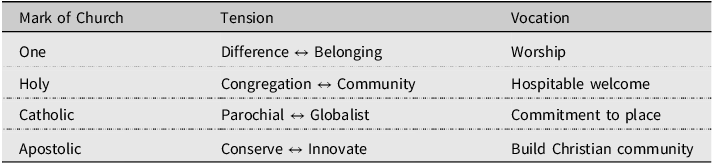
Rumsey’s challenges contribute to a series of four overlapping tensions and the vocations that arise from holding these tensions. It is in holding these tensions that the parish will be able to create the ecclesial space to enact its vocation (Table 1).
The tensions and vocations of the parish

I shall take each in turn.
Difference and Belonging
The first tension that the parish holds is between difference and belonging. Within any parish congregation, there will be differences of class, age, race and politics. Indeed, any kind of difference that might be thought of can potentially be found within a parish congregation. Andrew Davison and Alison Milbank put this simply: ‘the parish … is a mixed community’.Footnote 21 The reality of this mixture is that it is always partial and rarely as mixed as Davison and Milbank suggest. Such mixture as there is will create tension, and congregations always seem capable of manufacturing difference to create further tension. Whether that be the ‘in-group’ of the few families that have been the pillars of the church for decades, or the policing of unwritten and unspoken rules of behaviour, the differences within a congregation are a source of tension.
This tension is not to be resolved. It is as this tension is held that the gifts of difference can be experienced and received. Martyn Snow’s vision of an intercultural church holds the mutual exchange of gifts amongst this difference to be at the heart of the church that began at Pentecost. ‘The church is founded on the principle that diversity is good and can be celebrated, because the same Spirit is at work in all of us’.Footnote 22 Above all it is in worship that the gifts of diversity can be experienced. For Snow, ‘in the regular celebration of Holy Communion we are presented again and again with a model of healthy gift exchange’.Footnote 23 In worship, we encounter one another as gift as we encounter God. Our difference and our belonging are held in this encounter.
Congregation and Community
The Anglican vision of the ‘cure of souls’ holds a wide place for the congregation as well as for the wider community of the parish. That this is the tension of the second mark locates the tension of holiness as being ‘set apart’. Alison Milbank expressed this with some irony: ‘the whole point of the parish system is that it is for everyone, offering a liturgical round suited to the real needs of all, whether they know this or not’.Footnote 24 The implicit superiority of those who do know that the liturgical round meets their needs is clear. Timothy Jenkins articulates something similar in his ethnographical account of St Mary’s Comberton. Here, there are two competing visions of the parish at play: an egalitarian vision held by incomers, which sees the church as open to all who want to become part of its life; and a conservative vision held by villagers, which sees the parish church as simply there for the village. ‘The two views are mutually incomprehending: the one sees the church’s work for the village in terms of involving as many as are willing in the life of the church, while the other sees the church’s work in terms of the facilities (and events) it provides for the village’.Footnote 25
Beyond the drama of these accounts, there are competing goods at play in the need to tend to the congregation’s needs and to reach out in service and mission to the parish. Once again, the tension is not to be resolved or released, but rather in holding it the parish finds a vocation to hospitable welcome. Rumsey reminds us that in Graeco-Roman society, the parokia was a community of people who lived beyond the city walls or as non-citizens within the walls. ‘The Church was the fellowship of strangers, the community of non-belongers, who had found their place in Christ’.Footnote 26 This has New Testament roots in the address of Christians as ‘aliens (paroicous) and exiles’ (1 Peter 2.11).Footnote 27 The parish church as a place of hospitable welcome is a place where aliens and exiles welcome others who may feel equally alien or may feel they own the place. For Rowan Williams, ‘the parish system provides a model of the church’s life as essentially, not just occasionally and accidentally, hospitable. The church exists so that there may be a place where certain human beings can find a home’.Footnote 28 Bishop Saga Muthalaly speaks of hospitality as ‘a channel through which all other gifts including the gift or ourselves can be given and received. And through practising hospitality – welcoming the stranger – we can be led deeper into the heart of a God who is both guest and host’.Footnote 29 The practice of welcome is difficult, because as Muthalaly suggests it involves the giving and receiving of gifts. Nicholas Holtam emphasizes the importance of receiving the gifts the church is offered.
Every church says it is welcoming but the test is whether the visitors bring anything that is valued, wanted, will change the life of the parish church and not just be assimilated into it so that the only people who belong are the people who fit the existing community. The test is whether we really do expect to meet Christ in the stranger.Footnote 30
Muthalaly notes the power of hospitality being rooted in the host. He advocates an understanding in which we are ‘weaned from our illusions of control through hospitality [that] not only allows us to better make space for the other – it also helps us make room for God’.Footnote 31
Parochial and Global
One of the joys of parishes is that they differ from one another. In doing so, they make an offering of what is special about the particular locality of this parish. There are numerous local traditions and activities, from well-dressings in Derbyshire villages to the cross in a Swindon church made from spanners by a local engineer. Here, the celebration of the local has been welcomed and forms a joyous part of local ecclesial life. Here, the local enriches and embodies the tradition of faith in a way that an incarnational faith surely must. As Amy Plantinga Pauw puts it, ‘All clay comes from the earth, but its properties vary by region, and so does the pottery that is made from it’.Footnote 32 This prioritization of the local, linking it to God, thus enabling the gifts of this place to be offered to God, is an important part of the vocation of the parish. As Andrew Rumsey puts it, ‘the Anglican parish is clearly a fundamental way of seeing not just place, but ‘Christ in our place’.Footnote 33
One of the crucial tensions held by the parish is that it is, well, parochial. Andrew Davison and Alison Milbank assert that ‘the parish … is a mixed community … the mixed community of the parish church is our local witness to the Church as mixed, universal and all embracing’.Footnote 34 But this assertion does not bear much scrutiny. Looking at demographic data from the United States, Bill Bishop has spoken of ‘the Big Sort’, which describes ‘the way Americans have chosen to live, an unconscious decision to cluster in communities of like-mindedness’.Footnote 35 It is not too hard to see this happening in England as well. If so, then Davison and Milbank’s assertion of the mixed parish being a witness to the universality of the whole Church is badly undermined. The very locality of the parish can prevent it from seeing global concerns with which the wider Church must engage. The parish is emphatically local, but my local and your local may have competing interests. The privileging of my local is simply that, a privileging of my place and perspective. Andrew Rumsey notes that the drawbacks of parochialism include ‘wistful exceptionalism and reactionary jingoism’.Footnote 36 It is, of course, possible to demonstrate both of these simultaneously. The level of tension between parochial and global will vary from place to place and over different issues. But it is a significant tension that must be held.
Holding this tension reveals the vocation of the parish to offer a commitment to place. The rootedness of the parish is essential here. In its vocation of commitment to place, the parish will not, indeed cannot, express the catholicity of the Church of God. Yet without that commitment to place, that catholicity will never be real. Catholicity needs to be grounded in the specificity of place. This is where the local church needs both parish and diocese to express what it is to be the Church. The parish provides a specific, committed account of place. The diocese, precisely because it contains multiple parishes, multiple places, offers a wider vision of how those places fit together.
Conserve and Innovate
If catholicity is the great challenge for the parish, apostolicity is its greatest opportunity. Here, I locate the parish’s pivotal role in the missio dei, joining God’s mission from the church to the rest of creation. Mission, bringing the good news of Jesus Christ to the world, is a source of innovation. The great Roman Catholic missionary Vincent Donovan speaks of the ‘unpredictable process of evangelization, a process leading to that new place where none of us has ever been before’.Footnote 37 Mission is generative of all kinds of activity in the life of the Church, from ways of worshipping, to forms of communal organizing, to the ways in which the faith is communicated and understood. Without the innovation attendant on mission, there would be no scriptures, no liturgy and no Church.
With this innovation comes tension with what came before. This has been a feature of Christian life since the earliest days. Arguments over Gentile inclusion form a steady drum beat beneath most of the New Testament. All attempts to share Christian faith are risky. They may inadvertently betray the very faith they are attempting to embody. Indeed, Clare Watkins sees ‘faithful treachery’ as an important part of the local church’s living out of tradition.Footnote 38 The tension between conserving and innovation can become very pronounced, even to the point of breaking as most of the great schisms of church history bear witness.
Holding this tension is, therefore, of the utmost importance for the local church. Here, the parish is called to a vocation to build Christian community. This is a broad and deep vocation. It incorporates the proclamation of the good news in evangelism and in action. It also involves the nurture of the community formed and forming around this good news. Finding ways that those who have been part of the church for many years and those who are finding their way to faith can enrich one another is the stuff of parish ministry. Following this vocation involves all the vocations of the parish that I have identified. It includes rich worship that enables all to bring their diverse gifts to God. It will include a hospitable welcome, in which those invited in will be changed by the welcome and also change the welcomers by their presence. And it will involve a deep commitment to place, in which God is encountered here in the specificity of a locality. All of this forms part of the vocation to build Christian community. It is in the parish that this will become real, woven from the lives of people, woven into an expression of the outflowing love of God.
For the Diocese
Having set out the way that the parish contributes to an ecclesiology for the local church, it is now the turn of the diocese. There are fewer studies of the diocese, which may itself contribute to an imbalance in the understanding of the local church. Where the diocese does appear in studies of the local church, it is often portrayed as in opposition to the parish. There is, therefore, a need for an appreciative approach to the diocese which does not seek to shirk the criticisms. Above all, expression needs to be given to Paul Avis’ claim that ‘Anglicans are perhaps beginning to realize … that they need to strengthen their sense that the diocese is also the Church of Christ’.Footnote 39
Key to a diocese is a bishop. The diocese is the territory in which a bishop has jurisdiction. This is an understanding of diocese that is shared with the Roman Catholic church.Footnote 40 However, the bishop does not exhaust the meaning of the diocese, at least not in the Church of England. First, there is the Diocesan Synod – a gathering which includes the bishop and representatives of the clergy and laity of the diocese. Second, each of the dioceses of the Church of England has a legal entity in the diocesan board of finance (DBF), with a (usually, but not universally, lay) chair. The diocesan synod sets the budget for the DBF and sets the direction and work of the DBF. This then leads to the third diocesan entity. The DBF employs staff, known in some dioceses as the ‘diocesan support services’ (DSS). The diocesan secretary (usually, although not exclusively a lay person) is the person who holds these three entities together. The diocesan secretary is an officer of the diocesan synod, the chief executive of the DBF and the ultimate line manager of DSS staff.
These are, however, merely the basic structures of a diocese in the Church of England.Footnote 41 More fundamentally, the diocese is a cumulative entity comprising all those churches, with their associated laity and clergy, who fall within the geographical boundaries of the diocese. Together all of this is the diocese. The structures of the diocese are there to serve this coming together and of course do so imperfectly. This coming together enables the local church (both parish and diocese) to serve its locality. The ‘Cure of Souls’ is shared by the bishop of the diocese and the incumbents of each benefice within the diocese. Like the parish, the diocese exists to serve all who live, work and visit within its boundaries.
The history of the evolution of the diocese into the type of organization that can be seen today has yet to be written.Footnote 42 But it seems fair to see the diocese as rooted both in the court of the bishop, and the more recent development of structures and procedures as part of the ‘professionalization’ of the clergy and the church that has been ongoing since the nineteenth century. This, in turn, is a recognition of the changes in societal expectations and norms.
This is itself a contested change, but notably those contesting it do so by making the parish into the unipolar instantiation of the local church, with the supplement of a bishop. For Alison Milbank, ‘the parish is the basis alongside the adjacent parishes for the eventual emergence of the diocese. So, the diocese is not in essence a controlling bureaucracy but is rather a kind of ‘parish of parishes’, held in unity with the bishop through the sharing of the cure of souls with the incumbent’.Footnote 43 This neither grasps the historical realities of evangelization and ecclesial development, nor the potential for conflict in the ‘unity’ held with the bishop. Martyn Percy has a more accurate grasp of historical reality, when he notes that ‘The multiplication of centres and staff over the last fifty years has led to the enhancement and intensification of ‘diocesan identity’, and the deepening and extension of what a regional resource can offer to the local’. Note the contrast Percy makes between ‘regional’ (diocese) and ‘local’ (parish), which leads him to assert that ‘fundamentally, parishes remain the basic unit of ecclesiological order and identity in the Church of England. Parishes need a bishop (occasionally), but a diocese seldom’.Footnote 44
If, contrary to Milbank and Percy, the local church is both parish and diocese, reflecting a richer understanding of episcopacy and a care for the historical realities of ecclesiology, this does not remove the challenges to which they point. Rather these challenges inform the tensions of both parish and diocese.
The Tensions and Vocations of the Diocese
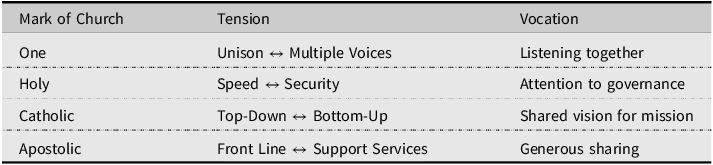
Just as with the parish, I identify four tensions, ordered by the four marks of the church which must be held by a diocese. Again, as with the parish, holding these tensions gives rise to vocations for the diocese (Table 2).
The tensions and vocations of the diocese

Unison and Multiple Voices
A diocese is nothing if not multiple. Within the diocese, there will be a variety of contexts, urban and rural, rich and poor, settled and transient. There will be different political and social preferences, and a range of different industries and businesses. There will be different social, racial and cultural groups. The churches of the diocese will contain much of the spectrum of traditions within the Church and voices on all sides of all disputes within the Church. A diocese will rarely if ever speak in a single voice.
At a diocesan level, these multiple voices can be a huge gift to those the Church is sent to serve. The greatest and most under-utilized Anglican gift in mission is precisely the variety and range of the churches that it contains. Churches in which different theologies and spiritualities are expressed, embodied and experienced, and which enable the Church to speak of the Gospel to a wide range of people ‘in their own language’ (Acts 2.6) could be a realization of the most fundamental spiritual gift. Once again, Martyn Snow captures this well. ‘The church is founded on the principle that diversity is good and can be celebrated, because the same Spirit is at work in all of us’.Footnote 45
In the midst of these multiple voices, the diocesan expression of the local church is called to listen together. There will be insights and reflections that come from others in this multiplicity that are needed to support the mission both of the whole diocese and of parts within it. Only by attending carefully to one another can we unlock the gifts and find the learning we have for one another. St Benedict’s Rule includes the wisdom that ‘whenever any important matters need to be dealt with … the abbot should gather the whole community together… everybody should be summoned to take part in the discussion because the Lord often reveals the better course to a younger person’.Footnote 46 A reflection of Benedict’s monastic gathering of the whole community for consultation may be seen, perhaps, in the Diocesan Synod. But the vocation to listen together, whilst certainly needing to be more formative of Synods, must happen more frequently and in deeper ways. All kinds of spaces are needed where lay people and clergy of the diocese can meet, in many different combinations, to listen together.
When particular issues demanding change or decision are at the fore, the need for listening is both needed more than ever and more difficult to achieve. Writing twenty-five years ago, Paul Avis warned that ‘it is of the essence of a diocese that the clergy and people remain in communion with their bishop. Where that communion is impaired, as it is in some Anglican dioceses over the issue of women priests, a grave anomaly has entered Anglican ecclesiology’.Footnote 47 Without wishing to remove the force of Avis’ warning, it is clear that the arrangements currently in place for those who cannot in conscience accept the authority of a diocesan bishop who is a woman require a greater degree of working with the diocesan bishop. Whilst remaining a source of pain, there are examples of good practice here. The danger is that by settling into a system, however workable, there is no listening to the other, and hence no listening to the Spirit.
Speed and Security
It is not only within the life of the Church that the tension between speed and security is felt. The desire to do something quickly and efficiently can lead to resistance to regulation that is seen as slowing down and making the outcome more difficult to achieve. On the other side of this tension, the need for healthy and safe working practices has been hard won to prevent death and injury. Within Church contexts, this is often worked out as the tension between the vision of an individual or a community to do a particular piece of work (evangelism, beginning a new community, starting a piece of social outreach), and those who insist that there is consultation, due process and a faculty. It is, of course, not hard to conceive of effective governance in which both sides are help together. A system that is not so slow that nothing happens, but not so fast that corners are cut in a dangerous way.Footnote 48
The diocese is well-positioned in the local church to hold this tension. In practice, it does so in a number of different ways. Archdeacons hold a brief to promote good order within the church. The DSS hold expertise that is not available to many parishes, due to their relative small scale. Whether this be about buildings, finances, human resources, church planting or safeguarding, the contributions made here to the life of the local church are hugely important. It is helpful, I think, to consider the demands of governance under the second mark of the Church – that the Church is holy. The diocese is concerned with holiness by attending to good governance.Footnote 49
Top-Down and Bottom-Up
Martyn Percy complains that ‘Too often dioceses or central structures assume that the meta-organization is essential and that the local is small and therefore expendable’.Footnote 50 Whilst this seems to be overstated, Percy’s own solution is that ‘dioceses need to listen to their local congregations more deeply than ever, and begin to build a missional strategy that is more collaborative and less hierarchical’.Footnote 51 This fits well with the vocation that I have suggested follows from the first tension of the diocese (between unison and multiple voices). The recognition that missional strategy needs to be collaborative and is challenged by a hierarchical approach captures the third tension of the diocese – between being top-down and bottom-up. Bishops, archdeacons and diocesan officers will all come with enthusiasms and ideas, and if people of calibre are appointed to these roles, these may even be good things. Likewise, local parishes, congregations, clergy and lay people will also have enthusiasm and ideas. Again, these will often be good things which will sometimes fit together easily and, at other times, pull in different directions. Because it is true that top-down ideas can be good and that bottom-up ideas can be good, this is a tension that must be held.
In holding this tension, I suggest that a more sophisticated approach can be found than either ‘top’ or ‘bottom’ trump the other. Rather, in the listening that Percy advocates, and that I have suggested, a shared vision for mission can be set out and owned widely. This is the vocation of the diocese in holding the tension between top-down and bottom-up. Such a shared vision enables the sharing of energy and the directing of energy and resources towards the service of those beyond the church. Each brings its gifts to this. The parish brings a commitment to place, which enables a depth of understanding of how something will work. Earlier I noted that this also brings a limitation, especially in the sense of catholicity. The diocese brings a wider vision of how the mission of the local church can meet the needs of a broader community. In recognizing that the local church is both parish and diocese, the catholicity of the local church is enhanced.
Claire Watkins notes a similar top-down and bottom-up tension within the parish. She notes that ‘the enabling power of parish clergy in supporting these faith-full practices has its own shadow side: the ability to enable carries with it the potential for failing to nurture or even obstructing.’ This, she argues, may not be a deliberate strategy, but is rather a demonstration of ‘the ‘soft’ power of the parish priest as the gatekeeper.Footnote 52
Front-line and Support Services
A diocese that is heeding its call to listen together is attending to governance and has a shared vision for mission needs, and then to attend to where that mission is happening and who will deliver it. It is less likely to be bishops, archdeacons or diocesan officers who are doing this. Rather the front-line for the mission of the local church will be found in the parish. It is clear that the diocese has need of the parish, with its engagement with people and places, in order to fulfil the demands of apostolicity.
This brings into the open the final tension that I will identify, between the front-line and support services. To be clear, both are needed. Military history is replete with examples of the front-line failing due to poor attention to the support needed behind the lines. Within the local church, this tension is most often expressed in terms of resourcing. Conversations over parish share, used to pay for both parish clergy and diocesan support staff, are often hard and conflictual. Martyn Percy looks for ‘leaner diocesan structures in the future … Indeed, I would go further and suggest that a reasonable goal would be the radical shrinkage of the parish quota system and diocesan infrastructure’.Footnote 53 It is not my aim in this paper to determine levels of funding for dioceses, but it is important to note that both front-line and support services are needed. It is often smaller parishes that need the support most. This is a tension that must be held.
In holding this tension, the diocese is called to a generous sharing. This is a sharing that must attend to both the front-line and the support services. It is a sharing that must be generous too in its support for mission from different traditions and in different contexts. The importance of generosity in the local church is that it is not just given to those who share one set of views or practices but to all who are part of the local church. This is where the vocation to a shared vision for mission is important. That vision should enable some clarity in how that generosity is exercised for the good of the mission of the local church, not for the upkeep of any element of the local church. Transparency is important, both in the normal sense of accounts and financial good practice, but also in how the money so generously given is used to support the shared vision for mission.
Conclusion
What I have tried to do in this paper is to work from the premise that the local church is both the parish and the diocese. When one is positioned as the only form of the local church, in theory or practice, the local church is diminished. Together, parish and diocese form a canopy under which the mission and ministry of the local church can flourish in many different forms. Martyn Percy, writing from a position that sees the parish as the local church to the exclusion of the diocese, nevertheless calls for ‘a new sense of the partnership that forms the paradigm for ministry: between parish, congregation, diocese and priest’.Footnote 54 I wholeheartedly agree.
I began with a story from a parish of saying ‘I need you’ to one another in the church. I hope that this paper has gone some way to enabling the parish and the diocese both to say ‘I need you’ to one another. The PCC meeting I attended ended after ninety minutes of honest and difficult conversation with the parish priest speaking to the assembled group. ‘Whatever the decision we make, however you vote,’ she said, ‘know that I love you and will continue to love you’. The movement from needing one another to loving one another is a truly biblical account of being the body of Christ. But let us begin by acknowledging our need.