Introduction
Plants often provide the first cue in the sequence of events that lead to host location by parasitoids of phytophagous insects, and parasitism levels of different parasitoid species on the same host species have been reported to vary from one host plant species to another (Vinson, Reference Vinson1976). Price et al. (Reference Price, Bouton, Gross, McPheron, Thompson and Weis1980) discussed some of the host plant characteristics that influence parasitism level and parasitoid species composition in a host population. These include plant-secreted attractants, differences in parasitoid search behavior on different host plants, structural refuges that conceal the host and plant toxins sequestered by the host insect that adversely affect parasitoid survival.
Lygus Hahn (Hemiptera: Miridae) are serious pests of a wide variety of economically important crops in North America. Native univoltine Peristenus (Hymenoptera: Braconidae) do not provide adequate suppression of Lygus in Canada; thus, bivoltine European Peristenus are being considered for release as part of a biological control program for Lygus (Kuhlmann et al., Reference Kuhlmann, Mason and Greathead1998). Coutinot & Hoelmer (Reference Coutinot and Hoelmer1999) indicated that studies on the host plant associations of Peristenus would be valuable; however, the attractiveness of different host plants to European Peristenus spp. has not been addressed. In Europe, P. digoneutis Loan and P. relictus are the dominant parasitoids of L. rugulipennis Poppius (Bilewicz-Pawinska & Pankanin, Reference Bilewicz-Pawinska and Pankanin1974). A third species, P. pallipes Curtis, attacks several species of Miridae in Europe and North America (Brindley, Reference Brindley1939; Bilewicz-Pawinska, Reference Bilewicz-Pawinska1982; Goulet & Mason, Reference Goulet and Mason2006). The impact of host plants on parasitism levels and parasitoid species compositions in Lygus in a multiparasitoid system is unknown and may be an important consideration prior to parasitoid release in Canada.
Plants can influence the search and parasitization behaviour of Peristenus pseudopallipes Loan, a native parasitoid of Lygus in North America (Streams et al., Reference Streams, Shahjahan and Le Masurier1968). Parasitism of Lygus lineolaris Palisot de Beauvois by P. pseudopallipes was high on Erigeron spp. (Asteraceae) but negligible on other plant species in the same field (Streams et al., Reference Streams, Shahjahan and Le Masurier1968; Shahjahan & Streams, Reference Shahjahan and Streams1973). Olfactometer assays and experiments on P. pseudopallipes feeding preferences showed that Erigeron spp. were more attractive to the parasitoid than several other host plants of Lygus and that parasitoid longevity was significantly higher when female parasitoids were provided with Erigeron flowers (Shahjahan, Reference Shahjahan1974). This suggests that plant attractants may be important cues for the location of food and host resources by Peristenus species.
Laboratory studies on European P. relictus Ruthe (syn. P. stygicus Loan) showed that parasitoid females responded to volatiles from L. lineolaris nymphs on green bean (Phaseolus vulgaris L.) but not from nymphs or green bean alone (Condit & Cate, Reference Condit and Cate1982). This supports the statement by Vinson (Reference Vinson1976) that plant injury, or a mixture of plant and host factors may guide parasitoids to plants with potential hosts. Thus, odors from Lygus-infested plants may serve as attractants that allow P. relictus females to localize their search for hosts (Condit & Cate, Reference Condit and Cate1982).
Molecular methods to screen host insects for the presence of multiple parasitoid species can be used to estimate parasitism level, parasitoid species composition and incidence of multiparasitism in mirid populations (Gariepy et al., Reference Gariepy, Kuhlmann, Haye, Gillott and Erlandson2005; Greenstone, Reference Greenstone2006; Gariepy et al., Reference Gariepy, Kuhlmann, Gillott and Erlandson2007). Thus, molecular methods could be used to screen L. rugulipennis nymphs collected from different host plants to investigate potential host plant-parasitoid associations. Molecular methods would facilitate such studies because they provide rapid and accurate detection of parasitoids within host insects and are not plagued by the host and parasitoid mortality encountered in rearing. A single-step multiplex PCR assay developed for the simultaneous detection of P. digoneutis, P. relictus and P. pallipes (see Gariepy et al., Reference Gariepy, Kuhlmann, Haye, Gillott and Erlandson2005) was used to screen DNA extracted from L. rugulipennis nymphs collected in red clover (Trifolium pratense L.; Fabaceae), alfalfa (Medicago sativa L.; Fabaceae) and chamomile (Matricaria recutita L.; Asteraceae) in two European ecoregions (see DMEER, 2000). The parasitism levels and parasitoid species composition in the host populations from these different plant species were compared to investigate plant species-host-parasitoid interactions.
Materials and methods
Field collections
Lygus rugulipennis nymphs were collected from five chamomile and five red clover fields in the Northern Temperate Atlantic (NTA) ecoregion in 2003, and in ten red clover and ten alfalfa fields in the Western European Broadleaf Forest (WEBF) ecoregion in 2004. Chamomile sites were generally fallow fields colonized almost exclusively by this plant species (>90% chamomile relative to other plant species in terms of percent cover). Red clover and alfalfa fields were generally monocultures, with few other plant species present. When other plant species were present at a given site, only the host plants of interest were swept for Lygus nymphs. At each site, 100 nymphs were collected using a standard sweep net (38 cm in diameter), sorted in white trays coated with Fluon® (polytetrafluoroethylene, Dyneon Werk Gendorf, Burgkirchen, Germany) and preserved in 95% ethanol for molecular analysis.
Parasitism level and parasitoid species composition in Lygus rugulipennis
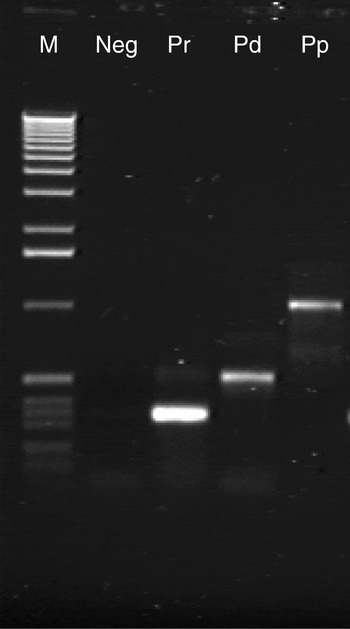
DNA was extracted from individual L. rugulipennis nymphs and amplified using a multiplex PCR assay for P. digoneutis, P. relictus and P. pallipes (Gariepy et al., Reference Gariepy, Kuhlmann, Haye, Gillott and Erlandson2005). As parasitized nymphs provide a positive PCR result and unparasitized nymphs provide a negative result, amplification of DNA from individual nymphs was used to calculate the parasitism level at each site. Parasitoid species composition at each site was estimated based on the number of PCR reactions that generated species-specific products for P. digoneutis, P. relictus and P. pallipes (515-, 330- and 1060-bp PCR products, respectively; see fig. 1). Parasitoid species composition was expressed as the proportion of each parasitoid species in the total number of parasitoids detected. The proportion of multiparasitism (indicated by PCR reactions that were positive for two species simultaneously) in parasitized nymphs was also estimated.
Amplification products obtained with the multiplex PCR assay for P. relictus (Pr), P. digoneutis (Pd) and P. pallipes (Pp). M, 1 kb marker; Neg, negative control (no DNA).

Statistical analysis
To test the null hypothesis that parasitism levels in L. rugulipennis do not differ between red clover and chamomile in the NTA ecoregion, or between red clover and alfalfa in the WEBF ecoregion, independent t-tests (two-tailed; P=0.05) were used. To test the null hypothesis that parasitoid species composition does not differ between red clover and chamomile or between red clover and alfalfa, a Mann-Whitney U test (two-tailed; P=0.05) was used to compare the proportion of a given parasitoid species from each host plant investigated.
Results
The mean parasitism levels in L. rugulipennis collected in red clover and chamomile were 49.6±7.5 (SE) and 45.2±8.1 (SE) in the NTA ecoregion. In L. rugulipennis collected in red clover and alfalfa in the WEBF ecoregion, the mean parasitism levels were 31.8±4.2 (SE) and 24.8±5.0 (SE), respectively. Parasitism levels in L. rugulipennis did not differ significantly between red clover and chamomile sites in the NTA ecoregion (t=−0.40; P=0.70), or red clover and alfalfa habitats in the WEBF ecoregion (t=1.08; P=0.30).
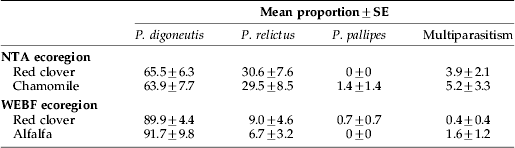
In samples from the NTA ecoregion, the mean proportion of each species and the mean proportion of multiparasitism (table 1) were not significantly different between red clover and chamomile fields (P. digoneutis: z=0.10, P=0.91; P. relictus: z=0.31, P=0.75; P. pallipes: z=−0.52, P=0.60; multiparasitism: z=−0.31, P=0.75). In the host plants surveyed, P. digoneutis and P. relictus were the dominant parasitoid species in L. rugulipennis (approximately 65% and 30%, respectively), whereas P. pallipes was virtually absent (0–1.4%). Multiparasitism was low (4–5%) in both habitats.
Mean proportion (±SE) of P. digoneutis, P. relictus, P. pallipes and multiparasitism in L. rugulipennis collected from red clover, alfalfa or chamomile in the Northern Temperate Atlantic (NTA) ecoregion and the Western European Broadleaf Forest (WEBF) ecoregion.
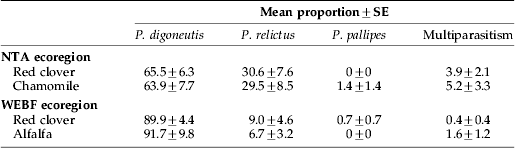
Similarly, there was no significant difference in parasitoid species composition or multiparasitism of L. rugulipennis from red clover and alfalfa in the WEBF ecoregion (table 1): P. digoneutis (z=0.57, P=0.57), P. relictus (z=−0.26, P=0.79), P. pallipes (z=0.38, P=0.71), and multiparasitized individuals (z=−1.09, P=0.27). In the WEBF ecoregion, P. digoneutis was the dominant parasitoid species in L. rugulipennis (approximately 90%). Although P. relictus was present, it represented less than 10% of the parasitoid species composition in red clover and alfalfa. In the Lygus populations sampled, P. pallipes was virtually absent, as was multiparasitism (table 1).
Discussion
Trophic interactions among parasitoids, herbivorous insects and their host plants have become a key focus of studies in insect community ecology (Hawkins & Sheehan, Reference Hawkins and Sheehan1994). There are many examples of insect species that experience different levels of parasitism from the same parasitoid species on different host plant species (DeBach, Reference DeBach1964; Price et al., Reference Price, Bouton, Gross, McPheron, Thompson and Weis1980). Price et al. (Reference Price, Bouton, Gross, McPheron, Thompson and Weis1980) suggested that several host plant characteristics can influence parasitism level and species richness of a parasitoid community. One of these, the production of floral nutrients, influences parasitism of L. lineolaris by P. pseudopallipes on certain host plants (Shahjahan & Streams, Reference Shahjahan and Streams1973).
In the current study, P. digoneutis and P. relictus were the dominant parasitoid species of L. rugulipennis, whereas P. pallipes was rare; this is consistent with previous studies on European Lygus parasitoids (Bilewicz-Pawinska, Reference Bilewicz-Pawinska1982; Coutinot & Hoelmer, Reference Coutinot and Hoelmer1999; Haye et al., Reference Haye, Kuhlmann, Goulet and Mason2005, Reference Haye, Goulet, Mason and Kuhlmann2006). Coutinot & Hoelmer (Reference Coutinot and Hoelmer1999) suggested that regional differences in the Peristenus species composition of Lygus occur in southern and central Europe. Our results support this observation; in the NTA ecoregion, parasitism by both species was relatively high, whereas P. digoneutis dominated in the WEBF ecoregion.
In neither ecoregion were differences observed in the parasitism level or parasitoid community that attack L. rugulipennis on the host plants investigated. Thus, Lygus on all three host plants studied were equally attractive. Although we have no indication of the nature of this attraction, olfactometer experiments have shown that P. relictus females respond positively to volatiles from L. lineolaris nymphs feeding on green bean, but not to volatiles from nymphs or green beans alone (Condit & Cate, Reference Condit and Cate1982). This suggests that P. relictus can detect and respond to volatiles from Lygus-infested plants, and that P. relictus (and perhaps P. digoneutis) may use these volatiles as long-range cues for host habitat location (Condit & Cate, Reference Condit and Cate1982). Host density can also influence parasitism levels and parasitoid community structure (Vinson, Reference Vinson1976; Price, Reference Price1984). Red clover, alfalfa and chamomile are much more attractive than other host plants to Lygus spp. (Easterbrook & Tooley, Reference Easterbrook and Tooley1999; Accinelli et al., Reference Accinelli, Lanzoni, Ramilli, Dradi and Burgio2005). Thus, it cannot be excluded that high parasitism on these host plants is partially influenced by increased Lygus densities.
The present study showed that P. digoneutis and P. relictus parasitized Lygus nymphs on red clover and alfalfa at a fairly high level, with mean parasitism levels of 25–50%. In contrast, P. pseudopallipes rarely parasitized Lygus nymphs collected on red clover (5% parasitism) or alfalfa (2.6% parasitism) in North America (Streams et al., Reference Streams, Shahjahan and Le Masurier1968). Similarly, in northern Sweden (where P. pallipes is the dominant Peristenus species associated with L. rugulipennis), the average parasitism levels in red clover and alfalfa were 11% and 1%, respectively (Rämert et al., Reference Rämert, Hellqvist and Petersen2005). In Poland, average parasitism levels in L. rugulipennis collected on rye, barley, wheat and oats ranged from 12.5–22%. However, P. digoneutis and P. relictus were not the dominant parasitoid species and represented only 0–34% (P. digoneutis) and 8–18% (P. relictus) of the parasitoid species composition (Bilewicz-Pawinska, Reference Bilewicz-Pawinska1982). In comparison, the present study reports fairly high mean parasitism levels (see above), with P. digoneutis and P. relictus dominating the parasitoid species composition (66–92% and 7–31%, respectively). This suggests that P. digoneutis and P. relictus may be better adapted to search for Lygus on red clover and alfalfa, which would be advantageous for classical biological control program in these crops.
Red clover and alfalfa are both in the Fabaceae and may be similar in some of the characteristics that Price et al. (Reference Price, Bouton, Gross, McPheron, Thompson and Weis1980) suggest influence parasitism and parasitoid species composition (e.g. secreted attractants, structural refuges and plant toxins). Although this may explain why no significant differences were found, previous studies on pea aphids (Acyrthosiphon pisum; Homoptera: Aphididae) demonstrated that parasitism by Aphidius ervi (Hymenoptera: Braconidae) was significantly higher on red clover than on alfalfa (Hufbauer & Via, Reference Hufbauer and Via1999). Thus, even closely related plants may differ in their attractiveness to foraging parasitoids.
Godfray (Reference Godfray1994) indicated that the evolutionary and behavioral ecology of host-parasitoid interactions are largely influenced by host plant, with tritophic interactions leading to increased parasitoid efficiency. This increased efficiency can translate into decreased herbivory and/or reduction in the population density of future generations of the herbivore (Godfray, Reference Godfray1994). Thus, host plants can mediate host-parasitoid associations and influence the success of a biological control program (Turlings & Wäckers, Reference Turlings, Wäckers, Cardé and Millar2004).
European parasitoids for Lygus may be released in Canada to reduce pest populations in several economically important crops, including canola. Braun et al. (Reference Braun, Erlandson, Baldwin, Soroka, Mason, Foottit and Hegedus2001) noted that, in the Canadian prairies, parasitism of Lygus spp. by native P. pallipes was almost insignificant in canola and mustard fields. In contrast, parasitism of L. rugulipennis by P. relictus and P. varisae van Achterberg in canola in central Sweden averaged 35% (Rämert et al., Reference Rämert, Hellqvist and Petersen2005). It may be valuable to compare parasitism levels and parasitoid communities in Lygus spp. in brassica crops with those in red clover or alfalfa in different locations in Europe. To complement field studies, olfactometer assays could be used to assess parasitoid response to brassica volatiles (i.e. attractive or repellent). Such studies might allow the selection of the most appropriate parasitoid species or populations adapted to Lygus plant bugs feeding on brassica crops.
Parasitoid adults use nectar and pollen as a food and energy source (Jervis et al., Reference Jervis, Kidd, Fitton, Huddleston and Dawah1993). Red clover and alfalfa have nectar that is high in sucrose, fructose and glucose (Percival, Reference Percival1960) and could potentially be used by P. digoneutis and P. relictus as a source of carbohydrates.
In a classical biological control program for Lygus, the availability of host plants that are attractive to P. digoneutis and P. relictus would be crucial to maintain high parasitoid densities in target crops. In cases where the target crop is not attractive to Peristenus or does not provide floral nutrients, intercropping with preferred host plants, such as red clover or alfalfa, would attract and retain parasitoids in the crop habitat, as both food and host resources would be available.
Beyond agent identification, PCR-based methods can be used to address important aspects of parasitoid ecology. Understanding the structure of parasitoid communities can be hindered by difficulty in the identification of parasitoid species and the large number of rearings required to estimate parasitism levels and parasitoid host ranges (LeCorff et al., Reference LeCorff, Marquis and Whitfield2000). Molecular methods provide a rapid and accurate alternative for the identification and detection of parasitoids within their hosts. And, in contrast to conventional rearing methods, molecular methods are not plagued by host and parasitoid mortality or lengthy diapause periods.
Our study is the first where molecular diagnostics have been used to address host plant-parasitoid associations. These methods offer a unique approach to studying tritrophic interactions and provide detailed information on parasitism level, parasitoid species composition and multiparasitism in a host population. In-depth knowledge of tritrophic interactions may improve the design of effective biological control strategies (Lewis et al., Reference Lewis, Stapel, Cortesero and Takasu1998). Further investigation of tritrophic interactions between Lygus plant bugs, their host plants and parasitoids both in Europe and North America would enhance classical biological control programs for this pest.
Acknowledgements
The authors would like to thank T. Haye for comments and suggestions on this manuscript, and L. Lovis and J. Miall for assistance in the field. This research was supported by the Natural Sciences and Engineering Research Council (NSERC Canada Graduate Scholarship for T.D. Gariepy), CABI Europe-Switzerland, Agriculture and Agri-Food Canada and the Biocontrol Network of Canada.