INTRODUCTION
The Multilingual Naming Test (MINT) is a picture-naming test designed to assess degree of bilingualism (i.e., equal proficiency in two languages) and naming abilities in speakers of English, Spanish, Mandarin, and Hebrew as well as individuals who speak any combination of these languages (Gollan et al., Reference Gollan, Weissberger, Runnqvist, Montoya and Cera2012). Prior studies showed that the MINT performed well as a classification tool for identifying dominant language in Spanish–English bilinguals by subtracting the Spanish scores from the English scores (negative scores indicate Spanish dominance and vice versa) (Gollan et al., Reference Gollan, Weissberger, Runnqvist, Montoya and Cera2012; Tomoschuk, Ferreira, & Gollan, Reference Tomoschuk, Ferreira and Gollan2019). A subsequent study of an abbreviated (32-item) version of the MINT, which primarily includes the more difficult items from the full version of the MINT, provided preliminary evidence for its clinical utility (Ivanova, Salmon, & Gollan, Reference Ivanova, Salmon and Gollan2013). The study showed that the 32-item MINT successfully detected naming deficits (i.e., dysnomia) in monolingual English speakers across different levels of cognitive impairments, including those with mild cognitive impairment (MCI) or Alzheimer’s disease (AD). This same study also reported that the MINT scores were sensitive for identifying bilingual Spanish–English speakers with AD, but not those with MCI (Ivanova et al., Reference Ivanova, Salmon and Gollan2013).
In April of 2015, all Alzheimer’s Disease Research Centers (ADRCs) across the United States started using the abbreviated 32-item MINT in their annual cognitive evaluations to assess naming deficits. Initial data from the ADRCs showed that the MINT could be used to distinguish monolingual English-speaking older adults with MCI from those with normal cognition and AD (Stasenko, Jacobs, Salmon, & Gollan, Reference Stasenko, Jacobs, Salmon and Gollan2019). Preliminary normative data for the MINT have been reported using over 3000 cognitive normal participants across the ADRCs (Weintraub et al., Reference Weintraub, Besser, Dodge, Teylan, Ferris, Goldstein and Morris2018). Despite its potential, the contents of the MINT may not be optimal for monolingual speakers of languages other than English, such as Mandarin and Cantonese. Both Cantonese and Mandarin are dialects of the Chinese language. Cantonese is the spoken language in Hong Kong, Macau, GuangZhou, and southern parts of China, whereas Mandarin is the spoken language in other parts of Mainland China and Taiwan. Item difficulty in the MINT increases with item progression, but an item that is difficult in the English language may be relatively easy in the Chinese language and vice versa. In addition, differences in cultural background might also influence responses on the MINT. For instance, the Boston Naming Test (BNT; Kaplan, Goodglass, & Weintraub, Reference Kaplan, Goodglass and Weintraub1983), one of the most frequently used picture-naming tests, has items (e.g., trellis, beaver, and pelican) that are not familiar to the Chinese populations, whereas most Chinese are able to easily recognize some of the most difficult items in the test (e.g., abacus).
Chinese Americans are the fastest growing ethnic minority in the United States, surpassing the Hispanic American population in recent years (Lopez, Ruiz, & Patten, Reference Lopez, Ruiz and Patten2017). At present, there are roughly a quarter million Chinese Americans who are over the age of 65 years (Roberts, Ogunwole, Blakeslee, & Rabe, Reference Roberts, Ogunwole, Blakeslee and Rabe2018). The proportion of Chinese American older adults is anticipated to increase exponentially in the United States (Sun, Ong, & Burnette, Reference Sun, Ong and Burnette2012). Chinese is the spoken language within the Chinese American population (Cooc & Leung, Reference Cooc and Leung2016) and is also the third-most common language spoken in the United States (Lyons, Reference Lyons2020). Chinese is the primary language spoken at home for about 3.4 million individuals, most of whom are limited in their English proficiency (Zong & Batalova, Reference Zong and Batalova2015). In the 2011 U.S. Census Bureau, almost 90% of Chinese older adults were foreign born, 30% immigrated to the United States after 60 years old, and almost 70% have a low English proficiency (Tang, Zhang, Chi, & Dong, Reference Tang, Zhang, Chi and Dong2018). The data indicate the need for linguistically appropriate services for Chinese American older adults. This poses a particular challenge in dementia evaluations due to lack of sensitive tools available for cognitive assessment of Chinese American older adults, particularly tests of language function.
The MINT could potentially be used to detect language deficits in Chinese American older adults who are monolingual Chinese speakers. However, the test has yet to be validated for use in Chinese monolinguals with different stages of cognitive impairments. The content of the MINT reflects the cultural context and word difficulty in which it was developed and may not be appropriate for individuals from other cultural and linguistic groups. Such cultural and linguistic discrepancies can influence MINT performance. To the best of our knowledge, no study has investigated the psychometric properties of the Chinese translations of the MINT. The purpose of the present study is to describe the performance on the MINT by Chinese American older adults who monolingual Chinese speakers. An attempt was made to identify items that could potentially introduce biases and warrant attention in future investigation.
METHOD
Participants
The ADRC at the Icahn School of Medicine at Mount Sinai (ISMMS) was established and funded by the National Institute on Aging in the 1980s to facilitate collaborative research using the National Alzheimer’s Coordinating Center Uniform Data Set (NACC UDS). The NACC UDS was only available for English speakers until 2007 when the Spanish translation of the UDS became available. Between 2018 and 2019, the ADRC at ISMMS implemented the Chinese translation of the NACC UDS version 3.0 to evaluate monolingual Chinese-speaking older adults. Inclusion criteria were as follows: 65 years old or above, monolingual Chinese-speaking, and having a study partner able to participate as required in the NACC protocol. Institutional review board approval was obtained at the ISMMS. Informed consent was signed by either the participants or their legally authorized representatives. A total of 67 monolingual Chinese-speaking older adults were evaluated at the ADRC at ISMMS using the NACC UDS 3.0 before human subject research studies have to be paused due to the coronavirus disease 2019.
Procedure and Measures
The NACC UDS is a 3-hr in-person diagnostic workup, which includes an evaluation by a geriatric psychiatrist specializing in memory loss, cognitive testing with an English–Chinese bilingual psychometrician, and a research blood draw. Administration and scoring of the 32-item MINT in the NACC UDS 3.0 were as follows:
Participants were given up to 20 seconds to name each of the 32 items on the MINT, with full credit accorded to self-corrections that occurred during this time period. If an incorrect, or no response was provided within this time period a stimulus cue was offered (e.g., “it is an animal”). If provision of a stimulus cue did not result in a correct answer, a phonemic cue was provided (e.g., “it starts with the sound…”). The test was discontinued when participants failed to correctly name objects on six consecutive trials. Consistent with the English version of the MINT, the Chinese version allows for alternative responses from item 3 lightbulb (i.e., electric bulb 电灯泡, bulb 灯), item 10 seesaw (i.e., teeter-totter 压跷板), and item 29 gauge (i.e., manometer 压力计, barometer 气压计).
The MINT items were scored in two ways: “rigorous” and “lenient.” The “rigorous” scoring included correct responses based on the NACC UDS response form, whereas the “lenient” scoring included correct responses based on the participant’s region of origin. Some items on the MINT have names used in other regions of China that are not correct standard responses based on the NACC UDS response form. These regionalisms were accepted if at least one Internet-based Chinese dictionary listed them as correct. Scoring was checked by a bilingual English–Chinese neuropsychologist. Disagreements on scoring decisions were resolved through discussion and careful review of the Chinese dictionaries.
Diagnostic Criteria
All participants were assigned a research diagnosis at standard consensus conference using diagnostic criteria for normal aging, MCI (Albert et al., Reference Albert, DeKosky, Dickson, Dubois, Feldman, Fox and Phelps2011), and dementia (McKhann et al., Reference McKhann, Knopman, Chertkow, Hyman, Jack, Kawas and Phelps2011). The consensus conference was run by three staff members at the ADRC at ISMMS: a geriatric psychiatrist who specializes in memory loss, an English–Chinese bilingual neuropsychologist, and an English–Chinese bilingual psychometrician who administered the cognitive tests. Using the diagnostic criteria, the sample was categorized into 38 normal cognition, 12 MCI, and 17 with dementia.
Analytic Approach
Demographic variables, including age, education, gender, years living in the United States, primary language, and country of origin, were computed for the overall sample. Analyses were descriptive, examining the frequencies and percentages of various categories of item responses: (1) spontaneously correct (“rigorous” scoring), (2) correct with semantic cue, (3) correct based on the participant’s region of origin (“lenient” scoring), and (4) nonresponse (i.e., “I don’t know”). Correlations between MINT scores and demographic variables were examined using Pearson’s correlation for continuous variables (i.e., age and education) and Eta correlation for nominal variable (i.e., gender). An ANCOVA was conducted to investigate if there were differences on MINT scores by cognitive diagnosis (i.e., normal cognition, MCI, and dementia) while controlling for the demographic variables that were significantly correlated to MINT scores. Statistical significance was set a priori at p = 0.05. Items with low percentage of correct responses (<45%) in the normal group were examined using a qualitative approach to classify errors into categories.
RESULTS
Sample Description
Participants included 67 monolingual Chinese Americans with a mean age of 72.49 ± 8.27 years. The mean education was 12.25 ± 4.26 and mean years living in the United States was 33.83 ± 13.63; the majority of participants were female (61.2%). Examination of native language reported by the participants revealed that 61.2% were Mandarin speakers and 38.8% were Cantonese speakers. The majority of the participants were born in southern China (58.0%).
MINT Performance
Overall, participants with dementia (“lenient” = 18.41 ± 8.56; “rigorous” = 15.59 ± 8.22) obtained lower total scores on the MINT than participants with MCI (“lenient” = 23.08 ± 4.32; “rigorous” = 21.08 ± 3.68) or normal cognition (“lenient” = 25.24 ± 3.2; “rigorous” = 22.32 ± 3.41). There were no significant differences in MINT scores between male and females. Mandarin-speaking participants had slightly higher scores than Cantonese-speaking subjects. As expected, years of education positively correlated with the MINT scores (“lenient” r = −0.314, p = 0.010; “rigorous” r = 0.282, p = 0.021). Age negatively correlated with the MINT scores (“lenient” r = −0.270, p = 0.027; “rigorous” r = −0.286, p = 0.019). The ANCOVA revealed that age (“lenient” p = 0.072, r 2 = 0.051; “rigorous” p = 0.078, r 2 = 0.049) and education (“lenient” p = 0.003, r 2 = 0.136; “rigorous” p = 0.008, r 2 = 0.110) had an effect on MINT scores. There was also a significant effect of cognitive diagnosis on MINT scores after controlling for the effect of age and education (“lenient” p = 0.004, r 2 = 0.164; “rigorous” p = 0.004, r 2 = 0.161). The difference between normal cognition and dementia group was statistically significant (“lenient” p < 0.001; “rigorous” p < 0.001). MCI group was significantly different from dementia group (“lenient” p = 0.021; “rigorous” p = 0.006), but not significantly different from normal cognition (“lenient” p = 0.219; “rigorous” p = 0.467).
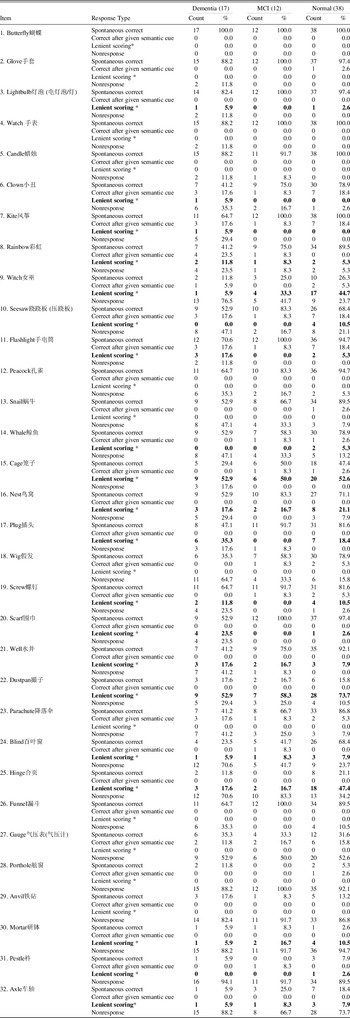
Table 1 lists the items in the order of difficulty. There was one item (i.e., butterfly) showing a 100% correct response across diagnostic groups. Several other items (i.e., glove, lightbulb, watch, and candle) also had very few wrong answers in all three diagnostic groups. Semantic cueing helped participants name certain items (i.e., glove, clown, rainbow, witch, snail, whale, wig, screw, blind, gauge, porthole, pestle, and axle). The benefit of semantic cues ranged from 0% to 23.5% (see Table 1). Inclusion of acceptable responses based on participants’ regions of origin (refers to “lenient” scoring) changed the results from incorrect to correct for 20 items (i.e., lightbulb, clown, kite, rainbow, witch, seesaw, flashlight, whale, cage, nest, plug, screw, scarf, well, dustpan, blind, hinge, mortar, pestle, and axle). Specifically, the benefit of “lenient” scoring ranged from 2.6% to 73.7% (see bolded rows in Table 1). The last five items (i.e., porthole, anvil, mortar, pestle, and axle) yielded a relatively high nonresponse rate (i.e., “I don’t know”) (see Table 1).
Responses per item in monolingual elderly Chinese Americans across cognitive diagnostic groups
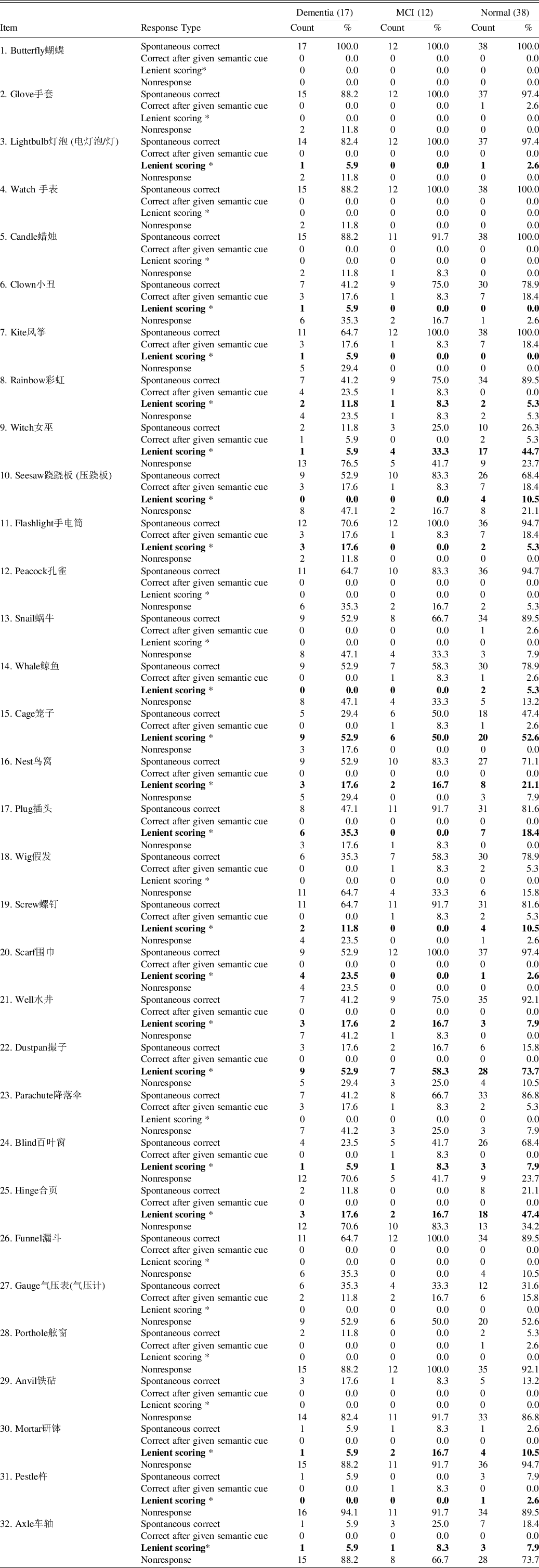
Note. Inclusion of acceptable response based on participants’ regions of origin changed the results from incorrect to correct for the items in bolded rows. The words in () represent alternative correct responses provided by the National Alzheimer’s Coordinating Center Uniform Data Set (NACC UDS) version 3.0.
* Correct responses based on the participant’s region of origin.
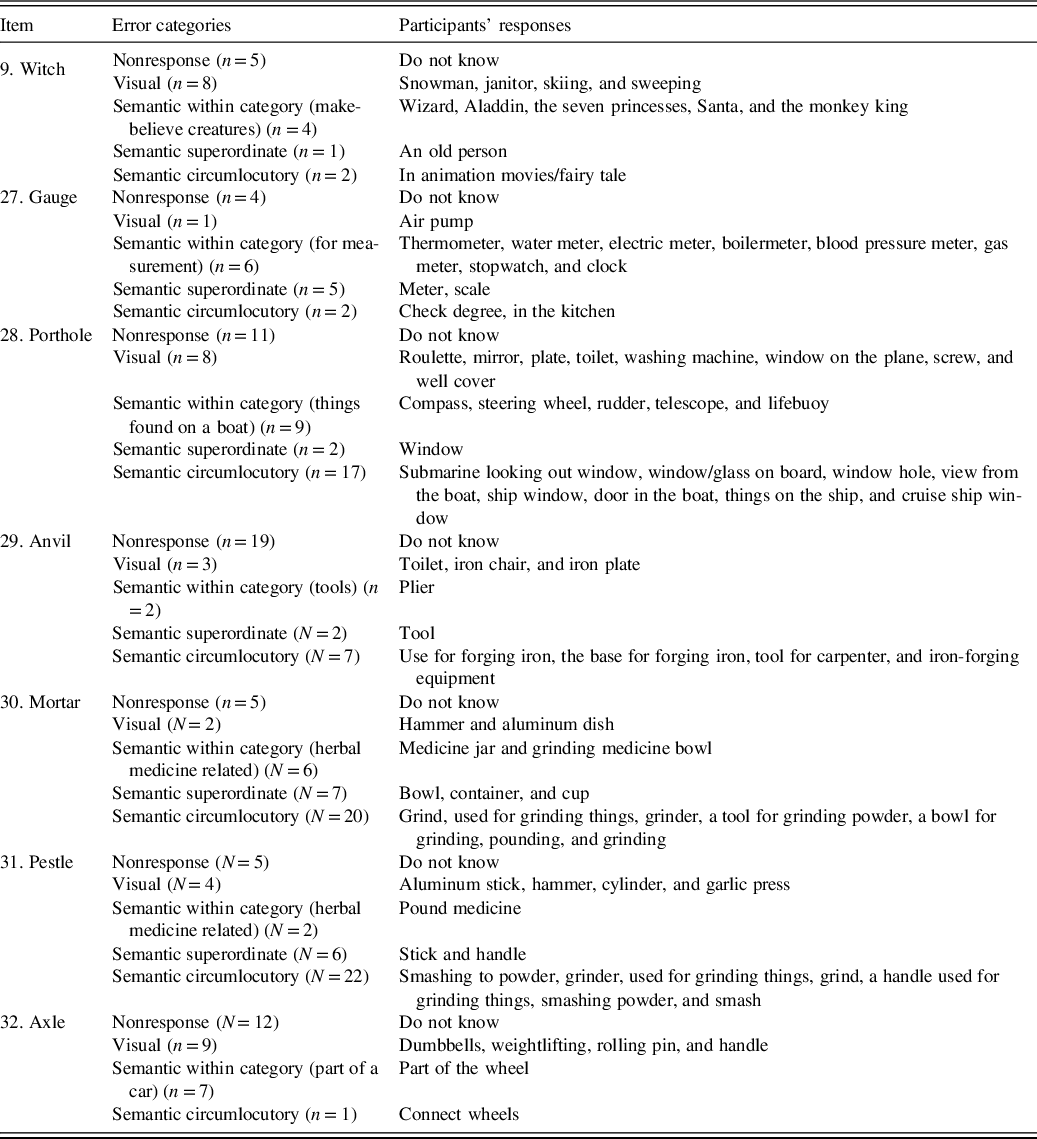
As can be seen in Table 1, the standard order of presentation may be inappropriately rank ordered for monolingual Chinese-speaking older adults. Item 26 (i.e., funnel) showed a higher percentage of correct than items with lower difficulty levels (e.g., item 25 hinge and item 24 blind). In contrast, a lower percentage of correct was evident with item 9 (i.e., witch), item 10 (i.e., seesaw), and item 18 (i.e., wig) compared to items with higher difficulty levels (e.g., item 19 screw). Using our cognitively normal participants, examination of errors made on the low-accuracy items (<45%) reveals five types of naming errors (see Table 2): (1) nonresponse, (2) visual errors: objects are visually similar to the target words but belong to a different semantic category (e.g., “dumbbells” for axle), (3) semantic within category errors: responses from the same semantic category but visually different (e.g., “Aladdin” for witch), (4) semantic superordinate errors: general class (e.g., “window” for porthole), and (5) semantic circumlocutory errors: statements of action or function (e.g., “a tool for grinding powder” for mortar).
Naming difficulties in monolingual cognitively normal elderly Chinese Americans by error patterns

Note. The numbers in () represent number of participants endorsed the error.
DISCUSSION
In this study, we found that the test performance of monolingual Chinese-speaking older adults was correlated with age and education as expected, demonstrating sensitivity to demographic characteristics. Our results indicated that the MINT is sensitive to naming impairments in monolingual Chinese-speaking older adults with dementia but not MCI. Only 16% of the variance in MINT scores were explained by cognitive diagnosis, with a smaller variance explained by age (about 5%) and education (11%–14%). These findings highlight an important limitation of existing MINT in identifying monolingual Chinese-speaking older adults who are at high risk of developing dementia. In other words, the MINT is not sensitive enough to detect MCI in the present cohort. The biased nature of the items toward English speakers likely affects the sensitivity of the capture subtle cognitive changes.
Mandarin speakers seemed to perform better than Cantonese speakers. This could be a result of using standard response options that were inclusive of Mandarin Chinese, but exclusive of Cantonese Chinese. In the present study, Mandarin standard was used to score responses by Cantonese speakers as the “rigorous” scoring method because the original scoring form did not include Cantonese responses. In fact, this pilot effort suggests that there is a need to expand responses for 20 items to take regional differences into consideration (i.e., lightbulb, clown, kite, rainbow, witch, seesaw, flashlight, whale, cage, nest, plug, screw, scarf, well, dustpan, blind, hinge, mortar, pestle, and axle). These items on the MINT have more than one correct name, suggesting the need to consider cultural and linguistic diversity in different regions of China when making scoring decisions.
Comparison of published MINT mean total scores and standard deviation (Weintraub et al., Reference Weintraub, Besser, Dodge, Teylan, Ferris, Goldstein and Morris2018) to the present sample revealed that monolingual Chinese-speaking older adults performed significantly below the level obtained by their Caucasian counterparts (more than 1 standard deviations below the mean for a Caucasian normative group). In our present sample, a “lenient” score of 25.24 ± 3.2 or a “rigorous” score of 22.32 ± 3.41 is considered in the normative range for monolingual Chinese-speaking older adults with a mean age of 72.49 ± 8.27 years and mean education of 12.25 ± 4.26 years. While the MINT was designed to contain items that have similar levels of difficulty across English, Spanish, Hebrew, and Mandarin (Gollan et al., Reference Gollan, Weissberger, Runnqvist, Montoya and Cera2012), our study shows that the current order of presentation might not reflect graded naming difficulty level for monolingual Mandarin- or Cantonese-speaking older adults.
The pattern of item difficulty suggests that the Chinese older populations performed at or near ceiling level for the first five items of the test (i.e., butterfly, glove, lightbulb, watch, and candle). The item funnel (item 26) appears to be much more common in the Chinese culture than in the English culture. In contrast, the items witch (item 9), seesaw (item 10), and wig (item 18) seem to be much rarer in the Chinese culture compared to the English culture. In addition, response variations and errors were high for the last five items (i.e., porthole, anvil, mortar, pestle, and axle) even in the normal group. An additional ANCOVA was conducted on a 27-item MINT after removing the five items. The results showed that cognitive diagnosis captured slightly larger variances in the 27-item MINT (lenient” p = 0.001, r 2 = 0.193; “rigorous” p = 0.003, r 2 = 0.175) than the 32-item MINT (lenient” p = 0.004, r 2 = 0.164; “rigorous” p = 0.004, r 2 = 0.161) after controlling for age and education. However, the differences in MINT scores between MCI and normal cognition remain insignificant. Further research must be conducted not only to change the item order but also to remove problematic items that are part of the MINT.
Examination of errors reveals that the item gauge might be a culturally biased item. The majority of errors (e.g., thermometer, blood pressure meter, stopwatch, and clock) reflect types of measurements that are more common in the Chinese culture. Similar issues are observed with the item witch, where participants’ responses (e.g., wizard, Aladdin, the seven princesses, Santa, the monkey king) reflect characters of similar characteristics that are more common in the Chinese culture. It should be noted that the image of the witch (i.e., pointy hat and flying broomstick) is not a character that is popularly seen in the Chinese culture. Many of the participants responded with janitor for “witch”. Similarly, the items porthole and axel appear to need better representations of the images to reduce visual errors. For example, participants responded with washing machine, mirror, roulette, plate, well cover for “porthole” and dumbbells, weightlifting, rolling pin, handle for “axle.” The majority of errors made when presented with items anvil, mortar, and pestle suggests that the target words have low levels of usage and familiarity, even among the educated participants with normal cognition.
Overall, the present study shows that some MINT items are not familiar to Chinese older populations and should be replaced with more culturally appropriate items to improve sensitivity of the test. In addition, new normative data must be collected due to the observed word-difficulty differences across cultures and languages. According to our findings, some original MINT items are likely culturally biased (i.e., witch and gauge) and extremely rare (i.e., porthole, anvil, mortar, pestle, and axle) in the Chinese culture and language. In addition, some of the easy MINT items (i.e., seesaw and wig) are not familiar to monolingual Chinese older populations, whereas most Chinese older adults are able to easily recognize a more difficult MINT item (i.e., funnel). Thus, it is recommended that the use of the MINT on monolingual Chinese-speaking older adults requires a revision of the test. The results presented in Table 1 may serve as a reference to develop a better, less culturally biased naming test.
Our results in Table 1 reveal limitations of the MINT in different cultures, with significant biases toward native-born English speakers. These findings suggest the need to develop a new naming test that has culturally equivalent items. Future effort on the MINT revision may use less culturally biased items with comparable word frequency in different languages. There are different sources of word frequencies that can be used for establishing comparable word frequency in Chinese. The first is the Chinese Lexical Database http://www.chineselexicaldatabase.com, which can be downloaded in.txt,.csv, and.pdf formats. The second is the Leiden Weibo Corpus http://lwc.daanvanesch.nl, which can be accessed through a search interface. Another source that can be used is in the Chinese Single-Character Word Database http://www.personal.psu.edu/pul8/psylin_norm/psychnorms.html, which provides information about single-character Chinese words including nouns, verbs, and adjectives.
The present study has several limitations. First, our results were obtained through descriptive analysis made on the MINT items by monolingual Chinese-speaking older adults. To improve the potential clinical utility of the MINT, further testing is warranted using an item analysis with enhanced sample sizes to replace biased items with more culturally appropriate and similar difficulty items across cultures. Another approach to consider is tests of differential item functioning. The analyses can identify biased items between monolingual Chinese- and English-speaking older adults, but the minimal sample size requirement for these models is 200 per group (Orlando Edelen, Thissen, Teresi, Kleinman, & Ocepek-Welikson, Reference Orlando Edelen, Thissen, Teresi, Kleinman and Ocepek-Welikson2006). To understand why certain items show biases and other items do not, a qualitative method can be applied to understand the cognitive processes of participants when they are responding to the items (e.g., how they achieve an answer). Different cognitive processes are expected from participants of different cultural groups when items are flagged as biased items. By revealing the cognitive processes of participants who responded to the different language versions of the MINT, we many establish the cause of the item bias. The calculation of sensitivity, specificity, positive predictive value, and negative predictive value should also be included to establish the validity of the revision. Our results indicate that while monolingual Chinese-speaking older adults as a whole are the subject of cultural bias when presented with the MINT, cultural groups within Chinese might be the subject of additional cultural biases. Thus, images used in the revised MINT should be piloted on cognitively healthy Chinese-speaking older adults to ensure that items have similar frequency and appearances in different regions of China. In addition, future research should be conducted to examine the psychometric properties of the Chinese translation of the MINT, including their reliability, validity, discriminative ability, and sensitivity to longitudinal cognitive decline. Finally, our study did not compare sensitivity of the MINT with a similar picture-naming test, such as the BNT. There is evidence suggesting that a modified version of the BNT is applicable to Chinese population (Cheung, Cheung, & Chan, Reference Cheung, Cheung and Chan2004). Subsequent studies in this area could consider comparing the sensitivity of the MINT with the BNT to determine which test is most appropriate for assessing naming deficits in monolingual Chinese-speaking older adults.
In conclusion, despite the clinical utility of the MINT for English monolinguals, our findings suggest that there is a need to investigate the existing MINT items when used in monolingual speakers of a language other than English. Although potentially biased items were identified in monolingual Chinese older adults, further research should be conducted to examine if item difficulty levels are sufficient to explain performance differences in English and Chinese monolinguals. To our knowledge, it is the first paper reporting the potential biases in the Chinese version of the MINT. Our study highlights cultural and linguistic differences that lead to unfamiliarity with picture-naming items that might influence the test results. The findings provide items that warrant additional analysis for future projects.
AUTHOR CONTRIBUTIONS
All authors certify that they have participated sufficiently in the work, including participation in the concept, design, analysis, writing, or revision of the manuscript. Furthermore, each author certifies that this material or similar material has not been and will not be submitted to or published in any other publication.
FINANCIAL SUPPORT
This work was supported by the National Institutes of Health (C.L., grant number R03AG061439), (M.S., grant number P50AG05138), and (N.G., grant number P30AG028741).
CONFLICTS OF INTEREST
None.
ETHICAL STANDARDS
All procedures performed in the study were in accordance with the ethnical standards of the institutional research committee. Informed consent was obtained from all individual participants involved in the study.