Introduction
A key step in developing successful integrated pest management (IPM) programs is to understand how components of the agroecosystem can alter the intensity of attack of a pest species to the host crop (Pereira et al., Reference Pereira, Picanço, Bacci, Crespo and Guedes2007). This can be even more important if considering systems with occasional pests that have the potential to become key pests due to changes in the production practices and where information on the efficacy of control interventions, such as pesticides, is still scarce for such pests. In these cases, conservation and improvement of natural control, performed by components of the agroecosystem, can help in the reduction of losses due to the occurrence of pests, being environmentally safe and having little or no impact on the production costs.
It has been shown that the maintenance of the population equilibrium of several important pests can be obtained through the action of natural mortality factors (e.g. Miranda et al., Reference Miranda, Picanço, Zanuncio and Guedes1998; Gonring et al., Reference Gonring, Picanço, Guedes and Silva2003a,b; Pustejovsky & Smith, Reference Pustejovsky and Smith2006; Pereira et al., Reference Pereira, Picanço, Bacci, Crespo and Guedes2007). Usually, this type of information is acquired with the development of ecological life tables and the determination of key mortality factors (Harcourt, Reference Harcourt1969). Among the key mortality factors involved in the natural mortality of several pests, two groups deserve more attention since they usually have great impact on the population dynamics of pest species. These groups are natural enemies and weather conditions, and they can cause mortality in the two critical stages – eggs and immature stages such as nymphs and larvae. Both groups can show seasonality in their occurrence through the cycle of annual crops and also during the different seasons of the year, for perennial crops. Therefore, it is important to be aware of the duration and magnitude of these factors in different growing seasons since this information is central to the study of population dynamics and development of suitable pest management programs.
Among the phytophagous pests of major importance are the psyllids (Hemiptera: Sternorrhyncha: Psylloidea). Besides the direct damage caused by the sucking of plant sap and toxin injection, these insects can transmit diseases and increase the development of sooty mold, reducing photosynthetic activity (Malagnini et al., Reference Malagnini, Pedrazzoli, Gualandri, Zasso, Bozza, Fiamingo, Pozzebon, Mori and Ioroatti2010). Several plant species in different countries have been attacked by these insects. For example, high losses have been reported on eucalypt in Australia, Brazil, Europe and Africa (Collett, Reference Collett2000; Hodkinson, Reference Hodkinson2007; Santana & Burckhardt, Reference Santana and Burckhardt2007; Tamesse et al., Reference Tamesse, Laurentine, Wenceslas and Joly2010), citrus in the US and Brazil (Coletta-Filho et al., Reference Coletta-Filho, Targon, Takita, De Negri, Pompeu, Amaral, Muller and Machado2004; Manjunath et al., Reference Manjunath, Halbert, Ramadugu, Webb and Lee2008), apple in Germany and Italy (Jarausch et al., Reference Jarausch, Fuchs, Schwind, Krczal and Jarausch2007; Malagnini et al., Reference Malagnini, Pedrazzoli, Gualandri, Zasso, Bozza, Fiamingo, Pozzebon, Mori and Ioroatti2010) and potato in the US, Mexico, Central America and New Zealand (Miles et al., Reference Miles, Buchman and Munyaneza2009).
A particular species of psyllid Triozoida limbata (Enderlein) (Hemiptera: Sternorrhyncha: Triozidae) has become an important pest in guava orchards (Psidium guajava L. and P. cattleianum Sabine) in the neotropical region (Colombi & Galli, Reference Colombi and Galli2009; Ouvrard, Reference Ouvrard2010). This species is usually considered an occasional pest of guava, but may become a key pest where pruning management is frequently carried out to obtain year-round production (Lima & Gravina, Reference Lima and Gravina2009). There are few insecticides registered for controlling T. limbata, and it has been shown that several formulations do not provide effective control (Lima & Gravina, Reference Lima and Gravina2009). When the nymphs of this species reach third instar, they move to the edges of the leaves where they inject toxins causing the leaves to curl and consequently form galls. These structures protect the nymphs until they become adults, making the efficiency of control interventions, such as insecticides, low. Consequently, natural enemies that are adapted to this situation and weather conditions can overcome this barrier and are critical IPM components that can greatly impact the population dynamics of T. limbata.
Thus, the objectives of this work were to investigate the impact and the seasonality of natural mortality factors of T. limbata in the field and to determine the relationship among the components of mortality.
Materials and methods
Study site and periods of study
This research was carried out in an experimental guava orchard located in Viçosa (20°48′45″S; 42°56′15″W; altitude 672m), state of Minas Gerais, Brazil. Ten-year-old guava plants belonging to the variety ‘Paluma’ were cultivated using a 5-m plant spacing × 6-m row spacing within an area of 800m2. Standard agronomic practices for guava orchards (Manica et al., Reference Manica, Icuma, Junqueira, Salvador, Moreira and Malavolta2000) were carried out in the area, but no control methods were applied for pests and diseases control. At the beginning of the autumn and by the end of winter seasons, plants were pruned to encourage the production of new leaves.
The seasonal effects on the factors affecting the natural mortality of T. limbata were studied using data collected in four different periods, May to June 2006, July to August 2006, October to November 2006 and January to February 2007, which roughly represent the different seasons of the year (autumn, winter, spring and summer, respectively) for the southern hemisphere. These periods were also chosen because they are distinct in terms of temperature and rainfall, which were considered as potential major weather-related factors, having great direct or indirect impacts on the mortality of T. limbata.
Cohort establishment
Eight guava plants were used as the experimental unity across seasons, with the further selection of six branches within each plant. All branches were carefully inspected for the presence of T. limbata eggs and nymphs using 10 × magnifier lens, and any egg or nymph present was removed with the aid of a soft paint brush. The paint brush was also used to remove any dust or eggs and nymphs of other species that were present on the leaves. Only the two most recently emerged and completely expanded pair of leaves per branch were used since these are the leaves preferred by T. limbata (M.C. Picanço, personal observation). To establish several cohorts with similar ages, adults of T. limbata were collected on the same day in a commercial guava orchard located in Paula Cândido County, state of Minas Gerais, Brazil. Thirty adults were caged on each branch using an organza bag and left for 24h to lay eggs. After 24h, all adults were removed and killed, the bags were removed, and the cohorts of eggs were identified on the upper and lower sides of the leaves and their positions were recorded with the aid of schematic drawings of the leaves.
Assessment of natural mortality
After cohort establishment, natural mortality was monitored daily from the egg to the nymphal stages (Miranda et al., Reference Miranda, Picanço, Zanuncio and Guedes1998; Gonring et al., Reference Gonring, Picanço, Guedes and Silva2003a; Pereira et al., Reference Pereira, Picanço, Bacci, Crespo and Guedes2007). Throughout the entire egg stage, all disappearing eggs had their position and date of disappearance recorded, and the reason for disappearance was determined. To evaluate the role of rainfall in the natural mortality, the number of eggs was counted immediately before and after each rain. When no rain occurred between two consecutive evaluations, the eggs not found on their recorded position were considered to be attacked by predators. This assumption is reasonable since T. limbata eggs are strongly attached to the leaves, which makes it almost impossible for them to fall due to wind. The presence of predators on each leaf was recorded, and representative specimens were collected and maintained in 70% ethanol for further identification. All the eggs that did not hatch were taken to the laboratory where they were kept at room temperature inside glass vials for the potential emergence of parasitoids, being then considered unviable if no parasitoids emerged.
Since data on the biology of T. limbata is scarce in the literature, there was no information on the number of nymphal instars in tropical conditions. To address this issue, a frequency curve was developed to determine the number of nymphal instars. Nymphs of all sizes were measured using pictures taken with a digital camera (Leica MZ75; program Leica QWIN) attached to a computer, and the number of nymphal instars was determined considering the number of peaks present in the curve. For the evaluation of natural mortality at the nymph stage, in each instar one branch with the two pairs of leaves was removed and taken to the laboratory where live nymphs were counted under a microscope with zoom capacity of ten to 45 times. Predation by wasps was evaluated on 40 additional leaves collected from other guava plants in the same experimental area and by determining the number of galls and nymphs that were predated. The methodology was developed to account for the nymphs that can potentially survive the attack of wasps and, therefore, prevent the overestimation of levels of mortality. Mortality by predaceous wasps was identified in the field since attacked galls are easily recognized by their torn or removed surfaces. Additionally, samples were taken to the laboratory where galls of different sizes were opened to count the number of remaining live nymphs. In the leaves collected to determine wasps' predation, all galls were opened, the number of nymphs was counted and the instar identified. Galls were classified in five categories: type 1 (smallest visible gall occupying up to 1/5 of one leaf edge); type 2 (from 1/5 to 2/5 of one leaf edge); type 3 (from 2/5 to 3/5 of one leaf edge); type 4 (from 3/5 to 4/5 of one leaf edge) and type 5 (from 4/5 to 5/5 of one leaf edge). Based on the size of the gall removed by the wasps and the average number of nymphs per cm of gall, it was possible to determine the percentage of predated galls and, consequently, the percentage of predated nymphs. A similar methodology was used to determine the predation by syrphids. However, in this case, predated galls were defined as the galls with at least one larva of a syrphid (A.A. Semeão, personal observation). Additionally, all branches were monitored daily for the presence of other natural enemie, and representative specimens were collected and maintained in 70% ethanol for further identification. Similarly to the egg stage, the effect of rainfall was determined by checking the leaves immediately before and after each rain. The galls in the leaves were open; and, if they were flooded with water from rainfall with the presence of recently dead nymphs, the nymphs were considered dead due to this factor.
Levels of parasitism in each period were determined in 40 additional leaves collected in other guava plants in the same experimental area using the methodology adapted from Reis Jr. et al. (Reference Reis, Lima, Vilela and Barros2000). For that purpose, nymphs were kept under room condition. Clear plastic containers of 1000ml capacity were used to incubate the leaves. These containers had an opening in the lid which was covered with organza cloth. A layer of wet vermiculite (∼1cm height) was added to the bottom of the containers where the leaves' stems were immersed. On the top of the vermiculite layer, a disk of filter paper was laid to avoid the direct contact of the nymphs falling down from the leaves into the wet vermiculite. All parasitoids emerging were counted and maintained in 70% ethanol for further identification. All the T. limbata adults were also counted and removed from the containers. Leaves were kept in the containers until no emergence of T. limbata adults or parasitoids could be observed.
Statistical analysis
Significant differences in the total mortality, caused by natural components of the agroecosystem, among the four periods (‘seasons’) were tested using ANOVA (PROC ANOVA) in SAS v. 9 software (SAS Institute, Cary, NC, USA). Since the mortality levels can affect the population growth, for each season, the net reproductive rate (R0) was compared to a reference reproductive rate (R0 = 1) using t-tests (PROC) in SAS v. 9. The reproductive rate was estimated by dividing the number of eggs expected in the next generation (surviving adults in the actual cohort × sex ratio × fecundity) by the number of eggs in the actual cohort (unpublished data).
To identify the differences between the mortalities in the stages and mortality factors within each stage, we determined the k-value. This value (k) was calculated by the formula [k = log(100qx)], where 100qx is the apparent mortality rate (Southwood & Henderson, Reference Southwood and Henderson2000).
To identify the critical stage and the key mortality factors of T. limbata, in each period studied, a simple linear regression analysis of partial k of each stage or each mortality factor as a function of total K (K = ∑k) at P < 0.05 was performed. In these cases, critical stage or key mortality factors were considered as those with the regression curve showing the largest inclination coefficient at P < 0.05 (Pereira et al., Reference Pereira, Picanço, Bacci, Crespo and Guedes2007).
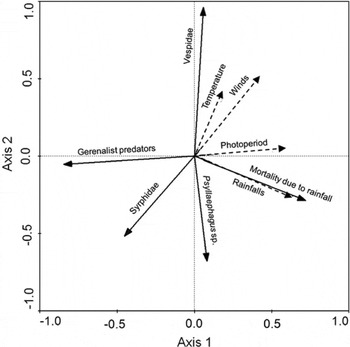
To determine the seasonality of mortality factors potentially associated with T. limbata, environmental factors such as wind speed, rainfall, air temperature and photoperiod were subjected to principal component analysis (PCA) with the other natural control agents using the Canoco 4.5 system and following Ter Braak (Reference Ter Braak, Jongman, Ter Braak and Van Tongeren1995). The biplot ordination gradient was generated with Canodraw 3.0. The gradients of response were represented by vectors with the origin at the central point of the two axes of the ordination diagram. The vector length is proportional to the variable importance. Vectors with the same direction and orientation represent variables with positive correlation, while vectors with the same direction and opposite orientation represent negative correlation. Variables are not correlated when the angle between the vectors is 90°.
Results
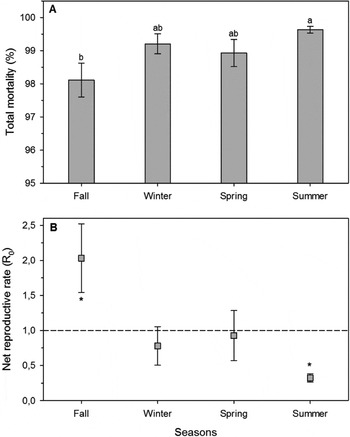
There were significant differences in the total mortality caused by the natural factors, considering different seasons (ANOVA, F 3,28 = 3.06, P = 0.044) (fig. 1A). Natural mortality in the summer reached the highest levels, causing mortality of 99.6 ± 0.11% of T. limbata eggs and nymphs. This high level of mortality had significant effects on the net reproductive rate of the population, causing the population to grow at a rate of 0.32 ± 0.06, which was significantly lower than the equilibrium value of 1 (t-test = 11.1, P < 0.001) (fig. 1B). On the other hand, natural mortality in the autumn reached the lowest levels, with 98.1 ± 0.52% of eggs and nymphs being lost due to this mortality factor. The net growth rate of 2.03 ± 0.49 was significantly higher than the equilibrium value of 1 (t-test = 2.1, P = 0.04) (fig. 1A, B). Winter (99.2 ± 0.30%) and spring (98.9 ± 0.41%) seasons caused intermediate mortality in the egg and nymph stages, and could not be differentiated from autumn and summer seasons (fig. 1A). The net growth rate in the winter (t-test = 0.8, P = 0.23) and spring (t-test = 0.2, P = 0.42) were not statistically different from 1 (fig. 1B).
Analysis of the seasonality in two parameters of the life history of Triozoida limbata. (A) Differences in the total mortality among the seasons. Seasons were compared using ANOVA, and different letters on the top of bars indicated significant differences at P < 0.05 using Tukey's test. (B) Differences in the net reproductive rate (R0) among the seasons. For each season the net reproductive rate was compared to an equilibrium value (R0 = 1) using t-tests. Asterisks indicate that the R0 for that season is different from the equilibrium value.

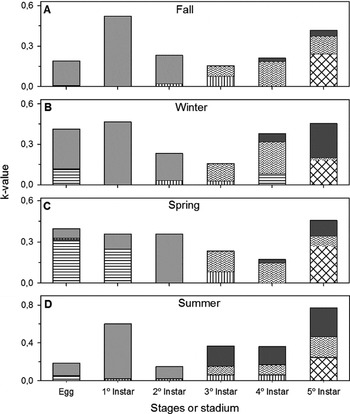
Several factors contributed for the mortality of T. limbata in the different seasons (fig. 2). The k-value, which represents the partial mortality, shows the relative importance of the factors in each particular stage (eggs or nymph) and stadium (first through fifth instar). Rainfall, physiological disturbance, the parasitoid Psyllaephagus sp. (Hymenoptera: Encyrtidae), and the predators, syrphids, predatory wasps and other generalist predators, were the factors that caused mortality of T. limbata in the different seasons. Overall, the highest mortalities were caused by the generalist predators. This group, which includes many different species observed in the leaves of guava plants (e.g. Chrysoperla sp. (Neuroptera: Chrysopidae)), Harmonia axyridis (Coleoptera: Coccinellidae), Acanthinus sp. (Coleoptera: Anthicidae), and Discodon sp. (Coleoptera: Cantaridae) caused mortality of eggs and nymphs in early instars (first and second) which were completely exposed to the attack of this group of predators. The lowest mortality caused by this factor was observed in the spring when rainfall caused a higher mortality compared to the other seasons. In this season, the amount of rainfall was about five times higher compared to other seasons (fig. 3). Temperature changes in subtropical regions usually are not too drastic that can cause mortalities by freezing, and it can be observed that, although temperature was lower in the winter, it was at levels that may reduce the reproduction but do not cause mortality (fig. 3A). Variation in wind speed was observed (less intense in autumn than in the winter), but wind speed does not seem to be a factor that causes mortality of T. limbata (fig. 3B). The photoperiod was relatively similar among the different periods of study (fig. 3B). Individuals from the families Syrphidae (syrphids) and Vespidae (predatory wasps) were two other predators causing high mortality levels of T. limbata nymphs. In contrast to the other predators, these two families attacked late instars (third, fourth and fifth) when nymphs had moved to the edges of the leaves and were protected inside the galls. While mortality caused by syrphids was consistent across all periods, mortality caused by predatory wasps tended to increase in the summer (fig. 2).
Relative proportion of mortality caused by different mortality factors and represented by the k-value in each season. The x-axis represents the different stages and stadium of development of Triozoida limbata ( , rainfall;
 , physiological disturbance;
 , Psyllaephagus sp.;
 , Syrphidae;
 , generalist predators;
 , Vespidae).

Seasonal variation in four environmental factors (rainfall, temperature, wind speed and photoperiod) in the four seasons. These factors were hypothesized to affect the survival of Triozoida limbata on guava orchards.

Psyllaephagus sp. was also an important factor involved in the mortality of T. limbata causing mortality of fifth instar nymphs. Similar to syrphids, the mortality caused by Psyllaephagus sp. tended to be consistent in all periods of observation, and no effects of season were observed. Finally, physiological disturbances (observed as no hatching, incomplete mounting and malformation of nymphs) were observed during egg stage and in the different instars (fig. 2). This mortality factor occurred in the different periods and tended to have a slight increase in the summer and slight decrease in the winter, although no statistical tests were applied to test for differences.
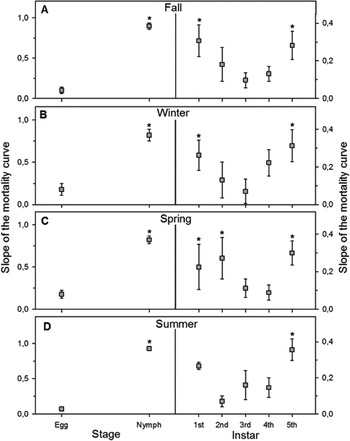
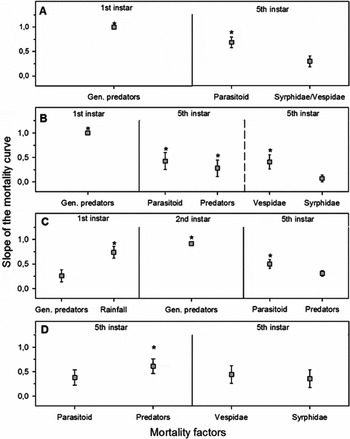
Additionally to providing the partial mortality of each factor in each season (fig. 2), we tested which stage and stadium were the key stages for the mortality of T. limbata. Also, within the key stage and stadium, we determined the key factor causing mortality. In all periods, nymph was the key stage of mortality of T. limbata (fig. 4). Within the nymph stage, the key stadia of mortality tended to change depending upon the period studied (fig. 4). The key stadiums of mortality according to the period were: autumn (first and fifth instars), winter (first and fifth instars), spring (first, second and fifth instar) and summer (fifth instar) (fig. 4). The key mortality factors also showed some variability depending upon the period, but overall, Psyllaephagus sp. and predators were the key mortality factors associated with the mortality of T. limbata (fig. 5). In the autumn, generalist predators on the first instar and Psyllaephagus sp. on the fifth instar had the highest slopes in the regression analysis; and, therefore, they are the primary factors responsible for variation in nymph mortality in these instars (fig. 5A). In the winter, generalist predators on the first instar, and Psyllaephagus sp. and Vespidae on the fifth instar, were the primary factors responsible for variation in nymph mortality (fig. 5B). In the spring, rainfall on the first instar, generalist predators on the second instar and Psyllaephagus sp. on the fifth instar were the primary factors responsible for variation in nymph mortality (fig. 5C). Finally, in the summer, the predators of the families Vespidae and Syrphidae were the primary factors responsible for variation in nymph mortality (fig. 5D).
Critical stage (left side) and critical instar (right side) of mortality of Triozoida limbata in the four seasons. A simple linear regression analysis of partial k of each stage or each mortality factor as a function of total K (K = ∑k) at P < 0.05 was performed being the critical stage or stadium those with the regression curve showing the largest inclination coefficient at P < 0.05.

Key mortality factors of Triozoida limbata in (A) autumn, (B) winter, (C) spring and (D) summer. A simple linear regression analysis of partial k of each stage or each mortality factor as a function of total K (K = ∑k) at P < 0.05 was performed being the key mortality factors those with the regression curve showing the largest inclination coefficient at P < 0.05.

The principal component analysis (PCA) with the natural enemies and the weather conditions generated four axes, explaining 99.6% of the observed variance (fig. 6). Some trends can be observed in the PCA diagram, elucidating the relationship of occurrence of different natural enemies and variation in the weather conditions, and three groups of correlated trends can be observed. First, the occurrence of predatory wasps was positively correlated with temperature and occurrence of winds and relatively independent of photoperiod and rainfall. Second, the occurrence of syrphids and Psyllaephagus sp. were negatively correlated with temperature and winds and relatively independent of rainfall and photoperiod. Third, the occurrence of other generalist predators were negatively correlated with the occurrence of rainfall and photoperiod and relatively independent of temperature and winds.
Ordination diagram of the principal component analysis (PCA) of the effect of different natural mortality factors on Triozoida limbata. The length of the vector is proportional to the importance of the variable. Variables with positive correlation have vectors with the same direction and orientation. Variables with negative correlation have vectors with the same direction and opposite orientation. When the angle between the vectors is 90°, the variables are not correlated.

Discussion
An effective tool for implementation in a successful IPM program should either provide prevention or the reduction of the infestation of target pest populations to levels that are economically acceptable. Moreover, the relative impact on the population size should be synchronized with the pest population dynamics causing higher levels of mortality during periods in which the population has higher rate of increase and consequently higher damage. Identification of major mortality factors and the developmental stages of the pests in which the majority of mortality occurs has practical implications for pest management (Pereira et al., Reference Pereira, Picanço, Bacci, Crespo and Guedes2007). In general, insect-pests are poikilothermic and their body temperature varies according to the temperature of the environment. Therefore, insect populations tend to develop faster in the warmer months of the year (i.e. spring and summer) when higher temperatures allow the development and reproduction in a short period of time, and thus management strategies should primarily seek the maintenance and possibly the improvement of mortality factors in these periods by primarily identifying and quantifying the relative mortality caused by each factor and considering their potential to be implemented in the IPM programs.
The results presented here show that the action of natural control factors caused the highest mortality in the summer and the lowest mortality in the autumn with consequent effect on the net reproductive rate in both periods. These results provide strong evidence of the importance of these natural factors for keeping population levels of T. limbata at equilibrium, and thus reducing the need for interventions such as insecticide application. Because of the reproductive capacity of T. limbata, even a slight reduction on the action of the natural factors in the autumn caused a sharp increase in the net reproductive rate, even though temperature in this period was not at the optimum for the reproduction of this species in the field. However, in tropical regions where temperatures in the cool months of the year are still above freezing most of the time, field pests can survive all year long and maintain their reproduction. Therefore, IPM in guava orchards should also include strategies that maximize the effects of natural mortality factors in the autumn as well, because even slight reduction of mortality in this season can affect levels of damage in the following season.
The key stage of mortality, in all periods studied, was the nymph stage. This result is in accordance with several other studies focusing on ecological life tables which have found this immature stage (larvae for holometabolic insects) as the most vulnerable to the action of natural factors (Pereira et al., Reference Pereira, Picanço, Bacci, Crespo and Guedes2007). This is because this stage has a longer period for development, compared to stages such as egg or pupae, and therefore is more exposed to biotic and abiotic factors of mortality (Miranda et al., Reference Miranda, Picanço, Zanuncio and Guedes1998; Albergaria et al., Reference Albergaria, Cividanes and Dória2003; Naranjo & Ellsworth Reference Naranjo and Ellsworth2005). In the particular case of T. limbata, two distinct periods could be identified during the nymph stage. In the first period, nymphs were completely exposed to the attack of predators; and, in the second period, they were protected inside galls. Consequently, different groups of natural control factors tended to act in these different periods. As the results showed, one instar in each of these periods was the key instar for the mortality and this result reinforces the importance of the maintenance of diversity of natural agents since the key mortality factors were not the same in the two key instars.
Several generalist predators were observed in the leaves of guava plants in the experimental area. Among the generalist predators were Chrysoperla sp., Harmonia axyridis, Acanthinus sp. and Discodon sp. Michaud (Reference Michaud2004) has found the same group of predators attacking Diaphorina citri K. (Hemiptera: Psyllidae) in citrus in Florida, USA. These predators are generalists and have high predatory ability. The highest levels of mortality of T. limbata were observed in the summer and the predatory wasps and syrphids were the key mortality factors in the key instar of mortality (i.e. fifth instar) in this period. Predatory wasps of several species have been reported as efficient natural control agents of several species of pests (Pereira et al., Reference Pereira, Picanço, Bacci, Crespo and Guedes2007). However, the occurrence of this type of natural enemy is most common in dry season. Wasps are sensitive to weather conditions since their flight in rainy conditions is difficult, and the temperature drop usually associated with rain may force them to stay in the nest to maintain their body temperature (Heinrich, Reference Heinrich1996).
Coccinellids have also been reported as important predatory species of psyllids that attack different plant species (Michaud & Olsen, Reference Michaud and Olsen2004; Valente et al., Reference Valente, Manta and Vaz2004; Pluke et al., Reference Pluke, Escribano, Michaud and Stansly2005). In the specific case of T. limbata, the species commonly reported are Cycloneda sanguinea, Eriopis conexa and Scymnus sp. Although only these species have been reported as predators of T. limbata, in our study other coccinellids were observed in guava plants leaves such as Harmonia axyridis (Pallas, 1773). This species observed in the guava leaves can, in some situations, become the most important biological control agent of psyllids (Michaud, Reference Michaud2004). This group of predators can be in the area, attracted by weeds with aphids and then migrate to guava plants. Other predators observed in the experimental area are reported in the literature as natural enemies of psyllids such as spiders and ants (Michaud, Reference Michaud2004). Syrphids are other predators commonly associated with psyllids (Solomon et al., Reference Solomon, Cross, Fitzgerald, Campbell, Jolly, Olszak, Niemczyk and Vogt2000; Pinzon et al., Reference Pinzon, Guzman and Navas2002; Valente et al., Reference Valente, Manta and Vaz2004), including the guava psyllid (Barbosa et al., Reference Barbosa, Ferreira, Kiill, Souza, Moreira, Alencar and Haji2003). In this study, we observed the larvae of this predator were able to completely develop inside the galls, thus causing the mortality of T. limbata; and, therefore, in galls where syrphids were present, the number of nymphs of T. limbata was drastically reduced.
Only one parasitoid species was observed in the present study and it was identified as being of the genus Psyllaephagus (Hymenoptera: Encyrtidae). Menezes Jr. & Pasini (Reference Menezes and Pasini2001) reported three species associated with T. limbata: Psyllaephagus sp. próx. trioziphagus (Howard, 1885) (Chalcidoidea: Encyrtidae), Signiphora sp. (Chalcidoidea: Signiphoridae) and Aprostocetus sp. (Chalcidoidea: Eulophidae, Tetrastichinae). However, the last two species are reported as hyperparasitoids, thus reinforcing the hypothesis that only the first species is a parasitoid of T. limbata. Species of this genus are associated with several other species in the family Psyllidae (Butignol & Pedrosa-Macedo, Reference Butignol and Pedrosa-Macedo2003; Daane et al., Reference Daane, Sime, Dahlsten, Andrews and Zuparko2005; Mehrnejad & Copland, Reference Mehrnejad and Copland2006).
If necessary, the use of insecticides should be selective to avoid the elimination of natural enemies of the life system (Gusmão et al., Reference Gusmão, Picanço, Gonring and Moura2000; Fragoso et al., Reference Fragoso, Jusselino-Filho, Guedes and Proque2001; Bacci et al., Reference Bacci, Picanço, Rosado, Silva, Crespo, Pereira and Martins2009), especially predaceous wasps. Although no significant correlation was found between the occurrence of wasps and rainfall, the fact that the wasps were more important in the wet season in this study was probably due to the relative reduced occurrence of rain at the time the experiment was set up. Besides affecting natural enemies, rain can also directly affect the pest populations. In tropical regions, rainfall can cause asynchrony in adult emergence and, consequently, reduce mating, therefore reducing oviposition and influencing movement (Michereff et al., Reference Michereff, Vilela, Michereff Fillho, Nery and Thiebaut2004; Bacca et al., Reference Bacca, Lima, Picanço, Guedes and Viana2006). In the specific case of T. limbata, it should be expected that rain will affect the early instars more than late instars since they are protected inside the galls.
It is important to further highlight the relationship of occurrence of different natural enemies and variation in the weather conditions associated with the mortality of T. limbata (fig. 6). Predatory wasps had higher occurrence during periods of higher temperatures, while syrphids and the only species of parasitoid had higher occurrence in periods of lower temperatures. Other studies have also shown the occurrence of predators in the warm seasons and parasitoids in the cool seasons (Pereira et al., Reference Pereira, Picanço, Bacci, Crespo and Guedes2007). This temporal separation in the occurrence of natural enemies could be associated with aspects of evolution, since occurrence of one species may directly affect the occurrence of the other or because predatory wasps are bigger and they require more heat for flight and, therefore, are less active in the cool periods (Silva et al., 2000; Resende et al., Reference Resende, Santos, Filho and Gimenes2001).
In conclusion, we found that the occurrence of natural control factors in guava orchards resulted in a reduction on the reproductive rate of the guava psyllid in the summer. Several agents were responsible for this reduction and they show seasonality throughout the year. Nonetheless, it is important to highlight the results and conclusions reported here must be interpreted with caution. The results were obtained in one year and studies that seek to develop life tables and identify mortality factors should, whenever possible, be repeated in multiple seasons (years). Although the need for multiple season data is important, this can be challenging to execute due to the large amount of resources and labor necessary. Finally, it is important to employ strategies that maintain or even enhance the action of natural control factors, and in this way contribute for their maintenance and the consequent use in the IPM program on guava orchards.
Acknowledgments
The authors wish to thank CNPq, CAPES, FAPEMIG and FAPITEC BNB for scholarships and funds granted. The authors also wish to thank Dr Daniel Burckhardt, Dr Lúcia Massutti de Almeida and Dr Angélica Maria Penteado-Dias for the identification of insects.