Colorectal cancer (CRC) is one of the leading causes of cancer-related deaths in Australia and a common cause of morbidity and mortality worldwide (1;2). Screening is an attractive option because there is an identifiable precursor lesion (the adenoma or polyp) and the bowel is readily accessible for screening. Furthermore, the early detecting of CRC or adenoma has been proven to reduce CRC-associated mortality (Reference Mandel, Church and Bond3).
The fecal occult blood test (FOBT) is a widely-used cost-effective screening tool for large-scale bowel cancer screening programs. The FOBT has the advantages of being noninvasive, safe and less costly than endoscopic procedures (Reference Salkeld, Young, Irwig, Haas and Glasziou4–Reference Bishop, Glass and Tracey6). Between November 2002 and June 2004 a National Bowel Cancer Screening Pilot Program was implemented to test the feasibility, acceptability, and cost-effectiveness of bowel cancer screening. Based on the success of this pilot study, in 2006 the National Bowel Cancer Screening Program (NBCSP) was established, using an immunochemistry-based FOBT (fecal immunochemistry test, or FIT). The Program currently targets all Australians who turn 50, 55, or 65 years of age between January 2011 and December 2014.
Despite the proven impact of screening on reducing bowel cancer mortality, the uptake of the NBCSP has been low. The participation rate in the first phase of the NBCSP conducted between August 2006 and June 2008 was 42.9 percent. During this phase only Australians turning 55 and 65 years of age were invited to screen. In mid-2008, the program was expanded to include people aged 50. In 2008, the average participation rate was 40.1 percent, reflecting a lower participation rate amongst the newly introduced 50-year-old group. Participation rates were considerably lower among indigenous populations (7). Consequently, it is of interest to consider patient-directed interventions to promote CRC screening.
Currently in Australia, there is limited evidence on the impact of patient-directed interventions to promote CRC screening. A randomized controlled trial (RCT) by Cole et al. (Reference Cole, Smith and Wilson8) was identified, which measured the impact of several different patient-directed interventions. Notably, an advance notification letter, sent 2 weeks before the standard NBCSP invitation letter was the most effective intervention. A statistically significant improvement in screening rates was observed in the advance notification letter group (relative risk, 1.23; 95 percent confidence interval [CI], 1.06–1.43). This represents an 8.8 percentage point increase in participation (Reference Cole, Smith and Wilson8). In Australia, an advance notification letter was introduced as part of the NBCSP in 2008. This letter informs participants of the program and advises them that they will be receiving a screening kit in the mail 2 weeks later. The invitation letter that follows includes the screening kit and outlines the screening process. To date, estimating the actual impact of the advance notification letter on the screening rate is problematic due to confounding with several concurrent changes in the NBCSP (for example, the introduction of 50-year-olds and the temporary cessation of the NBCSP in 2009 due to an ineffective batch of tests).
There have been several international studies on the cost-effectiveness of interventions to promote CRC screening. Of note in the United States, patient-directed mail improved participation in screening by between 6 and 16 percentage points (Reference Cole, Smith and Wilson8–Reference Sequist, Franz and Ayanian10). In one comparative study, Lee and colleagues (Reference Lee, Groessl, Ganiats and Ho9) randomized 769 patients to receive FOBT alone (n = 382) or FOBT plus a mailed reminder (n = 387). At 6 months after test distribution, 64.6 percent patients in the intervention group returned completed FOBT tests compared with 48.4 percent in the control group (p < .001). The total cost of the intervention was $962 or $2.49 per patient, and the incremental cost-effectiveness ratio (ICER) was $15 per additional person screened for CRC. The sample of this study was comprised of U.S. veteran patients from San Diego, California, which limits the generalizability of the findings. Sequist et al. (Reference Sequist, Franz and Ayanian10) investigated the cost-effectiveness of a patient mailed letter to increase rates of CRC screening. In this study, the tailored letter was provided along with a FOBT kit to 21,860 patients in eleven centers in Eastern Massachusetts. Colorectal cancer screening rates were higher for patients in the intervention compared with control patients (44 percent versus 38 percent, p < .001). The total cost of the intervention was approximately $5.48 per patient, resulting in an ICER of $94 per additional patient screened.
A major limitation of both of these studies was the use of an intermediate outcome (cost per additional person screened for CRC). This approach limits the comparability across interventions with different outcomes and as the outcome is uni-dimensional, it is not possible capture morbidity and mortality. The present study has the advantage of estimating the impact of the advance letter, in terms of quality adjusted life-years (QALYs) gained, allowing morbidity and mortality of CRC to be measured directly. The primary aim of the study is to measure the cost-effectiveness of an advance notification letter designed to improve CRC screening participation in Australia.
METHODS
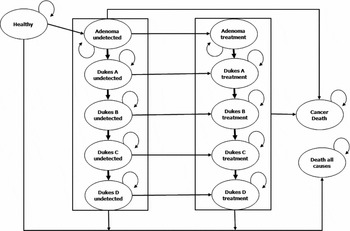
By using decision analysis software (TreeAge Pro Suite 2009, TreeAge Software Inc, Williamstown, MA), we created a Markov model to investigate hypothetical cohorts of 50-year-old, 55-year-old, and 65-year-old patients undergoing screening for CRC (Figure 1).
Markov model to investigate hypothetical cohorts of 50-year-old, 55-year-old, and 65-year-old patients undergoing screening for colorectal cancer.

Eligible individuals are invited to participate in the screening program by means of a letter and FOBT (control group) or by means of an advance letter and FOBT (test group). Participants choose to participate and are required to post the completed FOBT to a pathology service.
Following a positive FOBT result, the individual will either see their general practitioner (either because they received the positive test result and arranged to meet their GP, or the GP received the positive test, arranged a consultation, and the individual attended for their appointment) or not. If the GP decides that a colonoscopy is appropriate, the decision tree considers both the predictive value of the colonoscopy and the likelihood of an adverse event taking place during colonoscopy. The tree then assumes a colonoscopy will identify a proportion of the cancers and adenomas successfully.
Once successfully identified, each individual exits the screening pathway for treatment. Individuals with colorectal cancer or adenoma not identified successfully will receive no immediate treatment, and will re-enter the program when they turn 55 years or 65 years when they are invited to screen again. The models allow these individuals to present with symptomatic colorectal cancer outside the screening cycle. Participants cycle through the Markov model annually.
The key assumptions underpinning the model were;
1. The participation rate of the NBCSP before the introduction of the advance letter is assumed in the no-letter group, whereas an 8.8 percentage point increase is assumed in the advance letter group (Reference Cole, Smith and Wilson8);
2. Nonparticipants in the screening program have the same probability of a colorectal abnormality as those screened (this assumption is relaxed in the sensitivity analysis);
3. The proportion of the cohort entering each health state is determined by age adjusted prevalence (2;Reference O'Leary, Olynyk, Neville and Platell11–Reference Lieberman, Weiss and Bond13) and incidence using a formula derived by Bishop et al. (2008) (Reference Bishop, Glass and Tracey6), weighted by asymptomatic and symptomatic presentation (Reference Bell14–Reference Robinson, Hardcastle and Moss16) (undetected and detected);
4. Bowel cancers are classified into stages and levels of severity depending on the extent and spread of malignancy. For the purpose of this study, Dukes stage classifications were used (17). Treatment costs for detected bowel cancer is dependent on the stage of bowel cancer at diagnosis (18);
5. All adenomas detected by colonoscopy are removed by means of polypectomy during the same procedure. The risk of adverse events associated with colonoscopy is incorporated in the model;
6. The natural history of colorectal cancer was defined such that patients with undiagnosed cancer passed sequentially through each clinical state after the appropriate time interval (estimated using the sojourn time (Reference Loeve, Brown and Boer19;Reference Brenner, Altenhofen, Katalinic, Lansdorp-Vogelaar and Hoffmeister20). A half cycle correction is incorporated into the model. All of the derived transition probabilities were converted into annual probabilities by using standardized methods (Reference Petitti21);
7. Patients do not skip stages and all cancers develop from large adenomas;
8. Each year, the cohort cycled through the model, they gained 1 year of life, which is adjusted by the utility weight (quality of life), according the health state they were in (Reference Robinson, Hardcastle and Moss16). The utility of the undetected Dukes A, Dukes B, and Dukes C health states is calculated as the midpoint between “healthy” and “Dukes A,” “Dukes B,” or “Dukes C,” respectively (Reference Parker, Robinson, Scholefield and Hardcastle22). It is assumed that the utility of Dukes D is the same for detected and undetected cancer;
9. Once diagnosed people are removed from the screening program and allocated a one off treatment cost, plus utility and life-year gains over the rest of the screening program;
10. Bowel cancer mortality was determined using data on 5-year survival (annualized) reported in clinical practice guidelines (17);
11. Noncancer-related mortality was calculated using probabilities determined from Australian life tables (23);
12. The sensitivity and specificity of the FOBT is defined by two levels: adenoma and cancer (24;Reference Smith, Young, Cole and Bampton25). These are held constant for large adenomas and all Dukes stages, respectively;
13. Participation in the screening program was independent of past behavior;
14. Participation rates were the same across all screening cycles; and
15. Patients were followed until 100 years old or until death (either by cancer or any other cause).
Competing Strategies
The base-case decision model compared two strategies: sending an advance notification letter to participants in the NBCSP and not sending an advance letter (current practice in the pilot program). Patients who receive a letter in advance do so 2 weeks before the arrival in the mail of the invitation to screen and the FOBT kit.
The model incorporated clinical probability estimates in prevalence, natural history, diagnosis and management of CRC (details and references in Supplementary Table 1, which can be viewed online at www.journals.cambridge.org/thc2013111). To identify appropriate estimates for these variables, we performed a systematic search of MEDLINE from 1990 to 2009.
Costs and Utilities
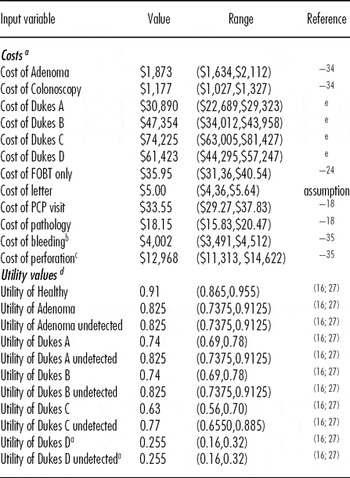
All estimates for costs and utilities used in the model are provided in Table 1. Costs are limited to direct healthcare costs and exclude non–healthcare-related costs borne by the patient. All costs were converted into 2009 estimates by using the medical component of the consumer price index (26). To calculate QALYs, we used a range of relevant health state utilities derived from the published literature (Table 1). All costs and utilities were discounted at 5 percent.
Costs and Utilities

FOBT = Faecal occult blood test, PCP = primary care provider;
aBased on gamma distribution.
bCost of bleeding based on (AR-DRGG02) AR-DRG: Australian Refined Diagnosis Related Groups.
cCost of perforation based on (AR-DRG H40Z)Australian Refined Diagnosis Related Groups.
dBased on Gamma distribution.
eTran B., Kosmider S., Ananda S., et al. The impact of modern treatment on the cost-effectiveness of the National Bowel Cancer Screening Program (Unpublished Paper).
Melbourne: The Royal Melbourne Hospital; 2010.
Outcomes
The primary outcomes were life-years gained (LYG), QALYs gained, and the incremental cost-effectiveness ratio (ICER) between the two competing strategies. The ICER is calculated as the difference in costs between two strategies divided by the difference in LYG (or QALYs). Additional outcomes of this study include the mean cost per patient and overall colorectal cancer deaths avoided.
Sensitivity Analyses
A univariate sensitivity analysis was conducted in which all of the base-case probability estimates were varied. The ranges used in this study were based on the published literature. All variables were assumed to be independent.
A probabilistic sensitivity analysis (PSA) was also conducted. PSA allows for all input parameters in a model to be specified as full probability distributions, rather than point estimates, allowing for an estimate of uncertainty surrounding their values. Distributions were selected to reflect the natural bounds implicit to the parameter (e.g., costs have to be nonnegative). The model then randomly draws from these distributions 10,000 times, a technique called a Monte Carlo micro-simulation (Reference Briggs, Claxton and Mculpher27).
RESULTS
Base-Case Results
We examined the impact of an advance notification letter on the general population at 50 years old, 55 years old, and 65 years old (the time of screening with FOBT). The incremental strategy costs $27 per patient for the 50-year-olds, $19 per patient for the 55-year-olds and $10 per patient for the 65-year-olds, which included the cost of the letter and the associated screening costs (including increased colonoscopy costs associated with both real and false positive tests). The decreasing costs in the three cohorts are a reflection of the number of screens each group received over their lifetime.
The advance notification letter yielded twenty-three fewer cancer-related deaths per 100,000 patients in the 50-year-olds, seventeen fewer cancer-related deaths in the 55-year-olds, and fourteen fewer cancer-related deaths in the 65-year-old group over the lifetime of the cohort. Across the three age cohorts, this aggregated to a total of fifty-four fewer cancer-related deaths when compared with the strategy of no advance notification letter (Supplementary Table 2, which can be viewed online at www.journals.cambridge.org/thc2013112).
In terms of cost-effectiveness, the incremental cost per LYG is $4,226 and $8,633 per QALY in the 50-year-old cohort, $3,958 per LYG and $6,882 per QALY in the 55-year-old cohort and $3,255 per LYG and $4,022 per QALY in the 65-year-old group. Overall, the ICER was $3,976 per LYG and $6,963 per QALY compared with the strategy of no advance notification letter.
Sensitivity Analyses
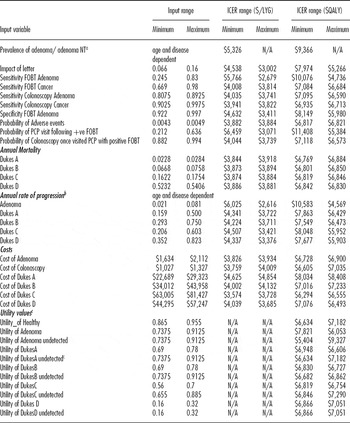
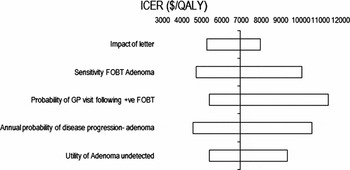
The results from the univariate sensitivity analysis are presented in Table 2, and the Tornado diagram in Figure 2. Screening variables (impact of the letter, GP follow-up, and colonoscopy), disease variables (cancer mortality and rate of disease progression), and screening tool sensitivity for adenoma detection were important drivers of the model. This is further demonstrated in the tornado diagram, which illustrates the range of the ICER based on the upper and lower threshold defined by the sensitivity analysis. Increasing the probability of GP follow-up after a positive FOBT test to 64.5 percent (base case 42.4–43.4 percent depending on age) reduced the ICER to $5,384/QALY gained. In contrast, GP follow-up rates of 21.4 percent increased the ICER to $11,408/QALY gained. However, none of the parameters used in the univariate analysis increased the cost per QALY above $12,000, indicating that the model is robust.
One-way sensitivity analyses- Univariate Sensitivity Analysis

FOBT = Faecal occult blood test, QALY = quality adjusted life year, LYG = life year gained, ICER = incremental cost-effectiveness ratio
a(36)
bAnnual probabilities of disease progression estimated from sojourn times (time spent at each stage before progression). (37–40)
cUtility values of undetected Dukes A and Dukes B assumed to be equivalent to Utility of Adenoma, Dukes C assumed to be the mid-point between ‘healthy’ and ‘detected Dukes C ‘, value of adenoma assumed to be midpoint between “Dukes A detected’ and ‘healthy’, value of Dukes D undetected assumed to equivalent to Dukes D disease.
The Tornado diagram.

DISCUSSION
Our study is the first to estimate the costs and cost-effectiveness of a patient-directed intervention (mailed advance letter) on CRC screening in Australia. Based on the upper threshold for acceptable cost-effectiveness in Australia ($50,000 per QALY) (28), this analysis demonstrates that a patient-directed intervention in the form of an advance notification letter is inexpensive, with significant benefits in terms of cost-effectiveness.
It is evident from the model that disease progression was an important driver of costs. Although the initial letter might only cost $5, the overall strategy costs between $10 and $27 per-patient indicating significant flow-on effects that resulted in overall higher costs of early detection and treatment. These are somewhat offset by the lower costs of late stage treatment (fewer cases), less complex surgery, improved recovery, and fewer complications. Also, as expected the model showed there was a shift in the Dukes stage distribution with patients in the advance notification group being more likely to be detected with adenoma or stage I disease rather than with symptomatic cancers. This is consistent with a recent study by Lane et al. (Reference Lane, Chow, Young and Good29) who found that patients who participated in FOBT screening between scheduled colonoscopies had cancers and advance adenomas detected on average 24–25 months earlier than patients on surveillance who did not participate in interval FOBT testing. There are limitations to the comparison of these two studies, as patients in the latter were at “elevated” risk of CRC. Nevertheless, it is important to acknowledge the impact that early detection would have on healthcare resource requirements associated with treatment.
The impact of the mailed letter is assumed to be constant across all age groups and participation rates were assumed to be the same across all screening cycles. This means that at each subsequent screening round a proportion of previous non-screeners were assumed to screen, which led to increased diagnosis of previously undiagnosed cancers. Also, the impact of the letter appeared to be more significant for the younger age group, possibly because the greatest gains were made by detecting the earlier stage adenomas before disease progression and the avoidance of future treatment costs for undetected cancer. This supports the conclusions made by Howard et al. (Reference Howard, Salkeld, Irwig and Adelstein30), who found that the key to cost-effectiveness in a screening program is to capture previous nonscreeners.
In the model, it was assumed that non-participants in the screening program had the same probability of colorectal abnormalities as those that screen. This is a logical assumption given the lack of evidence to the contrary; however, it could be argued that participants in the screening program are more motivated to screen because they have a family history of CRC or symptoms associated with CRC, such as anal bleeding. Therefore, it is plausible that participants have a higher prevalence of colorectal abnormality than nonparticipants. To test this assumption, we halved the probability of CRC in the nonparticipant group, relative to the screening participant group. This demonstrated that the advance letter remained cost-effective ($9,366/QALY, $5,326/LYS) (Table 2).
The pilot NBCSP results showed that only 55 percent of people with a positive FOBT result were recorded as visiting their GP and subsequently underwent a colonoscopy. Although there has been uncertainty in this value due to under-reporting of these data, these figures are considerably lower than expected (2). In Australia, King et al. (1992) (Reference King, Fairbrother, Thompson and Morris31) explored optimal compliance to postal FOBT testing in a sample of 966 patients from Southern Sydney medical practices. Although this study predates the NBCSP, results showed that a personally addressed letter from the GP with an enclosed FOBT kit achieved the highest compliance rates (59.8 percent) (Reference O'Leary, Olynyk, Neville and Platell11). Internationally, GP interventions to improve adherence to CRC screening have achieved mixed results. An RCT by Chirikos et al. (Reference Chirikos, Chistman, Seft Hunter and Roetzheim32) (The Cancer Screening Office Systems Intervention) looked at the efficacy of a low-cost intervention for primary care clinics serving disadvantaged populations to improve the rates of three cancer screening tests: mammography, Pap smear, and FOBT in the United States. This intervention reminded clinicians to consider whether screening tests were up-to-date in eligible patients and then assisted in developing procedures to ensure that the tests were ordered and patient compliance with the orders monitored until they were completed. At 12 months, the intervention showed a 29 percent improvement in adherence, which equated to an ICER of US$10.50 per additional individual screened. If these results are transferable, we postulate that GP-focused interventions should be explored further in Australia.
The model is subject to several limitations. First, the natural history of colorectal cancer was defined such that patients with undiagnosed cancer passed sequentially through each clinical state (Dukes Stage) after the appropriate time interval (estimated using the sojourn time). Recurrence of disease was excluded, which may underestimate the true incidence of adenomas (Reference Atkin, Morson and Cuzick33). Second, the model assumes that patients do not skip stages and all cancers develop from large ≥10 mm adenomas. Previous models of CRC screening have assumed a proportion of smaller adenomas (6–9 mm) develop into cancer as well as a proportion of large adenoma that will remain nonprogressive until death (Reference Bishop, Glass and Tracey6;Reference Loeve, Brown and Boer19). Additionally, the model uses estimates of age-related prevalence of large adenomas. This is consistent with previous cost-effectiveness models (Reference Bishop, Glass and Tracey6). However, the prevalence of adenoma in the general population remains a central uncertainty concerning the natural history of CRC, with limited empirical evidence to estimate it (Reference Tappenden, Eggington and Nixon5;Reference Bishop, Glass and Tracey6). As a result, we undertook rigorous PSA to explore the extent of uncertainty around the ICER and, therefore, improve the robustness of our model.
The model assumes that all adenomas detected by colonoscopy are removed by means of polypectomy during the same procedure. This has ramifications for the overall cost of colonoscopy which may be underestimated in those individuals with large advance adenomas who may receive a polypectomy during a second procedure.
Lastly, there are inherent differences that exist between the healthcare system of Australia and other countries which make generalizing of results difficult. However, a value of $50,000–$75,000 per life-year saved is generally regarded as an upper threshold for acceptable cost-effectiveness in Australia (Reference George, Harris and Mitchell28) and up to $100,000 internationally. Based on these thresholds, the introduction of an advance notification letter supports the existing literature that it offers a feasible cost-effective strategy.
In conclusion, a simple mailed advance notification letter offers a cost-effective intervention for promotion of CRC screening. The advance screening letter was recently introduced as an intervention to improve participation in the NBCSP. This model provides a template to measure the direct impact of an advance notification letter on the national screening program when these data become available in the future. Further analyses of other sources of nonadherence should be explored to increase CRC screening rates.
SUPPLEMENTARY MATERIAL
Supplementary Table 1: www.journals.cambridge.org/thc2013111
Supplementary Table 2: www.journals.cambridge.org/thc2013112
CONTACT INFORMATION
Paula Cronin, BSc, MPH Research Fellow, Centre for Health Economics, Research and Evaluation(CHERE), University of Technology Sydney, NSW, Australia
Stephen Goodall, BSc, MSc, PhD Associate Professor, Deputy Director, Centre for Health Economics, Research and Evaluation(CHERE), University of Technology Sydney, NSW, Australia
Trevor Lockett, BSc(Hons), PhD Biologist, Theme Leader, Colorectal Cancer & Gut Health Preventative Health National Research Flagship and CSIRO Food and Nutritional Sciences
Christine M. O'Keefe, BSc(Hons), PhD, MBA Research Program Leader, Business and Services Analytics, CSIRO Mathematics, Informatics and Statistics, Canberra ACT Australia, Adjunct Professor, University of Adelaide, SA Australia
Richard Norman, BA(Hons), MSc, PhD Senior Research Fellow, Centre for Health Economics, Research and Evaluation(CHERE), University of Technology Sydney, NSW, Australia
Jody Church, BComm, MAEcon Research Fellow, Centre for Health Economics, Research and Evaluation(CHERE), University of Technology Sydney, NSW, Australia
CONFLICTS OF INTEREST
Paula Cronin, Stephen Goodall, Richard Norman, and Jody Church have received fees to their institution from CSIRO. The other authors report they have no potential conflicts of interest.