INTRODUCTION
The first identification and chronology of Valdivia culture (Early Formative in the regional context) (Figure 1) was presented by Meggers et al. (Reference Meggers, Evans and Estrada1965) as a result of the excavations carried out at the Valdivia, Buena Vista, Palmar, and Punta Arenas sites in the late 1950s/early 1960s (Estrada Reference Estrada1956). Based on the pottery typology (vessel shapes and decorative techniques) and radiocarbon dates, it included the following four periods:
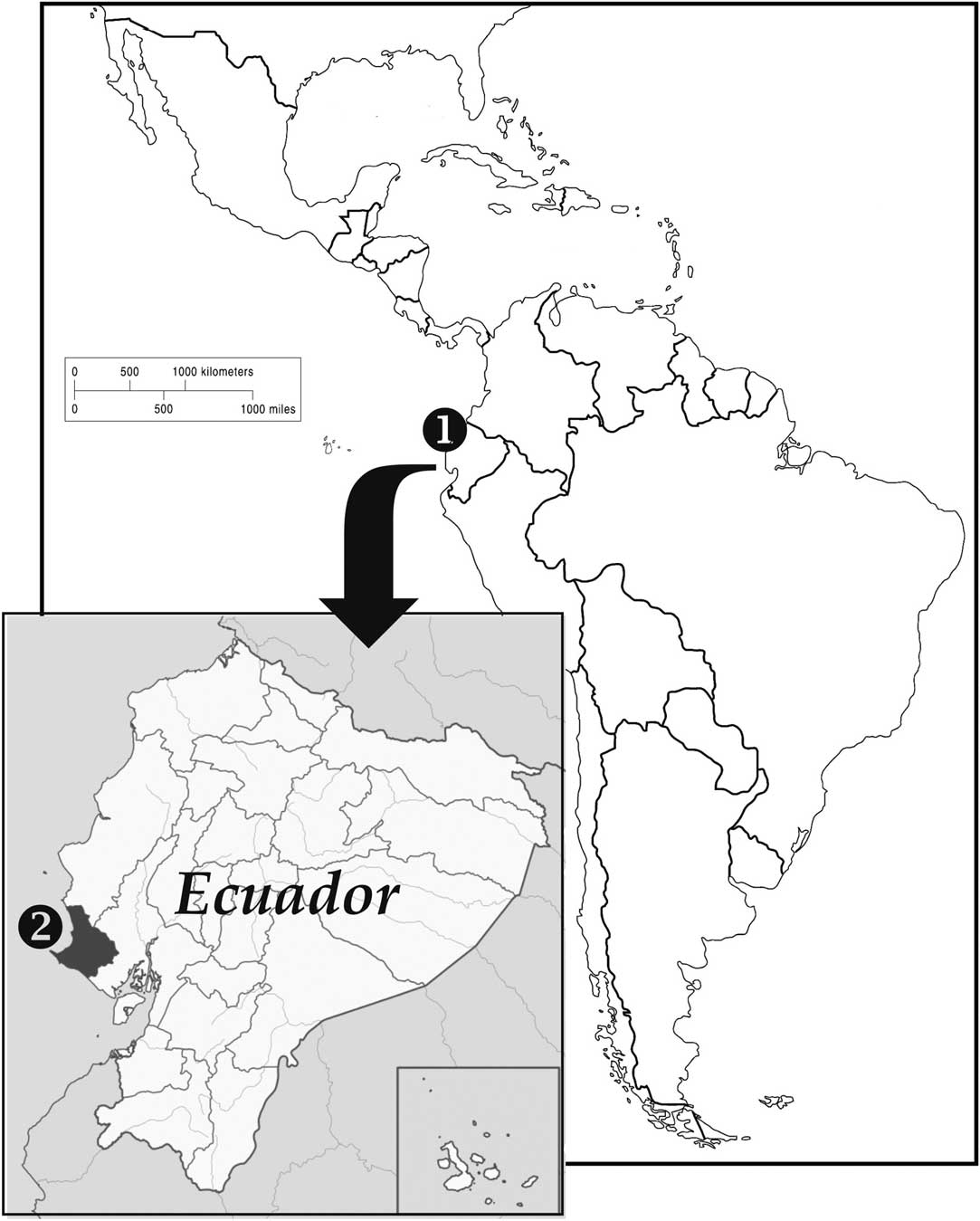
Plate (1) Ecuador within South America; Plate (2) Santa Elena Peninsula, the core area of Early Valdivia sites.

Period A: 5000–4300 BP;
Period B: 4300–4000 BP;
Period C: 4000–3400 BP; and
Period D: 3400–3000 BP (calibrated herein for consistency).
For Period A, Meggers et al. (Reference Meggers, Evans and Estrada1965) listed 12 dates, 5 from charcoal and 7 from various shells. Six dates were rejected as not referring to the cultural period in which they stratigraphically occurred. The accepted dates demonstrated the following sequence:
4480±140 BP (M-1317), Cut J, Section D, 270–300 cm, charcoal;
4450±90 BP (SI-22), Cut J, Section D, 300–330 cm, charcoal;
4530±55 BP (SI-83), Cut A, 160–180 cm, shell;
4450±200 BP (W-631), Cut A, 400–420 cm, shell;
5150±150 BP (M-1320), Cut J, Section E, 400 cm, charcoal; and
4620±140 BP (M-1322), Cut J, Section E, 400 cm, hearth.
The authors hypothesized that the appearance of early pottery on the coast of Ecuador was the result of trans-Pacific voyages of Jomon culture peoples from the Kyushu and Honshu Islands, Japan, around 5000 BP.
This hypothesis was criticized by a number of scholars during the early 1970s. Bischof revisited the Valdivia site in 1971 with Viteri Gamboa and Fung and published a revised stratigraphic profile (Corte Viteri, Sector E), which, in addition to Periods A–D by Meggers et al. (Reference Meggers, Evans and Estrada1965), included the pre-Valdivia San Pedro complex with distinctive pottery, dated between 4495±140 BP (Hv-4840) and 4260±100 BP (Hv-4838), along with an “aceramic” level, with dates 4510±95 BP (Hv-4674), 4535±55 BP (Hv-4839), 4580±80 BP (ISGS-274), 4700±80 BP (ISGS-275), and 4760±80 BP (Hd-3810) (Bischof and Viteri Reference Bischof and Viteri1972, Reference Bischof and Viteri2006).
In turn, Hill (1972/Reference Hill1974) conducted a detailed analysis of pottery collected from Punta Concepción and several other sites on the Santa Elena Peninsula and proposed a sequence of eight ceramic phases for the Valdivia culture. The main novelty of this sequence was Phase 1 (Valdivia I) pottery that was earlier than Period A proposed by Meggers et al. (Reference Meggers, Evans and Estrada1965). According to Hill, Period A corresponds with the later Phase II (Valdivia II). Moreover, Hill found no similarities between Jomon and the earlier Valdivia I pottery and pointed to the probable local roots of incipient pottery technology.
The 1971 discovery of the Real Alto site by Marcos (Reference Marcos1978) was a milestone in the history of the Valdivia culture investigations. During the 1974–1977 excavations, archaeologists recorded abundant information about the evolution of small sites of early agriculturalists into huge settlements with artificial mounds and plazas and, later, into one of the earliest regional ceremonial centers in South America. The beginning of Valdivia culture was thus shifted to 5400–5300 BP (Damp Reference Damp1979; Lathrap et al. Reference Lathrap, Marcos and Zeidler1977; Zeidler Reference Zeidler1984).
Another important site of the Valdivia culture, Loma Alta, located 19 km inland, deep into the Valdivia River valley, was excavated by P Norton in the early 1970s (Norton Reference Norton1977), and later, in 1980 and 1982 by Raymond, Damp, Norton, and Marcos (Damp Reference Damp1984; Raymond Reference Raymond1993). The primary archaeological components at Loma Alta belong to the Valdivia I and II phases. 14C dates place the earliest period (Phase I) between 5250–4650 BP.
In the 1970s, K E Stothert (following the information on the pioneering survey of E Lanning in the mid-1960s) conducted intensive archaeological surveys on the Santa Elena Peninsula in order to locate and excavate sites of the pre-ceramic period, i.e. preceding the Valdivia culture. These investigations were marked by the discovery and detailed characterization of Las Vegas culture, dated by 14C to 10,800–6600 BP (Lanning Reference Lanning1967; Stothert Reference Stothert1988; Stothert et al. Reference Stothert, Piperno and Andres2003; Stothert and Tellkamp Reference Stothert and Tellkamp2006).
Unfortunately, after the mid-1980s intensive archaeological studies of the Valdivia culture were interrupted and a number of questions remained unanswered for nearly 30 yr. However, Valdivia culture remained a common topic of regional and international conferences, with publications integrating archaeological data of the northern Andes and greater South America as a whole. Publications with the total corpus of 14C and thermoluminescence (TL) dates on the Formative period are particularly important (Marcos Reference Marcos2008; Marcos and Michczynski Reference Marcos and Michczynski1996; Marcos and Obelic Reference Marcos and Obelic1998; Zeidler Reference Zeidler2003). As a result, a new research project at the Real Alto site initiated by a joint team of Russian, Japanese, and Ecuadorian specialists has the principal goals of returning to the problem of Valdivia cultural origins and dating the context of the earliest pottery.
PRIOR 14C DATING OF THE EARLY COMPONENT AT REAL ALTO
The initial method of excavation at Real Alto included three exploratory trenches (A, B, and C) (Lathrap et al. Reference Lathrap, Marcos and Zeidler1977). The last one was established in the northern part of the site and revealed traces of the earliest occupation (Valdivia I–II), or “Valdivia Temprana.” Damp’s (Reference Damp1979) dissertation provided a detailed description of the 1975 and 1977 excavations, along with 14C dates from charcoal samples of the various stratigraphic levels within Trench C, as follows:
4140±190 BP (ISGS-467), Charcoal, 70–80 cm, Valdivia II (?);
4390±75 BP (ISGS-466), Charcoal, 70–80 cm, Valdivia II;
4495±160 BP (GX-5266), Charcoal, 70–80 cm, Valdivia II;
4760±120 BP (ISGS-468), Charcoal, 80–90 cm, Valdivia I;
6195±215 BP (GX-5269), Charcoal, 80–90 cm, ???;
4900±170 BP (GX-5268), Charcoal, 90–98 cm, Valdivia I;
5495±200 BP (GX-5267), Charcoal, 95–102 cm, Valdivia I; and
5620±250 BP (ISGS-448), Charcoal, 90–100 cm, ???
In the same work, Damp (Reference Damp1979) proposed one more date for Valdivia II, 4700±300 BP (ISGS-452), from a charcoal sample at the bottom of the so-called Charnel House Mound, in the central part of the Real Alto site. According to Damp, this series was from a very stable sequence. The only exception is the date of 6195±215 BP (GX-5269), that is, “…clearly out of sequence and cannot be related to a Valdivia occupation nor to the radiocarbon determinations above and below…” (Damp Reference Damp1979:22). Also, in his dissertation and later publications, he was not sure about the date 5620±250 BP (ISGS-448), that is, if it belonged to Valdivia I or, possibly, to a pre-Valdivia context (Damp Reference Damp1979; Damp and Vargas Reference Damp and Vargas1995).
On the topic of San Pedro pottery, Damp pointed out that all diagnostic sherds were found between 40–50 or 50–60 cm below the surface (Damp Reference Damp1984) and chronologically fall between 4450–4250 BP, a timespan that corresponds to the beginning of the Valdivia II phase. This conclusion matches prior work on the San Pedro complex at the Valdivia type-site by Bischof and Viteri (Reference Bischof and Viteri1972, Reference Bischof and Viteri2006), with 14C dates of 4495±140 BP (Hv-4840) and 4260±100 BP (Hv-4838). If so, San Pedro cannot be regarded as a separate pre-Valdivia pottery complex, but as a phase of distinctive decoration in Early Valdivia culture.
In the 1980s, interpreting the chronology of Early Valdivia culture (dates from the Real Alto, Loma Alta, Valdivia, and Colimes sites), one of the authors of this paper (Marcos) proposed to divide Phases I and II into subphases. At Real Alto, this subdivision is as follows (Marcos Reference Marcos2008; Marcos and Michczynski Reference Marcos and Michczynski1996):
Ia: 5620±250 BP (ISGS-448) to 5495±200 BP (GX-5267);
Ib: 4900±170 BP (GX-5268) to 4760±120 BP (ISGS-468);
IIa: 4700±300 BP (ISGS-452) to 4495±160 BP (GX-5266); and
IIb: 4390±75 BP (ISGS-466) to 4265±75 BP (ISGS-446).
NEW DATES AND THEIR POSITION
To meet our current goals, we chose to place our excavations in the northern part of the Real Alto site in close proximity (about 50 m) to the former Trench C. The 2014 excavations included two units (5×2 m) with a 1-m-high wall in between them. The first season of excavation was mainly devoted to testing in order to reestablish the sequence of cultural horizons, and to document their thickness and cultural context.
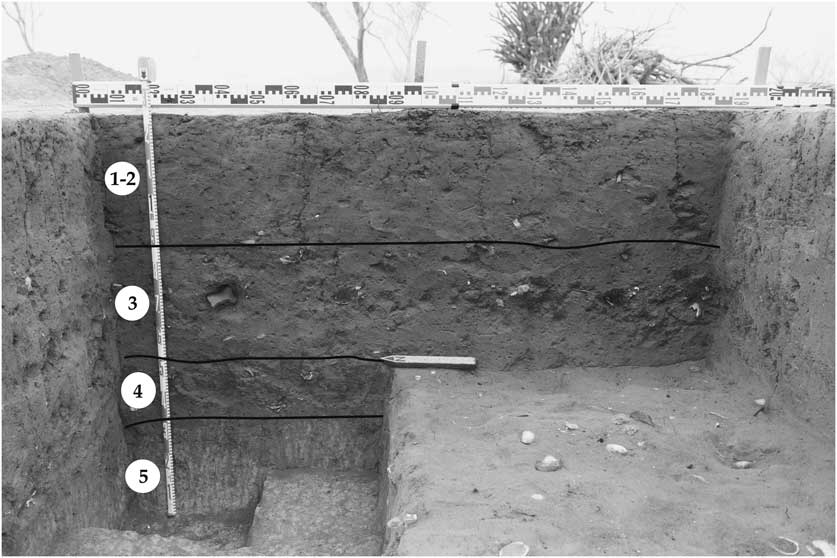
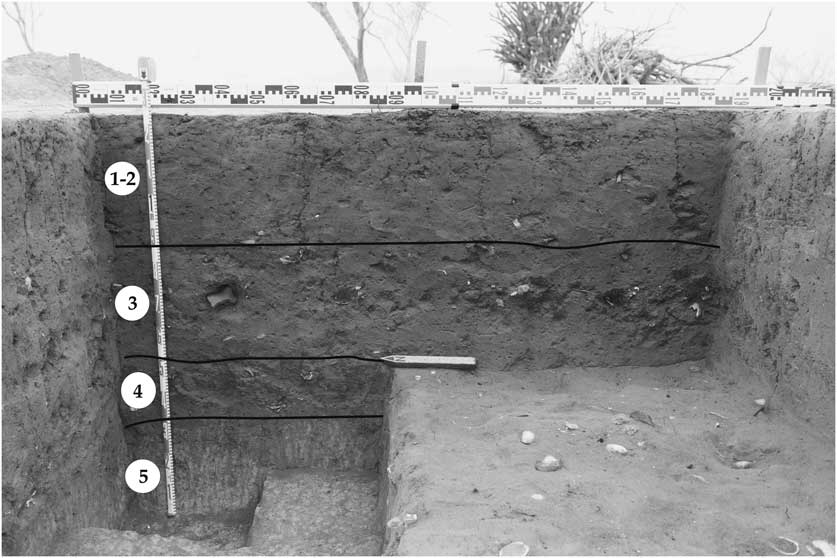
As a result of careful excavations of the 5–7 cm horizons, we documented the following stratigraphic column (Figure 2):
-
1. Layers 1–2: 0–40 cm below surface (bs) with a mixture of Valdivia I and II pottery (with very few sherds of later Valdivia periods and single sherd of Machalilla pottery), stone tools, debitage, and shells. There was no clear evidence of living floors, but a number of concentrations of cultural material were encountered.
-
2. Layer 3: 40–75 cm bs with a high density of archaeological materials including Valdivia I, II, and San Pedro pottery, lithics, and shells. The horizon between 50 and 60 cm could be preliminarily recognized as a “living floor” visible over the whole area of the excavation unit.
-
3. Layer 4: 75–90 cm bs represented by a dense concentration of shells. A small number of fragments of typical Valdivia I pottery were found in the uppermost part of this concentration, while the main part of shell horizon did not include any evidence of pottery, just lithics and some artifacts manufactured from shells.
-
4. Layer 5: the underlying solid sterile deposits with no traces of artifacts. We excavated to a depth of 35 cm for control purposes.
Real Alto site: cross-section of the archaeological unit excavated in 2014, Layers 1–5.
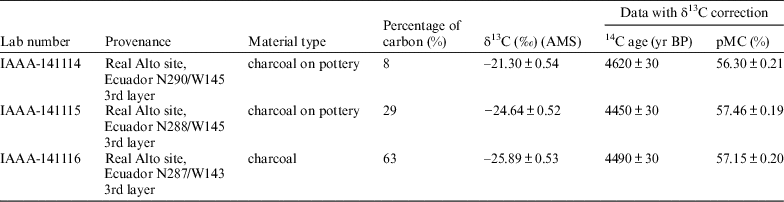
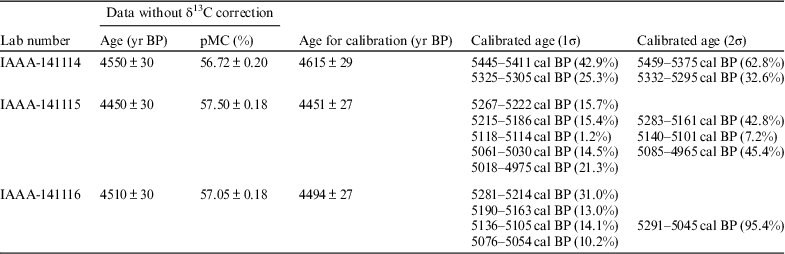
Three samples for 14C dating (one from a small concentration of charcoal and two from pottery sherds) were taken from the middle and lower parts of Layer 3 (60–75 cm bs). Results of the 14C analysis are detailed in Tables 1 and 2.
Radiocarbon ages for charcoal samples of the Real Alto site, Ecuador.

Calibrated ages for charcoal samples of the Real Alto site. Dates were calibrated using OxCal v 4.2.3 (Bronk Ramsey Reference Bronk Ramsey2009) and the SHCal13 calibration data (Hogg et al. Reference Hogg, Hua, Blackwell, Niu, Buck, Guilderson, Heaton, Palmer, Reimer, Reimer, Turney and Zimmerman2013).

As described earlier, the Trench C samples, taken from the depth of 70–80 cm, yielded dates between 4140±190 and 4495±160 BP. One sample, from a depth of 80–90 cm, was dated to 4760±120 BP. These fit into Damp’s chronology at the end of Valdivia I and beginning of Valdivia II. In terms of Marcos’ subphases, the new dates could be placed into Valdivia IIa, and, in the case of 4620±30 BP (IAAA-141114), probably to the very end of Valdivia Ib. These results validate the position of San Pedro-style pottery within the Early Valdivia time period.
DISCUSSION AND INTERIM CONCLUSIONS
Based on the stratigraphic position of dated samples (Layer 3), we suggest that the lower horizons (Layer 4) represent the earliest time of habitation (Valdivia I or, in the alternative scenario, Valdivia Ia). Furthermore, the peculiarities of the artifact distributions within Layer 4 offer the potential to divide the early ceramic and pre-ceramic periods.
If so, we arrive at one of the most intriguing questions for regional archaeology: the timing and nature of the transition from the pre-ceramic Las Vegas culture (10,800–6600 BP) to the early ceramic Valdivia culture (starting from 5600 BP). Such timeframes create the effect of a ~1000-yr cultural break and the archaeologically visible independence of two culture horizons.
In fact, the situation with the current suite of 14C dates remains controversial and provides ample room for interpretation. In a series of articles, Stothert et al. (Reference Stothert, Piperno and Andres2003) and Stothert and Tellkamp (Reference Stothert and Tellkamp2006) published an expanded chronology with 32 14C dates for the Las Vegas cultural context. She presented two dates as “Post-Las Vegas”: 5830±80 BP (TX-4458) at Site 213 from shell, and 5780±60 BP at Site 80 from phytoliths, which nearly overlap with the dates from Real Alto, 5620±250 BP (ISGS-448) and 5495±200 BP (GX-5267). Considering the youngest date for Late Las Vegas, i.e. 6600±150 BP (TX-4463) from human bone at Site 80, the gap between Las Vegas and Valdivia would be ~600–700 yr. However, taking into consideration the possible validity of the date 6195±215 BP (GX-5269) from Trench C at Real Alto, this gap may shrink to only 40–50 yr.
Interestingly, our detailed analysis of Late Las Vegas and Early Valdivia lithic industries has not revealed any distinctive differences in raw materials, technologies of percussion, or in tool-kit content. The only real visible difference between these cultural complexes is the presence of pottery in Early Valdivia. From our point of view, archaeological materials testify to continuity and succession, rather than intermittence in cultural development on the Santa Elena Peninsula during Early–Middle Holocene times. It is clear that additional fieldwork and more numerous (15–20) and varied samples of different materials (charcoal from hearths, charcoal on pottery, wood, bone, shell) taken from the lowest horizons of the Real Alto site will yield the information needed to unlock the time, place, and origin of the earliest pottery making in the New World.
ACKNOWLEDGMENTS
Field research at Real Alto, Ecuador, in 2014 was supported by Scientific Foundation of the Far Eastern Federal University, Vladivostok, Russia, and AMS dating was provided by the Institute of Accelerator Analysis Ltd. (IAA), Kawasaki, Japan. We are also deeply grateful to Dr Karen Stothert for the kind opportunity to work with the materials of Las Vegas culture in La Libertad, Ecuador, in 2013 and to exchange ideas on the Las Vegas–Valdivia cultural transition.