Antibiotic resistance continues to emerge and threaten our antibiotic arsenal.Reference Tenover 1 Of particular concern has been the emergence of extended-spectrum cephalosporin-resistant (ESC-R) bacteria, particularly among Enterobacteriaceae (EB) species. Several studies have shown that ESC-R EB infections are associated with increased morbidity, mortality, and healthcare costs.Reference Lautenbach, Patel, Bilker, Edelstein and Fishman 2 , Reference Schwaber, Navon-Venezia, Kaye, Ben-Ami, Schwartz and Carmeli 3 The primary mechanisms causing ESC-R among EB species include production of extended-spectrum beta-lactamases (ESBLs) or an AmpC beta-lactamase.Reference Bradford 4 ESBLs are typically plasmid-mediated, while production of AmpC can result from overexpression of the chromosomal AmpC gene or from acquisition of a plasmid-mediated AmpC determinant.Reference Pfeifer, Cullik and Witte 5
Urinary tract infections (UTIs) are the most common bacterial infection among adults in the community setting,Reference Simonsen, Conn, Pinner and Teutsch 6 and recent data have demonstrated marked increases in bacterial resistance to first-line antibiotics used to treat UTIs in ambulatory settings.Reference Talan, Krishnadasan, Abrahamian, Stamm and Moran 7 Resistance has been associated with increased microbiologic and clinical failure.Reference Talan, Stamm and Hooton 8
Although ESC-R EB infections in healthcare settings have been highlighted as an important issue for many years, the emergence of ESC-R EB infections in the community has only recently been recognized. Since its initial description, the incidence of community-onset ESC-R EB infections has increased significantly.Reference Pitout, Nordmann, Laupland and Poirel 9 – Reference Apisarnthanarak, Kiratisin, Saifon, Kitphati, Dejsirilert and Mundy 13 One study performed in Switzerland reported an increase in ESC-R EB prevalence among outpatients from 0.9% in 2004 to 5.3% in 2011.Reference Kronenberg, Hilty, Endimiani and Muhlemann 14
Prior studies have sought to investigate risk factors for ESC-R EB infections in the community setting.Reference Calbo, Romani and Xercavins 10 , Reference Colodner, Rock and Chazan 11 , Reference Apisarnthanarak, Kiratisin, Saifon, Kitphati, Dejsirilert and Mundy 13 , Reference Ben-Ami, Rodriguez-Bano and Arslan 15 – Reference Rogers, Ingram and Runnegar 22 Identified risk factors have varied significantly across studies and have included advanced age,Reference Colodner, Rock and Chazan 11 , Reference Azap, Arslan and Serefhanoglu 16 , Reference Rodriguez-Bano, Alcala and Cisneros 17 , Reference Rodriguez-Bano, Alcala and Cisneros 19 , Reference Banerjee, Strahilevitz and Johnson 21 diabetes mellitus,Reference Colodner, Rock and Chazan 11 , Reference Laupland, Church, Vidakovich, Mucenski and Pitout 23 – Reference Briongos-Figuero, Gomez-Traveso and Bachiller-Luque 25 prostatic disease,Reference Azap, Arslan and Serefhanoglu 16 antibiotic use in the prior 3 months,Reference Colodner, Rock and Chazan 11 , Reference Apisarnthanarak, Kiratisin, Saifon, Kitphati, Dejsirilert and Mundy 13 , Reference Azap, Arslan and Serefhanoglu 16 , Reference Yilmaz, Akalin and Ozbey 18 , Reference Rodriguez-Bano, Alcala and Cisneros 19 , Reference Banerjee, Strahilevitz and Johnson 21 , Reference Rogers, Ingram and Runnegar 22 and prior UTIs.Reference Azap, Arslan and Serefhanoglu 16 , Reference Rogers, Ingram and Runnegar 22 However, these studies have had significant limitations, including small sample sizes, focus on only bloodstream infections, which are generally less common in the community setting, and focus on only one organism. Further, only one prior study evaluating risk factors for community-onset UTI with an ESC-R EB organism was conducted in the United States; this study included only ESBL-producing Escherichia coli isolates, did not differentiate between true infection and colonization, and was performed nearly 10 years ago,Reference Banerjee, Strahilevitz and Johnson 21 raising concerns about generalizability to the present time given marked increases in resistance over the past decade.Reference Kronenberg, Hilty, Endimiani and Muhlemann 14 Given the limitations of the one prior study performed in the United States, and the marked differences in antibiotic use and expected ESC-R EB epidemiology across countries, the generalizability of the prior findings to the current US population is uncertain.
Characterizing the clinical and molecular epidemiology of ESC-R EB UTIs in the community setting is critical for identification of modifiable risk factors to curb further emergence of resistance, as well as for guiding appropriate empirical antibiotic therapy. Therefore, the objective of our study was to evaluate risk factors for community-onset ESC-R EB UTIs among patients cared for in a large academic health system in the United States. We also sought to evaluate the molecular epidemiology of ESC-R EB isolates causing community UTIs, including prevalence and types of ESBLs.
METHODS
Study Design and Setting
A case-control study was performed at 2 emergency departments (EDs) and a network of outpatient practices within the University of Pennsylvania Health System, as follows: (1) the ED at the Hospital of the University of Pennsylvania (HUP), a 776-bed quaternary care medical center; (2) the ED at Penn Presbyterian Medical Center, a 331-bed academic medical center; and (3) the Practice-Based Research Network, which is a collaboration among 246 primary care physicians at community and hospital-based practices.
Study Population
The initial source population comprised all patients presenting to an ED or an outpatient practice with a community-onset urine culture positive for EB from December 21, 2010 through April 22, 2013. Eligible patients were identified through the HUP Clinical Microbiology Laboratory, which processes all cultures from HUP, Penn Presbyterian Medical Center, as well as more than 90% of urine cultures from Practice-Based Research Network practices. A patient was designated as having a community-onset urine culture if it was obtained in the ED, in outpatient practices, or within 72 hours of hospital admission from the ED or an outpatient clinic. Subsequently, only patients with a true UTI were included because we sought to identify risk factors for ESC-R EB UTI rather than urinary colonization. A urine culture was considered indicative of an infection on the basis of Centers for Disease Control and Prevention definitions, 26 with medical record review performed by an infectious diseases-trained physician (J.H.H.).
Case patients were defined as those with an EB UTI demonstrating resistance to an ESC (ie, ceftriaxone or cefotaxime minimum inhibitory concentration >1 μg/mL) in accordance with recent Clinical and Laboratory Standards Institute criteria. 27 Control patients were those who had a UTI with ESC-susceptible EB during the study period (ie, ceftriaxone and cefotaxime minimum inhibitory concentrations ≤1 µg/mL). Control patients were randomly selected from the source population using a computerized random number generator and were matched with case patients on study year in a 1:1 ratio.
Each patient was included as a subject only once. If an ESC-R EB was isolated on multiple occasions in the same patient, only the first episode of infection was considered. The study was approved by the institutional review board of the University of Pennsylvania.
Data Collection
Data on case and control patients were abstracted from the University of Pennsylvania Health System electronic medical records. Information was collected on demographic characteristics (eg, age, gender, race), comorbidities (eg, diabetes, malignant tumor, hemodialysis), urologic disorders (eg, prior UTIs, urinary catheters, prostate disease within the previous 6 months), recent skilled nursing facility or hospital stay, and culture location (ED versus outpatient practice).
All inpatient and outpatient antibiotic therapy in the preceding 6 months was documented. Antibiotics were classified for the purposes of analysis, as follows: penicillins (ie, ampicillin, amoxicillin, nafcillin); extended-spectrum penicillins (amoxicillin-clavulanate, ampicillin-sulbactam, piperacillin-tazobactam); first-generation cephalosporins (ie, cefadroxil, cefazolin, cephalexin); extended-spectrum cephalosporins (ie, ceftriaxone, ceftazidime, cefpodoxime, cefepime); aminoglycosides; macrolides; fluoroquinolones; carbapenems; metronidazole; intravenous vancomycin; clindamycin; trimethoprim-sulfamethoxazole; nitrofurantoin; and fosfomycin.
Susceptibility and Molecular Testing of EB Isolates
Susceptibility testing of EB isolates was performed at the HUP Clinical Microbiology Laboratory. All isolates identified from study subjects were tested as part of routine care for susceptibility to antibiotics using the semi-automated Vitek 2 identification and susceptibility system (bioMérieux). Updated minimum inhibitory concentration breakpoints for ceftriaxone and cefotaxime were used without confirmatory ESBL testing in accordance with Clinical and Laboratory Standards Institute guidelines. 27
One hundred twenty (79.5%) of the 151 ESC-R EB isolates were available for further microbiologic testing. These isolates underwent confirmatory ESBL testing using the double disk method, using both cefotaxime and ceftazidime. 27 Real-time polymerase chain reaction (PCR) using SYBR dye for qualitative detection of TEM, SHV, OXA-1, and CTX-M type beta-lactamase genes, followed by gel confirmation of the band sizes, was performed and grouped as previously described by the investigators.Reference McGettigan, Hu, Andreacchio, Nachamkin and Edelstein 28 All strains with detectable TEM/SHV genes were further confirmed by Sanger sequencing. In addition, multiplex PCR for plasmid-mediated AmpC enzymes was performed as previously described.Reference Pérez-Pérez and Hanson 29 Finally, the ESC-R EB isolates were screened for the presence of Klebsiella pneumoniae carbapenemase, using ertapenem susceptibility screening.Reference McGettigan, Andreacchio and Edelstein 30 Isolates with elevated ertapenem minimum inhibitory concentrations were tested for the presence of K. pneumoniae carbapenemase by PCR.Reference McGettigan, Andreacchio and Edelstein 30
Molecular Typing by Pulsed-Field Gel Electrophoresis (PFGE)
The genetic relatedness of isolates was determined by molecular typing using PFGE as described previously.Reference Lautenbach, Fishman and Metlay 31 E. coli isolates that were positive for CTX-M ESBL were included in PFGE analysis. XbaI was used to prepare chromosomal digests.Reference Sabbuba, Mahenthiralingam and Stickler 32 All results were analyzed using the Fingerprinting II Informatix Software, version 3.0 (Bio-Rad), and interpreted according to established criteria.Reference Tenover, Arbeit and Goering 33
Statistical Analysis
Case and control patients were characterized by potential risk factors, including demographic details, comorbidities, and prior antibiotic use. Continuous variables were compared using the t test or Wilcoxon rank-sum test, and categorical variables were compared using the χ2 or Fisher exact test. Conditional bivariable logistic regression was used to examine the relationship between each potential risk factor and ESC-R EB UTI. An odds ratio (OR) and 95% CI were calculated to evaluate the strength of any association. Multivariable conditional logistic regression was then performed, with variables from bivariable analyses with P<.20 considered for inclusion in the final multivariable model. Backward stepwise selection was performed for selection of variables in the final explanatory model, with results confirmed using likelihood ratio testing.Reference Mickey and Greenland 34 All analyses were performed using Stata, version 13.0 (StataCorp).
RESULTS
Study Population
A total of 574 patients had a community-onset urine culture with EB during the study period. Of these, 258 were excluded as they did not represent true UTI. Among the 316 community-onset UTIs, 151 were due to ESC-R EB and 165 were due to ESC-susceptible EB. One hundred fifty-one of the 165 potential control patients with community-onset UTI due to an ESC-susceptible EB were included and matched to case patients on the basis of study year.
Among the entire study cohort of 302 patients, the median age was 56 years (interquartile range, 37–68 years), and 62 (21%) were men. With regard to racial classification, 143 patients (47%) were categorized as white. Eighty-five patients (28%) presented to the ED, while 217 (72%) presented to an outpatient practice. The most common pathogens isolated were E. coli (76%), Klebsiella species (13%), and Enterobacter species (9%). Forty-three patients (14%) required admission to a hospital (HUP or Penn Presbyterian Medical Center).
Risk Factors for Community-Onset UTI Due to ESC-R EB
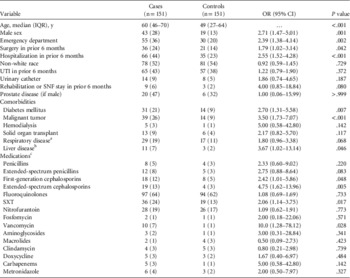
On bivariable analysis (Table 1), several variables were noted to be significantly associated with community-onset UTI due to ESC-R EB, including older age (P<.001), male gender (OR, 2.71 [95% CI, 1.47–5.01]; P=.001), presentation to the ED (2.39 [1.38–4.14]; P=.002), surgery in the prior 6 months (1.79 [1.02–3.14]; P=.042), hospitalization in the prior 6 months (2.55 [1.52–4.28]; P<.001), diabetes mellitus (2.70 [1.31–5.58]; P=.007), malignant tumor (3.50 [1.73–7.07]; P<.001), liver disease (3.67 [1.02–13.14]; P=.046), and receipt within the prior 6 months of a first-generation cephalosporin (2.42 [1.01–5.86]; P=.048), extended-spectrum cephalosporin (4.75 [1.62–13.96]; P=.005), trimethoprim-sulfamethoxazole (2.06 [1.14–3.75]; P=.017), and intravenous vancomycin (10.0 [1.28–78.12]; P=.028).
Bivariable Conditional Logistic Regression of Risk Factors for Community-Onset UTI Due to Extended-Spectrum Cephalosporin-Resistant Enterobacteriaceae

NOTE. Data are number (percentage) except where noted. IQR, interquartile range; OR, odds ratio; SNF, skilled nursing facility; SXT, trimethoprim-sulfamethoxazole; UTI, urinary tract infection.
a Chronic obstructive pulmonary disease or chronic bronchitis.
b Hepatitis or cirrhosis.
c Receipt in the prior 6 months.
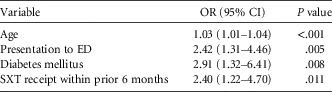
On subsequent multivariable analysis (Table 2), receipt of TMP-SMX within the prior 6 months was significantly associated with ESC-R EB UTI (OR, 2.40 [95% CI, 1.22–4.70]; P=.011). Other independent risk factors associated with an ESC-R EB UTI were older age (1.03 [1.01–1.04]; P<.001), diabetes mellitus (2.91 [1.32–6.41]; P=.008), and presentation to the ED (2.42 [1.31–4.46]; P=.005).
Multivariable Conditional Logistic Regression Model of Risk Factors for Community-Onset UTI Due to Extended-Spectrum Cephalosporin-Resistant Enterobacteriaceae

NOTE. ED, emergency department; OR, odds ratio; SXT, trimethoprim-sulfamethoxazole; UTI, urinary tract infection.
Susceptibility Testing
Susceptibility testing was performed on all of the EB isolates. Among the 151 ESC-R isolates, most were also resistant to fluoroquinolones (67%) and TMP-SMX (57%). In addition, 20% were resistant to aminoglycosides, and 18% were resistant to nitrofurantoin (18%). Two percent were resistant to meropenem.
Microbiologic Characterization
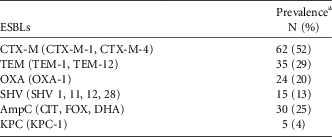
One hundred twenty (79.5%) of the 151 ESC-R EB case isolates were available for further microbiologic testing. Seventy-five (62.5%) of these isolates were positive on double disk testing. Among the isolates that were negative on double disk testing, 31% had at least one ESBL present on PCR testing and 45% were positive for AmpC. Among the isolates that were positive on double disk testing, 4% did not have an ESBL present on follow-up PCR testing. The prevalence of ESBLs among the ESC-R isolates was as follows (Table 3): 52% CTX-M, 29% TEM, 20% OXA, and 13% SHV. The number of ESBLs present in each ESC-R isolate varied: 28.3% had no ESBLs (specifically, no CTX-M, TEM, OXA, or SHV ESBLs), 34.2% had 1 ESBL, 34.2% had 2 ESBLs, 2.5% had 3 ESBLs, and 0.8% (1 patient) had 4 ESBLs. Of the 28.3% of ESC-R isolates that did not have an ESBL, most (19 [56%]) were positive for AmpC.
Prevalence of ESBLs, AmpC, and KPC Among Cases

NOTE. ESBL, extended-spectrum beta-lactamase; KPC, Klebsiella pneumoniae carbapenemase.
a For 120 case isolates. The presence of an ESBL is not mutually exclusive (eg, SHV and TEM can co-occur), so the total prevalence will be greater than 100%.
Thirty (25%) of the 120 characterized isolates were positive for AmpC, and 5 isolates (4%) were positive for K. pneumoniae carbapenemase. Among the 120 ESC-R EB isolates, there were 57 E. coli isolates that were positive for CTX-M. There were no distinct clusters among the 57 CTX-M E. coli isolates on PFGE analysis (Online Supplementary Figure 1). CTX-M groups among these 57 isolates were as follows: 34 (59.6%) were CTX-M-1, 22 (38.6%) were CTX-M-4, and 1 (1.8%) was ungrouped.
DISCUSSION
In this case-control study, we found that recent use of TMP-SMX, older age, diabetes mellitus, and presentation to the ED (as opposed to an outpatient practice) were significant risk factors for community-onset ESC-R EB UTI in a US health system. Furthermore, we identified a high prevalence of CTX-M-producing EB causing UTIs in the community setting, with more than half of characterized ESC-R isolates positive for CTX-M. The results of our study are strengthened by a large sample size including patients who presented to 2 EDs and a large network of primary care practices in the United States; focus on UTI, which is the most common bacterial infection among adults in the community setting; and inclusion of all EB species that were resistant to extended-spectrum cephalosporins. This is only the second study to date to determine risk factors for community-onset ESC-R EB UTI in the United States and is the larger of the studies.Reference Banerjee, Strahilevitz and Johnson 21
Our study showed that receipt of TMP-SMX during the prior 6 months was associated with the development of ESC-R EB UTI. Prior studies have found that antibiotic exposure is associated with development of ESC-R EB UTIs, including receipt of penicillins, fluoroquinolones, second- and third-generation cephalosporins, or any beta-lactam antibiotic.Reference Colodner, Rock and Chazan 11 , Reference Apisarnthanarak, Kiratisin, Saifon, Kitphati, Dejsirilert and Mundy 13 , Reference Azap, Arslan and Serefhanoglu 16 , Reference Yilmaz, Akalin and Ozbey 18 , Reference Rodriguez-Bano, Alcala and Cisneros 19 , Reference Banerjee, Strahilevitz and Johnson 21 Only one prior study has shown a specific association between TMP-SMX and ESC-R EB infection.Reference Rogers, Ingram and Runnegar 22 This association between TMP-SMX use and ESC-R EB UTI is likely due to TMP-SMX exerting broad selection pressure on gastrointestinal flora and promoting the development of resistance. This association is particularly significant because TMP-SMX is a commonly prescribed antibiotic in the community setting; given the high prevalence of ESBL EB organisms in the community, this suggests that TMP-SMX should be used cautiously in the community and that agents with the narrowest possible spectrum, such as nitrofurantoin, should be used when appropriate. This finding also underscores the importance of effective antibiotic stewardship measures in the community setting to limit the subsequent emergence of antibiotic-resistant organisms. Further study is indicated to assess whether decreased use of TMP-SMX can decrease the incidence of community ESC-R EB UTIs.
Similar to previous studies,Reference Colodner, Rock and Chazan 11 , Reference Azap, Arslan and Serefhanoglu 16 , Reference Rodriguez-Bano, Alcala and Cisneros 17 , Reference Rodriguez-Bano, Alcala and Cisneros 19 we found that older age was also a significant risk factor for development of an ESC-R EB UTI in the community setting. UTIs are one of the most common infections in community-dwelling older adults owing to a number of age-related risk factors, including increased rates of neurogenic bladder, increased use of urinary catheters, benign prostatic hypertrophy in men, and vaginal atrophy and increased incontinence in women.Reference Hu, Boyko and Scholes 35 Furthermore, older adults may be at higher risk for colonization and subsequent infection with antibiotic-resistant organisms, including ESC-R EB, as a result of chronic comorbidities and aging-related immunosenescence.
Comorbid diabetes mellitus was also associated with the development of community-onset ESC-R EB UTI in our study. The presence of diabetes mellitus is a well-described risk factor for infections due to ESC-R organisms (eg, UTI, bacteremia).Reference Colodner, Rock and Chazan 11 , Reference Laupland, Church, Vidakovich, Mucenski and Pitout 23 – Reference Briongos-Figuero, Gomez-Traveso and Bachiller-Luque 25 This elevated risk is likely related to the hyperglycemia-related impairment of immune responses in diabetes mellitus as well as increased prescription of antibiotics for conditions such as asymptomatic bacteriuria.Reference Muller, Gorter and Hak 36
The results of this study also showed that presentation to the ED (as opposed to an outpatient practice) was significantly associated with development of an ESC-R EB UTI in the community setting. Medically complex patients with greater healthcare and antibiotic exposures are more likely to present to the hospital ED, rather than an outpatient clinic, for presumed infection. It is also possible that patients with ESC-R EB UTIs were more symptomatic than those with an ESC-susceptible EB UTI and were thus more likely to present to an ED. Of note, in contrast to prior studies, our study did not show any significant association between recent hospitalization or stay in a long-term care facility and acquisition of an ESC-R EB UTI in the community.Reference Ben-Ami, Rodriguez-Bano and Arslan 15 , Reference Moor, Roberts and Simmons 20
Finally, we found that there was a high prevalence (52%) of CTX-M ESBLs among the community ESC-R EB isolates that we evaluated, as well as a high prevalence of AmpC (25%). This is consistent with prior reports that have found an increasing prevalence of CTX-M in the community.Reference Calbo, Romani and Xercavins 10 , Reference Woodford, Ward and Kaufmann 37 – Reference Ho, Poon and Loke 39 This high prevalence of CTX-M is concerning, given the association between CTX-M and multidrug resistance, particularly to oral agents that are typically prescribed for community-onset UTIs. High rates of resistance to these oral agents were confirmed in our study, with a resistance rate of 72% to both fluoroquinolones and TMP-SMX in CTX-M-positive isolates.
There are potential limitations of our study. Misclassification is a concern in case-control studies. However, the outcome of community-onset ESC-R EB UTI was validated through medical record review by an infectious diseases-trained physician, rather than relying on diagnostic or billing codes. The assessment of recent antibiotic use was limited to prescriptions in the University of Pennsylvania Health System; antibiotics prescribed by outside providers would not have been captured, though the impact should be nondifferential between cases and controls. Although we evaluated 80% of the 151 ESC-R EB isolates, lack of characterization of the entire group may have impacted estimates of ESBL prevalence and antibiotic susceptibility profiles. Finally, the present study was conducted in a single healthcare system, and the results may not be generalizable to other dissimilar institutions.
In conclusion, the results of our study demonstrated that recent use of TMP-SMX, older age, diabetes mellitus, and presentation to the ED were significant risk factors for the development of a community-onset UTI with an ESC-R EB organism in a US health system. Further studies are needed to evaluate the clinical impact of these ESC-R EB infections, as well as to determine optimal infection control strategies to limit the spread of these highly resistant and increasingly common organisms in the community.
ACKNOWLEDGMENTS
Financial support. Agency for Healthcare Research and Quality (grant R18-HS020002 to E.L.); the National Institutes of Health (grant K24-AI080942 to E.L. and K01-AI103028 to J.H.H.); and the Centers for Disease Control and Prevention Cooperative Agreement (grant FOA CK000163 to E.L.).
Potential conflicts of interest. All authors report no conflicts of interest relevant to this article.
SUPPLEMENTARY MATERIAL
For supplementary material/s referred to in this article, please visit http://dx.doi.org/10.1017/ice.2016.225.