Laterality defects are defined as abnormalities in the establishment of the left-right axis, and are associated with congenital cardiac disease, abnormal pulmonary lobation, splenic problems leading to immunodeficiency, intestinal malrotation, and hepatic malposition. Laterality syndromes are estimated to account for 3% of neonates with congenital cardiac disease.1 The etiology of such disease is largely unknown. In some cases, genetic predisposition to laterality disorders has been suggested by associated chromosomal anomalies and familial aggregation, often within consanguineous families, suggesting autosomal recessive inheritance. Autosomal dominant and X linked inheritance are infrequently noted, and there is no sex bias among sporadic cases.2
Although many genes have been implicated in the determination of laterality in other species,3–17 few of these genes have been tested in humans. CFC1 is a member of the epidermal growth factor family, encoding extracellular proteins that have key roles in vertebrate embryogenesis.18 Mice with induced loss of function mutations of CFC1 develop visceral laterality defects and complex cardiac malformations similar to human heterotaxy syndrome.9, 19 Through positional cloning and approaches using candidate genes, mutations in transforming growth factor beta 4, activin receptor IIb, CFC1, and zinc finger protein of the cerebellum have all been associated with laterality defects and congenital cardiac disease in humans.20, 21
The CFC1 gene maps to 2q21.1 (MIM 605194). Bamford et al. have recently demonstrated 3 heterozygous mutations of this gene, named R112C, G174del1, and R189C, in 4 unrelated subjects with laterality disorders associated with congenital cardiac disease.22 The R112C and G174del1 mutations resulted in altered protein function, as demonstrated by aberrant cellular-localization and inability to rescue zebrafish one eyed pin head mutants, and were incompletely penetrant. A fourth sequence variant (R78W) was identified in five affected African-American subjects, and in unaffected African-Americans, with a carrier frequency of from 6 to 13.6%, and demonstrated abnormal cellular localization in transfection assays and functional differences from wild type CFC1 in the mutant rescue assay.22 Bamford et al. also reported additional polymorphisms, including N21H, R47Q, P75P, A145T, P196P, L220L and P204P.22 Goldmuntz et al.23 extended the analysis of CFC1 to 86 subjects with discordant ventriculo-arterial connections or double outlet right ventricle without laterality disorders, and identified 2 mutations, G174del1 as previously observed,22 and a tandem duplication of the exon 4 splice donor site, with incomplete penetrance of the G174del1 mutation. They suggested that mutations in CFC1 may be common to patients with these abnormal ventriculo-arterial connections, as well as those with visceral heterotaxy.23 They also observed the R78W missense variant in a single African-American subject with double outlet right ventricle.23
Our study was designed further to assess the frequency, and role, of mutations and genetic variations in CFC1 in children with laterality disorders associated with cardiovascular involvement.
Methods
Subjects
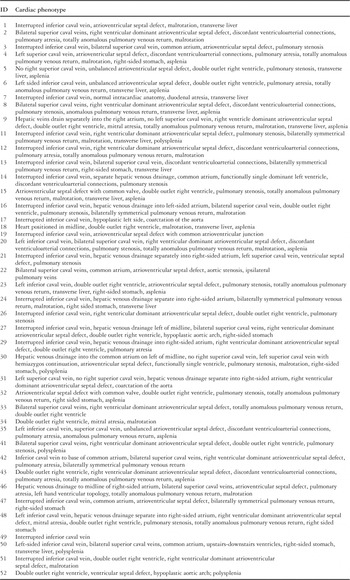
We recruited 42 unrelated subjects with laterality defects and cardiovascular involvement from the Morgan Stanley Children's Hospital of New York Presbyterian Medical Centre. Informed consent was obtained from parents, and blood for assessment of genomic deoxyribonucleic acid was obtained from the probands, and when possible, also from the parents. The study was approved by the Institutional Review Board of Columbia University Medical Center. Cardiac and visceral phenotypes were determined by review of chest X-rays, abdominal ultrasonograms, echocardiograms, angiocardiograms, operative reports, and clinical history. These assessments identified the anatomy of the heart, venous, and visceral structures. Specific cardiac phenotypes are provided in the Appendix. Parents also provided history regarding ethnicity, medical conditions, and results of cyto-genetic studies. Subjects with karyotypic anomalies were excluded.
Of the 42 subjects, 18 were females, and 24 males. The ethnic composition was 19 Caucasians, 10 African Americans, 11 Hispanics, and 2 Asians. None of the parents of the 42 subjects had any known laterality defect, cardiac disease, or birth defects. Two subjects were adopted, and lacked information on the biological parents. Only one subject had a family history of laterality defects, a deceased sibling.
Genetic analysis
Genomic deoxyribonucleic acid was isolated from lymphocytes by standard phenol/chloroform extraction and ethanol precipitation, quantified by ultraviolet spectrometry and stored at 4 degree Celsius.24 The polymerase chain reaction was used to amplify each of the coding exons of CFC1 from genomic deoxyribonucleic acid for mutation screening by bidirectional deoxy sequence analysis (Table 1). The chain reaction was performed in a 25 microlitre reaction volume consisting of 100 nanogram deoxyribonucleic acid, 2.5 microlitre 10 X polymerase chain reaction buffer, 50μM dNTPs, 100 nM each primer, and 1 U Taq deoxyribonucleic acid polymerase. Thermocycling conditions consisted of one cycle for two minutes at 94 degree Celsius, followed by 35 cycles of denaturation at 94 degree Celsius for 30 seconds, touch down annealing from 63 degree Celsius to 58 degree Celsius over the first 12 cycles for 30 seconds, and extension at 72 degree Celsius for 30 seconds with a final six minute extension at 72 degree Celsius. Thermocycling was performed on a Multiblock System (Thermohybaid, Middlesex, UK). Products of the polymerase chain reaction were purified after electrophoresis through a 2% agarose gel using the Qiaquick deoxyribonucleic acid purification columns (Qiagen Inc. Valencia, CA). Fluorescent dideoxy termination sequencing of purified polymerase chain reaction products was performed on a ABI 377 sequencer using standard reagents and conditions as recommended by the manufacturer.25
Table 1. Polymerase chain reaction primers and conditions for the CFC1 amplification.

When possible, parents of probands with identified variants in CFC1 were also analyzed for the variant or variants exhibited by the proband by direct sequencing of fragments obtained from the polymerase chain reaction. To investigate the pathogenicity of genetic variants, 100 African American, 100 Caucasian subjects and 50 Asian subjects unaffected with laterality defects or congenital cardiac disease by report were genotyped by direct sequencing to determine the allele frequency in the unaffected population. Data from the association study were analyzed by Fisher's exact test with a Bonferroni correction for multiple testing.
Results
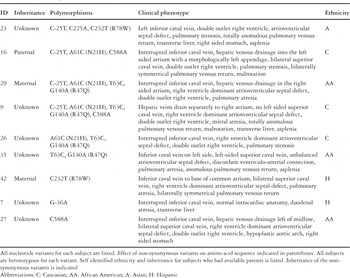
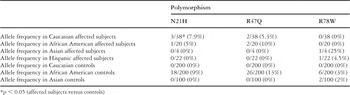
We identified 8 polymorphisms in CFC1 in 9 of the 42 subjects, with 6 of the polymorphisms located in the coding exons, 3 of which, namely N21H, R47Q, and R78W, resulted in substitutions of amino acids to produce non-synonymous polymorphisms (Fig. 1). In 6 subjects, we found multiple variants (Table 2). The parents of our 16th and 29th subjects were genotyped. These studies demonstrated that N21H was paternally inherited in the 16th subject, and that N21H and R47Q were both maternally inherited in the 29th subject. R78W was maternally inherited in the 42nd subject. Because the intronic and synonymous variants are unlikely to be functionally significant, additional studies were focused on the three non-synonymous variants. For this purpose, we used our 100 Caucasian, 100 African American and 50 Asian subjects without a history of laterality defects or congenital cardiac disease, genotyping them for the 3 non-synonymous polymorphisms to determine the frequencies of these alleles in an unaffected population. Within the 100 Caucasian controls, no subjects carried any of these 3 polymorphisms, while the frequencies in affected Caucasian subjects were 7.9% for N21H, and 5.3% for R47Q. These polymorphisms were observed in unaffected African-American controls, with frequencies of 9% for N21H, 13% for R47Q, and 3% for R78W (Table 3). The N21H polymorphism was observed with an allele frequency of 5%, and R47Q of 10%, in affected African American subjects. The R78W polymorphism was observed in a single Asian and a single Hispanic subject; with an allele frequency of 2% in unaffected Asian controls. Hispanic controls were not screened.

Figure 1. Location of CFC1 polymorphisms in subjects with laterality defects. We identified 8 polymorphisms in CFC1 in 9 of 42 subjects with abnormalities of lateralisation. The boxes represent the coding exons, beneath which the upper row shows the nucleotide substitutions, and the lower row shows the amino acid substitutions. Of the polymorphisms, 6 are located in exons, and 3 of the polymorphisms produce amino acid substitutions. Nucleotides are numbered according to GenBank entry AF312925 with the A in the start methionine as nucleotide 1. Intronic variants indicated by nucleotide position before the splice site.
Table 2. Subjects with genetic variants in CFC1.

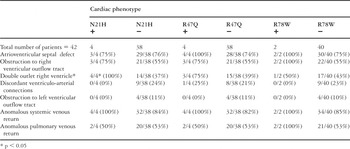
There was a significant difference in frequencies of alleles between cases and controls for only the N21H variant in Caucasians (Table 3), with a Fischer's exact test of p equal to 0.0038 and p equal to 0.034 after a Bonferroni correction for 9 tests. Atrioventricular septal defect was seen with similar frequency in the group of patients with and without non-synonymous polymorphisms (Table 4). Double outlet right ventricle was observed with higher frequency in subjects carrying the N21H polymorphism compared to subjects who did not carry the polymorphism (100% versus 37%). Three of these four subjects with double outlet right ventricle also carried the R47Q polymorphism.
Table 3. Allele frequencies of non-synonymous variants in CFC1.

Table 4. Correlation with cardiac phenotype with presence (+) or absence (−) of non-synonymous variants.

Discussion
In our study, we have identified two intronic variants, specifically exon 2 C-25T and exon 5 G-36A, 3 synonymous polymorphisms, specifically T63C, C225A, and C588A, and 3 non-synonymous coding variants, namely N21H, R47Q, and R78W, in the CFC1 gene in one-fifth of our cohort of 42 subjects with laterality defects and congenital cardiac disease. No nonsense or splicing mutations in CFC1 causing obvious loss of function of the gene were identified. None of the intronic or non-synonymous variants are predicted to affect splicing, and are unlikely to be functionally significant. The 3 non-synonymous variants are not located in conserved amino acids, or within conserved epidermal growth factor families or CFC motifs. All three of these substitutions of amino acids differ in charge, but because these residues are not predicted to be buried, and are not highly conserved across species, they are less likely significantly to alter function, although more subtle effects on function are possible. The 3 non-synonymous variants were also observed in unaffected parents. Thus, they either represent mutations with reduced penetrance has been observed for other CFC1 mutations,22, 23 or are benign polymorphisms. Additionally, the high allele frequency of N21H and R47Q in unaffected African-American controls suggests that these variants are polymorphisms with allele frequencies that differ between populations. The significant difference in allele frequency of the N21H variant in Caucasian cases and controls suggests that this variant may play a role in susceptibility to laterality defects, or could be in linkage disequilibrium in Caucasians with other non-coding variants of functional significance. Additionally, double outlet right ventricle was observed in all 4 subjects carrying the N21H variant, suggesting more specifically that N21H, or another variant in linkage disequilibrium with N21H, can increase the susceptibility to double outlet right ventricle in patients having defective lateralisation. Because N21H is in linkage disequilibrium with R47Q, interactions between these two polymorphisms and/or additional polymorphisms could interact to increase the susceptibility to disordered lateralisation.
The R78W polymorphism has been previously identified in 6 unrelated African-American subjects with laterality disorders as having an allele frequency of 3 to 6.8% in normal African American controls.22, 23 In our study, the R78W variant was observed in a single affected Asian subject, and in a single affected Hispanic subject. We also determined that the allele frequency was 3% in unaffected African Americans, and 2% in unaffected Asians. The C225A and C232T polymorphisms were also observed in association with R78W in our Asian subject, as was previously observed in African-American subjects, suggesting a common haplotype in African-Americans and Asians.23 Previous biological assays of the R78W polymorphism suggest it may have different cell surface clustering, and that it differs functionally from wild type CFC1.22 The small size of our studied cohort, however, did not provide sufficient power to demonstrate statistical significance in the R78W variant in cases versus controls.
None of our 3 non-synonymous variants is fully penetrant, but these variants could potentially interact with other genetic and environmental factors to increase susceptibility to deficient lateralisation and its associated congenital cardiac disease, particularly double outlet right ventricle. Functional, and larger association studies of patients with deficient lateralisation and double outlet right ventricle are required definitely to test this hypothesis.
Conflict of interest
The authors have no conflict of interest to disclose. There are no sources of outside support for this project including funding, equipment and drugs.
Acknowledgements
We gratefully acknowledge assistance from Patricia Lanzano, Lin Feng, Emerson Whittington, Charles LeDuc, and Liyong Deng in management of the database, and preparation and sequencing of the deoxy-ribonucleic acid.
Appendix Phenotypes of the patients.