The healthcare system in Greece is currently undergoing major reforms, in an effort to contain public expenditure on health as foreseen in the country's Economic Adjustment Program (EAP) (1). The constant increase of pharmaceutical expenditure in years before the economic crisis was considered a major issue in the Greek healthcare system. Over the decade 1998–2008, the annual growth rate in pharmaceutical spending in Greece was 11.3 percent, a figure significantly above the European Union (EU) average (4.7 percent) (2). The reduction of public expenditure on pharmaceuticals to approximately 1 percent of Greece's gross domestic product (GDP) by end-2014 is an objective of the country's EAP (1). In this direction, promotion of cost-effective use of pharmaceuticals and consideration of economic evaluation criteria for the reimbursement of newly patented medicines are considered important (1).
Decisions regarding pricing and reimbursement (P&R) of medicines should be based on scientific evidence such as health technology assessment (HTA). HTA is well established in many European countries as well as in Canada and Australia, whereas countries in Central and Eastern Europe, Asia, and South America have recently undertaken initiatives toward incorporating health economics/HTA criteria in decision making (Reference Sivalal3).
In Greece, the lack of policy measures to promote cost-effectiveness and manage the introduction and diffusion of health technologies has been highlighted since the mid-1990s (Reference Liaropoulos and Kaitelidou4). Various attempts have been made since to introduce HTA in decision making. Economic evaluation criteria were finally introduced in the legislation regarding reimbursement of pharmaceuticals in 2010. Currently, ATC-level classification and inclusion in the positive list of newly marketed medicines is decided, among other criteria, on the basis of their positive assessment by HTA Organizations in other EU countries. The Greek EAP (1), furthermore, suggests internal capacity building on HTA. A description of the reimbursement system for pharmaceuticals in Greece and initiatives relating to HTA are available as Supplementary Materials, which can be viewed online at http://dx.doi.org/10.1017/S0266462314000130.
The explicit use of economic evaluation criteria in decision making was the main motivation for conducting this study as it constituted a significant reform in the Greek pharmaceutical market. Furthermore, current international developments regarding the widespread use of HTA in health policy suggest that the study is timely and interesting.
Stakeholder involvement in HTA can offer significant benefits and to this direction, several initiatives are in place internationally aiming at investigating stakeholders’ perceptions and promoting collaboration at the various stages of the HTA process (Reference Fronsdal, Pichler and Mardhani-Bayne5–Reference Curtis, Gordon, Slaughter-Mason and Thielke7). In countries building HTA capacity, relevant stakeholder sensitization as well as clarification and discussion of the HTA concept are strongly suggested as part of the preparatory phase (8). To our knowledge, there are no recent studies investigating views of actors involved in the pharmaceutical market on the potential for HTA in Greece. The pharmaceutical industry in Greece is directly affected by the introduced reforms and therefore can be regarded as a key stakeholder. Furthermore, executives in departments handling P&R issues have greater familiarity and knowledge of HTA methods and its role in the P&R of medicines, due to their profession and educational background. In this respect, they can provide insight regarding opportunities, barriers, and prerequisites for establishing HTA in Greece. The present study aims to elicit their views on HTA and its potential contribution in decision making in Greece and depict pharmaceutical industry use of pharmaco-economic evaluation in Greece.
METHODOLOGY
Qualitative research seeks to understand and translate personal attitudes, beliefs and experiences of participants in relation to a phenomenon (Reference Mack, Woodsong, MacQueen, Guest and Namey9). It was, thus, considered the most appropriate method, because it provides the opportunity for in-depth exploration of participants’ views on the topic.
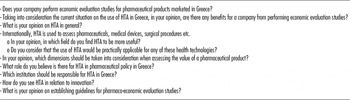
Semi-structured interviews were conducted with the use of an interview schedule consisting of open-ended questions. Open-ended questions establish the topic to be discussed, but allow the interviewee the freedom to explain and organize his/her answer according to his preferences (Reference Filias10). This approach was preferred over alternative methodologies such as self-completion questionnaires because it achieves greater scrutiny of practices and attitudes of respondents and captures important elements (Reference Filias10). Furthermore, the interviewer has the ability to probe the participants to clarify answers and request further information. Key topics included in the interview schedule are presented in Table 1. The interview schedule was pilot tested on two employees in originator pharmaceutical companies which operate in the Greek market, weaknesses were identified and all necessary modifications were done.
Selected Questions Included in the Interview Schedule

Participants were selected by purposive sampling. The target population consisted of executives of originator pharmaceutical companies which operate in the Greek market. Originator companies develop and patent original products which are defined as the first version of a medicine that is marketed under a unique brand name (11). The focus on original medicines was based on the fact that production and distribution of original medicines are inextricably linked to innovation, research and development (Reference Di Masi, Hansen and Grabowski12); pharmaco-economic studies are conducted by pharmaceutical companies at all stages of medicines development and are used to demonstrate the products’ cost-effectiveness to decision makers (Reference Maniadakis and Fragkoulakis13). Furthermore, new innovative medicines are those mainly undergoing evaluation through HTA procedures (Reference Taylor, Drummond, Salkeld and Sullivan14). A second key criterion for participants’ recruitment was their employment in market access and/or health economics departments or job positions in the pharmaceutical company, as described in the introduction section.
In total, according to a recent report on the pharmaceutical industry (15), thirty-five originator pharmaceutical companies operated in Greece in 2009. Of them, seven were biotechnology companies. A telephone inquiry with all pharmaceutical companies was made to investigate whether there was a market access or health economics department or an employee whose job position was relevant to issues regarding P&R of medicines. Overall, sixteen companies (46 percent of total) met this criterion. An invitation letter to participate was e-mailed to the executives who met the above criteria, informing them of the study purpose. Subsequently, an interview appointment was arranged. In total, ten executives agreed to participate, one declined, and five were excluded when they did not reply after two reminders.
Interviews were conducted between July and October 2011 at respondents’ company's premises and the average duration of interview was 30 minutes. At the beginning of the interview, the aim of the study was explained. Moreover, protection of anonymity of the employees and pharmaceutical companies and confidentiality of the information were clarified, as well as that the data collected would be used only for scientific purposes. During the interviews, a recording device was used (with the consent of interviewees). Interviews were conducted by a Master's student (E.A.) with basic training in qualitative methods. The interviewer had no prior relationship with participants.
Each interview was transcribed verbatim immediately after its completion by the same person (E.A.). Data were analyzed using content analysis. Content analysis aims to provide a condensed and broad description of the phenomenon under study, and the outcome of the analysis is concepts or categories describing the phenomenon (Reference Elo and Kyngäs16). An initial list of codes was developed by E.A. a priori on the basis of the interview guide questions, however, new codes also emerged in the process. The final coding scheme was decided following discussion among research team members, in which codes were organized hierarchically. E.A. subsequently coded and analyzed transcripts under the supervision of experienced research team members (E.K., E.P.). All interviews, coding, and analysis were undertaken in Greek. No qualitative analysis software was used.
RESULTS
Of the sample of ten executives, eight participants were finally interviewed (five men and three women) of whom two were employed in biotechnology companies. The remaining two who had accepted the invitation to participate were not eventually interviewed as the study had reached the saturation point, i.e., no more new information was collected. Major themes identified were: (a) current practices regarding use of economic evaluation; (b) views on HTA in decision making in general; (c) definition of the value of medicines; (d) attitudes toward HTA institutionalization, opportunities and prerequisites; and (e) perceived characteristics of an HTA agency.
Industry Practices Regarding Pharmaco-economic Evaluation Studies
The majority of the pharmaceutical companies (six of eight) in our sample undertake pharmaco-economic evaluation studies in phases III and IV of the medicine's life cycle. Pharmaco-economic evaluations during phases I and II are carried out centrally by their parent companies.
The selection of the medicines for which pharmaco-economic evaluation studies will be conducted is based on criteria relating to the pharmaceutical market environment. Both new and medicines already in the market are selected. The types of economic evaluation which are usually carried out are cost-of-illness analysis, budget impact analysis or cost-effectiveness analysis. The type of analysis selected depends on the information needs of regulators as well as the product strategy.
Most of the companies outsource these activities to contracted associates such us universities or private companies specialized in conducting economic evaluation studies. Simpler pharmaco-economic models may be performed also in-house, but companies mainly choose to cooperate with field agents as they contribute to a higher impartiality and validity of the process of analysis. In addition, pharmaceutical companies in Greece encounter technical issues, such as the complexity of the study, the lack of data (epidemiological, cost, etc.), and the lack of personnel time, all of which force them to contract with field agents.
The reasons why pharmaceutical companies carry out economic evaluations are mainly related to the company's strategy to support and promote their products, to the market and the healthcare system needs and the product characteristics. Practically, all participants endorsed the view that performing pharmaco-economic evaluations positively affects the promotion, prescribing, and launch of their medicines in the market.
Two of eight companies did not perform pharmaco-economic evaluations, while one company had recently started carrying out such studies. The reason why pharmaco-economic evaluations are not performed by these pharmaceutical companies is that it is not an institutionalized process in Greece. Therefore, these companies choose to use the pharmaco-economic studies which have been carried out by their parent company.
Views and Perceptions on the Importance of HTA
All participants held the opinion that HTA is a very useful process. HTA was seen as a necessary additional scientific tool for decision making in pharmaceutical policy which provides comparative data to bring forward the treatment which is cost-effective.
“For me, it is a very transparent, serious and sound system of negotiating medicines’ value as well as pricing and reimbursement decisions.” (Respondent 1)
Assessment was considered by most participants useful for all types of health technologies. Disease areas with high unmet need or/and significant health and economic impact, highly innovative medicines, and medicines with a significant impact on the pathway of care were used by some participants as examples of areas in which HTA would be particularly useful.
All participants believed that HTA can only have a positive role in innovation, provided that the meaning of innovation is clearly defined by the State. Furthermore, HTA should be a transparent and consistent process regarding the methodology used and data required. If these conditions are not met HTA was perceived to have a negative impact on patient access and innovation.
Value of Medicines
The value of a medicine was perceived by interviewees as a concept which involves much more than safety, efficacy, and effectiveness. It consists of the medicine's benefits to the patient (clinical and nonclinical such as improvement in quality of life), to the health system, and society. Moreover, a very important aspect of value was whether a medicine is a substitute or complement for other forms of healthcare. In other words, if it contributes to reducing healthcare costs related to hospitalization, surgical procedures, and medical procedures. Furthermore, it was pointed out that a medicine's value relates to the characteristics of the targeted disease.
“If this disease has a high unmet need . . . In addition, if it is a disease of extremely high burden . . . then again this constitutes value.” (Respondent 5)
Last but not least, participants stated that value is closely related to innovation. In their view, innovation is a key aspect of a medicine's value and the definition of innovation should take into consideration all aspects of value that were previously described.
“When we assess the value of a medicine we must consider all aspects which bring value, namely innovation. And innovation can mean better quality of life, better clinical outcomes, (the medicine's) route of administration etc.” (Respondent 5)
The Possibility of HTA Institutionalization in Greece
All participants argued that HTA institutionalization will contribute to the rationalization of health and pharmaceutical policy and that it would benefit all stakeholders in the pharmaceutical market: the healthcare system, pharmaceutical companies, the patients, and society in general.
According to participants, HTA in Greece could be introduced for medicines and medical devices but not for surgery or medical procedures due to the latter's higher complexity and the lack of statistical data (cost of procedures, epidemiological data).
Participants stated that there are significant limitations for the institutionalization of HTA in Greece. There was a consensus that the main constraint is the lack of political will. Furthermore, pharmaceutical policy measures were described by participants as horizontal, unstable, and lacking transparency. In addition, key stakeholders and mainly the pharmaceutical industry are not involved in the decision-making process, whereas the decision-making process itself presents organizational problems. Another limitation brought forward related to the availability of data records in the healthcare system. Finally, some participants expressed concerns regarding the availability of scientific personnel adequately qualified to carry out pharmaco-economic evaluations. On the other hand, all participants agreed that, despite the constraints, there are opportunities for the institutionalization of ΗΤΑ, such as the financial crisis and the fact that there are many Greek scientists skilled in health economics and pharmaco-economic evaluation who work abroad.
Notwithstanding the opportunities and limitations, it was stressed that the institutionalization of HTA is only possible if certain conditions are met and it is introduced gradually, after the necessary structures have been developed. The main prerequisites mentioned were as follows: change of political will, a common strategy among public bodies involved in pharmaceutical policy, setting of defined pharmaceutical policy goals, publication of pharmaco-economic evaluation guidelines, recording and monitoring of cost and epidemiological data, and stakeholder involvement in HTA decision-making procedures.
Focusing on P&R decisions on pharmaceuticals, there was a consensus that HTA should have a bigger role as a supplementary tool in decisions related to reimbursement of selected medicines. Their views regarding the role of HTA on pricing decisions appear to be contradictory. Some of the interviewees considered that it is impossible for HTA to be part of the price-setting mechanism, whereas others expressed the belief that it could be an additional criterion. One participant considered that it is important to introduce HTA in pricing but not in the reimbursement of medicines in the Greek healthcare setting. In general, respondents believed that medicines are primarily a social good; hence, the majority supported that, when assessing a medicine, the societal perspective should be taken into account in contrast to the “narrow interpretation” of the healthcare system perspective, for example in chronic diseases. On the other hand, there were some participants who believed that at present, limitations such as difficulties in estimating societal cost or lack of data constitute the healthcare system perspective more suitable.
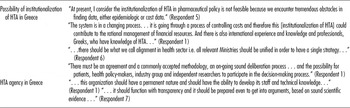
All participants were asked about their knowledge regarding collaboration on HTA at a European level through the activity of the European Network for Health Technology Assessment (EUnetHTA). Several participants were well informed, although the majority did not have a clear knowledge of the Network's role. Irrespective of their knowledge of the subject, there was a general agreement that EUnetHTA activities as well as European experience in HTA can contribute to the development of HTA in Greece in terms of exchange of information, know-how, and methodologies. Selected quotes on the possibility of HTA institutionalization in Greece are presented in Table 2.
Selected Quotes from Participants on HTA Institutionalization

Characteristics of a Greek HTA Agency
In light of the above, participants believed that a Greek HTA agency should be a novel, independent organization. It was viewed that it should have a permanent nature, operate on the basis of transparent procedures and ensure participation of all stakeholders. The current financial crisis was seen as both the biggest opportunity and the biggest constraint for the agency's establishment.
Regarding the role of the pharmaceutical industry, it was noted that it should be strengthened and that scientists working in the pharmaceutical companies can contribute to the HTA process through their advanced experience.
DISCUSSION
Our study showed that originator pharmaceutical companies in which our study participants were employed conduct pharmaco-economic evaluation studies for reasons relating to (present and anticipated) healthcare system regulatory requirements as well as their promotion strategy, as products which have undergone pharmaco-economic evaluation are perceived to provide added value and to be differentiated from competitors’ products. In addition, as part of the international pharmaceutical industry, pharmaceutical companies in Greece seek to align their strategy with current international developments, that is, the increasing importance of HTA in pharmaceutical policy and requirements for submission of relevant evidence to support medicines’ P&R decisions (Reference Sorenson17). The latter have led the pharmaceutical industry in Europe and worldwide to acknowledge the need for conducting economic evaluation studies and to develop in-house HEOR departments (Reference Lothgren and Ratcliffe18). According to Neumann and Saret (Reference Neumann and Saret19), there is a growing field for HEOR and increased awareness and support for internal HEOR capacity in the U.S.-based industry.
A positive attitude toward institutionalization of HTA in Greece has been recorded. Pharmaceutical industry executives believed that HTA is very useful for pharmaceutical policy both at the international level and especially in Greece, considering the need for rationalization of pharmaceutical expenditure. The institutionalization of HTA was perceived as beneficial to all stakeholders in the pharmaceutical market (industry, patients, healthcare system) and society in general. HTA was seen more suitable as an additional tool in decisions regarding reimbursement of medicines. The economic situation in Greece was considered as probably the greatest opportunity for the institutionalization of HTA.
In parallel, it was emphasized that HTA is a difficult, time consuming, expensive, and complex process with specific resource requirements and it can be successfully applied in Greece only under certain conditions, such as the development of guidelines for conducting pharmaco-economic evaluation, the change in health policy goals, the recording of cost and epidemiological data, and the broader participation of all stakeholders in HTA decision-making process.
To our knowledge, this is the first study to provide insight into the practices and incentives in place for implementation of pharmaco-economic evaluation studies by pharmaceutical companies in Greece. Furthermore, we have brought forward areas for improvement as well as opportunities identified by pharmaceutical industry executives for the institutionalization of HTA in Greece. Our findings are consistent with pharmaceutical industry's perspectives on HTA (with specific comments on the HTA systems in England and Wales, France, The Netherlands, and Sweden) as discussed by Lonthgren and Ratcliffe (Reference Lothgren and Ratcliffe18). More specifically, we have identified similar views on the complexity of HTA and its requirements regarding financial and other resources. Barriers to proper implementation of HTA such as the use of HTA as a cost-containment tool and the subsequent impact on patients’ access to innovative medicines were brought forward also by participants in our study. Finally, the need for transparency as well as for an extended and better collaboration between stakeholders was highlighted in both cases. Prerequisites emphasized by participants in our study—independence and transparency in the HTA system—were also strongly supported in the focus groups (including participants from all key stakeholders) conducted in the framework of an HTA Review in Australia (6). Participants in the focus groups also considered consultation with stakeholders during all assessment phases as important (6).
Stakeholder engagement in HTA can strengthen legitimacy of HTA as well as increase transparency, acceptance, and usage of HTA products in decision making (Reference Nielsen, Lauritsen and Kristensen20). Furthermore, improved communication and coordination between regulatory bodies, HTA bodies, and industry could contribute to improved efficiency of review processes and timely access of patients to effective treatments (Reference Fronsdal, Pichler and Mardhani-Bayne5). In this direction, several HTA agencies have developed stakeholder engagement strategies, although the intensity of stakeholder involvement varies (Reference Nielsen, Lauritsen and Kristensen20). Future developments in the use of HTA such as value-based pricing (where medicine's price is closely linked to its value) (Reference Sussex, Towse and Devlin21), are expected to require increased collaboration between stakeholders in the pharmaceutical market as stakeholders’ perspectives on value as well as decision-making procedures in place for assessing value may differ (Reference Henshall and Schuller22). Participants in our study considered improvements in patient health outcomes but also wider societal benefits (productivity, impact on carers) and burden-of-disease aspects (unmet need, cost savings) as attributes of a products’ value.
Concerns about pharmaceutical policy in Greece (e.g., lack of data records, unstable policies), which have already been pointed out in the past (Reference Contiades, Golna and Souliotis23), were also considered important among interviewees in our study. However, our findings suggest that pharmaceutical companies’ attitude toward the institutionalization of HTA in pharmaceutical policy has improved.
In Greece, there is a noticeable lack of sustained policy on the issue of institutionalization of HTA. Measures that could be taken for HTA to be reinforced in Greece, include the introduction of the field of HTA in undergraduate and postgraduate courses and the encouragement of scientific research related to HTA. In addition, continuing education programs for executives in Social Security Funds and the Ministry of Health should be introduced and Greek scientists’ knowledge and experience in HTA should be used. Involvement of stakeholders to establish reliable HTA processes is necessary to take into account a broad perspective on expectations of HTA and on value perception. The above should form part of a strategic plan on HTA institutionalization in the Greek healthcare sector. In this direction, established knowledge on European countries’ practices (Reference Sorenson, Drummold and Kanavos24) as well as developed recommendations (Reference Durczak, Kiersztyn and Orłowski25) must be exploited.
CONCLUSIONS
In summary, we found that pharmaceutical companies’ executives recognize the importance of HTA as a complementary tool for decision making in health policy, and believe that it could be introduced in pharmaceutical policy and especially in the decisions on medicines’ reimbursement. They consider that HTA institutionalization in Greece will only be successful provided that certain conditions are fulfilled, such as a change of political culture and the establishment of a long-term pharmaceutical policy with clearly defined goals, electronic recording of health data, and involvement of stakeholders. There are many obstacles which need to be overcome and opportunities which must be taken advantage of. In any event, a new approach must be adopted where scientific methods will set transparent rules for decision making in P&R of medicines.
Future studies should explore to what extent these special conditions are met and which measures must be taken for the successful introduction of HTA in decision making. Due to time and resource constraints, our study focused on sub-group of people involved in the pharmaceutical market. A larger qualitative study of stakeholders’ views and perceptions on HTA involving healthcare professionals, payers (social security funds), technology manufacturers (pharmaceutical and medical device industry), academia, health policy makers, and patients’ associations, would provide a complete overview of stakeholder's views on HTA in Greece. Nevertheless, our study contributes to the understanding of the challenges related to the process of establishing HTA procedures in Greece. We believe that our findings are relevant also for countries considering or in the process of introducing HTA procedures.
SUPPLEMENTARY MATERIAL
Supplementary Material: http://dx.doi.org/10.1017/S0266462314000130
CONTACT INFORMATION
Eleni Armataki, MSc (lenarmat@hotmail.com), Department of Health Economics, National School of Public Health, 196 Alexandras Ave., 115 21, Athens, Greece; Special Assistant to the Mayor on Social Policy, Municipality of Lavreotiki, 1 Kountouriotou St., 19500, Lavrion, Greece
Eleftheria Karampli, MSc, Research Fellow, Department of Health Economics, National School of Public Health, 196 Alexandras Ave., 115 21, Athens, Greece
John Kyriopoulos, MD, MPH, MSC, PhD, Professor Emeritus of Health Economics, Department of Health Economics, National School of Public Health, 196 Alexandras Ave., 115 21, Athens, Greece
Elpida Pavi, DDS, MPH, PhD, Senior Lecturer, Department of Health Economics, National School of Public Health, 196 Alexandras Ave., 115 21, Athens, Greece
CONFLICTS OF INTEREST
Mrs. Armataki has nothing to disclose. Mrs. Karampli has nothing to disclose. Dr. Kyriopoulos has nothing to disclose. Dr. Pavi has nothing to disclose.