1. Introduction
This huge work provides a unique synthesis of comparative knowledge of Australian languages. It does so very much from the point of view of its sole author. This singleness of vision is both its strength and its weakness. On the one hand, it was bound to be provocative and to stimulate much debate and discussion among Australianists. On the other hand, readers unfamiliar with the relevant literature, which is now substantial, should not mistake this volume for a more or less neutral manual or textbook which canvasses all the relevant facts and thus summarises, in a balanced way, the state of play in the Aboriginal linguistic field. Such a project would have required closer participation, in a collegial way, by the community of relevant scholars. Unusually, scholars' names are not indexed in this volume.
Our review article tries to give readers a description of the whole book, in its own terms. Our critical assessment focuses on the historical explanatory framework that is given by the author as its main thrust, on the social context of the languages that it assumes, and the implications of its Punctuated Equilibrium model for the interdisciplinary interpretation of Australian prehistory. The review by Evans (Reference Evans2005) also targets the historical framework – treating some aspects in much more detail than ours. Alpher's (Reference Alpher2005) shorter review addresses some of the historical issues (reconstruction, use of statistics, typological description and chronologisation of coverb constructions) and has a section critiquing ‘Models of language change and social setting’.
2. Description of contents
2.1. Contents and organisation
This book is a considerably updated version of Dixon (Reference Dixon1980): ‘The present work is a reworking and extension of the typological survey in chapters 5–13 of the 1980 book’ (xxvii). It is about 200 pages longer (xlii+734) than the earlier book (xxii+547), and contains a great many more maps (34 vs. 9 in Dixon Reference Dixon1980). A larger amount of space is here devoted to historical issues than in Dixon (Reference Dixon1980).
The organisation differs considerably from the earlier book. While both are organised into 14 chapters, this book omits the 1980 chapters on the background topics ‘Tribe and language’, ‘Speech and song styles’, ‘The role of language in Aboriginal Australian society today’, and ‘Word classes’. Chapters on ‘Vocabulary’ and ‘Verbs’ are retained. The 1980 chapters on ‘Phonology’ and ‘Phonological change’ are combined into one chapter on ‘Phonology’, and the chapter on ‘Pronouns’ is split into two, ‘Pronouns’ and ‘Bound pronouns’. In place of the chapter on ‘Nouns’ are two chapters on ‘Case and other nominal suffixes’ and ‘Generic nouns, classifiers, genders and noun classes’; replacing the chapter on ‘Syntax’ is one on ‘Ergative/accusative morphological and syntactic profiles’; and ‘Classification of Australian languages’ is here represented by ‘Genetic subgroups and small linguistic areas’. There is a new chapter on ‘Prefixing and fusion’. The introductory chapters – totalling 95 pages – consist of ‘The language situation in Australia’, ‘Modelling the language situation’, and ‘Overview’. The brief (ten-page) final chapter ‘Summary and conclusion’ summarises the arguments concerning the history of the languages. End matter includes a list of references, subject index, and an index of languages referred to. Front matter – besides contents, list of maps, abbreviations, and acknowledgements – includes a five-page preface, and a 13-page classified list of ‘Languages and language groups’, which is keyed to a master map (xviii).
A companion volume, Australian languages: A complete catalogue, is announced as being in preparation. This will give a ‘short account’ and full bibliographical information on each of the 240–250 languages (p. xxi). An earlier summary of the book under review appeared as Dixon Reference Dixon, Aikhenvald and Dixon2001.
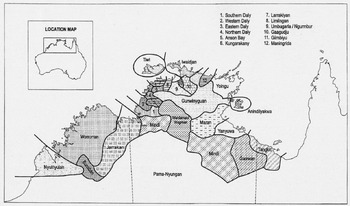
In comparison with the 1980 book, the amount of material on the northern (so-called non-Pama-Nyungan) languages (figure 1) is vastly expanded. Most of these languages are typologically fairly different from the languages that predominated in Dixon (Reference Dixon1980): they are head-marking rather than dependent-marking; they typically involve verb prefixes to mark participants plus mood; many include systems of noun classification; and the majority involve complex verbs, described here as consisting of a coverb and a simple verb.
Non-Pama-Nyungan language families (from Evans 2003b: 2)

The core of the volume, the eight chapters devoted to grammar and phonology, follows a typical pattern of exposition. In the linguistic domain selected for study, the chapter describes the different variations that are found and sorts languages into various ‘types’ or ‘systems’ of organisation with respect to the relevant parameters. The geographical distribution of many of these types is plotted on maps. There is considerable discussion about how one system can change into another – sometimes supported by the evidence of particular languages, sometimes more speculative. In a number of cases the transitions between types are claimed to reveal a ‘cycle’ of possible transitions between the possible types. In many instances an ‘original’ or ‘earlier’ system is ‘suggested’ (rarely reconstructed). The explanations offered for changes include parallel structural change (often based on an unexplained common ‘inner dynamic’ and diffusion/borrowing/language contact, but almost never on genetic inheritance). The types established include not only patterns but also forms.
2.2. Explanatory framework
While this book, like Dixon (Reference Dixon1980), combines typological description with historical explanation, the conceptual framework for the historical understanding of the languages is radically different here. The earlier book's explanations were in terms of a genetic relationship within an Australian language family.
This should be regarded … as a tentative survey of our present knowledge of Australian linguistics, together with some hypotheses concerning the structure of the putative ancestor language, proto-Australian, and the development of modern languages from this base. (Dixon Reference Dixon1980: xiii)
The main contribution of this book, as I see it, is to provide the beginnings of a proof that all the languages of Australia (except perhaps two or three northern languages such as Tiwi and Djingili) are genetically related. (Dixon Reference Dixon1980: xiv)
The historical explanations of the 2002 book, on the other hand, are in terms of linguistic areas.
[T]he Australian language situation is here viewed as a long-term equilibrium zone; it is certainly the longest-established linguistic area in the world. The aim of this volume is to investigate the parameters of variation within this area, and the ways in which languages change with respect to them. (55)
Patterns of variation are typically explained areally:
Like most parameters in Australian linguistics, this typology [of verbal organisation] is largely on an areal basis. (188)
Dixon presents some of the reasons for his change in focus. The procedure involved in supporting the hypotheses concerning proto-Australian in the earlier book is here considered to be flawed, since the data on which it was based was drawn predominantly from the non-prefixing languages, and hence whatever reconstructions were proposed ‘did not justify the label “proto-Australian”’ (xviii).
The conceptual framework used here was provided in Dixon (Reference Dixon1997), which ‘was conceived as a prolegomenon for the present work’ (xix). It includes the so-called ‘Punctuated Equilibrium’ model of language relationships (see below). Following is a summary of the revised historical framework presented in Dixon (Reference Dixon1997, Reference Dixon, Aikhenvald and Dixon2001), and the book under review.Footnote 2
The first point to note is that, unlike his earlier book (Dixon Reference Dixon1980), Dixon in this work does not assert that all or even most of the Australian languages are related; hence there is no talk of a ‘Proto-Australian’. ‘The question of whether all Australian languages go back to a single ancestor is not answerable, because of the great time-depth involved’ (xix). Instead he entertains the idea that there may have been several early Australian languages or language families, with the attested shared features resulting predominantly from convergence (38). Secondly, he rejects, as in Dixon (Reference Dixon1980), the idea of a large genetic unit corresponding to the ‘Pama-Nyungan language family’ that has been widely accepted by Australianists since the 1960s (cf. O'Grady, Voegelin & Voegelin Reference O'Grady, Voegelin and Voegelin1966, Wurm Reference Wurm1972) and was supported with new arguments in the late 1980s (Blake Reference Blake, Evans and Johnson1988, Reference Blake and Philip1990; Evans Reference Evans, Evans and Johnson1988; see now also Koch Reference Koch, Eva, Anna and Jiří2003b, Alpher Reference Alpher, Bowern and Koch2004, O'Grady & Hale Reference O'Grady, Hale, Bowern and Koch2004). But Dixon remains unconvinced:
The ‘Pama-Nyungan’ idea … is totally without foundation and must be discarded if any progress is to be made in studying the nature of the linguistic situation in Australia. (xx)
The putative division between ‘Pama-Nyungan’ and ‘non-Pama-Nyungan’ (either Mark I or Mark II) has had a deleterious effect on the study of Australian languages. (53)
Thirdly, Dixon does recognise some 40 ‘low-level genetic subgroups’ (691), by which he means small language families consisting for the most part of two or three languages. These are called ‘subgroups’ to allow for the possibility that they may eventually be linked into higher-level groupings (xxiv), although Dixon expresses skepticism that this will indeed be feasible:
On the evidence available, it seems most unlikely that the low-level genetic groups will be relatable together in terms of higher-level genetic groups. (xix)
It is worth emphasising that Dixon makes no attempt to reconstruct higher-level genetic units or show relations between groups of Australian languages by means of family tree diagrams. Indeed he claims that ‘Australian languages cannot be appropriately represented by a family tree model’ (101) and that ‘[t]he established methods of historical and comparative linguistics, which can be applied so successfully elsewhere, have limited appropriateness in Australia’ (699). He objects to the assumption ‘that all languages which are related must be related in family trees, and that there must be family trees of family trees’ (23).
This claim is difficult to reconcile with Dixon's methodological assumption that ‘each language has a single parent’ and that in the case of mergers of two separate linguistic communities the resultant language ‘will be a genetic descendant of just one of the original languages’, albeit with some features derived from the other language (21). ‘The new language can be said to have come from a single parent – that from which it received most of its grammar and lexicon’ (42). Since it is precisely this filiation which is modelled by family tree diagrams, it is not clear why Dixon objects in principle to the establishment of such a model of linguistic relationship as one of the goals for linguists attempting to unravel the linguistic prehistory of Australia.
The massive amount of shared formal and structural features across his 30–40 genetic groups, which is documented in this book, is predominantly interpreted by Dixon in terms of diffusion rather than genetic inheritance. In fact diffusion is the default explanation for most shared phenomena. Many such facts are said to be ‘plainly’ or ‘certainly’ the result of diffusion, without an alternative genetic explanation being explored. Where the two approaches are considered, the diffusional explanation is typically declared to be ‘more likely’.
2.3. System of reference to languages
Dixon uses a system of letters and numbers to refer to the languages. For example, Mg1 stands for Gumbaynggirr, with dialects Baanbay and Gambalamam. This language belongs to Mg*, the Gumbaynggirr/Yaygirr subgroup, which in turn forms part of M, the Central East Coast Group. The 50 highest-level groups are numbered from A to Y, WA-WM, and NA-NL. A few of these labels are mnemonic: W and N evoke western and northern respectively, WD stands for Western Desert and Y for Yolngu. The use of the single-letter labels W (for the non-western Kalkatungu/Yalarnnga Areal Group) and N (for the non-northern Central New South Wales Group) is potentially confusing to the reader, however. The schema as a whole is presented in an introductory section (xxx–xlii) and displayed on a master map (xxviii), which readers are advised to photocopy for handy reference.
The linguistic groupings are referred to by one of the following terms. ‘Language’ is used for a set of mutually intelligible varieties for which it is ‘feasible to produce an overall grammar … with notes on dialectal variation’ (xxiv). ‘Subgroup’ is ‘here used in a special way’ to designate ‘low-level genetic groups’, which in traditional terminology would be called small language families (xxiv). ‘Areal group’ refers to languages forming a small linguistic area. ‘Group’ is a term for a set of languages classed together for convenience on the basis of geographical proximity only. The (letter–number) label for subgroups in his genetic sense includes a following asterisk, as in the example of Mg* cited above. The basis for Dixon's judgements regarding the status of particular classifications is generally not given in this book.
Evans' review (Reference Evans2005: 248–256) includes a section on ‘Classification’, in which (inter alia) he explores and critiques Dixon's grouping of Arnhem Land languages, objecting in particular to the ‘phylogenetic scale distortion’ involved in Dixon's schema, and to the problems with mixing genetic and areal groupings.
3. Assessment
3.1. Synchronic typology
The description of structures is admirable for its comprehensive coverage of the languages. Dixon reports that he has ‘made use of all the available material on each of the 240–250 autochthonous languages of mainland Australia’ (xviii), including not only recent grammars but also old materials on long-extinct languages, and unpublished as well as published sources (xxi). (Unlike Dixon Reference Dixon1980, the present volume does not include an account of the Tasmanian languages.) The topics covered include phonology and all the obvious areas of morphosyntax. Some readers might doubtless have preferred to see further areas covered – additional issues of syntax and semantics, possibly discourse structure and social use of languageFootnote 3 – but it must be admitted that data is lacking for many languages on these further topics.
Patterns found in the data are categorised exhaustively into types and subtypes along various parameters or combinations of parameters. For example, verbal organisation is categorised into seven types with a total of 34 subtypes, distinguished by parameters such as: relative number of simple verbs and coverbs, whether coverbs are fused with simple verbs, whether personal prefixes are attached to the whole complex or to the simple verb, etc. (187–201). A typology of case systems, given in the chapter on bound pronouns, describes seven patterns of case marking in nouns, free pronouns, and bound pronouns (plus a few variants). There are several parameters that are combined: which grammatical functions (of A transitive subject, S intransitive subject, O direct object) are syncretised; for which of the word classes each syncretism pattern applies; and, derivatively, whether free pronouns resemble nouns and bound pronouns resemble free pronouns in their case distinctions. One could question the usefulness of combining several parameters to distinguish types rather than treating each parameter separately.
3.2. Chronology of types
A prominent role in this book is given to discussion of transition between types.Footnote 4 Since we have little real time depth in the description of Australian languages, and since Dixon largely eschews systematic reconstruction, the claims about relative chronology are based on inferences derived from comparison of forms in closely related languages and dialects and from hypotheses concerning the likely initial structure and the expected direction of typological change. Sometimes the types are so closely correlated with the posited chronology that they are labelled ‘stages’ instead of ‘types’ (see, for example, section 7.5 on pronominal case systems).
Many of the postulated changes, for example in case systems, are uncontroversial and have long been known (e.g. Blake Reference Blake and Wurm1979). But some of the diachronic claims made here should be treated with caution. Thus we are told that the central dialects of the Western Desert language (e.g. NgaanjatjarraFootnote 5), as opposed to northern dialects (e.g. Manjtjiltjarra), ‘are just developing bound pronouns’ (353); nevertheless, the subject (AS) form of the bound pronouns (e.g. 1Sg=rna) is unrelated to the corresponding free pronoun form and is shared with a great number of languages of Western Australia, and hence was probably inherited as an enclitic from a fairly remote ancestor language (see cognates, 358). Another controversial history involves Baagandji. The northern dialect Kurnu is given as ‘perhaps the most unusual example’ (391) of the development and loss of bound pronouns. Dixon spends two full pages (391–393) presenting a scenario whereby free pronouns, all of which begin with the consonant ng (e.g. 1Sg ngaba), were reduced to post-verbal enclitics (as in Southern Baagandji) without their initial consonant (e.g. =aba), then through the reanalysis of the verb's final tense suffix as part of the pronoun gained a tense-marking prefix, and then these Tense+Pronoun combinations were ‘released’ as free words, which could henceforth occur in positions other than following the verb. The new system of pronouns distinguishes tense: ngaba ‘1Sg:Present’, waba ‘1Sg:Past’, kaba ‘1Sg:Future’. This is said to be an example of a language developing bound pronouns and then losing them (possibly due to ‘areal pressure’), a manifestation of the ‘cyclic pattern of gain and loss’. Apart from the difficulty of the unexpected upgrading of clitics (plus a preceding verbal suffix) to free words (which is counter to the normal direction of grammaticalisation processes), this scenario does not really work very well since there is no etymology for the Future k, the Past wu is Perfect in other dialects, and there is no construction where =aba would follow a Present verbal inflection -ng. Dixon does note, albeit without further comment, that a different origin has been proposed by Hercus in her grammar of Baagandji (Hercus Reference Hercus1982) – a scenario which by the way does not involve Kurnu ever having had bound pronouns.
Many of the typological changes are said to be cyclic. ‘A major finding … is that Australian languages tend to vary in terms of a number of typological parameters, and to change with respect to them in a cyclic fashion’ (xix). One cyclic pattern involves loss and re-creation of categories, for example the Inclusive vs. Exclusive distinction in first person pronouns, the merger and later re-distinguishing of Ergative vs. Nominative or Nominative vs. Accusative case distinctions in pronouns, the creation and subsequent loss of bound pronouns, and, in phonology, the creation and loss of a distinction between retroflex and alveolar apical consonants. This is uncontroversial and to be expected. Some of the longer cycles posited, however, lose some of their explanatory force when it is acknowledged that some changes are bidirectional. A chart of possible changes with respect to types of verbal organisation shows unidirectional changes a→{d or f}, {d or f}→g, g→c, {d or e}→g, but also bidirectional changes a↔b and b↔c (200). It is hard to see how this is ‘cyclic’ change. The transitions between ‘stages’ of pronoun case marking include A to B, but C-i can arise from either A or B, and C-ii can come from A, B, or C-i. Again, it is not clear how the notion of a cycle adds any explanatory value. The notion of cyclic change would be strengthened if it could be demonstrated, for example, that the changes are unidirectional except where motivated by language contact/areal influence. Sometimes the cyclic scheme seems to be invoked gratuitously.
3.3. Earliest stages
Dixon here offers a number of hypotheses or ‘suggestions’ concerning the structures of the ‘earliest’ stages of Australian languages. It should be emphasised that these are not reconstructions based on the application of the comparative method, nor are they attributed to any particular proto-language. Some suggestions, however, may be motivated by the comparative evidence that went into earlier attempts at reconstruction. Thus for pronominal case marking, the presumed earliest type, ‘Stage A’ – which distinguished A, S, and O in singular pronouns but syncretised A and S in non-singular forms – matches the forms reconstructed for ‘Proto-Australian’ in Dixon (Reference Dixon1980) and for Proto-Pama-Nyungan by other authors.
In at least one case the posited original type is selected so as to harmonise with the presumed structure on another level of linguistic organisation.
It is impossible to decide on the original type of verbal organisation from the normal methodology of linguistic comparison and reconstruction. But my a priori hypothesis concerning the original pattern of semantic organisation would suggest a variant of Type (a) as the point of entry. (200f.)
Type (a) consists of a small number (5–30) of simple verbs, which co-occur with many coverbs to make up complex verbs (188). This verbal pattern parallels that of generic nouns used with more specific nouns:
[W]e posit an original scheme whereby great use is made of a smallish number of generic nouns and verbs, with wide meanings. To these can be added nouns or coverbs with more specific meanings, as required for communicative purposes. (62)
In many cases the earliest types involve structures that are simpler in some sense than many of the attested patterns.
In phonology, Dixon posits an earliest system of three vowels, even though many of the northern language groups have four- or five-vowel systems (he notes (636) that Harvey (Reference Harvey and Evans2003b) has reconstructed four vowels for the large Gunwinyguan family).
The agglutinative morphological structure posited for the earliest stages of the languages is likewise based on aprioristic grounds rather than argued from the evidence of comparative reconstruction.Footnote 6
I will here put forward a hypothesis (repeated and improved from Dixon Reference Dixon1980: 378–430) concerning the form of verbs at an earlier stage in the history of the Australian language area. This is based on two initial assumptions. First, we have noted that, all over the continent, there is a tendency for languages to become more synthetic and to develop fusion. This is a particularly striking tendency in parts of the prefixing area but it is also evident among non-prefixing languages, particularly with respect to verbs. It seems reasonable to extrapolate back to an earlier stage that was basically agglutinative; that is, all types of morpheme boundaries were readily segmentable. The second assumption concerns the final segment of verb roots. Most modern languages allow words to end in a vowel or a consonant … In a fully agglutinative language the underlying roots would be expected to exhibit the same formal possibilities as inflected words … My hypothesis is that, at an early agglutinative stage, verbs ended in a vowel, or in a nasal … a liquid … or the semi-vowel y. (215)
At the beginning of this section I suggested that at an early stage all verb paradigms were agglutinative – there was a root with constant form (ending in a consonant or a vowel) followed by a suffix which also had a constant form. Phonological change then applied across the root–suffix boundary and served to obscure this boundary. These changes produced conjugational classes of verbs … (232)
This reasoning allows Dixon to treat conjugations (inflectional classes) as uniformly derivative from a more orderly system. This flies in the face of the results of comparative reconstruction by other scholars using traditional methods of reconstruction, who have found evidence for (messy) verb conjugations in a number of major language families, including Proto-Pama-Nyungan (Alpher Reference Alpher, O'Grady and Tryon1990), Proto-Gunwinyguan (Alpher, Evans & Harvey Reference Alpher, Evans, Harvey and Evans2003) and Proto-Arnhem (R. Green Reference Green and Evans2003). Alpher (Reference Alpher, O'Grady and Tryon1990) has shown, furthermore, that Dixon's approach requires the relaxation of the requirement for regularity in phonological change – a practice which Dixon here defends in his attempt to refute Alpher's arguments (222).Footnote 7
Dixon hypothesises that the functions of earlier suffixes were more semantic in nature and more similar across verbal and nominal word classes than in the attested languages.
It is likely that in the distant past Australian languages had just three or so nominal suffixes and these may have had a basically semantic, rather than a grammatical role … There may also have been just a few verbal suffixes at an earlier stage, and the set of verbal suffixes may have overlapped with the set of nominal suffixes … It is possible that the distinction between word classes was less distinct at this time. The languages then moved towards a more grammatical profile, with a strict division between word classes, between intransitive and transitive subclasses of verbs, between nominal and verbal suffixes, and so on. They gradually became more synthetic, with greater morphological complexity. In some cases they have moved further around the cycle of change, towards a fusional profile. (74f.)
Such speculation adds little to the scientific understanding of Australian historical linguistics.
On the issue of pronominal prefixes, Dixon also opts for a scenario in which the earliest stages of the languages lacked bound pronouns and verbal prefixes. Dixon notes that one-quarter of Australian languages have verbal prefixes, which always include reference to at least one of the core arguments of the verb (402). This structure is everywhere claimed to be the result of (parallel) innovations and diffusion from an originally non-prefixing, dependent-marking grammatical structure.
A basic hypothesis underlying this volume is that Australian languages were originally dependent marking, with the syntactic function of a predicate argument shown by a case affix (or clitic) on the NP expressing that argument. There has been a steady development towards a head-marking profile, where information about the syntactic function of core arguments is largely given by bound pronominals to the verb (the head of the clause). (509)
It is clear that at an earlier stage Australian languages simply had free form pronouns. (354)
[W]e can put forward a speculative hypothesis for historical development. It is possible that prefixing developed independently at more than one place in the present-day prefixing area, and then spread out by diffusion, the several diffusion areas joining up to create the present-day continuous area of languages showing a full prefixing profile. (408)
[I]t makes little sense to suppose that the prefixing languages form one genetic group, with prefixing being a feature of genetic linkage. (447)
Evans (Reference Evans2005: 272–277), in a section of his review labelled ‘The problem of pronominal prefixes’, challenges this conclusion, presenting comparative evidence from a cross-section of northern languages which makes a strong case for shared inheritance of verbal prefixes that reference the subject and object of verbs. Likewise, Harvey (Reference Harvey and Evans2003a) compares free personal pronouns and pronominal prefixes across 50 non-Pama-Nyungan languages and posits proto-forms for eight pronominal prefixal forms.Footnote 8
3.4. Reconstruction methods
Where Dixon does attempt historical reconstructions, his methods are not very satisfactory. Alpher (Reference Alpher2005: 796) notes that Dixon often cites ‘basic forms’ of lexemes without attributing them to proto-languages, and comments further that he ‘by and large pays only cursory attention to problems with the regularity of sound correspondences and is all too ready to appeal to shortcuts’. Moreover, Alpher (Reference Alpher, Bowern and Koch2004: 124) criticises Dixon's ‘practice of reconstructing without necessarily checking for recurrence of sound correspondences’ and deems Dixon's interpretation of the distribution of linguistic features in terms of proto-languages to be idiosyncratic. Alpher accuses Dixon of
treating a question of subgrouping as if it were a typological issue: the failure of a diagnostic feature (which of course can have been earlier present and later lost in any number of languages) to appear absents the language that fails to contain it from the typological group it defines and therefore vitiates the claim that it is a subgrouping innovation. (Alpher Reference Alpher, Bowern and Koch2004: 124)
Evans (Reference Evans2005: 264–268) likewise claims that Dixon sets the bar too high when he refuses to accept the first person dual form ngali as a diagnostic innovation of a Pama-Nyungan genetic group, as claimed by other Australianists – even though he admits that it is found in most of the Pama-Nyungan and none of the non-Pama-Nyungan languages – on the grounds that it is lacking in at least seven separate languages (out of some 130). Evans (Reference Evans2005: 268) calls attention to Meillet's three-witness rule, whereby attestation in three distinct branches is enough to guarantee a form for a proto-language, such as Proto-Indo-European. The explicit criteria for recognising a genetic subgroup are likewise too strong; Dixon (Reference Dixon, Aikhenvald and Dixon2001: 85) requires ‘considerable correspondence of grammatical and lexical forms such that it should be possible to reconstruct a good deal of the proto-language’. By the classic subgrouping method used in comparative linguistics, however, a set of unique common innovations is sufficient to establish a subgroup of an established language family (see Bowern & Koch Reference Koch, Bowern and Koch2004a).
3.5. Diffusionist bias in historical explanation
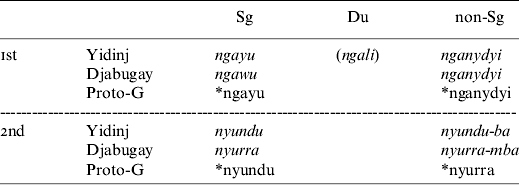
In this work diffusion emerges as the default explanation for the sharing of forms between languages. This applies to grammatical forms, such as personal pronouns, as well as vocabulary. Dixon's interpretations of particular situations in terms of borrowing, however, are typically not compared to possible alternative scenarios involving genetic explanations. Consider, for example, his discussion of Djabugay and Yidinj, two languages of North Queensland, which he classifies as the unique members of a small genetic group which he calls the ‘Cairns Subgroup’, his G. The forms and Dixon's reconstructions are given in table 1.
Pronouns of Group G
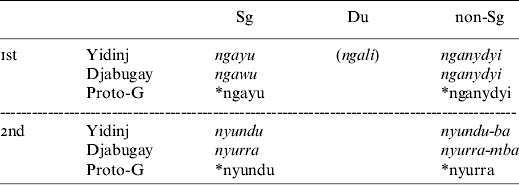
Whereas most Australian languages have three contrasting forms marking singular, dual, and plural, these languages have only a basic contrast between singular and a non-singular form which is used for two or more people. Both languages have innovated non-Sg forms for the 2nd person which are built on the corresponding singulars; in Djabugay the singular is historically a non-sg, and is related to the 2Pl form of table 2 below. The issue here is that in Yidinj where the form nganydyi can be used where a 1st person dual is required, there is also a specific dual form, ngali, which is used sparingly, primarily in texts to introduce ‘we two’ for the first time (281). Dixon's interpretation is that
the most likely scenario is that ngali was recently borrowed into G2 [Yidinj] from its southerly neighbour H1, Dyirbal … It is just coming into use in Yidinj … We would also expect it eventually to spread into G1 [Djabugay] (ngali is already established in G1's other neighbour, F Kuku-Yalanji …) (282)
This ‘likely scenario’ is later upgraded: ‘Yidinj almost certainly borrowed ngali from its neighbour H1, Dyirbal’ (287).
An alternative, genetic interpretation of these same facts would be as follows. The dual form ngali was inherited in Yidinj, as in the relatively closely related Kuku-Yalanji and the more distantly related Dyirbal. The contrast between plural and dual meanings in personal pronouns is in the process of being lost in Yidinj; this has already happened in Djabugay and has affected the 2nd person of Yidinj. The change proceeds by way of letting the erstwhile plural serve as a general expression for non-singular, while still allowing explicit dual marking where this is considered essential for the discourse. Yidinj ngali is thus interpreted as a relic of an earlier system (like the dual in nouns in some Indo-European languages) rather than as an innovation borrowed from a neighbour. Dixon gives other examples of languages not signalling the dual vs. plural contrast: the Wik languages, also of northern Queensland (291), and several languages of southeastern Australia (279). A genetic solution would simply involve seeing the many shared pronominal forms as inherited from a proto-language which contained the whole set. Different subgroups and languages underwent different processes of replacement and reformation of pronouns. Such an interpretation has the advantage of adhering to the experience of languages in the rest of the world, where pronouns are not readily borrowed.
Another example of Dixon's leaning towards explanations involving borrowing without exploring alternatives is found his chapter on noun classes.
Languages which lack noun classes – such as Dalabon and Rembarrnga – do have a handful of nouns whose initial syllable could be a relic of a noun class prefix. But these are most likely to be loans from a neighbouring language, which has noun classes, rather than relics of earlier noun class systems in the languages themselves. (507)
[Harvey] suggests that … Gungarakanj … Kamu, and … Wagiman may be losing noun classes [by absorbing the class prefixes into lexical stems]. But the fact that some languages begin with what looks like an old noun class prefixal syllable may simply be an indication that they are loans from a language with noun classes. (508)
Jawoyn … and Warray are neighbouring languages but with … little evidence for a close genetic relationship. They do, however, have systems of noun classes which are similar both in semantics and in marking …, suggesting that the entire system (including prefixes) may have been borrowed from one language to the other or else may have evolved on an areal basis, in the NBb group. (507)
Harvey (Reference Harvey and Evans2003b) has now made a persuasive case for Jawoyn and Warray being closely related genetically. So the shared noun class system has a good chance of having a phylogenetic interpretation. The identification of relics is an important part of the evidence of historical relationships (Koch Reference Koch, Barry and Kate2003a). Determining whether a form is a historical relic or the product of borrowing is a necessary part of solving historical puzzles and requires careful analysis; this is not an area where glib pronouncements should carry any weight.
3.6. Genetic groupings
Dixon's arguments lead him to conclusions with respect to genetic groups which are opposed to the interpretations of the majority of Australian comparativists. We discuss his stance with respect to the Pama-Nyungan family and to the Yolngu subgroup of Pama-Nyungan. Evans' review (Reference Evans2005: 261–272) also has a section on ‘The Pama-Nyungan debate’. Alpher (Reference Alpher, Bowern and Koch2004), O'Grady & Hale (Reference O'Grady, Hale, Bowern and Koch2004) and Koch (Reference Koch, Eva, Anna and Jiří2003b) are recent defences of Pama-Nyungan. Alpher (Reference Alpher, Bowern and Koch2004: 122f.) includes a section ‘The Yolngu languages are Pama-Nyungan’.
Pronouns constitute some of the strongest evidence offered in support of Pama-Nyungan as a genetic group. Blake (Reference Blake, Evans and Johnson1988, Reference Blake and Philip1990) proposes that a set of non-singular pronouns is diagnostic of Pama-Nyungan languages and best explained as having co-existed in a common ancestral language Proto-Pama-Nyungan (cf. Evans Reference Evans, Evans and Johnson1988). The set of six non-singular pronouns, which unlike the pronouns of many non-Pama-Nyungan languages are unanalysable with respect to either person or number (except for the recurrent partial nga- in the 1st person forms), would for many historical linguists constitute strong prima facie evidence in favour of a genetic relationship. Dixon, however, rejects this view:
[E]ach of these forms (excepting ngali …) is found only in a selection of ‘Pama-Nyungan’ languages. It would be speculative to assign them to a ‘proto-Pama-Nyungan’ (if indeed there were independent evidence for such a construct, which there appears not to be). (276)
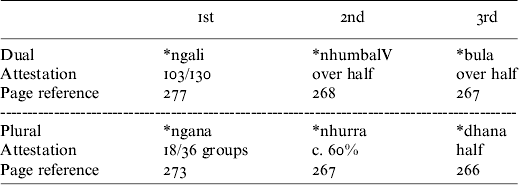
The Pama-Nyungan non-singular pronouns are shown in table 2. The number of languages in which each is found, according to Dixon, is given in table 2 along with the relevant page reference.
Proto-Pama-Nyungan non-singular pronouns
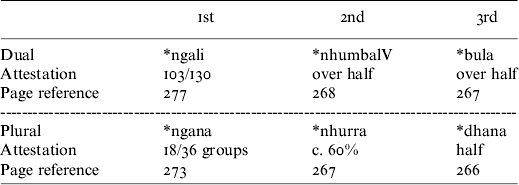
Dixon admits that these six forms are found only in the so-called Pama-Nyungan languages (Dixon's A–Y, WA–WM) and that ngali ‘is found in the great majority of languages from groups A–Y, WA–WM and in none at all from NA–NL’ (277). He gives a map (278) showing languages where ngali is not found and devotes considerable space to trying to account for its distribution without resorting to a genetic explanation (277–282). He finds it absent without plausible reason from a mere seven languages. Since most of these are on the periphery of the Pama-Nyungan area (either on the coast or adjacent to non-Pama-Nyungan languages) he argues that a ‘diffusional hypothesis’ – according to which the form ‘simply diffused over a continuous area’ and ‘has not yet reached nine areas, eight of them on the fringe of the region’ (280) – is more plausible than the ‘Pama-Nyungan hypothesis’, which would require that it ‘must have been lost from at least nine distinct areas’ (280). He admits the difficulty presented by the Yolngu subgroup – in an enclave in Northeast Arnhem Land separated from the other Pama-Nyungan languages by the sea and by non-Pama-Nyungan languages – but claims that ‘it is likely that Y [the Yolngu subgroup] did form part of this diffusion zone at some time in the past, and that it has become separated from it’ (281) – either by Yolngu languages moving away from ‘the ngali area’ or by other languages moving in and cutting them off (662). Dixon concludes that, of the two historical explanations for the distribution of ngali, ‘[a]lternative (B) [the diffusional hypothesis] is simpler and plainly to be preferred’ (281).
The most widespread of the 1Pl forms, ngana, receives a similar explanation. ‘The form ngana has plainly diffused over languages in many parts of the non-number-segmentable pronoun area’ (276). The map of its distribution (275), however, reveals discontinuities, including the Yolngu languages (cf. 273, 662).
All of the sharing of forms across the 20 subgroups that Dixon recognises among the so-called Pama-Nyungan languages would have to be attributed to contact-induced change. ‘Diffusion is also [in addition to ngali] undoubtedly at least partly responsible for the wide distribution of 2pl nhurra, 3du bula and the other recurrent forms [i.e. non-singulars]’ (293). Dixon shows little concern that such massive borrowing of grammatical forms goes against the generally accepted processes of linguistic change.
Evans (Reference Evans2005) discusses the distribution of these pronouns, reproducing some of the maps, and argues that a variable pattern of retention of individual forms is to be expected. He evaluates the pattern of ‘distribution over much (though never all) of the Pama-Nyungan area, including the discontinuous zones, and complete absence from the non-Pama-Nyungan languages’ (271) as ‘a very significant clustering indeed’ (270).
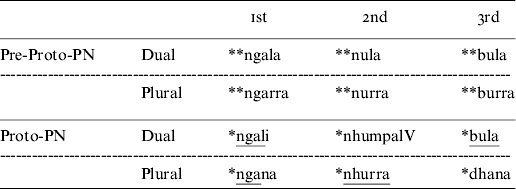
Some historical linguists might be happier if they saw a hypothesis of what kind of system the set of Pama-Nyungan non-singular pronouns might have evolved from. Table 3 gives some plausible Pre-Proto-Pama-Nyungan forms, assuming a model in which Proto-Pama-Nyungan was an offshoot of a part of the non-Pama-Nyungan language group (as argued in Evans Reference Evans and Evans2003a, Reference Evans2005).
Possible prehistory of Proto-Pama-Nyungan (Proto-PN) non-singular pronouns
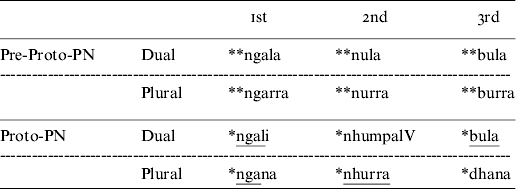
In some non-Pama-Nyungan languages, duals are marked by lV and plurals by rrV. Let us assume that in the ancestor of proto-Pama-Nyungan the vowel V was a. Also, in accordance with Evans' (Reference Evans, Evans and Johnson1988) laminalisation rule whereby initial apical nasals became laminals in proto-Pama-Nyungan, the 2nd person forms are given with an apical nasal; it is assumed that the shift to laminal nh was the result of a regular sound change. Most non-Pama-Nyungan languages have exclusive and inclusive forms for 1st non-singular; the forms given here are assumed to have been available for first person, whether or not they marked the inclusion distinction. Non-Pama-Nyungan languages have evidence for both *nurrV and *gurra as the 2Pl form; we assume that it was the *nurra form which was ancestral to proto-Pama-Nyungan. In the bottom half of the table the parts of each form which are inherited in Pama-Nyungan are underlined. Note that the 3Dual and the 2Plural forms are not changed (except by the laminalisation rule). The 1Dual form requires a change of final vowel from **ngala. This might have been the result of the addition of an increment y or yi (either by analogy to the 1Singular *ngay or as the marker of a further specification such as inclusion). A form like *ngalay(i) might then have reduced phonologically to *ngali. The 3rd plural form obviously represents a total replacement of *burra; a plausible source for a new 3Pl form is a demonstrative or a word meaning ‘all’, ‘many’, etc. Once in place, it might be expected that the form of the 3Pl could influence that of the 1Pl, effecting an analogical change from **ngarra to *ngana. The effect is to mark the 1st person by means of the first syllable nga, and the category plural by means of the second syllable na. The 2nd dual form is plausibly interpreted as a re-formation based on the 2nd singular *nhun, possibly consisting of *nhun plus the 3Dual form *bula, i.e. *nhun-bula. This form would have undergone assimilation of the n and possibly alteration of the vowels of the second and third syllables (which are not reliably reconstructed anyway). As a result of these changes, the symmetry of l and rr as markers of dual and plural and the transparency of bu- as a 3rd person non-singular root have become obscured.
If this historical scenario has any validity, we have a whole cluster of innovations which either originated in a language ancestral to the whole group of Pama-Nyungan languages (in the genetic interpretation), or arose separately and each diffused to the majority of the set of languages known as Pama-Nyungan, but always stopping at the border of the non-Pama-Nyungan languages (in Dixon's diffusionist account). Readers can judge for themselves whether the above speculative etymological account is more or less plausible than Dixon's scenario (286f.), which treats *ngali as a ‘rogue pronoun’ marking speaker and hearer, which disrupted an earlier pronominal system and diffused over a large part of the continent.
Dixon's treatment of the Yolngu group of languages, isolated from other Pama-Nyungan languages in the north-eastern corner of Arnhem Land and considered by most Australianists as a subgroup of Pama-Nyungan, is worth examining, especially with respect to the evidence of pronouns. Dixon admits that Yolngu shares two of the six ‘Pama-Nyungan’ pronouns and explains this fact by positing diffusion at an earlier time when the languages must have been in contact with the other ‘Pama-Nyungan’ languages (662). But he disputes this as evidence for membership in a Pama-Nyungan genetic family.
However, they show hardly any of the other features said to characterise ‘Pama-Nyungan’; for example, there is no trace of ergative -nggu … or any of the recurrent ‘Pama-Nyungan’ pronouns beyond 1du.inc ngali and 1pl.exc ngana … Even if there were justification for recognising ‘Pama-Nyungan’, there would be little for including Yolngu within it. (662)
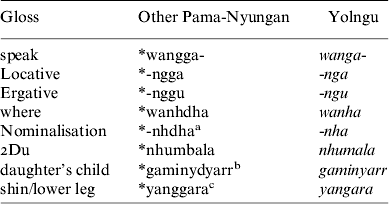
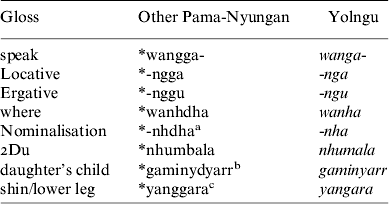
These assertions deserve closer examination. A third non-singular pronoun, 3Du bula, is elsewhere said by Dixon to be present in Yc, the Djinang-Djinba branch of Yolngu (267). Likewise, the 3Pl dhana is said to be attested in two branches, Yb and Yc (266). This leaves the 2nd person forms. It is explicitly stated that ‘Y … lacks 2pl nhurra, 2du nhu(m)bVlV …’ (281). Yet the distribution map for nhurra shows it as present in Yb and Yc (269); the expected stem is found in the Djapu ‘Dative 2’ case form nhurrawambal (Morphy Reference Morphy, Dixon and Barry1983: 51). The claim that 2du nhu(m)bVlV is not represented in Yolngu (281 and 270 map) can also be refuted. The 2Du form given for Nhangu is nhuma (265). Now a look at the paradigms given for Djapu (Ya), for example, shows that although the nominative case form is nhuma, the stem of oblique cases is a longer form, nhumala- (Morphy Reference Morphy, Dixon and Barry1983: 51). There is actually a systematic sound correspondence in evidence here whereby nasal consonants in the Yolngu languages match homorganic nasal+stop clusters in other Pama-Nyungan languages. This is most naturally interpreted in terms of a Proto-Yolngu sound change ND>N (Alpher Reference Alpher, Bowern and Koch2004: 122, with references to earlier recognition by O'Grady (Reference O'Grady, O'Grady and Tryon1990: 90) and McConvell (Reference McConvell, McConvell and Evans1997: 225)). Some examples are given in table 4, where the earlier forms are reconstructible from other Pama-Nyungan languages.
Evidence for Yolngu sound change ND>N
a This reconstruction is equivalent to Dixon's *-njdja: Australianists have not yet agreed whether palatals like *dj (also spelled *dy) contrast in proto-Pama-Nyungan with laminodentals like *dh. I (Koch) think they do.
b Alpher (Reference Alpher, Bowern and Koch2004: 422) cites Mudburra kaminyjarra ‘woman's daughter's children’, matching gaminyarr, which is found in several Yolngu varieties.
c Alpher (Reference Alpher, Bowern and Koch2004: 566) cites, among others, Gupapuyngu yangara ‘lower leg; tail; handle’ and reconstructs *yangkara ‘shin’ based on seven Paman languages of Cape York Peninsula (including Kuku Thaayore yangkar) with a gloss ‘shin, lower leg’, Biri (Maric) yangkara ‘(calf of) leg’, and Western Desert yangkarl(pa) ‘hip’.
This sound change involving nasals is not mentioned by Dixon, although some of the comparisons are noted. Y wanga- is included with the widespread verb wangga- ‘speak’ (123). Regarding ‘where’, he notes:
[T]he ‘where’ interrogative is wanhdha (or a development from this) in more than 80 per cent of the languages in the A–Y, WA–WM [i.e. ‘Pama-Nyungan’] region … We also find wanha/wanja for ‘where’ in … Ya … (332)
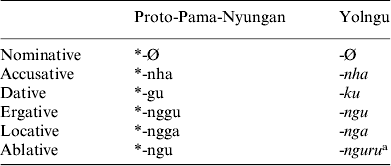
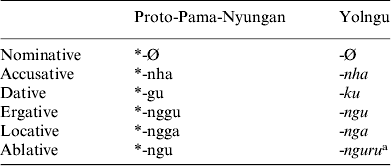
The nominaliser suffix -(nj)dja is mentioned without reference to Yolngu (75). The locative suffix -nga of Yb is mentioned without relating it to the widespread (Pama-Nyungan) allomorph -ngka (165). The presence of a Yolngu cognate of the distinctively Pama-Nyungan ergative allomorph -ngku is explicitly denied (164, 662). This is a mistake, however. Although the regular allomorph of the ergative in Yolngu languages is *-thu or a reflex thereof, a variant form -ng(u) does occur but is restricted to demonstratives (see e.g. Morphy Reference Morphy, Dixon and Barry1983: 57). This form is most plausibly explained as a reflex of Pama-Nyungan *-ngku according to the sound change mentioned above (Alpher Reference Alpher, Bowern and Koch2004: 122f.; see also Evans Reference Evans2005: 268).
In the light of the foregoing, it is clear that the supposedly absent 2Du pronoun *nhumpala has its predicted reflex in Yolngu in the form nhuma(la). We are then left with the remarkable situation that the Yolngu languages have reflexes of all six of the non-singular Pama-Nyungan pronouns which Blake (Reference Blake, Evans and Johnson1988, Reference Blake and Philip1990) and Evans (Reference Evans, Evans and Johnson1988) claim to be diagnostic of the Pama-Nyungan family.
The evidence for Yolngu as Pama-Nyungan comes not only from these personal pronouns, but also from case morphology, as shown in table 5. The Yolngu languages have reflexes of no less than six Pama-Nyungan cases. This result is as remarkable as the situation with respect to pronouns. It reinforces the interpretation of Yolngu as part of a large genetic group of the kind the Pama-Nyungan hypothesis is meant to describe.
Yolngu reflexes of Pama-Nyungan case suffixes
a Many Pama-Nyungan languages include an incremental syllable after the reconstructed Ablative suffix *-ngu.
We would claim, therefore, that Dixon's rejection of genetic groupings is not imposed by the data. Rather, there is plenty of evidence, much of it to be found in Dixon's book, which can be used to support a genetic interpretation of the shared data, even if Australianists are not yet in a position to present a fully articulated model of genetic relationships among all the continent's languages. Nevertheless, a substantial number of linguists are making progress on describing genealogical relations using the usual assumptions and methods of historical linguistics. For non-Pama-Nyungan languages, see papers in Evans (Reference Evans2003b), plus a few in Bowern & Koch (Reference Koch, Bowern and Koch2004b), with earlier references. Evidence for Proto-Pama-Nyungan is discussed in Blake (Reference Blake, Evans and Johnson1988, Reference Blake and Philip1990), Evans (Reference Evans, Evans and Johnson1988), Alpher (Reference Alpher, O'Grady and Tryon1990, Reference Alpher, Bowern and Koch2004) and Koch (Reference Koch, Bowern and Koch2004b). A number of subgroups within Pama-Nyungan are justified in papers in Bowern & Koch (Reference Koch, Bowern and Koch2004b). A number of groupings that Dixon treats as non-genetic ‘areal groups’ are rather accounted for in genetic terms by other Australianists: Dixon's WA ‘Lake Eyre Basin areal group’ consists of two subgroups, Karnic (Bowern Reference Bowern and Simpson2001) and Yarli (Hercus & Austin Reference Hercus, Austin, Bowern and Koch2004), while his WL ‘Arandic areal group’ is justified as a genetic subgroup in Koch (Reference Koch, Bowern and Koch2004b); Dixon's NHd ‘Southern Daly group’ is demonstrated to be a language family in I. Green (Reference Green and Evans2003); and his NG ‘North Kimberley areal group’ is justified as a genetic construct, Worrorran, in McGregor & Rumsey (forthcoming).
3.7. Reasons for Dixon's diffusionist bias
Readers may wonder (as one referee has) as to what is the source of Dixon's diffusionist bias. Is the Australian data intractable to application of the standard historical methods for discovering genetic relations, reconstructing earlier forms, and identifying instances of contact-induced change?Footnote 9 All Australianists agree that borrowing of forms (including some grammatical morphemes) and copying of patterns is prevalent among the Australian languages. But the degree of this linguistic contact does not appear to be higher than in other parts of the world.
Although some have suggested that Australian languages change more rapidly or borrow more heavily than languages elsewhere in the world, this is not supported by the evidence available. (Black Reference Black, Darrell and Michael1997: 67; cf. also Evans Reference Evans2005: 261)
It is admitted that the uniformity of phonological structure in Australian languages makes the identification of loanwords problematic in many areas. But there are other methods of identifying loanwords or at least the fact of borrowing, including etymological analysis (Koch Reference Koch, McConvell and Evans1997) and skewed patterns of lexicostatistical percentages (Black Reference Black, Darrell and Michael1997). Where different sound changes have applied (even minor ones), careful attention to sound correspondences allows for the identification of loanwords. We are not persuaded (by the facts or by Dixon's arguments) that the Australian linguistic relations are so different from those in other parts of the world that different historical methods are called for (see more detailed discussions in Alpher Reference Alpher2005 and Evans Reference Evans2005). In our judgement, if Dixon has found Australian historical linguistics to be a ‘cul-de-sac’, it is one of his own making, created by his acceptance of a number of questionable assumptions.
Basic and non-basic vocabulary
In the first place, Dixon rejects the standard assumption regarding language change that core vocabulary is more stable and replaced at a slower rate than non-core vocabulary. This claim is said to be an inference drawn from his repeated experience that, when two languages are compared, approximately the same cognate scores are found regardless of the size of vocabulary compared (47); curiously, he does not mention the kinds of meanings involved in these tests, whether ‘basic’ or not. His conclusions have not been demonstrated to the satisfaction of other linguists. In fact, Black (Reference Black, Darrell and Michael1997) has shown, from a number of regions of Australia, that more basic vocabulary is indeed more resistant to borrowing than less basic environmental and cultural vocabulary. His most conclusive case is from the Torres Strait Islands, where the Australian language Mabuiag is compared with Meriam Mer, whose affiliations are rather with languages of Papua New Guinea. Black found related forms as follows: 0% among 13 closed-class grammatical forms, 11% among 82 basic nouns, verbs and adjectives from a 100-item list, 12% among 73 other ‘basic’ words, but 27% among 227 species names and cultural terms (Black Reference Black, Darrell and Michael1997: 62).
Borrowing of grammar
Secondly, in spite of his recognition that grammatical forms are a better guide to genetic relatedness than general vocabulary, Dixon is willing to allow considerable borrowing of personal pronouns and other whole sets of grammatical functors such as noun class prefixes.
In many parts of the world, pronouns are said to be resistant to borrowing. There is no such constraint in Australia. (293)
Overgenerous appeal to grammatical borrowing weakens the expected control that agreement in grammar, especially morphology, can provide as a guide to genetic relationships.
The 50% equilibrium model
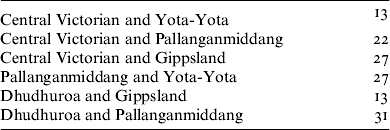
Thirdly, Dixon repeats here (27–30) his ‘50% equilibrium’ model of Australian linguistic divergence and convergence, first proposed in Dixon (Reference Dixon, Stephen and Don1970) and repeated in Dixon (Reference Dixon1972: 331–337; Reference Dixon1980: 245f.; Reference Dixon1997: 26f.; Reference Dixon, Aikhenvald and Dixon2001: 84), according to which it is claimed that given sufficient time adjacent languages will, through mutual borrowing, tend toward a figure of 50% (or a broad band of 40–60%) shared vocabulary, whether they began as unrelated languages with no common lexicon or as dialects with nearly identical vocabularies. This hypothetical model is maintained in the face of a demonstration by Alpher & Nash (Reference Alpher and Nash1999: 30) that any language pair in a stable contact situation is unlikely to display a cognacy score higher than 25%, even given the assumption that loans are not distinguished from genetic inheritances. Evans' review (Reference Alpher2005: 258–261) includes a section on ‘The myth of the 50 percent equilibrium level’. Evans shows that in a number of northern languages figures of 8–21% obtain between adjacent languages, and there are a couple of cases as high as 30% in the Kimberleys; but he argues that the situation of Ngandi and Ritharrngu described by Heath (Reference Heath1981) – whose 41% figure is due to special social conditions – is the only known case of unrelated languages reaching anywhere near Dixon's 50% figure. To Evans' figures we can add Blake & Reid's (Reference Blake, Reid and Barry1998: 4) figures for a number of adjacent but distantly related languages of Victoria, summarised in table 6.
Percentage of core vocabulary shared by Victorian languages
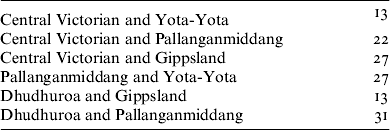
Thus, Dixon's claims are not confirmed. Furthermore, Black (Reference Black and Keith2006) explores the implications of Dixon's model in the western part of the Top End of the Northern Territory (Darwin, Daly River, etc.). He finds eleven languages or sets of languages that share less than 40% with all their neighbours. According to Dixon's model these would all have had to have moved into their adjacent locations fairly recently; otherwise they would have attained the 50% equilibrium level. It is not clear where they may have moved from; nor is there any support from mythology, archaeology, or human genetics for the considerable amount of population movement that is presupposed if Dixon's 50% equilibrium model is correct. Evans (Reference Evans2005: 278f.) rightly claims that the ‘manifestly false’ claim that ‘languages that have been in contact for a long time will come to share 50 percent of their vocabulary’ introduces into Australian historical linguistics a ‘reconstructive pessimism’ regarding the possibility of recognising genetic groupings. If the 50% equilibrium model is abandoned, most of the sets of languages sharing 40–60% of their vocabulary, which Dixon is forced to treat as areal groups, can be recognised as genetic groups; indeed some, such as Arandic, have been established as such by the criterion of common innovation (Evans Reference Evans2005: 260, Koch Reference Koch, Bowern and Koch2004b).
3.8. The tasks of Australian historical linguistics
The research program set by Dixon is not one that, in our judgement, will lead to progress in the field. Dixon would have us abandon attempts to reconstruct Proto-Pama-Nyungan or any other high-level genetic groups, and not even try to construct family trees to model the historical relations. ‘Historical-comparative reconstruction, on any level larger than that of rather small subgroups, is discouraged’ (Alpher Reference Alpher2005: 798). He paints a comparative ‘picture of apparent chaos’ (Alpher Reference Alpher2005: 796), ‘assuming a vast muddy swirl of endless diffusion’ (Evans Reference Evans2005: 278).
All that appears to be left is to map as many features as possible and generate historical scenarios to account for the endless ebb and flow of isoglosses and cyclical changes that have taken place in each domain of language. An endeavour of this kind – consisting of collecting, cataloguing, categorising, counting, comparing, cartographising, chronologising – is not likely to appeal, in our opinion, to linguists who would like to bring to bear on the vast Australian laboratory of linguistic data all the available tools of historical linguistic analysis that are used in the rest of the world, applying them in a careful, persistent, and even painstaking manner and thereby generating specific and testable hypotheses of historical relations.
3.9. The social context of Australian languages
Dixon's model of the social dimensions of language in Aboriginal Australia, which is presented in his first chapter, is largely idiosyncratic. His approach to the topic does not do justice to the relative sophistication of the anthropological-linguistic literature on the varied and complex relationships between populations and linguistic identities in Aboriginal Australia, and, in its draft form, prompted one of the present reviewers to suggest to Dixon that it be scrapped rather than reworked. It has, however, come through more or less unscathed in print.
Each language-bearing group is treated by Dixon more or less as a sub-society, each with ‘its own territory, system of social organisation, traditional oral literature and laws, song styles, and its own “language” – just like the nations of Europe, but on a smaller scale’ (3). But social organisational systems, oral traditions, customary laws, song styles, land-based ethnic identities and regional political alliances simply do not pattern isomorphically with linguistic identity groups in Aboriginal Australia, nor with each other very often, no matter how one defines them. If they match anything at all well, it is weakly bounded regional populations, whose members traditionally intermarried, shared the initiation of novices and other dramatic religious performances, spoke each others' languages, and were linked by particular mythic pathways, for example. Multilingualism was by and large a function of internal, not external, social relations. Strong social cleavage at the edges of such regional groupings is reported for certain parts of the continent, e.g. the Wik/Thaayorre abutment at Edward River in Cape York Peninsula (Sutton's own field data), or that of Western Arrernte with the Western Desert language in Central Australia (McConvell Reference McConvell1996). A likely explanatory candidate in such cases is recency of contact.
One of the reasons why Dixon's generalisations are unhelpful is because the sizes of the social groups identified with, or as ‘owning’, particular linguistic varieties vary enormously in Australia, from the hundreds to the thousands and down to only a few score or less, depending on the region (see e.g. Krzywicki Reference Krzywicki1934; Sutton Reference Sutton2003: 79f.; Reference Sutton2007). One ought not assume that a linguistic identity group of 35 people in Cape York Peninsula (Sutton Reference Sutton and Simpson2001a: 460) and a grammatically unified linguistic area of several thousand people in New South Wales (e.g. in the large regions now known as Kamilaraay and Wiradjuri country, Krzywicki Reference Krzywicki1934: 317) both had more or less the same socio-political character, especially as regards the role of multilingualism. The interesting thing about this huge range of variation is whether or not it can be brought under a single dynamic and diachronic model of expansion and contraction, whether cataclysmic or minor, for the Australian continent as a single population system. This is a task not really approached by Dixon, though it is arguably a precursor to a culturally appropriate modelling of linguistic contact, convergence, and diversification, in any specific context. Johanna Nichols' model of spread zones and residual zones (1992), and its predecessor, Sapir's ‘time perspective’ of 1916, have this kind of integrative quality.
While in the past Dixon would have consistently described the owners of particular linguistic varieties as ‘tribes’ (e.g. Dixon Reference Dixon1980), he has caught wind of the fact that there has been sustained and effective criticism of the so-called ‘Tindale-Birdsell dialectal tribe’ model in recent decades (e.g. Peterson Reference Peterson and Nicolas1976; Sutton Reference Sutton1978, Reference Sutton and Suzanne1991). But to move away from that older model in real terms, one has to do more than merely augment the word ‘tribe’ with another expression such as ‘political group’, as Dixon does here (3), or with ‘language group’, as some others have done, while retaining the original structural description underneath the new label. For a start, while there clearly was a political role for linguistic identifications in the Aboriginal social fabric, populations of common linguistic identity were, in classical systems at least, not sets of people who acted in a coordinate way on matters political or military, nor did their members, in any uniform, continental sense, intermarry largely with people of the same linguistic identity (Sutton Reference Sutton2003: 58–81).Footnote 10
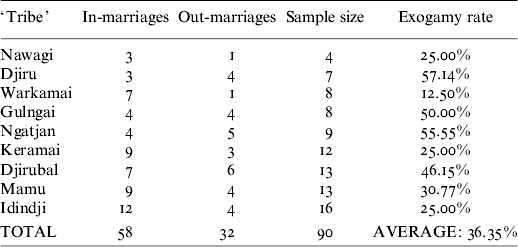
Dixon (3f.) maintains the dogma that most traditional Aboriginal marriages were between people of the same tribe or political linguistic group. The source of this is likely to have been Tindale (Reference Tindale1953), who claimed a continental extra-tribal marriage average of only 14%. In fact, the statistics on linguistic endogamy/exogamy (in-marriage/out-marriage) vary greatly across Australia (Sutton Reference Sutton1978). Linguistic endogamy is typically associated with larger language size: the smaller the language-identified group, the more the likelihood that unions will involve people of differing language identities (Sutton Reference Sutton1978, Alpher Reference Alpher2005: 803). Here again, what we need are productive descriptions of variation and what might drive it, rather than flat universal generalisations. If we look at Tindale's figures for Dixon's own primary field area in this case, the Cairns Rainforest region (table 7), the figures contradict Dixon's own model of linguistic endogamy (Tindale Reference Tindale1953: 188f.).Footnote 11
Cairns Rainforest linguistic exogamy rates
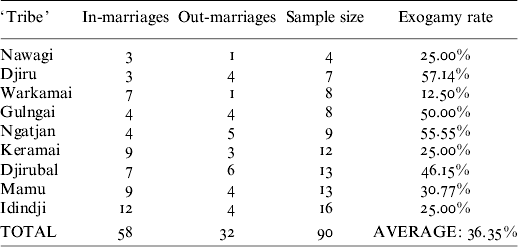
It is clear here that in a third of the Rainforest linguistic groupings the exogamy rate was 50% or higher, and in less than half of the the example groups was it 25% or lower. In a study of Wik linguistic organisation (Cape York Peninsula) I analysed 291 older marriages arranged along traditional lines and found that only 24% were between people of the same named linguistic variety (take this as Dixon's kind of ‘tribe’ in the present context), while 76% were between people of different named linguistic identities. Even if we forget named varieties and look only at distinct grammatical languages (mutually intelligible dialect-sets), 60% of Wik marriages were still linguistically exogamous. Indeed five of the 27 clans represented had 100% linguistic exogamy, a further 14 had 50–90% exogamy, and only one of the 27 clans had 0% linguistic exogamy (Sutton Reference Sutton1978: 110f.).
The key objection to the Tindale-Birdsell ‘dialectal tribe’ is that it was presented in a modal way as a relatively bounded endogamous population, and defined above all by a coincidence of social and demographic closure with the ‘speaking’ of a common language (e.g. Tindale Reference Tindale1974). It has long been demonstrated that this identification of a culturally constructed language-holding entity with a primary population unit – an analytical or logical failure first pointed out by Peterson (Reference Peterson and Nicolas1976) – simply does not stand up empirically to ethnographic scrutiny when bush camp composition, intermarriage statistics and multilingual competence are taken into account (for a guide to some of the wider literature, see Sutton Reference Sutton2003: 70, 75–84).
The absence of anthropological underpinnings to Dixon's understanding of Aboriginal societies is once again apparent in his discussion of social organisation (especially 16–19). He asserts, for example: ‘There are basically three types of social groupings in Australia, moieties, sections and subsections’ (16). Perhaps it was the formalistic structure of these three varieties of social category that made them seem most important or basic to Dixon. But there is nothing more ‘basic’ about them than there is about groupings formed by descent and marriage, land holding groups, and residential entities such as hearth groups and bands. Indeed the reverse is true. Then, there are the other social institutions that Dixon does not mention at all here, such as semimoieties, matrilineal totemic clans, cult lodges, linked strings of patri-groups (sometimes called ‘phratries’), and even linguistic identity groups themselves – the latter a particularly curious omission.
Australian linguistic prehistory and archaeology
The parts of this book that will attract the most controversy are probably those dealing with linguistic prehistory. Dixon's claim that ‘there is no evidence for any major punctuation within Australia at any time since the continent was first populated’ (34) is highly debatable.
The continent Dixon writes about was at the earliest occupational phase one that included what is now New Guinea, until a rise of sea levels separated the two land masses, stabilising about 6000 years ago (Lourandos Reference Lourandos1997: 125). Given that this latter time depth roughly approximates that of Proto-Indo-European, it might seem strange that there are no demonstrable genetic links between the languages of Australia and New Guinea. Dixon's assumption seems to be that Melanesian New Guineans and Australians were one population well into the Holocene, a view recently supported by Y chromosome and mtDNA research (Hudjashov et al. Reference Hudjashov, Kivisild, Underhill, Endicott, Sanchez, Lin, Shen, Oefner, Renfrew, Villems and Firster2007). The linguistic disjunction between the two land masses, if caused by rising sea levels and isolation, would surely have to count as a major punctuation event, in Dixon's own terms, even though it would have been gradual rather than sudden, except where large shallow areas were more quickly inundated (e.g. what is now the Gulf of Carpentaria). Clendon (Reference Clendon2006) proposes a controversial set of hypotheses about the role of this palaeogeographic event in creating the typological relationships between Australian and New Guinean languages, and between Pama-Nyungan and non-Pama-Nyungan Australian languages.
Of more impact on some readers of Dixon's book will be the vigorous entrenching of his argument against the view that there was a spread of a ‘Proto-Pama-Nyungan’ linguistic family roughly in the period 4000–8000 years ago over all of the Australian mainland apart from certain regions of the north (see e.g. 53). Many would regard this Pama-Nyungan expansion itself as a major punctuation event, or more likely a series of events, that effectively wiped out most of the continent's then-existing languages – including those of the Cape York Peninsula, which might have offered us evidence of genetic linguistic links to New Guinea. Donohue & Denham (to appear) have recently been developing a body of evidence for the view that pre-Pama-Nyungan and pre-Austronesian phonological features remain clustered in the modern languages of the New Guinea-Cape York Peninsula region. Their evidence is not ‘genetic’, but it is still regionally localised and distant in historical origin. While Dixon's linguistic arguments about Pama-Nyungan expansion are dealt with above, the following addresses the serious difficulties with his cultural argument.
Dixon says that major linguistic punctuations are caused by extra-linguistic factors including environmental changes, innovations in technology, innovations in the means of production, the influence of a charismatic leader, and territorial expansion (33f.). If ‘Pama-Nyungan’ were a case of punctuation, it would have required just such a trigger; but no plausible trigger can be found (53). Low-level subgroupings of Australian languages suggest ‘minor punctuations in the recent past’ (34), but nothing on a large scale.
Any linguist who takes a short or indeed a very long look at the grammars and lexicons of languages as far apart as those of the south-west of Western Australia, the Lake Eyre Basin and the north-east of Queensland, and then sets them against localised groupings from the Daly River or the lower Murray River, would find Dixon's claims counter-intuitive to say the least. Compared with far smaller regions where there is high diversity, the striking commonalities found across vast distances suggest at least some kind of comparatively sudden spread over a period of a few thousand years. The general absence of linguistic outliers or inliers involving internal branches of Pama-Nyungan subgroups such as those of the Lake Eyre region (Karnic, see Bowern Reference Bowern and Simpson2001: 246, 254) and Cape York Peninsula (Paman, see Hale Reference Hale1997), suggests for such cases an explosive and massive sociolinguistic event followed by a long period of stability and in situ efflorescence, as well as, no doubt, diffusion. These surely are cases of explosive punctuation followed by equilibrium.
Whether these more or less catastrophic linguistic events were replacements of people or merely of linguistic stock – or the third and perhaps more realistic possibility: something of both – there does seem to be non-linguistic evidence that supports the Pama-Nyungan explosion theory. First, there are significant technological and demographic changes that coincide with the kind of time depth usually posited for the expansion of Pama-Nyungan. Dixon is rather dismissive of the artefactual argument put forward by Evans & Jones (Reference Evans, Jones, McConvell and Evans1997), especially the idea that Pama-Nyungan might have spread by ceremonial introduction of a new quartzite technology (53), a proposal that has indeed been granted little or no plausibility since being advanced. However, Evans & Jones' summary of other contemporaneous changes in the mid-Holocene is impressive: the emergence of a new range of smaller stone tools (giving rise to a small tool tradition), the new exploitation of cycads and macrozamias, the development of seed-grinding economies, the intensification of populations (now in question, see e.g. Hiscock Reference Hiscock2008), and changes in rock art styles. If the age of Pama-Nyungan expansion were mid-Holocene, then these changes look like they might be part of the same period of upheaval.
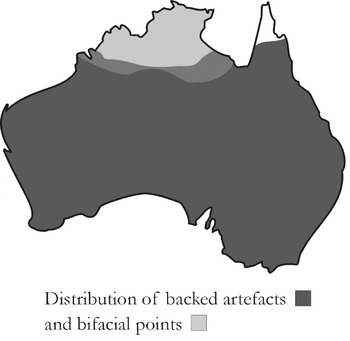
Hiscock (Reference Hiscock, Robert and Steven2002; see further Hiscock Reference Hiscock and Ian2006: 87–91; Reference Hiscock2008: 149, 156–160) adds further support to the views of Evans, Jones and McConvell (above) that the mid-Holocene in Australia saw a significant technological and economic event that might be linked to or be part of the Pama-Nyungan expansion. Hiscock argues in some detail that this event was linked to climate change, which might thus provide Dixon's missing trigger. Hiscock gives evidence that between 4,500 and 3,500 years ago, there was a marked rise in production rates for backed artefacts across much of southern Australia. These are hafted items which were multifunctional, and small and light in weight. The spread of this technological proliferation came to cover most of Australia, indeed basically the area usually attributed to Pama-Nyungan minus the tip of Cape York Peninsula (figure 2). The non-Pama-Nyungan area experienced its own efflorescence of a tool with similar functions, but there it was the bifacial point (figure 2; Hiscock Reference Hiscock, Robert and Steven2002: 167). The fit with the Pama-Nyungan/non-Pama-Nyungan boundary, while not exact, makes a purely accidentalist explanation for the correlation seem counterintuitive.
Distribution of backed artefacts and bifacial points across Australia (from Hiscock 2002: 167)

Hiscock argues that the proliferation of these artefacts for a specific period reflected a need for greater mobility and greater effectiveness in resource procurement – in other words, it reflected a rise in risk. Just such a rise in risk arrived with the onset of the El Niño Southern Oscillation (ENSO). This produced a marked increase in climatic variability, including droughts. Hiscock (Reference Hiscock, Robert and Steven2002: 170) suggests that the onset of ENSO occurred at about 5000–4500 BP in southern Australia and at about 4000–3800 BP in northern Australia – a south>north directional movement that uncannily parallels the chronological pattern of backed artefact proliferation. In the last 2000 years, rainfall variability decreased and effective precipitation increased (the relevant evidence comes from geomorphic and palynological indicators, Hiscock Reference Hiscock, Robert and Steven2002: 170; Reference Hiscock and Ian2006: 87) – a time span which encompasses the period in which backed artefact production went into decline. This 1000–2000-year frame is also the kind of believable period for the spread of Western Desert dialectal varieties across that vast region (see McConvell Reference McConvell1996), and for the expansion of other extremely large low-diversity linguistic areas such as those west of the Great Dividing Range in New South Wales and Queensland. Mulvaney & Kamminga's (Reference Mulvaney and Kamminga1999) speculation that the low linguistic variability of the vast Western Desert could have been maintained for several thousand years by high mobility does not match the pattern of the dialectal variation. This decreases systematically from northwest to southeast (O'Grady Reference O'Grady1966; Sutton & Nash Reference Sutton and Nash2008). Nor does it match the evidence that pulsing demographic movement, described historically for the Western Desert, suggests a strong centrifugal pattern at its outer edges (Sutton Reference Sutton, Betty and Neville1990; McConvell Reference McConvell1996; Sutton & Vaarzon-Morel Reference Sutton and Vaarzon-Morel2003). Ongoing work by archaeologists such as Peter Veth, Peter Hiscock, Mike Smith (who urges caution against oversimplifying the history of Western Desert expansion (2005: 238)) and others can be expected to add to the evidence relevant to the debate over these issues (see e.g. Veth Reference Veth2000, and papers in Veth et al. Reference Veth, Smith and Hiscock2005).
4. Conclusion
The author's claim is that this book will ‘provide something of a foundation for further work on the indigenous languages of Australia’ (xxi). At best, we suggest, it can be treated as a useful source of data on the linguistic facts and their distribution, which still need to be explained, although hopefully by using more orthodox methods of linguistic reconstruction than those proposed by Dixon.
The key problems of the book may be summarised as these: an over-simplified model of the socio-cultural dynamics relevant to understanding linguistic variation and change in classical Aboriginal societies; too much space devoted to speculative historical scenarios; the sidestepping of evidence that points to a genetic solution in favour of a constant bias towards diffusional explanations; a failure to take phonological regularity as seriously as it deserves; and, more generally, a failure to demonstrate that orthodox comparative-historical methods are inapplicable in Australia in the way proposed by Dixon.