I. INTRODUCTION
Magnesium alloys are being used in aerospace, transportation, industries, and consumer goods due to their light weight and high specific strength. Reference Nie, Deng, Wang, Gan, Xu, Wu and Zheng1–Reference Song, Zhou, Li and Ma4 Among the various Mg-based alloy systems that have been developed, the Mg–Al alloy system is normally the most widely used for engineer components because of its good castability, low cost, and moderate strength at room temperature. However, it exhibits adverse elevated temperature mechanical properties at temperature over 120 °C, which is caused by the presence of low thermal stable Mg17Al12 phase with a relatively low melting temperature (∼430 °C). Reference Alizadeh and Mahmudi5 This disadvantage greatly limits their high performance applications. Research has been demonstrated that the alloy’s mechanical properties at high temperatures are strongly related to any thermal stable phases it may contain, the elevated temperature performance of Mg alloys have been successfully enhanced through creating the thermal stability of phases. Reference Moon, You and Hahn6
Previous research has indicated that the addition of Si to Mg–Al alloys can assist in forming thermal stable phase such as Mg2Si, as well as induce refining the grain size, all of which combine to improve the high temperature strength. Reference Wang, Zhou, Zhao, Zhou, Cheng and Liang7 However, massive Mg17Al12 phase with network and coarse Mg2Si phase with Chinese-script shape were formed in the Mg–Al–Si based composite under a low solidification rate, which can reduce the ductility and strength of these composite. Reference Wang, Zhou, Zhao, Zhou, Cheng and Liang7 It is explicit that refinement of Mg2Si phase and Mg17Al12 phase is one of the methods to enhance the mechanical properties of Mg–Al–Si composite.
Equal channel angular pressing (ECAP) provides an effective way of refining the size of grains and second phases by inducing a severe plastic deformation. It has been reported that the ECAP process can significantly refine the grain size of the as-cast Mg15Al (wt%) alloy and beak coarse Mg17Al12 phase into fine particles, thereby improving the mechanical properties of the alloy at room temperature. Reference Wang, Liang, Xue, Zhao, Bian and Zhang8 It has also been confirmed in a previous study Reference Wang, Zhou, Zhao, Zhou, Cheng and Liang7 that the coarse Mg2Si phase of as-cast Mg15Al–1Si alloy was fragmented into small pieces and distributed homogeneously during ECAP, thus enhancing the tensile properties of the alloy at room temperature and elevated temperatures. However, the Mg2Si phase and Mg17Al12 phase are only refined to micron size, which can restrict further improvement of ductility.
In recent years, SiC nanoparticles reinforced magnesium composite has inspired considerable research interest because of the potential development of novel composites with unique mechanical and physical properties. Reference Song, Zhou, Li and Ma4 Research has revealed that addition of high melting point nanoscale SiC particles to AZ91 alloy can lead to a significant improvement in strength and ductility. Reference Nie, Wang, Hu, Xu, Wu and Zheng9 It has been reported that the addition of n-SiCp to AZ91D can significantly improve the elongation of nanocomposite at high temperature. Reference Liu, Li, Zhu and He10 However, open literature search indicates that little attention was paid to the research on microstructures and mechanical properties of SiC nanoparticles reinforced Mg9Al–1Si composite deformed by ECAP. Therefore, Mg9Al–1Si–1SiC composite was processed by ECAP successfully and the effect of SiC nanoparticles addition on the microstructures and mechanical properties of ECAPed Mg9Al–1Si alloy was investigated in this paper.
II. MATERIALS AND METHODS
A. Materials
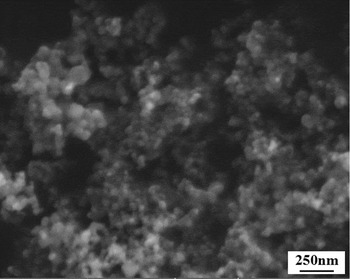
Mg9Al–1Si alloy and Mg9Al–1Si–1SiC (wt%) nanocomposite was selected in the present study. SiC nanoparticles with an average diameter of 60 nm were used as reinforcement, and the SEM image of SiC nanoparticles was shown in Fig. 1. And nanocomposite was fabricated by semisolid stirring assisted ultrasonic vibration. Reference Nie, Wang, Wu, Hu, Zheng and Xu11 The whole fabrication process was conducted in a protective atmosphere of CO2 and SF6. Reference Deng, Wang, Shi, Wu and Wu12–Reference Nie, Deng, Xu, Wang and Wu15 First, Mg9Al–1Si alloy was molten at 720 °C, and then cooled to 590 °C at which the matrix alloy was in the semi-solid condition. 1 wt% SiC nanoparticles which were preheated to 550 °C were quickly added into semi-solid alloy, and the melt was stirring for 10 min.
The SEM image of SiC nanoparticles.

After adequately stirring the melt, the melt was rapidly reheated to 700 °C and held at this temperature for 5 min. Then the melt ultrasonically processed for 15 min. Next the melt was rapidly reheated to 720 °C and held at this temperature for 30 min. Finally the melt was cooled to 690 °C and poured into a preheated steel mold (300 °C). For comparison, an Mg9Al–1Si alloy ingot was also cast under the same conditions.
B. Processing method
A rectangular billet for ECAP with a dimension of 12 × 12 × 55 mm was machined from ingots. The ECAP processing was carried out by using a die having an internal angle, Φ, of 90° between the two equal channels and the outer arc of curvature at the point of intersection of the two channels (Ψ) of 16°. Reference Wang, Liang, Wang, Bian and Chen16 This die configuration carryout a large strain on the sample in each ECAP pass. Repeating pressings were conducted at a temperature of 360 °C up to a total of 4 passes, using route Bc with a constant of 1.0 mm/min.
C. Microstructural characterization and tensile testing
Microstructure of the as-cast and ECAPed alloys and composites was determined by a Leica DM2500M optical microscopy (OM; Leica Microsystems, Heidelberg, Germany), a KY2-2000 X-ray diffractometer (XRD; Dandong Ray Instrument Co. Ltd., Dandong, China), a Mira3 TESCAN scanning electron microscopy (SEM; TESCAN, Brno, Czech Republic) equipped with an energy dispersive x-ray spectrometer (EDS) and a JEOL 2100F transmission electron microscopy (TEM; JEOL Ltd., Tokyo, Japan). The samples were ground, polished, and etched in acetic picral [4.2 g picric acid + 10 mL acetic acid + 90 mL ethanol + 10 mL H2O]. The grain size distribution was analyzed from the microstructure image using Image-Pro Plus software. Specimens for TEM were prepared by grinding-polishing the sample to produce a foil of 50 µm thickness followed by punching 3 mm diameter disks. The disks were ion beam thinned. A total of three tensile specimens for each sample were performed at room temperature and 150 °C using a DNS 100 machine with a speed of 0.1 mm/min.
III. RESULTS AND DISCUSSION
A. Effect of SiC nanoparticles on the as-cast Mg9Al–1Si alloy microstructures
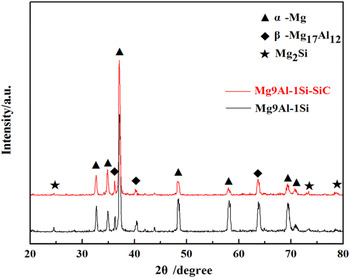
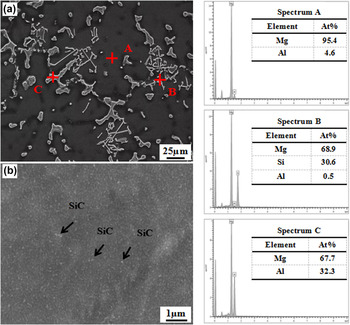
Figure 2 shows the XRD patterns of Mg9Al–1Si alloy and Mg9Al–1Si–1SiC composite. The alloy and composite were mainly composed of α-Mg, Mg17Al12, and Mg2Si phases. But the new phase (SiC) was not found in Mg9Al–1Si–1SiC composite by XRD testing due to the less content of SiC nanoparticles. For further study of phase composition, SEM images and EDS results of spectrum points of Mg9Al–1Si–1SiC composite were shown in Fig. 3. As shown in Fig. 3(b), amount of white particles were existing in composite. According to the morphology of SiC nanoparticles in Fig. 1, the white particles were identified as SiC nanoparticles.
XRD patterns of Mg9Al–1Si alloy and Mg9Al–1Si–1SiC composite.

SEM images (a and b) and EDS results in (a) of as-cast Mg9Al–1Si–1SiC composite.

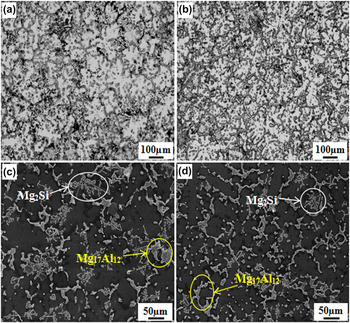
Figure 4 shows the microstructures of Mg9Al–1Si alloy and Mg9Al–1Si–1SiC composite. As shown in Figs. 4(a) and 4(c), the microstructures of the as-cast Mg9Al–1Si alloy were composed of α-Mg grains with an average size of ∼150 µm, massive network β phase along the grain boundaries, and the average size of coarse Chinese-script-shaped Mg2Si phase ∼100 µm. After adding 1 wt% SiC to Mg9Al–1Si alloy, however, the matrix grain size was refined from ∼150 to 100 µm as shown in Figs. 4(a) and 4(b). Beside, although the Mg17Al12 phase was refined as shown in Figs. 4(c) and 4(d), it exhibited network morphology. It also can be seen in Fig. 4(d), although the Mg2Si phase was refined to ∼50 µm in the Mg9Al–1Si–1SiC composite through adding SiC nanoparticle, the morphology of Mg2Si phase was still Chinese-script type.
(a and b) Optical and (c and d) SEM micrographs of as-cast alloy and composite: (a and c) Mg9Al–1Si and (b and d) Mg9Al–1Si–1SiC.

The changes of microstructures can be attributed to the following aspects: the “push” effect of the solidification front on the insoluble solid impurities including SiC nanoparticles may cause the nuclei clusters along grain boundaries. Reference Nie, Wang, Wu, Xu, Zheng and Hu17,Reference Wang, Hu, Nie, Wu and Zheng18 Thus, the grain refinement as well as the refined Mg17Al12 phase along the grain boundaries of the Mg9Al–1Si–1SiC composite, as shown in Figs. 4(b) and 4(d), could be attributed to the combined effect of heterogeneous nucleation of α-Mg on SiC nanoparticles and restricted growth of matrix grain during solidification. In addition, SiC nanoparticles have the higher ratio of surface to volume and primary Mg2Si phase clings to it Reference Zhao, Liu, Yang and Bian19 in the Mg9Al–1Si–1SiC composite. Based on Wang et al.’s investigation, Reference Wang, Song, Sun and He20 the higher ratio of surface to volume usually induces a higher surface energy. Thus, the Mg2Si phase can obtain much more nucleation sites in Mg9Al–1Si–1SiC composite as compared with Mg9Al–1Si alloy. Consequently, the Mg2Si phase becomes much smaller in Mg9Al–1Si–1SiC composite.
B. Microstructural evolution during ECAP
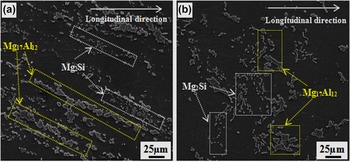
The SEM micrographs in Fig. 5 reveal that the ECAP process greatly modifies the morphology of Mg17Al12 and Mg2Si phases through deformation and breakage. In case of the Mg9Al–1Si alloy [Fig. 5(a)], although some of the network Mg17Al12 and coarse Mg2Si phases were partially broken down into fine particles (∼10 µm) and much finer particles (∼2 µm) respectively, most was in fact elongated and aligned in the direction of shear, thus creating a considerable amount of agglomeration. In contrast, the fragmentation of the Mg17Al12 and Mg2Si phases were much more prominent in the Mg9Al–1Si–1SiC composite [Fig. 5(b)]. It could be seen that Mg2Si phase was fully broken down into finer particles, which were homogenously distributed in the matrix. Although there were still some relatively larger and unbroken Mg17Al12 phases remaining in the Mg9Al–1Si–1SiC composite after ECAP, they did not form a network and showed better uniform distribution. As mentioned above, the Mg17Al12 and Mg2Si phases exhibited finer size in the as-cast composite as compared with Mg9Al–1Si alloy owing to the addition of SiC nanoparticles, which was the reason for the fine and well-distributed secondary phases in the ECAPed Mg9Al–1Si–1SiC composite.
SEM morphologies of ECAPed alloy and composite for 4 passes: (a) Mg9Al–1Si and (b) Mg9Al–1Si–1SiC.

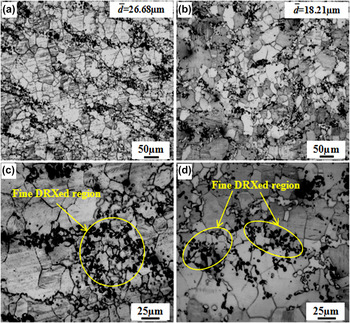
The average grain size of the ECAPed alloy is also significantly reduced by SiC addition from ∼26.68 µm to 18.21 µm (Figs. 6(a) and 6(b)). Further observation also indicated that after processing by ECAP, there were much more fine DRXed grains around Mg2Si and Mg17Al12 particles, as shown in Figs. 6(c) and 6(d). It is well known that during hot deformation an incompatibility between deformations occurs at the interface between the soft grains of the Mg matrix and hard second phases, and that this induces a strong stress concentration that can increase the formation of fine DRXed grains. Reference Hagihara, Kinoshita, Sugino, Yamasaki, Kawamura, Yasuda and Umakoshi21,Reference Guo, Wang, Ye, Zhou and Liu24 In Mg9Al–1Si–1SiC composite, more homogeneous dispersion of the hard micron-sized Mg17Al12 and Mg2Si particles accelerated the formation of much more DRXed grains during ECAP by inducing a stress concentration around these particles. Similarly, fine Mg17Al12 and Mg2Si particles play an important role in restricting DRXed grain growth by creating a pinning effect. Reference Shang, Deng, Nie, Li, Zhou, Xu and Fan22–Reference Guo, Wang, Ye, Zhou and Liu24 Thus, the greater number of micron-sized particles dispersed along grain boundaries of the Mg9Al–1Si–1SiC composite [Fig. 6(d)] were considered to reduce the size of grains through an enhanced grain boundary pinning effect. In addition, the existence of harder SiC nanoparticles in Mg9Al–1Si–1SiC composite and their pinning effect on grain boundary migration Reference Nie, Wang, Xu, Wu, Hu and Zheng25 could also refined grains during ECAP.
Optical microstructures of the ECAPed alloy and composite for 4 passes: (a and c) Mg9Al–1Si and (b and d) Mg9Al–1Si–1SiC.

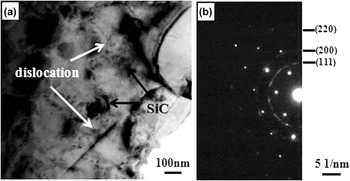
Figure 7 shows TEM micrographs of ECAPed Mg9Al–1Si–1SiC composite for 4 passes. Figure 7(a) presented the dislocation pile-ups around SiC nanoparticles. In Fig. 7(b), the study of electron diffraction confirmed that composition of nanoparticles was SiC nanoparticles. These dislocations were the result of residual plastic strain caused by the thermal [the difference in the coefficient of thermal expansion (CTE)] and the elastic modulus (EM) mismatch between the matrix and reinforcement particles or work hardening during ECAP process. Reference Sanaty-Zadeh26
TEM micrographs of ECAPed Mg9Al–1Si–1SiC composite for 4 passes: (a) SiC nanoparticles and dislocations and (b) electron diffraction patterns of SiC nanoparticles.

C. Mechanical properties
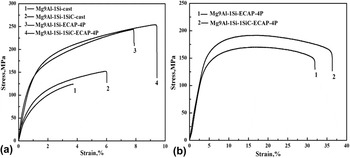
Tensile testing was conducted at room temperature and 150 °C. Figure 8 shows tensile stress–strain curves of experimental alloy and composite at the different temperatures. Table I shows specific values of mechanical properties corresponding to Fig. 8. Typical room temperature tensile stress–strain curves were shown in Fig. 8(a) for as-cast Mg9Al–1Si alloy, as-cast Mg9Al–1Si–1SiC composite, ECAPed Mg9Al–1Si alloy and ECAPed Mg9Al–1Si–1SiC composite which were labeled 1–4 in order. The mechanical properties of as-cast Mg9Al–1Si alloy were improved with the addition of SiC, with further improvement hindered by the presence of the network Mg17Al12 and Chinese-script type Mg2Si phases. In contrast, the ECAPed Mg9Al–1Si alloy and Mg9Al–1Si–1SiC composite exhibited higher values of mechanical properties in relation to the as-cast state. In particular, the ultimate tensile strength, yield strength, and the elongation to failure of the Mg9Al–1Si–1SiC composite processed by ECAP were 255 MPa, 161 MPa and 7.9% at room temperature, respectively, which were approximately 68%, 106%, and 65% greater than the values for the as-cast composite (152 MPa, 78 MPa and 4.8%). These results are attributed to the grain refinement and dispersion strengthening (the existence of fine Mg17Al12 and Mg2Si particles). In case of ECAPed alloy and composite, Mg9Al–1Si–1SiC composite exhibited optimal mechanical properties, which could be mainly attributed to fine microstructure with well-distributed particles (Mg17Al12 and Mg2Si) produced by ECAP and the existence of SiC nanoparticles. These SiC nanoparticles can play an important role in strengthening the ECAPed composite by increasing the stress required to move dislocations. Interestingly, in addition to the increase in strength the elongation was also improved by SiC addition, which ran contrary to the inverse relationship that was normally observed between strength and ductility. This is most likely due to the addition of nanoscale SiC particles, which lead to an improvement in strength and ductility. Reference Nie, Wang, Hu, Xu, Wu and Zheng9
Mechanical properties of as-cast/ECAPed Mg9Al–1Si alloy and Mg9Al–1Si–1SiC composite under different temperature: (a) room temperature and (b) 150 °C.

Mechanical properties of as-cast/ECAPed Mg9Al–1Si alloy and Mg9Al–1Si–1SiC composite at room temperature and 150 °C.

In Fig. 8(b), elevated temperature tensile stress–strain curves of Mg9Al–1Si alloy with or without 1 wt% SiC after 4 passes of ECAP were depicted while marking with number of 1–2. It is noted that the values of UTS, YS, and elongation to failure for ECAPed Mg9Al–1Si–1SiC composite were both higher than that of ECAPed Mg9Al–1Si alloy. Compared with ECAPed Mg9Al–1Si alloy, the tensile strength and elongation to failure of ECAPed Mg9Al–1Si–1SiC composite were improved by 12% and 19% at 150 °C, reached up to 191 MPa and 32%. In previous study, Lin et al. reported that ECAPed ZA85 alloy with a grain size of 4–20 µm is deformed by dislocation glide during tensile testing at high temperature, and that the high-temperature mechanical properties increase with decreasing grain size due to hinder dislocation motion. Reference Lin, Tsai, Chao and Liu27 In the present study, it would therefore seem that as the grains, Mg17Al12 and Mg2Si particles were more effectively refined and well-distributed by SiC nanoparticles addition [Fig. 5(b)], the mechanical properties were improved at elevated temperatures due to obstruction of dislocation movement and the grain boundary migration. Furthermore, thermally stable SiC nanoparticles could also contribute to an improvement of high temperature mechanical properties through impeding mobile dislocations.
D. Fractured surface
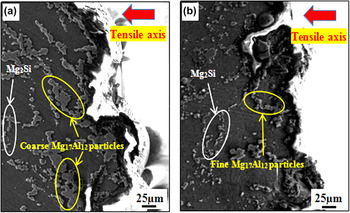
Figure 9 illustrates fractured microstructures (parallel to the tensile direction) of ECAPed Mg9Al–1Si alloy and Mg9Al–1Si–1SiC composite for 4 passes at room temperature. In the fractured microstructures of ECAPed Mg9Al–1Si alloy [Fig. 9(a)], the agglomeration of coarse Mg17Al12 particles could be observed, and microcrack could initiate within the Mg17Al12 particles dense zones due to the uncoordinated deformation between the Mg17Al12 particles dense zones and the matrix during the tensile test at room temperature. In contrast, the Mg17Al12 phases were cracked into more finer particles and the distribution of that tended to be homogeneous, which could decrease the microcrack nucleation at the interface between Mg17Al12 particles and matrix as shown in ECAPed Mg9Al–1Si–1SiC composite [Fig. 9(b)]. As a result, the ultimate tensile strength and elongation of ECAPed Mg9Al–1Si–1SiC composite increase compared with ECAPed, SiC-free Mg9Al–1Si alloy.
SEM images of ECAPed alloy and composite for 4 passes at room temperature: (a) Mg9Al–1Si and (b) Mg9Al–1Si–1SiC.

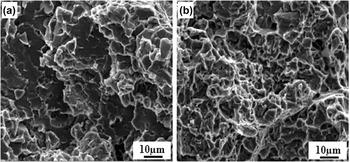
Figure 10 displays the tensile fractographs of ECAPed Mg9Al–1Si–1SiC composite and ECAPed, SiC-free Mg9Al–1Si alloy at room temperature. Compared with ECAPed Mg9Al–1Si alloy, the amount of dimples in ECAPed Mg9Al–1Si–1SiC composite was increased [Figs. 10(a) and 10(b)], which was responsible for the higher performance in tensile properties. This shall be evidently attributed to the uniformly distributed finer Mg17Al12 particles in ECAPed Mg9Al–1Si–1SiC composite, which could decrease the microcrack nucleation corresponding to Fig. 9(b).
Fratographs of the ECAPed alloy and composite for 4 passes at room temperature: (a) Mg9Al–1Si and (b) Mg9Al–1Si–1SiC.

IV. CONCLUSION
-
(1) Addition of SiC nanoparticles resulted in the decrease of grain size, Mg17Al12 phase and Mg2Si phase in as-cast Mg9Al–1Si alloy, but the Mg17Al12 phase still exhibited network structure and the morphology of Mg2Si phase was still Chinese-script shape. After processing by ECAP for 4 passes, the grain size of Mg9Al–1Si–1SiC composite was decreased to 18.21 µm and network Mg17Al12 phases were broken down to fine particles (∼10 µm), and Chinese-script shaped Mg2Si phases were fragmented into much finer particles (∼2 µm). These particles were distributed homogeneously in the ECAPed Mg9Al–1Si–1SiC composite.
-
(2) The mechanical properties of ECAPed Mg9Al–1Si–1SiC composite was optimal at room temperature. Not only did nanoscale SiC particles improve tensile strength, but also it increased elongation to failure. For ECAPed alloy and composite, microcrack could initiate within the Mg17Al12 particles dense zones during tensile process.
-
(3) ECAPed Mg9Al–1Si–1SiC composite exhibited excellent mechanical properties at elevated temperature of 150 °C as a result of the finer grain size, uniform distribution of fine Mg17Al12 and Mg2Si particles, and the thermally stable SiC nanoparticles.
ACKNOWLEDGMENTS
The authors are grateful for financial support received from the National Natural Science Foundation of China (51301118, 51404166); International Cooperation in Shanxi (2014081002); Technological Innovation Programs of Higher Education Institutions in Shanxi (2013108).