In the past 30 years, catheter-based stenting of the arterial duct has gained attraction as an alternative to surgical modified Blalock–Taussig–Thomas shunt in patients with parallel circulation. While surgical intervention carries the risks associated with thoracotomy and cardiopulmonary bypass, there are also concerns of safety regarding transcatheter stenting of a tortuous arterial duct.
Previous studies have compared the outcomes of each intervention in neonates with ductal dependent pulmonary blood flow. A recent meta-analysis demonstrated that patients with arterial ductal stent placement had lower risk of morbidity and mortality. This meta-analysis demonstrated a 75% risk reduction in need for extracorporeal membrane oxygenation. Stent patients also had higher post-procedure oxygen saturations when compared to shunt patients. There was no difference in reintervention rates between both cohorts. Reference Fakhry AbdelMassih, Menshawey and Menshawey1 Other studies have demonstrated that admission characteristics including hospital length of stay, growth of the pulmonary arteries, need for diuretics at discharge, and time to repair were similar between both groups. Reference Bauser-Heaton, Qureshi and Goldstein2
While data regarding overall clinical outcomes are available, there are currently minimal data comparing the differences in acute haemodynamics and laboratory findings between both cohorts immediately after these procedures, although a study has suggested that stent patients required lower vasoactive support. Reference Bauser-Heaton, Qureshi and Goldstein2
The primary aim of this study was to compare haemodynamic and laboratory values in children with ductal dependent pulmonary blood flow immediately after undergoing surgical systemic to pulmonary artery shunt placement or catheter-based arterial ductal stent placement. Secondary aims included comparing admission outcomes such as post-procedural hospital length of stay, cardiac arrest, and inpatient mortality.
Materials and methods
Study design
This was a single-centre retrospective cohort study comparing differences in haemodynamic parameters in the first 48 hours after either surgical Blalock–Taussig–Thomas shunt placement or catheter-based arterial ductal stent placement.
This study received approval from the institutional review board and was in concordance with the Helsinki declaration.
Patient identification
Patients with ductal dependent pulmonary blood flow were identified from our institutional database. Neonates (< 30 days old) who underwent surgical shunt placement and those who underwent catheter-based arterial ductal stent placement between January 2013 and January 2022 were identified. January 2013 was selected as the earliest timepoint for inclusion as this was when the institutional database was established and when an electronic health record was introduced. Patients with antegrade sources of pulmonary blood flow were not included. Those who did not survive to either shunting or stenting or who returned to the ICU without an arterial line post-procedure were also excluded.
Variables of interest
The following haemodynamic variables were collected for each patient: heart rate, systolic blood pressure, diastolic blood pressure, central venous pressure, arterial saturation by pulse oximetry, cerebral near infrared spectroscopy, and renal near infrared spectroscopy. The blood pressures were recorded from an arterial line. The following laboratory values were collected: blood urea nitrogen, serum creatinine, and serum lactate. The following clinical variables were collected: vasoactive inotropic score. This score quantifies the total inotropic support using a validated scoring system. Reference Gaies, Gurney and Yen3
The cerebral and renal oxygen extraction ratio were calculated using the aforementioned data at each timepoint. The oxygen extraction ratio was calculated as follows: ((pulse oximetry – near infrared spectroscopy value)/pulse oximetry) x 100. This was done separately for the cerebral and renal beds.
The variables of interest were collected at the following timepoints: immediately prior to shunt or stent placement, immediately after stent or shunt placement upon admission to the ICU, 6 hours after admission, 12 hours after admission, and 48 hours after admission.
Central venous pressure was often not available immediately prior to the procedure and so was only collected at the post-procedure timepoints. Blood urea nitrogen and serum creatinine are collected at greater time intervals than used in this study and were thus collected upon admission and at 48 hours.
Admission characteristics of interest that were collected included: post-procedural mechanical ventilation duration, post-procedural hospital length of stay, need for reintervention, need for extracorporeal membrane oxygenation, cardiac arrest, and inpatient mortality. A composite endpoint consisting of need for reintervention, need for extracorporeal membrane oxygenation, cardiac arrest, and inpatient mortality was also created.
Statistical Analyses
Continuous variables were presented as median and range while descriptive variables were presented as absolute frequency and percent.
Descriptive characters were compared between the two groups using a Fisher’s exact test. Univariable analyses for continuous variables were conducted using one-way analyses of variance, with one done for each variable of interest comparing the two groups at each timepoint.
Multi-variable analyses were then conducted using regression analyses. For these, values for each timepoint were not used separately. Post-procedural data were averaged over the timepoints for each variable and the averages were used for the multi-variable analyses. A linear regression was done with the post-procedural hospital length of stay as the dependent variable, a logistic regression was done with cardiac arrest as the dependent variable, and a logistic regression was done with inpatient mortality as the dependent variable. For the linear regression, a backwards conditional regression was utilised, while a stepwise regression was utilised for the logistic regressions. Independent variables entered into all these regressions included: heart rate, systolic blood pressure, central venous pressure, pulse oximetry, cerebral oxygen extraction ratio, renal oxygen extraction ratio, blood urea nitrogen, serum creatinine, serum lactate, vasoactive inotropic score, and source of pulmonary blood flow.
The specific regression strategy utilising backwards elimination or stepwise elimination was utilised due to the relatively low number of patients and to enhance power of the regression analyses. Backwards elimination and stepwise elimination can have their limitations, but all variables of interest were already selected a priori with presumed association to the dependent variables. Thus, some of the limitations of these strategies were mitigated while preserving their strengths.
All statistical analyses were done utilising SPSS Version 23.0. A p-value of less than 0.05 was considered statistically significant.
Results
Cohort characteristics
A total of 52 patients were included in the final analyses. Of these, 38 (73%) underwent shunt placement while 14 (23%) underwent a stent placement. The median shunt size was 4 mm. The median stent size was 4 mm. Baseline cohort characteristics were not significantly different between the two groups with respect to gender, gestational age, birth weight, need for intubation prior to the procedure, age at procedure, or weight at procedure. Median age at time of shunt was 6 days, and median weight was 3.12 kg in the shunt group compared to 3.05 kg in the stent group (Table 1).
Cohort characteristics

Haemodynamic parameters
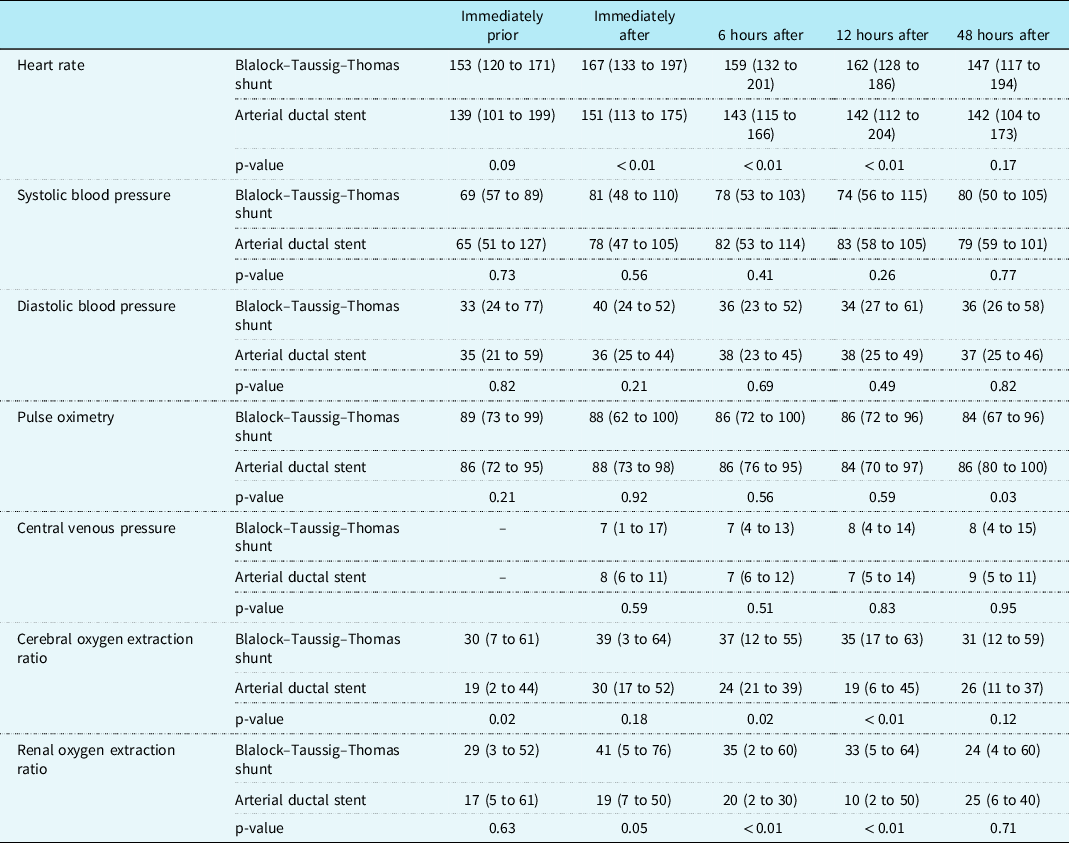
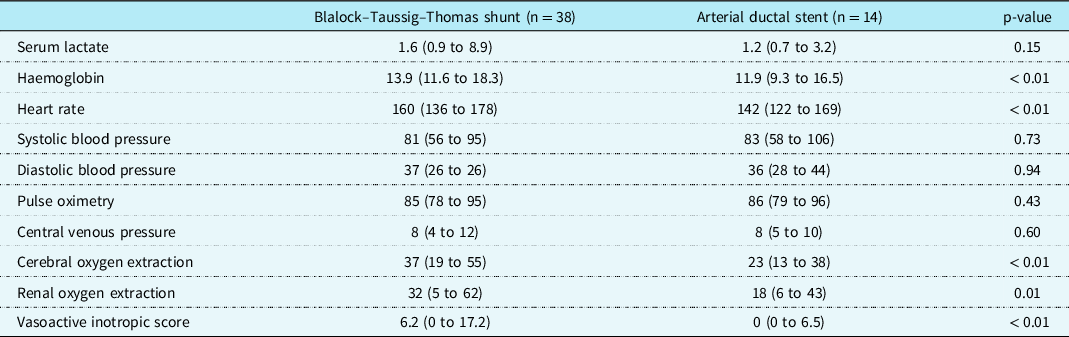
Significant differences were noted in heart rate at various timepoints, with heart rates tending to be lower in the stent group (Table 2). Average heart rate across the first 48 hours after the procedure was also significantly lower in the stent group (Table 3). Significant differences were noted in cerebral oxygen extraction ratio and renal oxygen extraction at some timepoints, with both ratios tending to be lower in the stent group (Table 2). Average cerebral oxygen extraction ratio and renal oxygen extraction ratio across the first 48 hours after procedure were also significantly lower in the stent group (Table 3).
Comparison of haemodynamic variables

Average values for the first 48 hours post-procedural

Average values in the first 48 hours after the procedure.
There was a significant difference in pulse oximetry measurement at the 48-hour timepoint, with the shunt group having a lower value (Table 2). However, there was no significant difference in pulse oximetry values when averaged across the first 48 hours after procedure (Table 3)
There were no significant differences in systolic blood pressure, diastolic blood pressure, or central venous pressure at any specific timepoint or by the 48-hour post-procedure average.
Laboratory values
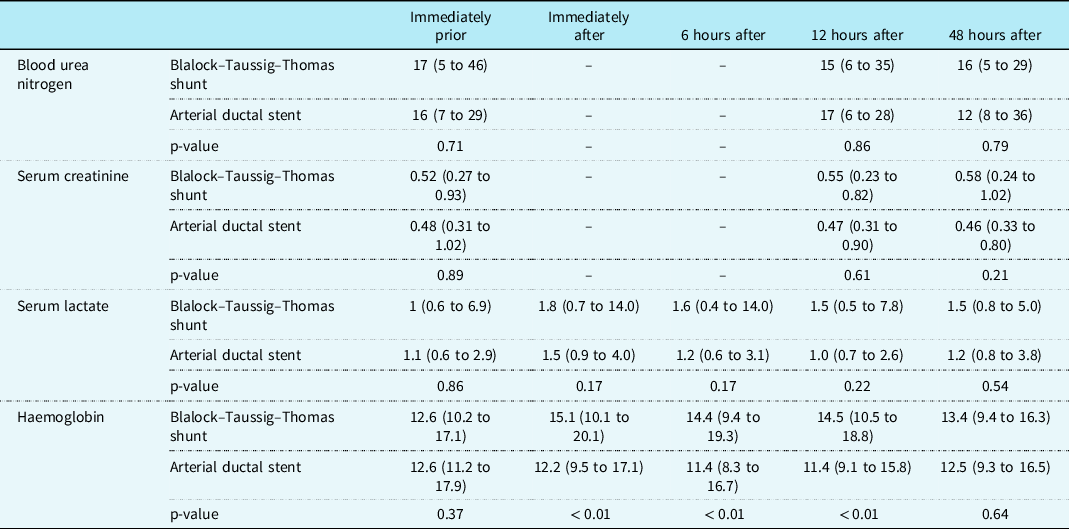
Significant differences were noted in haemoglobin at some timepoints, with haemoglobin tending to be lower in the stent group (Table 4). Average haemoglobin across the first 48 hours after the procedure was also significantly lower in the stent group (Table 3). Blood urea nitrogen, serum creatinine, and serum lactate did not differ at any timepoint or by 48-hour post-procedure average.
Comparison of laboratory values

Vasoactive inotropic score
Significant differences were noted in vasoactive inotropic score at some timepoints, with vasoactive inotropic score tending to be lower in the stent group (Table 5). Average vasoactive inotropic score across the first 48 hours after the procedure was also significantly lower in the stent group (Table 3).
Comparison of clinical variables

Clinical outcomes
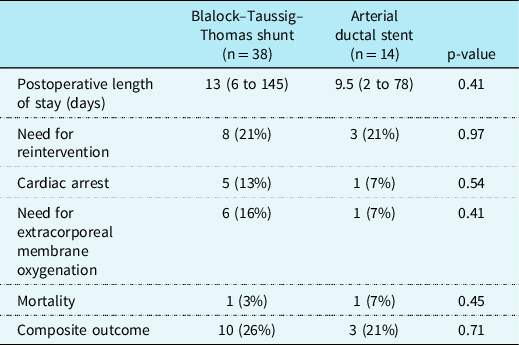
Univariable analyses demonstrated no significant differences in post-procedural length of stay, need for reintervention, cardiac arrest, need for extracorporeal membrane oxygenation, inpatient mortality, or the composite outcome (Table 6).
Univariable analysis comparing post-procedural length of stay, need for reintervention, cardiac arrest, need for extracorporeal membrane oxygenation, inpatient mortality, and the composite outcome

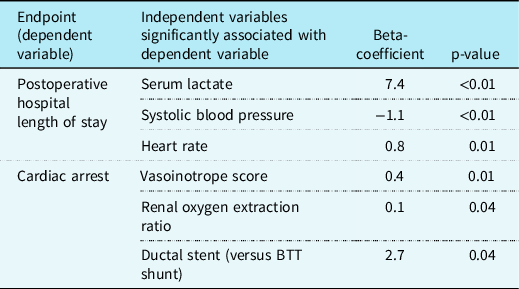
Regression analyses with post-procedural hospital length of stay as the dependent variable demonstrated that the following factors were associated with increased length of stay: higher serum lactate, lower systolic blood pressure, and higher heart rate (Table 7). Regression analyses with cardiac arrest as the dependent variable demonstrated that the following factors were associated with increased risk of cardiac arrest: higher vasoactive inotropic score, higher renal oxygen extraction ratio, and having a stent versus a shunt (Table 7). Regression analyses with inpatient mortality as the dependent variable demonstrated no significant associations with any of the independent variables.
Regression analysis using average values in the first 48 hours post-procedure

It should be noted that over the study period there were not marked changes in the frequency of mortality, cardiac arrest, or need for ECMO in children having undergone cardiac surgery or catheterisation. This is evidenced by data from the institution’s local database.
Aetiology of cardiac arrest
In the stent group, one patient had cardiac arrest secondary to dissection. In the shunt group, one cardiac arrest occurred intraoperatively. Two patients had acute haemodynamic compromise and cardiac arrest post-procedure. One patient had cardiac arrest secondary to complications related to extracorporeal membrane oxygenation. Another had a cardiac arrest secondary to abdominal perforation and subsequent haemorrhage.
Aetiology of reintervention
Three patients required reintervention in the stent group. Reinterventions included re-stenting of the ductus, ductal dissection, and carotid pseudoaneurysm repair. Of the patients who required reintervention in the shunt group, four out of eight patients required intervention on the shunt. Other causes for reintervention included sternal wound debridement, post-procedural bleeding, left pulmonary artery stenosis, and catheterisation due to concern for myocardial ischaemia.
Discussion
This study demonstrates that there are some haemodynamic differences between ductal dependent patients who undergo a shunt versus stent in the first 48 hours after the procedure. Notably, the stent group tends to have lower heart rates, lower haemoglobin, lower renal oxygen extraction ratio, lower cerebral oxygen extraction ratio, and lower vasoactive inotropic score when compared to the shunt group. While univariable analyses did not demonstrate any differences in post-procedural length of stay, need for reintervention, need for extracorporeal membrane oxygenation, cardiac arrest, inpatient mortality, or the composite outcome, multi-variable analyses demonstrated that stenting was associated with post-procedural increased risk of cardiac arrest.
Arterial ductal stent placement in ductal dependent patients was first described 30 years ago. Reference Gibbs, Rothman, Rees, Parsons, Blackburn and Ruiz4 Initially, stent placement in these children was discouraged due to concerns of ductal thrombosis, ductal spasm, and stent migration. Reference Gibbs, Uzun, Blackburn, Wren, Hamilton and Watterson5 However, advancements in transcatheter technique and equipment have improved outcomes and made arterial ductal stenting a more favourable option. Reference Gewillig, Boshoff, Dens, Mertens and Benson6,Reference Bahaidarah, Al-Ata and Alkhushi7 In our study, there was an increase in the rate of ductal stenting in the last four years of the study. This likely reflects practice changes over this time period.
Previous studies comparing stent placement versus shunt placement in ductal dependent patients have demonstrated conflicting results, with some demonstrating lower mortality associated with stent placement and others demonstrating no significant difference in mortality. Reference Bauser-Heaton, Qureshi and Goldstein2,Reference Bentham, Zava and Harrison8,Reference Glatz, Petit and Goldstein9 The current study demonstrated no difference in inpatient mortality between both cohorts.
Arterial ductal stenting has been demonstrated to be associated with higher reintervention rates. Reference Bauser-Heaton, Qureshi and Goldstein2,Reference Bentham, Zava and Harrison8,Reference Glatz, Petit and Goldstein9 The current study demonstrated no difference in the rate of reintervention between both cohorts. It is important to note that only four out of eight reinterventions in the shunt group required reintervention on the shunt itself. Previous studies have demonstrated that even despite higher reintervention rates, patients in the ductal stent group may have lower or equivalent hospital costs over the first year of life. Reference Goldstein, O'Byrne and Petit10
The minimally invasive nature of stenting makes arterial ductal stent placement an appealing option for all ductal dependent patients with parallel circulation. The operative mortality for those undergoing central shunt placement can be as high as 14%. Reference Williams, Bansal and Kim11 Risk factors for mortality include infants less than 3 kg and the diagnosis of pulmonary atresia with intact ventricular septum. Reference Petrucci, O'Brien, Jacobs, Jacobs, Manning and Eghtesady12 Complications of the procedure that have been described include cardiac arrest, bleeding, thrombosis, acute kidney injury, arrhythmia, and vocal cord paralysis. Reference Bauser-Heaton, Qureshi and Goldstein2 Additionally, cardiopulmonary bypass has been known to cause an inflammatory response and contribute to post-procedural low cardiac output syndrome. Reference Bronicki and Hall13,Reference Epting, McBride, Wald and Costello14 This may explain why the ductal stent cohort had lower vasoactive inotropic scores and had lower heart rates compared to the shunt group. It is important to note that drug-related chronotropy may confound the finding of a lower heart rate in patients receiving a stent. Additionally, this institution does not routinely use cardiopulmonary bypass for systemic to pulmonary shunts unless necessary. There was no significant difference in blood urea nitrogen and creatinine between both cohorts within the first 48 hours. This is likely mediated by the fact that somatic oxygen delivery did not differ between the groups as demonstrated by renal near infrared spectroscopy. While it appears that the ductal stent cohort had lower haemoglobin trends post-procedure, this may be secondary to increased blood loss necessitating transfusion intraoperatively for the shunt cohort.
The limitations of this study include its single-center study design. Furthermore, selection bias may have been present in deciding which children receive ductal stents versus shunt. For example, ductal morphology may play a role in ductal stent outcomes; therefore, children with a tortuous duct may have preferentially received a shunt. Reference Qureshi, Goldstein and Glatz15 Additionally, children who may not tolerate cardiovascular surgery could have been selected for arterial ductal stent. The low incidence of cardiac arrest is a limitation of this study. While limited, this may still offer insight for future studies.
Knowledge of acute post-procedural haemodynamic and laboratory changes after either arterial duct stent placement or central shunt placement in patients with parallel circulation can help guide therapy in the ICU setting. Patients who have undergone arterial ductal stent placement appear to have favourable heart rate trends and less need for vasoinotropes in the first 48 hours post-procedure. However, these patients do have an increased risk of cardiac arrest.
Conclusion
Patients with ductal dependent CHD who undergo arterial ductal stent placement have lower heart rates, haemoglobin, renal oxygen extraction ratio, cerebral oxygen extraction ratio, and vasoactive inotropic score in the first 48 hours post-procedure compared to patients who have undergone a central shunt placement. Patients who have undergone stent placement also have increased post-procedural risk of cardiac arrest. There was no identifiable difference in inpatient mortality or reintervention rates.
Acknowledgements
None.
Financial support
This research did not receive any specific grant from funding agencies in the public, commercial, or not-for-profit sectors.
Conflicts of interest
None.