The writing of empire into the history of Ireland has produced a vibrant debate. For some years this debate focused primarily on the colonial status of the island. Always interesting and sometimes provocative, this particular discussion has perhaps run its course, and a consensus that Ireland’s relationship with Britain shared at least some features with those of the dominions and colonies has settled in across the disciplines of Irish studies.Footnote 1 We have now entered the second wave of Irish imperial studies. Mainly concerned with Irish nationalists, these works reveal that different strands of nationalism engaged intellectually and politically with empire in a variety of complex ways. Scholars in this field have demonstrated that Irish engagements with empire were more extensive and vigorous than some have allowed and that they were frequently central to the elaboration of Irish nationalist understandings of Ireland’s place in the wider world.Footnote 2 The result is a convincing and nuanced portrayal of anti-imperialism as a central thread of Irish nationalism from the 1840s through the 1880s. For example, Niamh Lynch demonstrates that a “coherent and ultimately revolutionary form of anti-imperialism” was an important element of the political ideology of Thomas Davis and John Mitchel.Footnote 3 Matthew Kelly traces the continuity of this hostility to empire in the post-famine and Fenian eras, although he also argues that this anti-imperialism was only prominent “at times when the demands of Irish public opinion could not be satisfied through representative political processes.”Footnote 4 Paul Townend’s examination of the Nationalist response to events in South Africa in the late 1870s reveals that in this period “anti-imperialism emerged as an integral, powerful part of Irish national mobilizing rhetoric.” The nationalists tacked to the left on imperial matters, Townend suggests, as a key part of their effort to “construct a credible popular movement.” In other words, they were responding to and helping give focus to a widespread antipathy for British imperial expansion among their supporters.Footnote 5
Aside from the platform and popular press, Irish disapproval of empire was most vigorously expressed in Parliament, where nationalists had long criticized imperial misgovernment and claimed to speak for the various unrepresented subject peoples of the empire. This interest in and censure of empire was most pronounced between the late 1870s and 1886. Led by inveterate imperial critics such as F. H. O’Donnell and Michael Davitt, the Nationalist MPs “debated foreign affairs at greater length than any other single issue” save Irish questions.Footnote 6 The Parnellites’ public stance on empire softened after the introduction of the first home rule bill and the establishment of the “Union of Hearts,” as the party sought to reassure a British public deeply concerned that Irish self-government would lead to imperial dissolution. The Irish party’s rhetorical shift to the federalist approach to empire championed earlier by Isaac Butt reached its apogee with John Redmond’s plea for Irish volunteers in 1914.Footnote 7 Still, even if they toned down their public criticism of the empire, many nationalists retained their aspiration to transform it into a commonwealth of equal nations.Footnote 8
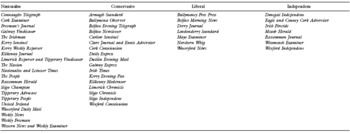
Following this enhanced understanding of the complexity of the nationalists’ engagement with empire, the next logical step is to widen the focus and begin to explore Irish imperial sensibilities more generally. In other words, the moment has come for the new imperial history to cross the Irish Sea. Part of a larger comparative study of the late-Victorian press and northeast Africa in the 1880s, this article offers a case study of coverage of Egypt and the Sudan during the Mahdist rebellion of 1883–85 in fifty-two Irish newspapers. Twenty-one of these papers were Nationalist (40 percent), seventeen Conservative (33 percent), seven Liberal (13.5 percent), and seven Independent (13.5 percent) (see appendix table A1). Fifteen of these newspapers were published in Dublin, Belfast, or Cork, while the rest were published in smaller towns. The result is a survey of press opinion across the political and geographic spectrum of Ireland. This article will focus on two topics in particular. The first of these is the character of reporting on the Mahdi and his followers. As will be seen, Irish press commentary on the Mahdists was as complex and diverse as opinion on the empire more generally. Second, this article explores how late-Victorian Irish newspapers viewed the role of the press in the formulation of imperial policy. The newspaper press, it will be shown, was understood to be the main vehicle for a conversation among readers, journalists, and politicians in which the former two could most effectively register their views and influence, for good or ill, the decisions of the imperial state.
In their efforts to intertwine the histories of colonies and metropole, practitioners of the new imperial history have focused on cultural representations of the empire. Popular literature, music hall songs, art, advertisements, school textbooks, and many other cultural forms have been mined for their imperial content to discover how Britons viewed their empire and to determine its influence on British society and national identity. While the new imperial history now dominates the field, the inevitable challenges and revisions have been accumulating. Perhaps the most effective criticism concerns the British public’s absorption of the imperial images and themes teased out in these many studies. Scholars have demonstrated a widespread production of symbolic goods of empire, but they have been less successful in proving how or even if these were consumed by the majority of the British public.Footnote 9
Not only have these scholars overestimated popular concern for empire, the critics charge, but they have also in many cases failed to place imperial images or cultural forms in any significant political context.Footnote 10 In other words, studies of imperial propaganda, religious and racial stereotypes, Orientalism, and so on are a valuable and interesting start, but they simply do not go far enough. Cultural analyses by themselves cannot explain the concrete policy decisions that maintained and directed the empire. Additionally, it is striking that the new imperial history has largely ignored the perspectives of Irish Britons.Footnote 11 This omission reflects in part the ambiguous or contested imperial position of Ireland. Not knowing quite where to position Ireland, most scholars have simply ignored it. In addition, investigations of “British” attitudes toward empire have too often focused exclusively on English sources. Irish popular and political opinion, along with that in Wales and Scotland, must be considered if we hope to create a more nuanced and comprehensive account of British imperial sensibilities.
Some British historians have been perhaps too ready to take Irish Nationalist critiques of empire at face value and conflate their opinions with those of their compatriots. Other scholars have underestimated Irish anti-imperialism because of the opacity of certain kinds of political discourse. This is unfortunate when one considers the success of scholars in teasing out the many ambiguities and ambivalences of English imperial sentiment. An appreciation of the Irish dimension presents a partial solution to the problem of connecting imperial culture and politics. For example, understanding the anti-imperial nature of some varieties of Irish nationalism helps us to realize the authentic tensions within metropolitan attitudes on empire and to contextualize the real importance within British political culture of the “Irish question.”Footnote 12 Nationalist opinion on empire was sometimes divided, ambivalent, or contradictory, particularly after the mid-1880s, and Charles Stewart Parnell and his successors did not speak for all Irish men and women.Footnote 13 Irish pro-imperial sentiment, Conservative or otherwise, deserves considerably more attention.Footnote 14
The Press and Empire
This article examines popular views of empire and of the political debates that shaped imperial policy through an examination of Irish newspaper reporting on events in Egypt and the Sudan between 1883 and 1885. Contrary to Bernard Porter’s contention, it holds that a wide cross section of Victorian society was well informed about and interested in imperial events. As Jennifer Regan argues in her study of Irish Nationalist press reporting on India, newspapers will not “reveal what people thought, but they should reveal what kind of information was available to the literate public who did not have imperial knowledge through first-hand accounts.”Footnote 15 Imperial information was abundant and prominently positioned in newspapers across the political spectrum. Readers and journalists in Ireland participated in sustained debates on the justification, purpose, and future of British political control of Egypt and the Sudan. By examining how the press engaged with these issues we can more fully appreciate the ebb and flow of contemporary opinion and how these attitudes helped to form the context in which Egyptian policies were crafted and contested. In other words, by studying press commentary we can understand how imperial controversies unfolded in the public sphere, allowing us to write politics firmly into the history of popular imperialism. Many historians of empire have consulted newspapers, but almost always in a selective fashion, typically limiting themselves to the Times, Illustrated London News, or Punch. As Simon Potter has pointed out, the role of the press in popular imperialism or anti-imperialism has too often been assumed rather than actually investigated.Footnote 16
This article is an exercise in content analysis rather than formal newspaper history. It is not concerned with the careers or opinions of specific editors or correspondents, but instead treats the press as a cultural product that must be explored in aggregate in order to discover and trace common threads of opinion, while also exploring divisions among newspapers affiliated with the Liberal, Conservative, and Nationalist parties. As Potter has astutely noted, one cannot claim automatically to know more about the minds of readers by simply increasing the number of newspapers under investigation.Footnote 17 Using a large and varied collection of newspapers does, however, reveal which issues captured journalistic attention across the political divide and which matters the political classes felt compelled to address. By sheer virtue of what it chose to report on, what it chose to ignore, and what topics it chose to privilege, the press shaped the public conversation and helped set the political agenda.Footnote 18 While imperial-themed art, advertising, or music hall songs are all interesting sources for examining imperial awareness and sentiment, they did not influence the political agenda in the same manner or degree as did the popular press. A study of late-Victorian newspaper commentary illuminates the political and public discursive context, driven in no small part by the press, in which Gladstone’s government made imperial policy decisions such as the invasion of Egypt or dispatching the mission to rescue Gordon.
The press, the reading public, and politicians were engaged in a mutually dependent triangular relationship. Editors and journalists consciously positioned the newspaper and periodical press as the fourth estate, connecting the electorate and the political classes by establishing and expressing what was regarded as the conventional wisdom on political questions of the day. Readers used the press as the primary source of information on current issues and as a tool to effect desired political change. The daily newspaper provided a space in which readers might join the debate over issues such as social problems, proposed reforms, or the government’s management of a military campaign.Footnote 19 The political classes of Britain and Ireland viewed the popular press as the best gauge of the march of public opinion, particularly in newspapers identified with the party faithful. The press thus played a critical role in defining political boundaries. Editorials, cartoons, and letters to the editor did not necessarily tell British and Irish politicians what they must do, but they did provide a sense of what was politically achievable and/or necessary.
Having argued for the central role of the press in the creation and expression of public opinion as it was understood by politicians in Britain and Ireland, we must acknowledge that there was no more a popular consensus on any issue than there was a common Irish or British culture. Nor was there a hegemonic conception of the empire. This diversity was recognized by Victorian journalists. Commentary and policy prescriptions varied substantially depending on the region under discussion, particularly the settler colonies as opposed to India or Egypt. Newspapers in Scotland and Wales, not just in Ireland, often offered a perspective on empire quite distinct from that of the English papers.Footnote 20
Any effort to use the newspaper and periodical press to analyze popular imperialism must therefore acknowledge and analyze these multiple strands of thought and different viewpoints. It must discover and illuminate the dominant themes in journalistic commentary as well as dissenting and minority voices, necessitating a detailed and systematic study of a large number of wide-ranging newspapers and journals. Inundated with imperial symbols or not, Victorians gleaned most of their knowledge of their overseas possessions from newspapers and other periodicals. The press thus wielded considerable, perhaps unparalleled, authority in shaping popular understandings of the empire and its peoples. Empire, imperial identities, and their political import were contested concepts for Victorians as much as they are among present-day scholars. The primary arena for these contests was the popular press.
This article will demonstrate that Irish journalists and their readers were fully engaged imperial citizens participating in a dense, multivalent conversation about their government’s interventions in northeast Africa and the influence of popular opinion on imperial policy. Within these conversations we can discern three distinct theories or understandings of empire. The Conservative press championed imperial strength, a global dominion founded on military and political prestige in which British rights and interests (such as the Suez Canal) were inviolate. Yet for all this emphasis on power, the Conservative vision of empire also harbored deep anxieties that tended to exaggerate challenges to British authority, especially by its Muslim subjects. Coverage in the Liberal press was shaped by a transitional or hybrid theory of empire. These newspapers recognized the necessity of defending British prestige, especially in India, but also retained their faith, if with some difficulty, in the progressive potential of empire. They believed, or at least hoped, that British political control of northeast Africa could be limited in term and scope and would effect some genuine improvements in the lives of the Egyptian people. The majority argued that while the uprising in the Sudan must not endanger Egyptian security and improvement (and General Gordon must be saved), the British and Irish people had no other interests or rights in the Sudan and should therefore withdraw as the government planned. In the Nationalist press, criticism of the government’s Egyptian policy reflected a general antipathy for British subjection of other peoples and particularly the hypocrisy inherent in the so-called civilizing mission. While Nationalist journalists clearly felt superior to the African and Asian victims of British voracity and exploited their plight for their own metropolitan political purposes, they also believed that the peoples of Egypt and the Sudan had the right to decide for themselves what aspects of Western civilization, if any, they should adopt. Just as we must recognize this diversity of imperial opinion within Ireland, we must also include these Irish voices in any reckoning of popular imperialism in the United Kingdom.
The Mahdi
British military intervention in northeast Africa began in June 1882 when a reluctant William Gladstone dispatched a military expedition to Egypt to suppress a nationalist-military revolt against the country’s British-backed ruler, Tewfik Pasha.Footnote 21 Led by Arabi Pasha, the rebellion was inspired in large part by resentment over European control of Egypt’s finances, the result of the enormous debt accrued by Tewfik’s father, Ismail Pasha. After failing to convince France, the other principal European power in the region, and the Ottoman Empire, the nominal suzerain of Egypt, to join them in military action, the British invaded Egypt alone and quickly defeated Arabi’s forces. The British occupation of Egypt was intended as a temporary measure, but government plans for a rapid withdrawal soon collided with its desire to enact an ever-growing list of reforms. The result was a “veiled protectorate,” in which Egyptians supposedly ruled their own country (nominally subject to the Ottoman Sultan) but were largely directed by British officials. British responsibility for Egypt included protecting its interests in the Sudan, which had come under Egyptian rule in the early nineteenth century. Defending these interests proved difficult when a number of Sudanese tribes united under Muhammad Ahmad, who had declared himself the Mahdi (Guided One), the prophesied redeemer of Islam.Footnote 22 In 1882, Ahmad began a revolt to expel the Egyptians from the Sudan in order to establish a theocratic state (the Mahdiya). In addition to imposing Sharia law, Ahmad also modified the five pillars of Islam. He ordered that the phrase “and Muhammad Ahmad is the Mahdi of God and the representative of His Prophet” be added to the recitation of the shahada (profession of faith) and service in the jihad (struggle for Islam) replace the hajj (pilgrimage to Mecca) as the duty of the faithful. Ahmad’s successors remained committed to his vision of extending the Mahdiya through jihad and launched several unsuccessful invasions of Ethiopia and Egypt in the late 1880s and 1890s.
The Egyptians dismissed Ahmad as a religious fanatic, but their forces were unable to cope with the rebellion. After a British-officered Egyptian expedition led by Baker Pasha was annihilated by the Mahdi’s forces in November 1883, the British government quietly decided to abandon the Sudan. Soon afterward, numerous journalists, army officers, and many others began vigorously to lobby the government to dispatch the famed general Sir Charles “Chinese” Gordon to the region. The cabinet acceded to the pressure and hastily dispatched Gordon in January 1884 to oversee the evacuation of the garrisons at Khartoum and other fortified towns. Gordon no doubt faced a difficult and rapidly deteriorating situation in the Sudan, but there is little question that he soon exceeded his orders, intending to make a heroic stand rather than abandon the region to the Mahdi. On 13 March 1884, the 320-day siege of Khartoum began. Exasperated by Gordon’s conduct, Gladstone’s cabinet delayed organizing a relief force for months until public pressure became irresistible. The relief expedition, commanded by General Wolseley, finally got underway in late September. An advance force arrived at Khartoum on 28 January 1885, only to find the city in the hands of the Mahdi. Two days earlier, in perhaps the most famous British defeat of the Victorian era, the Madhists had overwhelmed the garrison, killing and then beheading General Gordon.
The cult of the martyr Gordon began almost immediately, as Britain erupted in a frenzy of public mourning and angry denunciations of Gladstone. In the press, even those journalists who had criticized Gordon and supported the evacuation now argued that the Mahdi must be taught a lesson, not for vengeance, but to restore Britain’s prestige among the Great Powers and its subject peoples in India and elsewhere. The government, however, managed to weather the storm, narrowly defeating a vote of censure in late February, and reverted to its original policy of withdrawal. The evacuation was continued by the Conservatives when they came into office in June 1885, and by May 1886 the last British troops had left the Sudan.
The Mahdi figured prominently in Irish reporting on Egypt and the Sudan, particularly after the spectacular defeat of Baker Pasha in November 1883. In their columns and leaders journalists and editors addressed four main questions: Who was the Mahdi? What were his goals? What danger did he pose to British interests? And, finally, why did his followers fight for him?
No Irish or British journalist accepted Ahmad’s claim to be the Redeemer. In fact, the vast majority of newspapers typically referred to him as the “False Prophet.” In the opinion of Conservative newspapers such as the Cork Constitution, a paper aimed at Anglican landowners and merchants in Cork and the southwestern cities, the Mahdi was “A calculating, cold-blooded fanatic, rich deserving of the sobriquet, ‘False Prophet.’”Footnote 23 Even Nationalist newspapers regularly used this appellation, but sometimes in a satiric or ironic manner. Others rejected the title or at least called it into question. For example, the Dublin-based advanced Nationalist Irishman noted in late 1883 that “We should not objurgate the Prophet because his enemies declare him false. So far, he has been true as steel, and the truth of cold iron is always convincing. It is the only thing that burns truth into the English mind.”Footnote 24 John Bull’s inability to understand anything but force was a frequent theme in Nationalist reporting in these years, and it mirrored the common refrain in Conservative and British newspapers that the only thing Asiatic and Oriental peoples respected was a strong hand.
This theme was repeated a few weeks later in the moderate Catholic Nationalist Weekly Freeman cartoon “The Logic of Cold Steel,” in which the Mahdi appears holding a bloody spear and a flag reading “home rule” on a pole tipped with a crescent amidst a corpse-ridden battlefield.Footnote 25 Gladstone, bowing slightly and hat in hand, stands before him with a paper reading “evacuation of the Soudan,” while a “coercion for Ireland” bill pokes out of his back pocket. The caption reads:
G.O.M.: “My dear Mahdi, you advance your arguments in favour of Home Rule with such force that I do not feel justified in interfering in your affairs, you have my permission therefore, to consider yourself free.”
Mahdi: “Confound your permission! You can keep it for those who seek it. The joke is that it is you who need my permission to leave this.”
This cartoon reflected the widespread Nationalist charge of hypocrisy at the heart of the imperial enterprise, particularly as practiced by the Liberals. The British, and especially the followers of Gladstone, the nationalists complained, viewed themselves as a benevolent global power possessing a universal right to intervene in the affairs of other nations, supposedly in the interest of liberty, civilization, and other progressive values. In reality, these interventions were typically made to protect British commercial and political interests.Footnote 26 Only “cold steel” could prevent the English from interfering, and even then they characterized their withdrawal as benevolence. Although freely applied to Albion’s misadventures in Africa, for the moment only the most advanced nationalists and Fenians in Ireland and the United States were prepared to adopt this model of resistance to Anglo-Irish relations. The cartoon also makes use of a theme repeated across the Nationalist press in this period, paralleling the government’s coercive policies in Ireland with its conduct in Egypt and the Sudan. The reputed crimes of British forces in the region, such as shooting Egyptian soldiers in the back or burning Sudanese villages, were presented as corollaries to the suspension of habeas corpus, curfews, and militarization of the countryside in Ireland.
For its part, the moderate Nationalist Cork Examiner, noted by the authorities for its influence among farmers and shopkeepers, saw no utility in the label typically applied to the Mahdi.Footnote 27 “To the majority of us,” the paper noted in late 1883, “the Mahdi is no more false prophet than any other prophet of the Koran.”Footnote 28 Islam, in other words, was a false creed. Late-Victorian journalists’ understanding of Islamic doctrine and practice was, to put it mildly, quite limited.Footnote 29 Regardless, the vast majority of commentators shared several critical assumptions about Muslims and Islam, particularly in northeast Africa. These included the fanatical nature of Islamic belief, the militaristic nature of Islam, Muslim hatred of Christians, and the transnational appeal of any call to Muslim unity. From the buildup of tensions in Egypt in early summer 1882 through the winding down of the Sudan campaign in 1885, fanaticism was the most common and seemingly the first descriptor to come to mind to journalists when commenting on events in the Arab and Muslim world. While rooted in Western views of Islamic popular religiosity and the history of Christian-Muslim conflict, this concept of fanatical Arabs was applied equally to political and religious movements. In other words, the followers of Arabi’s movement to secure “Egypt for the Egyptians” were just as likely to be described as fanatics or fanatical as were the Mahdists. In fact, they were typically termed “fanatical followers,” a characterization that blended the tendency to religious excess with the Oriental worship of power and strong men. Whether it was in Egypt or the Sudan, this innate tendency toward religious fanaticism left these men resistant or even immune to the appeal of reason, diplomacy, or self-interest. As many British newspapers had long argued regarding the Irish, this inborn tendency to emotionalism and passion left the Arab lacking in self-control, making him the easy tool of demagogues and false prophets. The slogan “Egypt for the Egyptians” was almost immediately applied to Arabi’s movement by newspapers across the political spectrum in Britain and Ireland, some of whom described him as “the Parnell of Egypt.” A play on the Irish nationalists’ well-known demand of “Ireland for the Irish,” the common use of this motto suggests both the currency of the Irish Question in the public mind and the manner in which it influenced interpretations of events elsewhere in the empire.
Journalists across the Irish press also believed that Arabs, like all Muslims, placed their loyalty first and foremost with their creed. “The religious link which binds Mahomedans,” claimed the independent Liberal Belfast Morning News is “quite as strong as the patriotic feeling which unites other nations. The feelings of loyalty of one Mussulman to another are not coterminous with the confines of the country in which he was born.”Footnote 30 The Mahdi was thus a considerable threat, as he purported to be the universal redeemer of Islam who would usher in a new age across the Muslim world. “The leader who calls himself the Mahdi is a danger to India,” the Conservative Daily Express argued, “because the resources of civilization have outstepped its influences. Steam and telegraphs and newspapers have brought the ends of the world together, but the Arab of the desert is as much a fanatic and a barbarian now as his ancestors were in the days of Mahomet the Prophet of Mecca. The Indian Moslem, too, is very much what his forefathers were when Baber reigned or when Nadir Shah invaded India. But commotion in the Moslem world spreads more rapidly now, when the means of communication are more readily available.”Footnote 31 Here was the danger of the modernization and globalization engendered by European intrusion into the Muslim world. Technology and communication spread much faster than Western values, producing the menacing possibility of an international network of religious ignorance, intolerance, and rebellion. The “resources of civilization” also refers to Gladstone’s famous warning in October 1881 that “the resources of civilization are not yet exhausted” immediately before the arrest of Parnell and the leading Land Leaguers. Given the widespread violence and disorder in the Irish countryside just a few short years earlier, some of the Express’s readers likely wondered just how far the influence of civilization extended on their own island.
For their part, Nationalist newspapers tended rather to characterize the Mahdi as a freedom fighter, particularly the Parnellite United Ireland, the most advanced and fiery of the Nationalist papers. In January 1884, it declared: “For us he is not a False Prophet, but a Hot Gospeller from Heaven, that we trust, may be vouchsafed to every suffering people. Go on, sweet Mahdi, and put every infidel … in Khartoum to the edge of the sword.”Footnote 32 The Waterford Daily Mail, a small, rather down-market local paper, avowed in like tone: “Our earnest wish is that the Mahdi will never lay down his arms until the priceless boon of liberty be secured to him and his faithful followers. Mahdi! Mahdi! Solemnly do we wish that every stroke of thy scimitar killed ten of liberty’s foes.”Footnote 33 The Nationalist (but anti-Parnell) Connaught Telegraph for its part offered its sincere wish for “a hearty God speed to the victorious arms of that dusky Prophet of the Desert!”Footnote 34 These cheers for the Mahdi were interpreted by some contemporary critics as simply reflexive support for Albion’s foes, whether they be Zulus, Hindus, Boers, or Arab fanatics. But in reality they reflected a genuine populist anti-imperial sentiment in Ireland, a sentiment that Parnell and his lieutenants had ably harnessed in their rise to power, as Townend has demonstrated.
Just as the Irish press debated how to classify the Mahdi, they similarly differed over his intentions. While some Liberal and Conservative newspapers believed his ambitions were rather limited, many others took the Mahdi at his word and argued that he aimed to usher in a new age of Islamic expansion by the sword. The Mahdi, claimed the independent, general-interest Meath Herald, “carries the sword in one hand and the Koran in the other, and his mission is to destroy all who will not accept the Crescent of Islam as the symbol of their religious creed.”Footnote 35 “No one can tell his ultimate aims,” warned the Cork Constitution. “From Mecca we may at any moment hear news of surprising import; for if the Mahdi’s claims be there admitted, an outbreak of uncontrollable fanaticism is to be expected throughout the Moslem world.”Footnote 36 While they disagreed on the scope of his aspirations, editors of all political stripes agreed that if left unchecked, the Mahdi represented a danger to the empire. Nowhere was the threat greater than in India, home to millions of Muslims. As the moderate Nationalist Limerick Reporter and several other newspapers put it, Britain was “the greatest Mahometan power in the world.”Footnote 37 The key to Britain’s authority over these Muslims and indeed all subjects of its far-flung and thinly-staffed empire, many journalists argued, was the country’s military prestige, hard-won through numerous colonial wars and skirmishes. Thus the Mahdi’s victories over the Egyptian Khedive, Britain’s client, threatened to tarnish its prestige. Even worse, in the opinion of the Conservative press, was the government’s plan to abandon the Sudan to the False Prophet. “To the Oriental mind,” argued the Conservative Belfast News-Letter, “there is nothing succeeds like success. A power which will make itself felt is the only power the Oriental respects, and the power that is defeated and retreats before a victorious enemy stands self-disgraced.”Footnote 38 The siege of Khartoum, therefore, came to represent far more than the fate of that remote outpost or even that of the great national hero Gordon. The fall of the city, many feared, could prove a devastating blow to Britain’s reputation, inciting unrest across the empire.Footnote 39
This commentary reflected a shift in political language on empire that began in the 1880s. As Jonathan Parry argues, debates over British policy in Africa and Asia “were now mainly conducted in terms of simple national interest and prestige.” In the preceding thirty years, the Liberals had successfully deployed a patriotic discourse that emphasized global progress and superior British values. By the mid-1880s, Parry finds, “the most obvious way of asserting a patriotic appeal … was an unsentimental defence of British prestige and British strategic and commercial rights against other powers and other races.”Footnote 40 This turn in imperial language was well represented in Irish and British reporting on Egypt and the Sudan, particularly in Conservative newspapers.
While Conservative and Liberal newspapers fretted over the danger the Mahdi posed to imperial stability, the advanced Nationalist papers celebrated. The Irishman, for example, wrote hopefully, “If the Crescent should shine out victoriously in one part of the world, it may run riot in other quarters. Let the Mahomedans revolt in India, and the disaffected Hindoos may be caught by the contagion.”Footnote 41 The United Ireland prophesied that “if happily Khartoum and other strong places fall into the Prophet’s hands Cairo will be seriously threatened, and the grip of the British on Moslem races all over the world will be in danger.”Footnote 42 The Weekly News wistfully observed: “England, which has forty millions of Mohammedans enslaved in India, cannot afford to let them be roused to revolt by the spectacle of the False Prophet’s success in Africa.”Footnote 43 These and other leaders in the Nationalist papers expressed more than just knee-jerk responses to England’s difficulty. Instead, they reflected a widespread anti-imperialism and an affinity for those in India and Africa who were defying British domination. This is not to say that these hopeful prophesies of international Muslim resistance to John Bull were not also political rhetoric intended to bolster Nationalist morale. They could be both. We should always exercise caution when analyzing politically useful speech, and resist the impulse to regard it as inherently insincere or manipulative. We should be equally circumspect about discounting Nationalist expressions of sympathy for other peoples, even when, as was often the case, they were made with condescending or overtly racist language.Footnote 44
On the whole, the tone of the Freeman’s Journal, arguably the most respectable of the Nationalist papers, was rather milder than that of the other Nationalist papers, although it remained a consistent critic of Gladstone and his “Egyptian crimes.” The greatest of these and the fount of all the troubles in northeast Africa, according to the paper, was the invasion and overthrow of Arabi Pasha in 1882. From this original sin, all of Britain’s Egyptian troubles ran. Also, while it believed his mission to be “quixotic,” the Freeman remained sympathetic to General Gordon. Like the majority (but not all) of its Nationalist peers, the paper remembered his criticism of the Irish landlords in a public letter a few years earlier. As the leading Nationalist daily, the Freeman spilled the most ink (among its peers) on Egypt and the Sudan, printing daily leaders for weeks on end during certain periods of the crisis. In early 1885, the Freeman also included on-the-spot reports from its own correspondent traveling with the Nile Expedition as well regular missives from Parnellite MP and Daily News correspondent James J. O’Kelly.Footnote 45 Similar to papers across the political divide, the Freeman frequently expressed its belief that the Mahdi’s successes endangered British prestige well beyond the Sudan. “To smash the Mahdi is acknowledged to be a vital necessity,” it argued in early 1885, “for were the flame to spread and once catch up the inflammable material ready to hand in British India, the fate of England would be at stake.”Footnote 46
On the whole, the Nationalist press tended to downplay the religious nature of the movements in Egypt and the Sudan, characterizing them instead as patriotic efforts to secure self-rule. Thus, a potential combined Arab-Indian revolt was portrayed as an effort by oppressed colonized people to secure their freedoms rather than the pan-Islamic jihad depicted in the Conservative press. Unlike tropes of barbarism and savagery, religious stereotypes were much more difficult if not impossible to flip and use against the British government. And of course late nineteenth-century Ireland was no hotbed of philo-Islamism. As has been demonstrated, the Nationalist press shared many of the negative assumptions about Islam and made free use of terms such as “fanatic” and “False Prophet.”Footnote 47 These stereotypes were equally pervasive in the Conservative and Liberal press. Notions of Arab fanaticism and fatalism were easy markers used to explain the current crises as yet another in a long-standing series of conflicts between east and west, religious truth and error, civilization and barbarism.Footnote 48 In other words, the variations in Irish press coverage of events in the Sudan were guided by political concerns rather than religion. There was no discernible denominational take on the Madhi, as Catholic and Protestant journalists condemned the perceived excesses of Islam with equal vigor.
“Fanatic Hordes”
Irish reporting on the Mahdi’s followers was generally concerned with two main issues or themes: why and how they fought for him. The most common reason cited for serving in the Mahdist army was religion. They were fanatics who believed the Mahdi’s claims and willingly flocked to his banner in order to wage jihad and create a pure Islamic state. As the Belfast News-Letter put it, they had “gathered under the False Prophet’s flag in the full assurance and conviction of his Divine mission.”Footnote 49 The Limerick Reporter remarked similarly that the “fanatic hordes … follow the banner of the Mahdi with an energy … which can only be compared with that which distinguished the followers of the first Mahometan prophet.”Footnote 50 An often overlapping explanation characterized them as ignorant sons of the desert, savage and untamed, who joined out of superstition, fear, or hope of booty. A smaller group of newspapers, mostly but not exclusively Nationalist, portrayed the Mahdist soldiers as patriots or at least honorable men who fought merely to protect their land from foreign aggressors.
Some newspapers granted that the movement was inspired at least in part by the desire to free the Sudan from Egyptian control. Gladstone endorsed this view by initially describing the Mahdi and his men as “rightly struggling to be free.” Subsequent resistance to British expeditions in 1884 and 1885 was portrayed as simple defense of hearth and home, and it earned the sympathies of the many journalists who were deeply skeptical of, if not openly opposed to, the use of British troops in the Sudan. Like all non-Nationalist newspapers, the Liberal Munster News, one of the larger local newspapers and an advocate of Tenant-Right, celebrated the martial achievements of the outnumbered British soldiers, but noted “that sympathy should also be felt for those who are resisting them, considering that in doing so they are fighting for their native land, where they and their forefathers have made laws, and lived under them for generations. England can gain very little glory in such a contest.”Footnote 51 Still, this defense of home, however understandable or even laudatory it might be, was not equated with legitimate nationalism but rather with a supposedly savage or tribal loyalty. As the Conservative Kilkenny Moderator put it, “We rule India because India is but a collection of semi-independent people and princes, and is devoid of the sentiment of nationality. Of such a sentiment the Soudanese are just as destitute.”Footnote 52
Not surprisingly, the Nationalist press was more sympathetic toward the Sudanese. “We hold that the hordes of Arabs in the desert, or the fanatics of the Mahdi,” proclaimed the Catholic Nationalist Western News, “have as good a right in the eyes of the world to be free as the winds which create Simooms in the Sahara, free as the waters of the kingly and historic Nile to overflow its banks.” The paper continued, “Men, though they may be barbarians and fanatics, fighting for their native land, are inspired with more than ordinary courage, and impelled to deeds of bravery, than the pluck of those who are mercenary invaders.”Footnote 53 Although clearly couched in negative or condescending language (“barbarians and fanatics”), remarks such as these articulated some degree of admiration and approval. As noted, the Nationalist press was typically silent on the religious motivations of the Mahdi’s men, but still they could not entirely escape the dominant tropes of the day. But in some instances this fanaticism was reconstructed or reoriented into something positive—a zealous defense of home and hearth against Albion’s imperial overreach. Such commentary also followed a well-worn Nationalist narrative of British and Anglo-Irish history, a history of invasion, conquest, and greed that began in the twelfth century. As Lynch, Kelly, and Townend have demonstrated, this narrative played a central role in Nationalist responses to imperial expansion from the 1840s through the 1870s.Footnote 54
The Nationalist press highlighted other historical parallels as well. For example, the Tipperary Advocate, a small local paper, noted in January 1885 that the Sudanese “are called the ‘enemy’ in Wolselely’s dispatches, as Cromwell called us the ‘Irishrie’ when giving orders to his captains at the Drogheda butchery not to spare man, woman, or child.”Footnote 55 Larger, more influential, and more respectable (in its readership) than the Advocate, the People (Wexford) similarly observed that “The Irish of former days were ‘savages,’ and, therefore, might be treated as noxious animals like savages might be; they should be killed, at any time or any how, foully or fairly; and they were. The same fate is now in store for the Soudanese.”Footnote 56 These and other Nationalist papers made a number of such references, highlighting the mutability and power of language, specifically terms such as “savage” or “enemy.” Just as in seventeenth-century Ireland, they argued, the British applied these labels to groups that opposed their plans to spread “civilization.” And, once again, they were being used to rationalize massacres.Footnote 57
Despite this, almost no Nationalist journalists viewed the Sudanese as engaged in or capable of a truly national movement. Theirs was a premodern tribal society, lacking the ability to build national institutions or supralocal identity and loyalty. They wanted not the freedom to engage in representative politics, but rather to continue the peripatetic lifestyle of their ancestors. This had been rather different in the case of Egypt, which, although it also lacked genuine national feeling (according to the majority of journalists), was believed ultimately capable of developing proper national sensibilities. Given its history in the ancient era, few commentators viewed Egypt as uncivilized, but described it rather as decadent and decayed. Egypt currently lacked most of the key elements of modern civilization, but it had begun the slow transition to modernity, if only in fits and starts, and thus should be occupied and brought under Western tutelage, at least according to the Liberal and Conservative press. Egypt, in other words, was less Oriental than the Sudan. There was, properly understood, no Sudanese nation, and thus even the advanced Nationalist newspapers refrained from describing the Mahdi as fighting to secure “Sudan for the Sudanese.”Footnote 58
The Press and Government Policy
Regardless of their stance on the empire, Irish newspapers were fairly unified in their poor opinion of the Gladstone ministry’s handling of the Sudanese crisis. The ministry was widely excoriated for its vacillating, contradictory, and procrastinating policy. From the beginning, every step taken in Egypt seemed contrary to the Liberals’ inclinations and principles. Major policy decisions such as the evacuation of the Sudan or the Gordon relief expedition came grudgingly and too late. As most contemporary observers believed, the Cabinet did not have its heart in the Egyptian question. Rather than craft a far-sighted policy centered on the interests of Egypt and the empire, the Grand Old Man seemed to lurch from crisis to crisis, dragging his feet until the political pressure in the Commons, the country, and the press proved irresistible. Criticism of the Ministry’s tardiness was legion.Footnote 59 Perhaps the best summary of press opinion was offered by the Conservative Wexford Constitution: “Excuse followed by bloodshed has been the order of Mr. Gladstone’s policy ever since he touched the Egyptian question.”Footnote 60
Editors identified different groups pressuring the government to act—the Tories, the English public, Jewish bondholders—but all of them were understood to use the newspaper press as their most important instrument in pressing their agenda.Footnote 61 As the Irish Times argued, on the Egyptian question, “the conviction of the country, the feeling of the country, has found expression in the utterances of every independent newspaper.”Footnote 62 While Gladstone was not lacking for advice on any aspect of the Egyptian question, public pressure was most influential in his decision to dispatch Gordon to the Sudan and then to send the resulting relief expedition. Both decisions were regarded by contemporaries as clear attempts to satisfy public feeling.Footnote 63 Strong public pressure returned after the fall of Khartoum, when there were widespread demands to maintain British forces in the area, although no unanimity as to their mission. As noted, however, Gladstone was able to resist the outcry and gradually resume his plans to abandon the Sudan. He was no doubt helped by a war scare with Russia in the spring of 1885, which shifted public attention.
Many Liberal and some Nationalist newspapers were disposed to excuse the government’s conduct in the Sudan, at least partially. Instead, they laid blame for the disaster at the feet of the Tories and the Jingoes who had forced the government to act in order to advance their goal of annexing Egypt and the Sudan. “The Government are, of course, not to be excused from engaging in this work of crime and blunder,” argued the Limerick Reporter, “but they were in a manner forced into this grievous violation of justice by the perpetual stimulants of Tory writers and speakers.”Footnote 64 “It is very difficult to say what we are fighting for in the Soudan,” the Northern Whig complained. “The Government most reluctantly gave way in obedience to the loud cry that was raised. They had, perhaps, under the circumstances, no choice.”Footnote 65 On one level, we might imagine that the press would be gratified by such a clear example of the power of the fourth estate and the public opinion that it represented. Instead, the majority press response was dissatisfaction. The Conservative papers expressed frustration with the government for responding so slowly to the popular demand to rescue Gordon, while Liberal and some Nationalist newspapers were disappointed with the prime minister for caving to the Tory and Jingo press.
Some Liberal observers claimed that the Tory campaign was not motivated by actual policy differences, but was instead simply an exercise in scoring political points. The Tories, argued the Londonderry Standard, “rouse public opinion so as virtually to compel the Government to do what they gladly would have avoided doing, and then seek to condemn them for their inconsistent action.”Footnote 66 The Standard, one of the leading Liberal papers in Ulster, was perhaps the greatest critic of the Conservatives in this matter, and it returned often to the subject.Footnote 67 “The present cry for the relief of Gordon is simply got up for a purpose,” it claimed in April 1884, “to make political capital against the Government, and to turn them out of office if possible. Yet if the Tories were in office at this moment they would think twice before venturing to send a British army to perish in the desert.”Footnote 68 The Standard consistently opposed the relief expedition and, when Khartoum fell, managed to largely blame it on the Tories, who had demanded that Gordon be sent in the first place.Footnote 69
The Connaught Telegraph also chided the Tories, arguing, “This oft repeated nonsense about the ‘desertion’ of Gordon is pure vapour, as everyone knows that the ill-fated fanatic should never have gone on such a foolish mission … but his death affords a most opportune theme for Tory carpers.”Footnote 70 Although it seems somewhat striking given the cult of Christian martyrdom that soon enveloped Gordon’s memory, the Telegraph’s criticism represented a minor but consistent theme in the Irish press. A small number of papers of all political stripes were quite critical of Gordon as a quixotic fool at best, who never should have been sent and, once he arrived, quickly made a complete mess of things.
While Liberal and Nationalist journalists criticized the role of popular pressure in shaping government policy, the Conservative press welcomed it, although often expressing regret or even scorn that it was necessary in the first place. Many Conservative newspapers in Britain had taken the same line a few years earlier during the Land War once Gladstone’s government succumbed to the overwhelming demands to reintroduce coercion and prosecute the Land League leadership. “It is not pleasant for high-spirited Englishmen to reflect,” complained the Sligo Chronicle, “that their Government sought to evade their duty until they were forced to recognize it.”Footnote 71 The Belfast Evening Telegraph, a moderate Conservative paper aimed at all classes, similarly noted in January 1884, “They have now been aroused to a sense of their duty, not from feelings of patriotism, but from sheer fear of public opinion.”Footnote 72 These and other Conservative newspapers supported a forward position in Egypt and the Sudan, and especially the relief of Gordon, for the same reasons that they regarded the Mahdi as a threat. They believed that continued English control of Egypt was essential for both the security of the empire and the improvement of the Egyptian people. Although the pro-imperial papers differed on what to do with the Sudan, they all agreed that at the very least it was essential to humble the Mahdi. A punitive expedition was necessary in the first instance to disabuse him of any designs on Egypt, but also in order to maintain British prestige among its European peers and particularly its millions of Muslim subjects.Footnote 73
Some Conservative newspapers also argued that the government’s reluctance to act and the disastrous policies it adopted once it did proved their larger claims regarding Liberalism and the empire—namely, that the Liberals, particularly the Radical wing of the party, were simply not trustworthy custodians.Footnote 74 “The Radical party and its representatives in cabinet,” claimed the Irish Times, “have no desire to maintain England’s position in the world, and scuttling out of every place where her power is felt is their unprincipled theory of government.”Footnote 75 Or, as the Belfast Evening Telegraph simply put it: “There is no better proof of the incapability of the Liberal government in dealing with the foreign affairs of the Empire than their action in Egypt.”Footnote 76 The Conservative Irish press did not have to wait long for an even clearer and more painful lesson that Gladstone could not be trusted to keep intact the union, much less the empire, when he introduced the first Irish Home Rule Bill in April 1886.
These Irish journalists echoed the prime minister’s Conservative critics in Parliament. As Parry argues, by the 1880s Gladstonian Liberals increasingly found themselves on the defensive in regard to imperial policy as “a much more hard-headed, Tory language of empire” rose to the fore and the opposition frequently used “the language of prestige to exploit any Liberal weakness on empire issues.”Footnote 77 For example, the Weekly Irish Times cartoon “British Prestige—Khartoum 1884!” depicts Gordon behind fortifications next to a broken flag pole with the Union Jack while an aide surveys with binoculars a besieging encampment flying a crescent banner. At Gordon’s feet a black man and woman kneel in supplication. An inset panel depicts Gladstone, Hartington, and Chamberlain gathered around a “Franchise Bill” on the table in the House of Commons. The text at the bottom of the cartoon reads “Abandoned!”Footnote 78 The clear import of the cartoon was that the government, focused on domestic reforms demanded by Radicals, was neglecting Britain’s international position. Once again, the Liberals failed to understand that British prestige was only maintained by projecting strength and determination to potential foes in Europe, Africa, or Asia. This policy of strength, many argued, should begin at home, that is to say Ireland. Gladstone’s conciliatory policies, Conservative newspapermen asserted, had only emboldened the enemies of peace and order on the island. The Land Bill, many pointed out, had been met by agrarian violence and “no rent” and Parnell’s release from Kilmainham with the Phoenix Park assassinations.
The Nationalist press was deeply critical of both the dominant currents in British opinion in these years and Gladstone’s bungled policy on the Nile. They were sharply disparaging of Tory political machinations, but most assumed that the Conservatives actually represented majority opinion in Britain. What was at work, they believed, was the same jingoism, chauvinism, and moral sickness that undergirded the entire imperial enterprise. This was manifested in the British public’s appetite for violence and military glory, fed by a popular press that offered war news as entertainment. This sickness had been the order of the day in the years of Disraeli, but moderate nationalists at least had hoped that Gladstone’s government would make good on the principles of Midlothian. The government’s decision to intervene in Egypt and the Sudan was deeply disappointing to these journalists, while it confirmed the suspicions of the more advanced nationalists that no Englishman could resist the siren call of territorial aggrandizement. As a result, Nationalist criticism of British actions in northeast Africa often quickly and effortlessly shaded into condemnation of the empire as a whole. “Wherever we look,” proclaimed the Tipperary People, “the track of British dominion can be traced by its blood, shame, and utter corruption. In all quarters of the globe the descendants of Cromwell are present with the sword in one hand and the Bible in the other. We should disgrace the followers of Mahomet by comparing them with our rulers. The Saracens were at any rate sincere.”Footnote 79
Matthew Kelly and Eugenio Biagini have demonstrated that anti-jingoism was a central and long-standing current in the Nationalist press and party, one which helps to explain “why the nationalists became so attached to the G.O.M.”Footnote 80 In turn, Jonathan Parry proposes that Gladstone introduced home rule for Ireland in part to atone for his recent imperial mistakes, combat the rising jingo tide in Britain, and “reassert the right view of England’s mission, based on the Providential principles of economy, restraint, and self-government.”Footnote 81 Biagini identifies the Freeman in particular as holding a moderate line on imperial issues, generally favoring preserving the empire but opposing jingoism.Footnote 82 It opposed the Egyptian invasion and all that followed, but it placed much of the blame on the jingo English public and bondholders.Footnote 83 Still, the paper grew increasingly frustrated by the prime minister’s reluctance or inability to face down his war-hungry critics in Parliament and the press and began to denounce “the entire Gladstonian policy of England in Egypt—its hypocrisies, its extortionateness, its blood-guiltiness.”Footnote 84 In a sense, the Nationalist newspapers were more Gladstonian than Gladstone in their policy prescriptions for Egypt and the Sudan, and they were quick to point out the prime minister’s betrayal of the principles trumpeted at Midlothian.Footnote 85 However, as Parry and Biagini have argued, the faith that some Irish nationalists and British Radicals placed in Gladstone as an anti-imperialist was quite misplaced. Regardless of his appeals to humanitarianism and sharp criticism of Disraelian jingoism, Gladstone never hesitated to wield imperial power when he felt that British interests were at stake.Footnote 86 Regardless, the invasion of Egypt intensified an already growing sense of disillusionment with the Liberal government among the nationalists and some British Radicals that was initially sparked by the government’s use of coercion during the Land War.Footnote 87 Some Radicals, such as Joseph Chamberlain, viewed British intervention as a means ultimately to further Egyptian political and cultural development and self-reliance, but this argument cut little ice with the Irish nationalists and their newspapers.Footnote 88
The greatest of the many hypocrisies inherent in British imperialism, Nationalist critics frequently charged, was the consistent use of brutal methods to spread the supposed benefits of British civilization. Responding to the British claim that they were forced to intervene and remain in Egypt to establish stability, the Western News noted that “the kind of law and order which England established in Afghanistan, Zululand, South Africa, she has also established it appears in Egypt, that is internecine war, anarchy, and confusion.”Footnote 89 “White as Gladstone’s hair is,” fumed the Irishman, “there is not a particle that is not incarnadined with the blood of freemen fighting against vulgar robbery and spoliation; for wars undertaken by strong powers against helpless races are nothing but gigantic crimes of the character for which the yard-arm and the ‘rope that stops the wind’ are the lawful penalties.”Footnote 90 These papers were drawing on an already well-established anti-imperial narrative that highlighted the violence that seemed inherent in the expansion and maintenance of the empire. Journalistic critics of empire in Ireland and Britain frequently counterpoised the self-satisfied and triumphant reporting of the pro-imperial press with critical commentary on the human and financial costs of spreading civilization at the point of a bayonet.
The Nationalist press was also more than a bit skeptical of the supposed benefits of Western civilization, especially when those benefits were forced on the people by an occupying power. The Cork Examiner, for example, had expressed its doubts in July 1882 that “Egyptians will really derive any great advantage from the intercourse with Western civilization that has been forced upon them,” as “we are far from having a guarantee that the semi-barbarian peoples benefit very greatly.”Footnote 91 Egypt proper, according to the Cork Examiner, was “half civilized and the rest of [meaning the Sudan] more than three-quarters savage.”Footnote 92 These remarks illustrate the complexity of nationalist press commentary on the Arab world.Footnote 93 While regarding the peoples of Northeast Africa as clearly inferior, the Examiner and many of its peers were nonetheless sympathetic to their claims for self-rule. They were also clearly frustrated at being tied financially, politically, and morally to imperial adventures of which they heartily disapproved. This is not to say that the Nationalist press objected to the empire entirely, or even that there was such as thing as a unified nationalist opinion, in the press or otherwise. But it can be said that these newspapers were uniformly opposed to British intervention in the Sudan. For the moderate and middle-class Nationalist Nation, Irish involvement in British imperialism was “one of the most maddening results of the legislative union—that whether we will or no we are made participators in the wholesale slaughter of peoples who have never done us any wrong and towards whom we cherish no antagonistic feelings.”Footnote 94
The Irish nationalist newspapers often used the same language as the Liberal and Conservative press to describe the Sudanese, even in sympathetic leaders. But, in their estimation, these were not the only barbarians present in northeast Africa.Footnote 95 The most savage acts committed in the region, some argued, were those of the British government. From the bombardment of Alexandria in July 1882 to the seemingly pointless battles in the Sudan following the fall of Khartoum, British intervention was portrayed as one long criminal blunder. In the spring of 1884, the Weekly News denounced the “barbarous slaughter of some six thousand Arabs,” while the Freeman’s Journal wrote of “cruelties and barbarities against an inoffensive and unaggressive race, the recital of which makes the human blood run cold.”Footnote 96 In February 1885, the Weekly News offered the cartoon, “Butcher Gladstone Presents His Little Bill,” in which the prime minister appears in Parliament wearing a bloody butcher’s apron while the speaker looks on, rather distressed.Footnote 97 Gladstone presents a bloody bill reading “To slaying 100,000 Soudanese rightly struggling to be free £40,000,000.”
These attacks did not go unnoticed in the Conservative press. Commenting on the recent United Ireland leader entitled “Speed to the Mahdi!” the Cork Constitution argued in February 1884 that this piece, and others like it, demonstrated that the Parnellites were “determined enemies of England, who welcome with a fiendish glee every difficulty that meets the English Government.”Footnote 98 The United Ireland article also caught the attention of the British press and was even briefly mentioned in Parliament.Footnote 99 The independent illustrated newspaper the Graphic, for example, noted matter-of-factly, “The chief organ of the Irish nationalists expresses its delight at the disaster [the destruction of Baker Pasha’s force], and its hope that a similar catastrophe will befall General Gordon.”Footnote 100 In the opinion of the influential Liberal Northern Echo, the United Ireland article provided a valuable demonstration of the Irish Party’s commitment to obstructionism: “They delight to delay English reforms, and they shamelessly exult in whatever embarrasses the English Government. They discern in the Mahdi a powerful auxiliary to Mr. Parnell. In this sense the Conservative Party will heartily endorse the prayer, ‘Speed the Mahdi.’”Footnote 101 This double-barreled blast at the Parnellites and the Conservatives reflected a fairly common criticism by the Irish and British Liberal press of the Conservatives’ recent conduct in Parliament. The party’s constant attacks on government policy, punctuated by sharp interventions by Randolph Churchill and Stafford Northcote and several votes of censure, were depicted by many Liberal newspapers as a new breed of obstructionism. The Conservatives, it was argued, were the new Parnellites, intent on wrecking the Parliamentary session, but in this case to block the government’s eagerly awaited franchise reform bill.
Many Conservative newspapers, such as the Cork Constitution, dismissed the United Irishman’s support for the Mahdi with the assertion that “the ‘Irishmen’ who would approve of such cold-blooded opinions are few in number, and are entirely confined to the wire-pullers of the National League.”Footnote 102 And yet it was increasingly apparent to Irish Conservatives and the British public that a large section of the Irish public possessed some degree of antipathy toward the empire and opposed its expansion. This anti-imperialism, as Townend argues, “contributed to increasing English frustration with their fellow subjects.”Footnote 103 The Nationalist response to the imperial crises of 1878–85 was not forgotten when Gladstone introduced his home rule bill the following year, and the frustration and deep lingering suspicions it produced undercut the nationalists’ assurances that a home-ruled Ireland would be a trustworthy imperial partner.
Conclusion
In the era of the new imperialism in Africa and Asia, the Mahdi revolt was an exceptional setback for Britain and the greatest imperial disaster since the Indian Rebellion of 1857. Egypt and the Sudan were the salient imperial issues in the years between the Land War (1879–82) and the first home rule bill (1886). This was so for a number for reasons, including the strategic position of Egypt and the Suez Canal, the potential global threat of the Mahdi, the role of popular anti-imperialism in the rise of Parnell’s party, and, if we follow Parry, Gladstone’s turn to Irish home rule in reaction to the popular jingoism he found so distasteful during this period. Any attempt to comprehend the development of Irish imperial attitudes in this critical period must therefore begin with northeast Africa.
While the Irish press offered a wide range of opinion and policy recommendations on the Sudan crisis, the differences among newspapers of the same political outlook were generally those of tone rather than substance. That is to say, Irish Liberal, Conservative, or Nationalist organs tended to share the same general outlook as their political peers on Egypt, the Sudan, and the empire more generally. The same held true in regard to class. Newspapers aimed at the respectable and middle class of Dublin and the larger county towns were much more likely to share the opinions of their down-market rural party peers than the local organ of the opposing party. Across the Irish Sea the story was a bit different, owing in part to the fact that Britain, or at least London, had a robust offering of working-class newspapers. Many, but by no means all, of these papers still tended to take a skeptical line on the empire and especially imperial expansion in this period while otherwise supporting the domestic agenda of Gladstone’s government.
So, while party papers tended to share many opinions, there were still noticeable variations in the vigor with which particular newspapers criticized the government, the British public, the Tories, the nationalists, or their newspapers. The Mahdi revolt was regarded by the Liberal and Conservative newspapers as driven by or at least rooted in religion. Not all journalists agreed that the Mahdi sought to create a universal theocratic state, but they did concur that his claim to be the Redeemer was central to his appeal to his followers. They also shared many assumptions about negative qualities supposedly inherent in the Arab and Oriental character. A people naturally inclined to superstition and violence proved useful pawns for the Mahdi, they argued, while also hoping that they would quickly lose faith once their prophet was proven false by a few military reversals.
Supportive leaders in Nationalist and other newspapers made frequent use of common stereotypes and universally assumed that Sudanese society was at best only semi-civilized. Irish journalists were keenly aware of the power of these stereotypes, and they deployed some of them to great effect in criticisms of British policy, just as the British press had in commentary on Ireland during the Land War. These simultaneously sympathetic and prejudicial discourses reveal the complex role of racial attitudes in the formation of Irish imperial sensibilities. Nationalist and other newspapers supported the general goals of the Sudanese, yet they did not regard them as their intellectual, political, or religious equals. Conversely, some advocates of British intervention made their case without any reference at all to Arab barbarism, fanaticism, or other innate deficiency.
Newspapermen of all political persuasions agreed that the Mahdi represented a special danger to Britain, “the greatest Mahometan power in the world.” They also shared a respect, even if a grudging one, for the bravery and valor shown by the Mahdists in battle. From this point the Nationalist newspapers diverged widely from their contemporaries (and often among themselves). The most striking difference was the consistent downplaying of religion in Nationalist coverage of what was first and foremost a religious revolt. The Mahdi was presented as a patriot and champion in the struggle against the British Empire, while his followers were more likely to be described as patriots than as holy warriors. Nationalist denunciations of Gladstone’s African policy and the popular opinion that drove it typically expanded into critiques of the entire empire, as these newspapers sought to reflect and focus popular Irish antipathy to British imperialism in all its forms. While expressing some genuine sympathy for Sudanese self-rule, their primary concern was to validate the Nationalist movement’s criticisms of British misgovernment at home (in Ireland) and abroad in the interest of bolstering the case for Irish home rule. In the end, the nationalists’ interest in the Sudan itself was perhaps primarily tactical.
In this period, the Irish Conservative newspapers frequently presented themselves as guardians of Britain’s imperial interests and international prestige against Liberal fecklessness and Radical wrongheadedness, reprising a role they had played just a few years earlier in regard to the government’s Irish policies. The Conservative papers condemned the government for its tardiness in responding to the public demand to rescue Gordon and then blamed them entirely for his death. Gladstone’s response to the Mahdi revolt, they argued, was yet more evidence that the Liberals could not be trusted with the empire, a charge that carried special poignancy for the Protestant-majority Conservatives of Ireland. The Irish Liberal newspapers also cast themselves as protectors, but in their case of the principles of Midlothian and Liberal values against the base jingoistic passions stirred up by irresponsible Conservative politicians and their newspapers. These newspapers typically characterized criticism in the Conservative press as disingenuous cant designed to further Tory aims of annexing northeast Africa or simply exercises in political point scoring. In general, the majority of these newspapers sought to limit the scope and duration of British intervention in the region. Perhaps the most common complaint registered in the Liberal press in the wake of the Sudanese disasters was that the Tory party and press had cynically forced Gladstone to pursue a policy that they themselves would not have undertaken had they been the ones in power.
The Liberal and Conservative presses differed widely in their appraisals of the government’s reaction to the Sudan crisis, but they shared the assumption that the fourth estate played a critical role in the formulation of imperial and indeed all government policy. As they saw it, the press, as W. T. Stead described it in 1886, had become the “Chamber of Initiative” through which any proposed measure had to first pass for scrutiny and debate.Footnote 104 The newspapers not only established the conventional wisdom, the argument ran, but in fact largely set the political agenda. Thus, when a particular interpretation of events or policy prescription was repeated not only day after day in one newspaper but in others across the country, this was understood to represent public opinion. And, when newspapers across the political spectrum agreed on a course of action, such as dispatching and then rescuing Gordon, the political pressure was irresistible. Whether or not the mainstream press in Ireland or Britain precisely reflected the opinions of the majority of the population or the electorate is rather beside the point. What matters is that most Victorians, including members of Parliament, believed it did and acted accordingly. So, the study of imperial themes in various elements of popular culture has been and remains valuable, but we must turn to the press first and foremost if we wish to examine what contemporaries believed to be public opinion on empire and imperial policy. This case study of Irish press reaction to the Mahdist rebellion has thus offered a glimpse into how imperial theory was worked out in the public sphere and points us toward a more complex understanding of empire that integrates the press and politics into the history of popular imperialism.
What, then, does this article reveal about how the press positioned Ireland in regard to the Arab world and the empire more generally? The Arabs of the Sudan were clearly believed by virtually the entire Irish press to be culturally and racially inferior to the Irish and British. Conservative and Liberal journalists followed much the same line of argument as their peers in the British press, enthusiastically supporting intervention in the case of the former and rather reluctantly in that of the latter. Both parties, however, largely shared the assumption that a disordered, semi-savage, and static northeast Africa could only benefit from British guardianship. Conservative and Liberal commentators saw Ireland as seamlessly integrated into the metropolitan imperial polity, sometimes falling into the same habit as British journalists in their references to the “English” empire or civilization. While they often celebrated the exploits of Irish soldiers or officers in these conflicts, they demonstrated no conception of an “Irish empire.” There was only one British empire, and they belonged to and participated in it the same as the Welsh or Scots.
Nationalist journalists assumed the position of privileged critics of British imperialism, a position built on hard experience.Footnote 105 As we have seen, these newspapers found in Sudanese policy numerous echoes of British actions in Ireland since the seventeenth century. As in Ireland, they claimed, the British used assassination, the smearing of popular leaders, and characterizations of a naturally violent and savage enemy to justify violence and political control. And yet the majority of Nationalist journalists agreed that the Sudanese were indeed savage, or at least less civilized than themselves. The Nationalist newspapers found common cause with the Mahdists but supported them at a distance. While they opposed British intervention and supported Sudanese self-rule, the nationalists affirmed the Sudan’s location in the dominant late-Victorian hierarchies of civilization and national development. In the end, they sought not to demolish these hierarchies but rather to secure a place for Ireland in their first ranks.
Irish journalists were not writing in a vacuum; they were members of a vibrant, politicized late-Victorian press that freely exchanged personnel and ideas back and forth across the Irish Sea. Irish newspapers, and not just the Dublin and Belfast dailies, were read and frequently commented on by journalists across the United Kingdom. While often critical of nationalist politicians and agrarian rebels, late-Victorian British journalists still recognized the Irish as imperial citizens and considered their opinions on matters foreign and domestic. For their part, Irish liberals and conservatives saw Ireland as an equal constituent of the British and imperial polities, while nationalists often made common cause with British critics of imperial expansion. In other words, imperial identities were discussed, constructed, and contested not only in London but across the United Kingdom. So, just as Irish imperial studies must expand beyond its focus on the nationalists and consider the diversity of Ireland’s engagement with empire, so must the new imperial history more fully incorporate the popular press and particularly non-English voices in order to craft a more comprehensive and satisfactory account of British imperial sensibilities.
Appendix
Newspapers Consulted by Political Affiliation