1. The Place of Hwæt and Hwæt þa Among Old English Interjections
Until recently, the status of hwæt in Old English (OE) syntax has seemed quite clear. Since hwæt, as an interrogative pronoun, belongs to the group of secondary interjections—that is, words from other word-classes also used as interjections (Sauer Reference Sauer2009:172)—it can fulfill a number of distinct functions in OE. It can function as one of the wh-words in direct and indirect questions, shown in 1a and 1b, respectively, as a relativizer in free relative clauses (usually within the combination swa hwæt swa ‘whatever’) as in 1c, as well as an interjection, as in 1d. For years it has generally been assumed that the interjection hwæt is an extra-clausal element, which, by definition, plays “no part in the syntax of the sentence” (Mitchell Reference Mitchell1985:§1234).
-
(1)

Brinton (Reference Brinton1996:179–210) treats hwæt in main declarative clauses such as 1d as a pragmatic marker close in function to Modern English (ModE) you know and notes that “[t]he use of pragmatic hwæt appears to be much less frequent in prose than in verse” (p. 192). Since the use of hwæt is a well-known feature of OE poetry (several poems including Beowulf, The Dream of the Rood, and Fates of the Apostles begin with it), its relatively low frequency in OE prose is associated with the less oral character of this group of texts.
Regardless of whether hwæt is viewed as an interjection or a pragmatic marker, its status as an extra-clausal element without any discernible influence upon the clause structure had not been questioned until Walkden (Reference Walkden2013) suggested an alternative analysis. Walkden argued that hwæt-clauses pattern with subordinate, not with main clauses, as far as the position of the verb is concerned, since the finite verb tends to appear in clause-final or clause-late position, as in 1b,c. In his study, Walkden claimed that hwæt-clauses such as 1d should be analyzed as wh-exclamatives “parallel in interpretation to Modern English How you've changed!” (Reference Walkden2013:484–485). Under this analysis, hwæt is not an extra-clausal interjection but a fully-fledged clause constituent.
Interestingly enough, for Walkden (Reference Walkden2013), there is no structural or functional difference between clauses with simple hwæt, such as 1d, and clauses introduced by the combination hwæt þa ‘what then’, as in 2; he merges both types in his analysis and claims that they both follow the same patterns and are exclamative in their illocutionary force.
-
(2)
In contrast, Brinton (Reference Brinton1996) makes a distinction between hwæt and hwæt þa, claiming that while the former is the functional equivalent of you know in both poetry and prose, the latter (used only in prose) is different and most closely approximates the ModE use of so, denoting “clausal connections on a more global level” (p. 195).
Functional considerations aside, there may be two structural interpretations of þa in a hwæt þa-clause: Hwæt may be treated as an interjection and þa as an adverb (which is how these elements are annotated in the YCOE corpus); alternatively, both may be treated as a single pragmatic marker (or a complex interjection) in which þa has no temporal meaning and no additional discourse-organizing function (which seems to be Brinton's interpretation, though her study is focused on function and not structure of these clauses). Thus, the status of þa in hwæt þa-clauses such as 2 is not obvious; hwæt þa is not traditionally regarded as a complex interjection, and it is not listed in any of the general studies of OE interjections (for example, Offerberg 1967 in Hiltunen Reference Hiltunen and Walmsley2006:94, Mitchell Reference Mitchell1985:§1239, Sauer Reference Sauer2009:172). Walkden, in his analysis of hwæt—which is based on two prose texts, Lives of Saints and Bede's Historia Ecclesiastica—notes that hwæt and þa are “normally collocated …by Ælfric” (Walkden Reference Walkden2013:472, note 11); he does not count þa as a clause constituent in his analysis of word order patterns, even though he glosses þa in hwæt þa-clauses as ‘then’ (Walkden Reference Walkden2013:480, example 36). However, if þa is an independent clause constituent, it is quite intriguing to see that it shows some specific syntactic behavior when preceded by hwæt: Þa on its own causes very regular S-V inversion in OE (Pintzuk Reference Pintzuk1999:91, Fischer et al. Reference Fischer, van Kemenade, Koopman and van der Wurff2000:118, Haeberli Reference Haeberli, Zwart and Abraham2002, Ringe & Taylor Reference Ringe and Taylor2014:399), while hwæt þa usually fails to invert the verb and the subject, as in 2 above and 4 below.
Brinton (Reference Brinton1996) shows that there is also a difference between clauses with simple hwæt and hwæt þa with respect to subject type. She notes that “almost every instance” of simple hwæt in poetry co-occurs with a 1st or 2nd person pronoun (p. 185) and suggests that “it functions in a similar way in prose as in verse” (p. 192), though she admits that a full investigation of the use of hwæt in OE prose is beyond the scope of her study. Her examples from prose, however, mostly do contain 1st and 2nd person pronouns (Reference Brinton1996:192–193), as in 3.
-
(3)
On the basis of her analysis of Lives of Saints, Brinton notes that clauses with hwæt þa are different from clauses with simple hwæt since, in the former, subjects are mostly nominal, and in over half the cases the subject is a proper name (p. 194), as in 4.
-
(4)
Thus, for Brinton, the difference between simple hwæt and hwæt þa is as follows: They perform different functions, have different distribution (hwæt þa is used only in prose), and are associated with different subject types. For Walkden, hwæt and hwæt þa are structurally similar exclamatives, though this does not mean that they could not perform all the discourse functions described by Brinton (Reference Brinton1996). The two theories are supposed to complement each other rather than stand in opposition (Walkden Reference Walkden2013:488). One of the aims of this study is to check if the functional discrepancy suggested by Brinton (Reference Brinton1996) is in any way reflected in the constituent order of hwæt- and hwæt þa-clauses, which are not differentiated by Walkden (Reference Walkden2013).
The structure of this article is as follows: Section 2 discusses some basic facts about OE constituent order, with a special focus on the V-final order, which Walkden (Reference Walkden2013) associates with hwæt-clauses, and with a summary of Walkden's (Reference Walkden2013) main findings. In section 3, the methodology of the present study is explained. Section 4 presents the results, showing how hwæt-clauses differ from subordinate clauses introduced by hwæt and bringing to light some interesting similarities between the order in hwæt-clauses and coordinate clauses. Section 5 offers an alternative analysis of hwæt-clauses, showing how the variables that increase the frequency of V-late and V-final in main clauses work in hwæt-clauses. Section 6 concludes the article.
2. V-Final Order in OE and the Presence of Hwæt
There is a well-known asymmetry between OE main and subordinate clauses in terms of constituent order: While the former show a strong tendency for V-2, the latter have the finite verb placed in the clause-final or clause-late position (Fischer et al. Reference Fischer, van Kemenade, Koopman and van der Wurff2000:49–53). Nonetheless, it is not impossible to find subordinate clauses with V-2 or even V-1 order and V-final main clauses: The asymmetry is manifested by strong tendencies, not categorical order distinctions.
The V-final order, defined as S…V with a heavy intervening element such as a nominal object, a nominal or adjectival complement, or a nonfinite verb form (Mitchell Reference Mitchell1985:§3911), is rare in main clauses unless they are coordinated (that is, introduced by the coordinating conjunction and or ac; Fischer et al. Reference Fischer, van Kemenade, Koopman and van der Wurff2000:53, Ringe & Taylor Reference Ringe and Taylor2014:419). That said, however, some recent corpus studies of OE report that V-final coordinate clauses are not as common in OE as traditionally assumed (Cichosz et al. Reference Cichosz, Gaszewski and Pęzik2016, Bech Reference Bech2017). In noncoordinate main clauses, the frequency of the V-final order is “generally on the low side” (Ringe & Taylor Reference Ringe and Taylor2014:406), but “is much higher than previously acknowledged” (Pintzuk & Haeberli Reference Pintzuk and Haeberli2008). It is usually assumed that the use of the V-final order in main clauses is a reflection of the Proto-Germanic clause structure (Mitchell Reference Mitchell1985:§3916).
On the basis of her detailed corpus-based study, Bech (Reference Bech2012) identified several factors that promote the use of V-final order in OE main declarative clauses (pp. 74–75):
-
(i) Information structure: In OE main V-final clauses, the subject usually conveys given information, though it is not necessarily pronominal.Footnote 3
-
(ii) Weight: Verbs in OE main V-final clauses are often heavy; ca. 37% of verbs in Bech's sample of V-final clauses have three syllables, while the result for SVX clauses is only 4.5%.
-
(iii) Verb type: Verbs in OE main V-final clauses are punctual rather than durative, that is, they do not express qualities, states or stances; copula verbs are rare, while in SVX clauses they constitute 44.6% of the early OE and 38.7% of the late OE sample (figures from Bech Reference Bech2001:107–109).
Bech (Reference Bech2012) also studied the functions of SXV main clauses in discourse organization and found that the relation is not straightforward. However, “it seems that verb-final order is often used in the substructure of the text, after the main events have been introduced” (p. 82), as in 5, which is presented as “a rather common discourse environment for verb-final clauses” (p. 80).
-
(5) On þære ilcan tide wurdon twegen æþelingas afliemde of Sciþþian (XVS), Olenius 7 Scolopetius wæron hatene, … 7 hie ðær æfter hrædlice tide from þæm londleodum þurh seara ofslægene wurdon (SXV). Ða wurdon hiora wif swa sarige on hiora mode… þætte… (XVS) (Or., p. 29:1. 14)
At the same time were two noble-men driven from Scythia (XVS), Plynos and Scolopythos were called, … and they there after short time by the land-people through treachery killed were (SXV). Then became their wives so sorrowful in their minds… that… (XVS). (after Bech Reference Bech2012:80–81)
All in all, the V-final order is not a feature unique to OE subordinate clauses, and its (infrequent) use in main clauses may be associated with a number of clear and verifiable factors (though their role in discourse is not fully understood).
Constituent order in hwæt-clauses has not been considered separately in general studies of OE syntax, since hwæt as an interjection has not been thought to have any impact on element order. However, Mitchell (Reference Mitchell1985:§2547, note 95) does note a potential relation between the presence of an interjection (or a coordinating conjunction) and the untypical S-V order after þa ‘then’ and þonne ‘then’:
Clauses in which þa or þonne follows conjunctions like ac, forðæm, and ond, or interjections like efne and hwæt, must be considered separately, because of the possible influence of these words on the element order.
Thus, even though hwæt is an extra-clausal interjection for Mitchell, he does note its potential influence on the order of the following clause. Walkden (Reference Walkden2013) assumes that an extra-clausal element cannot influence constituent order, but if this was true, why would OE and- and ac-clauses show patterns different from other main clauses? The conjunctions and and ac are conventionally and uncontroversially analyzed as extra-clausal, so the extra-clausal status of a word does not preclude its influence on constituent order. Thus, the aim of this study is to explore in detail the influence of hwæt on constituent order regardless of its (more or less certain) extra-clausal status.
Walkden (Reference Walkden2013) claims that hwæt-clauses pattern with subordinates in their positioning of the finite verb, but his analysis leaves several issues open. First of all, he compares hwæt-clauses with all subordinate clauses (taking the aggregate figures for all types of subordinate clauses as a reference point), even though his analysis of hwæt-clauses as exclamatives requires them to pattern with a specific subtype of embedded clauses, that is, free relatives (p. 479). Next, he claims to have shown that hwæt-clauses pattern with subordinate clauses. However, this turns out to be true only for the material in Bede; in Lives of Saints, where subordinate clauses are weakly V-final (only 38% with V-final/V-late order), “it cannot be said that hwæt-clauses pattern with subordinate clauses; instead they seem to follow a pattern of their own, with the verb much more likely to be later than in other clauses in general” (Walkden Reference Walkden2013:474). Thus, the claim that hwæt-clauses pattern with subordinate clauses is, in fact, based on one text (Bede) with only 29 hwæt-clauses. The aim of this study is to follow up Walkden's analysis and test the validity of his claim for the entire set of hwæt-clauses in the YCOE corpus.
3. Research Design
The present study aims to deepen our understanding of the structure of hwæt-clauses in OE prose by finding answers to the following research questions:
-
(i) Is the position of the verb in hwæt-clauses similar to the position of the verb in subordinate clauses introduced by hwæt?
-
(ii) Could hwæt-clauses be analyzed as main clauses in which the information status of the subject, length of the verb, and verb type have an impact on the particularly frequent use of the V-final pattern?
-
(iii) Are there any differences in constituent order between clauses with simple hwæt and clauses with hwæt þa?
-
(iv) Is þa in hwæt þa-clauses a part of the interjection phrase or an independent adverb?
The study has been conducted on the basis of the YCOE corpus (Taylor et al. Reference Taylor, Warner, Pintzuk and Beths2003) searched by means of the CorpusSearch 2 application (Randall et al. Reference Randall, Kroch and Taylor2005–2013). All main clauses containing hwæt annotated as an interjection have been extracted and subjected to a detailed quantitative and qualitative analysis. All free relatives and dependent questions introduced by hwæt have also been analyzed to provide a solid empirical basis for testing the hypothesis that hwæt-clauses pattern with subordinate clauses (all queries used to extract the data are shown in appendix 1).
In the constituent order analysis, all the patterns are first presented with descriptive labels allowing for their identification, and then the analysis is focused on patterns that are structurally unambiguous. In order for the analysis to be comparable with Walkden's (Reference Walkden2013) study, both hwæt and hwæt þa are treated as extra-clausal in the calculation of verb positions, but an alternative calculation with þa as a clause constituent is presented in the final section of this paper.
For a clause to be considered unambiguously V-late, there must be an element following the verb and an element intervening between the subject and the verb, as in 6a.Footnote 4 Unambiguously V-final clauses need to fulfill the latter condition only, as in 6b. Clauses in which a nonfinite form is the only element following the finite verb, as in 6c, are not considered as clear examples of V-late (even though this is what the surface order suggests) because they could be analyzed as V-final with verb-raising (see Ringe & Taylor Reference Ringe and Taylor2014:413). Counting them as either V-final or V-late would be theory-biased, so they are excluded from the qualitative part of the analysis.
-
(6)
A clear example of V-1 requires the finite verb to be placed immediately after hwæt (þa) with some other constituent following the verb, as in 7a; in unambiguous examples of V-2, an element is placed between hwæt (þa) and the finite verb, with another constituent (other than a nonfinite verb form) following the verb, as in 7b. All clauses in which the verb is at the same time the first/second and final constituent, such as 7c, are analyzed as ambiguous and excluded from further analysis.Footnote 5
-
(7)
Clauses in which the finite verb is clause-final or clause-late with no element intervening between the subject and the finite verb (x-S-V or x-S-V-x), as in 8, are also considered ambiguous because the element preceding the subject may be analyzed as a topicalized constituent, and the clause could then be treated as V-2 (Ringe & Taylor Reference Ringe and Taylor2014:406). Therefore, such clauses are also excluded from the qualitative part of the analysis (as they are in Bech Reference Bech2012).
-
(8)
All the observed patterns, including the ambiguous ones, are presented in tables 2–4. The subsequent analysis, however, focuses only on the clear examples of V-1, V-2, V-late, and V-final (see tables 6–13), classified according to the methodology presented above.
4. Do Hwæt-Clauses Pattern with Subordinate Clauses?
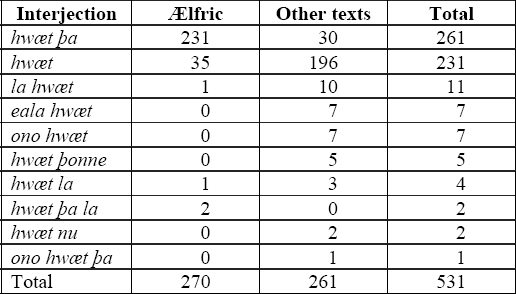
Table 1 shows that as far as OE prose is concerned, the combination hwæt þa is more frequent than simple hwæt, but the difference is not overwhelming. Other combinations of hwæt and an interjection and/or an adverb are present, but their frequency in the corpus is very low.
The frequency of occurrence of hwæt in main declarative clauses in OE prose.

What is more, it turns out that there is a significant difference between Ælfric's writings and other OE prose texts in the proportion of clauses with hwæt þa and simple hwæt: 231 out of 261 uses of hwæt þa (88%) can be found in the texts written by Ælfric. Thus, hwæt þa does not come across as a collocation used in OE prose generally; it rather seems to be a characteristic element of Ælfric's style. Moreover, out of the 30 uses from other texts, 16 come from Gregory's Dialogues (H), so the distribution of hwæt þa in the YCOE corpus is far from being even.
It is also noteworthy that there are 28 clauses with simple hwæt that are used at the beginning of a quotation, as in 9. With respect to hwæt þa-clauses, no such cases have been identified.
-
(9)
Thus, the discourse-opening function of hwæt (that is, introducing direct speech) seems restricted to clauses with simple hwæt, and even there, it is quite limited in OE prose, at least when compared to OE poetry.
Coming back to constituent order, in clauses with simple hwæt there is a strong tendency for a simple adverb (þa, þonne or nu) or another interjection (la) to appear later in the clause, as in 10; 70 such clauses have been identified in the data, which means that 30% of clauses with simple hwæt follow this pattern.
-
(10)
It is interesting that these follow-up elements are exactly the same as the ones that co-occur with hwæt in the clause-initial position, as in 11.
-
(11)
The position of þa, þonne, nu, and la in hwæt-clauses seems unrestricted: The element may be placed either immediately after hwæt or later in the clause (usually between the subject and the verb) without any noticeable influence on the meaning, as in 10d and 11d, where the only difference between the clauses is the position of la. Therefore, it is not certain whether hwæt þa should indeed be treated as a unit from a syntactic point of view, since the data suggest that the elements could be separated, as in 10a. The number of clauses with hwæt…þa in the YCOE corpus amounts to 30. The factor underlying this variation seems to be subject type: The subjects in hwæt þa-, hwæt þonne-, and hwæt nu-clauses are hardly ever pronominal. When the subject is a pronoun, it usually precedes the adverb, as in 10; in clauses with la no such restriction is observed. It is natural to assume that the status of þa in hwæt þa-clauses is the same as the status of nu in hwæt nu-clauses or the status of þonne in hwæt þonne-clauses: All these are simple adverbs known to trigger similar syntactic behavior in main clauses, leading to regular S-V inversion of both pronominal and nominal subjects (they are treated as operators in Kroch & Taylor Reference Kroch, Taylor, van Kemenade and Vincent1997, Pintzuk Reference Pintzuk1999, Haeberli Reference Haeberli, Zwart and Abraham2002, Kemenade & Westergaard Reference Kemenade and Westergaard2012). In contrast, la, as an interjection, is not subject to this line of reasoning. If one assumes that these adverbs are not a part of an extra-clausal interjection phrase but are fully-fledged clause constituents, the question is why they fail to cause S-V inversion when preceded by the interjection hwæt, as explored in the following part of this section.
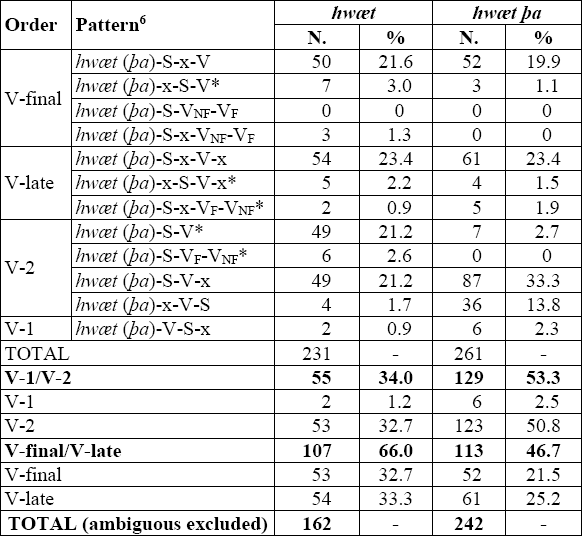
Table 2 shows the distribution of various element order patterns in clauses with simple hwæt and hwæt þa. The patterns are grouped into 4 main categories: V-final, V-late, V-2, and V-1.
Constituent order in main clauses with hwæt and hwæt þa.

As shown in table 2, there are 87 hwæt þa-S-V-x clauses in which þa fails to cause S-V inversion, as in 11a above; there are 6 hwæt þa-V-S clauses in which inversion does take place after þa, as in 12a, and 36 hwæt þa-x-V-S clauses in which inversion does take place, but it is not þa (or not only þa) that triggers it, as in 12b.
-
(12)
In table 2, clauses such as 12a are classified as V-1 because the whole combination hwæt þa is analyzed as a unit. However, it seems more plausible to assume that the S-V inversion is caused by þa, as in 13, than to analyze 12a as an example of the infrequent V-1 order, which, by the way, does not co-occur with the verb aspringan ‘arise’ even once in the YCOE corpus.
-
(13)
As far as the general element order differences between clauses with hwæt þa and simple hwæt are concerned, table 2 shows that if syntactically ambiguous clauses are excluded (the biggest group are short hwæt (þa)-S-V clauses with the finite verb being the second and the final element), hwæt þa-clauses exhibit the V-2 order more often than clauses with simple hwæt: The two groups are clearly different. The main difference between them is related to the frequency of S-V inversion: In the case of hwæt þa, 42 out of 129 V-1/V-2 clauses (32.5%) show inversion, as in 12 above, while in clauses with simple hwæt the same may be observed in only 6 out of 55 clauses (11%), as in 14.
-
(14)
Nonetheless, despite the differences between clauses with hwæt þa and those with simple hwæt, both groups have an intriguingly high proportion of clauses with V-final/V-late order. For example, in Bech's (Reference Bech2012) study, only 214 out of 2,500 main clauses are S-x-V. After adding up S-x-V (that is, V-final) and S-x-V-x (that is, V-late) and considering only structurally unambiguous clauses, the proportion of V-late/V-final in Bech's sample of main clauses is only 19% (14% if coordinate clauses are excluded).Footnote 7 In the case of hwæt- and hwæt þa-clauses, the proportion of V-late/V-final is much higher (66% and 47%, respectively). Let us recall Walkden's (Reference Walkden2013) claim that hwæt-clauses pattern with subordinate clauses with respect to verb position. Considering the frequency of V-late/V-final in hwæt (þa)-clauses, this seems to be more than justified. However, Walkden's claim is based on aggregate figures for all subordinate clauses and all nonconjoined main clauses; the analysis is purely quantitative and does not take into account the quality of the elements other than the finite verb.Footnote 8 In order to verify the claim, an analysis similar to the one presented in table 2 has been conducted for two groups of subordinate clauses introduced by hwæt: dependent questions, as in 15a, and free relatives introduced by hwæt and swa hwæt swa, as in 15b,c. The logic behind this decision was that i) different types of subordinate clauses may show different proportions of element order patterns (Quirk & Wrenn Reference Quirk and Wrenn1957:94, Traugott Reference Traugott1972:108, Stockwell & Minkova Reference Stockwell and Minkova1987:509), and ii) if hwæt-clauses resemble subordinate clauses, they should be closest to those subordinates that are introduced by the same introductory word.
-
(15)
The order of free relatives is especially interesting: Walkden's (Reference Walkden2013) analysis of hwæt-clauses as exclamatives is based on the assumption that they should resemble free relatives and not direct questions in their constituent order. (Indirect, that is, dependent questions are not mentioned).
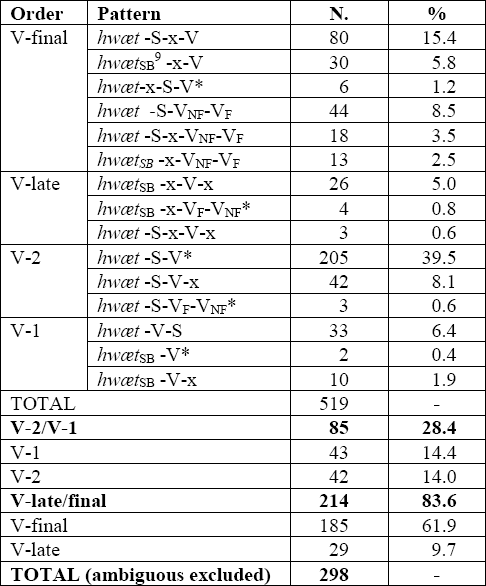
Table 3 shows that dependent questions with hwæt in OE prose are to a great extent short, syntactically ambiguous clauses with S-V order; the proportion of such clauses reaches 40%.
Constituent order in dependent questions introduced by hwæt.

When all unclear examples are excluded, it turns out that the proportion of V-late/V-final clauses in the investigated group is higher than in main clauses with hwæt. What is more, some of the hwæt-V-S dependent questions could also be analyzed as direct questions, as in 16a, which would decrease the already low proportion of V-1/V-2. However, a good example illustrating that hwæt-V-S may be used in dependent questions is 16b (see 16c for the same meaning rendered with hwæt-S-V; both clauses are unambiguously subordinate).
-
(16)
Two particularly interesting patterns involve a complex verb phrase in the clause-final position, as shown in 17.
-
(17)
The pattern shown in 17a, with the finite verb following the nonfinite form, seems to be a norm with hardly any deviations: It is found in 44 dependent questions introduced by hwæt. Only three exceptions, as in 17b, have been identified in the data. What is more, the same order (nonfinite followed by finite) may be observed in clauses with some constituents following the complex verb phrase, as in 18.
-
(18)
Such clauses are not distinguished in table 3. However, if one counts all the clauses in which the nonfinite and the finite verb form are adjacent (there are 97 such clauses altogether), the ratio of the order finite > nonfinite to nonfinite > finite in dependent questions is 9 to 88.
It should be emphasized that the pattern shown in 17a is missing from table 2: Main clauses introduced by the interjection hwæt (or hwæt þa) never follow it. Instead, the alternative ordering, subject–finite verb–nonfinite verb, is found without any exceptions, as in 19.
-
(19)
If clauses with elements following the complex verb phrase are included in the calculation, the ratio of the order finite > nonfinite to nonfinite > finite in main clauses with hwæt and hwæt þa is 17 to 8. Thus, despite the clearly lower numbers, the tendency is the reverse of the one revealed for dependent questions. Naturally, the pattern shown in 19 is not unknown in subordinate clauses (in generative accounts it is analyzed as verb raising and treated as a variant of V-final; see Ringe & Taylor Reference Ringe and Taylor2014:413). However, the asymmetry between its use in main clauses with hwæt versus dependent questions with hwæt is striking and casts some doubt on Walkden's (Reference Walkden2013) claim that the two groups of clauses behave in a similar way.
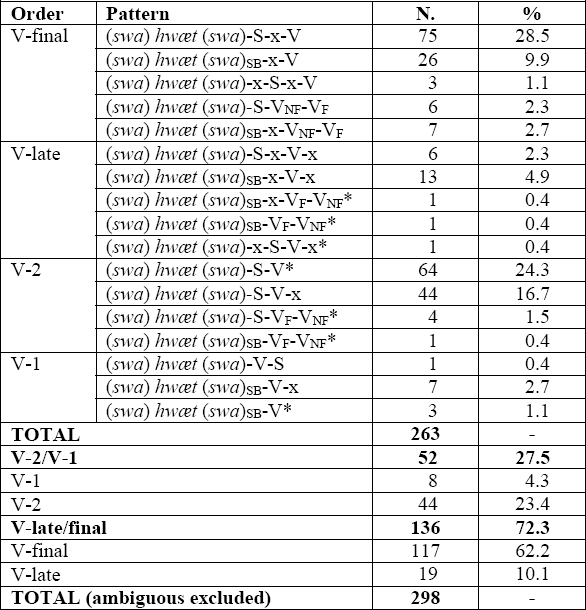
Turning to free relatives, table 4 shows that the distribution of orders is similar to that in dependent questions, if short, structurally ambiguous clauses are not taken into account.
Free relatives introduced by (swa) hwæt (swa).

S-V inversion hardly ever takes place in free relatives. This is natural considering the fact that it is the relativizer (swa) hwæt (swa) that often functions as the subject of the free relative, as in 20.
-
(20)
In clauses with complex verb phrases, similarly to dependent questions, the finite verb has a tendency to follow the nonfinite form, as in 21.
-
(21)
If clauses with elements following the complex verb phrase are included in the calculation, the ratio of the order finite > nonfinite to nonfinite > finite is 7 to 20. Thus, the tendency is the same in both groups of subordinate clauses, and it is different from the one revealed for main hwæt-clauses (though, because of the lower frequency of complex verb phrases in free relatives, the difference is less overwhelming than the one noted for dependent questions and main hwæt-clauses).
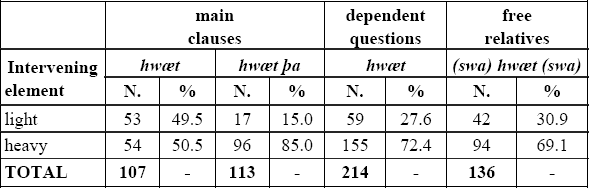
In order to further understand the differences between the investigated clause types, elements intervening between S and V in the (x)-S-x-V-(x) patterns have been analyzed with respect to their weight, and the results are presented in table 5.
Weight of the intervening elements in (x)-S-x-V-(x) clauses.

It turns out that a large number of (x)-S-x-V-(x) clauses in all the groups of hwæt-clauses (especially main clauses with simple hwæt) cannot be treated as clear examples of the V-final/V-late pattern because the element(s) intervening between the subject and the finite verb are light: They are either pronouns, as in 22a, or short (monosyllabic) adverbs, as in 22b.
-
(22)
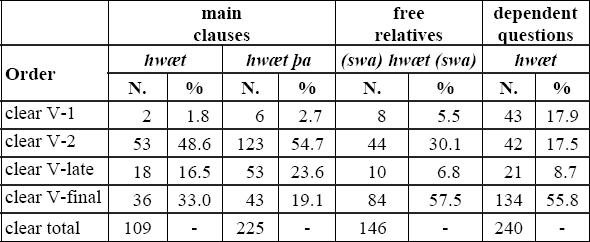
If such clauses are excluded from the sample of V-final and V-late clauses, the difference between main hwæt (þa)-clauses on the one hand and both types of subordinate clauses introduced by hwæt on the other hand becomes evident, as shown in table 6.
Constituent order in various types of hwæt-clauses.

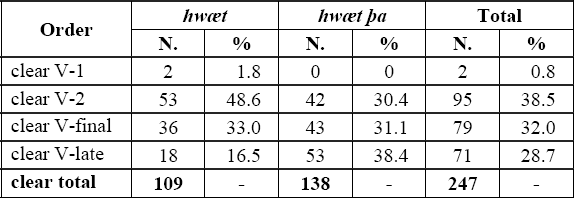
The frequency of clear V-final order in the set of structurally unambiguous clauses with hwæt is different in main clauses and in subordinate clauses. In free relatives and dependent questions, the proportion of V-final is virtually identical (56–57%); in main clauses with simple hwæt, it is 34%, and in hwæt þa-clauses—only 19% (though with a high proportion of V-late). Of course, 34% is a low proportion compared to subordinate hwæt-clauses, but it is still high compared to main clauses, which are supposed to be predominantly V-2 in OE. Even the relatively lowest result of 19% observed in hwæt þa-clauses deserves an explanation. Only ca. 50% of both hwæt- and hwæt þa-clauses have the expected V-2 order. Neither clauses with simple hwæt nor hwæt þa-clauses have the same or similar proportion of V-late/V-final order as the subordinate hwæt-clauses (the difference is statistically significant, the two-tailed Fisher's exact test, p=0.0054 for clauses with simple hwæt and p<0.0001 for clauses with hwæt þa compared to both types of subordinate clauses with hwæt combined).
Moreover, it is noteworthy that the results obtained by Bech (Reference Bech2012) for coordinate clauses are virtually the same as the ones identified for hwæt- and hwæt þa-clauses in the present study. In Bech's (Reference Bech2012) sample, ca. 19% (122 out of 649) of syntactically unambiguous coordinate clauses follow the V-final order, while 49% (318 out of 649) are V-2 (SVX or XVS).Footnote 10 These numbers show that hwæt (þa)-clauses pattern with coordinate (and not subordinate) clauses in their verb position: Hwæt þa-clauses follow the same constituent order patterns as coordinate clauses in Bech's study, whereas hwæt-clauses exhibit the V-final pattern with a relatively higher frequency than Bech's coordinate clauses but with the same proportion of V-2.
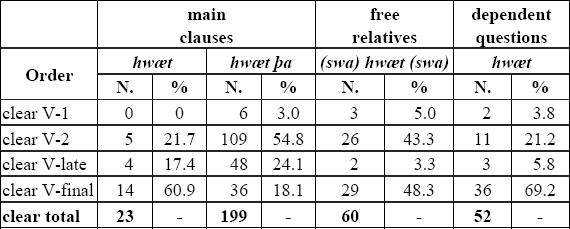
If only texts written by Ælfric are taken into account (Lives of Saints, Catholic Homilies I and II, Supplemental Homilies and letters), the difference between hwæt- and hwæt þa-clauses becomes considerable, as can be seen in table 7.
Constituent order in various types of hwæt-clauses in Ælfric's texts.

The less numerous hwæt-clauses indeed follow the V-final order very regularly; the frequency of V-final/V-late orderings is higher in them than in free relatives, and it is close to that in dependent questions (the difference between main clauses with simple hwæt and subordinate hwæt-clauses in Ælfric is statistically insignificant). In hwæt þa-clauses, the proportions resemble the ones presented in table 6 (which is natural considering that most of hwæt þa-clauses are found in Ælfric's texts). This group of clauses is significantly different from subordinate hwæt-clauses used by Ælfric (p=0.006).
Having established that main hwæt (þa)-clauses do not generally pattern with subordinate clauses with respect to their verb position (contrary to Walkden Reference Walkden2013), the question now arises what the reason is for the high frequency of V-final and V-late orders in this group.
5. Alternative Analysis: Hwæt (þa)-Clauses as Main Clauses
As discussed in section 2, it is not impossible to find V-final main clauses in OE, though it is a minority pattern, even in coordinate clauses (Cichosz et al. Reference Cichosz, Gaszewski and Pęzik2016, Bech Reference Bech2017). In this section, I show that the order in hwæt (þa)-clauses is influenced by the same factors that increase the use of the V-final order in main clauses. Let us recall that according to Bech Reference Bech2012, these factors include subject type (S-x-V clauses do not introduce new subjects), verb weight (verbs in S-x-V clauses are heavy), and verb type (verbs in S-x-V clauses are dynamic and/or punctual, rather than durative).
5.1. Subject Type
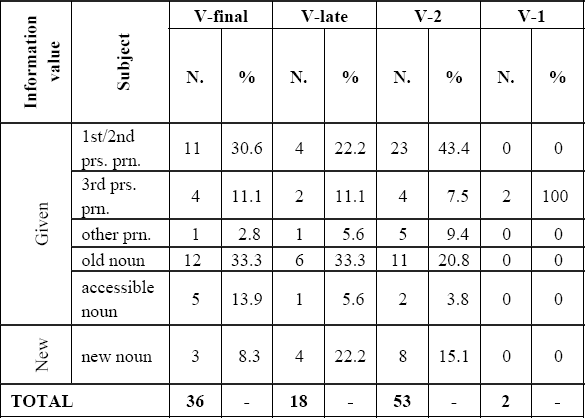
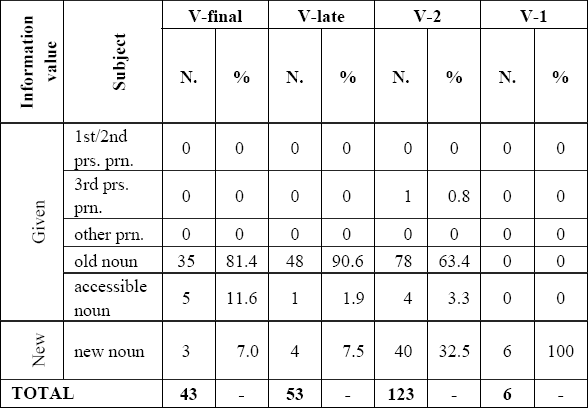
Table 8 presents the analysis of the information value of subjects in clauses with simple hwæt. All pronominal subjects are treated as given, whereas nouns are classified as old (directly repeated), accessible (with the referents inferable from the context), or new (introducing discourse-new referents).
Information value of subjects in structurally unambiguous hwæt-clauses.

Although the percentage of clauses with new subjects is indeed the lowest among V-final clauses, it is quite low among hwæt-clauses in general. This is not unexpected considering that 57 out of 109 structurally unambiguous clauses with simple hwæt contain pronominal subjects, which, by definition, cannot refer to new information.
In table 9, figures are given for hwæt þa-clauses, in which the ratio of pronominal to nominal subjects is drastically different from the one in clauses with simple hwæt, as there is only one case of a pronominal subject (confirming Brinton's Reference Brinton1996 observations).
Information value of subjects in structurally unambiguous hwæt þa-clauses.

The majority of subjects in V-final and V-late hwæt þa-clauses are nouns, and so one would expect their information value to be high. However, the nominal subjects in these clauses most often refer to old, directly repeated material, as in 23.
-
(23)
By contrast, subject nouns in V-2 hwæt þa-clauses are quite often new (32%), as in 24a, and the extreme is represented by hwæt þa-V-S clauses, in which all 6 subjects are clearly discourse-new, as in 24b.
-
(24)
The crucial factor is S-V inversion: In clauses with inverted subjects—both hwæt þa-x-V-S and hwæt þa-V-S, as in 24a and 24b, respectively—the subjects tend to be new, while in clauses without inversion, the subjects are predominantly given. Because the number of inverted subjects in clauses with simple hwæt is lower than in hwæt þa-clauses, the proportion of new subjects is also lower. On the whole, however, it must be stated that the average information value of subjects in both hwæt þa- and hwæt-clauses is low, which may have increased the frequency of the V-final order noted in this group.
5.2. Weight of the Verb
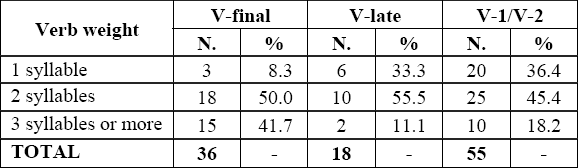
Another factor mentioned by Bech (Reference Bech2012) in connection with V-final main clauses is the weight of the clause-final verb. Table 10 presents the weight of verbs in all structurally unambiguous clauses with simple hwæt; weight is measured by number of syllables.
Weight of verbs in structurally unambiguous hwæt-clauses.

It is evident that the percentage of heavy verbs is exceptionally high in V-final hwæt-clauses, as in 25.
-
(25)
Hardly any of the V-final clauses contain light monosyllabic verbs, but in clauses showing other orders, such verbs are quite frequent, as in 26.
-
(26)
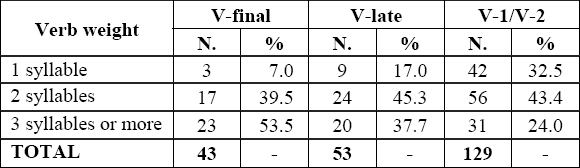
In hwæt þa-clauses, illustrated in table 11, the tendency is the same, though the difference between V-late and V-1/V-2 clauses is clearer than in clauses with simple hwæt.
Weight of verbs in structurally unambiguous hwæt þa-clauses.

More than half of the V-final clauses contain heavy verbs, as in 27a, while light monosyllabic verbs are relatively frequent in V-1/V-2 clauses only, as in 27b.
-
(27)
Thus, in both, hwæt- and hwæt þa-clauses, the weight of the verb has an impact on its position. A similar calculation conducted for subordinate hwæt-clauses revealed that only 9% of V-final dependent questions and 28% of V-final free relatives contain heavy verbs. At the same time, in 29% of the former and 33% of the latter, the verbs are monosyllabic, which makes V-final main and V-final subordinate clauses with hwæt completely different in this respect. Let us recall that in Bech's (Reference Bech2012) study, 37% of verbs in SXV clauses are heavy, while in SVX clauses, the corresponding figure is only 4.5%. Thus, the influence of weight on the position of the verb in hwæt- and hwæt þa-clauses is even stronger than in ordinary main clauses.
5.3. Verb Type
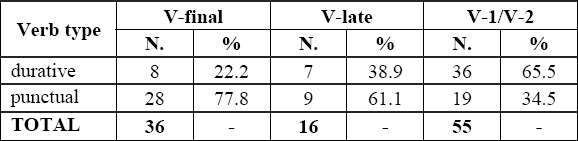
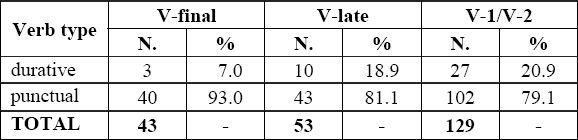
Finally, Bech (Reference Bech2012) claims that verbs appearing in the clause-final position are dynamic in nature. This claim is confirmed in my sample of hwæt-clauses. As shown in table 12, almost 78% of the clause-final verbs are punctual rather than durative.
Types of verbs in structurally unambiguous hwæt-clauses.

As for the durative verbs, they are mostly verbs of being, as in 26 above, and they are rarely used in V-final and V-late hwæt-clauses. In hwæt þa-clauses, the tendency is less clear because, as shown in table 13, punctual verbs are relatively frequent in the whole group of clauses. This observation is consistent with Brinton's (Reference Brinton1996) analysis of Lives of Saints, which points to the “overwhelmingly dynamic, telic, and active” nature of verbs in hwæt þa-clauses (p. 194), visible in all clauses of the group regardless of the verb position.
Types of verbs in structurally unambiguous hwæt þa-clauses.

Nonetheless, the clause-final verbs often seem to carry the crucial part of the message, as in 25 and 27a, which goes hand in hand with Bech's (Reference Bech2012:75) interpretation of V-final main clauses:
The verb thus seems to play an essential role in the clause, to the extent that from an information structure point of view, its final position may even be a result of its importance (on the assumption that high information value elements occur at the end of the clause); there is focus on the verb.
Brinton (Reference Brinton1996:188–189) claims that one of the functions of clauses with simple hwæt in OE poetry is to provide evaluation of the narrative point: They never introduce mainline events but rather comment upon the narrative. The same cannot be claimed for OE prose on the basis of the present study: Clauses with simple hwæt often tend to push the narration forward, just like clauses with hwæt þa, for which the function is defined by Brinton as denoting “an event occurring sequentially in the plot” (p. 196), so that they “express foregrounded events, or mainline events in the plot development” (p. 194).
However, the claim that hwæt-clauses fulfill different functions in OE poetry versus prose is undermined by the following observation: Many hwæt-clauses in OE prose contain þa, þonne, or nu later in the clause (as shown at the beginning of section 4). Naturally, due to the presence of these adverbs, these clauses introduce mainline events, as in 25, since the main function of þa and þonne in main clauses is to mark the main line of the narrative (Wårvik Reference Wårvik2011, Los Reference Los2015:196). Note that ca. 50% of clauses with simple hwæt contain pronominal subjects (see table 8), which precludes the use of the hwæt þa-S pattern (recall that pronominal subjects regularly intervene between hwæt and þa in contexts such as 10a). Thus, some of the clauses with simple hwæt could actually be syntactic variants of hwæt þa-clauses with a different subject type, given the functional similarity between the two (both tend to introduce mainline events). When a hwæt-clause in OE prose does not contain any of the adverbs, it can, indeed, often be interpreted as a commentary on the mainline event, just as in OE poetry, exemplified by 28.Footnote 11
-
(28)
Bech (Reference Bech2012:82) suggests that “verb-final order is often used in the substructure of the text, after the main events have been introduced,” which means that hwæt-clauses without the adverbs—which do not introduce mainline events—could be expected to have the V-final order more often than clauses following the pattern hwæt-S-þa/þonne/nu. However, as shown in table 14, the tendency is actually the reverse: If one of the adverbs is present, the clause has the V-final order more often, though the difference is not overwhelming. Moreover, the dominant pattern is structurally ambiguous: The light narrative-sequencing, or time-sequencing adverb is usually the only element intervening between the subject and the verb, as in 29b below, and thus the clause cannot be treated as a clear example of V-final or V-late.
Time-sequencing adverbs in long hwæt-clauses.Footnote 12

Thus, the functional difference between clauses with simple hwæt (commentary on a mainline event) and hwæt þa (introducing a mainline event) suggested in Brinton Reference Brinton1996 may be the direct consequence of the presence or absence of þa in the clause. In OE prose, clauses with simple hwæt often contain these adverbs placed later in the clause. This may be the reason for an apparent lack of a clear-cut functional distinction between these groups of clauses. Finally, the conclusion is that the functional difference between clauses with and without the time-sequencing adverbs is not reflected in their constituent order, at least not in the way suggested by Bech (Reference Bech2012).
Interestingly, in places where hwæt-clauses are used to introduce speech (which happens relatively rarely, as shown at the beginning of section 4), V-final/V-late is a minority pattern: Only 3 clauses out of 28 follow it. The most common order in this group is V-2, as in 29a, or S-x-V with a light intervening element, as in 29b.
-
(29)
To sum up, it seems that information structure, verb weight, and verb type influence the order of elements in hwæt (þa)-clauses, which leads to a conclusion that hwæt (þa)-clauses pattern with main clauses of a specific type. Their constituent order shows i) limited availability of S-V inversion (especially in clauses with simple hwæt), and ii) higher-than-average frequency of V-final (provided that the clause is not used to introduce speech). Lack of S-V inversion is typical of clauses that tend not to introduce new subjects into the narration, while the frequency of V-final is increased due to verb weight and (to some extent) verb type, with durative verbs preferring V-1/V-2 and punctual verbs favoring V-final/V-late (at least in clauses with simple hwæt). The relation between function and verb position is not clear, but the presence or absence of a time-sequencing adverb seems crucial for the functional classification of a hwæt-clause, which is another argument for treating þa in hwæt þa-clauses as a functionally independent constituent.
6. Summary and Conclusions
The study has shown that it is an overgeneralization to state that main hwæt (þa)-clauses pattern with subordinate clauses because:
-
(i) The frequency of the unambiguously V-final order is higher in both types of subordinate clauses introduced by hwæt than in main clauses with hwæt, and the difference is especially striking in clauses with hwæt þa.
-
(ii) In clauses with complex verb phrases, the finite form regularly precedes the nonfinite form in main hwæt (þa)-clauses, while in subordinate clauses, the tendency is the reverse.
-
(iii) Neither hwæt þa-clauses nor clauses with simple hwæt pattern with subordinate hwæt-clauses with respect to verb position, though the latter are closer to subordinate clauses than the former (especially in Ælfric's texts).
-
(iv) The position of the verb in main hwæt (þa)-clauses is sensitive to verb weight, while in subordinate clauses, the verb tends to take the clause-final position regardless of its length.
There are two further points that should be highlighted. First, clauses with simple hwæt and hwæt þa-clauses are not identical in their element order tendencies, especially as far as S-V inversion is concerned. While hwæt-clauses rarely follow the V-S pattern (and, as a result, rarely introduce new subjects into the narration), hwæt þa-clauses show inversion more often, though less often than main clauses that are not preceded by hwæt. The presence of the interjection at the beginning of the clause regularly (though not categorically) blocks the inverting influence of þa, which results in the hwæt þa-S-V order.
Second, it must be emphasized that even though the regular co-occurrence of hwæt and þa in OE prose has led some scholars to treat the two words as a unit (see Brinton Reference Brinton1996, Walkden Reference Walkden2013), such an analysis is not unproblematic. First of all, hwæt þa as a collocation appears only in OE prose, and it is to a large extent limited to Ælfric's writings, which makes its distribution rather restricted. What is more, þa appears very frequently in hwæt-clauses, where it is placed between the subject and the verb. If the subject is pronominal, þa is not placed before it, which suggests regular variation between hwæt þa-S-V and hwæt-S-þa-V based on subject type, with a similar narrative function of both patterns.
Finally, it should be noted that hwæt is not the only (extra-clausal) element that decreases the rate of inversion after þa. As shown in 30, the same inversion-blocking effect may be observed in clauses introduced by the interjection efne and in coordinate clauses with and.
-
(30)
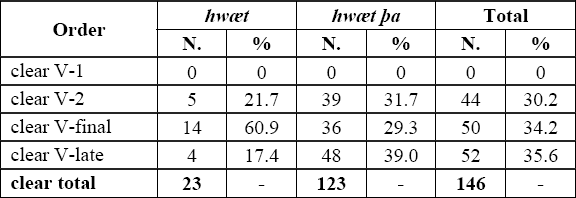
Thus, it seems that þa may not cause S-V inversion in certain syntactic contexts, namely, in the presence of a particular type of extra-clausal elements (coordinating conjunctions and interjections, as noted by Mitchell Reference Mitchell1985:§2547, note 95). In all of these contexts, þa introduces a new event, so it seems functionally independent of the preceding interjection/conjunction. In such a situation, one would be justified in treating þa in hwæt þa-clauses as a structurally independent clause element. If þa is analyzed as a clause-initial constituent, the frequency of V-2 in hwæt þa-clauses is automatically decreased, since all hwæt þa-S-V-x clauses can no longer be classified as V-2 (and because there is no intervening element between the subject and the verb, such clauses must be excluded from the study sample as ambiguous). After recalculating the frequencies, there is still a difference between the two groups in the relative frequency of V-2 and V-late, as shown in table 15. When the groups are combined, the order in main hwæt-clauses is still different from the order in subordinate hwæt-clauses (see table 6).Footnote 13
Constituent order in hwæt-clauses (þa treated as a clause constituent).

If only texts written by Ælfric are taken into account (to limit the problem of intertextual differences), as in table 16, the order distribution does not pattern with that in free relatives or dependent questions either (see table 7): Hwæt-clauses show the V-2 order more often than dependent questions and less often than free relatives; they also show V-final less often than either of these groups. Therefore, on the basis of these results, it would be difficult to claim that the position of the verb in main hwæt-clauses resembles that in subordinate hwæt-clauses: Differences exist, and they are relatively extensive.
Constituent order in hwæt-clauses in Ælfric's texts (þa treated as a clause constituent).

What is more, the study has shown that it is possible to analyze hwæt-clauses as main clauses and to explain the exceptionally high incidence of the V-final order in them on the basis of the factors identified for other main clauses: the information value of the subject, weight (length) of the verb, and verb type. It seems that hwæt-clauses have the V-final order so often because they are used in contexts that generally favor this order in main clauses: They mostly contain low information subjects as well as dynamic (and often long) verbs. When they are used in OE prose in a different, less typical context—that is, when they introduce new subjects and contain short monosyllabic durative verbs, or introduce speech—they have the V-2 order. Thus, hwæt-clauses do not tend to be V-final because of hwæt; rather, they have the V-final order for similar reasons and in similar contexts as other main (coordinate and noncoordinate) clauses in OE prose. In his study, Walkden does not take coordinate clauses into account, claiming that “constituent order in these clauses is not well understood” (Walkden Reference Walkden2013:471, note 9). However, it seems that hwæt-clauses actually bear some resemblance to coordinate clauses: They do not show regular S-V inversion after þa and have higher-than-average frequency of V-late/V-final order (compared to noncoordinate main clauses). Therefore, grouping and-, ac-, efne-, and hwæt-clauses together seems empirically justified (though a detailed comparison of all these clause types is needed to verify the hypothesis), whereas the claim that hwæt-clauses follow the same patterns of constituent order as subordinate clauses is not supported by the corpus data discussed in the present study.
APPENDIX
Query 1: used to extract main clauses with the interjection hwæt (including hwæt þa-clauses)

Query 2: used to extract free relatives introduced by hwæt (including swa hwæt swa-clauses)
Query 3: used to extract dependent questions introduced by hwæt