When Hillary Clinton announced her presidential candidacy, questions about the role of gender in presidential politics immediately surfaced. Would gender stereotyping and sexism pervade the electoral environment? Would the media treat Clinton differently than her competitors in the Democratic primary field? Would Clinton's candidacy mobilize women of all types, simply by virtue of its historic nature? And when Clinton lost the Democratic nomination, new questions quickly arose. Was America just not ready to elect a female president? To what extent did Bill Clinton account for Senator Clinton's successes and failures? How would the 18 million women and men who cast their ballots for Clinton vote in the general election? With so many interesting unknowns, political scientists will likely spend the next several years examining Hillary Clinton's campaign and assessing the extent to which her sex affected her experiences and contributed to her primary loss.
As interesting as many of these questions may be, we must proceed cautiously in answering them, since Hillary Clinton was not a “typical” female presidential candidate. Not only did Clinton begin the race with levels of name recognition that many candidates never achieve, but she also entered the electoral arena with 17 years of public accomplishments and 17 years of well-publicized baggage. On the one hand, many members of the media reporting on her race had also covered her as first lady; and many of the unresolved “scandals” that plagued the Clinton administration emerged once again as fodder for commentary. On the other hand, Clinton immediately tapped into a network of donors and political operatives that most presidential candidates—male or female—spend months, if not years, attempting to access and cultivate. In short, analyzing Hillary Clinton's campaign and extrapolating from her experiences to those of other women who might potentially emerge as presidential contenders is likely an endeavor with limited generalizability.
Even if Hillary Clinton's presidential campaign was unique and atypical, though, it shed light on at least three gender dynamics that affect women in politics more broadly, each of which suggests that navigating the political terrain in 2008 was more complicated and complex for women than for men. This was the case for Hillary Clinton, a female candidate who operated within, and was forced to respond strategically to, an electoral environment rife with overt bias. This was the case for female potential candidates, who will now have to reconcile the sexism they observed with their own political ambition. And this was the case for female party leaders and elected officials, many of whom felt compelled to apologize for and justify their endorsements and vote choice in a way that men rarely do. Although this essay provides only preliminary evidence for these claims, I seek to use the 2008 presidential primary as a lens through which to highlight several ways that gender remains relevant in the electoral arena and to suggest a series of research questions that grew out of the 2008 Democratic primary, but that transcend Hillary Clinton's campaign.
DEALING WITH GENDER STEREOTYPING AND SEXISM: AN ADDITIONAL HURDLE FOR FEMALE CANDIDATES
Few women and politics scholars were shocked when the New York Times lauded Speaker of the House Nancy Pelosi for securing the votes to increase the minimum wage, fund stem cell research, and reduce the price of prescription drugs for seniors, all while “looking preternaturally fresh, with a wardrobe that, while still subdued and over-reliant on suits, has seldom spruced the halls of Congress.”Footnote 1 Nor were they likely stunned when the Washington Post barely discussed the education policy Senator Hillary Clinton promoted while donning a neckline that “sat low on her chest and had a subtle V-shape.”Footnote 2 And when Rush Limbaugh, on the basis of an “unflattering” photograph of Senator Clinton, asked, “Does our looks-obsessed culture want to stare at an aging woman?” political scientists probably did not balk.Footnote 3 After all, a wide body of literature provides compelling evidence that women are more likely than men to receive media coverage and commentary that is based on their appearance, “feminine” traits, and ability to handle “women's issues” (Braden Reference Braden1996; Bystrom et al Reference Bystrom, Banwart, Kaid and Robertson2004; Carroll and Schreiber Reference Carroll, Schreiber and Norris1997; Kahn Reference Kahn1996; Norris Reference Norris and Norris1997a; Reference Norris and Norris1997b; Weir Reference Weir and Duke1996).
The 2008 election cycle, however, presented scholars, analysts, and citizens with examples of far more than a “mere” focus on female candidates' appearances. When two men chanted “Iron my shirt!” at a Hillary Clinton campaign rally in New Hampshire days before the primary, the candidate responded, “Ah, the remnants of sexism—alive and well.” Indeed, this is only one instance of the sexism, chauvinism, and even misogyny that occurred during the primary season. Consider Bill Maher's reaction to Clinton's infamous campaign trail “cry.” Recounting the incident in which Senator Clinton became slightly choked up when discussing the humbling yet harrowing experience of running for president, Maher said, “The first thing a woman does, of course, is cry.”Footnote 4 Think about Chris Matthews's use of the words “stripteaser” and “witchy” to describe Clinton.Footnote 5 Or Tucker Carlson's assessment of the Hillary Clinton nutcracker: “That is so perfect. I have often said, when she comes on television, I involuntarily cross my legs.”Footnote 6 A list of similar comments—by pundits, pollsters, reporters, and voters—is virtually endless.Footnote 7 Put simply by Katie Couric, “Like her or not, one of the lessons of [the Clinton] campaign is the continued and accepted role of sexism in American life, particularly in the media.”Footnote 8 Nancy Pelosi echoed this sentiment: “Of course there is sexism. We all know that, but it's a given.”Footnote 9
Despite these examples of overt sexism, the consensus among observers and analysts, with a few notable exceptions, is that Clinton did not lose the nomination because she was a woman. Her campaign, in other words, developed a strategy to work effectively within the confines of gender stereotyping and media bias. According to presidential historian Doris Kearns Goodwin, “It will be seen that being a woman, in the end, was not a detriment and if anything it was a help to [Clinton].”Footnote 10 On the basis of a compilation of polls and assessments from political analysts, the Christian Science Monitor concludes: “Certainly, [Clinton] encountered sexism on the trail and in media coverage, and a quick cruise around the Web could have found some of the crudest examples of misogyny imaginable aimed at her. But her being female did not cost her the nomination.”Footnote 11 Even a former press aide in the Clinton administration, who acknowledges the “sexist overtones to the coverage,” concludes that sexism did not affect the outcome of the race.Footnote 12
Exactly what Clinton's strategy entailed, the demographic groups on which she relied, and the best messages to combat sexism were, and will continue to be, examined by the political elite and the public alike.Footnote 13 What is not up for debate, however, is that Clinton was forced to navigate a sexist environment and craft a strategic response. Her response may have been sufficient to mitigate or even offset the potentially harmful media bias she encountered. But that bias did provide an additional hurdle with which Clinton, because she was a woman, had to grapple.
As we generalize beyond Hillary Clinton, it is imperative to incorporate into our analyses the deeply embedded—indeed, stipulated—societal sexism that often accompanies women's inclusion in politics. Because women tend to win elections at comparable rates as men (Fox Reference Fox, Carroll and Fox2006; Lawless and Pearson Reference Lawless and Pearson2008; Plutzer and Zipp Reference Plutzer and Zipp1996; Seltzer, Newman, and Leighton Reference Seltzer, Newman and Leighton1997; Thompson and Steckenrider Reference Thompson and Steckenrider1997), we often overlook the fact that the playing field that produces gender parity in outcomes is not level. We also often fail to acknowledge that, as a nation, we are not ready to discuss why sexism still exists, the extent to which cultural norms have evolved, or how we can eradicate it. Rather, we focus on how female candidates can and do succeed within its confines. If 2008 can teach us anything, it should be that any discussion of campaigns and elections that fails to account for the sexist terrain candidates often navigate falls short of fully assessing gender's role in American politics and women's place in society.
WHY WOULD I EVER WANT TO ENDURE THAT? LINKING PERCEPTIONS OF BIAS TO POLITICAL AMBITION
Shortly after Barack Obama clinched the Democratic nomination, the Pew Research Center attempted to account for women's slow movement into high-level political positions in the United States. On the basis of a representative national sample, they found that 51% of respondents believe that Americans are not “ready to elect a woman to high office.” Nearly 40% of the individuals they surveyed contend that women are discriminated against in all realms of society, including politics.Footnote 14 A September 2008 Lake Research/Lifetime Television poll confirmed these general results, and supplemented them with data indicating that 40% of women do not think Hillary Clinton was treated fairly in her campaign.Footnote 15
Senator Clinton's loss in the Democratic primary is noteworthy, therefore, not only because it appears consistent with many Americans' perceptions of a competitive electoral environment that is biased against women, but also because it likely reinforces these perceptions. Indeed, recent survey data collected during the presidential primary from thousands of “potential candidates”—men and women lawyers, business leaders, educators, and political activists—reveal widespread perceptions of gender bias in politics.Footnote 16
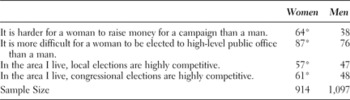
The data presented in Table 1 reveal that women are nearly twice as likely as men to contend that it is more difficult for women to raise money for a political campaign, and only half as likely to believe that women and men face an equal chance of being elected to high-level office (13% of women, compared to 24% of men). Twelve percent of women state outright that they are not qualified to run for office simply because they are the “wrong” sex. Perhaps as a result of their increased levels of perceived bias, women are approximately 25% more likely than men to judge their local and congressional elections as “highly competitive.”Footnote 17
Gender differences in perceptions of the electoral system

Notes: Entries indicate percentage of respondents who answered affirmatively. Significance levels of the gender gap: *p < .05 or better.
These abstract perceptions of bias in the electoral environment affect potential candidates' assessments of their own electoral prospects as well. Women are significantly less likely than men to think that they would win their first campaign. Only 28% of female potential candidates, compared to 39% of men, think that an electoral victory would be “likely” or “very likely.” Alternatively, 29% of women, but only 17% of men, think the odds of winning their first race would be “very unlikely” (gender differences significant at p < .05).
We have long known that when women run for office, they tend to perform at least as well as their male counterparts on Election Day. In terms of fund-raising and vote totals, there is no bias against women candidates. The lack of gender bias in fund-raising receipts and election outcomes, however, is only as good as the extent to which those findings resonate in the candidate eligibility pool. That is, if women who are well positioned to run for office think the system is biased against them, then the empirical reality of a playing field on which women can succeed is almost meaningless. Perceptual differences, then, translate into an additional hurdle that women must overcome when behaving as strategic politicians and navigating the candidate emergence process.
While perceived bias in the political sphere predated Hillary Clinton's presidential bid, her candidacy likely reinforced in potential candidates the notion that it is more difficult for women than for men to succeed in campaigns and elections. As political scientists continue to investigate the gender gap in political ambition and the perceptions of what it means to be qualified to run for office, we must incorporate into our analyses the remarkable levels of bias identified by women and men. Moreover, scholarly examinations must begin to address the extent to which losses incurred by prominent female politicians exacerbate women's reluctance to put themselves forward as candidates. The degree of comfort that women articulate regarding their entry into electoral politics, after all, serves as an important barometer of their full integration into all aspects of life in the United States.
I'M NOT NOT SUPPORTING HILLARY CLINTON: GENDER CONSCIOUSNESS AND VOTE CHOICE
Gender also proved relevant in the 2008 Democratic primary in that we saw an underlying assumption that prominent women would—and should—support Hillary Clinton. The notion that candidate sex affects vote choice is not, in and of itself, new to the study of campaigns and elections. A wide body of research suggests that voters tend to support candidates who elicit group identification (Chaney and Sinclair Reference Chaney, Sinclair, Cook, Thomas and Wilcox1994; Plutzer and Zipp Reference Plutzer and Zipp1996; Sanbonmatsu Reference Sanbonmatsu2002; Smith and Fox Reference Smith and Fox2001). More specifically, gender consciousness—“the recognition that one's relation to the political world is shaped in important ways by the physical fact of one's sex”—is a potentially empowering cognitive evaluation (Tolleson-Rinehart Reference Tolleson Rinehart1992, 14). Granted, women's levels of gender consciousness vary according to sociodemographics and political ideology, with some women feeling no sense of group identification with other women at all. But in many cases, women feel better about government when more women are included in positions of political power (Lawless Reference Lawless2004a; Mansbridge Reference Mansbridge1999; Rosenthal Reference Rosenthal1995; Thomas Reference Thomas, Thomas and Wilcox1998). Thus, women are more likely than men to use gender as a criterion by which to evaluate political candidates and elected officials.
In 2008, however, the expectation that women should vote for women garnered substantial attention in the national discourse. And when prominent women did not support Hillary Clinton, the onus was on them either to explain or to apologize for their “deviation,” as well as to temper their support for Barack Obama. Perhaps the most obvious way this phenomenon manifested itself was through Obama endorsements that included praise for Senator Clinton.
It is not uncommon for elected officials to compliment candidates who do not garner their endorsements. As U.S. Senator Claire McCaskill (D-MO), explained, though, “significant guilt” accompanied her endorsement of Obama:
I think it's hard for women. We all care very much about gender equality, and so it's easy to kind of gravitate over to gender preference. … Hillary Clinton is a strong, smart woman. She is—she is—she would be a terrific president. … I have got a lot of my supporters and friends that are disappointed in me, that feel like I owe a—almost a blind loyalty to Senator Clinton, because she is capable and strong and would be a good president.Footnote 18
U.S. Senator Amy Klobuchar (D-MN) followed suit; she prefaced her endorsement of Obama by stating that she would “never say one bad thing about [Hillary Clinton],” and that she is “just amazed” by Clinton's leadership and accomplishments.Footnote 19 Arizona Governor Janet Napolitano employed similar rhetoric; prior to endorsing Obama, she described Hillary Clinton as an “eminently qualified” candidate who would “serve well as president.”Footnote 20 New York Feminists for Peace, a group of 100 feminist leaders who ardently oppose the war in Iraq, explained that “choosing to support Senator Obama was not an easy decision,” not only because electing a woman president would be cause for celebration, but also because Hillary Clinton is such an impressive candidate.Footnote 21 And Oprah Winfey, who enthusiastically stumped for Obama throughout the country, announced that she would like to be viewed as “being in support of Barack Obama,” but not “being against Hillary Clinton.”Footnote 22
Certainly, not every woman who endorsed Obama reflected positively on Hillary Clinton. Kansas Governor Kathleen Sebelius, as well as Democratic activists Maria Shriver, Caroline Kennedy, and Kate Michelman were among prominent women who did not mention Hillary Clinton at all. Many others unabashedly rebuked Clinton on policy grounds. And progressive activists consistently debated which candidate was more pro-choice, better on the Iraq War, and more electable. At the end of the day, though, the undercurrent of the Democratic primary seems to have been that gender should factor into endorsements, at least as much as policy congruence on key issues. Women, in essence, often felt compelled to justify their vote choice in a way that men rarely must.
In an interview with the New York Times Magazine, Philadelphia Mayor Michael Nutter, a black man who supported Hillary Clinton in the Democratic primary, acknowledged that Barack Obama's candidacy represents a racial milestone. But he explained that not supporting Obama demonstrates progress as well; it embodies a choice and the fact that African Americans cast votes as individuals. Nutter's response to whether he found it insulting to have to defend his support for Clinton summarizes his position well:
It's not insulting. It's presumptuous. It demonstrates a continuation of this notion that the African American community, unlike any other, is completely monolithic, that everyone in the African American community does the same thing in lockstep, in contrast to any other group, I mean. I don't remember seeing John Kerry on TV and anybody saying to him, “I can't believe you're not for Hillary Clinton.” Why?Footnote 23
While white, male superdelegates did not have to justify their candidate preference, many women were, in fact, forced to deal with the situation and frustration that Nutter describes; the playing field for women's participation and activism is more nuanced than it is for men. As political scientists analyze voting behavior in 2008 and beyond, as well as the role of gender in the candidate endorsement process, it would behoove us to incorporate into our research the extent to which gender consciousness and societal pressure often affect the ease with which women can participate openly, actively, and comfortably in electoral politics.
CONCLUSION
Gender clearly plays a complex role in electoral politics in the United States. We rank in the top 10 countries in terms of gender equity in economic opportunities, education, and family law (Inglehart and Norris Reference Inglehart and Norris2003); and when women run for office, women win elections. But in-depth examinations of campaigns continue to show that gender stereotypes affect the manner in which the media assess women candidates (Fox Reference Fox1997; Kahn Reference Kahn1996). Voters rely on stereotypical conceptions of women and men's traits, issue expertise, and policy positions when casting ballots (Koch Reference Koch2000; Lawless Reference Lawless2004b; McDermott Reference McDermott1997, Reference McDermott1998). Women congressional candidates face more primary competition than do their male counterparts (Lawless and Pearson Reference Lawless and Pearson2008). Female candidates are more likely than men to report having been recruited to run for office, suggesting that without outside encouragement and support for a candidacy, they will be less likely than men with comparable backgrounds to emerge in the electoral arena (Lawless and Fox Reference Lawless and Fox2005; Moncrief, Squire, and Jewell Reference Moncrief, Squire and Jewell2001; Niven Reference Niven2006). And geographic differences facilitate women's election in some congressional districts, but lessen their chances of success in others (Palmer and Simon Reference Palmer and Simon2006). As women have achieved parity on some dimensions, then, other barriers remain deeply embedded in the institutions that shape political competition.
This essay suggests at least three additional ways that gender continues to make navigating the political arena more complicated for women than for men. First, at least in terms of the 2008 presidential election, Hillary Clinton was forced to function within the confines of an environment many pundits and analysts stipulated was sexist. Second, potential candidates perceived this sexist environment and, regardless of whether their perceptions are grounded in empirical reality, their political ambition (or lack thereof) may well be a rational response to the prospects of navigating a system in which women must contend with bias. Finally, women who chose to endorse Barack Obama had to fight allegations of “betrayal,” thereby indicating that operating in the political sphere even for female party leaders, officials, and elites is more complex than it is for men.
As we move beyond election 2008 and continue to study the role that gender plays in politics and attempt to measure its deep—albeit sometimes elusive—reach, we must take the lessons learned from this cycle and use them to guide our research. Certainly, we must rely on more than one candidate's experiences and more than one election cycle to determine the extent to which our observations are systemic and systematic. But the 2008 Democratic primary provides us with an excellent starting point for investigating gender's continued relevance in campaigns and elections and the new forms that sexism and bias might now take.