




On the eve of the Constitutional Revolution of Iran (1905–1911, enqelab-e mashruteh), constitutionalist reformers entered Tehran, Iran’s capital, aiming to set off a new political era. They had no unitary vision about the country’s future, though their common aspiration was to be in step with the times, which by then meant being attuned with European modernity. Ideals about governance, law-making, and public order differed among social reformers, religious modernisers, and the state bureaucrats. Yet, as the tide turned in favour of the revolution, the prime target of this pluralistic movement was not the royal court or the mosques, which had haphazardly propped up the Qajar dynasty over the previous turbulent decades. Instead, the Constitutionalists led their – by then, unhampered – march towards the southern slums of the capital, with the intent to uproot the opium dens (shirekesh-khaneh) and to punish the opium users (teriyaki) who populated these venues.Footnote 1 Opium, and the places of intoxication with which it was associated, had become emblems of the old world order, the one to which the decadent dynasty of the Qajar had belonged. In the view of most modernists, this was a world made of belief, of superstitions, of healing, and it was at odds with the world of technology and science, which was arising from the West. The old world order had to be overturned to make way for a new era of health and sobriety. The opium dens were a stage for the new political era through a recalibration of the use of bodies, a bouleversement in how to be a citizen, and how to arrange and govern the conditions of life. This was the beginning of a long historical journey which, in a series of twists and turns, dramatic changes and setbacks, would see Iranian political activists and modernisers confront and struggle with the question of intoxication and its spatial being, its architecture, well into the first years of the 1979 Iranian Revolution.
The use of bodies in the wake of modernity has long been a terrain for theory, both in health and architecture, as well as in politics. Giorgio Agamben, reflecting on the French Situationist Guy Debord, recalled how the clandestinity of private life is left to be understood only through ‘pitiful documents’,Footnote 2 the stuff of everydayness, which nonetheless is ‘the other face of the arcanum imperii’,, the Latin expression referring to the mystery of power and sovereignty. In this encounter between the small and ordinary and the making of world orders, Agamben suggests the use of bodies as a parameter through which assessing change in ethics and politics becomes possible.Footnote 3 But rather than insisting on the ‘agency’ of individuals or groups, we consider seeing bodies as grounds for definition and redefinition of power, and for challenging power through being ‘out of work’. The case that the article explores is significant for many reasons. Firstly, opium’s long history in the modern world is deeply tied to the emergence of capitalism. Iran has been at the centre of this history since the mid-nineteenth century, having been one of the world’s top opium producers and the world’s largest opium consumer. The country’s leadership also experimented on an array of policies that moved from laissez-faire to the total ban of opium, all of which occurred in the game of tensions and concessions with the emergent world order of capitalism. Secondly, while scholarship on drugs and intoxicants has reflected on reformist movements targeting intoxication,Footnote 4 the relative lack of attention to the spaces involved has also been a salient dimension of these emergent confrontations over sovereignty, capitalist forms of life, and health. Thirdly, although the case of the opium dens may seem marginal at first glance, opium’s local and global role as a commodity and its deep entrenchment in the social fabric reveal otherwise. Focusing on the opium dens demonstrates how negotiations and confrontations around this subject were foundational to the creation of novel forms of life under capitalism.Footnote 5
The events that followed the attack on Tehran’s opium dens took Iran through a period of popular protests, political reforms, and foreign interventions, which led to the establishment of Iran’s first parliament (the Majles) and the adoption of a constitution to limit the powers of the defunct dynasty of the Qajar, whose rule had started in 1789. Historians have written about the significance of the Constitutional Revolution in Iran’s modern history as well as in the wider geopolitical game between European nations and the Russian Empire.Footnote 6 A series of dramatic back-and-forth in laws and public regulations reflected a radical confrontation over everyday life, in its mundane practices and ethics. The years of the Constitutional Revolution coincided with the first steps towards the establishment of the international order of drug control. This new politico-medical order evolved through a series of international meetings, the first of which took place in the Chinese coastal city of Shanghai in 1909. Amongst the participants was also Qajar Persia, one of the world’s major opium producers. The meeting aimed to establish an international regulated trade of opium in accordance with medical demands.Footnote 7
To make sense of how the international and the local came together in this transformative era of modernisation, we begin in an obscure, malodorous, and deliberately hidden place: the opium den. These dens, which commentators also called crypts (dakhmeh), were materially and symbolically important to the conceptualisation and practices of health and its dialogue with the international regulatory regime of control of intoxicants. The opium den that this article refers to is more than an opium-using venue, but also something less defined than the better-known Chinese opium den. In the case of Iran, the opium den encompasses a range of spaces – from tea and coffeehouses where opium could accompany social interaction over tea and coffee and waterpipes (qalyan), as well as bathhouses and more hidden crypt-like structures. The defining feature of an opium den is its organisation: smoking occurs with ad hoc pipes (vafur) which are prepared by those managing the den, with servants and garçons providing the paraphernalia and help in the ritual practice. This would occur regardless of the exterior appearance of the den, whether a simple, downtrodden crypt or a fancier equivalent. As spatial arrangements of a built and semi-formalised nature, the opium dens changed over time but never beyond the arrangement of providing the basic assistance to the opium smokers in a relaxed and reserved environment. These spaces became ever more reserved as the public outcry against them grew louder.
Exploring their geographical and situational variations, taryak-khaneh, shireh-kesh khaneh, chay-khaneh, which included also the ruins (kharabat) where they were often built or repurposed, the article discusses questions of darkness, light, order and colour, smell, and bodily arrangements and how they were critiqued and opposed by the architectural renewal movement (informed by the Euro-centric paradigms of order, clarity, whiteness and minimalism), under the state-making projects initiated following the Constitutional Revolution in 1905, and more vigorously after the establishment of the Pahlavi monarchy in 1925.
In brief, the article juxtaposes and parallels the architecture of intoxication as an alternative world order to the one that emerged under the modernist state and its architectural models. It offers a new documented account of the built environment of the opium dens and how it exemplified the tension between contesting uses of the body and world orders. Using primary sources from Iranian archives,Footnote 8 including reports about opium dens, drawings and images, first-hand descriptions by visitors to such spaces, and commentaries by leading revolutionaries and reformists waging war against opium dens in the early twentieth century, the article shows how the materiality of everyday life helps to situate abstract historisation of world order in times of dramatic transformation.
World orders and the question of opium
By the late nineteenth century, historical documents attest to opium as a major commodity in Iran’s agricultural economy, with a dramatic surge in cultivated lands dedicated to the poppy. Widespread availability of the poppy was also caused by the underdeveloped healthcare system, with opium having a therapeutic role in the treatment of pain, respiratory and digestive conditions, as well as low mood.Footnote 9 Under the combined pressures of dilapidated resources, cholera and plague epidemics, and famine, opium’s role became central to many activities in the social, economic, and medical realms in the late nineteenth and early twentieth centuries.Footnote 10 Concomitantly, debates about the place of opium, its regulation, and the management of public intoxication were no longer side talks on the more urgent questions of public governance. They become core issues of public order with the royal court, reformers, and clerics engaging in debate on how to govern these matters.
The emergent public concern around opium coincided with the international momentum around its regulation, which took shape through diplomatic conventions. The Shanghai and Hague meetings confirmed that opium functioned as a testing ground for new approaches to governance, health, morality, and international cooperation. This world order was built also around the redefinition of the place of opium, and more generally, intoxication, in a converse drive to the way opium as a commodity had defined the world order of the mid-nineteenth century in the wake of the Opium Wars (1839–42; 1856–60), and the rise of free trade capitalism spearheaded by Britain.Footnote 11 The Iranian delegation was in an uncomfortable place when it came to opium. The early twentieth century saw the Iranian state in a desperate pursuit of financial resources to counter the general decline of its institutions, including the army. With Iran’s economy heavily dependent on the trade of opium, the emergent world order created a paradoxical situation where calls for national renewal at home needed large-scale investment in public institutions and infrastructures, which, before the discovery of oil, could not materialise without opium, Iran’s principal export asset. Without the latter, Iran’s treasury risked bankruptcy and would have been unable to meet its financial obligations.
So, when the government in Tehran signed the Shanghai Opium Treaty (1909), it expressed reservations to Article 3a in Chapter 1, the text of which read that ‘it was undesirable to import drugs into a country where their use was illegal’.Footnote 12 That did not impede the Iranian parliament, on 15 March 1911, from making Iran the first opium-producing country to introduce laws to limit the scope of land cultivated with the poppy and to regulate the spaces where people could smoke opium and its derivatives in public.Footnote 13 The new law established a seven-year window period for all opium users to kick their habit, while it created a government office charged with the duty to sell opium to registered opium users and to collect smoked opium residue to produce shireh, an opium derivative. It was a small, but ground-breaking step, which attempted to harmonise the nascent, predominantly moralistic internationalism of opium control with the everyday material culture of the opium habit in Iran.
The association of opium with a decaying world order was enshrined in the law and the new intellectual milieux that had come to public life with the Constitutional Revolution. These novel groups advanced the idea that opium and the opium dens were a threat to Iran’s modernising plan and an impediment to its joining the new world order blossoming under the steering force of Western capitalism. By 1942 groups of middle-class professionals (physicians and intellectuals) and their wives had established the Anti-Alcohol and Anti-Opium Society.Footnote 14 Its manifesto declared: ‘It seems that the question of the effects of opium and alcohol has reached a point where the Iranian race …will come to annihilation. In the name of the protection of our nationality, we create a committee for the fight against this sad situation …’ This rhetoric (‘annihilation’ and ‘protection’) reframed addiction as a threat not only to the individual but to the survival of the nation. It redefined intoxication as a socio-political pathology, one that justified disciplinary intervention in the body, the household, and the city, the oikos and the polis.
The modernist discourse which developed within the context of the Constitutional revolution, and flourished with the establishment of Reza Shah’s modern nation-state in 1925, had led to a new ideal body paradigm: healthy, heterosexual, hygienic, productive, civilised and virile.Footnote 15 Only an upright body like this was capable of combating the enemies of the individual and of the nation: germs, ‘backward’ traditions, despotism, intoxication, laziness and Anglo-Russian colonialism. More importantly, this new body would be productive and contribute to the economic prosperity of the nation. Historian Tavakoli-Targhi, on the basis of a systematic reading of period publications, noted that the Constitutionalists allegorised the ‘mother homeland’ as a sick body in need of care and nurturing.Footnote 16 This is not unlike other contemporary reform movements across Asia, Africa and the Americas, where the use of medical metaphors was instrumental in calls for political change and national redemption. In some instances, like China, social reformers identified opium as the culprit of national decadence and the body of the new men who belong to it.Footnote 17
In writings and visual culture within and following the Constitutional Revolution, the metaphor of the ‘ill mother’ showed a reclining body which needed to ‘rise’ and stand on her feet, as seen in Figure 1. In some of the Persian novels published in the 1920s, diseased and ignorant bodies lay on the floor, while modern heroes stood up or lay on beds.Footnote 18 Many poems and lyrics emphasised keywords such as barkhastan (to rise), as seen in the song ‘Iran! It is time to work | Rise up and see!’Footnote 19 or in Alinaqi Vaziri’s Gymnastique musicale and Athletes, the titles themselves suggesting a muscular view of citizenship.Footnote 20 In this context, opium dens and other spaces of intoxication became antithetical to the Constitutional ideal of the body.
An illustration from the Constitutional women’s magazine Shokufeh. On the right, the ‘sons’ of Iran are asleep, leaving the ‘mother homeland’, who is ill, alone in her misery. To cure the mother, who is also lying down, the sons must ‘wake up’. Shokufeh, 29 Apr. 1915, 4.

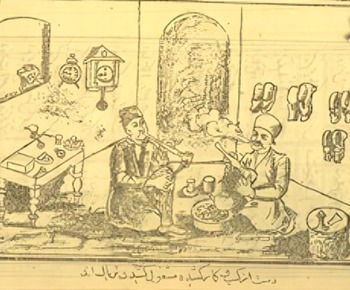
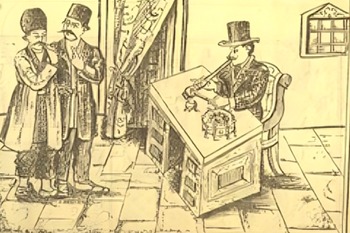
Although writers of that period were cognisant that workers used opium to boost productivity, they maintained that such a habit led inevitably to ‘laziness’, as seen in the illustration in Figure 2 from The Illustrated Book of Mahmoud (1911), a treatise written by a Muslim cleric addressed to both his son and ‘the sons of the nation’ to warn them against consuming opium.Footnote 21 So, when night guards and land workers used opium to keep their bodies ‘awake’, it did not embody the fully active force of the modern worker; rather, it reflected the delayed sluggishness of a bygone era’s labourer.Footnote 22 Later in the 1920s, the new Shah, Reza Pahlavi, had made a point of differentiating his own opium habit from that of the populace. As opposed to most Iranians, it was said that Reza Shah smoked his opium pipe while standing behind his desk or walking.Footnote 23 This was indeed very similar to the stereotypical love-hate Iranian image of the deceitful yet progressive farangi (Westerner, literally ‘Franc’) agent who had made the Iranian nation addicted. In another illustration from The Illustrated Book of Mahmoud, as seen in Figure 3, a person who appears to be a farangi sits behind a desk, smoking opium from a vafur, while two Iranian men stand in front of him. The caption reads, ‘A farangi sitting behind his chair and deceiving Iranians by teaching them how to use a vafur’. The room is furnished with a European curtain, and its window is covered by what appears to be a pitched roof from the inside. This window detail is particularly important, as it bears little resemblance to Western architectural practices and instead serves as a metonym for farangi architecture (in that it employs pitched roofs on the building's overall mass). Therefore, as evident in this illustration and Reza Shah’s case, the image of Iranian progress in relation to body politics was not so much about rejecting opium. Rather, it was the chain of associations attached to opium smoking and traditional forms of intoxication that were under attack, such as lying down or sitting on the floor as opposed to sitting on a chair, and Iranian architecture with its arcs as opposed to an architecture with pitched roofs. Here, the body of architecture itself was paralleled with the use of the body of opium users. The old architecture was unproductive, lying down, roofless, and in ruins, like the people in it who were out of work, whereas Western architecture was upright, intact, and vital.
Two men in their hojreh (traditional shop in bazar) sitting on the floor and smoking opium. The caption reads ‘[t]hey have stopped working and are busy smoking opium’. Kashani, The Illustrated Book of Mahmud.

A farangi sitting behind his chair and deceiving Iranians by teaching them how to use a vafur. Kashani, The Illustrated Book of Mahmud.

The materiality and semiotics of the opium den
Following this brief contextual analysis around the place of opium and opium users in the emerging world order of modernity, our argument moves at ground level in search of the material and semiotic expressions of the conflict and tensions in this transformative historical period.
The space in the city
Opium dens became recognisable spaces of intoxication during the period of rapid commercialisation of the poppy economy in Iran, starting from the mid-nineteenth century. The abundance of opium meant that it was no longer a substance acquired through the attari (herbalists) for health purposes, or as a secondary option in coffeehouses and teahouses. As the number of people who devoted their time to smoking opium, as opposed to swallowing opium pills, surged by the turn of the twentieth century, a new recreational setting made its appearance in the cityscape: the taryak-khaneh and shireh-kesh-khaneh, literally ‘the opium house’ and ‘the opium-residue-smoking house’. The shift from eating to smoking opium was key in the creation of opium dens. While eating opium could occur in any place, in line with the pharmacopeia enunciated by Iranian traditional medicine, smoking opium represented a novel habit which had been imported through Iranian traders’ encounter with the Chinese culture of intoxication. Smoking required space, time, and paraphernalia, which included the heating of charcoal and the opium pipe (vafur), the cutting of opium doses (bast), and laying down of side treats, such as tea and sweets. For the experience of intoxication to be a pleasant one, the spatial arrangement needed to be well thought out. Thus, opium dens were conceived as spaces that offered both the pleasures of intoxication and the need for quiet, particularly protection from intrusion and disturbance. Throughout the first half of the twentieth century, the places had come to be known as dar-ol-e‘laj, the Arabic lemma for ‘house of treatment’, or ‘clinic’, indicating the fundamentally medical – or at least self-care – aspect that opium habit required.Footnote 24
Smoking opium also produced large quantities of burnt residue (sukhteh taryak). When properly prepared, this residue had potent intoxicating effects and, in traditional medical practice, was used as a strong sedative. By scratching the inside of the vafur, one could collect burnt opium residue that, when cooked with water over several hours and then filtered, would produce another analgesic substance called shireh, ‘juice’. Shireh has generally twice the morphine amount of raw opium, making it a stronger substance with powerful painkilling, intoxicating effects.Footnote 25 Shireh had become popular among working-class users who would collect the burnt opium residue from the pipes of wealthier users to prepare it or resell it in exchange for money or opium, minimising the cost of their own consumption through a parasitic interaction. It is in this context that the opium dens became places of social gathering and industry, necessary to cook the opium residue and filter it in large cauldrons over several hours.Footnote 26
Due to the need to use a large space and to conceal the strong smell of cooked opium, opium dens were generally located in the neighbourhoods of the capital surrounding the Great Bazaar and the nearby city gates. They employed young workers (at times children) and opium users themselves who often resided in the excavated settlements of brickmakers in areas known as the gowds.Footnote 27 Another site for opium smokers was the old walls of the city. Before the urban interventions of later decades, which dismantled the fortifications of the nineteenth century, Sufis and dervishes gathered in the trenches near Tehran’s city gates to consume intoxicants, particularly opium and hashish (cannabis residue). They established their own khanqahs (places for congregating Sufi orders), using tents, mats, sacks, and fabric to create light makeshift shelters, where they, along with a group of followers, engaged in their rituals, which included intoxication.Footnote 28 More generally, plebeian and pauperised categories, to which the dervishes and some Sufi groups belonged, were mobile in the space of the city. This mobility meant that they would interact across the class divisions that otherwise applied to the geography and built environment defining opium habits in public places, because they were itinerant and, in recognition of their age-old role in Iranian social life, they could enter spaces beyond their material means and social rank. For instance, a pauper dervish visiting a high-end venue with wealthy opium smokers could be welcomed to join the party because of his dervish status, in a way that a working-class man could not.
There is also evidence of other buildings, such as hammams (bathhouses), being converted into opium dens.Footnote 29 By the 1940s, there were at least 175 such official establishments in Tehran alone. One commentator reported that the managers of an opium den operated an itinerant bus on the road connecting the satellite city of Karaj to Tehran. The bus would collect people in need of opium and shireh, and provide them with a space to smoke on the bus before taking them to a secure location in an opium den. Emblematically, the driver’s assistant would shout ‘we take them away dead, we bring them back alive [morde mibarim, zende miyarim]’.Footnote 30 This arrangement seems to have survived for several decades at least.Footnote 31 Later, with morphine and heroin appearing in the Iranian consumer market, injection became another mode of use of opiates, though never prevalent, and with no public or semi-public space allocated to it.Footnote 32
That, however, does not represent the full picture, as wealthy opium users – no less numerous than their working-class counterparts – also gathered in spaces of conviviality, marked by the shared practice of opium intoxication and its associated cultural norms. Wealthy users gathered at events conceived as hedonistic parties (bazm, basat, mehmani, or majles), or simply smoked it at home as part of their everyday routine, which included regular visitors and friends, often in the hayat, the walled garden separating the entrance to the property from the house. Clampdowns on working-class gatherings involved the arrest and prosecution of subaltern social groups and public scrutiny, which led to the destruction of the built structures of the opium dens. Their very purpose was neither reported nor known beyond the circle of visitors. Yet, based on primary sources that indirectly report their spatial qualities, we argue that they stood in stark opposition to the core principles and visions of the then-emerging global modern architectural movement and its annexed notions of health.
The place: an architectural investigation of the opium dens
A two-storey building stood along a wide street lined with lamp posts in Cheraq-Barq Street (literally Electric Lamp Street) in Tehran. The street, the first street to be lit by electric lamps, was built during the nineteenth-century Baroque-inspired development of the capital. From the outside, it looked just like one of the many coffeehouses of the area. But Arsh was no ordinary place. The venue functioned as a coffeehouse and opium den during the day, served ‘araq (raisin vodka) and opium in the evening, and eventually became a hostel and an opium den for shireh smokers after midnight.Footnote 33 The saqisFootnote 34 with their dimly lit equipment in hand attended to the shireh smokers, who lay on the same benches with pillows, spending the night – an arrangement that most likely reflected the class distinctions surrounding different intoxicants. Many coffeehouses featured storytellers (naqqal) who performed tales from Ferdowsi’s tenth-century Shahnameh (Book of Kings)Footnote 35 and folklore, often using wall paintings as visual aids. Musicians, male dancers, male sex workers and itinerant dervishes frequented the coffeehouses. They had wide benches (takht) where customers reclined or leaned comfortably, moving freely or lying down to rest, sleep, or smoke. Unlike chairs, these benches accommodated relaxed positions and had cushions (posthi) supposed to be used for long stretches of time. Constitutionalists often associated coffeehouses with sleeping, chort (napping), deraz (lying down), chombatmeh (squatting), and lamidan (to lean-seat), all of which had strongly negative connotations.Footnote 36 Coffeehouses also functioned as shelters or hostels,Footnote 37 a feature evident since the nineteenth century when travellers and visitors would ask for hospitality from the coffeehouse owner, much like the taverns and inns across Europe. While wealthy individuals consumed opium in private parties with food, wine, and live music, those without monetary means used these public venues that included people from various walks of life, including itinerant beggars and petty criminals.Footnote 38
Sources suggest that many, if not all, of the coffeehouses were also spaces for opium consumption, and in some cases, as seen in the case of Arsh, the two could not be separated. A description of another coffeehouse in Tehran, Postkhaneh, does not differ from equivalent descriptions of opium dens, where the smoke from ‘samovars, stew pot burners, and vafur [opium pipe] braziers’ made it resemble ‘a hammam [bathhouse] furnace’ or ‘a photographer’s darkroom’, with smokers present from ‘dawn until late at night’. Calling this space a dakhmeh (crypt) within the coffeehouse, the Tehranologist Jafar Shahri (1914–99) implied that the seemingly undesirable qualities of the coffeehouse enriched the experience of those who visited it. Its ‘confined and compact’ space ‘quickly fostered familiarity’, while smoke-saturated walls ‘intensified the euphoria of the opium’.Footnote 39 Dakhmeh, repeatedly used by Iranian modernists to refer to opium dens, originally referred to Zoroastrian burial chambers, which could be carved into mountains or located underground. These cave-like chambers were sites where Zoroastrians once burned or cremated their dead,Footnote 40 a feature resonating with the slowly burning residues and dimly lit lights in the opium dens. By the twentieth century, dakhmeh lost its older connotations and became a metonym for any concealed, dark, and stifling place. However, its connection with burial persisted in the metaphors used in descriptions of opium dens. Drug users were often characterised as the walking dead, as illustrated in an earlier example. A dakhmeh, therefore, is a place that hides bodies, whether dead or alive, from the sight of others. It is inhospitable but not uninhabitable, like a crypt, its conception likely evolved in response to the repressive intrusion of the watchmen and policemen, known as mohtaseb, who enforced public sobriety starting from the medieval period to the present.
In the eyes of modernists, opium dens used for smoking shireh were the epitome of the dakhmeh. In a 1935 report published in a medical magazine, the reporter visited an opium den which was built into a brick kiln, possibly near Varamin and Rey, two towns south of Tehran, which since then have been englobed in the metropolitan area.Footnote 41 The reporter entered via a series of underground corridors, resembling the report on the Arsh coffeehouse.Footnote 42 These passageways were described as dark, narrow, and terrifying, with ceilings that seemed at risk of collapse, and evoked the image of ‘burial in an underground grave’. The opium den was depicted as an ‘underground hole’ and dakhmeh (crypt). The air was reported to be filled with foul smoke from opium, coal, and human breath, creating a suffocating atmosphere to which the occupants paradoxically seemed immune. The writer proceeded to the main chamber, which he described as ‘filthy’ and ‘uninhabitable’. Consumers were sprawled on ‘worn-out’ and ‘contaminated mats’, with their heads on ‘dirty cushions’. The darkness was disturbed only by the weak light from makeshift lamps made from cylindrical tins and glass, alongside tools like sikh (long needle) and jowhar-tarash (to wipe off the burnt residue of the opium, which could then be boiled and consumed again in the form of shireh or sold to merchants who traded in it). In a depiction of how the concealment and enclosure of the space – this time described as a siyah-chaleh (dungeon, literally ‘black-pit’) – were essential to the consumers’ experience, he wrote:
In this dark space, which lacked any worthiness for life [salahiyat-e zendegani], fourteen people were lying in various positions. Most of them, with half-open eyes, were stretched out, passing the time by smoking shireh. The stench of the space was so overpowering that it nearly caused us to lose our composure. Reluctantly, we persuaded the manager to open the door of this dungeon for a few minutes, so the air could become somewhat breathable and we could continue our observations. It wasn’t long before a few of the attendees began grumbling in protest at the opening of the door, and the manager (!), eager to please them, closed the door and trapped the air inside once again.
The reporter allegorised the smokers as ‘worms and earth-dwelling insects’ and ‘living dead’, and interviewed a few of them, the only one with a stated occupation being a traditional architect-builder (banna). Choosing a traditional architect-builder as a mo’tad, ‘addict’, is particularly significant given the later modernist architects’ vilification of them as uneducated, backward, and sluggish labourers, a view echoed in two satirical poems published in Architecte in 1946, the first Iranian architectural magazine founded in the relatively free atmosphere of the 1940s by modern architects of different political orientations.Footnote 43
The modernists described opium consumers in a similar animalistic fashion in other reports on opium dens, too, such as a 1930 article in a women’s magazine run by the American Bethel School in Tehran that described the people in an opium den as ‘snakes and scorpions’.Footnote 44 In a later account from 1955, after the passing of new anti-drugs legislation, a doctor described the opium dens as ‘filthy, damp hovels’, with walls and doors covered with ‘thick layers of dust’ and ‘cobwebs hanging from the ceiling and the corners’.Footnote 45 On a ‘tattered mat’, there were ‘foul-smelling mattresses or pillows so dirty they have turned black’, with lamps that ‘flicker[ed] weakly’. The smokers were ‘half-dead beings’ who ‘move[d] like ghosts from the world of the dead’,Footnote 46 descriptions resembling the settings in Figure 4. Another article, published in 1925, also used the metaphor of the ‘moving dead’ to denigrate the opium consumers in a description of a den in the southern city of Ahwaz. Titled ‘Summary of a Distressing Letter’ and similar to the previous reports, this article by an unsigned author described the main space of the opium den as a ‘relatively large room’, with all its holes and openings blocked, except for the door, making it dark. The author estimated that it hosted around 200 customers in total. The consumers were gathered in small groups of no more than three, yet in ‘solitude’ and ‘disappointed’, all resting their heads on a ‘pillow of misery’, not only smoking opium and its residue but ‘probably also hashish’. Notably, in this article, similar to the English term and unlike the literal meaning of the Persian shireh-kesh-khaneh (which means ‘place/house’ for smoking opium or shireh), the den was referred to as ashiyaneh (nest or den), carrying the same dehumanising connotations found in the English term. While the term dakhmeh, with its Zoroastrian burial roots and inference of the presence of burning fire – sacred to Zoroastrians – aligned with the portrayal of the opium den inhabitants as the walking dead, ashiyaneh reflected their animalistic depiction. The modernist critique of darkness in the architecture of the past, as opposed to the transparent and light architecture of the new world order, linked to animalisation: just like insects and the dead, those in the opium dens belonged to the world of the dark.Footnote 47
An opium den, date and original source unknown. Reproduced from J. Shahri, Tarikh-e ejtema’yi-ye Tehran [Social History of Tehran], vi (Tehran, 1990), 163.

Opium den as a castle
Under increasingly heavy policing, the owners of opium dens adapted their buildings to evade detection through different spatial strategies. This made them look like enclosures whose characteristics echoed those of defensive fortifications and castles. As repression of public intoxication increased, opium dens, such as this one described in a 1955 report, moved into ‘narrow, dark alleyways’ in remote neighbourhoods. The walls were ‘built just inside the narrow entrance corridors’ to force visitors to squeeze through sideways, making it easier for the workers to check and control them. ‘Openings [were] created in the door or the parapets’ for monitoring purposes, a defensive and military strategy similar to that of a pre-modern castle. Inside the rooms or on the floor, holes were leading to wells, either in the opium den itself or in an adjacent house, which was usually also owned by the operator. In the eventuality of a police raid, all opium-smoking paraphernalia could be thrown into these holes, erasing possible signs of narcotic consumption (or at least the extent of it).Footnote 48
The human organisation of an opium den also included at least two workers responsible for protection: the dam-e dari (doorkeeper), who, as seen in Figure 5, would stay inside behind the not-fully-opening entrance door and would not open it until he had confirmed the visitor’s identity, and a bepa (guard), similar to ‘a barracks guard’, who knocked on the door to inform the doorkeeper when a customer arrived. Other guards also whistled from outside at various points along the paths leading to the opium den.Footnote 49 Therefore, the opium dens maintained a multi-layered system of human monitoring and infrastructural arrangements aimed at not being monitored. Parallel to the cat-and-mouse dynamics surrounding these spaces, a modern architectural order was being introduced and established in Iran, an order fundamentally opposed to everything that opium dens embodied and symbolised.
A doorkeeper (keshik/dam-e dari) poses in what appears to be a staged photo. In the article related to this photo, published in 1955, raided opium dens are described as ‘crypts’ (dakhmeh). ‘Nimeh-shab-e gozashteh ma’murin…’, Ettela‘at, 10 Sep. 1955, 4.

Opium dens had architectural features of concealment, such as holes in parapets, barrack guards and tall walls, all of which suggest a defensive-military spatial adaptation that was not the product of a traditional arrangement but rather a modern response to the threat of state-led repression of opium culture, a modern response which in itself was based on the traditional spatial methods of defence and monitoring. Anti-opium campaigns applied military strategies too, but theirs was that of a military campaign. This militarism was echoed in the rhetoric around anti-opium campaigns, especially after 1953, the year of the CIA-backed coup that replaced the nationalist prime minister Mohammad Mosaddegh with an army general, Fazlollah Zahedi. According to a report, in 1955, when a group of armed policemen in trucks ‘raided’ twenty-two opium dens in the south, people thought it was another ‘military coup’. In this operation, fifty groups of armed policemen placed the opium dens under ‘siege’ and ‘occupied’ them, before arresting the consumers and sending them to Mehran Garden, an old and vast garden converted to a rehabilitation centre. The report itself was accompanied by a picture of destroyed and toppled furniture of an opium den, such as lanterns, stools, and beds.Footnote 50 In this regard, it might be no coincidence that the red-light district of Tehran was called Shahr-e Now Castle (qal’eh-ye shahr-e now). Although the state recognised its legal status, it existed within a governmental space of moral judgement and public intrusion that, much like the opium dens, carried the recurrent risk of physical clampdown by those opposed to its very existence.Footnote 51
The fortified opium dens were one of the last remaining symbols of the old city with its fortifications. Not long before these reports were written, from 1932 to 1937, the municipality of Tehran had demolished the city’s abandoned fortifications,Footnote 52 both to facilitate the ongoing development of the city and to dismantle the informal settlements that had formed around the city walls where beggars, the impoverished, and opium consumers had gathered. Losing their initial function of providing security, defence, and concealment for the city, the city walls were an obstacle in the way of Tehran’s modernisation. The opium dens’ fortifications were a microscale version of the old city and its demolished walls, fiercely opposing the new order. If Tehran was opening up its walls to expand outwards, the opium dens were moving further inward by heightening their walls.
Space, time, intoxication
Despite Foucault’s formulation of the medieval ‘dungeon’ as a spatial mechanism for punishment, made possible by its enclosedness, absence of light, and concealment,Footnote 53 the crypt of an opium den (dakhmeh) was not a space of suffering from the perspective of an opium smoker. Rather, with its darkness and concealment (see Figure 6), it not only provided a refuge from officially imposed behavioural codes of conduct but also enhanced the experience of intoxication, limiting sensory exposure to a bare minimum. In a space arranged to detach individuals from the ordinary reality of a bustling city, with its fights, hassles, noises, and unpleasant odours, a crypt intensified the experience of intoxication in ways that produced enhanced relaxation, dissociation from negative influences, and the possibility of calm interaction outside intrusive gaze. It was a dark environment with dim yellow glows from shireh-smoking lanterns – each representing a smoker – the soft, repetitious sounds of boiling opium residue and the intensely smoky atmosphere with a low ceiling, encapsulating the smoke to further intoxicate those present and blur their physical boundaries as the weight of bodies progressively left way for a lighter state of being of nash’egi and khomari. These two distinct categories were used by opium smokers to refer to the trajectory of their intoxication, respectively meaning the calm, energetic high and the lethargic relaxation.Footnote 54 The spatial, tactile, sonic, and olfactory conditions of the den worked together to produce an integrated environment suited to intoxication. Darkness muted visual perception just as smoke softened spatial and bodily boundaries. Smell, temperature, and touch merged into an architecture of ambiguity – and flow – that both shaped and was shaped by intoxication. The dens’ earthen floors, thick walls, and low ceilings meant that their heat retention, sound insulation, bodily postures (lying on the side, so that one faced the wall or other bodies rather than the ceiling), and the austere yet ambiguous space sustained the enclosure that made intoxication both spatial and material.
Cave-like spaces within opium dens in which consumers gathered, original source unknown. Reproduced from J. Shahri, Tarikh-e ejtema’yi-ye Tehran [Social History of Tehran], vi (Tehran, 1990), 163.

Modern architecture, on the other hand, was fundamentally opposed to subterranean living, except when related to infrastructure or transportation. By ‘modern architecture’, we do not merely refer to a stylistic or technological phenomenon referred to as modernist architecture, but to a broader moral and disciplinary project of modernity translated into architecture, which found one of its most explicit expressions in the modern movement. The modern movement was marked by a persistent tendency to detach architecture from the ground and to privilege elevation, light, and verticality. From the fascination with skyscrapers (seen in the First Chicago SchoolFootnote 55 and the International Style)Footnote 56 to Le Corbusier’s Five Points of Architecture,Footnote 57 two of which favoured distancing from the ground,Footnote 58 the modern movement aligned with Enlightenment ideals that prioritised transparency over the ambiguity of the medieval order, conditions imagined as incompatible with subterranean space. Underground spaces and basements hardly attracted the attention of modern architects, either in theory or in practice. The dakhmeh, hence, stood at the antipode of such emerging models of spatial arrangement.
One of the less-explored aspects of modern architecture’s infatuation with transparency was the question of time. The new understanding of ‘space-time’ in modern architecture, in Sigfried Giedion’s words, involved a superimposition of spaces, movements, and perspectives, like the concept of time in Cubist painting. This overlapping, interpenetration, and superimposition of spaces in modern architecture made it possible to have multiple viewpoints at the same time, interior and exterior, upper and lower floors, etc.Footnote 59 This implied a break with the centrality of Renaissance perspective, where a sequence of spaces could be experienced in a linear temporal order. In modern architecture, this linear order was replaced by a superimposition of past, present, and future. Modern architecture’s transparency meant that one did not have to discover the different sequences of a building in a linear temporal order, but rather to perceive all the sequences at once. The shift from a linear, single-viewpoint space-time in the Renaissance to the multi-viewpoint space-time of modern architecture – its ‘simultaneity’ – stood in contrast to the spatiotemporal state of an opium den. This temporal simultaneity was an ideological expression of acceleration and oversight, the spatialisation of the modern temporality.
In the Iranian context, too, until the late 1950s, the same principles (though adapted to local needs and restrictions) were practised and propagated by modern architects such as Vartan Hovanessian (1896–1970), Keyqobad Zafar (1910–87), Mohsen Foroughi (1907–83), and Gabriel Guevrekian (1892–1970), as seen in Figure 7. A critical reflection on opium dens or spaces of intoxication was, however, absent from their practice, as dakhmeh (crypt), for Iranian modernists, was the main nemesis to be eradicated (see next section). Up until the 1970s and the rise of a number of national-modernist architects who employed a range of Iranian-inspired historicist grammars in their designs, such as Houshang Seyhoun (1920–2014), a generation of artists and intellectuals sought, in diverse and politically varied ways, a return to the old ‘self’. Ironically, Iranian painters in the 1960s and 1970s re-embraced a space historically associated with opium consumption by reusing the style known as qahveh-khāneh (coffeehouse) painting, which, as the name suggests, originated in coffeehouses and was used for storytelling.Footnote 60
Photo of Hotel Darband (Vartan Hovanessian), a modern leisure space and one of the earliest examples of modern architecture in Iran. Standing proudly ‘over’ Tehran’s northern outskirts and overlooking the older city, it symbolises a rejection of ‘crypt’s of the pasts, which were concealed, dark and enclosed. Published in Iran-e Emruz, Apr. 1938, 29.

Opium dens, therefore, stood in complete opposition to the overtly transparent temporality and spatiality of modern architecture. In opium dens, the confusion of twisted tunnels erases the sequential clarity of space while the darkness in the main rooms disrupts hierarchies that could imply a linear space-time, let alone, the temporal transparency of modern architecture, where inside and outside, and the present and future, were superimposed. Perhaps what distanced the temporal experience of an opium den from any conventional sense of time was the opium consumer’s altered time perception. Whereas modernists championed speed and movement in architecture (Gidion believed the modern time-space in the arts was best expressed in the multi-perspectivity of Cubism and the Futurists’ concern with speed as asserted in the opening of their Manifesto),Footnote 61 time in the opium consumer’s experience slowed to the point of arrest, creating a white emptiness within the mind which bestowed peace and tranquillity. While modern architecture and its ‘simultaneity’ posed an overt-time-awareness, the opium dens were aimed to embody time-unawareness. The uses of the body and the space surrounding it represented the clash of two competing orders, one emerging as a world order (speed and capital) and the other progressively taking refuge in the margins of society.
The lying down body and the right angle
The Constitutionalist emphasis on pathologising and vilifying the reclining body in opium dens, framing it as a symbol of a backward, unhealthy past, was reinforced within a broader architectural discourse by both modern architects and non-architects. This critique was intertwined with international debates on modern architecture and the healthy and standard body, which later peaked in the 1930s and 1940s. In this sense, modern architecture operated as a health regime, prescribing an upright and disciplined body as the universal standard of modern citizenship.
For instance, an illustration from The Illustrated Book of Mahmoud, as portrayed in Figure 8, depicts a setting strikingly resembling a critique by Vaziri, the reformist musician, on ‘middle-class Iranian men’ and the way they sat cross-legged on a small mattress under the korsi (a heated low table with a blanket on it).Footnote 62 In this illustration of a traditional middle-class domestic setting, the figure who appears to be the father sits in front of a korsi on a small mattress (toshakcheh) while smoking opium. A younger figure, possibly the son, stands upright, facing outward from a window, his back to the hunching father, the figure of the backward body. Two decades later, a similar tone was adopted by the architect Vartan Hovanessian, who linked the inhabitants’ ailing, ‘darkened’ bodies to their ‘mattresses’, traditionally used for sleeping on the floor in Iranian homes.Footnote 63 This was in contrast to modern architecture’s ideal body, reflected in its highly regulated and orthogonal forms and lines, in canonical works such as Le Corbusier’s The Modulor (1948)Footnote 64 or Ernst Neufert’s Architects’ Data (1936). For Le Corbusier, the Modulor was a measure ‘to the Human Scale Universally applicable to Architecture’, a ‘universal’ human scale based on the average height of a standing European man with his hand raised; a model which led to a series of design standards.
A young boy stands in front of a window in what appears to be the interior of an Iranian house. An older man, presumably the boy’s father, sits cross-legged on a mattress in front of a korsi, smoking opium. Kashani, The Illustrated Book of Mahmoud.

The critique of the lying-down body and favouring the perpendicular and standing body in Iranian modernists’ writings was perhaps most strikingly reminiscent of Le Corbusier’s ‘right angle’, according to which ‘among the infinite possible angles, the right angle is the angle type’, a ‘symbol of perfection’, and an angle according to which ‘the human being works’.Footnote 65 The urban and architectural grid system, one of the hallmarks of orthodox modernist architecture, emerged parallel to this orthogonal mentality, a system opposing the ‘narrow and twisted’ lines of the opium den or what Le Corbusier called ‘the pack-donkey’s way’,Footnote 66 the hunched body, the reclining body, and Iranian pre-modern architecture with its crypts.
Conclusions
The opium den is a microcosm that sat uneasily with the dawn of a world order that, progressively, was embraced by the Iranian state, its public ethics and institutions. While comparable spaces, such as the red-light districts and the winehouse (tavern, meykhaneh), prospered under the aegis of this new world order, the opium den became both the symbol and architecture of a past to be banished, together with those who spent time with it. But this ban on opium dens should not be confused with a ban on opium as such. Indeed, up until 1955, the Iranian state regulated opium consumption in various, albeit haphazard ways, which included the right of citizens to purchase and consume the substance, as long as this was not done in public. As our article illustrated, the ban represented the very spatial, architectural paradigm that the opium dens materialised: those places that stood as the antithesis of the imaginal and material order of a new polis, understood as a novel world order, constructed by capitalist impulses and desires of integration, productivity, and profit?
Even when, in 1955, following his restoration on the throne, Mohammad Reza Shah had instructed a total ban on opium, the policy lasted for fourteen years before being abandoned in favour of a medicalised programme of state-led opium distribution, known as the coupon system. However, the ban on the opium dens remained in place, enforced by a toughened law enforcement framework against public intoxication.Footnote 67 It seems to us, in light of the documents that our archival research has revealed, that when it came to the opium dens, the state was concerned with matters of architecture, its technologies, and matters of the use of bodies. As illegible places in the modernist order of the Pahlavi state, the dens were crypts hosting unproductive bodies, shameful in their performativity under the Westernised gaze that judged success and failure in public governance. As mentioned in Agamben’s description in the opening of the article, they were ‘pitiful’ aspects of everyday life.Footnote 68 This not only applied to the bodies of the consumers, but to the body of architecture as well. Old architecture, and particularly its crypts – opium dens, public bathhouses, narrow alleyways – were interpreted as a ruinous, ill, and dismantled state of being. Parallel to all of these, modernist architects, regardless of their political persuasions, institutionalised their practice from the 1930s to the 1950s.Footnote 69 By turning old architecture into an architecture of the decrepit and of dispensability, they aimed to eradicate both the old body of the city, the person of the traditional architect-builder (me’mar), and that of publicly visible opium users. Opium dens, in this sense, became architectural entities that maintained the old order. But more than that, the opium den remained a fundamentally antinomian space for the rejection of the totalising nature of modern nation-states with their territorialised bureaucratic reach and regulatory projection, which, though rarely fully expressed in overt terms and strategies, is embodied by the modernist project of harmonisation of citizenship with the space of the city.
Acknowledgements
We would like to express our gratitude to the anonymous peer reviewers for their insightful and constructive comments.
Author contributions
Kamyar Salavati worked on the data collection, interpretation, and writing of the article. Maziyar Ghiabi worked on the data collection, interpretation, and writing of the article. The contribution of the authors is to be considered as equal and part of a collaborative formation of an interdisciplinary approach to the study of health, architecture, and history.
Financial support
Maziyar Ghiabi’s work is supported by The Wellcome Trust (grant: 219771/Z/ 19/Z) under the project, ‘Living “Addiction” in States of Disruption: A Transdisciplinary Approach to Drug Consumption and Recovery in the Middle East’, at the University of Exeter.
Competing interests
The authors declare none.



 Open access

