




No CrossRef data available.
Article contents
Semantic and phonemic sequence effects in random word generation: A dissociation between Alzheimer's and Huntington's disease patients
Published online by Cambridge University Press: 04 May 2005
Abstract
Alzheimer's disease (AD) patients perform worse on category than letter fluency tasks, while Huntington's disease (HD) patients show the reverse pattern or comparable impairment on both tasks. We developed a random word generation task to further investigate these deficits. Twenty AD and 16 HD patients and 20 elderly and 16 middle-aged controls guessed which of three pictures (hat, cat, or dog) landed on a die's top face sixty times. Three consecutive response pairings were possible: semantic (cat–dog), phonemic (hat–cat), and neutral (hat–dog). Since healthy individuals avoid repeating meaningful associates (“repetition avoidance”), an increased pairing frequency reflects processing deficits. AD patients produced more semantic and HD patients more phonemic pairings compared to their respective control groups, indicating selective semantic and phonemic processing deficits in AD and HD patients, respectively. (JINS, 2005, 11, 303–310.)
Information
- Type
- Research Article
- Information
- Journal of the International Neuropsychological Society , Volume 11 , Issue 3 , May 2005 , pp. 303 - 310
- Copyright
- © 2005 The International Neuropsychological Society
INTRODUCTION
Verbal fluency tasks have often been employed to investigate the differential cognitive impairments in Alzheimer's disease (AD) and Huntington's disease (HD) patients. These tasks generally take two forms. Category, or semantic, fluency requires participants to name as many exemplars as possible from a predefined semantic category within a given time period. Letter, or phonemic, fluency requires participants to name as many words beginning with a prespecified letter as possible within a given time interval. While successful performance on both tasks requires efficient search strategies and retrieval processes, the former also depends on an intact organization of semantic knowledge whereas the latter demands the use of phonemic or lexical cues to guide production from a much larger category of conceptual information. Correspondingly, functional imaging studies have shown that while both tasks activate frontal lobe regions of mainly the left hemisphere (Elfgren & Risberg, 1998; Pujol et al., 1996), category fluency tasks also activate regions of the temporal lobes (Gourovitch et al., 2000; see also Martin et al., 1994).
While deficient on both tasks, patients with AD generally evidence greater impairments on category than on letter fluency tasks (Barr & Brandt, 1996; Butters et al., 1987; Hodges et al., 1992; Mickanin et al., 1994; Monsch et al., 1992, 1994; Pasquier et al., 1995; Randolph et al., 1993; Rosser & Hodges, 1994; Salmon et al., 1999). These impairments are both quantitative and qualitative in nature: not only is the total output reduced, but AD patients also generate the bulk of their responses early during the task (Rohrer et al., 1999), and produce less subordinate exemplars (Martin & Fedio, 1983; Tröster et al., 1989) compared to age and education-matched control groups. These findings have been interpreted as a primary, bottom-up loss of the attributes composing the semantic store (Binetti et al., 1995; Rohrer et al., 1999) as well as a secondary deficiency in search and retrieval processes (Chertkow & Bub, 1990; Salmon et al., 1999; Weingartner et al., 1993). Consistent with this view, exemplars missing in the category fluency task tend to remain missing in following annual examinations (Salmon et al., 1999), were more likely to be missed in confrontation naming tasks (Chertkow & Bub, 1990), and category fluency performance declines longitudinally at a faster rate than letter fluency performance (Hodges et al., 1990; Salmon et al., 1999).
In HD patients, category and letter fluency performances are typically impaired to a similar degree (Butters, 1984; Butters et al., 1987; Hodges et al., 1990; Monsch et al., 1994; Rosser & Hodges, 1994). This pattern has been interpreted to reflect a general retrieval deficit, a hypothesis supported by HD patients' uniform distribution of responses over the allotted time period (Rohrer et al., 1999). However, several more recent studies have suggested that HD patients may be specifically impaired in phonological information processing, that is, in letter fluency. For example, Rosser and Hodges (1994) reported that HD patients evidenced greater deficits in letter than category fluency tasks. Moreover, HD patients' letter, but not category, fluency scores were correlated with disease severity (Barr & Brandt, 1996) and declined significantly over the course of one year (Hodges et al., 1990). Finally, Ho and colleagues (Ho et al., 2002) reported that measures of phonological, but not semantic, switching on letter and category fluency tasks were longitudinally impaired in HD patients (see also Rich et al., 1999).
Alternative explanations are available to account for the greater semantic fluency impairments in AD and greater letter fluency deficits in HD patients. With respect to AD patients, some investigators have argued that their primary deficit is one of semantic access and not of semantic storage. This view is based on findings of, for example, spared semantic priming (Auchterlonie et al., 2002; Nebes & Brady, 1990) and equivalent category and letter fluency impairments (Suhr & Jones, 1998) in AD patients. With respect to HD patients, the greater letter than category fluency impairment may reflect the greater difficulty in retrieving items from an unstructured letter category and hence greater sensitivity of letter fluency tasks to HD patient's generalized retrieval deficit (Hodges et al., 1990; Butters et al., 1985). Alternatively, more impaired letter than category fluency performance may reflect a specific deficit in phonological information processing in HD patients. To distinguish between the competing hypotheses of deficient storage or retrieval in AD and deficient retrieval or phonological processing in HD, semantic and phonological tasks with minimal retrieval demands are needed.
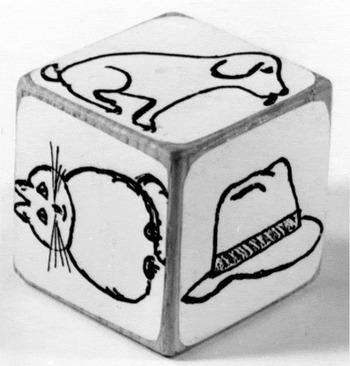
We developed a random word generation test, the “Hat–Cat–Dog” (HCD) task, which fulfills these requirements. This task presents participants with a die with two hat, cat, and dog pictures on its opposing sides (see Figure 1). Blindfolded participants are instructed to guess which item appears on the die's top face following each of sixty rolls by the experimenter. Since the response set is continuously available, retrieval and long-term memory demands are minimized (Wiegersma, 1984). Instead, the pattern of consecutive guesses provides important information about processing characteristics. For example, when healthy participants attempt to mimic a random sequence, they avoid repeating identical response alternatives (Brugger, 1997; Wiegersma, 1982). This “repetition avoidance” is apparent not only with identical items (i.e., phonologically and semantically identical), but even with unique, semantically related response alternatives. Thus, when healthy individuals attempted to mimic which of three pictures would appear on consecutive rolls of dies, they avoided consecutively pairing the most meaningfully related items: participants presented with a rabbit-carrot-reed die avoided pairing rabbit with carrot, while participants presented with a duck-carrot-reed die avoided pairing duck with reed (Brugger et al., 1995). Consecutive sequences of guesses therefore contain information of how the response alternatives are processed. Specifically, any statistically significant repression in the pairing of two response alternatives indicates that a participant recognized a salient relationship between them. On the other hand, when the relationship between two response alternatives becomes less salient or is not recognized, the frequency of their pairings increases to match the behavior of a real die.

Hat–cat–dog die employed in present task.
In the present study, two response pairings were of interest: semantic (“cat”–“dog” and “dog”–“cat”) and phonemic (“hat”–“cat” and “cat”–“hat”). We hypothesized that if AD patients have selective deficits in encoding semantic information, the frequency of semantic pairings will be increased compared to a demographically matched control group. Similarly, if HD patients have selective deficits in processing phonemic information, then the frequency of phonemic pairings will be increased compared to a demographically matched control group.a
It must be noted that the semantic relationship between “cat” and “dog” is confounded by an associative relationship, that is, “cat” is frequently given as a response to “dog” on free association norms and vice versa. Associative relationships, which are hypothesized to be acquired through the repeated cooccurrence of two words in natural language, are thought to be coded at the level of word form, and not word meaning (Moss et al., 1995). Thus, one could posit that a selective increase in “cat”–“dog” pairings reflected a semantic and/or word form deficit. However, whereas AD patients clearly suffer from numerous, well-documented semantic deficits, word form deficits are comparatively mild as evidenced by, for example, normal lexical decision accuracies to real words and decreased accuracies to pseudowords (Snyder et al., 1996; see also Glosser & Friedman, 1991). We would therefore interpret increased “cat”–“dog” pairings in AD patients to primarily reflect a semantic, and not a lexical or word-form, deficit.
METHOD
Participants
Seventy-two individuals participated in this study: 20 patients with a clinical diagnosis of AD (13 men and 7 women) matched pairwise to 20 elderly normal controls (ENC; 13 men and 7 women) with respect to gender, age, and education and 16 patients with a clinical diagnosis of HD (9 men and 7 women) matched pairwise to 16 middle-aged normal controls (MNC; 9 men and 7 women) with respect to age and education. All participants were native English speakers. This study was approved by the University of California at San Diego's (UCSD) Institutional Review Board and written informed consent was obtained from all participants, or patients' caregivers where appropriate, after the procedures of the study had been fully explained to them.
The AD patients were recruited from the University of California at San Diego's (UCSD) Alzheimer's Disease Research Center. All had been diagnosed by two senior staff neurologists according to the criteria for primary degenerative dementia outlined in the third edition of the Diagnostic and Statistical Manual of Mental Disorders (DSM–III; American Psychiatric Association, 1980) and by the National Institute of Neurological and Communicative Disorders and Stroke and the Alzheimer's Disease and Related Disorders Association criteria for probable Alzheimer's disease (McKhann et al., 1984). Extensive medical, laboratory, and neuropsychological testing ruled out other possible causes of dementia.
The HD patients were participants of UCSD's Genetically Handicapped Persons Program. All had been diagnosed by a senior staff neurologist on the basis of a positive family history, the presence of involuntary choreiform movements, and the DSM–III criteria for dementia (American Psychiatric Association, 1980).
The healthy control participants were spouses of patients or volunteers obtained through advertisements. Control participants with a history of alcohol or drug abuse, learning disabilities, or serious neurological or psychiatric illness were excluded from the study.
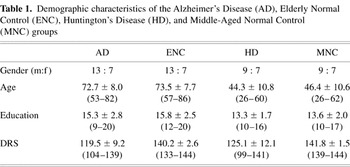
The demographic characteristics and mean Dementia Rating Scale (DRS; Mattis, 1976) scores of each group are listed in Table 1. The AD and HD groups did not differ from their respective control groups with respect to age or education (all t < 1), and no differences in gender were observed over all groups [χ2(3, N = 72) = 3.53; p = .32]. As expected, the patient groups' DRS scores were lower than their respective control groups' (AD vs. ENC: t = 9.74; p < .0001; HD vs. MNC: t = 5.46; p < .0001). Importantly, both patient groups achieved comparable scores on the DRS (t = 1.58; p = .12) which were indicative of mostly mild stages of dementia (Monsch et al., 1995). The AD and HD groups differed, as expected, with respect to age (t = 9.05; p < .0001) and also with respect to education (t = 2.45; p < .05).
Demographic characteristics of the Alzheimer's Disease (AD), Elderly Normal Control (ENC), Huntington's Disease (HD), and Middle-Aged Normal Control (MNC) groups

The Hat–Cat–Dog (HCD) Task
All participants were shown a wooden die with hat, cat, and dog line drawings on opposing sides and asked to name the pictures (see Figure 1). The experimenter ensured that the participants labeled the pictures as “hat”, “cat”, and “dog”. The participants were then told that the experimenter would continuously roll the die and that they were required to guess which item appeared on its top face. The experimenter stressed that the participants respond as spontaneously and quickly as possible and required all participants to close their eyes during all trials. All participants were given 6 practice trials followed by 60 test trials, which were timed by the experimenter (due to an administration error, time data are missing for one ENC and one MNC participant). The HCD task was always administered after the DRS. Repetition avoidance was assessed with the number of semantic, phonemic, and neutral pairings: a relative increased frequency of a given response pairing indicates a lack of normal repetition avoidance and thus suggests that the relationship between the two response alternatives has become less salient or was not recognized.
RESULTS
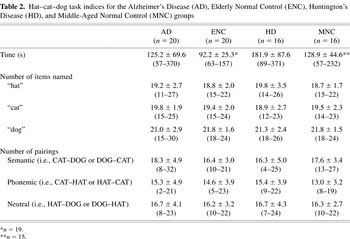
The time required to complete the task differed between groups [F(3,66) = 6.32; p < .001]; the HD group performed the task slower than all other groups [HD vs. AD: t(34) = 2.17, p < .05; HD vs. MNC: t(29) = 2.1, p < .05; and, HD vs. ENC: t(33) = 4.27, p < .001] and the AD group tended to perform the HCD task slower than the ENC subjects [t(37) = 1.95, p = .06]. Surprisingly, the ENC group was faster than the MNC group [t(32) = 3.03, p < .01]. Despite the differences in time, all groups named the three items a comparable number of times (all F < 1). Within-participant comparisons revealed that the AD, HD, and ENC groups generated semantic (“cat–dog” and “dog–cat”), phonemic (“hat–cat” and “cat–hat”), and neutral (“hat–dog” and “dog–hat”) pairings with a comparable frequency (all F < 1). Only the MNC group did not produce these pairings equally frequently [F(2) = 9.27; p < .001]; phonemic pairings were generated less often than both semantic and neutral pairings [t(15) = 3.54, p < .01 and t(15) = 2.8, p < .05, respectively], suggesting a greater repetition avoidance (and, by inference, higher saliency) of phonemically related response alternatives in this group. We performed correlations between the numbers of semantic, phonemic, and neutral pairings and available neuropsychological measures [DRS total score, DRS subscale scores, and total number of words on letter (F, A, S; Newcombe, 1969) and semantic (animals, fruits, vegetables) fluency tasks] separately for the AD and HD patients. The results of these analyses were not significant.
Hat–cat–dog task indices for the Alzheimer's Disease (AD), Elderly Normal Control (ENC), Huntington's Disease (HD), and Middle-Aged Normal Control (MNC) groups

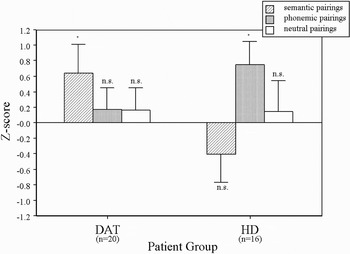
The central hypotheses of the study, namely that AD patients suffer from a selective deficit in semantic and HD patients in phonemic processing, were next tested. The difference in demographic characteristics between the two patient groups prohibited a direct comparison of their performances. We thus transformed the number of semantic, phonemic, and neutral pairings for both patient groups into standard scores (z-scores); thus, the following statistics reflect patients' performances in terms of their respective control groups. A group (AD vs. HD) by response pairing (semantic vs. phonemic) analysis of variance revealed neither a main effect of group [F(1,34) = .75; p = .39] nor response pairing [F(1,34) = .40, p = .53], but a significant interaction [F(1,34) = 4.30, p < .05]. Post-hoc analyses with two-tailed sign tests (hypothesized values = 0) confirmed the dissociation: whereas AD patients produced significantly more semantic (p < .05), but not phonemic (p = .50) pairings than expected, the HD patients produced more phonemic (p < .05), but not semantic (p > .99) pairings than expected (see Figure 2). Standard scores for the neutral pairings did not differ from zero in both patient groups, indicating that both AD and HD patients produced as many neutral pairings as their respective control groups [one sample t tests: AD patients: t(19) = .54, p = .59; HD patients: t(15) = .35, p = .73]. Unpaired t tests comparing the raw numbers of semantic, phonemic, and neutral pairings for the AD and ENC, or for the HD and MNC groups, were not significant.

Standard scores (z-scores relative to respective control group) with standard errors of semantic, phonemic, and neutral response pairings of the AD and HD groups on the HCD task. The asterisks indicate significant (p < .05) two-tailed sign tests of the respective z-score with a hypothesized value of 0.
DISCUSSION
All groups named each of the three items an equal number of times in the present random word generation task. This finding indicates that all three lexical items were continuously available during the task and thus that retrieval demands were minimized. However, AD patients generated more semantic pairings and HD patients more phonemic pairings compared to their demographically matched control groups. Although it is a theoretical possibility that a lexical (word form) deficit could account for the relatively greater number of “cat”–“dog” pairings in AD patients (see footnote a), the scarcity of such impairments in AD strongly suggests that the impaired repetition avoidance reflects a selective deficit in semantic information processing. Thus, we interpret these findings as a dissociation in semantic and phonemic processing deficits in AD and HD patients, respectively.
It should be noted, however, that the observed effect sizes were comparatively small and that the differences in the patterns of performance exhibited by AD and HD patients were not clearly evident when the raw scores were analyzed. Given this limitation and the relatively small sample sizes, a replication of the present findings would be important.
Despite this limitation, the present finding in AD patients is consistent with a primary deficit in their semantic store and not in the retrieval of semantic information. Moreover, it corresponds to other specifically semantic deficits in AD patients (Chertkow & Bub, 1990) such as semantic errors committed on confrontation naming tasks (Hodges et al., 1991; Martin & Fedio, 1983), the abnormal clustering of semantic concepts (Chan et al., 1993), and deficits in priming of semantic decisions (Lazzara et al., 2001) and word associations (Brandt et al., 1988). The present finding may also be related to AD patients' performances on a random number generation task, where adjacent number pairs (e.g., “2–3”, “5–6”) can be conceived of as more closely semantically related than more distant number pairs (e.g., “1–5”; see the network model of random number generation by Jahanshahi et al., 1998). Indeed, when asked to randomly generate numbers from a die, AD patients produced more pairings of numbers in their natural order compared to demographically matched control participants (Brugger et al., 1996). Conversely, in the present experiment, AD patients performed normally with the phonological pairs, a finding consistent with their ability to profit from phonemic cuing on confrontation naming tasks (Nebes, 1989) and common lack of phonological deficits (Kempler, 1991; Kempler et al., 1987).
The abnormal repetition avoidance for phonemic pairs suggests that a phonological processing deficit could account for the findings of poorer lexical than category fluency performance in HD patients. As retrieval processes were minimized in the current task, the common denominator in HD may be a dysfunctional phonological loop responsible for the temporary storage of speech-related material (Baddeley, 2003). Indeed, in a dual-task interference paradigm, an articulatory suppression task thought to disrupt operations within the phonological loop letter fluency performance, was disrupted to a significantly greater degree than semantic fluency performance, indicating that letter fluency depends on the phonological loop significantly more than category fluency (Rende et al., 2002). Moreover, processing within the phonological loop is thought to rely in part on frontal lobe structures (Baddeley, 2003), consistent with HD's primary fronto-subcortical pathology (Sotrel et al., 1991).
The MNC participants evidenced a stronger repetition avoidance for phonemic pairs, that is, they produced fewer phonemic response pairings than all other participant groups. This finding may be due to the fact that repetition avoidance is more pervasive at the acoustic than semantic level. Wiegersma (1984) reported that their young participants avoided direct repetitions of items with an acoustic content more than those with a semantic content while attempting to generate random sequences, implying that repetition avoidance is mediated more strongly by phonology than semantics. However, Wiegersma did not employ a competitive paradigm, which would have allowed the quantification of the relative effects of acoustic and semantic relationships on repetition avoidance.
The reported dissociation in AD and HD patients was demonstrated by comparing the patient groups to their respective control groups using standard scores. The control groups, however, differed: whereas the MNC group produced significantly fewer phonemic compared to semantic and neutral pairings, the ENC group produced an equal number of all pairing types. Thus, it could be argued that aging-related differences are responsible for the reported dissociation in the dementia groups. While an increase in repetition avoidance is documented over the lifespan from infancy to adulthood (e.g., Vecera et al., 1991; see Brugger, 1997, for review), we are not aware of any evidence for age-related changes in this particular response bias later in life. Moreover, we would argue that it is essential to analyze patient data relative to an appropriate baseline, that is, one that controls for demographic and other factors which themselves may influence performance. Indeed, the present finding underscores the importance of employing Z-scores to compare patient groups of differing demographic statuses. Finally, we note that although the AD and HD groups' educational levels differed, education level is not known to significantly influence repetition avoidance during randomization performance (Brugger, 1997).
The present findings suggest that previous reports of poorer category and lexical fluency performances in AD and HD patients, respectively, may reflect their respective primary deficits in semantic and phonological information processing, and not retrieval deficits. The dissociation between AD and HD patients' performances may be most parsimoniously accounted for by primary deficits in long-term memory, thought to rely on semantic codes, and a primary deficit in short-term memory, thought to rely on phonological codes (Schulman, 1971). It would be of interest in the future to investigate whether this dissociation in semantic and phonological processing deficits generalizes to patients with other forms of cortical dementia, in particular semantic dementia, and to other patients with subcortical-frontal pathology, respectively.
ACKNOWLEDGMENTS
This work was supported by the Roche Research Foundation and the Swiss Foundation for Medical-Biological Stipends (K.I.T.), NIH grants AG-05131 and AG-12963 (D.P.S.), and a Swiss National Science Foundation grants 823A-030702 (P.B.) and 3200-049107 (A.U.M.). We thank the patients, volunteers, and staff of the Alzheimer's Disease Research Center and the Huntington's Disease Program of the University of California, San Diego. An earlier version of this study was presented at the 23rd annual mid-year meeting of the International Neuropsychological Society, July, 2000, in Brussels, Belgium.
References
REFERENCES
American Psychiatric Association.
(1980).
Diagnostic and Statistical Manual of Mental Disorders
(3rd ed.).
Washington, DC:
American Psychiatric Association Press.
Auchterlonie, S.,
Phillips, N.A., &
Chertkow, H.
(2002).
Behavioral and electrical brain measures of semantic priming in
patients with Alzheimer's disease: Implications for access failure
versus deterioration hypotheses.
Brain and Cognition,
48,
264–267.Google Scholar
Baddeley, A.
(2003).
Working memory and language: An overview.
Journal of Communication Disorders,
36,
189–208.Google Scholar
Barr, A. &
Brandt, J.
(1996).
Word-list generation deficits in dementia.
Journal of Clinical and Experimental Neuropsychology,
18,
810–822.CrossRefGoogle Scholar
Binetti, G.,
Magni, E.,
Cappa, S.F.,
Padovani, A.,
Bianchetti, A., &
Trabucchi, M.
(1995).
Semantic memory in Alzheimer's disease: An analysis of category
fluency.
Journal of Clinical and Experimental Neuropsychology,
17,
82–89.Google Scholar
Brandt, J.,
Spencer, M.,
McSorley, P., &
Folstein, M.F.
(1988).
Semantic activation and implicit memory in Alzheimer disease.
Alzheimer Disease and Associated Disorders,
2,
112–119.CrossRefGoogle Scholar
Brugger, P.
(1997).
Variables that influence the generation of random sequences: An
update.
Perceptual and Motor Skills,
84,
627–661.CrossRefGoogle Scholar
Brugger, P.,
Monsch, A.U.,
Salmon, D.P., &
Butters, N.
(1996).
Random number generation in dementia of the Alzheimer type: A test
of frontal executive functions.
Neuropsychologia,
34,
97–103.CrossRefGoogle Scholar
Brugger, P.,
Regard, M.,
Landis, T., &
Graves, R.E.
(1995).
The roots of meaningful coincidence.
Lancet,
345,
1306–1307.Google Scholar
Butters, N.
(1984).
The clinical aspects of memory disorders: Contributions from
experimental studies of amnesia and dementia.
Journal of Clinical Neuropsychology,
6,
17–36.CrossRefGoogle Scholar
Butters, N.,
Granholm, E.,
Salmon, D.P., &
Grant, I.
(1987).
Episodic and semantic memory: A comparison of amnesic and demented
patients.
Journal of Clinical and Experimental Neuropsychology,
9,
479–497.Google Scholar
Butters, N.,
Wolfe, J.,
Martone, M.,
Granholm, E., &
Cermak, L.S.
(1985).
Memory disorders associated with Huntington's disease: Verbal
recall, verbal recognition and procedural memory.
Neuropsychologia,
23,
729–743.CrossRefGoogle Scholar
Chan, A.S.,
Butters, N.,
Salmon, D.P., &
McGuire, K.A.
(1993).
Dimensionality and clustering in the semantic network of patients
with Alzheimer's disease.
Psychology and Aging,
8,
411–419.CrossRefGoogle Scholar
Chertkow, H. &
Bub, D.
(1990).
Semantic memory loss in dementia of Alzheimer type: What do various
measures measure?
Brain,
113,
397–417.Google Scholar
Elfgren, C.I. &
Risberg, J.
(1998).
Lateralized frontal blood flow increases during fluency tasks:
Influence of cognitive strategy.
Neuropsychologia,
36,
505–512.Google Scholar
Glosser, G. &
Friedman, R.B.
(1991).
Lexical but not semantic priming in Alzheimer's disease.
Psychology and Aging,
6,
522–527.Google Scholar
Gourovitch, M.L.,
Kirkby, B.S.,
Goldberg, T.E.,
Weinberger, D.R.,
Gold, J.M.,
Esposito, G.,
Van Horn, J.D., &
Berman, K.F.
(2000).
A comparison of rCBF patterns during letter and semantic
fluency.
Neuropsychology,
14,
353–360.Google Scholar
Ho, A.K.,
Sahakian, B.J.,
Robbins, T.W.,
Barker, R.A.,
Rosser, A.E., &
Hodges, J.R.
(2002).
Verbal fluency in Huntington's disease: A longitudinal analysis
of phonemic and semantic clustering and switching.
Neuropsychologia,
40,
1277–1284.CrossRefGoogle Scholar
Hodges, J.R.,
Salmon, D.P., &
Butters, N.
(1990).
Differential impairment of semantic and episodic memory in
Alzheimer's and Huntington's diseases: A controlled prospective
study.
Journal of Neurology, Neurosurgery, and Psychiatry,
53,
1089–1095.CrossRefGoogle Scholar
Hodges, J.R.,
Salmon, D.P., &
Butters, N.
(1991).
The nature of the naming deficit in Alzheimer's and
Huntington's disease.
Brain,
114,
1547–1558.CrossRefGoogle Scholar
Hodges, J.R.,
Salmon, D.P., &
Butters, N.
(1992).
Semantic memory impairment in Alzheimer's disease: Failure of
access or degraded knowledge?
Neuropsychologia,
30,
301–314.Google Scholar
Jahanshahi, M.,
Profice, P.,
Brown, R.G.,
Ridding, M.C.,
Dirnberger, G., &
Rothwell, J.C.
(1998).
The effects of transcranial magnetic stimulation over the
dorsolateral prefrontal cortex on suppression of habitual counting during
random number generation.
Brain,
121,
1533–1544.CrossRefGoogle Scholar
Kempler, D.
(1991).
Language changes in dementia of the Alzheimer type. In
R. Lubinski (Ed.),
Dementia and communication, pp.
98–114.
Philadelphia, Pennsylvania:
B.C. Decker.
Kempler, D.,
Curtiss, S., &
Jackson, C.
(1987).
Syntactic preservation in Alzheimer's disease.
Journal of Speech and Hearing Research,
30,
343–350.Google Scholar
Lazzara, M.M.,
Yonelinas, A.P., &
Ober, B.A.
(2001).
Conceptual implicit memory performance in Alzheimer's
disease.
Neuropsychology,
15,
483–491.Google Scholar
Martin, A. &
Fedio, P.
(1983).
Word production and comprehension in Alzheimer's disease: The
breakdown of semantic knowledge.
Brain and Language,
19,
124–141.Google Scholar
Martin, A.,
Wiggs, C.L.,
Lalonde, F., &
Mack, C.
(1994).
Word retrieval to letter and semantic cues: A double dissociation in
normal subjects using interference tasks.
Neuropsychologia,
32,
1487–1494.CrossRefGoogle Scholar
Mattis, S.
(1976).
Mental status examination for organic mental syndrome in the
elderly patient.
In
L. Bellak &
T.B. Karasu (Eds.),
Geriatric psychiatry.
New York:
Grune and Stratton.
McKhann, G.,
Drachman, D.,
Folstein, M.,
Katzman, R.,
Price, D., &
Stadlan, E.M.
(1984).
Clinical diagnosis of Alzheimer's disease: Report of the
NINCDS-ADRDA work group under the auspices of Department of Health and
Human Services Task Force on Alzheimer's disease.
Neurology,
34,
939–944.CrossRefGoogle Scholar
Mickanin, J.,
Grossman, M.,
Onishi, K.,
Auriacombe, S., &
Clarke, C.
(1994).
Verbal and nonverbal fluency in patients with probable
Alzheimer's disease.
Neuropsychology,
8,
385–394.Google Scholar
Monsch, A.U.,
Bondi, M.W.,
Butters, N.,
Paulsen, J.S.,
Salmon, D.P.,
Brugger, P., &
Swenson, M.R.
(1994).
A comparison of category and letter fluency in Alzheimer's and
Huntington's disease.
Neuropsychology,
8,
25–30.CrossRefGoogle Scholar
Monsch, A.U.,
Bondi, M.W.,
Butters, N.,
Salmon, D.P.,
Katzman, R., &
Thal, L.J.
(1992).
Comparisons of verbal fluency tasks in the detection of dementia of
the Alzheimer type.
Archives of Neurology,
49,
1253–1258.CrossRefGoogle Scholar
Monsch, A.U.,
Bondi, M.W.,
Salmon, D.P.,
Butters, N.,
Thal, L.J.,
Hansen, L.A.,
Wiederholt, W.C.,
Cahn, D.A., &
Klauber, M.R.
(1995).
Clinical validity of the Mattis Dementia Rating Scale in detecting
Dementia of the Alzheimer type. A double cross-validation and application
to a community-dwelling sample.
Archives of Neurology,
52,
899–904.Google Scholar
Moss, H.E.,
Ostrin, R.K.,
Tyler, L.K., &
Marslen-Wilson, W.D.
(1995).
Accessing different types of lexical semantic information: Evidence
from priming.
Journal of Experimental Psychology: Learning, Memory, and
Cognition,
21,
863–883.CrossRefGoogle Scholar
Nebes, R.D.
(1989).
Semantic memory in Alzheimer's disease.
Psychological Bulletin,
106,
377–394.CrossRefGoogle Scholar
Nebes, R.D. &
Brady, C.B.
(1990).
Preserved organization of semantic attributes in Alzheimer's
disease.
Psychology and Aging,
5,
574–579.Google Scholar
Newcombe, F.
(1969).
Missile wounds of the brain.
London:
Oxford University Press.
Pasquier, F.,
Lebert, F.,
Grymonprez, L., &
Petit, H.
(1995).
Verbal fluency in dementia of frontal lobe type and dementia of
Alzheimer type.
Journal of Neurology, Neurosurgery, and Psychiatry,
58,
81–84.Google Scholar
Pujol, J.,
Vendrell, P.,
Deus, J.,
Kulisevsky, J.,
Marti-Vilalta, J.L.,
Garcia, C.,
Junque, C., &
Capdevila, A.
(1996).
Frontal lobe activation during word generation studies by functional
MRI.
Acta Neurologica Scandinavica,
93,
403–410.Google Scholar
Randolph, C.,
Braun, A.R.,
Goldberg, T.E., &
Chase, T.N.
(1993).
Semantic fluency in Alzheimer's, Parkinson's, and
Huntington's disease: Dissociation of storage and retrieval
failures.
Neuropsychology,
7,
82–88.CrossRefGoogle Scholar
Rende, B.,
Ramsberger, G., &
Miyake, A.
(2002).
Commonalities and differences in the working memory components
underlying letter and category fluency tasks: A dual-task
investigation.
Neuropsychology,
16,
309–321.CrossRefGoogle Scholar
Rich, J.B.,
Troyer, A.K.,
Bylsma, F.W., &
Brandt, J.
(1999).
Longitudinal analysis of phonemic clustering and switching during
word-list generation in Huntington's disease.
Neuropsychology,
13,
525–531.CrossRefGoogle Scholar
Rohrer, D.,
Salmon, D.P.,
Wixted, J.T., &
Paulsen, J.S.
(1999).
The disparate effects of Alzheimer's disease and
Huntington's disease on semantic memory.
Neuropsychology,
13,
381–388.Google Scholar
Rosser, A. &
Hodges, J.R.
(1994).
Initial letter and semantic category fluency in Alzheimer's
disease, Huntington's disease, and progressive supranuclear
palsy.
Journal of Neurology, Neurosurgery, and Psychiatry,
57,
1389–1394.CrossRefGoogle Scholar
Salmon, D.P.,
Heindel, W.C., &
Lange, K.L.
(1999).
Differential decline in word generation from phonemic and semantic
categories during the course of Alzheimer's disease: Implications for
the integrity of semantic memory.
Journal of the International Neuropsychological Society,
5,
692–703.Google Scholar
Schulman, H.G.
(1971).
Similarity effects in short-term memory.
Psychological Bulletin,
75,
399–415.CrossRefGoogle Scholar
Snyder, L.S.,
Holland, A.K., &
Forbes, M.
(1996).
Lexical decisions in patients with Alzheimer's disease: Some
notes on automatic versus controlled processing.
Journal of Communication Disorders,
29,
398–399.CrossRefGoogle Scholar
Sotrel, A.,
Paskevich, P.A.,
Kiely, D.K.,
Bird, E.D.,
Williams, R.S., &
Myers, R.H.
(1991).
Morphometric analysis of the prefrontal cortex in Huntington's
disease.
Neurology,
41,
1117–1123.Google Scholar
Suhr, J.A. &
Jones, R.D.
(1998).
Letter and semantic fluency in Alzheimer's, Huntington's,
and Parkinson's dementias.
Archives of Clinical Neuropsychology,
13,
447–454.CrossRefGoogle Scholar
Tröster, A.I.,
Salmon, D.P.,
McCullough, D., &
Butters, N.
(1989).
A comparison of the category fluency deficits associated with
Alzheimer's and Huntington's disease.
Brain and Language,
37,
500–513.CrossRefGoogle Scholar
Vecera, S.P.,
Rothbart, M.K., &
Posner, M.I.
(1991).
Development of spontaneous alternation in infancy.
Journal of Cognitive Neuroscience,
3,
351–354.CrossRefGoogle Scholar
Weingartner, H.J.,
Kawas, C.,
Rawlings, R., &
Shapiro, M.
(1993).
Changes in semantic memory in early stage Alzheimer's disease
patients.
The Gerontologist,
33,
637–643.CrossRefGoogle Scholar
Wiegersma, S.
(1982).
Can repetition avoidance in randomization be explained by randomness
concepts?
Psychological Research,
44,
189–198.Google Scholar
Wiegersma, S.
(1984).
Acoustic and semantic similarity effects on repetition avoidance in
produced sequences.
Memory and Cognition,
12,
190–194.Google Scholar
Hat–cat–dog die employed in present task.
Demographic characteristics of the Alzheimer's Disease (AD), Elderly Normal Control (ENC), Huntington's Disease (HD), and Middle-Aged Normal Control (MNC) groups
Hat–cat–dog task indices for the Alzheimer's Disease (AD), Elderly Normal Control (ENC), Huntington's Disease (HD), and Middle-Aged Normal Control (MNC) groups
Standard scores (z-scores relative to respective control group) with standard errors of semantic, phonemic, and neutral response pairings of the AD and HD groups on the HCD task. The asterisks indicate significant (p < .05) two-tailed sign tests of the respective z-score with a hypothesized value of 0.
 You have
Access
- 14
- Cited by