Introduction
To transform the taxonomic process, it is necessary to increase the productivity of identification of biodiversity, including the description of new species, by using new tools (e.g. by Miller, Reference Miller2007; La Salle et al., Reference La Salle, Wheeler, Jackway, Winterton, Hobern and Lovell2009). These approaches speed up identification and make it more precise by using parallel alternative methods, resulting perhaps in a semi- or fully automated process of identification. Among such methods, there are artificial neural networks (ANN) methodologies based on the artificial intelligence principle (Weeks & Gaston, Reference Weeks and Gaston1997, Vaňhara et al., Reference Vaňhara, Muráriková, Malenovský and Havel2007, Reference Vaňhara, Havel, Fedor and O'Hara2010; MacLeod, Reference MacLeod2008; Fedor et al., Reference Fedor, Malenovský, Vaňhara, Sierka and Havel2008, Reference Fedor, Vaňhara, Havel, Malenovský and Spellerberg2009). Molecular analysis provides valuable results, as it is commonly understood, and has been well used in dipterology (our review Tóthová et al., Reference Tóthová, Bryja, Bejdák and Vaňhara2006). Classical comparative morphology remains widely used, for example in identification keys (both classical dichotomous and multi-entry computer based, e.g. Moritz et al., Reference Moritz, Morris and Mound2001 and others). Knowledge of taxonomy and species relationships within the genus Tachina has been insufficiently deeply studied; the existence of 45 synonyms for the 12 species currently recognised as valid in the West Palaearctic fauna is a result of a persistent state of taxonomic uncertainty in the genus (Herting, Reference Herting1984; Herting & Draskovits, Reference Herting, Dely-Draskovits, Soós and Papp1993; Tschorsnig et al., Reference Tschorsnig, Bergström, Bystrowski, Cerretti, Hubenov, Raper, Richter, Van de Weyer, Vaňhara, Zeegers and Ziegler2004).
Polyphasic taxonomy in entomology
The principle of integrating different sources of data used for identification was initiated by Colwell (Reference Colwell1970), who introduced the term ‘polyphasic taxonomy’ to microbiology.
Such a polyphasic approach takes into account all known phenotypic and genotypic information and integrates them not only for the purpose of taxonomy and identification, but also for the full reciprocal validation of methods used and for the results obtained. We compared the three basic processes; identification is based on (i) ANN, (ii) molecular analyses deduced from up to four mitochondrial markers and (iii) the male postabdominal structure at different taxonomic levels (see Novotná et al., Reference Novotná, Vaňhara, Tóthová, Muráriková, Bejdák and Rozkošný2009). In entomology, independent identification based on several methodological sources is not common. ANN used here, as a part of a polyphasic taxonomic approach, enabled us to incorporate a further method of identification, which is now possible thanks to a wide background of computational strategies. This idea is not speculative, as this ANN technology is able to evaluate a vast amount of data, which might form a stable basis for a good and reliable system for biodiversity identification (Vandamme et al., Reference Vandamme, Pot, Gills, De Vos, Kersters and Swings1996). A wide polyphasic taxonomic approach for other insect groups is now required.
An analogous approach to achieving an ‘integrated taxonomy’ is the integration of web resources into taxonomic effort, the work of Deans & Kawada (Reference Deans and Kawada2008) being an example.
ANN in insect taxonomy
In recent years, the use of ANN has spread to many branches of science; but, in entomology and arachnology, as far as we know, ANN applications are still rare.
Usually, ANN constitute bases of automatic species recognition systems (Weeks & Gaston, Reference Weeks and Gaston1997; MacLeod et al., Reference MacLeod, O'Neill, Walsh, Curry and Humphries2007; MacLeod, Reference MacLeod2008). Its advantage as a computational method is that ANN can evaluate different kinds of input data, e.g. qualititative and quantitative (e.g. morphometric) morphological characters, transformed digital images, optical or acoustic spectra, etc. In the framework of particular insect/spider groups, for example, Chesmore (Reference Chesmore2001, Reference Chesmore2004) used ANN for acoustic recognition of several Orthoptera species, Moore & Miller (Reference Moore and Miller2002) for optic recognition of wing flaps of five aphid species (Hemiptera), Aldrich et al. (Reference Aldrich, Magirang, Dowell and Kambhampati2007) for near-infrared reflectance spectroscopy used for termite species and Fedor et al. (Reference Fedor, Malenovský, Vaňhara, Sierka and Havel2008) identified 18 species of four genera of Thysanoptera on the basis of 20 mostly morphometric characters. The system ABIS was developed for identification of bees (Francoy et al., Reference Francoy, Wittmann, Drauschke, Müller, Steinhage, Bezerra-Laure, De Jong and Gonçalves2008) and the system DAISY (O'Neill, Reference O'Neill and MacLeod2007) for several insect groups (e.g. moths, bumblebees, ceratopogonids, lycosiids, butterflies, caterpillars, etc.). Do et al. (Reference Do, Harp and Norris1999), Platnick et al. (Reference Platnick, Russell and Do2005) and Russell et al. (Reference Russell, Do, Huff, Platnick and MacLeod2008) successfully used ANN for automatic identification, respectively of lycosid and trochanteriid spiders, based on transformed digital images of male pedipalp and female epigynium and even developed an on-line automated identification system SPIDA for 121 spp. and 15 genera of Australian Trochanteriidae. In Diptera, ANN were applied in Culicidae where Moore (Reference Moore1991) evaluated frequency of wing-beat in both sexes of two species. Marcondes & Borges (Reference Marcondes and Borges2000) distinguished the morphologically identical males of two species of Psychodidae; as inputs (classification variables), they used a ratio of measurements of different parts of the male body. Vaňhara et al. (Reference Vaňhara, Muráriková, Malenovský and Havel2007) tested the methodology of ANN identification in the family Tachinidae on the basis of five model species of two genera, using 16 morphometric characters.
Chemometric methodology, outside insect taxonomy, was also develop by us and was used for identification of molluscs (Patella) (Hernández-Borges et al., Reference Hernández-Borges, Corbella-Tena, Rodriguez-Delgado, Garcia-Montelongo and Havel2004).
Molecular analyses of tachinids
A wide survey of DNA analyses used within the genus Tachina was published in a parallel paper (Novotná et al., Reference Novotná, Vaňhara, Tóthová, Muráriková, Bejdák and Rozkošný2009).
Identification within Tachina
The present taxonomy of Tachina was established by Herting (Reference Herting1984), who recognized four subgenera; but the existence of a new one was discussed by Novotná et al. (Reference Novotná, Vaňhara, Tóthová, Muráriková, Bejdák and Rozkošný2009). See also the diverse opinions published by O'Hara et al. (Reference O'Hara, Shima and Zhang2009). Novotná et al. (Reference Novotná, Vaňhara, Tóthová, Muráriková, Bejdák and Rozkošný2009) included an identification key based on the male terminalia, illustrated by original pen drawings and deep focus micrographs, some of them used for the first time. (The results were confirmed by mitochondrial markers CO I, Cyt b, 12S and 16S rDNA).
This paper also resolved some old taxonomic discrepancies, as: (i) the taxonomic concept of the genus was evaluated, see above; (ii) the position of the present subgenus Tachina s. str. seemed to be untenable; while T. grossa (Linnaeus, 1758) remained within the existing subgenus Tachina s. str., a new subgenus could be created for T. magna (Giglio-Tos, 1890); (iii) and an expected new species from subgenus Eudoromyia was confirmed within European boreo-alpine material, although it has not been described formally; (iv) T. nigrohirta (Stein, 1924) was resurrected from synonymy and confirmed as a valid species; (v) some differences, possibly of a specific nature, between central European and Japanese specimens of T. nupta (Rondani, 1859) were found.
In our study, we compare ANN with previous results concerning molecular analyses and morphology of the male postabdomen (Novotná et al., Reference Novotná, Vaňhara, Tóthová, Muráriková, Bejdák and Rozkošný2009) to test if we can synthesize the results of all three methods.
Materials and methods
Examination of taxa
For a model study of a polyphasic approach in this work, the taxonomically problematic genus Tachina with 12 West Palaearctic species, including potential new taxa suggested by Novotná et al. (Reference Novotná, Vaňhara, Tóthová, Muráriková, Bejdák and Rozkošný2009) was chosen. For initial nomenclature of the Tachina species, the catalogues of Herting & Dely-Draskovits (Reference Herting, Dely-Draskovits, Soós and Papp1993) and Herting (Reference Herting1984) were used.
The tachinids studied were identified by C. Bergström, P. Cerretti, J. Čepelák, B. Herting, L.P. Mesnil, H. Novotná, R. Rozkošný, H.-P. Tschorsnig, J. Vaňhara and J. Ziegler.
Examination of material
For ANN evaluation, 227 dry-mounted, mostly pinned, specimens were used. Specimens of Tachina species were given by the following institutions and dipterologists:
BAR – M. Barták, Czech University of Agriculture, Praha, Czech Republic
BER – Ch. Bergström, Uppsala, Sweden
ČEP – J. Čepelák (late), collection deposited partly with J. Vaňhara (corresponding author)
CER – P. Cerretti, Università degli Studi di Roma ‘La Sapienza’, Roma, Italy
ICH – R.T. Ichiki; Japan International Research Center for Agricultural Sciences, Tsukuba, Japan
MIH – F. Mihályi (late), National Museum, Budapest, Hungary (arranged by L. Papp)
TSCH – H.-P. Tschorsnig, Staatliches Museum für Naturkunde, Stuttgart, Germany
VAŇ – J. Vaňhara, Masaryk University, Brno, Czech Republic
ZIE – J. Ziegler, Museum fuer Naturkunde, Humboldt University, Berlin, Germany
Specimens were photographed (using a stereomicroscope Olympus SZX 12 with attached Camedia C-5050 digital camera); the digitalized images were scaled (in μm) by means of an image analyser using the software M.I.S QuickPhoto Micro Olympus (Japan).
DNA species analyses
Methods for molecular analyses based on mitochondrial markers CO I, Cyt b, 12S and 16S rDNA are described fully in Novotná et al. (Reference Novotná, Vaňhara, Tóthová, Muráriková, Bejdák and Rozkošný2009). DNA was extracted following the protocol according to Tóthová et al. (Reference Tóthová, Knoz, Sonnek, Bryja and Vaňhara2008).
Examination of characters and ANN data management
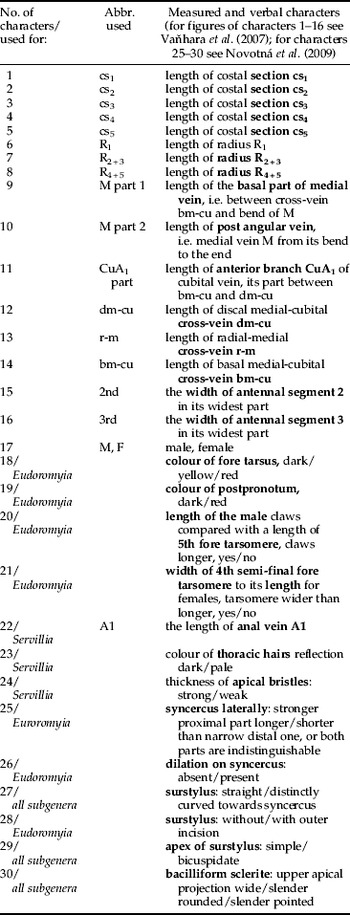
Preferentially, we selected 16 morphometric characters in Tachina, 14 for the wing, which included the length of different wing veins or their sections and two for the antenna (table 1; see also Vaňhara et al., Reference Vaňhara, Muráriková, Malenovský and Havel2007). All linear distances were measured by manually selecting landmarks with a mouse on a computer screen (with the image file opened in the QuickPhoto programme), which automatically provided the value of the measurement. Sex of the studied specimens was recorded as an additional character. The right wing was measured; for four specimens with the right wing missing, the left one was measured (see Vaňhara et al., Reference Vaňhara, Muráriková, Malenovský and Havel2007).
List of characters selected for creation of ANN sub-databases.

For application of ANN, the wide basic database (227 specimens) was divided into smaller sub-databases according to logical taxonomic units needed for each case studied, i.e. according to subgenera or to species groups within the subgenus Eudoromyia. For sub-databases, specific characters (additional to the basic 16 shared characters) were sought and added in order for ANN to reach a better result (see table 1). To construct and achieve really reliable and ‘clean’ sub-databases (i.e. based on really well identified specimens), all evidently damaged, incomplete or atypical specimens were eliminated.
Tachina ANN computational strategy
ANN computation was performed using Trajan Neural Network Simulator, Release 3.0 D. (Trajan Software Ltd 1996–1998, UK). All computation was performed on a standard PC computer with operating system Microsoft Windows Professional XP 2003. The ANN strategy applied in this study is based on ANN methodology by Vaňhara et al. (Reference Vaňhara, Havel, Fedor and O'Hara2010) with background formed by Fedor et al. (Reference Fedor, Malenovský, Vaňhara, Sierka and Havel2008, Reference Fedor, Vaňhara, Havel, Malenovský and Spellerberg2009).
The use of ANN consists of six distinct steps (commented on in detail in case 1 only and briefly summarised in further cases):
(i) sub-database creation as a fundamental step for every case under study;
(ii) multilayer perceptrons networks (MLP) architecture construction, which consists of input, one or more hidden layers and output;
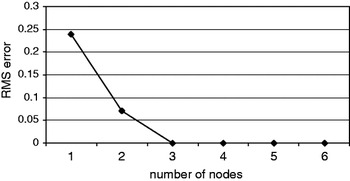
(iii) number of nodes assessment in a hidden layer for optimalization of ANN using dependence of root mean square (RMS) error value, n is usually recommended to be slightly higher (one or two nodes) than the optimum found (see fig. 1);
(iv) training of neural network;
(v) verification using cross-validation; and
(vi) identification of unknown specimens.
Dependence of root mean square error (RMS) on the number of nodes in the hidden layer of ANN for a three-layered Multilayer perceptrons network architecture (MLP), five subgenera of Tachina trained. For ANN analyses n is usually recommended to be slightly higher (one or two nodes more) than the optimum found.

Results
Case 1: The recognition hitherto of four subgenera versus proposal of an additional new subgenus
Status quo
The present taxonomy of the genus Tachina was established by Herting (Reference Herting1984), who recognised four subgenera. The recognition of a new subgenus was recently suggested by Novotná et al. (Reference Novotná, Vaňhara, Tóthová, Muráriková, Bejdák and Rozkošný2009). The newly proposed subgenus would comprise T. magna, which has been treated as belonging to the subgenus Tachina s.str. The type species of that subgenus is T. grossa. However, results of our analyses confirmed a hypothesis that T. magna is more closely related to the species of the subgenus Servillia than to T. grossa. According to Novotná et al. (Reference Novotná, Vaňhara, Tóthová, Muráriková, Bejdák and Rozkošný2009), establishment of a new subgenus for T. magna is the best solution to this problem.
Hypothesis for ANN
Are we able to use ANN to recognize a new subgenus?
ANN case 1 process
(i) Sub-database: selected specimens of all 13 species (including a potential sp.n. (see also case 2) were used for subgeneric analysis, 81 specimens in total. Only males were analyzed due to the use of several additional characters on the male postabdomen (on surstylus, its apex and bacilliform sclerite) together with the basic 16 characters on the wing and antenna, which were applied to ANN computation, see characters of all subgenera in table 1.
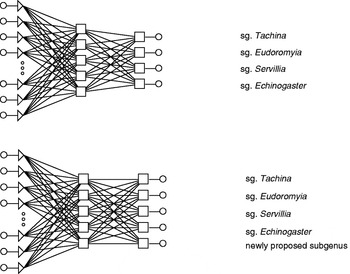
(ii) Multilayer perceptrons networks: as the number of taxa is not high (five subgenera) and ANN architecture should be conventionally the simplest, MLP was constructed as three-layered (24, n, 4 or 5), where 24 is a number of characters in the input layer, n is a number of nodes in the hidden layer, and 4 or 5 are the numbers of subgenera in the output layer (with or without a new subgenus in the training process).
(iii) Number of nodes: five was chosen for the single hidden layer (24, 5, 4 or 5) (fig. 2).
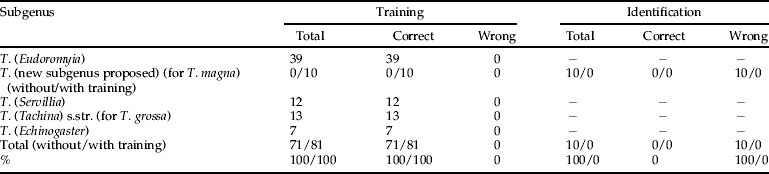
(iv) Training: of neural network on the specialized sub-database for case 1 was completely successful (100%), see table 2.
(v) Verification: from all males of T. magna, two specimens were randomly selected and five different combinations tested by cross-validation. Only one male in one combination was marked as wrong, i.e. 98.7% success was achieved.
(vi) Identification: based on a training set with 71 samples of four subgenera, ten additional samples (of T. magna) were examined (see table 2; ‘without training’). From these ten samples, 100% were classified as wrong specimens. This means that T. magna specimens were not placed within any of the four hitherto known subgenera (as a correct identification), thus supporting the proposal in Novotná et al. (Reference Novotná, Vaňhara, Tóthová, Muráriková, Bejdák and Rozkošný2009) that they should belong to another (new) subgenus.
Additionally to this analysis, we put in the training process all the above mentioned ten males of T. magna as a fifth subgenus, i.e. 81 samples (see table 2; ‘with training’) were trained, using ANN architecture (24, 5, 5). As none of the examined specimens overlapped with any of the other trained subgenera, we obtained confirmation of the above result.
Used ANN architecture for resolution of subgenera, training without a new proposed subgenus (above) and trained with it (below). Three-layered Multilayer perceptrons network (MLP 24, 5, 4 or 5).

ANN analysis supports new subgenus. Two methods of training were used, ‘without’ and ‘with’ specimens of a new subgenus. Wrong identification of ten specimens shows a good result for case 1; no specimen identified was put into known subgenera. It was supported also by DNA analysis and morphological study of male postabdomen, see case 1.

Analysis of morphological data
See Novotná et al. (Reference Novotná, Vaňhara, Tóthová, Muráriková, Bejdák and Rozkošný2009) for conclusions based on postabdominal characters. A potential new subgenus was recommended for T. magna, as its current inclusion in the subgenus Tachina seemed to be problematic. Also, its position in the phylogenetic trees published by Novotná et al. (Reference Novotná, Vaňhara, Tóthová, Muráriková, Bejdák and Rozkošný2009: see figs 18–20) proved that this species could hardly belong to any current subgenus. A new subgenus is not yet formally established because a wider revision of the species of subgenus Tachina is needed.
Analysis of molecular data
Parallel analyses based on up to four mitochondrial DNA markers with partial sequences of genes CO I, Cyt b, 12S and 16S rDNA of total length about 1500 bp have been used for validation of the new subgeneric position. Also, a combination of molecular (12S and 16S rDNA) and morphological (male postabdomen) characters has been discussed, and the principle of recognising five subgenera was independently verified as well. Phylogenetic trees and their resolution are good and the reliability of branches is high. Both trees have been published in Novotná et al. (2009: see figs 5 and 6). The convincing and strong results obtained using ANN, as described above, are supported here by a quite decisive method, i.e. by molecular analysis; and a clear conclusion, at an interspecific level within the subgenus Tachina, is recommended.
Discussion of case 1
ANN applied as a further method yielded the same results as other polyphasic taxonomic approaches. The above mentioned ANN results validated the proposal of a new subgenus. This proposition is also underlain in the process of ANN by two different computational methods. In addition, this ANN process was also checked by consequent cross-validation. The results also dovetail into the context based on our parallel research of the male postabdomen (see Novotná et al., Reference Novotná, Vaňhara, Tóthová, Muráriková, Bejdák and Rozkošný2009) and molecular analysis. However, we are aware that even if such strong support for a new subgenus was obtained by ANN, a phylogenetic dimension is missing from the ANN approach.
Case 2: New species vs. known West Palaearctic species of the subgenus Eudoromyia
Status quo
Among the specimens examined of the subgenus Eudoromyia (BER, ČEP, TSCH and ZIE coll.) the existence of a new species was determined (see Novotná et al., Reference Novotná, Vaňhara, Tóthová, Muráriková, Bejdák and Rozkošný2009).
Hypothesis for ANN
Are we able to recognize a new species using ANN?
ANN case 2 process
(i) Sub-database creation: five Eudoromyia species were used, 52 specimens in total. To the ANN computation, 16 basic characters (wing, antenna) and several additional (male postabdomen, tarsus and colour of some parts of the body) were used, see characters of Eudoromyia in table 1.
(ii) Multilayer perceptrons networks: three-layered architecture (21, n, 5).
(iii) Number of nodes: six nodes in a single hidden layer (21, 6, 5).
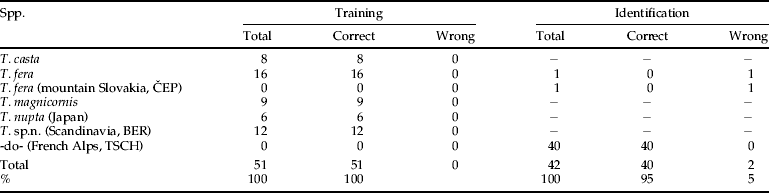
(iv) Training: completely successful, see table 3.
(v) Verification: 12 specimens of sp.n. (BER) were 12 times randomly selected and then tested. by cross-validation with 100% correctness.
(vi) Identification: 40 not trained specimens from the French Alps were identified as T. sp.n.
Also, one not trained Slovak specimen, identified formerly as T. fera (Linnaeus, 1761) (det. Herting), was re-identified by ANN as T. sp.n. and subsequently also by the male postabdominal structure (table 3).
ANN analysis supports proposed T. sp.n. (case 2). This species was identified among not trained material from French Alps. Also, two further not trained specimens of T. fera (det. Čepelák and Herting) were classified by ANN as wrong and identified in parallel as T. sp.n. This species was also supported by DNA analysis and morphological study of the male postabdomen, see case 2.

Analysis of morphological data
Novotná et al. (Reference Novotná, Vaňhara, Tóthová, Muráriková, Bejdák and Rozkošný2009) described a postabdominal character, namely a distinct callus on the syncercus, which characterises the T. fera species group among species of the subgenus Eudoromyia (viz. T. fera, T. canariensis (Macquart, 1839), T. casta (Rondani, 1859) and the proposed sp.n.). In parallel, a male postabdomen was successfully placed here using ANN (100%), and subsequently a Slovak specimen was also correctly re-identified using ANN.
Analysis of molecular data
The combined analysis of two mitochondrial markers, 12S and 16S rDNA, with male postabdominal characters for support of taxonomic recommendations, was utilized in Novotná et al. (Reference Novotná, Vaňhara, Tóthová, Muráriková, Bejdák and Rozkošný2009). In this study, a further two specimens from the French Alps were also ranked as belonging to the sp.n.
Discussion of case 2
ANN yielded identical results to the postabdominal characters and DNA analyses, done by Novotná et al. (Reference Novotná, Vaňhara, Tóthová, Muráriková, Bejdák and Rozkošný2009). In this paper, ANN recognized that 40 specimens could not be assigned to any known West Palaearctic species of the genus Tachina (separately in T. fera gr. and T. magnicornis (Zetterstedt, 1844) gr.), but all of them were assigned to the same species as the trained Scandinavian material (12 specimens). Our conclusion reached here was anticipated by some previous authors in recent years, they published it in their faunistic studies as an unnamed Tachina sp., e.g. Ziegler & Lange (Reference Ziegler and Lange2001, 2006) and Tschorsnig et al. (Reference Tschorsnig, Ziegler and Herting2003). This new boreo-alpine species has been recorded in Sweden, Finland, Denmark, Alpine France and from the Slovak mountains. This new species has not yet been formally described.
Case 3: Mediterranean T. casta vs. ‘Central European T. casta’ (=syn. T. lefebvrei sensu Čepelák)
Status quo
T. lefebvrei (Robineau-Desvoidy, 1830) was described on the basis of material from the type locality in Sicily (Herting & Dely-Draskovits, Reference Herting, Dely-Draskovits, Soós and Papp1993). Bezzi & Stein (Reference Bezzi, Stein, Becker, Bezzi, Kertész and Stein1907) accepted it as a valid species in their catalogue, which J. Čepelák followed for a long time and also identified it from Slovakia (Čepelák,1986); T. lefebvrei was also accepted by Zimin et al. (Reference Zimin, Zinověva, Shtakelberg, Shtakelberg and Nartshuk1970). Herting (Reference Herting1984) synonymized T. lefebvrei with T. casta (Rondani), which is according to present knowledge a Mediterranean species only and it was, after re-identification of several of Čepelák´s specimens, excluded from the Slovak checklist (Vaňhara et al., Reference Vaňhara, Tschorsnig and Barták2004; Vaňhara & Tschorsnig, Reference Vaňhara, Tschorsnig, Jedlička, Kúdela and Stloukalová2006).
Hypothesis for ANN
Does T. casta occur in Central Europe (identified as T. lefebvrei by J. Čepelák)?
ANN case 3 process
(i) Sub-database: five species from subgenus Eudoromyia were used for the Case 3 sub-database, see case 2.
(ii) Multilayer perceptrons networks: three-layered architecture with a single hidden layer was constructed (21, n, 5).
(iii) Number of nodes: (21, 6, 5).
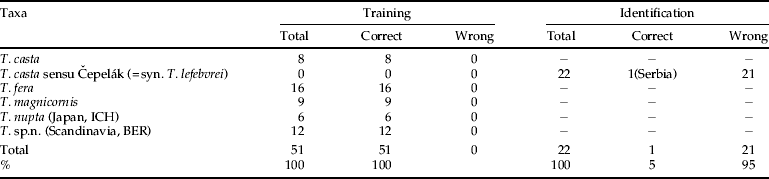
(iv) Training: see table 4 (100%).
(v) Verification: eight specimens of T. casta were eight times randomly tested by cross-validation. Success of identification was 100%.
(vi) Identification: from 22 Slovak and Serbian specimens identified by J. Čepelák as T. lefebvrei, the single Serbian specimen of T. casta (from Golubac) was re-identified by ANN as correct, see table 4. The remaining specimens were re-identified, mostly as T. sp.n. and T. magnicornis. The one other problematic specimen of T. casta from Sicily (det. Cerretti) was also correctly re-identified by ANN. No specimens from Slovakia were identified as T. casta (table 4).
ANN analysis of T. casta sensu Čepelák (as syn. T. lefebvrei). J. Čepelak identified his T. lefebvrei correctly among southern European specimens. But, all specimens of his T. lefebvrei from central Europe were correctly identified as other Eudoromyia species. This result was also supported by DNA analysis and morphological study of the male postabdomen, see case 3.

Analysis of morphological data
Tachina casta differs from other representatives of the subgenus in details of the male postabdomen. The male postabdomen of 14 of Čepelák´s specimens determined as T. lefebrei were analyzed and most of them were identified as T. sp.n. or T. magnicornis. Čepelák´s correct identification of T. casta from Serbia (see above) was also verified by the postabdomen. None of Čepelák´s specimens named as T. lefebrei from Slovakia were re-identified as T. casta.
Analysis of molecular data
None of the three specimens of Čepelák´s T. lefebvrei under analysis of two mitochondrial markers, 12S and 16S rDNA, were T. casta. Their position in the phylogenetic tree was very unclear but far from the T. casta clade. Other specimens could not be analyzed, as they are more than 20 years old.
Discussion of case 3
No specimens of T. casta sensu Čepelák (det. as T. lefebvrei) that originated from Slovakia were confirmed by ANN. Also, this was supported by molecular and postabdominal results. This confirms that its previous exclusion from the Diptera list of Slovakia (Vaňhara et al., Reference Vaňhara, Tschorsnig and Barták2004) was correct. Čepelák´s identification of one southern specimen from Serbia as T. casta was confirmed.
Case 4: Problematic T. nupta vs. T. magnicornis
Status quo
Tachina nupta was described in 1859 from Italy (cf. Herting & Dely-Draskovits, Reference Herting, Dely-Draskovits, Soós and Papp1993). Because there is a great variability in morphological characters in the T. magnicornis species group, the species can be considered as problematic. Bezzi & Stein (Reference Bezzi, Stein, Becker, Bezzi, Kertész and Stein1907) did not accept this species and mentioned it as a synonym of T. magnicornis. Some later authors considered it as a valid species (Mesnil, Reference Mesnil and Lindner1966; Zimin & Kolomietz, Reference Zimin and Kolomietz1984; Mihályi, Reference Mihályi1986; Herting & Dely-Draskovits, Reference Herting, Dely-Draskovits, Soós and Papp1993; Čepelák & Vaňhara, Reference Čepelák, Vaňhara and Chvála1997; Chao et al., Reference Chao, Shi, Zhou, Chen, Liang, Sun, Xue and Chao1998). According to Herting & Dely-Draskovits (Reference Herting, Dely-Draskovits, Soós and Papp1993) there are six synonyms of this species. Mesnil (Reference Mesnil and Lindner1966) classified the East Palaearctic T. micado (Kirby, 1884) as a subspecies of T. nupta. This taxon was synonymized by Herting (Reference Herting1984). The unclear position of T. nupta was presented by Tschorsnig & Herting (Reference Tschorsnig and Herting1994).
Hypothesis for ANN
Is West Palaearctic T. nupta a valid species?
ANN case 4 process
(i) Sub-database: five species from subgenus Eudoromyia were used for the case 4 sub-database, see case 2. We have at our disposal not only material of T. nupta from Europe but also six specimens from Japan. Because identification of West Palaearctic material of T. nupta has been uncertain for a long time, for ANN analysis we purposely utilized only some specimens of T. nupta from Japan (T. nupta East), whereas West Palaearctic specimens (T. nupta West) were included in the identification process only.
(ii) Multilayer perceptrons networks: three-layered architecture (21, n, 5).
(iii) Number of nodes: (21, 6, 5).
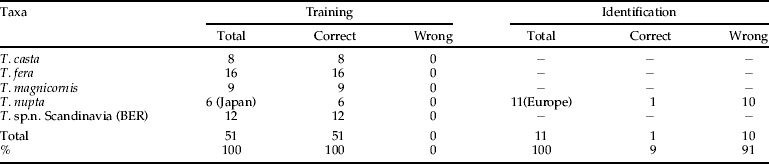
(iv) Training: correct (100%), see table 5.
(v) Verification: each one of six specimens of T. nupta East was tested (100%). Random test by cross-validation: six specimens of T. nupta East were six times randomly tested; all specimens were analyzed as correct. Success of identification was 100%.
(vi) Identification: all 11 specimens of T. nupta West (all BAR, CEP-VAN, ZIE coll.) previously identified by several tachinologists, were re-identified by ANN. One of the 11 analyzed specimens (BAR coll.) was T. nupta according to the structure of the postabdomen, but its validation by ANN was impossible due to it having damaged fore legs. The other ten were identified as sp.n. or wrong species, but some of them are rather damaged and some characters are not usable, see table 5.
ANN analysis of T. nupta identifications. From rare European material, only one specimen correlated with trained Japanese material. This result was also supported by morphological study of the male postabdomen, see case 4.

Analysis of morphological data
The postabdomen of four specimens of T. nupta East (CER, ICH coll.) and one specimen of T. nupta West (BAR, coll.) were analyzed. Novotná et al. (Reference Novotná, Vaňhara, Tóthová, Muráriková, Bejdák and Rozkošný2009) recommended a revision of the West Palaearctic T. nupta, which differs from Japanese and Iranian specimens under study. On the basis of postabdominal characters, both forms of ‘nupta’ are without a medial or submedial callus on the syncercus. In one West Palaearctic specimen of T. nupta (drawings in Novotná et al., Reference Novotná, Vaňhara, Tóthová, Muráriková, Bejdák and Rozkošný2009), the tip of the surstylus is stout and short, but in Japanese specimens the tip of surstylus is slender and elongate. In Japanese T. nupta, the inner margin of the syncercus in lateral view is almost straight in the distal half, the syncercus relatively broad in the basal half and both distal projections of the bacilliform sclerite are separated by a shallow emargination; while in the closely related T. magnicornis, the inner margin of the syncercus in lateral view is slightly arched in the distal half, the syncercus is relatively slender in the basal half and both distal projections of the bacilliform sclerite are separated by a deep emargination. The Japanese T. nupta is closer to T. magnicornis than to the West Palaearctic specimen.
Analysis of molecular data
Partial nucleotide sequences of the 12S and 16S rDNA mitochondrial genes were used in Novotná et al. (Reference Novotná, Vaňhara, Tóthová, Muráriková, Bejdák and Rozkošný2009). DNA analysis of two specimens of T. nupta from Japan was consistent in the molecular trees obtained. The single West Palaearctic representative of T. nupta (BAR) could not be analyzed due to its preservation in formaldehyde. In this study, the three West Palaearctic specimens formerly identified as T. nupta could be analyzed, but no T. nupta was found among them.
Discussion of case 4
ANN gave us identical results to the postabdominal characters and DNA analyses, when these could be done (Novotná et al., Reference Novotná, Vaňhara, Tóthová, Muráriková, Bejdák and Rozkošný2009). It was confirmed that only one of the West Palaearctic specimens of T. nupta could be assigned to the same species as the specimens of T. nupta from the East. The remaining ten specimens, formerly identified as T. nupta, were re-identified here by ANN as not belonging to T. nupta, but some of them could not be determined due to damage that had been suffered by this very old material. Consequently, the problem persists. For future studies, more material and from intervening areas is needed for testing. Also, type material should be sought and evaluated. For further information, see Novotná et al. (Reference Novotná, Vaňhara, Tóthová, Muráriková, Bejdák and Rozkošný2009).
Case 5: Re-establishment of T. nigrohirta as a valid species in the European fauna vs. synonymy with T. ursina
Status quo
Tachina nigrohirta was described in 1924 by Stein. The type locality is in Austria (Herting & Dely-Draskovits, Reference Herting, Dely-Draskovits, Soós and Papp1993). Most authors have accepted it as only a synonym of T. ursina Meigen, 1824 (Mesnil, Reference Mesnil and Lindner1966; Herting & Dely-Draskovits, Reference Herting, Dely-Draskovits, Soós and Papp1993). Also, Tschorsnig & Herting (Reference Tschorsnig and Herting1994) regarded this species as: “indistinct and a possible form of T. ursine”. The species was accepted and repeatedly identified only by J. Čepelák (Čepelák, Reference Čepelák1986; Čepelák & Vaňhara, Reference Čepelák, Vaňhara and Chvála1997). The species was restored to the European fauna by Tschorsnig et al. (Reference Tschorsnig, Bergström, Bystrowski, Cerretti, Hubenov, Raper, Richter, Van de Weyer, Vaňhara, Zeegers and Ziegler2004) on the basis of five specimens, which we have studied and which were used for the present analysis. The two discussed species (T. nigrohirta and T. ursina) have hitherto been differentiated from each other only by the dorsal hairs on the thorax, which are completely or predominantly black in T. nigrohirta and by the marginal bristles on tergite 4, which are longer than the segment. In T. ursine, the hairs are pale yellow or whitish and the marginal bristles are shorter (Tschorsnig & Herting, Reference Tschorsnig and Herting1994).
Hypothesis for ANN
Was the re-establishment of T. nigrohirta as a valid species correct?
ANN case 5 process
(i) Sub-database: 64 specimens in total. Additional characters for this case (anal vein, thoracic hairs, apical bristles), see Servillia in table 1.
(ii) Multilayer perceptrons networks: (20, n, 3).
(iii) Number of nodes: (20, 4, 3).
(iv) Training: trained T. nigrohirta (5 specimens TSCH coll.) had been formerly studied in the connection with its re-establishment as a valid species (see above).
(v) Verification: cross-validation of five specimens of T. nigrohirta, from 64 trained specimens of Servillia, was randomly tested. In all five tests, 100% validation was found. Random test by cross-validation: five specimens of T. nigrohirta were five times randomly tested. Success of identification was 100%.
(vi) Identification: 12 not trained specimens, formerly identified as T. nigrohirta, were used (table 6). Five were correctly classified (ČEP, ZIE coll.) and seven were wrong (four were re-identified as T. ursina, two as T. lurida (Fabricius, 1781) and one specimen was ranked as wrong due to missing data. Two of the above ‘correct’ specimens were also re-identified by the postabdominal analysis as T. nigrohirta (ČEP).
ANN analysis of former identifications of T. nigrohirta. Five specimens used for resurrecting T. nigrohirta from synonymy were used for training. Among additional known not trained material only five specimens were re-identified correctly. This result was also supported by DNA analysis and morphological study of the male postabdomen, see case 5.

Analysis of morphological data
Novotná et al. (Reference Novotná, Vaňhara, Tóthová, Muráriková, Bejdák and Rozkošný2009) used postabdominal characters to distinguish T. nigrohirta from the closely related T. ursina. Four specimens of T. nigrohirta (ČEP, TSCH) were analyzed and two of them were also analyzed by molecular methods.
Analysis of molecular data
Two specimens from the ANN trained T. nigrohirta (TSCH) were analyzed. One of these, also identified on the basis of the postabdomen and correctly identified by ANN (from unknown specimens of ČEP coll.), was also validated by molecular analysis.
Discussion of case 5
Novotná et al. (Reference Novotná, Vaňhara, Tóthová, Muráriková, Bejdák and Rozkošný2009) found important characters on the male postabdomen which unambiguously supported the validity of T. nigrohirta. Also, ANN analyses confirmed this, as did the molecular analyses. One specimen was validated by all three of the above mentioned polyphasic methods (TSCH). Inclusion of T. nigrohirta as a valid species in the Fauna Europaea database by Tschorsnig et al. (Reference Tschorsnig, Bergström, Bystrowski, Cerretti, Hubenov, Raper, Richter, Van de Weyer, Vaňhara, Zeegers and Ziegler2004) was correct.
Discussion
This paper is part of our wider project concerning the genus Tachina from the West Palaearctic area. The first paper (Novotná et al., Reference Novotná, Vaňhara, Tóthová, Muráriková, Bejdák and Rozkošný2009) studied both the male postabdomen with the resulting phylogenetic consequences and the molecular background. The present paper practices polyphasic taxonomic principles on the same model taxa to add the results from ANN analyses. ANN were used here not only for identification, but also for solving longstanding taxonomic and faunistic problems and discrepancies. Three independent and parallel methods unambiguously supported the principles of polyphasic taxonomy. From this model project, it is concluded that polyphasic taxonomy could be applied to any other insect group in order to attain a consensus assessment based on genotypic and phenotypic inputs used in parallel.
Conclusions
The parallel tools of polyphasic taxonomy proposed in our study represent a useful method for solving long-standing taxonomic difficulties within the genus Tachina. ANN, molecular analysis of up to four mitochondrial markers and male postabdominal morphology, three parallel distinct methods, yielded consistent taxonomic results.
Solved taxonomic questions and uncertainties:
(i) ANN can be used as a parallel taxonomic tool, not only for specific and subgeneric identification, but also for solving longstanding taxonomic and faunistic problems and discrepancies.
(ii) Subdivision of Tachina into five subgenera was verified. A potential new subgenus should be created for T. magna, which is not closely related to T. grossa and cannot, thus, be included in the same subgenus Tachina s.str. A new subgenus is not established here formally because a subsequent wider revision of the genus Tachina is needed.
(iii) A new species preliminarily designated on the basis of discrete structures of the male terminalia was supported by the DNA analysis as well as ANN. The description will be published separately.
(iv) The previously reported occurrence of T. casta in Central Europe was refuted by all three methods, and its previous elimination from the national checklist of Slovakia by us was confirmed to be correct.
(v) ANN analysis illustrates that T. nupta from Japan is consistent and differs from the West Palaearctic specimens. Status of West Palaearctic T. nupta is apparently ambiguous and must be solved by a revision and a study of material from additional geographical regions.
(vi) Based on the ANN, molecular analysis and male terminalia characters, T. nigrohirta is definitively resurrected from synonymy with T. ursina.
From the general point of view, multiple taxonomical re-analyses gave more accuracy to the results obtained. Reliability of ANN results obtained here and the power of ANN were confirmed by two independent non-numerical methods (molecular analysis, comparative morphology) for the first time. The utility of the polyphasic taxonomy approach was evidenced and could be applied in entomology generally.
Acknowledgements
Financial support for this project was provided by the Czech Ministry of Education of the Czech Republic and the Masaryk University in Brno (grant No. MSM 0021622416) and Research Fellowship of the Czech Science Foundation (GAČR 524/05/H536) are acknowledged. For kind loans or gifts of Tachina material, we are indebted to C. Bergström (Sweden), P. Cerretti (Italy), S. Čepelák (Slovakia), R.T. Ichiki. (Japan), H.-P. Tschorsnig and J. Ziegler (Germany both). Our thanks are also extended to I. Malenovský (Czech Republic) for critical reading of the manuscript and P.J. Chandler (Great Britain) for linguistic cooperation.