Introduction
Dementia has serious consequences for the quality of life of those who suffer from the syndrome, and for his or her network. Cognitive degeneration causes problems with communication, memory, planning, and motor functioning. These problems can seriously affect the fulfillment of basic psychological human needs. One of these needs is occupation (Kitwood, Reference Kitwood1997).
Occupation has been described as “involvement in life in a way that is personally significant” (Kitwood, Reference Kitwood1997) and “that which we seize for our own personal possession, and which engages our time, attention and environment” (Perrin et al., Reference Perrin, May and Anderson2008). Occupation goes beyond pure involvement in recreational activities. It can involve work, leisure, and play, but also getting up, eating and drinking, receiving physical care, sexual stimulation, interest in objects, helping others, social conversation, and so on (Elliot, Reference Elliot2011). People with dementia become increasingly dependent on their environment to be occupied, since they lose skills to initiate activities and increasingly need visual or verbal prompting to start occupation (Cook et al., Reference Cook, Fay and Rockwood2008). Especially in a long-term care environment where their sick role and dependency are emphasized and where it is hard to exercise autonomy, occupation can be a challenge for people with dementia (Harmer and Orrell, Reference Harmer and Orrell2008).
Research has shown, however, that residents with dementia still consider occupation to be important for their quality of life (Train et al., Reference Train, Nurock, Manela, Kitchen and Livingston2005; Dröes et al., Reference Dröes2006). Moreover, several studies show that occupation can have beneficial effects on the wellbeing of long-term care residents with dementia. For example, involvement in scheduled recreational activities such as games or songs was found to increase residents’ positive affect or “happiness” during these activities (Schreiner et al., Reference Schreiner, Yamamote and Shiotani2005). A continuous activity program, in which long-term care residents were brought to a “club area” to be engaged in various activities during the day, was found to improve behavioral problems, decrease the use of psychotropic medication, improve nutritional status, and decrease social isolation (Vollicer et al., Reference Vollicer, Simard, Heartquist Pupa, Medrek and Riordan2006). In an intervention program called TimeSlips, where residents and staff constructed stories together once a week for one hour for ten weeks, higher engagement and alertness were found in the intervention group compared with a control group, although the intervention group also expressed higher levels of anxiety and sadness (Fritsch et al., Reference Fritsch, Kwak, Grant, Lang, Montgomery and Basting2009). The Enriching Opportunities Program, an activity-based model of care where the capabilities and interests of residents are assessed and staff are trained to provide activities under the supervision of a specialized staff member, led to an increase in the wellbeing and diversity of activity (Brooker et al., Reference Brooker, Wooley and Lee2007). Lack of occupation, on the other hand, can result in boredom, apathy, disruptive behavior, loss of self-esteem, depression, social exclusion, and loneliness (Kolanowski et al., Reference Kolanowski, Buettner, Litaker and Yu2006).
However, despite the fact that activity programming is evidently important to residents and is even mentioned in recent dementia care practice guidelines (e.g. Scottish Intercollegiate Guidelines Network, 2006; National Collaborating Centre for Mental Health, 2007; American Psychiatric Association, 2007), wide implementation in care practice seems to remain difficult, as illustrated by recent studies in which occupation was still found to be a large unmet need amongst long-term care residents with dementia (Orrell et al., Reference Orrell, Hancock, Galboda Liyanage, Woods, Challis and Hoe2008; Passos et al., Reference Passos, Sequeira and Fernandes2012).
Several organizational and environmental factors may contribute to this problem. The most commonly used explanations for limited activity programs are limited resources in terms of staff and finances. Both care workers and family caregivers often express the need for additional staff to engage residents in meaningful occupation (Train et al., Reference Train, Nurock, Manela, Kitchen and Livingston2005; Harmer and Orrell, Reference Harmer and Orrell2008). Innes and Surr (Reference Innes and Surr2001) structurally observed active and inactive behavior of 76 residents with dementia over 269 hours, and found no relationship between staff ratio and the engagement of residents in occupational activity.
Another important influence of the lack of occupation might be a knowledge deficit of staff concerning what activities actually comprise occupation, and the impact these have on resident wellbeing (Innes and Surr, Reference Innes and Surr2001; Harmer and Orrell, Reference Harmer and Orrell2008). There is general consensus that occupation should contain “meaningful activities.” Although attempts have been made to define meaningful occupation (e.g. “occupation that is personally significant, that gives a sense of belonging and something to do, occupation that addresses psychological and social needs”; Phinney et al., Reference Phinney, Chaudhury and O'connor2007; Harmer and Orrell, Reference Harmer and Orrell2008), the concept remains inexplicit, making it difficult to work with.
A first step in increasing occupation among long-term care residents might be simplifying the concept of meaningful occupation into wellbeing-enhancing occupation. This can be done by looking at which types of occupation generally lead to greater resident wellbeing. For example, it was found that work-related occupation resulted in greater engagement and longer involvement than non-work-related occupation, both in persons with moderate and severe dementia (Cohen-Mansfield et al., Reference Cohen-Mansfield, Thein, Dakheel-Ali and Marx2010a). The researchers suggested that this finding might be explained by a lifetime exposure to office or household tasks, willingness to assist in a project, or the desire to make oneself useful. Other activities that are assumed to enhance wellbeing in long-term care residents with dementia are reminiscence, listening to music, singing, dancing, and quality interaction about family and social topics (Woods et al., Reference Wood, Harris, Snider and Patchel2005; Harmer and Orrell, Reference Harmer and Orrell2008). Also, creative expression, handcrafts, intellectual occupation, and exercise were found to enhance wellbeing (Innes and Surr, Reference Innes and Surr2001).
An insight into wellbeing-enhancing types of occupation will help care practice to focus on what is generally important for residents. Identification also enables studying the impact of the care environment on resident occupation. For example, factors that were found to positively influence residents’ occupation are the delivery of small, person-centered activities, instead of a central activity program (Train et al., Reference Train, Nurock, Manela, Kitchen and Livingston2005; Vollicer et al., Reference Vollicer, Simard, Heartquist Pupa, Medrek and Riordan2006), a smaller number of residents in a care unit (Cohen-Mansfield et al., Reference Cohen-Mansfield, Thein, Dakheel-Ali and Marx2010b), a homelike atmosphere of the common living room (Phinney et al., Reference Phinney, Chaudhury and O'connor2007; Smit et al., Reference Smit, de Lange, Willemse and Pot2012), and visual and occupational stimuli (Elliot, Reference Elliot2011).
This study explores residents’ involvement in different types of occupation and its relation to wellbeing, and those characteristics of care facilities that might facilitate occupation among residents. The following research questions are studied: (1) In what types of occupation are residents of long-term dementia care facilities involved in shared living rooms, and to what extent? (2) Does involvement in certain types of occupation specifically enhance wellbeing of residents? (3) To what extent do the observed care facilities vary in the average time their observed residents are involved in wellbeing-enhancing occupation? (4) To what extent is residents’ involvement in wellbeing-enhancing occupation related to organizational and environmental characteristics of the care facility?
Methods
Study design and sample
Data were derived from a sub-study of the Living Arrangements for people with Dementia (LAD) study. This is an ongoing study to monitor development and variety in Dutch nursing home care for people with dementia, and consequences of different care environments in terms of group living home care characteristics, staffing models and person-centeredness for residents’ quality of life, quality of care, staff ratio, and staff wellbeing. Data collection takes place every two years. The design of the LAD study has been described in detail elsewhere (Willemse et al., Reference Willemse, Smit, De Lange and Pot2011).
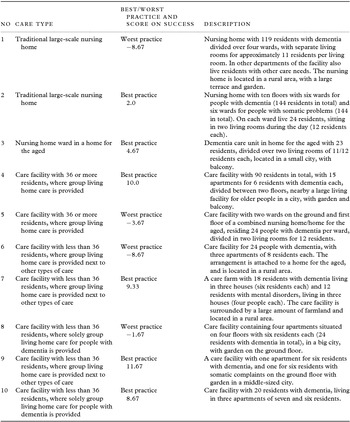
In the first measurement cycle of the LAD study (2008–2009), 136 long-term care facilities for people with dementia participated. These facilities represented traditional large-scale nursing homes (n = 27), nursing home wards in homes for the aged (n = 17), and three types of group living home care facilities: (1) group living home care facilities that had 36 or more residents with dementia (“large-scale group living homes”; n = 31); (2) small-scale group living homes (defined as fewer than 36 residents with dementia) that solely provided group living home care (n = 26); and (3) small-scale group living homes that also provided other types of long-term care at the same location (n = 35). The 136 care facilities were all state financed and had a similar resident population concerning age, sex, cognitive performance, and physical functioning. However, they varied to a great extent in terms of care organization and the primary study outcomes of resident quality of life, quality of care, and staff wellbeing. To gain more in-depth insight into facilitators and barriers of high-quality dementia care, a sub-study was conducted amongst facilities rated with the best and worst performing on measures used in the original LAD study (Willemse et al., Reference Willemse, Smit, De Lange and Pot2011). Using a selection of the quantitative data of the LAD study, all 136 locations were ranked according to their scores on (1) resident wellbeing measured using quality of life (the Qualidem; Ettema et al., Reference Ettema, Dröes, de Lange, Mellenbergh and Ribbe2007) and pain (MDS-RAI; InterRai, 2005); (2) staff wellbeing measured using job satisfaction, intention to leave (the Leiden quality of work scale; Van der Doef and Maas, Reference van der Doef and Maes1999) and burnout complaints (Maslach Burnout inventory; Maslach and Jackson, Reference Maslach and Jackson1986); (3) quality of care measured using person centered attitude of staff (Approach to Dementia Questionnaire; Lintern et al., Reference Lintern, Woods and Phair2000), and clinical records of the use of physical restraints and psychotropic drugs; (4) staff-to-resident ratio. The scores on these four outcomes were transformed to percentiles and added, resulting in a “total score of success.” It was aimed to select a high- and a low-scoring facility of each type of long-term dementia care facility. The selected care facilities were invited to participate in the sub-study. If they refused, the care facility within the specific type of care with the second highest or lowest score was approached. There was no “worst-performing” facility in the category “homes for the aged” willing to participate in the study. This category was filled with the inclusion of a second best practice in the small-scale care facility that solely provided group living home care, since group living home care was of primary interest of the sub-study. This procedure led to the participation of ten care facilities that are described in Table 1.
Description of participating facilities (n = 10)

In one shared living room in every care facility, five to six residents were selected for observation to collect data on behavior, occupation, and wellbeing (n = 57). Only residents that were living in the care facility for more than one month were observed. When the observed living rooms consisted of more than six residents that resided there for over one month, the observant consulted the team manager to gather a sample of residents that represented both males and females, people with moderate and severe dementia, and expressed different levels of disruptive behavior to obtain a representative sample of an average nursing home population. Prior to observation, informed consent was given by the primary family caregivers of the observed residents.
Measures
Occupation and wellbeing of residents
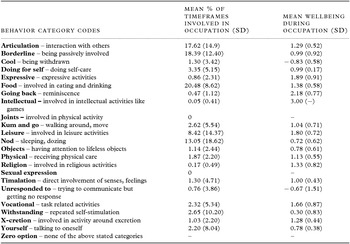
As observation tool, the eighth edition of Dementia Care Mapping (DCM) was used (Bradford Dementia Group, 2005; Brooker and Surr, Reference Brooker and Surr2006). DCM is a system for structurally examining components of behavior and quality of life of residents of dementia care settings. While it was originally developed as a tool to evaluate and improve quality of care in long-term dementia care, it has gained popularity as a research tool. Usually, DCM involves six continuous hours of observation, during which a trained observant (mapper) follows five to eight people over 5-minute intervals (Brooker, Reference Brooker2005; Sloane et al., Reference Sloane2007). For the current study, DCM was performed during two periods of three hours in each facility for the purpose of including mealtimes in the observations. The organization of mealtimes was theorized to be a determining factor for good dementia care, since in some care facilities meals were prepared in the kitchen of the shared living room, creating the opportunity for activities and social interaction. During each 5-minute interval at which the residents were observed, the dominant occupation of the residents was coded in one of 23 behavior category codes (BCCs), which are presented in Table 2. At the same time that BCCs were given to occupation of residents, their wellbeing was observed by ranking ill-being or wellbeing values that are rated on a six-point scale. A value of −5, −3, and −1 represents levels of ill-being, 1 is the neutral value, and +3 and +5 represent wellbeing.
Overview of the time involved in types of occupation and mean wellbeing during occupation (n = 57)

The bold words are the codes that are given to each type of occupation (ranging from A to Z) during Dementia Care Mapping. After these words, a description is given on that type of occupation.
Organizational and environmental characteristics of care facilities
To study the influence of characteristics of the care organization and individual space of residents, data of the larger LAD study dataset were used (Willemse et al., Reference Willemse, Smit, De Lange and Pot2011). Data on staff-to-resident ratio were derived from the working schedules of the care facilities. Data concerning the presence of a central activity program and the number of residents were derived from structured interviews with care managers. The size of the common living rooms was measured by research assistants.
To study the possible relationship between wellbeing-enhancing occupation and environmental characteristics of long-term care facilities, items of the physical environment evaluation component of DCM were measured (PEEC-DCM; Chaudhury et al., Reference Chaudhury, Cooke, Frazee, Rowles and Bernard2013). This tool is currently under development to form an environmental supplement to DCM. For the current paper, the domains “continuity of the self,” “social interaction,” and “stimulation” of the PEEC-DCM were studied, since these were theoretically assumed to enhance occupation. The domains respectively represent characteristics that help preserve or support residents’ past activities and preferences; characteristics that facilitate and enable meaningful interaction with others (i.e. resident–resident, resident–staff, resident–family); and characteristics that contribute to an appropriate quantity and quality of sensory experience (Chaudhury et al., Reference Chaudhury, Cooke, Frazee, Rowles and Bernard2013).
Since the complete tool was still under development at the time of the study, the mapper observed the characteristics once only in every care facility, instead of observing the environment in relation to the residents during the 5-minute interval observations. The mappers were instructed to explain their answers to the questions that required interpretation, so that the research team was able to check whether the answers to the questions were uniform. The used items of the PEEC-DCM and the mapper's instructions are presented in Box 1.
Environmental characteristics inventoried in each care facility, based on three domains of the Physical Environment Evaluation Component of Dementia Care Mapping (Chaudhury et al., Reference Chaudhury, Cooke, Frazee, Rowles and Bernard2013).
Please explain the answers to the items beneath
Continuity
1. Homelike décor and furniture in terms of colors, carpet, walls, tables, chairs, cabinets, lamps yes, partly, no
2. Presence of outdoor space yes, partly, no
3. Presence of walking path yes, partly, no
Both continuity and social interaction
4. Presence of occupational stimuli like books, papers, magazines, games, stuffed animals yes, partly, no
5. Presence of meaningful objects (objects that have potential value to residents) yes, partly, no
Social interaction
6. Presence of separate seatings on care unit outside the living room yes, partly, no
7. Furniture is arranged in conversational pattern (stimulating social interaction) yes, partly, no
Both social interaction and stimulation
8. Visual stimuli: decoration of the wall, photographs, mobiles, fish tank yes, partly, no
Stimulation
9. Presence of blinding glare on floors, furniture yes, partly, no
10. Enough daylight yes, neutral, no
11. Sound: TV, radio, shouting residents, shouting staff, dish washer pleasant, neutral, noisy
12. Smell pleasant, neutral, smelly
Analysis
For statistical analysis, the DCM data of the observed timeframes and attached behavior code categories and wellbeing were entered into SPSS version 19. To answer the first research question, the mean percentage of timeframes that all residents were involved in the different occupation types was calculated, as well as the standard deviations. The relationship with type of occupation and wellbeing (second research question) was studied by computing the average wellbeing value during involvement in the specific type of occupation. Concerning the third research question, those occupation types on which the average wellbeing value of residents was 1.5 points or higher were defined as “occupation types that enhanced wellbeing of residents.” The cut-off point of 1.5 was chosen in accordance with the cut-off points described by Fossey et al. (Reference Fossey, Lee and Ballard2002) in their study on the psychometric properties on DCM, in which they proposed that a mean wellbeing score of 1.5 or higher represents good to excellent wellbeing, whereas a score of 0.9–1.4 represents “fair” wellbeing, and a score below 0.9 represents low wellbeing in DCM. For all participating care facilities, an “enhancing occupation score” was calculated, representing the average time their observed residents were dominantly involved in one of the occupation types that corresponded with high levels of wellbeing. To answer the last research question, the participating care facilities were ranked according to their enhancing occupation scores, along with an overview of their organizational and environmental characteristics as observed by the mappers. The characteristics of the two highest and lowest scoring facilities were compared, to see if they prominently differed and might play a role in engaging residents in wellbeing-enhancing occupation.
Results
Resident characteristics
A total of 87.7% of the observed residents were female. The mean wellbeing score of residents was 1.17 (SD = 0.48), representing neutral or “fair” wellbeing.
Involvement in different types of occupation
In Table 2, the percentage of observed timeframes that the study sample of 57 residents were involved in the different BCCs is presented. All types of occupation, except for physical exercise (“joints”), sexual expression, and behavior that was not represented in DCM codes (“zero option”) were observed. Involvement in intellectual occupation was observed only for one timeframe.
Residents were mostly involved in eating and drinking (20.48% of the observed time), followed by being passively involved (18.39%), indicating that they were observing but not actively engaged. Other common behaviors were interaction with other residents, care staff or visitors, and sleeping or dozing. In 8% of the observed time, residents were involved in leisure activities such as reading and looking in magazines, listening to the radio, or watching TV. Other types of occupation were far less present during the observations.
Occupation types and wellbeing
Examining mean wellbeing values experienced during different types of occupation, a fair mean wellbeing level (mean value of 0.9–1.4) was observed during interaction with others, doing self-care, eating and drinking, walking around, receiving physical care, religious activities, involvement of senses, and excretion (leaving the living room to go to the restroom). High mean wellbeing values (+1.5) were recorded during expressive, reminiscence, intellectual, and vocational occupation.
Enhancing occupation in care facilities
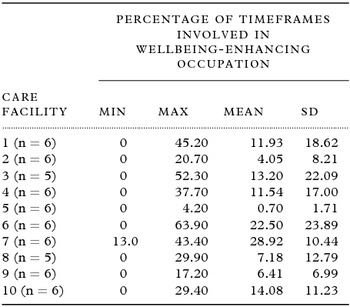
Wellbeing was enhanced during reminiscence, expressive activities, leisure activities, and vocational occupation and were labeled as “enhancing occupation.” Intellectual activities were excluded since they were only observed once. Table 3 presents the minimum, maximum, and average percentages of timeframes that residents within the ten care facilities were involved in any of the enhancing occupation types including standard deviations. Large variation exists in the average enhancing occupation of residents between care facilities.
Involvement of observed residents per care facility in types of occupation that are related to high wellbeing (n = 57)

Organizational and environmental characteristics and enhancing occupation
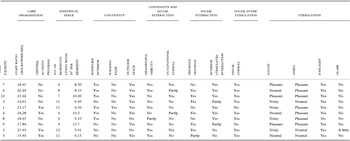
In Table 4, the care facilities are presented in order of the mean percentage of timeframes that their residents were involved in enhancing occupation, and their organizational and environmental characteristics. When looking at the two highest (facilities 6 and 7) and lowest (facilities 5 and 2) scoring facilities, few characteristics seem to be of importance concerning enhancing occupation in long-term dementia care. In particular, there seems to be no relationship between wellbeing-enhancing occupation and staff-to-resident ratio, as pointed out by the average staff ratio of the facility rated highest on wellbeing-enhancing occupation, and the average rating of facility 3 that had lowest staff ratio.
Characteristics that potentially contribute to wellbeing-enhancing types of occupation of ranked care facilities

The absence of a central activity program – in other words, activities were not primarily offered outside the care units and performed by specialized care workers on a fixed week schedule – did seem to be a potential contributor to engagement in enhancing occupation offered in the shared living room, as did two environmental characteristics derived from the Physical Environment Evaluation Component of DCM: a homelike, non-institutional interior (domain of continuity), and an interior that stimulates interaction (domain of social interaction).
Discussion
This explorative study shows differences between types of occupation in their potential to enhance wellbeing of people with dementia and in the extent to which these types of occupation are offered, and sheds light on some potential contributors to enhancing occupation. In our sample, reminiscence, leisure, expression, and vocational occupation seem to be of greater value for residents’ wellbeing than other types of occupation. Unfortunately, these wellbeing-enhancing occupation types were rarely offered – less than 5% of the timeframes on average – to the observed residents. There was much variation found between care facilities participating in this study in engaging the observed residents in enhancing occupation. However, in one facility residents were engaged in enhancing occupation during 25% of the observed timeframes on average, in another facility this was only during less than 1% of the timeframes. Facilities that engaged their residents in enhancing occupation on a frequent basis more often had a homelike atmosphere, supported social interaction through the environment, and did not have a central activity program.
The findings on wellbeing-enhancing types of occupation are generally consistent with the literature. Especially reminiscence, expressive, and vocational activities were described to have positive effects on mood, engagement, and sometimes even on cognition and behavior in previous research (Innes and Surr, Reference Innes and Surr2001; Woods et al., Reference Wood, Harris, Snider and Patchel2005; Harmer and Orrell, Reference Harmer and Orrell2008; Cohen-Mansfield et al., Reference Cohen-Mansfield, Thein, Dakheel-Ali and Marx2010a). Leisure activities, which contained activities such as looking at magazines, reading, or knitting in this study, are not frequently mentioned in the literature as a type of wellbeing-enhancing occupation, possibly because they are often not recognized as an activity. Physical exercise, a type of occupation that is described to positively influence wellbeing (Williams and Tappen, Reference Williams and Tappen2007) and which was found to lead to highest mean wellbeing scores in other DCM research (Innes and Surr, Reference Innes and Surr2001), was not observed during this study, so no conclusions can be drawn considering its impact on wellbeing. This might be explained by the fact that we observed in residents’ common living rooms. Involvement in intellectual activities was only observed once, so no conclusions can be drawn for this type of occupation.
Interaction was not found to be a wellbeing-enhancing type of occupation. This might be explained by the quality of interaction. Interaction was rated when residents talked to other residents, care workers, or family for the greater part of a timeframe, but could contain neutral, positive or negative interaction. As Harmer and Orrell (Reference Harmer and Orrell2008) reported, interaction might be only beneficial when it is of good quality. This illustrates the importance of the actual content of a type of occupation.
Consistent with the DCM study of Innes and Surr (Reference Innes and Surr2001), the staff ratio was not found to be clearly related with time spent in wellbeing-enhancing occupation in this study and, therefore, seems to be no explanation for low occupation of residents in long-term dementia care facilities, as assumed in some earlier studies (Train et al., Reference Train, Nurock, Manela, Kitchen and Livingston2005; Harmer and Orrell, Reference Harmer and Orrell2008). This suggests that occupation of residents depends on how care workers use the available time and how staff are equipped to engage residents in wellbeing-enhancing occupation. Findings from Smith et al. (Reference Smith, Mathews and Gresham2010) suggest that staff training in involving residents by using the daily environment significantly increases occupation, also on the long term, without increasing the number of staff.
Our study findings suggest that the presence of a central activity program does not necessarily have to decrease involvement in enhancing types of occupation as long as it is offered on a complementary basis. In one of the observed facilities in this study, the central program clearly was an extra service for residents, in addition to the provision of occupation in the shared living rooms. However, in the other three with a central activity program, only a few residents were involved during the observation period, leaving remaining residents generally unoccupied. These findings are consistent with findings of Vollicer et al. (Reference Vollicer, Simard, Heartquist Pupa, Medrek and Riordan2006), who assumed that the presence of a central activity program decreases the involvement in meaningful occupation. Also, for residents that are regularly involved in central activities, the sole provision of a central activity program might not meet the specific needs of long-term care residents. Knight and Mellor (Reference Knight and Mellor2007) pointed out that a central activity program for long-term care residents can emphasize their feelings of living in an institution instead of at home, and may facilitate only superficial interaction with other residents, although residents with dementia were excluded in this study.
Concerning individual space, the number of residents per living room and the size of the living rooms did not seem to make that much of a difference in terms of involvement in wellbeing-enhancing occupation. This conflicts with the findings that limiting numbers to between four and nine people optimizes engagement in activities (Cohen-Mansfield et al., Reference Cohen-Mansfield, Thein, Dakheel-Ali and Marx2010a). However, there could have been too little variation in the size of resident groups in the current study to find a relationship, and this might also be dependent on the type of residents and the type of occupation they need.
No relationship was found between occupational and visual stimuli and the provision of wellbeing-enhancing occupation. This is in accordance with the findings of Wood et al. (Reference Wood, Harris, Snider and Patchel2005), who found that the mere presence of stimuli does not automatically mean that residents were involved in activities due to their loss of skills to initiate activities. They have to be actively engaged to be occupied. In our study, sound did not clearly seem to affect involvement of residents in enhancing types of occupation, as was found in earlier research (Cohen-Mansfield et al., Reference Cohen-Mansfield, Thein, Dakheel-Ali and Marx2010b).
This study has some methodological limitations and strengths. This study is explorative in nature and not meant to represent daily practice of the participating care facilities, let alone nursing homes in general. Only a small sample of residents (n = 57) and living arrangements (n = 10) participated in this study. Our observations were done in two shifts of three hours, observing at least two different care workers per facility. Still, the observations could have been biased by the care workers present during observations. Also, the presence of the dementia care mapper might have influenced the study data, although it was tried to limit this bias by informing staff that we observed interaction and behavior, but not about the exact research questions on occupation and wellbeing. If study results are biased by this cause however, it is likely that this would have led to an overestimation of occupation of residents since staff would have wanted to perform better than usual, making our findings of low occupation even more distressing.
The fact that our observations covered the mealtimes of residents might have led to a bias in average time and types of occupation. Probably, residents would have spent more time in other types of occupation in other observation times than they did now since they would probably be less involved in eating and drinking. The time of the day can also influence mood and behavior of people with dementia. On the other hand, the mean time that residents were observed to be engaged in different types of occupation resembles observations of other studies using DCM (Sloane et al., Reference Sloane2007). A longer observation period would have limited the potential biases mentioned above.
DCM is sometimes questioned as a research tool since it was primarily developed to evaluate and improve care practice. Although the observation technique is standardized and performed by trained observers, it has certain psychometric limitations, such as low variability and low inter-rater reliability in the wellbeing code (Sloane et al., Reference Sloane2007). Despite these limitations, with the DCM tool, behavior and wellbeing can be measured simultaneously, enabling the study of the relationship between both in detail.
In this study, environmental characteristics were studied with the use of items of the physical evaluation component of DCM (Chaudhury et al., Reference Chaudhury, Cooke, Frazee, Rowles and Bernard2013). While this tool was still in development at the time of the data collection of this study, it was only used to observe the environment once by the dementia care mapper, instead of structurally inventorying the influence of the physical context alongside observations. Thus, although the items used in this study are evidence based, the way data on characteristics were collected leaves them open for interpretation, making the data of limited reliability.
Another limitation is the absence of objective data on the observed residents concerning age, stage of dementia, functional status, and disruptive behavior. Although all residents had to have moderate-to-severe dementia needing 24-hour care and assistance with their activities of daily living, since these are strict criteria for receiving the type of care subject of this study, residents had individual differences in their behavior and dependency that probably influenced our study data. Subjective statements of the mappers suggested that residents with lower cognitive and functional status were occupied less often than residents with higher functioning levels, as is also indicated in several studies on factors that influence occupation of residents (Kuhn et al., Reference Kuhn, Fulton and Edelman2004; Dobbs et al., Reference Dobbs, Munn, Zimmerman, Boustani, Williams, Sloane and Reed2005; Kolanowski et al., Reference Kolanowski, Buettner, Litaker and Yu2006; Smit et al., Reference Smit, de Lange, Willemse and Pot2012). Standardized data on these characteristics would have provided more insight into this relationship.
Despite the explorative character of this study with accompanying limitations, its results have important implications for care practice. They show that it is possible to engage residents in wellbeing-enhancing types of occupation, and to do so within current means of budget and staff. They also show that the environment might have some influence on activity participation. The next step would be to translate these group results back to the individual resident, with its own preferences and needs. Further research is needed to study which mechanisms cause certain types of activities to be of greater value, or of greater meaning, than others so that care workers can apply this knowledge when making care plans for and preferably with residents. The same holds true for the impact of the environment on resident occupation. For example, does a homelike environment create more opportunities to involve residents in wellbeing-enhancing occupation, or is “feeling at home” of vital importance to enjoy activities? Understanding what makes activities meaningful, and eventually how to involve each unique resident in meaningful occupation, is the key factor for its increase. In order to reach this, it is essential to put wellbeing-enhancing occupation on the care facility's agenda, to evaluate the contribution of the organizational and physical environment, and to enable care staff to acquire skills to integrate wellbeing-enhancing occupation in practice and to adjust these types of occupation to the individual interests, needs, and abilities of residents.
Conflict of interest
None.
Description of authors’ roles
Dieneke Smit analyzed the data and drafted the paper. Bernadette Willemse helped in analyzing the data and helped to draft the paper as did Jacomine de Lange. Anne Margriet Pot helped to draft the paper, checked the analyses, and is principal investigator of the LAD study. All authors contributed to the design of the LAD study. All authors read and approved the final paper for publication.
Acknowledgments
The Living Arrangements for people with Dementia study is supported by a grant from the Netherlands Ministry of Health, Welfare and Sports and patient organization Alzheimer Nederland.