The problem of word setting in Machaut's refrain songs
The manuscripts devoted to the works of Guillaume de Machaut notate his musical compositions with striking precision and and a high degree of consistency.Footnote 1 Particularly noteworthy is the attention paid to the clear indication of word setting, at a time when the cultivation of increasingly melismatic styles was rendering this aspect of text notationally problematic.Footnote 2 The care that evidently went into indicating the coordination of syllables and notes demonstrates that it was an important aspect of Machaut's compositional conception.Footnote 3 Yet the values underlying this conception are clearly different from those that were later to be promoted under the influence of Humanism and that have remained central to good practice in word setting subsequently. Often found are such apparent solecisms as contravention of word accents, introduction of formal breaks without regard for semantic units and placement of melismas on unimportant words or syllables. Word setting seems to be an aspect of compositional practice that aligns Machaut with values distant from those of subsequent musical practice, values that may still seem strange.
It is widely recognised that a system of rhythmic declamation of poetic lines is the basis of Machaut's word setting: the syllables of a line are grouped at a structural level and then rhythmicised to create a specific form.Footnote 4 Robert Gieber studied Machaut's word setting from the perspective of its response to aspects of poetic form and observed a fairly consistent complexity in the relationship.Footnote 5 In general, the musical setting matches the poetic form; but in particular instances, the poetic form as set by the music may not be identical with that of the poem. Challenges of strophic verse setting are at work here. Within the framework of a given stanzaic form, the poet has a certain latitude for variation, as in the use of enjambement or lyric caesura. The musical setting is fixed for all the stanzas and thus does not respond to such variations within them. Where a stanza employs features of this sort individually, its form will be different from that fixed in the musical setting and will thus be detached from it. Machaut goes beyond this, however, in introducing wholescale differences between formal features of the poem and of the musical setting.
Marie-Louise Göllner has developed the view of a structured detachment between music and poem: ‘The musical fabric does not … serve simply to reinforce features of the poetry, but rather sets up a structure of its own to counterbalance that of the text … [T]his structure is always related to and indeed derived from the poetry.’Footnote 6 Similarly in their patterns of repetition and contrast, poetry and music are very similar whilst not being structurally identical.Footnote 7 The two dimensions of the song complement one another but operate separately.
The present article extends this thinking to address a wider range of technical elements with a deeper significance for the resultant composition. It proposes as a hypothesis for the phenomena observed a dualistic relationship of words and music in Machaut's word setting.Footnote 8 The dualism is founded in the coordinated but independent operation of principles of musical mimesis and musico-poetic dislocation. The music is constructed at a primary level as an imitation of the poetic form; but the musical form resulting from the imitation is fundamentally separate from its model and may thus be displaced against it. Displacement may, in extreme cases, lead to a full-scale abstraction of the music from the poetic model that inspired it. The hypothesis is proposed to account for complexities that can be observed in the setting of words to music even where poem and music are closely connected, as in the virelais and many of the ballades. It makes, though, a contribution to understanding also another striking aspect of Machaut's word setting: the disconnection often apparent between the length of a poem and of the song derived from it.
There is a wide range in the length of the lyric poems: the longest virelai (‘Diex, Biauté’ (V19)) has as many as seventy-four lines, mixing paroxytonic heptasyllables and pentasyllables, whilst the shortest rondeau (‘Dous viaire’ (R1)) has eight oxytonic heptasyllables. However, the musical lengths of the resultant songs do not always manifest a corresponding difference. Whilst R1 is indeed the shortest song, with its fifty-six syllables being set to a length of forty-six breves, the 552 syllables of V19 have a length of 268 breves, just over half of the proportionate length; and the longest song is in fact ‘Ma fin est mon commencement’ (R14), whose mere sixty-four syllables are carried by 320 breves of music. The difference in the density of these two settings is exaggeratedly wide. In the one case, the music hugs close to the poem for its shape and dimension, in the other it breaks free, almost oblivious of the poem's presence. Are these really manifestations of the same aesthetic disposition, and if so, how does it cohere? The proposition advanced here is that the dualistic relationship of words and music provides a basis for understanding the two types of song as manifestations of the same technical and aesthetic principles.
Musical mimesis and its dislocation in Machaut's word-setting
In composing a song, Machaut began with the poem. His lyric poetry replicated formal patterns in a way that contributed to their recognition as fixed elements in French poetic composition of the time, the ‘formes fixes’ of literary history; and they continued to be standard up to the end of the fifteenth century. Each form grouped lines to correspond to two parts, which were the principal divisions of the musical form recognised in the descriptions of Egidius de Murino, writing in the second half of the fourteenth century, and of an anonymous author, writing probably later than Egidius and now preserved in two fifteenth-century manuscripts.Footnote 9 It was the pattern of repetition of the parts that defined the form, as shown in Table 1. In the virelai, the first part set the refrain and was followed by the second part, which was repeated before the first part returned to complete the stanza. In the ballade, the first part was repeated and followed by the second, completing the stanza.Footnote 10 Within the second part was the refrain and before it a group of lines which Jacques Legrand, a theorist of poetry writing at the beginning of the fifteenth century, called ‘oultrepasse’.Footnote 11 In the rondeau, the refrain was set across the two parts, and the song continued setting the ‘additamenta’ (the lines of the poem other than the refrain)Footnote 12 via a sequence of repetitions to create a through-composed poetic thought of comparable length to a single stanza of a ballade.
Formal differences between a typical virelai, ballade and rondeau.

{ } = statement of a part setting the lines of the poetic refrain
() = statement of one or more parts setting lines other than the refrain
Capital letters in the poetic form indicate refrain lines
In ballades, the refrain line (or occasionally lines) is included within the second part; sometimes it is separated by a textural break yielding a (1 1 2) {3} form to the stanza.
Although the music of each type of song consisted of two parts, suggesting that formally speaking there might not be much difference between them, the number of lines typically grouped within each part varied according to the form, as Table 1 shows. At this basic structural level, each of the song-types was different. The extremities of Machaut's practice ranged from a part containing as few as one line (as very commonly in the rondeaux) to one containing as many as eight lines (as exceptionally in the virelai ‘Tuit mi penser’ (V25)).Footnote 13 Each line comprised a certain number of syllables leading up to a rhyme of one stressed syllable (oxytonic) or two syllables, the first stressed and the second unstressed (paroxytonic).Footnote 14 The poem thus presented the composer with an initial rhythmic framework for the song, and the first compositional challenge was how to respond to it.
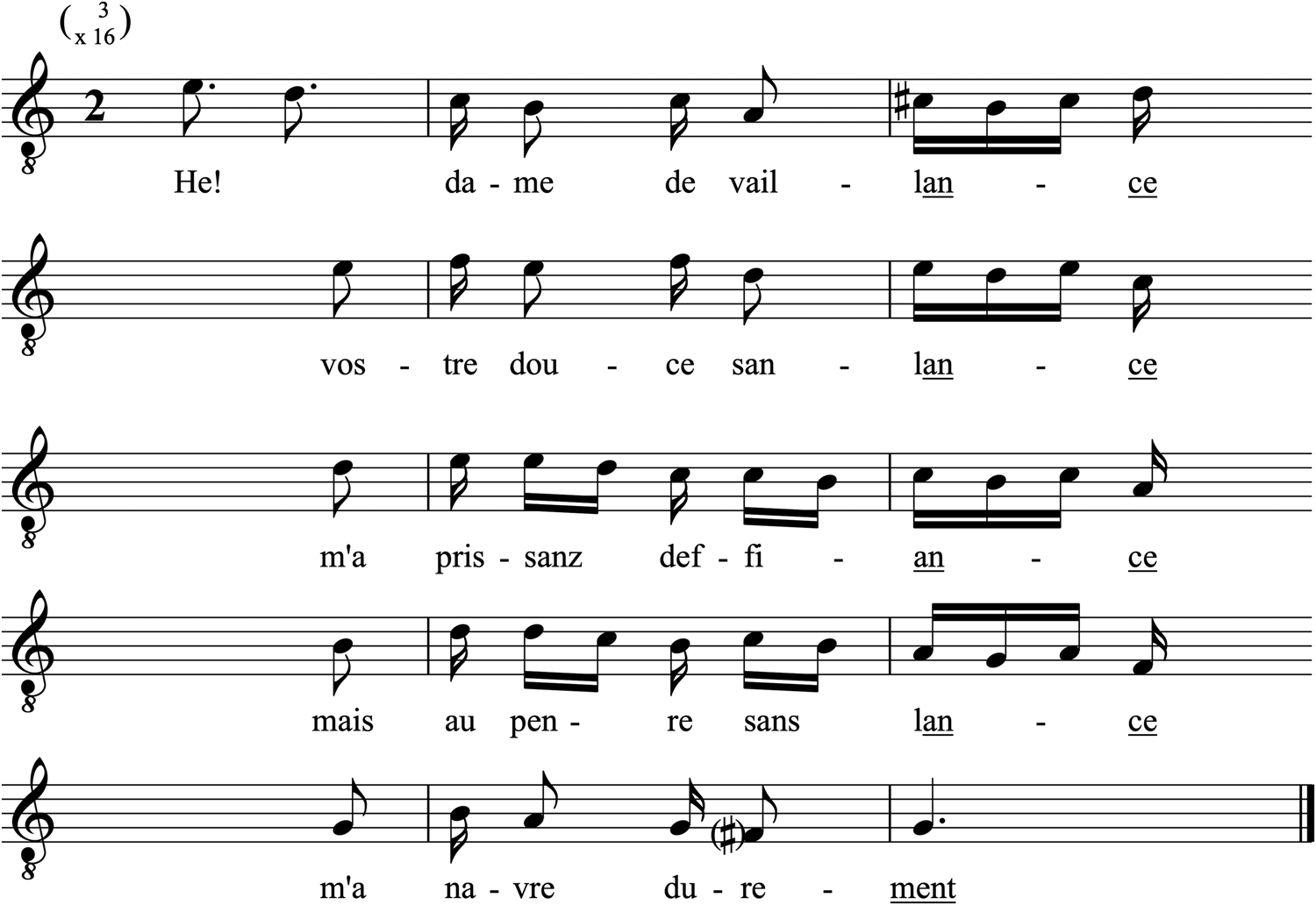
‘He! dame de vaillance’ (V1) shows in its refrain the sort of correspondence between poetic and musical elements that might be expected and can be regarded as basic. The form of the poem provides a rhythmic framework defined by the rhymes and the number of syllables in the lines. The first four lines have paroxytonic rhymes and the fifth an oxytonic one. Each line has five syllables leading to the rhyme. The basic rhythm of this section of verse is:Footnote 15
In developing a musical rhythm from this, Machaut elongated the stressed rhyme syllables to twice the length of the other syllables. He thereby created a pattern of isochronous syllabic groups: those of four equal syllables alternating with those of three, of which the first was a stressed rhyme syllable counting for two, the second being the unstressed rhyme syllable and the third the first syllable of the following line:
The melody with which Machaut set this poem follows the rhythmic framework closely (Ex. 1). The groups of syllables are aligned with major imperfect tempus (compound duple) metre; the accented syllables of the rhymes are placed at metrically stressed positions. The first syllable is expanded to the length of a full bar, establishing the metrical unit at the outset. The transfer of poetic rhythm into musical is almost automatic. The music imitates the basic rhythm of the poetic form inflecting only the style of it through the adoption of the short–long pattern of the second rhythmic mode. This rhythmic choice was one that Machaut commonly made for virelais and was very likely associated with the genre of dance-song.Footnote 16
The first part of V1.

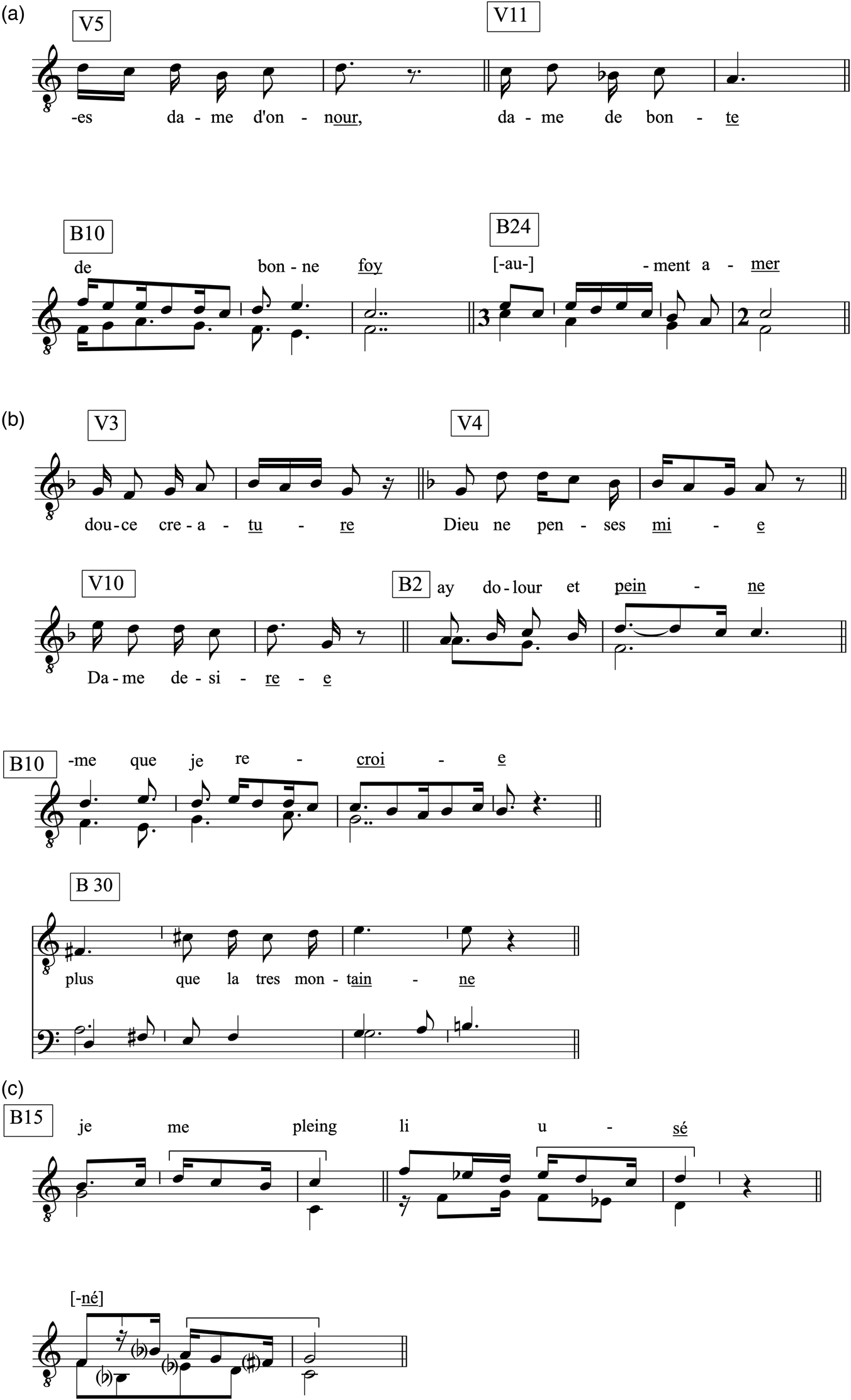
The musical rhythm is thus grounded in a framework that imitates the poetic construction. The pitch dimension of the melody enhances the imitation through the use of musical rhymes, cadential figures that recur at phrase-ends like the rhymes of the poem at line-ends.Footnote 17 They further differentiate the two types of rhyme in the poem. V1 is not unique in this respect: the setting of oxytonic and paroxytonic rhymes with cadences appropriate for them is a standard part of Machaut's compositional technique (Ex. 2a and 2b). As the oxytonic cadence is a single note, such rhymes are often enhanced through figural repetition leading into the cadence itself – a musical version of rime riche (Ex. 2c).Footnote 18
Characteristic cadences matching rhyme types.

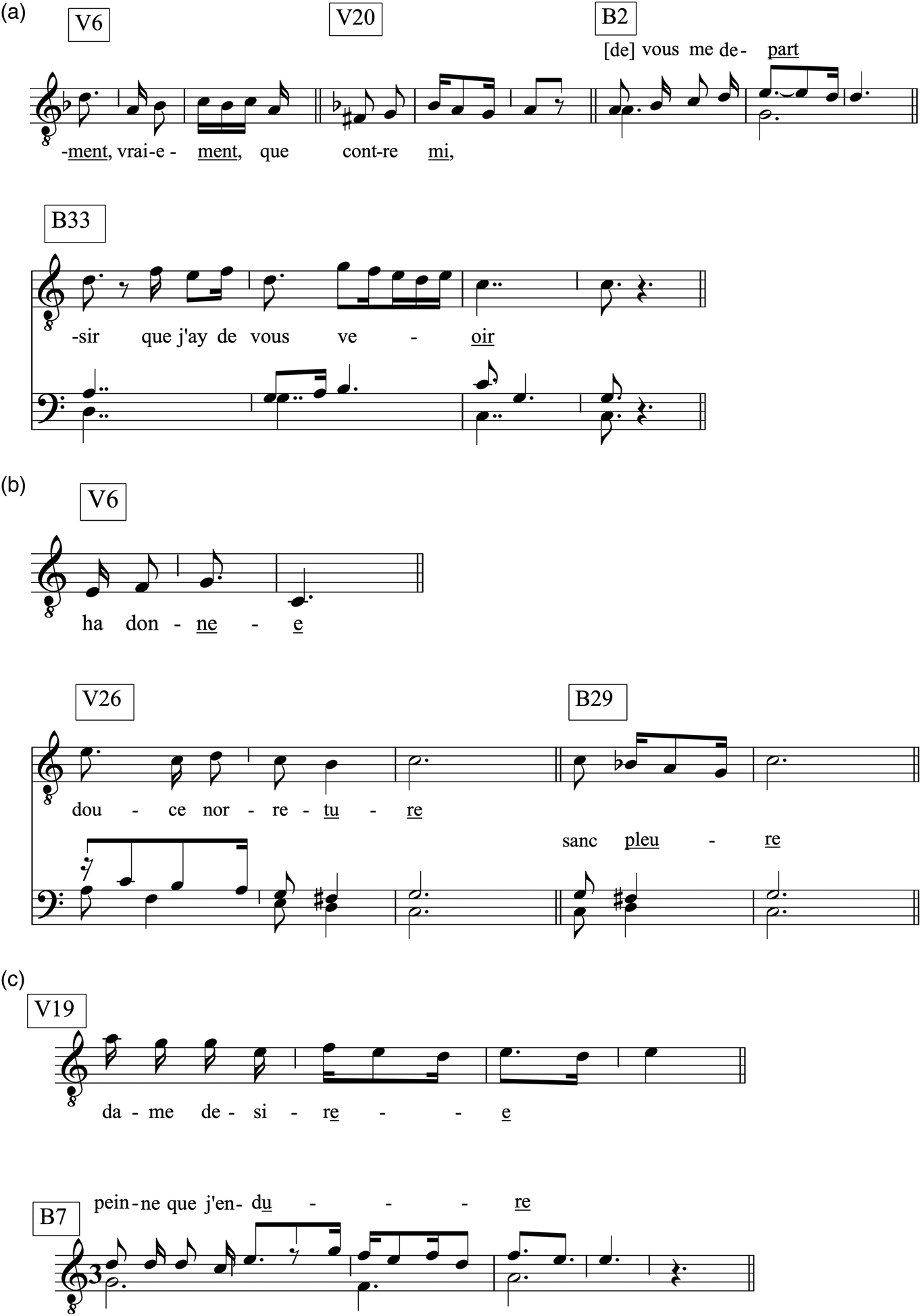
V1 shows that Machaut understood how to set poetry such that the music was directly correspondent to the verse. The capacity to do this represents a fundamental facet of his compositional practice: the technical starting point of his lyric song. However, this transparent imitation of poetic form by melodic design was a formal effect that Machaut seldom used. Even the apparently simple monophonic virelais register numerous refinements and developments of the model. Machaut realised that the possibility of aligning the words with a melody that simply imitates their formal properties in its musical elements, what might be deemed a ‘correct’ setting of the poem, is just one approach that can be taken; it is equally possible to fit words to a setting containing the same number of syllabic positions but imitating the formal properties of a different verse structure. One of the simplest of these techniques was the inversion of cadences in relation to rhymes, a phenomenon for which I have proposed the term ‘cross-cadencing’.Footnote 19 An oxytonic rhyme could be set to a figure matching a paroxytonic rhyme (Ex. 3a), or the other way around (Ex. 3b); or in a complex version, a paroxytonic rhyme might be set as an oxytonic rhyme in cross-cadence with a paroxytonic rhyme (Ex. 3c).
Instances of cross-cadencing.

Through these simple sleights, the setting may be subverted: the music still stands as a mimesis of poetic form, but it does so in an abstract way, as the poem it imitates is not the one that is actually set but an imagined one with a slightly different form, a form at odds with that of the original poem. Dissonance is thereby introduced into the setting through the variance between the poem itself and the poetic form implied by the setting. As will be shown below, Machaut deployed a variety of techniques for developing such dissonance.Footnote 20
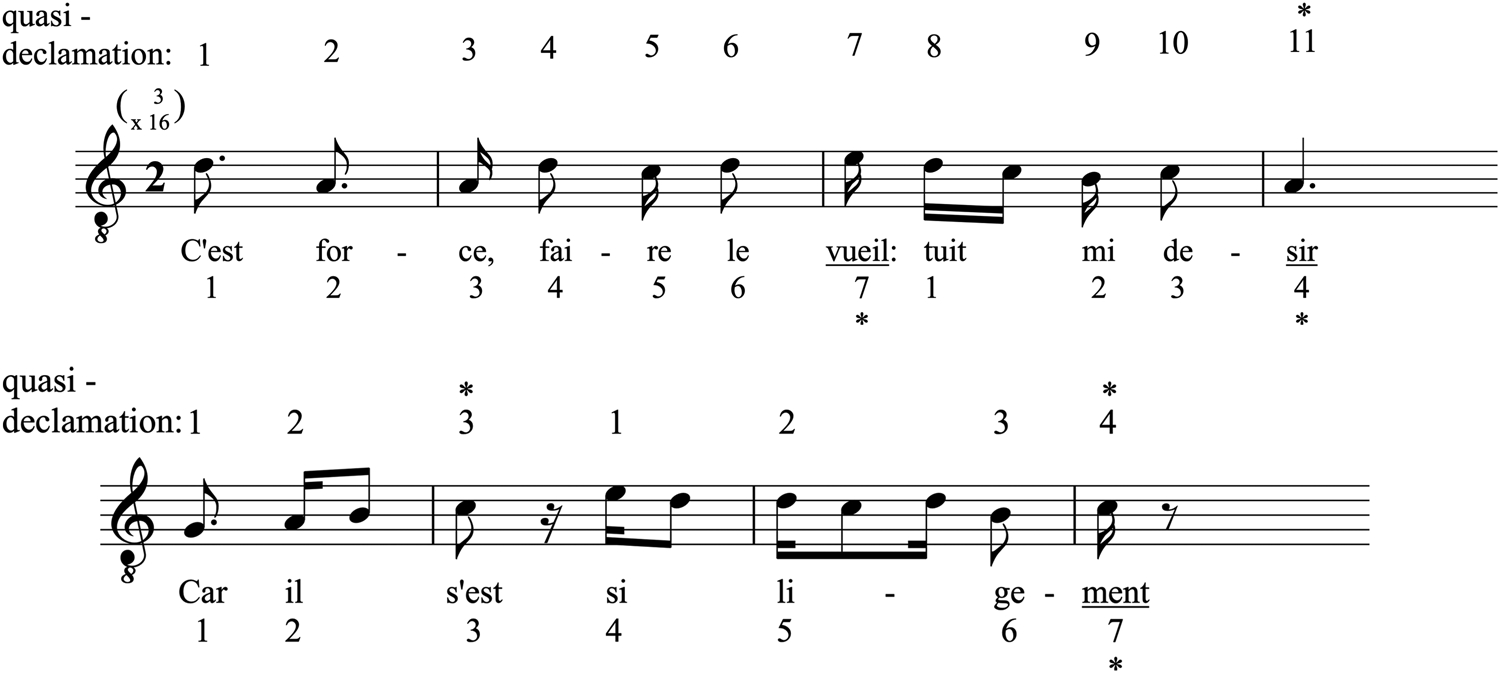
Detachment between the poem and the setting could be effected in a more thorough-going way by setting two lines to a single phrase or one line to two phrases. At the beginning of ‘C'est force’ (V16), the first two lines are set to a single phrase (Ex. 4a). The melody works as if it were setting a single line of the combined length of the two:
Conversely, the seven syllables of the first line of the second part of ‘Dame, mon cuer emportez’ (V32/29) are set across two phrases (Ex. 4b). The single line is set as if it were two:
These are examples of a phenomenon that I call ‘quasi-declamation’, by which one or more lines are set as if they had a different versification scheme from the one they actually have.Footnote 21 In both of the cases above, the setting is still connected to the poem, even though it differs from it. In V16, the rhyme of the first line is placed at an accented position in the metre, as would normally be the case at the end of a phrase. The difference is simply that the melody does not stop to make a cadence but continues through into the next line. In V32/29, the declamation of the line proceeds in semibreves. Its structure is one belonging to the line, but within this the melody articulates an independent phrasing, as if setting two shorter lines.
Instances of quasi-declamation.

Quasi-declamation can be taken further, leading even to a radical detachment of the verse and music. This is the case in ‘Biaute qui’ (B4), which begins with a pair of octosyllabic lines:
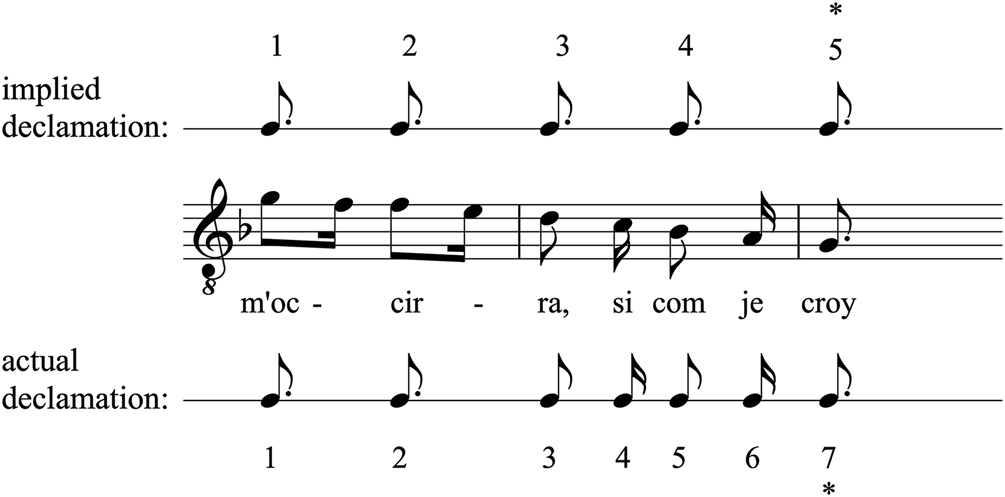
Machaut sets the lines to three phrases, and only the cadence of the third coincides with a rhyme in the poem (Ex. 5): the first phrase breaks after the fifth syllable of the first line; the second phrase concatenates the remainder of the first line to the first three syllables of the second; and the third phrase picks up the rest of the second line. The quasi-declamation represents lines of four, seven and five syllables:
In fact, there is a further level of detachment at work in this case, as the rhythm of the syllables is not always that implied by the music viewed on its own. The melody implies word setting consistently at the tempus level, with syllabic change occurring in semibreves of the original notation. Following this, an ‘implied declamation’ can be discerned that indicates yet another versification scheme for the opening (shown also in Ex. 5):
Machaut's starting point was a pair of rhythmically isochronous lines, but his end was a sequence of three musical phrases of different lengths: four, three and two breves respectively. In short, the musical phrases look as if they were written for an entirely different poem.
Quasi-declamation and implied setting at the beginning of B4.

The setting creates dissonance between the actual and implied declamations. Far from being an occasional effect, it is central to Machaut's technique. He sometimes creates dissonance between implied and actual versification even when setting a line to a single phrase. The sixth line of ‘Mors sui’ (V29/26) has seven syllables but is set to a pentasyllabic phrase, necessitating a change of syllabic rhythm from tempus to prolatio grouping (Ex. 6).
Dissonance between implied and actual setting in V29/26.

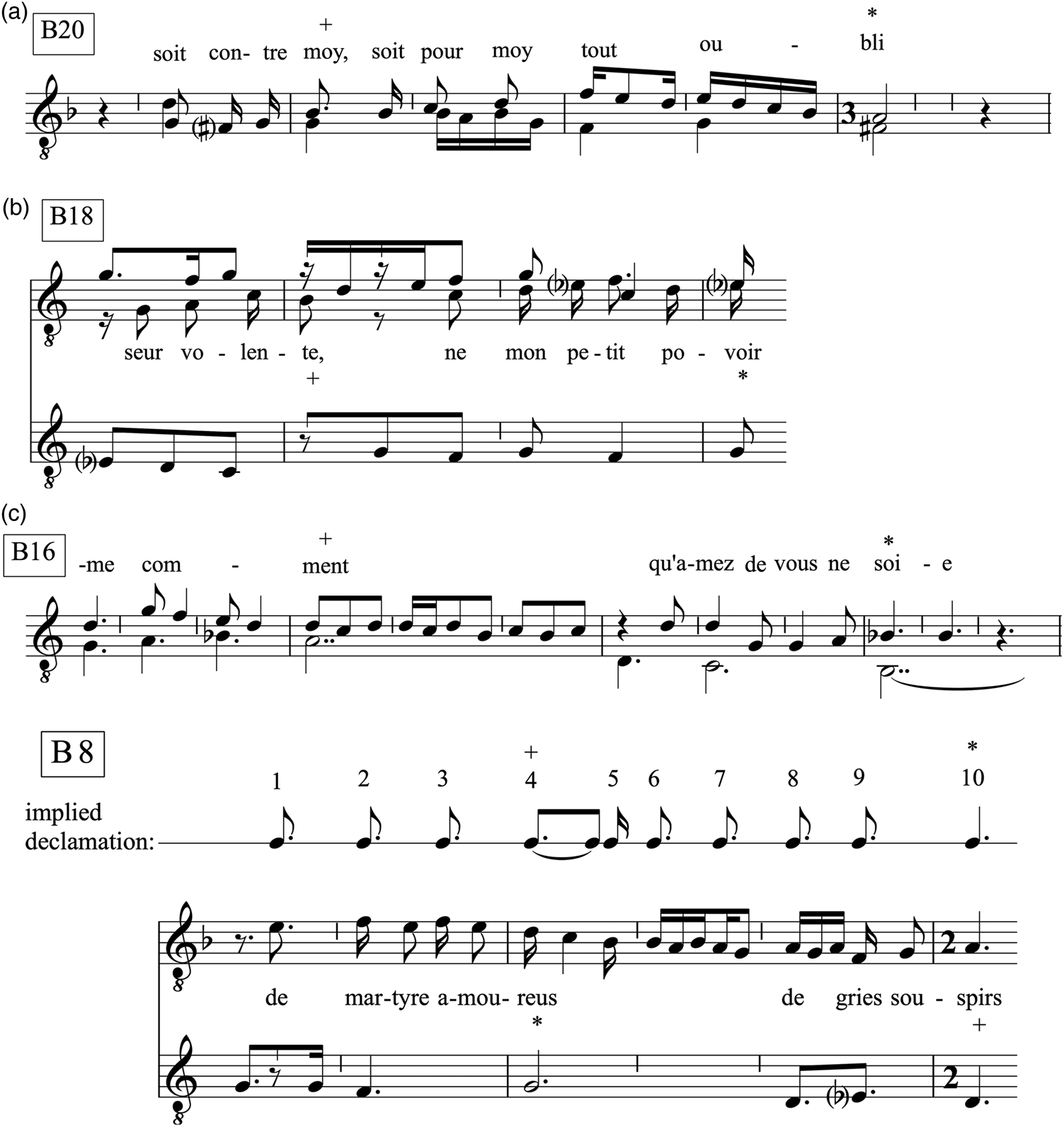
Splitting a single line into two with separate phrases has poetic precedent in the structuring of a longer line as a pair of hemistichs separated at an accented caesural syllable. That syllable may, but does not always, coincide with a syntactic break; and it may have been paused in recitation.Footnote 22 The practice of dividing the line is ubiquitous in decasyllables, where the caesura falls usually between the fourth and fifth syllables, dividing the line into a minor hemistich of four syllables and a major hemistich of six syllables. Machaut's melodic writing imitates this phenomenon with a pause or a break or with both (Ex. 7a–c), contrasting it with the strong cadences of the rhyme. The cadences of the caesura and rhyme are complementary, articulating pairs of phrases that combine into a single unit, as do the hemistichs of the line. Here too is a potential for subversion; and by a process of ‘complementary-cadence inversion’, setting the caesura as a rhyme and the rhyme as a caesura, another sort of dissonance is introduced between the poem and the music. In the first part of ‘De desconfort’ (B8), the major hemistich of the first line and the minor hemistich of the second are set to a phrase with implied decasyllabic declamation, the rhyme of the first line being at the caesural cadence and the caesura of the second line at the rhyme cadence (Ex. 7d).
Caesural cadences in decasyllabic phrasing.

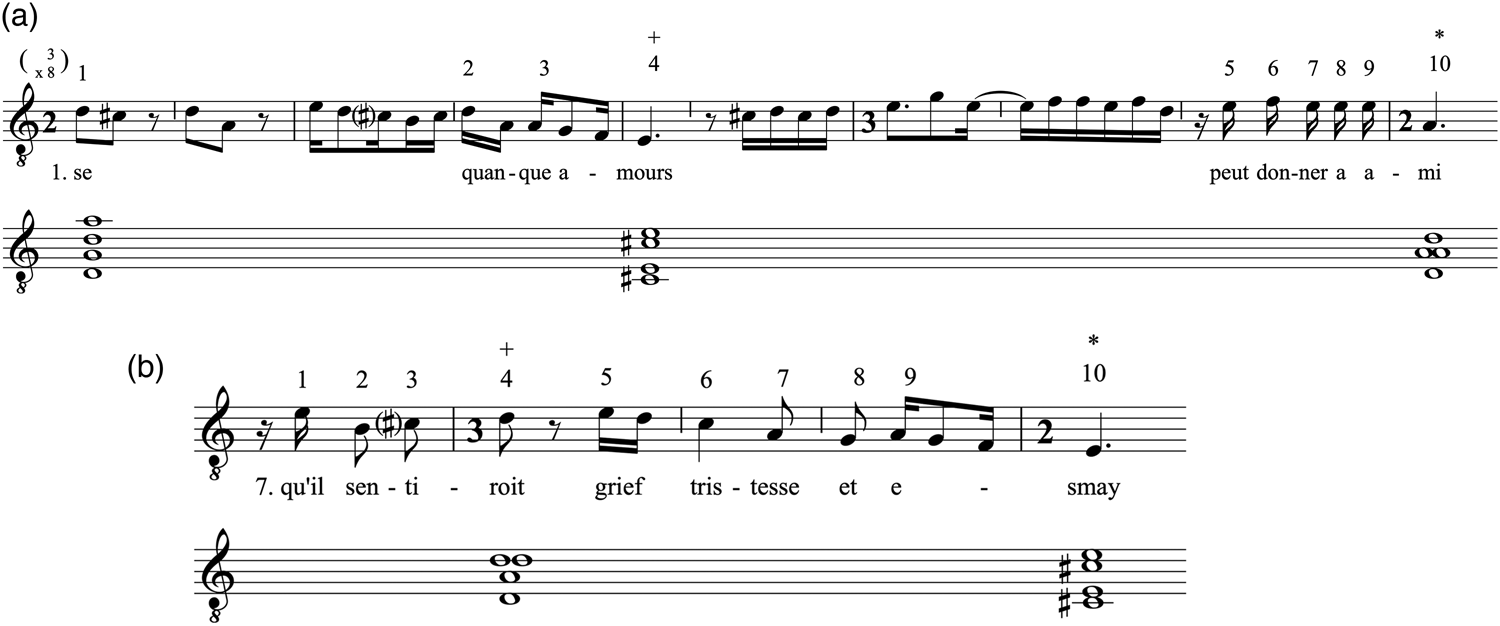
Polyphonic music also has harmonic means to imitate the effect of the caesural pause: an imperfect chord conveys the impression of suspension at this point in the line, whilst a perfect chord gives the finality of the rhyme. As Rose Lühmann pointed out, the caesural and rhyme cadences in the setting of the first line of ‘Se quanque amours’ are harmonically differentiated in this way (Ex. 8a).Footnote 23 The harmonic differentiation enhances the complementarity of the phrases to yield something similar to that of the eighteenth-century period. The intrinsic compositional strength and utility of this phenomenon are revealed in some of the following examples. The characterisation can also be subverted: in the seventh line, it is the caesura that is set to the perfect chord and the rhyme to the imperfect chord (Ex. 8b).
Differentiation of caesural and rhyme cadences in B21.

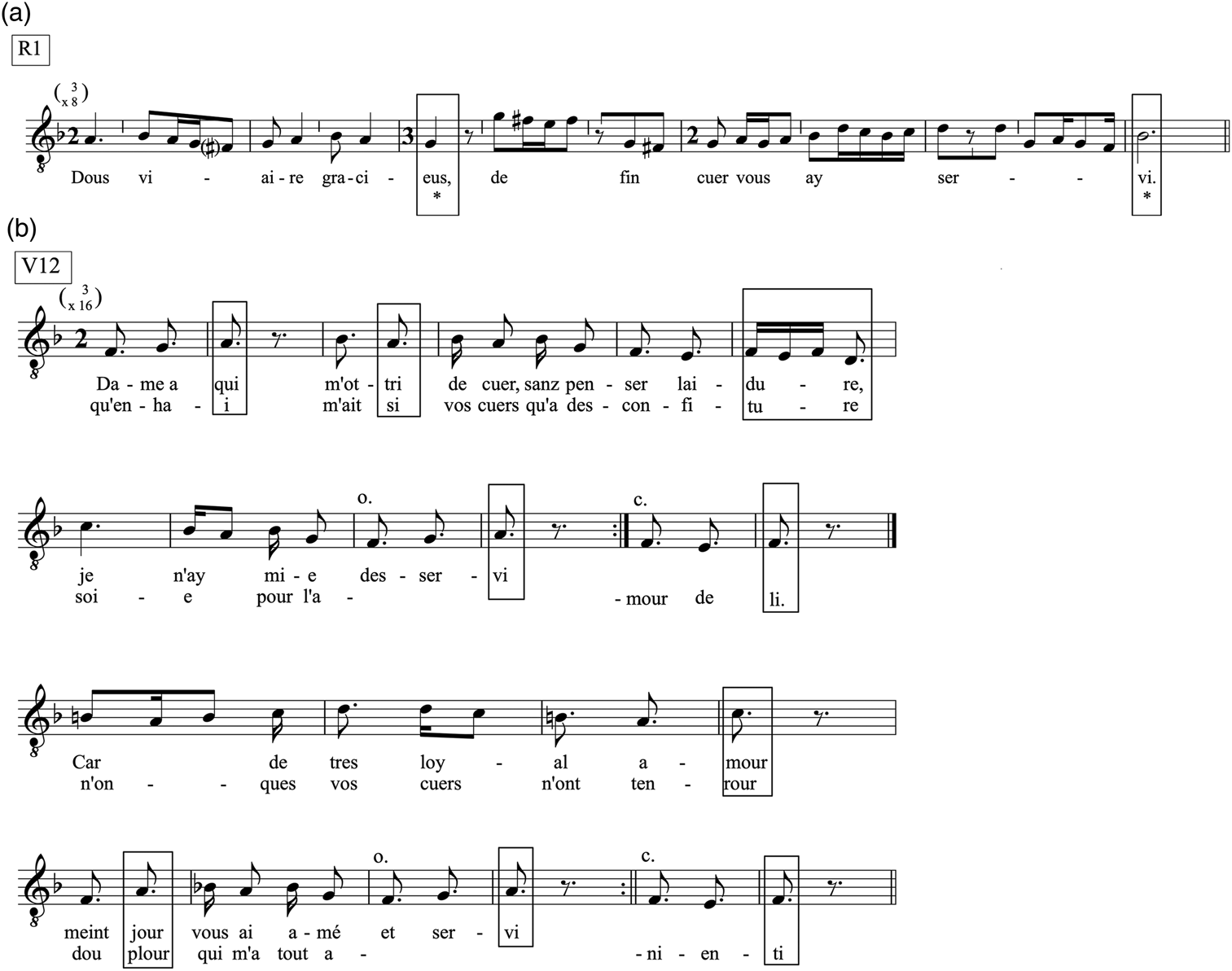
Rhyme could be matched in the music not only by melodic figures but also by specific cadential pitches. Such matching was almost unavoidable in a simple rondeau, as the cadences at the ends of the two parts were contrasted.Footnote 24 In R1, for example, the first part ends with -eus on G and the second part with -i on b flat (Ex. 9a). Amongst the more formally elaborate songs, ‘Dame, a qui’ (V12) comes the closest to a parallel of rhyme and cadence (Ex. 9b): the majority of rhymes are in -i, and most of these are on a; the two exceptions are the clos cadences on F. The -ure rhyme occurs only in the middle of the first part and has its own figure and pitch. The -our rhyme arrives in the middle of the second part on c. The contrastive effect of it is not undermined by its intraphrasal recurrence on a soon after.
Coincidence of rhymes and cadential pitches.

The contrast of ouvert and clos was an aspect of form recognised by theorists of both music and poetry. The music-theoretical accounts of the song forms cited above mention it in the repetitions of the parts of ballade and virelai and between the two parts of the rondeau. It occurs also in the description of ballade form offered by Jacques Legrand, where the ballade is said to begin with ‘two verses of two or more couplets, the first of which two verses is called the ouvert and the other the clos’ (‘deux vers de pluseurs couples, desquelz deux vers l'ung s'appelle l'ouvert et l'autre le clos’).Footnote 25 Perhaps he was simply borrowing terminology from music theory into poetic;Footnote 26 but the possibility that he recognised the contrast as an effective one in the poetry alone should not be overlooked. The first part of the ballade form, setting what Legrand regarded as the first ‘verse’, consists typically of two lines of contrasting rhyme. The rhyme structure is incomplete (and thus open) at this stage, as rhyme has not yet occurred. The first part is repeated with two further lines (Legrand's second ‘verse’) using the same form, and these complete (and thus close) the rhyme structure by supplying the necessary syllabic repetitions.Footnote 27 Here is the process at the beginning of ‘Dame, se vous m'estes’ (B37):
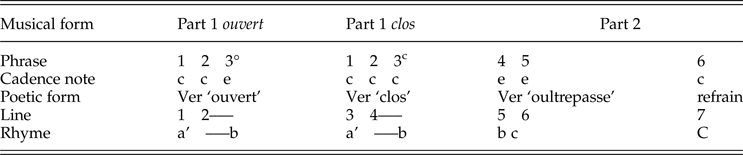
The ouvert and clos principle is thus one that works in the poetry. Analysis of the correlation of poetic and musical forms in B37 shows how it works differently in the music (Table 2). The poem has three rhymes, but the melody uses just two cadential pitches. The ouvert and clos contrast is achieved in the poem through the repetition of rhymes across the repeat of the first part; in the music the ouvert is created by a change of cadential note (the first cadence on e) and the clos by a return to the previous cadential note (c). The tonal form of this song is ‘recursive’, meaning that it derives from movement away from and back to the tonic established at the outset, thereby achieving closure.
Musico-poetic form in B37.

There is dissonance in this song, then, between the progressive structure of the ballade's rhyme scheme and the recursive structure of its melody's tonality. A poem could be written with rhymes to match the tonal and phrase structure of the music, following the implied declamation of the phrases. It would have the scheme:
Such a poem, if theoretically possible, would not be a ballade; nor would it correspond to any other form cultivated by Machaut. The only form that could come close in its rhyme structure to the recursive structure of this sort of tonality is the virelai. In V1, the -ment rhyme with which the refrain of V1 ends coincides with the first (and only) cadence on the tonic G (see again Ex. 1 above). The rhymes of the second part (-ueil and -iere) are on e and d and are ouvert because of their contrast with the G tonic. The tonality is recursive because virelai form returns to the first part to complete the stanza and for the intervening refrain. The first part thus begins and ends the form, and each time that the concluding G tonic arrives, it is accompanied by the -ment rhyme in the poem.
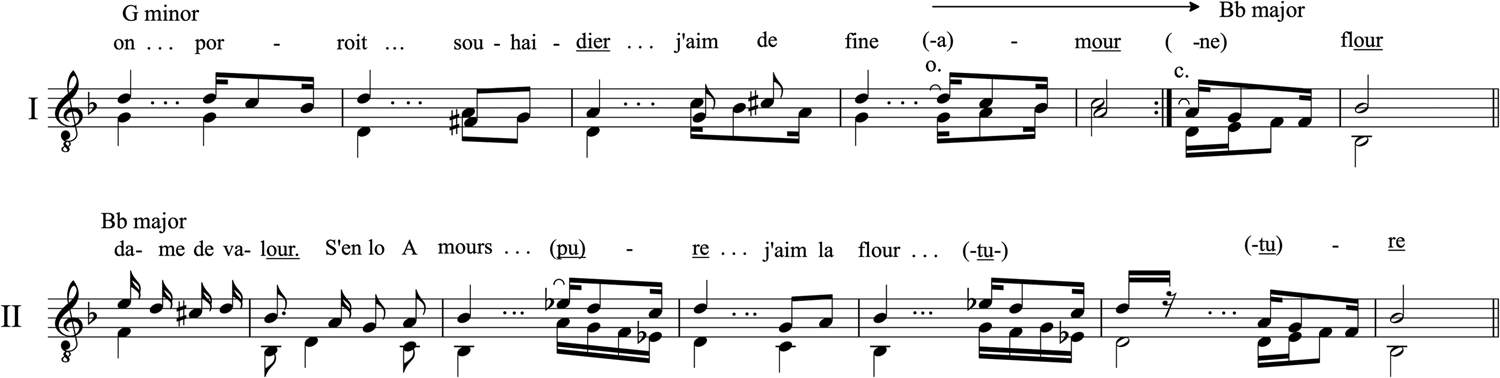
The progressive structure of the rhymes in B37 and much else of Machaut's poetry is paralleled tonally in some songs. In several cases it is achieved by a move from G minor to B flat major:Footnote 28 in R1 (Ex. 9a above), contrasting cadences for the rhymes match changes of key; in ‘On ne porroit’ (B3) rhyme and cadence are not coordinated (Ex. 10), but the tonal scheme is nonetheless comparable with the form's progressive rhyme structure.
Progressive tonal form as mimesis of progressive rhyme in B3.

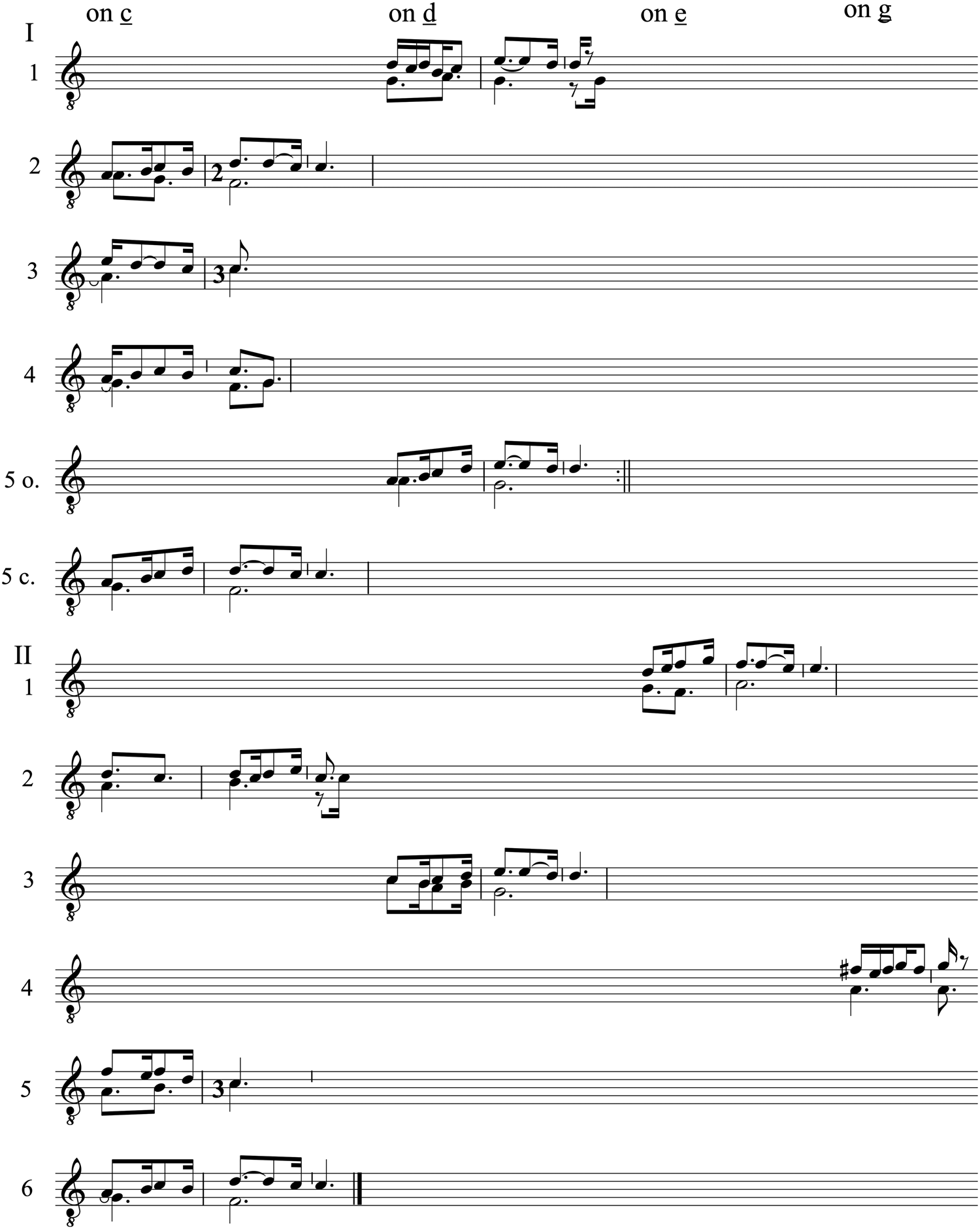
The possibility of articulating rhyme tonally by recurrence of a melodic figure or a pitch affords possibilities that go beyond those of poetic rhyme when the two are used concurrently. ‘Helas! tant ay’ (B2) deploys an appoggiatura cadence-figure as a musical rhyme (Ex. 11). Eight of the twelve phrases end with it.Footnote 29 Three different transpositions are used: ending on c (four times), d (three times) and e (once). All of these rhyme with each other on the basis of figural similarity; but those on c and d additionally rhyme in their pitch. The cadences on c further rhyme with phrases seven and ten, which cadence on this note without using the appoggiatura figure. The insistence of the appoggiatura figure is relieved by its appearance at different pitches in a way that monorhyme in the poem would not be. The musical materials have a latent capacity to surpass the verbal forms they accompany in their formal richness.
Musical rhymes in B2.

The use of a refrain is a defining aspect of the poetical forms. As Table 1 shows, the position of the refrain relative to the music varies. Yet in each of the forms, the whole of the musical setting repeats from stanza to stanza, so the musical refrain could not be manifested as a recurrence between stanzas; rather, it takes the form of one or more phrases repeated within or more commonly between the two parts.Footnote 30
Machaut used musical refrains in songs of each of the forms.Footnote 31 Most commonly the refrain ends the two parts, meaning that in the ballade it aligns with the refrain of the poem (fully in ‘Gais et jolis’ (B35),Footnote 32 but more often as part of a melisma on the last few syllables of the refrain-line, as in ‘De toutes flours’ (B31)).Footnote 33 In virelais and rondeaux, musical refrains occur without relationship to the poetic form.
At the beginning of this discussion, the metre of the musical settings was presented as a musical imposition upon the verse. This view merits qualification, as there are grounds for connecting musical metre to accentual patterns found in verse, to the extent that clear contraventions of linguistic accent constitute a special effect in the setting. The accentual pattern of paroxytonic rhymes is reflected in Machaut's settings; on occasions where the weak syllable is stressed through cross-cadencing, convention is deliberately flouted. The same can be observed within lines as well.
Machaut wrote at a time when the strength of verbal accent in the French language is thought to have decreased, moving to a flatter dynamic profile in which the timing of the individual syllable was more important in the metre than its intensity.Footnote 34 Deschamps and Legrand wrote simply of the number of syllables in a line, not of the accentual rhythm they would have. Accordingly, modern views of this poetry tend to reckon that, apart from the formal fixed stresses of rhyme and caesura (where present), the position of accents within the poetic line did not have metrical significance in poetic composition. There is, though, evidence of metrical use of verbal accent in poetic composition immediately prior to Machaut.Footnote 35 In the light of it, effects of accentual alignment in Machaut's work acquire significance. The beginnings of ‘Je vivroie’ (V23/21), the refrain of ‘On ne porroit’ (B3) and the beginning of ‘Rose, lis’ (R10) offer striking but not isolated examples:
The regular alternation of strong and weak syllables in these lines is imitated in each case by a melody setting them in pairs (Ex. 12a–c). Such setting is the structural basis for the declamation in a large majority of the lines, and its ubiquity suggests that Machaut composed his lyric verse against a basic metre of alternating stressed and unstressed positions.Footnote 36 It seems likely that this metrical rhythm and its accompanying declamatory structure in song had origins in the accentual rhythm of the language. The metre was a starting point not a straitjacket for the rhythm, and the accentual profile of an individual line might deviate from it, as towards the end of the first stanza of V23/21, in a line also set by the first phrase:
The accents within the line create dissonances with the metrical stresses maintained by the musical setting. The tension between the poem as imitated by the music and as actually constituted in the words is part of the conception of the song.
Musical and poetic metres aligned.

The widespread tendency towards pairing should not obscure occasional groupings of three syllables. Machaut adopts it in the metrical conception of the stanza in the oultrepasse of ‘Je ne cuit pas’ (B14) (Ex. 12d):
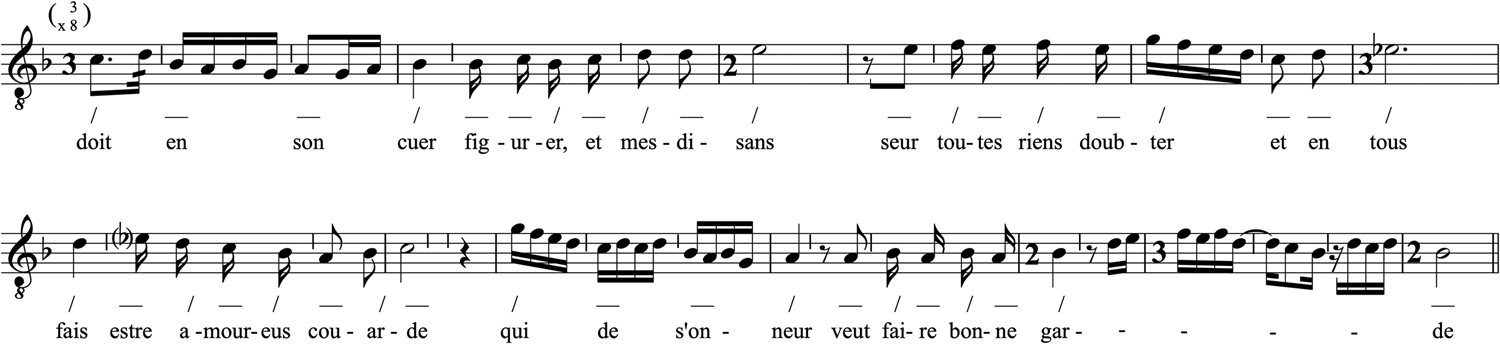
Here the change in poetic metre is met simply by a different grouping structure of the declamation within the prevailing musical metre.Footnote 37 In ‘Honte, paour’ (B25), some of the numerous metrical changes in the music respond to changes in the poem. The rhythmic coordination is clearest in the oultrepasse of the first stanza (Ex. 13):
The setting of the fifth line begins by following the poetic metre with declamation in breves creating a bar of perfect modus. The last three syllables of the line are run into the minor hemistich of the sixth line, and this combined series of seven syllables is set in such a way to mediate the transition from triple to duple grouping in the syllabic rhythm. Changes in the rhythmic level of the declamation (prolatio then tempus) enable perfect modus metre to be maintained for a further bar, though the accompanying voices switch to imperfect metre straightaway. The metre changes to imperfect for the major hemistich of the sixth line and first two syllables of the seventh. A striking moment in the setting is the treatment of the third and fourth syllables of the seventh line. There are apposed accents here, and the setting reflects them with pause and accent on both, the moment being highlighted by a reversion to perfect metre. The setting of the major hemistich of the seventh line, seven syllables because of the paroxytonic rhyme, follows the model of the final three syllables of the fifth line and minor hemistich of sixth, overriding the accents of the line.
Interaction of musical and poetic metres in B25.

The movement between perfect and imperfect metre that derives from the poem is epitomised in the refrain. The poetic rhythm begins with a triple group in the minor hemistich before duple groups in the major hemistich:
The setting mirrors the poem with perfect metre at the outset. The move to imperfect metre is then made in a similar way to that at the start of the oultrepasse, with a shift in the level of the declamation before the metrical change itself.
B25 is unusually changeable in its metre. It is one of two songs that resist classification according to a predominant metre, with perfect and imperfect bars almost equally mixed.Footnote 38 The music imitates the poem in its metrical changeability, even if the changes are often not coincident.
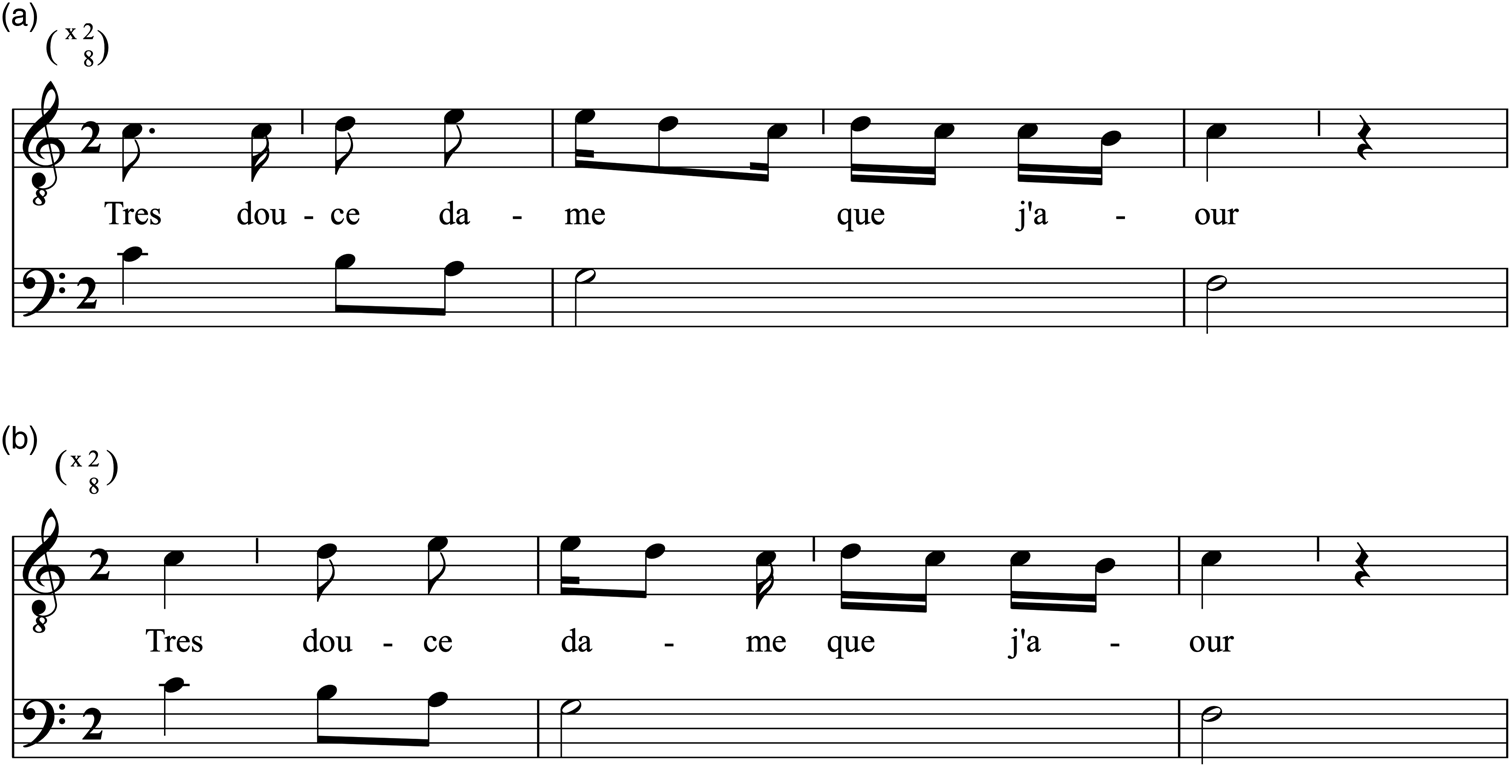
Control of the relationship of poetic and musical metres apparent in B25 shows that when Machaut sets the first line of ‘Tres douce dame’ (B24) against its verbal rhythm (Ex. 14a), where he could so easily have done otherwise (Ex. 14b), it is not because of ignorance or indifference, but because he sought a particular effect of dissonance:
The musical phrase is a straightforward binary octosyllable. By dividing the initial c to accommodate two syllables, Machaut shifts the second to fifth syllables earlier in the phrase than they should have been and thus changes the relationship between the words and music. The phrase fits the line so readily that it seems as if Machaut went out of his way to dislocate the setting against it. The dissonance between the regular iambic rhythm of this line and its musical setting is intrinsic to the aesthetic.Footnote 39
Accentual dissonance in the setting of B24.

Machaut's approach to song rested on a complete imitation of the elements of the poetry in the music. Rhyme, rhythm, refrain, form were all the basis for shaping musical ideas. The mimetic principles enabled Machaut to create a musical analogue of the poem in parallel to it. The rhymes and caesuras could be matched by cadences to create musical phrases corresponding to the lines or hemistichs of the poem. Variation in the placement of accents within the poetic line could provoke metrical change in the music. The presence of a refrain in the poem might be matched by one or more recurrent phrases of music.
It would have been possible for Machaut to realise musical settings that corresponded closely to the formal properties of the poetry he set;Footnote 40 but this is not what he set out to achieve. He cultivated dissonance, dislocating the elements of the musical imitation from their poetic originators. He used cross-cadencing and quasi-declamation; he detached the actual setting from the implied setting, the metrical stresses of the music from the accents of the individual poetic lines; he counterpointed the patterns of repetition in the music against those in the poetry. The settings that Machaut created are ones in which the correspondent elements of the two dimensions interact with one another. The songs work on two levels and derive much of their interest from the interplay between them. At the extreme, it can seem as if the music was conceived for a different poem from the one set, the setting holding the two together through an oblique relationship.
Some of the techniques Machaut used, such as musical rhyme and refrain, can be found in trouvère song.Footnote 41 What differentiates their appearance in Machaut's songs is the coordinated and systematic manner of their deployment. As the anonymous author of Les Règles de la seconde rhétorique noted, Machaut inaugurated a new formal phase of lyric poetry: ‘After [Philippe de Vitry] came master Guillaume de Machaut, the great poet of new form, who initiated all the new dimensions [of poetic form]’.Footnote 42 The cultivation of polyphony in his songs was the musical corollary of this aesthetic shift. The mimetic practice discussed here constituted a deliberate constructive technique reflective of the self-conscious novelty of fashioning autonomous polyphonic invention.Footnote 43 To mould this undertaking, Machaut's music looked to the poetry for its shape. Machaut's pursuit of the new aesthetic provoked him to subsume the musical imitation of poetry to the extent that the music could be detached from the poem set, retaining only the general model of verse.