Introduction
During the last few decades, the public debate on older people and the social science approach to ageing have developed an optimistic view of later life that is far from the customary stereotypes of decline, dependency and passivity and that is exemplified by the concept of active ageing. This emphasises the capacity of older adults to participate in social, economic, cultural and civic activities, not just their ability to be physically active. Active ageing has been adopted by the World Health Organization (2002) since the late 1990s to convey a more inclusive and complex view of older people, and it was the central concept for discussion during the Second World Assembly on Ageing in Madrid during 2002. Many consider education to be a cornerstone of active ageing. Recognising that the opportunity to learn does not diminish as we grow older and that education should not be restricted to certain life stages connotes that older people can improve and contribute to their community regardless of their age (e.g. Hinterlong, Morrow-Howell and Rozario Reference Hinterlong, Morrow-Howell and Rozario2007). The Madrid International Plan of Action on Ageing (United Nations Organization 2002), which emerged from the Madrid Assembly, proposes that education and capacity-building in older age are key priorities for integrating older people into a society for all ages and for promoting a more active and community-involved lifestyle (Davey Reference Davey2002; Sidorenko and Walker Reference Sidorenko and Walker2004). Returning to formal education should therefore be an option for older people who seek to spend their time in meaningful ways, and it gives them a chance to engage in activities that are personally fulfilling and can lead to a sense of satisfaction.
In this context, universities, as institutions designed to generate and spread knowledge, are key providers of educational opportunities for older people. In Europe, this has been recognised since the early 1970s when Pierre Vellas at the University of Toulouse designed a special educational programme for older people that started the University of the Third Age (U3A) movement. Around the same time, the first Open University and Institutes of Learning in Retirement appeared in respectively the United Kingdom and the United States of America (USA); they offered more higher education opportunities for older people. Since the 1970s, university programmes for older people (UPOP) have multiplied and become a global movement with examples in diverse countries such as as Finland (Yenerall Reference Yenerall2003), Italy (Principi and Lemura Reference Principi and Lemura2009), Australia (Swindell Reference Swindell1993), Taiwan (Huang Reference Huang2005), Japan, Canada (Hori and Cusack Reference Hori and Cusack2006) and Spain (Orte, Ballester and Touza Reference Orte, Ballester and Touza2004).
As UPOP have spread, research on their participants has also grown, although the literature is still sparse compared to that on adult learners in general. Apart from reports of the typical profiles of the participants and the main characteristics of the offered educational programmes (e.g. Alfageme Reference Alfageme2007; Huang Reference Huang2005), the most popular research topic has been the motives that drive older people to join university programmes. In this vein, many studies have distinguished expressive from instrumental motives. While the former refer to reasons related to the process of learning (such as learning for learning's sake, an intrinsic interest in the subject, or the wish for self-development), the latter refer to reasons other than those related to the process of learning, such as obtaining qualifications, meeting new people or solving personal or family problems. Research findings to date have generally suggested that learning among older adults is guided more by expressive than instrumental motivations – older learners tend to rank interest in a subject, intellectual curiosity and the desire to learn the highest among their motivations for engagement (Brady and Fowler Reference Brady and Fowler1988; Jarvis and Walker Reference Jarvis and Walker1997; Mulenga and Liang Reference Mulenga and Liang2008; Scala Reference Scala1996; Yenerall Reference Yenerall2003).
Other important reasons reported by older adults relate to personal growth and the satisfaction derived from learning. Kim and Merriam (Reference Kim and Merriam2004) reported that ‘to learn just for the joy of learning’, ‘to satisfy an enquiring mind’ and ‘to seek knowledge for its own sake’ were three of the five main reasons for enrolling at a US Learning in Retirement Institute, and that reasons related to reinforcing family ties or escaping from difficult or undesired life situations were the least frequently expressed. This predominance of expressive over instrumental motives does not mean that the latter are unimportant. In particular, social relationships (making new friends or socialising) have been regarded as an important outcome of older people's participation in education (Mehotra Reference Mehotra2003), which empirical evidence confirms (e.g. Kim and Merriam Reference Kim and Merriam2004; Montoro, Pinazo and Tortosa Reference Montoro, Pinazo and Tortosa2007; Villar Reference Villar2003).
Other potentially relevant issues about UPOPs have been studied far less. For instance, some authors have argued that educational participation has multiple benefits for older students. It has been asserted that maintaining and improving cognitive functioning, enhancing a better sense of self-esteem and personal utility, and expanding social networks and gaining more social support are some of the main benefits of participating in formal education in older age (Mehotra Reference Mehotra2003), but few empirical studies have explored these issues. In one study, Alfageme (Reference Alfageme2007) found that a sample of older university students ranked educational issues (such as increasing knowledge or discovering things that one did not know) as the main personal outcomes of programme attendance. Over one-half of the respondents in his study stated that their personal wellbeing had improved and that their circle of relationships had grown.
One pitfall of research on older university students is the assumption that all university programmes targeted towards senior citizens are equivalent, when in fact there are important differences. In Spain, for instance, university programmes for older people (UPOP) follow two models: ‘University Classes for Older People’ and ‘Experience Universities’. The University Classes for Older People model originated in the early 1980s when the first UPOPs were developed largely through the initiative of older people themselves. In this model, the programme is typically set up by an association of older people that runs the programme and designs the curriculum. The programme generally has lectures (normally one or two per week) with an academic rationale and that are combined with outdoor activities, such as excursions and cultural visits. In this model, the role of universities and university staff is quite limited, although the former may provide infrastructure support such as classrooms or computers, and the latter may be the lecturers and tutors and provide methodological advice. The bottom-up approach makes ‘University Classes’ in Spain similar to the Universities of the Third Age (U3A) which originated in Great Britain during the 1980s and are now widespread in the USA. In both cases, the programmes are run by associations independent of formal universities and embody a tradition of volunteerism and mutual help.
During the 1990s, Experience Universities, the second and top-down model of UPOP began to develop in Spain. In this model, the programmes are developed under the direction of conventional universities as an extension of their educational provision. Such programmes have generally been designed as three- or four-year versions of regular degrees in selected subject areas, most often the humanities and social sciences. The classes are tailored for older students, which usually means that their difficulty is lowered and assessment requirements, particularly examinations, are absent. In contrast to the previous model, older people are primarily students, and have little participation in the design and organisation of the courses which are the responsibility of university academic staff. At present, around 50 private and public Spanish universities offer these programmes for seniors (Orte, Ballester and Touza Reference Orte, Ballester and Touza2004). To date, no study has compared students belonging to the two UPOP models, a void that the present study aims to fill. It has two specific goals:
• To explore the motives of older adults for joining university programmes and their perceived benefits of participation.
• To examine how the type of university model (University Classes and Experience Universities) affects the students' profiles, their motives for participation and the benefits they derived.
Methods
The participants
A sample of 321 UPOP students (188 women, 133 men) participated in the study. Their ages ranged from 55 to 86 years, with a mean of 67.5 (standard deviation (s.d.) 6.9). Most of the participants were married (58.3%) or widowed (20.2%), and the rest had either never married (15.6%) or were divorced (5.9%). They all lived independently in their own homes. With regard to their educational background, 56 (17.4%) had completed only primary studies, 144 (44.9%) had completed university studies, and 121 (37.7%) had completed secondary studies. This distribution made the educational level of the sample significantly higher than that of the older Spanish population: according to recent statistics, 6.6 per cent had completed university studies (Instituto de Mayores y Servicios Sociales 2009). The sample was recruited from two universities:
• The Older People's Classes of the University of Barcelona (164 participants, 51.1%), which are organised as lecture courses (two per week). The organisation of older people responsible for the programme has organised and sustains seven courses that draw on lecturers, facilities and institutional support from the university. The students of three courses were randomly selected for this study.
• La Nau Gran, the university programme for older people at the University of Valencia (157 participants, 48.9%), which uses the Universities of Experience model outlined above. It offers three-year degrees adapted for senior students. These degrees combine courses (or modules) exclusively for older people (especially in the first two years) with selected regular courses in which older participants mix with the generality of students. The participants were recruited from the three most popular degrees in the programme: Psychology, Humanities and Life Sciences.
The questionnaires
To assess the profile of the participants, including their motivational orientations and the benefits they derived from the university programme, a questionnaire was designed and administered to the participants. It has three sections, the first of which solicits socio-demographic information including age, gender, marital status (married, widow/er, divorced or never married), level of formal education (primary, secondary or university studies), employment status, and level of involvement in the university course (years enrolled, days per week of attendance, hours per week of attendance). The second section is a modified version of Boshier's (Reference Boshier1991) Educational Participation Scale (EPS, A-form). Items in the scale ask about reasons for attending the university programme. The original version stipulated seven factors: communication improvement, social contacts, educational preparation, professional advancement, family togetherness, social stimulation and cognitive interest. Several studies using this scale have shown a consistent factor structure and found indicators of construct validity and good internal consistency (alpha from 0.91 to 0.77, depending on the factor) (e.g. Fujita-Starck Reference Fujita-Starck1996). Good consistency values have also been found in studies of older students (e.g. Kim and Merriam Reference Kim and Merriam2004).
Following Kim and Merriam's (Reference Kim and Merriam2004) suggestion, three factors were omitted in our version of the scale: two were not appropriate for an older student sample (educational preparation and professional advancement) and the third, communication improvement, which refers to learning to write or to improve language skills, was not appropriate given the high level of education of the participants. In addition, the original factor ‘social stimulation’, which could be mistaken for ‘social contact’, was renamed ‘escapism’, because it relates to attending the educational programme in order to solve problems or avoid difficult situations. Thus our version of the EPS included 24 items (six per factor) that captured various reasons for joining the university programme. The participants were asked to rate the extent to which each reason was true in his or her case using a four-point scale that ranged from ‘not at all’ to ‘very much’. The 24 items were translated into Spanish by a fluent, English–Spanish bilingual speaker, and translated back into English by another bilingual person. The comparison between versions identified only minor wording differences that were discussed by the translators until they reached an agreement.
Finally, the third section has seven items that reflect the potential benefits of taking the course, including health-related benefits (‘my health has improved’), psychological benefits (‘I feel more useful’, ‘I feel more satisfied with myself’, ‘I enjoy more my life’, ‘I am more active’), and social benefits (‘I have more friends’, ‘my relationships with other family members have improved’). The prompt was as follows: ‘How much have the following aspects of your life improved due to participating in the university programme?’ Participants had to answer the items using a four-point scale that ranged from ‘not at all’ to ‘very much’.
Procedure
After obtaining permission from the course directors and lecturers at the universities, two members of the research team visited the target university programmes in Barcelona and Valencia. They explained the aims of the study, the questionnaires and how to complete them, and emphasised the anonymity of the data and that participation was voluntary. Altogether 537 questionnaires were delivered (247 in Barcelona, 290 in Valencia) to older students who agreed to participate. One week later, the same members of the research team returned to collect the questionnaires. Questionnaires were collected from 360 students (182 in Barcelona, 178 in Valencia), giving response rates of 73.6 per cent in Barcelona and 61.3 per cent in Valencia, while 39 questionnaires were discarded because they were incomplete, so a final sample of 321 questionnaires was analysed.
Results
The profiles of the students
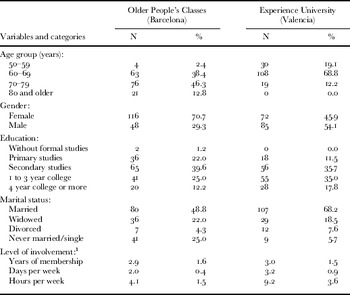
The profiles of the older students participating in the two programmes were very different (Table 1). The students at the Older People's Classes tended to be older (mean age 71.1 years, s.d. 6.6) than those at the Experience University (mean age 63.7 years, s.d. 4.9), and the difference was statistically significant (t (319 degrees of freedom (df)) 11.37; p<0.001). The Older People's Classes' participants had less formal education than the Experience University students, and among them were relatively more women, widows and widowers. Whereas the number of years (three) of enrolment in the university programme was nearly identical for both models, the level of involvement, or the time spent per week in the programme, was significantly different (Table 1). Participants in the Experience University of Valencia spent one more day per week in their programme than participants in the University Classes of Barcelona (t (df 319)−15.53; p<0.0001). In addition, the Valencia students allocated more than twice as many hours per week (t (df 319)−16.24; p<0.0001) to the programme than the Barcelona students.
Socio-demographic profiles and levels of involvement of the participants by UPOP model

Notes: N: sample size. s.d.: standard deviation. UPOP: University Programme for Older People.
1. Values are means and standard deviations.
Motives to attend university
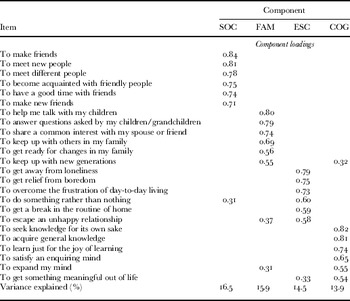
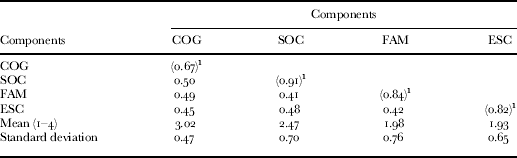
Principal components analysis and factor analysis were used to verify the stability of the factor structure of the EPS, with Varimax orthogonal rotation being used to produce the final structure. As shown in Table 2, the rotated solution replicated clearly the four-factor structure identified by Boshier (Reference Boshier1991) and Fujita-Starck (Reference Fujita-Starck1996). Cronbach's alpha was calculated for each dimension of the new questionnaire. The resulting coefficients ranged from 0.67 (Cognitive interest) to 0.91 (Social contact), indicating fair to high internal consistency of the components (Table 3). These values are similar to those obtained by Kim and Merriam (Reference Kim and Merriam2004). Table 3 presents also the Pearson correlation matrix for the four motivational components. Similar and moderately high degrees of correlation were found between the pairs of components. The primary motivation for participation in the programmes studied appeared to be cognitive interest, while family-related reasons and escapism seem to be far less powerful motivators (Table 3).
Principal components analysis of the Educational Participation Scale (EPS) scores

Notes: The table only includes loadings of at least 0.30. Key to component labels: COG: Cognitive interest; SOC: Social contact; FAM: Family togetherness; ESC: Escapism.
Correlations among Educational Participation Scale (EPS) components, internal consistency indices, mean and standard deviation of each sub-scale
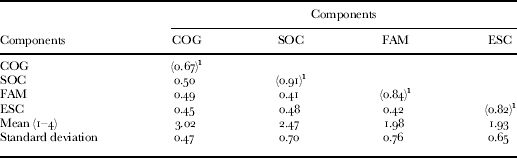
Notes: 1. Cronbach's alpha scores on the diagonal (in parentheses). COG: Cognitive interest. SOC: Social contact. FAM: Family togetherness. ESC: Escapism.
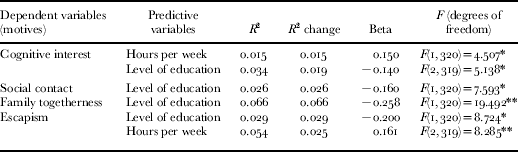
There was no statistical difference between the motivations of participants in the different programmes, suggesting that the type of UPOP model did not affect the reasons for participation. Student–Fisher t-tests were performed to ascertain if the motivations depended on the programme. Because no t value reached statistical significance, it seems that the type of UPOP model did not affect the motivations for enrolling in the courses. In order to assess how the motives were influenced by the combined effects of the socio-demographic variables, level of involvement and UPOP model, linear regression analysis was used. Forward-entry stepwise regressions were first run, with the entry criterion for a variable being p⩽0.05, followed by backward-entry calibration, with the exclusion criterion being p>0.10. The categorical variables (such as gender or type of organisation) were transformed to variables with values 0 and 1 in the regression analysis. The type of university programme was not predictive of any motive to attend university, which is consistent with the statistically insignificant results from the t-tests (Table 4). The most solid predictive variable was the level of education: a low level correlated with higher scores in the four components of the EPS. In the same vein, involvement in the programme (particularly in terms of number of hours per week) predicted higher scores in the ‘Cognitive interest’ and ‘Escapism’ components of the EPS.
Socio-demographic variables, indicators of involvement and type of university programme regressed on Educational Participation Scale (EPS) components
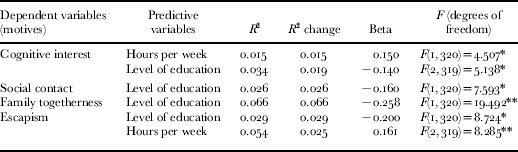
Notes: Among predictive variables, gender was coded 0 (female) and 1 (male), marital status was coded 0 (unmarried) and 1 (married), and type of university programme was represented by two dichotomies: participation in Older People's Classes (0=no; 1=yes), and participation in Experience University (0=no; 1=yes). Only statistically significant associations are shown, n.b. type of university programme was not significant.
Significance levels: * p<0.01, ** p<0.001.
Perceived benefits
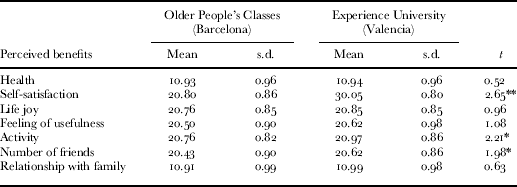
The participants derived a number of benefits from attending the university programmes. The identified positive outcomes included both social gains, such as having more friends, and psychological gains, such as self-satisfaction, life joy and feeling more useful or active. According to the participants' reports, on the other hand, attending university programmes had little positive effect on their health or family relationships – in both cases the scores did not reach the middle point of the response scale (Table 5). Students from the University of Experience consistently perceived more benefits than those from Older People's Classes, but only three benefits were significant higher: self-satisfaction, activity, and number of friends, and only the last was statistically significant at a level greater than p<0.01.
Student–Fisher's t mean comparisons of perceived benefits by UPOP model
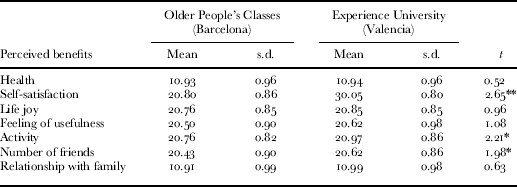
Notes: In all cases, the scales ranged from 1 to 4 and there were 319 degrees of freedom. s.d.: standard deviation. UPOP: University Programme for Older People.
Significance levels: * p<0.05, ** p<0.01.
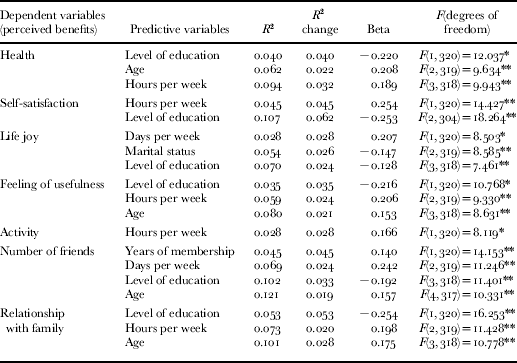
The slight differences in benefits by type of UPOP model did not remain when the effects of other socio-demographic variables were taken into account (Table 6). When a stepwise linear regression analysis was performed to assess the impact of diverse variables on perceived benefits (with an F criteria of p<0.05 for entry and of p>0.10 for exclusion), participation in an Experience University or in an Older People's Class did not predict any particular benefit. As was the case for the motives to attend a UPOP, education was one of the most solid predictors: less-educated people tended to score higher in six out of seven possible benefits, with activity being the exception. Number of days or hours per week devoted to the programme was a significant predictor of higher scores in the seven measured benefits. In addition, age was a predictor in four cases: older participants tended to perceive benefits from the programme in terms of better health, increased feelings of usefulness, more friends and better relationships with their family.
Regression of perceived benefits on socio-demographic variables, indicators of involvement and type of university programme
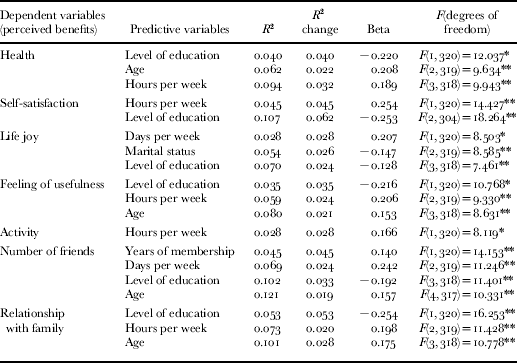
Notes: Among predictive variables, gender was coded 0 (female) and 1 (male), marital status was coded 0 (unmarried) and 1 (married) and university programme was transformed into Older People's Classes (0=no; 1=yes), and Experience University (0=no; 1=yes). Only statistically significant associations are shown, n.b. type of university programme was not significant.
Significance levels: * p<0.01, ** p<0.001.
Discussion
The first objective of this study was to explore the motives for joining a university programme for older people (UPOP) and to study the benefits that senior students derive from such participation. The results are consistent with previous studies (cf. Kim and Merriam Reference Kim and Merriam2004) that participation in UPOP is motivated firstly by expressive motives. According to the participants' reports, acquiring knowledge, expanding the mind or learning for the joy of learning were the main motives for joining the university programme. An important but secondary motivation was to access an enlarged or strengthened social network, but other motives, such as to improve family relationships, to escape loneliness or boredom or to forget life problems, were infrequently reported. Older students also perceived many other benefits of their participation in UPOP. Self-satisfaction, life joy, activity or feeling useful were most frequent, and a secondary benefit was an increased number of friends. These results reinforce the value of education, particularly higher education programmes, in promoting the quality of life of older people.
The importance that older students gave to expressive motives and to benefits related to life satisfaction may in itself demonstrate the value of UPOP, particularly when taking into account that the students were also very satisfied with the design and organisation of the programmes (cf. Alfageme Reference Alfageme2007). University programmes for older people generally assume that the students do not need or desire to participate for instrumental reasons. Our results support such a view, but without under-estimating expressive reasons and benefits, an approach that gives room for instrumental dimensions of learning might be welcomed in UPOP. Although Jamieson (Reference Jamieson2007) found that people aged 60 or more years enrolled part-time in higher education institutions rarely mentioned gaining a qualification as an important reason for study, many saw this attribute as an important benefit, since it provided a challenge and a way to preserve or gain self-esteem. If this attitude is widespread, expressive and instrumental motives could be more interlinked than generally assumed.
As well as producing happiness in older people, learning experiences could have an important role in building capacities that enable the students to manage their life better, to contribute more to their community or to be more involved in society. Such instrumental and capacity-building aspects of older-age education and their implications (with reference to the content and the teaching and evaluation methods normally used in UPOPs) have been virtually absent in the discussion of why, what and how to teach older students. Incorporating such an instrumental approach could make higher education in old age a more ambitious enterprise. Such a shift would not only contribute to changing the image of older people as a burden into a resource for their communities, but also be a source of personal meaning and pave the way to attaining the promise of active ageing.
A wider perspective on senior education should also re-examine the questionnaires that are used to assess motivations and benefits. Our results suggest that the EPS distinguishes and captures with a high degree of internal consistency conceptually different motives for joining a university programme, and that from a psychometric perspective the instrument has a clear and replicable internal structure. Questionnaires like the EPS, at least in the version adapted to older people used in this study and in similar ones tend, however, to be biased towards the expressive motives that have to date guided the design of educational programmes for older people. If programmes with more comprehensive objectives are developed, the instrumental dimensions that pertain to older students (over and above social motives or negative aspects such as escapism) would need to be added in the assessment instrument. This would allow the dynamics between self and emotional-oriented aspects versus other competence-oriented ones to be assessed more accurately.
Among the variables that influence both the motives to join a UPOP and the achieved benefits from participation three stand out, namely age, education and involvement with the programme. We argue that this means two things. Firstly, that older people who have a lower level of education benefit most from joining a UPOP, and they report higher scores in motivational dimensions. Since UPOPs have customarily been selective of relatively young and more educated students, it can be argued that more energetic promotion of UPOP programmes (or other educational programmes) to older and less-educated retired people could be the key to spreading their benefits among older people and attract those who thought higher education beyond their reach. Withnall (Reference Withnall2006) found among older learners a sense of being capable to face learning challenges and considerable determination. Wider recognition and support of these attitudes would encourage and sustain participation.
Secondly, it seems that the more time students invest in the programme, the more benefits they gain, which could mean that structured and intensive programmes produce more benefits for older students. Both Older People's Classes and Experience Universities have pre-defined and relatively rigid time and class schedules, however, which might reduce the benefits, at least for students who wish to be more involved. Enhancing and diversifying the forms of participation beyond class attendance, as by promoting older students' associations and their role in designing the programme, or by offering a wider range of cultural and recreational activities, could create programmes that suit diverse learners' needs and raise the benefits of UPOPs.
The second objective of this study was to compare the two programmes' student profiles, motives and benefits. The results showed that while there were some differences in the students' characteristics, they did not exist or were slight for the motives and benefits. Degree-like programmes (such as Experience University) attracted younger and more educated students, but the motives were similar in both models. Perceived benefits associated with participation were consistently greater among Experience University students, reaching statistical significance in some cases, but when the type of UPOP was combined with other variables such as level of education, age or time devoted to the programme, the effect of the programme type on benefits lost significance.
One strong advantage of Older People's Classes is that they empower their members, by offering opportunities for the students to participate in and lead the programme. It might therefore be expected that this deeper commitment would have a greater impact on students' lives, but in the studied case apart from the few students involved on the board, most limited their participation to attending lectures and joining in outdoors activities, i.e. a similar level of participation to that of a senior student of an Experience University course. The teaching methods were similar, being primarily lectures followed by instructor-led discussions. Larger student groups were found in Older People's Classes (some have 80–90 students), which restricted the students' participation and made the classes less interactive. In addition, the Older People's Class students spent fewer hours in the programme than Experience University students, which may explain why we found that the perceived benefits of Older People's Classes were actually less than in Experience Universities. Put another way, although the organisation and bottom-up approach of Older People's Classes had similarities with the British model of Universities of the Third Age, in practice they had converged with Experience Universities, being even more rigid as a result of the large groups of students who spent fewer hours per week on the programme. That could explain why differences between the models were fewer than expected and, when identified, they favoured the Experience Universities. This finding needs further research to explore and compare how students experience their participation in both models.
Interpretation of the presented results should take into account the study's limitations. Apart from the non-probability sampling procedure, one is that the two groups were not fully equivalent. Not only were they recruited in different cities, but they also differed in key variables, making it more difficult to attribute differences between groups to the specific model of UPOP. Analyses with more controls, for instance using paired groups, are needed to ascertain if the educational experience offered to older students attracts a particular profile of motives or achieves specific benefits. Also, the use of a wider range of indicators, including both subjective and objective measures, and more sophisticated methods and longitudinal models, may shed more light on the impact that university programmes have on the lives of older people.