Exposure to adverse childhood experiences confers risk in biological and behavioral domains of functioning (Anda et al., Reference Anda, Felitti, Bremner, Walker, Whitfield and Perry2006; Felitti et al., Reference Felitti, Anda, Nordenberg, Williamson, Spitz and Edwards1998). In particular, early exposure to child maltreatment (CM) is associated with deficits in children's self-regulatory functioning. Compared with their nonmaltreated peers, children exposed to CM in early childhood are at increased risk for developmental delays (Pears & Fisher, Reference Pears and Fisher2005), behavioral and emotional dysregulation (Maughan & Cicchetti, Reference Maughan and Cicchetti2002; Shields, Cicchetti, & Ryan, Reference Shields, Cicchetti and Ryan1994), altered stress physiology (Bruce, Fisher, Pears, & Levine, Reference Bruce, Fisher, Pears and Levine2009; Cicchetti & Rogosch, Reference Cicchetti and Rogosch2001; Dozier, Peloso, Lewis, Laurenceau, & Levine, Reference Dozier, Peloso, Lewis, Laurenceau and Levine2008; Fisher, Van Ryzin, & Gunnar, Reference Fisher, Van Ryzin and Gunnar2011; Laurent, Gilliam, Bruce, & Fisher, Reference Laurent, Gilliam, Bruce and Fisher2014; Tarullo & Gunnar, Reference Tarullo and Gunnar2006), poor school adjustment (Pears, Fisher, Bruce, Kim, & Yoerger, Reference Pears, Fisher, Bruce, Kim and Yoerger2010), and development of adverse mental and physical health problems in adolescence and adulthood (Kaplow & Widom, Reference Kaplow and Widom2007; Solís et al., Reference Solís, Kelly-Irving, Fantin, Darnaudéry, Torrisani and Lang2015). Despite burgeoning evidence linking early CM exposure to indices of children's affective, attention, physiological, and behavioral domains of self-regulation, the pathways to strong regulatory development in these children are not well understood, and significant heterogeneity is observed in their outcomes (Cicchetti & Toth, Reference Cicchetti and Toth2005; Cicchetti & Valentino, Reference Cicchetti and Valentino2006). The lasting effects of exposure to early adversity may extend beyond the effects of discrete CM acts and result from more subtle forms of interpersonal stress in the form of parenting behaviors that are controlling, low in warmth, and/or that thwart children's expression of age-appropriate autonomy (e.g., Wilson, Rack, Shi, & Norris, Reference Wilson, Rack, Shi and Norris2008), none of which are classified by child welfare agencies.
Evidence from two generational studies indicates that parenting characterized by warm guidance and support for children's age-appropriate autonomy is central to the development and internalization of children's capacities to regulate their affect, attention, physiology, and behavior. For example, early autonomy-supportive parenting appears to be a key to the development of executive functioning, such as working memory, impulse control, and set shifting (Bernier, Carlson, & Whipple, Reference Bernier, Carlson and Whipple2010), and the regulatory capacities that underlie successful adjustment and performance in school settings (Coll, Reference Coll2008; Joussemet, Koestner, Lekes, & Landry, Reference Joussemet, Koestner, Lekes and Landry2005), over and above other factors, such as maternal education, child early general cognitive skills, and child temperament (e.g., Bindman, Pomerantz, & Roisman, Reference Bindman, Pomerantz and Roisman2015). Conversely, harsh and rigid parental control thwarts children's developing capacities for autonomy-in-connection and is related to poorer task performance (Winsler, Diaz, McCarthy, Atencio, & Chabay, Reference Winsler, Diaz, McCarthy, Atencio and Chabay1999), poor inhibitory control (Moilanen, Shaw, Dishion, Gardner, & Wilson, Reference Moilanen, Shaw, Dishion, Gardner and Wilson2010), altered physiological regulation (Skowron, Cipriano-Essel, Benjamin, Pincus, & Van Ryzin, Reference Skowron, Cipriano-Essel, Benjamin, Pincus and Van Ryzin2013), and less autonomous self-regulated behavior (Maughan & Cicchetti, Reference Maughan and Cicchetti2002; Shields & Cicchetti, Reference Shields and Cicchetti1998; Trickett & McBride-Chang, Reference Trickett and McBride-Chang1995).
Meta-analysis has shown that CM parents (both physically abusive and neglectful) are less warm toward their children; engage in more harsh, aversive control; are less supportive of their children's autonomous strivings; and tend to view their children as hostile and threatening (Wilson et al., Reference Wilson, Rack, Shi and Norris2008). Because more than 80% of child physical abuse and neglect is perpetrated by parents (US Department of Health and Human Services, Administration for Children and Families, Administration on Children, Youth and Families, Children's Bureau, 2012) and modest, yet significant, continuity in CM perpetration exists across generations (Belsky, Conger, & Capaldi, Reference Belsky, Conger and Capaldi2009), multigenerational paradigms that identify factors that predict children's self-regulatory outcomes may provide insight into the mechanisms underlying continuities and discontinuities in CM across generations of a family and help identify intervention targets that are most responsive to environmental influence. In our study, we sought to determine whether aspects of the Generation 1 (G1)–Generation 2 (G2) relationship between a mother and her own mother influence biomarkers of Generation 3 (G3) children's self-regulation. Specifically, we examined the relationship between maternal mental representations of women's G1–G2 autonomous and affiliative childhood experiences with their own mothers and autonomic physiology (i.e., vagal tone) in the next (G3) generation.
Warm Autonomy-Supportive Parenting and Child Self-Regulation
An individual's active striving for self-organization and the self-regulatory structures of the mind are believed to be stabilizing determinants of both psychological and neural development (Cicchetti & Tucker, Reference Cicchetti and Tucker1994). These homeostatic forces may help account for the substantial variability in the outcomes of maltreated children. Developmental psychopathology provides a useful framework for understanding self-regulatory development in risk contexts by focusing on the role of experience in shaping developmental biomarkers of self-regulation outcomes. As a specific risk context, CM is rooted in the day-to-day interactions between parents and children and lies at the extreme end of the continuum of parenting at risk. As such, the relational context of CM is as important as specific CM acts for understanding the impact of maltreatment on children's developing self-regulation (Barnett, Manly, & Cicchetti, Reference Barnett, Manly and Cicchetti1993; Rogosch, Cicchetti, & Aber, Reference Rogosch, Cicchetti and Aber1995).
Convergent theoretical models, each of which emphasizes the relational context underpinning the development of children's regulatory capacity, suggest that parental support for the development of meaningful, reciprocal relationships and a positive, autonomous sense of self are both necessary for adaptive child self-regulation in the face of environmental challenge. For example, in his polyvagal theory, Porges (Reference Porges1995, Reference Porges2001, Reference Porges2003, Reference Porges2007, Reference Porges2011) offers a neurobiological model of how safe, supportive, social caregiving systems function to support the development of strong parasympathetic control of heart rate (i.e., respiratory sinus arrhythmia [RSA]). Attachment theory (Ainsworth, Reference Ainsworth1989; Ainsworth & Bowlby, Reference Ainsworth and Bowlby1991; Bowlby, Reference Bowlby1982/1969, Reference Bowlby1988) and family systems theory (Bowen, Reference Bowen1978; Kerr & Bowen, Reference Kerr and Bowen1988) evoke the concepts of attachment, exploration, and differentiation of self, respectively, to describe processes through which multigenerational family experiences shape children's developing self-regulation. Though diverse in their focus, these approaches show remarkable theoretical and empirical convergence with two-polarity theories of development (e.g., Blatt, Reference Blatt1974, Reference Blatt2008) that identify support for autonomy and relatedness as orthogonal axes of relational experience that shape personality across the life span.
According to attachment theory (e.g., Bowlby, Reference Bowlby1988), the presence of a secure attachment relationship with one's primary caregiver(s) in early childhood serves as a “secure base” that enables and supports exploration (e.g., Fuendeling, Reference Fuendeling1998; Lopez & Brennan, Reference Lopez and Brennan2000) and hence scaffolds the development of children's self-regulation skills. Attachment and other developmental theories suggest that this scaffolding occurs, in part, as children internalize important regulatory aspects of their caregiving environment, which in turn shapes the quality of their relationships outside of the family. Caregiving characterized by CM appears to have a deleterious impact on young children's representations of themselves and others (e.g., Toth, Cicchetti, MacFie, Maughan, & Vanmeenen, Reference Toth, Cicchetti, MacFie, Maughan and Vanmeenen2000), the latter of which has been associated with indices of poor self-regulation, including emotion dysregulation, aggression, and peer rejection (Shields, Ryan, & Cicchetti, Reference Shields, Ryan and Cicchetti2001). CM-related differences in children's narrative representations of their caregiving environment (e.g., Toth, Cicchetti, Macfie, & Emde, Reference Toth, Cicchetti, Macfie and Emde1997) may help account for the heterogeneity in CM outcomes, in that negative or conflictual representations appear to partially mediate the relationship between experiences of early maltreatment and poor outcomes, including peer rejection and behavior problems (Shields et al., Reference Shields, Ryan and Cicchetti2001; Toth, Cicchetti, Macfie, Rogosch, & Maughan, Reference Toth, Cicchetti, Macfie, Rogosch and Maughan2000). Conversely, positive/coherent representations have been associated with prosocial behavior and peer preference (Shields et al., Reference Shields, Ryan and Cicchetti2001), suggesting that how CM-exposed children internalize their relationship environment may also play a protective role in buffering them from the effects of abuse and neglect.
According to family systems theory (i.e., Bowen, Reference Bowen1978; Kerr & Bowen, Reference Kerr and Bowen1988), differentiation of self refers to the capacity of a family system and its members to manage emotional reactivity and allow for both intimacy and autonomy in relationships. Parents with higher differentiation of self are less emotionally reactive, better able to regulate emotion, think clearly under stress, more capable of remaining connected, and as such, are thought to promote/support children's developing capacity for self-regulation (Bowen, Reference Bowen1978; Skowron, Reference Skowron2005; Skowron et al., Reference Skowron, Loken, Gatzke-Kopp, Cipriano-Essel, Woehrle and Van Epps2011). Adults at risk for perpetrating CM score lower on a measure of differentiation, relative to low-risk adults (McCanne & Hagstrom, Reference McCanne and Hagstrom1996; Skowron & Platt, Reference Skowron and Platt2005). Of particular relevance to our understanding of developing self-regulation is Bowen's (Reference Bowen1978) proposition that differentiation of self operates on both autonomic physiological and behavioral levels. Consistent with Bowen's assertions, countless studies have shown that self-regulation of emotion and behavior show predictable neurophysiological substrates (e.g., Beauchaine, Reference Beauchaine2001; Graziano & Derefinko, Reference Graziano and Derefinko2013).
RSA as an Indicator of Child Regulatory Capacity
One physiological marker of children's autonomic reactivity and regulatory development is RSA. RSA is a measure of the change in oscillatory dynamics of the heart across the respiration cycle and is considered to be a measure of the parasympathetic nervous system's influence on cardiac function in response to changing environmental demands (Berntson et al., Reference Berntson, Bigger, Eckberg, Grossman, Kaufmann and Malik1997; Porges, Reference Porges1995). Parasympathetic control of heart rate, indexed by RSA, enables rapid regulation of emotional states in social contexts (Porges, Reference Porges2003) and thus is of particular interest for understanding how individual differences in regulation may result from variations in parent–child processes and broader multigenerational family system functioning.
Resting RSA levels reflect the extent of an individual's regulatory capacity (Porges, Reference Porges1998, Reference Porges2001). Higher levels of resting RSA reflect greater parasympathetic influence (reflected in slower heart rate and calmer affective state) and are associated with greater attentional control and regulatory capacity (Beauchaine, Reference Beauchaine2001; Mezzacappa, Kindlon, Saul, & Earls, Reference Mezzacappa, Kindlon, Saul and Earls1998). In contrast, lower resting RSA is associated with negative emotional states and a range of psychopathologies and is thought to reflect a general risk for emotional dysregulation (Beauchaine, Reference Beauchaine2001).
Research examining RSA levels in the context of challenge shows that RSA levels at rest and in response to challenge offer important information about an individual's capacity for physiological regulation (Hinnant & El-Sheikh, Reference Hinnant and El-Sheikh2009). Decreases in RSA mark withdrawal of parasympathetic influence, leading to heart rate acceleration that supports mobilization and engagement. Increases in RSA mark increased parasympathetic influence (i.e., slowing heart rate), which promotes calm behavioral states, self-soothing, and social engagement (e.g., Porges, Reference Porges2001). A number of findings have documented RSA increases during positive social engagement (Geisler, Kubiak, Siewert, & Weber, Reference Geisler, Kubiak, Siewert and Weber2013), during social self-regulation of emotion with strangers (Butler, Wilhelm, & Gross, Reference Butler, Wilhelm and Gross2006), and during family interactions (Lorber & O'Leary, Reference Lorber and O'Leary2005). Among preschool children exposed to significant early adversity, high vagal tone and vagal augmentation are associated with greater self-regulation and fewer behavioral problems (e.g., Calkins, Graziano, Berdan, Keane, & Degan, Reference Calkins, Graziano, Berdan, Keane and Degan2008; Obradović, Bush, Stamperdahl, Adler, & Boyce, Reference Obradović, Bush, Stamperdahl, Adler and Boyce2010; Skowron et al., Reference Skowron, Loken, Gatzke-Kopp, Cipriano-Essel, Woehrle and Van Epps2011, Reference Skowron, Cipriano-Essel, Benjamin, Pincus and Van Ryzin2013). A recent meta-analysis of 44 studies (N = 4,996 children) documented significant relationships between RSA levels and children's adaptive functioning (Graziano & Derefinko, Reference Graziano and Derefinko2013).
Parenting Quality and Child Biology
In humans, the powerful two-generational influence of parenting on offspring biology is well documented. In line with Bowen's propositions regarding the autonomic substrates of differentiation, more sensitive, skillful, autonomy-supportive parenting is associated with higher resting vagal tone in children (e.g., Skowron et al., Reference Skowron, Loken, Gatzke-Kopp, Cipriano-Essel, Woehrle and Van Epps2011). Of particular relevance to child self-regulation, research has demonstrated the impact of low-responsive, neglectful, or abusive parental care on children's structural brain development (De Bellis, Reference De Bellis2001; Teicher et al., Reference Teicher, Dumont, Ito, Vaituzis, Giedd and Andersen2004) and stress reactivity, including the responsivity of corticolimbic circuits involved in threat processing (Gunnar & Quevedo, Reference Gunnar and Quevedo2007; Tarullo & Gunnar, Reference Tarullo and Gunnar2006), greater right frontal electroencephalographic asymmetry (Hane & Fox, Reference Hane and Fox2006), and altered parasympathetic tone (Skowron et al., Reference Skowron, Loken, Gatzke-Kopp, Cipriano-Essel, Woehrle and Van Epps2011). In the context of proximate early adversity (e.g., CM, household dysfunction, other forms of interpersonal stress, and poverty), such increased stress reactivity may be adaptive insofar as it facilitates the swift detection of environmental threat, such as expressions of anger (e.g., Pollak & Kistler, Reference Pollak and Kistler2002; Pollak & Sinha, Reference Pollak and Sinha2002; Pollak & Tolley-Schell, Reference Pollak and Tolley-Schell2003; Pollak, Vardi, Putzer, & Curtin, Reference Pollak, Vardi, Putzer and Curtin2005; Shackman, Shackman, & Pollak, Reference Shackman, Shackman and Pollak2007). However, the cost of these adaptations may be high for maltreated children, as CM exposure is associated with adverse outcomes across behavioral and neurobiological domains (Cicchetti & Toth, Reference Cicchetti and Toth2005). By contrast, supportive parenting in early childhood strongly predicts favorable indices of limbic brain development, such as larger hippocampal volume (Luby et al., Reference Luby, Barch, Belden, Graffrey, Tillman and Babb2012) and smaller amygdala volume (Tottenham et al., Reference Tottenham, Hare, Quinn, McCarry, Nurse and Gilhooly2010), biobehavioral recovery from exposure to early neglect (Nelson et al., Reference Nelson, Zeanah, Fox, Marshall, Smyke and Guthrie2007), brain electrical patterns consistent with positive emotionality and approach-oriented behavior (Hane & Fox, Reference Hane and Fox2006), and vagal indices of child self-regulation (e.g., Perlman, Camras, & Pelphrey, Reference Perlman, Camras and Pelphrey2008; Perry, Mackler, Calkins, & Keane, Reference Perry, Mackler, Calkins and Keane2014; Skowron et al., Reference Skowron, Loken, Gatzke-Kopp, Cipriano-Essel, Woehrle and Van Epps2011). With respect to the latter, both CM exposure and the quality of maternal responses to children's prosocial autonomy have been independently associated with parasympathetic tone in preschool-age children. For example, Skowron et al. (Reference Skowron, Loken, Gatzke-Kopp, Cipriano-Essel, Woehrle and Van Epps2011) found that during a challenge task, children whose autonomous ideas and actions were more often met with maternal harsh control and criticism during parent–child interactions showed lower parasympathetic activity (lower RSA). Conversely, children whose autonomous bids were met with maternal affirmation (i.e., warm support for their independent ideas and actions) showed stronger parasympathetic tone (higher RSA). Taken together, these findings indicate that in two-generational contexts, direct experiences of autonomy in childhood with warm, autonomy-supportive parenting relate to physiological indices of child self-regulation, including RSA.
Multigenerational Links Between G1–G2 Experience and G3 Regulatory Capacity
Beyond the direct associations between G2 parenting and G3 children's functioning, ongoing research conducted primarily with rodents and nonhuman primates is documenting links between biology and experience across three generations of families. In other words, a parent's own early caregiving experiences (i.e., G1–G2 parenting) influence not only their own G2 biology and behavior but also the biology in their G3 offspring, particularly systems implicated in offspring self-regulation. In this domain, research indicates that variations in maternal care form the basis for individual differences in offspring stress reactivity by altering the expression of genes that regulate endocrine responses to environmental stress, brain development, and behavior (Fleming et al., Reference Fleming, Kraemer, Gonzalez, Lovic, Rees and Melo2002; Francis & Meaney, Reference Francis and Meaney1999; Liu et al., Reference Liu, Diorio, Tannenbaum, Caldji, Francis and Freedman1997; Meaney, Reference Meaney2001). The broad impact of maternal rearing on DNA methylation in both the brain and T cells suggests that these responses to early-life adversity are both system- and genomewide and persist into adulthood (Provençal et al., Reference Provençal, Suderman, Guillemin, Massart, Ruggiero and Wang2012). Moreover, such epigenetic modifications to the genome are transmitted across generations and appear to be reversible with environmental intervention (i.e., cross-fostering; Champagne, Reference Champagne2008; Weaver et al., Reference Weaver, Cervoni, Champagne, D'Alessio, Sharma and Seckl2004). This suggests that in mammals, biological indices of regulatory capacity are affected, at least in part, by the quality of nurturing parental care they receive, and that variations in such care are best understood in a multigenerational context.
As such, in humans, increasing attention has been paid to CM as a multigenerational family problem with biological correlates. According to systems theory, intergenerational continuities in emotional maturity and functioning also exist. Bowen asserted that levels of differentiation of self are transmitted across generations of a family, with the previous generation's level of differentiation roughly constraining the level of differentiation achieved in the next generation. Bowen (Reference Bowen1978) observed that “all things being equal, you emerge with about the same basic level of differentiation your parents had. This is determined by the process before your birth and the situation during infancy and early childhood” (p. 409). Bowen's theory (1978; Noone & Papero, Reference Noone and Paperoin press) asserts that (a) levels of differentiation in one generation of a family shape levels of functioning in the next generation, and (b) differentiation of self operates on both physiological and behavioral levels. In other words, level of differentiation is thought to remain relatively consistent across generations of a family (Kerr & Bowen, Reference Kerr and Bowen1988). Therefore, it would stand to reason that behavioral parameters of differentiation of self experienced in earlier generations (i.e., warmth and autonomy in connection) would correspond with autonomic parameters of differentiation (i.e., higher RSA) in the next generation. Although no studies have examined this directly, longitudinal research suggests that G1–G2 experiences of abuse do have a deleterious impact on G3 child self-regulation (e.g., Delker, Noll, Kim, & Fisher, Reference Delker, Noll, Kim and Fisher2014). Extensive work has also documented the links among maternal attachment representations, parental responsiveness, and child attachment (e.g., van IJzendoorn, Reference van IJzendoorn1995). However, few studies have examined the relationship between dimensions of maternal G1–G2 early caregiving experiences of warmth and autonomy support and biological indices of G3 children's regulatory capacity, such as RSA.
Study Aims and Hypotheses
In this study, we sought to examine the relationship between maltreating and nonmaltreating G2 mothers' mental representations of their childhood relationship with their G1 mother and their G3 child's autonomic physiology. Given the developmental importance of early warmth and autonomy support for children's developing self-regulation, we tested a multigenerational extension of this effect by examining the hypothesis that G2 mothers who reported higher levels of early warmth and autonomy support in their G1–G2 relationship with their own mothers would have G3 children who displayed greater parasympathetic tone (i.e., higher RSA levels) at rest and in response to a variety of challenge tasks. To this end, we used both observational and self-report measures of parenting quality and electrocardiogram assessments of children and their mothers.
Theorizing that associations between maternal mental representations and child autonomic physiology may be transmitted behaviorally and/or physiologically through G2 maternal factors, we examined two types of mediators: observed G2 maternal behavior and maternal parasympathetic tone (RSA). Given the abundance of animal studies documenting the intergenerational transmission of stress responsivity through caregiving behavior (e.g., Meaney, Reference Meaney2001) and human studies linking G2 parenting behavior with positive and with harsh G1 parenting (e.g., Conger, Belsky, & Capaldi, Reference Conger, Belsky and Capaldi2009; Conger, Neppl, Kim, & Scaramella, Reference Conger, Neppl, Kim and Scaramella2003; Serbin & Stack, Reference Serbin and Stack1998), we hypothesized that the relationship between G1–G2 experiences and G3 child RSA would be partially mediated by maternal warmth and autonomy-granting behavior during parent–child interactions. Some studies have failed to find associations between mother–child resting levels of RSA (e.g., Perlman et al., Reference Perlman, Camras and Pelphrey2008), and other work has documented concordance between mother–child RSA (e.g., Bornstein & Suess, Reference Bornstein and Suess2000). We predicted that during challenge, the relationship between G1–G2 caregiving experiences and G3 child RSA might be partially mediated by baseline levels of G2 maternal RSA. Further, because the degree of warmth and prosociality in mothers' narrative representations of their young children predicts individual differences in child behavior (i.e., affective expression) under conditions of regulatory challenge (e.g., Bugental, Reference Bugental and Sameroff2009; Rosenblum, McDonough, Muzik, Miller, & Sameroff, Reference Rosenblum, McDonough, Muzik, Miller and Sameroff2002), we also investigated the potential mediating role of maternal representations of their G3 children in the relationship between G1–G2 experience and G3 autonomic physiology.
Extending previous work that has documented the relationship between exposure to CM and lower RSA observed in preschool-age children (e.g., Skowron et al., Reference Skowron, Loken, Gatzke-Kopp, Cipriano-Essel, Woehrle and Van Epps2011), we explored the potential moderating effect of G3 children's CM exposure on the relationship between G1–G2 experience and G3 children's RSA. Reasoning that maltreated children are, by definition, exposed to increased levels of proximate interpersonal stress that itself shapes RSA, we predicted that the relationship between mental representations and child physiology would be stronger among nonmaltreated children.
Method
Participants
Participants were 213 mothers and their preschool children ages 3 to 5 years (M = 3.75, SD = 0.73). The majority of children were Caucasian (80.8%), and 51.6% were female. Mothers' average age was 29.8 years (SD = 6.06). The majority of the mothers were Caucasian (91.1%), 41.9% were married, 61.2% had a high school degree or less, and 71.8% reported an annual income of less than $30,000. All CM mothers in our study (n = 85) had Child Protective Services (CPS) documentation as a perpetrator of maltreatment. Among the CM-exposed children, 22.5% had been physically abused, 66.7% had been physically neglected, and 1.8% had been emotionally maltreated, based on CPS documentation and coded using the Maltreatment Classification System (Barnett et al., Reference Barnett, Manly and Cicchetti1993). CM exposure was classified hierarchically such that neglected children may have experienced emotional maltreatment but did not have records indicating physical abuse, and physically abused children may have also experienced neglect and/or emotional abuse. Comorbidity of CM subtypes (i.e., physical abuse with neglect and/or emotional abuse; physical neglect with emotional abuse) was observed in 41.7% of the CM group, a finding consistent with those of other studies (e.g., Belsky, Reference Belsky1993; Kaufman & Ziegler, Reference Kaufman, Ziegler, Cicchetti and Carlson1989). Non-CM dyads were drawn from a sociodemographically comparable sample from department of public welfare agencies and a database of birth announcements published in local newspapers, and non-CM mothers consented to verification that their family was free of CPS preventive or protective service records. CM and non-CM children did not differ on dimensions of child age, t (211) = 1.20, p = .23, gender, χ2 (1) = 0.54, p = .46, or ethnicity, χ2 (3) = 1.49, p = .69. However, given known associations between child age and RSA, child age was included as a covariate in all analyses.
Procedures
All procedures used in this study were approved and monitored by the Office for Research Protections. Participating mothers were age 18 years or older, fluent in English, and living with their preschool-age child. A three-visit protocol completed by mother–child dyads during a 2- to 3-week period consisted of two home visits (i.e., psychosocial assessments, including maternal reports of G1–G2 early caregiving) and a laboratory visit to enable assessment of autonomy, physiology, and observed parent–child interactions and to collect parent reports of child behavior. Families were paid $150 to complete the study, and were provided transportation, snacks, and small toys/gifts for participating children.
Laboratory assessment
Sessions lasted approximately 2.5 hr, during which time children and their mothers completed a 5-min resting baseline while sitting together on a comfortable couch and viewing a relaxing video segment; participated in the preschool strange situation procedure and a 5-min free-play period; and completed four joint challenge tasks (i.e., train, duplo, wait, and cleanup). In addition, children completed three individual challenge tasks alone after instructions from an experimenter (snack delay, day/night, shapes, and transparent box).
In the strange situation procedure (Ainsworth, Blehar, Waters, & Wall, Reference Ainsworth, Blehar, Waters and Wall1978; Cassidy & Marvin, Reference Cassidy and Marvin1992), the child experienced a series of separations and reunions with the parent, including periods during which a stranger entered the room. This segment was immediately followed by the free-play task to facilitate recovery. At the end of the free-play period, mothers instructed children to clean up all the toys. During the train task, the child was provided with a disassembled nine-piece train puzzle and instructed to complete it using all the pieces. Children were given 3–5 min to complete the task. In the duplo task (Hoffman, Crnic, & Baker, Reference Hoffman, Crnic and Baker2006), the child was provided a model figurine and 12 disassembled blocks to construct a replica in 3–5 min. During the train and duplo tasks, mothers were asked to help their children build a model using the blocks provided and assist as they might normally but not handle any of the blocks. Next, the mother and child participated together in the wait task (Carmichael-Olson, Greenberg, & Slough, Reference Carmichael-Olson, Greenberg and Slough1985), an 8-min, competing-demands task. The mother was instructed to fill out a questionnaire after placing a wrapped prize on a table in view and instructing her child to open the present only after she completed her work. The child was given a broken toy to play with, and mother interacted with her child as needed while she completed her questionnaire. Following the joint tasks, children were given a snack break while their mothers completed the Stroop task. In the 5-min day/night task (Gerstadt, Hong, & Diamond, Reference Gerstadt, Hong and Diamond1994), the child was introduced to two sample cards and then asked to respond to a total of 16 trial cards. The card to be correctly responded to as “day” was a picture of a crescent moon and stars against a dark night sky, and the card to be correctly responded to as “night” was a picture of the sun (a yellow circle with yellow rays around it). This Stroop-like paradigm requires the child to ignore a dominant perceptual feature of a stimulus for the sake of a subdominant feature indicating level of attentional and overall executive control. In the 4-min shapes task (adapted from Kochanska, Murray, & Coy, Reference Kochanska, Murray and Coy1997), the child was introduced to six picture cards, each displaying a little or a big piece of fruit, and was given the name of each (e.g., “little banana” or “big orange”). During the test phase, the child was asked to point to the little fruit on consecutive trial cards that had pictures of small fruit embedded in a large fruit (e.g., little apples in a large banana). These tasks measure attentional/inhibitory control. Children then participated in the 4-min transparent box task (Goldsmith, Reilly, Lemery, Longley, & Prescott, Reference Goldsmith, Reilly, Lemery, Longley and Prescott1999), an individual challenge task designed to elicit frustration. The experimenter placed two toys that the child indicated as his/her favorites into a clear box, locked it, and demonstrated to the child how to open the box with a key. The experimenter then gave the child a set of keys that did not work and left the room. After 4 min, the experimenter reentered the room, told the child she had given him/her the wrong key, and opened the box, enabling the child to play with the preferred toys for several minutes.
Measures
Structural analysis of social behavior (SASB)
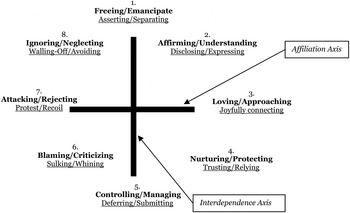
The SASB (Benjamin, Reference Benjamin1974, Reference Benjamin1996, Reference Benjamin, Horowitz and Strack2011; Benjamin & Cushing, Reference Benjamin and Cushing2000) is a circumplex model of interpersonal relations and their internal representations, based on Sullivan's (Reference Sullivan1953) interpersonal theory that has been applied cross-theoretically to test a variety of questions about interpersonal functioning, psychopathology, and psychotherapy. Both the SASB self-report Intrex questionnaires (SASB ratings; Benjamin, Reference Benjamin2000) and the observational coding system (SASB coding; Benjamin & Cushing, Reference Benjamin and Cushing2000) were used in this study (see Figure 1).
Structural analysis of social behavior simplified cluster model. The affiliation axis is the x-axis and the interdependence axis is the y-axis. Labels in bold describe prototypical parenting behaviors directed toward another person (i.e., child) and are the focus in this study. Underscored labels describe prototypically childlike actions in response to the other (intransitive). Reprinted from Interpersonal Diagnosis and Treatment of Personality Disorders (2nd ed., p. 55), by L. S. Benjamin, Reference Benjamin1996, New York: Guilford Press. Copyright 1996 by Guilford Press. Reprinted with permission.

SASB ratings
Mothers rated the quality of their early relationship with their own mothers (G1–G2 representations), provided ratings of their child's current behavior (G3 ratings), and rated their current parenting behavior toward their child (e.g., Benjamin & Friedrich, Reference Benjamin, Friedrich and Horowitz1991; Gurtman, Reference Gurtman2001) by completing 16 short-form items each from the “yourself with your mother (age 5–10)” intransitive scales and “your child at best” “your child at worst” intransitive scales. Each item is rated on a scale ranging from 0 (not at all true) to 100 (completely true) in increments of 10, according to how well it describes the person being rated. Each set of ratings produces a single behavioral profile that comprises two-dimensional scores: a summary weighted affiliation score and weighted autonomy score. Thus, G1–G2 affiliation and autonomy ratings reflected the degree of a G2 mother's experience of warmth/affiliation and autonomy, respectively, in relation with her G1 mother. Similarly, G2 mother reports of G3 child behavior reflected maternal perceptions of her child's affiliative behavior and autonomous behavior in their relationship. Higher affiliation scores indicated higher levels of warmth and less hostility, whereas higher autonomy scores indicated higher levels of maternal autonomy support or child autonomous behaviors (Benjamin, Reference Benjamin1996). One-month test–retest reliability for individual cluster profiles is high at M = 0.87 (Benjamin & Cushing, Reference Benjamin and Cushing2000). The factor structure of the SASB circumplex has been shown to conform to the two orthogonal dimensions of affiliation and autonomy (Pincus, Gurtman, & Ruiz, Reference Pincus, Gurtman and Ruiz1998).
SASB coding
The SASB observational coding system was used to assess and microcode parent and child behaviors during the joint train and duplo tasks. These interactions were videotaped, transcribed verbatim, unitized, and subjected to SASB coding by teams of two to three trained coders. The process of SASB coding a unit of behavior involves three steps: determining focus, level of affiliation (ranging from extreme warmth to extreme hostility), and level of interdependence (ranging from autonomy-giving/autonomy-taking behavior to control/submissive behavior). Again, SASB dimensional scores were used to assess observed levels of mother and child affiliation and autonomy. Coders received 60 hr of training by experienced SASB coders, worked with practice tapes to achieve sufficient reliability (weighted κ > 0.7) prior to coding the video recordings, and were blind to families' CM status. Weighted κs calculated on a randomly selected 18% of dyads were strong at M = 0.75 (SD = 0.05).
RSA
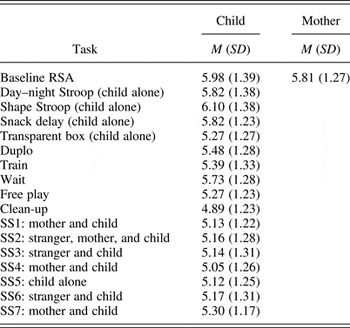
Children's cardiac physiology was monitored during the resting baseline, strange situation procedure, joint tasks (train, duplo, wait, free play, and cleanup), and individual tasks (shapes, day/night, shapes, and transparent box). Disposable pregelled Ag/AgCl electrodes were placed in a modified lead II placement on the distal end of the right clavicle, lower left rib cage chest, and the lower abdomen. Data were acquired via Mindware Technologies© (Gahanna, OH) ambulatory electrocardiograph MW1000A, sampled at 500 Hz, and transmitted via wireless signal to a computer equipped with data acquisition software. The majority of children (n = 175, 82%) provided data for at least one task and 158 (74%) mothers provided baseline RSA data. Electrocardiogram data were processed offline, and epochs were visually inspected by trained research assistants. The resulting interbeat interval time series was subjected to a fast Fourier transformation, and power in the respiratory frequency band was derived from the spectral density function. The RSA frequency bands were set between 0.24 and 1.04 for children and between 0.12 and 0.40 for mothers. RSA values were extracted in 30-s epochs, and epochs were averaged across each task to create single scores for the baseline period (RSAbaseline), strange situation episodes (RSAss), joint tasks (RSAtrain, RSAduplo, RSAwait, RSAfree play, and RSAcleanup), and the individual tasks (RSAshapes, RSAday/night, RSAtransparent.box, and RSAsnack delay). Mothers' resting RSA scores were examined as potential mediators. Descriptive statistics for RSA scores are presented in Table 1.
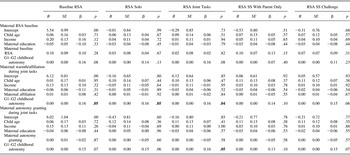
Mean child and mother RSA values for various regulatory tasks

Note: RSA, Respiratory sinus arrhythmia; SS, strange situation.
Composite child RSA variables
There was considerable stability in child RSA from one task to another (r = .51–.85, p < .01). Specifically, correlations between the RSA values ranged from .66 to .87 (p < .001) for tasks that the child performed alone, from .61 to .85 for tasks completed jointly with the parent, from .76 to .81 for strange situation episodes during which the parent was in the room, and from .72 to .82 for strange situation episodes during which the parent was absent from the room. In the interests of parsimony, we conducted confirmatory factor analysis on children's RSA data collected during the regulatory tasks to distill the data into meaningful factors. Mplus (Muthén & Muthén, Reference Muthén and Muthén1998–2012) analytic software uses maximum likelihood estimation to handle missing data, such that those children who had RSA data for at least one task could be included in this analysis. Several theoretically plausible models were compared. The best fitting model was a four-factor model. Children's RSA during tasks assessing independent self-regulation (RSAsolo: shapes, day/night tasks, transparent box, and snack delay) loaded on Factor 1. Factor 2 included children's RSA scores during the joint tasks completed with the parent (RSAjoint: train, duplo, wait, free play, and cleanup). Factor 3 consisted of children's RSA during the “parent alone with child” phases of the strange situation (i.e., Episodes 1 together, 4 reunion, and 7 reunion, RSASSw-parent), and Factor 4 included the remaining phases of the strange situation procedure (i.e., Episodes 2 stranger with parent, 3 separation, 5 separation, and 6 stranger; RSASSchallenge), χ2 (98) = 194.31, p < .001, root mean square error of approximation = 0.07, comparative fit index = 0.97. Based on this model, composite RSA factor scores were computed for use in subsequent analyses.
Statistical analyses
Analyses proceeded in three major steps. First, we used partial correlations and linear multiple regression analyses, controlling for children's age, to test multigenerational associations between mothers' SASB-Intrex ratings of G1–G2 warmth/affiliation and autonomy with her own mother and her G3 child's RSA. Second, we examined leading candidates for mediation by G2 factors, including G2 maternal RSA and G2 observed parenting with her child. Third, we divided the sample by CM subtype according to the highest classified level of CM, that is, nonmaltreated, physically abused, and physically neglected, and conducted correlational analyses to provide a descriptive picture of the multigenerational transmission processes that characterize each CM subgroup. A small number of children (n = 7) for whom emotional abuse was the highest classified level of maltreatment were not included in this final set of post hoc analyses.
Results
Relation of G1–G2 interactions to G3 RSA
Table 2 describes the univariate correlations, controlling for child age, between the G1–G2 SASB-Intrex scores and G3 children's RSA measured at baseline and across multiple regulatory contexts. As shown, mothers' G1–G2 autonomy scores correlated with child RSA measured across a number of the regulatory tasks, including snack delay, wait, train, and the strange situation episodes without the stranger, with similar trends noted for baseline RSA and free play. That is, mothers who reported that they were able to be autonomous in their relationships with their own mothers during childhood (ages 5–10) had children with higher RSA. There were no significant correlations between G1–G2 warmth/affiliation scores and child RSA.
Correlations between grandmother–mother (G1–G2) interactions and child RSA during various regulatory challenges

Note: Correlations are partialed for child age. G1–G2, Generation 1–Generation 2; RSA, respiratory sinus arrhythmia; TB, transparent box; SS, strange situation.
†p < 0.10. *p < 0.05. **p < 0.01.
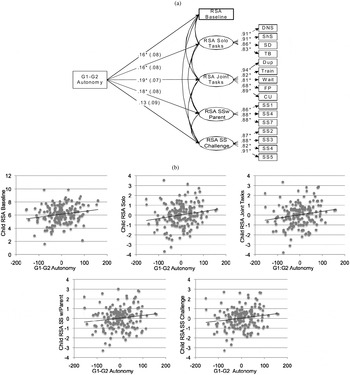
A multivariate regression of children's baseline RSA and all four RSA factors scores (i.e., RSAsolo, RSAjoint, RSASSw-parent, and RSASSchallenge) on G1–G2 autonomy confirmed patterns from the univariate correlations. Specifically, controlling for age, greater G1–G2 experience of maternal autonomy in childhood correlated with higher G3 child RSA at resting baseline (β = 0.17, SE = 0.08, p = .037), higher RSAsolo scores (β = 0.16, SE = 0.08, p = .044), higher RSAjoint scores (β = 0.19, SE = 0.07, p = .013), and higher RSASSw-parent scores (β = 0.19, SE = 0.08, p = .019), although the effect was not significant for the RSASSchallenge scores (β = 0.13, SE = 0.08, p = .129; see Figure 2a and b). Furthermore, the relations remained significant and of similar magnitude after covarying for household income, maternal education, and maternal depression symptoms. Overall, these findings suggest that greater childhood autonomy in the G1–G2 caregiving relationship correlated with higher G3 RSA at baseline during independent cognitive and emotional challenge tasks and during joint challenge tasks with the mother.
(a) Relations of grandmother–mother autonomy to child respiratory sinus arrhythmia in the full sample. Note: Child age was included as a covariate in this model, although not displayed. DNS, day/night Stroop; ShS, shape Stroop; SD, snack delay; TB, transparent box; Dup, duplo; FP, free play; CU, cleanup; SS, strange situation. *p < .05. (b) Grandmother–mother intransitive autonomy in relation to child respiratory sinus arrhythmia across various regulatory challenges.

Examination of potential mediators of G1–G2 intransitive autonomy to G3 RSA
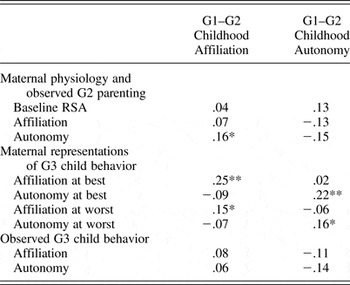
The next step was to determine whether G2 maternal physiology or G2 observed parenting mediated relations between G1–G2 autonomy support and G3 child RSA. As shown in Table 3, there were no significant correlations between G1–G2 affiliation or autonomy support and G2 RSA at baseline. In terms of parenting behavior, G1–G2 affiliation correlated with autonomy granting in G2, such that mothers who reported higher levels of warmth in their interactions with their own mothers showed higher levels of autonomy granting when interacting with their children (r = .16, p = .037). However, G1–G2 autonomy support was not significantly correlated with G2 observed parenting behavior.
Correlations between grandmother–mother (G1–G2) interactions, maternal RSA, parenting and (G3) child behavior

Note: G1–G2, Generation 1–Generation 2; G3, Generation 3; RSA, respiratory sinus arrhythmia.
*p < .05. **p < .01.
Table 4 shows the regression models testing maternal physiology and parenting behavior as mediators of the intergenerational effect of G1–G2 autonomy support on G3 child RSA, controlling for child age, household income, and maternal education. Mothers' resting RSA scores did not correlate with child RSA. Likewise, there was no evidence that the quality of observed parenting (i.e., warmth or autonomy granting) mediated the associations between G1–G2 autonomy and G3 child RSA. Moreover, associations between G1–G2 autonomy and G3 child RSA generally remained robust after accounting for these posited maternal mediators.
Summary of regression models for potential mediators of (G1–G2) mother's childhood autonomy and G3 child RSA

Note: G1–G2, Generation 1–Generation 2; G3, Generation 3; RSA, respiratory sinus arrhythmia.
Given that neither maternal physiology nor observed parenting behavior mediated the relation of G1–G2 autonomy to G3 child RSA, we examined correlations among G1–G2 autonomy, maternal representations of her child's (G3) warm affiliation and autonomy, and child behavior observed during joint interactions as alternative theoretical mechanisms that could potentially explain the link. As shown in Table 3, there were significant correlations between mothers' recalled experiences with their own mothers and their reports of their children's warmth and autonomy. Therefore, we turned to an examination of how these links might vary by maltreatment status.
Multigenerational associations vary by maltreatment status
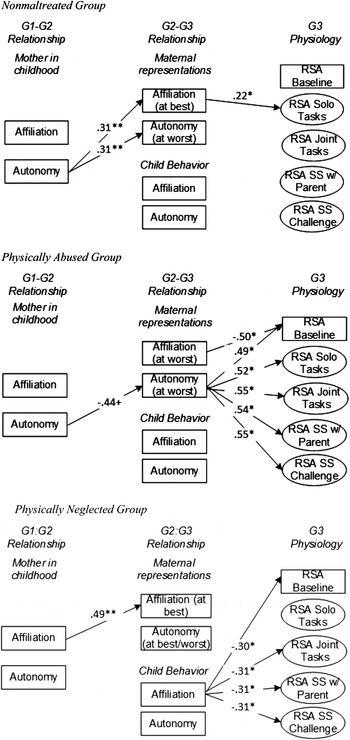
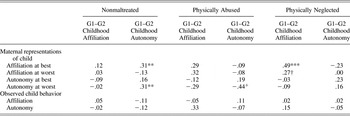
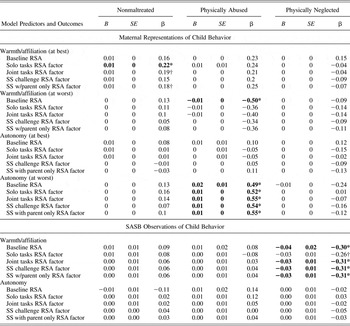
Table 5 shows the correlations among G1–G2 interactions, maternal representations of her G3 child, and G3 child behavior during joint tasks by maltreatment group. Table 6 describes a series of regression models relating G2-G3 maternal representations of child and/or child observed warmth/affiliation and autonomy during joint activities to G3 child RSA. Significant associations for each of the maltreatment groups are summarized in Figure 3. Turning first to the non-CM dyads, higher levels of a G1–G2 mother's childhood autonomy were associated with mother perceptions of her child as more warm/affiliative (when child was at his/her best, n = 89, r = .31, p = .003) and more autonomous (when child was at his/her worst, r = .31, p = .003). In addition, among non-CM children, mother perceptions of her child as more warm/affiliative were associated with higher child RSA scores, although this trend reached statistical significance for the solo RSA factor only (β = 0.22, p = .038).
Summary of correlations between grandmother–mother relations, maternal representations of her child, and child physiology by maltreatment group. Correlations are partialed for child age. SS, strange situation. +p < .10, *p < .05, **p < .01.

Correlations between G1–G2 interactions, maternal representations of her child, and child behavior during joint tasks for groups by maltreatment group

Note: Correlations are partialed for child age. G1–G2, Generation 1–Generation 2.
†p < .10. *p < .05. **p < .01. ***p < .001.
Summary of regression models of G2 maternal representations of child and/or G3 child behavior as predictors of G3 child RSA by maltreatment group

Note: All models control for child age. G2, Generation 2; G3, Generation 3; RSA, respiratory sinus arrhythmia; SS, strange situation; SASB, structural analysis of social behavior.
†p < .10. *p < .05.
Within the physical abuse dyads, a significant trend (n = 18, r = −.44, p = .06) was observed between G1–G2 autonomy support and mother perceptions of her child's autonomy. However, unlike the association observed in non-CM dyads, this correlation showed an inverse pattern. Specifically, in physical abuse dyads, greater G1–G2 autonomy was associated with the mother's perceptions of her G3 child as less autonomous when the child was at his/her worst. Further, maternal perceptions of her child as more autonomous and less warm/affiliative (when at his/her worst) were correlated with higher RSA scores in physically abused children (β = 0.49–0.55, ps < .05).
In the physical neglect dyads, no associations between G1–G2 autonomy scores and maternal representations of her child emerged, nor were maternal representations related to children's RSA in this group. However, SASB-coded observations of neglected children's behavior while interacting with their mothers showed significant correlations with child RSA scores. Specifically, in the physical neglect dyads, children who behaved in more warm/affiliative ways with their mother while completing the joint interaction tasks showed lower child RSA scores (β = −0.26 to −0.30, ps < .05).
Discussion
In this study we investigated multigenerational associations between G1–G2 mothers' early experience of warmth and autonomy in their relationships with their own mothers and their G3 children's autonomic physiological regulation. At the sample level, which included maltreating (CM) and nonmaltreating (non-CM) families, we found a robust association between mothers' G1–G2 experiences of childhood autonomy and G3 child RSA at rest and across diverse challenge contexts. Specifically, controlling for child age and household income, G2 mothers who recalled greater autonomy in their childhood relationships with their G1 mothers, between ages 5 and 10 years, were more likely to have preschool-age G3 children with higher RSA during quiet rest, alone while engaged in individual challenge tasks, during social exchanges with their mother in joint challenge tasks, and during the portions of the strange situation procedure when the mother was present. From a family system's perspective, these findings are consistent with Bowen's (1978) assertion that the capacity for differentiation of self (i.e., autonomy-in-connection) may be observed in behavioral and physiological systems. They are also consistent with recent empirical work documenting the developmental importance of autonomy support for childhood self-regulation (e.g., Bindman et al., Reference Bindman, Pomerantz and Roisman2015; Coll, Reference Coll2008; Joussemet et al., Reference Joussemet, Koestner, Lekes and Landry2005). Mothers' G1–G2 experiences of warm affiliation with their own mothers were not strongly associated with child RSA, suggesting that it is the internalization of autonomy during childhood (i.e. remembering oneself as able to be autonomous-in-connection with one's own mother), rather than the memory of being warmly connected with one's own mother, that predicts preschooler autonomic regulation in the next generation.
In an effort to elucidate mechanisms underlying links between positive parenting experienced in one generation and indices of self-regulation in the next, we examined leading candidates for biobehavioral mediation (i.e., through G2 maternal autonomic physiology and/or G2 maternal caregiving behavior). Contrary to our predictions, neither of these variables mediated the association between G1–G2 autonomy and G3 children's RSA. This was particularly surprising in the case of maternal behavior, because ample animal and human research suggests that parental behavior plays a key role in transmitting regulatory capacity across generations (e.g., Meaney, Reference Meaney2001). There are several possible reasons the parenting variables examined in this study did not mediate this association. Because child stress reactivity and autonomic physiology are shaped by parenting beginning in early infancy, it is quite possible that earlier (unmeasured) parenting behaviors may be more relevant to the link between mothers' G1–G2 childhood experiences with autonomy and preschooler vagal tone. In particular, early experiences of warm affiliation and contingent responsivity may lay the foundation for later differentiation of self, insofar as these parental behaviors help scaffold the child's ability to become increasingly autonomous with respect to his/her internal and external world. This transactional relationship between experiences of relatedness and autonomy has been described by numerous overlapping models of personality (for a review, see Luyten & Blatt, Reference Luyten and Blatt2011), including Blatt's (Reference Blatt1974, Reference Blatt2008) two polarity/two configuration model, Deci and Ryan's (Reference Deci and Ryan1985) self-determination theory, Beck's (Reference Beck, Clayton and Barrett1983, Reference Beck and Cloninger1999) cognitive–behavioral model, interpersonal approaches (e.g., Pincus, Reference Pincus, Lenzenweger and Clarkin2005), family systems theory (Kerr & Bowen, Reference Kerr and Bowen1988), and contemporary attachment theory (e.g., Mikulincer & Shaver, Reference Mikulincer and Shaver2007), all of which accord more broadly with articulations of the importance of these developmental lines within the field of developmental psychopathology.
Finally, in an effort to better understand how maternal representations of G1–G2 experience relate to CM, we delineated the association between G1–G2 mothers' childhood autonomy and G3 child RSA by CM subtype (i.e., nonmaltreating, physically abusive, or neglecting) and explored the role of maternal representations of her G3 child and her child's actual behavior. In the non-CM group, a positive association was observed between a G1–G2 mother's childhood experiences of autonomy and perceptions of her child as more warm/affiliative when at his/her best and more autonomous when at his/her worst. In other words, nonmaltreating mothers who experienced greater autonomy in their childhood relationships with their own mothers saw their children as more warm/affiliative (at their best) and more comfortably independent (at their worst). For these mothers, there was, in turn, a positive association between seeing their children as more warm/affiliative (at best) and higher child RSA, indicating greater vagal augmentation, while their children completed the solo challenge tasks. It is notable that these associations (among G1–G2 autonomy, G2 maternal representations of her child as warm/affiliative, and greater G3 child RSA) were most significant within the regulatory context that requires maximal independent autonomic regulation (i.e., tasks during which the mother was not present and interacting with the child) and that this pattern of associations was not observed in either the physically abusive or neglectful groups.
Although a significant trend was observed between G1–G2 autonomy support and mother perceptions of her child's autonomy within the physical abuse group, no significant associations between G1–G2 autonomy and maternal representations were observed. However, abusive mothers' representations of their children as more autonomous when at their worst and less affiliative at their best were correlated with greater parasympathetic tone (i.e., higher RSA scores) during the solo and joint challenge tasks in physically abused children. While further work is needed to clarify the developmental significance of higher RSA for other behavioral outcomes in abused children, to the extent that higher RSA represents an index of greater regulatory capacity, these findings suggest that physically abused children whose mothers view them as less connected at best and more psychologically separate/autonomous during times when the child is at his/her worst may be less biologically impacted by their maltreating caregiver. In other words, these maternal representations of a child as less connected and more independent may serve as a protective buffer that facilitates the development of regulatory capacity in the context of a harsh interpersonal environment. For others, perhaps when this buffer is not present, other adaptations may be more salient; for example, some recent research suggests lower levels of RSA can be adaptive in the context of intrusive parenting (e.g., Holochwost, Gariépy, Propper, Mills-Koonce, & Moore, Reference Holochwost, Gariépy, Propper, Mills-Koonce and Moore2014).
In the physical neglect group, no associations between G1–G2 autonomy and maternal representations of her child were observed, nor were maternal representations related to children's RSA. However, observations of neglected children's behavior while interacting with their mothers showed that neglected children who behaved in less warm/affiliative ways with their mother while completing the joint interaction tasks had higher parasympathetic tone at rest and while interacting with their mothers in the joint tasks and during the strange situation procedure. Again, to the extent to which higher RSA is an index of regulatory capacity, these findings suggest that adaptations that distance the child (here via less affiliative child behavior) from a maltreating caregiver may be adaptive for autonomic function (and by extension, child self-regulation).
Taken together, the findings presented here complement prior two-generational research documenting associations between mental representations of G1–G2 caregiving experiences and G2 parental behavior (e.g., Jacobvitz, Morgan, Kretchmar, & Morgan, Reference Jacobvitz, Morgan, Kretchmar and Morgan1991; Kretchmar & Jacobvitz, Reference Kretchmar and Jacobvitz2002) and extend our understanding of G3 adaptation, insofar as they highlight the importance of considering mental representations of the G1–G2 relationship when investigating the development of child self-regulation. Given the differential associations observed in non-CM and CM dyads, multigenerational representations of parent–child relationship quality and behavior may be important for understanding both the multifinality of outcomes for maltreated children and the differential mechanisms by which abuse and neglect may be transmitted across generations.
Limitations and future directions
Several limitations must be considered when interpreting these results. Because sampling of mother and child autonomic physiology, parent–child interactions, and maternal mental representations of her mother and her own child were all collected within a 2- to 3-week period, longitudinal work is needed to examine the developmental trajectory of child self-regulation as it relates to maternal representations of caregiving in previous generations. In this study, maternal representations of early G1–G2 experiences were measured retrospectively with self-report questionnaires. As such, subsequent studies with observational G1–G2 data may prove fruitful to further explore the mechanisms by which caregiving experiences are internalized and shape physiological indices of self-regulation in subsequent generations. Murray's (Reference Murray1938) notion of beta press (viz., the idea that behavior, affect, and cognition are driven more by perceptions of reality than by reality itself) is relevant here, because in this study it was not G1 autonomy-granting behavior per se that predicted child RSA in the next generation but rather G2 mothers' representations of themselves as autonomous in relation to their G1 mother. In that these data do not allow for a comparison of G1–G2 observed interactions and G2 mothers' mental representations of the quality of caregiving they received from their mother during childhood, longitudinal work that combines both observed interactions and representations is needed to elucidate the developmental origins of the representations themselves and their respective contributions to G3 autonomic physiology. Consistent with strategies chosen by researchers in other studies (e.g., Bornstein & Suess, Reference Bornstein and Suess2000; Obradović et al., Reference Obradović, Bush, Stamperdahl, Adler and Boyce2010), we did not control for respiration rate when measuring child baseline and task RSA. In experimental paradigms with a variable activity level, respiration rate may represent a physiological confound. However, the consistency of our finding across tasks with very different demand characteristics and a range of activity levels suggests that the association of G1–G2 experiences of autonomy and G3 child RSA is not likely an artifact of respiration rate.
Furthermore, additional physiological markers of mother and child self-regulation (e.g., sympathetic activation or neuroendocrine reactivity) were not considered in this study and are needed to further elucidate the relationship between maternal representations and child autonomic response to task demands in high-risk samples, such as those characterized by poverty and CM. Likewise, future work is needed to elucidate mechanisms by which representations of childhood autonomy play a role in transmitting regulatory capacity across generations and to explore the significance of these findings as they relate to other multimodal studies investigating possible correlates of physiological regulation to psychosocial stress. Finally, CM children with a documented history of sexual abuse were excluded from the study, so the significance of the findings for this population remains entirely unknown and should be considered in future studies.
Despite these limitations, the results presented here provide preliminary evidence that mental representations of one's ability to be autonomous in relation to one's primary caregiver during early childhood have important implications for children's regulatory function in the next generation. In particular, these representations and other self-regulatory structures of the mind may serve homeostatic forces in complex nonlinear developmental systems, such as those described by Cicchetti and Tucker (Reference Cicchetti and Tucker1994), which help account for the substantial variability in the outcomes of maltreated children. As such, these findings may have important implications for intervention. Parents with a documented history of maltreating their child and individuals parenting in the context of increased demographic risk (e.g., low socioeconomic status), such as the mothers in this study, represent two high-needs groups with limited resources. Although effective interventions for CM exist (e.g., Hakman, Chaffin, Funderburk, & Silovsky, Reference Hakman, Chaffin, Funderburk and Silovsky2009), historically, CM has been highly resistant to intervention (for a review, see Skowron & Reinneman, Reference Skowron and Reinemann2005). Hence, a better understanding of the intergenerational processes that confer increased risk for poor self-regulation from one generation to the next may help identify new intervention targets for at-risk families and help elucidate the mechanisms by which effective interventions successfully interrupt the transmission of altered stress physiology from one generation to the next. Two-generation programs (Shonkoff & Fisher, Reference Shonkoff and Fisher2013) that facilitate autonomy-supportive parenting (e.g., Chaffin et al., Reference Chaffin, Silovsky, Funderburk, Valle, Brestan and Balachova2004) may prove to be particularly powerful for at-risk families.